Tags
1974, Blaxploitation, Dark Americana, libretto, Mojo Hannah, Paul Maslansky, Southern Gothic, Spanish translation, Sugar Hill, Supernatural Voodoo Woman
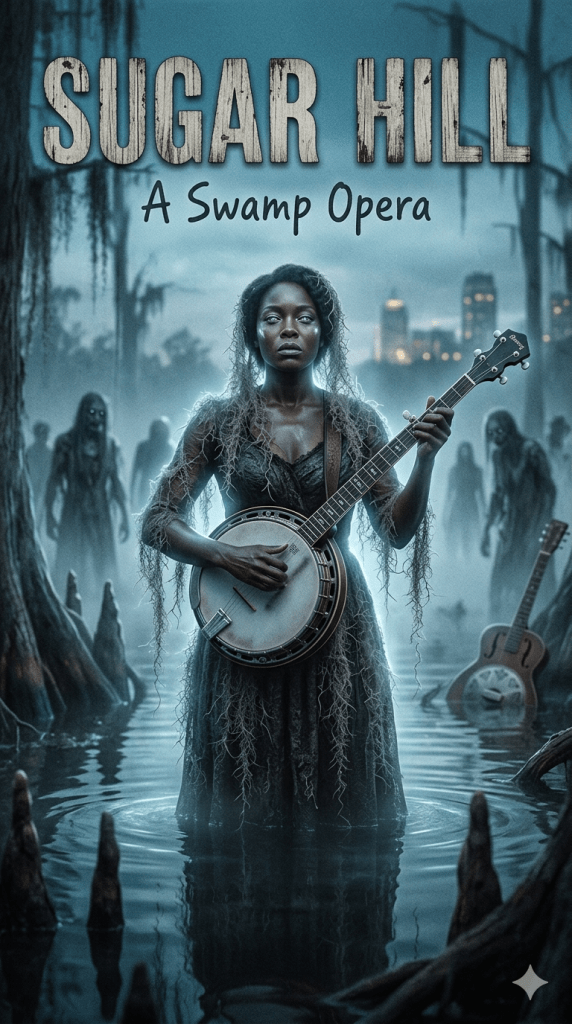
After the film by Paul Maslansky (1974)
Translations & Libretto by ZJC (2026)
)(^)(
A Note on Origins and Responsibility
Sugar Hill (1974) is a product of Blaxploitation cinema—a genre that, for all its flaws, created some of the first opportunities for Black heroines on screen; even as the directors, writers and producers behind those images were predominantly white and their interpretations of Black stories are through a lens of commercial sensationalism.
I, myself, come to this material as a pale male, a composer of Russian, Italian, Jewish and Irish descent, a relative newcomer to the Southern Gothic and Dark Americana traditions that have shaped this Opera. Spanish is not my native language. I do not claim expertise in the Histories, Spiritual practices, or lived experiences that form the foundation of this story. What I can offer, though, is an act of listening—to the Scholars, Musicians and Traditions that have long cultivated the soil from which this work grows. This libretto has been shaped by deep study and love of Black composers (Harry Lawrence Freeman, Florence Price, Margaret Bonds) and contemporary practitioners (Rhiannon Giddens, Nicole Brooks, Jessie Montgomery) whose work demonstrates how to honor these Traditions with rigor and care.
I have tried, always, to write not as one who speaks for, but as one who listens to—and to let the music that emerged be not my voice, but a Chorus of voices far older and wiser than I will ever be. Any failures of imagination or understanding are mine alone. My admiration and the conversations that I hope we shall have belong to the Traditions —their sins as well as their blessings— that brought us all here.
Thank you. ZJC.
PART I:
ACT ONE, SCENE ONE
TITLE: Club Haití — La Ritual Falsa (The Fake Ritual)
SETTING: Club Haití, New Orleans, 1974. A discotheque with pretensions of authenticity—tiki torches that are actually electric, fake moss draped too evenly, a cardboard vévé on the wall. The Audience sits at cabaret tables. Waiters move through with drinks. It’s sophisticated, commercial and slightly tacky. The proscenium is framed to look like a swamp proscenium—the Audience is watching a ‘show’ within the show.
TIME: Evening. The club is full. White patrons and Black patrons mix uneasily, the whites here for ‘exotic’ entertainment, the Blacks here because it’s the place.
ATMOSPHERE: The National Style 0 Resonator is visible on stage, played by a guitarist in a sharp suit. He’s part of the band. The lighting is warm, amber, safe. Nothing scary has happened yet.
SOUND: The Orchestra begins with a slow, swampy drone—cellos, bass, the Vega Vintage Star humming underneath, barely audible. Then the National Resonator cracks in with a syncopated, brassy riff. The drums kick in. It’s funk, but corrupted—the harmonies are just slightly wrong, the beat just slightly mechanical. This is Voodoo as product.
)(^)(
MUSICAL NUMBER: ‘SUPERNATURAL VOODOO WOMAN’ (Opening Chorus)
The stage fills with dancers. They wear glittering, exaggerated ‘Voodoo’ costumes—sequined top hats, feathers, face paint. Their movements are sharp, rhythmic, theatrical—this is possession as choreography, not as truth. They twitch on cue. They roll their eyes on the downbeat. It’s a show.
ENSEMBLE (backup singers, bright and brassy):
Supernatural Voodoo Woman!
Supernatural Voodoo Woman!
The lead dancer—let’s call her FANTASIA—struts forward. She’s the ‘High Priestess’ of this performance. She sings in English, with a staged Creole accent that’s just a little too thick.
FANTASIA (mezzo, with belt):
Deep in the heart of the foggy Bayou
Where the moss hangs low and the water is blue
There’s a lady waiting with a secret in her hand
The most powerful woman in all of the land!
DANCERS (kicking in unison):
Ooh! She’s got the power!
FANTASIA:
She’s got the spirits, she’s got the soul
She’s got a power that’s out of control!
ENSEMBLE (full company, the National Resonator wailing):
Supernatural Voodoo Woman!
(Sugar Hill, Sugar Hill!)
Supernatural Voodoo Woman!
She’s coming for you, yes she will!
The choreography intensifies. Dancers ‘collapse’ in trance, then pop back up with grins. It’s athletic, impressive and completely hollow. The white patrons applaud enthusiastically; they’ve seen this in a movie. As for many of the Black patrons—they’ve also seen this before, but they’re here for the music and the scene, not some Hollywood phantasy.
FANTASIA (strutting, working the room):
She walks through the night with a silver-eyed stare!
She’s calling the shadows from out of thin air!
Don’t try to hide, don’t try to run!
The work of the Spirits has only begun!
A cringe-worthy YANKEE at a front table—Northern, drunk, laughing—calls out: ‘Dig it! Groovy! Work it, brown sugar!’ Fantasia flashes him a smile that’s pure commerce.
FANTASIA:
She’s taking her vengeance, she’s paying the debt!
A night with Sugar is a night you won’t forget!
ENSEMBLE:
Supernatural Voodoo Woman!
(Sugar Hill, Sugar Hill!)
Supernatural Voodoo Woman!
She’s coming for you, yes she will!
BRIDGE:
The music shifts. The Resonator drops out. For a moment, just the drums—and the Vega, shimmering underneath, barely audible. The dancers freeze. Fantasia’s voice drops to something almost like reverence. For a split second, it feels real.
FANTASIA (alone, center stage, no backup):
Raise ’em up…
(the dancers slowly raise their arms)
From the mud and the clay…
(a single, genuine shiver runs through her—then she catches herself, grins and the mask is back)
FANTASIA (belting again, the Resonator crashing back in):
SUGAR’S GONNA HAVE HER WAY!
The dancers explode into motion. A guitar solo—National Resonator, distorted wah-wah, pure 70s disco—tears through the club. The patrons are on their feet. It’s a party. It’s a hit. It’s nothing.
FANTASIA (shouting over the solo):
Can’t no bullet stop ’em! Can’t no fire burn!
The Dead have got a lesson for the Living to learn!
ENSEMBLE (building to a climax):
SUPERNATURAL! VOODOO! WOMAN!
She’s coming for you! YES SHE WILL!
The number ends with a huge crash—cymbals, Resonator feedback, the dancers in a final tableau of ‘possession.’ The lights come up. The Audience applauds wildly. Fantasia bows, blows kisses and the dancers exit, already loosening their costumes, becoming ordinary performers again.
FANTASIA (to a waiter, sotto voce, as she exits):
Dios mío, necesito un trago.
(My God, I need a drink.)
)(^)(
SCENE CONTINUES: The Real World Enters
The club settles. The band strikes up something smooth, slick and background-y. LANGSTON enters from the office door upstage. He’s handsome, warm, in his late 30s—the co-owner, the host, the man who made this place work. He crosses to a table where SUGAR sits alone, watching the crowd. She’s stunning—elegant, composed, dressed not for the show but for herself. She’s been watching Fantasia with a complicated expression: amusement, distance, maybe a little sadness.
LANGSTON (leaning down, kissing her cheek):
Diana. ¿Te gustó el show, Sugar?
(Diana. Did you like the show, Sugar?)
SUGAR (smiling up at him, her hand finding his):
Es dinamita.
(It’s dynamite.)
LANGSTON (sitting beside her, his knee touching hers):
Dinamita. Es lo que algunas personas dicen que eres.
(Dynamite. That is what some people say you are.)
She laughs—a real laugh, warm and low.
SUGAR:
Podrían tener razón.
(They could be right.)
They kiss. It’s not a stage kiss. It’s two people who genuinely love each other, comfortable, present, in love. The Orchestra swells beneath them—warm strings, the love theme introduced quietly, a melody that will haunt the rest of the Opera.
LANGSTON (pulling back, looking at her):
Debo estar haciendo algo bien.
(I must be doing something right.)
SUGAR (touching his face):
Todo. Simplemente, todo.
(Everything. Simply everything.)
A pause. The club noise fades beneath them. The Vega hums faintly—The Swamp, waiting.
LANGSTON (simply, without drama):
Te amo, Sugar.
(I love you, Sugar.)
SUGAR (the same):
Yo también te amo, Langston.
(I love you too, Langston.)
They sit together, watching their club, their world. For this moment, everything is perfect.
)(^)(
THE INTRUSION
The mood doesn’t sour—it curdles. Four men enter from the street door. FABULOUS leads—sharp suit, sharp smile, nothing behind the eyes. TANK follows, huge and stupid. O’BRIEN, jumpy and cruel. GEORGIE, silent and dangerous. They move through the crowd like sharks. Patrons instinctively lean away. The background music seems to curdle too—the strings hold a dissonant note, the Resonator hums a warning.
FABULOUS (approaching Langston’s table, arms wide, grin wide, everything wide):
¡Hey Langston, amigo!
(Hey Langston, my friend!)
Langston doesn’t stand. His hand tightens on Sugar’s.
LANGSTON (flat):
No soy tu amigo.
(I am not your friend.)
Fabulous‘ grin doesn’t flicker. He’s done this before.
FABULOUS:
Te lo diré una vez más.
(I’ll tell you one more time.)
LANGSTON:
Tú no vas a decirme nada, Fabulous.
(You’re not going to tell me anything, Fabulous.)
O’BRIEN (laughing, too loud):
¡Es un hermano duro!
(He’s a tough brother!)
FABULOUS (savoring it):
Lo es.
(He is.)
GEORGIE (the first words he’s spoken, soft and ugly):
No debe recordar quiénes somos.
(He must not remember who we are.)
FABULOUS (waving a hand, dismissing Georgie’s concern):
No, no. Sólo se está divirtiendo. ¿Verdad, Langston?
(No, no. He’s just having fun. Right, Langston?)
Langston stands. He’s not tall, but he’s solid and he’s not afraid. Sugar rises with him.
LANGSTON:
Acércate un poco y averigüalo.
(Come a little closer and find out.)
Tank shifts forward, but Fabulous stops him with a look.
TANK (muttering):
Ya estoy harto…
(I’ve had enough…)
FABULOUS (to Langston, voice dropping, losing the performance):
Calma. El Sr. Morgan sólo quiere darte un precio justo por tu club. Completamente legal.
(Calm down. Mr. Morgan just wants to give you a fair price for your club. Completely legal.)
LANGSTON (his voice rising, for the first time, for the whole club to hear):
¿Qué demonios sabe el Sr. Morgan sobre lo que es legal? ¡Que se lo meta en el culo!
(What the hell does Mr. Morgan know about what’s legal? He can shove it up his ass!)
A few patrons look over. Most look away. This is not their business. This is the Gothic South.
FABULOUS (quiet, dangerous):
¿Tu última palabra?
(Is this your last word?)
LANGSTON:
La última.
(The last one.)
Fabulous looks at Sugar. He lets his eyes travel. Langston steps forward, but Sugar’s hand on his arm stops him.
FABULOUS (to Langston, still looking at Sugar):
Has atrapado a una linda dama, Langston. Demasiada clase para un buitre como tú.
(You’ve snagged yourself a lovely lady, Langston. Too much class for a vulture like you.)
LANGSTON (shaking with rage):
Fabulous, saca tu sucio trasero de mi lugar. Ahora.
(Fabulous, get your dirty ass out of my place. Now.)
A long beat. The club is silent. Georgie smiles—a small, ugly thing.
GEORGIE (low, to Fabulous):
Claro, hermano.
(Sure, brother.)
FABULOUS (spreading his hands, the grin back, the mask restored):
Tienes razón. No hemos venido a pelear. Sólo somos hombres de negocios. Los tratos se cumplen o no.
(You’re right. We didn’t come here to fight. We’re just businessmen. Deals are either honored or they aren’t.)
He turns. The four of them walk out. The club exhales. Music starts again—something safe.
SUGAR (her hand still on Langston’s arm, her voice low):
Están jugando contigo, cariño.
(They’re playing with you, honey.)
LANGSTON (watching the door, not looking at her):
No estoy preocupado, Sugar.
(I’m not worried, Sugar.)
She turns him to face her. Her eyes are fierce.
SUGAR:
No lo estés tú.
(Don’t be.)
He softens, just a little, for her.
LANGSTON:
Puedo manejar a esos tipos con los ojos cerrados.
(I can handle those guys with my eyes closed.)
SUGAR (her voice breaking, just a little, a crack in the facade):
No quiero que nada le suceda a mi hombre.
(I don’t want anything to happen to my man.)
He pulls her close. They hold each other. The Orchestra swells—the love theme, full and warm and doomed.
LANGSTON (into her hair):
Nada sucederá. Nada sucederá, Sugar. Tengo que ir a esa reunión. Terminaremos a eso de las nueve.
(Nothing will happen. Nothing will happen, Sugar. I have to go to that meeting. We’ll finish around nine.)
He doesn’t know. She doesn’t know. But we know. The Vega hums beneath the strings—The Swamp, waiting, patient, hungry.
Slow fade.
LIGHTING CUE: The amber warmth of the club slowly bleeds away, replaced by a cold, silver wash—the color of zombies’ eyes, the color of what’s coming.
TRANSITION MUSIC: The love theme holds, then fragments. A single note from the Vega. A single drumbeat. Silence.
END OF SCENE ONE
)(^)(
ACT ONE, SCENE TWO
EL ASESINATO — EL SILENCIO DESPUÉS (THE MURDER — THE SILENCE AFTER)
SETTING: A back alley near the docks. Chain-link fence. Puddles reflecting distant neon. A single bare bulb above a door that says ‘SALIDA’ in chipping paint. The Bayou is close—you can smell it, even here—but this is the City’s edge, the liminal space where the Swamp begins to reclaim what belongs to it.
TIME: Later that night. The sky is bruised purple and black. No moon.
ATMOSPHERE: The National Resonator is silent. The Vega is silent. There is only the Orchestra—but it’s an Orchestra of absence. Low strings, holding single notes. Percussion that sounds like distant thunder or approaching footsteps; you can’t tell which.
SOUND DESIGN: This entire scene should be felt more than heard. The murder itself happens almost entirely in instrumental terms, with the human voice reduced to its most primal: grunts, gasps, a single, choked cry.
)(^)(
BEAT I
‘EL GOLPE’ (THE BLOW) — INSTRUMENTAL INTERLUDE WITH CHORUS OF WITNESSES
The scene begins in near-darkness. We see LANGSTON walking, alone. He’s taken a shortcut—he knows these streets, he’s walked them a thousand times. He’s thinking of Sugar, maybe humming the love theme under his breath. The Audience can’t hear it, but the Orchestra can: a solo cello, playing the theme softly, tenderly, tragically.
Shadows move. Four figures emerge from behind a dumpster. They wear pantyhose over their faces—distorted, grotesque, almost featureless. FABULOUS. TANK. O’BRIEN. GEORGIE. They are not individuals now; they are a machine.
The cello stops. Silence.
LANGSTON (seeing them, stopping, his voice calm—he knew this could happen, he just hoped it wouldn’t):
Fabulous.
(Fabulous.)
Fabulous doesn’t answer. He nods. The machine moves.
THE ORCHESTRA: A single, shattering percussion hit—a bass drum, a slammed metal door, something primal. Then chaos.
The beating is not shown in graphic detail. It is suggested—through shadows on the chain-link fence, through the choreography of the four men moving in and out, through LANGSTON’S body falling and rising and falling again. The Orchestra plays a brutal, atonal assault: brass screaming, strings scraping, percussion pounding. It’s not music; it’s violence given sound.
And beneath it all, a new element enters: THE CHORUS OF THE DEAD, wordless, humming. They are not yet visible. They have not yet risen. But they are watching. Their hum is a low, polyphonic drone—close intervals, beating in the air—the sound of centuries of violence witnessing this new violence.
THE MURDER lasts perhaps ninety seconds. It will feel like an hour.
A final blow. LANGSTON falls and does not rise.
The Four Men stand over him, breathing hard. The Chorus’s hum fades. The Orchestra falls silent. Only the hum of the single bare bulb remains—a thin, electric whine.
FABULOUS (his voice flat, stripped of performance):
¿Qué hacemos con él?
(What do we do with him?)
MORGAN enters from the shadows. He wasn’t here for the beating; he’s been watching from a distance, perhaps from a car, perhaps from a doorway. He walks forward slowly, deliberately. He looks down at Langston‘s body. No emotion.
MORGAN (quietly, to himself as much as them):
No es más que polvo. Déjenlo ahí.
(It is nothing but dust. Leave it there.)
He turns and walks away. The Four Men follow. The stage empties.
Only the body remains.
)(^)(
BEAT II
THE LONG SILENCE
The stage holds on LANGSTON’S body for a full thirty seconds. The Orchestra is silent. The bulb hums. A dog barks somewhere. A door slams. The City doesn’t care.
Then: footsteps. Running. Stopping.
SUGAR enters. She’s in the same clothes from the club—she’s been waiting and waiting and finally couldn’t wait anymore. She followed the route she knew he would take. She found him.
She stops. She sees.
The Orchestra begins, but barely—a single violin, playing the love theme, but so slowly, so fractured, that it’s almost unrecognizable.
)(^)(
BEAT III
‘LAMENTACIÓN’ (LAMENT)
SUGAR (approaching the body as if in a dream, as if this isn’t real, as if she can still wake up):
Langston…
(Langston…)
She kneels. She touches his face. It’s cold. It’s real. She can’t wake up.
SUGAR (her voice small, childlike, destroyed):
¿Qué te han hecho?
(What have they done to you?)
A pause. She looks at her hands—they have his blood on them. She doesn’t understand.
SUGAR (louder, as if he can hear her, as if he’s just sleeping):
¡Por favor, no me dejes!
(Please, don’t leave me!)
Nothing. The violin fractures further—notes sliding into dissonance.
SUGAR (a scream, torn from her throat, operatic in its raw power):
¡LANGSTON!
(Langston!)
The Orchestra answers—a full, shattering chord, all the grief and rage the instruments can hold. Then it collapses. The violin is gone. Only the cello remains, playing the love theme in its lowest register, funereal, hopeless.
SUGAR (rocking, holding him, her voice dropping to something barely audible):
No me dejes… no me dejes… no me dejes…
(Don’t leave me… don’t leave me… don’t leave me…)
She repeats it like a prayer, like a spell, like she can undo what’s been done through sheer repetition. The cello fades. The bulb hums. A stray cat calls.
Slow fade to black.
)(^)(
BEAT IV
MORGAN’S LAIR — THE PHILOSOPHY OF POWER
SETTING: Morgan’s office. Expensive but tasteless—leather, chrome, a wet bar, a painting of a white horse that’s trying too hard. It’s the lair of a man who has money but no class, power but no soul.
TIME: The next day. Sunlight through Venetian blinds—stripes of light and shadow, like a prison.
ATMOSPHERE: The National Resonator returns, but muted—this is business, not pleasure. The music is cool, detached, almost conversational. Morgan is in his element.
MORGAN (sitting in a massive leather chair, Fabulous kneeling at his feet, shining his shoes—an image of casual domination):
Como ya les he dicho, señores, si se quiere destruir a un hombre, tienen que romperlo en pedazos.
(As I have already told you, gentlemen, if you want to destroy a man, you have to break him into pieces.)
He gestures expansively, as if sharing wisdom.
MORGAN:
Pedazos tan pequeños que no puedan ser armados de nuevo. Nada más que un pedazo de carne hermana y fría.
(Pieces so small that they cannot be put back together. Nothing more than a cold, sisterly piece of flesh.)
He looks at FABULOUS, who keeps polishing.
MORGAN:
Esta será nuestra forma de trabajar de ahora en adelante. Si Morgan quiere algo, Morgan lo toma. Sin problemas, simple, directo al grano.
(This will be our way of working from now on. If Morgan wants something, Morgan takes it. No problems—simple, straight to the point.)
FABULOUS (not looking up from the shoes, but his voice carrying a smirk):
El tipo tenía malos modales. Ya no los necesita más.
(The guy had bad manners. He doesn’t need them anymore.)
A beat. Fabulous pauses, looks up.
FABULOUS [cont.]:
La pregunta es… ¿cómo vas a comprarle el club a un hermano muerto?
(The question is… how are you going to buy the club from a dead brother?)
Morgan smiles. It’s not a nice smile.
MORGAN:
Ese es el problema con los muertos, Fabulous. No pueden firmar contratos. Pero las novias… las novias siempre heredan.
(That’s the problem with the dead, Fabulous. They can’t sign contracts. But brides… brides always inherit.)
He leans back, satisfied. The Resonator plays a cool, cynical little riff—the sound of evil at ease.
MORGAN [cont.]:
Tráeme a la señorita Hill. Vamos a darle el pésame.
(Bring me Miss Hill. We are going to offer her our condolences.)
Blackout.
END OF SCENE ONE.
)(^)(
ACT ONE, SCENE TWO
Title: Sugar’s Studio — The Return of Valentina
SETTING: Sugar’s photography studio. Cameras, backdrops, evidence of an artist’s life. But today, it’s dim, closed. Sugar sits at her desk, staring at nothing. She hasn’t slept. She hasn’t changed her clothes. There’s dirt on her hands—from the alley? She hasn’t washed.
TIME: Late afternoon. Grey light through the windows.
ATMOSPHERE: The Vega hums—just barely, just beneath consciousness. The Swamp is reaching out for her and she doesn’t know it yet.
A knock. Sugar doesn’t move. Another knock. Then the door opens.
VALENTINA enters. She’s in uniform—police, but not the captain, not yet. She’s beautiful, composed, but her eyes are raw. She’s been crying too.
VALENTINA (stopping in the doorway, seeing Sugar, her voice cracking):
¿Diana?
(Diana?)
Sugar looks up. For a moment, she doesn’t recognize her. Then she does. Her face does something complicated—grief, surprise, a flicker of something older.
SUGAR (her voice hollow):
Valentina.
(Valentina.)
A long pause. They look at each other across the room. The Vega hums.
VALENTINA (stepping inside, closing the door):
Ha pasado mucho tiempo.
(A long time has passed.)
She crosses to Sugar, stands behind her, doesn’t touch her—yet.
VALENTINA [cont.]:
Te ves bien.
(You look well.)
Sugar laughs—a broken, bitter sound.
SUGAR:
¿Te parece? Siento que tengamos que encontrarnos de nuevo así.
(You think? I’m sorry that we have to run into each other again like this.)
Valentina‘s composure breaks, just a little. She moves—she can’t help it—and kneels beside Sugar’s chair, taking her hands. The touch is electric, old, familiar.
VALENTINA (quietly, intimately):
Sabes, es extraño. Después que nos separamos, me tomó mucho tiempo superar el hecho de que salieras con Langston.
(You know, it’s strange. After we broke up, it took me a long time to get over the fact that you were dating Langston.)
SUGAR (looking at their joined hands, not pulling away):
Sí, pero lo superaste bien.
(Yes, but you got through it well.)
VALENTINA:
De todos modos, nunca pensé que tendría que interrogarte sobre su muerte.
(In any case, I never thought I would have to question you about his death.)
The word ‘death’ lands like a slap. Sugar pulls her hands back.
SUGAR (standing, moving away):
Asesinato.
(Murder.)
VALENTINA (rising, following):
Diana—
(Diana—)
SUGAR (turning, fierce):
No fue muerte. Fue asesinato. Lo golpearon hasta matarlo, Valentina. Como a un perro. En un callejón. Y se fueron a tomar algo.
(It wasn’t a death. It was murder. They beat him to death, Valentina. Like a dog. In an alley. And then they went to get a drink.)
She’s shaking. Valentina wants to hold her but doesn’t know if she’s allowed.
VALENTINA (gently):
Lo sé. Lo sé.
(I know. I know.)
SUGAR (her voice dropping, becoming something else—colder, harder):
Nos conocimos aquí. En el club. Se acercó y me preguntó mi nombre. Diana Hill, le dije. Dijo: ‘a partir de ahora te llamarás Sugar.’ La Srta. Sugar Hill. Porque eres dulce como el azúcar.
(We met here. At the club. He walked up to me and asked my name. ‘Diana Hill,’ I told him. He said, ‘From now on, you’ll be called Sugar.’ Miss Sugar Hill. Because you’re sweet as sugar.)
A pause. She looks at Valentina.
SUGAR [cont.]:
¿Ahora tú manejas el caso? ¿Alguna vez caen… tipos como esos?
(So you’re handling the case now? Do guys like that… ever go down?)
VALENTINA (meeting her gaze, steady):
Lo pagarán. A su momento.
(They will pay for it. In due time.)
Sugar shakes her head—a small, violent motion.
SUGAR:
Sabes, si supiera quiénes fueron… me vengaría uno por uno. Podría verlos morir. Lentamente.
(You know, if I knew who they were… I would take my revenge on them, one by one. I could watch them die. Slowly.)
The Vega swells—just for a moment, just enough to be felt. Valentina shivers but doesn’t know why.
VALENTINA (watching Sugar carefully):
Diana…
(Diana…)
SUGAR (turning away, toward the window, toward the gray light):
No digas nada, Valentina. No me digas que el tiempo cura, o que la justicia existe, o ninguna de esas cosas que dices a las víctimas.
(Don’t say anything, Valentina. Don’t tell me that time heals, or that justice exists, or any of those things you say to victims.)
A long silence. Valentina crosses to her, stands behind her, close enough to feel her heat but not to touch.
VALENTINA (barely a whisper):
No iba a decir eso.
(I wasn’t going to say that.)
Sugar turns. They’re inches apart. The Vega hums. The love theme, fractured, plays in the strings—the ghost of what they were, what they might have been.
VALENTINA (touching Sugar’s face, gently, the way she used to):
Te he extrañado.
(I’ve missed you.)
Sugar closes her eyes. For a moment, she leans into the touch. For a moment, she’s just a body who has lost everything and is being held by someone who once loved her.
Then she opens her eyes. They’re dry. They’re hard.
SUGAR (stepping back, gently, inevitably):
Tienes un caso que resolver, Teniente.
(You have a case to solve, Lieutenant.)
Valentina‘s hand falls. She nods. She understands.
VALENTINA:
Sí.
(Yes.)
She moves to the door. Pauses. Looks back.
VALENTINA [cont.]:
Diana… ten cuidado. Quienes hicieron esto… son peligrosos.
(Diana… be careful. The ones who did this… are dangerous.)
SUGAR (her voice strange, distant, already somewhere else):
Lo sé. Lo sé. Lo sé.
(I know. I know. I know.)
Valentina exits. Sugar stands alone. The Vega swells—a full, shimmering chord. The lights shift to silver. The Swamp is calling.
Blackout.
END OF SCENE TWO
)(^)(
ACT ONE, SCENE THREE
TITLE: El Descenso — La Casa de Mamá Maitresse (The Descent — Mama Maitresse’s House)
SETTING: The Swamp. Not the picturesque Bayou of postcards—this is the real thing. Ancient cypress trees draped in Spanish moss that looks like old women’s hair. Water the color of tea. Mist that moves against the wind. The sound of things living and dying just out of sight. A narrow path of packed mud leads to a cabin that seems to grow out of the earth itself—cypress knees for pillars, moss for curtains, smoke curling from a chimney that shouldn’t work but does.
TIME: Dusk. The liminal hour. The hour when the veil thins.
ATMOSPHERE: The National Resonator is gone. For the first time, the Orchestra is dominated by the Deering Vega Vintage Star—but softly, distantly, as if played in another room, another world. Low strings drone. Woodwinds make sounds like birds, like insects, like things that should not be imitated. The percussionist has found objects: chains, wooden crates, a metal sheet bowed into a shriek.
SOUND DESIGN: The journey should feel like submersion. Each step Sugar takes, the music gets thicker, more humid, more alive. The Audience should feel the sweat on their skin, the mosquitoes at their necks, the weight of the air.
)(^)(
BEAT I
‘EL CAMINO’ (THE PATH) — INSTRUMENTAL JOURNEY
The scene begins in near-darkness. A single figure moves through the Swamp: Sugar, in clothes she shouldn’t be wearing for this—City clothes, heels sinking into mud. She’s carrying a small bag. She’s determined. She’s terrified.
The Vega plays a slow, shimmering drone—two notes, a minor second apart, beating against each other. This is the sound of the Swamp‘s attention.
Sugar stops. She’s lost. The path has vanished. The mist closes in.
SUGAR (calling out, her voice swallowed by the trees):
¿Mamá? ¿Mamá Maitresse?
(Mama? Mama Maitresse?)
No answer. Only the drone. Only the beating wings of something large and unseen.
SUGAR (louder, trying to hide her fear):
¿Estás aquí, Mamá? ¡Responde por favor, Mamá!
(Are you here, Mama? Please answer, Mama!)
A rustle. A splash. Something moves in the water. Sugar spins—nothing there.
SUGAR (her voice smaller now):
¿Mamá Maitresse? ¿Estás aquí? Mamá…
(Mama Maitresse? Are you here? Mama…)
She’s about to turn back. She’s about to give up. And then—
A hand on her shoulder.
Sugar screams. The Orchestra screams with her—a violent, dissonant crash. She spins and there is MAMA MAITRESSE, inches from her face, ancient and impossible, her eyes milky with age but sharp with knowing.
They stare at each other. The Vega holds its drone. The Swamp holds its breath.
)(^)(
BEAT II
‘EL ENCUENTRO’ (THE MEETING)
MAMA MAITRESSE (her voice a cracked contralto, the sound of roots and rot and something that has been here longer than memory):
¿Por qué has vuelto aquí?
(Why are you back here?)
Sugar can’t speak. She’s shaking.
MAMA (stepping closer, circling her, examining her like a curious specimen):
¿Has venido a ver a mamá Maitresse? ¿Por qué?
(Have you come to see Mama Maitresse? Why?)
SUGAR (finding her voice, barely):
Necesito tu ayuda.
(I need your help.)
Mama laughs—a dry, rattling sound.
MAMA:
Puedo sentir tus problemas. Te rodean.
(I can feel your problems. They surround you.)
She gestures—at the mist, at the trees, at Sugar herself. The Orchestra swells—the Vega, the drones, the found percussion.
MAMA [cont.]:
Están en tu sangre. En tu aliento. En el hueco donde solía estar tu risa.
(They are in your blood. In your breath. In the hollow where your laughter used to be.)
SUGAR (breaking, the words tumbling out):
Estaba enamorada, Mamá. Pero mataron al hombre con quien me iba a casar. Lo golpearon hasta la muerte.
(I was in love, Mama. But they killed the man I was going to marry. They beat him to death.)
A pause. Mama watches her.
SUGAR (her voice hardening, the grief turning to something else):
Los quiero muertos.
(I want them dead.)
Mama stops circling. She stands before Sugar, studying her with those impossible eyes.
MAMA:
Siento tu rabia y tu dolor. Y simpatizo contigo. ¿Pero qué puedo hacer?
(I feel your rage and your pain. And I sympathize with you. But what can I do?)
SUGAR (meeting her gaze, not backing down):
Sé lo que puedes hacer. Los poderes que posees.
(I know what you can do. The powers you possess.)
Mama‘s face shifts—something like pain, something like memory.
MAMA (turning away, moving toward the cabin):
Hace mucho tiempo, no ahora. Soy vieja y débil, y sólo quiero que me dejen sola.
(A long time ago—not now. I am old and weak and I just want to be left alone.)
SUGAR (following, not letting her escape):
Vengo a ti porque sé que puedes ayudarme.
(I come to you because I know you can help me.)
MAMA (at the door, not turning):
Estoy cansada, muy cansada. Se necesita un gran esfuerzo, no sé…
(I’m tired—very tired. It takes a great effort… I don’t know.)
Sugar reaches into her bag. She pulls out a photograph—Langston, smiling, alive. She holds it out.
SUGAR:
Por favor, mamá. Te lo ruego.
(Please, Mama. I beg you.)
Mama looks at the photograph. Something softens in her face—the memory of love, perhaps. The memory of loss.
MAMA (turning, taking Sugar’s chin in her ancient hand, studying her):
Tú siempre fuiste una gran incrédula.
(You were always a great skeptic.)
She laughs—not cruelly, but with wonder.
MAMA [cont.]:
¿Por qué crees ahora?
(Why do you believe now?)
SUGAR (her voice raw, honest, stripped of all pretense):
¡Porque quiero venganza!
(Because I want revenge!)
A long pause. The Swamp listens.
SUGAR (whispering):
Por favor, Mamá Maitresse.
(Please, Mama Maitresse.)
Mama closes her eyes. She begins to murmur—words that Sugar doesn’t understand, words older than Spanish, older than America, words that make the Vega shimmer and the chains rattle and the mist swirl.
MAMA (opening her eyes, fixing Sugar with a gaze that sees everything):
¿Cuán fuerte es tu odio?
(How strong is your hatred?)
Sugar doesn’t hesitate.
SUGAR:
Tan fuerte como era mi amor, mi odio aún más fuerte es.
(As strong as my love was, my hatred is even stronger.)
Mama nods slowly.
MAMA:
El riesgo es alto.
(The risk is high.)
SUGAR:
Estoy lista.
(I am ready.)
Mama studies her for a long moment. Then she nods again, decisively.
MAMA:
Bien. Mira en la llama.
(Good. Look into the flame.)
She gestures Sugar toward a small fire that has inexplicably appeared—or was it always there? Sugar kneels before it. Mama raises her hands to the sky.
MAMA (chanting, her voice growing in power):
Llamaré a mis más poderosos dioses vudú.
(I will call upon my most powerful vodoun gods.)
The Orchestra swells—the Vega, the drums, the chains, the bowed metal. THE CHORUS OF THE DEAD enters, humming their polyphonic drone, still invisible, still waiting.
)(^)(
BEAT III
‘LA CATECISMO DE LOS MUERTOS’ (THE CATECHISM OF THE DEAD)
MAMA (her voice a rhythmic chant):
¿Por dónde sale el sol?
(Where does the sun rise?)
SUGAR (answering, her voice finding a new strength):
Por el este, Mamá.
(To the east, Mama.)
MAMA:
¿Dónde se pone el sol?
(Where does the sun set?)
SUGAR:
En Guinea, Mamá.
(In Guinea, Mama.)
The Chorus’ hum grows louder, more present.
MAMA:
¿De dónde viene el poder?
(Where does power come from?)
SUGAR:
De los vivos entre los muertos, Mamá.
(From the Living among the Dead, Mama.)
MAMA (her voice rising):
¿Quién puede usar el poder?
(Who can use the power?)
SUGAR (rising with her, her voice soaring):
Los muertos entre los vivos.
(The Dead among the Living.)
A thunderous percussion hit. Lightning flickers—not from the sky, but from somewhere else. The mist parts. A path appears.
MAMA (taking Sugar’s hand, pulling her to her feet):
Ven. El Barón nos espera.
(Come. The Baron awaits us.)
They move into the mist. The Chorus follows. The Vega holds its shimmering drone.
Blackout.
)(^)(
BEAT IV
THE CEMETERY — THE THRONE OF BONES
SETTING: A clearing deeper in the Swamp. An ancient cemetery—if it can be called that. The graves are unmarked, but the earth is disturbed, as if things have been climbing out for centuries. At the center, an altar of stacked stones, with slave chains bolted to the largest. Moss hangs like funeral curtains. The trees are hung with offerings: bottles, bones, ribbons faded to gray.
TIME: Night, but the moon is wrong—too bright, too close.
ATMOSPHERE: The Vega is now dominant. The National Resonator is dead weight, absent. The percussion is all found objects: chains rattling, wood striking wood, the bowed metal, screaming.
Mama and Sugar enter the clearing. Sugar stops, staring at the altar, at the chains.
MAMA (gesturing to the ground before the altar):
Arrodíllate.
(Kneel.)
Sugar kneels. The mud is cold. The chains gleam in the wrong moonlight.
MAMA (raising her arms, her voice filling the clearing):
¡Barón Samedi!
(Baron Samedi!)
Thunder—distant, answering.
MAMA [cont.]:
¡Barón Samedi! ¡Guardián de los muertos! ¡Rey de los cementerios!
(Baron Samedi! Guardian of the Dead! King of the Cemeteries!)
The wind rises. The moss dances.
MAMA [cont.]:
¡Escucha nuestra llamada! ¡Demuestra tu presencia! ¡Acude a nuestra llamada!
(Heed our call! Make your presence known! Answer our call!)
Silence. Nothing. Sugar looks up at Mama, desperate.
MAMA (lowering her arms, muttering):
Es un Dios codicioso.
(He is a greedy god.)
She turns to Sugar.
MAMA [cont.]:
¿Tienes algo de dinero?
(Do you have any money?)
SUGAR (patting her pockets, finding nothing):
No, nada.
(No, nothing.)
MAMA (impatient):
Algo, lo que sea.
(Something—anything.)
Sugar reaches up, pulls off her necklace—a simple gold chain, Langston’s gift.
SUGAR (holding it out):
¿Esto?
(This?)
Mama takes it, places it on the altar.
MAMA:
Barón Samedi, un regalo para ti.
(Baron Samedi, a gift for you.)
Nothing. Sugar’s hope flickers.
SUGAR:
Inténtelo de nuevo, Mamá.
(Try again, Mama.)
MAMA (looking at Sugar’s hands):
Tu anillo. Dame tu anillo.
(Your ring. Give me your ring.)
Sugar hesitates. It’s her grandmother’s ring—the only thing she has from her mother’s mother. Then she pulls it off, places it in Mama‘s hand.
MAMA (placing it on the altar):
Otro regalo, Barón Samedi.
(Another gift, Baron Samedi.)
The sky tears. Thunder—not distant, but here, splitting the ozone. Lightning—not flickering, but striking, hitting the altar, setting the chains ablaze with cold fire. Smoke curls. The ground shakes.
And from the smoke, and from the fire, and from the desecrated earth itself—
BARON SAMEDI appears.
)(^)(
BEAT V
‘EL PRECIO DE LA SOMBRA’ (THE PRICE OF THE SHADOW) — BARON’S ENTRANCE ARIA
The Baron is magnificent and terrible. He wears a tattered top hat, a formal coat rotting with age, a cane that is also a snake, a snake that is also a cane. His eyes are pits of darkness. His smile is a wound. He is Bass-Baritone and his lowest notes should vibrate in the Audience’s bones.
BARON (laughing—a sound that is also thunder):
¡Ja ja ja!
(Ha ha ha!)
He strides forward, surveying his Domain, his Kingdom, these intruders.
BARON [cont.]:
¿Quién despierta de su sueño al Barón Samedi?
(Who wakes Baron Samedi from his slumber?)
MAMA (bowing low):
¡Barón Samedi!
(Baron Samedi!)
BARON (approaching her, amused):
¿Eres tú, Mamá Maitresse? Hace mucho que no siento tu voz en mi reino.
(Is that you, Mama Maitresse? It has been a long time since I heard your voice in my Realm.)
MAMA:
Vinimos a pedir tu ayuda, barón.
(We have come to ask for your help, Baron.)
BARON (his gaze shifting to Sugar, who has not bowed, who is staring at him with fear and defiance):
¿Ayuda?
(Help?)
He circles her. She forces herself to hold still.
SUGAR:
Quiero el poder para destruir a mis enemigos.
(I want the power to destroy my enemies.)
MAMA (horrified):
¡Mujer!
(Woman!)
The Baron laughs again—delighted, genuinely delighted.
BARON (stopping before Sugar, leaning close):
¿Quién eres? Soy el Barón Samedi. ¡Este es mi dominio! ¡Mi reino de los muertos!
(Who are you? I am Baron Samedi. This is my Domain! My Kingdom of the Dead!)
MAMA (interceding):
Ella no quiso faltarte el respeto, señor. Su nombre es Diana.
(She didn’t mean to disrespect you, sir. Her name is Diana.)
The Baron ignores her. He is focused entirely on Sugar.
BARON:
Diana. ¿Y qué va a entregar esta Diana al Barón Samedi por el poder que busca?
(Diana. And what will this Diana give to Baron Samedi for the power she seeks?)
Behind him, figures emerge from the mist. The Zombie brides—women in rotting nightgowns, their eyes silver, their movements fluid and wrong. They flank him, watching Sugar with hunger.
SUGAR (staring at them, horrified):
¿Quiénes son?
(Who are they?)
BARON (smiling, gesturing to them):
Esas son las novias del Barón Samedi.
(Those are Baron Samedi’s brides.)
He reaches out, strokes the hair of one. She leans into his touch like a cat.
BARON:
Es un gusto adquirido.
(It’s an acquired taste.)
He turns back to Sugar.
BARON [cont.]:
¿Qué me vas a dar?
(What are you going to give me?)
Sugar swallows. She knows what’s expected. She’s ready.
SUGAR:
Mi alma.
(My soul.)
The Baron stares at her for a beat. Then he roars with laughter—genuine, astonished, delighted.
BARON:
¿Tu alma? ¡Ja ja ja! ¿Qué es eso de las almas, mujer? No estoy interesado en las almas.
(Your soul? Ha ha ha! What is this talk of souls, woman? I am not interested in souls.)
More thunder. More lightning. The Brides sway.
BARON (stepping closer, his voice dropping, becoming intimate, dangerous):
Nada de almas. ¿No me temes?
(No souls. Do you not fear me?)
Sugar meets his eyes. Her voice is steady.
SUGAR:
No.
(No.)
A long pause. The Baron studies her. Something shifts in his face—respect, perhaps. Interest, certainly.
BARON:
Dime, ¿por qué quieres mis poderes?
(Tell me, why do you want my powers?)
SUGAR:
Hay unos hombres a los que quiero castigar.
(There are some men I want to punish.)
BARON:
¿Castigar?
(Punish?)
SUGAR:
Muerte. Pero necesito a más de un hombre. ¿Me puedes ayudar?
(Death. But I need more than one man. Can you help me?)
The Baron looks at her for a long moment. Then he smiles—a terrible, wonderful smile.
BARON (spreading his arms, addressing the Night, the Dead, everything):
¡Tengo un ejército de muertos… esperando tus órdenes!
(I have an Army of the Dead… waiting for your orders!)
The ground erupts. From every grave, from every patch of mud, from the water itself—Hands. Arms. Bodies. The Zombies rise. They wear the chains of slaves. Their eyes are silver. Their machetes catch the wrong moonlight.
BARON (his voice building, drawing out each syllable, commanding the Universe):
¡Despierten! ¡Todos han jurado obedecer la voluntad… del Barón Samedi! ¡Esclavo y amo! ¡Amo y esclavo! ¡DESPIERTEN!
(Wake up! You have all sworn to obey the will… of Baron Samedi! Slave and master! Master and slave! Wake Up!)
)(^)(
BEAT VI
‘LA DANZA DE LOS ZOMBIS’ (THE DANCE OF THE ZOMBIES) — FULL COMPANY BALLET
This is not a dance of joy. It is a dance of awakening. The Zombies move slowly at first, stiffly, as if remembering how bodies work. Then faster, more fluid, more terrifying. They raise their machetes. They turn their silver eyes toward Sugar. They are waiting.
The Orchestra is at full power—the Vega shimmering, the percussion pounding, the brass and strings weaving a horrifying, beautiful tapestry. THE CHORUS OF THE DEAD hums and keens and stomps.
Two Zombies—a man and a woman—find each other. They look into each other’s silver eyes. They smile. It’s the most human thing they’ve done and it’s the most horrible.
Sugar watches them. She should be terrified. She is. But beneath the terror, something else is growing. Power. Purpose. The knowledge that she is no longer alone.
The Baron appears beside her, watching his children dance.
BARON (his voice cutting through the music, but only for her):
¡Te daré tu venganza! Ponlos al servicio del mal. Es todo lo que saben y desean.
(I will give you your vengeance! Put them in the service of evil. It is all they know and desire.)
Sugar looks at him. Looks at the Zombies. Looks at Mama, who is watching with ancient, knowing eyes.
She steps forward. The Zombies part for her. She walks among them and they bow.
The music builds to a shattering climax. The Zombies raise their machetes to the sky. Sugar stands at the center, her face half-lit by the wrong moonlight, half-shadowed by the thing she is becoming.
And for just a moment, her eyes flicker silver.
Blackout.
The Vega holds its final note—a shimmering, endless drone—for three full seconds after darkness.
Then silence.
END OF SCENE THREE
)(^)(
ACT ONE, SCENE FOUR
STRUCTURE NOTE: This scene is a double scene—two locations inter-cut, two worlds unfolding simultaneously. On one side: the first kill, brutal and swift. On the other: Valentina’s first encounter with the impossible, small and strange. The scene should be staged with fluid transitions—lighting shifts, the Orchestra moving between two auditory worlds, the action flowing from one to the other without blackouts.
)(^)(
BEAT I
THE DOCKYARDS — MORNING
SETTING: The docks. Shipping containers, cranes, the smell of diesel and river. A hiring line—Black men waiting for day work, their faces tired and familiar with humiliation. Tank presides over them like a petty king, clipboard in hand, enjoying himself entirely too much.
TIME: The morning after the cemetery. Sugar has not slept. She has been elsewhere.
ATMOSPHERE: The National Resonator is back—but it’s different now. Tainted. The urban brass is there, but beneath it, the Vega shimmers faintly, watching. The two worlds are beginning to bleed into each other.
)(^)(
TANK (calling out, enjoying the power):
Bueno, necesito diez hombres. Para un contenedor de la línea Quesada. Tengo un barco de bananas de Costa Rica.
(Alright, I need ten men—for a container from the Quesada line. I have a banana ship from Costa Rica.)
He pauses, letting them hope.
TANK [cont.]:
¿Qué opinan, chicos? ¡Todas las bananas que quieran! Y además, paga.
(What do you boys think? All the bananas you want! Plus, it pays.)
A murmur among the men. One of them—WORKER 1, a man who has done this too many times—steps forward.
WORKER 1:
No nos gusta pagar para trabajar.
(We don’t like paying to work.)
Tank’s smile doesn’t flicker. This is the part he likes.
TANK:
De acuerdo. No hay dinero, no hay trabajo. Siguiente.
(Agreed. No money, no work. Next.)
Worker 1 doesn’t move. The men behind him shift, angry.
WORKER 1:
No compramos puestos de trabajo.
(We do not buy jobs.)
Tank moves faster than a man his size should. He punches Worker 1 in the stomach—once, twice. The man crumples. Tank stands over him, breathing hard, enjoying the silence.
TANK (to the fallen man, to all of them):
¿Qué has dicho? ¡Tú compras tu trabajo, chico! ¡O te mueres de hambre!
(What did you say? You buy your job, boy! Or you starve!)
He looks around at the other men. They won’t meet his eyes.
TANK [cont.]:
¿Entiendes? ¿Entendido?
(Do you understand? Understood?)
Silence. Then movement—the men begin to drift away, angry, humiliated, defeated. Tank watches them go, satisfied.
TANK (to himself, chuckling):
Tienen más cerebro de lo que pensaba.
(They have more brains than I thought.)
He turns and exits toward the warehouse. The stage empties.
But one figure remains. He was at the back of the crowd—an old Black man in a tattered coat, leaning on a cane, watching everything. The Baron, in his ‘Old Sam’ guise. He smiles—a small, private smile.
He follows Tank into the warehouse.
The Vega shimmers. The Resonator holds a single, decaying note.
Light shift.
)(^)(
BEAT II
THE WAREHOUSE — THE FIRST KILL
SETTING: Inside the warehouse. Dark, cavernous, stacked with crates. A single shaft of light from a high window. The sound of water dripping somewhere. The smell of rot.
TIME: The same moment. The light is wrong—gray, flat, as if the sun has forgotten this place.
ATMOSPHERE: The Resonator fades. The Vega takes over—slow, shimmering, patient. The percussion begins: a rhythmic, metallic clanking—chains, dragging.
TANK enters, alone. He’s still smug, still enjoying his morning’s work. But something’s wrong. The shadows are too dark. The silence is too complete.
TANK (calling out, trying to sound confident):
¿Quién anda ahí?
(Who’s there?)
Silence. He takes another step.
TANK (louder):
Dije que quién anda ahí.
(I said, ‘Who’s there?’)
A figure steps from the shadows. SUGAR. She’s wearing the same clothes as the cemetery—mud on her hem, something different in her eyes.
TANK (relieved, then leering):
Bueno, bueno. La novia de Langston.
(Well, well. Langston’s girlfriend.)
He circles her, slow and ugly.
TANK [cont.]:
¿Sabes? Tienes uno de los mejores culos de la ciudad. No me gustaría vértelo pateado por acusar a las personas.
(You know? You have one of the best asses in the City. I’d hate to see it kicked for accusing people.)
Sugar doesn’t move. Doesn’t flinch. Her voice is calm, cold, elsewhere.
SUGAR:
No soy tu juez, soy tu destino.
(I am not your judge; I am your destiny.)
Tank laughs—but it’s uncertain now.
TANK:
¿Qué dijiste?
(What did you say?)
SUGAR:
No es una acusación, es tu sentencia: la muerte.
(It is not an accusation; it is your sentence: death.)
She steps closer. He steps back—and bumps into something solid. He turns.
ZOMBIES. Silver eyes. Shackled wrists. Machetes raised.
Tank screams. He turns—another Zombie. Another. Another. They surround him, silent, patient, terrible.
TANK (falling to his knees, begging):
¡Por favor, no me mates! ¡No quise hacerlo! ¡Me obligaron! ¡No quise hacerlo! ¡No, por favor!
(Please, don’t kill me! I didn’t mean to do it! They forced me! I didn’t mean to do it! No, please!)
Sugar watches. Her face is expressionless. But beneath the stillness, something is happening—a flicker of silver in her eyes, a tremor in her hands. This is the first time. This is the threshold.
She nods.
The Zombies’ blows flood down upon Tank.
The Orchestra does not play music. It plays sound—the wet thud of machetes, the crunch of bone, the gurgle of a scream cut short. THE CHORUS OF THE DEAD hums—low, steady, indifferent. They have done this before. They will do it again.
Tank’s gutted body finally falls. The Zombies stand over it, silent.
Sugar looks at what she’s done. Her face is pale. Her hands are shaking. She opens her mouth—to say something, to take it back, to claim it—
But The Baron appears behind her, silent, watching. He doesn’t speak. He doesn’t need to. This is what she asked for. This is what she’ll become.
Sugar closes her mouth. She walks away. The Zombies dissolve into shadow.
The Vega holds a single, shimmering note.
Light shift.
)(^)(
BEAT III
THE CRIME SCENE — THE IMPOSSIBLE ENTERS
SETTING: The same warehouse, hours later. Now it’s a crime scene—yellow tape, police officers, the harsh glare of portable lights. Tank’s headless body has been removed, but the blood remains. And something else.
TIME: Afternoon. The wrong light is gone; this is ordinary daylight, harsh and unforgiving.
ATMOSPHERE: The Orchestra is back in ‘real world’ mode—but it’s off. Slightly detuned. Slightly wrong. The Vega is gone, but its absence is felt.
THE CAPTAIN—a weary man who has seen too much and understood too little—supervises the investigation. VALENTINA enters, out of breath, still in uniform from her shift.
VALENTINA:
Vine tan pronto como pude. ¿Es Tank Watson?
(I came as soon as I could. Was that Tank Watson?)
CAPTAIN (not looking up):
Eso creemos.
(That is what we believe.)
VALENTINA:
¿Creen?
(You believe?)
She crosses to where the body was. The blood is enormous—a lake of it. She stares.
VALENTINA (quietly):
Dios mío.
(My god.)
OFFICER 1 enters, speaking carefully.
OFFICER 1:
Tenemos algo, capitán.
(We’ve got something, Captain.)
CAPTAIN:
Vamos.
(Come on.)
They cross the warehouse. In a corner, near a stack of crates, they find it: Tank’s head, severed, eyes still open, mouth frozen in a scream. Valentina turns away, sick.
OFFICER 1 kneels, examining the area. He picks something up—holds it to the light.
OFFICER 1:
¿Qué es esto?
(What is this?)
Valentina forces herself to look. It’s a shackle. Old. Rusted. The kind slaves wore.
She takes it, turns it over in her hands. The Orchestra plays a single, dissonant chord—the Vega, silent but present, a ghost in the machine.
VALENTINA (staring at the shackle, her voice barely a whisper):
¿Qué es esto?
(What is this?)
THE CAPTAIN glances at it, dismissive.
CAPTAIN:
Basura. Los niños encuentran esas cosas en los pantanos todo el tiempo.
(Junk. Kids find things like that in the swamp all the time.)
VALENTINA (not convinced):
Sí. Claro.
(Yes. Of course.)
She holds the shackle tighter. The lights hold on her face—confused, disturbed, beginning to suspect things she cannot name.
Blackout.
)(^)(
BEAT IV
MORGAN’S LAIR — THE UNEASY KING
SETTING: Morgan’s office, same as before. But something has shifted. The leather and chrome seem tawdry now, cheap, vulnerable. Morgan eats at his desk—a steak, bloody—but he’s not enjoying it.
TIME: Evening. The same day.
ATMOSPHERE: The National Resonator tries to assert itself, but it’s wrong—notes slip, rhythms stumble. Something is coming.
MORGAN eats. FABULOUS stands by the door. O’BRIEN and KING hover, uneasy.
MORGAN (chewing, annoyed):
Bueno, ¿qué están esperando?
(Well, what are you waiting for?)
O’BRIEN (unable to look at the steak):
¿Cómo puedes comer después de lo que le pasó a Tank?
(How can you eat after what happened to Tank?)
KING (quiet, for once shaken):
Los chicos están asustados. La manera en que fue cortado…
(The boys are scared. The way he was cut…)
MORGAN (waving a fork dismissively):
Cuéntamelo más tarde.
(Tell me about it later.)
KING:
¡Pero Morgan…!
(But Morgan…!)
MORGAN (slamming down the fork):
¡DIJE DESPUÉS!
(I Said ‘Later’!)
Silence. Morgan takes a breath, composes himself.
MORGAN [cont.]:
Sal a la calle y averigua quién está detrás de esta basura. ¡Ahora, idiota!
(Get out on the street and find out who’s behind this garbage! Now, you idiot!)
KING (backing away):
Está bien, está bien.
(It’s fine, it’s fine.)
O’Brien and King exit. Fabulous remains by the door, watching Morgan.
Morgan picks up his fork again. Tries to eat. Can’t.
MORGAN (muttering, trying to convince himself):
Algún hippie drogado mató a Tank… ¡y ahora no me dejan comer en paz!
(Some stoned hippie killed Tank… and now they won’t let me eat in peace!)
He forces a bite. Chews. Swallows. The Resonator plays a sad, cynical little riff—the sound of a man who doesn’t know he’s already dead.
Light shift.
)(^)(
BEAT V
THE LAB — THE IMPOSSIBLE NAMED
SETTING: The police lab. Fluorescent lights, stainless steel, the smell of chemicals. A microscope. Evidence bags.
TIME: Late night. Valentina hasn’t gone home.
ATMOSPHERE: The Orchestra is clinical—precise, detached—but beneath it, the Vega hums faintly, waiting.
VALENTINA stands at the microscope. THE LAB TECH—young, earnest, a little strange—stands beside her.
TECH:
¿Así que no hay nada sobre esto?
(So there’s nothing about this?)
VALENTINA (not looking up):
Un viejo grillete de esclavo. Los niños los encuentran de vez en cuando en los pantanos. Nada raro.
(An old slave shackle. The children find them every now and then in the swamp. Nothing unusual.)
TECH (hesitating):
Maldición.
(Damn.)
Valentina looks up.
VALENTINA:
¿Qué?
(What?)
The Tech moves to another microscope, gestures for her to look.
TECH:
Esto es lo que quiero que veas.
(This is what I want you to see.)
Valentina looks. She sees… nothing unusual.
VALENTINA:
¿Qué se supone que vea?
(What am I supposed to see?)
TECH:
Es una muestra del cuello de Tank Watson.
(It is a sample from Tank Watson’s neck.)
VALENTINA:
¿Entonces?
(So?)
TECH (choosing his words carefully):
Es un hongo.
(It is a fungus.)
VALENTINA:
¿De qué clase?
(What kind?)
TECH:
No del tipo que se encuentra en el queso suizo.
(Not the kind found in Swiss cheese.)
Valentina straightens, frustrated.
VALENTINA:
De acuerdo. ¿Dónde encontramos este tipo de hongo?
(Alright. Where can we find this type of fungus?)
TECH:
No lo sé. Pero quién sea que agarró a Tank, tenía los dedos cubiertos de piel muerta.
(I don’t know. But whoever grabbed Tank had their fingers covered in dead skin.)
Valentina stares at him.
VALENTINA:
¿Piel muerta y moho?
(Dead skin and mold?)
TECH (leaning forward, intense):
Teniente, no lo entiende. No estoy hablando de células muertas que son reemplazadas. Eso es lo normal.
(Lieutenant, you don’t understand. I’m not talking about dead cells being replaced. That is normal.)
A pause. The Vega hums louder.
TECH [cont.]:
Lo que tenemos aquí son terminaciones nerviosas, células de pigmento, epidermis… todo muerto.
(What we have here are nerve endings, pigment cells, epidermis… all dead.)
Valentina processes this. Her face goes through several stages—disbelief, confusion, the beginning of something she can’t name.
VALENTINA (slowly, testing the idea):
¿Quieres decir que estas células provenían de tejidos muertos?
(You mean that these cells were from dead tissue?)
She laughs—a nervous, disbelieving sound.
VALENTINA [cont.]:
¡Ja, ja, ja! ¡Eso significaría que el asesino no estaba vivo! ¡Que un muerto asesinó a Tank Watson!
(Ha, ha, ha! That would mean the killer wasn’t alive! That a dead man murdered Tank Watson!)
The Tech meets her eyes. He’s not laughing.
TECH:
Tú lo dijiste, no yo.
(You said it, not me.)
The Vega swells—a full, shimmering chord. Valentina feels it, physically—a vibration in her chest, a cold at the base of her spine.
She looks at the shackle. She looks at the microscope. She looks at The Tech, who is pale and serious.
She doesn’t speak. She can’t.
Slow fade.
The Vega holds its note into the darkness.
END OF SCENE FOUR
)(^)(
ACT ONE, SCENE FIVE
TITLE: Los Cerdos — La Segunda Muerte (The Pigs — The Second Death)
STRUCTURE NOTE: This scene inter-cuts three locations: the docks (O’Brien’s casual cruelty), the taxi ride (The Baron as chauffeur) and the pig pen (Sugar’s grotesque justice). The tone shifts from realistic brutality to surreal horror to black comedy—sometimes in the same moment.
)(^)(
BEAT I
THE DOCKYARDS — THE LITTLE TYRANT
SETTING: Another part of the docks. A produce stall—crates of vegetables, a scale, an awning that provides inadequate shade. The owner is an old man, Produce Cart Owner, who has run this stall for years.
TIME: A few days after Tank’s death. O’Brien hasn’t learned anything.
ATMOSPHERE: The National Resonator is back—but it’s nervous, skittish, playing riffs that start and stop. O’Brien’s music is jumpy, cruel, small.
O’Brien stands at the produce stall, looming over the Owner. He’s enjoying this.
O’BRIEN:
Escúchame bien, tienes un día para traer el dinero. O todo esto y tu trasero serán míos. ¿Entendido?
(Listen to me closely: you have one day to bring the money. Or all of this—and your ass—will be mine. Understood?)
The Owner says nothing. He’s learned that saying nothing is safest.
O’BRIEN (louder, leaning in):
¿ENTENDIDO?
(Understood?)
OWNER (barely audible):
Sí, señor.
(Yes, sir.)
O’BRIEN (satisfied, stepping back):
Bien. No queremos enojar al Sr. Morgan, ¿no?
(Alright. We don’t want to anger Mr. Morgan, do we?)
He turns to go—and nearly collides with an old Black man in a tattered coat, leaning on a cane, smiling.
BARON (as ‘Old Sam,’ cheerful, harmless):
¿Señor? ¿Sr. O’Brien?
(Sir? Mr. O’Brien?)
O’BRIEN (suspicious):
¿Me hablas a mí, chico?
(Are you talking to me, boy?)
BARON (unfazed by ‘chico,’ beaming):
El Sr. Morgan dice que quiere hablar con usted ahora.
(Mr. Morgan says he wants to speak with you now.)
O’BRIEN:
¿Para qué?
(What about?)
BARON:
Eso es lo que me dijo. Y el viejo Sam… no le pregunta al Sr. Morgan. No, señor.
(That’s what he told me. And Old Sam… he doesn’t ask Mr. Morgan. No, sir.)
He leans in conspiratorially.
BARON [cont.]:
Es un hombre malo. De hecho, me dijo que…
(He is a bad man. In fact, he told me that…)
O’BRIEN (impatient, waving him off):
Está bien, está bien. Vamos.
(Okay, okay. Let’s go.)
He follows The Baron toward a waiting taxi. The Resonator plays a jaunty, sinister little tune—the sound of a trap closing.
Light shift.
)(^)(
BEAT II
THE TAXI — THE ROAD TO JUSTICE
SETTING: The interior of a taxi. O’Brien in the back seat. The Baron driving. The windows show swamp—more and more swamp, less and less City.
TIME: Late afternoon, fading toward dusk.
ATMOSPHERE: The Resonator fades. The Vega enters—softly at first, then growing. The percussion begins: the sound of water, of mud, of things moving just beneath the surface.
O’BRIEN (looking out the window, uneasy):
Oye… esto no es el camino a la oficina de Morgan.
(Hey… this isn’t the way to Morgan’s office.)
BARON (cheerfully):
No, señor. El Sr. Morgan está en su otra oficina. La del pantano.
(No, sir. Mr. Morgan is in his other office. The one in the Swamp.)
O’BRIEN:
¿Morgan tiene una oficina en el pantano?
(Morgan have an office in the swamp?)
BARON:
Desde siempre, señor. Muy privada. Muy segura. Nadie encuentra a Morgan si Morgan no quiere ser encontrado.
(Always has been, sir. Very private. Very secure. No one finds Morgan unless Morgan wants to be found.)
O’Brien doesn’t like this. But he’s also smart enough to say anything about it.
O’BRIEN (sullen):
Bueno, apúrate. Tengo cosas que hacer.
(Well, hurry up. I have things to do.)
BARON (glancing in the rearview, smiling):
Sí, señor. Apurándonos.
(Yes, sir. Hurrying up.)
The taxi drives deeper into the Swamp. The Vega shimmers. The light fades.
Light shift.
)(^)(
BEAT III
THE SWAMP ESTATE — THE PIG PEN
SETTING: A clearing deep in the Swamp. At its center: a small enclosure, fenced with rough wood. Inside: pigs. Not cute pigs—these are large, hungry, restless. They push against the fence. They smell blood.
TIME: Dusk. The wrong light again—silver, otherworldly.
ATMOSPHERE: The Vega dominant. The percussion includes sounds that might be pigs or might be something else. THE CHORUS OF THE DEAD hums—low, anticipatory.
The taxi arrives. O’Brien gets out, looking around with growing alarm.
O’BRIEN:
¿Dónde está Morgan?
(Where is Morgan?)
BARON (gesturing toward the trees):
Por allí, señor. Solo tiene que caminar un poco.
(Over there, sir. You just have to walk a little.)
O’BRIEN:
¿Caminar? ¿En esto?
(Walk? In this?)
He looks at the mud, the mosquitoes, the hot wet dark. The Baron waits, patient, smiling.
O’BRIEN (sighing, starting forward):
Este puto Morgan…
(That fucking Morgan…)
He walks. The Baron watches him go. Then The Baron dissolves into the shadows—not walking away, just gone.
O’Brienwalks deeper into the clearing. He sees the enclosure. The pigs. He stops.
O’BRIEN (to himself, confused):
¿Qué es esto?
(What is this?)
Behind him: movement. He spins.
ZOMBIES. Surrounding him. Silver eyes. Shackled wrists. Machetes gleaming in the wrong light.
He screams—but before he can run, they’re on him. They don’t kill him. They drag him—toward the enclosure, toward the pigs.
SUGAR enters. She’s different now—more composed, more Other. The silver in her eyes is stronger. Her voice is calm, almost gentle.
SUGAR:
Hola, guapo. ¿Me recuerdas?
(Hello, handsome. Do you remember me?)
O’Brien thrashes, but the Zombies hold him fast.
SUGAR [cont.]:
Acércate, O’Brien. Quiero mostrarte algo.
(Come here, O’Brien. I want to show you something.)
She gestures. The Zombies drag him to the fence, force him to look at the pigs.
O’BRIEN (struggling, desperate):
¡No! ¡Sólo quiero marcharme de aquí!
(No! I just want to get out of here!)
SUGAR (ignoring him, speaking to the pigs):
Pobres cerditos. ¿Sabes que hace casi una semana que no comen basura?
(Poor little pigs. Do you know that they haven’t eaten garbage for almost a week?)
She turns to O’Brien, smiles—a terrible, beautiful smile.
SUGAR [cont.]:
Tienen un hambre terrible, diría yo.
(They have a terrible hunger, I would say.)
O’BRIEN (understanding dawning, horrified):
¡No! ¡No vas a hacer nada loco, ¿no?!
(No! You’re not going to do anything crazy, are you?!)
SUGAR (tilting her head, curious):
¿Quieres decir como hice con Tank?
(Do you mean like I did with Tank?)
O’Brien goes still. His face drains of color.
O’BRIEN:
¿Fuiste tú? No lo creo.
(That was you? I don’t believe it.)
SUGAR:
Te estás por convertir en un creyente.
(You are about to become a believer.)
She steps closer. Her voice drops—intimate, almost kind.
SUGAR [cont.]:
¿Te estás divirtiendo?
(Are you having fun?)
O’BRIEN (babbling now):
Ya entendí el mensaje. No vas a hacer nada más, ¿no? ¡Ya entendí!
(I got the message. You’re not going to do anything else, are you? I get it!)
SUGAR:
Por supuesto que no. Te di mi palabra. Lo prometí.
(Of course not. I gave you my word. I promised.)
She pauses. Looks at the pigs. Looks back at him.
SUGAR:
Pobres cerditos.
(Poor little pigs.)
A long moment. O’Brien actually relaxes, just slightly—he’s going to be okay, she promised, she gave her word—
SUGAR (to the Dead, gesturing):
Aliméntenlos.
(Feed them.)
The Zombies move. O’Brien screams—really screams, a sound that tears through the Swamp, through the Orchestra, through the Audience’s chest. They lift him. They throw him over the fence.
He lands among the pigs. For a moment, nothing happens. He lies there, frozen, hoping—
Then they move.
The Orchestra doesn’t play. It becomes the sound—the grunting, the tearing, the screaming that doesn’t last nearly long enough. THE CHORUS OF THE DEAD hums, steady, indifferent. They’ve seen this before. They’ll see it again.
Sugar watches. Her face is still. But beneath the stillness—something. Not guilt. Not pleasure. Something else. Something new.
She turns away. The Baron is there, watching her.
BARON (quietly, approvingly):
Bien.
(Good.)
She meets his eyes. Hers flicker silver.
SUGAR:
Espero que les guste la basura blanca.
(I hope they like white trash.)
She walks away. The Baron laughs—softly, privately—and follows.
The pigs continue feeding. The Vega holds a single, shimmering note.
Light shift.
END OF SCENE FIVE
)(^)(
ACT ONE, SCENE SIX
SETTING: Sugar’s photography studio. The same as before—but different. Something has shifted. The light is wrong. The shadows are too dark.
TIME: The next day. Ordinary daylight, but it doesn’t feel ordinary.
ATMOSPHERE: The Orchestra is quiet—tense, waiting. The Vega is silent, but its absence is heavy.
)(^)(
BEAT I
THE STUDIO — THE WEIGHT OF SILENCE
SUGAR sits at her desk. She’s not working. She’s staring at nothing. Her hands are clean—she washed them—but she can still feel it. The weight of the screams. The sound of the body.
A knock. She doesn’t move. Another knock. The door opens.
VALENTINA enters. She’s in civilian clothes—off duty, but not off the case. She carries a file. She looks exhausted.
VALENTINA:
Hola.
(Hello.)
Sugar doesn’t respond. Valentina crosses to her, stands beside her.
VALENTINA [cont.]:
Una cosa no ha cambiado: Aún trabajas tan duro como siempre.
(One thing hasn’t changed: You still work as hard as ever.)
Sugar laughs—a hollow, broken sound.
SUGAR:
Hace mucho que no andabas por aquí, Valentina.
(It’s been a long time since you were around here, Valentina.)
VALENTINA (sitting across from her):
Si no recuerdo mal, tuvo más que ver contigo que conmigo.
(If I recall correctly, that had more to do with you than with me.)
Sugar looks at her. Really looks. For a moment, the mask slips—she’s just a woman, exhausted, horrified by what she’s become.
SUGAR:
¿Qué te trae aquí hoy?
(What brings you here today?)
VALENTINA (quietly):
Negocios.
(Business.)
SUGAR:
Solía ser placer.
(It used to be a pleasure.)
A long pause. They look at each other. The air between them is thick with everything unsaid.
VALENTINA:
Sí, solía serlo.
(Yes, it used to be.)
SUGAR:
Sería bueno si pudiéramos transformar ese pasado en presente.
(It would be good if we could transform that past into the present.)
VALENTINA:
Bueno, con el tiempo las cosas cambian.
(Well, over time, things change.)
SUGAR:
A veces vuelven a su estado anterior.
(Sometimes they return to their previous state.)
Valentina studies her. There’s something different about Sugar—something she can’t name but feels.
VALENTINA:
¿Has oído hablar de los asesinatos?
(Have you heard about the murders?)
Sugar’s face doesn’t change.
SUGAR:
¿Qué asesinatos?
(What murders?)
VALENTINA:
Dos hombres de Morgan.
(Two of Morgan’s men.)
SUGAR:
No se supone que me ponga triste, ¿no? No los conocía, pero sé lo que eran. Basura.
(I’m not supposed to feel sad, am I? I didn’t know them, but I know what they were. Trash.)
VALENTINA (leaning forward, intense):
Tengo la sensación de que sus muertes fueron una especie de castigo.
(I have the feeling that their deaths were a kind of punishment.)
Sugar meets her gaze—steady, unreadable.
SUGAR:
¿Qué significa eso?
(What does that mean?)
VALENTINA:
Nena, soy policía. A veces los policías tienen corazonadas que parecen inverosímiles. Pero a veces son mejores que cualquier prueba tangible.
(Baby, I’m a cop. Sometimes cops have hunches that seem far-fetched. But sometimes they’re better than any tangible evidence.)
SUGAR (her voice flat):
Me parece bien que sigas tus corazonadas, Valentina, sólo te digo que aquí estás equivocado.
(I think it’s fine that you follow your hunches, Valentina—I’m just telling you that you’re wrong here.)
VALENTINA (not backing down):
Quizás no sabes nada sobre los asesinatos. Sólo por los viejos tiempos, ten cuidado. Morgan no es un tipo con el que se juegue.
(Maybe you don’t know anything about the murders. Just for old times’ sake, be careful. Morgan isn’t a guy to mess with.)
Sugar stands, moves to the window—putting distance between them.
SUGAR:
Soy suficientemente inteligente para saber eso.
(I am intelligent enough to know that.)
VALENTINA (rising, following):
Sé exactamente lo lista que eres, Sugar. Eres capaz de hacer cualquier cosa que se te meta en la cabeza.
(I know exactly how smart you are, Sugar. You are capable of doing anything you set your mind to.)
Sugar turns—and for a moment, the mask is gone. Her eyes are fierce, wounded, dangerous.
SUGAR:
¡Vamos, Valentina! ¿Te parezco una loca asesina?
(Come on, Valentina! Do I look like a crazy killer to you?)
A long pause. Valentina looks at her—really looks. She sees the woman she loved. She sees someone she doesn’t recognize.
VALENTINA (softly):
Esa no es una pregunta justa.
(That is not a fair question.)
SUGAR (her voice cracking, just slightly):
¿Por qué?
(Why?)
Valentina crosses to her. Stands inches away. Lifts a hand—touches Sugar’s face, gently, the way she used to.
VALENTINA:
Nena, siempre lucirás bien para mí.
(Baby, you’ll always look good to me.)
She leans in. Kisses her. It’s soft, tender, full of everything they were and everything they’ll never be again.
Sugar doesn’t move. Doesn’t respond. But she doesn’t pull away either.
The kiss ends. Valentina steps back.
VALENTINA [cont.]:
Planeo estar en contacto.
(I plan to stay in touch.)
She moves to the door. Pauses. Looks back, then exits. Sugar stands alone. She touches her lips—where Valentina kissed her. Her hand trembles.
The Vega shimmers—just once, just a note. The silver flickers in her eyes.
She closes them. When she opens them again, the mask is back. She is SugarHill. She is the Mother of the Rot in progress. She is unstoppable.
Blackout.
)(^)(
BEAT II
MORGAN’S LAIR — THE HEART ARRIVES
SETTING: Morgan’s office. Same as before—but now it seems smaller, cheaper, as if the Swamp is pressing in on it.
TIME: Night. Morgan is alone, drinking, trying to pretend everything is fine.
ATMOSPHERE: The National Resonator tries to play—but it’s sick, notes sliding out of tune, rhythms stumbling. Something is coming.
A knock. Morgan starts, recovers.
MORGAN (calling):
¡Adelante!
(Come in!)
The door opens. No one’s there. But on the doorstep: a ceramic urn. Ornate. Old. Wrong.
Morgan stares at it. He doesn’t want to go look. He goes anyway.
He picks up the urn. Carries it inside. Sets it on his desk. Circles it.
MORGAN (calling out, uncertain):
¿Fabulous?
(Fabulous?)
No answer. He’s alone.
He lifts the lid. Looks inside.
The Orchestra screams—a full, dissonant crash. Morgan staggers back, dropping the urn and whatever horror it contains. It doesn’t break. It just… sits there.
MORGAN (his voice small, childlike, terrified):
¡Dios! ¡Dios! ¡Dios!
(God! God! God!)
He stares at the urn, the sickly glow of the human heart tucked within, barely out of sight. The Resonator plays a single, dying note—the sound of a man realizing he’s not safe anywhere.
Slow fade.
The urn sits on his desk, patient, waiting.
The Vega shimmers—once, softly, from somewhere far away.
Blackout.
END OF SCENE SIX
)(^)(
ACT ONE, SCENE SEVEN
TITLE: El Muñeco — La Tercera Muerte (The Doll — The Third Death)
STRUCTURE NOTE: This entire scene takes place in one location—a pool hall transformed into a temple of dread. The tension builds slowly, inexorably. The Audience should feel the fuse burning, even if they can’t see it.
)(^)(
BEAT I
THE POOL HALL — THE TRAP SPRINGS
SETTING: A pool hall on the edge of the City. Not a nice one—felt worn, cues crooked, lights low. A few tables, a bar in the back, the smell of stale beer and old cigarettes. But tonight, something’s wrong. Something has taken it over. The usual crowd is gone. The lights are dimmer than they should be. Candles have been placed on every surface—flickering, casting long shadows.
TIME: Night. Late. The hour when nothing good happens.
ATMOSPHERE: The National Resonator is present, but it’s trapped—playing the same nervous riff over and over, unable to escape. The Vega shimmers beneath it, patient, waiting. The percussion is sparse: the click of pool balls, the creak of a cue stick, the slow tick of something burning.
GEORGIE stands at a pool table, cue in hand. He’s alone—or so he thinks. He’s been here for an hour, waiting for someone who never came. He’s nervous. He should leave. He doesn’t.
The door opens. SUGAR enters. She’s dressed for a photo shoot—stylish, composed—but her eyes catch the candlelight strangely.
GEORGIE (relieved, then wary):
Vaya lugar que tienes.
(What a place you have.)
SUGAR (crossing to him, smiling):
¿Te gusta?
(Like it?)
She gestures at the candles, the shadows, the vodoun fetishes arranged on a shelf behind the bar.
SUGAR [cont.]:
Para la portada de una revista.
(For a magazine cover.)
Georgie looks around. He doesn’t like what he sees.
GEORGIE:
¿Buscas algo en particular?
(Are you looking for something in particular?)
SUGAR:
A ti.
(For you.)
A long pause. Georgie’s hand tightens on his cue.
GEORGIE (forcing a laugh):
¿A mí? ¿Para qué?
(For me? Whatever for?)
SUGAR (still smiling, still pleasant):
Quiero hacerte unas fotos. Eres muy fotogénico, Georgie.
(I want to take some photos of you. You’re very photogenic, Georgie.)
He doesn’t buy it. He’s looking at the things he does not understand, at the candles, at the shadows that seem to move when he’s not looking directly at them.
GEORGIE:
¡Hay algo malo en este lugar!
(There is something wrong with this place!)
His voice rises. He points at the shadows.
GEORGIE [cont.]:
¡Las velas, los muñecos, eso! ¡No me gusta nada de esto!
(The candles, the dolls—that stuff! I don’t like any of this!)
SUGAR (calm, unchanging):
Tranquilo, Georgie. Siéntate.
(Calm down, Georgie. Sit down.)
GEORGIE:
¡No me gusta nada de esto!
(I don’t like any of this!)
He backs away from her—and bumps into a table. He spins. Nothing there. When he turns back, Sugar is somehow much closer.
SUGAR:
Tú y yo vamos a hablar.
(You and I are going to talk.)
GEORGIE (panic rising):
Hablar, ¿qué quieres decir con hablar? ¿Por qué me has traído aquí?
(Talk—what do you mean by talk? Why have you brought me here?)
Sugar doesn’t answer. She just watches him—patient, calm, terrible.
Georgie’s hand goes to his jacket. Comes out with a gun.
GEORGIE (pointing it at her, his voice shaking):
¡Tienes tres segundos para decirme qué está sucediendo aquí… y para quién trabajas!
(You have three seconds to tell me what’s going on here… and who you work for!)
Sugar looks at the gun. Looks at him. Smiles.
SUGAR:
¿En verdad quieres saberlo?
(Do you really want to know?)
GEORGIE (screaming):
¿PARA QUIÉN?
(For Who?)
SUGAR (softly, almost gently):
Para él.
(For him.)
Behind Georgie, the shadows thicken. A figure emerges—tall, top-hatted, grinning. The Baron. He’s been here the whole time. They’ve all been here the whole time.
Georgie spins. Shoots.
The bullet passes through The Baron like he’s made of smoke. The Baron doesn’t flinch. Doesn’t blink. Just laughs—that terrible, wonderful laugh.
BARON:
¡Ja ja ja!
(Ha, ha, ha!)
Georgie screams. He shoots again. Again. The Baron is untouched. The bullets embed themselves in the wall behind him.
Sugar moves to a table. On it: a ceremonial knife, a fetish doll in the shape of Georgie and a single candle. She sits. Gestures for Georgie to join her.
He can’t move. The Zombies have appeared—silent, silver-eyed, surrounding him. They don’t touch him. They don’t need to. He’s already trapped.
He stumbles to the table. Sits across from Sugar. The Baron looms behind her, watching.
)(^)(
BEAT II
THE TABLE — THE FUSE BURNS
SETTING: The table. Intimate, claustrophobic. The candle between them. The doll. The knife.
TIME: Now. Time has stopped. Only the candle moves.
ATMOSPHERE: The Resonator is gone. The Vega holds a single, shimmering drone. The percussion is the tick-tick-tick of something burning.
Sugar and Georgie face each other. He’s shaking. She’s utterly still.
GEORGIE (staring at the doll, at the knife):
¿Qué…? ¿Para qué es eso?
(What…? What is that for?)
Sugar doesn’t answer. She reaches out—slowly, deliberately—and snaps her fingers.
A spark. A small flame. It begins to travel—along a thin fuse, laid across the table, heading toward the doll.
SUGAR (her voice calm, almost kind):
Cuando el muñeco esté en llamas, toma el cuchillo y úsalo… en ti.
(When the doll is in flames, take the knife and use it… on yourself.)
Georgie stares at her. His mouth opens. No sound comes out.
GEORGIE (finally, whispering):
Es una locura.
(That’s crazy.)
SUGAR:
No, es justicia. Mi justicia, Georgie.
(No, it’s justice. My justice, Georgie.)
GEORGIE (louder, desperate):
No lo haré.
(I won’t do it.)
SUGAR (nodding, accepting):
Sí, lo harás.
(Yes, you will.)
GEORGIE (screaming):
¡NO, NO LO HARÉ! ¡NO PUEDO! ¡NO!
(No! No, I won’t do it! I can’t do it! No!)
He tries to rise—but the Zombies are there, hands on his shoulders, forcing him down. They’re gentle about it. That’s the worst part.
GEORGIE (sobbing now):
¡No lo haré! ¡No lo haré! ¡No lo haré!
(I won’t do it! I won’t do it! I won’t do it!)
One of the Zombies picks up the knife. Places it in Georgie’s hand. Closes his fingers around it. Steps back.
Georgie looks at the knife in his hand. Looks at the fuse, burning steadily toward the doll. Looks at Sugar, who watches him with something almost like pity.
SUGAR:
Vas a morir por tu propia mano.
(You’re going to die by your own hand.)
A tear slides down Georgie’s face. He doesn’t wipe it away.
SUGAR [cont.]:
Relájate. No hay nada que puedas hacer. Tengo el poder de destruirte.
(Relax. There is nothing you can do. I have the power to destroy you.)
The fuse reaches the doll. The doll bursts into flame.
SUGAR (her voice rising, commanding, terrible):
¡Usa el cuchillo, Georgie! ¡ÚSALO!
(Use the knife, Georgie! Use it!)
Georgie looks at the knife. Looks at his own chest. His hand is shaking so badly he can barely hold it.
THE CHORUS OF THE DEAD begins to hum—low, steady, inexorable. They’re not watching. They’re waiting.
Georgie screams—one long, sustained note of pure terror. And then he drives the knife into his own heart.
The Orchestra explodes—a single, shattering chord. Then silence.
Georgie slumps forward onto the table. The burning doll gutters and dies. Blood spreads across the felt, dark and final.
Sugar sits motionless. She looks at what she’s done. Her face is unreadable.
The Baron appears beside her. He doesn’t speak. He just watches her watching Georgie.
She meets his eyes. Hers flicker silver—longer this time. Stronger.
Sugar rises. Walks away. The Zombies dissolve into shadow.
The Baron remains. He looks at Georgie’s body. Shakes his head—not with pity, but with something like professional appreciation.
BARON (to the body, softly):
Bienvenido al reino, hermano.
(Welcome to the Kingdom, brother.)
He tips his hat. Exits.
The candle continues to burn, alone on the table, beside the dead man and the blood.
Slow fade.
)(^)(
BEAT III
MORGAN’S LAIR — THE HEARTS MULTIPLY
SETTING: Morgan’s office. Same as before. The urn still sits on his desk. He hasn’t moved it. Can’t move it.
TIME: The next morning. Grey light through the blinds. Morgan hasn’t slept.
ATMOSPHERE: The National Resonator is silent. Dead. The Vega is absent. Only the Orchestra remains—low strings, uneasy woodwinds, the sound of a man alone with his fear.
Morgan sits at his desk, staring at the urn. He hasn’t touched it since last night. He doesn’t want to touch it ever again.
A knock. He jumps.
MORGAN (hoarse):
¿Quién?
(Who is it?)
FABULOUS (through the door):
Soy yo, jefe.
(It’s me, boss.)
Morgan exhales. Wipes his face. Tries to compose himself.
MORGAN:
Adelante.
(Come in.)
Fabulous enters. He’s holding something—a small package, wrapped in brown paper.
FABULOUS:
Esto llegó a la puerta. No hay remitente.
(This arrived at the door. There is no return address.)
Morgan stares at the package. He knows what it is. He doesn’t want to open it.
FABULOUS (hesitant):
¿Jefe? ¿Estás bien?
(Boss? Are you okay?)
MORGAN (not looking at him):
Déjalo ahí.
(Leave it there.)
Fabulous places the package on the desk, beside the urn. He looks at the urn. Looks at Morgan.
FABULOUS:
¿Qué es eso?
(What’s that?)
MORGAN (quietly):
No preguntes.
(Don’t ask.)
A long pause. Fabulous doesn’t ask. He’s learning.
FABULOUS:
¿Quieres que me quede?
(Do you want me to stay?)
MORGAN (shaking his head):
No. Sal a la calle. Presiona a todo el que conozcamos. Cada puta, cada cliente, cada soplón. Que sepan que quiero saber quién está detrás de esto.
(No. Hit the streets. Lean on everyone we know. Every hooker, every john, every snitch. Let them know I want to know who’s behind this.)
He looks up at Fabulous—and for the first time, Fabulous sees it: fear. Real fear.
MORGAN:
Asústalos, pero consigue resultados.
(Scare them, but gets results.)
FABULOUS (nodding):
Sí, jefe.
(Yes, boss.)
He exits. Morgan is alone with the urn and the package.
He stares at them for a long moment. Then, slowly, he reaches for the package. Unties the string. Unfolds the paper.
Inside: now visible to the Audience, another human heart.
Morgan doesn’t scream this time. He’s past screaming. He shakes the first heart from the urn onto the paper. Two hearts side by side. He slumps back, staring at it—this second heart, this second message, this second death.
MORGAN (whispering):
¿Quién eres?
(Who are you?)
No answer. Only the sound of his own breathing, too loud in the silent room.
Slow fade.
)(^)(
BEAT IV
THE VOODOO MUSEUM — THE EDUCATION OF VALENTINA
SETTING: The New Orleans Voodoo Museum and Research Institute. Not a tourist trap—a real place, dusty shelves, old books, artifacts in glass cases. Skulls. Dolls. Shackles. The history of a faith Hollywood loves to pretend it understands.
TIME: Afternoon. The same day.
ATMOSPHERE: The Orchestra is academic—precise, curious—but the Vega hums beneath it, faint but present. Knowledge is reaching for Valentina, whether she wants it or not.
VALENTINA enters. DR. PARKHURST—a woman in her 60s, sharp, warm, utterly unafraid of the subject she’s dedicated her life to—looks up from a book.
PARKHURST:
¡Teniente Valentina, qué bueno verlo de nuevo! Pase.
(Lieutenant Valentina, it’s good to see you again! Come in.)
She gestures to a chair. Valentina sits, exhausted.
PARKHURST:
Supongo que la única chance de vernos es cuando necesita mi ayuda. Por favor, siéntese.
(I suppose the only chance we have of seeing each other is when you need my help. Please, sit down.)
VALENTINA:
Gracias.
(Thanks.)
PARKHURST (settling across from her):
¿Algún asunto con el vudú? ¿Talismánes falsos que se venden a los turistas y cosas por el estilo?
(Any issues with vodoun? Fake talismans being sold to tourists and things like that?)
VALENTINA (shaking her head):
No. Hace un par de años que me fui de ese departamento. Homicidios.
(No. I left that department a couple of years ago. Homicide.)
Parkhurst’s eyebrows rise.
PARKHURST:
¿Asesinatos? Interesante. ¿Una taza de té?
(Murders? Interesting. A cup of tea?)
VALENTINA:
No, gracias.
(No, thanks.)
She leans forward, intense.
VALENTINA [cont.]:
Doctora Parkhurst… vine a usted porque es el único que puede creerme.
(Dr. Parkhurst… I came to you because you are the only one who can believe me.)
PARKHURST (studying her):
Esa es una afirmación extraña.
(That is a strange statement.)
VALENTINA:
Ha habido tres asesinatos recientemente. No puedo ir ante mis superiores. Se reirían en mi cara.
(There have been three murders recently. I can’t go before my superiors. They would laugh in my face.)
Parkhurst says nothing. Waits.
VALENTINA (reaching into her bag, pulling out the shackle):
Encontré esto en una escena del crimen.
(I found this at a crime scene.)
Parkhurst takes the shackle. Turns it over in her hands. Her face changes—professional interest, yes, but something else. Reverence. Sorrow.
PARKHURST:
Un grillete de esclavo. ¿Dónde lo encontraste?
(A slave shackle. Where did you find it?)
VALENTINA:
Digamos que es posible evidencia.
(Let’s say it is possible evidence.)
Parkhurst nods. Crosses to a glass case, retrieves a similar shackle, holds them side by side.
PARKHURST:
De 1840. Tal vez 1850. En ese momento se trajeron esclavos de Guinea. Transatlántica. ‘Pasaje del medio’. Muchos no sobrevivían al viaje. Las enfermedades se esparcían a bordo.
(From 1840. Perhaps 1850. At that time, slaves were brought from Guinea. Transatlantic. ‘Middle Passage.’ Many did not survive the journey. Diseases spread on board.)
She looks at Valentina.
PARKHURST [cont.]:
Eran enterrados lejos de la ciudad, en cementerios pantanosos. Todavía con sus cadenas.
(They were buried far from the City, in swampy cemeteries. Still in their chains.)
A pause. The Vega hums.
PARKHURST [cont.]:
Por cierto… esto puede ser un poderoso juju.
(By the way… this could be some powerful juju.)
VALENTINA:
¿Juju?
(Juju?)
PARKHURST:
Un talismán vudú.
(A vodoun talisman.)
Valentina takes the shackle back. Stares at it.
VALENTINA:
Sospecho que el ‘vudú’ está relacionado con los tres asesinatos. El grillete se encontró en una de las escenas del crimen. Y por supuesto, hay otras pruebas. Algo de piel muerta… La forma en que se cometieron los asesinatos… Casi ritual.
(I suspect that ‘vodoun’ is connected to the three murders. The shackle was found at one of the crime scenes. And, of course, there is other evidence. Some dead skin… The way the murders were committed… Almost ritualistic.)
Parkhurst watches her carefully.
PARKHURST:
La mejor biblioteca sobre el tema está en esta sala. Y siempre estoy ansiosa de iniciar a un escéptico.
(The best library on the subject is in this room. And I am always eager to initiate a skeptic.)
She gestures at the shelves, the cases, the history.
PARKHURST [cont.]:
¿Algún aspecto en particular?
(Any particular aspect?)
VALENTINA (meeting her eyes):
Sí. Los secretos. Las maldiciones. Los rituales del vudú.
(Yes. The secrets. The curses. The voodoo rituals.)
She stands.
VALENTINA [cont.]:
¿Cuándo podemos empezar?
(When can we start?)
PARKHURST (smiling—a warm, curious smile):
¿‘Podemos‘?
(‘We’?)
VALENTINA:
No volveré a la oficina de mi capitán… hasta que tenga algo que apoye mi historia.
(I won’t go back to my Captain’s office… until I have something to back up my story.)
Parkhurst nods. Crosses to a shelf, pulls down a heavy book, places it on the table between them.
PARKHURST:
Entonces, Teniente… empecemos.
(So, Lieutenant… let’s begin.)
The Vega shimmers—a full, resonant chord. Knowledge is power. Power is dangerous. Valentina is walking into the dark and she doesn’t even know it yet.
Slow fade.
END OF SCENE SEVEN
)(^)(
ACT ONE, SCENE EIGHT
TITLE: La Navaja — La Cuarta Muerte (The Razor — The Fourth Death)
STRUCTURE NOTE: This scene inter-cuts three locations: the bar (King’s brutality), the alley (the Preacher’s trauma) and the ritual space (Sugar’s most personal kill). The straight razor becomes a physical object that connects all three—a weapon, a tool, a symbol.
)(^)(
BEAT I
THE BAR — THE BULLY’S MUSIC
SETTING: A dive bar on the edge of the French Quarter. The kind of place where the regulars don’t ask questions. A piano in the corner, old and out of tune. A bartender who’s seen everything and forgotten most of it.
TIME: Evening. The blue hour—that moment between daylight and darkness when nothing is quite what it seems.
ATMOSPHERE: The National Resonator is back, but it’s dying—playing the same few notes over and over, like a record stuck. The Vega hums beneath it, patient, waiting. The percussion is the sound of glasses clinking, a door opening, footsteps on a wooden floor.
An old man sits at the piano. THE PREACHER—though he hasn’t preached in years. He plays the Blues, softly, to himself. It’s the only prayer he has left.
The door opens. KING enters. He’s alone—for once. He looks around, sees the Preacher, walks toward him.
KING:
¡Hey, predicador! Quiero hablar contigo, hombre.
(Hey, Preacher! I want to talk to you, man.)
The Preacher doesn’t stop playing. Doesn’t look up.
KING (louder, slamming a hand on the piano):
¡DIJE QUE QUIERO HABLAR!
(I said I want to talk!)
The music stops. The Preacher looks up. His eyes are old, tired, afraid.
PREACHER:
Yo no sé nada. No sé nada.
(I don’t know anything. I don’t know anything.)
KING (leaning in, grinning):
Seguro te sabes alguna canción. ¿Qué hay de Tank? ¿Y O’Brien? ¿Y Georgie?
(You surely know a song or two. What about Tank? And O’Brien? And Georgie?)
The Preacher shakes his head, slowly, hopelessly.
PREACHER:
En serio, te lo diría si lo supiera.
(Seriously, I would tell you if I knew.)
King’s grin doesn’t waver. He’s enjoying this.
KING:
No jodas, hermano. ¿Quién? Si no lo sabes, averigüalo.
(No way, man. Who? If you don’t know, find out.)
He looks at the piano. Looks at the Preacher’s hands on the keys. His grin widens.
KING:
Tal vez esto te refresque la memoria.
(Maybe this will refresh your memory.)
Before the Preacher can move, King grabs the piano lid and slams it down—on the Preacher’s fingers.
The Preacher screams—a raw, broken sound. His hands are crushed, bleeding, ruined. He falls from the bench, cradling them, sobbing.
KING (standing over him, satisfied):
Ahora recuerdas, ¿verdad?
(Now you’ll remember, won’t you?)
He turns away—and almost collides with the bartender. The Baron, in his ‘Old Sam’ guise, polishing a glass, utterly calm.
KING (to The Baron, dismissive):
Chico… si quieres cuidar tu cabeza, no has visto nada.
(Boy… if you want to save your head, you didn’t seen anything.)
BARON (nodding, smiling):
Seguro, no he visto nada. Ciertamente, no he visto nada.
(Sure, I haven’t seen anything. Certainly, I haven’t seen anything.)
He sets down the glass. Reaches under the bar. Brings out a bottle—dusty, ancient, labeled with something that might be a skull.
BARON:
Tal vez una copa por la casa. Mi cóctel especial. Un trago por el que soy famoso.
(Perhaps a drink on the house. My specialty cocktail. A drink I’m famous for.)
He pours a glass. Slides it toward King.
BARON:
El Zombi.
(The Zombie.)
King looks at the drink. Looks at The Baron. Something in those old, smiling eyes makes him uneasy.
KING (pushing the glass away):
Ahógate en él.
(Drown in it.)
He turns to leave—and stops.
The Zombies are there. Every exit. Every shadow. Silver eyes. Shackled wrists. Silent.
King reaches for his gun—but before he can draw, they’re on him. They don’t hurt him. They just… hold him. Firmly. Gently. Inescapably.
SUGAR enters from the back room. She’s carrying something—a small box. She sets it on the bar.
KING (staring at her, understanding dawning):
¿Tú?
(You?)
SUGAR (calm, almost pleasant):
Sí, King.
(Yes, King.)
King struggles. The Zombies don’t loosen their grip.
KING:
¡Ayúdenme!
(Help me!)
SUGAR (tilting her head, curious):
¿Ayudarte? Yo te ayudaré, nene.
(Help you? I’ll help you, baby.)
She opens the box. Inside: a fetish doll. A straight razor.
SUGAR [cont.]:
Como Tank y los demás ayudaron a Langston.
(Just like how Tank and the others helped Langston.)
KING (desperate):
¡Yo no estuve allí! ¡No hice nada!
(I wasn’t there! I didn’t do anything!)
Sugar looks at him. For a long moment, she considers this.
SUGAR:
Entonces recibirás tu castigo… por todas las veces que no te atraparon.
(Then you will receive your punishment… for all the times you weren’t caught.)
She picks up the razor. Turns it in the light.
SUGAR:
Cerdo.
(Pig.)
King thrashes, but the Zombies are iron. He can’t move.
KING:
¡AUXILIO!
(Help!)
Sugar looks at The Baron, who has resumed polishing his glass, watching with mild interest.
SUGAR:
Barón…
(Baron…)
The Baron nods. Sugar raises the razor. Holds it above the doll’s throat.
King screams—a long, terrible sound that fills the bar, fills the theater, fills the night.
Sugar brings the blade across the doll’s throat.
On the other side of the room, King’s throat opens. Blood gushes—not from the doll, but from him, from nowhere, from everywhere. He falls. The Zombies release him. He crumples to the floor, bleeding out in seconds, dead before he stops moving.
Sugar looks at the razor. No blood. She looks at the doll. A thin red line across its throat.
She looks at King’s body. Then at The Baron. Then at the Preacher, who has crawled into a corner, clutching his ruined hands, staring at her with eyes that have seen too much.
She doesn’t speak. She doesn’t need to.
The Baron takes the razor from her hand. Wipes it on his apron. Puts it away.
BARON (softly, to Sugar):
Bien hecho.
(Well done.)
She meets his eyes. Hers are fully silver now—not flickering, but steady. She has crossed a threshold. She is no longer entirely human.
Blackout.
)(^)(
BEAT II
THE ALLEY — THE WITNESS
SETTING: The alley behind the bar. Garbage cans, a single light, the smell of rotting vegetables. The Preacher huddles against the wall, his hands wrapped in his own shirt, blood seeping through.
TIME: Later that night. The same blue hour, stretched into something else.
ATMOSPHERE: The Vega is silent. The Resonator is dead. Only the Orchestra remains—low strings, a single mournful woodwind. This is the sound of aftermath.
VALENTINA enters, out of breath. She’s been following leads all night. She found him.
VALENTINA (kneeling beside him):
Predicador… ¡Predicador, tienes que hablar conmigo!
(Preacher… Preacher, you have to talk to me!)
The Preacher stares at her. His eyes are empty.
VALENTINA [cont.]:
Sí, hablar. ¿Los reconocerías si los vieras de nuevo?
(Yes, to talk. Would you recognize them if you saw them again?)
The Preachershakes his head—a small, hopeless motion.
PREACHER:
No quiero volver a ver nada así de nuevo. Nunca más.
(I don’t want to see anything like that again. Never again.)
VALENTINA (gently):
Cálmate, abuelo.
(Calm down, grandfather.)
PREACHER (his voice breaking):
Nunca vi algo así. No. Nunca.
(I’ve never seen anything like this. No. Never.)
Valentina takes his good hand—the one that isn’t crushed.
VALENTINA:
Trata de recordar. ¿Podrías reconocerlos?
(Try to remember. Could you recognize them?)
The Preacher looks at her. For a moment, something flickers in his eyes—not sanity, not hope, but memory.
PREACHER:
Eran como cadáveres. Si los vuelvo a ver, espero que ellos no me reconozcan.
(They were like corpses. If I see them again, I hope they don’t recognize me.)
Valentina goes very still.
VALENTINA (slowly):
¿Como cadáveres?
(Like corpses?)
PREACHER (nodding, his voice dropping to a whisper):
Sí, como cadáveres.
(Yes, like corpses.)
The Orchestra plays a single, dissonant chord—the Vega, absent but felt. Valentina closes her eyes. She wanted proof. She has it. Now she doesn’t want it.
Slow fade.
)(^)(
BEAT III
THE VOODOO MUSEUM — THE TRUTH TAKES SHAPE
SETTING: The Voodoo Museum. Same as before. Books and artifacts and the weight of history.
TIME: The next day. Daylight, but it feels thin, insubstantial.
ATMOSPHERE: The Vega is present—not loud, but there, a constant shimmer beneath the academic surface. Knowledge is becoming dangerous.
VALENTINA sits at a table, surrounded by books. DR. PARKHURST across from her, watching her read. She pushes a book forward.
PARKHURST:
Puedes encontrar interesantes a estos. Aunque temo que las letras son demasiado pequeñas.
(You might find these interesting. Although I’m afraid the lettering is too small.)
Valentina looks up. She’s been reading for hours. Her eyes are red. Her hands are shaking.
VALENTINA:
Doctora… esto es…
(Doctor… this is…)
She trails off. Can’t find the words.
PARKHURST (gently):
Esto del vudú es fascinante. Es algo absorbente. Lo he estudiado toda la vida. Y temo que recién ahora comienzo a entender su significado.
(This Voodoo business is fascinating. It is something absorbing. I have studied it all my life. And I fear that only now am I beginning to understand its meaning.)
VALENTINA:
¿Hay Manbo Asogwe por aquí?
(Are there Mambo Asogwe around here?)
Parkhurst nods slowly.
PARKHURST:
Oh, sí, sí… No es algo de lo que la gente hable. Hubo una Manbo durante muchos años. Poderosa. Se decía que podía invocar a los muertos.
(Oh, yes, yes… It’s not something people talk about. There was a Mambo for many years. Powerful. It was said that she could summon the dead.)
VALENTINA (leaning forward):
¿Cuánto hace que murió?
(How long ago did she die?)
Parkhurst smiles—a sad, knowing smile.
PARKHURST:
¿Morir? Mamá Maitresse no está muerta.
(Die? Mama Maitresse has not died.)
Valentina stares at her.
VALENTINA:
¿Dónde puedo encontrarla?
(Where can I find her?)
PARKHURST:
No lo sé. Siempre nos encontrábamos en un cruce de caminos. Al límite del condado, cerca de las vías del tren.
(I don’t know. We always met at a crossroads. At the county line, near the train tracks.)
She pauses, thinking.
PARKHURST [cont.]:
Eso está cerca… del barrio francés.
(That is close… to the French Quarter.)
VALENTINA (standing, gathering her things):
Sí, claro. ¿Por qué?
(Yes, of course. Why?)
Parkhurst watches her—this determined woman walking toward a truth that will destroy her.
PARKHURST (quietly):
Por nada, Teniente. Por nada.
(It was nothing, Lieutenant. It was nothing.)
Valentina pauses at the door. Looks back.
VALENTINA:
Gracias, Doctora.
(Thanks, Doctor.)
She exits. Parkhurst sits alone, surrounded by her books, her artifacts, her history.
PARKHURST (to herself, softly):
Que los dioses te protejan, hija. Los que no conoces te están esperando.
(May the gods protect you, daughter. Those you do not know are waiting for you.)
The Vega shimmers—a single, resonant chord. The truth is out there. Valentina is walking toward it.
Slow fade.
)(^)(
BEAT IV
THE SWAMP ESTATE — THE RETURN
SETTING: The Swamp estate. Mama’s cabin. The same as before—ancient, impossible, patient.
TIME: Dusk. The same liminal hour where this all began.
ATMOSPHERE: The Vega is everywhere now—shimmering in the air, in the water, in the bones of the Audience. The Swamp is no longer a place; it’s a presence.
SUGAR sits alone on the porch. She’s different now—her movements slower, more deliberate, more other. The silver in her eyes has faded to a faint shimmer, but it’s always there, always watching.
The Baron approaches through the trees. He’s not in his ‘Old Sam’ guise—he’s himself, top hat, cane, terrible smile. He sits beside her. They don’t speak for a long moment.
BARON (finally):
¿Te gusta esa mujer?
(Do you like that woman?)
Sugar doesn’t pretend not to understand.
SUGAR:
Me cae bien —sí.
(I like her—yes.)
BARON:
¿Eso te molesta?
(Does that bother you?)
She looks at him. His face is unreadable.
SUGAR:
¿Yo? ¿Sugar? Nada me molesta.
(Me? Sugar? Nothing bothers me.)
The Baron chuckles—a low, dark sound.
BARON:
Pero ella está justo detrás de ti. ¿Qué vas a hacer?
(But she is right behind you. What are you going to do?)
A long pause. Sugar stares at the water, at the trees, at the darkness gathering.
SUGAR:
Por eso estamos aquí. Para detenerla.
(That is why we are here. To stop her.)
She turns to him. Her eyes are steady.
SUGAR [cont.]:
Pero no la mates.
(But don’t kill her.)
The Baron considers this. Tilts his head.
BARON:
Matarla es más fácil.
(Killing her is easier.)
SUGAR (firm):
Haz lo que te pido.
(Do as I ask.)
A long moment. The Baron studies her—this woman who commands him, who has become something he didn’t expect, something almost like an equal.
BARON (nodding slowly):
Hecho.
(Agreed.)
He reaches into his coat. Pulls out a small doll—crude, featureless, but unmistakably Valentina. He holds it up. Looks at Sugar. Looks at the doll.
Sugar watches. Her face is still, but her hands grip the porch railing, white-knuckled.
The Baron takes a long pin from his lapel. Holds it above the doll’s leg.
BARON (softly, almost apologetically):
Sólo un pequeño recordatorio.
(Just a small reminder.)
He drives the pin into the doll’s thigh.
In a cut-away—we don’t see it, but we feel it—VALENTINA, somewhere in the City, descending a staircase, suddenly cries out, grabs her leg and tumbles down the remaining stairs. The sound of her fall is the sound of the Orchestra—a sickening crash of percussion, a wail of strings.
Sugar flinches. Closes her eyes. When she opens them, they’re fully silver—bright, terrible, Other.
SUGAR (quietly, to The Baron, to herself, to the night):
Que así sea.
(May it be so.)
The Baron nods. Puts away the doll. Rises. Tips his hat.
BARON:
Hasta la próxima, Sugar.
(Until next time, Sugar.)
He dissolves into the mist. Sugar sits alone, watching the darkness, becoming the darkness.
Slow fade.
)(^)(
BEAT V
THE HOSPITAL — THE WOUND THAT DOESN’T HURT
SETTING: A hospital room. White, sterile, anonymous. Valentina lies in a bed, her leg in a cast, her face pale with exhaustion and confusion.
TIME: The next day. Harsh daylight through venetian blinds.
ATMOSPHERE: The Orchestra is quiet—almost absent. The Vega hums faintly, a ghost in the machine. This is the space between worlds.
The door opens. Sugar enters. She’s composed, beautiful, wrong—but Valentina can’t see it. Not yet.
SUGAR (crossing to the bed, taking Valentina’s hand):
¿Valentina, qué ha pasado?
(Valentina, what happened?)
VALENTINA (confused, trying to smile):
Me caí por las escaleras. No sé cómo.
(I fell down the stairs. I don’t know how.)
She pauses. Her face shifts.
VALENTINA [cont.]:
Los doctores tampoco. Sé que mi pierna está rota, pero no siento ningún dolor. Eso es raro.
(Neither do the doctors. I know my leg is broken, but I don’t feel any pain. That’s strange.)
Sugar’s face doesn’t change. But something flickers in her eyes—guilt, perhaps. Or regret. Or something else entirely.
SUGAR:
Valentina, estás trabajando demasiado. Descansa. Estoy segura que saldrás pronto.
(Valentina, you’re working too much. Get some rest. I’m sure you’ll be out soon.)
VALENTINA (watching her carefully):
¿Cuán segura?
(You sure?)
Sugar doesn’t answer. She squeezes Valentina‘s hand—once, briefly—then releases it.
SUGAR:
Espera y verás. No me puedo quedar, nene. Tengo una cita. Te veré más tarde.
(Just you wait and see. I can’t stay, baby. I have a date. I’ll see you later.)
She turns to go. Valentina‘s voice stops her.
VALENTINA:
Diana.
(Diana.)
Sugar pauses. Doesn’t turn.
VALENTINA:
Sé bastante bien lo que está sucediendo. No sé cuánto estás involucrada, pero si descubro…
(I know quite well what is happening. I don’t know how involved you are, but if I find out…)
Sugar turns. Her face is kind. Her eyes are silver.
SUGAR:
No sé de lo que estás hablando.
(I don’t know what you’re talking about.)
She blows a kiss—the ghost of the woman that she used to be.
SUGAR [cont.]:
Nos vemos pronto.
(See you soon.)
She exits. Valentina lies alone, staring at the door, at the empty space where Sugar stood, at the wound that doesn’t hurt and the love that does.
The Vega holds a single, shimmering note.
Slow fade.
END OF SCENE EIGHT
)(^)(
ACT ONE, SCENE NINE
TITLE: El Masaje — La Quinta Muerte (The Massage — The Fifth Death)
STRUCTURE NOTE: This scene provides the crucial beat: Fabulous, the most loyal of Morgan’s men, dies in a setting of corrupted intimacy, at the hands of the Baron’s Brides. The scene also introduces the Zombie Brides as active agents, not just decorations.
)(^)(
BEAT I
THE BROTHEL — THE TRAP IS SET
SETTING: Masajes L’amour — a massage parlor on the edge of the French Quarter. Pink neon, velvet curtains, the smell of cheap perfume and expensive secrets. A reception desk with a crystal ball that doesn’t work. Stairs leading to rooms upstairs.
TIME: Evening. The hour when men come to forget.
ATMOSPHERE: The National Resonator is present, but sick—playing the same few notes over and over, like a heartbeat that won’t stop. The Vega shimmers beneath it, patient, waiting. The percussion is soft: the rustle of velvet, the click of heels, the distant sound of a door closing.
SUGAR stands at the reception desk. She’s dressed for the part—stylish, composed, other. Across from her, MADAM L’AMOUR—a woman in her fifties, sharp eyes, a mouth that has seen everything and forgotten nothing.
L’AMOUR (counting the money Sugar has placed on the desk):
Si me preguntas, es un montón de dinero para hacerle una broma a un amigo.
(If you ask me, that’s a lot of money to play a prank on a friend.)
The phone rings. She holds up a finger.
L’AMOUR [cont.]:
Disculpa.
(Sorry.)
She picks up the phone, her voice transforming into something warm, practiced, professional.
L’AMOUR (into the phone):
Buenas tardes, ‘Masajes L’amour’. Habla L’amour. Sí. Sí. A las seis esta noche. Gracias por llamar.
(Good afternoon, ‘Masajes L’amour’. This is L’amour speaking. Yes. Yes. At six o’clock tonight. Thank you for calling.)
She hangs up. Looks at the money. Looks at Sugar.
L’AMOUR [cont.]:
No sé si debería hacerlo.
(I don’t know if I should do it.)
Sugar reaches into her bag. Places more money on the desk.
SUGAR:
Cien dólares.
(One hundred dollars.)
L’amour doesn’t move. Sugar adds another bill.
SUGAR [cont.]:
¿Ciento veinte?
(One hundred twenty?)
L’amour looks at the money. Looks at Sugar’s eyes—and something in those eyes makes her shiver, though she doesn’t know why.
L’AMOUR (taking the money):
Estoy convencida.
(I am convinced.)
SUGAR:
¿Seguro que vendrá?
(Are you sure he will come?)
L’AMOUR (counting the bills, not looking up):
No se ha perdido un jueves en seis meses.
(He hasn’t missed a Thursday in six months.)
She puts the money in a drawer. Looks up. Sugar is already walking toward the stairs.
L’AMOUR (calling after her):
¿Quieres que suba alguien? ¿Algo de beber?
(Do you want someone to come up? Something to drink?)
Sugar pauses at the bottom of the stairs. Turns. Her face is calm, beautiful, wrong.
SUGAR:
Na’. Solo el cuarto, ¿me captas? Nadie más sube esta noche. Punto.
(Nah. Just the room—you catch my drift? Nobody else is coming up tonight. Period.)
She climbs the stairs. L’amour watches her go, then shakes her head, counts the money again, and returns to her magazine.
The Vega shimmers. The resonator holds a single, decaying note.
Slow fade.
)(^)(
BEAT II
THE RECEPTION — THE BARON AS HOST
SETTING: The reception desk. The pink neon has dimmed. The velvet curtains seem heavier. L’amour is gone—where, we don’t know. Behind the desk stands THE BARON, in his ‘Old Sam’ guise, polishing a glass, utterly at home.
TIME: Later that evening. The hour when men arrive.
ATMOSPHERE: The National Resonator is silent. The Vega holds a low, shimmering drone. The percussion is the sound of footsteps on the stairs.
The door opens. FABULOUS enters. He’s dressed sharp, but his face is drawn—the strain of the past weeks showing. He’s looking for comfort, for forgetting, for something that isn’t death.
He approaches the desk. Sees the Baron. Doesn’t recognize him.
BARON (cheerful, harmless):
¿Qué puedo hacer por ti esta noche, amigo?
(What can I do for you tonight, my friend?)
FABULOUS (looking around, impatient):
¿Dónde está Opal?
(Where’s Opal?)
BARON:
Está engripada. Ella me pidió que me encargara de ti.
(She has the flu. She asked me to take care of you.)
Fabulous looks at him—this old man, this nothing. Something flickers in his eyes. Suspicion? Recognition? He pushes it aside.
FABULOUS:
¿Tú?
(You?)
BARON (unbothered, beaming):
La atractiva y sensual Frenchie será tu chica esta noche.
(The attractive and sensual Frenchie will be your girl tonight.)
Fabulous hesitates. He should leave. He knows he should leave. But he’s tired. He’s so tired.
FABULOUS:
¿Sí? Ya que Opal está enferma…
(Yes? Since Opal is sick…)
BARON (pouring a glass of something dark, sliding it across the desk):
No te arrepentirás.
(You won’t regret it.)
Fabulous takes the glass. Drinks. The Baron watches him with eyes that are not old, not young, not human.
Fabulous sets down the glass. Moves toward the stairs.
FABULOUS (without looking back):
¿Arriba?
(Upstairs?)
BARON:
Arriba. La última puerta a la izquierda.
(Upstairs. The last door on the left.)
Fabulous climbs the stairs. The Baron watches him go. When Fabulous disappears into the shadows, the Baron smiles—a small, private, terrible smile.
He polishes the glass. Puts it away. The Vega shimmers.
BARON (to the empty room):
Que disfrutes, amigo.
(Enjoy yourself, my friend.)
He dissolves into shadow. The reception desk stands empty. The pink neon flickers once, twice, then steadies.
Slow fade.
)(^)(
BEAT III
THE MASSAGE ROOM — THE BRIDES RECEIVE
SETTING: A room at the top of the stairs. Velvet walls, a massage table draped in white, candles flickering. The air is warm, close, smelling of oil and jasmine and something else—something old, something patient.
TIME: The same moment. Time is slowing.
ATMOSPHERE: The Vega is dominant now—shimmering, eternal. The percussion is the sound of breathing, of fabric moving, of something waiting.
FABULOUS enters the room. He’s stripped to a towel, his body tense, his eyes scanning the shadows. He’s looking for Frenchie, for comfort, for something that isn’t there.
He lies on the massage table. Closes his eyes. Tries to relax.
The door opens. SUGAR enters. She’s dressed as Frenchie—or something like Frenchie—but her eyes are silver, and her skin is cold, and she is not what he came for.
He doesn’t recognize her. He’s not looking.
SUGAR (her voice low, intimate):
Bonjour. Ce que vous voyez vous plaît?
(Hello. Do you like what you see?)
Fabulous doesn’t open his eyes. He’s already sinking into the fantasy.
FABULOUS:
Estoy tenso. Mi espalda está rígida. Hazme un masaje. Aprieta fuerte.
(I’m tense. My back is stiff. Give me a massage. Press hard.)
Sugar doesn’t move. She stands beside him, watching him with silver eyes, waiting.
SUGAR:
Pourquoi es-tu si tendue, chérie?
(Why are you so stiff, darling?)
Fabulous shifts on the table. His voice is tight, closed.
FABULOUS:
No quiero hablar de ello. ¿Ok, nena?
(I don’t want to talk about it. Okay, baby?)
A pause. Sugar’s hand hovers over his back—not touching, not yet.
SUGAR:
J’ai une idée.
(I have an idea.)
Fabulous almost smiles.
FABULOUS:
Apuesto que sí.
(I bet you do.)
SUGAR:
C’est un peu calme ce soir.
(Things are a little quiet tonight.)
FABULOUS:
Sí. Pero yo no.
(Yes. But not me.)
Sugar turns. Gestures. From the shadows, two figures emerge. THE ZOMBIE BRIDES—the Baron’s companions, the ones who have been waiting in the wings since Act I. They move toward the table, their silver eyes fixed on Fabulous, their hands outstretched.
SUGAR
Tu aimerais que deux ou trois superbes filles s’occupent de toi? Ce serait comme une fête. Je te ferais un prix de groupe, chéri.
(Would you like two or three gorgeous girls to take care of you? It would be like a party. I’d give you a group rate, darling.)
Fabulous opens his eyes. Sees the Brides. Something flickers in his face—desire, confusion, the first stirring of fear.
He pushes it aside. He’s come this far. He’s not stopping now.
FABULOUS:
Soy todo tuyo.
(I am all yours.)
Sugar smiles. It is not a kind smile.
SUGAR:
Ooo la la, bébé. Reste ici. Je reviens bientôt.
(Ooo la la, baby. Stay here. I’ll be back soon.)
She exits. The Brides move to the table. Their hands—cold, silvered, inhuman—begin to work on Fabulous’s back.
He closes his eyes again. The candles flicker. The Vega shimmers.
For a moment, nothing happens. For a moment, it’s almost peaceful.
Then—
FABULOUS (stirring, uneasy):
¿Con qué me estás rascando?
(What are you scratching me with?)
The Brides do not answer. Their hands continue their work—slower now, deeper, wrong.
FABULOUS (his voice rising):
¡Tus manos están frías!
(Your hands are cold!)
He tries to sit up. The Brides push him back down. Gently. Firmly. Inescapably.
FABULOUS (struggling):
¡No me gusta! ¡Trátame suavemente!
(I don’t like it! Treat me gently!)
The Brides do not stop. Their hands are not massaging now. They are gripping. Their nails—long, silvered, sharp—dig into his skin.
He screams.
The Vega swells. The candles extinguish. The room is dark except for the silver of the Brides’ eyes, the silver of their hands, the silver of the blood that is beginning to flow.
Fabulous’ screams become gurgles. The gurgles become silence.
The Brides step back. Their hands are red. Their faces are still. They have done what they were made to do.
Sugar re-enters. She looks at the body on the table—the man who beat Langston, who threatened her, who thought he was untouchable.
She looks at the Brides. Nods once.
SUGAR:
Gracias.
(Thank you.)
The Brides dissolve into shadow. Sugar stands alone with the body, with the candles, with the silence.
The Vega holds a single, shimmering note.
SUGAR (to the body, softly):
Bienvenido al infierno, Fabulous.
(Welcome to hell, Fabulous.)
She exits. The room is empty. The candles relight themselves—or perhaps they were never extinguished. The body is gone. The table is clean. There is no evidence that anything happened here.
Except the smell of jasmine, and something else. Something old. Something patient.
Slow fade.
)(^)(
BEAT IV
THE AFTERMATH — WHAT REMAINS
SETTING: Morgan’s lair. The same as before. The urn with the heart is still on his desk. He hasn’t moved it. Can’t move it.
TIME: The next morning. Grey light through the blinds. Morgan hasn’t slept.
ATMOSPHERE: The National Resonator is silent. The Vega is absent. Only the Orchestra remains—low strings, a single mournful woodwind. The sound of a man alone with his fear.
Morgan sits at his desk, staring at the urn. Fabulous didn’t come back last night. No one came back. He is alone.
A knock. He doesn’t move. Another knock.
MORGAN (hoarse):
¿Quién?
(Who?)
Silence. He rises. Crosses to the door. Opens it.
No one is there. But on the doorstep: Fabulous’s shoes. Polished. Empty. Waiting.
Morgan picks them up. Stares at them. He knows what this means. He has known since the first heart, since the first death, since the night Langston fell.
He closes the door. Sits back at his desk. The shoes sit beside the two hearts. He doesn’t look at them. He can’t look away.
The Vega shimmers—once, softly, from somewhere far away.
MORGAN (to the empty room, to the shoes, to the heart):
¿Quién eres?
(Who are you?)
No answer. Only the sound of his own breathing, too loud in the silent room.
Slow fade.
END OF SCENE NINE
)(^)(
ACT ONE, SCENE TEN
TITLE: La Emboscada — El Pantano Recibe (The Ambush — The Swamp Receives)
STRUCTURE NOTE: This final scene of Act One is a continuous sequence—no breaks, no inter-cuts. The action builds relentlessly from Morgan’s lair to the Swamp to the final image of Sugar transformed. The Orchestra never stops; the Vega never stops; the Dead never stop watching.
)(^)(
BEAT I
MORGAN’S LAIR — THE LAST STAND OF A SMALL MAN
SETTING: Morgan’s office the next day. But it’s different now—stripped, somehow, of its pretensions. The leather seems cheap, the chrome tarnished, the painting of the white horse crooked on the wall. Morgan sits at his desk, but he’s not working. He’s just… sitting. Waiting. Afraid.
TIME: Late afternoon. The light through the blinds is orange, sickly, the color of bad meat.
ATMOSPHERE: The National Resonator is dead. Silent. The Vega is absent. Only the Orchestra remains—low, tense, waiting. The percussion is Morgan’s heartbeat, too fast, too loud.
The phone rings. Morgan stares at it. Rings again. He picks up.
MORGAN (his voice hoarse, trying to sound in control):
¿Quién es? ¿Sí?
(Who is it? Yes?)
On the other end of the line: Sugar’s voice, calm, almost cheerful.
SUGAR (voice only, through the theater’s speakers):
Decidí no vender el club después de todo.
(I decided not to sell the club after all.)
Morgan’s grip tightens on the phone.
MORGAN:
Traidora.
(Traitor.)
SUGAR:
Mi decisión.
(My decision.)
MORGAN (standing, pacing as far as the cord allows):
No te muevas. Voy para tu estudio.
(Don’t move. I’m coming to your studio.)
A pause. Then Sugar’s voice again—and now there’s something in it, something cold and amused.
SUGAR:
No estoy en mi estudio.
(I’m not at my studio.)
MORGAN (stopping):
¿Dónde estás?
(Where are you?)
SUGAR:
En mi antigua casa de Hill Road.
(In my old house on Hill Road.)
Morgan laughs—a desperate, disbelieving sound.
MORGAN:
¿Crees que voy a ir ahí? ¿A tu territorio?
(Do you think I’m going to go there? To your dominion?)
SUGAR (simply):
Ya jugué lo suficiente contigo.
(I’ve played with you long enough.)
Morgan’s face twists—rage, fear, the desperate need to be the one in control.
MORGAN:
¡No te muevas! ¡Voy para allá!
(Don’t move! I’m on my way!)
He slams down the phone. Grabs his coat. Stops. Looks around the office—this space that has always felt like power, now feeling like a cage.
MORGAN [cont.]:
¡Vamos a ajustar cuentas con ese cerdito apestoso y tambaleante de una vez por todas!
(We’re going to settle the score with that stinky, wobbly little pig once and for all!)
He exits. The office stands empty. The painting of the white horse hangs crooked. The light through the blinds is the color of blood.
Slow fade.
)(^)(
BEAT II
THE SWAMP ESTATE — THE HUNTER BECOMES THE HUNTED
SETTING: The swamp estate. The cabin. The cypress trees. The water. The mist. Everything is silver and gray and waiting.
TIME: Dusk deepening toward night. The liminal hour has stretched into something eternal.
ATMOSPHERE: The Vega is everywhere—shimmering in the air, in the water, in the Audience’s bones. THE CHORUS OF THE DEAD hums constantly now, a low polyphonic drone that is the sound of The Swamp itself. The percussion is the sound of Morgan’s footsteps, too loud, too human, too doomed.
MORGAN enters, gun drawn, moving through the trees like the City man he is—loud, clumsy, utterly out of place. He doesn’t see the shadows that move when he’s not looking. He doesn’t see the eyes that watch from every direction.
MORGAN (calling out, trying to sound commanding):
¡Sugar! ¿Dónde estás, puta?
(Sugar! Where are you, bitch?)
Silence. Only the hum. Only the eyes.
He moves deeper. The cabin looms ahead. He approaches it, gun raised.
MORGAN (kicking open the door):
¡SAL AHORA Y TERMINAMOS ESTO!
(Come out now and let’s finish this!)
The cabin is empty. But on the table: a single object. A doll. A straight razor. A heart in a jar. Something—everything—that tells him he’s been expected.
He backs out of the cabin. Turns. And sees them.
The Zombies. Everywhere. Surrounding him. Silent. Patient. Their silver eyes reflecting the dying light.
Morgan fires. The bullets pass through them like they’re made of mist. The Zombies don’t flinch. Don’t fall. Don’t even notice.
He runs.
)(^)(
BEAT III
THE CHASE — THE SWARM RECEIVES ITS OWN
SETTING: The Swamp. Morgan runs through it, but The Swamp is alive—trees shift, paths disappear, the water rises and falls. He’s not running through The Swamp. He’s running in it and it’s playing with him.
TIME: Night now. Full dark. But the silver eyes provide their own light.
ATMOSPHERE: The Vega is joined by the full Orchestra—but it’s a swamp Orchestra, dissonant and beautiful and terrible. THE CHORUS OF THE DEAD hums and keens and laughs. This is their music. This is their night.
Morgan runs. Falls. Rises. Runs again. Behind him, always, the silver eyes—never closer, never farther, just there.
He bursts into a clearing. And stops.
They’re waiting for him. All of them. TANK, head reattached, silver-eyed, grinning. O’BRIEN, covered in mud and pig bites, standing with the pigs themselves, who have silver eyes now too. GEORGIE, the knife still in his chest, blood still fresh. KING, throat slit, smiling. FABULOUS, torn apart and reassembled wrong.
They sit at a long table—rotting, moss-covered, but a table—and they’re laughing. Silent, silver-eyed, horrible laughter.
Morgan screams. He fires into them. They don’t stop laughing.
SUGAR appears at the head of the table. She holds a lantern—not electric, not flame, something else, something cold electric blue and silver. Her eyes are fully silver now, bright as stars, bright as death.
SUGAR:
¡Morgan!
(Morgan!)
He turns to her. His face is wet with tears and sweat and terror.
MORGAN:
¡Miserable vejiga cabruna y chupada por el pantano! ¡Te arrancaré el corazón!
(You wretched, goat-like bladder, sucked dry by The Swamp! I will tear out your heart!)
He raises his gun—but his hand is shaking too badly. He can’t aim. Can’t do anything.
MORGAN (his voice breaking):
¿Qué diablos eres? ¿Qué quieres de mí?
(What the hell are you? What do you want from me?)
Sugar sets down the lantern. Walks toward him. The Zombies part to let her pass.
SUGAR:
Juré que te atraparía. Por Langston.
(I swore I would catch you. For Langston.)
Behind her, The Baron emerges from the mist. He’s not laughing now. He’s simply present, terrible and magnificent.
BARON:
Buenas noches, Sr. Morgan. Lástima que nuestro primer encuentro también sea el último.
(Good evening, Mr. Morgan. It is a pity that our first meeting is also our last.)
Morgan looks at him—really looks—and understands. Not how, not why, but who. The old man in the taxi. The bartender. The brothel owner. Always there. Always watching.
MORGAN (whispering):
Tú…
(You…)
BARON (tipping his hat):
El viejo Sam, a su servicio.
(Old Sam, at your service.)
Sugar steps closer to Morgan. He backs away—but the Zombies are behind him, blocking escape.
SUGAR:
Estás solo ahora, Morgan. Muéstranos. Muéstranos lo gran hombre que eres.
(You are alone now, Morgan. Show us. Show us what a great man you are.)
She gestures at the table, at the Dead, at the Night.
SUGAR [cont.]:
Todos los demás están muertos. Todos excepto tú.
(Everyone else is dead. Everyone except you.)
Morgan looks at the Dead. Looks at Sugar. Looks at The Baron. And for the first time in his life, he has nothing to say. No threats. No deals. No clever lines. Just terror. Just silence.
The Baron laughs—that terrible, wonderful laugh—and the Zombies join in, a Chorus of the damned, laughing at the little man who thought he could trump the world.
Morgan breaks. He runs—not toward anything, just away, into the Swamp, into the dark, into whatever waits.
)(^)(
BEAT IV
THE QUICKSAND — THE SWAMP’S JUSTICE
SETTING: A clearing at the Swamp’s heart. Water like black glass. Trees like skeletons. And in the center: a patch of mud that looks solid but isn’t. Quicksand. Patient. Hungry.
TIME: The same moment. Time doesn’t matter here.
ATMOSPHERE: The Orchestra falls silent. The Vega holds a single note. THE CHORUS OF THE DEAD hums—low, steady, expectant. This is the moment they’ve been waiting for. This is justice.
Morgan stumbles into the clearing. He doesn’t see the quicksand. He doesn’t see anything except the dark and the eyes and the terror.
He steps onto the mud. It holds—for a moment. Then it gives.
He sinks. Slowly. Inexorably. He thrashes, but that only makes it faster.
MORGAN (screaming):
¡AYÚDENME! ¡POR EL AMOR DE DIOS, AYÚDENME!
(Help me! For the love of God, help me!)
Sugar appears at the edge of the clearing. She watches. Her face is still. Her silver eyes reflect the dying man.
MORGAN (reaching toward her, toward anyone):
¡QUE ALGUIEN ME AYUDE! ¡CELESTE!
(Someone help me! Celeste!)
The name of a woman he wronged, a woman he killed, a woman who isn’t coming. The Swamp doesn’t care. The Dead don’t care. Sugar doesn’t care.
He sinks lower. The mud reaches his chest. His neck. His mouth.
His eyes meet Sugar’s—one last time. And in them, she sees it: not remorse, not understanding, just terror. The terror of dying alone in a place that doesn’t even know his name.
The mud covers his face. A few bubbles. Then nothing.
Silence.
)(^)(
BEAT V
THE ASCENSION — SUGAR ALONE
SETTING: The same clearing. Morgan is gone. The mud is smooth again, as if nothing happened. The Zombies have vanished. Only Sugar remains—and The Baron, watching from the trees.
TIME: Night. The moon is wrong. The stars are wrong. Everything is wrong and everything is as it should be.
ATMOSPHERE: The Vega shimmers—a single, sustained note. THE CHORUS OF THE DEAD hums—softly now, reverently. This is a coronation.
Sugar stands at the edge of the quicksand. She looks at the smooth mud where Morgan disappeared. She looks at her hands—silvered now, gleaming in the wrong moonlight.
The Baron approaches. Stands beside her. They don’t speak for a long moment.
BARON (finally):
Está hecho.
(It’s done.)
SUGAR (her voice different now—hollow, echoing, eternal):
Sí.
(Yes.)
BARON:
¿Cómo te sientes?
(How do you feel?)
Sugar considers this. Really considers it. She searches inside herself for the woman who loved Langston, who kissed Valentina, who was afraid.
She can’t find her.
SUGAR (quietly):
No lo sé.
(Don’t know.)
The Baron nods. He understands.
BARON:
El precio.
(The price.)
SUGAR:
El precio.
(The price.)
A long pause. The Swamp breathes around them. The Dead wait.
BARON:
¿Y ahora?
(And now?)
Sugar looks at him. Her silver eyes are steady.
SUGAR:
Ahora… soy la Colina.
(Now… I am the Hill.)
She turns away from the quicksand. Walks toward the cabin. The Baron watches her go.
At the cabin door, she pauses. Looks back—not at him, but at the Swamp, the Trees, the Water, the Dead.
SUGAR (to the Night, to the Spirits, to herself):
Despierten. La reina está en casa.
(Wake up. The queen is home.)
She enters the cabin. The door closes behind her.
The Baron smiles—a sad smile, a proud smile, a smile for the daughter he never had, the queen he helped create.
BARON (to the night, softly):
Bienvenida, Reina de la Podredumbre.
(Welcome, Queen of Rot.)
He tips his hat. Dissolves into mist.
The stage holds on the cabin, The Swamp, the silver moonlight.
The Vega holds its note.
THE CHORUS OF THE DEAD hums—softly, endlessly, forever.
Slow fade to black.
Silence.
End of Act One.
CURTAIN
)(^)(
ACT TWO — LA REINA DE LA PODREDUMBRE (The Queen of Rot)
DRAMATURGICAL NOTE: Act Two is shorter than Act One, but denser. The killings are done. Now we face the consequences. This act is a descent into the heart of The Swamp—and into the heart of Sugar herself. The structure is a continuous arc, building toward the final confrontation and Sugar’s ultimate transformation.
)(^)(
ACT TWO, SCENE ONE
TITLE: La Investigación — La Verdad Tiene Ojos de Plata (The Investigation — Truth Has Silver Eyes)
)(^)(
BEAT I
THE CROSSROADS — WHERE MAMÁ WAITS
SETTING: A crossroads at the edge of the county. Train tracks cutting through swamp. A wooden sign, half-rotted, pointing nowhere. An old truck, rusted, abandoned. This is where the City ends and The Swamp begins. This is where Mamá Maitresse receives her visitors.
TIME: Early morning. Mist rising from the ground. The light is gray, uncertain, neither day nor night.
ATMOSPHERE: The Vega is present—not overwhelming, but there, a shimmer beneath everything. The Orchestra is sparse: a single cello, a single woodwind, the distant sound of a train that never arrives.
VALENTINA stands at the crossroads. She’s been here before—in her dreams, in her fears, in the long nights since the hospital. Her leg still aches where The Baron‘s pin went in, but she doesn’t feel it. She doesn’t feel much of anything anymore, except the need to know.
She looks up the road, down the road, into The Swamp. Nothing. She’s about to leave—
And then MAMA MAITRESSE is there. Not walking. Not emerging. Just… present. As if she’s been there the whole time, waiting for Valentina to be ready to see her.
They look at each other. The Vega shimmers.
MAMA (her voice ancient, cracked, but clear as water):
Has estado buscando.
(You have been searching.)
Valentina doesn’t deny it.
VALENTINA:
Sí.
(Yes.)
MAMA:
Has encontrado cosas que no querías encontrar.
(You have found things you didn’t want to find.)
VALENTINA:
Sí.
(Yes.)
MAMA:
Y sigues buscando.
(And you keep searching.)
Valentina meets her eyes—those ancient, milky, knowing eyes.
VALENTINA:
Necesito entender.
(I need to understand.)
Mama laughs—a dry, rattling sound, like leaves in wind.
MAMA:
Comprender. Los vivos siempre quieren comprender. Como si lo que saben los muertos pudiera comprenderse.
(To understand. The living always want to understand. As if what the dead know could be understood.)
She circles Valentina, examining her the way she examined Sugar, so long ago (or was it yesterday? time works differently here).
MAMA [cont.]:
Tú no eres creyente.
(You are not a believer.)
It’s not a question. Valentina doesn’t pretend otherwise.
VALENTINA:
No. No lo soy.
(No. I am not.)
MAMA (stopping before her, tilting her head):
¿Y qué crees, entonces? ¿Qué eres, si no creyente?
(And what do you believe, then? What are you, if not a believer?)
Valentina thinks about this. About the shackle, the dead cells, the Preacher’s ruined hands, the woman she loves whose eyes have turned to silver.
VALENTINA:
Soy policía. Creo en la justicia.
(I am a police officer. I believe in justice.)
Mama shakes her head—not dismissing, just… sad.
MAMA:
La justicia, hija, no es lo mismo que la verdad.
(Justice, my daughter, is not the same thing as truth.)
She gestures at the Swamp, the crossroads, the space between worlds.
MAMA [cont.]:
Tu Sugar aprendió eso.
(Your Sugar learned that.)
Valentina‘s breath catches.
VALENTINA:
No es mi Sugar. No más.
(She’s not my Sugar. Not anymore.)
MAMA (softly, almost kindly):
¿No? Entonces ¿por qué estás aquí?
(No? Then why are you here?)
Valentina has no answer. Or rather: she has an answer, but it’s the one she’s been running from since the beginning.
VALENTINA (finally, quietly):
Porque la amo.
(Because I love her.)
The Vega swells—just for a moment, just enough to be felt. Mama nods, slowly, as if she expected this, as if she’s heard it before, as if she’s heard it a thousand times across a thousand years.
MAMA:
El amor no salva, hija. El amor no trae de vuelta a quienes se han ido. El amor solo… atestigua. Atestigua lo que hemos perdido. Atestigua lo que hemos hecho.
(Love does not save, my daughter. Love does not bring back those who have gone. Love only… bears witness. It bears witness to what we have lost. It bears witness to what we have done.)
A long pause. Valentina‘s eyes are wet, but she doesn’t wipe them.
VALENTINA:
¿Puedo verla?
(Can I see her?)
Mama studies her—this woman who has walked into the Swamp with nothing but her love and her stubbornness and her refusal to look away.
MAMA:
Ella no es quien recuerdas.
(She is not who you remember.)
VALENTINA:
Lo sé.
(I know.)
MAMA:
No es humana. No más.
(She is not human. Not anymore.)
VALENTINA (her voice breaking, just a little):
Lo sé.
(I know.)
MAMA:
Y si la ves… no podrás volver a la ciudad. No podrás ser policía. No podrás ser la que eras. El pantano te cambiará. Te marcará. Te recordará siempre.
(And if you see her… you won’t be able to return to the City. You won’t be able to be a police officer. You won’t be able to be the person you were. The Swamp will change you. It will mark you. It will always remember you.)
Valentina looks at the Swamp, at the mist, at the dark between the trees. She thinks of her apartment, her job, her life. She thinks of Sugar. She thinks of Sugar’s silver eyes.
VALENTINA:
Llévame.
(Take me.)
Mama nods. Takes Valentina‘s hand—her grip is old and strong, older than anything, strong as roots. She leads her into the Swamp.
The Vega shimmers. The mist closes behind them. The crossroads stand empty.
Slow fade.
)(^)(
BEAT II
THE CABIN — THE QUEEN AT HOME
SETTING: The cabin in the Swamp. But it’s different now—transformed. The walls are hung with silver moss. The floor is packed earth, soft as a grave. A table holds offerings: a photograph of Langston, a photograph of Valentina, a straight razor, a fetish doll, a single silver candle that burns without flame. Sugar sits at the table. She is not the woman Valentina loved. She is something else.
TIME: The same moment. Time is strange here.
ATMOSPHERE: The Vega is constant now—a shimmering drone that underlies everything. THE CHORUS OF THE DEAD hums softly, somewhere, everywhere. This is Sugar’s court. These are her subjects.
Mama enters first. Sugar looks up—and for a moment, something flickers in her silver eyes. Recognition. Hope. Fear. Then it’s gone, replaced by the stillness of the Dead.
Valentina enters behind Mama. She stops in the doorway. She sees Sugar—really sees her: the silver eyes, the pale skin, the stillness of something that has stopped being alive and hasn’t yet become something else.
They look at each other across the room. The distance between them is everything.
SUGAR (her voice different—hollow, echoing, but still hers):
Viniste.
(You came.)
VALENTINA (her voice raw, honest, stripped of everything but the truth):
Dije que planeaba estar en contacto.
(I said that I planned to stay in touch.)
A pause. Almost a laugh. Almost. Sugar’s face doesn’t change, but something in her posture shifts—softens, just slightly.
SUGAR:
Deberías haberte quedado en la ciudad.
(You should have stayed in the City.)
VALENTINA:
No pude.
(I couldn’t.)
SUGAR:
No debiste venir.
(You shouldn’t have come.)
VALENTINA:
Lo sé.
(I know.)
She steps forward. Mama moves aside, watches. The Zombies watch. The Swamp watches.
VALENTINA (stopping a few feet away, not touching, not yet):
Te vi. En el hospital. Tus ojos…
(I saw you. At the hospital. Your eyes…)
SUGAR (looking away):
Mis ojos.
(My eyes.)
VALENTINA:
Eran plateados. Y yo no dije nada. Porque tenía miedo.
(They were silver. And I said nothing. Because I was afraid.)
SUGAR:
Tenías razón de tener miedo.
(You were right to be afraid.)
VALENTINA (fierce, suddenly):
¡No de ti!
(Not from you!)
Sugar’s head snaps up. Something in her face—something human, something wounded, something that hasn’t died yet.
SUGAR:
Deberías.
(You should.)
They look at each other. The Vega shimmers. The Dead hum in the humid heat.
VALENTINA:
Mataste a esos hombres.
(You killed those men.)
Sugar doesn’t deny it.
SUGAR:
Sí.
(Yes.)
VALENTINA:
Los mataste… con los muertos.
(You killed them… with the Dead.)
SUGAR:
Sí.
(Yes.)
VALENTINA:
Los hiciste sufrir.
(You made them suffer.)
SUGAR (quietly):
Sí.
(Yes.)
A long pause. Valentina‘s face works through something—grief, horror, understanding, love—all of it, all at once.
VALENTINA:
¿Y tú? ¿Sufres?
(And you? Do you suffer?)
Sugar stares at her. No one has asked her that. Not Mama. Not The Baron. Not herself.
SUGAR (her voice cracking, the first crack in the mask):
No… sé.
(I… don’t know.)
She looks at her hands—silvered, terrible, beautiful.
SUGAR [cont.]:
A veces… pienso que sí. Pero no sé si es dolor. O memoria del dolor. O solo… el eco.
(Sometimes… I think so. But I don’t know if it’s pain. Or the memory of pain. Or just… the echo.)
Valentina steps closer. Reaches out. Touches Sugar’s face.
Sugar flinches—but doesn’t pull away.
VALENTINA (her hand on Sugar’s cheek, feeling the cold there):
Estás fría.
(You’re cold.)
SUGAR (closing her eyes):
Sí.
(Yes.)
VALENTINA:
¿Puedes sentir esto?
(Can you feel this?)
She leans in. Kisses her. Softly. Gently. The way she kissed her in the studio, the way she kissed her years ago, the way she has always kissed her.
Sugar doesn’t move. Doesn’t respond. But she doesn’t pull away either.
The Vega shimmers—a single, sustained note. The Dead fall silent.
The kiss ends. Valentina pulls back. Looks at Sugar’s face. The silver eyes are open. Something is there—something that wasn’t there before.
SUGAR (barely a whisper):
Sí. Lo siento.
(Yes. I’m sorry.)
A long pause. They look at each other. The world narrows to this cabin, these two women, this moment.
And then The Baron is there. Not emerging. Not arriving. Just… present. As he always is. As he always will be.
)(^)(
BEAT III
TITLE: El Juicio del Barón — La Corona o el Caos (The Baron’s Judgment — The Crown or the Chaos)
SETTING: The cabin, but the walls have drawn back, or perhaps the Swamp has drawn in. Sugar and Valentina stand together. Mama watches from the shadows. The Zombies surround them—silver-eyed, shackled, patient. The Baron stands before Sugar and, for once, he is not laughing.
TIME: The hour between night and dawn. The hour when choices are made.
ATMOSPHERE: The Vega is joined by the full Orchestra—but it’s a dark Orchestra, a swamp Orchestra, the sound of roots and rot and resurrection. THE CHORUS OF THE DEAD hums their polyphonic drone, but they are waiting. They are all waiting.
The Baron looks at Sugar. Looks at Valentina. Looks at their hands, still touching.
BARON (his voice dark, patient):
El trato era claro. Los hombres están muertos. La deuda está pagada. Y tú… tú eres mía.
(The deal was clear. The men are dead. The debt is paid. And you… you are mine.)
Sugar’s hand tightens on Valentina’s.
BARON [cont.]:
Ese era el precio, Sugar. Lo aceptaste. Lo juraste.
(That was the price, Sugar. You accepted it. You swore to it.)
VALENTINA (stepping between them, her voice fierce):
Ella no es tuya.
(She is not yours.)
The Baron laughs—a dark, terrible sound.
BARON:
¿No? ¿Entonces de quién es? ¿Tuya? ¿La tuya, la policía, la que no cree, la que no sabe?
(No? Then whose is she? Yours? Yours—the police—the one who doesn’t believe, the one who doesn’t know?)
He circles Valentina, examining her.
BARON [cont.]:
La llamaste Diana. La besaste. La amaste. Pero ¿la conoces? ¿Conoces a la mujer que mandó a los muertos a matar? ¿Conoces a la mujer que abrió la garganta de un hombre con una muñeca y una navaja? ¿Conoces a la que se sienta en mi trono y usa mi corona?
(You called her Diana. You kissed her. You loved her. But do you know her? Do you know the woman who sent the Dead to kill? Do you know the woman who slit a man’s throat with a doll and a razor? Do you know the one who sits on my throne and wears my crown?)
He stops before Sugar. Leans close.
BARON [cont.]:
¿La quieres ahora, policía? ¿La quieres con los ojos plateados y las manos frías y el corazón que ya no late?
(Do you want her now, officer? Do you want her with silver eyes, cold hands and a heart that no longer beats?)
VALENTINA (not backing down):
La quiero.
(I love her.)
The Baron studies her. Something shifts in his face—not pity, not respect, but recognition. He has seen this before. He will see it again. Love walking into the dark.
BARON (softly, almost gently):
Eso no es suficiente.
(That’s not enough.)
He turns to Sugar. His voice hardens.
BARON [cont.]:
El trato, Sugar. Lo pagaste con tu alma. Tu alma es mía. Tu cuerpo es mío. Tu reino es este pantano, esta noche, estos muertos que te obedecen.
(The deal, Sugar. You paid for it with your soul. Your soul is mine. Your body is mine. Your kingdom is this Swamp—this Night, these Dead who obey you.)
He gestures at the Zombies, the Trees, the Silver moon.
BARON [cont.]:
Esa es la corona. Esa es la jaula.
(That is the crown. That is the cage.)
Sugar looks at Valentina. Looks at The Baron. Looks at her hands—silvered, cold, terrible.
SUGAR (quietly):
¿Y si no quiero la corona?
(And what if I don’t want the crown?)
A long pause. The Baron tilts his head.
BARON:
No hay vuelta atrás, Sugar. Eso no es cómo funciona.
(There’s no turning back, Sugar. That’s not how it works.)
SUGAR:
Dime cómo funciona.
(Tell me how it works.)
The Baron considers this. He has never been asked. No one has ever asked.
BARON (slowly):
Hay un camino. Uno solo.
(There is a path. Only one.)
He points at Valentina.
BARON [cont.]:
Ella puede tomar tu lugar.
(She can take your place.)
Valentina goes pale. Sugar’s hand tightens on hers.
BARON [cont.]:
Una vida por otra. Un alma por otra. El pantano no es exigente. Solo tiene hambre.
(One life for another. One soul for another. The Swamp is not demanding. It is only hungry.)
VALENTINA (her voice steady, though her hands are shaking):
Tómame.
(Take me.)
SUGAR (fierce, turning on her):
¡No!
(No!)
VALENTINA (meeting her silver eyes):
He vivido. He amado. He hecho lo que pude. Tú… tú tienes tanto que dar. Tanto que hacer. No puedes quedarte aquí, en este pantano, siendo la reina de los muertos.
(I have lived. I have loved. I have done what I could. You… you have so much to give. So much to do. You cannot stay here, in this Swamp, being the Queen of the Dead.)
SUGAR:
Y tú puedes?
(And you can?)
VALENTINA (smiling—a small, sad, beautiful smile):
Soy policía, Diana. He visto cosas. Cosas peores que esto. Y siempre he estado solo. Incluso ahora. He estado lista.
(I’m a cop, Diana. I’ve seen things. Things worse than this. And I’ve always been alone. Even now. I’ve been ready.
She turns to The Baron.
VALENTINA [cont.]:
Tómame. Déjala ir.
(Take me. Let her go.)
The Baron looks at her. Looks at Sugar. Looks at the Zombies, the Swamp, the Night.
For a long moment, he says nothing. Then—
BARON:
No.
(No.)
They stare at him.
BARON [cont.]:
El trato fue con Sugar. La deuda es de Sugar. El precio es de Sugar.
(The deal was with Sugar. The debt belongs to Sugar. The price belongs to Sugar.)
He steps closer to Sugar, his voice dropping to something almost intimate.
BARON [cont.]:
Pero si tú rechazas la corona… si eliges el caos… el pantano buscará lo que necesita. Buscará… a quien necesita.
(But if you reject the crown… if you choose chaos… the Swamp will seek what it needs. It will seek… the one it needs.)
His eyes shift to Valentina. Then back to Sugar.
BARON [cont.]:
Pero esa elección no es mía. Es tuya, Sugar.
(But that choice isn’t mine. It’s yours, Sugar.)
A long pause. Sugar’s face is white, her silver eyes flickering.
SUGAR:
¿Y si no quiero la corona ni el caos? ¿Y si quiero… otra cosa?
(And what if I don’t want the crown, nor the chaos? What if I want… something else?)
The Baron goes still. Something shifts in his ancient face—surprise, perhaps, or curiosity. He has never been asked this either.
BARON (slowly, drawing out the words):
Otra cosa… no existe.
(Anything else… doesn’t exist.)
He studies her—this woman who has defied him, commanded him, become something he didn’t expect.
BARON [cont.]:
Pero si quieres buscarla… tienes hasta el amanecer.
(But if you want to look for her… you have until dawn.)
He steps back. His form begins to dissolve.
BARON [cont.]:
Cuando el sol toque el agua… volveré. Y entonces… elegirás.
(When the sun touches the water… I will return. And then… you will choose.)
He laughs—his terrible, wonderful laugh—and dissolves into mist. The Zombies follow, one by one, fading into the shadows. The cabin is gone. The clearing is gone. Only Sugar and Valentina remain, alone in the swamp, alone in the night.
The Vega holds a single, shimmering note.
Slow fade.
END OF SCENE ONE
)(^)(
ACT ONE, SCENE TWO
TITLE: El Trío — El Peso de la Elección (The Trio — The Weight of Choice)
SETTING: The heart of the swamp. The clearing where Morgan died, where Sugar was crowned, where everything has led. The quicksand is smooth, untroubled. The cypress trees stand like sentinels. The silver moon hangs low and wrong, but the east is beginning to lighten.
TIME: The hour before dawn. The Baron’s deadline approaches.
ATMOSPHERE: The Vega shimmers—deep, resonant, eternal. The CHORUS OF THE DEAD hums softly, waiting. MAMA MAITRESSE stands at the edge of the clearing, her ancient face unreadable. This is the Trio. This is the last moment before the choice.
)(^)(
BEAT I
Sugar and Valentina stand together at the water’s edge. Mama watches from the shadows. The moon is setting. The sun is not yet risen. The Baron is absent—for now. This moment belongs to the women.
They don’t speak for a long moment. There is too much to say and none of it will change what comes.
SUGAR (finally, her voice quiet, almost human):
¿Por qué viniste?
(Why did you come?)
VALENTINA:
Lo sabes.
(You know it.)
SUGAR:
Dilo.
(Say it.)
Valentina takes Sugar’s face in her hands. Her eyes are wet, but her voice is steady.
VALENTINA:
Porque te amo. Porque te amé desde el principio. Porque te amaré hasta el final.
(Because I love you. Because I loved you from the beginning. Because I will love you until the end.)
Sugar’s hands come up, cover Valentina’s. Her touch is cold—silver-cold, death-cold. But she doesn’t pull away.
SUGAR:
Eso no es suficiente.
(That’s not enough.)
VALENTINA:
Es todo lo que tengo.
(That’s all I have.)
They stand like that for a long moment—two women at the edge of everything. Sugar’s eyes flicker, brown to silver, silver to brown. She is fighting. She has been fighting since the cemetery.
Mama takes a step forward. Her voice is ancient, cracked, gentle.
MAMA:
Hija… he visto esto antes. Muchas veces. Mujeres que entran al pantano buscando justicia. Mujeres que encuentran poder. Mujeres que pierden todo lo que aman.
(Daughter… I have seen this before. Many times. Women who enter the Swamp seeking Justice. Women who find Power. Women who lose everything they love.)
She looks at Valentina. Her eyes are wet.
MAMA [cont.]:
Y cada vez… cada vez, la que se queda piensa que puede encontrar otra cosa. Que el pantano le debe algo. Que el amor puede vencer a la muerte.
(And every time… every time, the one who stays behind thinks she can find something else. That the Swamp owes her something. That Love can conquer Death.)
She shakes her head—slowly, sadly.
MAMA [cont.]:
El amor no vence a la muerte, hijas mías. El amor es tan solo memoria… y la muerte se alimenta de la memoria hasta que no queda nada más que polvo y huesos desnudos.
(Love does not conquer Death, my daughters. Love is merely Memory… and Death feeds on Memory until nothing remains but dust and bare bones.)
Sugar pulls away from Valentina. Turns to the water. Stares into its smooth, dark surface.
SUGAR:
Me acuerdo de cuando nos conocimos.
(I remember when we met.)
Valentina doesn’t move. Doesn’t speak.
SUGAR [cont.]:
Eras policía nueva. Yo estaba haciendo fotos en el parque. Me viste y pensaste que estaba haciendo algo ilegal.
(You were a new police officer. I was taking photos in the park. You saw me and thought I was doing something illegal.)
She almost smiles. Almost.
SUGAR [cont.]:
Me dijiste: ‘Señorita, necesita un permiso para fotografiar en propiedad pública.’
(You said to me: ‘Miss, you need a permit to take photographs on public property.’)
VALENTINA (her voice cracking):
Y tú me dijiste: ‘Entonces arréstame, oficial. Me muero por pasar la noche en tu celda.’
(And you said to me: ‘Then arrest me, Officer. I’m dying to spend the night in your cell.’)
Sugar turns. For a moment, the silver fades. For a moment, she’s just Diana. Just the woman Valentina fell in love with.
SUGAR:
¿Te acuerdas?
(Do you remember?)
VALENTINA:
Me acuerdo de todo.
(I remember everything.)
They cross to each other. Embrace. It is not a kiss of passion—it is a kiss of farewell. They both know. They have both known since The Baron spoke.
Mama watches. Her face is wet. She has seen this before. She will see it again. It never gets easier.
The kiss ends. Sugar steps back. Her eyes flicker—brown, silver, brown. She is trying to hold onto the human part of herself, trying to find the ‘otra cosa’ that The Baron said doesn’t exist.
She looks at the eastern sky. It’s lighter now. The dawn is coming.
SUGAR (her voice breaking):
No hay otra cosa. Nunca la hubo.
(There is nothing else. There never was.)
Valentina takes her hands. Squeezes them.
VALENTINA:
Lo sabía. Desde el principio.
(I knew it. From the beginning.)
SUGAR (desperate):
¿Y aun así viniste?
(And yet you came?)
Valentina smiles—a small, sad, beautiful smile. The smile of someone who has already made her peace.
VALENTINA:
Aun así.
(Even so.)
She releases Sugar’s hands. Steps back.
VALENTINA [cont.]:
Tienes que elegir, Diana. No puedes huir. No esta vez.
(You have to choose, Diana. You can’t run away. Not this time.)
Sugar looks at her. Looks at Mama. Looks at the water, the trees, the lightening sky. She knows what she has to do. She has known since The Baron spoke.
She opens her mouth to speak—
But The Baron is there. Not emerging. Not arriving. Just… present. As he always is. As he always will be.
The Vega swells. The Chorus rises. The dawn holds. The choice has come.
)(^)(
BEAT II
EL DÚO — EL SACRIFICIO (THE DUET — THE SACRIFICE)
SETTING: The same clearing. But the walls of the world are drawing in. The trees press closer. The water rises. The Dead emerge from the shadows—silver-eyed, shackled, waiting. And in their center: THE BARON, no longer laughing, his face grave and eternal. The east is lightening. The sun will rise soon.
TIME: The moment of choice. The moment of sacrifice. The moment that will end everything and begin something new.
ATMOSPHERE: The Vega swells to its full power. THE CHORUS OF THE DEAD sings—not humming now, but singing, a polyphonic chant in a language older than America, older than Spanish, older than words. The Orchestra is full, terrible, beautiful.
The Baron advances. Sugar steps forward to meet him—but Valentina is beside her, holding her hand. Mama has withdrawn to the edge of the clearing, watching, weeping.
BARON (his voice carrying the weight of the First Act, the weight of eternity):
La corona o el caos. Siempre la corona o el caos.
(The crown or chaos. Always the crown or chaos.)
He stops before Sugar. Looks at her silver eyes, her cold hands, what she has become.
BARON [cont.]:
Has elegido.
(You have chosen.)
Sugar’s voice is steady. The decision is made. The fight is over.
SUGAR:
He elegido.
(I have chosen.)
BARON:
¿La corona?
(The crown?)
Sugar looks at Valentina. Looks at the Water, the Trees, the Dead who wait for her. She shakes her head.
SUGAR:
No.
(No.)
BARON:
¿El caos?
(The chaos?)
Sugar looks at Valentina again. Looks at the woman she loves, the woman who walked into the dark for her, the woman who is smiling at her with tears in her eyes.
SUGAR (barely a whisper):
No. Ella.
(No. Her.)
A long pause. The Baron looks at Valentina. Looks at Sugar Hill. His face is unreadable—ancient, patient, eternal. But something moves behind his eyes. Recognition. Respect. Perhaps even grief.
BARON (quietly, to Valentina):
Lo sabías. Desde el principio.
(You knew it. From the beginning.)
VALENTINA (her voice steady, her eyes on Sugar):
Lo sabía.
(I knew it.)
BARON (to Sugar):
El trato fue contigo. La deuda es tuya.
(The deal was with you. The debt is yours.)
He steps closer to Valentina. Studies her—this woman who has walked into the Swamp with nothing but her love and her stubbornness and her refusal to look away.
BARON [cont.]:
Pero tú has pagado la deuda con tu elección. Y la elección… tiene su propio precio.
(But you have paid the debt with your choice. And the choice… has its own price.)
He extends his hand to Valentina.
BARON [cont.]:
¿Estás lista, hija?
(Are you ready, daughter?)
Valentina looks at his hand. Looks at Sugar. The woman she loves. The woman she came to save. The woman she will become.
She takes Sugar’s face in her hands one last time. Kisses her forehead. Kisses her closed eyes. Kisses her lips—softly, gently, farewell.
VALENTINA:
Adiós, Diana. No te olvidaré… ni siquiera mientras la Muerte se sacia conmigo.
(Goodbye, Diana. I will not forget you… not even while Death sates itself upon me.)
She releases her. Turns to The Baron. Takes his hand.
The silver begins. It rises from the water, from the mud, from the roots of the cypress trees. It fills her eyes, her hands, her heart. She does not fight it. She has never fought anything in her life except the truth of how much she loves this woman.
Sugar watches. She does not scream. She has no scream left. She watches Valentina become something else. Something swamp-born. Something eternal. Something that will never grow old, never die, never forget.
SUGAR (her final words to Valentina, barely audible):
Amor. Amor. Amor. No te olvidaré. Ni siquiera en la muerte. Ni siquiera en la muerte.
(Love. Love. Love. I will not forget you. Not even in Death. Not even in Death.)
Valentina—silver-eyed, transformed, crowned—turns. She looks at Sugar. For a moment, something human flickers in her new eyes. Love. Grief. Farewell.
VALENTINA (her voice hollow now, echoing, eternal):
Vete, Diana. Vive. Ama. Envejece. Muere.
(Go, Diana. Live. Love. Grow old. Die.)
She turns. Walks into the swamp. The Dead follow. The Baron follows. They disappear into the mist, into the silver-blue-crystal light, into the kingdom that is hers now.
Sugar falls to her knees. The scream that tears from her throat is not human—it is the sound of a soul losing everything, twice and surviving anyway.
The Vega holds its note. The Chorus is silent. The world is silent.
Mama stands alone at the water’s edge, watching Sugar, watching the place where Valentina disappeared, watching the dawn that is finally breaking.
)(^)(
BEAT III
THE SOLO — LA REINA DE LA NADA (THE QUEEN OF NOTHING)
SETTING: The clearing. Empty now. The water is smooth. The trees are still. The mist has lifted. The sun is rising—pale, watery, indifferent. Mama stands at the edge of the trees, watching Sugar with eyes that have seen too much.
TIME: Dawn. The dawn after the night that contained everything.
ATMOSPHERE: The Vega is silent. The Orchestra is silent. There is only Sugar, alone and the sound of her breathing and the slow, terrible transformation that is still happening, that will not stop, that cannot be undone.
Sugar kneels at the water’s edge. She is not crying. She has no tears left. She is watching her hands—her silver hands, her cold hands, her hands that killed and loved and lost.
Mama takes a step toward her. Stops.
MAMA (her voice ancient, cracked, gentle):
Hija…
(Daughter…)
SUGAR (not looking up):
Vete, Mamá.
(Go away, Mama.)
MAMA:
No puedo dejarte así.
(I can’t leave you like this.)
SUGAR:
No estoy así. Estoy… como debo estar.
(I’m not like that. I am… how I should be.)
She rises. Turns. Her eyes are fully silver now—not flickering, not fighting, just steady. The transformation is complete. She is not Valentina. She is not the queen. But she is not human anymore either.
Mama sees this. Backs away.
MAMA:
Diosa misericordiosa… lo que has perdido…
(Merciful Goddess… what you have lost…)
SUGAR (almost smiling):
Lo que he perdido, Mamá, no es nada comparado con lo que he ganado.
(What I have lost, Mom, is nothing compared to what I have gained.)
She spreads her arms. The Vega returns—not the Vega of the swamp, but something new, something that contains both the Resonator’s decay and the Vega’s shimmer, something that is entirely Sugar’s.
SUGAR [cont.]:
No soy la reina. No soy la madre. No soy nada de lo que el Barón quería que fuera.
(I am not the queen. I am not the mother. I am nothing of what the Baron wanted me to be.)
She looks at the water where Valentina disappeared. Her face is still, but something moves behind her silver eyes—grief, perhaps, or love, or memory.
SUGAR [cont.]:
Pero tampoco soy la mujer que entró en este pantano. Esa mujer murió con Langston. Esa mujer se ahogó en el barro. Esa mujer… la maté yo misma.
(But neither am I the woman who entered this swamp. That woman died with Langston. That woman drowned in the mud. That woman… I killed her myself.)
She raises her hands. The dead rise from the water—not threatening, not serving, just present. They are not her army. They are her witnesses.
SUGAR [cont.]:
Mírenme. Miren lo que queda. Miren lo que eligió quedarse.
(Look at me. Look at what remains. Look at what chose to stay.)
She walks to the edge of the water. The dead part to let her pass.
SUGAR [cont.]:
No hay corona. No hay trono. No hay reino que gobernar. Solo… esto.
(There is no crown. There is no throne. There is no kingdom to rule. Only… this.)
She touches the water. It ripples. The silver spreads from her fingers, through the water, through the mud, through the roots of the cypress trees.
SUGAR [cont.]:
Soy la podredumbre. Soy la raíz. Soy la tierra que recuerda.
(I am the rot. I am the root. I am the earth that remembers.)
She turns back to Mama. Her face is terrible and beautiful and sad.
SUGAR [cont.]:
Dile al Barón que su reina es la que eligió. Dile que yo… yo soy otra cosa.
(Tell the Baron that his queen is the one he chose. Tell him that I… I am something else entirely.)
She walks into the water. It rises around her—her knees, her waist, her chest. The Dead watch. Mama watches.
At her throat, the water stops. She stands in the center of the clearing, half-submerged, silver-eyed, eternal.
SUGAR (her final words, spoken to the Dawn, to the Swamp, to the woman she lost, to what she now is):
Soy la Colina. Soy el Azúcar. Soy la dulzura que crece sobre la tumba de los que me hicieron daño.
(I am the Hill. I am the Sugar. I am the sweetness that grows upon the grave of those who hurt me.)
She looks up at the rising sun—pale, indifferent, beautiful.
SUGAR [cont.]:
Y algún día… cuando los vivos me hayan olvidado… cuando la ciudad sea pantano otra vez… cuando no quede nadie que recuerde mi nombre…
(And someday… when the living have forgotten me… when the City is a swamp once again… when no one remains to remember my name…)
She smiles—a small, terrible, beautiful smile.
SUGAR [cont.]:
Todavía estaré aquí. Esperando. Recordando. Siendo.
(I will still be here. Waiting. Remembering. Being.)
The water closes over her head. She is gone.
The dead stand silent. Mama stands alone at the water’s edge.
The Vega plays one last time—a single, shimmering note that holds for a long moment, then fades, slowly, into silence.
The sun rises. The mist lifts. The swamp is just a swamp. The dead are just shadows.
But something remains. Something in the water. Something in the roots. Something in the silver light that catches on the surface of the water, just for a moment, just for a breath.
Sugar is there. Sugar is everywhere. Sugar is the hill, the swamp, the memory of vengeance and love and loss.
The stage bleeds to white.
Silence.
Curtain.
(THE END)
PART II:
SUGAR HILL: A Swamp Opera
A GUIDE TO THE MUSICAL AND AESTHETIC WORLD
‘Well, what did you expect in an opera… a happy ending?’ Bugs Bunny, from, What’s Opera, Doc? (1957)
)(^)(
CAST OF CHARACTERS
Principal Roles
SUGAR (Diana Hill) — Soprano (Lyric to Dramatic)
A successful fashion photographer and the co-owner of Club Haiti. Grief transforms her from a warm, loving woman into something cold and powerful. Her voice moves from vibrant, vibrato-rich lyric soprano in Act I to a straight-toned, silvered dramatic soprano in Act II. She is the Opera’s heart and its open wound.
Vocal range: B3 – C6
)(^)(
VALENTINA — Mezzo-Soprano
A police lieutenant, sharp and stubborn, who once loved Sugar. She is the Opera’s conscience—grounded in the real world, committed to justice and ultimately willing to sacrifice everything for the woman she never stopped loving. Her voice is warm but precise, capable of both tenderness and steel.
Vocal range: G3 – A5
)(^)(
BARON SAMEDI — Bass-Baritone
The Vodou spirit who rules the Cemetery, the Dead and the Crossroads between Worlds. He is ancient, playful and utterly terrifying. His laugh is a musical motif—thunder and delight mixed together. He is not evil; he is simply inevitable. His lowest notes should vibrate in the floorboards.
Vocal range: D2 – F4
)(^)(
MAMA MAITRESSE — Contralto
A Vodou priestess who has served The Baron for decades. Ancient, reluctant and deeply wise. She is the bridge between Sugar’s human world and the Spirit world. Her voice is cracked but powerful—the sound of roots and memory.
Vocal range: F3 – D5
)(^)(
LANGSTON — Tenor (Lyric)
Sugar’s fiance, the co-owner of Club Haiti. Warm, steady and unafraid. His death in Act I is the catalyst for everything that follows. His love theme returns throughout the Opera, fragmented and corrupted. He appears only in Act I.
Vocal range: B2 – A4
)(^)(
MORGAN — Baritone
A corrupt businessman who wants to own the French Quarter. He is the secular villain—slick, cruel and utterly unprepared for the supernatural forces he has unleashed. His voice should be smooth and cynical in Act I, decaying into panic and terror in Act II.
Vocal range: C3 – F4
)(^)(
Supporting Roles
FABULOUS — Tenor (Character)
Morgan’s right hand. Charismatic, dangerous and ultimately disposable. He leads the Mob’s attacks with a smile. His death is the most intimate of the revenge killings—at the hands of the Baron’s Brides.
Vocal range: B2 – G4
)(^)(
TANK — Bass
Morgan’s enforcer. Huge, stupid and casually cruel. His death is the first—brutal, swift and witnessed by the Zombies.
Vocal range: D2 – E4
)(^)(
O’BRIEN — Tenor (Character)
A jumpy, cruel member of Morgan’s crew. His death is the Opera’s most grotesque—fed to hungry pigs in the Swamp.
Vocal range: B2 – G4
)(^)(
KING — Baritone
The quietest of Morgan’s men and the most dangerous. His death is the most fantastic—Sugar cuts a voodoo doll’s throat and King’s throat opens.
Vocal range: C3 – F4
)(^)(
GEORGIE — Tenor
A pool hall regular, one of Morgan’s crew. His death is the most psychological—forced to take his own life while Sugar watches.
Vocal range: B2 – G4
)(^)(
DR. PARKHURST — Soprano
A professor of anthropology and Vodou studies. She helps Valentina understand what she’s hunting. Warm, academic and quietly reverent about the traditions she studies.
Vocal range: C4 – A5
)(^)(
CAPTAIN — Bass-Baritone
Valentina’s supervisor. A weary, practical police captain who dismisses the supernatural explanations even as the evidence mounts.
Vocal range: D3 – E4
)(^)(
THE PREACHER — Tenor (Character)
An old Blues pianist whose hands are crushed by King. He becomes the first witness who confirms Valentina’s suspicions: the killers were ‘like corpses’.
Vocal range: C3 – F4
)(^)(
FANTASIA — Mezzo-Soprano
The lead dancer at Club Haiti’s ‘voodoo show’. She performs possession as entertainment, unaware that the real thing is coming. Appears only in Act I.
Vocal range: G3 – A5
)(^)(
LAB TECH — Tenor
A young, earnest forensic technician who discovers that the evidence from Tank’s murder points to impossible conclusions. His deadpan delivery of horrifying facts provides the Opera’s darkest comic moment.
Vocal range: B2 – G4
)(^)(
Ensemble / Chorus
THE ZOMBIES — Mixed Chorus (SATB)
The risen Dead, bound to the Baron, commanded by Sugar. They wear slave shackles and have silver eyes. Their music is polyphonic humming, hocketing rhythms and the occasional burst of terrifying song. They function as both Chorus and army—witnesses to Sugar’s vengeance, instruments of her will and ultimately the kingdom she chooses to leave behind.
)(^)(
THE CHORUS OF THE DEAD — Mixed Chorus (SATB)
Whatever is the opposite of all the patrons of Club Haiti, the workers on the docks, the police officers and the Community of New Orleans. They represent the Spirit world that Sugar is tranforming into—and that Valentina is trying to protect her from.
)(^)(
CHARACTER VOICE TYPES SUMMARY
| Role | Voice Type | Range |
| Sugar | Soprano (Lyric to Dramatic) | B3 – C6 |
| Valentina | Mezzo-Soprano | G3 – A5 |
| Baron Samedi | Bass-Baritone | D2 – F4 |
| Mama Maitresse | Contralto | F3 – D5 |
| Langston | Tenor (Lyric) | B2 – A4 |
| Morgan | Baritone | C3 – F4 |
| Fabulous | Tenor (Character) | B2 – G4 |
| Tank | Bass | D2 – E4 |
| O’Brien | Tenor (Character) | B2 – G4 |
| King | Baritone | C3 – F4 |
| Georgie | Tenor | B2 – G4 |
| Dr. Parkhurst | Soprano | C4 – A5 |
| Captain | Bass-Baritone | D3 – E4 |
| Preacher | Tenor (Character) | C3 – F4 |
| Fantasia | Mezzo-Soprano | G3 – A5 |
| Lab Tech | Tenor | B2 – G4 |
| Zombies | Mixed Chorus (SATB) | Flexible |
| Chorus of the Dead | Mixed Chorus (SATB) | Flexible |
CASTING NOTES
Sugar requires a soprano with both lyric warmth and dramatic power. She must be able to sustain the love theme’s tenderness in Act I and deliver the straight-toned, silvered final aria of Act II. The role demands stamina, emotional range and the ability to convey transformation through vocal color.
The Baron requires a bass-baritone with a genuinely dangerous low register. His laugh must be both comic and terrifying. The role demands a performer who can be charming, menacing and ultimately something like sympathetic—a force of Nature who is not evil but simply inevitable.
Valentina requires a mezzo-soprano with both warmth and steel. She must be able to ground the Opera’s supernatural elements in human reality. The role demands a performer who can convey intelligence, stubbornness and the quiet devastation of sacrificial love.
Mama Maitresse requires a contralto with genuine depth in the lower register. The role is small but crucial—she is the Opera’s ancient conscience, the bridge between worlds. Her voice should sound like it has been singing for centuries.
)(^)(
NOTES & ANSWERS
I. WHAT IS A ‘SWAMP OPERA’?
All of this belongs to a tradition that doesn’t yet have a name—but it has roots. Call it Swamp Opera: an intersection where the high drama of Operatic form meets the humid, decaying, supernatural landscape of the American South. It is Opera that smells like moss and tastes like salt. Opera that rises from the mud.
The term acknowledges two lineages:
- Verismo Opera (Mascagni, Leoncavallo, Puccini): Gritty, earthy stories of ordinary people driven to extraordinary passion and violence.
- Southern Gothic Literature (Faulkner, O’Connor, McCullers): Grotesque characters, moral decay, religious fervor dreams and the psychedelic weight of history pressing down on the present, on us.
Swamp Opera marries these traditions. It replaces the Sicilian villages of verismo with Louisiana bayous. It gives the grotesque characters of Southern Gothic a voice that can soar. It makes the land itself a character—not a backdrop, but a presence that breathes, waits and ultimately claims what belongs to it.
)(^)(
II. THE SOUND OF THE SWAMP: Southern Gothic & Dark Americana
The score of Sugar Hill draws from two distinct but related aesthetic traditions. Understanding them is essential to understanding the Opera’s musical language.
Southern Gothic (The ‘High Art’ Tradition)
Southern Gothic in music is characterized by:
- Lush dissonance: Chords that are beautiful and unsettling at the same time, like a summer afternoon that feels like a high pressure cell of a threat.
- Atmospheric strings: Low, sustained droning that mimic the weight of humidity, the hum of insects, the patience of the swamp.
- Lonely woodwinds: A solo oboe or duduk playing a repetitive, slightly out-of-tune bird-call—the sound of being watched by something non-human.
- Unrelieved tension: Music that never fully resolves, that holds its dissonance like the South holds its history.
Key reference: Carlisle Floyd’s Susannah (1955)
Often called the ‘father of American Opera,’ Floyd’s masterpiece is set in rural Tennessee and uses Appalachian folk melodies transformed into tragic, sweeping orchestral language. It captures the judgmental energy of a small community and the oppressive weight of nature. Susannah is the essential text for understanding how to make American folk music Operatic without losing its grit.
What we borrow from Floyd:
- The ‘Swamp Drone’: Low, sustained strings that never quite resolve.
- The ‘Stuttering Woodwind’: A solo voice that repeats, fragments, decays.
- The use of folk melodies as the foundation for tragic arias.
Dark Americana (The ‘Folk’ Tradition)
Dark Americana is rooted in the soil of American folk music—but slowed down, distorted and turned toward the shadows. It is characterized by:
- Percussive folk instruments: Banjo, fiddle, slide guitar, played not for virtuosity but for texture.
- Rhythmic work-song pulses: The sound of bodies working, suffering, persisting.
- A cappella ritual: Voices alone, creating both melody and percussion through hocketing, polyphonic humming and body sounds.
- Found sound: The use of chains, wooden crates, bowed metal—instruments that come from the physical world of the Bayou.
Key reference: Rhiannon Giddens’ Omar (2022)
Giddens’ Opera (co-composed with Michael Abels) tells the story of an enslaved Muslim man who wrote his autobiography in Arabic. It uses banjo, fiddle and percussive foot-stomping in ways that feel both ancient and utterly new. Giddens reclaims folk instruments from their ‘quaint’ associations and reveals their capacity for tragedy.
What we borrow from Giddens:
- The banjo as a percussive, ‘stabbing’ instrument, not a pretty one.
- The use of folk forms (work songs, spirituals) as the basis for operatic structures.
- The integration of a cappella sections that use the human voice as both melody and percussion.
)(^)(
III. THE INSTRUMENTS: Two Sounds, Two Worlds
At the heart of Sugar Hill‘s sound is a dual-instrument system: a guitar and a banjo that function as opposing moral forces. They are not just instruments; they are characters.
The National Style O Resonator Guitar (The Mob)
- Sound: Brassy, metallic, aggressive. It ‘honks’ rather than sings.
- Association: The City, capitalism, corruption, Morgan and his men.
- Musical style: Debased P Funk, jagged rhythms, staccato attacks.
- Dramatic function: Represents what the Mob thinks Power is—loud, visible, bought.
- Fate: In Act Two, the Resonator is detuned, played by a zombie having a bad acid trip—the sound of a world that has been swallowed whole.
Listening reference: The soundtrack to Shaft (1971), but played through a speaker underwater and a thousand years ago.
The Deering Vega Vintage Star Banjo (The Swamp)
- Sound: Ghostly, woody, shimmering. Its Dobson tone ring creates a sustain that hangs in the air like stagnant water.
- Association: The Bayou, the Spirits, the Dead, the Truth.
- Musical style: Drones, open tunings, modal harmonies, silence.
- Dramatic function: Represents what Power actually is—ancient, patient, eternal.
- Fate: In Act Two, the Vega becomes the dominant voice of the Opera, swallowing the Resonator’s sounds and transforming them.
Listening reference: The scores of Nick Cave and Warren Ellis (see: The Assassination of Jesse James), but with the harmonics of a sitar and the decay of a banjo played on a Louisiana porch at dusk.
The Instrumental Arc of the Opera:
| Act | Dominant Instrument | Dramatic Meaning |
| Act I, Scenes 1-4 | National Resonator | The world of the Mob, the City, the ‘fake’ power |
| Act I, Scene 5 (The Descent) | Vega enters, Resonator fades | The Swamp begins to claim the story |
| Act I, Scene 8 (The Coronation) | Vega dominant | Sugar has accepted her power |
| Act II, Scene 1 | Vega + corrupted Resonator | The two worlds have merged |
| Act II, Scene 2 (The Finale) | Vega alone, then silence | The Swamp has won. Sugar has become the Other. |
)(^)(
IV. THE RITUALS: Voodoo-Pop vs. The Real Thing
One of the Opera’s central structural ideas is the contrast between two rituals: one false, one true. This contrast is communicated through music, movement and staging.
The Club Haiti Ritual (Act I, Scene 1)
- What it is: A tourist show. Voodoo as entertainment, commodified, safe.
- Music: Syncopated Disco, the National Resonator dominant, major keys, predictable structures. (‘Yeah. White is so much… whiter.’)
- Movement: Theatrical ‘Possession’—dancers twitch on cue, roll their eyes on the downbeat. It’s choreographed. It’s a performance.
- Atmosphere: Warm amber light, applause, cocktails. Nothing is actually happening.
- Dramatic function: Establishes what the Mob thinks Vodoun is. Sets a trap for the Audience: they think they know what’s coming. They don’t.
The Bayou Ritual (Act I, Scene 5)
- What it is: The real thing. Sugar’s invocation of the Baron, her pact with the Dead.
- Music: Drones, polyphonic humming, the Vega emerging from beneath the Resonator and slowly overwhelming it. The shift from major to modal harmonies. (‘Well, whatever it is, you could use some of it.’) Silence as a structural element.
- Movement: Crise de Locher—The convulsive onset of Possession. If there is any duende to be found in this, it is here. This is not choreographed; it is visceral. The body moves involuntarily. The Spirit takes the ‘Rider’ (the Possessed person) as a Horse.
- Atmosphere: Silver-blue light, fog, the smell of ozone and mud. The Audience should feel that something sacred and dangerous is happening.
- Dramatic function: The mask drops. The real Power emerges. The Mob’s confidence is revealed as ignorance. )(^)(
Movement Terminology for the Choreographer/Director:
| Term | Definition | Application in Sugar Hill |
| Crise de Locher | The violent onset of possession; the moment the Spirit takes the ‘Horse’ | Sugar’s transformation during the Invocation |
| Chwal (Horse) | The Possessed person; the Vessel for the Spirit | The Zombies are the chwal of The Baron; Sugar becomes his chwal in Act I, rejecting it in Act II |
| ‘Convulsive Labor’ | A term for the physical struggle of accommodating a Spirit; the body working hard to contain the Divine | Valentina’s transformation in the Duet; she does not fight against the silver, but her body registers the change |
| Averring / Swaying | Rhythmic, hypnotic movements that occur once the spirit has settled | The Zombies’ movement; they are not thrashing, they are waiting |
)(^)(
V. HISTORICAL PRECEDENTS: What Came Before
It is my hope that Sugar Hill stands in a lineage of American Art that engage with Black spirituality, Southern history and Supernatural themes. As I stated in the beginning:
What I can offer, though, is an act of listening—to the Scholars, Musicians and Traditions that have long cultivated the soil from which this work grows. This libretto has been shaped by deep study and love of Black composers (Harry Lawrence Freeman, Florence Price, Margaret Bonds) and contemporary practitioners (Rhiannon Giddens, Nicole Brooks, Jessie Montgomery) whose work demonstrates how to honor these Traditions with rigor and care.
Understanding this lineage is essential for placing the work in context.
)(^)(
Harry Lawrence Freeman (1869-1954) — The ‘Colored Wagner’
Freeman was an African American composer of the Harlem Renaissance who wrote over twenty Operas. His work Voodoo (1928) is the closest historical relative to Sugar Hill.
- Setting: A Louisiana plantation.
- Plot: A love triangle, a Voodoo Queen named Lolo, a full ritual ceremony.
- Musical style: Wagnerian leitmotifs infused with spirituals, chants and jazz.
- Key moment: The ‘Voodoo Queen Aria,’ noted for its malevolent energy and ‘effectively barbaric’ orchestral moments.
- What we borrow: The integration of ritual into Operatic form; the treatment of Vodoun as a legitimate Spiritual force, not exotic Spectacle. )(^)(
Florence Price (1887-1953) — The Symphonic Voice
Price was the first Black woman to have a symphony performed by a major Orchestra. Her music incorporates Spirituals, Juba dances and the Blues into classical forms.
- Relevance: Her Symphonies Nos. 1 and 3 demonstrate how to use African American folk forms as the foundation for ‘High Art’ music without losing their cultural specificity.
- What we borrow: The integration of Blues harmonies into orchestral writing; the use of folk rhythms as structural elements. )(^)(
Margaret Bonds (1913-1972) — The Spiritual Reimagined
Bonds was a composer and pianist who worked closely with Langston Hughes. Her settings of Spirituals transformed them from ‘folk songs’ into concert works of tremendous power.
- Relevance: Her Spiritual Suite shows how to treat Spirituals not as quaint artifacts but as vessels of grief, resistance and transcendence.
- What we borrow: The treatment of THE CHORUS OF THE DEAD’S humming as a Spiritual without words—a sound that carries centuries of meaning.
)(^)(
VI. CONTEMPORARY REFERENCES: Who Is Doing This Now
Sugar Hill is not alone in its aesthetic. These living composers are working in related territory:
Rhiannon Giddens (b. 1977)
- Key work: Omar (2022, with Michael Abels)
- What she does: Uses banjo, fiddle and percussive folk forms in operatic contexts. Reclaims folk instruments from their ‘quaint’ associations.
- Relevance to Sugar Hill: The percussive banjo technique; the integration of a cappella sections; the centering of Black historical experience. )(^)(
Jessie Montgomery (b. 1981)
- Key work: Voodoo Dolls (2008)
- What she does: Uses West African drumming patterns and lyrical chant motives in instrumental contexts. High-energy, rhythmic, ritualistic.
- Relevance to Sugar Hill: The rhythmic language for the Invocation; the use of chant as a structural element.
)(^)(
Nicole Brooks (b. 1970)
- Key work: Obeah Opera (2015)
- What she does: A strictly a cappella Opera telling the story of the Salem witch trials through Tituba, a Black slave. Uses Ska, Calypso and traditional Caribbean folk music. The Chorus creates both melody and percussion through hocketing, polyphonic humming and body sounds.
- Relevance to Sugar Hill: The a cappella sections for THE CHORUS OF THE DEAD; the use of the human voice as environmental sound; the treatment of ritual as the center of operatic form.
)(^)(
VII. THE ORCHESTRA: A Practical Summary
The Orchestra for Sugar Hill is unconventional. It requires:
Strings:
- Standard string section, but with a focus on low registers (cellos and basses as the ‘Swamp Drone’).
- Solo violin for the love theme and its corruptions.
- Bowed percussion: violin bows on vibraphone and metal sheets for ghostly shrieks.
Woodwinds:
- Standard woodwinds, but with a focus on the low register (bassoon, duduk, bass clarinet).
- Solo oboe for the ‘Stuttering Bird-Call’—a repetitive, slightly out-of-tune figure that represents the swamp’s watchfulness.
Brass:
- Trumpets and trombones for the Mob’s staccato, jagged music.
- French horns for the Baron’s fanfares.
Percussion (The Found Sound Section):
- Chains (dragged, rattled, struck).
- Wooden crates (struck, stomped).
- Bowed metal sheets.
- Traditional drums, but with a focus on low, slow rhythms.
- Timpani for the thunder of The Baron’s entrance.
Folk Instruments (The Dual System):
- National Style O Resonator Guitar (The Mob)
- Deering Vega Vintage Star Banjo (The Swamp)
Voices:
- Full operatic Chorus (the living, the dead, the community)
- A cappella sections for THE CHORUS OF THE DEAD (polyphonic humming, hocketing, body percussion).
)(^)(
VIII. Glossary of the Sacred & The Profane
For readers unfamiliar with the aesthetic traditions Sugar Hill draws from:
| Term | Definition |
| Southern Gothic | A genre of American art (literature, music, visual art) characterized by grotesque characters, moral decay, religious fervor and the weight of history. In music: lush dissonance, atmospheric strings, unrelieved tension. |
| Dark Americana | A musical genre that takes American folk traditions (Blues, Gospel, Torch n’ Twang) and slows them down, distorts them and turns them toward themes of Death, Loss and supernatural Dread. |
| Verismo | An Italian operatic movement (c. 1890-1920) focusing on gritty, realistic stories of ordinary people. Cavalleria Rusticana and Pagliacci are the classic examples. |
| Leitmotif | A recurring musical theme associated with a character, place, or idea. Wagner made this famous; Sugar Hill uses it with the love theme, The Baron’s laugh and the Banjo and the Guitar. |
| Polyphonic Humming | Multiple voices humming close intervals (like a C and a C-sharp simultaneously), creating ‘beats’ in the air—a physical vibration that feels like heat or pressure. Used for TheChorus Of The Dead. |
| Hocketing | A vocal technique where the melody is split between voices, creating a rhythmic, percussive texture. Used for the Zombies’ ‘heartbeat’ in Act II. |
| Crise de Locher | In Vodou tradition, the violent onset of Possession; the moment the Spirit takes the ‘Horse.’ In Sugar Hill, it is the movement language for Sugar’s transformation. |
| Manbo/ (Mambo) | A female high priestess. Use this for Sugar’s final form. It implies a woman who has ‘the ason’ (the rattle of power) and can command the Spirits. |
| Lwa/ (Loa) | The Spirits or deities of the Vodou pantheon. They are not ‘gods’ in the Western sense, but intermediaries. In our Opera, the Baron Samedi is the primary Lwa—the Ruler of the Dead and the Guardian of the Crossroads. |
)(^)(
IX. A LISTENING PATH
For collaborators, musicians, or curious readers who want to hear what Sugar Hill is hearing:
The Foundation (Southern Gothic Opera)
- Carlisle Floyd, Susannah — especially the ‘Aria of the Elders’ and the Overture.
- Harry Lawrence Freeman, Voodoo — the 2015 Miller Theatre revival recording.
The Folk Tradition (Dark Americana)
3. Rhiannon Giddens, Omar — the full Opera, or at least the ‘Prelude’ and ‘Dido’s Lament’ sections.
4. Rhiannon Giddens, Songs of Our Native Daughters — the percussive use of banjo and the treatment of historical trauma.
The Contemporary Voice
5. Jessie Montgomery, Voodoo Dolls — for the rhythmic language of the Invocation.
6. Nicole Brooks, Obeah Opera — excerpts focusing on the a cappella Chorus.
The Cinematic Swamp
7. Nick Cave and Warren Ellis, The Assassination of Jesse James score — for the atmosphere of decay and dread.
8. T-Bone Burnett, O Brother, Where Art Thou? soundtrack — for the integration of folk forms into narrative.
The Guitars
9. Any recording of a National Style O Resonator (Tampa Red, Bukka White) — for the brassy, aggressive sound of the Mob.
10. Any recording of a Deering Vega Vintage Star — for the ghostly, shimmering sound of the swamp.
)(^)(
POETRY OF THE DEAD: The Expected and the Unexpected.
The English lyrics of ‘Supernatural Voodoo Woman’ come from the 1974 vinyl release of the Sugar Hill Soundtrack, as preformed by The Originals (arranged by DePitte; written by Fekaris). If this is unavailable, an original composition is fine, provided that it reflects early Zombie cinema (originating in the 1930s) focusing on ‘old-school’ aesthetic: Haitian vodoun-driven tales of enslaved, mindless shambling husks. Key classics include White Zombie (1932) and I Walked with a Zombie (1943), but not the genre-defining Night of the Living Dead (1968), which shifted the focus to flesh-eating ghouls. The Zombies in Sugar Hill (1974) are ashy-blue, with skull-like faces, bulging chrome/ silver balls for eyes and bodies covered in dirt and cobwebs, often seen wearing old slave chains and wielding machetes.
Another choice, depending on copyright laws, might be Tami Lynn’s 1971 Funk/Soul version of ‘Mojo Hannah’ (Cotillion Records; produced by Shapiro and Wexler; written by Williams, Paul and Paul). I include the lyrics here, as they say in many a Tarot reading, for ‘entertainment value,’ only:
I’m taking four strands of your hair
And a five dollar bill
I’m gonna put it in a letter,
I’m gonna drop it in the mail
I’m gonna send it to a woman
That a friend of mine told me about
She’s a Gumbo Cooker and an Alligator Hooker
Make a Dead Man jump and shout
Talking about a woman named Hannah
Down in Louisiana
Oh, she’s a Mojo worker
She’s gonna work that thing for me
She’s gonna end my misery
And I know he’s coming on home soon…
She don’t wear fancy stitches
All she wears is a man’s britches
And now and then she takes a little sip
She’s got a forty-five on her hip
She’s built a strong reputation in the Southern land
Saturday night about twelve o’clock
You know she hoodoos the Voodoo Man…
Talking about a woman named Hannah
Down in Louisiana
Oh, she’s a Mojo worker
She’s gonna work that thing for me
She’s gonna end my misery
And I know, I know, I know that he’s coming on home to you…
)(^)(
STAGING THE SUCK
‘What is it that’s not exactly water, and it ain’t exactly earth?’
— Bart, Blazing Saddles (1974)
Short of alligators and piranha, was there anything more deadly in ‘The Dark Jungles of Mysterious Africa’ than 1970 Hollywood Quicksand? Can it really be called a B-film if, at least once, the merest touch of the bog’s outer edge isn’t enough to pull the unwary screaming into its oily and all-consuming depths?
Of course, even the Wicked Witch’s melting scene in The Wizard of Oz (1939) required a trap door. The logistics of disappearing a human being into the stage have been solved for centuries—trap doors, elevators, smoke and mirrors. But Morgan’s death in Sugar Hill is not a disappearance. It is a consumption. The quicksand does not swallow him in one gulp. It takes its time. It savors him. And the audience must watch him sink, inch by inch, unable to look away.
So how do we stage the impossible?
The Trap Door Problem
A traditional trap door does two things: it makes a person vanish quickly, and it draws attention to itself. The audience knows, intellectually, that there is a hole in the stage. But Morgan’s death requires the opposite of quick disappearance. It requires duration. It requires the audience to see him struggle, to see the mud rise, to see his face disappear last. A trap door gives us the before and the after, but not the during.
We could use a rising platform—the kind used for phantom exits in The Phantom of the Opera—where the stage floor rises to meet the actor, creating the illusion of sinking. But these mechanisms are expensive, finicky, and dangerous if not operated with precision. And they still require the audience to look at a mechanism rather than a man dying.
We could use a scrim and projection—Morgan on a slowly descending platform, his image projected onto a screen that shows the mud rising. But projection distances us from the immediacy of the performance. Opera is live. The Audience needs to see the sweat on his face, the terror in his eyes, the mud reaching his mouth.
So what do we do?
Let the Orchestra Do the Heavy Lifting
Here is the solution: we don’t stage the quicksand. We score it.
Morgan’s death is not a special effect. It is a musical event. The Audience should hear him sinking before they see it. The Orchestra creates the mud. The Orchestra creates the weight. The Orchestra creates the inexorable pull that drags him down.
The Mechanism:
Morgan stands on a small, circular platform—no more than four feet in diameter—at the center of the stage. The platform is covered in dark fabric that matches the stage floor. It is not a trap door. It is not an elevator. It is simply… a platform.
As The Baron laughs, Morgan begins to sink. But he does not sink into the stage. The platform rises around him. A collar of dark fabric, attached to the platform, is drawn up by stagehands beneath. The effect is not that Morgan is descending, but that the mud is rising. His feet disappear. His knees. His waist. His chest.
And all the while, the Orchestra is playing the music of the Swamp—the Vega shimmering, the strings droning, the percussion building like a heartbeat that will not stop.
When the mud reaches his chest, the lights begin to shift. The warm amber of Morgan’s world is replaced by the cold silver of Sugar’s. The focus is no longer on Morgan’s body. It is on his face. And the Orchestra is telling us what we cannot see: the mud is cold, it is heavy, it is hungry.
When the mud reaches his neck, The Chorus of the Dead enters—not singing words, but humming their polyphonic drone, close intervals beating against each other, the sound of pressure, the sound of suffocation.
When the mud reaches his mouth, Sugar speaks her final words to him. Not to the platform. Not to the mechanism. To him. He hears her. We hear her. And then—
The lights go to silver. The Orchestra swells to a shattering chord. And when the lights return, Morgan is gone. The platform is flat. The stage is empty. The mud has taken him.
Why this works:
The Audience never sees the mechanism. They see Morgan sinking. They see the mud rising. They do not see how it happens because they are watching him, not the floor.
The duration is controlled by the music. The Orchestra dictates the pace. A slow, inexorable tempo creates the horror of sinking. A sudden acceleration can create the shock of the final plunge. The Music leads; the Staging follows.
The focus stays on the actor’s face. The most important thing in this moment is Morgan’s terror. The mechanism exists to support the performance, not replace it.
It is Operatic. The quicksand is not a cinematic effect; it is a musical event. The Orchestra creates the mud. The Chorus becomes the weight. The Audience experiences the drowning through their ears as much as their eyes.
The Final Detail: The Name
In the film, Morgan’s last word is ‘Celeste’—the name of a woman he wronged, a woman who isn’t coming. It is a brilliant, terrible detail. The man who thought he could own everything dies calling for someone he abused, someone who will not save him.
In the Opera, that name must be heard. Not shouted over the Orchestra, not lost in the chaos. Heard. In the moment before the mud covers his face, the Orchestra drops to silence. The Chorus stops. The Vega holds a single, shimmering note. And Morgan—alone, terrified, finally small—whispers:
‘Celeste…’
The mud covers his face. The Vega fades. Silence.
Then Sugar speaks her final words to him. Or perhaps she says nothing at all. Perhaps she simply watches. Perhaps that silence is the most terrible thing of all.
A Note on Safety
The Platform Mechanism described above is not theoretical. It has been used in productions of Metamorphoses, The Tempest, and other plays requiring water or earth effects. It requires a skilled stage crew, careful rehearsal, and rigorous safety protocols. But it is possible. And it is safe.
The alternative—should budget or venue limitations make the platform impossible—is to trust the Orchestra entirely. Morgan stands on the stage, the lights shift, the music builds, and he simply… stops moving. His face goes still. His eyes go empty. And the Orchestra tells us: he is drowning in fear. He is gone and the world is a better place because of that.
Sometimes, what we don’t see is more powerful than what we do.
)(^)(
X. FINAL THOUGHTS
Speaking only for myself, Sugar Hill is an Opera about Grief, Vengeance and Transformation. But it is also an Opera about Sound—about what Power might sound like, what Grief might sound like, what the Dead might sound like when they rise. To the best of my ability, the musical language of Southern Gothic and Dark Americana should not be an aesthetic overlay; I hope that it is the very substance of the work. The Swamp that haunts my dreams is not a setting; it is a Presence. The Guitar and Banjo are not instruments; they are Moral forces.
When the Audience hears the National Resonator’s brassy honk, they should feel the City. When they hear the Vega’s shimmering sustain, they should feel the weight of Centuries. When the two merge in Act Two, they should hear something new—something that has never been heard before, because it has never been made before.
That is the sound of Sugar Hill. That is the sound of the Swamp. That is the sound of the Dead: rising, waiting, singing.
Thank you. ZJC (2026)
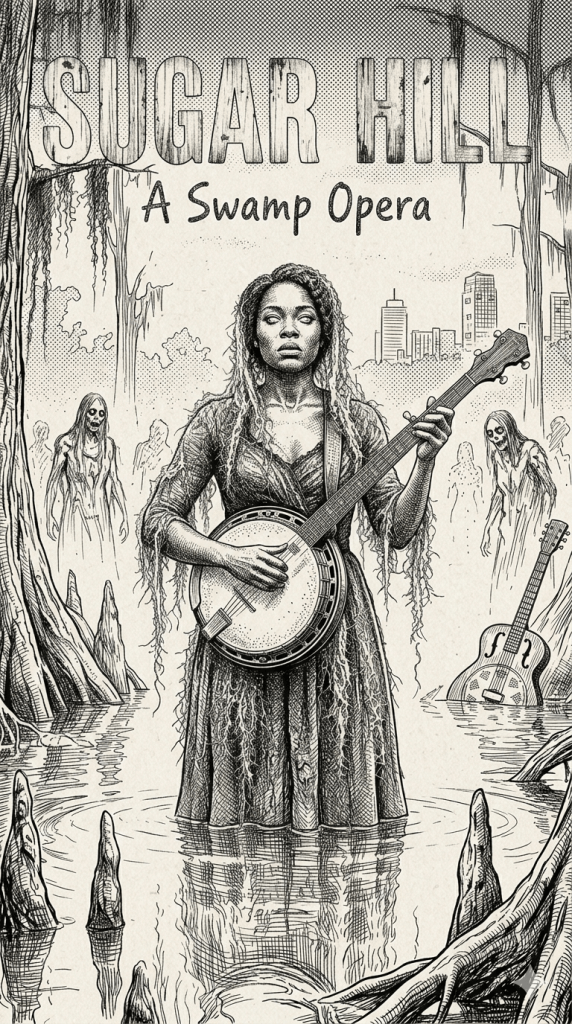
 memories of my ghost sista