Friar Bonaventura: Dispute no more in this, Giovanni. Philosophy may allow such sophistry, but Heaven makes no jest. Those who labour to prove God does not exist find only a shortcut to Hell. Enough! I will hear no more.
Giovanni: Dear Father, I have poured out the burden that weighs upon my heart. I have kept back no word to hide what I truly feel; and is this all the comfort you give me? May I not do what all men do — love?
Friar Bonaventura: You may, you may love, my dear son.
博纳文图拉修士: 可以,你可以爱,我亲爱的孩子。
Giovanni: Then shall a common prejudice, passed from man to man, from brother to brother, become the obstacle to my happiness? You said it yourself: we share but one father, one womb — cursed be my joy — that brought us both into the world. If Nature joined us, are we not all the more each other’s? And does not religion itself teach us we should be one: one soul, one flesh, one heart, one whole?
Friar Bonaventura: Hold your tongue, Giovanni. You are lost already.
博纳文图拉修士: 住口,乔瓦尼。你已经迷失了。
Giovanni: Must my joy be forever banished from her bed, only because I am her brother?
乔瓦尼: 难道只因为我是她的哥哥,我的欢愉就要永远被逐出她的床榻?
Friar Bonaventura: Are you the same prodigy who made all Bologna marvel but three months ago? I was proud to have you as my pupil; I would have given up my books rather than part from you. Yet my hopes in you are ruined, just as you have ruined yourself, Giovanni! Did you turn from learning only to run toward lust and death? For death waits beside your lust. Open your eyes to the world, and you will see a thousand faces brighter than your sister’s. Leave her; choose another woman; the sin would be lighter.
Giovanni: You might more easily stop the sea’s ebb and flow than turn my desire aside.
乔瓦尼: 要阻止大海的涨潮与退潮,也比劝退我的欲望容易。
Friar Bonaventura: Then I have nothing left to say. I already see your ruin. Heaven is just. And yet, hear my counsel still.
博纳文图拉修士: 那么,我已经无话可说。我已经看见你的毁灭。天是公正的。然而,你仍要听我的劝告。
Giovanni: I shall hear it as the voice of life itself.
乔瓦尼: 我会把它当作生命本身的声音来听。
Friar Bonaventura: Let your heart weep. Wash every word you have spoken with your tears, with your blood. Beg Heaven to cleanse the lust that rots your soul. For one week, pray three times each day, three times each night. If your desire remains unchanged, return and see me again. May my blessing go with you.
Giovanni: I will do all this, to escape the lash of vengeance. But afterwards, I swear, I will have no other god — but my fate.
乔瓦尼: 我会照做这一切,为了逃过复仇的鞭答。可之后,我发誓,我将不再有别的神——除了命运。
第二场 / Act I, Scene 2
English
中文
Florio: Signor Soranzo, though many suitors for my daughter have offered terms of great weight, my trust in your fortunes outweighs all other considerations. Yet you must know, I would not force my daughter to marry against her will. I have but two children — a son, and her. My son is too deep in his books, and I confess I fear for his health. Should anything befall him, all my hopes rest on my daughter. Thank God, my estate is sufficient: I would not have her marry for wealth, but for love.
Putana: What do you say, my little darling? Everybody busies themselves about you, quarrels for you, all on your account! You must watch yourself, or before long, someone will pluck you while you sleep.
Annabella: But, Putana, I have no interest in that kind of life. My thoughts are elsewhere. Please, leave me alone a while.
安娜贝拉: 可是,普塔娜,我对那种生活并没有兴趣。我心里想的是别的事。求你,让我一个人待一会儿吧。
Putana: Leave you? What kind of talk is that? Let me not leave you alone, my sweetheart. Besides, I have to congratulate you. Soranzo is worthy of the finest lady in Italy.
Putana: Above all, never marry a soldier! Almost all of them have been wounded in places where they shouldn’t have been, so much so they can’t even be men!
普塔娜: 总之,千万别嫁给士兵!他们几乎人人都在不该受伤的地方受过伤,弄得他们连男人都做不成!
Annabella: What a wicked tongue you have!
安娜贝拉: 你这张嘴真坏!
Putana: To my mind, with a woman’s eye, I do like Soranzo. He is tender; better still, he is rich; and better than all that, he is nobly born. If I were the beautiful Annabella, I too would pray Heaven to send me such a man. He is handsome, and I think he carries no nasty diseases on him — something rarer and rarer in a young man of twenty-three. Whatever else, he is a man, that much is certain! If he were not, he could never have earned such a reputation with Hippolita. That widow — even while her husband was alive, she was perpetually in heat. For that reason alone, my darling, I would wish him for your man. Because what your bed needs is a plain, healthy, proper man.
Annabella:[Aside] This woman must have had a few drinks already.
安娜贝拉(旁白): 这女人一定已经喝了几口了。
Annabella:[Seeing Giovanni] Look, Putana! Who is that man? How sad he looks!
安娜贝拉(看见乔瓦尼): 看,普塔娜!那个人是谁?他看起来多么忧伤!
Putana: Where?
普塔娜: 哪里?
Annabella: There.
安娜贝拉: 那里。
Putana: Why, that’s your brother, my little darling.
普塔娜: 哎呀,那是你的哥哥呀,我的小乖乖。
Annabella: Ah!
安娜贝拉: 啊!
Putana: Yes, it’s your brother!
普塔娜: 是啊,是你的哥哥!
Annabella: It cannot be! That man has become a shadow of himself. He is wiping his eyes! I think I even heard him sigh! Come, Putana, let us go ask him why he is so sorrowful. Since my brother loves me, he will not refuse to let me share his grief.
Annabella:[Aside] My soul is full of melancholy and fear.
安娜贝拉(旁白): 我的灵魂里充满了忧郁和恐惧。
第四场 / Act I, Scene 4
English
中文
Giovanni: Lost! I am lost! My fate has already sentenced me to death. The more I struggle, the more I love; the more I love, the more hopeless I become. I have worn out Heaven itself with my prayers. I have tried everything reason could counsel me. But it is no use; I am still what I am. I must speak, or I shall burst. It is not lust, I know; it is my fate that draws me. Ah! Here she comes…
Giovanni: Come, give me your hand. I trust you will not blush to take a walk with me. There is no one here but you and me.
乔瓦尼: 来,把你的手给我。我希望你不至于因为同我一道散步而脸红。这里没有别人,只有你和我。
Annabella: What do you mean by that?
安娜贝拉: 你这是什么意思?
Giovanni: I mean no harm.
乔瓦尼: 我并没有什么恶意。
Annabella: Harm?
安娜贝拉: 恶意?
Giovanni: No. How are you?
乔瓦尼: 没有。你好吗?
Annabella:[Aside] I hope he is not mad.
安娜贝拉(旁白): 但愿他不是疯了。
Annabella:[Aloud] I am well.
安娜贝拉(高声): 我很好。
Giovanni: I am sick, and I think, sick enough to die.
乔瓦尼: 我病了,而且我想,我病得很重,重到快要死了。
Annabella: God! Let it not be so!
安娜贝拉: 我的天!但愿不是这样!
Giovanni: Sister, I think you love me.
乔瓦尼: 妹妹,我想你是爱我的。
Annabella: Yes, you know well I do.
安娜贝拉: 是的,你明明知道。
Giovanni: It is true, I know it. You are very beautiful.
乔瓦尼: 是真的,我知道。你非常美。
Annabella: It seems sickness has put you in a good humour.
安娜贝拉: 看来疾病倒让你心情好了。
Giovanni: That remains to be seen. The poets say Juno surpasses all the goddesses in beauty. I dare say, if you stood among them, you would surpass them all.
Giovanni: Your eyes are like twin stars; if they cast their gentle light, even stones would come to life.
乔瓦尼: 你的双眼,像一对星辰;若它们温柔地放出光来,连石头都会获得生命。
Annabella: Ah, how prettily spoken!
安娜贝拉: 啊,说得真漂亮!
Giovanni: Upon your face, the lily and the rose contend, and the contest is rare and lovely. Such lips would be enough to tempt a saint.
乔瓦尼: 在你的脸上,百合与玫瑰相互争胜,争得奇异而可爱。这样的嘴唇,足以诱惑一位圣徒。
Annabella: Are you flattering me, or mocking me?
安娜贝拉: 你是在奉承我,还是在取笑我?
Giovanni: If you wish to see a beauty more perfect than Nature can create, go look in a mirror.
乔瓦尼: 如果你想看见一种比自然所能创造的更完美的美,就去照镜子吧。
Annabella: You have turned into quite the gallant young gentleman!
安娜贝拉: 你倒成了个会献殷勤的少年郎!
Giovanni:[Handing her his dagger] Take this.
乔瓦尼(把匕首递给她): 拿着。
Annabella: What should I do with it?
安娜贝拉: 做什么?
Giovanni: Here is my breast. Strike it. Strike here. You will see a heart within which is written the truth of what I say to you. What are you waiting for?
Giovanni: Love me, Annabella. I am lost. You, and your beauty, have shattered the harmony of my peace and my life. Why do you not strike?
乔瓦尼: 爱我,安娜贝拉。我已经完了。你,和你的美,已经打碎了我安宁与生命的和谐。你为什么不刺?
Annabella: If all this be true, then it were better I should die.
安娜贝拉: 如果这一切都是真的,那还不如让我死。
Giovanni: Is it true? Annabella, I have long suppressed these secret flames; they have nearly burned me to nothing. I have reasoned against my love; I have done all that virtue could counsel me — and all for nothing. My fate is this: you love me, or I die.
Giovanni: If I dissemble in the slightest, may calamity fall upon me this instant.
乔瓦尼: 若我有半点隐瞒,愿灾祸此刻就降在我身上。
Annabella: You are my brother, Giovanni.
安娜贝拉: 你是我的哥哥,乔瓦尼。
Giovanni: You are my sister, Annabella; I know it. And I may even use that to prove our case: we are the more bound to love each other. Nature, when she made you, made you mine. I have sought counsel from Holy Church, and the Church told me I may love you. Then since I may, and I will, it is lawful; and I will. Yes, I will. Now, shall I live, or shall I die?
Annabella: Live. You have conquered without a fight. What you ask of me, my captive heart had already resolved. The words I must speak make me blush, but now I can tell you: you have sighed one sigh for me — I have sighed ten; you have shed one tear for me — I have shed twenty. Not because I love you more, but because I dared not speak, and scarcely dared to think.
Annabella: Kneel, brother. Swear to me, by our mother’s memory, not to betray me through hate, nor through fickleness. Love me, or kill me, my brother.
Giovanni: I swear too. By this kiss I swear, and by this one, and by this one. Now, rise. I would not exchange this moment for Heaven itself. What shall we do now?
Giovanni: Then come. After so many tears, let us learn to smile upon each other, to kiss, to share one bed.
乔瓦尼: 那么,来吧。流了这么多眼泪之后,让我们学会相视而笑,学会接吻,学会同床共眠。
第六场 / Act I, Scene 6
English
中文
Soranzo:[Reading] “Excess, thou art the measure of love. Pleasure turns to pain, life to torment, and humiliation is its reward.” What does this mean? Let me read this passage again. Yes, just so… The poet was wrong. Had he known Annabella, had his heart felt the pressure I feel, he would have gladly kissed the whip that lashed him. Then let me take up my pen and refute him. [He writes.] “Moderation, thou art the measure of love. Trouble itself grows pleasant, life turns to delight, and happiness is its reward.” Ah! How my thoughts —
Vasques:[Within] Pray you, wait a moment. Let me announce you first, or I shall be punished for neglect.
瓦斯奎斯的声音: 求您等一等。让我先通报,否则我会因怠慢而受罚。
Soranzo: What now? Can I not have one quiet place! Who is it?
索伦佐: 什么事?我就不能有一处清静地方吗!是谁?
Vasques:[Within] This does your reputation harm.
瓦斯奎斯的声音: 您这样可有损您的名声。
Soranzo: Who is it?
索伦佐: 是谁?
Enter Hippolita, followed by Vasques.
希波莉塔入,瓦斯奎斯随后。
Hippolita: It is I! Do you know me now? Look upon this woman, deceived by your lust. You have made me the scorn of men, and now you would abandon me? You know, hypocrite, when my reputation was still whole, nothing could overcome the chastity in my heart. But then there were tears in your eyes and oaths on your tongue, so many, so many, until I was at last captured by pity. To possess my bed, to hasten my husband’s death through his disgrace, to ruin my good name as an honest woman — should all this be repaid with hatred and contempt?
Hippolita: Call me that no more. Nor think that with a few words you can make your deeds forgotten. Your new mistress shall not triumph! You may tell her for me that I too am of noble birth —
Hippolita: And you too cowardly. Do you see this black dress? Do you see this veil of mourning and grief? You are the cause of all this. Would you make me a widow once more, within my widowhood?
Hippolita: Hear new lies? You need not add to their number.
希波莉塔: 听新的谎言吗?你不必再给它们添数了。
Soranzo: I shall leave. You have lost your reason.
索伦佐: 我要走了。你已经失去理智。
Hippolita: And you your decency.
希波莉塔: 而你失去了体面。
Vasques: Madam, you go too far. Even if my master bore the best intentions in the world, you are forcing him to abandon them all. [To Soranzo] I beg you, torment her no further. I dare say Hippolita is now fit to hear you speak.
Soranzo: To speak with a madwoman. Is this the fruit your love has borne?
索伦佐: 同一个发狂的女人说话。这就是你的爱情结出的果子吗?
Hippolita: This is the fruit your hypocrisy has borne. Did you not swear, while my husband still lived, that you desired no other happiness but to call me your wife? Did you not swear to marry me after his death?
Soranzo: You are mistaken. The oaths I swore to you were wicked and unlawful from the first. To keep them would be a greater sin than to break them; for I cannot hide my repentance from you. Do you understand how far you have fallen? You sent a man who was once your husband toward his death.
Vasques: This is not well; this is not what you once promised her.
瓦斯奎斯: 这不好,这可不是您从前答应她的。
Soranzo: I care nothing for that. She must be made to see her own immorality. If I were to remain enslaved to such black sin, I should be damned. [To Hippolita] Come here no more. You, and your wantonness, have gone too far. [Exit Soranzo.]
Vasques:[Aside] That last speech was delivered with a very masterly rudeness.
瓦斯奎斯(旁白): 最后那段话,说得真是粗暴得很有水平。
Hippolita: How this fool despises his own happiness. He thinks he can strip me of my love, but now I despise him more than I ever loved him. Well, let him go. My revenge will lighten my misery.
Vasques: I know you are very angry. You have reason — that is true; but not so much as you imagine.
瓦斯奎斯: 我知道您非常愤怒。您有理由愤怒,这是真的;但并没有您想象得那么多。
Hippolita: Is that so!
希波莉塔: 是吗!
Vasques: You were too sharp with him just now. You could not have encountered my master at a worse moment. Tomorrow, you will see another man.
瓦斯奎斯: 您刚才太尖刻了。您不可能在更不利的时刻遇见我主人。明天,您看见的就会是另一个人。
Hippolita: Very well, then I shall wait until he is in a better mood.
希波莉塔: 好吧,那我就等他心情好些。
Vasques: You speak too bitterly! Let me counsel you —
瓦斯奎斯: 您这话说得太苦了!让我劝劝您——
Hippolita:[Aside] Here is my chance. [To Vasques] Counsel me to what?
希波莉塔(旁白): 机会来了。对瓦斯奎斯。 劝我什么?
Vasques: To change your manner toward him.
瓦斯奎斯: 劝您改变对他的态度。
Hippolita: He will love me no more. Vasques, you are too loyal to such a master. I think your reward will prove the same as mine.
希波莉塔: 他不会再爱我了。瓦斯奎斯,你对这样的主人太忠诚了。我想,你得到的报偿会和我的一样。
Vasques: Perhaps.
瓦斯奎斯: 也许吧。
Hippolita: Observe him. If I had beside me a man as honest as you, as prudent, as full of good counsel, I think it would be no excessive reward to make him master of everything I own — even to give him myself.
Vasques:[Aside] So that is the way you work, old mole? Carry on; I hold the reins. [To Hippolita] I have nothing deserving of such favour. Yet, if I could —
Vasques: I would pass the remainder of my days in peace and safety.
瓦斯奎斯: 我愿在安宁与安全之中度过余生。
Hippolita: Give me your hand. Promise me now: keep my intended plan secret, and help me succeed.
希波莉塔: 把手给我。现在答应我:为我预备好的计划保守秘密,并助我成功。
Vasques: I can scarcely believe such happiness exists. I swear I shall play my part to perfection; before your design is carried out, I shall not breathe a word.
Giovanni: No longer my sister — now, my love. That name is gentler. Do not blush…
乔瓦尼: 不再是我的妹妹了——现在,是我的爱人。这个名字更温柔。不要脸红……
Annabella: Since my life already belongs to him…
安娜贝拉: 我的生命既然已经属于他……
Giovanni: I cannot understand why young women make losing their virginity seem so earth-shattering. Once it is lost, it is really nothing. You are still yourself.
乔瓦尼: 我真不明白,少女们为什么总把失去贞洁看得惊天动地。其实失去了,也算不得什么。你仍旧是你。
Annabella: The same goes for you. Of course you can say that now.
安娜贝拉: 对你来说也一样。你现在当然可以这样说。
Giovanni: Do you mean to reproach me? Kiss me — so! I envy not the most powerful man on earth. To be your king is greater than to be king of the whole world. And yet I shall lose you…
Putana: Ha! Ha! It looks to me not that you have entered Heaven, but that Heaven has entered your body! Well, well done! Do not worry because he is your brother. He is still a man, I hope? I have said it before and I’ll say it again: if a girl feels an itch, she may scratch it with whoever comes to hand — father, brother, it is all the same.
Annabella: The last thing I wish is for this to be known.
安娜贝拉: 我最不愿的,就是让这件事被人知道。
Putana: Nor I. What words would come out of people’s mouths! Otherwise, the thing itself is of no great matter.
普塔娜: 我也不愿。人们嘴里会说出什么话来呀。要不然,这事本身倒没什么要紧。
Florio:[Within] Annabella!
弗洛里奥的声音: 安娜贝拉!
Annabella: God, my father is here! Give me my needlework.
安娜贝拉: 我的天,父亲来了!把我的针线活给我。
第十场 / Act I, Scene 10
English
中文
Florio: Busy at your needlework. Good, you have not wasted your time. Have you seen Giovanni?
弗洛里奥: 勤勤恳恳做活。很好,你没有虚度时光。你见过乔瓦尼吗?
Annabella: He just went out. I think he is with his teacher, Friar Bonaventura.
安娜贝拉: 他刚出去。我想,他在他的老师那里,博纳文图拉修士那儿。
Florio: That is a man blessed by Heaven. I hope he can instruct Giovanni in the way to the other world. Annabella, I have something to discuss with you, concerning both of us, father and daughter. You know that among your suitors, Soranzo is the only one who satisfies me…
Friar Bonaventura: Hold your tongue. Every word you have recounted threatens the death of the soul. I rue having heard it. Why were my ears not struck deaf before you came? For your sake, I am reproached by other priests; for your sake, I exhaust myself day and night, forcing these poor eyes to stay open only to shed tears for you. If we were certain there were neither Heaven nor Hell, and men were guarded only by Nature, as the ancient philosophers said, then your case might find some defence. But it is not so. You will see: before Heaven, Nature is blind. God is angry. You may be satisfied. You are marked out to know evil. It may be slow in coming, but come it will.
Giovanni: If you carried within your own body a desire like mine, you would make my sister’s love your Heaven, and her person your God.
乔瓦尼: 倘若您体内也有一种像我这样的欲望,您就会把我妹妹的爱情当作您的天堂,把她本人当作您的神。
Friar Bonaventura: I see you have already sold body and soul to Hell. My prayers can no longer redeem you. But let me give you one piece of counsel: persuade your sister to marry as soon as possible.
Giovanni: Marry! Let another man discover the hunger in her senses?!
乔瓦尼: 嫁人!让另一个男人发现她感官中的饥渴?!
Friar Bonaventura: If you will not consent, at least allow me to hear her confession, so that she does not die without absolution.
博纳文图拉修士: 如果你不同意,至少允许我为她听忏悔,免得她死时没有赦罪。
Giovanni: Do as you will. Then look closely at her face. In that small oval you will see a strange and rich world. For colour, her lips; for fragrance, her breath; for jewels, her eyes; for threads of gold, her hair. Every part of her is a marvel. And as for those parts created only for delight, I shall say nothing, for fear of offending your ears.
Florio: Signor Soranzo, here is my daughter. She knows my mind already. Speak with her, I pray you. [To Annabella] And you, treat him with the courtesy his noble rank deserves. I shall leave you alone together.
Florio: Where have you been, Giovanni? What, alone again, always alone! I do not like to see you this way. You must lay aside this excessive love of books. Come.
Giovanni: Sister, do not be too much like a woman. Think of me.
乔瓦尼: 妹妹,不要太像一个女人。想想我。
Annabella: What! Are you jealous?
安娜贝拉: 什么!你嫉妒了?
Giovanni: You shall know soon enough. Gentle night shall be welcomed. Evening crowns the day.
乔瓦尼: 一会儿你就会知道。温柔的夜晚将受到欢迎。黄昏为白昼加冕。
第十三场 / Act I, Scene 13
English
中文
Annabella: What business do you have with me?
安娜贝拉: 您找我有什么事?
Soranzo: Do you not know what I would say to you?
索伦佐: 您不知道我要对您说什么吗?
Annabella: Yes. You would say that you love me.
安娜贝拉: 知道。您要说您爱我。
Soranzo: And I could swear it. Do you believe me?
索伦佐: 我也可以发誓。您相信我吗?
Annabella: Your oaths are not words out of the Gospel.
安娜贝拉: 您的誓言并不是福音书上的话。
Soranzo: Have you no wish to love?
索伦佐: 您难道没有爱的愿望吗?
Annabella: Not to love you.
安娜贝拉: 不是爱您。
Soranzo: Then whom?
索伦佐: 那是谁?
Annabella: That is for my fate to decide.
安娜贝拉: 由我的命运决定。
Giovanni:[Aside] Her fate, at this moment, is in my hands.
乔瓦尼(旁白): 她的命运,此刻由我掌握。
Soranzo: What do you mean by that?
索伦佐: 您这是什么意思?
Annabella: To live a virgin, and to die a virgin.
安娜贝拉: 生为处女,死为处女。
Soranzo: Oh! That would be a great pity.
索伦佐: 哦!那可太可惜了。
Giovanni:[Aside] There is someone here who can testify that those are but a woman’s words.
乔瓦尼(旁白): 这里有人能证明,这不过是女人嘴上的话。
Soranzo: If you could see my heart, you would certainly swear —
索伦佐: 倘若您能看见我的心,您一定会发誓——
Annabella: Swear that you were already dead.
安娜贝拉: 发誓您已经死了。
Giovanni:[Aside] If only that were so.
乔瓦尼(旁白): 若真是这样就好了。
Soranzo: Do you see these tears of love?
索伦佐: 您看见这些爱情的眼泪了吗?
Annabella: No.
安娜贝拉: 没有。
Giovanni:[Aside] She is mocking him!
乔瓦尼(旁白): 她在嘲弄他!
Soranzo: They are begging you.
索伦佐: 它们在向您恳求。
Annabella: I hear nothing.
安娜贝拉: 我什么也没听见。
Soranzo: Oh! Grant my wish!
索伦佐: 哦!请成全我的愿望!
Annabella: What wish?
安娜贝拉: 什么愿望?
Soranzo: Let me live.
索伦佐: 让我活下去。
Annabella: Then grant it yourself.
安娜贝拉: 那就请您自己成全吧。
Giovanni:[Aside] One more such answer, and his hopes should die.
乔瓦尼(旁白): 再来一句这样的话,他的希望就该死了。
Soranzo: Madam, let us cease these unprofitable games. Know that I love you truly, and have loved you long. It is not your wealth I love, but your person. So do not let me suffer in vain. I am sick, and sick at heart.
Soranzo:[Aloud] Malice does not suit your intelligence, nor your age.
索伦佐(高声): 恶意并不适合您的聪明,也不适合您的年纪。
Annabella: Sir, your reason should have told you: if I loved you, or had ever had the least intention of loving you, I should have given you more hope by now.
安娜贝拉: 大人,您的理智本该让您明白:倘若我爱您,或者曾有一点爱您的意思,我早该给您更多希望了。
Giovanni:[Aside] I need never doubt her love again.
乔瓦尼(旁白): 我再也不必怀疑她的爱了。
Annabella: But since I would not have you waste your youth in waiting, I would rather counsel you to persist no further. Believe me, I say this precisely because I wish you well.
Annabella: Yes, it is myself. Yet I can give you some comfort. Know that, if I must choose from among the men who would have me, that man would be you. This should satisfy you.
Annabella: One word more. If you would have me believe your love, do not tell these things to my father. If in the end I must marry, it will be you, or no one.
Enter Florio and Putana. Giovanni emerges from hiding.
弗洛里奥与普塔娜入。乔瓦尼从藏身处出来。
Soranzo: Signor Florio, look to your daughter.
索伦佐: 弗洛里奥大人,您看您的女儿。
Giovanni: Sister, how are you?
乔瓦尼: 妹妹,你怎么样?
Annabella: I am ill. Brother, are you here?
安娜贝拉: 我病了。哥哥,你在这里吗?
Florio: Take her to bed at once.
弗洛里奥: 立刻把她扶到床上去。
Putana: Oh, poor little thing!
普塔娜: 哦,可怜的小东西!
Exeunt all but Soranzo.
众人下,只剩索伦佐。
第十四场 / Act I, Scene 14
English
中文
Vasques: Sir…
瓦斯奎斯: 大人……
Soranzo: Oh, Vasques! She told me she cannot love me! And then she fainted. I fear her life is in danger.
索伦佐: 哦,瓦斯奎斯!她对我说,她不能爱我!而且,她又昏了过去。我害怕她的性命有危险。
Vasques:[Aside] Your own life is in danger too, if you knew all. [Aloud] Perhaps it is nothing but a maid’s dizziness — too much youthful blood. What can one say, sir? In such cases, there is no better remedy than a swift marriage. But did she absolutely refuse you?
Friar Bonaventura: May peace and charity enter here.
博纳文图拉修士: 愿和平与慈爱临到这里。
Florio: Welcome, Friar. Wherever you go, you bring Heaven with you.
弗洛里奥: 欢迎您,修士。您无论走到哪里,都把天国带到哪里。
Giovanni: Father, I have fetched this holy man from his cell as swiftly as I could. He comes to aid my sister in this hour of distress with spiritual comfort, and to grant her absolution should she be in danger of death.
Florio: Well done, Giovanni. You have shown a Christian’s care and a brother’s love. Come, Father, I will take you to her chamber. But I have one more request: it is the deepest anxiety of a father’s heart. I hope, before I die, to see my daughter married as she should be. One word from you would move her more than all my persuasions.
Friar Bonaventura: I shall tell her all this. May Heaven assist her.
博纳文图拉修士: 我会把这一切告诉她,愿上天扶助她。
第十六场 / Act I, Scene 16
English
中文
Putana: Oh! We are all undone, utterly undone, completely undone, and everlastingly shamed! Your sister! Oh! Your sister!
普塔娜: 哦!我们全都完了,彻彻底底完了,完全完了,而且永远丢尽脸了!您的妹妹!哦!您的妹妹!
Giovanni: What has happened? Speak. How is she?
乔瓦尼: 怎么了?说。她怎样了?
Putana: I wish I had never been born than to see this.
普塔娜: 我宁愿自己从未出生,也不愿看见这种事。
Giovanni: She is not dead, is she?
乔瓦尼: 她没有死,对不对?
Putana: Dead? She is pregnant! You know what you have done. It is too late for regret now. May God forgive you.
普塔娜: 死?她怀孕了!您知道您自己做了什么。现在后悔也太迟了。愿上帝宽恕您。
Giovanni: Pregnant? How do you know?
乔瓦尼: 怀孕?你怎么知道?
Putana: The nausea, the sickness, the changing complexion — and certain details you will excuse me from describing. She is with child, trust me. If you let a doctor poke his nose into her water, you are all finished!
Putana: Better. It was only a passing discomfort; I saw it at once for what it was. And from now on she must be prepared to suffer such discomfort often.
普塔娜: 好些了。那不过是一阵不适,我一眼就看出来了。而且从现在起,她得预备常常这样不适了。
Giovanni: Speak to her for me. Tell her not to be afraid. Find a way to keep any doctor from her. Invent excuses, think of reasons! Oh, anxiety! My head holds a whole world of anxieties. Do you understand? Be careful.
Friar Bonaventura: I am glad to see your penitence. For the soul you have laid open to me is so dark, so sinful, I wonder the earth has not swallowed you up. But weep, weep for yourself. These tears will do you good. Now, weep more deeply. I shall recite a prayer.
Friar Bonaventura: Yes. You are a poor, miserable creature, almost condemned while yet alive. Listen, my daughter! Under a dark and profound vault there is a place where daylight can never enter. There, cursed souls howl without pity. The gluttonous are fed with toads and vipers; burning oil is poured down the drunkard’s throat; the murderer is stabbed over and over for all eternity; the lecher is stretched out upon a gridiron of red-hot steel and feels, within his soul, the torment of his own inflamed lust.
Friar Bonaventura: The one who commits incest suffers there. Then you will wish that every kiss from your brother had been a dagger. You will hear him cry: “Oh! I wish that my wicked sister had been hurled to Hell the moment she yielded to my lust!” But I see repentance entering your heart. Tell me, what do you feel now?
Friar Bonaventura: There is. Heaven is so merciful that it still offers you forgiveness. This is what you must do. First, to save your honour, you must marry Signor Soranzo. Second, to save your soul, you must abandon this sinful life and live only for your husband.
Friar Bonaventura: I know, it is hard to cast off the lure of sin. Oh, it is almost a kind of death. But do not forget what awaits you. Will you do this?
Annabella: Yes. I swear to live with you, and for you.
安娜贝拉: 是的。我发誓,同您一起生活,也为您而活。
Friar Bonaventura: This is well. What remains to be done may be completed tomorrow.
博纳文图拉修士: 这样就好。剩下该做的事,明日便可完成。
第十八场 / Act I, Scene 18
English
中文
Hippolita: He is betrothed?
希波莉塔: 他已经订婚了?
Vasques: I was present.
瓦斯奎斯: 我就在场。
Hippolita: When is the wedding?
希波莉塔: 什么时候成婚?
Vasques: Two days hence.
瓦斯奎斯: 两天之后。
Hippolita: Two days! Well, I almost wish they were two nights, so that I might send him to his last sleep. Vasques, I shall do this without hesitation.
Vasques: I do not doubt your courage; nor, I think, do you doubt my discretion. I am entirely yours.
瓦斯奎斯: 我不怀疑您的勇气;我想,您也不怀疑我的谨慎。我全然属于您。
Hippolita: Even if countless obstacles stood between us, I would still be yours. He is already to be married? Oh, this vile man! I am certain that if he saw me weep, he would only laugh.
Hippolita: No, let him laugh. My mind is made up. So long as you stay true!
希波莉塔: 不,就让他笑吧。我已经下定决心。只要你始终真诚!
Vasques: If I were to betray you, what could I gain that would compare to the unexpected fortune you permit me to long for?
瓦斯奎斯: 若我背叛您,所得的东西,怎能同您允许我渴望的那种意外命运相比?
Hippolita: Even my heart, Vasques, I could give you. Let my youth cast itself upon these new pleasures. If we succeed, he has but two days left to live.
Friar Bonaventura: May you flourish long, happy pair, taking joy in one another.
博纳文图拉修士: 愿你们长久昌盛,幸福的一对,彼此以对方为喜乐。
Soranzo: Father, your prayers shall be answered. Friends, let us raise our cups and crown this day to Annabella’s health. Vasques!
索伦佐: 神父,您的祈祷必会应验。朋友们,让我们举杯,为安娜贝拉的健康,为这一天加冕。瓦斯奎斯!
Vasques: Sir?
瓦斯奎斯: 大人?
Soranzo: Give me that cup. My brother, I drink to your health. Though you are still unmarried, your turn will come soon. I drink to your sister’s happiness, and to my own.
Annabella: If he does not wish to, do not force him.
安娜贝拉: 他不愿意,就不要勉强他。
Giovanni:[Aside] What torture! If this marriage were not yet complete, I would rather die than see my sister kissed by another man.
乔瓦尼(旁白): 多么折磨!若这婚姻还没有完成,我宁愿死,也不愿看见我的妹妹被另一个人亲吻。
Vasques: Are you unwell?
瓦斯奎斯: 您不舒服吗?
Giovanni: Attend to your own duties, boy. I need no care from you.
乔瓦尼: 请你做你的差事吧,小伙子。我不需要你的照料。
Enter Hippolita, veiled. She unveils.
希波莉塔入,戴着面纱。她揭下面纱。
Soranzo: Hippolita!
索伦佐: 希波莉塔!
Hippolita: It is I. Do not be afraid, charming bride; I have not come to steal your husband from you. The rumours that have long set Parma gossiping need no longer be spoken of. For now he is yours, my dear. Give me your hand. I bear you goodwill, gentle Annabella; and so I wish to bind once more the union that Holy Church has sanctioned. Come, Soranzo, take my hand. Do I not do well?
Hippolita: You know I have a merciful heart. Here I release you from any promises you may have made to me. For a witness, give me a cup of wine. [Vasques hands her a cup.] Soranzo, I drink to your long rest. [She drinks.][Aside, to Vasques.] Do not forget, Vasques!
Soranzo: I thank you, Hippolita. I too drink to this happy union, as to another life. — Oh! Where is the wine?
索伦佐: 多谢您,希波莉塔。我也为这幸福的结合而饮,像为另一种人生而饮。哦!酒呢?
Vasques: You shall have no wine.
瓦斯奎斯: 您不会有酒的。
Hippolita: What!?
希波莉塔: 什么!?
Vasques: Now you shall know, she-devil: it is your own treachery that kills you. I had no need to marry you.
瓦斯奎斯: 现在你该知道了,女魔鬼:杀死你的,正是你自己的背叛。我可没有必要娶你。
Hippolita: Traitor!
希波莉塔: 叛徒!
Vasques: Alas, hopes too high must always fall! If you have any religion left in you, now is the time to pray. This bag of malice, this woman, secretly tried to buy me with promises of marriage, to poison my master and so revenge herself upon him. Look upon her… End your days, Hippolita; as for life, there is no hope left.
Hippolita: It is true. I feel my last moment coming. If this slave had kept his promise — oh! How I suffer! — Soranzo, it is you who should now be dying. My heart burns in Hell’s fire! May my curse fall upon you! May your bridal bed become an instrument of torture to your heart! Oh, this fire is unbearable! May you father bastards! May monsters issue from your womb! May you die in your sin, despised and abandoned by all! [She dies.]
Friar Bonaventura: Thus does lust lead men and women!
博纳文图拉修士: 淫欲便是这样引人至此!
Annabella: What a terrible thing!
安娜贝拉: 多么可怕的事!
Soranzo: Vasques, from this day forward I count you a loyal servant. I shall never forget. Come, my love, let us go home. This feast has grown too sorrowful.
Soranzo: Whore! Was there no other man in all Parma but me, that I must serve as your flaunting cuckold, the screen for your belly’s sport? And now, must I be father to these rotten bastards? Tell me — was it I?
Annabella: Beast of a man! Very well, this is your fate. I never wanted you! Quite the contrary! If you had given me time, I would have told you what condition I was in. But you were in such haste!
Soranzo: Whore among whores, you dare speak to me so!
索伦佐: 娼妇里的娼妇,你竟敢这样对我说话!
Annabella: Yes, and why should I not? You are utterly mistaken. Do you think I chose you for love? I did it to save my honour! But if you are willing to be patient, I may see whether I can love you.
Annabella: Gently — that was not in our bargain. But I may tell you this: the man, the man who surpasses ordinary men, gave me this boy — for it is a boy, your heir shall be a son —
Annabella: If you will not hear me, I shall say no more.
安娜贝拉: 如果你不肯听我说,我就不再说下去了。
Soranzo: Go on. Speak!
索伦佐: 说下去,讲!
Annabella: That man, in every way, is like an angel.
安娜贝拉: 那个人,处处都像一位天使。
Soranzo: What is his name?
索伦佐: 他叫什么名字?
Annabella: That step we have not reached. Content yourself with this glory — that you shall serve as father to a child begotten by such a man.
安娜贝拉: 还没到那一步。你只要满足于这种荣耀就够了:你将替这样一个男人生下的孩子,充当父亲。
Soranzo: Tell me his name.
索伦佐: 告诉我他的名字。
Annabella: Never! May I be cursed forever if you learn it!
安娜贝拉: 永不!若你知道了,愿我永远受诅咒!
Soranzo: Shall I not know it, wretch? I shall cut open your heart and find it there.
索伦佐: 我会不知道吗,贱人!我会剖开你的心,在那里把它找出来。
Annabella laughs.
安娜贝拉大笑。
Soranzo: You laugh? Whore, tell me who your lover is, or I shall drag your body, corrupted by lust, into the dust by your hair. [He drags her.] Do you not tremble?
Annabella: No. Be a good executioner. I leave behind a revenge, and you shall taste it.
安娜贝拉: 不。做个好刽子手吧。我留下了一场复仇,而你会尝到它。
Soranzo: If you will confess, I will spare your life.
索伦佐: 你若肯招认,我就饶你一命。
Annabella: I will not purchase my life at so high a price.
安娜贝拉: 我不愿用这么高的价钱买我的命。
Soranzo: I shall not delay my vengeance. [He draws his sword. Enter Vasques.]
索伦佐: 我不会延迟我的复仇。他拔剑。瓦斯奎斯入。
Vasques: What do you mean to do?
瓦斯奎斯: 您要做什么?
Soranzo: Stand aside. Such a whore deserves no mercy.
索伦佐: 让开。这样的娼妇不配得到怜悯。
Vasques: Yet God forbids it. She is your wife. The fault she committed before she married you was not committed against you.
瓦斯奎斯: 可是上帝禁止这样做。她是您的妻子。她在嫁给您之前犯下的过错,并不是针对您而犯。
Soranzo: She shall not live.
索伦佐: 她不能活。
Vasques: No, she must live. Would you have her confess who caused her misfortune? That is no reasonable demand! If she answered, she would lose what little respect I still have for her.
Annabella: Pah! Do not plead for me. I hold my own life worth nothing. If this man must go mad, let him take it.
安娜贝拉: 呸!不要替我哀求。我把自己的性命看得一文不值。若这个男人需要发疯,就让他拿去吧。
Soranzo: Do you hear, Vasques?
索伦佐: 你听见了吗,瓦斯奎斯?
Vasques: I hear, and I admire her. She shows a nobility of soul. Curse me if you will, but it becomes her. [Aside, to Soranzo] Whatever happens, hold back your revenge for now. Let me ferret this matter out. You must restrain yourself, or all is ruined. [Aloud] Sir, if my service has ever earned any trust from you, do not be so violent.
Soranzo: Oh, Vasques, Vasques! I had locked all the treasure of my heart inside this lump of flesh, inside this treacherous face. How you have mocked my hopes! How you have buried me alive in your lewd womb!
Vasques:[Aside] Good. Continue in that strain — short, passionate; that is exactly what is needed.
瓦斯奎斯(旁白): 好。就照这个腔调继续,短促些,动情些,这正是需要的。
Soranzo: Tell me, do you deny that I once worshipped you?
索伦佐: 告诉我,你难道不认为我曾经崇拜过你吗?
Annabella: I must admit, you did love me very much.
安娜贝拉: 我必须承认,您的确很爱我。
Soranzo: And yet you meant to use me! Annabella, be assured that whoever the wretch was who pushed you into this shame, he may have desired you, but he never loved you as I loved you. What he loved was a pretty woman’s face, not the part that once belonged to me — your heart, and the virtue I thought was yours.
Annabella: Oh! These words cut deeper into my heart than your sword ever could.
安娜贝拉: 哦!这些话刺进我心里的深处,胜过你的剑。
Vasques: I am never soft-hearted, yet now even I am beginning to weep. You see, sir, I knew what he would be like once his anger had passed.
瓦斯奎斯: 我从不心软,可现在,连我也要开始流泪了。您看,大人,我早知道他的怒气过去以后会怎样。
Soranzo: Forgive me, Annabella. Though your youth tempted you beyond your strength, I will not forget what I am — your husband. If I see you are faithful to me from this day forward, I shall pardon all your faults.
Soranzo: Rise. My reason now tells me: “Women often fall into sin through weakness.” Go to your chamber.
索伦佐: 起来。我的理智如今告诉我:”女人常常因软弱而跌入罪中。”回你的房间去。
第二十一场 / Act I, Scene 21
English
中文
Vasques: Excellent — the best course that could have been taken. Now then, sir, how do you find your happiness?
瓦斯奎斯: 很好,这是所能采取的最好办法。那么现在,大人,您觉得自己的幸福如何?
Soranzo: I carry Hell in my heart. Every drop of my blood burns for revenge.
索伦佐: 我心里怀着地狱。我全身的血都为复仇而燃烧。
Vasques: That is very likely. But do you know how to revenge yourself? And upon whom? Ah! To marry a pregnant woman and think you had married a virgin — such things, they say, are common enough these days. The question is: who has crawled into your cave…
Soranzo: If revenge be delayed, the blow falls all the heavier.
索伦佐: 复仇若被延迟,那一击便更沉重。
第二十二场 / Act I, Scene 22
English
中文
Vasques: Ah, little wench, you have cost me trouble enough. From the very first, I suspected something. Seeing my mistress’s scornful looks, her wayward humours, her fits of irritation — finding fault with everything that happened here — I said to myself: “Where the hen crows and the cock is silent, that house will come to ruin.” But how did all this happen so quickly? First, I must find out who did it. [Enter Putana.] Here comes my means, where before there were none. What is this? You are weeping? I cannot blame you for that. We have a master who is mad as a devil.
Vasques: Me? He uses me like a dog. His cruelty will drive our mistress to her death. She is pregnant — but what great matter is it to reproach a woman of her age for being pregnant?
Putana: Alas! But she did it weeping, and not of her own free will.
普塔娜: 唉!可她是哭着做的,而且并非出于自愿。
Vasques: I would swear his fury comes entirely from one thing: she refuses to name the father. Once he knows, I know him well enough to say he will forget this instantly.
Vasques: I am certain. Just now he thought you could reveal everything, and meant to force you to speak; luckily I calmed him. On that note — you must know a great deal.
Putana: Not for the whole universe, Vasques, I swear to you.
普塔娜: 整个宇宙也不行,瓦斯奎斯,我向你发誓。
Vasques: To sell her out — that, of course, would be very wicked. But in the present case, you could ease her suffering, pacify our master, and earn a little money, all at once.
Putana: I am certain. You will see — he is never long away from her.
普塔娜: 我确定。你会看见,他不会离她太久。
Vasques: He would be wrong to stay away long. But can I trust you?
瓦斯奎斯: 他若离得久,那才错了。可是,我能相信你吗?
Putana: Trust me?! What sort of person do you take me for? I have been too close to this to invent tales.
普塔娜: 相信我?!你把我当成什么人?我一直贴得这么近,才不会胡编乱造。
Vasques strikes Putana senseless and gags her.
瓦斯奎斯击昏普塔娜,并堵住她的嘴。
Vasques: Come, open your gums, you toad-bellied old whore. I shall drag her down to the cellar, and later, I shall put out her eyes. [He disposes of Putana’s body and returns to the stage.]
Vasques: This is too good, better than all my hopes. Her own brother! What a horror! It is the devil who leads the dance now. Her brother — good. And this is only the beginning. I must tell my master and guide him toward his revenge. All this turmoil over a matter of breeches! Who comes? Giovanni! The very man. My judgment is fixed, as sure as winter and summer. [Enter Giovanni.]
Vasques: She has been somewhat indisposed again; her body is still a little weak.
瓦斯奎斯: 她又有些不适,身体还有点虚弱。
Giovanni: Too much bodily pleasure, I think.
乔瓦尼: 我想,她是肉体享用得太过分了。
Vasques: Too much bodily pleasure — that, I think, is fairly accurate.
瓦斯奎斯: 肉体享用得太过分——我想,这话相当准确。
Giovanni: Where is she?
乔瓦尼: 她在哪里?
Vasques: In her chamber. Go see her; she is alone. [Exit Giovanni.] Let the young man enjoy what good hours remain to him. He is already sold to death; even the devil himself could not buy him back. [Enter Soranzo.] Sir, I am a man of ability.
Soranzo: My wife’s brother has come. He shall know everything.
索伦佐: 我妻子的哥哥来了。他会知道一切。
Vasques: Let him be. I have settled matters with a certain person — I will tell you who.
瓦斯奎斯: 让他去。我已经同某个人办妥了该办的事——我会告诉您是谁。
Soranzo: Vasques, do you know…
索伦佐: 瓦斯奎斯,你知道……
Vasques: It is no longer for me to know. It is your turn now.
瓦斯奎斯: 现在不该由我知道了。该轮到您知道了。
第二十四场 / Act I, Scene 24
English
中文
Annabella: Farewell, pleasure; farewell, you fleeting moments — false joys that once wove a weary life into shape. You, Time, who travel through the world, pause here your restless course. Pause, to complete the journey of my fate and deliver the tragedy of a poor, miserable woman to future ages. My conscience now rises up against my desire and accuses it as sin. [Enter Friar Bonaventura.]
Annabella: Here, like a bird shut in a cage, I am cut off from everyone, even from Putana. I can only speak to air and walls, thinking of my foul misery. Oh, Giovanni, I wish the punishment our sins deserve might pass far from you and let me alone endure its torment.
Friar Bonaventura:[Aside] This voice is music to my soul.
博纳文图拉修士(旁白): 这声音,对我的灵魂而言,正是一支音乐。
Annabella: My God, forgive me: this once, help me. Let there be a good man who passes by this way, to whom I may entrust this letter written with tears and blood. If You grant me this grace, I vow to repent.
Friar Bonaventura: Madam, Heaven has heard you and appointed me the instrument of your salvation.
博纳文图拉修士: 夫人,天国已经听见了你,并命我做你得救的器具。
Annabella: Who are you?
安娜贝拉: 您是谁?
Friar Bonaventura: Your brother’s friend, the hermit — and one who takes comfort in having heard this confession.
博纳文图拉修士: 你哥哥的朋友,那位隐修士——也为听见这番忏悔而感到欣慰的人。
Annabella: Is Heaven so generous? Holy man, take this letter to my brother; tell him to repent. Advise him to be wary and not to trust my husband’s friendship. What I fear is more than I can say.
Annabella: I thank You, Heaven; You have lengthened my life until I might make such good use of it.
安娜贝拉: 感谢您,天国,您延长了我的生命,直到我能这样好好地使用它。
第二十五场 / Act I, Scene 25
English
中文
Vasques: Am I to be believed now? You first married a whore; she threw herself into your arms only to mock the horns on your head, to cuckold you in the bridal bed, and to spend your money on panders.
Vasques: Horned beasts are very patient creatures, sir.
瓦斯奎斯: 长角的牲畜,都是很有耐性的动物,大人。
Soranzo: I am resolved. Not another word. You are the best at handling such agreeable phrases — use them to invite my brother and rival, and his father, to the feast I hold for my birthday. Go quickly, and return.
Vasques: Until I return, do not let your pity show itself. Think of incest, think of adultery.
瓦斯奎斯: 在我回来以前,别让您的怜悯出来。想着乱伦,想着通奸。
Soranzo: This revenge is the sole ambition that possesses me. I shall either achieve it, or perish for it.
索伦佐: 这复仇,是唯一占有我的雄心。我要么达成它,要么为它灭亡。
第二十六场 / Act I, Scene 26
English
中文
Giovanni: Before my sister married, I once thought all the savour of love would be lost in such a union. Yet now I find no change in my delight. She is still mine. Every kiss of ours is as sweet, as intoxicating, as the first. For me, the world and all its joys are here. A life of pleasure — that is Heaven. [Enter Friar Bonaventura.] Father, I may tell you now: that Hell with which you used to threaten me is nothing but superstition.
Friar Bonaventura: Your blindness is killing you. Look at this letter, written to you. [He hands Giovanni the letter.] Why do you change colour, my son?
Giovanni: You play the devil’s messenger between my love and your so-called religious sorcery. Where did you get this?
乔瓦尼: 您在我的爱情和您那些所谓宗教的巫术之间,扮演魔鬼信使的角色。这东西您从哪里来的?
Friar Bonaventura: Your conscience is withered, Giovanni. Otherwise, you would have obeyed this warning.
博纳文图拉修士: 你的良心已经枯干了,乔瓦尼。否则,你早该服从这警告。
Giovanni: It is her hand — I recognise it. And written in her blood. What does she write? — that we are discovered. Discovered? Damnation, if it be true! How is that possible? Have we become traitors to our own delight? All nonsense! This is nothing but your invention, my poor — [Enter Vasques.] Well, what do you here?
Vasques: My master invites you to the feast he gives today to celebrate his birthday. Your father, and the Cardinal — the Pope’s ambassador — have also promised to attend. Will you join them at the feast?
Giovanni: Tell him just as I said. And add this: I will come.
乔瓦尼: 就按我说的告诉他。再多告诉他一句:我会去。
Vasques: That has a strange ring to it.
瓦斯奎斯: 这话听起来有些奇怪。
Giovanni: Tell him I will come.
乔瓦尼: 告诉他,我会去。
Vasques: You will not fail to appear?
瓦斯奎斯: 您不会失约?
Giovanni: More questions! I will come. Have you your answer?
乔瓦尼: 又问!我会去。你得到答复了吗?
Vasques: I shall deliver it. I am your servant. [Exit Vasques.]
瓦斯奎斯: 我会转告他。我是您的仆人。瓦斯奎斯下。
Friar Bonaventura: I hope you will not go.
博纳文图拉修士: 我希望你不会去。
Giovanni: Not go? Why not?
乔瓦尼: 不去?为什么?
Friar Bonaventura: Be wise — do not go. I swear this feast is a plot.
博纳文图拉修士: 要明智,不要去。我发誓,这场宴会是一场阴谋。
Giovanni: Not go! Even if Death stood before me and threatened me with its blazing dangers, I would go there, resolved, like them, to plunge deep into the slaughter.
Friar Bonaventura: Go where you will. I see the confusion of your fate has reached its end, and a most foul and terrible end it is. I should not stay to witness your fall with my own eyes. I will return to Bologna. Farewell, Parma! I wish I had never known you, nor anything to do with you! Well, my son, since no prayer can save you, I leave you to your despair. [Exit Friar Bonaventura.]
Giovanni: Despair, or the torments of Hell — I care for none of it. My mind is set. Now, now, stir yourselves, my thoughts, and build a plan of destruction. My soul, become a man entire. If I must fall like a mighty oak, then as I fall, many small trees shall be crushed.
Vasques: All of them. You see, everything is prepared for this great business; nothing is lacking but a firm resolution in your heart. Remember your shame, remember your honour’s loss, remember Hippolita’s blood; arm your courage with your own humiliation.
Soranzo: The less I speak, the hotter my heart burns. Blood will quench this flame.
索伦佐: 我说得越少,心里烧得越烈;鲜血会扑灭这火焰。
Vasques: Very good. One thing more: when our little incestuous one arrives, he will be eager to gnaw his old meat. Let him. Give him time to make good use of your bed; let this rutting hare run free until he is hunted to death. Thus we may dispatch him to Hell in the very act of his cursed deed.
Soranzo: Let it be so. Look — he comes first, just as you wished. [Enter Giovanni.] Welcome, my dear brother. I see what an honour you do me. But where is our father?
Giovanni: He is waiting upon the Cardinal, to greet him. How is my sister?
乔瓦尼: 他正等着红衣主教,好向他致意。我的妹妹怎么样?
Soranzo: Like a good housewife, not yet fully prepared. You should go see her.
索伦佐: 像一个贤良的女主人,还没有完全准备好。您该去看看她。
Giovanni: If you wish.
乔瓦尼: 若您愿意。
Soranzo: I must await my guests. My good brother, I pray you, hasten to bring her here.
索伦佐: 我必须等候我的客人。我的好兄弟,劳驾您快些把她请来。
Giovanni: You are in a great hurry. [Exit Giovanni.]
乔瓦尼: 您倒很急。乔瓦尼下。
Vasques: Matters advance as if the Prince of Devils himself meant to destroy him! Let him gorge upon his own ruin. [Enter Cardinal and Florio.]
瓦斯奎斯: 事情进展得就像恶魔之王亲自要毁掉他一样!让他饱餐他自己的毁灭吧。红衣主教与弗洛里奥入。
Soranzo: Most reverend Father, the condescension you show in gracing my humble house does me deep honour. I shall ever remain your servant.
索伦佐: 至为尊贵的神父,您屈尊降临寒舍,使我深感荣耀。我将永远是您的仆人。
Cardinal: You are our friend, sir. The Holy See shall understand with what zeal you honour, in his representative, the deputy of St Peter.
红衣主教: 您是我们的朋友,大人。圣座会明白,您以何等热忱,在他的代表身上,尊敬圣彼得的代理人。
第二十八场 / Act I, Scene 28
English
中文
Giovanni: What, so soon changed! Has your new master taught you some new night-games that our simpler days knew nothing of? Is that it? Or do you now intend to deny the vows you once swore?
Annabella: Why laugh at my misery, yet see nothing of the danger we are in?
安娜贝拉: 为什么嘲笑我的不幸,却丝毫没有觉察我们身处的危险?
Giovanni: What danger is greater than your manner? You are a faithless sister. Otherwise you would know that all their malice would halt at a single frown from me. Ah! I once held fate clenched in my fist; had you been steadier then, I might have commanded even the eternal movement of time. But now you mean to become an honest woman, do you? Is it decided?
Annabella: My dearest brother, know what I once was; and know also that now only the space of a banquet divides us from death. They have dressed me in these splendid clothes not without purpose; this sudden and solemn feast is no entertainment for pleasure and extravagance. I was kept a prisoner here alone; now they give me a moment’s liberty so that you may come to me — this too is not without cause. Do not deceive yourself, Giovanni. This banquet is the sign of our death. Prepare yourself to meet it.
Giovanni: In the other world, will we still know each other?
乔瓦尼: 到了另一个世界,我们还会认得彼此吗?
Annabella: Yes.
安娜贝拉: 会的。
Giovanni: Who told you so?
乔瓦尼: 你听谁说过?
Annabella: I am certain of it.
安娜贝拉: 我确信如此。
Giovanni: Do you truly believe I shall see you still? Look at me. Shall we be able to embrace, to speak, to laugh — or to do those things we did here?
乔瓦尼: 你真相信我还能看见你?看着我。我们还能拥抱、说话、发笑,或者做我们在这里所做的事吗?
Annabella: I do not know. But for now, how do you think you can escape this danger?
安娜贝拉: 我不知道。可眼下,你以为自己怎样逃过这危险?
Giovanni: Look, look here. What do you see in my face?
乔瓦尼: 看,看这里。你在我的脸上看见什么?
Annabella: Madness, and a soul in chaos.
安娜贝拉: 疯狂,还有一个混乱的灵魂。
Giovanni: Death, and groaning fury. But look again — what do you see in my eyes?
乔瓦尼: 是死亡,和呻吟的愤怒。可是再看——你在我的眼里看见什么?
Annabella: I think you are weeping.
安娜贝拉: 我想,你在哭。
Giovanni: Yes, I weep. These are tears of mourning — the very tears that ran down my cheeks when I first loved you and knew not how to speak that love. Pray, Annabella, pray! Go, go and win a throne of purity and holiness in Heaven.
Giovanni: Protect me too. Kiss me. If future ages hear of us, perhaps their laws may have cause to blame us; yet perhaps, when they know what this love of ours truly was, this love may erase the horror they feel at other incests. Give me your hand. How gently life runs in these full veins. I see a fine life-line — a sweet promise made by Nature. Kiss me once more… Forgive me.
Annabella: Oh, my brother, by your hand… Heaven, forgive him, and forgive my sin too. Farewell, cruel brother… cruel… mercy… Heaven… oh… oh… [Annabella dies.]
Giovanni: She is dead, alas! Poor soul! The unhappy fruit within her womb — life given by me, and from me it receives both cradle and grave. I may not delay. Soranzo, you have miscalculated. I have forestalled you: I have killed your beloved; and for her sake I would have staked my heart against every drop of your blood. Beautiful Annabella, how you have conquered folly and hatred! Do not hesitate, my brave hand. Rise up, my heart, and play your last and greatest part!
Soranzo: May it please Your Eminence to taste these humble confections.
索伦佐: 请尊驾尝一尝这些粗陋的蜜饯。
Cardinal: We shall ever remain your friend.
红衣主教: 我们将永远是您的朋友。
Vasques:[Aside, to Soranzo] Remember what you must do.
瓦斯奎斯(旁白,对索伦佐): 记住您该做的事。
Soranzo:[Aside, to Vasques] My heart is resolved. [Aloud] But where is my brother Giovanni?
索伦佐(旁白,对瓦斯奎斯): 我的心已经决定了。高声: 可是,我的兄弟乔瓦尼究竟在哪里?
Enter Giovanni.
乔瓦尼入。
Giovanni: Here, here, Soranzo. Clad in reeking blood, I come triumphant over death. Neither Fate nor the powers that govern the course of souls could hold me back.
Giovanni: The glory of this deed of mine has quenched the noonday sun and turned noon to night! You came to the feast hoping for a sumptuous banquet. I too came to the feast; but I have dug deep and brought forth a richer food. This is a heart — a heart in which my own heart is buried. Look upon it well. Do you know it?
Giovanni: Yes, Father. Listen, and I will tell you how worthy I am to be your son.
乔瓦尼: 是的,父亲。听着,我要告诉您,我何等配得上做您的儿子。
Florio: What are you saying?
弗洛里奥: 你在说什么?
Giovanni: It is now some many moons since I first truly loved, and forcibly possessed, your daughter — my sister.
乔瓦尼: 已有几轮月亮过去了,自从我第一次真诚地爱上,并强有力地占有了您的女儿——我的妹妹。
Florio: What! Alas, my lords, he is mad, horribly mad!
弗洛里奥: 什么!唉,诸位大人,他疯了,疯得可怕!
Giovanni: No, Father. I have enjoyed the bed of gentle Annabella. Soranzo, you know it. Your shame is written on your face.
乔瓦尼: 不,父亲。我曾享用温柔的安娜贝拉的床榻。索伦佐,你知道。你的脸上刻着你的耻辱。
Cardinal: Shameless incestuous wretch!
红衣主教: 无耻的乱伦者!
Florio: His frenzy speaks lies for him!
弗洛里奥: 他的狂怒在替他说谎!
Giovanni: No, what I have spoken is all truth, I swear it!
乔瓦尼: 不,我所说的全是真相,我发誓!
Soranzo: Bring that whore here.
索伦佐: 把那个娼妇带来。
Vasques: I go. [Exit Vasques.]
瓦斯奎斯: 我去。瓦斯奎斯下。
Giovanni: Have you so little faith left in yourselves as to doubt my triumph? I swear, by my love for Annabella, it was her own hand that tore this heart from her breast. [Enter Vasques.] Is it true or false?
Giovanni: Let them be! Oh, my father, how well such a death becomes your grief. Now none of our house survives but me — me, gilded with the blood of a sister too beautiful and of an unhappy father.
Soranzo: Shame of inhuman humanity, do you think you can live after such a crime?
索伦佐: 非人的人类之耻,你以为你能在罪行之后活下去吗?
Giovanni: Soranzo, look upon this heart that once belonged to your wife. I bring it in triumph, to exchange it for yours. [They fight. Soranzo falls.] Now my beautiful revenge is mine!
Vasques: I can endure no more. You are too arrogant in your own slaughter.
瓦斯奎斯: 我再也忍不住了。你在自己的屠杀里太过傲慢。
Giovanni: Come, I am ready to meet you. [They fight. Vasques, aided by the Cardinal, cuts Giovanni’s veins.]
乔瓦尼: 来吧,我已准备好迎接你。他们交战。瓦斯奎斯在红衣主教帮助下,割断乔瓦尼的血脉。
Vasques:[To Soranzo] Sir, how fare you? [He points to Giovanni.] Do you see?
瓦斯奎斯(对索伦佐): 大人,您怎样了?他指着乔瓦尼。 您看见了吗?
Soranzo: I am dying; yet I am happy in my death, for I have lived to see my humiliation revenged upon this black demon. Vasques, let me breathe my last upon your breast. Do not let this monster live. [Soranzo dies.]
Vasques: May rest be his reward, and may it accompany this my ever more dear master and lord!
瓦斯奎斯: 愿安息成为他的报偿,并伴随我这永远更加亲爱的主人与大人!
Giovanni: Whose hand gave me this wound?
乔瓦尼: 是哪只手给了我这一伤口?
Vasques: Mine. I was your first adversary. Is that enough?
瓦斯奎斯: 我的手。我是你的第一个敌手。这样够了吗?
Giovanni: I thank you. You have done for me what I would have done myself. Are you certain your master is dead?
乔瓦尼: 谢谢。你替我做了我本来也要做的事。你确定你的主人死了吗?
Vasques: As certain as I see you dying too.
瓦斯奎斯: 确定,正如我看见你也在死去一样。
Cardinal: Think on your life, think on your death, and beg for mercy.
红衣主教: 想想你的生,想想你的死,请求宽恕吧。
Giovanni: Mercy! I have already found it — in this justice.
乔瓦尼: 宽恕!我已经在这正义里找到了它。
Cardinal: At least seek to pray to Heaven.
红衣主教: 至少试着向天国哀求。
Giovanni: Oh, how much blood I have shed! Death, you are a guest I have waited for too long. I embrace you, and I embrace your wounds. Oh, my last moment has come. Wherever I go, may I freely gaze upon my Annabella’s face and take my joy in it! [Giovanni dies.]
Cardinal: Strange miracle of justice. Tell me, child, is there anyone we have not yet mentioned who knows the secret of this incest?
红衣主教: 奇异的正义神迹。告诉我,孩子,还有没有什么人,我们尚未提到,却知道这桩乱伦的秘密?
Vasques: There is — the waiting-woman who attended the murdered mistress.
瓦斯奎斯: 有。被杀的女主人身边那个女仆。
Cardinal: What is her condition now?
红衣主教: 她现在怎样?
Vasques: She is imprisoned. After she confessed, I put out her eyes; but I kept her alive so that she might bear witness to everything I heard with my own ears from Giovanni’s mouth. Now, my lord, I submit my deeds to your judgment.
Cardinal: As for that woman, she is the fountainhead of these consequences. My sentence: take her out of the city at once and burn her on the spot.
红衣主教: 至于那个女人,她是这些后果的祸首。我的判决是:立刻将她押出城去,当场烧死。
Vasques: That is great justice. And what of me? If it be death, I welcome it too.
瓦斯奎斯: 这是伟大的正义。那么我呢?若是死亡,我也欢迎它。
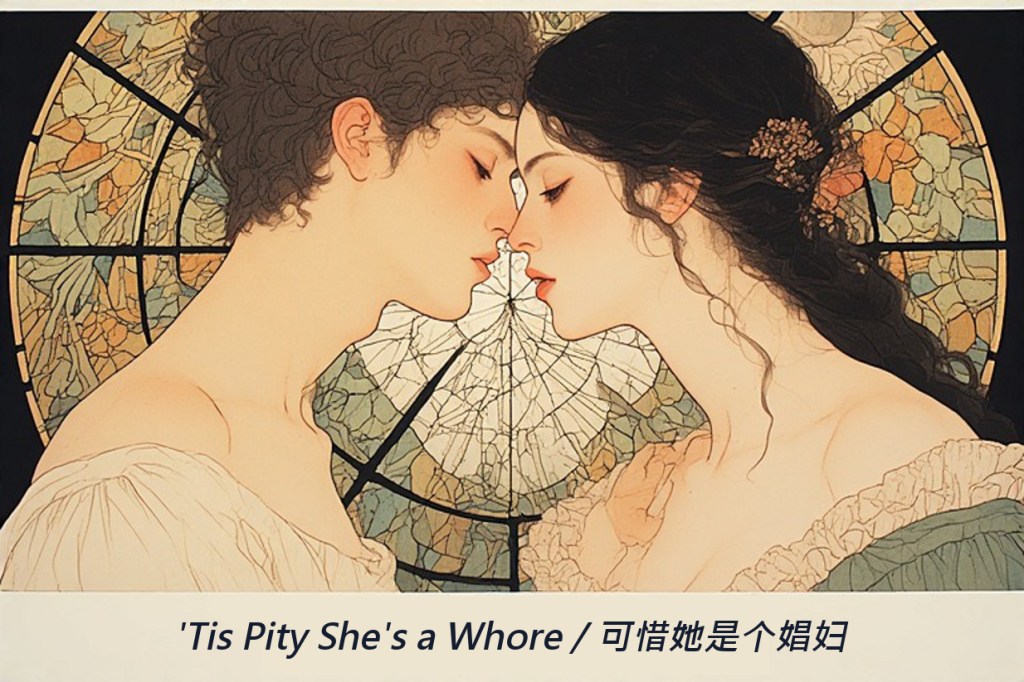
Cardinal: Child, since what you have done was not carried out from private malice, we sentence you to perpetual banishment. Within three days, you must depart. We do this not for your crime, but to uphold the principle of reason. Remove these bodies and give them proper burial. All their gold, jewels, and goods shall be confiscated by the Church. Until this day, incest and murder have never met so strangely. Of such a young woman, so richly endowed with all the beauties Nature can bestow, it is hard indeed not to say: ‘Tis pity she’s a whore.
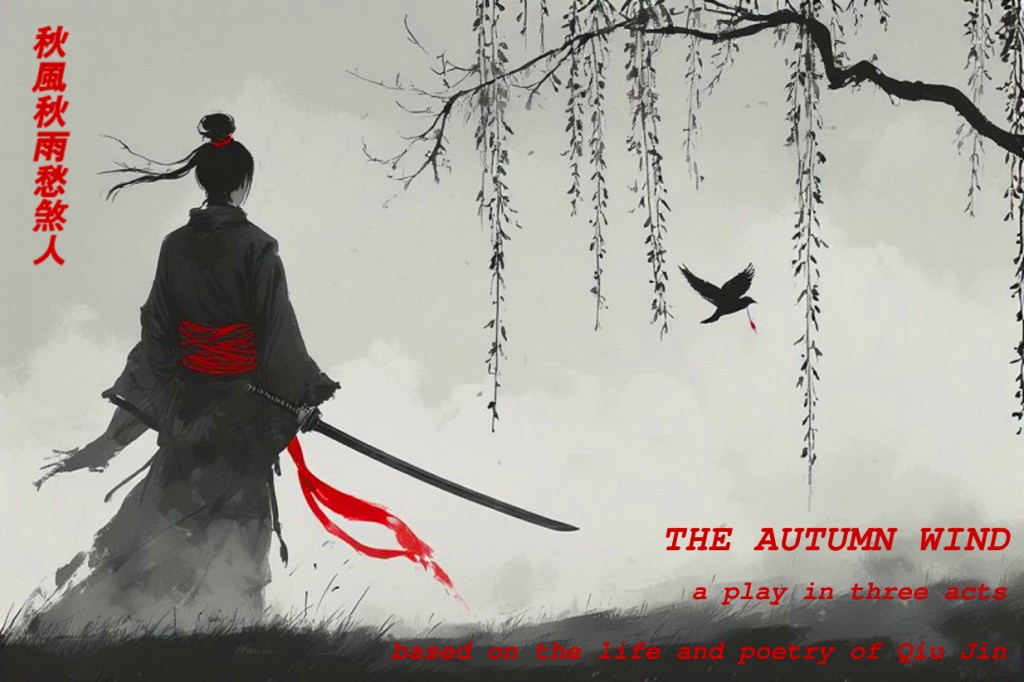
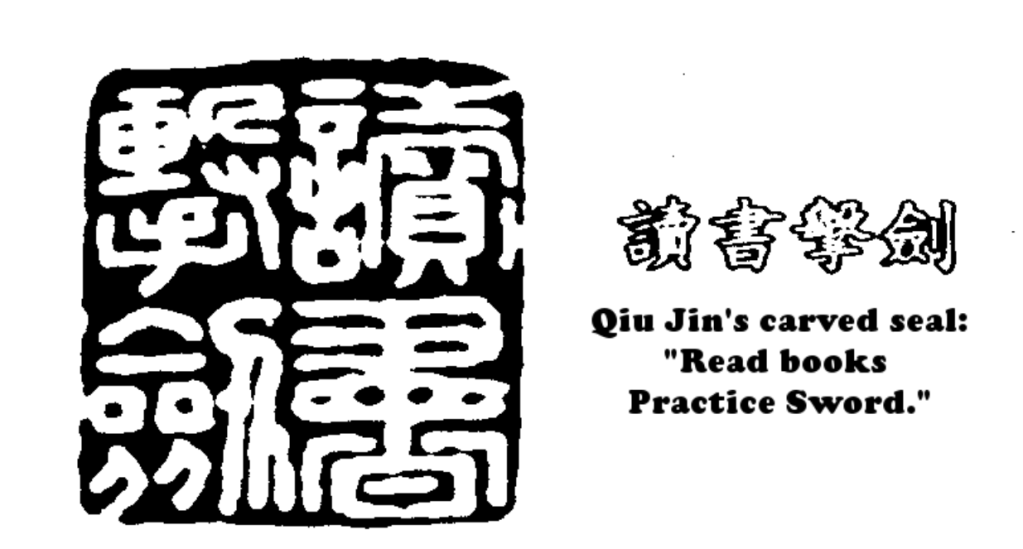
QIU JIN (30s) — Revolutionary, poet, swordswoman. She leaves her husband and children to change China. She will not succeed. She will be remembered.
WU ZHIYING (late 40s) — Poet, calligrapher, wife of a Qing official. She helps Qiu Jin escape to Japan. She loves her across distance and death.
XU ZIHUA (40s) — Widowed principal of Xunxi Girls’ School. She hires Qiu Jin. She becomes Qiu Jin’s partner, her sister, her gravedigger.
XU XILIN (30s) — Qiu Jin’s cousin. Revolutionary. He recruits her into the Restoration Society. His failure causes her death.
THE STATE (Actor 5) — Messenger, Official, Executioner, Gulin. The face of the government that wants to erase her.
Setting: Beijing, Tokyo, Zhejiang, Shaoxing. 1903-1908. A single room that transforms — a writing desk, a tea table, a scroll on the wall, a willow branch when needed, a sword that appears and disappears.
Running Time: Approximately 90 minutes.
ACT ONE: THE OATH
SCENE 1: THE CAPITAL
Beijing, 1903. Wu Zhiying’s house.
A room. Elegant but restrained. A writing desk. A scroll on the wall: four characters: 宁静致远 (“Tranquility leads to distance”). A tea table. A window.
WU ZHIYING sits at the tea table. She pours tea with precise, careful movements.
QIU JIN stands by the window, looking out.
WU ZHIYING: You have been standing there for ten minutes.
QIU JIN: I like the light.
WU ZHIYING: The light is the same as it was ten minutes ago.
QIU JIN: No. It has moved.
(Wu Zhiying sets the teapot down. She looks at Qiu Jin’s back.)
WU ZHIYING: You are not what I expected.
(Qiu Jin turns.)
QIU JIN: What did you expect?
WU ZHIYING: Someone quieter.
(Qiu Jin almost smiles.)
QIU JIN: My husband says the same thing.
WU ZHIYING: Your husband is here? In Beijing?
QIU JIN: He is here. He is always here. That is the problem.
(She crosses to the tea table. She sits across from Wu Zhiying. She does not drink.)
QIU JIN: You wrote to me. After you read my poems.
WU ZHIYING: I did.
QIU JIN: Why?
(Wu Zhiying considers the question.)
WU ZHIYING: Because I have never read anything like them. A woman writing about the Manchus. About revolution. About the lives women are forced to live.
(Pause.)
I did not know women could write like that.
QIU JIN: Neither did I. Until I did.
(Wu Zhiying looks at her.)
WU ZHIYING: You are very strange.
QIU JIN: I know.
WU ZHIYING: I like it.
(Qiu Jin finally picks up the teacup. She drinks.)
QIU JIN: This is good tea.
WU ZHIYING: It is the only good thing in this house.
(Qiu Jin sets the cup down.)
QIU JIN: You are unhappy.
(Wu Zhiying does not answer.)
QIU JIN: I can see it. In the way you pour tea. In the way you sit. You are very still. Too still. Like you are too large and are afraid someone will notice you.
WU ZHIYING: Someone might.
QIU JIN: Your husband?
WU ZHIYING: My husband does not notice anything… except for his work, his colleagues, his position. I am furniture.
(She says this flatly. Not with self-pity, simply a fact.)
QIU JIN: Then why do you stay?
WU ZHIYING: Where would I go?
(Qiu Jin leans forward.)
QIU JIN: Japan. There are women there — Chinese women — studying, writing, organizing. They are not furniture.
WU ZHIYING: I cannot go to Japan.
QIU JIN: Why not?
WU ZHIYING: Because I am a woman.
QIU JIN: That is not a reason.
WU ZHIYING: It is the only reason that matters.
(They look at each other.)
QIU JIN: I am going. As soon as I can arrange it. My husband does not know yet. He will not approve.
WU ZHIYING: Then how will you go?
QIU JIN: I will find a way.
(Wu Zhiying is silent for a long moment.)
WU ZHIYING: I have money. Not much. But some. My mother left it to me. My husband does not know.
QIU JIN: I cannot take your money.
WU ZHIYING: You are not taking it. I am giving it.
(Pause.)
Consider it payment for the poems.
(Qiu Jin stares at her.)
QIU JIN: You do not know me. We met an hour ago.
WU ZHIYING: I know your poems. That is enough.
(Qiu Jin looks down at her hands.)
QIU JIN: I will pay you back.
WU ZHIYING: No. You will not.
(She pours more tea.)
You will go to Japan. You will study. You will write more poems. You will become the woman you are meant to be. And I will stay here. In this house. Pouring tea.
QIU JIN: That is not fair.
WU ZHIYING: No. It is not.
(She hands Qiu Jin the cup.)
But it is the only way.
(Qiu Jin takes the cup. She does not drink. She holds it in both hands.)
QIU JIN: I will write to you. From Japan.
WU ZHIYING: I would like that.
QIU JIN: I will tell you everything. The women I meet. The things I learn. The revolution.
WU ZHIYING: Be careful.
QIU JIN: I am always careful.
(Wu Zhiying looks at her — at her restless hands, her bright eyes, her refusal to sit still.)
WU ZHIYING: No. You are not.
(Qiu Jin almost smiles again.)
QIU JIN: No. I am not.
(She sets the cup down. She stands.)
I should go. My husband will be wondering where I am.
WU ZHIYING: Let him wonder.
(Qiu Jin looks at her.)
WU ZHIYING: Stay a little longer.
(Qiu Jin sits down again.)
(They sit in silence. The tea grows cold.)
(Wu Zhiying reaches across the table. She takes Qiu Jin’s hand.)
(Qiu Jin does not pull away.)
WU ZHIYING(quietly): I have never done that before.
QIU JIN: Done what?
WU ZHIYING: Reached for someone.
(Qiu Jin looks at their joined hands.)
QIU JIN: Neither have I.
(They sit in silence. The light changes — the sun moving across the room.)
(Wu Zhiying speaks without looking up.)
WU ZHIYING: When you go to Japan — when you become what you are meant to be — will you remember me?
QIU JIN: I will remember this room. This tea. This light.
(She squeezes Wu Zhiying’s hand.)
I will remember your hand in mine.
(Wu Zhiying closes her eyes.)
(Lights fade.)
SCENE 2: THE ESCAPE
Beijing, 1904. The same room.
The tea table is bare. A small bag sits on the floor — Qiu Jin’s luggage. A cloak hangs over the back of a chair.
WU ZHIYING stands by the window, looking out. QIU JIN paces.
WU ZHIYING: You should sit.
QIU JIN: I cannot sit.
WU ZHIYING: You are making me nervous.
QIU JIN: You should be nervous.
(Wu Zhiying turns from the window.)
WU ZHIYING: I have done everything you asked. The money is in the bag. The tickets are in your coat. The ship leaves at dawn.
QIU JIN: I know.
WU ZHIYING: Then why are you still here?
(Qiu Jin stops pacing. She looks at Wu Zhiying.)
QIU JIN: Because I am afraid.
(Wu Zhiying crosses to her.)
WU ZHIYING: You? Afraid?
QIU JIN: I have never been outside Beijing. I have never been on a ship. I have never been alone.
WU ZHIYING: You will not be alone. There will be other women on the ship. Students. Revolutionaries.
QIU JIN: I do not know them.
WU ZHIYING: You did not know me. Six months ago.
(Qiu Jin looks at her.)
QIU JIN: That was different.
WU ZHIYING: How?
QIU JIN: Because I knew you before I met you. In your poems.
(Wu Zhiying is silent.)
QIU JIN: I read everything you ever wrote. Before I ever wrote to you. Before I ever asked to meet you. I knew your voice before I heard it.
(Pause.)
I do not know anyone in Japan.
(Wu Zhiying takes Qiu Jin’s hands.)
WU ZHIYING: Then write to me. Tell me their voices. I will learn them with you.
(Qiu Jin grips her hands.)
QIU JIN: What if I fail?
WU ZHIYING: Fail at what?
QIU JIN: At becoming what I am meant to be.
(Wu Zhiying looks at her — at her dark clothes, her pinned-up hair, her trembling hands.)
WU ZHIYING: Then why go? Why do… any of this?
(She releases Qiu Jin’s hands. She moves to the table. She picks up a small package — wrapped in silk, tied with a red cord.)
I have something for you.
QIU JIN: You have already given me too much.
WU ZHIYING: This is not money. This is not tickets.
(She holds it out.)
This is for when you are afraid.
(Qiu Jin takes the package. She unties the cord. She unwraps the silk.)
(Inside: a small jade pendant. A lotus flower. Worn smooth — old, loved.)
QIU JIN: What is this?
WU ZHIYING: My mother’s. She gave it to me when I married. She said it would protect me.
(Pause.)
It did not. Nothing could have protected me from that life.
(Qiu Jin looks at the pendant.)
WU ZHIYING: But it protected me from forgetting who I was. Before I became furniture.
(Qiu Jin holds the pendant against her chest.)
QIU JIN: I cannot take this.
WU ZHIYING: But you will.
(She steps back.)
When you are in Japan. When you are alone. When you are afraid. Hold this. Remember that someone in Beijing is thinking of you. Someone in Beijing is waiting for your letters. Someone in Beijing loves you.
(Qiu Jin’s eyes fill with tears.)
QIU JIN: You have never said that before.
WU ZHIYING: I have never had the courage.
(They stand in silence.)
(Outside, a bell rings — distant, insistent.)
WU ZHIYING: That is the curfew. You need to go.
QIU JIN: I know.
(Neither of them moves.)
WU ZHIYING: Qiu Jin.
QIU JIN: Yes?
WU ZHIYING: Do not look back.
(Qiu Jin puts the pendant around her neck. She picks up her bag and pulls her cloak over her shoulders.)
(She moves to the door. She stops.)
QIU JIN: I will write to you. From the ship. From Japan. From everywhere I go.
WU ZHIYING: I will be here.
QIU JIN: Promise me.
WU ZHIYING: I promise.
(Qiu Jin opens the door.)
(She looks back — one last time.)
QIU JIN: I love you, too.
(She leaves.)
(Wu Zhiying stands alone.)
(She crosses to the window. She watches Qiu Jin go.)
(The light changes. Dawn approaching.)
(Wu Zhiying speaks — to herself, to the empty room.)
WU ZHIYING: “Now that things have gotten so dangerous —”
(She stops.)
You wrote that. To me. In your last letter. Before you decided to leave.
(She touches the window frame.)
“Now that things have gotten so dangerous — Please change your girl’s garments for a Wu sword.”
(Pause.)
I have not changed my garments… but I have changed my heart.
(She turns from the window.)
(She looks at the tea table — bare now, empty.)
WU ZHIYING: I will wait for your letters. I will read them a hundred times. I will write back. I will tell you everything. And I will pretend — every day — that you are coming back.
(She sits down at the table.)
(She picks up a brush. She begins to write — not a poem, not a letter. Just a single character, over and over.)
(The character for “wait.”)
(守.)
(She writes it again. And again. And again.)
(Lights fade.)
SCENE 3: THE DISTANCE
Two spaces on stage simultaneously.
Stage left: A small room in Tokyo, Japan. 1904-1905. A writing desk. A window.
Stage right: Wu Zhiying’s house in Beijing. The same room.
Both poets sit at their respective desks. They write. They speak their letters aloud. The audience hears both sides of the conversation, but the women cannot hear each other.
The lights come up on both sides of the stage simultaneously.
QIU JIN writes. She speaks as she writes.
QIU JIN: I have been in Japan for three months. The city is loud. The language is strange. I do not understand half of what people say to me.
(She writes.)
But there are other Chinese women here. Students. Revolutionaries. They talk about the future as if it is something we can build with our own hands.
(She looks up.)
I have never met anyone like them.
(On the other side of the stage, WU ZHIYING reads Qiu Jin’s letter. She writes back.)
WU ZHIYING: You write about the future as if it is already here. I read your letters three, four, five times a day. I memorize them.
(She writes.)
I showed one to my husband. He asked who had written it. I told him a friend. He said, “Your friend writes like a man.”
(She sets the brush down.)
I did not tell him that was a compliment.
(QIU JIN writes again.)
QIU JIN: I have started wearing men’s clothing. It is easier to move. Easier to be seen. Easier to be taken seriously.
(She writes.)
The women here call me “Brother Qiu.” I like it.
(She pauses.)
I cut my hair. It is short now. When I look in the mirror, I do not recognize myself. But I recognize who I want to become.
(WU ZHIYING reads. She touches the page — as if she could touch Qiu Jin through the paper.)
WU ZHIYING: I dream about you. In the dreams, you are always leaving. Walking away from me. I call your name, but you do not turn around.
(She writes.)
Last night, the dream was different. You turned around. You smiled. You said, “I am not leaving. I am going ahead.”
(She sets the brush down.)
I woke up crying.
(QIU JIN writes again. Faster now.)
QIU JIN: I have joined a revolutionary society. The Restoration Society. My cousin Xu Xilin introduced them to me. They talk about assassinations. About uprisings. About blood.
(She writes.)
I thought I would be afraid. I am not.
(She pauses.)
I thought of you. When they asked me to take the oath. I thought of your hand in mine. In your house. That first day.
(She writes.)
I thought: if I die, she will remember me.
(WU ZHIYING reads. Her hand trembles.)
WU ZHIYING: Do not die.
(She writes.)
I am not asking. I am telling you. Do not die.
(She sets the brush down.)
I cannot write the poem I want to write. The words will not come. They are stuck in my chest. Behind my ribs. Where I keep your letters.
(QIU JIN writes one final time.)
QIU JIN: I am coming back to China. Soon. Not to Beijing — to Zhejiang. To start a school. To train women to fight.
(She writes.)
I do not know when I will see you again. I do not know if I will see you again.
(She pauses. She touches the jade pendant at her neck — the one Wu Zhiying gave her.)
But I carry you with me. Everywhere.
(She sets the brush down.)
(On the other side of the stage, WU ZHIYING reads the letter. She holds it against her chest.)
(Both women sit in silence.)
(The lights fade on both sides simultaneously.)
SCENE 4: THE REVOLUTIONARY
Tokyo, Japan. 1905. A small room. A table. A few chairs. On the wall, a map of China. A single sword.
QIU JIN sits at the table. Before her: a letter from Wu Zhiying. She has read it many times. She touches the characters.
XU XILIN enters. He is agitated.
XU XILIN: Are you still reading that, cousin?
(Qiu Jin looks up.)
QIU JIN: Are you still interrupting?
(He sits across from her.)
XU XILIN: I have news. The Restoration Society is meeting tonight. Cai Yuanpei will be there. Tao Chengzhang will be there.
QIU JIN: I know who they are.
XU XILIN: Then you know they are the ones who will overthrow the Manchus. Not the poets. Not the letter-writers.
(He glances at the letter.)
The ones with swords.
(Qiu Jin folds the letter. She sets it aside.)
QIU JIN: You think poetry cannot be a weapon?
XU XILIN: I think poetry has never stopped a bullet.
(She looks at him.)
QIU JIN: What are you asking me to do?
XU XILIN: Join us. Tonight. Take the oath. Become a revolutionary.
QIU JIN: I am already a revolutionary.
XU XILIN: You are a woman who wears men’s clothes and writes angry poems. That is not the same.
(She stands. He does not flinch.)
QIU JIN: You came to me in Beijing. Before I left. You told me the Manchus had to go. You told me women deserved better. You told me I could be part of something larger than myself.
XU XILIN: I meant it.
QIU JIN: Then why are you treating me like a child?
(He is silent.)
QIU JIN: I know what the Restoration Society does. Assassination. Armed uprising. Blood.
XU XILIN: Yes.
QIU JIN: You think I am not capable of that?
XU XILIN: I think you are capable of more.
(She stares at him.)
XU XILIN: You are a woman. That is a weapon. No one expects a woman to carry a bomb. No one searches a woman for a dagger. You can go where I cannot.
(Pause.)
You can kill where I cannot.
(Qiu Jin sits down slowly.)
QIU JIN: You want me to be an assassin?
XU XILIN: I want you to be a revolutionary. Assassination is just one tool.
(She looks at the letter from Wu Zhiying.)
XU XILIN: Who is that from?
QIU JIN: A friend.
XU XILIN: A friend, or a lover?
(She does not answer.)
XU XILIN: I do not care what she is to you. But do not let her make you soft.
QIU JIN: She does not make me soft. She makes me brave.
(Xu Xilin stands.)
XU XILIN: Then be brave tonight. Come to the meeting. Take the oath. Stop writing letters and start planning.
(He moves to the door. He stops.)
The meeting is at eight. I will wait for you until eight-fifteen.
(He leaves.)
(Qiu Jin sits alone. She picks up the letter. She reads it again — silently, her lips moving.)
(She sets it down. She picks up a brush. She writes back to Wu Zhiying. She speaks as she writes.)
QIU JIN(writing): My cousin has asked me to join the Restoration Society. He wants me to carry a dagger. He wants me to learn to kill.
(She writes.)
I do not know if I can. I do not know if I should. But I know I cannot stay here forever, writing poems, waiting for the world to change.
(She writes.)
I asked you once to change your girl’s garments for a Wu sword. I have changed my garments. Now I must decide what to do with my hands.
(She sets the brush down.)
(She stands. She looks at the map on the wall — China, divided, occupied.)
(She speaks to the map — to China, to the revolution, to herself.)
QIU JIN: I will go to the meeting.
(Pause.)
I will take the oath.
(Pause.)
I will become what they need me to become.
(She finishes the letter to Wu Zhiying with the following words.)
“When the saber is drawn from its scabbard, the heavens shake.
The sun, moon, and stars hide their radiance.
With one chop to the ground, the sea water stands upright.
With three inches of blade, a sinister wind howls.”
(Pause. She finishes the letter with.)
And I will not stop writing.
(She leaves.)
(Blackout.)
SCENE 5: THE ORCHID VERSE
Tokyo, Japan. 1905.
A small room. A table. A candle. On the table: a sheet of white paper, a brush, ink.
The room is bare — no map, no sword, no scrolls. Just the table and the candle and the two women who have come here to change their lives.
WU ZHIYING stands at the table. She has not yet sat down. She is looking at the blank paper.
QIU JIN watches her from the doorway.
QIU JIN: You came.
(Wu Zhiying turns.)
WU ZHIYING: You asked me to.
QIU JIN: I have asked you many times. You have not come before.
(Wu Zhiying looks around the room.)
WU ZHIYING: This is not what I expected.
QIU JIN: What did you expect?
WU ZHIYING: Something grander. An altar. Flowers. Incense.
QIU JIN(almost smiling): We are not swearing to the gods. We are swearing to each other.
(Wu Zhiying looks at her. Really looks.)
WU ZHIYING: You have changed.
QIU JIN: Yes.
WU ZHIYING: Your hair. Your clothes. Your face.
QIU JIN: My face is the same.
WU ZHIYING: No. Your face is harder.
(Qiu Jin crosses to the table. She stands opposite Wu Zhiying.)
QIU JIN: I have been learning to kill.
(Wu Zhiying does not flinch.)
WU ZHIYING: I know.
QIU JIN: My cousin — Xu Xilin — he wants me to carry a dagger. I’ve joined the Restoration Society but he wants me to be ready to die.
WU ZHIYING: And what do you want?
(Qiu Jin is silent for a moment.)
QIU JIN: I want to stop being afraid.
(Wu Zhiying nods slowly.)
WU ZHIYING: That is why I came.
(She sits down at the table. Qiu Jin sits across from her.)
WU ZHIYING: I have been thinking about what you wrote. In your letters.
(She pauses. Then she recites — from memory — Qiu Jin’s own words.)
“The scent of orchids — heart to heart,/ Like metal and stone — silently in harmony.”
(Pause.)
I have been thinking about my own life. My husband. My house. My poems. No one reads them. No one cares. I am a wife who writes. That is all.
QIU JIN: That is not all.
WU ZHIYING: It is all they see.
(She touches the blank paper.)
You wrote to me once: “My soulmate is separated by mountains and rivers.”
QIU JIN(quietly): I remember.
WU ZHIYING: I wrote a poem. For you. For today.
QIU JIN: Let me hear it.
Wu Zhiying takes a breath. She recites.
WU ZHIYING:
“We met in the capital, strangers.
We meet again in Japan, sisters.
The ink on this paper will fade.
The seals will crack. But the vow —
The vow will outlast us both.”
(She looks up.)
That is why I came.
(Silence.)
(Qiu Jin reaches across the table. She takes Wu Zhiying’s hand.)
QIU JIN: Then let us swear it. Here. Now. No altar. No incense. Just us.
WU ZHIYING: What do we swear?
QIU JIN: That we are sisters. Beyond blood. Beyond marriage. Beyond death.
(Wu Zhiying looks at their joined hands.)
WU ZHIYING: And if one of us dies?
QIU JIN: Then the other carries her name.
(Wu Zhiying nods.)
WU ZHIYING: Then write it.
(Wu Zhiying reaches into her sleeve. She pulls out a small silk pouch. She unties it. Inside: a brush — not an ordinary one. The handle is carved with orchids. It is beautiful, personal, clearly special.)
(She holds it out to Qiu Jin.)
WU ZHIYING: My brush. The one I use for my best poems. I have never let anyone else hold it.
(Qiu Jin takes it. She looks at it. She looks at Wu Zhiying.)
QIU JIN: This is more than a vow.
WU ZHIYING: Yes.
(Qiu Jin picks up the brush. She dips it in ink. She begins to write on the white paper. She speaks as she writes.)
QIU JIN(writing): We, Qiu Jin and Wu Zhiying, swear before heaven and earth —
(She writes.)
To be sisters. To share each other’s joys and sorrows. To protect each other’s names.
(She writes.)
If one of us dies, the other will live as if she were still here.
(She sets the brush down. She reads what she has written.)
(Then she hands the brush to Wu Zhiying.)
(Pause.)
(Wu Zhiying takes the brush. She reads the contract. She adds her own lines. She speaks as she writes.)
WU ZHIYING(writing): I, Wu Zhiying, swear to keep Qiu Jin alive.
(She writes.)
I will not let her disappear.
(She sets the brush down.)
(They look at each other across the table.)
(Wu Zhiying folds the contract carefully. She tucks it into her sleeve.)
(They sit in silence.)
(Wu Zhiying stands.)
WU ZHIYING: I should go. The ship leaves at dawn.
QIU JIN: I know.
WU ZHIYING: Will you write to me?
QIU JIN: Every day.
WU ZHIYING: And when you return to China?
QIU JIN: I will find you.
(Wu Zhiying moves to the door. She stops.)
WU ZHIYING: Qiu Jin.
QIU JIN: Yes?
WU ZHIYING: Do not die.
(Qiu Jin does not answer.)
(Wu Zhiying leaves.)
(Qiu Jin stands alone. She holds the carved brush against her chest. She looks at the empty doorway.)
(She speaks — to Wu Zhiying, who cannot hear her, and to herself.)
QIU JIN: I will try.
(She bows her head.)
(Lights fade.)
ACT TWO: THE SCHOOL
SCENE 6: THE HIRE
Xunxi Girls’ School, Zhejiang Province. 1906.
A small office. A wooden desk, neat. A stack of student essays. A pot of cold tea. A window looking out onto a courtyard.
On the wall behind the desk: a scroll of calligraphy. Four characters: 宁静致远 — “Tranquility leads to distance.”
XU ZIHUA sits behind the desk. She holds a letter — Qiu Jin’s application. She has read it three times.
QIU JIN stands. She has not been offered a seat. She does not seem to notice.
XU ZIHUA: Your letter says you studied in Tokyo.
QIU JIN: I did.
XU ZIHUA: And before that?
QIU JIN: I was married.
(Xu Zihua looks up. A pause.)
XU ZIHUA: Many of our teachers are married.
QIU JIN: I left.
(Another pause.)
XU ZIHUA: I see.
(She sets the letter down. She folds her hands.)
You understand what we teach here. Girls. Young women. Most of them will marry. Most of them will raise children. We teach them to read, to write, to calculate. To be useful.
QIU JIN: You teach them to be small.
XU ZIHUA: I teach them to survive.
QIU JIN: Same thing.
(Xu Zihua does not rise to it. She waits.)
XU ZIHUA: Why do you want to teach here?
QIU JIN: Because you are the only school that would read my letter.
XU ZIHUA: That is not an answer.
QIU JIN: But it is the truth.
(Xu Zihua stands. She moves to the window. She looks out at the courtyard.)
XU ZIHUA: I have been principal here for six years. When I started, we had forty students. Now we have sixty. The local gentry want me to stop. They say I am creating women who will not obey their husbands.
(She turns.)
They are right.
QIU JIN: Then why do you keep going?
XU ZIHUA: Because my husband is dead.
(Qiu Jin waits.)
XU ZIHUA: He was a good man. He did not beat me. He did not take concubines. By every measure, I should mourn him still.
(She returns to the desk. She does not sit.)
But when he died, I could breathe.
(Qiu Jin’s face changes. Something softens.)
XU ZIHUA: I do not teach these girls to be small. I teach them to wait. There is a difference.
QIU JIN: For how long?
XU ZIHUA: What?
QIU JIN: For how long should they wait?
(Xu Zihua does not answer.)
QIU JIN(quoting from memory):
“I often wondered if you were a goddess beyond the clouds.
How fortunate to meet you, to clasp your hand in joy.
Your ambition surpasses even men’s.
Such talent in a woman is rare indeed.
Together we shall save our motherland…
How many women have long been submissive, hidden away?
We rely on you to restore our rights to freedom.”
Xu Zihua is startled into silence.
XU ZIHUA: You’ve read my poetry?
(She laughs, as if this is too absurd to even believe.)
Of course you have. Of course you have.
(She shakes her head.)
Look around you. This is a girl’s school, not a den of cut-throats and radicals. I am a school teacher, not a revolutionary.
QIU JIN: I think you already are. You just won’t admit it.
(A long silence.)
(Xu Zihua sits down heavily.)
XU ZIHUA: The magistrate came to see me last week. He said he has heard rumors about you. About the women’s newspaper you started in Shanghai.
QIU JIN: The newspaper is not a rumor.
XU ZIHUA: He said if I hire you, he will close my school.
QIU JIN: Will he?
XU ZIHUA: I do not know.
QIU JIN: Then we find out together.
(Xu Zihua laughs once more — a short, surprised sound.)
XU ZIHUA: You are not afraid of anything, are you?
QIU JIN: I am afraid of dying old. In a bed. Having done nothing.
(Xu Zihua looks at her. Really looks.)
XU ZIHUA: What would you teach my students?
QIU JIN: The truth.
XU ZIHUA: Which is?
QIU JIN: That the world can be different.
(Xu Zihua nods slowly.)
XU ZIHUA: And if I ask you to leave that part out?
QIU JIN: Then I am not your teacher.
XU ZIHUA: I cannot hire you.
QIU JIN: I know.
XU ZIHUA: You will get us both killed.
QIU JIN: Probably.
(Xu Zihua stands again. She goes to the window. She speaks without turning.)
XU ZIHUA: My daughter is eight years old. She is learning to read. She asked me last week why there are no women in the history books. I told her there are. She asked why no one talks about them. I did not have an answer.
(She turns.)
Be here tomorrow. Seven in the morning. The students arrive at seven.
QIU JIN: You just said—
(This time it is Qiu Jin who falls into silence. A small, brief smile.)
(Xu Zihua returns to the desk. She picks up the application letter. She folds it carefully.)
XU ZIHUA: I will tell the magistrate you are teaching physical education. Sword drills. Traditional forms. Nothing political.
QIU JIN: The sword is political.
XU ZIHUA(without looking up): Then teach them to hold it quietly.
(Qiu Jin watches her for a long moment.)
QIU JIN: What is your daughter’s name?
XU ZIHUA: Xiao Hua.
QIU JIN: Little Flower.
(Xu Zihua nods.)
QIU JIN: Then she is about to write history books that do not exist yet.
(Xu Zihua looks up. Her eyes are wet. She does not wipe them.)
XU ZIHUA: Seven o’clock.
(Qiu Jin turns to leave. At the door, she stops.)
QIU JIN: One more thing.
XU ZIHUA: Yes?
QIU JIN: The sword drills. They are not traditional.
(She leaves.)
(Xu Zihua sits alone. She picks up the cold tea. She does not drink it. She holds it.)
(After a long moment, she speaks to the empty room.)
XU ZIHUA(quietly): Little Flower. You asked why no one talks about them.
The same room as Scene 6. The desk. The scroll on the wall: “Tranquility leads to distance.”
But now there is something new: a printing press. Small. Portable. Ink-stained. Sheets of paper are scattered everywhere — some printed, some smudged, some discarded. Qiu Jin has been working. It is a messy job. Ink is on her hands, her sleeves, her face.
XU ZIHUA enters. She finds Qiu Jin hunched over the press, pulling a lever, checking a sheet, cursing softly under her breath. Ink is everywhere.
Xu Zihua watches for a moment. Then she approaches. She touches the metal of the press.
XU ZIHUA: This is what you spent your money on?
(Qiu Jin does not look up. She is adjusting the type.)
QIU JIN: This is what will change the world.
(Xu Zihua looks at her.)
XU ZIHUA: It’s a printing press.
(Qiu Jin looks up. She holds up a sheet of paper — the first proof of the newspaper.)
QIU JIN: It’s a sword.
(Xu Zihua is silent.)
XU ZIHUA: How many copies?
QIU JIN: One thousand.
XU ZIHUA: We have sixty students.
QIU JIN: The students are not the only ones who need to read it.
(She picks up the proof sheet.)
The magistrate has soldiers. He has guns. He has the law on his side.
(She holds up the paper.)
We have this.
XU ZIHUA: A gazette? A tabloid? A periodical?
QIU JIN: A truth that will reach those who have never been told they matter. In villages where no revolutionary has ever gone. It will reach anyone who thinks they are alone.
(She sets the paper down.)
The magistrate can kill me. He cannot kill everyone who reads this.
(Xu Zihua is silent.)
XU ZIHUA: You wrote the first issue already. What does it say?
(Qiu Jin picks up the proof sheet. She reads — not the whole thing, just fragments. The most dangerous lines.)
QIU JIN(reading): “The greatest injustice in this world is the injustice suffered by our two hundred million sisters.”
(She turns the page.)
“When heaven created people, it never intended such injustice. If the world is without women, how can men be born?”
(She looks up.)
“If we don’t take heart now and shape up, it will be too late when China is destroyed.”
(She sets the proof down.)
And I mean every word.
(Xu Zihua picks up the proof. She reads it silently. Her face changes.)
XU ZIHUA: They will burn every copy they find.
QIU JIN: Then we print more.
XU ZIHUA: They will arrest the people who distribute it.
QIU JIN: Then we find new people.
XU ZIHUA: They will kill you.
(Qiu Jin looks at her. Steady.)
QIU JIN: Then you will print it without me.
(Xu Zihua stares at her.)
QIU JIN: That is the test. Not whether you will fight when I am standing beside you—
(She stops. A long silence.)
(Xu Zihua sets the proof down. She touches the printing press again — differently this time. Not curious. Committed.)
XU ZIHUA: Show me how it works.
(Qiu Jin places a sheet of paper on the press. She inks the type. She pulls the lever.)
(The press closes. Opens.)
(A printed page.)
(Xu Zihua picks it up. She holds it in both hands. She reads the title.)
XU ZIHUA:“China Women’s News.”
(She looks at Qiu Jin.)
With this we will shake the world. With this everyone will hear.
QIU JIN: Yes.
(Xu Zihua looks at the printed page in her hands. Then she crosses to the wall. She pins it there — in huge letters, for everyone to see.)
《中国女报》
(She steps back. She looks at it. Then she looks at Qiu Jin.)
(Qiu Jin looks at the stack of printed pages — the newspaper that they both hope will outlast them all.)
(Xu Zihua picks up the next blank sheet of paper. She moves to the machine. She begins the process.)
XU ZIHUA: One thousand copies.
(She smiles.)
You asked me to help. So, I am helping.
(Xu Zihua touches the paper — not the ink, not the type. The edge. The place where the next issue will begin.)
(They turn back to the press. They work together — placing paper, inking type, pulling the lever.)
(The rhythm of it. The sound of it.)
(Lights fade.)
SCENE 8: THE SWORD
Setting: Xunxi Girls’ School. 1907.
The room is now a sparring hall. Mats on the floor. A weapons rack against the wall — wooden swords, staffs, a real blade.
On the wall: a scroll with Qiu Jin’s personal motto: “Read Books./ Practice Sword.”
Qiu Jin is dressed in protective gear, holding a wooden sword. She is in the middle of training one of her students (Actor 5), who is also dressed for dueling.
Qiu Jin has been training her students for months and months and still the young girls are not ready.
XU XILIN enters. He is agitated — always agitated now.
XU XILIN: I finally found you! What are you doing?
(Humoring him but not stopping what she is doing.)
QIU JIN: Preparing.
(He crosses to her.)
XU XILIN: These girls. The ones you are training. Are they ready?
(As if to illustrate the two women duel. The student isn’t very good.)
QIU JIN: They are learning.
XU XILIN: Learning is not the same as ready.
(Lowering her sword. Still not looking at him.)
QIU JIN(almost sarcastic): Must I point out that patience is a virtuous trait?
(He looks at her blankly.)
XU XILIN: The sword. You have been practicing.
(For the first time Qiu Jin turns to look at her cousin. There is something wrong with him, something manic, something unhinged.)
(She has no words for this: of course she has been “practicing.”)
XU XILIN: Show me.
(He moves to the weapons rack. He takes a wooden sword. The student moves to one side. He takes her place.)
(They face each other.)
(Xu’s rage and impatience bubble right under the surface. When he recites his little speech it is clear that he’s been saying the same thing over and over for ages. It could be a slogan from a propaganda poster. It isn’t poetry.)
XU XILIN: For two hundred years the Manchus have forgotten that we are Han!
(He raises his blade.)
We will remind them!
(He attacks.)
(They spar. The fight is not long — thirty seconds, forty. But it is real. No music. Just the sound of wood on wood, breath, feet on the mats.)
(Xu Xilin is good. But Qiu Jin is far better. She disarms him. His wooden sword clatters to the floor.)
(He picks up his sword as if that round didn’t count.)
XU XILIN: Again.
(They circle each other.)
XU XILIN: You are thinking about her. The woman in Beijing. The one who writes you letters.
(Xu attacks — faster this time, harder.)
(She blocks and counters. She disarms him again.)
(For all his revolutionary zeal he has lost his way, his humanity.)
XU XILIN: You are thinking about *her* when you should be thinking about the *blade!*
QIU JIN(calmly): I am always thinking about her.
(He picks up his sword. He does not wait for her to attack. He moves first.)
(This time, she does not hesitate.)
(She drives him back across the room. He parries, blocks, retreats. She presses forward.)
(She strikes his blade from his hand.)
(His wooden sword falls, for the last time, to the ground.)
(She points her blade at his chest.)
(Silence.)
(The Student stares.)
XU XILIN(breathing hard): Fine. So you’ve “practiced.”
(He still only sees her as a girl.)
I have something for you.
(She lowers her sword.)
(He brings out a dagger — small, sharp, ridiculous against the sword Qiu Jin normally wears.)
(He holds it out.)
XU XILIN: It is meant to be hidden. In your sleeve. In your boot. In your hair.
(Qiu Jin looks at the dagger. Then at him.)
QIU JIN: I already have a sword.
XU XILIN(sneers): Yes, yes, that “sword”… what good are swords for assassinations?
XU XILIN: Take it.
(She does not take it.)
(Instead she walks to where his fallen wooden sword lays, retrieves it and places both hers and his back into the weapon rack. Respect for the weapon. For the ritual. A highly trained realist doing what the chaotic zealot can’t.)
XU XILIN(again): Take it.
(She takes it. She holds it in her palm. It is light.)
XU XILIN: You will need it. Soon.
(She looks at him.)
QIU JIN: What do you mean?
XU XILIN: I am going to Anqing. Next week.
QIU JIN: Why?
XU XILIN: To meet with En Ming. The governor.
(For once Qiu Jin looks taken aback. This isn’t news, this is just crazy.)
QIU JIN: What? You are going to kill him?
(He does not answer.)
QIU JIN(calmly): Xu Xilin. Cousin. You are going to kill him?
XU XILIN: Yes.
(She stares at him.)
QIU JIN: That is suicide.
XU XILIN: It is revolution.
QIU JIN: It is madness. You will die. Nothing will change.
XU XILIN: You do not know that. The People! The People will rise!
QIU JIN: I know that when you fail — and you *will* fail — they will go after your comrades, your friends… and your family. They will come here. They will arrest every student in this building. They will torture them. They will kill them.
XU XILIN: Then you should have trained them to fight harder.
(This is the one moment in the play when Qiu Jin loses her self-control. She slams the dagger down into the floor between them. The sound rings through the room.)
QIU JIN: You are a fool!
(He does not flinch.)
QIU JIN: You are a blind, arrogant fool. You think one dead governor will bring down the Qing? You think all of China will rise up at your call, like a trained dog?
XU XILIN: Someone has to start.
QIU JIN: Starting is not the same as succeeding! You are starting nothing. They’ll cut out your entrails and eat you alive. And you are taking the rest of us with you.
(She turns away from him. She cannot look at him.)
XU XILIN: You did not used to be this way. You used to believe in the revolution.
QIU JIN: “Believe”? No, cousin. Back in Japan I “believed”.
(She turns back.)
Now I am beyond belief. This is faith. What you suggest isn’t even revolution. It is vanity.
XU XILIN: You are a coward.
(Qiu Jin wrenches the dagger from the floor. She is furious.)
QIU JIN: Once! Once I swore that if I ever returned to the motherland, if I ever surrendered to the Manchu barbarians, if I ever deceived the Han people, then “stab me with this dagger”!
(He is silent.)
(She holds the dagger out in one hand.)
QIU JIN: If I am such a coward! — If all of this (gestures to the student, the school, China, everything) — means nothing to you — then go on, use this! Show me what a real revolutionary would do!
(Silence.)
(She drops the dagger on the floor, forgotten — not shouting now. Quiet. Deadly.)
QIU JIN: But I will not follow you into death for no reason. I will not sacrifice my students for some man’s pathetic satisfaction.
(She walks to the door. She stops.)
Even if the soldiers come — even if they ask what I knew — I will *never* tell them the truth: that you are a madman and are willing to throw away everything that we’ve worked for, everything that we’ve built, for pride.
(She leaves, her student following quickly behind.)
(Xu Xilin stands alone.)
(He looks at the dagger, laying on the floor.)
(It is impossible to read what he is thinking.)
(He picks it up. He holds it in his hand.)
(He says nothing.)
(Lights fade.)
SCENE 9: THE NEWS
Setting: Xunxi Girls’ School. July 1907. Afternoon.
Xu Zihua’s office. The same room. The scroll on the wall: “Tranquility leads to distance.” The printing press is in the corner. The newspaper is still pinned to the wall — 《中国女报》.
Xu Zihua and Qiu Jin sit at the desk. They are grading papers. A pot of tea sits between them. It is ordinary. It is mundane. It is the last ordinary moment of their lives.
Xu Zihua marks a paper. She sets it aside. She picks up another.
XU ZIHUA: This one is good. She wrote about the Tang dynasty poets.
QIU JIN(without looking up): Which ones?
XU ZIHUA: Li Bai. Du Fu. The usual.
QIU JIN: Did she mention that Li Bai died drunk in a boat, trying to embrace the moon’s reflection in the water?
(Xu Zihua looks at her.)
XU ZIHUA: No. She left that part out.
QIU JIN: Pity. That is the best part.
(She sets her paper down. She pours tea.)
QIU JIN: How many more?
XU ZIHUA: A dozen. Maybe more.
QIU JIN: We will be here all night.
XU ZIHUA: Is that a problem?
(Qiu Jin almost smiles.)
QIU JIN: No.
(She hands Xu Zihua a cup of tea.)
QIU JIN: No, it is not.
(They drink their tea. The afternoon light is golden. Peaceful.)
(Then — running footsteps. The door bursts open.)
(THE MESSENGER stands there, gasping for breath. His face is white. His clothes are torn. He has run all the way from Anqing.)
(Xu Zihua stands. The cup falls from her hand. It shatters on the floor.)
XU ZIHUA: What happened?
(The Messenger cannot speak. He is shaking.)
QIU JIN(calmly): Tell me.
MESSENGER: Anqing. The governor. Xu Xilin —
(He stops. He cannot finish.)
QIU JIN: Tell me.
MESSENGER: He killed En Ming. At the police academy. In front of everyone.
(Xu Zihua gasps. Qiu Jin does not move.)
MESSENGER: But the soldiers — they surrounded the building. He fought for hours. They captured him.
QIU JIN: Is he dead?
MESSENGER: Not yet.
(Pause.)
But he will be.
(Silence.)
(Xu Zihua looks at Qiu Jin. Qiu Jin’s face is unreadable.)
MESSENGER: Madam, you need to leave. They know about the school. They know about the plan. They will come here next.
QIU JIN: When?
MESSENGER: Hours. Maybe less. I rode ahead. They — they are coming.
(Outside, in the distance, shouting, violence. The sound of boots. There is nothing human about this noise: if totalitarianism had a heartbeat it would pound like this.)
(Xu Zihua runs to the window. She looks out. Her face drains of color.)
XU ZIHUA: They are already here.
(She turns to Qiu Jin.)
There is a back way. Through the kitchen. You can climb the wall—
QIU JIN: No.
XU ZIHUA: Qiu Jin—
QIU JIN: If I run—
(She pauses, gathers herself. Self-control is a terrible weight to carry.)
QIU JIN: (trying again): If I run they will take it out on everyone: you, the students, anyone who has ever trained in this room.
(She stands. She is calm.)
I have been waiting for this moment since the day my cousin left for Anqing.
XU ZIHUA: You knew he would fail?
QIU JIN: I knew he would try. That was enough.
(She moves to the desk. She picks up a brush. She dips it in ink.)
XU ZIHUA: What are you doing?
QIU JIN: Writing a letter. To a friend.
XU ZIHUA: There is no time for letters.
QIU JIN: There is always time for letters.
(She writes. She speaks as she writes.)
QIU JIN(writing): To Wu Zhiying, Beijing —
(She writes.)
The uprising has failed. Xu Xilin is captured. They are here.
(She stops. Stares at nothing.)
QIU JIN: (speaking as if Wu Zhiying were there): I do not regret anything. Not Japan. Not the school. Not the newspaper. Not the sword.
(She looks down at the paper. Writes.)
I only regret that I will not see you again.
(She sets the brush down.)
XU ZIHUA(picking up the paper, horrified): You are not finished.
(The noise outside intensifies. If there are students, or teachers, or civilians crying or lamenting or pleading it is lost in the chaos.)
QIU JIN(slowly): No. I am not.
(Xu Zihua rushes to Qiu Jin, as if she is ready to break a thousand years of tradition in this one action and clings to her, desperate, out of her mind with horror.)
XU ZIHUA: No! No, no, no, no! You can’t! There is still time. The back way—
(Qiu Jin gently removes Xu Zihua from her.)
QIU JIN: And lose you?
I will not let that happen.
(She moves to the door.)
(Qiu Jin stops. She does not turn.)
QIU JIN: When they ask… tell them that I was not afraid.
(Pause.)
(She turns. She looks at Xu Zihua. Her face is calm. Resolved.)
QIU JIN: Bury me at West Lake. Where the heroes are.
(She leaves.)
(Xu Zihua collapses in shock. She holds the unfinished letter.)
(Chaos outside. Boots on the stairs. Worlds ending.)
(As the lights and noise fade we are left in a bloodcurdling silence of inevitability.)
(Blackness.)
SCENE 10: THE AUTUMN WIND
The room is now a prison cell. Dim. Claustrophobic. One small window.
QIU JIN sits, shackled, at a bare wooden table.
She has been here for days. The interrogation is over. Her hands are shattered. Her lip is split. One eye is swollen. Her clothes are torn.
But her back is straight. She has not broken.
The light outside her cell is bleak, gray, rainy: autumn.
She traces a single word for the wind on the bare table in front of her: 风
These are the two elements that will form her greatest poem.
She stops.
She closes her eyes.
The noise of boots: softer but still just as tyrannical.
The sound of keys, of bolts being drawn of locks opening.
The door opens.
THE OFFICIAL enters. He is the face of the state, come to offer her a way out. He is doing his job.
OFFICIAL: Qiu Jin.
(She opens her eyes. She does not turn.)
OFFICIAL: You have been given every chance. Confess. Name your comrades. The governor is merciful.
QIU JIN: The governor is a Manchu. There is no mercy in him.
OFFICIAL: He will spare your life.
(Qiu Jin turns. She looks at him. They both know that’s a lie.)
QIU JIN: And, tell me, what would I do with my life if I “confessed and named my comrades”?
(The Official is surprised. He pauses, considering.)
OFFICIAL: Why, you would live, of course.
(Qiu Jin says nothing. The Official tries reasoning one last time. It has yet to work.)
OFFICIAL: Look, I understand. You are brave, for a woman. You want things better for all of us. So does the governor.
(The Official spreads a blank sheet of paper before her. He brings out ink and a brush. Qiu Jin stares at all this.)
QIU JIN(almost a whisper to herself, almost): “Not a man in the flesh, unable to walk among them;/ But my heart is stronger, more fierce than any man’s.”
OFFICIAL(confused): What? (Pressing on.) Go ahead. Take the brush. Confess.
(Qiu Jin raises one shackled hand, the chains rattling. She writes. She puts the brush down.)
(He looks at the paper. He reads the characters.)
(He looks at her.)
This is not a confession.
QIU JIN: It is the only one I have.
(He stares at her.)
OFFICIAL: Then you will die at dawn.
QIU JIN: I know.
(He leaves.)
(Qiu Jin is alone.)
(She stands. She speaks — to the room, to the women she loves, to everyone who cannot hear her.)
QIU JIN: They will kill me at dawn. At Xuantingkou. In the square where they behead criminals.
(Pause.)
There will be a crowd. Some will cheer. Some will weep.
(She touches her chest, where the pendant lies.)
I will not close my eyes. I want to see them.
I want to see the ones who will remember.
(Blackout.)
(When the lights rise, the stage is transformed.)
(The prison cell is gone. The square at Xuantingkou. Bare. A single wooden post. Ropes.)
(The gray light of dawn.)
(THE EXECUTIONER stands to one side. His ASSISTANT stands beside him.)
(Qiu Jin is led in. The Guards bind her to the post. Her hands are tied behind her. Her body is upright. Her face is toward the audience. She does not blink.)
(The Assistant moves behind her. He gathers her long hair in one hand, pulling it forward, lowering her head toward the ground.)
(Qiu Jin does not close her eyes.)
(She speaks, her confession, her last lines.)
QIU JIN: “Autumn wind, autumn rain, fills my heart with sorrow.”
(Pause.)
(The Executioner raises his sword.)
(The Assistant holds her hair taut.)
(The sword hangs in the air.)
(Silence.)
(Qiu Jin’s eyes find the audience.)
(She does not look away.)
(Blackout.)
(Complete darkness.)
(No sound.)
(Long pause.)
(Then, very faintly, the sound of wind.)
ACT THREE: THE ELEGY
SCENE 11: THE MADNESS OF WU ZHIYING
Setting: Wu Zhiying’s house, Beijing. July 1907.
The same room as Act One. On the wall, a scroll of calligraphy: 安排嬌骨用鞭摑 — in Qiu Jin’s handwriting. It would be droll if anyone was in the mood for such frivolous gestures.
But the room is a wreck. Dark. Curtains drawn. Table overturned. A broken tea set. A black mess where a pot of ink had been thrown against a wall in rage.
A single candle burns low — it has been burning for days.
Books, poems, papers are scattered on the floor. A life of letters has been dropped and not picked up.
WU ZHIYING sits on the floor. Hair undone. She does not move, staring at nothing. She has been here for days.
The candle flickers.
She mumbles — these are not words to be heard by anyone.
WU ZHIYING: “One life…”
(She stops.)
(She tries again.)
“One life…”
(She cannot finish.)
(She looks at the writing brush on the floor. She does not pick it up.)
(Blackout.)
(When the lights come on again time has passed. A couple of days — a thousand years, it is impossible to know.)
(Wu Zhiying has moved beyond grief into a new state — not mania, but she is a woman driven by a feverish goal that has consumed her.)
(But she is ill, gravely ill. A cup of untouched medicine sits on the floor. Cold. Forgotten. She stops once in a while to cough into a handkerchief. Perhaps not consumption, perhaps not blood in the lungs, but a dire illness.)
(Regardless, she sits at her table, now right side up, writing furiously.)
(Whatever sentiment that drove her to say, “I will stay here in this house pouring tea,” in Act 1 has been forgotten.)
(The floor around her contains a thousand crumpled attempts at articulating her grief. At her elbow, a small mountain of papers have been stacked; she has been composing Qiu Jin’s biography, writing eulogies, writing and writing and writing.)
(She stops. Puts down her brush with ink-stained fingers.)
(Silently reads her lines.)
(Rage at not writing the right words. In a fit she crumples the poem, tosses it aside. There is a horrible moment when she isn’t in control. It passes. She takes a fresh sheet of paper and starts again.)
(She closes her eyes. Gathers her thoughts. A long pause.)
(She begins to write. Stops. Adds a thought and puts down the brush.)
(She stands. This should be an agonizing movement; she has been sitting for days, her body forgotten. She walks a little, trying to get the blood moving. She stands over her poem, looking down on it, casting judgment.)
(She picks up the paper and finally reads it out loud.)
WU ZHIYING: “One life, not preserved, / For millennia, a heroic name lives.”
(At some earlier time she would have paused to enjoy such a powerful, creative success. Not today. She places the paper on top of the pile of finished work.)
(She sits. Picks up her brush and begins to write once more.)
(Blackness.)
(When the lights come up this time Wu Zhiying has transformed. She is still ill, still weak, but her hair is washed and her clothes clean. Her manuscripts organized into piles in front of her.)
(She speaks as she writes.)
WU ZHIYING(writing and coughing): To Xu Zihua, Principal of Xunxi Girls’ School —
(She writes.)
You have suggested a burial site by West Lake. Xiling. The place Qiu Jin herself wanted.
(She writes.)
Already the government is speaking out against — (She finds she is about to write, “Brother Qiu,” pauses and includes it.) Already there are rumors her body will be dug up, desecrated, as a warning to others. (She pauses, thinks.) The first priority is to secretly transport her coffin to the lake without the officials knowing. I have found a man in Shaoxing who can help.
(She stops as coughing nearly overwhelms her. Through pure self-will she controls herself, picks up the brush and continues.)
Write to me. We must act quickly.
(She sets the brush down. She reads what she has written. Then she adds one more line.)
WU ZHIYING(writing): She spoke of you often. In her last months, you were the one at her side. I do not know you. But I know she loved you. That is enough for me.
(She folds the letter. She seals it.)
(She holds it in both hands.)
(She speaks — to the letter, to Xu Zihua, to Qiu Jin.)
WU ZHIYING: I do not know if you will answer. I do not know if you are even alive.
(Pause.)
But you are the only other person in the world who loved her the way I did.
(She sets the letter down.)
That makes you my sister.
(She stands. She moves to the window. She opens the curtains. Light floods the room.)
(She blinks as if she had forgotten sunlight was even possible.)
(She calls out.)
WU ZHIYING: Messenger!
(The MESSENGER enters — the same young man from Scene 10. He is frightened. He is always frightened.)
MESSENGER: Madam?
WU ZHIYING: This must go to Zhejiang. Xunxi Girls’ School. Do not let anyone else touch it.
MESSENGER: Madam, the roads are dangerous—
WU ZHIYING: Then avoid the danger.
(He takes the letter. He leaves.)
(Wu Zhiying stands alone.)
(She looks at the scroll on the wall — Qiu Jin’s calligraphy.)
(She speaks — not to Qiu Jin now. To herself.)
WU ZHIYING:“One life, not preserved. / For millennia, a heroic name lives.”
(Whatever she was suffering in the beginning of the scene, she has turned her trauma into a weapon.)
(She bows her head.)
(Lights fade.)
SCENE 14: THE FUNERAL
Setting: West Lake, Hangzhou. Spring 1908.
The stage is bare. A single willow branch hangs from above — the suggestion of a tree, of water, of a place where heroes are buried.
A grave marker. Simple. Unadorned. A mound of earth.
WU ZHIYING and XU ZIHUA kneel at the grave. They have been here for some time.
The sound of a crowd — distant, murmuring. Not loud. Just present. Waiting.
Wu Zhiying reads her eulogy first. Not loudly. Not whispered. Simply.
WU ZHIYING:
“Are you sated by my great offering of wine?
Looking back at Jiangting, one farewell, many tears.
Today at Xiling I risk a great wailing.
I cannot sing your song, ‘The Precious Sword’.”
(She pauses.)
(Xu Zihua speaks.)
XU ZIHUA:
Those few of us who still keep our promises
will hang up our swords at her grave like the loyal Yanling.
From now on, the waves of Xiling,
when they reach this bridge, will not rest.
(Wu Zhiying speaks again.)
WU ZHIYING:
Painful is the memory of our parting,
tears of the lone traveler fell like silken thread.
Alone, I gaze upon the sun that sets behind the lone grave mount,
Holding my sorrow, which no one can know.
XU ZIHUA:
XU ZIHUA:
The one who lies here met a bloody end,
though now may rest by a good lake and a green hill, at home.
Oh let my grave be at the right side of yours —
under the bright moon, we will wander together
among the pines and catalpas.
(Silence.)
(The crowd murmurs. Louder now. Restless.)
(Wu Zhiying speaks again — a different poem, one she wrote on the road to Shanyin.)
WU ZHIYING:
Vast and murky are heaven and earth,
a myriad of feelings assault me.
I gather your bones, my tears soak the kerchief.
Autumn wind, autumn rain,
along the Shanyin road,
Sigh upon sigh,
it is not easy to be a survivor.
(She pauses.)
(Xu Zihua speaks her final poem.)
XU ZIHUA:
A legend of blood has been written.
Fortunately, there are green hills to hold the white bones.
Nanhu has built a bower for “Mourning Autumn”;
Will you visit us there, when the wind comes, and the rain?
(They wait.)
(The wind.)
(Silence.)
(Then — footsteps.)
(GULIN steps forward from the crowd. He is a Manchu official. He is not there to mourn. He is there to control the narrative.)
(He speaks — not shouting. Calm. Measured. Dangerous.)
GULIN: This is not a hero’s grave.
(Wu and Xu turn to look at him.)
(The crowd stirs. Murmurs grow.)
GULIN: The Qing did not steal this land. We took it from bandits. You honor a criminal.
(Wu and Xu do not answer.)
(The crowd erupts.)
(Boos. Shouts. Protest. The sound is not organized. It is not clean. It is messy, loud, and undeniable.)
(Gulin looks around. He is surrounded. Not by soldiers. By voices, common voices.)
(He tries to continue but cannot compete.)
(He leaves. Angry. Humiliated.)
(The crowd continues. Their voices swell.)
(Wu and Xu look at each other.)
(A nod.)
(Darkness.)
(The sound of the crowd continues — not fading, not diminishing, but growing, spreading, as if all of China were protesting.)
(The lights are gone. The stage is black. But the sound remains.)
(Long pause.)
(Gradually — very gradually — the crowd begins to fade. Not because they have stopped. Because they have moved beyond this place, this moment, this grave.)
(Silence.)
(Then, very faintly, the sound of wind.)
SCENE 15: AFTERMATH
Setting: West Lake, Hangzhou. The present day. The statue of Qiu Jin.
The stage is bare. A single light rises on the statue — a suggestion, a shape, a presence.
A VISITOR stands before it. She holds a red silk scarf in one hand. A small print — a woodblock image of Qiu Jin’s face — is tucked into her pocket, visible but not explained.
She speaks — not to the audience. To the statue. To Qiu Jin.
VISITOR: I have been standing here for an hour.
(Pause.)
People walk by. They mistake me for someone else. A tourist. A student. A ghost.
(She looks at the statue.)
I do not correct them.
(She steps closer. She touches the base of the statue.)
There was a printmaker once. In 1979. She carved your face into wood and pressed it onto paper. She said, “No one can tell how great Qiu Jin is.”
(She pauses.)
There was a filmmaker. She made a film where women with swords danced to your poems. She called you a “messy revolutionary.” A drama queen.
(She almost smiles.)
I think she was right.
(She is silent for a moment.)
(Then she speaks — a line of poetry. Qiu Jin’s line. The one that started everything.)
VISITOR: “Don’t tell me women are not the stuff of heroes…”
(She pauses.)
(She wraps the red scarf around the base of the statue. She places the print beside it.)
(She steps back.)
(She bows her head.)
VISITOR: I am not the first person to stand here. I will not be the last.
(The light fades slowly — very slowly — until there is nothing but darkness.)
(Silence.)
(Then, very faintly, the sound of wind.)
(Then — a new sound. Footsteps. Someone else approaching the statue.)
(The play does not end. It continues. Offstage. Into the future.)
(Blackout.)
EPILOGUE: THE JINGWEI BIRD
The stage is dark.
A single light rises on QIU JIN. She stands alone. She holds no sword. She holds no brush. She simply stands, facing the audience.
She speaks — not as the character Qiu Jin, but as the writer Qiu Jin, reaching out across a century to speak directly to us.
QIU JIN: I live in an era of transition.
(Pause.)
I’ve taken advantage of the glimmer of civilization that appears here — small, fragile, like light through a crack in a closed door — to expand the… (Pause, selecting the word.) boundaries of my universe.
(She steps forward.)
I am not very erudite. I have read fewer books than the men who dismiss me. I have studied fewer classics than the scholars who mock me. But I know this: it is always very painful for me to think that women in my country live in a world of darkness.
As if drunk.
As if immersed in a dream.
Without any knowledge.
(She touches her chest.)
There is a bird in the old stories. The Jingwei bird. She was a girl once — a girl who drowned in the Eastern Sea. She did not accept her death. She did not accept the sea’s power over her. She transformed. She became a bird. And every day, she carries twigs and stones from the Western Mountains to fill the sea.
Every day.
She will never fill it. She knows this. The sea is vast. The sea is ancient. The sea does not care about her small stones.
But she carries them anyway.
She looks out at the audience.
That is what I am doing. Carrying stones. Writing poems. Starting newspapers. Opening schools. Training women to fight. Small things. Impossible things.
They will kill me for it. I know this too.
(She almost smiles.)
But the Jingwei bird does not stop. Neither will I.
(The light begins to fade.)
(She speaks her final words into the dark.)
秋風秋雨愁煞人.
Qiūfēng qiūyǔ, lìng xīnzhōng chōngyíngzhe nányǐ chéngshòu de āichóu.
Autumn wind, autumn rain, fills my heart with sorrow.
(Blackout.)
AUTHOR’S NOTE
This play is based on the historical lives of Qiu Jin (1875-1907), Wu Zhiying (1857-1918), and Xu Zihua (1873-1935). While the dialogue and specific scenes are dramatized, the major events — the meeting in Beijing, the escape to Japan, the Golden Orchid oath, the founding of Chinese Women’s News, the Xunxi School, the failed uprising, the execution, the secret burial at West Lake — are documented in historical sources.
The poetry in Act One, Scene 5 (Wu Zhiying’s oath poem) is my own dramatic reconstruction. The poems in Act Three, Scene 14 are authentic translations of Wu Zhiying’s “Mourning Qiu Jin at Xiling” and Xu Zihua’s response poems, as documented in Hu Ying’s Burying Autumn and other scholarly sources.
The author wishes to acknowledge the scholarly work of Hu Ying (Burying Autumn), Li-li Ch’en (Women Writers of Traditional China), Yilin Wang (The Lantern and the Night Moths), and the archival research that has preserved these women’s stories.
ZJC (20206)
As supplementary sources go, this was my very first attempt at translating Qiu Jin’s poetry years and years ago; the poem that started it all. The original title reads, “A Reply Verse in Matching Rhyme (for Ishii-kun, a Japanese friend).” At the time I simply wrote, “A first attempt, by a young translator, who found Qiu Jin in an old anthology and fell in love.”
Scene: Ancient Greece. Before the royal palace of Thebes. Setting: Dawn. The tomb of Semele is visible, entwined with living vines. [A deep, earth-shaking drumroll. Then, the voice of Dionysus is heard from above or within the audience.]
Dionysus: I have come! (He appears, a figure of dazzling beauty and calm majesty.) I am Dionysus, the son of Zeus, returned to Thebes, this land where I was born. My mother was the daughter of Cadmus, named Semele, delivered by fire as midwife, brought forth by the lightning-bolt. Now I stand here, a god in disguise—having taken mortal form—beside the waters of Dirce and the stream of Ismenus. There, before the palace, I see the tomb of my lightning-wed mother, and upon the ruins of her broken house, the undying flame of Zeus’ fire still smoulders, a living witness to Hera’s outrage against my mother.
(He pauses before the shrine, showing approval.) But Cadmus has won my favor, for he has made this grave a sanctuary for my mother. It was I who covered her tomb with the green luxuriance of clustering vines. The lands of golden rivers—Lydia and Phrygia—are left far behind, where my journey began. I have crossed the sun-scorched plains of Persia, the jagged mountains of Bactria, and the harsh deserts of Media. Then I reached prosperous Arabia, traveling along the entire coast of Asia, densely populated and thick with towers, where Greeks and barbarians mingle together. There, I taught my dances to the feet of the living and established my mysteries and rites, so that I might be revealed to mankind for what I am: a god.
And so, to Thebes. This city, the first in Greece, now shrieks and echoes with the cries of my female followers and their ecstasy. In Thebes, I have bound the fawnskin to their flesh and armed their hands with the ivy-wreathed thyrsus. I have come here to refute the slanders of my mother’s sisters—those who had the least right to disparage her. They claimed that Dionysus was not the son of Zeus, but that Semele had slept with a mortal and blamed her shame on Zeus—a trick, they mocked, cooked up by Cadmus to protect his daughter’s reputation. They said she lied, and Zeus, in his fury, burned her to ash with a thunderbolt.
Because of this blasphemy, I have stung them with madness, driving them from their homes to the mountains, where they wander with crazed minds, forced to wear the robes of my revels. Every woman of Thebes—only the women—I have driven from her house in a frenzy. There they sit, rich and poor alike, even the daughters of Cadmus, upon the roofless rocks beneath the silver firs. Willing or not, this city must learn its lesson: it has not been initiated into my mysteries. I shall vindicate my mother Semele and manifest myself before mortal eyes as the god she bore to Zeus.
King Cadmus has abdicated, leaving his throne and power to his grandson Pentheus; and this man now rebels against divinity—against me! He shuts me out from sacrifices and forgets my name in his prayers. Therefore, I will prove to him and to every mortal in Thebes that I am indeed a god. When my worship here is established and all is in order, I will depart and reveal my true self to others in other lands. But if the men of Thebes attempt to use weapons to drive my Bacchants from the slopes, I will lead my Maenads into battle. For this purpose, I have temporarily concealed my godhead and walk in the form of a man.
(Calling out, his voice reaching toward the invisible, ecstatic band.) Onward, my Bacchants! Women who worship me, whom I led out of Asia, from where Mount Tmolus stands like a bulwark over Lydia! Forward, my companions on this journey! Come, with the drums of your native Phrygia—the drums of Rhea, which are also mine—and strike against the palace gates of Pentheus! Let the city of Thebes behold you, while I return to the forested glens of Cithaeron where my Bacchic women wait, and I will join them in their whirling dance.
[A sound rising from the distance, growing louder: drums, flutes, the clashing of bronze. The Bacchic women begin to enter from all directions—some from the audience, some from the wings. They are women of all ages, moving with a unified and terrifying rhythm. Some carry the thyrsus (the ivy-wreathed staff), some hold tambourines or cymbals, others castanets or sistrums. Their movement is both dance and march. Agave, Ino, and Autonoe are among them, their faces sanctified by an ecstatic void. The drumming is constant, like a restless heartbeat.]
Chorus of Bacchants: From the land of Asia, from beneath sacred Mount Tmolus, we come to serve our god, racing onward; we come for Bromius! The labor of the god is hard; hard, but the service is sweet. Sweet to serve, sweet to cry out: Bacchus! Euoi!
Out of the way! Out of the path! Everyone, make room! Let every mouth be hushed. Let no ill-omened words profane your lips. Out of the way! Fall back! Silence. For now I raise that ancient, ancient hymn to Dionysus.
Blessed, blessed is he who knows the holy mysteries of the gods. Blessed is he who hallows his life in worship, whose soul is possessed by the god, joined with the holy band of the divine. Blessed is the dancer, the purified one, who dances the sacred dance of the god upon the hills. Blessed is the bearer of the thyrsus, who swings the god’s holy staff in his hand. Blessed is he who wears the god’s crown of ivy. Blessed, O blessed are they: Dionysus is their god!
Onward, Maenads! Onward, you Bacchic women! Bring your god home in triumph! Lift up the god, the son of the god; escort your Dionysus home! Lead him down from the Phrygian hills, follow him through the streets of Greece!
So his mother brought him forth, through the agony of labor; struck by lightning, forced by the bursting flame of Zeus, consumed, she died—and he was torn away too soon. Upon that bed of birth, she died by a stroke of light! From the light, this son was born! It was Zeus who saved his son; with a speed beyond mortal sight, he snatched him away and bound the infant with golden buckles; hidden in his thigh, as in a womb, concealing the son from the gaze of Hera. When the Fates wove the appointed hour, the bull-horned god was born of Zeus. Joyfully he crowned his son, placing serpents in his hair—and thus, in piety, he passed to us the Maenads’ coiled crown, her “locks” of snakes.
O Thebes, nurse of Semele, deck your hair with ivy! Let the green of the poisonous vine run wild! Redden it with berries! O city, take up the branches of oak and fir, and come dance the dance of the god! Adorn your dappled fawnskins with tassels of tightly-twisted wool! Hold with holy reverence the violent staff of the god! Let the dance begin!
He is Bromius, running to the mountains! To the mountains! Where many women wait, driven from the loom and the shuttle, possessed by Dionysus! I praise the holiness of Crete, the cave of the dancing Curetes, the birthplace of Zeus, where, wearing triple helmets and surrounding the primal drum, the Corybantes danced. They were the first of all beings to answer the strict beat of the stretched hide and the scream of the shrill flute with whirling feet. Then, from them, it passed into the hands of Rhea, and this holy drum was handed down through generations; but, stolen by the frenzied Satyrs, it came finally to me—and now it accompanies the dance, the dance that every other year celebrates your name: Dionysus!
He is so sweet upon the mountains. He comes down to earth from the running herds. He wears the holy fawnskin. He hunts the wild goat and devours its flesh. He hungers for the raw, fresh meat. He runs to the mountains of Phrygia, he runs to the mountains of Lydia! He is Bromius, our leader! Euoi!
The earth flows with milk! It flows with wine! It gushes with the nectar of bees! Fragrant as frankincense is the flame of the torch he carries. Fire streams from the thyrsus he trails as he runs, as he dances, setting the stragglers ablaze, driving them with his cries, his long hair flying in the wind! And he cries, as they cry, Euoi!
Onward, Maenads! Onward, you Bacchic women! Follow, glory of golden Tmolus, praise the god with the rumbling of the drums, with a single cry, Euoi! To the god Evius, with the shouting voice of Phrygia, when the holy flute flows like honey, playing a sacred song for the one who runs to the mountains—to the hills! To the hills!
[The drumming reaches a crescendo. The Bacchic women have completely occupied the space. Their eyes are wide, staring into another world. The very air seems to tremble. Then, a sudden, collective silence. They are here. The invasion is complete.]
第一场:老者们与神
[提瑞西阿斯自山冈方向上,身着鹿皮,头戴常春藤冠。他目盲,以酒神杖为手杖。]
[Teiresias enters from the direction of the mountains, dressed in fawnskin and wearing a crown of ivy. He is blind and uses a thyrsus as a walking-staff.]
Teiresias: Ho, there, gatekeeper! Call Cadmus—Cadmus, son of Agenor, the stranger from Sidon who built these towers of Thebes. Go, someone. Tell him Teiresias is looking for him. He knows why I have come, for the pact we made, two old men together: to wreathe our staves, put on the fawnskin, and crown our heads with ivy.
[卡德摩斯自宫中上,同样身着鹿皮,头戴常春藤冠。他也以酒神杖为手杖。]
[Cadmus enters from the palace, likewise dressed in fawnskin and wearing an ivy crown. He, too, uses a thyrsus as a staff.]
Cadmus: My old friend, at the first sound of your call, I knew it was you. For “wisdom is in the voice of the wise, and the wise recognize it.” I have come, dressed in this gear of the god, ready to go. Teiresias, regardless of how meager mortal strength may be, we must do our utmost to honor this deity, for he is my daughter’s child, and has now been revealed to the world as a god, Dionysus.
Where shall we go? Where shall we step and dance, tossing our pale heads in the god’s own rhythm? Instruct me, Teiresias. In these matters, you are the wise one. I could dance all night and all day, tirelessly striking the earth with the thyrsus! How sweet it is to forget one’s own old age.
提瑞西阿斯: 我亦如此。我也感到年轻,年轻得足以舞蹈。
Teiresias: I feel the same. I, too, feel young—young enough to dance.
卡德摩斯: 很好。我们可要驾车前往山冈?
Cadmus: Excellent. Shall we take a chariot to the hills?
提瑞西阿斯: 步行更好。这更能彰显对神的敬意。
Teiresias: Walking is better. It shows a greater reverence for the god.
卡德摩斯: 便如此吧。我来引路,以我之老迈,导你之老迈。
Cadmus: Let it be so, then. I will lead the way, my old age guiding yours.
提瑞西阿斯: 神自会指引我们前去,无需我们费力。
Teiresias: The god himself will guide our steps there, without effort on our part.
卡德摩斯: 难道只有我们两人将为巴克斯起舞吗?
Cadmus: Are we the only two who will dance for Bacchus?
提瑞西阿斯: 众生皆盲,唯独你我能洞见真相。
Teiresias: The rest of the world is blind; only you and I can see the truth.
卡德摩斯: 但我们耽搁太久了。来,挽住我的手臂。
Cadmus: But we have delayed too long. Come, take my arm.
提瑞西阿斯: 将你的手与我的相扣。
Teiresias: Interlock your hand with mine.
卡德摩斯: 我只是个凡人,仅此而已。我不敢嘲弄上天。
Cadmus: I am a mortal man, nothing more. I dare not mock the heavens.
Teiresias: We do not hold divinity in light regard. No, we are the inheritors of customs and traditions, made holy by their antiquity, passed down to us by our ancestors. No sophistry of logic can overthrow them, no matter what subtle arguments this clever age might invent.
People might say: “Are you not ashamed? At your age, to go dancing, wearing a crown of ivy?” Well, I am not ashamed. Has the god ever stated that only the young or only the old are permitted to dance? No, he desires to be honored by all of humanity. He wishes to exclude no one from his worship.
Cadmus: Teiresias, since you cannot see, let me serve as your eyes for a moment. The man to whom I yielded the throne—Pentheus, son of Echion—is rushing toward the palace. He seems agitated and disturbed. Yes, listen to him.
第一场:暴君与先知
[彭透斯与随从自城中上。]
[Pentheus enters from the city with his attendants.]
Pentheus: I happened to be away from the city, but news has reached my ears of some strange mischief here—how our women have abandoned their homes to play at “ecstasy” in the mountain forests, dancing to worship some upstart god, this Dionysus, whoever he may be! They set up overflowing wine-bowls in their midst, and then, one by one, the women slink off into secret corners to satisfy the lusts of men. They call themselves priestesses of Bacchus, but it is Aphrodite they truly serve.
I have already captured some of them; my jailers have them safely locked in the public prison. Those still at large I will hunt down from the mountains like wild beasts—yes, including my own mother Agave, and Ino and Autonoe, the mother of Actaeon. In no time, I shall trap them in iron nets and put an end to this obscene disorder. I also hear of some stranger who has come to Thebes from Lydia, one of those sorcerer-priests, with long, perfumed soft curls, a flush on his cheeks, and the spells of Aphrodite in his eyes. He spends his days and nights among the women and girls, seducing them with the “joys” of his initiation rites.
But if I catch him inside this house, I will make him stop his thyrsus-tapping and his head-tossing. By heaven, I will cut his head from his shoulders! This is the man who claims that Dionysus is a god, sewn into the thigh of Zeus, when in fact that same lightning-bolt incinerated him and his mother alike, because she shamelessly lied about sleeping with Zeus. Whoever this stranger may be, does such swaggering lawlessness not deserve a hanging?
Pentheus (continued): What?! This is beyond belief! The prophet Teiresias, dressed in a dappled fawnskin! And you, you, my own grandfather, playing the Maenad with a thyrsus! Sir, I am truly ashamed to see your old age so lacking in sense. Tear off that ivy, grandfather! Now, drop that staff. Drop it, I say.
Pentheus (continued): Aha, I see: this is your doing, Teiresias. Of course, you want to reveal yet another new god to the world, the better to line your pockets from burnt offerings and bird-divinations. By heaven, if it were not for your advanced years, I would throw you into prison this instant along with those Bacchic women, for introducing these filthy mysteries to Thebes. Once you see the gleam of wine at a woman’s feast, you can be sure the festival is rotten.
Chorus Member: What blasphemy! Stranger, have you no fear of the heavens? No respect for Cadmus, who sowed the dragon’s teeth? Does the son of Echion mean to bring shame upon his own house?
Teiresias: When a wise man has a noble cause to argue, his eloquence is no surprise. But you, your tongue is nimble; your words roll off your lips so smoothly that they sound like wisdom, though they are only folly. A man who prattles on, confident in his own eloquence, only exposes his true nature: a worthless and foolish citizen. I tell you, this god whom you mock will one day possess vast power and prestige throughout all of Greece.
Young man, mankind possesses only two supreme gifts. The first is the goddess Demeter, or Earth—call her by whichever name you choose. It is she who gives humans the nourishment of grain. But after her came the son of Semele, matching her gift with his own invention—liquid wine. Because they drink deeply of this beautiful gift, suffering mortals forget their grief; it brings sleep; it brings forgetfulness of the day’s troubles. There is no other medicine for misery.
When we pour libations to the gods, it is the god of wine himself we pour out, so that through his mediation, mortals may win the favor of heaven. Furthermore, Dionysus is a god of prophecy. His followers, like the madwomen, are granted the power of foresight. For when the god enters a woman’s body in possession, he fills her with the breath of prophecy. One day, you will even see him with torches leaping among the crags of Delphi, bounding over the upland pastures, brandishing and whirling his thyrsus: his name famous throughout Greece.
Mark my words, Pentheus. Do not be so certain that power is the most important thing in life; do not mistake the delusions of your sick mind for wisdom. Welcome this god to Thebes; crown yourself; pour him libations and join his revels. You are satisfied when people stand at your gates and the city magnifies the name of Pentheus. The god is the same: he also loves glory. But Cadmus and I, these two men whom you mock, will wear the ivy and join the god’s dance—an old and foolish pair we may be, but dance we must.
Nothing you have said will change my mind or make me defy the heavens. You are mad, sick with a madness beyond the power of any medicine to heal, for you have been drugged by the frenzy of power.
歌队成员: 阿波罗会赞同您的话,先生。您明智地尊崇布洛弥俄斯:一位伟大的神。
Chorus Member: Apollo would approve of your words, sir. You are wise to honor Bromius: a great god.
Cadmus: My child, Teiresias is right. Your place is here, with us and our customs and traditions, not standing alone outside. Right now you are distracted; your thoughts are nothing but delirium. Even if this Dionysus is not a god, as you assert, convince yourself to believe he is. The fiction is a noble one, for it makes Semele seem the mother of a god, which brings no small honor to our family.
You saw the terrible death of your cousin Actaeon: how the man-eating hounds he had raised himself tore him to pieces, simply because he boasted that his skill in the hunt surpassed the art of Artemis. Do not let his fate become yours. Come, let me crown you with ivy. Then come with us and honor the god.
Pentheus: Take your hands off me! Go worship your Bacchus, but do not infect me with your madness. By heaven, I will make the man who taught you this folly pay the price. Go, someone, at once, to the place where this prophet sits to deliver his omens. Prise it up with crowbars, flip the whole thing upside down; demolish everything you see! Throw his sacred fillets to the winds and the rain! That will sting him more than anything.
As for the rest of you, go scour the city for that effeminate stranger, the fellow who infects our women with this strange disease and pollutes our beds. Once you catch him, bring him here in chains. He shall have the death he deserves—stoning. He will regret coming to Thebes for his revelries.
(The attendants exit. Teiresias and Cadmus move toward the shrine.)
Teiresias: Rash fool, you do not know the consequences of your own words! You spoke folly before, but this is now the raving of a madman! Cadmus, let us go and pray for this frantic fool, and for the city too, asking the god not to let some terrible vengeance fall from the sky. Ah, well, take up your staff and follow me. Hold me up, and I will do the same for you, lest two old men fall down together and become a laughingstock. But we must go and perform our duty to the god—Bacchus, son of Zeus. But beware, lest one day your house regrets what Pentheus has done. I speak not in prophecy, but in fact. The words of a fool end in folly.
Chorus: Holiness, Queen of Heaven, Holiness who wings her golden flight over the earth, do you hear the words of Pentheus? Do you hear his blasphemy against the King of the Blessed, the god of wreaths and banquets, Bromius, the son of Semele? These are the blessings he bestows: the laughter of the flute, the dissolving of cares when the sparkling wine is poured at the feasts of the gods, and the sleep that the wine-bowl casts over the ivy-crowned revelers.
The end of an unbridled tongue, of lawless folly, is disaster. But the life of quiet goodness, the wisdom of acceptance… these remain unshaken and hold together the homes of men. Far off in the air the sons of heaven dwell, but they keep watch upon the lives of mortals. What passes for wisdom is not wisdom; it is unwise to be ambitious and to overleap the boundaries of man. Our life is brief. We die soon. And so I say, the man who chases greatness, who pursues some dream of the infinite and the superhuman, may lose the harvest at his feet and garner only death. Such men are mad, and their counsels are evil.
O, let me go to Cyprus, the island of Aphrodite, home of the Loves who cast their spells upon the hearts of men! Or to Paphos, where the hundred-mouthed barbarian river brings rainless fertility! Or to Pieria, the Muses’ haunt, the holy hill of Olympus! O Bromius, leader, god of joy, Bromius, take me there! There the Graces wander in loveliness, there is Desire, and there I have the right to worship as I will.
This god, the son of Zeus, delights in banquets and festivals. He loves the goddess Peace, who bestows abundance and protects the young. To rich and poor alike he gives this simple gift: wine, the joy of the grape. But he hates the mocker, the man who scorns the life he lives—blessed by day and doubly blessed by night; the simple wisdom of those who shun the thoughts of the extraordinary mind and all its dreams of overreaching the gods. But what the common people do, what the simple man believes, that I believe, and that I do.
第二场:异乡人被捕与审讯
[两名随从押着狄俄尼索斯上;其中一人走向王宫,遇见正上场的彭透斯,指向被缚的狄俄尼索斯。]
[Two attendants enter leading Dionysus in chains; one goes toward the palace and meets Pentheus as he enters, pointing to the bound Stranger.]
Attendant: Pentheus, we are back; and not empty-handed. We have captured the prey you sent us to hunt. But this prey of ours was quite tame: he did not run or hide, but willingly held out his hands, entirely without fear. His cheeks remained flushed with a wine-dark glow, and he stood there smiling while we bound his hands and led him here; he offered no protest. It made me deeply uneasy. “Listen, stranger,” I said, “this is not my doing. I am acting on the orders of Pentheus.”
As for those women you shackled and threw into the dungeons—they are gone, vanished clean away, skipping off to the meadows, calling upon their god Bromius. The chains on their legs simply snapped apart. The palace doors swung open by themselves, touched by no human hand. My lord, this stranger who has come to Thebes is full of miracles. That is all I know. The rest is up to you.
Well, you are quite charming, stranger—at least to women—which, I suppose, explains your presence in Thebes. Your curls are long. I take it you are no wrestler. And your skin is so very white—you must take great care of it—it is not the color of the sun; no, this complexion comes from the night, when you use your beauty to hunt down Aphrodite in the dark. Now, tell me who you are and where you come from.
狄俄尼索斯: 这没什么可夸耀的,说来也简单。想必你听说过盛产鲜花的托摩洛斯山?
Dionysus: There is no boast in it; the answer is simple. Surely you have heard of Mount Tmolus, rich in flowers?
彭透斯: 我知道那地方。它环绕着撒尔狄斯城。
Pentheus: I know the place. It encircles the city of Sardis.
狄俄尼索斯: 我来自那里。我的国家是吕底亚。
Dionysus: I come from there. My country is Lydia.
彭透斯: 你传入希腊的这位神祇是谁?
Pentheus: And who is this god you are introducing to Greece?
狄俄尼索斯: 狄俄尼索斯,宙斯之子。是他使我入门。
Dionysus: Dionysus, the son of Zeus. It was he who initiated me.
彭透斯: 你们那里有个本地宙斯,专门繁衍新神吗?
Pentheus: Is there some local Zeus in your country who breeds new gods?
狄俄尼索斯: 他与你们的宙斯是同一位——那位娶了塞墨勒的宙斯。
Dionysus: He is the same as your Zeus—the one who wedded Semele.
彭透斯: 嗤。你如何看见他的?在梦中还是面对面?
Pentheus: Pah! And how did you see him? In a dream or face to face?
狄俄尼索斯: 面对面。他授予我他的仪式。
Dionysus: Face to face. He bestowed his rites upon me.
彭透斯: 你的这些秘仪,是什么形式?
Pentheus: And what form do these mysteries of yours take?
狄俄尼索斯: 不可告知未入门者。
Dionysus: They may not be told to the uninitiated.
彭透斯: 告诉我,知晓你秘仪的人享受何种益处。
Pentheus: Tell me what benefit they bring to those who know them.
狄俄尼索斯: 我不可说。但它们值得知晓。
Dionysus: I may not say. But they are worth knowing.
彭透斯: 你的回答是故意要激起我的好奇。
Pentheus: A clever answer, designed to provoke my curiosity.
狄俄尼索斯: 不:我们的秘仪憎恶不信之人。
Dionysus: No: our mysteries loathe the unbeliever.
彭透斯: 你说你见过那神。他化作什么形貌?
Pentheus: You say you saw the god. In what shape did he appear?
狄俄尼索斯: 他愿化作什么形貌便是什么形貌。选择在他,不在我。
Dionysus: In whatever shape he pleased. The choice was his, not mine.
彭透斯: 你在回避问题。
Pentheus: You are evading the question.
狄俄尼索斯: “与愚人讲道理,反被称作愚人。”
Dionysus: “To speak sense to a fool is to be called a fool oneself.”
彭透斯: 你是否也将你的仪式传入了其他城邦?还是忒拜首当其冲?
Pentheus: Have you introduced your rites to other cities, or is Thebes the first?
狄俄尼索斯: 如今四海之外邦皆有人为狄俄尼索斯起舞。
Dionysus: Everywhere among the barbarians, men already dance for Dionysus.
彭透斯: 他们比希腊人更愚昧。
Pentheus: They are more foolish than the Greeks, then.
狄俄尼索斯: 在此事上并非如此。习俗各异。
Dionysus: In this matter, they are not. Customs differ.
彭透斯: 你们是在白日还是夜间举行仪式?
Pentheus: Do you perform your rites by day or by night?
狄俄尼索斯: 多在夜间。黑暗更宜于虔敬。
Dionysus: Mostly by night. Darkness is better suited to devotion.
彭透斯: 更宜于淫乱和勾引妇女。
Pentheus: Better suited to lewdness and seducing women.
狄俄尼索斯: 白日里亦可寻见放荡。
Dionysus: Shameful acts can be found in the daylight as well.
彭透斯: 你会为这些狡黠的回答后悔的。
Pentheus: You will regret these clever answers.
狄俄尼索斯: 而你,会为你愚蠢的渎神之言后悔。
Dionysus: And you, for your ignorant blasphemies.
彭透斯: 好一个大胆的狂女!你真会摔跤——在唇舌上。
Pentheus: How bold this Maenad is! You truly are a wrestler—with your tongue.
狄俄尼索斯: 告诉我,你打算施以何种惩罚?
Dionysus: Tell me, what punishment do you intend to inflict?
彭透斯: 首先,我要剪掉你这女里女气的卷发。
Pentheus: First, I shall shear off those effeminate curls of yours.
狄俄尼索斯: 我的头发是神圣的。我的卷发属于神。
Dionysus: My hair is sacred. My curls belong to the god.
彭透斯: 其次,你要交出你的神杖。
Pentheus: Second, you will surrender your thyrsus.
狄俄尼索斯: 你拿去吧。它属于狄俄尼索斯。 (彭透斯夺过酒神杖。)
Dionysus: Take it from me. It belongs to Dionysus. (Pentheus seizes the thyrsus.)
彭透斯: 最后,我将派人看管你,将你囚禁在宫中。
Pentheus: And finally, I will keep you under guard, imprisoned within the palace.
狄俄尼索斯: 神自会在我愿意时释放我。
Dionysus: The god himself will release me whenever I wish.
彭透斯: 哈哈!等你向他求助时,你已和你的女人们一同在牢里了。
Pentheus: Ha! By the time you call on him for help, you will be in a cell with your women.
狄俄尼索斯: 他此刻就在这里,并看见我如何忍受你的对待。
Dionysus: He is here right now, and sees how I endure your treatment.
彭透斯: 哦?他在哪儿?我看不见他。
Pentheus: Oh? And where is he? I do not see him.
狄俄尼索斯: 尽管如此,他与我同在。你的渎神之言使你目盲。
Dionysus: He is with me nonetheless. Your blasphemy has made you blind.
彭透斯: (对随从)抓住他。他在嘲弄我和忒拜。
Pentheus:(To the attendants) Seize him. He is mocking me and Thebes.
狄俄尼索斯: 我给予你们清醒的警告,蠢材:不要给我戴上镣铐。
Dionysus: I give you sober warning, fools: do not put me in chains.
彭透斯: 然而我说:锁住他。看见了吗?在这里,我更强。
Pentheus: But I say: shackle him. See? Here, I am the stronger.
Dionysus:(As he speaks, the Bacchic women begin to drum, a beat that continues to the end of the scene.) You do not know the limits of your own power. You do not know what you are doing. You do not even know who you are.
彭透斯: 我是彭透斯,厄喀翁与阿高厄之子。
Pentheus: I am Pentheus, son of Echion and Agave.
狄俄尼索斯: 彭透斯,你的名字预示了你的悲哀。
Dionysus: Pentheus, your name portends your grief.
Pentheus: Take him away. Chain his hands! Shut him in the stables by the palace. Since he craves the darkness, let him have what he wants. Let him dance down there in the dark. (As the attendants bind Dionysus, the drumming becomes louder and more frantic.)
Pentheus (continued): As for these women, your accomplices in mischief, I shall sell them as slaves or set them to work at my looms. That will silence their drumming. (Pentheus exits into the palace.)
Dionysus: I go, though not to suffer—for that is impossible. But Dionysus, the one whose divinity you insult and deny with your actions, will call you to account. When you put me in chains, it is the god himself you are imprisoning. (Dionysus exits into the palace with the attendants; the Chorus of Bacchants sweeps across the stage, surging from the wings and various directions where they have been drumming, leaving the drums behind; the percussion is taken up by musicians.)
Chorus: O Dirce, holy river, child of Achelous’ stream, your waters once welcomed the infant god, the son of Zeus! For Zeus his father snatched his child from the eternal flame, crying: “Dithyrambus, come! Enter this, my masculine womb.” I name you Bacchus, and by this name, I reveal you to Thebes. But now, O blessed Dirce, when I come to your banks with ivy-crowned celebration, you reject me. O Dirce, why do you shut me out? I swear by the clustering grapes, by the wine of Dionysus, the day will come when you shall know the name of Bromius!
With rage, with rage, he seethes—Pentheus, son of Echion, born of the earth-born race, spawned from the dragon’s seed, nurtured by the soil! He is no man, but a savage beast, a giant raging in fury, snarling and defying the gods of heaven. He threatens me with chains, though my soul and body are bound to the god. He imprisons my companions, casting them into dark cells.
O Lord, son of Zeus, do you see? O Dionysus, do you see how we are held by inescapable bonds, trapped by the shackles of the oppressor? Descend from Olympus, O Lord! Come, brandish your golden thyrsus and strike down this bloodthirsty beast whose arrogance outrages both man and god.
O Lord, where do you brandish your thyrsus amidst your racing divine band? Upon the beast-breeding slopes of Nysa? On the ridges of Corycia? Or perhaps in the forests of Olympus, where Orpheus once plucked his lyre, gathering the trees and the wild beasts with his music? O Pieria, you are blessed! Evius honors you. He comes to dance, leading his Bacchants across the rushing Axius, guiding his Maenads in their whirling dance across Lydia—that generous father of rivers, famous for its rich waters that nourish the land of fine horses.
第三场:神迹与彭透斯的受辱
[雷鸣电闪;地动山摇;王宫震颤。]
[Thunder and lightning; earth shaking; the palace trembling.]
狄俄尼索斯 (自宫内): 嗬!听我呼唤!嗬,巴克科斯们!嗬,巴克科斯们!听我呼喊!
Dionysus (From within the palace): Io! Hear my call! Io, Bacchants! Io, Bacchants! Hear my cry!
巴克科斯歌队: 谁在呼喊?谁以厄维俄斯的呼声召唤我?主啊,你在何处?
Chorus: Who is calling? Who summons me with the cry of Evius? O Lord, where are you?
狄俄尼索斯: 嗬!我再次呼喊——宙斯与塞墨勒之子!
Dionysus: Io! I call again—the son of Zeus and Semele!
歌队: 噢,主啊,布洛弥俄斯!布洛弥俄斯,此刻降临我们身边!
Chorus: O Lord, Bromius! Bromius, come to us now!
狄俄尼索斯: 让地震降临吧!震裂这世界的根基!
Dionysus: Let the earthquake come! Shatter the foundations of the world!
Chorus: Look there, Pentheus’ palace is shaking! Look, the palace is falling! Dionysus is within. Worship him! We worship him! Look there! How the stone lintels above the columns are cracking and shattering! Listen. Bromius is shouting in victory!
Dionysus: Unleash the god’s fiery thunderbolt! O lightning, come! Burn Pentheus’ palace with flame! (A flash of lightning bursts forth; flames leap from Semele’s tomb; thunder crashes.)
Chorus: (Singing, dancing, and falling prostrate at the end of this short, rhythmic/percussive song.) Ah, look how the fire leaps up on Semele’s holy tomb, the flame of Zeus’ thunder, his lightning, still living, burning where it fell! Kneel, Maenads, fall to the ground in awe! He walks among the ruins he has made! He has brought the high house down! He is here, our god, the son of Zeus!
Dionysus: What is it, women of Asia? Are you so struck with terror that you fall to the ground? Then I suppose you must have seen how Bacchus shook the palace of Pentheus. But come, rise up. No need to fear.
歌队: 噢,我们神圣狂欢中最伟大的光,见到你的面容我是多么欢喜!没有你,我便迷失了。
Chorus: O greatest light of our holy revels, how glad I am to see your face! Without you, I was lost.
狄俄尼索斯: 当他们押走我,要将我投入彭透斯黑暗的牢狱时,你曾绝望吗?
Dionysus: Did you despair when they led me away to cast me into Pentheus’ dark dungeon?
歌队: 我还能如何?若你有不测,我该向何处求助?但你如何从那不敬神之人手中逃脱?
Chorus: How could I not? If you were to suffer harm, where would I turn for help? But how did you escape the hands of that ungodly man?
Dionysus: In this point, I humiliated him in return, repaying insult with insult. He seemed to think he was binding me, yet he never touched even a finger of mine. He was feeding on his own delusions. In the stable where he intended to imprison me, he found not me, but a bull, and tried to bind its knees and hooves. He panted, biting his own lips, dripping with sweat, while I sat nearby, watching quietly.
But just then, Bacchus came, shook the palace, and touched his mother’s tomb with tongues of flame. Pentheus, thinking the palace was on fire, ran frantically here and there, shouting to the slaves to bring water. Everyone set to work: all in vain. Then, fearing I might escape, he suddenly stopped, drew his sword, and rushed into the palace. There, it seems, Bromius created a shape, a phantom, in my likeness, standing in the courtyard. Pentheus charged in, stabbing and hacking at the shining air, as if it were me.
Then, the god humiliated him once more. He razed the palace to the ground, shattering it utterly into ruins—this was his reward for imprisoning me. Seeing this bleak sight, Pentheus dropped his sword, exhausted by the struggle. A man, a mere man, dared to wage war against a god. As for me, I quietly left the palace and came out. Pentheus means nothing to me.
(宫内传来践踏与踢踹声。)
Dionysus (continued): (Sounds of stomping and kicking from within the palace.)
Dionysus (continued): But judging by the tramp of boots from the courtyard, I think our gentleman will be coming out very soon. I wonder what he will have to say? Let him bluster. I shall not be provoked. It is the mark of a wise man to practice self-control, and with it, to master his temper.
第四场:暴君与信使
背景:宫殿废墟前。 Setting: Before the ruins of the palace.
Pentheus: Outrageous! That intruder, the man I locked up in chains with my own hands, has escaped! [Seeing Dionysus] What?! You? Well, what do you have to say? How did you escape? Answer me!
狄俄尼索斯: 你的怒气,脚步太重。在此地,须得放轻脚步。
Dionysus: Your anger makes your footsteps heavy. You must tread lightly here.
彭透斯: 少废话!你是怎么逃出来的?
Pentheus: Enough talk! How did you get out?
狄俄尼索斯: 你不记得了?我说过,自有人会放我自由。
Dionysus: Do you not remember? I told you, someone would set me free.
彭透斯: 有人?谁?这个故弄玄虚的“有人”到底是谁?
Pentheus: Someone? Who? Who is this mysterious “someone”?
狄俄尼索斯: 正是那位赐予人类葡萄藤与累累硕果的神。
Dionysus: The very god who gave mankind the vine and its clustered fruit.
彭透斯: 呵,真是“了不起”的贡献。
Pentheus: Hah, a “magnificent” contribution indeed.
狄俄尼索斯: 你嗤之以鼻的,正是他最伟大的荣光。
Dionysus: What you sneer at is his greatest glory.
彭透斯: 等我在这里抓到他,他就别想逃过我的雷霆之怒。我要下令把城里所有塔楼的门闩都给我插紧!
Pentheus: Wait until I catch him here; he won’t escape my thunderous rage. I will order every latch on every tower in the city to be bolted tight!
狄俄尼索斯: 那又如何?难道一道城墙,拦得住神明的脚步?
Dionysus: And what of it? Can a mere wall stop the footsteps of a god?
彭透斯: 你呀,是很机灵——可惜,没用对地方。
Pentheus: You are very clever—but, alas, not where it counts.
狄俄尼索斯: 恰恰在最关键的地方,我才最是机灵。 【一位牧牛人自基泰戎山上赶来。】
Dionysus: It is precisely where it counts most that I am clever. [A Cowherd enters from Mount Cithaeron.]
Cowherd: Majesty, I saw those holy madwomen, the ones who ran barefoot and frantic from the city. I come to report to you and to Thebes the strange, fantastic things they do—acts that are miracles, and even beyond miracles. But I do not know if I may speak freely, to tell the story in my own way and words? Or should I cut it short? I fear your harsh nature, Sire; your kingly temper is fierce, and your rage is excessive.
Pentheus: Speak freely. I promise you: I will not punish you. It makes no sense to be angry at a man who tells the truth. But—the more shocking your story, the more severe will be my punishment for the man who taught our women these wicked arts.
【牧牛人开始讲述。在此期间,酒神的女信徒们(歌队)围绕着他起舞;乐师提供鼓点/打击乐伴奏。】
[The Cowherd begins his tale. During this, the Bacchants (Chorus) dance around him; musicians provide drum/percussion accompaniment.]
The Cowherd’s Narrative: Just as the sun sent forth its rays to warm the earth, our cattle were climbing the ridge-path. Suddenly, I saw three companies of dancing women: one led by Autonoe, the second commanded by your mother Agave, and Ino leading the third. They lay there, sunk in deep and weary sleep—some resting against fir branches, others simply lying among the fallen oak leaves, scattered everywhere—but all of them modest and sober, not drunk as you imagine, nor entranced by flute music to chase after lust in the woods.
Then your mother, hearing the lowing of our horned cattle, sprang up and gave a sharp cry to wake them all from their slumber. They rubbed the soft sleep from their eyes and stood up, light and straight—a moving sight to behold: old women, young girls, and unmarried maidens, all moving as one. First, they let their hair fall loose over their shoulders; those whose fastenings had come undone used winding snakes to secure their fawnskins, the snakes licking their cheeks with flickering tongues. New mothers, their breasts full of milk, having left their human babies behind, were now cradling gazelles and wolf cubs in their arms, nursing them. Then they crowned their hair with leaves—ivy, oak, and flowering bryony.
One woman struck her thyrsus against a rock, and a cool spring of water gushed forth. Another plunged her fennel stalk into the ground, and where the tip touched the earth, the god sent a fountain of wine shooting up. Those who desired milk had only to scratch the earth with their fingertips, and white streams flowed out. Pure honey dripped constantly from their wands. Majesty, had you been there and seen these miracles with your own eyes, you would have fallen to your knees and prayed to the god you now deny.
We herdsmen and shepherds gathered in small knots, arguing and marveling at the strange and terrible miracles these women were performing. Then a fellow from the city, glib of tongue, stood up and said: “All you who live on the mountain pastures, what do you say we hunt down King Pentheus’ mother, Agave, snatch her from her revels, and win a little favor with the King?” We agreed to his plan, so we withdrew and hid ourselves in the ambush of the undergrowth.
Then, at a signal, all the Bacchants swung their wands, and the revelry began. With one voice they cried aloud: “O Iacchos! Son of Zeus!” “O Bromius!” They shouted until the wild beasts and the mountain itself seemed wild with divinity. As they ran, everything ran with them. But Agave was running near the ambush where I lay hidden. I jumped up to seize her, but she gave a great cry: “Hounds of my following, men are hunting us! Follow, follow me! Arm yourselves with your wands!”
Hearing this, we fled just in time to avoid being torn to pieces by the women. Unarmed, they swooped down upon the cattle grazing on the grass. Then you could see it: a single woman, with her bare hands, tearing a bellowing, fatted calf in two; others were ripping heifers apart. Ribs and cloven hooves were scattered everywhere; bloody scraps of flesh hung dripping from the fir branches. Bulls, their rage gathered in their horns, lowered their heads to charge, but were dragged to the ground by swarms of women, stumbling and falling, their flesh stripped from their bones in an instant—Majesty, faster than you could blink your royal eyes.
Then, carried by their own speed, they flew like birds across the wide plains along the river Asopus, the most fertile of lands. like invaders, they swooped down on Hysiae and Erythrae at the foot of the mountain. Everything in sight they looted and destroyed. They snatched children from their homes. The plunder was piled on their backs, staying steady without being tied. Nothing—neither bronze nor iron—fell to the ground. Fire played in their curls, yet it did not burn them.
The villagers, enraged by what the women were doing, took up arms to resist. Majesty, that was the terrible sight. The men’s sharp spears drew no blood; but the wands thrown by the women inflicted wounds. And then the men ran—routed by a band of women! I tell you, a god was with them. Finally, the Bacchants returned to where they started, to the springs the god had made, and washed their hands, while snakes licked the drops of blood from their cheeks.
陛下,无论这位神明是谁,请迎他入忒拜吧。因为他是伟大的。 【牧牛人下】
Majesty, whoever this god may be, receive him into Thebes. For he is great. [The Cowherd exits.]
第五场:诱惑与陷阱
歌队: 在暴君面前宣讲自由,令我战栗。但真理必须宣之于口:没有哪位神,比狄俄尼索斯更伟大。
Chorus: I tremble to speak with freedom before a tyrant. But the truth must be told: there is no god greater than Dionysus.
Pentheus: (Seething with rage) This Bacchic fury spreads like wildfire! It burns too close. In the eyes of all Hellas, we are humiliated. There is no room for hesitation now! (To an attendant) You! Go at once to the Electra Gate; summon all my heavy infantry; command the swiftest cavalry, the light troops, and the archers to muster. We march against these Bacchic Maenads! To endure such behavior from women would be to let all control slip away! [Attendant exits]
Dionysus: (With unnatural, unsettling calm) Pentheus, you hear but do not heed my warnings. You have insulted me, yet even so, I warn you once more: do not take up arms against a god. Stay quiet where you are. Bromius will not permit you to drive his followers from their revels in the mountains.
彭透斯: 轮不到你来教训我!你是从牢里逃出来的。难道还想再受一次惩罚?
Pentheus: It is not for you to lecture me! You have escaped your cell. Do you wish to taste my punishment again?
狄俄尼索斯: 我若是你,会向他献祭,而非愤怒地踢打必然之事,以一介凡人之躯对抗神明。
Dionysus: If I were you, I would offer him sacrifice rather than kick in anger against the inevitable—a mere mortal struggling against a god.
Pentheus: I will give that god of yours the “sacrifice” he deserves—the slaughter of his women! I will make a great carnage of them in the woods of Cithaeron.
狄俄尼索斯: 当她们的常春藤神杖击退你们的青铜盾牌时,你们都将溃败,蒙羞而逃。
Dionysus: You will all be routed; you will flee in shame when their ivy wands drive back your shields of bronze.
彭透斯: (对歌队或自语) 跟这人纠缠毫无希望。世上没什么能让他闭上嘴。
Pentheus: (To the Chorus or to himself) There is no hope in struggling with this man. Nothing on earth will make him hold his tongue.
狄俄尼索斯: 朋友,你仍有挽回局面的机会。
Dionysus: Friend, there is still a chance to save the situation.
彭透斯: 哦?靠听从我自己奴隶的命令?
Pentheus: Oh? By taking orders from my own slave?
狄俄尼索斯: 不。我负责将女人们带回忒拜。不流一滴血。
Dionysus: No. I myself will bring the women back to Thebes. Without shedding a drop of blood.
彭透斯: 这是个圈套。
Pentheus: This is a trap.
狄俄尼索斯: 圈套?如果我用我的办法救了你,何来圈套?
Dionysus: A trap? How can it be a trap if I use my own means to save you?
彭透斯: 我知道。你和她们合谋,想永远确立你那套仪式。
Pentheus: I know. You have conspired with them to establish your rites forever.
Dionysus: I have indeed conspired—with the god. (A pause; the atmosphere shifts slightly) Bring me my armor! And you, be silent. [Pentheus strides toward the mountain, but is frozen by Dionysus’ voice.]
狄俄尼索斯: 且慢!……你,想亲眼看看她们在山上的狂欢么?
Dionysus: Wait! … Would you like to see them, at their revels in the mountains?
彭透斯: (脚步停下,语气不由自主地改变) 为了看到那景象,我愿付一大笔钱。
Pentheus: (Stopping in his tracks, his tone involuntarily changing) I would pay a great sum of gold to see that sight.
狄俄尼索斯: (轻声,带着诱捕般的兴趣) 为何有如此炽烈的好奇?
Dionysus: (Softly, with the interest of a hunter) Why this sudden, burning curiosity?
彭透斯: (试图找回威严,却泄露了遐想) 我当然会为看到她们赤身裸体、醉态百出而感到遗憾——
Pentheus: (Trying to recover his dignity, but betraying his fantasy) Of course, I should be sorry to see them naked and flushed with wine—
狄俄尼索斯: (敏锐地打断,戳破伪装) 但尽管“遗憾”,你却非常非常想看到她们赤身裸体、醉态百出?
Dionysus: (Cutting him off sharply, piercing the mask) But “sorry” though you’d be, you would very, very much like to see them naked and flushed with wine?
Pentheus: (Blurting it out, desire overmastering reason) Yes, very much. (Lowering his voice, as if sharing a secret) I could crouch under the fir trees, hidden, and watch them.
狄俄尼索斯: (冷静地推翻他的设想) 但若你试图隐藏,她们可能会追踪到你。
Dionysus: (Coolly dismissing the plan) But if you try to hide, they might track you down.
彭透斯: (被说服,思考状) 你说得有理。嗯……我会公开地去。
Pentheus: (Convinced, reflecting) You are right. Hm… I will go openly then.
狄俄尼索斯: (推进一步) 要我现在就带你去吗?你准备好了?
Dionysus: (Pushing further) Shall I lead you there now? Are you ready?
彭透斯: (急切地) 越快越好。现在哪怕浪费片刻,都令人失望。
Pentheus: (Eagerly) As fast as possible. Any delay now would be a disappointment.
狄俄尼索斯: (抛出陷阱) 但首先,你必须穿上女人的衣服。
Dionysus: (Setting the snare) But first, you must put on women’s clothes.
彭透斯: 什么?!你要我,一个男人,穿女裙?为什么?
Pentheus: What?! You want me, a man, to wear a woman’s dress? Why?
狄俄尼索斯: (理所当然地) 如果她们知道你是男人,会立刻杀了你。
Dionysus: (As if it were obvious) If they know you are a man, they will kill you on the spot.
彭透斯: 哦……这倒是。我看出来了,你是个老练的狡猾之徒。
Pentheus: Oh… that is true. I see you are a seasoned and cunning fellow.
狄俄尼索斯: (坦然承认) 我所知的一切,都是狄俄尼索斯所教。
Dionysus: (Accepting it frankly) All I know, Dionysus has taught me.
彭透斯: (已被说服,进入“解决问题”思维) 你的建议很中肯。我只是还没想好,我们具体该怎么做。
Pentheus: (Convinced, moving into problem-solving mode) Your advice is sound. I only haven’t decided exactly how we should do this.
狄俄尼索斯: 我会随你进去,帮你穿戴。
Dionysus: I will go in with you and help you dress.
彭透斯: (羞耻感猛然抬头) 穿戴?穿女人的裙子?那我会羞愤而死。
Pentheus: (Shame suddenly flaring up) Dress me? In a woman’s gown? I should die of shame.
狄俄尼索斯: (以退为进,淡淡地) 那好吧。看来你不再渴望观看狂女们的嬉戏了?
Dionysus: (A tactical retreat, indifferently) Very well. Then I suppose you no longer wish to watch the Maenads at their play?
彭透斯: (迅速回应,暴露了真正的渴望) 等等……我必须穿成什么样?
Pentheus: (Quickly, exposing his true craving) Wait… how exactly must I be dressed?
Dionysus: (Outlining it methodically, like casting a spell) First, I shall place on your head a wig with long, curling hair. Then, a robe reaching to your ankles, and a pair of slippers. Finally, you will hold a thyrsus and wear a dappled fawnskin over your shoulder.
彭透斯: (最后的抗拒) 我受不了那个!我无法让自己穿上女人的衣服。
Pentheus: (A final resistance) I cannot bear it! I cannot bring myself to put on women’s clothes.
狄俄尼索斯: (平静地施加最后压力) 但如果你执意要与狂女们开战,那就意味着流血。
Dionysus: (Applying the final pressure calmly) But if you persist in waging war against the Maenads, that means bloodshed.
彭透斯: (被拉回现实,权衡利弊) ……对。我们首先得去侦察一下。
Pentheus: (Pulled back to reality, weighing the options) … True. We must go and scout first.
狄俄尼索斯: (表示认可) 这当然比从糟糕走向更糟,要明智得多。
Dionysus: (Approvingly) That is certainly wiser than moving from bad to worse.
彭透斯: (已完全进入“秘密行动”的心态) 但我们怎样才能穿过城市而不被人看见?
Pentheus: (Now fully committed to the “covert op”) But how can we pass through the city without being seen?
狄俄尼索斯: 我们走僻静的街道。我来带路。
Dionysus: We will take the back streets. I will lead the way.
Pentheus: (His worries becoming ridiculously specific) Any route you like, as long as those Bacchants don’t get a chance to mock me. However, I must first weigh your advice—whether to go or not.
狄俄尼索斯: (一切尽在掌握) 悉听尊便。无论你作何决定,我都已准备好。
Dionysus: (Everything under control) As you wish. Whatever you decide, I am ready.
Pentheus: (Trance-like, as if talking in a dream) Yes… either I march to the mountain with my army, or… I follow your advice. [Pentheus enters the palace, dazed.]
Dionysus: (To the Chorus, his voice low and commanding) Women, the prey is struggling in the net. He shall go to the Maenads, and pay the price with his life. Dionysus, the task is now yours. Ha! You are near at hand. Punish this man. But first, distract his wits; confuse him with madness, for in his right mind he would never consent. Remembering how fiercely he threatened, I shall make him a laughingstock to all Thebes as he is led through the streets.
Now, I go to dress Pentheus in the finery he will wear to the house of Death—slaughtered by his own mother’s hands. He shall know Dionysus, son of Zeus, a god in the highest, most terrible to men, and yet most gentle. [Dionysus enters the palace.]
Chorus (Third Stasimon and Dance): —When shall I dance again with bare feet through the night, tossing my head in the damp air and the dew, like a running fawn leaping for joy in the green life of the wide meadows, free from the fear of the hunt, far from the shouting of the beaters, the woven nets, and the hunter’s cry to his hounds?
—What is wisdom? What gift of the gods is more held in honor than this: to hold your hand in victory over the head of a foe? Glory is precious forever. The power of the gods moves slowly, but it is unerring. It punishes the man whose soul is obsessed, whose pride is hard, who disregards the gods. The gods are cunning: they lie in wait, stepping through long reaches of time to hunt down the unholy.
Dionysus (Emerging from the palace, calling out): Pentheus! If you are still so curious to see what is forbidden, so obsessed with evil, come out. Let us see you dressed as a Maenad, ready to spy on your mother and her companions.
【彭透斯自宫门出。他身穿亚麻长裙,手持酒神杖,头戴长假发。他已被神附体。】
狄俄尼索斯(续): 哎呀,你看起来活像卡德摩斯家的一个女儿。
[Pentheus enters, dressed in a linen gown, holding a thyrsus and wearing a long wig. He is possessed by the god.]
Dionysus (continued): Why, you look exactly like one of Cadmus’ daughters.
Pentheus: (Eyes glazed, voice tranced) I seem… to see two suns burning in the sky. And two cities of Thebes, each with its seven gates. And you—you are a bull walking before me. Horns have grown from your head. Were you always a beast? Ah, now I see, you are a bull indeed.
狄俄尼索斯: 你看见的是神。他虽曾为敌,如今宣布休战,与我们同行。你看见了先前目盲时看不见的。
Dionysus: You see the god. Though once he was your enemy, he now declares a truce and walks with us. You see now what you were blind to before.
彭透斯: (扭捏作态) 我看起来像谁吗?像伊诺,还是我母亲阿高厄?
Pentheus: (Simpering) Do I look like anyone? Like Ino, or my mother Agave?
狄俄尼索斯: 像极了,简直如同双生。不过瞧:你的一缕卷发从发网里松脱了,那是我刚才塞好的。
Dionysus: Exactly like them, as if you were twins. But look: a lock of your hair has slipped from the net, where I tucked it just now.
彭透斯: (天真地) 一定是我欢欣起舞,随着音乐摇头时弄松的。
Pentheus: (Innocently) It must have come loose while I was dancing, shaking my head to the music.
狄俄尼索斯: 那让我当你的侍女,帮你塞回去。别动。 (上前整理)
Dionysus: Then let me be your maid and tuck it back in. Stand still. (He steps forward to adjust the hair.)
彭透斯: 你弄吧!我完全交给你了。
Pentheus: You do it! I am entirely in your hands.
狄俄尼索斯: 还有,你的束带滑了。真不像话,裙摆在你脚踝处歪了。
Dionysus: And your sash is loose. Such a pity—the hem of your dress is crooked at the ankle.
彭透斯: (心神迷乱) 我……我无法思考。务必让裙边整齐!
Pentheus: (Dazed) I… I cannot think. Please, make the hem straight!
狄俄尼索斯: 等你亲眼看到酒神的狂女们是何等贞洁时,你会惊讶万分,并视我为最好的朋友。
Dionysus: When you see for yourself how chaste the Maenads are, you will be struck with wonder and count me as your best friend.
Pentheus: (With a sudden burst of delusional strength) Tell me, can I lift Mount Cithaeron? I want to carry the whole mountain on my shoulder, Maenads and all!
狄俄尼索斯: 如果你想,当然。你曾心智失常,但现在你的想法和健全人一样了。
Dionysus: If you wish, certainly. You were once of unsound mind, but now your thoughts are as they should be.
彭透斯: 我们该带撬棍去吗?还是我该用肩膀抵住山崖,把它掀起来?
Pentheus: Should we take crowbars? Or should I use my shoulder to heave the cliff up?
狄俄尼索斯: 什么?那会毁了宁芙的居所,毁掉潘神吹奏林间笛的神圣丛林啊。
Dionysus: What? And destroy the homes of the Nymphs, and the sacred groves where Pan plays his pipe?
彭透斯: 哦!你说得对。无论如何,不该用蛮力制服女人。我还是躲在冷杉树下好了。
Pentheus: Oh! You are right. In any case, one should not overcome women by force. I will hide under the fir trees instead.
狄俄尼索斯: (语带双关) 你会找到一个配得上你的埋伏处。
Dionysus: (With a double meaning) You will find the hiding place you deserve.
彭透斯: 我想也是。我已经能看见她们了,就在灌木丛里,像田野里的野兽一样交配,陷在情欲的罗网中。
Pentheus: I think so too. I can see them already, there in the thickets, mating like wild animals in the fields, caught in the nets of lust.
Dionysus: Exactly. That is your mission: you go to spy. You might frighten them… or they might frighten you. Let me lead you through the heart of Thebes, for you alone in this city are brave enough to do this.
彭透斯: 领我穿过忒拜城的中心吧,因为全城唯有我,敢这么做。
Pentheus: Lead me through the center of Thebes, for I am the only one in the city who dares to do this.
Dionysus: (Solemnly) You, and you alone, shall endure this. A great ordeal awaits you. I shall bring you there in safety… though another shall bring you back.
彭透斯: 是的……我母亲。你太宠我了!
Pentheus: Yes… my mother. You spoil me!
狄俄尼索斯: 我就是要宠你。
Dionysus: I intend to spoil you.
彭透斯: 来吧,我迫不及待要得到我的奖赏了!
Pentheus: Come, I cannot wait to receive my reward!
Chorus: Go! To the mountain, swift hounds of madness! Run, run to the revels of Cadmus’ daughters! Go and sting them against this man in women’s dress, this madman who spies on the Maenads, watching from behind the rocks, scouting from the heights! His mother shall be the first to see him. She will cry out to the Bacchants:
“Who is this spy? Who dares to come and watch the revels of the faithful of Thebes? Who gave him birth, O followers of Bacchus? This man was not born of woman. Some lioness gave him birth! Or one of the Libyan Gorgons!”
O Justice, principle of Order, spirit of Custom, come! Reveal yourself! Appear with sword in hand! Pierce the throat of the blasphemer, the mocker who goes forth, trampling on custom and profaning the gods! O Justice, strike down this evil, earth-born spawn of Echion!
He is gone, the unbeliever, out of control, foaming with rage, rebellious, running wild, madly attacking the secret rites of the god, defiling the sacraments of the Mother. He rushes toward the inviolable. He is consumed by fury. He runs headlong toward his death. For only death can bridle the wild words of mortals. We all race toward death. Therefore, I say, accept it, accept: to be humble is to be wise; to be humble is to be blessed.
But the wisdom of the world, I do not seek. I hunt another goal, those great, manifest, and certain ends by which our mortal lives are blessed. Let these be the prey I hunt: purity, humility; a gentle soul that accepts all things. Let me walk the path of custom, the eternal, honored road trodden by all, walking under the children of heaven with awe and trembling.
O Justice, principle of Order, spirit of Custom, come! Reveal yourself! Appear with sword in hand! Pierce the throat of the blasphemer, the mocker who goes forth, trampling on custom and profaning the gods! O Justice, strike down this evil, earth-born spawn of Echion!
O Dionysus, reveal yourself as a bull! Appear as a many-headed, darting serpent, or a fire-breathing lion! O Bacchus, come! Descend with your smile! Cast your noose over the man who hunts your Maenads! Hurl him to the ground! Let him be trampled under the feet of your bloodthirsty band!
第七场:彭透斯之死
【一名信使自山上奔来。】 [A Messenger enters, running from the mountain.]
Messenger: (In a heavy, ominous tone) O house that once was great throughout all Hellas! This house of Cadmus, the stranger from Sidon, who sowed the dragon’s teeth in this serpent-haunted soil! I am but a slave, a man of no account, yet even I mourn for the ruin of this master’s house.
歌队: (急切地) 怎么了?有酒神狂女们的消息?
Chorus: (Eagerly) What is it? Is there news of the Bacchants?
信使: (直接宣告) 我的消息是:厄喀翁之子,彭透斯,死了。
Messenger: (Directly) My news is this: Pentheus, the son of Echion, is dead.
歌队: (爆发出狂喜的欢呼) 万岁,布洛米俄斯!我们的神是伟大的神!
Chorus: (Bursting into a shout of joy) Victory to Bromius! Our god is a great god!
信使: (震惊、不解) 你们说什么,女人们?你们竟敢为这摧毁此家的灾祸而欢庆?
Messenger: (Shocked) What are you saying, women? Do you dare to rejoice in the disaster that has destroyed this house?
Chorus: (Coldly) I am no Greek. I worship my god in my own way. I no longer shrink in fear of dungeons. It is Dionysus, Dionysus—not Thebes—who has mastery over me!
信使: (仍感不义,但被催促) 但这幸灾乐祸是不对的……
Messenger: It is not right to gloat over such misfortune…
歌队: (急切地切入正题) 告诉我们,那个嘲笑着是怎么死的。他是如何被杀的?
Chorus: (Cutting to the point) Tell us how the mocker died. How was he killed?
Messenger: (Hesitantly beginning) There were three of us: Pentheus, myself, and that stranger who acted as our guide. We crossed the Asopus and entered the wild uplands of Cithaeron. In a grassy glen, we halted, holding our breath and keeping silent, so that we might see without being seen.
From that lookout, we saw the Maenads. Some were twining fresh ivy onto their wands; others, like young fillies released from painted yokes, were chanting Bacchic hymns. But Pentheus could not see well. He said, “Stranger, from where I stand, I cannot see these counterfeit Bacchants. But if I climb that towering fir tree overlooking the bank, I could better see their shameful lusts.”
Then the stranger performed a miracle. He reached up for the topmost branch of a great fir and pulled it down, down to the dark earth, until it was curved like a drawn bow. No mortal strength could have done it. Then, he seated Pentheus upon the highest tip and let the trunk rise, slowly and gently. The tree soared up toward the sky, with my master perched upon its crest.
Now the Maenads saw him more clearly than he saw them. No sooner was he visible than the stranger vanished, and a great voice from heaven cried out: “Women, I bring you the man who mocks you and my sacred rites. Take vengeance upon him.” As he spoke, a flash of fire lit the sky. The air grew still. The Maenads sprang up, and when the voice called a second time, they understood the god’s clear command.
They rushed through the woods and torrents, their feet driven mad by the breath of the god. When they saw my master perched in the tree, they pelted him with stones and hurled their thyrsi. They even tried to pry up the roots to topple the tree. Then Agave cried: “Maenads! Circle the trunk! We must catch this climbing beast before he reveals the god’s secrets!”
A thousand hands tore the fir tree from the earth. Pentheus fell from his high perch, screaming as he tumbled, for he knew his end was near. His own mother, like a lioness on her prey, was the first to fall upon him. He tore off his wig, pleading: “No, no! Mother! I am Pentheus, your own son! Have mercy, spare me, do not kill your own child!”
But Agave, foaming at the mouth, her eyes rolling in frenzy, was possessed by Bacchus. She seized his left arm, planted her foot against his chest, and wrenched the limb from its socket. Meanwhile, Ino and Autonoe and the whole host of Maenads set upon him. He shrieked with his last breath while they screamed in triumph. They tore away his arms, they ripped the feet from his legs; every hand was red with blood as they played ball with the scraps of his flesh.
The wretched remains are scattered everywhere. His mother has taken his head and fixed it upon her thyrsus. She thinks it is the head of a mountain lion and carries it in triumph. She is coming here now, boasting of her gruesome trophy. But the victory she brings home is nothing but her own grief. Let me leave this place of sorrow. To be humble and to fear the gods—these are the best possessions for a mortal man. [The Messenger exits.]
Chorus (Fifth Stasimon and Dance): —We dance in honor of Bacchus! We dance to celebrate the death of Pentheus, the fall of the dragon’s seed! He wore a woman’s dress; he carried the beautiful thyrsus! It was this that led him to his death, guided by a bull, down to the house of Hades!
Victory to the Bacchants! Victory to the women of Thebes! Your triumph is a thing of beauty, this trophy is a thing of beauty—a famous trophy drenched in grief! What a glorious game of the hunt! To clasp your own child in your arms, while he is dripping with blood!
Agave: (Singing in a high, floating tone) Women of Asia! We bring this fresh-cut branch back to the palace! It is the new sprig I plucked from the mountains in our joyful hunt. A young cub of a mountain lion, captured by me, without a net. Look, see the prize I bring!
On Cithaeron, our prey was slain! I was the first to strike him! The Maenads call me “Blessed Agave”! Daughters of Cadmus. This hunt—it was truly a joy.
Chorus: (Crowding forward, with hidden edge) Tell us, tell us! I see it. I welcome our god’s fellow-reveler. Where was it caught? On Cithaeron? Who killed it? Joyful indeed. And then?
Agave: Then share in my glory, share in this feast! See how young this cub is, how tender. Beneath its soft mane, the down is just beginning to sprout on its cheeks. Our god is wise. Bacchus the hunter, deftly and shrewdly, drove the Maenads upon his prey. Do you praise me now? Ha! The men of Thebes should also praise the mother of Pentheus and her extraordinary skill. I have won the trophy of this hunt!
Chorus: (Continuing to lead her on) “Share”? O wretched woman? With that wig, yes, he looks like a beast. I praise you. And Pentheus, your son? An extraordinary capture. Are you proud? This hunt—it was truly a joy.
Agave: (Completely oblivious) Then, you poor creatures, show this great prize to the citizens of Thebes! Show everyone the trophy you won in the hunt! [Agave boastfully raises her thyrsus, with the head of Pentheus impaled upon it.]
Agave: (To an imaginary audience) You citizens of this high-towered city! You men of Thebes! Behold your Queen’s hunting trophy! This is the prey we pursued, not with nets, nor with bronze spears, but captured by the bare hands of women. What value do your boasts have now? We, with our own hands, captured this prey and tore its bleeding body limb from limb!
Agave: (Suddenly shifting to an everyday, puzzled tone) —But where is my father, Cadmus? He should be here. And my son…—where is Pentheus? Call him. I want him to take the head of this wild lion I have killed and nail it to the city gates as a trophy.
第九场:觉醒与哀悼
【卡德摩斯上,仆从们抬着一具棺椁,内盛彭透斯支离的遗体。】 [Cadmus enters, followed by servants carrying a bier containing the mangled remains of Pentheus.]
Cadmus: (His voice old and weary) Follow me, servants. Bring this terrible burden and lay it before the palace. This is Pentheus. Only after a long and weary search did I painfully piece his body together from the glens of Cithaeron—where his remains lay scattered in fragments through the forest, no two pieces in the same place.
Agave: (Still in her frenzy) Now, father, you may boast of being the proudest man under the sun. For you are the father of the bravest daughters in the whole world. Take it, father, take it in your hands. Glory in my kill, and invite your friends to share in this feast of victory.
Cadmus: (Heartbroken) O gods, how I pity you—and myself. Bromius, the god of our own blood, has destroyed us all, justly—but with a justice too terrible to bear.
卡德摩斯: (引导她) 首先,抬起你的眼睛,望向天空。
Cadmus: (Guiding her) First, lift your eyes and look up at the sky.
阿高厄: 那儿。可是为什么?
Agave: There. But why?
卡德摩斯: 世界看起来和之前一样吗?还是它变了?
Cadmus: Does the world look as it did before? Or has it changed?
Agave: (Looking down, in shock and terror) Wha—What is this? What am I holding in my hands? No! O gods, no! It is—the head of Pentheus—I am holding my—
阿高厄: (茫然) 可……是谁杀了他?
Agave: (Dazed) But… who killed him?
卡德摩斯: (一字一句) 是你杀了他。你和你的姐妹们。在基泰戎,就在猎犬将阿克泰翁撕成碎片的地方。
Cadmus: (One word at a time) You killed him. You and your sisters. On Cithaeron, in the very place where the hounds tore Actaeon to pieces.
阿高厄: (开始明白) 那么……是狄俄尼索斯毁灭了我们?
Agave: (Beginning to understand) Then… it was Dionysus who destroyed us?
Cadmus: (Pointing to the bier) There he lies. I gathered the pieces with great labor. Child, you were the pillar of my house; you were my daughter’s son. Now, I must go, an exile and a disgraced man.
Agave: (Bursting into agony from complete sanity) O father! Now you see how the world is turned upside down. I am in torment, in agony! These cursed hands, stained with the curse of my son’s blood! How can I take him into my arms with these hands?
Agave: (The final benediction) O dearest, dearest face! Beautiful, boyish mouth! Now, I cover your head with this veil. Now, with loving care, I gather these broken limbs of flesh and bone—this body that I brought into the world.
歌队: (肃穆地) 让这景象,教诲所有目睹者:狄俄尼索斯,是宙斯之子。
Chorus: (Solemnly) Let this sight teach all who behold it: Dionysus is the son of Zeus.
第十场:神的判决
【狄俄尼索斯以神显之姿显现。】 [Dionysus appears in his divine form.]
Dionysus: (His voice vast and inhuman) I am Dionysus, son of Zeus. Yet the people of Thebes have profaned me. They slandered me, saying I was born of mortal seed; they even dared to threaten my person with violence. Therefore, I reveal the sufferings they must endure: they shall be driven from this city as enemies and wander in foreign lands; there, they shall submit to the yoke of slavery and spend their remaining days in bitter humiliation.
As for you, Agave, and your evil sisters, you must leave this city to atone for the murder you have committed. You are now unclean. You, Cadmus, shall be transformed into a serpent; and your wife Harmonia shall suffer the same fate. This is ordained by the oracle of Zeus. These are the words of Dionysus, born of no mortal father, but the true seed of Zeus.
卡德摩斯: (哀恳) 我们恳求您,狄俄尼索斯。我们错了。
Cadmus: (Pleading) We beseech you, Dionysus. We have done wrong.
Dionysus: (Coldly) Too late. You did not recognize me when you should have. I am a god. I was insulted by your house, and so your house must suffer. All this my father Zeus ordained long ago. [Dionysus vanishes.]
阿高厄: (声音空洞) 这是命定,父亲。我们必须走了。被放逐了!我们该去往何处?
Agave: (In a hollow voice) It is fate, father. We must go. Exiled! Where are we to go?
Cadmus: (Old and helpless) I do not know, my child. Your father can help you no more. Farewell, my unhappy child. This is the price of Hubris. [Cadmus exits.]
阿高厄: (诀别) 让我离开吧,让我永不再见基泰戎!我将它留给别的狂女了。 【阿高厄下。】
Agave: (Her final farewell) Let me go, and let me never see Cithaeron again! I leave it to other Maenads now. [Agave exits.]
Chorus (Exodos): (Chanting as they exit) The gods appear in many forms. The gods bring many things to pass. What was most expected has not been done. But for the unexpected, the god has found a way. [THE END]
ACT I. THE LAND SPEAKS. SCENE 1 – ELECTRA’S FIRST MONOLOGUE.
ELECTRA Հա՛յր։ Father.
Քո անունը չեմ ասում բարձր, որ պատերը չլսեն և չսովորեն այն հնչյունը, որ պիտի մաշեն իրենց լեզուներով։ I do not speak your name aloud, so the walls will not hear it and learn that sound only to wear it down with their tongues.
Ես կանգնած եմ այստեղ ոչ թե որովհետև սպասում եմ, այլ որովհետև գնալու տեղ չկա այն կնոջ համար, որի ներսում հողը արդեն բացվել է։ I stand here not because I wait, but because there is no place to go for the woman inside whom the earth has already opened.
Գիշերները ես հաշվում եմ քո ոսկորների թվով։ Առավոտները՝ քո արյանի չչորացած հետքերով քարերի վրա։ At night I count your bones. By morning, the still-wet tracks of your blood on the stones.
Նրանք ասում են՝ «Ժամանակը բուժում է»։ Սուտ են խոսում։ Ժամանակը սովորեցնում է միայն, թե ինչպես ապրել վերքի մեջ առանց գոռալու։ They say, “Time heals.” They lie. Time only teaches how to live in a wound without screaming.
Ես սովորել եմ։ Ես չեմ լացում, երբ նրանք նայում են։ Ես չեմ աղաչում։ Ես չեմ ընկնում գետնին ինչպես կանայք, որոնք ուզում են մխիթարվել։ I have learned. I do not cry when they watch. I do not beg. I do not fall to the ground like women who seek comfort.
Իմ մխիթարությունը հիշողությունն է։ Իմ աղոթքը՝ չմոռանալը։ My comfort is memory. My prayer is not to forget.
Նրանք քայլում են քո տան մեջ քո անունը բերանում, ինչպես կեղտոտ հաց։ Նրանք քնում են քո անկողնում և մտածում են՝ հողը լռել է։ Բայց հողը չի լռում։ They walk in your house with your name in their mouths, like dirty bread. They sleep in your bed and think the earth is silent. But the earth does not remain silent.
Հողը լսում է ինձ։ Քարերը լսում են։ Գիշերը, երբ ոչ ոք չի համարձակվում շնչել, ես խոսում եմ նրանց հետ։ The earth listens to me. The stones listen. At night, when no one dares to breathe, I speak with them.
Ես ասում եմ՝ «Պահեք»։ Պահեք այն օրը։ Պահեք այն ժամը։ Պահեք այն ձեռքը, որ պիտի բարձրանա։ I say, “Preserve.” Preserve that day. Preserve that hour. Preserve that hand which must rise.
Ես դեռ գիտեմ բառերը։ Ես դեռ գիտեմ անունները։ Ես չեմ շտապում։ I still know the words. I still know the names. I do not rush.
Ով շտապում է՝ մոռանում է։ Ամեն բան սպասում է ինձ։ Who hurries forgets. Everything waits for me.
Ահա ես այստեղ եմ, հա՛յր, որ չմոռացնեմ։ Here I am, Father, so that I will not forget.
֎
ACT 1. WHEN SHADOWS SPEAK.
SCENE 2 – THE WATCHING WOMEN CHORUS.
WATCHING WOMAN I Նայեցե՛ք նրան։ Look at her. Նա չի շարժվում։ She does not move.
WATCHING WOMAN II Երբ մարդը չի շարժվում, կամ շատ ուժեղ է, կամ արդեն քար է։ When a person does not move, they are either very strong, or already stone.
WATCHING WOMAN III Նա չի լացում։ Սա ամենավտանգավոր նշանն է։ She does not cry. This is the most dangerous sign.
WATCHING WOMAN IV Լացը փրկություն է։ Լացը բաց է թողնում։ Ավելի լավ է բաց թողնել, իսկ նա պահում է։ Crying is salvation. Crying lets go. It is better to let go, but she holds on.
[All four step slowly forward, forming a semi-circle; light tightens on Electra at center stage.]
WATCHING WOMAN I Նրա աչքերը փակ չեն, բայց քուն չկա դրանց մեջ։ Her eyes are not closed, but there is no sleep in them.
WATCHING WOMAN II Նա լսում է այն, ինչ մենք չենք լսում։ She hears what we cannot hear.
WATCHING WOMAN III Գիշերը ես տեսա նրան պատերի հետ խոսելիս։ At night I saw her speaking with the walls.
WATCHING WOMAN IV Չէ՛, նա չէր խոսում։ Նա հրաման էր տալիս։ No, she was not speaking. She was giving orders.
[Short pause; all whisper, eyes fixed on Electra.]
WATCHING WOMAN I Նա հոր անունը բերանում է պահում ինչպես դանակ։ She keeps her father’s name in her mouth like a knife.
WATCHING WOMAN II Եվ չի օգտագործում։ And she does not use it.
WATCHING WOMAN III Դանակը, որ չի օգտագործվում, ավելի սուր է դառնում։ The knife that is not used becomes sharper.
WATCHING WOMAN IV Նա մեզ չի նայում, որովհետև մենք արդեն մեռած ենք նրա համար։ She does not look at us, because we are already dead to her.
WATCHING WOMAN I Կինը, որ մոռանում է իր մարմինը, վտանգավոր է։ The woman who forgets her body is dangerous.
WATCHING WOMAN II Կինը, որ հիշում է միայն հիշողությունը, ավելի վտանգավոր է։ The woman who remembers only memory is more dangerous.
WATCHING WOMAN III Նա չի խելագարվել։ Դեռ ոչ։ She is not mad. Not yet.
WATCHING WOMAN IV Խելագարությունը աղմուկ է։ Սա լռություն է։ Madness is noise. This is silence.
[They step back slowly, bow slightly, then freeze.]
WATCHING WOMEN [I-VI.] Նա չի աղաչում։ Նա չի խնդրում։ Նա չի մոռանում։ And she does not beg. She does not plead. She does not forget.
Եվ ով չի մոռանում, չի ներում։ And whoever does not forget does not forgive.
[Light dims on the Watching Women; focus tightens on Electra center stage, alone, silent. Stone scraping fades. Soft wind continues.]
֎
ACT I. MEMORY BECOMES FLESH. SCENE 3 – ELECTRA’S SECOND MONOLOGUE.
ELECTRA Հիշողությունը այլևս գլխումս չէ։ Memory is no longer in my head.
[Steps forward, hands brushing over thighs and torso as if tracing an internal map.]
Այն իջել է ներքև, ոսկորների մեջ, ուր բառերը չեն հասնում։ It has descended down, into the bones, where words cannot reach.
[Breath deepens; slight tremor in knees; light flickers over her feet.]
Երբ քայլում եմ, հողը ծանրանում է իմ տակ։ Երբ կանգնում եմ, ծնկներս դողում են ոչ հոգնածությունից — այլ որովհետև ինչ-որ բան ուզում է ծնվել ներսում։ When I walk, the earth grows heavy beneath me. When I stand, my knees tremble not from fatigue— but because something wants to be born inside.
[She leans forward, hands almost touching floor, as if feeling a pulse in the earth.]
Ես չեմ կարող երկար նստել։ Ես չեմ կարող պառկել։ Մարմինս գիտի մի բան, որ լեզուս դեռ չի համարձակվում ասել։ I cannot sit for long. I cannot lie down. My body knows something my tongue still does not dare to speak.
[Takes quick breath, chest heaving; slight shiver of shoulders.]
Գիշերը արթնանում եմ քրտինքի մեջ, և դա վախ չէ։ Դա հիշողություն է, որ դուրս է եկել երակներիս վրա։ At night I wake in sweat, and it is not fear. It is memory that has risen through my veins.
[Hand rises slowly toward heart, then traces ribs; light glows slightly red over torso.]
Հա՛յր… քո արյունը ես չեմ տեսել։ Բայց իմ ձեռքերը գիտեն դրա ջերմությունը։ Father… I have not seen your blood. But my hands know its warmth.
[She clenches fists, nails digging slightly into palms; metallic scrape echoes softly.]
Երբ սեղմում եմ մատներս, ինչ-որ բան խշշում է ներսումս, ինչպես մետաղը՝ քարերին դիպչելիս։ When I clench my fingers, something rustles inside me, like metal striking stone.
[Pauses; lifts gaze to audience; voice softens, almost whispering.]
Նրանք ասում են՝ «Մոռացիր, աղջիկ»։ Բայց ես չեմ կարող մոռանալ այն, ինչ հիմա քայլում է իմ մեջ։ They say, “Forget, girl.” But I cannot forget what now walks inside me.
[Steps forward slowly, spreading arms slightly; light warms, highlighting face and torso.]
Ես քեզ կրում եմ ոչ թե սրտումս — այլ ազդրերիս մեջ, մեջքիս լարումում, ատամներիս սեղմման մեջ։ I carry you not in my heart— but in my thighs, in the tension of my back, in the clench of my teeth.
[Breath heavy, audible; pauses to inhale; hand brushes along ribs.]
Երբ շնչում եմ, շունչս ծանր է։ Երբ բացում եմ բերանս, բառերը դառն են։ When I breathe, my breath is heavy. When I open my mouth, the words are bitter.
[Steps back, fists unclench, arms drop slowly.]
Ես այլևս չեմ խոսում հողի հետ։ Հողը խոսում է ինձնով։ I no longer speak with the earth. The earth speaks through me.
Եթե ձեռք բարձրացնեմ, դա իմը չի լինի։ Եթե գոռամ, դա ձայն չէ — դա ճեղք է։ If I raise my hand, it will not be mine. If I scream, it is not a voice— it is a rupture.
[Turns slowly, one hand extended, as if feeling invisible resistance.]
Ես չեմ շտապում։ Բայց մարմինս սկսել է հաշվել։ I am not in a hurry. But my body has begun to count.
Օրերը՝ ոչ արևով, այլ զարկերով։ The days— not by the sun, but by the beats.
[Pause; light flickers; shadow of wall stretches behind her.]
Եվ երբ թիվը լրացվի, ես չեմ հարցնի։ And when the count is complete, I will not ask.
[Step forward sharply; sudden tension in shoulders and hands.]
Ես կշարժվեմ։ I will move.
[Lights dim to near darkness; heartbeat sound grows louder and slower; scrape and metallic tinkle fade.]
֎
ACT II. THE VULTURE GROWS SCENE 1 – THE WATCHING WOMEN [THE OMEN OF ELECTRA]
[The Watching Women enter from different sides, moving silently at first, like shadows pooling into the center. Each step is measured, yet the air trembles with urgency.]
WATCHING WOMAN I Որտե՞ղ է թաքնվում Էլեկտրան։ Where is Electra hiding?
WATCHING WOMAN II Սա Էլեկտրայի ժամը է։ Այն ժամը, երբ նա լաց է լինում հոր գերեզմանի մոտ, մինչդեռ պատերը զրնգում են։ This is Electra’s hour. The hour when she weeps at her father’s grave, while the walls resound.
[A sudden metallic clink echoes; Electra darts out from the inner hall, unseen until now. Everyone turns toward her. She recoils like a wild animal, one arm shielding her face.]
WATCHING WOMAN I Տեսա՞ր, թե ինչպես էր նա մեզ նայում։ Did you see how she looked at us?
WATCHING WOMAN II Չարաճճի։ Նա վայրի կատվի նման է։ Mischievous. She is like a wild cat.
WATCHING WOMAN III Այս պահին նա պառկած է և տնքում է։ At this moment, she lies and prowls.
WATCHING WOMAN I Նա միշտ պառկում է և այդպես տնքում, երբ արևը մայր է մտնում։ She always lies and prowls like this when the sun sets.
WATCHING WOMAN III Եվ հետո մենք չափազանց հեռու գնացինք։ Չափազանց մոտեցանք նրան։ And then we went too far. We approached her too closely.
WATCHING WOMAN I Նա չի կարող դիմանալ, եթե պարզապես նայես նրան։ She cannot bear it if you simply look at her.
WATCHING WOMAN III Մենք չափազանց մոտեցանք նրան։ Հետո նա գոռաց մեզ վրա՝ ինչպես կատվի։ «Գնացե՛ք, ճանճեր, հեռացե՛ք», – գոռաց նա։ We approached her too closely. Then she shouted at us like a cat: “Go, flies, get away!”
WATCHING WOMAN IV «Կեղտոտ ճանճեր, հեռացեք»։ “Filthy flies, get away.”
WATCHING WOMAN III «Մի՛ բավարարվեք իմ վերքերով»։ [raises her hand, striking air as if the lash lands] Եվ մեզ հարվածեց հանգույցված կաշվի կտորով։ “Do not settle for my wounds.” And she struck us with a knotted piece of leather.
[Electra straightens. The laugh rises from her throat—harsh, chattering, not melodic, not human.]
ELECTRA Դուք… դուք ինչ-որ բան մոռացել եք ասել։ You… you forgot to say something.
WATCHING WOMAN IV «Սողալով հեռացեք», – գոռաց նա մեզ վրա։ «Քաղցր կերեք և ճարպ կերեք, և գաղտնի պառկեք քնելու, դուք և ձեր ժողովուրդը…» “Creep away,” she shouted at us. “Eat sweet and fat, and lie down in secret, you and your people…”
WATCHING WOMAN III Մենք անգործ չէինք մնացել— We did not remain idle—
WATCHING WOMAN IV Մենք պատասխանեցինք նրան։ We answered her.
WATCHING WOMAN III Այո՛։ «Եթե քաղցած ես, – պատասխանեցի ես Էլեկտրային, – ուրեմն դու նաև կրքոտ ես»։ Yes. “If you are hungry,” I answered Electra, “then you are also fierce.”
ELECTRA Կրքոտ… Դուք սխալվում եք։ Ես քաղցած չեմ սննդի համար։ Ես քաղցած չեմ սիրո կամ մխիթարության համար։ Fierce… You are mistaken. I am not hungry for food. I am not hungry for love or comfort.
WATCHING WOMAN II Հետո ի՞նչ… Then what…
ELECTRA [Voice erupts, guttural, animal-like growl.] Ես իմ փորի մեջ անգղ եմ կերակրում։ Ամեն օր։ Ամեն ժամ։ Եվ նա աճում է։ Նրա կտուցը սուր է իմ ներսից։ Նրա թևերը ճեղքում են իմ կողերը՝ դուրս գալու համար։ I feed a vulture in my belly. Every day. Every hour. And it grows. Its beak is sharp inside me. Its wings tear through my ribs to get out.
[She folds her hands toward her stomach, as if caressing and restraining the monstrosity within.]
Տեսնու՞մ եք նրան։ Նա սպասում է։ Ինչպես ես։ Do you see it? It waits. Like me.
WATCHING WOMAN I [Half whisper, gasping.] Դիակուտող… Corpse-devourer…
ELECTRA [Soft, almost intimate, metallic in tone.] Այո՛։ Դիակուտող։ Ես նստում եմ այնտեղ, որտեղ կարող եմ զգալ դիակի հոտը։ Ես քերում եմ հողը վաղուց մեռածի հետևից։ Ինչո՞ւ… Yes. Corpse-devourer. I sit where I can smell the corpse. I scratch the earth behind the long-dead. Why…
[Voice sharpens, metallic.]
Որովհետև դիակը սպասում է։ Եվ անգղը սպասում է։ Եվ ես… ես միայն այն միջնորդն եմ, որ պետք է միավորի նրանց։ Because the corpse waits. And the vulture waits. And I… I am only the mediator who must unite them.
[Short, frozen silence. The Watching Women are paralyzed.]
Այժմ գնացեք։ Գնացեք և պատմեք ձեր ժողովրդին։ Ասացեք, որ Էլեկտրան ոչ թե լաց է լինում… Այլ կերակրում է։ Go now. Go and tell your people. Say that Electra does not weep… She feeds.
[She turns, back to them. The Watching Women scatter quickly, clumsily, like shadows fleeing. Spotlight narrows to Electra, alone. Heartbeat softens, metallic echoes fade.]
֎
ACT II. THE HAUNTED MOTHER. SCENE 2 – CLYTEMNESTRA ENTERS.
[Clytemnestra enters slowly from upstage right. Hair plastered to her forehead with sweat. Her body seems to carry a weight of unseen horrors. She stops mid-stage, breath ragged, glancing at Electra but not approaching.]
CLYTEMNESTRA Ջուր տվե՛ք։ Give me water.
[Silence. Nobody moves. Her voice trembles slightly, but is commanding.]
Օդն այստեղ խիտ է։ Սա տուն չէ։ Սա փակված մարմին է։ The air is thick here. This is not a house. This is a closed body.
[She notices Electra. Stares but keeps distance.]
Դու այստեղ ես։ Ես գիտեի։ You are here. I knew it.
Գիշերը, երբ աչքերս փակեցի, դու կանգնած էիր նույն տեղում, և պատերը քրտնում էին։ At night, when I closed my eyes, you stood in the same place, and the walls sweated.
[Pause. She wipes her neck with her hand.]
Իմ մարմինը չի քնում։ Այն հիշում է, երբ ես չեմ ուզում։ My body does not sleep. It remembers when I do not want it to.
Երազներս չեն գալիս պատկերներով։ Նրանք գալիս են հոտով։ Մետաղ։ Հող։ Թաց մազ։ My dreams do not come as images. They come as smell. Metal. Earth. Wet hair.
Երբեմն արթնանում եմ գոռալով, բայց ձայն չկա։ Միայն բերանս է բաց։ Sometimes I wake screaming, but there is no sound. Only my mouth is open.
[Pause. Breath ragged. She takes a tentative step toward Electra, then stops.]
Դու լռում ես։ Դու միշտ լռում ես այնպես, որ թվում է՝ իմ ներսը լսելի է դառնում։ You are silent. You are always silent in such a way that it seems my inside becomes audible.
Ասա մի բան։ Նույնիսկ անեծք։ Նույնիսկ սուտ։ Say something. Even a curse. Even a lie.
Լռությունը կպչում է մաշկիս։ Silence sticks to my skin.
[She steps closer, then halts.]
Ես թագուհի եմ։ Բայց գիշերը թագը ծանրանում է գլխիս վրա, ինչպես քար։ I am a queen. But at night the crown grows heavy on my head, like stone.
Իմ մարմինը չի հավատում իմ իշխանությանը։ My body does not believe in my authority.
Ձեռքերս դողում են։ Ոտքերս հիշում են փախուստը։ My hands tremble. My feet remember fleeing.
[Her voice cracks.]
Ես չեմ վախենում քեզնից։ I am not afraid of you.
[Short pause.]
Սա սուտ է։ This is a lie.
Ես վախենում եմ քո հիշողությունից։ I am afraid of your memory.
[She glances at Electra’s hands.]
Որովհետև այն մարմին ունի։ Because it has a body.
[Short, heavy silence. She stands, frozen, caught between dread and awe.]
Դու ոչինչ չես անում, բայց տունը այլևս չի ենթարկվում ինձ։ You do nothing, yet the house no longer obeys me.
Պատերը շնչում են քեզնով։ Հողը ծանրանում է։ The walls breathe you. The earth grows heavy.
Ասա ինձ՝ դու ինչ ես սպասում։ Tell me— what are you waiting for?
[Whispers.] Ո՞վ է գալու։ Who is coming?
[Silence. Metallic scrape again, closer. A lantern flickers and dies. The wind moves the curtain but the door does not open.]
WATCHING WOMAN [whispering from different corners.] — Ճանապարհի հոտ կա։ — Օտար փոշի։ — Ոտքերի ձայն՝ առանց մարդու։ — There is the scent of a path. — Foreign dust. — Footsteps without a human.
[Clytemnestra shivers, sensing the presence.]
CLYTEMNESTRA Ո՞վ է այստեղ։ Who is here?
[No answer. Only metallic scraping, slowly approaching. Her body tenses.]
WATCHING WOMAN [deep, layered voices.] Այն, ինչ հեռու էր, այլևս հեռու չէ։ Այն, ինչ անուն չուներ, մոտենում է։ That which was distant, is no longer distant. That which had no name, approaches.
[All eyes on Electra. She stands calm, poised, the center of the stage.]
ELECTRA [soft, almost gentle, voice steady.] Երազը չի սպանում — այն պարզապես բացում է դուռը։ The dream does not kill— it simply opens the door.
[Lights slowly dim, leaving only shadows and faint outlines of the characters. The metallic echoes linger as the tension thickens.]
֎
ACT II. DREAMS BECOME FLESH. SCENE 3 – CLYTEMNESTRA [CONTINUES.]
[Clytemnestra sits on a low platform or step. Her hands tremble. Sweat drips down her face. Every emotion is small, hesitant. She begins her fragmented monologue.]
CLYTEMNESTRA Ես չեմ քնում։ I do not sleep.
Եթե աչքերս փակվեն, այն քուն չէ — դա ներս ընկնել է։ If my eyes close, it is not sleep— it is falling inward.
Երազներս չեն գալիս պատմությամբ։ Նրանք գալիս են մարմնով։ My dreams do not come as stories. They come with a body.
Սկզբում՝ մի ձայն։ Ոչ անուն։ Ոչ խոսք։ Միայն ծանրություն, ինչպես քայլ թաց հողի վրա։ At first— a sound. No name. No words. Only weight, like a step on wet earth.
Հետո՝ ձեռքեր։ Then— hands.
Ես չեմ տեսնում դեմք։ Ես տեսնում եմ միայն ինչպես են ձեռքերը իմնից մեծ։ I do not see a face. I see only how the hands are bigger than mine.
Նրանք ինձ չեն խփում։ Դա ավելի վատ է։ They do not strike me. It is worse.
Նրանք չափում են։ Իմ վիզը։ Իմ ուսերը։ Իմ քունքը։ They measure. My neck. My shoulders. My sleep.
[Breathing quickens, almost panicked.]
Երբեմն արթնանում եմ իմ անունը բերանում, բայց դա իմ ձայնը չէ։ Sometimes I wake my name in my mouth, but it is not my voice.
Այլ ձայն է, որ սովորել է իմ բերանը։ It is another voice that has learned my mouth.
Երբեմն ես վազում եմ երազի մեջ, բայց ոտքերս չեն հպվում գետնին։ Sometimes I run in a dream, but my feet do not touch the ground.
Ես լողում եմ արյան միջով, և այն տաք է։ I swim through blood, and it is warm.
Չի այրում։ It does not burn.
Սա ամենասարսափելին է։ This is the most terrible.
[Short pause. Her hands clench, she looks at Electra almost pleadingly.]
Երեկ երազում տեսա ծառ։ Yesterday, in a dream, I saw a tree.
Չոր։ Արմատները՝ դուրս եկած։ Dry. Roots torn out.
Երբ մոտեցա, տեսա՝ արմատների տակ մարմին կա։ When I approached, I saw— beneath the roots was a body.
Ես գիտեի՝ եթե նայեմ դեմքին, ես չեմ արթնանա։ I knew— if I looked at its face, I would not wake.
Ես չնայեցի։ I did not look.
[She speaks without tears; voice empty, almost metallic.]
Բայց մարմինը բացեց աչքերը։ But the body opened its eyes.
[Pause. She trembles slightly, voice softer, fragile.]
Ես թագուհի եմ։ Բայց գիշերը ես պարզապես միս եմ։ I am a queen. But at night I am only flesh.
Եվ միսը հիշում է։ And the flesh remembers.
[Whisper, directed at Electra, almost a confession.]
Ասա ինձ… սա պատիժ է՞, թե հիշեցում։ Tell me… is this punishment, or remembrance?
[She leans forward slightly, eyes searching. A faint metallic clang offstage. Wind rustles the curtain; door remains closed.]
WATCHING WOMEN [I-VI.] [whispering, from different corners.] — Ճանապարհի հոտ կա։ — Օտար փոշի։ — Ոտքերի ձայն՝ առանց մարդու։ — There is the scent of a path. — Foreign dust. — Footsteps without a human.
[Clytemnestra shivers, senses the approach. Fear, awe, and guilt swirl into physical tension.]
CLYTEMNESTRA Ո՞վ է այստեղ։ Who is here?
[Silence. The metallic scrape grows nearer, closer. Her body freezes. A single flickering lantern casts quick shadows.]
WATCHING WOMEN [I-IV.] [deep, layered.] Այն, ինչ հեռու էր, այլևս հեռու չէ։ Այն, ինչ անուն չուներ, մոտենում է։ That which was distant, is no longer distant. That which had no name, approaches.
[All eyes on Electra, still and poised.]
ELECTRA [soft, deliberate, almost gentle.] Երազը չի սպանում — այն պարզապես բացում է դուռը։ The dream does not kill— it simply opens the door.
[Lights dim gradually, shadows swallowing the edges of the stage. Metallic echoes linger. Tension thickens, ready to erupt into the Straussian frenzy of Act III.]
֎
ACT III. THE BLOOD STANDS STILL. SCENE 1 – ORESTES’ FIRST ENTRANCE.
[Door opens silently. Orestes stands at the threshold, body rigid, face unreadable. His presence is cold, almost spectral.]
ORESTES Ես տուն եմ եկել։ I have come home.
[Silence. Clytemnestra trembles, Electra remains still, eyes fixed on him.]
CLYTEMNESTRA Դու— You—
ORESTES [cutting, precise.] Ես տուն եմ եկել։ I have come home.
CLYTEMNESTRA Տունը… Այո՛, տունը… [pleading, fragile.] The house… Yes, the house… Եկ… քո տեղը ներսում է… Come… your place is inside…
ORESTES Իմ տեղը միշտ այստեղ է եղել։ My place has always been here.
ELECTRA [voice rises, then cracks.] Դու ուշացար։ You were late.
ORESTES Դու սպասեցիր։ You waited.
[Long silence. Orestes looks at Clytemnestra. She does not meet his eyes, only watches the crown fall slightly on her neck.]
֎
ACT III. LAST PLEA. SCENE 2 – CLYTEMNESTRA ENTERS.
CLYTEMNESTRA Կրկին լսե՛ք ինձ։ Hear me again.
Ես խոսում եմ, ոչ որպես թագուհի, այլ որպես մարմին, որ դեռ ցանկանում է շնչել։ I speak not as a queen, but as a body that still wants to breathe.
Արյունը իմն է, բայց ո՞վ է հանձնելը: The blood is mine, but who shall surrender it?
Թող ձեր ձեռքը դառնա փափուկ, Թող ձեր աչքը մի պայթի… Let your hand become gentle, Let your eye not burst…
Ես պատրաստ եմ՝ մատանիներ, ոսկի, հող, անուշաբույր… I am ready— rings, gold, soil, fragrance…
Լացեք, եթե պետք է, բայց թող ինձ ապրելու թույլտվություն տաք: Cry, if you must, but grant me permission to live.
[Sharp, urgent, pleading.]
Վերադարձեք… Թող շնչեմ… Թող ես էլ ճեղքեմ լռությունը… Return… Let me breathe… Let me break the silence as well…
[Electra remains cold, unyielding. Orestes’ presence is controlled, silent. Clytemnestra understands: time has run out. The crown slips from her head.]
֎
ACT III. – STRAUSSIAN FRENZY. SCENE 3 – ELECTRA ENTERS.
ELECTRA [with no warning, twisted smile.] Դու մտածեիր, որ շանս ունես… You thought… you had a chance…
[She moves toward Clytemnestra like a predator. Mother recoils.]
CLYTEMNESTRA [screaming, merciless.] Ազնիվ չէ՛… You are not innocent…
ORESTES [breathless, cold.] Դու ժամանակ չունես։ You have no time.
[Clytemnestra runs, claws extended, feet sliding on the floor. Electra grabs her, tight but not tender. Orestes raises the knife.]
ELECTRA [sharp, almost sensitive.] Արդեն իսկ վերջ։ It is already over.
[Movement erupts—blows, grabs, knife. Clytemnestra cries, but not as queen—she is only body, realizing the inevitability. Short, muted silence. Electra’s small smile—the first crack of ecstasy.]
֎
ACT III. FINAL COLLAPSE. SCENE 4 – ELECTRA ENTERS.
ELECTRA [firm, whisper.] Այս տունը… այլևս մերն է։ This house… is ours now.
[Orestes makes a small, precise motion. No enemy, no words. Lights fade gradually. Only the shadows of walls remain.]
֎
ACT III.– SHORT EPILOGUE.
SCENE 5 – ELECTRA ENTERS.
ELECTRA Արյունը մնաց հողին, ոչ ոք չի մաքրելու, ոչ ոք չի մոռանալու: The blood remains on the earth, no one will cleanse it, no one will forget it:
Անկարող է իմ շունչը մոռանալ տառապանքը, անձրևը չի լվացնելու մեղքը, սիրտը չի մոռանալու ծիծաղն ու լացը, Եվ այս տունը… այս տունը միշտ կհիշի այն, ինչ եղել է: My breath cannot forget the suffering, the rain will not wash away the guilt, the heart will not forget laughter and tears, and this house… this house will always remember what has been:
Այս դատը… այս արյունը… Այժմ մերն է, բայց ոչ խաղաղություն։ Ոչ մեղք՝ չի մնացել, ոչ անմեղություն։ This judgment… this blood… is now ours, but there is no peace. No guilt remains, no innocence.
[Silence. Electra and Orestes stand side by side, breaths balanced, eyes sharp. The room heavy, silent. Darkness.]