When the nightsky pours by it’s really a crowd of beggars and they all want some of this …
Rumi, fragment (trans. C. Barks)

20 Friday Apr 2018
Posted in quote unquote
≈ Comments Off on quote unquote
When the nightsky pours by it’s really a crowd of beggars and they all want some of this …
20 Friday Apr 2018
Posted in quote unquote
≈ Comments Off on quote unquote
Tags
I loved you once, Atthis, long ago. You seemed like a child to me, little and graceless.
20 Friday Apr 2018
Posted in quote unquote
≈ Comments Off on quote unquote
Tags
For me neither honey nor the honey bee.
20 Friday Apr 2018
Posted in quote unquote
≈ Comments Off on quote unquote
Tags
What girl has seduced you? Draped in burlap, she doesn’t even know to pull her rags down over her ankles.
20 Friday Apr 2018
Posted in quote unquote
≈ Comments Off on quote unquote
Tags
blessed one/ lovely braids … O Cypris may she find you more bitter still and Dorikha not boast of her desire come to fulfillment a second time.
11 Wednesday Oct 2017
Posted in Historic Research
≈ Comments Off on qiu jin: i die unfulfilled
Tags
1911, ch'iu chin, China, Chinese, i die unfulfilled, personal hero, Qiu Jin, radical feminst, translation, translation theory
autumn rain/ autumn wind/ i die unfulfilled
Poetry translation is never an exact science. Taking a
concept, rich with metaphors, from one language and somehow then discovering a similar meaning in another has challenges. How does one
find that original essence – the core of what the poet was trying
to say – in an alien tongue? I have always found translation to be
a synthesis of everything that has been done before my attempt and
then a smoothing out of all the rough bits into something that sings
to me. If there was a philosophy to this it’d go: be illiterate in
all languages, just resonate with the soul of what is being said. I
suppose that is the difference between professionals and amateurs. I
will always be an amateur. To misquote the Japanese haiku poet Issa:
“there will always be farmers/ laboring in the fields/ I don’t
feel guilty.”
Today I turn my attention to the Chinese radical
feminist, revolutionary and martyr, Ch’iu Chin (better known through
modern translation as Qiu Jin). If you’ve never heard her name before
just know this: she was a lesbian poet who tried to overthrow the
Qing dynasty in 1907 and then was executed, beheaded. One day someone will
translate all her poetry, essays and speeches into English and that
will be a blessing. Just now I am only looking at her last words, her death poem. They’re
simple, they look like this:
秋风秋雨愁煞人
Technology fails us. According to Google Translate we
get, “Autumn autumn rain sad people.” which are at least English
words strung together in some sort of order. And they fail to capture
any meaning of this poem. First let me reprint the best translation
that I’ve found:
Autumn rain, autumn wind/ I die of sorrow.
[from the documentary, Autumn Gem]
Now let me tell you why this is so good. Ch’iu Chin’s
name literally translates into, “Autumn Gem,” and the ‘autumn’ is
the metaphor that works in this poem. By the time of her arrest she
was burned out, depressed and had realized that her revolutionary
goals would never happen. She let herself be captured and executed so
that she could become one of the Chinese heroines of myth who rose up
to fight for women during times of oppression.
As one says, there are no bad translations, just
different interpretations. I point this out simply because these are faithful to the word but the translators did not seem to know why
they were written:
O Autumn Winds chilly, O Autumn Rains chilly, (Why you
are spilling)
Autumn wind autumn rain makes one gloomy
For whom does the autumn rain and wind lament?
All of which, out of context, still works. Getting
executed would make one gloomy and spill. Then there is the fact that Ch’iu
Chin became a symbol for the 1911 Revolution and her words were used
to express the woes of other people, and thus we get the royal ‘we’
Autumn wind and rain have brought overwhelming grief to
many
The sorrow of autumn wind and autumn rain kills
Again, this is all just a matter of interpretation of
what comes before. Like I said, I can’t read Chinese, I can just
guesstimate from the works of others. If I’m wrong then I’m wrong
and this was just a curious post that won’t mean anything. Still, I
love the poetry of Qiu Jin and if I can be part of helping her find
an English audience then let us say that my day was good. Two translations that I think are kind
of marvelous:
Autumn wind and autumn rain often bring forth unbearable
sorrow
The autumn wind and autumn rain agonize me so much.
11 Wednesday Oct 2017
Posted in Chinese, Feminism, Historic Research, Poetry, Translation
≈ Comments Off on ch’iu chin: i die unfulfilled
Tags
ch'iu chin, Chinese translation, 秋风秋雨愁煞人, essay, i die unfulfilled, Poetry, Qiu Jin, translation
autumn rain/ autumn wind/ i die unfulfilled
Poetry translation is never an exact science. Taking a concept, rich with metaphors, from one language and somehow then discovering a similar meaning in another has challenges. How does one find that original essence – the core of what the poet was trying to say – in an alien tongue? I have always found translation to be a synthesis of everything that has been done before my attempt and then a smoothing out of all the rough bits into something that sings to me. If there was a philosophy to this it’d go: be illiterate in all languages, just resonate with the soul of what is being said. I suppose that is the difference between professionals and amateurs. I will always be an amateur. To misquote the Japanese haiku poet Issa: “there will always be farmers/ laboring in the fields/ I don’t feel guilty.”
Today I turn my attention to the Chinese radical feminist, revolutionary and martyr, Ch’iu Chin (better known through modern translation as Qiu Jin). If you’ve never heard her name before just know this: she was a lesbian poet who tried to overthrow the Qing dynasty in 1907 and then was executed, beheaded. One day someone will translate all her poetry, essays and speeches into English and that will be a blessing. Just now I am only looking at her last words, her death poem. They’re simple, they look like this:
秋风秋雨愁煞人
Technology fails us. According to Google Translate we get, “Autumn autumn rain sad people.” which are at least English words strung together in some sort of order. And yet they fail to capture any meaning of these words. First let me reprint the best translation that I’ve found:
Autumn rain, autumn wind/ I die of sorrow.
[from the documentary, Autumn Gem]
Now let me tell you why this is so good. Ch’iu Chin’s name literally translates into, “Autumn Gem,” and the ‘autumn’ is the metaphor that works in this poem. By the time of her capture she was burned out, depressed and had realized that her revolutionary goals would never happen. She let herself be captured and executed so that she could become one of the Chinese heroines of myth who rose up to fight for women during times of oppression.
As one says, there are no bad translations, just different interpretations. I point out these simply because they were faithful to the words on the page but the translators did not seem to know why the words were written:
O Autumn Winds chilly, O Autumn Rains chilly, (Why you are spilling)
Frank C Yue
Autumn wind autumn rain makes one gloomy
Lu Yin, from Imagining Sisterhood in Modern Chinese Texts, 1890–1937
For whom does the autumn rain and wind lament?
Sjcma
All of which, out of context, still works. Getting executed would make one gloomy. Then there is the fact that Ch’iu Chin became a symbol for the 1911 Revolution and her words were used to express the woes of other people, and thus we get the royal ‘we’
Autumn wind and rain have brought overwhelming grief to many
Albert Chan
The sorrow of autumn wind and autumn rain kills
China Heritage Quarterly
Again, this is all just a matter of interpretation of what comes before. Like I said, I can’t read Chinese, I can just guesstimate from the works of others. If I’m wrong … then I’m wrong and this was just a curious post won’t mean anything. Still, I love the poetry of Qiu Jin and if I can be part of helping her find an English audience then my day is good. Two translations that I think are kind of marvelous:
Autumn wind and autumn rain often bring forth unbearable sorrow
Alan Cykok
The autumn wind and autumn rain agonize me so much.
Badass Women of Asia
02 Monday Jan 2017
Posted in quote unquote
≈ Comments Off on quote unquote
Moses heard a shepherd on the road, praying, “God, where are you? I want to help you, to fix your shoes and comb your hair. I want to wash your clothes and pick the lice off. I want to bring you milk to kiss your little hands and feet when it’s time for you to go to bed. I want to sweep your room and keep it neat. God, my sheep and goats are yours. All I can say, remembering you, is ayyyy and ahhhhhhhhh.”
Moses could stand it no longer: “Who are you talking to?“
The shepherd replied: “The one who made us, and made the earth and made the sky.”
“Don’t talk about shoes and socks with God! And what’s this with your little hands and feet? Such blasphemous familiarity sounds like you’re chatting with your aunts. Only something that grows needs milk. Only someone with feet needs shoes. Even if you meant God’s human representatives, as when God said, `I was sick, and you did not visit me,’ even then this tone would be foolish and irreverent. Body-and-birth language are right for us on this side of the river, but not for addressing the origin, not for Allah.”
The shepherd repented and tore his clothes and sighed and wandered out into the desert.
And then, suddenly, a revelation came to Moses. The Friend’s voice:
`You have separated me from one of my own. Did you come as a Prophet to unite, or to sever? I have given each being a separate and unique way of seeing and knowing that knowledge. What seems wrong to you is right for him. What is poison to one is honey to someone else.
Purity and impurity, sloth and diligence in worship, these mean nothing to me. I am apart from all that.`Ways of worshiping are not to be ranked as better or worse than one another. It’s all praise, and it’s all right.
`It’s not me that’s glorified in acts of worship. It’s the worshipers. I don’t hear the words they say. I look inside at the humility. That broken-open lowliness is the reality, not the language.
`I want burning, burning. Be friends with your burning.
`Moses, those who pay attention to ways of behaving and speaking are one sort. Lovers who burn are another. Don’t scold the Lover. The “wrong” way he talks is better than a hundred “right” ways of others. Inside the Kaaba it doesn’t matter which direction you point
your prayer rug.`When you eventually see through the veils to how things really are, you will keep saying again and again, “This is certainly not like we thought it was!”
It’s all praise and it’s all right
(trans. Coleman Barks)
06 Wednesday Nov 2013
Posted in Poetry, Portuguese, Translation
≈ Comments Off on molly peacock’s WHY I’M NOT A BUDDHIST [translated into portuguese]
POR QUE EU NÃO SOU BUDISTA
Eu amo esse desejo — o estado de necessidade e pensando
diga-me como — de construção um reino na alma
requer desejo. Eu amo as coisas que eu busquei–
você em um desamarrado roupão, dinheiro de línguas pendurados
da minha carteira–e eu amo as coisas que eu deseja: roupas,
casas, resgates. É que um novo terno equivalente malva
a Deus? ¡Ay não! o desejo de ter hierarquias. Perder
um lápis amado não é igual a perder a fé. O desejo
persistente de uma gateau de nozes é esquecido por causa da morte,
mas o bolo no prato adquire um sentido,
mesmo quando o amor é nada importa ameaçadas.
Para a minha mãe, a saúde–para a minha irmã, desolado,
completude. Mas porque é que desejo o sofrimento?
¿Porque a desejo deixa o mundo em frangalhos?
¿Que outra maneira senão nos frangalhos deve ser o mundo?
Uma casa com uma porta de entrada cercado por pilares de alta acima de um lago.
Aqui, aqui está o meu dinheiro. Um rosto amado em agonia,
um espírito está faltando. Aqui, usar meus frangalhos de amor.
—-tradução por ZJC
][][
WHY I’M NOT A BUDDHIST
I love desire–the state of want and thought
of how to get–building a kingdom in a soul
requires desire. I love the things I’ve sought–
you in your beltless bathrobe, tongues of cash that loll
from my billfold–and love what I want: clothes,
houses, redemption. Can a new mauve suit
equal God? Oh no, desire is ranked. To lose
a loved pencil is not like losing faith. Acute
desire for nut gateau is driven out by death,
but the cake on its plate has meaning,
even when love is endangered and nothing matters.
For my mother, health–for my sister, bereft,
wholeness. But why is desire suffering?
Because want leaves a world in tatters?
How else but in tatters should a world be?
A columned porch set high above a lake.
Here, take my money. A loved face in agony,
the spirit gone. Here, use my rags of love.
—–Molly Peacock
note:
I love translating things … mainly because I’m terrible at it so it becomes a lovely mind-fuck trying to figure out what goes where and how it should sound in a language I literally have no clue how to speak. In a perfect world I’d have a friend fluent in Armenian and we’d translate every erotic poem we can find (Armenian literature needs more erotica in it) but since I don’t know anyone like that I ended teaching myself Portuguese, since it’s awesome, and have been spending my free time finding new poets I’ve never heard of and translating their work into English. Sometimes, though, I run across a poet in English I adore and have the urge to be the first to translate her or him into Portuguese (other people may have already translated this poem but it’s not on the Internet) because that’s fun too.
I understand that to any native Portuguese reader this translation probably sounds like I took an axe to my translating dictionary, but how can one improve except making a fool of oneself in front of all creation? Por favor, aproveite …
05 Tuesday Nov 2013
Posted in French, Translation
≈ Comments Off on baudelaire’s la géante





][][
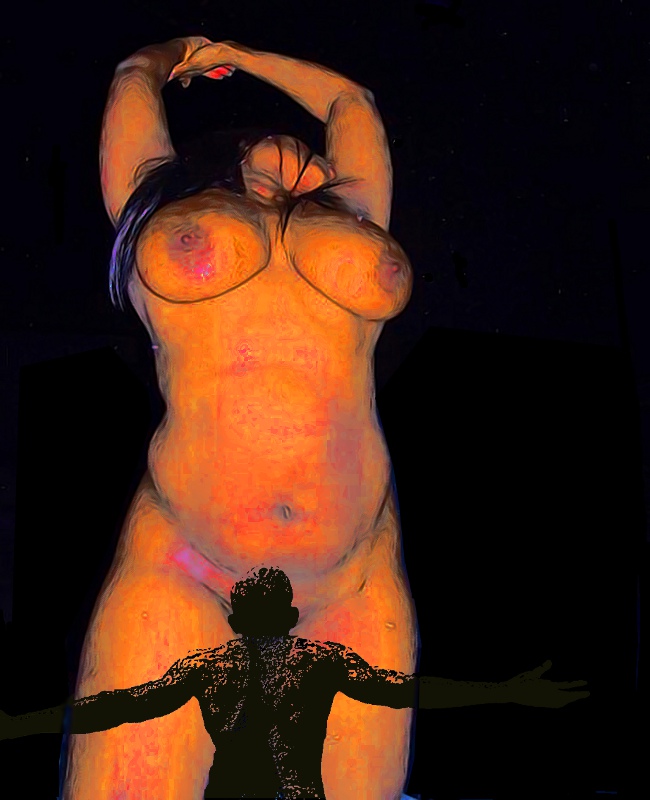
La Géante
Du temps que la Nature en sa verve puissante
Concevait chaque jour des enfants monstrueux,
J’eusse aimé vivre auprès d’une jeune géante,
Comme aux pieds d’une reine un chat voluptueux.
J’eusse aimé voir son corps fleurir avec son âme
Et grandir librement dans ses terribles jeux;
Deviner si son coeur couve une sombre flamme
Aux humides brouillards qui nagent dans ses yeux;
Parcourir à loisir ses magnifiques formes;
Ramper sur le versant de ses genoux énormes,
Et parfois en été, quand les soleils malsains,
Lasse, la font s’étendre à travers la campagne,
Dormir nonchalamment à l’ombre de ses seins,
Comme un hameau paisible au pied d’une montagne.
— Charles Baudelaire
][][
The Giantess
In those times when Nature in powerful zest
Conceived each day monstrous children,
I would have loved to live near a young giantess,
A voluptuous cat at the feet of a queen.
I would have loved to see her body flower with her soul,
To grow up freely in her prodigious play;
To find if her heart bred some dark flame
Amongst the humid mists swimming in her eyes;
To run leisurely over her marvelous lines;
To creep along the slopes of her enormous knees,
And sometimes in summer, when impure suns
Made her wearily stretch out across the countryside,
To sleep carelessly in the shadow of her breasts,
Like a peaceful village at the foot of a mountain.
— Geoffrey Wagner, Selected Poems of Charles Baudelaire (NY: Grove Press, 1974)
][][
The Giantess
In times when Nature, lusty to excess,
Bred monstrous children, would that I had been
Living beside a youthful giantess,
Like a voluptuous cat beside a queen;
To see her soul and body gain full size
Blossoming freely in her fearsome games,
And by the damp mists swimming in her eyes
To watch her heart nursing what somber flames!
To roam her mighty form at my sweet ease,
To crawl along the slopes of her vast knees,
And, summers, when the sun’s unhealthy heats
Made her sprawl, tired, across the countryside
To sleep at leisure, shaded by her teats,
Like a calm hamlet by the mountainside.
— Jacques LeClercq, Flowers of Evil (Mt Vernon, NY: Peter Pauper Press, 1958)
][][
The Giantess
Of old when Nature, in her verve defiant,
Conceived each day some birth of monstrous mien,
I would have lived near some young female giant
Like a voluptuous cat beside a queen;
To see her body flowering with her soul
Freely develop in her mighty games,
And in the mists that through her gaze would roll
Guess that her heart was hatching sombre flames;
To roam her mighty contours as I please,
Ramp on the cliff of her tremendous knees,
And in the solstice, when the suns that kill
Make her stretch out across the land and rest,
To sleep beneath the shadow of her breast
Like a hushed village underneath a hill.
— Roy Campbell, Poems of Baudelaire (New York: Pantheon Books, 1952)
][][
The Giantess
In those days when Nature’s overwhelming Lust
Engendered infant-monsters day by day
I’d love to have lived with a young giantess.
Like a lazy cat at the foot of my queen I’d lay.
I’d watch her grow into her gruesome games,
As I observed her body blossom with her soul.
And in the misty pools of her great eyes I’d try
To spy some secret flame, ominous and cold.
Her magnificent forms, I’d cuddle lazily,
Climbing the slopes of her gigantic knees.
And when she tired of the sick mid-summer suns
And stretched across the land to take her rest,
Like a peaceful hamlet at the foot of the hills,
I’d sleep serenely there in the shadow of her breast.
— James W. Underhill
 memories of my ghost sista