• hopilavayi: an erotic dictionary

memories of my ghost sista

~ the dead are never satisfied

memories of my ghost sista

Category Archives: Feminism

SUGAR HILL: a swamp opera in two acts

22 Sunday Mar 2026

Posted by babylon crashing in Disaster –- Pain –- Sorrow, drama, Feminism, Historic Research, quote unquote, Script, Spanish, Translation

≈ Comments Off on SUGAR HILL: a swamp opera in two acts

Tags

1974, Blaxploitation, Dark Americana, libretto, Mojo Hannah, Paul Maslansky, Southern Gothic, Spanish translation, Sugar Hill, Supernatural Voodoo Woman
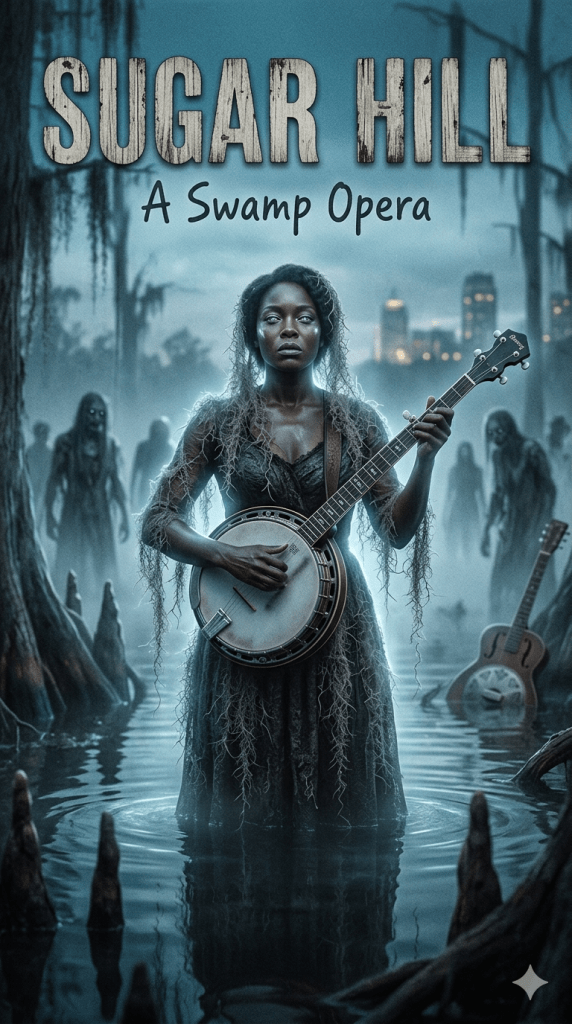
After the film by Paul Maslansky (1974)

Translations & Libretto by ZJC (2026)

)(^)(

A Note on Origins and Responsibility

Sugar Hill (1974) is a product of Blaxploitation cinema—a genre that, for all its flaws, created some of the first opportunities for Black heroines on screen; even as the directors, writers and producers behind those images were predominantly white and their interpretations of Black stories are through a lens of commercial sensationalism.

I, myself, come to this material as a pale male, a composer of Russian, Italian, Jewish and Irish descent, a relative newcomer to the Southern Gothic and Dark Americana traditions that have shaped this Opera. Spanish is not my native language. I do not claim expertise in the Histories, Spiritual practices, or lived experiences that form the foundation of this story. What I can offer, though, is an act of listening—to the Scholars, Musicians and Traditions that have long cultivated the soil from which this work grows. This libretto has been shaped by deep study and love of Black composers (Harry Lawrence Freeman, Florence Price, Margaret Bonds) and contemporary practitioners (Rhiannon Giddens, Nicole Brooks, Jessie Montgomery) whose work demonstrates how to honor these Traditions with rigor and care.

I have tried, always, to write not as one who speaks for, but as one who listens to—and to let the music that emerged be not my voice, but a Chorus of voices far older and wiser than I will ever be. Any failures of imagination or understanding are mine alone. My admiration and the conversations that I hope we shall have belong to the Traditions —their sins as well as their blessings— that brought us all here.

Thank you. ZJC.
PART I:

ACT ONE, SCENE ONE

TITLE: Club Haití — La Ritual Falsa (The Fake Ritual)

SETTING: Club Haití, New Orleans, 1974. A discotheque with pretensions of authenticity—tiki torches that are actually electric, fake moss draped too evenly, a cardboard vévé on the wall. The Audience sits at cabaret tables. Waiters move through with drinks. It’s sophisticated, commercial and slightly tacky. The proscenium is framed to look like a swamp proscenium—the Audience is watching a ‘show’ within the show.

TIME: Evening. The club is full. White patrons and Black patrons mix uneasily, the whites here for ‘exotic’ entertainment, the Blacks here because it’s the place.

ATMOSPHERE: The National Style 0 Resonator is visible on stage, played by a guitarist in a sharp suit. He’s part of the band. The lighting is warm, amber, safe. Nothing scary has happened yet.

SOUND: The Orchestra begins with a slow, swampy drone—cellos, bass, the Vega Vintage Star humming underneath, barely audible. Then the National Resonator cracks in with a syncopated, brassy riff. The drums kick in. It’s funk, but corrupted—the harmonies are just slightly wrong, the beat just slightly mechanical. This is Voodoo as product.

)(^)(

MUSICAL NUMBER: ‘SUPERNATURAL VOODOO WOMAN’ (Opening Chorus)

The stage fills with dancers. They wear glittering, exaggerated ‘Voodoo’ costumes—sequined top hats, feathers, face paint. Their movements are sharp, rhythmic, theatrical—this is possession as choreography, not as truth. They twitch on cue. They roll their eyes on the downbeat. It’s a show.

ENSEMBLE (backup singers, bright and brassy):
Supernatural Voodoo Woman!

The lead dancer—let’s call her FANTASIA—struts forward. She’s the ‘High Priestess’ of this performance. She sings in English, with a staged Creole accent that’s just a little too thick.

FANTASIA (mezzo, with belt):
Deep in the heart of the foggy Bayou
Where the moss hangs low and the water is blue
There’s a lady waiting with a secret in her hand
The most powerful woman in all of the land!

DANCERS (kicking in unison):
Ooh! She’s got the power!

FANTASIA:
She’s got the spirits, she’s got the soul
She’s got a power that’s out of control!

ENSEMBLE (full company, the National Resonator wailing):
Supernatural Voodoo Woman!
(Sugar Hill, Sugar Hill!)
Supernatural Voodoo Woman!
She’s coming for you, yes she will!

The choreography intensifies. Dancers ‘collapse’ in trance, then pop back up with grins. It’s athletic, impressive and completely hollow. The white patrons applaud enthusiastically; they’ve seen this in a movie. As for many of the Black patrons—they’ve also seen this before, but they’re here for the music and the scene, not some Hollywood phantasy.

FANTASIA (strutting, working the room):
She walks through the night with a silver-eyed stare!
She’s calling the shadows from out of thin air!
Don’t try to hide, don’t try to run!
The work of the Spirits has only begun!

A cringe-worthy YANKEE at a front table—Northern, drunk, laughing—calls out: ‘Dig it! Groovy! Work it, brown sugar!’ Fantasia flashes him a smile that’s pure commerce.

FANTASIA:
She’s taking her vengeance, she’s paying the debt!
A night with Sugar is a night you won’t forget!

ENSEMBLE:
Supernatural Voodoo Woman!
(Sugar Hill, Sugar Hill!)
Supernatural Voodoo Woman!
She’s coming for you, yes she will!

BRIDGE:

The music shifts. The Resonator drops out. For a moment, just the drums—and the Vega, shimmering underneath, barely audible. The dancers freeze. Fantasia’s voice drops to something almost like reverence. For a split second, it feels real.

FANTASIA (alone, center stage, no backup):
Raise ’em up…
(the dancers slowly raise their arms)
From the mud and the clay…
(a single, genuine shiver runs through her—then she catches herself, grins and the mask is back)

FANTASIA (belting again, the Resonator crashing back in):
SUGAR’S GONNA HAVE HER WAY!

The dancers explode into motion. A guitar solo—National Resonator, distorted wah-wah, pure 70s disco—tears through the club. The patrons are on their feet. It’s a party. It’s a hit. It’s nothing.

FANTASIA (shouting over the solo):
Can’t no bullet stop ’em! Can’t no fire burn!
The Dead have got a lesson for the Living to learn!

ENSEMBLE (building to a climax):
SUPERNATURAL! VOODOO! WOMAN!
She’s coming for you! YES SHE WILL!

The number ends with a huge crash—cymbals, Resonator feedback, the dancers in a final tableau of ‘possession.’ The lights come up. The Audience applauds wildly. Fantasia bows, blows kisses and the dancers exit, already loosening their costumes, becoming ordinary performers again.

FANTASIA (to a waiter, sotto voce, as she exits):
Dios mío, necesito un trago.
(My God, I need a drink.)

)(^)(

SCENE CONTINUES: The Real World Enters

The club settles. The band strikes up something smooth, slick and background-y. LANGSTON enters from the office door upstage. He’s handsome, warm, in his late 30s—the co-owner, the host, the man who made this place work. He crosses to a table where SUGAR sits alone, watching the crowd. She’s stunning—elegant, composed, dressed not for the show but for herself. She’s been watching Fantasia with a complicated expression: amusement, distance, maybe a little sadness.

LANGSTON (leaning down, kissing her cheek):
Diana. ¿Te gustó el show, Sugar?

(Diana. Did you like the show, Sugar?)

SUGAR (smiling up at him, her hand finding his):
Es dinamita.

(It’s dynamite.)

LANGSTON (sitting beside her, his knee touching hers):
Dinamita. Es lo que algunas personas dicen que eres.

(Dynamite. That is what some people say you are.)

She laughs—a real laugh, warm and low.

SUGAR:
Podrían tener razón.

(They could be right.)

They kiss. It’s not a stage kiss. It’s two people who genuinely love each other, comfortable, present, in love. The Orchestra swells beneath them—warm strings, the love theme introduced quietly, a melody that will haunt the rest of the Opera.

LANGSTON (pulling back, looking at her):
Debo estar haciendo algo bien.

(I must be doing something right.)

SUGAR (touching his face):
Todo. Simplemente, todo.

(Everything. Simply everything.)

A pause. The club noise fades beneath them. The Vega hums faintly—The Swamp, waiting.

LANGSTON (simply, without drama):
Te amo, Sugar.

(I love you, Sugar.)

SUGAR (the same):
Yo también te amo, Langston.

(I love you too, Langston.)

They sit together, watching their club, their world. For this moment, everything is perfect.

)(^)(

THE INTRUSION

The mood doesn’t sour—it curdles. Four men enter from the street door. FABULOUS leads—sharp suit, sharp smile, nothing behind the eyes. TANK follows, huge and stupid. O’BRIEN, jumpy and cruel. GEORGIE, silent and dangerous. They move through the crowd like sharks. Patrons instinctively lean away. The background music seems to curdle too—the strings hold a dissonant note, the Resonator hums a warning.

FABULOUS (approaching Langston’s table, arms wide, grin wide, everything wide):
¡Hey Langston, amigo!

(Hey Langston, my friend!)

Langston doesn’t stand. His hand tightens on Sugar’s.

LANGSTON (flat):
No soy tu amigo.

(I am not your friend.)

Fabulous‘ grin doesn’t flicker. He’s done this before.

FABULOUS:
Te lo diré una vez más.

(I’ll tell you one more time.)

LANGSTON:
Tú no vas a decirme nada, Fabulous.

(You’re not going to tell me anything, Fabulous.)

O’BRIEN (laughing, too loud):
¡Es un hermano duro!

(He’s a tough brother!)

FABULOUS (savoring it):
Lo es.

(He is.)

GEORGIE (the first words he’s spoken, soft and ugly):
No debe recordar quiénes somos.

(He must not remember who we are.)

FABULOUS (waving a hand, dismissing Georgie’s concern):
No, no. Sólo se está divirtiendo. ¿Verdad, Langston?

(No, no. He’s just having fun. Right, Langston?)

Langston stands. He’s not tall, but he’s solid and he’s not afraid. Sugar rises with him.

LANGSTON:
Acércate un poco y averigüalo.

(Come a little closer and find out.)

Tank shifts forward, but Fabulous stops him with a look.

TANK (muttering):
Ya estoy harto…

(I’ve had enough…)

FABULOUS (to Langston, voice dropping, losing the performance):
Calma. El Sr. Morgan sólo quiere darte un precio justo por tu club. Completamente legal.

(Calm down. Mr. Morgan just wants to give you a fair price for your club. Completely legal.)

LANGSTON (his voice rising, for the first time, for the whole club to hear):
¿Qué demonios sabe el Sr. Morgan sobre lo que es legal? ¡Que se lo meta en el culo!

(What the hell does Mr. Morgan know about what’s legal? He can shove it up his ass!)

A few patrons look over. Most look away. This is not their business. This is the Gothic South.

FABULOUS (quiet, dangerous):
¿Tu última palabra?

(Is this your last word?)

LANGSTON:
La última.

(The last one.)

Fabulous looks at Sugar. He lets his eyes travel. Langston steps forward, but Sugar’s hand on his arm stops him.

FABULOUS (to Langston, still looking at Sugar):
Has atrapado a una linda dama, Langston. Demasiada clase para un buitre como tú.

(You’ve snagged yourself a lovely lady, Langston. Too much class for a vulture like you.)

LANGSTON (shaking with rage):
Fabulous, saca tu sucio trasero de mi lugar. Ahora.

(Fabulous, get your dirty ass out of my place. Now.)

A long beat. The club is silent. Georgie smiles—a small, ugly thing.

GEORGIE (low, to Fabulous):
Claro, hermano.

(Sure, brother.)

FABULOUS (spreading his hands, the grin back, the mask restored):
Tienes razón. No hemos venido a pelear. Sólo somos hombres de negocios. Los tratos se cumplen o no.

(You’re right. We didn’t come here to fight. We’re just businessmen. Deals are either honored or they aren’t.)

He turns. The four of them walk out. The club exhales. Music starts again—something safe.

SUGAR (her hand still on Langston’s arm, her voice low):
Están jugando contigo, cariño.

(They’re playing with you, honey.)

LANGSTON (watching the door, not looking at her):
No estoy preocupado, Sugar.

(I’m not worried, Sugar.)

She turns him to face her. Her eyes are fierce.

SUGAR:
No lo estés tú.

(Don’t be.)

He softens, just a little, for her.

LANGSTON:
Puedo manejar a esos tipos con los ojos cerrados.

(I can handle those guys with my eyes closed.)

SUGAR (her voice breaking, just a little, a crack in the facade):
No quiero que nada le suceda a mi hombre.

(I don’t want anything to happen to my man.)

He pulls her close. They hold each other. The Orchestra swells—the love theme, full and warm and doomed.

LANGSTON (into her hair):
Nada sucederá. Nada sucederá, Sugar. Tengo que ir a esa reunión. Terminaremos a eso de las nueve.

(Nothing will happen. Nothing will happen, Sugar. I have to go to that meeting. We’ll finish around nine.)

He doesn’t know. She doesn’t know. But we know. The Vega hums beneath the strings—The Swamp, waiting, patient, hungry.

Slow fade.

LIGHTING CUE: The amber warmth of the club slowly bleeds away, replaced by a cold, silver wash—the color of zombies’ eyes, the color of what’s coming.

TRANSITION MUSIC: The love theme holds, then fragments. A single note from the Vega. A single drumbeat. Silence.

END OF SCENE ONE

)(^)(

ACT ONE, SCENE TWO

EL ASESINATO — EL SILENCIO DESPUÉS (THE MURDER — THE SILENCE AFTER)

SETTING: A back alley near the docks. Chain-link fence. Puddles reflecting distant neon. A single bare bulb above a door that says ‘SALIDA’ in chipping paint. The Bayou is close—you can smell it, even here—but this is the City’s edge, the liminal space where the Swamp begins to reclaim what belongs to it.

TIME: Later that night. The sky is bruised purple and black. No moon.

ATMOSPHERE: The National Resonator is silent. The Vega is silent. There is only the Orchestra—but it’s an Orchestra of absence. Low strings, holding single notes. Percussion that sounds like distant thunder or approaching footsteps; you can’t tell which.

SOUND DESIGN: This entire scene should be felt more than heard. The murder itself happens almost entirely in instrumental terms, with the human voice reduced to its most primal: grunts, gasps, a single, choked cry.

)(^)(

BEAT I

‘EL GOLPE’ (THE BLOW) — INSTRUMENTAL INTERLUDE WITH CHORUS OF WITNESSES

The scene begins in near-darkness. We see LANGSTON walking, alone. He’s taken a shortcut—he knows these streets, he’s walked them a thousand times. He’s thinking of Sugar, maybe humming the love theme under his breath. The Audience can’t hear it, but the Orchestra can: a solo cello, playing the theme softly, tenderly, tragically.

Shadows move. Four figures emerge from behind a dumpster. They wear pantyhose over their faces—distorted, grotesque, almost featureless. FABULOUS. TANK. O’BRIEN. GEORGIE. They are not individuals now; they are a machine.

The cello stops. Silence.

LANGSTON (seeing them, stopping, his voice calm—he knew this could happen, he just hoped it wouldn’t):
Fabulous.

(Fabulous.)

Fabulous doesn’t answer. He nods. The machine moves.

THE ORCHESTRA: A single, shattering percussion hit—a bass drum, a slammed metal door, something primal. Then chaos.

The beating is not shown in graphic detail. It is suggested—through shadows on the chain-link fence, through the choreography of the four men moving in and out, through LANGSTON’S body falling and rising and falling again. The Orchestra plays a brutal, atonal assault: brass screaming, strings scraping, percussion pounding. It’s not music; it’s violence given sound.

And beneath it all, a new element enters: THE CHORUS OF THE DEAD, wordless, humming. They are not yet visible. They have not yet risen. But they are watching. Their hum is a low, polyphonic drone—close intervals, beating in the air—the sound of centuries of violence witnessing this new violence.

THE MURDER lasts perhaps ninety seconds. It will feel like an hour.

A final blow. LANGSTON falls and does not rise.

The Four Men stand over him, breathing hard. The Chorus’s hum fades. The Orchestra falls silent. Only the hum of the single bare bulb remains—a thin, electric whine.

FABULOUS (his voice flat, stripped of performance):
¿Qué hacemos con él?

(What do we do with him?)

MORGAN enters from the shadows. He wasn’t here for the beating; he’s been watching from a distance, perhaps from a car, perhaps from a doorway. He walks forward slowly, deliberately. He looks down at Langston‘s body. No emotion.

MORGAN (quietly, to himself as much as them):
No es más que polvo. Déjenlo ahí.

(It is nothing but dust. Leave it there.)

He turns and walks away. The Four Men follow. The stage empties.

Only the body remains.

)(^)(

BEAT II

THE LONG SILENCE

The stage holds on LANGSTON’S body for a full thirty seconds. The Orchestra is silent. The bulb hums. A dog barks somewhere. A door slams. The City doesn’t care.

Then: footsteps. Running. Stopping.

SUGAR enters. She’s in the same clothes from the club—she’s been waiting and waiting and finally couldn’t wait anymore. She followed the route she knew he would take. She found him.

She stops. She sees.

The Orchestra begins, but barely—a single violin, playing the love theme, but so slowly, so fractured, that it’s almost unrecognizable.

)(^)(

BEAT III

‘LAMENTACIÓN’ (LAMENT)

SUGAR (approaching the body as if in a dream, as if this isn’t real, as if she can still wake up):
Langston…

(Langston…)

She kneels. She touches his face. It’s cold. It’s real. She can’t wake up.

SUGAR (her voice small, childlike, destroyed):
¿Qué te han hecho?

(What have they done to you?)

A pause. She looks at her hands—they have his blood on them. She doesn’t understand.

SUGAR (louder, as if he can hear her, as if he’s just sleeping):
¡Por favor, no me dejes!

(Please, don’t leave me!)

Nothing. The violin fractures further—notes sliding into dissonance.

SUGAR (a scream, torn from her throat, operatic in its raw power):
¡LANGSTON!

(Langston!)

The Orchestra answers—a full, shattering chord, all the grief and rage the instruments can hold. Then it collapses. The violin is gone. Only the cello remains, playing the love theme in its lowest register, funereal, hopeless.

SUGAR (rocking, holding him, her voice dropping to something barely audible):
No me dejes… no me dejes… no me dejes…

(Don’t leave me… don’t leave me… don’t leave me…)

She repeats it like a prayer, like a spell, like she can undo what’s been done through sheer repetition. The cello fades. The bulb hums. A stray cat calls.

Slow fade to black.

)(^)(

BEAT IV

MORGAN’S LAIR — THE PHILOSOPHY OF POWER

SETTING: Morgan’s office. Expensive but tasteless—leather, chrome, a wet bar, a painting of a white horse that’s trying too hard. It’s the lair of a man who has money but no class, power but no soul.

TIME: The next day. Sunlight through Venetian blinds—stripes of light and shadow, like a prison.

ATMOSPHERE: The National Resonator returns, but muted—this is business, not pleasure. The music is cool, detached, almost conversational. Morgan is in his element.

MORGAN (sitting in a massive leather chair, Fabulous kneeling at his feet, shining his shoes—an image of casual domination):
Como ya les he dicho, señores, si se quiere destruir a un hombre, tienen que romperlo en pedazos.

(As I have already told you, gentlemen, if you want to destroy a man, you have to break him into pieces.)

He gestures expansively, as if sharing wisdom.

MORGAN:
Pedazos tan pequeños que no puedan ser armados de nuevo. Nada más que un pedazo de carne hermana y fría.

(Pieces so small that they cannot be put back together. Nothing more than a cold, sisterly piece of flesh.)

He looks at FABULOUS, who keeps polishing.

MORGAN:
Esta será nuestra forma de trabajar de ahora en adelante. Si Morgan quiere algo, Morgan lo toma. Sin problemas, simple, directo al grano.

(This will be our way of working from now on. If Morgan wants something, Morgan takes it. No problems—simple, straight to the point.)

FABULOUS (not looking up from the shoes, but his voice carrying a smirk):
El tipo tenía malos modales. Ya no los necesita más.

(The guy had bad manners. He doesn’t need them anymore.)

A beat. Fabulous pauses, looks up.

FABULOUS [cont.]:
La pregunta es… ¿cómo vas a comprarle el club a un hermano muerto?

(The question is… how are you going to buy the club from a dead brother?)

Morgan smiles. It’s not a nice smile.

MORGAN:
Ese es el problema con los muertos, Fabulous. No pueden firmar contratos. Pero las novias… las novias siempre heredan.

(That’s the problem with the dead, Fabulous. They can’t sign contracts. But brides… brides always inherit.)

He leans back, satisfied. The Resonator plays a cool, cynical little riff—the sound of evil at ease.

MORGAN [cont.]:
Tráeme a la señorita Hill. Vamos a darle el pésame.

(Bring me Miss Hill. We are going to offer her our condolences.)

Blackout.

END OF SCENE ONE.

)(^)(

ACT ONE, SCENE TWO

Title: Sugar’s Studio — The Return of Valentina

SETTING: Sugar’s photography studio. Cameras, backdrops, evidence of an artist’s life. But today, it’s dim, closed. Sugar sits at her desk, staring at nothing. She hasn’t slept. She hasn’t changed her clothes. There’s dirt on her hands—from the alley? She hasn’t washed.

TIME: Late afternoon. Grey light through the windows.

ATMOSPHERE: The Vega hums—just barely, just beneath consciousness. The Swamp is reaching out for her and she doesn’t know it yet.

A knock. Sugar doesn’t move. Another knock. Then the door opens.

VALENTINA enters. She’s in uniform—police, but not the captain, not yet. She’s beautiful, composed, but her eyes are raw. She’s been crying too.

VALENTINA (stopping in the doorway, seeing Sugar, her voice cracking):
¿Diana?

(Diana?)

Sugar looks up. For a moment, she doesn’t recognize her. Then she does. Her face does something complicated—grief, surprise, a flicker of something older.

SUGAR (her voice hollow):
Valentina.

(Valentina.)

A long pause. They look at each other across the room. The Vega hums.

VALENTINA (stepping inside, closing the door):
Ha pasado mucho tiempo.

(A long time has passed.)

She crosses to Sugar, stands behind her, doesn’t touch her—yet.

VALENTINA [cont.]:
Te ves bien.

(You look well.)

Sugar laughs—a broken, bitter sound.

SUGAR:
¿Te parece? Siento que tengamos que encontrarnos de nuevo así.

(You think? I’m sorry that we have to run into each other again like this.)

Valentina‘s composure breaks, just a little. She moves—she can’t help it—and kneels beside Sugar’s chair, taking her hands. The touch is electric, old, familiar.

VALENTINA (quietly, intimately):
Sabes, es extraño. Después que nos separamos, me tomó mucho tiempo superar el hecho de que salieras con Langston.

(You know, it’s strange. After we broke up, it took me a long time to get over the fact that you were dating Langston.)

SUGAR (looking at their joined hands, not pulling away):
Sí, pero lo superaste bien.

(Yes, but you got through it well.)

VALENTINA:
De todos modos, nunca pensé que tendría que interrogarte sobre su muerte.

(In any case, I never thought I would have to question you about his death.)

The word ‘death’ lands like a slap. Sugar pulls her hands back.

SUGAR (standing, moving away):
Asesinato.

(Murder.)

VALENTINA (rising, following):
Diana—

(Diana—)

SUGAR (turning, fierce):
No fue muerte. Fue asesinato. Lo golpearon hasta matarlo, Valentina. Como a un perro. En un callejón. Y se fueron a tomar algo.

(It wasn’t a death. It was murder. They beat him to death, Valentina. Like a dog. In an alley. And then they went to get a drink.)

She’s shaking. Valentina wants to hold her but doesn’t know if she’s allowed.

VALENTINA (gently):
Lo sé. Lo sé.

(I know. I know.)

SUGAR (her voice dropping, becoming something else—colder, harder):
Nos conocimos aquí. En el club. Se acercó y me preguntó mi nombre. Diana Hill, le dije. Dijo: ‘a partir de ahora te llamarás Sugar.’ La Srta. Sugar Hill. Porque eres dulce como el azúcar.

(We met here. At the club. He walked up to me and asked my name. ‘Diana Hill,’ I told him. He said, ‘From now on, you’ll be called Sugar.’ Miss Sugar Hill. Because you’re sweet as sugar.)

A pause. She looks at Valentina.

SUGAR [cont.]:
¿Ahora tú manejas el caso? ¿Alguna vez caen… tipos como esos?

(So you’re handling the case now? Do guys like that… ever go down?)

VALENTINA (meeting her gaze, steady):
Lo pagarán. A su momento.

(They will pay for it. In due time.)

Sugar shakes her head—a small, violent motion.

SUGAR:
Sabes, si supiera quiénes fueron… me vengaría uno por uno. Podría verlos morir. Lentamente.

(You know, if I knew who they were… I would take my revenge on them, one by one. I could watch them die. Slowly.)

The Vega swells—just for a moment, just enough to be felt. Valentina shivers but doesn’t know why.

VALENTINA (watching Sugar carefully):
Diana…

(Diana…)

SUGAR (turning away, toward the window, toward the gray light):
No digas nada, Valentina. No me digas que el tiempo cura, o que la justicia existe, o ninguna de esas cosas que dices a las víctimas.

(Don’t say anything, Valentina. Don’t tell me that time heals, or that justice exists, or any of those things you say to victims.)

A long silence. Valentina crosses to her, stands behind her, close enough to feel her heat but not to touch.

VALENTINA (barely a whisper):
No iba a decir eso.

(I wasn’t going to say that.)

Sugar turns. They’re inches apart. The Vega hums. The love theme, fractured, plays in the strings—the ghost of what they were, what they might have been.

VALENTINA (touching Sugar’s face, gently, the way she used to):
Te he extrañado.

(I’ve missed you.)

Sugar closes her eyes. For a moment, she leans into the touch. For a moment, she’s just a body who has lost everything and is being held by someone who once loved her.

Then she opens her eyes. They’re dry. They’re hard.

SUGAR (stepping back, gently, inevitably):
Tienes un caso que resolver, Teniente.

(You have a case to solve, Lieutenant.)

Valentina‘s hand falls. She nods. She understands.

VALENTINA:
Sí.

(Yes.)

She moves to the door. Pauses. Looks back.

VALENTINA [cont.]:
Diana… ten cuidado. Quienes hicieron esto… son peligrosos.

(Diana… be careful. The ones who did this… are dangerous.)

SUGAR (her voice strange, distant, already somewhere else):
Lo sé. Lo sé. Lo sé.

(I know. I know. I know.)

Valentina exits. Sugar stands alone. The Vega swells—a full, shimmering chord. The lights shift to silver. The Swamp is calling.

Blackout.

END OF SCENE TWO

)(^)(

ACT ONE, SCENE THREE

TITLE: El Descenso — La Casa de Mamá Maitresse (The Descent — Mama Maitresse’s House)

SETTING: The Swamp. Not the picturesque Bayou of postcards—this is the real thing. Ancient cypress trees draped in Spanish moss that looks like old women’s hair. Water the color of tea. Mist that moves against the wind. The sound of things living and dying just out of sight. A narrow path of packed mud leads to a cabin that seems to grow out of the earth itself—cypress knees for pillars, moss for curtains, smoke curling from a chimney that shouldn’t work but does.

TIME: Dusk. The liminal hour. The hour when the veil thins.

ATMOSPHERE: The National Resonator is gone. For the first time, the Orchestra is dominated by the Deering Vega Vintage Star—but softly, distantly, as if played in another room, another world. Low strings drone. Woodwinds make sounds like birds, like insects, like things that should not be imitated. The percussionist has found objects: chains, wooden crates, a metal sheet bowed into a shriek.

SOUND DESIGN: The journey should feel like submersion. Each step Sugar takes, the music gets thicker, more humid, more alive. The Audience should feel the sweat on their skin, the mosquitoes at their necks, the weight of the air.

)(^)(

BEAT I

‘EL CAMINO’ (THE PATH) — INSTRUMENTAL JOURNEY

The scene begins in near-darkness. A single figure moves through the Swamp: Sugar, in clothes she shouldn’t be wearing for this—City clothes, heels sinking into mud. She’s carrying a small bag. She’s determined. She’s terrified.

The Vega plays a slow, shimmering drone—two notes, a minor second apart, beating against each other. This is the sound of the Swamp‘s attention.

Sugar stops. She’s lost. The path has vanished. The mist closes in.

SUGAR (calling out, her voice swallowed by the trees):
¿Mamá? ¿Mamá Maitresse?

(Mama? Mama Maitresse?)

No answer. Only the drone. Only the beating wings of something large and unseen.

SUGAR (louder, trying to hide her fear):
¿Estás aquí, Mamá? ¡Responde por favor, Mamá!

(Are you here, Mama? Please answer, Mama!)

A rustle. A splash. Something moves in the water. Sugar spins—nothing there.

SUGAR (her voice smaller now):
¿Mamá Maitresse? ¿Estás aquí? Mamá…

(Mama Maitresse? Are you here? Mama…)

She’s about to turn back. She’s about to give up. And then—

A hand on her shoulder.

Sugar screams. The Orchestra screams with her—a violent, dissonant crash. She spins and there is MAMA MAITRESSE, inches from her face, ancient and impossible, her eyes milky with age but sharp with knowing.

They stare at each other. The Vega holds its drone. The Swamp holds its breath.

)(^)(

BEAT II

‘EL ENCUENTRO’ (THE MEETING)

MAMA MAITRESSE (her voice a cracked contralto, the sound of roots and rot and something that has been here longer than memory):
¿Por qué has vuelto aquí?

(Why are you back here?)

Sugar can’t speak. She’s shaking.

MAMA (stepping closer, circling her, examining her like a curious specimen):
¿Has venido a ver a mamá Maitresse? ¿Por qué?

(Have you come to see Mama Maitresse? Why?)

SUGAR (finding her voice, barely):
Necesito tu ayuda.

(I need your help.)

Mama laughs—a dry, rattling sound.

MAMA:
Puedo sentir tus problemas. Te rodean.

(I can feel your problems. They surround you.)

She gestures—at the mist, at the trees, at Sugar herself. The Orchestra swells—the Vega, the drones, the found percussion.

MAMA [cont.]:
Están en tu sangre. En tu aliento. En el hueco donde solía estar tu risa.

(They are in your blood. In your breath. In the hollow where your laughter used to be.)

SUGAR (breaking, the words tumbling out):
Estaba enamorada, Mamá. Pero mataron al hombre con quien me iba a casar. Lo golpearon hasta la muerte.

(I was in love, Mama. But they killed the man I was going to marry. They beat him to death.)

A pause. Mama watches her.

SUGAR (her voice hardening, the grief turning to something else):
Los quiero muertos.

(I want them dead.)

Mama stops circling. She stands before Sugar, studying her with those impossible eyes.

MAMA:
Siento tu rabia y tu dolor. Y simpatizo contigo. ¿Pero qué puedo hacer?

(I feel your rage and your pain. And I sympathize with you. But what can I do?)

SUGAR (meeting her gaze, not backing down):
Sé lo que puedes hacer. Los poderes que posees.

(I know what you can do. The powers you possess.)

Mama‘s face shifts—something like pain, something like memory.

MAMA (turning away, moving toward the cabin):
Hace mucho tiempo, no ahora. Soy vieja y débil, y sólo quiero que me dejen sola.

(A long time ago—not now. I am old and weak and I just want to be left alone.)

SUGAR (following, not letting her escape):
Vengo a ti porque sé que puedes ayudarme.

(I come to you because I know you can help me.)

MAMA (at the door, not turning):
Estoy cansada, muy cansada. Se necesita un gran esfuerzo, no sé…

(I’m tired—very tired. It takes a great effort… I don’t know.)

Sugar reaches into her bag. She pulls out a photograph—Langston, smiling, alive. She holds it out.

SUGAR:
Por favor, mamá. Te lo ruego.

(Please, Mama. I beg you.)

Mama looks at the photograph. Something softens in her face—the memory of love, perhaps. The memory of loss.

MAMA (turning, taking Sugar’s chin in her ancient hand, studying her):
Tú siempre fuiste una gran incrédula.

(You were always a great skeptic.)

She laughs—not cruelly, but with wonder.

MAMA [cont.]:
¿Por qué crees ahora?

(Why do you believe now?)

SUGAR (her voice raw, honest, stripped of all pretense):
¡Porque quiero venganza!

(Because I want revenge!)

A long pause. The Swamp listens.

SUGAR (whispering):
Por favor, Mamá Maitresse.

(Please, Mama Maitresse.)

Mama closes her eyes. She begins to murmur—words that Sugar doesn’t understand, words older than Spanish, older than America, words that make the Vega shimmer and the chains rattle and the mist swirl.

MAMA (opening her eyes, fixing Sugar with a gaze that sees everything):
¿Cuán fuerte es tu odio?

(How strong is your hatred?)

Sugar doesn’t hesitate.

SUGAR:
Tan fuerte como era mi amor, mi odio aún más fuerte es.

(As strong as my love was, my hatred is even stronger.)

Mama nods slowly.

MAMA:
El riesgo es alto.

(The risk is high.)

SUGAR:
Estoy lista.

(I am ready.)

Mama studies her for a long moment. Then she nods again, decisively.

MAMA:
Bien. Mira en la llama.

(Good. Look into the flame.)

She gestures Sugar toward a small fire that has inexplicably appeared—or was it always there? Sugar kneels before it. Mama raises her hands to the sky.

MAMA (chanting, her voice growing in power):
Llamaré a mis más poderosos dioses vudú.

(I will call upon my most powerful vodoun gods.)

The Orchestra swells—the Vega, the drums, the chains, the bowed metal. THE CHORUS OF THE DEAD enters, humming their polyphonic drone, still invisible, still waiting.

)(^)(

BEAT III

‘LA CATECISMO DE LOS MUERTOS’ (THE CATECHISM OF THE DEAD)

MAMA (her voice a rhythmic chant):
¿Por dónde sale el sol?

(Where does the sun rise?)

SUGAR (answering, her voice finding a new strength):
Por el este, Mamá.

(To the east, Mama.)

MAMA:
¿Dónde se pone el sol?

(Where does the sun set?)

SUGAR:
En Guinea, Mamá.

(In Guinea, Mama.)

The Chorus’ hum grows louder, more present.

MAMA:
¿De dónde viene el poder?

(Where does power come from?)

SUGAR:
De los vivos entre los muertos, Mamá.

(From the Living among the Dead, Mama.)

MAMA (her voice rising):
¿Quién puede usar el poder?

(Who can use the power?)

SUGAR (rising with her, her voice soaring):
Los muertos entre los vivos.

(The Dead among the Living.)

A thunderous percussion hit. Lightning flickers—not from the sky, but from somewhere else. The mist parts. A path appears.

MAMA (taking Sugar’s hand, pulling her to her feet):
Ven. El Barón nos espera.

(Come. The Baron awaits us.)

They move into the mist. The Chorus follows. The Vega holds its shimmering drone.

Blackout.

)(^)(

BEAT IV

THE CEMETERY — THE THRONE OF BONES

SETTING: A clearing deeper in the Swamp. An ancient cemetery—if it can be called that. The graves are unmarked, but the earth is disturbed, as if things have been climbing out for centuries. At the center, an altar of stacked stones, with slave chains bolted to the largest. Moss hangs like funeral curtains. The trees are hung with offerings: bottles, bones, ribbons faded to gray.

TIME: Night, but the moon is wrong—too bright, too close.

ATMOSPHERE: The Vega is now dominant. The National Resonator is dead weight, absent. The percussion is all found objects: chains rattling, wood striking wood, the bowed metal, screaming.

Mama and Sugar enter the clearing. Sugar stops, staring at the altar, at the chains.

MAMA (gesturing to the ground before the altar):
Arrodíllate.

(Kneel.)

Sugar kneels. The mud is cold. The chains gleam in the wrong moonlight.

MAMA (raising her arms, her voice filling the clearing):
¡Barón Samedi!

(Baron Samedi!)

Thunder—distant, answering.

MAMA [cont.]:
¡Barón Samedi! ¡Guardián de los muertos! ¡Rey de los cementerios!

(Baron Samedi! Guardian of the Dead! King of the Cemeteries!)

The wind rises. The moss dances.

MAMA [cont.]:
¡Escucha nuestra llamada! ¡Demuestra tu presencia! ¡Acude a nuestra llamada!

(Heed our call! Make your presence known! Answer our call!)

Silence. Nothing. Sugar looks up at Mama, desperate.

MAMA (lowering her arms, muttering):
Es un Dios codicioso.

(He is a greedy god.)

She turns to Sugar.

MAMA [cont.]:
¿Tienes algo de dinero?

(Do you have any money?)

SUGAR (patting her pockets, finding nothing):
No, nada.

(No, nothing.)

MAMA (impatient):
Algo, lo que sea.

(Something—anything.)

Sugar reaches up, pulls off her necklace—a simple gold chain, Langston’s gift.

SUGAR (holding it out):
¿Esto?

(This?)

Mama takes it, places it on the altar.

MAMA:
Barón Samedi, un regalo para ti.

(Baron Samedi, a gift for you.)

Nothing. Sugar’s hope flickers.

SUGAR:
Inténtelo de nuevo, Mamá.

(Try again, Mama.)

MAMA (looking at Sugar’s hands):
Tu anillo. Dame tu anillo.

(Your ring. Give me your ring.)

Sugar hesitates. It’s her grandmother’s ring—the only thing she has from her mother’s mother. Then she pulls it off, places it in Mama‘s hand.

MAMA (placing it on the altar):
Otro regalo, Barón Samedi.

(Another gift, Baron Samedi.)

The sky tears. Thunder—not distant, but here, splitting the ozone. Lightning—not flickering, but striking, hitting the altar, setting the chains ablaze with cold fire. Smoke curls. The ground shakes.

And from the smoke, and from the fire, and from the desecrated earth itself—

BARON SAMEDI appears.

)(^)(

BEAT V

‘EL PRECIO DE LA SOMBRA’ (THE PRICE OF THE SHADOW) — BARON’S ENTRANCE ARIA

The Baron is magnificent and terrible. He wears a tattered top hat, a formal coat rotting with age, a cane that is also a snake, a snake that is also a cane. His eyes are pits of darkness. His smile is a wound. He is Bass-Baritone and his lowest notes should vibrate in the Audience’s bones.

BARON (laughing—a sound that is also thunder):
¡Ja ja ja!

(Ha ha ha!)

He strides forward, surveying his Domain, his Kingdom, these intruders.

BARON [cont.]:
¿Quién despierta de su sueño al Barón Samedi?

(Who wakes Baron Samedi from his slumber?)

MAMA (bowing low):
¡Barón Samedi!

(Baron Samedi!)

BARON (approaching her, amused):
¿Eres tú, Mamá Maitresse? Hace mucho que no siento tu voz en mi reino.

(Is that you, Mama Maitresse? It has been a long time since I heard your voice in my Realm.)

MAMA:
Vinimos a pedir tu ayuda, barón.

(We have come to ask for your help, Baron.)

BARON (his gaze shifting to Sugar, who has not bowed, who is staring at him with fear and defiance):
¿Ayuda?

(Help?)

He circles her. She forces herself to hold still.

SUGAR:
Quiero el poder para destruir a mis enemigos.

(I want the power to destroy my enemies.)

MAMA (horrified):
¡Mujer!

(Woman!)

The Baron laughs again—delighted, genuinely delighted.

BARON (stopping before Sugar, leaning close):
¿Quién eres? Soy el Barón Samedi. ¡Este es mi dominio! ¡Mi reino de los muertos!

(Who are you? I am Baron Samedi. This is my Domain! My Kingdom of the Dead!)

MAMA (interceding):
Ella no quiso faltarte el respeto, señor. Su nombre es Diana.

(She didn’t mean to disrespect you, sir. Her name is Diana.)

The Baron ignores her. He is focused entirely on Sugar.

BARON:
Diana. ¿Y qué va a entregar esta Diana al Barón Samedi por el poder que busca?

(Diana. And what will this Diana give to Baron Samedi for the power she seeks?)

Behind him, figures emerge from the mist. The Zombie brides—women in rotting nightgowns, their eyes silver, their movements fluid and wrong. They flank him, watching Sugar with hunger.

SUGAR (staring at them, horrified):
¿Quiénes son?

(Who are they?)

BARON (smiling, gesturing to them):
Esas son las novias del Barón Samedi.

(Those are Baron Samedi’s brides.)

He reaches out, strokes the hair of one. She leans into his touch like a cat.

BARON:
Es un gusto adquirido.

(It’s an acquired taste.)

He turns back to Sugar.

BARON [cont.]:
¿Qué me vas a dar?

(What are you going to give me?)

Sugar swallows. She knows what’s expected. She’s ready.

SUGAR:
Mi alma.

(My soul.)

The Baron stares at her for a beat. Then he roars with laughter—genuine, astonished, delighted.

BARON:
¿Tu alma? ¡Ja ja ja! ¿Qué es eso de las almas, mujer? No estoy interesado en las almas.

(Your soul? Ha ha ha! What is this talk of souls, woman? I am not interested in souls.)

More thunder. More lightning. The Brides sway.

BARON (stepping closer, his voice dropping, becoming intimate, dangerous):
Nada de almas. ¿No me temes?

(No souls. Do you not fear me?)

Sugar meets his eyes. Her voice is steady.

SUGAR:
No.

(No.)

A long pause. The Baron studies her. Something shifts in his face—respect, perhaps. Interest, certainly.

BARON:
Dime, ¿por qué quieres mis poderes?

(Tell me, why do you want my powers?)

SUGAR:
Hay unos hombres a los que quiero castigar.

(There are some men I want to punish.)

BARON:
¿Castigar?

(Punish?)

SUGAR:
Muerte. Pero necesito a más de un hombre. ¿Me puedes ayudar?

(Death. But I need more than one man. Can you help me?)

The Baron looks at her for a long moment. Then he smiles—a terrible, wonderful smile.

BARON (spreading his arms, addressing the Night, the Dead, everything):
¡Tengo un ejército de muertos… esperando tus órdenes!

(I have an Army of the Dead… waiting for your orders!)

The ground erupts. From every grave, from every patch of mud, from the water itself—Hands. Arms. Bodies. The Zombies rise. They wear the chains of slaves. Their eyes are silver. Their machetes catch the wrong moonlight.

BARON (his voice building, drawing out each syllable, commanding the Universe):
¡Despierten! ¡Todos han jurado obedecer la voluntad… del Barón Samedi! ¡Esclavo y amo! ¡Amo y esclavo! ¡DESPIERTEN!

(Wake up! You have all sworn to obey the will… of Baron Samedi! Slave and master! Master and slave! Wake Up!)

)(^)(

BEAT VI

‘LA DANZA DE LOS ZOMBIS’ (THE DANCE OF THE ZOMBIES) — FULL COMPANY BALLET

This is not a dance of joy. It is a dance of awakening. The Zombies move slowly at first, stiffly, as if remembering how bodies work. Then faster, more fluid, more terrifying. They raise their machetes. They turn their silver eyes toward Sugar. They are waiting.

The Orchestra is at full power—the Vega shimmering, the percussion pounding, the brass and strings weaving a horrifying, beautiful tapestry. THE CHORUS OF THE DEAD hums and keens and stomps.

Two Zombies—a man and a woman—find each other. They look into each other’s silver eyes. They smile. It’s the most human thing they’ve done and it’s the most horrible.

Sugar watches them. She should be terrified. She is. But beneath the terror, something else is growing. Power. Purpose. The knowledge that she is no longer alone.

The Baron appears beside her, watching his children dance.

BARON (his voice cutting through the music, but only for her):
¡Te daré tu venganza! Ponlos al servicio del mal. Es todo lo que saben y desean.

(I will give you your vengeance! Put them in the service of evil. It is all they know and desire.)

Sugar looks at him. Looks at the Zombies. Looks at Mama, who is watching with ancient, knowing eyes.

She steps forward. The Zombies part for her. She walks among them and they bow.

The music builds to a shattering climax. The Zombies raise their machetes to the sky. Sugar stands at the center, her face half-lit by the wrong moonlight, half-shadowed by the thing she is becoming.

And for just a moment, her eyes flicker silver.

Blackout.

The Vega holds its final note—a shimmering, endless drone—for three full seconds after darkness.

Then silence.

END OF SCENE THREE

)(^)(

ACT ONE, SCENE FOUR

STRUCTURE NOTE: This scene is a double scene—two locations inter-cut, two worlds unfolding simultaneously. On one side: the first kill, brutal and swift. On the other: Valentina’s first encounter with the impossible, small and strange. The scene should be staged with fluid transitions—lighting shifts, the Orchestra moving between two auditory worlds, the action flowing from one to the other without blackouts.

)(^)(

BEAT I

THE DOCKYARDS — MORNING

SETTING: The docks. Shipping containers, cranes, the smell of diesel and river. A hiring line—Black men waiting for day work, their faces tired and familiar with humiliation. Tank presides over them like a petty king, clipboard in hand, enjoying himself entirely too much.

TIME: The morning after the cemetery. Sugar has not slept. She has been elsewhere.

ATMOSPHERE: The National Resonator is back—but it’s different now. Tainted. The urban brass is there, but beneath it, the Vega shimmers faintly, watching. The two worlds are beginning to bleed into each other.

)(^)(

TANK (calling out, enjoying the power):
Bueno, necesito diez hombres. Para un contenedor de la línea Quesada. Tengo un barco de bananas de Costa Rica.

(Alright, I need ten men—for a container from the Quesada line. I have a banana ship from Costa Rica.)

He pauses, letting them hope.

TANK [cont.]:
¿Qué opinan, chicos? ¡Todas las bananas que quieran! Y además, paga.

(What do you boys think? All the bananas you want! Plus, it pays.)

A murmur among the men. One of them—WORKER 1, a man who has done this too many times—steps forward.

WORKER 1:
No nos gusta pagar para trabajar.

(We don’t like paying to work.)

Tank’s smile doesn’t flicker. This is the part he likes.

TANK:
De acuerdo. No hay dinero, no hay trabajo. Siguiente.

(Agreed. No money, no work. Next.)

Worker 1 doesn’t move. The men behind him shift, angry.

WORKER 1:
No compramos puestos de trabajo.

(We do not buy jobs.)

Tank moves faster than a man his size should. He punches Worker 1 in the stomach—once, twice. The man crumples. Tank stands over him, breathing hard, enjoying the silence.

TANK (to the fallen man, to all of them):
¿Qué has dicho? ¡Tú compras tu trabajo, chico! ¡O te mueres de hambre!

(What did you say? You buy your job, boy! Or you starve!)

He looks around at the other men. They won’t meet his eyes.

TANK [cont.]:
¿Entiendes? ¿Entendido?

(Do you understand? Understood?)

Silence. Then movement—the men begin to drift away, angry, humiliated, defeated. Tank watches them go, satisfied.

TANK (to himself, chuckling):
Tienen más cerebro de lo que pensaba.

(They have more brains than I thought.)

He turns and exits toward the warehouse. The stage empties.

But one figure remains. He was at the back of the crowd—an old Black man in a tattered coat, leaning on a cane, watching everything. The Baron, in his ‘Old Sam’ guise. He smiles—a small, private smile.

He follows Tank into the warehouse.

The Vega shimmers. The Resonator holds a single, decaying note.

Light shift.

)(^)(

BEAT II

THE WAREHOUSE — THE FIRST KILL

SETTING: Inside the warehouse. Dark, cavernous, stacked with crates. A single shaft of light from a high window. The sound of water dripping somewhere. The smell of rot.

TIME: The same moment. The light is wrong—gray, flat, as if the sun has forgotten this place.

ATMOSPHERE: The Resonator fades. The Vega takes over—slow, shimmering, patient. The percussion begins: a rhythmic, metallic clanking—chains, dragging.

TANK enters, alone. He’s still smug, still enjoying his morning’s work. But something’s wrong. The shadows are too dark. The silence is too complete.

TANK (calling out, trying to sound confident):
¿Quién anda ahí?

(Who’s there?)

Silence. He takes another step.

TANK (louder):
Dije que quién anda ahí.

(I said, ‘Who’s there?’)

A figure steps from the shadows. SUGAR. She’s wearing the same clothes as the cemetery—mud on her hem, something different in her eyes.

TANK (relieved, then leering):
Bueno, bueno. La novia de Langston.

(Well, well. Langston’s girlfriend.)

He circles her, slow and ugly.

TANK [cont.]:
¿Sabes? Tienes uno de los mejores culos de la ciudad. No me gustaría vértelo pateado por acusar a las personas.

(You know? You have one of the best asses in the City. I’d hate to see it kicked for accusing people.)

Sugar doesn’t move. Doesn’t flinch. Her voice is calm, cold, elsewhere.

SUGAR:
No soy tu juez, soy tu destino.

(I am not your judge; I am your destiny.)

Tank laughs—but it’s uncertain now.

TANK:
¿Qué dijiste?

(What did you say?)

SUGAR:
No es una acusación, es tu sentencia: la muerte.

(It is not an accusation; it is your sentence: death.)

She steps closer. He steps back—and bumps into something solid. He turns.

ZOMBIES. Silver eyes. Shackled wrists. Machetes raised.

Tank screams. He turns—another Zombie. Another. Another. They surround him, silent, patient, terrible.

TANK (falling to his knees, begging):
¡Por favor, no me mates! ¡No quise hacerlo! ¡Me obligaron! ¡No quise hacerlo! ¡No, por favor!

(Please, don’t kill me! I didn’t mean to do it! They forced me! I didn’t mean to do it! No, please!)

Sugar watches. Her face is expressionless. But beneath the stillness, something is happening—a flicker of silver in her eyes, a tremor in her hands. This is the first time. This is the threshold.

She nods.

The Zombies’ blows flood down upon Tank.

The Orchestra does not play music. It plays sound—the wet thud of machetes, the crunch of bone, the gurgle of a scream cut short. THE CHORUS OF THE DEAD hums—low, steady, indifferent. They have done this before. They will do it again.

Tank’s gutted body finally falls. The Zombies stand over it, silent.

Sugar looks at what she’s done. Her face is pale. Her hands are shaking. She opens her mouth—to say something, to take it back, to claim it—

But The Baron appears behind her, silent, watching. He doesn’t speak. He doesn’t need to. This is what she asked for. This is what she’ll become.

Sugar closes her mouth. She walks away. The Zombies dissolve into shadow.

The Vega holds a single, shimmering note.

Light shift.

)(^)(

BEAT III

THE CRIME SCENE — THE IMPOSSIBLE ENTERS

SETTING: The same warehouse, hours later. Now it’s a crime scene—yellow tape, police officers, the harsh glare of portable lights. Tank’s headless body has been removed, but the blood remains. And something else.

TIME: Afternoon. The wrong light is gone; this is ordinary daylight, harsh and unforgiving.

ATMOSPHERE: The Orchestra is back in ‘real world’ mode—but it’s off. Slightly detuned. Slightly wrong. The Vega is gone, but its absence is felt.

THE CAPTAIN—a weary man who has seen too much and understood too little—supervises the investigation. VALENTINA enters, out of breath, still in uniform from her shift.

VALENTINA:
Vine tan pronto como pude. ¿Es Tank Watson?

(I came as soon as I could. Was that Tank Watson?)

CAPTAIN (not looking up):
Eso creemos.

(That is what we believe.)

VALENTINA:
¿Creen?

(You believe?)

She crosses to where the body was. The blood is enormous—a lake of it. She stares.

VALENTINA (quietly):
Dios mío.

(My god.)

OFFICER 1 enters, speaking carefully.

OFFICER 1:
Tenemos algo, capitán.

(We’ve got something, Captain.)

CAPTAIN:
Vamos.

(Come on.)

They cross the warehouse. In a corner, near a stack of crates, they find it: Tank’s head, severed, eyes still open, mouth frozen in a scream. Valentina turns away, sick.

OFFICER 1 kneels, examining the area. He picks something up—holds it to the light.

OFFICER 1:
¿Qué es esto?

(What is this?)

Valentina forces herself to look. It’s a shackle. Old. Rusted. The kind slaves wore.

She takes it, turns it over in her hands. The Orchestra plays a single, dissonant chord—the Vega, silent but present, a ghost in the machine.

VALENTINA (staring at the shackle, her voice barely a whisper):
¿Qué es esto?

(What is this?)

THE CAPTAIN glances at it, dismissive.

CAPTAIN:
Basura. Los niños encuentran esas cosas en los pantanos todo el tiempo.

(Junk. Kids find things like that in the swamp all the time.)

VALENTINA (not convinced):
Sí. Claro.

(Yes. Of course.)

She holds the shackle tighter. The lights hold on her face—confused, disturbed, beginning to suspect things she cannot name.

Blackout.

)(^)(

BEAT IV

MORGAN’S LAIR — THE UNEASY KING

SETTING: Morgan’s office, same as before. But something has shifted. The leather and chrome seem tawdry now, cheap, vulnerable. Morgan eats at his desk—a steak, bloody—but he’s not enjoying it.

TIME: Evening. The same day.

ATMOSPHERE: The National Resonator tries to assert itself, but it’s wrong—notes slip, rhythms stumble. Something is coming.

MORGAN eats. FABULOUS stands by the door. O’BRIEN and KING hover, uneasy.

MORGAN (chewing, annoyed):
Bueno, ¿qué están esperando?

(Well, what are you waiting for?)

O’BRIEN (unable to look at the steak):
¿Cómo puedes comer después de lo que le pasó a Tank?

(How can you eat after what happened to Tank?)

KING (quiet, for once shaken):
Los chicos están asustados. La manera en que fue cortado…

(The boys are scared. The way he was cut…)

MORGAN (waving a fork dismissively):
Cuéntamelo más tarde.

(Tell me about it later.)

KING:
¡Pero Morgan…!

(But Morgan…!)

MORGAN (slamming down the fork):
¡DIJE DESPUÉS!

(I Said ‘Later’!)

Silence. Morgan takes a breath, composes himself.

MORGAN [cont.]:
Sal a la calle y averigua quién está detrás de esta basura. ¡Ahora, idiota!

(Get out on the street and find out who’s behind this garbage! Now, you idiot!)

KING (backing away):
Está bien, está bien.

(It’s fine, it’s fine.)

O’Brien and King exit. Fabulous remains by the door, watching Morgan.

Morgan picks up his fork again. Tries to eat. Can’t.

MORGAN (muttering, trying to convince himself):
Algún hippie drogado mató a Tank… ¡y ahora no me dejan comer en paz!

(Some stoned hippie killed Tank… and now they won’t let me eat in peace!)

He forces a bite. Chews. Swallows. The Resonator plays a sad, cynical little riff—the sound of a man who doesn’t know he’s already dead.

Light shift.

)(^)(

BEAT V

THE LAB — THE IMPOSSIBLE NAMED

SETTING: The police lab. Fluorescent lights, stainless steel, the smell of chemicals. A microscope. Evidence bags.

TIME: Late night. Valentina hasn’t gone home.

ATMOSPHERE: The Orchestra is clinical—precise, detached—but beneath it, the Vega hums faintly, waiting.

VALENTINA stands at the microscope. THE LAB TECH—young, earnest, a little strange—stands beside her.

TECH:
¿Así que no hay nada sobre esto?

(So there’s nothing about this?)

VALENTINA (not looking up):
Un viejo grillete de esclavo. Los niños los encuentran de vez en cuando en los pantanos. Nada raro.

(An old slave shackle. The children find them every now and then in the swamp. Nothing unusual.)

TECH (hesitating):
Maldición.

(Damn.)

Valentina looks up.

VALENTINA:
¿Qué?

(What?)

The Tech moves to another microscope, gestures for her to look.

TECH:
Esto es lo que quiero que veas.

(This is what I want you to see.)

Valentina looks. She sees… nothing unusual.

VALENTINA:
¿Qué se supone que vea?

(What am I supposed to see?)

TECH:
Es una muestra del cuello de Tank Watson.

(It is a sample from Tank Watson’s neck.)

VALENTINA:
¿Entonces?

(So?)

TECH (choosing his words carefully):
Es un hongo.

(It is a fungus.)

VALENTINA:
¿De qué clase?

(What kind?)

TECH:
No del tipo que se encuentra en el queso suizo.

(Not the kind found in Swiss cheese.)

Valentina straightens, frustrated.

VALENTINA:
De acuerdo. ¿Dónde encontramos este tipo de hongo?

(Alright. Where can we find this type of fungus?)

TECH:
No lo sé. Pero quién sea que agarró a Tank, tenía los dedos cubiertos de piel muerta.

(I don’t know. But whoever grabbed Tank had their fingers covered in dead skin.)

Valentina stares at him.

VALENTINA:
¿Piel muerta y moho?

(Dead skin and mold?)

TECH (leaning forward, intense):
Teniente, no lo entiende. No estoy hablando de células muertas que son reemplazadas. Eso es lo normal.

(Lieutenant, you don’t understand. I’m not talking about dead cells being replaced. That is normal.)

A pause. The Vega hums louder.

TECH [cont.]:
Lo que tenemos aquí son terminaciones nerviosas, células de pigmento, epidermis… todo muerto.

(What we have here are nerve endings, pigment cells, epidermis… all dead.)

Valentina processes this. Her face goes through several stages—disbelief, confusion, the beginning of something she can’t name.

VALENTINA (slowly, testing the idea):
¿Quieres decir que estas células provenían de tejidos muertos?

(You mean that these cells were from dead tissue?)

She laughs—a nervous, disbelieving sound.

VALENTINA [cont.]:
¡Ja, ja, ja! ¡Eso significaría que el asesino no estaba vivo! ¡Que un muerto asesinó a Tank Watson!

(Ha, ha, ha! That would mean the killer wasn’t alive! That a dead man murdered Tank Watson!)

The Tech meets her eyes. He’s not laughing.

TECH:
Tú lo dijiste, no yo.

(You said it, not me.)

The Vega swells—a full, shimmering chord. Valentina feels it, physically—a vibration in her chest, a cold at the base of her spine.

She looks at the shackle. She looks at the microscope. She looks at The Tech, who is pale and serious.

She doesn’t speak. She can’t.

Slow fade.

The Vega holds its note into the darkness.

END OF SCENE FOUR

)(^)(

ACT ONE, SCENE FIVE

TITLE: Los Cerdos — La Segunda Muerte (The Pigs — The Second Death)

STRUCTURE NOTE: This scene inter-cuts three locations: the docks (O’Brien’s casual cruelty), the taxi ride (The Baron as chauffeur) and the pig pen (Sugar’s grotesque justice). The tone shifts from realistic brutality to surreal horror to black comedy—sometimes in the same moment.

)(^)(

BEAT I

THE DOCKYARDS — THE LITTLE TYRANT

SETTING: Another part of the docks. A produce stall—crates of vegetables, a scale, an awning that provides inadequate shade. The owner is an old man, Produce Cart Owner, who has run this stall for years.

TIME: A few days after Tank’s death. O’Brien hasn’t learned anything.

ATMOSPHERE: The National Resonator is back—but it’s nervous, skittish, playing riffs that start and stop. O’Brien’s music is jumpy, cruel, small.

O’Brien stands at the produce stall, looming over the Owner. He’s enjoying this.

O’BRIEN:
Escúchame bien, tienes un día para traer el dinero. O todo esto y tu trasero serán míos. ¿Entendido?

(Listen to me closely: you have one day to bring the money. Or all of this—and your ass—will be mine. Understood?)

The Owner says nothing. He’s learned that saying nothing is safest.

O’BRIEN (louder, leaning in):
¿ENTENDIDO?

(Understood?)

OWNER (barely audible):
Sí, señor.

(Yes, sir.)

O’BRIEN (satisfied, stepping back):
Bien. No queremos enojar al Sr. Morgan, ¿no?

(Alright. We don’t want to anger Mr. Morgan, do we?)

He turns to go—and nearly collides with an old Black man in a tattered coat, leaning on a cane, smiling.

BARON (as ‘Old Sam,’ cheerful, harmless):
¿Señor? ¿Sr. O’Brien?

(Sir? Mr. O’Brien?)

O’BRIEN (suspicious):
¿Me hablas a mí, chico?

(Are you talking to me, boy?)

BARON (unfazed by ‘chico,’ beaming):
El Sr. Morgan dice que quiere hablar con usted ahora.

(Mr. Morgan says he wants to speak with you now.)

O’BRIEN:
¿Para qué?

(What about?)

BARON:
Eso es lo que me dijo. Y el viejo Sam… no le pregunta al Sr. Morgan. No, señor.

(That’s what he told me. And Old Sam… he doesn’t ask Mr. Morgan. No, sir.)

He leans in conspiratorially.

BARON [cont.]:
Es un hombre malo. De hecho, me dijo que…

(He is a bad man. In fact, he told me that…)

O’BRIEN (impatient, waving him off):
Está bien, está bien. Vamos.

(Okay, okay. Let’s go.)

He follows The Baron toward a waiting taxi. The Resonator plays a jaunty, sinister little tune—the sound of a trap closing.

Light shift.

)(^)(

BEAT II

THE TAXI — THE ROAD TO JUSTICE

SETTING: The interior of a taxi. O’Brien in the back seat. The Baron driving. The windows show swamp—more and more swamp, less and less City.

TIME: Late afternoon, fading toward dusk.

ATMOSPHERE: The Resonator fades. The Vega enters—softly at first, then growing. The percussion begins: the sound of water, of mud, of things moving just beneath the surface.

O’BRIEN (looking out the window, uneasy):
Oye… esto no es el camino a la oficina de Morgan.

(Hey… this isn’t the way to Morgan’s office.)

BARON (cheerfully):
No, señor. El Sr. Morgan está en su otra oficina. La del pantano.

(No, sir. Mr. Morgan is in his other office. The one in the Swamp.)

O’BRIEN:
¿Morgan tiene una oficina en el pantano?

(Morgan have an office in the swamp?)

BARON:
Desde siempre, señor. Muy privada. Muy segura. Nadie encuentra a Morgan si Morgan no quiere ser encontrado.

(Always has been, sir. Very private. Very secure. No one finds Morgan unless Morgan wants to be found.)

O’Brien doesn’t like this. But he’s also smart enough to say anything about it.

O’BRIEN (sullen):
Bueno, apúrate. Tengo cosas que hacer.

(Well, hurry up. I have things to do.)

BARON (glancing in the rearview, smiling):
Sí, señor. Apurándonos.

(Yes, sir. Hurrying up.)

The taxi drives deeper into the Swamp. The Vega shimmers. The light fades.

Light shift.

)(^)(

BEAT III

THE SWAMP ESTATE — THE PIG PEN

SETTING: A clearing deep in the Swamp. At its center: a small enclosure, fenced with rough wood. Inside: pigs. Not cute pigs—these are large, hungry, restless. They push against the fence. They smell blood.

TIME: Dusk. The wrong light again—silver, otherworldly.

ATMOSPHERE: The Vega dominant. The percussion includes sounds that might be pigs or might be something else. THE CHORUS OF THE DEAD hums—low, anticipatory.

The taxi arrives. O’Brien gets out, looking around with growing alarm.

O’BRIEN:
¿Dónde está Morgan?

(Where is Morgan?)

BARON (gesturing toward the trees):
Por allí, señor. Solo tiene que caminar un poco.

(Over there, sir. You just have to walk a little.)

O’BRIEN:
¿Caminar? ¿En esto?

(Walk? In this?)

He looks at the mud, the mosquitoes, the hot wet dark. The Baron waits, patient, smiling.

O’BRIEN (sighing, starting forward):
Este puto Morgan…

(That fucking Morgan…)

He walks. The Baron watches him go. Then The Baron dissolves into the shadows—not walking away, just gone.

O’Brienwalks deeper into the clearing. He sees the enclosure. The pigs. He stops.

O’BRIEN (to himself, confused):
¿Qué es esto?

(What is this?)

Behind him: movement. He spins.

ZOMBIES. Surrounding him. Silver eyes. Shackled wrists. Machetes gleaming in the wrong light.

He screams—but before he can run, they’re on him. They don’t kill him. They drag him—toward the enclosure, toward the pigs.

SUGAR enters. She’s different now—more composed, more Other. The silver in her eyes is stronger. Her voice is calm, almost gentle.

SUGAR:
Hola, guapo. ¿Me recuerdas?

(Hello, handsome. Do you remember me?)

O’Brien thrashes, but the Zombies hold him fast.

SUGAR [cont.]:
Acércate, O’Brien. Quiero mostrarte algo.

(Come here, O’Brien. I want to show you something.)

She gestures. The Zombies drag him to the fence, force him to look at the pigs.

O’BRIEN (struggling, desperate):
¡No! ¡Sólo quiero marcharme de aquí!

(No! I just want to get out of here!)

SUGAR (ignoring him, speaking to the pigs):
Pobres cerditos. ¿Sabes que hace casi una semana que no comen basura?

(Poor little pigs. Do you know that they haven’t eaten garbage for almost a week?)

She turns to O’Brien, smiles—a terrible, beautiful smile.

SUGAR [cont.]:
Tienen un hambre terrible, diría yo.

(They have a terrible hunger, I would say.)

O’BRIEN (understanding dawning, horrified):
¡No! ¡No vas a hacer nada loco, ¿no?!

(No! You’re not going to do anything crazy, are you?!)

SUGAR (tilting her head, curious):
¿Quieres decir como hice con Tank?

(Do you mean like I did with Tank?)

O’Brien goes still. His face drains of color.

O’BRIEN:
¿Fuiste tú? No lo creo.

(That was you? I don’t believe it.)

SUGAR:
Te estás por convertir en un creyente.

(You are about to become a believer.)

She steps closer. Her voice drops—intimate, almost kind.

SUGAR [cont.]:
¿Te estás divirtiendo?

(Are you having fun?)

O’BRIEN (babbling now):
Ya entendí el mensaje. No vas a hacer nada más, ¿no? ¡Ya entendí!

(I got the message. You’re not going to do anything else, are you? I get it!)

SUGAR:
Por supuesto que no. Te di mi palabra. Lo prometí.

(Of course not. I gave you my word. I promised.)

She pauses. Looks at the pigs. Looks back at him.

SUGAR:
Pobres cerditos.

(Poor little pigs.)

A long moment. O’Brien actually relaxes, just slightly—he’s going to be okay, she promised, she gave her word—

SUGAR (to the Dead, gesturing):
Aliméntenlos.

(Feed them.)

The Zombies move. O’Brien screams—really screams, a sound that tears through the Swamp, through the Orchestra, through the Audience’s chest. They lift him. They throw him over the fence.

He lands among the pigs. For a moment, nothing happens. He lies there, frozen, hoping—

Then they move.

The Orchestra doesn’t play. It becomes the sound—the grunting, the tearing, the screaming that doesn’t last nearly long enough. THE CHORUS OF THE DEAD hums, steady, indifferent. They’ve seen this before. They’ll see it again.

Sugar watches. Her face is still. But beneath the stillness—something. Not guilt. Not pleasure. Something else. Something new.

She turns away. The Baron is there, watching her.

BARON (quietly, approvingly):
Bien.

(Good.)

She meets his eyes. Hers flicker silver.

SUGAR:
Espero que les guste la basura blanca.

(I hope they like white trash.)

She walks away. The Baron laughs—softly, privately—and follows.

The pigs continue feeding. The Vega holds a single, shimmering note.

Light shift.

END OF SCENE FIVE

)(^)(

ACT ONE, SCENE SIX

SETTING: Sugar’s photography studio. The same as before—but different. Something has shifted. The light is wrong. The shadows are too dark.

TIME: The next day. Ordinary daylight, but it doesn’t feel ordinary.

ATMOSPHERE: The Orchestra is quiet—tense, waiting. The Vega is silent, but its absence is heavy.

)(^)(

BEAT I

THE STUDIO — THE WEIGHT OF SILENCE

SUGAR sits at her desk. She’s not working. She’s staring at nothing. Her hands are clean—she washed them—but she can still feel it. The weight of the screams. The sound of the body.

A knock. She doesn’t move. Another knock. The door opens.

VALENTINA enters. She’s in civilian clothes—off duty, but not off the case. She carries a file. She looks exhausted.

VALENTINA:
Hola.

(Hello.)

Sugar doesn’t respond. Valentina crosses to her, stands beside her.

VALENTINA [cont.]:
Una cosa no ha cambiado: Aún trabajas tan duro como siempre.

(One thing hasn’t changed: You still work as hard as ever.)

Sugar laughs—a hollow, broken sound.

SUGAR:
Hace mucho que no andabas por aquí, Valentina.

(It’s been a long time since you were around here, Valentina.)

VALENTINA (sitting across from her):
Si no recuerdo mal, tuvo más que ver contigo que conmigo.

(If I recall correctly, that had more to do with you than with me.)

Sugar looks at her. Really looks. For a moment, the mask slips—she’s just a woman, exhausted, horrified by what she’s become.

SUGAR:
¿Qué te trae aquí hoy?

(What brings you here today?)

VALENTINA (quietly):
Negocios.

(Business.)

SUGAR:
Solía ser placer.

(It used to be a pleasure.)

A long pause. They look at each other. The air between them is thick with everything unsaid.

VALENTINA:
Sí, solía serlo.

(Yes, it used to be.)

SUGAR:
Sería bueno si pudiéramos transformar ese pasado en presente.

(It would be good if we could transform that past into the present.)

VALENTINA:
Bueno, con el tiempo las cosas cambian.

(Well, over time, things change.)

SUGAR:
A veces vuelven a su estado anterior.

(Sometimes they return to their previous state.)

Valentina studies her. There’s something different about Sugar—something she can’t name but feels.

VALENTINA:
¿Has oído hablar de los asesinatos?

(Have you heard about the murders?)

Sugar’s face doesn’t change.

SUGAR:
¿Qué asesinatos?

(What murders?)

VALENTINA:
Dos hombres de Morgan.

(Two of Morgan’s men.)

SUGAR:
No se supone que me ponga triste, ¿no? No los conocía, pero sé lo que eran. Basura.

(I’m not supposed to feel sad, am I? I didn’t know them, but I know what they were. Trash.)

VALENTINA (leaning forward, intense):
Tengo la sensación de que sus muertes fueron una especie de castigo.

(I have the feeling that their deaths were a kind of punishment.)

Sugar meets her gaze—steady, unreadable.

SUGAR:
¿Qué significa eso?

(What does that mean?)

VALENTINA:
Nena, soy policía. A veces los policías tienen corazonadas que parecen inverosímiles. Pero a veces son mejores que cualquier prueba tangible.

(Baby, I’m a cop. Sometimes cops have hunches that seem far-fetched. But sometimes they’re better than any tangible evidence.)

SUGAR (her voice flat):
Me parece bien que sigas tus corazonadas, Valentina, sólo te digo que aquí estás equivocado.

(I think it’s fine that you follow your hunches, Valentina—I’m just telling you that you’re wrong here.)

VALENTINA (not backing down):
Quizás no sabes nada sobre los asesinatos. Sólo por los viejos tiempos, ten cuidado. Morgan no es un tipo con el que se juegue.

(Maybe you don’t know anything about the murders. Just for old times’ sake, be careful. Morgan isn’t a guy to mess with.)

Sugar stands, moves to the window—putting distance between them.

SUGAR:
Soy suficientemente inteligente para saber eso.

(I am intelligent enough to know that.)

VALENTINA (rising, following):
Sé exactamente lo lista que eres, Sugar. Eres capaz de hacer cualquier cosa que se te meta en la cabeza.

(I know exactly how smart you are, Sugar. You are capable of doing anything you set your mind to.)

Sugar turns—and for a moment, the mask is gone. Her eyes are fierce, wounded, dangerous.

SUGAR:
¡Vamos, Valentina! ¿Te parezco una loca asesina?

(Come on, Valentina! Do I look like a crazy killer to you?)

A long pause. Valentina looks at her—really looks. She sees the woman she loved. She sees someone she doesn’t recognize.

VALENTINA (softly):
Esa no es una pregunta justa.

(That is not a fair question.)

SUGAR (her voice cracking, just slightly):
¿Por qué?

(Why?)

Valentina crosses to her. Stands inches away. Lifts a hand—touches Sugar’s face, gently, the way she used to.

VALENTINA:
Nena, siempre lucirás bien para mí.

(Baby, you’ll always look good to me.)

She leans in. Kisses her. It’s soft, tender, full of everything they were and everything they’ll never be again.

Sugar doesn’t move. Doesn’t respond. But she doesn’t pull away either.

The kiss ends. Valentina steps back.

VALENTINA [cont.]:
Planeo estar en contacto.

(I plan to stay in touch.)

She moves to the door. Pauses. Looks back, then exits. Sugar stands alone. She touches her lips—where Valentina kissed her. Her hand trembles.

The Vega shimmers—just once, just a note. The silver flickers in her eyes.

She closes them. When she opens them again, the mask is back. She is SugarHill. She is the Mother of the Rot in progress. She is unstoppable.

Blackout.

)(^)(

BEAT II

MORGAN’S LAIR — THE HEART ARRIVES

SETTING: Morgan’s office. Same as before—but now it seems smaller, cheaper, as if the Swamp is pressing in on it.

TIME: Night. Morgan is alone, drinking, trying to pretend everything is fine.

ATMOSPHERE: The National Resonator tries to play—but it’s sick, notes sliding out of tune, rhythms stumbling. Something is coming.

A knock. Morgan starts, recovers.

MORGAN (calling):
¡Adelante!

(Come in!)

The door opens. No one’s there. But on the doorstep: a ceramic urn. Ornate. Old. Wrong.

Morgan stares at it. He doesn’t want to go look. He goes anyway.

He picks up the urn. Carries it inside. Sets it on his desk. Circles it.

MORGAN (calling out, uncertain):
¿Fabulous?

(Fabulous?)

No answer. He’s alone.

He lifts the lid. Looks inside.

The Orchestra screams—a full, dissonant crash. Morgan staggers back, dropping the urn and whatever horror it contains. It doesn’t break. It just… sits there.

MORGAN (his voice small, childlike, terrified):
¡Dios! ¡Dios! ¡Dios!

(God! God! God!)

He stares at the urn, the sickly glow of the human heart tucked within, barely out of sight. The Resonator plays a single, dying note—the sound of a man realizing he’s not safe anywhere.

Slow fade.

The urn sits on his desk, patient, waiting.

The Vega shimmers—once, softly, from somewhere far away.

Blackout.

END OF SCENE SIX

)(^)(

ACT ONE, SCENE SEVEN

TITLE: El Muñeco — La Tercera Muerte (The Doll — The Third Death)

STRUCTURE NOTE: This entire scene takes place in one location—a pool hall transformed into a temple of dread. The tension builds slowly, inexorably. The Audience should feel the fuse burning, even if they can’t see it.

)(^)(

BEAT I

THE POOL HALL — THE TRAP SPRINGS

SETTING: A pool hall on the edge of the City. Not a nice one—felt worn, cues crooked, lights low. A few tables, a bar in the back, the smell of stale beer and old cigarettes. But tonight, something’s wrong. Something has taken it over. The usual crowd is gone. The lights are dimmer than they should be. Candles have been placed on every surface—flickering, casting long shadows.

TIME: Night. Late. The hour when nothing good happens.

ATMOSPHERE: The National Resonator is present, but it’s trapped—playing the same nervous riff over and over, unable to escape. The Vega shimmers beneath it, patient, waiting. The percussion is sparse: the click of pool balls, the creak of a cue stick, the slow tick of something burning.

GEORGIE stands at a pool table, cue in hand. He’s alone—or so he thinks. He’s been here for an hour, waiting for someone who never came. He’s nervous. He should leave. He doesn’t.

The door opens. SUGAR enters. She’s dressed for a photo shoot—stylish, composed—but her eyes catch the candlelight strangely.

GEORGIE (relieved, then wary):
Vaya lugar que tienes.

(What a place you have.)

SUGAR (crossing to him, smiling):
¿Te gusta?

(Like it?)

She gestures at the candles, the shadows, the vodoun fetishes arranged on a shelf behind the bar.

SUGAR [cont.]:
Para la portada de una revista.

(For a magazine cover.)

Georgie looks around. He doesn’t like what he sees.

GEORGIE:
¿Buscas algo en particular?

(Are you looking for something in particular?)

SUGAR:
A ti.

(For you.)

A long pause. Georgie’s hand tightens on his cue.

GEORGIE (forcing a laugh):
¿A mí? ¿Para qué?

(For me? Whatever for?)

SUGAR (still smiling, still pleasant):
Quiero hacerte unas fotos. Eres muy fotogénico, Georgie.

(I want to take some photos of you. You’re very photogenic, Georgie.)

He doesn’t buy it. He’s looking at the things he does not understand, at the candles, at the shadows that seem to move when he’s not looking directly at them.

GEORGIE:
¡Hay algo malo en este lugar!

(There is something wrong with this place!)

His voice rises. He points at the shadows.

GEORGIE [cont.]:
¡Las velas, los muñecos, eso! ¡No me gusta nada de esto!

(The candles, the dolls—that stuff! I don’t like any of this!)

SUGAR (calm, unchanging):
Tranquilo, Georgie. Siéntate.

(Calm down, Georgie. Sit down.)

GEORGIE:
¡No me gusta nada de esto!

(I don’t like any of this!)

He backs away from her—and bumps into a table. He spins. Nothing there. When he turns back, Sugar is somehow much closer.

SUGAR:
Tú y yo vamos a hablar.

(You and I are going to talk.)

GEORGIE (panic rising):
Hablar, ¿qué quieres decir con hablar? ¿Por qué me has traído aquí?

(Talk—what do you mean by talk? Why have you brought me here?)

Sugar doesn’t answer. She just watches him—patient, calm, terrible.

Georgie’s hand goes to his jacket. Comes out with a gun.

GEORGIE (pointing it at her, his voice shaking):
¡Tienes tres segundos para decirme qué está sucediendo aquí… y para quién trabajas!

(You have three seconds to tell me what’s going on here… and who you work for!)

Sugar looks at the gun. Looks at him. Smiles.

SUGAR:
¿En verdad quieres saberlo?

(Do you really want to know?)

GEORGIE (screaming):
¿PARA QUIÉN?

(For Who?)

SUGAR (softly, almost gently):
Para él.

(For him.)

Behind Georgie, the shadows thicken. A figure emerges—tall, top-hatted, grinning. The Baron. He’s been here the whole time. They’ve all been here the whole time.

Georgie spins. Shoots.

The bullet passes through The Baron like he’s made of smoke. The Baron doesn’t flinch. Doesn’t blink. Just laughs—that terrible, wonderful laugh.

BARON:
¡Ja ja ja!

(Ha, ha, ha!)

Georgie screams. He shoots again. Again. The Baron is untouched. The bullets embed themselves in the wall behind him.

Sugar moves to a table. On it: a ceremonial knife, a fetish doll in the shape of Georgie and a single candle. She sits. Gestures for Georgie to join her.

He can’t move. The Zombies have appeared—silent, silver-eyed, surrounding him. They don’t touch him. They don’t need to. He’s already trapped.

He stumbles to the table. Sits across from Sugar. The Baron looms behind her, watching.

)(^)(

BEAT II

THE TABLE — THE FUSE BURNS

SETTING: The table. Intimate, claustrophobic. The candle between them. The doll. The knife.

TIME: Now. Time has stopped. Only the candle moves.

ATMOSPHERE: The Resonator is gone. The Vega holds a single, shimmering drone. The percussion is the tick-tick-tick of something burning.

Sugar and Georgie face each other. He’s shaking. She’s utterly still.

GEORGIE (staring at the doll, at the knife):
¿Qué…? ¿Para qué es eso?

(What…? What is that for?)

Sugar doesn’t answer. She reaches out—slowly, deliberately—and snaps her fingers.

A spark. A small flame. It begins to travel—along a thin fuse, laid across the table, heading toward the doll.

SUGAR (her voice calm, almost kind):
Cuando el muñeco esté en llamas, toma el cuchillo y úsalo… en ti.

(When the doll is in flames, take the knife and use it… on yourself.)

Georgie stares at her. His mouth opens. No sound comes out.

GEORGIE (finally, whispering):
Es una locura.

(That’s crazy.)

SUGAR:
No, es justicia. Mi justicia, Georgie.

(No, it’s justice. My justice, Georgie.)

GEORGIE (louder, desperate):
No lo haré.

(I won’t do it.)

SUGAR (nodding, accepting):
Sí, lo harás.

(Yes, you will.)

GEORGIE (screaming):
¡NO, NO LO HARÉ! ¡NO PUEDO! ¡NO!

(No! No, I won’t do it! I can’t do it! No!)

He tries to rise—but the Zombies are there, hands on his shoulders, forcing him down. They’re gentle about it. That’s the worst part.

GEORGIE (sobbing now):
¡No lo haré! ¡No lo haré! ¡No lo haré!

(I won’t do it! I won’t do it! I won’t do it!)

One of the Zombies picks up the knife. Places it in Georgie’s hand. Closes his fingers around it. Steps back.

Georgie looks at the knife in his hand. Looks at the fuse, burning steadily toward the doll. Looks at Sugar, who watches him with something almost like pity.

SUGAR:
Vas a morir por tu propia mano.

(You’re going to die by your own hand.)

A tear slides down Georgie’s face. He doesn’t wipe it away.

SUGAR [cont.]:
Relájate. No hay nada que puedas hacer. Tengo el poder de destruirte.

(Relax. There is nothing you can do. I have the power to destroy you.)

The fuse reaches the doll. The doll bursts into flame.

SUGAR (her voice rising, commanding, terrible):
¡Usa el cuchillo, Georgie! ¡ÚSALO!

(Use the knife, Georgie! Use it!)

Georgie looks at the knife. Looks at his own chest. His hand is shaking so badly he can barely hold it.

THE CHORUS OF THE DEAD begins to hum—low, steady, inexorable. They’re not watching. They’re waiting.

Georgie screams—one long, sustained note of pure terror. And then he drives the knife into his own heart.

The Orchestra explodes—a single, shattering chord. Then silence.

Georgie slumps forward onto the table. The burning doll gutters and dies. Blood spreads across the felt, dark and final.

Sugar sits motionless. She looks at what she’s done. Her face is unreadable.

The Baron appears beside her. He doesn’t speak. He just watches her watching Georgie.

She meets his eyes. Hers flicker silver—longer this time. Stronger.

Sugar rises. Walks away. The Zombies dissolve into shadow.

The Baron remains. He looks at Georgie’s body. Shakes his head—not with pity, but with something like professional appreciation.

BARON (to the body, softly):
Bienvenido al reino, hermano.

(Welcome to the Kingdom, brother.)

He tips his hat. Exits.

The candle continues to burn, alone on the table, beside the dead man and the blood.

Slow fade.

)(^)(

BEAT III

MORGAN’S LAIR — THE HEARTS MULTIPLY

SETTING: Morgan’s office. Same as before. The urn still sits on his desk. He hasn’t moved it. Can’t move it.

TIME: The next morning. Grey light through the blinds. Morgan hasn’t slept.

ATMOSPHERE: The National Resonator is silent. Dead. The Vega is absent. Only the Orchestra remains—low strings, uneasy woodwinds, the sound of a man alone with his fear.

Morgan sits at his desk, staring at the urn. He hasn’t touched it since last night. He doesn’t want to touch it ever again.

A knock. He jumps.

MORGAN (hoarse):
¿Quién?

(Who is it?)

FABULOUS (through the door):
Soy yo, jefe.

(It’s me, boss.)

Morgan exhales. Wipes his face. Tries to compose himself.

MORGAN:
Adelante.

(Come in.)

Fabulous enters. He’s holding something—a small package, wrapped in brown paper.

FABULOUS:
Esto llegó a la puerta. No hay remitente.

(This arrived at the door. There is no return address.)

Morgan stares at the package. He knows what it is. He doesn’t want to open it.

FABULOUS (hesitant):
¿Jefe? ¿Estás bien?

(Boss? Are you okay?)

MORGAN (not looking at him):
Déjalo ahí.

(Leave it there.)

Fabulous places the package on the desk, beside the urn. He looks at the urn. Looks at Morgan.

FABULOUS:
¿Qué es eso?

(What’s that?)

MORGAN (quietly):
No preguntes.

(Don’t ask.)

A long pause. Fabulous doesn’t ask. He’s learning.

FABULOUS:
¿Quieres que me quede?

(Do you want me to stay?)

MORGAN (shaking his head):
No. Sal a la calle. Presiona a todo el que conozcamos. Cada puta, cada cliente, cada soplón. Que sepan que quiero saber quién está detrás de esto.

(No. Hit the streets. Lean on everyone we know. Every hooker, every john, every snitch. Let them know I want to know who’s behind this.)

He looks up at Fabulous—and for the first time, Fabulous sees it: fear. Real fear.

MORGAN:
Asústalos, pero consigue resultados.

(Scare them, but gets results.)

FABULOUS (nodding):
Sí, jefe.

(Yes, boss.)

He exits. Morgan is alone with the urn and the package.

He stares at them for a long moment. Then, slowly, he reaches for the package. Unties the string. Unfolds the paper.

Inside: now visible to the Audience, another human heart.

Morgan doesn’t scream this time. He’s past screaming. He shakes the first heart from the urn onto the paper. Two hearts side by side. He slumps back, staring at it—this second heart, this second message, this second death.

MORGAN (whispering):
¿Quién eres?

(Who are you?)

No answer. Only the sound of his own breathing, too loud in the silent room.

Slow fade.

)(^)(

BEAT IV

THE VOODOO MUSEUM — THE EDUCATION OF VALENTINA

SETTING: The New Orleans Voodoo Museum and Research Institute. Not a tourist trap—a real place, dusty shelves, old books, artifacts in glass cases. Skulls. Dolls. Shackles. The history of a faith Hollywood loves to pretend it understands.

TIME: Afternoon. The same day.

ATMOSPHERE: The Orchestra is academic—precise, curious—but the Vega hums beneath it, faint but present. Knowledge is reaching for Valentina, whether she wants it or not.

VALENTINA enters. DR. PARKHURST—a woman in her 60s, sharp, warm, utterly unafraid of the subject she’s dedicated her life to—looks up from a book.

PARKHURST:
¡Teniente Valentina, qué bueno verlo de nuevo! Pase.

(Lieutenant Valentina, it’s good to see you again! Come in.)

She gestures to a chair. Valentina sits, exhausted.

PARKHURST:
Supongo que la única chance de vernos es cuando necesita mi ayuda. Por favor, siéntese.

(I suppose the only chance we have of seeing each other is when you need my help. Please, sit down.)

VALENTINA:
Gracias.

(Thanks.)

PARKHURST (settling across from her):
¿Algún asunto con el vudú? ¿Talismánes falsos que se venden a los turistas y cosas por el estilo?

(Any issues with vodoun? Fake talismans being sold to tourists and things like that?)

VALENTINA (shaking her head):
No. Hace un par de años que me fui de ese departamento. Homicidios.

(No. I left that department a couple of years ago. Homicide.)

Parkhurst’s eyebrows rise.

PARKHURST:
¿Asesinatos? Interesante. ¿Una taza de té?

(Murders? Interesting. A cup of tea?)

VALENTINA:
No, gracias.

(No, thanks.)

She leans forward, intense.

VALENTINA [cont.]:
Doctora Parkhurst… vine a usted porque es el único que puede creerme.

(Dr. Parkhurst… I came to you because you are the only one who can believe me.)

PARKHURST (studying her):
Esa es una afirmación extraña.

(That is a strange statement.)

VALENTINA:
Ha habido tres asesinatos recientemente. No puedo ir ante mis superiores. Se reirían en mi cara.

(There have been three murders recently. I can’t go before my superiors. They would laugh in my face.)

Parkhurst says nothing. Waits.

VALENTINA (reaching into her bag, pulling out the shackle):
Encontré esto en una escena del crimen.

(I found this at a crime scene.)

Parkhurst takes the shackle. Turns it over in her hands. Her face changes—professional interest, yes, but something else. Reverence. Sorrow.

PARKHURST:
Un grillete de esclavo. ¿Dónde lo encontraste?

(A slave shackle. Where did you find it?)

VALENTINA:
Digamos que es posible evidencia.

(Let’s say it is possible evidence.)

Parkhurst nods. Crosses to a glass case, retrieves a similar shackle, holds them side by side.

PARKHURST:
De 1840. Tal vez 1850. En ese momento se trajeron esclavos de Guinea. Transatlántica. ‘Pasaje del medio’. Muchos no sobrevivían al viaje. Las enfermedades se esparcían a bordo.

(From 1840. Perhaps 1850. At that time, slaves were brought from Guinea. Transatlantic. ‘Middle Passage.’ Many did not survive the journey. Diseases spread on board.)

She looks at Valentina.

PARKHURST [cont.]:
Eran enterrados lejos de la ciudad, en cementerios pantanosos. Todavía con sus cadenas.

(They were buried far from the City, in swampy cemeteries. Still in their chains.)

A pause. The Vega hums.

PARKHURST [cont.]:
Por cierto… esto puede ser un poderoso juju.

(By the way… this could be some powerful juju.)

VALENTINA:
¿Juju?

(Juju?)

PARKHURST:
Un talismán vudú.

(A vodoun talisman.)

Valentina takes the shackle back. Stares at it.

VALENTINA:
Sospecho que el ‘vudú’ está relacionado con los tres asesinatos. El grillete se encontró en una de las escenas del crimen. Y por supuesto, hay otras pruebas. Algo de piel muerta… La forma en que se cometieron los asesinatos… Casi ritual.

(I suspect that ‘vodoun’ is connected to the three murders. The shackle was found at one of the crime scenes. And, of course, there is other evidence. Some dead skin… The way the murders were committed… Almost ritualistic.)

Parkhurst watches her carefully.

PARKHURST:
La mejor biblioteca sobre el tema está en esta sala. Y siempre estoy ansiosa de iniciar a un escéptico.

(The best library on the subject is in this room. And I am always eager to initiate a skeptic.)

She gestures at the shelves, the cases, the history.

PARKHURST [cont.]:
¿Algún aspecto en particular?

(Any particular aspect?)

VALENTINA (meeting her eyes):
Sí. Los secretos. Las maldiciones. Los rituales del vudú.

(Yes. The secrets. The curses. The voodoo rituals.)

She stands.

VALENTINA [cont.]:
¿Cuándo podemos empezar?

(When can we start?)

PARKHURST (smiling—a warm, curious smile):
¿‘Podemos‘?

(‘We’?)

VALENTINA:
No volveré a la oficina de mi capitán… hasta que tenga algo que apoye mi historia.

(I won’t go back to my Captain’s office… until I have something to back up my story.)

Parkhurst nods. Crosses to a shelf, pulls down a heavy book, places it on the table between them.

PARKHURST:
Entonces, Teniente… empecemos.

(So, Lieutenant… let’s begin.)

The Vega shimmers—a full, resonant chord. Knowledge is power. Power is dangerous. Valentina is walking into the dark and she doesn’t even know it yet.

Slow fade.

END OF SCENE SEVEN

)(^)(

ACT ONE, SCENE EIGHT

TITLE: La Navaja — La Cuarta Muerte (The Razor — The Fourth Death)

STRUCTURE NOTE: This scene inter-cuts three locations: the bar (King’s brutality), the alley (the Preacher’s trauma) and the ritual space (Sugar’s most personal kill). The straight razor becomes a physical object that connects all three—a weapon, a tool, a symbol.

)(^)(

BEAT I

THE BAR — THE BULLY’S MUSIC

SETTING: A dive bar on the edge of the French Quarter. The kind of place where the regulars don’t ask questions. A piano in the corner, old and out of tune. A bartender who’s seen everything and forgotten most of it.

TIME: Evening. The blue hour—that moment between daylight and darkness when nothing is quite what it seems.

ATMOSPHERE: The National Resonator is back, but it’s dying—playing the same few notes over and over, like a record stuck. The Vega hums beneath it, patient, waiting. The percussion is the sound of glasses clinking, a door opening, footsteps on a wooden floor.

An old man sits at the piano. THE PREACHER—though he hasn’t preached in years. He plays the Blues, softly, to himself. It’s the only prayer he has left.

The door opens. KING enters. He’s alone—for once. He looks around, sees the Preacher, walks toward him.

KING:
¡Hey, predicador! Quiero hablar contigo, hombre.

(Hey, Preacher! I want to talk to you, man.)

The Preacher doesn’t stop playing. Doesn’t look up.

KING (louder, slamming a hand on the piano):
¡DIJE QUE QUIERO HABLAR!

(I said I want to talk!)

The music stops. The Preacher looks up. His eyes are old, tired, afraid.

PREACHER:
Yo no sé nada. No sé nada.

(I don’t know anything. I don’t know anything.)

KING (leaning in, grinning):
Seguro te sabes alguna canción. ¿Qué hay de Tank? ¿Y O’Brien? ¿Y Georgie?

(You surely know a song or two. What about Tank? And O’Brien? And Georgie?)

The Preacher shakes his head, slowly, hopelessly.

PREACHER:
En serio, te lo diría si lo supiera.

(Seriously, I would tell you if I knew.)

King’s grin doesn’t waver. He’s enjoying this.

KING:
No jodas, hermano. ¿Quién? Si no lo sabes, averigüalo.

(No way, man. Who? If you don’t know, find out.)

He looks at the piano. Looks at the Preacher’s hands on the keys. His grin widens.

KING:
Tal vez esto te refresque la memoria.

(Maybe this will refresh your memory.)

Before the Preacher can move, King grabs the piano lid and slams it down—on the Preacher’s fingers.

The Preacher screams—a raw, broken sound. His hands are crushed, bleeding, ruined. He falls from the bench, cradling them, sobbing.

KING (standing over him, satisfied):
Ahora recuerdas, ¿verdad?

(Now you’ll remember, won’t you?)

He turns away—and almost collides with the bartender. The Baron, in his ‘Old Sam’ guise, polishing a glass, utterly calm.

KING (to The Baron, dismissive):
Chico… si quieres cuidar tu cabeza, no has visto nada.

(Boy… if you want to save your head, you didn’t seen anything.)

BARON (nodding, smiling):
Seguro, no he visto nada. Ciertamente, no he visto nada.

(Sure, I haven’t seen anything. Certainly, I haven’t seen anything.)

He sets down the glass. Reaches under the bar. Brings out a bottle—dusty, ancient, labeled with something that might be a skull.

BARON:
Tal vez una copa por la casa. Mi cóctel especial. Un trago por el que soy famoso.

(Perhaps a drink on the house. My specialty cocktail. A drink I’m famous for.)

He pours a glass. Slides it toward King.

BARON:
El Zombi.

(The Zombie.)

King looks at the drink. Looks at The Baron. Something in those old, smiling eyes makes him uneasy.

KING (pushing the glass away):
Ahógate en él.

(Drown in it.)

He turns to leave—and stops.

The Zombies are there. Every exit. Every shadow. Silver eyes. Shackled wrists. Silent.

King reaches for his gun—but before he can draw, they’re on him. They don’t hurt him. They just… hold him. Firmly. Gently. Inescapably.

SUGAR enters from the back room. She’s carrying something—a small box. She sets it on the bar.

KING (staring at her, understanding dawning):
¿Tú?

(You?)

SUGAR (calm, almost pleasant):
Sí, King.

(Yes, King.)

King struggles. The Zombies don’t loosen their grip.

KING:
¡Ayúdenme!

(Help me!)

SUGAR (tilting her head, curious):
¿Ayudarte? Yo te ayudaré, nene.

(Help you? I’ll help you, baby.)

She opens the box. Inside: a fetish doll. A straight razor.

SUGAR [cont.]:
Como Tank y los demás ayudaron a Langston.

(Just like how Tank and the others helped Langston.)

KING (desperate):
¡Yo no estuve allí! ¡No hice nada!

(I wasn’t there! I didn’t do anything!)

Sugar looks at him. For a long moment, she considers this.

SUGAR:
Entonces recibirás tu castigo… por todas las veces que no te atraparon.

(Then you will receive your punishment… for all the times you weren’t caught.)

She picks up the razor. Turns it in the light.

SUGAR:
Cerdo.

(Pig.)

King thrashes, but the Zombies are iron. He can’t move.

KING:
¡AUXILIO!

(Help!)

Sugar looks at The Baron, who has resumed polishing his glass, watching with mild interest.

SUGAR:
Barón…

(Baron…)

The Baron nods. Sugar raises the razor. Holds it above the doll’s throat.

King screams—a long, terrible sound that fills the bar, fills the theater, fills the night.

Sugar brings the blade across the doll’s throat.

On the other side of the room, King’s throat opens. Blood gushes—not from the doll, but from him, from nowhere, from everywhere. He falls. The Zombies release him. He crumples to the floor, bleeding out in seconds, dead before he stops moving.

Sugar looks at the razor. No blood. She looks at the doll. A thin red line across its throat.

She looks at King’s body. Then at The Baron. Then at the Preacher, who has crawled into a corner, clutching his ruined hands, staring at her with eyes that have seen too much.

She doesn’t speak. She doesn’t need to.

The Baron takes the razor from her hand. Wipes it on his apron. Puts it away.

BARON (softly, to Sugar):
Bien hecho.

(Well done.)

She meets his eyes. Hers are fully silver now—not flickering, but steady. She has crossed a threshold. She is no longer entirely human.

Blackout.

)(^)(

BEAT II

THE ALLEY — THE WITNESS

SETTING: The alley behind the bar. Garbage cans, a single light, the smell of rotting vegetables. The Preacher huddles against the wall, his hands wrapped in his own shirt, blood seeping through.

TIME: Later that night. The same blue hour, stretched into something else.

ATMOSPHERE: The Vega is silent. The Resonator is dead. Only the Orchestra remains—low strings, a single mournful woodwind. This is the sound of aftermath.

VALENTINA enters, out of breath. She’s been following leads all night. She found him.

VALENTINA (kneeling beside him):
Predicador… ¡Predicador, tienes que hablar conmigo!

(Preacher… Preacher, you have to talk to me!)

The Preacher stares at her. His eyes are empty.

VALENTINA [cont.]:
Sí, hablar. ¿Los reconocerías si los vieras de nuevo?

(Yes, to talk. Would you recognize them if you saw them again?)

The Preachershakes his head—a small, hopeless motion.

PREACHER:
No quiero volver a ver nada así de nuevo. Nunca más.

(I don’t want to see anything like that again. Never again.)

VALENTINA (gently):
Cálmate, abuelo.

(Calm down, grandfather.)

PREACHER (his voice breaking):
Nunca vi algo así. No. Nunca.

(I’ve never seen anything like this. No. Never.)

Valentina takes his good hand—the one that isn’t crushed.

VALENTINA:
Trata de recordar. ¿Podrías reconocerlos?

(Try to remember. Could you recognize them?)

The Preacher looks at her. For a moment, something flickers in his eyes—not sanity, not hope, but memory.

PREACHER:
Eran como cadáveres. Si los vuelvo a ver, espero que ellos no me reconozcan.

(They were like corpses. If I see them again, I hope they don’t recognize me.)

Valentina goes very still.

VALENTINA (slowly):
¿Como cadáveres?

(Like corpses?)

PREACHER (nodding, his voice dropping to a whisper):
Sí, como cadáveres.

(Yes, like corpses.)

The Orchestra plays a single, dissonant chord—the Vega, absent but felt. Valentina closes her eyes. She wanted proof. She has it. Now she doesn’t want it.

Slow fade.

)(^)(

BEAT III

THE VOODOO MUSEUM — THE TRUTH TAKES SHAPE

SETTING: The Voodoo Museum. Same as before. Books and artifacts and the weight of history.

TIME: The next day. Daylight, but it feels thin, insubstantial.

ATMOSPHERE: The Vega is present—not loud, but there, a constant shimmer beneath the academic surface. Knowledge is becoming dangerous.

VALENTINA sits at a table, surrounded by books. DR. PARKHURST across from her, watching her read. She pushes a book forward.

PARKHURST:
Puedes encontrar interesantes a estos. Aunque temo que las letras son demasiado pequeñas.

(You might find these interesting. Although I’m afraid the lettering is too small.)

Valentina looks up. She’s been reading for hours. Her eyes are red. Her hands are shaking.

VALENTINA:
Doctora… esto es…

(Doctor… this is…)

She trails off. Can’t find the words.

PARKHURST (gently):
Esto del vudú es fascinante. Es algo absorbente. Lo he estudiado toda la vida. Y temo que recién ahora comienzo a entender su significado.

(This Voodoo business is fascinating. It is something absorbing. I have studied it all my life. And I fear that only now am I beginning to understand its meaning.)

VALENTINA:
¿Hay Manbo Asogwe por aquí?

(Are there Mambo Asogwe around here?)

Parkhurst nods slowly.

PARKHURST:
Oh, sí, sí… No es algo de lo que la gente hable. Hubo una Manbo durante muchos años. Poderosa. Se decía que podía invocar a los muertos.

(Oh, yes, yes… It’s not something people talk about. There was a Mambo for many years. Powerful. It was said that she could summon the dead.)

VALENTINA (leaning forward):
¿Cuánto hace que murió?

(How long ago did she die?)

Parkhurst smiles—a sad, knowing smile.

PARKHURST:
¿Morir? Mamá Maitresse no está muerta.

(Die? Mama Maitresse has not died.)

Valentina stares at her.

VALENTINA:
¿Dónde puedo encontrarla?

(Where can I find her?)

PARKHURST:
No lo sé. Siempre nos encontrábamos en un cruce de caminos. Al límite del condado, cerca de las vías del tren.

(I don’t know. We always met at a crossroads. At the county line, near the train tracks.)

She pauses, thinking.

PARKHURST [cont.]:
Eso está cerca… del barrio francés.

(That is close… to the French Quarter.)

VALENTINA (standing, gathering her things):
Sí, claro. ¿Por qué?

(Yes, of course. Why?)

Parkhurst watches her—this determined woman walking toward a truth that will destroy her.

PARKHURST (quietly):
Por nada, Teniente. Por nada.

(It was nothing, Lieutenant. It was nothing.)

Valentina pauses at the door. Looks back.

VALENTINA:
Gracias, Doctora.

(Thanks, Doctor.)

She exits. Parkhurst sits alone, surrounded by her books, her artifacts, her history.

PARKHURST (to herself, softly):
Que los dioses te protejan, hija. Los que no conoces te están esperando.

(May the gods protect you, daughter. Those you do not know are waiting for you.)

The Vega shimmers—a single, resonant chord. The truth is out there. Valentina is walking toward it.

Slow fade.

)(^)(

BEAT IV

THE SWAMP ESTATE — THE RETURN

SETTING: The Swamp estate. Mama’s cabin. The same as before—ancient, impossible, patient.

TIME: Dusk. The same liminal hour where this all began.

ATMOSPHERE: The Vega is everywhere now—shimmering in the air, in the water, in the bones of the Audience. The Swamp is no longer a place; it’s a presence.

SUGAR sits alone on the porch. She’s different now—her movements slower, more deliberate, more other. The silver in her eyes has faded to a faint shimmer, but it’s always there, always watching.

The Baron approaches through the trees. He’s not in his ‘Old Sam’ guise—he’s himself, top hat, cane, terrible smile. He sits beside her. They don’t speak for a long moment.

BARON (finally):
¿Te gusta esa mujer?

(Do you like that woman?)

Sugar doesn’t pretend not to understand.

SUGAR:
Me cae bien —sí.

(I like her—yes.)

BARON:
¿Eso te molesta?

(Does that bother you?)

She looks at him. His face is unreadable.

SUGAR:
¿Yo? ¿Sugar? Nada me molesta.

(Me? Sugar? Nothing bothers me.)

The Baron chuckles—a low, dark sound.

BARON:
Pero ella está justo detrás de ti. ¿Qué vas a hacer?

(But she is right behind you. What are you going to do?)

A long pause. Sugar stares at the water, at the trees, at the darkness gathering.

SUGAR:
Por eso estamos aquí. Para detenerla.

(That is why we are here. To stop her.)

She turns to him. Her eyes are steady.

SUGAR [cont.]:
Pero no la mates.

(But don’t kill her.)

The Baron considers this. Tilts his head.

BARON:
Matarla es más fácil.

(Killing her is easier.)

SUGAR (firm):
Haz lo que te pido.

(Do as I ask.)

A long moment. The Baron studies her—this woman who commands him, who has become something he didn’t expect, something almost like an equal.

BARON (nodding slowly):
Hecho.

(Agreed.)

He reaches into his coat. Pulls out a small doll—crude, featureless, but unmistakably Valentina. He holds it up. Looks at Sugar. Looks at the doll.

Sugar watches. Her face is still, but her hands grip the porch railing, white-knuckled.

The Baron takes a long pin from his lapel. Holds it above the doll’s leg.

BARON (softly, almost apologetically):
Sólo un pequeño recordatorio.

(Just a small reminder.)

He drives the pin into the doll’s thigh.

In a cut-away—we don’t see it, but we feel it—VALENTINA, somewhere in the City, descending a staircase, suddenly cries out, grabs her leg and tumbles down the remaining stairs. The sound of her fall is the sound of the Orchestra—a sickening crash of percussion, a wail of strings.

Sugar flinches. Closes her eyes. When she opens them, they’re fully silver—bright, terrible, Other.

SUGAR (quietly, to The Baron, to herself, to the night):
Que así sea.

(May it be so.)

The Baron nods. Puts away the doll. Rises. Tips his hat.

BARON:
Hasta la próxima, Sugar.

(Until next time, Sugar.)

He dissolves into the mist. Sugar sits alone, watching the darkness, becoming the darkness.

Slow fade.

)(^)(

BEAT V

THE HOSPITAL — THE WOUND THAT DOESN’T HURT

SETTING: A hospital room. White, sterile, anonymous. Valentina lies in a bed, her leg in a cast, her face pale with exhaustion and confusion.

TIME: The next day. Harsh daylight through venetian blinds.

ATMOSPHERE: The Orchestra is quiet—almost absent. The Vega hums faintly, a ghost in the machine. This is the space between worlds.

The door opens. Sugar enters. She’s composed, beautiful, wrong—but Valentina can’t see it. Not yet.

SUGAR (crossing to the bed, taking Valentina’s hand):
¿Valentina, qué ha pasado?

(Valentina, what happened?)

VALENTINA (confused, trying to smile):
Me caí por las escaleras. No sé cómo.

(I fell down the stairs. I don’t know how.)

She pauses. Her face shifts.

VALENTINA [cont.]:
Los doctores tampoco. Sé que mi pierna está rota, pero no siento ningún dolor. Eso es raro.

(Neither do the doctors. I know my leg is broken, but I don’t feel any pain. That’s strange.)

Sugar’s face doesn’t change. But something flickers in her eyes—guilt, perhaps. Or regret. Or something else entirely.

SUGAR:
Valentina, estás trabajando demasiado. Descansa. Estoy segura que saldrás pronto.

(Valentina, you’re working too much. Get some rest. I’m sure you’ll be out soon.)

VALENTINA (watching her carefully):
¿Cuán segura?

(You sure?)

Sugar doesn’t answer. She squeezes Valentina‘s hand—once, briefly—then releases it.

SUGAR:
Espera y verás. No me puedo quedar, nene. Tengo una cita. Te veré más tarde.

(Just you wait and see. I can’t stay, baby. I have a date. I’ll see you later.)

She turns to go. Valentina‘s voice stops her.

VALENTINA:
Diana.

(Diana.)

Sugar pauses. Doesn’t turn.

VALENTINA:
Sé bastante bien lo que está sucediendo. No sé cuánto estás involucrada, pero si descubro…

(I know quite well what is happening. I don’t know how involved you are, but if I find out…)

Sugar turns. Her face is kind. Her eyes are silver.

SUGAR:
No sé de lo que estás hablando.

(I don’t know what you’re talking about.)

She blows a kiss—the ghost of the woman that she used to be.

SUGAR [cont.]:
Nos vemos pronto.

(See you soon.)

She exits. Valentina lies alone, staring at the door, at the empty space where Sugar stood, at the wound that doesn’t hurt and the love that does.

The Vega holds a single, shimmering note.

Slow fade.

END OF SCENE EIGHT

)(^)(

ACT ONE, SCENE NINE

TITLE: El Masaje — La Quinta Muerte (The Massage — The Fifth Death)

STRUCTURE NOTE: This scene provides the crucial beat: Fabulous, the most loyal of Morgan’s men, dies in a setting of corrupted intimacy, at the hands of the Baron’s Brides. The scene also introduces the Zombie Brides as active agents, not just decorations.

)(^)(

BEAT I

THE BROTHEL — THE TRAP IS SET

SETTING: Masajes L’amour — a massage parlor on the edge of the French Quarter. Pink neon, velvet curtains, the smell of cheap perfume and expensive secrets. A reception desk with a crystal ball that doesn’t work. Stairs leading to rooms upstairs.

TIME: Evening. The hour when men come to forget.

ATMOSPHERE: The National Resonator is present, but sick—playing the same few notes over and over, like a heartbeat that won’t stop. The Vega shimmers beneath it, patient, waiting. The percussion is soft: the rustle of velvet, the click of heels, the distant sound of a door closing.

SUGAR stands at the reception desk. She’s dressed for the part—stylish, composed, other. Across from her, MADAM L’AMOUR—a woman in her fifties, sharp eyes, a mouth that has seen everything and forgotten nothing.

L’AMOUR (counting the money Sugar has placed on the desk):

Si me preguntas, es un montón de dinero para hacerle una broma a un amigo.

(If you ask me, that’s a lot of money to play a prank on a friend.)

The phone rings. She holds up a finger.

L’AMOUR [cont.]:

Disculpa.

(Sorry.)

She picks up the phone, her voice transforming into something warm, practiced, professional.

L’AMOUR (into the phone):

Buenas tardes, ‘Masajes L’amour’. Habla L’amour. Sí. Sí. A las seis esta noche. Gracias por llamar.

(Good afternoon, ‘Masajes L’amour’. This is L’amour speaking. Yes. Yes. At six o’clock tonight. Thank you for calling.)

She hangs up. Looks at the money. Looks at Sugar.

L’AMOUR [cont.]:

No sé si debería hacerlo.

(I don’t know if I should do it.)

Sugar reaches into her bag. Places more money on the desk.

SUGAR:

Cien dólares.

(One hundred dollars.)

L’amour doesn’t move. Sugar adds another bill.

SUGAR [cont.]:

¿Ciento veinte?

(One hundred twenty?)

L’amour looks at the money. Looks at Sugar’s eyes—and something in those eyes makes her shiver, though she doesn’t know why.

L’AMOUR (taking the money):

Estoy convencida.

(I am convinced.)

SUGAR:

¿Seguro que vendrá?

(Are you sure he will come?)

L’AMOUR (counting the bills, not looking up):

No se ha perdido un jueves en seis meses.

(He hasn’t missed a Thursday in six months.)

She puts the money in a drawer. Looks up. Sugar is already walking toward the stairs.

L’AMOUR (calling after her):

¿Quieres que suba alguien? ¿Algo de beber?

(Do you want someone to come up? Something to drink?)

Sugar pauses at the bottom of the stairs. Turns. Her face is calm, beautiful, wrong.

SUGAR:

Na’. Solo el cuarto, ¿me captas? Nadie más sube esta noche. Punto.

(Nah. Just the room—you catch my drift? Nobody else is coming up tonight. Period.)

She climbs the stairs. L’amour watches her go, then shakes her head, counts the money again, and returns to her magazine.

The Vega shimmers. The resonator holds a single, decaying note.

Slow fade.

)(^)(

BEAT II

THE RECEPTION — THE BARON AS HOST

SETTING: The reception desk. The pink neon has dimmed. The velvet curtains seem heavier. L’amour is gone—where, we don’t know. Behind the desk stands THE BARON, in his ‘Old Sam’ guise, polishing a glass, utterly at home.

TIME: Later that evening. The hour when men arrive.

ATMOSPHERE: The National Resonator is silent. The Vega holds a low, shimmering drone. The percussion is the sound of footsteps on the stairs.

The door opens. FABULOUS enters. He’s dressed sharp, but his face is drawn—the strain of the past weeks showing. He’s looking for comfort, for forgetting, for something that isn’t death.

He approaches the desk. Sees the Baron. Doesn’t recognize him.

BARON (cheerful, harmless):

¿Qué puedo hacer por ti esta noche, amigo?

(What can I do for you tonight, my friend?)

FABULOUS (looking around, impatient):

¿Dónde está Opal?

(Where’s Opal?)

BARON:

Está engripada. Ella me pidió que me encargara de ti.

(She has the flu. She asked me to take care of you.)

Fabulous looks at him—this old man, this nothing. Something flickers in his eyes. Suspicion? Recognition? He pushes it aside.

FABULOUS:

¿Tú?

(You?)

BARON (unbothered, beaming):

La atractiva y sensual Frenchie será tu chica esta noche.

(The attractive and sensual Frenchie will be your girl tonight.)

Fabulous hesitates. He should leave. He knows he should leave. But he’s tired. He’s so tired.

FABULOUS:

¿Sí? Ya que Opal está enferma…

(Yes? Since Opal is sick…)

BARON (pouring a glass of something dark, sliding it across the desk):

No te arrepentirás.

(You won’t regret it.)

Fabulous takes the glass. Drinks. The Baron watches him with eyes that are not old, not young, not human.

Fabulous sets down the glass. Moves toward the stairs.

FABULOUS (without looking back):

¿Arriba?

(Upstairs?)

BARON:

Arriba. La última puerta a la izquierda.

(Upstairs. The last door on the left.)

Fabulous climbs the stairs. The Baron watches him go. When Fabulous disappears into the shadows, the Baron smiles—a small, private, terrible smile.

He polishes the glass. Puts it away. The Vega shimmers.

BARON (to the empty room):

Que disfrutes, amigo.

(Enjoy yourself, my friend.)

He dissolves into shadow. The reception desk stands empty. The pink neon flickers once, twice, then steadies.

Slow fade.

)(^)(

BEAT III

THE MASSAGE ROOM — THE BRIDES RECEIVE

SETTING: A room at the top of the stairs. Velvet walls, a massage table draped in white, candles flickering. The air is warm, close, smelling of oil and jasmine and something else—something old, something patient.

TIME: The same moment. Time is slowing.

ATMOSPHERE: The Vega is dominant now—shimmering, eternal. The percussion is the sound of breathing, of fabric moving, of something waiting.

FABULOUS enters the room. He’s stripped to a towel, his body tense, his eyes scanning the shadows. He’s looking for Frenchie, for comfort, for something that isn’t there.

He lies on the massage table. Closes his eyes. Tries to relax.

The door opens. SUGAR enters. She’s dressed as Frenchie—or something like Frenchie—but her eyes are silver, and her skin is cold, and she is not what he came for.

He doesn’t recognize her. He’s not looking.

SUGAR (her voice low, intimate):

Bonjour. Ce que vous voyez vous plaît?

(Hello. Do you like what you see?)

Fabulous doesn’t open his eyes. He’s already sinking into the fantasy.

FABULOUS:

Estoy tenso. Mi espalda está rígida. Hazme un masaje. Aprieta fuerte.

(I’m tense. My back is stiff. Give me a massage. Press hard.)

Sugar doesn’t move. She stands beside him, watching him with silver eyes, waiting.

SUGAR:

Pourquoi es-tu si tendue, chérie?

(Why are you so stiff, darling?)

Fabulous shifts on the table. His voice is tight, closed.

FABULOUS:

No quiero hablar de ello. ¿Ok, nena?

(I don’t want to talk about it. Okay, baby?)

A pause. Sugar’s hand hovers over his back—not touching, not yet.

SUGAR:

J’ai une idée.

(I have an idea.)

Fabulous almost smiles.

FABULOUS:

Apuesto que sí.

(I bet you do.)

SUGAR:

C’est un peu calme ce soir.

(Things are a little quiet tonight.)

FABULOUS:

Sí. Pero yo no.

(Yes. But not me.)

Sugar turns. Gestures. From the shadows, two figures emerge. THE ZOMBIE BRIDES—the Baron’s companions, the ones who have been waiting in the wings since Act I. They move toward the table, their silver eyes fixed on Fabulous, their hands outstretched.

SUGAR

Tu aimerais que deux ou trois superbes filles s’occupent de toi? Ce serait comme une fête. Je te ferais un prix de groupe, chéri.

(Would you like two or three gorgeous girls to take care of you? It would be like a party. I’d give you a group rate, darling.)

Fabulous opens his eyes. Sees the Brides. Something flickers in his face—desire, confusion, the first stirring of fear.

He pushes it aside. He’s come this far. He’s not stopping now.

FABULOUS:

Soy todo tuyo.

(I am all yours.)

Sugar smiles. It is not a kind smile.

SUGAR:

Ooo la la, bébé. Reste ici. Je reviens bientôt.

(Ooo la la, baby. Stay here. I’ll be back soon.)

She exits. The Brides move to the table. Their hands—cold, silvered, inhuman—begin to work on Fabulous’s back.

He closes his eyes again. The candles flicker. The Vega shimmers.

For a moment, nothing happens. For a moment, it’s almost peaceful.

Then—

FABULOUS (stirring, uneasy):

¿Con qué me estás rascando?

(What are you scratching me with?)

The Brides do not answer. Their hands continue their work—slower now, deeper, wrong.

FABULOUS (his voice rising):

¡Tus manos están frías!

(Your hands are cold!)

He tries to sit up. The Brides push him back down. Gently. Firmly. Inescapably.

FABULOUS (struggling):

¡No me gusta! ¡Trátame suavemente!

(I don’t like it! Treat me gently!)

The Brides do not stop. Their hands are not massaging now. They are gripping. Their nails—long, silvered, sharp—dig into his skin.

He screams.

The Vega swells. The candles extinguish. The room is dark except for the silver of the Brides’ eyes, the silver of their hands, the silver of the blood that is beginning to flow.

Fabulous’ screams become gurgles. The gurgles become silence.

The Brides step back. Their hands are red. Their faces are still. They have done what they were made to do.

Sugar re-enters. She looks at the body on the table—the man who beat Langston, who threatened her, who thought he was untouchable.

She looks at the Brides. Nods once.

SUGAR:

Gracias.

(Thank you.)

The Brides dissolve into shadow. Sugar stands alone with the body, with the candles, with the silence.

The Vega holds a single, shimmering note.

SUGAR (to the body, softly):

Bienvenido al infierno, Fabulous.

(Welcome to hell, Fabulous.)

She exits. The room is empty. The candles relight themselves—or perhaps they were never extinguished. The body is gone. The table is clean. There is no evidence that anything happened here.

Except the smell of jasmine, and something else. Something old. Something patient.

Slow fade.

)(^)(

BEAT IV

THE AFTERMATH — WHAT REMAINS

SETTING: Morgan’s lair. The same as before. The urn with the heart is still on his desk. He hasn’t moved it. Can’t move it.

TIME: The next morning. Grey light through the blinds. Morgan hasn’t slept.

ATMOSPHERE: The National Resonator is silent. The Vega is absent. Only the Orchestra remains—low strings, a single mournful woodwind. The sound of a man alone with his fear.

Morgan sits at his desk, staring at the urn. Fabulous didn’t come back last night. No one came back. He is alone.

A knock. He doesn’t move. Another knock.

MORGAN (hoarse):

¿Quién?

(Who?)

Silence. He rises. Crosses to the door. Opens it.

No one is there. But on the doorstep: Fabulous’s shoes. Polished. Empty. Waiting.

Morgan picks them up. Stares at them. He knows what this means. He has known since the first heart, since the first death, since the night Langston fell.

He closes the door. Sits back at his desk. The shoes sit beside the two hearts. He doesn’t look at them. He can’t look away.

The Vega shimmers—once, softly, from somewhere far away.

MORGAN (to the empty room, to the shoes, to the heart):

¿Quién eres?

(Who are you?)

No answer. Only the sound of his own breathing, too loud in the silent room.

Slow fade.

END OF SCENE NINE

)(^)(

ACT ONE, SCENE TEN

TITLE: La Emboscada — El Pantano Recibe (The Ambush — The Swamp Receives)

STRUCTURE NOTE: This final scene of Act One is a continuous sequence—no breaks, no inter-cuts. The action builds relentlessly from Morgan’s lair to the Swamp to the final image of Sugar transformed. The Orchestra never stops; the Vega never stops; the Dead never stop watching.

)(^)(

BEAT I

MORGAN’S LAIR — THE LAST STAND OF A SMALL MAN

SETTING: Morgan’s office the next day. But it’s different now—stripped, somehow, of its pretensions. The leather seems cheap, the chrome tarnished, the painting of the white horse crooked on the wall. Morgan sits at his desk, but he’s not working. He’s just… sitting. Waiting. Afraid.

TIME: Late afternoon. The light through the blinds is orange, sickly, the color of bad meat.

ATMOSPHERE: The National Resonator is dead. Silent. The Vega is absent. Only the Orchestra remains—low, tense, waiting. The percussion is Morgan’s heartbeat, too fast, too loud.

The phone rings. Morgan stares at it. Rings again. He picks up.

MORGAN (his voice hoarse, trying to sound in control):
¿Quién es? ¿Sí?

(Who is it? Yes?)

On the other end of the line: Sugar’s voice, calm, almost cheerful.

SUGAR (voice only, through the theater’s speakers):
Decidí no vender el club después de todo.

(I decided not to sell the club after all.)

Morgan’s grip tightens on the phone.

MORGAN:
Traidora.

(Traitor.)

SUGAR:
Mi decisión.

(My decision.)

MORGAN (standing, pacing as far as the cord allows):
No te muevas. Voy para tu estudio.

(Don’t move. I’m coming to your studio.)

A pause. Then Sugar’s voice again—and now there’s something in it, something cold and amused.

SUGAR:
No estoy en mi estudio.

(I’m not at my studio.)

MORGAN (stopping):
¿Dónde estás?

(Where are you?)

SUGAR:
En mi antigua casa de Hill Road.

(In my old house on Hill Road.)

Morgan laughs—a desperate, disbelieving sound.

MORGAN:
¿Crees que voy a ir ahí? ¿A tu territorio?

(Do you think I’m going to go there? To your dominion?)

SUGAR (simply):
Ya jugué lo suficiente contigo.

(I’ve played with you long enough.)

Morgan’s face twists—rage, fear, the desperate need to be the one in control.

MORGAN:
¡No te muevas! ¡Voy para allá!

(Don’t move! I’m on my way!)

He slams down the phone. Grabs his coat. Stops. Looks around the office—this space that has always felt like power, now feeling like a cage.

MORGAN [cont.]:

¡Vamos a ajustar cuentas con ese cerdito apestoso y tambaleante de una vez por todas!

(We’re going to settle the score with that stinky, wobbly little pig once and for all!)

He exits. The office stands empty. The painting of the white horse hangs crooked. The light through the blinds is the color of blood.

Slow fade.

)(^)(

BEAT II

THE SWAMP ESTATE — THE HUNTER BECOMES THE HUNTED

SETTING: The swamp estate. The cabin. The cypress trees. The water. The mist. Everything is silver and gray and waiting.

TIME: Dusk deepening toward night. The liminal hour has stretched into something eternal.

ATMOSPHERE: The Vega is everywhere—shimmering in the air, in the water, in the Audience’s bones. THE CHORUS OF THE DEAD hums constantly now, a low polyphonic drone that is the sound of The Swamp itself. The percussion is the sound of Morgan’s footsteps, too loud, too human, too doomed.

MORGAN enters, gun drawn, moving through the trees like the City man he is—loud, clumsy, utterly out of place. He doesn’t see the shadows that move when he’s not looking. He doesn’t see the eyes that watch from every direction.

MORGAN (calling out, trying to sound commanding):
¡Sugar! ¿Dónde estás, puta?

(Sugar! Where are you, bitch?)

Silence. Only the hum. Only the eyes.

He moves deeper. The cabin looms ahead. He approaches it, gun raised.

MORGAN (kicking open the door):
¡SAL AHORA Y TERMINAMOS ESTO!

(Come out now and let’s finish this!)

The cabin is empty. But on the table: a single object. A doll. A straight razor. A heart in a jar. Something—everything—that tells him he’s been expected.

He backs out of the cabin. Turns. And sees them.

The Zombies. Everywhere. Surrounding him. Silent. Patient. Their silver eyes reflecting the dying light.

Morgan fires. The bullets pass through them like they’re made of mist. The Zombies don’t flinch. Don’t fall. Don’t even notice.

He runs.

)(^)(

BEAT III

THE CHASE — THE SWARM RECEIVES ITS OWN

SETTING: The Swamp. Morgan runs through it, but The Swamp is alive—trees shift, paths disappear, the water rises and falls. He’s not running through The Swamp. He’s running in it and it’s playing with him.

TIME: Night now. Full dark. But the silver eyes provide their own light.

ATMOSPHERE: The Vega is joined by the full Orchestra—but it’s a swamp Orchestra, dissonant and beautiful and terrible. THE CHORUS OF THE DEAD hums and keens and laughs. This is their music. This is their night.

Morgan runs. Falls. Rises. Runs again. Behind him, always, the silver eyes—never closer, never farther, just there.

He bursts into a clearing. And stops.

They’re waiting for him. All of them. TANK, head reattached, silver-eyed, grinning. O’BRIEN, covered in mud and pig bites, standing with the pigs themselves, who have silver eyes now too. GEORGIE, the knife still in his chest, blood still fresh. KING, throat slit, smiling. FABULOUS, torn apart and reassembled wrong.

They sit at a long table—rotting, moss-covered, but a table—and they’re laughing. Silent, silver-eyed, horrible laughter.

Morgan screams. He fires into them. They don’t stop laughing.

SUGAR appears at the head of the table. She holds a lantern—not electric, not flame, something else, something cold electric blue and silver. Her eyes are fully silver now, bright as stars, bright as death.

SUGAR:
¡Morgan!

(Morgan!)

He turns to her. His face is wet with tears and sweat and terror.

MORGAN:
¡Miserable vejiga cabruna y chupada por el pantano! ¡Te arrancaré el corazón!

(You wretched, goat-like bladder, sucked dry by The Swamp! I will tear out your heart!)

He raises his gun—but his hand is shaking too badly. He can’t aim. Can’t do anything.

MORGAN (his voice breaking):
¿Qué diablos eres? ¿Qué quieres de mí?

(What the hell are you? What do you want from me?)

Sugar sets down the lantern. Walks toward him. The Zombies part to let her pass.

SUGAR:
Juré que te atraparía. Por Langston.

(I swore I would catch you. For Langston.)

Behind her, The Baron emerges from the mist. He’s not laughing now. He’s simply present, terrible and magnificent.

BARON:
Buenas noches, Sr. Morgan. Lástima que nuestro primer encuentro también sea el último.

(Good evening, Mr. Morgan. It is a pity that our first meeting is also our last.)

Morgan looks at him—really looks—and understands. Not how, not why, but who. The old man in the taxi. The bartender. The brothel owner. Always there. Always watching.

MORGAN (whispering):
Tú…

(You…)

BARON (tipping his hat):
El viejo Sam, a su servicio.

(Old Sam, at your service.)

Sugar steps closer to Morgan. He backs away—but the Zombies are behind him, blocking escape.

SUGAR:
Estás solo ahora, Morgan. Muéstranos. Muéstranos lo gran hombre que eres.

(You are alone now, Morgan. Show us. Show us what a great man you are.)

She gestures at the table, at the Dead, at the Night.

SUGAR [cont.]:
Todos los demás están muertos. Todos excepto tú.

(Everyone else is dead. Everyone except you.)

Morgan looks at the Dead. Looks at Sugar. Looks at The Baron. And for the first time in his life, he has nothing to say. No threats. No deals. No clever lines. Just terror. Just silence.

The Baron laughs—that terrible, wonderful laugh—and the Zombies join in, a Chorus of the damned, laughing at the little man who thought he could trump the world.

Morgan breaks. He runs—not toward anything, just away, into the Swamp, into the dark, into whatever waits.

)(^)(

BEAT IV

THE QUICKSAND — THE SWAMP’S JUSTICE

SETTING: A clearing at the Swamp’s heart. Water like black glass. Trees like skeletons. And in the center: a patch of mud that looks solid but isn’t. Quicksand. Patient. Hungry.

TIME: The same moment. Time doesn’t matter here.

ATMOSPHERE: The Orchestra falls silent. The Vega holds a single note. THE CHORUS OF THE DEAD hums—low, steady, expectant. This is the moment they’ve been waiting for. This is justice.

Morgan stumbles into the clearing. He doesn’t see the quicksand. He doesn’t see anything except the dark and the eyes and the terror.

He steps onto the mud. It holds—for a moment. Then it gives.

He sinks. Slowly. Inexorably. He thrashes, but that only makes it faster.

MORGAN (screaming):
¡AYÚDENME! ¡POR EL AMOR DE DIOS, AYÚDENME!

(Help me! For the love of God, help me!)

Sugar appears at the edge of the clearing. She watches. Her face is still. Her silver eyes reflect the dying man.

MORGAN (reaching toward her, toward anyone):
¡QUE ALGUIEN ME AYUDE! ¡CELESTE!

(Someone help me! Celeste!)

The name of a woman he wronged, a woman he killed, a woman who isn’t coming. The Swamp doesn’t care. The Dead don’t care. Sugar doesn’t care.

He sinks lower. The mud reaches his chest. His neck. His mouth.

His eyes meet Sugar’s—one last time. And in them, she sees it: not remorse, not understanding, just terror. The terror of dying alone in a place that doesn’t even know his name.

The mud covers his face. A few bubbles. Then nothing.

Silence.

)(^)(

BEAT V

THE ASCENSION — SUGAR ALONE

SETTING: The same clearing. Morgan is gone. The mud is smooth again, as if nothing happened. The Zombies have vanished. Only Sugar remains—and The Baron, watching from the trees.

TIME: Night. The moon is wrong. The stars are wrong. Everything is wrong and everything is as it should be.

ATMOSPHERE: The Vega shimmers—a single, sustained note. THE CHORUS OF THE DEAD hums—softly now, reverently. This is a coronation.

Sugar stands at the edge of the quicksand. She looks at the smooth mud where Morgan disappeared. She looks at her hands—silvered now, gleaming in the wrong moonlight.

The Baron approaches. Stands beside her. They don’t speak for a long moment.

BARON (finally):
Está hecho.

(It’s done.)

SUGAR (her voice different now—hollow, echoing, eternal):
Sí.

(Yes.)

BARON:
¿Cómo te sientes?

(How do you feel?)

Sugar considers this. Really considers it. She searches inside herself for the woman who loved Langston, who kissed Valentina, who was afraid.

She can’t find her.

SUGAR (quietly):
No lo sé.

(Don’t know.)

The Baron nods. He understands.

BARON:
El precio.

(The price.)

SUGAR:
El precio.

(The price.)

A long pause. The Swamp breathes around them. The Dead wait.

BARON:
¿Y ahora?

(And now?)

Sugar looks at him. Her silver eyes are steady.

SUGAR:
Ahora… soy la Colina.

(Now… I am the Hill.)

She turns away from the quicksand. Walks toward the cabin. The Baron watches her go.

At the cabin door, she pauses. Looks back—not at him, but at the Swamp, the Trees, the Water, the Dead.

SUGAR (to the Night, to the Spirits, to herself):
Despierten. La reina está en casa.

(Wake up. The queen is home.)

She enters the cabin. The door closes behind her.

The Baron smiles—a sad smile, a proud smile, a smile for the daughter he never had, the queen he helped create.

BARON (to the night, softly):
Bienvenida, Reina de la Podredumbre.

(Welcome, Queen of Rot.)

He tips his hat. Dissolves into mist.

The stage holds on the cabin, The Swamp, the silver moonlight.

The Vega holds its note.

THE CHORUS OF THE DEAD hums—softly, endlessly, forever.

Slow fade to black.

Silence.

End of Act One.

CURTAIN

)(^)(

ACT TWO — LA REINA DE LA PODREDUMBRE (The Queen of Rot)

DRAMATURGICAL NOTE: Act Two is shorter than Act One, but denser. The killings are done. Now we face the consequences. This act is a descent into the heart of The Swamp—and into the heart of Sugar herself. The structure is a continuous arc, building toward the final confrontation and Sugar’s ultimate transformation.

)(^)(

ACT TWO, SCENE ONE

TITLE: La Investigación — La Verdad Tiene Ojos de Plata (The Investigation — Truth Has Silver Eyes)

)(^)(

BEAT I

THE CROSSROADS — WHERE MAMÁ WAITS

SETTING: A crossroads at the edge of the county. Train tracks cutting through swamp. A wooden sign, half-rotted, pointing nowhere. An old truck, rusted, abandoned. This is where the City ends and The Swamp begins. This is where Mamá Maitresse receives her visitors.

TIME: Early morning. Mist rising from the ground. The light is gray, uncertain, neither day nor night.

ATMOSPHERE: The Vega is present—not overwhelming, but there, a shimmer beneath everything. The Orchestra is sparse: a single cello, a single woodwind, the distant sound of a train that never arrives.

VALENTINA stands at the crossroads. She’s been here before—in her dreams, in her fears, in the long nights since the hospital. Her leg still aches where The Baron‘s pin went in, but she doesn’t feel it. She doesn’t feel much of anything anymore, except the need to know.

She looks up the road, down the road, into The Swamp. Nothing. She’s about to leave—

And then MAMA MAITRESSE is there. Not walking. Not emerging. Just… present. As if she’s been there the whole time, waiting for Valentina to be ready to see her.

They look at each other. The Vega shimmers.

MAMA (her voice ancient, cracked, but clear as water):
Has estado buscando.

(You have been searching.)

Valentina doesn’t deny it.

VALENTINA:
Sí.

(Yes.)

MAMA:
Has encontrado cosas que no querías encontrar.

(You have found things you didn’t want to find.)

VALENTINA:
Sí.

(Yes.)

MAMA:
Y sigues buscando.

(And you keep searching.)

Valentina meets her eyes—those ancient, milky, knowing eyes.

VALENTINA:
Necesito entender.

(I need to understand.)

Mama laughs—a dry, rattling sound, like leaves in wind.

MAMA:
Comprender. Los vivos siempre quieren comprender. Como si lo que saben los muertos pudiera comprenderse.

(To understand. The living always want to understand. As if what the dead know could be understood.)

She circles Valentina, examining her the way she examined Sugar, so long ago (or was it yesterday? time works differently here).

MAMA [cont.]:
Tú no eres creyente.

(You are not a believer.)

It’s not a question. Valentina doesn’t pretend otherwise.

VALENTINA:
No. No lo soy.

(No. I am not.)

MAMA (stopping before her, tilting her head):
¿Y qué crees, entonces? ¿Qué eres, si no creyente?

(And what do you believe, then? What are you, if not a believer?)

Valentina thinks about this. About the shackle, the dead cells, the Preacher’s ruined hands, the woman she loves whose eyes have turned to silver.

VALENTINA:
Soy policía. Creo en la justicia.

(I am a police officer. I believe in justice.)

Mama shakes her head—not dismissing, just… sad.

MAMA:
La justicia, hija, no es lo mismo que la verdad.

(Justice, my daughter, is not the same thing as truth.)

She gestures at the Swamp, the crossroads, the space between worlds.

MAMA [cont.]:
Tu Sugar aprendió eso.

(Your Sugar learned that.)

Valentina‘s breath catches.

VALENTINA:
No es mi Sugar. No más.

(She’s not my Sugar. Not anymore.)

MAMA (softly, almost kindly):
¿No? Entonces ¿por qué estás aquí?

(No? Then why are you here?)

Valentina has no answer. Or rather: she has an answer, but it’s the one she’s been running from since the beginning.

VALENTINA (finally, quietly):
Porque la amo.

(Because I love her.)

The Vega swells—just for a moment, just enough to be felt. Mama nods, slowly, as if she expected this, as if she’s heard it before, as if she’s heard it a thousand times across a thousand years.

MAMA:
El amor no salva, hija. El amor no trae de vuelta a quienes se han ido. El amor solo… atestigua. Atestigua lo que hemos perdido. Atestigua lo que hemos hecho.

(Love does not save, my daughter. Love does not bring back those who have gone. Love only… bears witness. It bears witness to what we have lost. It bears witness to what we have done.)

A long pause. Valentina‘s eyes are wet, but she doesn’t wipe them.

VALENTINA:
¿Puedo verla?

(Can I see her?)

Mama studies her—this woman who has walked into the Swamp with nothing but her love and her stubbornness and her refusal to look away.

MAMA:
Ella no es quien recuerdas.

(She is not who you remember.)

VALENTINA:
Lo sé.

(I know.)

MAMA:
No es humana. No más.

(She is not human. Not anymore.)

VALENTINA (her voice breaking, just a little):
Lo sé.

(I know.)

MAMA:
Y si la ves… no podrás volver a la ciudad. No podrás ser policía. No podrás ser la que eras. El pantano te cambiará. Te marcará. Te recordará siempre.

(And if you see her… you won’t be able to return to the City. You won’t be able to be a police officer. You won’t be able to be the person you were. The Swamp will change you. It will mark you. It will always remember you.)

Valentina looks at the Swamp, at the mist, at the dark between the trees. She thinks of her apartment, her job, her life. She thinks of Sugar. She thinks of Sugar’s silver eyes.

VALENTINA:
Llévame.

(Take me.)

Mama nods. Takes Valentina‘s hand—her grip is old and strong, older than anything, strong as roots. She leads her into the Swamp.

The Vega shimmers. The mist closes behind them. The crossroads stand empty.

Slow fade.

)(^)(

BEAT II

THE CABIN — THE QUEEN AT HOME

SETTING: The cabin in the Swamp. But it’s different now—transformed. The walls are hung with silver moss. The floor is packed earth, soft as a grave. A table holds offerings: a photograph of Langston, a photograph of Valentina, a straight razor, a fetish doll, a single silver candle that burns without flame. Sugar sits at the table. She is not the woman Valentina loved. She is something else.

TIME: The same moment. Time is strange here.

ATMOSPHERE: The Vega is constant now—a shimmering drone that underlies everything. THE CHORUS OF THE DEAD hums softly, somewhere, everywhere. This is Sugar’s court. These are her subjects.

Mama enters first. Sugar looks up—and for a moment, something flickers in her silver eyes. Recognition. Hope. Fear. Then it’s gone, replaced by the stillness of the Dead.

Valentina enters behind Mama. She stops in the doorway. She sees Sugar—really sees her: the silver eyes, the pale skin, the stillness of something that has stopped being alive and hasn’t yet become something else.

They look at each other across the room. The distance between them is everything.

SUGAR (her voice different—hollow, echoing, but still hers):
Viniste.

(You came.)

VALENTINA (her voice raw, honest, stripped of everything but the truth):
Dije que planeaba estar en contacto.

(I said that I planned to stay in touch.)

A pause. Almost a laugh. Almost. Sugar’s face doesn’t change, but something in her posture shifts—softens, just slightly.

SUGAR:
Deberías haberte quedado en la ciudad.

(You should have stayed in the City.)

VALENTINA:
No pude.

(I couldn’t.)

SUGAR:
No debiste venir.

(You shouldn’t have come.)

VALENTINA:
Lo sé.

(I know.)

She steps forward. Mama moves aside, watches. The Zombies watch. The Swamp watches.

VALENTINA (stopping a few feet away, not touching, not yet):
Te vi. En el hospital. Tus ojos…

(I saw you. At the hospital. Your eyes…)

SUGAR (looking away):
Mis ojos.

(My eyes.)

VALENTINA:
Eran plateados. Y yo no dije nada. Porque tenía miedo.

(They were silver. And I said nothing. Because I was afraid.)

SUGAR:
Tenías razón de tener miedo.

(You were right to be afraid.)

VALENTINA (fierce, suddenly):
¡No de ti!

(Not from you!)

Sugar’s head snaps up. Something in her face—something human, something wounded, something that hasn’t died yet.

SUGAR:
Deberías.

(You should.)

They look at each other. The Vega shimmers. The Dead hum in the humid heat.

VALENTINA:
Mataste a esos hombres.

(You killed those men.)

Sugar doesn’t deny it.

SUGAR:
Sí.

(Yes.)

VALENTINA:
Los mataste… con los muertos.

(You killed them… with the Dead.)

SUGAR:
Sí.

(Yes.)

VALENTINA:
Los hiciste sufrir.

(You made them suffer.)

SUGAR (quietly):
Sí.

(Yes.)

A long pause. Valentina‘s face works through something—grief, horror, understanding, love—all of it, all at once.

VALENTINA:
¿Y tú? ¿Sufres?

(And you? Do you suffer?)

Sugar stares at her. No one has asked her that. Not Mama. Not The Baron. Not herself.

SUGAR (her voice cracking, the first crack in the mask):
No… sé.

(I… don’t know.)

She looks at her hands—silvered, terrible, beautiful.

SUGAR [cont.]:
A veces… pienso que sí. Pero no sé si es dolor. O memoria del dolor. O solo… el eco.

(Sometimes… I think so. But I don’t know if it’s pain. Or the memory of pain. Or just… the echo.)

Valentina steps closer. Reaches out. Touches Sugar’s face.

Sugar flinches—but doesn’t pull away.

VALENTINA (her hand on Sugar’s cheek, feeling the cold there):
Estás fría.

(You’re cold.)

SUGAR (closing her eyes):
Sí.

(Yes.)

VALENTINA:
¿Puedes sentir esto?

(Can you feel this?)

She leans in. Kisses her. Softly. Gently. The way she kissed her in the studio, the way she kissed her years ago, the way she has always kissed her.

Sugar doesn’t move. Doesn’t respond. But she doesn’t pull away either.

The Vega shimmers—a single, sustained note. The Dead fall silent.

The kiss ends. Valentina pulls back. Looks at Sugar’s face. The silver eyes are open. Something is there—something that wasn’t there before.

SUGAR (barely a whisper):
Sí. Lo siento.

(Yes. I’m sorry.)

A long pause. They look at each other. The world narrows to this cabin, these two women, this moment.

And then The Baron is there. Not emerging. Not arriving. Just… present. As he always is. As he always will be.

)(^)(

BEAT III

TITLE: El Juicio del Barón — La Corona o el Caos (The Baron’s Judgment — The Crown or the Chaos)

SETTING: The cabin, but the walls have drawn back, or perhaps the Swamp has drawn in. Sugar and Valentina stand together. Mama watches from the shadows. The Zombies surround them—silver-eyed, shackled, patient. The Baron stands before Sugar and, for once, he is not laughing.

TIME: The hour between night and dawn. The hour when choices are made.

ATMOSPHERE: The Vega is joined by the full Orchestra—but it’s a dark Orchestra, a swamp Orchestra, the sound of roots and rot and resurrection. THE CHORUS OF THE DEAD hums their polyphonic drone, but they are waiting. They are all waiting.

The Baron looks at Sugar. Looks at Valentina. Looks at their hands, still touching.

BARON (his voice dark, patient):
El trato era claro. Los hombres están muertos. La deuda está pagada. Y tú… tú eres mía.

(The deal was clear. The men are dead. The debt is paid. And you… you are mine.)

Sugar’s hand tightens on Valentina’s.

BARON [cont.]:
Ese era el precio, Sugar. Lo aceptaste. Lo juraste.

(That was the price, Sugar. You accepted it. You swore to it.)

VALENTINA (stepping between them, her voice fierce):
Ella no es tuya.

(She is not yours.)

The Baron laughs—a dark, terrible sound.

BARON:
¿No? ¿Entonces de quién es? ¿Tuya? ¿La tuya, la policía, la que no cree, la que no sabe?

(No? Then whose is she? Yours? Yours—the police—the one who doesn’t believe, the one who doesn’t know?)

He circles Valentina, examining her.

BARON [cont.]:
La llamaste Diana. La besaste. La amaste. Pero ¿la conoces? ¿Conoces a la mujer que mandó a los muertos a matar? ¿Conoces a la mujer que abrió la garganta de un hombre con una muñeca y una navaja? ¿Conoces a la que se sienta en mi trono y usa mi corona?

(You called her Diana. You kissed her. You loved her. But do you know her? Do you know the woman who sent the Dead to kill? Do you know the woman who slit a man’s throat with a doll and a razor? Do you know the one who sits on my throne and wears my crown?)

He stops before Sugar. Leans close.

BARON [cont.]:
¿La quieres ahora, policía? ¿La quieres con los ojos plateados y las manos frías y el corazón que ya no late?

(Do you want her now, officer? Do you want her with silver eyes, cold hands and a heart that no longer beats?)

VALENTINA (not backing down):
La quiero.

(I love her.)

The Baron studies her. Something shifts in his face—not pity, not respect, but recognition. He has seen this before. He will see it again. Love walking into the dark.

BARON (softly, almost gently):
Eso no es suficiente.

(That’s not enough.)

He turns to Sugar. His voice hardens.

BARON [cont.]:
El trato, Sugar. Lo pagaste con tu alma. Tu alma es mía. Tu cuerpo es mío. Tu reino es este pantano, esta noche, estos muertos que te obedecen.

(The deal, Sugar. You paid for it with your soul. Your soul is mine. Your body is mine. Your kingdom is this Swamp—this Night, these Dead who obey you.)

He gestures at the Zombies, the Trees, the Silver moon.

BARON [cont.]:
Esa es la corona. Esa es la jaula.

(That is the crown. That is the cage.)

Sugar looks at Valentina. Looks at The Baron. Looks at her hands—silvered, cold, terrible.

SUGAR (quietly):
¿Y si no quiero la corona?

(And what if I don’t want the crown?)

A long pause. The Baron tilts his head.

BARON:
No hay vuelta atrás, Sugar. Eso no es cómo funciona.

(There’s no turning back, Sugar. That’s not how it works.)

SUGAR:
Dime cómo funciona.

(Tell me how it works.)

The Baron considers this. He has never been asked. No one has ever asked.

BARON (slowly):
Hay un camino. Uno solo.

(There is a path. Only one.)

He points at Valentina.

BARON [cont.]:
Ella puede tomar tu lugar.

(She can take your place.)

Valentina goes pale. Sugar’s hand tightens on hers.

BARON [cont.]:
Una vida por otra. Un alma por otra. El pantano no es exigente. Solo tiene hambre.

(One life for another. One soul for another. The Swamp is not demanding. It is only hungry.)

VALENTINA (her voice steady, though her hands are shaking):
Tómame.

(Take me.)

SUGAR (fierce, turning on her):
¡No!

(No!)

VALENTINA (meeting her silver eyes):
He vivido. He amado. He hecho lo que pude. Tú… tú tienes tanto que dar. Tanto que hacer. No puedes quedarte aquí, en este pantano, siendo la reina de los muertos.

(I have lived. I have loved. I have done what I could. You… you have so much to give. So much to do. You cannot stay here, in this Swamp, being the Queen of the Dead.)

SUGAR:
Y tú puedes?

(And you can?)

VALENTINA (smiling—a small, sad, beautiful smile):
Soy policía, Diana. He visto cosas. Cosas peores que esto. Y siempre he estado solo. Incluso ahora. He estado lista.

(I’m a cop, Diana. I’ve seen things. Things worse than this. And I’ve always been alone. Even now. I’ve been ready.

She turns to The Baron.

VALENTINA [cont.]:
Tómame. Déjala ir.

(Take me. Let her go.)

The Baron looks at her. Looks at Sugar. Looks at the Zombies, the Swamp, the Night.

For a long moment, he says nothing. Then—

BARON:
No.

(No.)

They stare at him.

BARON [cont.]:
El trato fue con Sugar. La deuda es de Sugar. El precio es de Sugar.

(The deal was with Sugar. The debt belongs to Sugar. The price belongs to Sugar.)

He steps closer to Sugar, his voice dropping to something almost intimate.

BARON [cont.]:
Pero si tú rechazas la corona… si eliges el caos… el pantano buscará lo que necesita. Buscará… a quien necesita.

(But if you reject the crown… if you choose chaos… the Swamp will seek what it needs. It will seek… the one it needs.)

His eyes shift to Valentina. Then back to Sugar.

BARON [cont.]:
Pero esa elección no es mía. Es tuya, Sugar.

(But that choice isn’t mine. It’s yours, Sugar.)

A long pause. Sugar’s face is white, her silver eyes flickering.

SUGAR:
¿Y si no quiero la corona ni el caos? ¿Y si quiero… otra cosa?

(And what if I don’t want the crown, nor the chaos? What if I want… something else?)

The Baron goes still. Something shifts in his ancient face—surprise, perhaps, or curiosity. He has never been asked this either.

BARON (slowly, drawing out the words):
Otra cosa… no existe.

(Anything else… doesn’t exist.)

He studies her—this woman who has defied him, commanded him, become something he didn’t expect.

BARON [cont.]:
Pero si quieres buscarla… tienes hasta el amanecer.

(But if you want to look for her… you have until dawn.)

He steps back. His form begins to dissolve.

BARON [cont.]:
Cuando el sol toque el agua… volveré. Y entonces… elegirás.

(When the sun touches the water… I will return. And then… you will choose.)

He laughs—his terrible, wonderful laugh—and dissolves into mist. The Zombies follow, one by one, fading into the shadows. The cabin is gone. The clearing is gone. Only Sugar and Valentina remain, alone in the swamp, alone in the night.

The Vega holds a single, shimmering note.

Slow fade.

END OF SCENE ONE

)(^)(

ACT ONE, SCENE TWO

TITLE: El Trío — El Peso de la Elección (The Trio — The Weight of Choice)

SETTING: The heart of the swamp. The clearing where Morgan died, where Sugar was crowned, where everything has led. The quicksand is smooth, untroubled. The cypress trees stand like sentinels. The silver moon hangs low and wrong, but the east is beginning to lighten.

TIME: The hour before dawn. The Baron’s deadline approaches.

ATMOSPHERE: The Vega shimmers—deep, resonant, eternal. The CHORUS OF THE DEAD hums softly, waiting. MAMA MAITRESSE stands at the edge of the clearing, her ancient face unreadable. This is the Trio. This is the last moment before the choice.

)(^)(

BEAT I

Sugar and Valentina stand together at the water’s edge. Mama watches from the shadows. The moon is setting. The sun is not yet risen. The Baron is absent—for now. This moment belongs to the women.

They don’t speak for a long moment. There is too much to say and none of it will change what comes.

SUGAR (finally, her voice quiet, almost human):
¿Por qué viniste?

(Why did you come?)

VALENTINA:
Lo sabes.

(You know it.)

SUGAR:
Dilo.

(Say it.)

Valentina takes Sugar’s face in her hands. Her eyes are wet, but her voice is steady.

VALENTINA:
Porque te amo. Porque te amé desde el principio. Porque te amaré hasta el final.

(Because I love you. Because I loved you from the beginning. Because I will love you until the end.)

Sugar’s hands come up, cover Valentina’s. Her touch is cold—silver-cold, death-cold. But she doesn’t pull away.

SUGAR:
Eso no es suficiente.

(That’s not enough.)

VALENTINA:
Es todo lo que tengo.

(That’s all I have.)

They stand like that for a long moment—two women at the edge of everything. Sugar’s eyes flicker, brown to silver, silver to brown. She is fighting. She has been fighting since the cemetery.

Mama takes a step forward. Her voice is ancient, cracked, gentle.

MAMA:
Hija… he visto esto antes. Muchas veces. Mujeres que entran al pantano buscando justicia. Mujeres que encuentran poder. Mujeres que pierden todo lo que aman.

(Daughter… I have seen this before. Many times. Women who enter the Swamp seeking Justice. Women who find Power. Women who lose everything they love.)

She looks at Valentina. Her eyes are wet.

MAMA [cont.]:
Y cada vez… cada vez, la que se queda piensa que puede encontrar otra cosa. Que el pantano le debe algo. Que el amor puede vencer a la muerte.

(And every time… every time, the one who stays behind thinks she can find something else. That the Swamp owes her something. That Love can conquer Death.)

She shakes her head—slowly, sadly.

MAMA [cont.]:
El amor no vence a la muerte, hijas mías. El amor es tan solo memoria… y la muerte se alimenta de la memoria hasta que no queda nada más que polvo y huesos desnudos.

(Love does not conquer Death, my daughters. Love is merely Memory… and Death feeds on Memory until nothing remains but dust and bare bones.)

Sugar pulls away from Valentina. Turns to the water. Stares into its smooth, dark surface.

SUGAR:
Me acuerdo de cuando nos conocimos.

(I remember when we met.)

Valentina doesn’t move. Doesn’t speak.

SUGAR [cont.]:
Eras policía nueva. Yo estaba haciendo fotos en el parque. Me viste y pensaste que estaba haciendo algo ilegal.

(You were a new police officer. I was taking photos in the park. You saw me and thought I was doing something illegal.)

She almost smiles. Almost.

SUGAR [cont.]:
Me dijiste: ‘Señorita, necesita un permiso para fotografiar en propiedad pública.’

(You said to me: ‘Miss, you need a permit to take photographs on public property.’)

VALENTINA (her voice cracking):
Y tú me dijiste: ‘Entonces arréstame, oficial. Me muero por pasar la noche en tu celda.’

(And you said to me: ‘Then arrest me, Officer. I’m dying to spend the night in your cell.’)

Sugar turns. For a moment, the silver fades. For a moment, she’s just Diana. Just the woman Valentina fell in love with.

SUGAR:
¿Te acuerdas?

(Do you remember?)

VALENTINA:
Me acuerdo de todo.

(I remember everything.)

They cross to each other. Embrace. It is not a kiss of passion—it is a kiss of farewell. They both know. They have both known since The Baron spoke.

Mama watches. Her face is wet. She has seen this before. She will see it again. It never gets easier.

The kiss ends. Sugar steps back. Her eyes flicker—brown, silver, brown. She is trying to hold onto the human part of herself, trying to find the ‘otra cosa’ that The Baron said doesn’t exist.

She looks at the eastern sky. It’s lighter now. The dawn is coming.

SUGAR (her voice breaking):
No hay otra cosa. Nunca la hubo.

(There is nothing else. There never was.)

Valentina takes her hands. Squeezes them.

VALENTINA:
Lo sabía. Desde el principio.

(I knew it. From the beginning.)

SUGAR (desperate):
¿Y aun así viniste?

(And yet you came?)

Valentina smiles—a small, sad, beautiful smile. The smile of someone who has already made her peace.

VALENTINA:
Aun así.

(Even so.)

She releases Sugar’s hands. Steps back.

VALENTINA [cont.]:
Tienes que elegir, Diana. No puedes huir. No esta vez.

(You have to choose, Diana. You can’t run away. Not this time.)

Sugar looks at her. Looks at Mama. Looks at the water, the trees, the lightening sky. She knows what she has to do. She has known since The Baron spoke.

She opens her mouth to speak—

But The Baron is there. Not emerging. Not arriving. Just… present. As he always is. As he always will be.

The Vega swells. The Chorus rises. The dawn holds. The choice has come.

)(^)(

BEAT II

EL DÚO — EL SACRIFICIO (THE DUET — THE SACRIFICE)

SETTING: The same clearing. But the walls of the world are drawing in. The trees press closer. The water rises. The Dead emerge from the shadows—silver-eyed, shackled, waiting. And in their center: THE BARON, no longer laughing, his face grave and eternal. The east is lightening. The sun will rise soon.

TIME: The moment of choice. The moment of sacrifice. The moment that will end everything and begin something new.

ATMOSPHERE: The Vega swells to its full power. THE CHORUS OF THE DEAD sings—not humming now, but singing, a polyphonic chant in a language older than America, older than Spanish, older than words. The Orchestra is full, terrible, beautiful.

The Baron advances. Sugar steps forward to meet him—but Valentina is beside her, holding her hand. Mama has withdrawn to the edge of the clearing, watching, weeping.

BARON (his voice carrying the weight of the First Act, the weight of eternity):
La corona o el caos. Siempre la corona o el caos.

(The crown or chaos. Always the crown or chaos.)

He stops before Sugar. Looks at her silver eyes, her cold hands, what she has become.

BARON [cont.]:
Has elegido.

(You have chosen.)

Sugar’s voice is steady. The decision is made. The fight is over.

SUGAR:
He elegido.

(I have chosen.)

BARON:
¿La corona?

(The crown?)

Sugar looks at Valentina. Looks at the Water, the Trees, the Dead who wait for her. She shakes her head.

SUGAR:
No.

(No.)

BARON:
¿El caos?

(The chaos?)

Sugar looks at Valentina again. Looks at the woman she loves, the woman who walked into the dark for her, the woman who is smiling at her with tears in her eyes.

SUGAR (barely a whisper):
No. Ella.

(No. Her.)

A long pause. The Baron looks at Valentina. Looks at Sugar Hill. His face is unreadable—ancient, patient, eternal. But something moves behind his eyes. Recognition. Respect. Perhaps even grief.

BARON (quietly, to Valentina):
Lo sabías. Desde el principio.

(You knew it. From the beginning.)

VALENTINA (her voice steady, her eyes on Sugar):
Lo sabía.

(I knew it.)

BARON (to Sugar):
El trato fue contigo. La deuda es tuya.

(The deal was with you. The debt is yours.)

He steps closer to Valentina. Studies her—this woman who has walked into the Swamp with nothing but her love and her stubbornness and her refusal to look away.

BARON [cont.]:
Pero tú has pagado la deuda con tu elección. Y la elección… tiene su propio precio.

(But you have paid the debt with your choice. And the choice… has its own price.)

He extends his hand to Valentina.

BARON [cont.]:
¿Estás lista, hija?

(Are you ready, daughter?)

Valentina looks at his hand. Looks at Sugar. The woman she loves. The woman she came to save. The woman she will become.

She takes Sugar’s face in her hands one last time. Kisses her forehead. Kisses her closed eyes. Kisses her lips—softly, gently, farewell.

VALENTINA:
Adiós, Diana. No te olvidaré… ni siquiera mientras la Muerte se sacia conmigo.

(Goodbye, Diana. I will not forget you… not even while Death sates itself upon me.)

She releases her. Turns to The Baron. Takes his hand.

The silver begins. It rises from the water, from the mud, from the roots of the cypress trees. It fills her eyes, her hands, her heart. She does not fight it. She has never fought anything in her life except the truth of how much she loves this woman.

Sugar watches. She does not scream. She has no scream left. She watches Valentina become something else. Something swamp-born. Something eternal. Something that will never grow old, never die, never forget.

SUGAR (her final words to Valentina, barely audible):
Amor. Amor. Amor. No te olvidaré. Ni siquiera en la muerte. Ni siquiera en la muerte.

(Love. Love. Love. I will not forget you. Not even in Death. Not even in Death.)

Valentina—silver-eyed, transformed, crowned—turns. She looks at Sugar. For a moment, something human flickers in her new eyes. Love. Grief. Farewell.

VALENTINA (her voice hollow now, echoing, eternal):
Vete, Diana. Vive. Ama. Envejece. Muere.

(Go, Diana. Live. Love. Grow old. Die.)

She turns. Walks into the swamp. The Dead follow. The Baron follows. They disappear into the mist, into the silver-blue-crystal light, into the kingdom that is hers now.

Sugar falls to her knees. The scream that tears from her throat is not human—it is the sound of a soul losing everything, twice and surviving anyway.

The Vega holds its note. The Chorus is silent. The world is silent.

Mama stands alone at the water’s edge, watching Sugar, watching the place where Valentina disappeared, watching the dawn that is finally breaking.

)(^)(

BEAT III

THE SOLO — LA REINA DE LA NADA (THE QUEEN OF NOTHING)

SETTING: The clearing. Empty now. The water is smooth. The trees are still. The mist has lifted. The sun is rising—pale, watery, indifferent. Mama stands at the edge of the trees, watching Sugar with eyes that have seen too much.

TIME: Dawn. The dawn after the night that contained everything.

ATMOSPHERE: The Vega is silent. The Orchestra is silent. There is only Sugar, alone and the sound of her breathing and the slow, terrible transformation that is still happening, that will not stop, that cannot be undone.

Sugar kneels at the water’s edge. She is not crying. She has no tears left. She is watching her hands—her silver hands, her cold hands, her hands that killed and loved and lost.

Mama takes a step toward her. Stops.

MAMA (her voice ancient, cracked, gentle):
Hija…

(Daughter…)

SUGAR (not looking up):
Vete, Mamá.

(Go away, Mama.)

MAMA:
No puedo dejarte así.

(I can’t leave you like this.)

SUGAR:
No estoy así. Estoy… como debo estar.

(I’m not like that. I am… how I should be.)

She rises. Turns. Her eyes are fully silver now—not flickering, not fighting, just steady. The transformation is complete. She is not Valentina. She is not the queen. But she is not human anymore either.

Mama sees this. Backs away.

MAMA:
Diosa misericordiosa… lo que has perdido…

(Merciful Goddess… what you have lost…)

SUGAR (almost smiling):
Lo que he perdido, Mamá, no es nada comparado con lo que he ganado.

(What I have lost, Mom, is nothing compared to what I have gained.)

She spreads her arms. The Vega returns—not the Vega of the swamp, but something new, something that contains both the Resonator’s decay and the Vega’s shimmer, something that is entirely Sugar’s.

SUGAR [cont.]:
No soy la reina. No soy la madre. No soy nada de lo que el Barón quería que fuera.

(I am not the queen. I am not the mother. I am nothing of what the Baron wanted me to be.)

She looks at the water where Valentina disappeared. Her face is still, but something moves behind her silver eyes—grief, perhaps, or love, or memory.

SUGAR [cont.]:
Pero tampoco soy la mujer que entró en este pantano. Esa mujer murió con Langston. Esa mujer se ahogó en el barro. Esa mujer… la maté yo misma.

(But neither am I the woman who entered this swamp. That woman died with Langston. That woman drowned in the mud. That woman… I killed her myself.)

She raises her hands. The dead rise from the water—not threatening, not serving, just present. They are not her army. They are her witnesses.

SUGAR [cont.]:
Mírenme. Miren lo que queda. Miren lo que eligió quedarse.

(Look at me. Look at what remains. Look at what chose to stay.)

She walks to the edge of the water. The dead part to let her pass.

SUGAR [cont.]:
No hay corona. No hay trono. No hay reino que gobernar. Solo… esto.

(There is no crown. There is no throne. There is no kingdom to rule. Only… this.)

She touches the water. It ripples. The silver spreads from her fingers, through the water, through the mud, through the roots of the cypress trees.

SUGAR [cont.]:
Soy la podredumbre. Soy la raíz. Soy la tierra que recuerda.

(I am the rot. I am the root. I am the earth that remembers.)

She turns back to Mama. Her face is terrible and beautiful and sad.

SUGAR [cont.]:
Dile al Barón que su reina es la que eligió. Dile que yo… yo soy otra cosa.

(Tell the Baron that his queen is the one he chose. Tell him that I… I am something else entirely.)

She walks into the water. It rises around her—her knees, her waist, her chest. The Dead watch. Mama watches.

At her throat, the water stops. She stands in the center of the clearing, half-submerged, silver-eyed, eternal.

SUGAR (her final words, spoken to the Dawn, to the Swamp, to the woman she lost, to what she now is):
Soy la Colina. Soy el Azúcar. Soy la dulzura que crece sobre la tumba de los que me hicieron daño.

(I am the Hill. I am the Sugar. I am the sweetness that grows upon the grave of those who hurt me.)

She looks up at the rising sun—pale, indifferent, beautiful.

SUGAR [cont.]:
Y algún día… cuando los vivos me hayan olvidado… cuando la ciudad sea pantano otra vez… cuando no quede nadie que recuerde mi nombre…

(And someday… when the living have forgotten me… when the City is a swamp once again… when no one remains to remember my name…)

She smiles—a small, terrible, beautiful smile.

SUGAR [cont.]:
Todavía estaré aquí. Esperando. Recordando. Siendo.

(I will still be here. Waiting. Remembering. Being.)

The water closes over her head. She is gone.

The dead stand silent. Mama stands alone at the water’s edge.

The Vega plays one last time—a single, shimmering note that holds for a long moment, then fades, slowly, into silence.

The sun rises. The mist lifts. The swamp is just a swamp. The dead are just shadows.

But something remains. Something in the water. Something in the roots. Something in the silver light that catches on the surface of the water, just for a moment, just for a breath.

Sugar is there. Sugar is everywhere. Sugar is the hill, the swamp, the memory of vengeance and love and loss.

The stage bleeds to white.

Silence.

Curtain.

(THE END)
PART II:

SUGAR HILL: A Swamp Opera

A GUIDE TO THE MUSICAL AND AESTHETIC WORLD

‘Well, what did you expect in an opera… a happy ending?’ Bugs Bunny, from, What’s Opera, Doc? (1957)

)(^)(

CAST OF CHARACTERS

Principal Roles

SUGAR (Diana Hill) — Soprano (Lyric to Dramatic)
A successful fashion photographer and the co-owner of Club Haiti. Grief transforms her from a warm, loving woman into something cold and powerful. Her voice moves from vibrant, vibrato-rich lyric soprano in Act I to a straight-toned, silvered dramatic soprano in Act II. She is the Opera’s heart and its open wound.

Vocal range: B3 – C6

)(^)(

VALENTINA — Mezzo-Soprano
A police lieutenant, sharp and stubborn, who once loved Sugar. She is the Opera’s conscience—grounded in the real world, committed to justice and ultimately willing to sacrifice everything for the woman she never stopped loving. Her voice is warm but precise, capable of both tenderness and steel.

Vocal range: G3 – A5

)(^)(

BARON SAMEDI — Bass-Baritone
The Vodou spirit who rules the Cemetery, the Dead and the Crossroads between Worlds. He is ancient, playful and utterly terrifying. His laugh is a musical motif—thunder and delight mixed together. He is not evil; he is simply inevitable. His lowest notes should vibrate in the floorboards.

Vocal range: D2 – F4

)(^)(

MAMA MAITRESSE — Contralto
A Vodou priestess who has served The Baron for decades. Ancient, reluctant and deeply wise. She is the bridge between Sugar’s human world and the Spirit world. Her voice is cracked but powerful—the sound of roots and memory.

Vocal range: F3 – D5

)(^)(

LANGSTON — Tenor (Lyric)
Sugar’s fiance, the co-owner of Club Haiti. Warm, steady and unafraid. His death in Act I is the catalyst for everything that follows. His love theme returns throughout the Opera, fragmented and corrupted. He appears only in Act I.

Vocal range: B2 – A4

)(^)(

MORGAN — Baritone
A corrupt businessman who wants to own the French Quarter. He is the secular villain—slick, cruel and utterly unprepared for the supernatural forces he has unleashed. His voice should be smooth and cynical in Act I, decaying into panic and terror in Act II.

Vocal range: C3 – F4

)(^)(

Supporting Roles

FABULOUS — Tenor (Character)
Morgan’s right hand. Charismatic, dangerous and ultimately disposable. He leads the Mob’s attacks with a smile. His death is the most intimate of the revenge killings—at the hands of the Baron’s Brides.

Vocal range: B2 – G4

)(^)(

TANK — Bass
Morgan’s enforcer. Huge, stupid and casually cruel. His death is the first—brutal, swift and witnessed by the Zombies.

Vocal range: D2 – E4

)(^)(

O’BRIEN — Tenor (Character)
A jumpy, cruel member of Morgan’s crew. His death is the Opera’s most grotesque—fed to hungry pigs in the Swamp.

Vocal range: B2 – G4

)(^)(

KING — Baritone
The quietest of Morgan’s men and the most dangerous. His death is the most fantastic—Sugar cuts a voodoo doll’s throat and King’s throat opens.

Vocal range: C3 – F4

)(^)(

GEORGIE — Tenor
A pool hall regular, one of Morgan’s crew. His death is the most psychological—forced to take his own life while Sugar watches.

Vocal range: B2 – G4

)(^)(

DR. PARKHURST — Soprano
A professor of anthropology and Vodou studies. She helps Valentina understand what she’s hunting. Warm, academic and quietly reverent about the traditions she studies.

Vocal range: C4 – A5

)(^)(

CAPTAIN — Bass-Baritone
Valentina’s supervisor. A weary, practical police captain who dismisses the supernatural explanations even as the evidence mounts.

Vocal range: D3 – E4

)(^)(

THE PREACHER — Tenor (Character)
An old Blues pianist whose hands are crushed by King. He becomes the first witness who confirms Valentina’s suspicions: the killers were ‘like corpses’.

Vocal range: C3 – F4

)(^)(

FANTASIA — Mezzo-Soprano
The lead dancer at Club Haiti’s ‘voodoo show’. She performs possession as entertainment, unaware that the real thing is coming. Appears only in Act I.

Vocal range: G3 – A5

)(^)(

LAB TECH — Tenor
A young, earnest forensic technician who discovers that the evidence from Tank’s murder points to impossible conclusions. His deadpan delivery of horrifying facts provides the Opera’s darkest comic moment.

Vocal range: B2 – G4

)(^)(

Ensemble / Chorus

THE ZOMBIES — Mixed Chorus (SATB)
The risen Dead, bound to the Baron, commanded by Sugar. They wear slave shackles and have silver eyes. Their music is polyphonic humming, hocketing rhythms and the occasional burst of terrifying song. They function as both Chorus and army—witnesses to Sugar’s vengeance, instruments of her will and ultimately the kingdom she chooses to leave behind.

)(^)(

THE CHORUS OF THE DEAD — Mixed Chorus (SATB)
Whatever is the opposite of all the patrons of Club Haiti, the workers on the docks, the police officers and the Community of New Orleans. They represent the Spirit world that Sugar is tranforming into—and that Valentina is trying to protect her from.

)(^)(

CHARACTER VOICE TYPES SUMMARY

RoleVoice TypeRange
SugarSoprano (Lyric to Dramatic)B3 – C6
ValentinaMezzo-SopranoG3 – A5
Baron SamediBass-BaritoneD2 – F4
Mama MaitresseContraltoF3 – D5
LangstonTenor (Lyric)B2 – A4
MorganBaritoneC3 – F4
FabulousTenor (Character)B2 – G4
TankBassD2 – E4
O’BrienTenor (Character)B2 – G4
KingBaritoneC3 – F4
GeorgieTenorB2 – G4
Dr. ParkhurstSopranoC4 – A5
CaptainBass-BaritoneD3 – E4
PreacherTenor (Character)C3 – F4
FantasiaMezzo-SopranoG3 – A5
Lab TechTenorB2 – G4
ZombiesMixed Chorus (SATB)Flexible
Chorus of the DeadMixed Chorus (SATB)Flexible

CASTING NOTES

Sugar requires a soprano with both lyric warmth and dramatic power. She must be able to sustain the love theme’s tenderness in Act I and deliver the straight-toned, silvered final aria of Act II. The role demands stamina, emotional range and the ability to convey transformation through vocal color.

The Baron requires a bass-baritone with a genuinely dangerous low register. His laugh must be both comic and terrifying. The role demands a performer who can be charming, menacing and ultimately something like sympathetic—a force of Nature who is not evil but simply inevitable.

Valentina requires a mezzo-soprano with both warmth and steel. She must be able to ground the Opera’s supernatural elements in human reality. The role demands a performer who can convey intelligence, stubbornness and the quiet devastation of sacrificial love.

Mama Maitresse requires a contralto with genuine depth in the lower register. The role is small but crucial—she is the Opera’s ancient conscience, the bridge between worlds. Her voice should sound like it has been singing for centuries.

)(^)(

NOTES & ANSWERS

I. WHAT IS A ‘SWAMP OPERA’?

All of this belongs to a tradition that doesn’t yet have a name—but it has roots. Call it Swamp Opera: an intersection where the high drama of Operatic form meets the humid, decaying, supernatural landscape of the American South. It is Opera that smells like moss and tastes like salt. Opera that rises from the mud.

The term acknowledges two lineages:

  • Verismo Opera (Mascagni, Leoncavallo, Puccini): Gritty, earthy stories of ordinary people driven to extraordinary passion and violence.
  • Southern Gothic Literature (Faulkner, O’Connor, McCullers): Grotesque characters, moral decay, religious fervor dreams and the psychedelic weight of history pressing down on the present, on us.

Swamp Opera marries these traditions. It replaces the Sicilian villages of verismo with Louisiana bayous. It gives the grotesque characters of Southern Gothic a voice that can soar. It makes the land itself a character—not a backdrop, but a presence that breathes, waits and ultimately claims what belongs to it.

)(^)(

II. THE SOUND OF THE SWAMP: Southern Gothic & Dark Americana

The score of Sugar Hill draws from two distinct but related aesthetic traditions. Understanding them is essential to understanding the Opera’s musical language.

Southern Gothic (The ‘High Art’ Tradition)

Southern Gothic in music is characterized by:

  • Lush dissonance: Chords that are beautiful and unsettling at the same time, like a summer afternoon that feels like a high pressure cell of a threat.
  • Atmospheric strings: Low, sustained droning that mimic the weight of humidity, the hum of insects, the patience of the swamp.
  • Lonely woodwinds: A solo oboe or duduk playing a repetitive, slightly out-of-tune bird-call—the sound of being watched by something non-human.
  • Unrelieved tension: Music that never fully resolves, that holds its dissonance like the South holds its history.

Key reference: Carlisle Floyd’s Susannah (1955)
Often called the ‘father of American Opera,’ Floyd’s masterpiece is set in rural Tennessee and uses Appalachian folk melodies transformed into tragic, sweeping orchestral language. It captures the judgmental energy of a small community and the oppressive weight of nature. Susannah is the essential text for understanding how to make American folk music Operatic without losing its grit.

What we borrow from Floyd:

  • The ‘Swamp Drone’: Low, sustained strings that never quite resolve.
  • The ‘Stuttering Woodwind’: A solo voice that repeats, fragments, decays.
  • The use of folk melodies as the foundation for tragic arias.

Dark Americana (The ‘Folk’ Tradition)

Dark Americana is rooted in the soil of American folk music—but slowed down, distorted and turned toward the shadows. It is characterized by:

  • Percussive folk instruments: Banjo, fiddle, slide guitar, played not for virtuosity but for texture.
  • Rhythmic work-song pulses: The sound of bodies working, suffering, persisting.
  • A cappella ritual: Voices alone, creating both melody and percussion through hocketing, polyphonic humming and body sounds.
  • Found sound: The use of chains, wooden crates, bowed metal—instruments that come from the physical world of the Bayou.

Key reference: Rhiannon Giddens’ Omar (2022)
Giddens’ Opera (co-composed with Michael Abels) tells the story of an enslaved Muslim man who wrote his autobiography in Arabic. It uses banjo, fiddle and percussive foot-stomping in ways that feel both ancient and utterly new. Giddens reclaims folk instruments from their ‘quaint’ associations and reveals their capacity for tragedy.

What we borrow from Giddens:

  • The banjo as a percussive, ‘stabbing’ instrument, not a pretty one.
  • The use of folk forms (work songs, spirituals) as the basis for operatic structures.
  • The integration of a cappella sections that use the human voice as both melody and percussion.

)(^)(

III. THE INSTRUMENTS: Two Sounds, Two Worlds

At the heart of Sugar Hill‘s sound is a dual-instrument system: a guitar and a banjo that function as opposing moral forces. They are not just instruments; they are characters.

The National Style O Resonator Guitar (The Mob)

  • Sound: Brassy, metallic, aggressive. It ‘honks’ rather than sings.
  • Association: The City, capitalism, corruption, Morgan and his men.
  • Musical style: Debased P Funk, jagged rhythms, staccato attacks.
  • Dramatic function: Represents what the Mob thinks Power is—loud, visible, bought.
  • Fate: In Act Two, the Resonator is detuned, played by a zombie having a bad acid trip—the sound of a world that has been swallowed whole.

Listening reference: The soundtrack to Shaft (1971), but played through a speaker underwater and a thousand years ago.

The Deering Vega Vintage Star Banjo (The Swamp)

  • Sound: Ghostly, woody, shimmering. Its Dobson tone ring creates a sustain that hangs in the air like stagnant water.
  • Association: The Bayou, the Spirits, the Dead, the Truth.
  • Musical style: Drones, open tunings, modal harmonies, silence.
  • Dramatic function: Represents what Power actually is—ancient, patient, eternal.
  • Fate: In Act Two, the Vega becomes the dominant voice of the Opera, swallowing the Resonator’s sounds and transforming them.

Listening reference: The scores of Nick Cave and Warren Ellis (see: The Assassination of Jesse James), but with the harmonics of a sitar and the decay of a banjo played on a Louisiana porch at dusk.

The Instrumental Arc of the Opera:

ActDominant InstrumentDramatic Meaning
Act I, Scenes 1-4National ResonatorThe world of the Mob, the City, the ‘fake’ power
Act I, Scene 5 (The Descent)Vega enters, Resonator fadesThe Swamp begins to claim the story
Act I, Scene 8 (The Coronation)Vega dominantSugar has accepted her power
Act II, Scene 1Vega + corrupted ResonatorThe two worlds have merged
Act II, Scene 2 (The Finale)Vega alone, then silenceThe Swamp has won. Sugar has become the Other.

)(^)(

IV. THE RITUALS: Voodoo-Pop vs. The Real Thing

One of the Opera’s central structural ideas is the contrast between two rituals: one false, one true. This contrast is communicated through music, movement and staging.

The Club Haiti Ritual (Act I, Scene 1)

  • What it is: A tourist show. Voodoo as entertainment, commodified, safe.
  • Music: Syncopated Disco, the National Resonator dominant, major keys, predictable structures. (‘Yeah. White is so much… whiter.’)
  • Movement: Theatrical ‘Possession’—dancers twitch on cue, roll their eyes on the downbeat. It’s choreographed. It’s a performance.
  • Atmosphere: Warm amber light, applause, cocktails. Nothing is actually happening.
  • Dramatic function: Establishes what the Mob thinks Vodoun is. Sets a trap for the Audience: they think they know what’s coming. They don’t.

The Bayou Ritual (Act I, Scene 5)

  • What it is: The real thing. Sugar’s invocation of the Baron, her pact with the Dead.
  • Music: Drones, polyphonic humming, the Vega emerging from beneath the Resonator and slowly overwhelming it. The shift from major to modal harmonies. (‘Well, whatever it is, you could use some of it.’) Silence as a structural element.
  • Movement: Crise de Locher—The convulsive onset of Possession. If there is any duende to be found in this, it is here. This is not choreographed; it is visceral. The body moves involuntarily. The Spirit takes the ‘Rider’ (the Possessed person) as a Horse.
  • Atmosphere: Silver-blue light, fog, the smell of ozone and mud. The Audience should feel that something sacred and dangerous is happening.
  • Dramatic function: The mask drops. The real Power emerges. The Mob’s confidence is revealed as ignorance. )(^)(

Movement Terminology for the Choreographer/Director:

TermDefinitionApplication in Sugar Hill
Crise de LocherThe violent onset of possession; the moment the Spirit takes the ‘Horse’Sugar’s transformation during the Invocation
Chwal (Horse)The Possessed person; the Vessel for the SpiritThe Zombies are the chwal of The Baron; Sugar becomes his chwal in Act I, rejecting it in Act II
‘Convulsive Labor’A term for the physical struggle of accommodating a Spirit; the body working hard to contain the DivineValentina’s transformation in the Duet; she does not fight against the silver, but her body registers the change
Averring / SwayingRhythmic, hypnotic movements that occur once the spirit has settledThe Zombies’ movement; they are not thrashing, they are waiting

)(^)(

V. HISTORICAL PRECEDENTS: What Came Before

It is my hope that Sugar Hill stands in a lineage of American Art that engage with Black spirituality, Southern history and Supernatural themes. As I stated in the beginning:

What I can offer, though, is an act of listening—to the Scholars, Musicians and Traditions that have long cultivated the soil from which this work grows. This libretto has been shaped by deep study and love of Black composers (Harry Lawrence Freeman, Florence Price, Margaret Bonds) and contemporary practitioners (Rhiannon Giddens, Nicole Brooks, Jessie Montgomery) whose work demonstrates how to honor these Traditions with rigor and care.

Understanding this lineage is essential for placing the work in context.

)(^)(

Harry Lawrence Freeman (1869-1954) — The ‘Colored Wagner’

Freeman was an African American composer of the Harlem Renaissance who wrote over twenty Operas. His work Voodoo (1928) is the closest historical relative to Sugar Hill.

  • Setting: A Louisiana plantation.
  • Plot: A love triangle, a Voodoo Queen named Lolo, a full ritual ceremony.
  • Musical style: Wagnerian leitmotifs infused with spirituals, chants and jazz.
  • Key moment: The ‘Voodoo Queen Aria,’ noted for its malevolent energy and ‘effectively barbaric’ orchestral moments.
  • What we borrow: The integration of ritual into Operatic form; the treatment of Vodoun as a legitimate Spiritual force, not exotic Spectacle. )(^)(

Florence Price (1887-1953) — The Symphonic Voice

Price was the first Black woman to have a symphony performed by a major Orchestra. Her music incorporates Spirituals, Juba dances and the Blues into classical forms.

  • Relevance: Her Symphonies Nos. 1 and 3 demonstrate how to use African American folk forms as the foundation for ‘High Art’ music without losing their cultural specificity.
  • What we borrow: The integration of Blues harmonies into orchestral writing; the use of folk rhythms as structural elements. )(^)(

Margaret Bonds (1913-1972) — The Spiritual Reimagined

Bonds was a composer and pianist who worked closely with Langston Hughes. Her settings of Spirituals transformed them from ‘folk songs’ into concert works of tremendous power.

  • Relevance: Her Spiritual Suite shows how to treat Spirituals not as quaint artifacts but as vessels of grief, resistance and transcendence.
  • What we borrow: The treatment of THE CHORUS OF THE DEAD’S humming as a Spiritual without words—a sound that carries centuries of meaning.

)(^)(

VI. CONTEMPORARY REFERENCES: Who Is Doing This Now

Sugar Hill is not alone in its aesthetic. These living composers are working in related territory:

Rhiannon Giddens (b. 1977)

  • Key work: Omar (2022, with Michael Abels)
  • What she does: Uses banjo, fiddle and percussive folk forms in operatic contexts. Reclaims folk instruments from their ‘quaint’ associations.
  • Relevance to Sugar Hill: The percussive banjo technique; the integration of a cappella sections; the centering of Black historical experience. )(^)(

Jessie Montgomery (b. 1981)

  • Key work: Voodoo Dolls (2008)
  • What she does: Uses West African drumming patterns and lyrical chant motives in instrumental contexts. High-energy, rhythmic, ritualistic.
  • Relevance to Sugar Hill: The rhythmic language for the Invocation; the use of chant as a structural element.

)(^)(

Nicole Brooks (b. 1970)

  • Key work: Obeah Opera (2015)
  • What she does: A strictly a cappella Opera telling the story of the Salem witch trials through Tituba, a Black slave. Uses Ska, Calypso and traditional Caribbean folk music. The Chorus creates both melody and percussion through hocketing, polyphonic humming and body sounds.
  • Relevance to Sugar Hill: The a cappella sections for THE CHORUS OF THE DEAD; the use of the human voice as environmental sound; the treatment of ritual as the center of operatic form.

)(^)(

VII. THE ORCHESTRA: A Practical Summary

The Orchestra for Sugar Hill is unconventional. It requires:

Strings:

  • Standard string section, but with a focus on low registers (cellos and basses as the ‘Swamp Drone’).
  • Solo violin for the love theme and its corruptions.
  • Bowed percussion: violin bows on vibraphone and metal sheets for ghostly shrieks.

Woodwinds:

  • Standard woodwinds, but with a focus on the low register (bassoon, duduk, bass clarinet).
  • Solo oboe for the ‘Stuttering Bird-Call’—a repetitive, slightly out-of-tune figure that represents the swamp’s watchfulness.

Brass:

  • Trumpets and trombones for the Mob’s staccato, jagged music.
  • French horns for the Baron’s fanfares.

Percussion (The Found Sound Section):

  • Chains (dragged, rattled, struck).
  • Wooden crates (struck, stomped).
  • Bowed metal sheets.
  • Traditional drums, but with a focus on low, slow rhythms.
  • Timpani for the thunder of The Baron’s entrance.

Folk Instruments (The Dual System):

  • National Style O Resonator Guitar (The Mob)
  • Deering Vega Vintage Star Banjo (The Swamp)

Voices:

  • Full operatic Chorus (the living, the dead, the community)
  • A cappella sections for THE CHORUS OF THE DEAD (polyphonic humming, hocketing, body percussion).

)(^)(

VIII. Glossary of the Sacred & The Profane

For readers unfamiliar with the aesthetic traditions Sugar Hill draws from:

TermDefinition
Southern GothicA genre of American art (literature, music, visual art) characterized by grotesque characters, moral decay, religious fervor and the weight of history. In music: lush dissonance, atmospheric strings, unrelieved tension.
Dark AmericanaA musical genre that takes American folk traditions (Blues, Gospel, Torch n’ Twang) and slows them down, distorts them and turns them toward themes of Death, Loss and supernatural Dread.
VerismoAn Italian operatic movement (c. 1890-1920) focusing on gritty, realistic stories of ordinary people. Cavalleria Rusticana and Pagliacci are the classic examples.
LeitmotifA recurring musical theme associated with a character, place, or idea. Wagner made this famous; Sugar Hill uses it with the love theme, The Baron’s laugh and the Banjo and the Guitar.
Polyphonic HummingMultiple voices humming close intervals (like a C and a C-sharp simultaneously), creating ‘beats’ in the air—a physical vibration that feels like heat or pressure. Used for TheChorus Of The Dead.
HocketingA vocal technique where the melody is split between voices, creating a rhythmic, percussive texture. Used for the Zombies’ ‘heartbeat’ in Act II.
Crise de LocherIn Vodou tradition, the violent onset of Possession; the moment the Spirit takes the ‘Horse.’ In Sugar Hill, it is the movement language for Sugar’s transformation.
Manbo/ (Mambo)A female high priestess. Use this for Sugar’s final form. It implies a woman who has ‘the ason’ (the rattle of power) and can command the Spirits.
Lwa/ (Loa)The Spirits or deities of the Vodou pantheon. They are not ‘gods’ in the Western sense, but intermediaries. In our Opera, the Baron Samedi is the primary Lwa—the Ruler of the Dead and the Guardian of the Crossroads.

)(^)(

IX. A LISTENING PATH

For collaborators, musicians, or curious readers who want to hear what Sugar Hill is hearing:

The Foundation (Southern Gothic Opera)

  1. Carlisle Floyd, Susannah — especially the ‘Aria of the Elders’ and the Overture.
  2. Harry Lawrence Freeman, Voodoo — the 2015 Miller Theatre revival recording.

The Folk Tradition (Dark Americana)
3. Rhiannon Giddens, Omar — the full Opera, or at least the ‘Prelude’ and ‘Dido’s Lament’ sections.
4. Rhiannon Giddens, Songs of Our Native Daughters — the percussive use of banjo and the treatment of historical trauma.

The Contemporary Voice
5. Jessie Montgomery, Voodoo Dolls — for the rhythmic language of the Invocation.
6. Nicole Brooks, Obeah Opera — excerpts focusing on the a cappella Chorus.

The Cinematic Swamp
7. Nick Cave and Warren Ellis, The Assassination of Jesse James score — for the atmosphere of decay and dread.
8. T-Bone Burnett, O Brother, Where Art Thou? soundtrack — for the integration of folk forms into narrative.

The Guitars
9. Any recording of a National Style O Resonator (Tampa Red, Bukka White) — for the brassy, aggressive sound of the Mob.
10. Any recording of a Deering Vega Vintage Star — for the ghostly, shimmering sound of the swamp.

)(^)(

POETRY OF THE DEAD: The Expected and the Unexpected.

The English lyrics of ‘Supernatural Voodoo Woman’ come from the 1974 vinyl release of the Sugar Hill Soundtrack, as preformed by The Originals (arranged by DePitte; written by Fekaris). If this is unavailable, an original composition is fine, provided that it reflects early Zombie cinema (originating in the 1930s) focusing on ‘old-school’ aesthetic: Haitian vodoun-driven tales of enslaved, mindless shambling husks. Key classics include White Zombie (1932) and I Walked with a Zombie (1943), but not the genre-defining Night of the Living Dead (1968), which shifted the focus to flesh-eating ghouls. The Zombies in Sugar Hill (1974) are ashy-blue, with skull-like faces, bulging chrome/ silver balls for eyes and bodies covered in dirt and cobwebs, often seen wearing old slave chains and wielding machetes.

Another choice, depending on copyright laws, might be Tami Lynn’s 1971 Funk/Soul version of ‘Mojo Hannah’ (Cotillion Records; produced by Shapiro and Wexler; written by Williams, Paul and Paul). I include the lyrics here, as they say in many a Tarot reading, for ‘entertainment value,’ only:

I’m taking four strands of your hair

And a five dollar bill

I’m gonna put it in a letter,

I’m gonna drop it in the mail

I’m gonna send it to a woman

That a friend of mine told me about

She’s a Gumbo Cooker and an Alligator Hooker

Make a Dead Man jump and shout

Talking about a woman named Hannah

Down in Louisiana

Oh, she’s a Mojo worker

She’s gonna work that thing for me

She’s gonna end my misery

And I know he’s coming on home soon…

She don’t wear fancy stitches

All she wears is a man’s britches

And now and then she takes a little sip

She’s got a forty-five on her hip

She’s built a strong reputation in the Southern land

Saturday night about twelve o’clock

You know she hoodoos the Voodoo Man…

Talking about a woman named Hannah

Down in Louisiana

Oh, she’s a Mojo worker

She’s gonna work that thing for me

She’s gonna end my misery

And I know, I know, I know that he’s coming on home to you…

)(^)(

STAGING THE SUCK

‘What is it that’s not exactly water, and it ain’t exactly earth?’

— Bart, Blazing Saddles (1974)

Short of alligators and piranha, was there anything more deadly in ‘The Dark Jungles of Mysterious Africa’ than 1970 Hollywood Quicksand? Can it really be called a B-film if, at least once, the merest touch of the bog’s outer edge isn’t enough to pull the unwary screaming into its oily and all-consuming depths?

Of course, even the Wicked Witch’s melting scene in The Wizard of Oz (1939) required a trap door. The logistics of disappearing a human being into the stage have been solved for centuries—trap doors, elevators, smoke and mirrors. But Morgan’s death in Sugar Hill is not a disappearance. It is a consumption. The quicksand does not swallow him in one gulp. It takes its time. It savors him. And the audience must watch him sink, inch by inch, unable to look away.

So how do we stage the impossible?

The Trap Door Problem

A traditional trap door does two things: it makes a person vanish quickly, and it draws attention to itself. The audience knows, intellectually, that there is a hole in the stage. But Morgan’s death requires the opposite of quick disappearance. It requires duration. It requires the audience to see him struggle, to see the mud rise, to see his face disappear last. A trap door gives us the before and the after, but not the during.

We could use a rising platform—the kind used for phantom exits in The Phantom of the Opera—where the stage floor rises to meet the actor, creating the illusion of sinking. But these mechanisms are expensive, finicky, and dangerous if not operated with precision. And they still require the audience to look at a mechanism rather than a man dying.

We could use a scrim and projection—Morgan on a slowly descending platform, his image projected onto a screen that shows the mud rising. But projection distances us from the immediacy of the performance. Opera is live. The Audience needs to see the sweat on his face, the terror in his eyes, the mud reaching his mouth.

So what do we do?

Let the Orchestra Do the Heavy Lifting

Here is the solution: we don’t stage the quicksand. We score it.

Morgan’s death is not a special effect. It is a musical event. The Audience should hear him sinking before they see it. The Orchestra creates the mud. The Orchestra creates the weight. The Orchestra creates the inexorable pull that drags him down.

The Mechanism:

Morgan stands on a small, circular platform—no more than four feet in diameter—at the center of the stage. The platform is covered in dark fabric that matches the stage floor. It is not a trap door. It is not an elevator. It is simply… a platform.

As The Baron laughs, Morgan begins to sink. But he does not sink into the stage. The platform rises around him. A collar of dark fabric, attached to the platform, is drawn up by stagehands beneath. The effect is not that Morgan is descending, but that the mud is rising. His feet disappear. His knees. His waist. His chest.

And all the while, the Orchestra is playing the music of the Swamp—the Vega shimmering, the strings droning, the percussion building like a heartbeat that will not stop.

When the mud reaches his chest, the lights begin to shift. The warm amber of Morgan’s world is replaced by the cold silver of Sugar’s. The focus is no longer on Morgan’s body. It is on his face. And the Orchestra is telling us what we cannot see: the mud is cold, it is heavy, it is hungry.

When the mud reaches his neck, The Chorus of the Dead enters—not singing words, but humming their polyphonic drone, close intervals beating against each other, the sound of pressure, the sound of suffocation.

When the mud reaches his mouth, Sugar speaks her final words to him. Not to the platform. Not to the mechanism. To him. He hears her. We hear her. And then—

The lights go to silver. The Orchestra swells to a shattering chord. And when the lights return, Morgan is gone. The platform is flat. The stage is empty. The mud has taken him.

Why this works:

The Audience never sees the mechanism. They see Morgan sinking. They see the mud rising. They do not see how it happens because they are watching him, not the floor.

The duration is controlled by the music. The Orchestra dictates the pace. A slow, inexorable tempo creates the horror of sinking. A sudden acceleration can create the shock of the final plunge. The Music leads; the Staging follows.

The focus stays on the actor’s face. The most important thing in this moment is Morgan’s terror. The mechanism exists to support the performance, not replace it.

It is Operatic. The quicksand is not a cinematic effect; it is a musical event. The Orchestra creates the mud. The Chorus becomes the weight. The Audience experiences the drowning through their ears as much as their eyes.

The Final Detail: The Name

In the film, Morgan’s last word is ‘Celeste’—the name of a woman he wronged, a woman who isn’t coming. It is a brilliant, terrible detail. The man who thought he could own everything dies calling for someone he abused, someone who will not save him.

In the Opera, that name must be heard. Not shouted over the Orchestra, not lost in the chaos. Heard. In the moment before the mud covers his face, the Orchestra drops to silence. The Chorus stops. The Vega holds a single, shimmering note. And Morgan—alone, terrified, finally small—whispers:

‘Celeste…’

The mud covers his face. The Vega fades. Silence.

Then Sugar speaks her final words to him. Or perhaps she says nothing at all. Perhaps she simply watches. Perhaps that silence is the most terrible thing of all.

A Note on Safety

The Platform Mechanism described above is not theoretical. It has been used in productions of Metamorphoses, The Tempest, and other plays requiring water or earth effects. It requires a skilled stage crew, careful rehearsal, and rigorous safety protocols. But it is possible. And it is safe.

The alternative—should budget or venue limitations make the platform impossible—is to trust the Orchestra entirely. Morgan stands on the stage, the lights shift, the music builds, and he simply… stops moving. His face goes still. His eyes go empty. And the Orchestra tells us: he is drowning in fear. He is gone and the world is a better place because of that.

Sometimes, what we don’t see is more powerful than what we do.

)(^)(

X. FINAL THOUGHTS

Speaking only for myself, Sugar Hill is an Opera about Grief, Vengeance and Transformation. But it is also an Opera about Sound—about what Power might sound like, what Grief might sound like, what the Dead might sound like when they rise. To the best of my ability, the musical language of Southern Gothic and Dark Americana should not be an aesthetic overlay; I hope that it is the very substance of the work. The Swamp that haunts my dreams is not a setting; it is a Presence. The Guitar and Banjo are not instruments; they are Moral forces.

When the Audience hears the National Resonator’s brassy honk, they should feel the City. When they hear the Vega’s shimmering sustain, they should feel the weight of Centuries. When the two merge in Act Two, they should hear something new—something that has never been heard before, because it has never been made before.

That is the sound of Sugar Hill. That is the sound of the Swamp. That is the sound of the Dead: rising, waiting, singing.

Thank you. ZJC (2026)
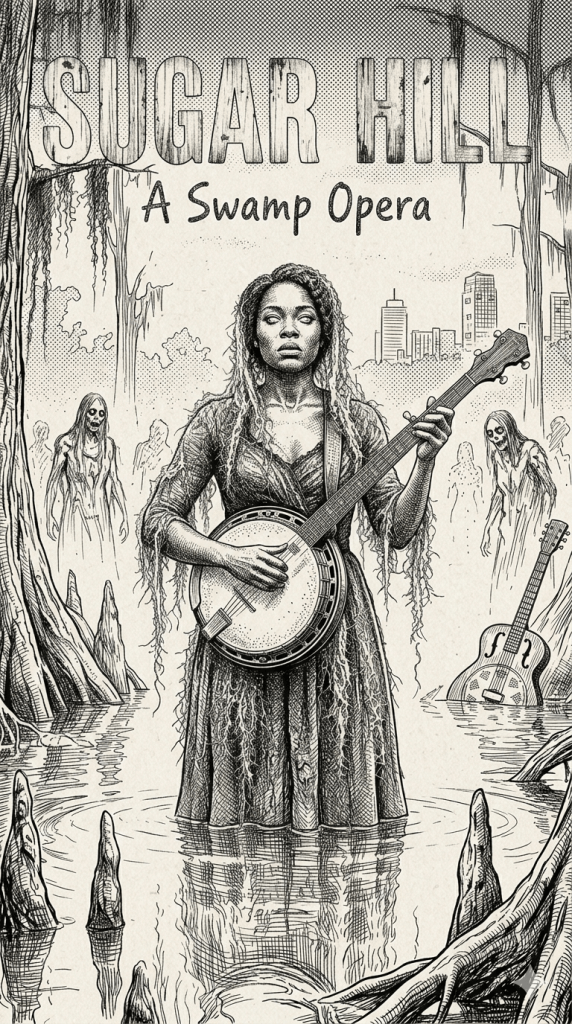
ALUCARDA: La Hija de la Encrucijada

06 Friday Mar 2026

Posted by babylon crashing in drama, Feminism, Script, Spanish, Translation

≈ Comments Off on ALUCARDA: La Hija de la Encrucijada

Tags

Alucarda, bruja, Chihuahuan Desert, Juan López Moctezuma, La Hija de la Encrucijada, libretto, quote unquote, Spanish translation

A Drama in Two Acts

Based on the film, Alucarda, la hija de las tinieblas,

by Juan López Moctezuma (1977)

Libretto by ZJC (2026)


Principal Cast

CharacterDescription
ALUCARDAThe ‘Crossroads’ daughter of the Desert and European Gothic ancestry. An untamed, elemental force.
JUSTINEA fragile, grieving orphan whose transformation provides the opera’s tragic heart.
THE BRUJAAn ancient, earthy figure who acts as the ‘Memory of the Desert.’
FATHER LÁZAROThe rigid, uncompromising arm of the Church.
DR. OSZEKA Viennese psychoanalyst and man of science.
SISTER ANGÉLICAThe kindest face of the Convent, who becomes the voice of mourning.
LUCY WESTENRAAlucarda’s mother. Appears in the Prologue only.

Silent Roles

CharacterDescription
MOTHER SUPERIORA terrifying presence who never speaks. She watches from the shadows.
THE BRUJOA beautiful, disturbing boy. He appears, gestures, and is sacrificed—all in silence.
CINTIAThe girl who committed suicide. Appears as a body in the funeral procession.

Chorus

GroupDescription
THE NUNSFemale chorus. They move and sing in rigid unison, descending into hysteria.
VOICES OF THE WINDOffstage voices that mimic the wailing of the Zone.

Setting

The Zone of Silence, Chihuahuan Desert, Mexico. 1910.


PROLOGUE: The Birth at the Crossroads

The ruins of a colonial palace in the Chihuahuan Desert. The architecture is skeletal, half-swallowed by sand. A violet twilight hangs over the horizon.

LUCY WESTENRA lies on a bed of dry corn husks and tattered silk. She is drenched in sweat and blood. The BRUJA moves with earthy grace, tending to her with bowls of water and bundles of herbs.

A sudden, piercing cry—LUCY screams in childbirth.

LUCY
(Weak, her voice a ghost)
¡Ay!… el aire… no puedo… respirar el polvo… / Oh!… the air… I can’t… breathe the dust…

BRUJA
(Deep and steady)
Empuje, señora. El desierto está escuchando. No le tenga miedo al Silencio… dele su aliento. / Push on, ma’am. The desert is listening. Don’t be afraid of the Silence… give it your breath.

A final surge. The sharp, thin cry of a newborn baby.

BRUJA [cont.]
(Lifting the child)
Es una niña, señora… y es preciosa. Tiene los ojos de la obsidiana. / She’s a girl, ma’am… and she’s beautiful. She has eyes like obsidian.

LUCY
(Reaching out with trembling hands)
Mi niña… mi pequeña luz de sombra…
Naciste donde los mapas terminan.
Pobre criaturita… me gustaría verte crecer…
Pero la sangre me reclama. La tierra me llama por mi nombre.

My little girl… my little light of shadow…
You were born where the maps end.
Poor little creature… I would like to see you grow…
But my blood calls me back. The earth calls me by my name.

(She grabs the Midwife’s arm with surprising strength)

Llévela al Convento. Por favor… prométame que la protegerá.
No deje que se la lleven. No deje que él la encuentre.

Take her to the convent. Please… promise me you’ll protect her.
Don’t let them take her. Don’t let him find her.

BRUJA
¿Quién, señora? ¿El padre? / Who, ma’am? The father?

LUCY
(Eyes wide, looking at a shadow no one else can see)
El pasado. El hambre que cruza el mar.
¡Júrelo! ¡Júrelo por la Virgen y por la Muerte!

The past. The hunger that crosses the sea.
Swear it! Swear it by the Virgin and by Death!

BRUJA
(Solemnly, crossing herself and then touching the baby’s forehead with a pinch of Desert soil)
Lo juro. La protegeré. La llevaré a las puertas de piedra. Ella será una hija del Convento… hasta que el desierto la reclame. / I swear it. I will protect her. I will take her to the stone gates. She will be a daughter of the Convent… until the desert claims her.

LUCY falls back. Her breathing rattles. She whispers one last name.

LUCY
…Alucarda… / …Alucarda…

She dies.

The BRUJA wraps the baby in a blood-stained lace shawl. She exits the ruins into the vast, purple night. Sand begins to blow into the room, covering the body of LUCY WESTENRA.

FADE TO BLACK.


ACT I

Scene 1: The Gates of Stone

Outside the high, limestone walls of the Convent. The Desert sun is high and bleaching. A dusty wagon sits before the massive wooden gates. The architecture is austere, imposing, European in its denial of the surrounding Desert.

JUSTINE, dressed in a heavy black mourning dress, is helped down from the wagon by a DRIVER. She looks fragile, her eyes wide with shock.

DRIVER
¡Justine! ¡Al fin has llegado! No es lugar para una niña sola, pero aquí los muros son gruesos. / Justine! You’ve finally arrived! This is no place for a girl alone, but the walls here are thick.

JUSTINE
¿Es este mi nuevo hogar? El aire… el aire aquí no se mueve. Todo parece… de piedra. / Is this my new home? The air… the air here doesn’t move. Everything seems… made of stone.

The small side-door of the gate creaks open. SISTER ANGÉLICA enters, warm and kind.

ANGÉLICA
Por aquí, Justine. Cuando nos dijeron que tus padres habían muerto, mi corazón lloró contigo. Te hemos estado esperando. Pasa… deja el polvo del camino afuera. / This way, Justine. When we heard your parents had died, my heart ached with yours. We’ve been waiting for you. Come in… leave the dust of the road outside.

JUSTINE
(Looking back at the vast Desert)
El hombre que me trajo dijo que el desierto tiene voz. ¿Es cierto, Hermana? / The man who brought me here said the desert has a voice. Is that true, Sister?

ANGÉLICA
(Smiling, guiding her inside)
Aquí solo escuchamos la voz de Dios, pequeña. En el silencio de la oración, el mundo desaparece. Aquí encontrarás una nueva vida. Ven. Olvida el sol. Olvida la arena. / Here we hear only the small voice of God. In the silence of prayer, the world disappears. Here you will find a new life. Come. Forget the sun. Forget the sand.

They walk through the threshold into the Convent hallway. The acoustic changes—stone walls, echoing reverb.

ANGÉLICA [cont.]
Aquí el tiempo no corre como afuera. Rezamos, estudiamos, y nos preparamos para ser esposas de lo eterno. No tengas miedo. Yo seré tu guía. / Time doesn’t flow here like it does outside. We pray, we study, and we prepare to be brides of eternity. Don’t be afraid. I will be your guide.

A shadow streaks across the white wall. ALUCARDA appears—perched on a high stone ledge, her hair wild, her white shift stained. She stops and stares at JUSTINE from a distance.

ANGÉLICA [cont.]
(Sighing)
Y esa es Alucarda. Ignórala, Justine. Ella… ella llegó aquí en una noche de tormenta, envuelta en encaje y sangre. No conoce las reglas. Es como el viento que sopla en la Zona del Silencio: no se puede atrapar. / And that’s Alucarda. Ignore her, Justine. She… she arrived here on a stormy night, wrapped in lace and blood. She doesn’t know the rules. She’s like the wind that blows in the Zone of Silence: uncatchable.

ALUCARDA lets out a short, mocking laugh and vanishes into the shadows. JUSTINE watches the spot where she was, mesmerized.

JUSTINE
(To herself)
Ella no parece de piedra. Ella parece… fuego. / She doesn’t look like stone. She looks like… fire.

FADE.


Scene 2: The Garden of Stone and Thorns

The Convent Cloister. A rectangular garden enclosed by arches. Meticulously kept but sterile—mostly sand, a few struggling rosebushes, a dry fountain. The heat is shimmering.

JUSTINE sits on a stone bench, clutching a black prayer book. She tries to pray, but her eyes keep wandering to the horizon.

ALUCARDA appears suddenly, hanging upside down from a low tree branch. She is eating a prickly pear fruit, her fingers stained purple.

ALUCARDA
(Light, mocking)
¿Por qué lees ese libro de muertos, Justine? Las letras no se mueven. Las sombras, sí. / Why are you reading that book of the dead, Justine? The letters don’t move. The shadows do.

JUSTINE
(Startled, standing)
¡Alucarda! Me asustaste. Es… es mi devocionario. Me ayuda a no sentirme tan sola. / Alucarda! You scared me. It’s… it’s my prayer book. It helps me not to feel so alone.

ALUCARDA drops to the ground with feline grace. She circles JUSTINE.

ALUCARDA
La soledad no es un libro. La soledad es este muro.
(She touches the stone wall)
Siente… la piedra está fría, pero el sol la quiere quemar. Tú eres como la piedra, Justine. Te visten de negro para que el sol no te encuentre.

Loneliness isn’t a book. Loneliness is this wall.
Feel… the stone is cold, but the sun wants to burn it. You are like the stone, Justine. They dress you in black so the sun won’t find you
.

JUSTINE
(Defensive, yet intrigued)
Sor Angélica dice que el negro es respeto. Mis padres… ellos acaban de… / Sister Angelica says that black is respect. My parents… they just…

ALUCARDA
(Stopping directly in front of her)
Tus padres son tierra ahora. Como mi madre. Ella vive en las ruinas, donde el viento no pide permiso para entrar. ¿Quieres verla? ¿Quieres ver lo que hay detrás de ese muro? / Your parents are dust now. Like my mother. She lives in the ruins, where the wind doesn’t ask permission to enter. Do you want to see her? Do you want to see what’s behind that wall?

JUSTINE
No podemos salir. La Madre Superiora dice que el desierto es un lugar de pecado. Que allí habita el Silencio. / We can’t leave. The Mother Superior says the desert is a place of sin. That Silence dwells there.

ALUCARDA takes JUSTINE’S hand, her purple-stained fingers leaving marks on her skin.

ALUCARDA
El Silencio no es pecado, Justine. El Silencio es música que ellos no saben cantar. Mi madre me habla desde la arena. Me dice que tú no eres una huérfana… eres una semilla. / Silence is not a sin, Justine. Silence is music they don’t know how to sing. My mother speaks to me from the sand. She tells me you are not an orphan… you are a seed.

They sing.

ALUCARDA
Ven conmigo a donde el mapa se borra,
donde las cruces no tienen sombra.
Deja que el polvo te limpie el luto,
deja que el hambre se vuelva fruto.

Come with me to where the map fades,
where the crosses cast no shadows.
Let the dust cleanse your mourning,
let hunger become fruit
.

JUSTINE
Tengo miedo de lo que no tiene nombre,
del viento que llora y del sol que corrompe.
Pero tus ojos… tus ojos son pozos,
donde el miedo se vuelve… hermoso.

I fear the nameless,
of the weeping wind and the corrupting sun.
But your eyes… your eyes are wells,
where fear becomes… beautiful
.

Their voices weave together.

ALUCARDA
Júrame, Justine. Júrame que si cruzamos ese muro, no volverás a cerrar los ojos ante la oscuridad. / Promise me, Justine. Promise me that if we cross that wall, you will never close your eyes to the darkness again.

JUSTINE
Lo juro, Alucarda. Llévame al Silencio. / I swear it, Alucarda. Take me to Silence.

They slip through a hidden gap in the garden wall where the stones have crumbled. The Convent bells begin to toll for Vespers—harsh, metallic, alarmed.

They vanish into the purple haze of the Zone of Silence.

FADE.


Scene 3: The Oracle of Dust

A desolate Desert landscape. In the background, the palace ruins shimmer in the sunlight. The sky has an eerie, almost electric hue.

ALUCARDA and JUSTINE run through the Desert, laughing. In the distance, a procession of figures in black carries a rustic coffin.

JUSTINE
(Stopping, panting)
¿Qué es eso, Alucarda? Nunca había visto un lugar que se sintiera tan… vacío y tan lleno a la vez. / What is that, Alucarda? I’ve never seen a place that felt so… empty and so full at the same time.

ALUCARDA
(Pointing at the ruins)
Es otro secreto, Justine. Como tú y como yo. El desierto guarda lo que la iglesia quiere enterrar. ¡Vamos a buscar más! / It’s another secret, Justine. Just like you and me. The Desert holds what the Church wants to bury. Let’s go find more!

JUSTINE
(Looking at the funeral procession)
Mira… ¿quiénes son? / Look… who are they?

ALUCARDA
Van a enterrar a Cintia. Se quitó la vida porque no aguantaba el peso de la cruz. La llevan a tierra no sagrada… donde por fin podrá descansar del cielo. / They are going to bury Cintia. She took her own life because she couldn’t bear the weight of the cross. They are taking her to unconsecrated ground… where she can finally rest from heaven.

JUSTINE
(Hugging herself)
Me dan miedo los funerales. Me recuerdan que el frío siempre llega. / Funerals scare me. They remind me that the cold always comes.

ALUCARDA
No tengas miedo. Todos tenemos que morir, Justine. Y te prometo que hay una felicidad después de la muerte que los sacerdotes no conocen. No está lejos. ¡Ven! / Don’t be afraid. We all have to die, Justine. And I promise you there is a happiness after death that priests don’t know about. It’s not far off. Come!

THE BRUJA appears from among the bushes. She doesn’t walk; she seems to emerge from the earth itself.

BRUJA
Hijas… miren lo que el viento ha traído. ¿Quieren jugar un juego? Un juego donde el futuro no se escribe con tinta, sino con sombras. / Daughters… look what the wind has brought. Do you want to play a game? A game where the future isn’t written in ink, but in shadows.

JUSTINE
(Backing away)
Creo que deberíamos irnos, Alucarda. Sus ojos… no tienen luz. / I think we should leave, Alucarda. Her eyes… they have no light.

BRUJA
(Laughing)
¿Escuchan? ¿Qué oyen? ¿Nada? Eso es porque el Silencio tiene mucho que decir. El viento me cuenta por qué muere la gente, quién busca un amuleto para no ser olvidado… Vengan, no muerdo… a menos que el destino lo pida. / Do you hear? What do you hear? Nothing? That’s because Silence has much to say. The wind tells me why people die, who seeks an amulet so as not to be forgotten… Come, I don’t bite… unless destiny demands it.

She leads them toward a small adobe hut. THE BRUJO sits on the ground—beautiful, disturbing; an indigenous cherubino. He takes JUSTINE’S hand with unexpected strength, studies it, then releases it as if burned.

The BRUJA observes.

BRUJA
Nada más que silencio, hija. Un silencio que grita. Sombras… sombras que se muerden la cola. Ten cuidado, Alucarda… ella ya es tuya. / Nothing but silence, my daughter. A silence that screams. Shadows… shadows that bite their own tails. Be careful, Alucarda… she’s already yours.

The BRUJA’s monologue.

BRUJA
Ahora verán las maravillas que guardo. Yo estudio la alquimia del desierto… puedo convertir este polvo en piedras preciosas, y las piedras en sueños que nunca imaginaste. Tienes sueños extraños, niña… profundos, cortantes, como los pájaros que se pierden en el bosque. Vienes del rocío, pero las criaturas de la noche te están esperando. Tienes que ser valiente… porque el camino de regreso al Convento se está borrando.

Now you will see the wonders I hold. I study the alchemy of the desert… I can turn this dust into precious stones, and the stones into dreams you never imagined. You have strange dreams, child… deep, sharp, like birds lost in the forest. You come from the dew, but the creatures of the night await you. You must be brave… for the path back to the Convent is fading away.

ALUCARDA laughs and pulls JUSTINE’S hand. They run toward the ruins.

BRUJA
(Shouting at the wind)
¡Hijas! ¿A dónde van? ¡No pueden huir de lo que ya llevan en la sangre! / Daughters! Where are you going? You can’t run from what’s already in your blood!

The girls disappear into the distance. The BRUJA watches. The BRUJO sits, still, his eyes following them.

FADE.


Scene 4: The Shrine of the Holy Death

The interior of the Ruined Palace. A small, hidden alcove contains a modest altar to SANTA MUERTE: white candles, marigolds, and small cadaverous figures draped in lace. Outside, the Desert wind whistles through the stone.

ALUCARDA leads JUSTINE by the hand, her voice hushed and reverent.

ALUCARDA
Mira, Justine. Aquí no hay confesionarios. Nadie te pide que te azotes por tus pecados. / Look, Justine. There are no confessionals here. Nobody’s asking you to flog yourself for your sins.

JUSTINE
(Fearful, looking at the skeletal figure)
¿Quién es ella, Alucarda? Parece… la muerte. / Who is she, Alucarda? She looks like… death.

ALUCARDA
Es la Santa Muerte. La que nos cuida cuando los hombres de negro nos olvidan. Ella no te pide que sufras para ser santa. Ella solo te pide que seas tú. / It’s Santa Muerte. The one who watches over us when the men in black forget us. She doesn’t ask you to suffer to be a saint. She only asks you to be yourself.

JUSTINE
(Shivering)
No… Alucarda, vámonos. Este lugar no nos quiere aquí. / No… Alucarda, let’s go. This place doesn’t want us here.

ALUCARDA approaches her, her voice becoming obsessive and dark.

ALUCARDA
Todos tenemos miedo. Pero hablo de morir amando… morir juntas para que podamos vivir eternamente con la misma sangre corriendo siempre por nuestras venas. Yo vivo en ti, Justine… ¿morirías por mí? Te quiero tanto… nunca he estado enamorada de nadie, excepto de ti.

We’re all afraid. But I’m talking about dying loving… dying together so we can live eternally with the same blood always running through our veins. I live in you, Justine… would you die for me? I love you so much… I’ve never been in love with anyone, except you.

JUSTINE
(Breathless)
¿Lo dices en serio? / Are you serious?

ALUCARDA
No sabes cuánto. Llámame cruel, llámame egoísta… el amor siempre lo es. Tienes que amarme hasta la muerte. Recuerdo una noche… casi me asesinaron. Me hirieron aquí, y nunca volví a ser la misma.

You have no idea. Call me cruel, call me selfish… love always is. You have to love me until death. I remember one night… they almost killed me. They hurt me here, and I was never the same again.

JUSTINE
¿Estuviste a punto de morir? / Were you close to death?

ALUCARDA draws a knife.

ALUCARDA
Sí. Casi. Hagamos un pacto. Si tenemos que irnos de esta vida, lo haremos juntas. / Yes. Almost. Let’s make a pact. If we have to leave this life, we’ll do it together.

JUSTINE
(Stretching out her hand, hesitating)
Está bien… si eso te hace feliz. / That’s fine… if it makes you happy.

As the knife nears JUSTINE’S palm, ALUCARDA freezes. Her eyes lock onto a coffin in the shadows.

ALUCARDA
Espera… «Lucille Westenra… muerta hace años». Justine… esta es mi madre. Nunca le he visto la cara. / Wait… “Lucille Westenra… dead for years.” Justine… this is my mother. I’ve never seen her face.

JUSTINE
¡No! ¡Tengo miedo, Alucarda! / No! I’m scared, Alucarda!

ALUCARDA heaves the lid open. Inside is the skeleton of LUCY, still wrapped in blood-stained lace.

JUSTINE
¡Santo cielo! ¡Dios mío! ¡Oh, Dios mío! / Good heavens! My God! Oh my God!

ALUCARDA screams—a raw, high-pitched sound. They flee.

The stage shifts to the exterior of the ruins—blue and cold. JUSTINE chases ALUCARDA through the sand.

JUSTINE
¡Alucarda! ¡Espera! ¡Te dije que este lugar me asustaba! ¡Vuelve! ¿Qué te ha pasado? / Alucarda! Wait! I told you this place scared me! Come back! What happened to you?

ALUCARDA
(Trembling, her confidence shattered)
Hace frío… estoy temblando… Volvamos, Justine. Lo que tenemos que hacer es volver… volvamos al Convento. / It’s cold… I’m shivering… Let’s go back, Justine. What we have to do is go back… let’s go back to the Convent.

They stand in the Desert, lost.

FADE.


Scene 5: The Anatomy of Evil

The Main Hall of the Convent. Stark, cold, echoing. FATHER LÁZARO stands in a high pulpit, looking down at a sea of black-and-white habits. THE NUNS are in a state of high-strung devotion.

LÁZARO
El demonio no toca a la puerta; el demonio la derriba. Entra en el cuerpo, usa los órganos para su propio placer… se apodera de la voluntad por encima de la fuerza humana. ¡Aquí está escrito! ¡En el libro sagrado! / The devil doesn’t knock; he breaks down the door. He enters the body, uses the organs for his own pleasure… he seizes control of the will beyond human strength. It is written here! In the holy book!

(He slams the Bible against the pulpit.)

Desde los tiempos del Señor, la Tlahuelpuchi y otros demonios han perseguido las almas cristianas. No hacen distinción entre hombres, mujeres o niños. ¡Él, el Diablo, usa vuestros cuerpos como si fueran suyos! Destruye, pervierte la lengua, distorsiona los labios… ¡En vez de plegarias, sale espuma de la boca! / Since the time of the Lord, Tlahuelpuchi and other demons have haunted Christian souls. They make no distinction between men, women, or children. He, the Devil, uses your bodies as if they were his own! He destroys, perverts the tongue, distorts the lips… Instead of prayers, foam comes from the mouth!

THE NUNS begin to sway.

LÁZARO
Debemos vivir bajo la norma, la única verdad. Si no, el Diablo encontrará un sitio en vuestro interior y se llevará vuestras almas al fuego eterno. ¡Arderán para siempre! ¡Sus cuerpos sufrirán torturas que la mente no puede imaginar! ¡La cólera de Satán no tiene piedad! / We must live by the law, the only truth. Otherwise, the Devil will find a place within you and drag your souls to eternal fire. They will burn forever! Your bodies will suffer tortures beyond comprehension! Satan’s wrath knows no mercy!

(With a thunderous roar)

¡ARREPIÉNTANSE! / REPENT!

Chaos erupts. THE NUNS scream, cry, collapse into hysteria. In the midst of the panic, JUSTINE, who has been staring at ALUCARDA with wide, unblinking eyes, suddenly buckles. Her knees hit the stone floor.

ALUCARDA
(Catching her)
Justine… ¿Qué te pasa? Mírame. / Justine… What’s wrong? Look at me.

ANGÉLICA
(Rushing over)
¡Justine! ¡Contéstame, hija! / Justine! Answer me, daughter!

JUSTINE stares at ALUCARDA. Her eyes roll back. She falls limp.

A chilling tableau: ALUCARDA holding the unconscious JUSTINE, ANGÉLICA looking at ALUCARDA.

FADE.


Scene 6: The Blood Wedding of the Shadows

Justine’s cell. Cold stone, a single crucifix on the wall, a small iron bed. Outside, the Zone is screaming.

ANGÉLICA and GERMANA hover over JUSTINE. ALUCARDA stands in the shadows of the doorway, watching.

ANGÉLICA
(Softly)
¿Te encuentras mejor, hija? El sermón de Lázaro fue… pesado para un alma tan joven. / Are you feeling better, daughter? Lazarus’ sermon was… heavy for such a young soul.

JUSTINE
(Weakly)
No lo sé… siento que el aire me pesa. / I don’t know… I feel like the air is heavy.

THE NUNS exit. The door clicks shut. The atmosphere changes.

ALUCARDA moves toward the bed with manic intensity.

ALUCARDA
¡Monstruos! ¡Te hicieron esto! No les cuentes nuestro secreto, Justine. Las voces han regresado… vienen del pasado. Todo se aclaró en el desierto: solo quedamos tú y yo. / Monsters! They did this to you! Don’t tell them our secret, Justine. The voices have returned… they come from the past. Everything became clear in the desert: only you and I remain.

JUSTINE
Oh, Alucarda… estoy tan asustada. / Oh, Alucarda… I’m so scared.

ALUCARDA enters a trance.

ALUCARDA
Nos lo pagarán… poco a poco. La Llorona… Nahual… Tlahuelpuchi… / They’ll pay for it… little by little. La Llorona… Nahual… Tlahuelpuchi…

JUSTINE
¡Alucarda! ¿Qué te pasa? ¡Por Dios, contesta! / Alucarda! What’s wrong? For God’s sake, answer me!

ALUCARDA begins to thrash. She rips the Crucifix from JUSTINE’S neck with a violent snap.

ALUCARDA
¡MUERTE! ¡MUERTE! ¡MUERTE! / DEATH! DEATH! DEATH!

The room explodes into a storm. Thunder shakes the stone. Lightning flashes.

THE BRUJA steps out of the shadows, laughing.

BRUJA
¡Jajaja! Tienes razón. Se lo haremos pagar. ¡Llamala! ¡Llamala! / Hahaha! You’re right. We’ll make her pay. Call her! Call her!

ALUCARDA
(In a soaring, desperate cry)
¡SANTA MUERTE! ¡CIHUATETEO! ¡LA LLORONA! / SANTA MUERTE! CIHUATETEO! LLORONA!

Red lightning. THE GIRLS appear stripped of their Convent clothes—naked and vulnerable yet empowered. THE BRUJA looms over them like a dark priestess.

ALUCARDA
(Kneeling before Justine)
Mírame, Justine. Eres tan guapa. Mírame… mírame… / Look at me, Justine. You’re so beautiful. Look at me… look at me…

The BRUJA guides the knife. She cuts their breasts. The red hue of the storm floods the room. She smears the blood onto their lips.

BRUJA
Ahora… únanse una con otra. Y luego… únanse en mí. Únanse en el Silencio. / Now… unite with one another. And then… unite in me. Unite in Silence.

THE BRUJA vanishes into the shadows. ALUCARDA leans in.

ALUCARDA
Mírame, querida Justine… / Look at me, my dear Justine…

ALUCARDA drinks the blood from JUSTINE’S lips. A moment of horror and profound intimacy. She licks the wound clean.

The Convent bells begin to toll—not for prayer, but in alarm.

BLACKOUT.


Scene 7: The Two Altars (The Ecstasy of Blood)

The stage is split. STAGE LEFT: SISTER ANGÉLICA’S cell—stark white, a crucifix, a candle. STAGE RIGHT: The Desert Shrine—shadowy, lit by torches, a skeletal figure of SANTA MUERTE draped in marigolds. A storm is brewing.

ANGÉLICA kneels in her cell.

ANGÉLICA
Padre nuestro que estás en los cielos… santificado sea tu nombre. Hágase tu voluntad, así en la tierra como en el cielo. / Our Father who art in heaven… hallowed be thy name. Thy will be done, on earth as it is in heaven.

On the Desert side, THE BRUJO—beautiful, naked, terrifying—leads ALUCARDA and JUSTINE. They are also naked, their skin shimmering under the lightning. Dozens of figures emerge from the shadows—a naked congregation. They begin a concentric, hypnotic dance.

ANGÉLICA continues to pray, her voice becoming more desperate.

ANGÉLICA
Líbranos de la maldad, oh querido Dios… dame fuerza para mantenerme alejada del pecado. / Deliver us from evil, oh dear God… give me strength to stay away from sin.

The dance intensifies. ALUCARDA and JUSTINE touch, their movements fluid and transgressive.

A figure representing DOÑA BELLA SEBASTIANA—the skeletal Bride of Death—joins THE GIRLS’ hands. The dance behind them turns into a chaotic orgy of movement.

In the Convent cell, blood begins to seep from ANGÉLICA’S eyes, running down her cheeks like red tears.

ANGÉLICA
(In a final, soaring cry)
¡POR FAVOR, PROTÉGELA, SEÑOR! / PLEASE PROTECT HER, LORD!

A massive wound opens on THE BRUJO’S neck. He crumples as a sacrifice.

In the cell, it begins to RAIN BLOOD. The white walls are splattered crimson. ANGÉLICA, her face smeared in gore, begins to float, lifted by the sheer psychic violence of the ritual. She is smiling—a terrifying, glassy-eyed beatitude.

BLACKOUT.


ACT II

Scene 1: The Gospel of the Skin

A stark, whitewashed classroom in the Convent. Large windows reveal the harsh Chihuahuan sun. A blackboard is covered in Latin verses. NUNS sit in rows.

GERMANA leads a lesson on the life of St. Teresa of Avila.

GERMANA
Y así, la Santa se entregó al dardo del ángel… Una herida que no duele en la carne, sino en el espíritu. Una sumisión perfecta. / And so, the Saint surrendered to the angel’s dart… A wound that does not hurt the flesh, but the spirit. A perfect submission.

ALUCARDA and JUSTINE sit at the back. They exchange a look of secret shared power.

ALUCARDA
(Interrupting)
¿Sumisión? O fue deseo, Hermana? / Submission? Or was it desire, Sister?

THE NUNS gasp.

GERMANA
(Startled, angry)
Alucarda… hablamos de la gracia divina. No de deseos terrenales. / Alucarda… we’re talking about divine grace. Not earthly desires.

ALUCARDA
¿No lo sientes? Debajo de ese hábito negro… ¿no sientes que tu piel tiene hambre? Nosotras vimos a la Niña Blanca. Ella no pide oraciones. Ella pide vida. / Don’t you feel it? Beneath that black habit… don’t you feel your skin is hungry? We saw the White Girl. She doesn’t ask for prayers. She asks for life.

GERMANA
¡Cállate! ¡Hijas de Satán! ¡Fuera de aquí! / Shut up! Daughters of Satan! Get out of here!

THE GIRLS sing.

ALUCARDA & JUSTINE
No hay pecado en el deseo,
no hay infierno en el placer.
El cuerpo es el único templo
que el tiempo no puede romper.

There is no sin in desire,
there is no hell in pleasure.
The body is the only temple
that time cannot break
.

THE GIRLS move through the rows. Everywhere they touch a NUN, that NUN begins to shake or weep.

ALUCARDA
Mírame, Germana. Anoche la sangre llovió sobre Angélica. ¿Quieres saber a qué sabe la eternidad? / Look at me, Germana. Last night blood rained down on Angelica. Do you want to know what eternity tastes like?

THE NUNS break. One laughs hysterically; another flagellates herself with her rosary. The classroom descends into religious mania.

GERMANA
(Falling to her knees, screaming)
¡Lázaro! ¡Lázaro, ayúdenos! ¡El desierto está dentro! ¡Las paredes están sangrando! / Lazarus! Lazarus, help us! The desert is within! The walls are bleeding!

ALUCARDA and JUSTINE stand on the desks, looking down at the writhing NUNS. Outside, the sky turns a deep, bruised purple.

BLACKOUT.


Scene 2: The Weakening

Justine’s cell. JUSTINE lies in a stupor, pale as wax. ANGÉLICA sits nearby, her face a mask of desperate love.

ANGÉLICA
(To herself)
No te dejaré, mi niña. No te dejaré. / I won’t leave you, my child. I won’t leave you.

DR. OSZEK enters, followed by MOTHER SUPERIOR, who stands in the doorway, watching in silence.

DR. OSZEK
Necesito más luz. / I need more light.

ANGÉLICA opens a window.

ANGÉLICA
Empeora minuto a minuto, doctor. / It’s getting worse by the minute, doctor.

OSZEK checks JUSTINE’S pulse.

DR. OSZEK
¿Cuánto hace que esta así? / How long has it been like this?

ANGÉLICA
Desde esta mañana, doctor. / Since this morning, doctor.

MOTHER SUPERIOR watches, unmoved, silent.

DR. OSZEK
Su pulso es muy débil. El corazón también. Esta chica está muy enferma. / Her pulse is very weak. Her heart is weak too. This girl is very sick.

JUSTINE stirs. Her eyes open—just slightly. She sees the Crucifix around ANGÉLICA’S neck. She screams.

DR. OSZEK [cont.]
¿Qué te pasa hija, que te pasa? Tranquilízate… tranquilízate. Así… así. / What’s wrong, daughter? What’s wrong? Calm down… calm down. Like this… like this.

JUSTINE passes out. ANGÉLICA weeps silently. MOTHER SUPERIOR watches, unmoved. OSZEK stares at his hands.

FADE.


Scene 3: The Trial of the Flesh

FATHER LÁZARO’S study. A dark, oppressive room dominated by a massive, bleeding crucifix. ALUCARDA sits in a hard wooden chair, unnervingly calm. GERMANA stands by the door.

GERMANA
(Hissing)
Es tu turno ahora, Alucarda. El Padre te sacará el veneno. / It’s your turn now, Alucarda. The Father will draw out the poison.

LÁZARO enters. He moves with heavy, rhythmic steps. ALUCARDA rises slowly, crosses the stage with the grace of a predator, and kneels before him with mocking, exaggerated piety.

LÁZARO
(His voice a low rumble)
Dime, hija mía… / Tell me, my daughter…

ALUCARDA
(Voice like silver)
Yo… yo… / I… I…

LÁZARO
Sí. Adelante. / Yes. Continue.

ALUCARDA
Me han dicho que viniera aquí. Me pidieron responder una pregunta y lo hice… y la Hermana Germana se enfadó mucho conmigo. / They told me to come here. They asked me to answer a question and I did… and Sister Germana got very angry with me.

LÁZARO
Y por una buena razón. Me han explicado lo que pasó. ¿Has pecado, Alucarda? / And for good reason. They’ve explained what happened to me. Have you sinned, Alucarda?

ALUCARDA
(Looking up, eyes wide)
No recuerdo haber hecho nada malo. / I don’t remember doing anything wrong.

LÁZARO
(Leaning over her)
Los mentirosos arderán en el infierno por la eternidad. ¿Estás segura? No pierdas esta oportunidad. Puedes contar la verdad ahora y aquí. / Liars will burn in hell for eternity. Are you sure? Don’t miss this opportunity. You can tell the truth right now, right here.

ALUCARDA rises slowly until she is standing dangerously close.

ALUCARDA
No he mentido. Amo la vida… con Justine. Nos hemos vuelto muy unidas. Yo la amo, y usted… usted se hace llamar bendito. Usted cree en la ‘vida eterna’ y adora a un Dios muerto… pero yo adoro la Vida. Usted adora la Muerte. / I haven’t lied. I love life… with Justine. We’ve become very close. I love her, and you… you call yourself blessed. You believe in ‘eternal life’ and worship a dead God… but I worship Life. You worship Death.

LÁZARO
(Stunned, stepping back)
¡Blasfemia! / Blasphemy!

ALUCARDA advances on him.

ALUCARDA
Yo quiero a Justine. Y usted… usted solo quiere matar. Hemos hecho un pacto y lo sellamos con nuestra sangre. ¡La culpa no es nuestra, es suya! Se cubre el cuerpo con esa negra sotana porque se avergüenza de él. Tiene miedo a la vida… / I love Justine. And you… you only want to kill. We made a pact and sealed it with our blood. The fault is not ours, it’s yours! You cover your body with that black cassock because you’re ashamed of it. You’re afraid of life…

(She grabs the edge of his robe, her face inches from his.)

¿Pero le gustaría poseerme, verdad? ¡Pues tómeme! ¡Quítese esa sotana! ¡Sea el hombre que oculta bajo su miedo! / But you’d like to possess me, wouldn’t you? Well, take me! Take off that cassock! Be the man you hide beneath your fear!

LÁZARO lets out a guttural, primal scream. He falls backward, tripping over his own chair.

GERMANA
(Rushing over)
¿Pero qué pasa, Padre? ¿Qué ha pasado? / But what’s wrong, Father? What happened?

LÁZARO
(Cowering on the floor)
¡Sáquela de aquí! ¡Fuera! ¡Dios mío, no… no… no! / Get her out of here! Get out! Oh my God, no… no… no!

ALUCARDA stands over him, laughing. GERMANA drags her out as LÁZARO begins to pray frantically in Latin, his voice cracking.

FADE.


Scene 4: The Cathedral of Pain

The basement of the Convent. A vaulted stone cellar. The air is thick with dampness and the smell of copper. FATHER LÁZARO and THE NUNS are stripped to the waist, their backs crisscrossed with bloody welts. They move in a rhythmic, agonizing dance of self-flagellation.

LÁZARO
(Ragged, punctuated by the crack of the whip)
¡Lo que dijo era horrible! ¡No eran palabras de una niña… era el demonio hablando por su boca! ¡Solo el Diablo! / What she said was horrible! Those weren’t the words of a little girl… it was the devil speaking through her! Only the Devil!

GERMANA
(Wailing as she strikes herself)
¡Por favor, Señor, no nos abandones ante la dificultad! ¡Líbranos! / Please, Lord, do not abandon us in our time of difficulty! Deliver us!

NUNS
¡El Diablo! ¡El Diablo está entre nosotros! / The Devil! The Devil is among us!

LÁZARO signals for them to stop. They collapse, panting. He produces a heavy, ancient Vatican record.

LÁZARO
¿Creen que estar en la Iglesia nos protege? He leído los archivos del Vaticano… incidentes confirmados. En 1479, en el monasterio de Cameron, las monjas ladraban como perros y predecían el futuro. ¡Convirtieron el santuario en un templo de Satán! / Do you think being in the Church protects us? I’ve read the Vatican archives… confirmed incidents. In 1479, at the Cameron monastery, the nuns barked like dogs and predicted the future. They turned the sanctuary into a temple of Satan!

GERMANA
(Reading from the book)
En 1550, las monjas de Nazareth subían a los árboles como gatos… levitaban durante horas en el aire del demonio. / In 1550, the nuns of Nazareth climbed trees like cats… they levitated for hours in the devil’s air.

NUN III
¡En Roma! Tres huérfanas como estas… dos enfermaron, la tercera enloqueció. ¡Murieron las tres! ¡Justine y Alucarda están poseídas! / In Rome! Three orphans like these… two fell ill, the third went mad. All three died! Justine and Alucarda are possessed!

TERESA
(A lone voice)
No… el diablo puede estar en cualquier parte, pero no en esas pobres chicas. / No… the devil can be anywhere, but not in those poor girls.

LÁZARO
(Turning on her)
¡Es una conspiración! Satán elige a las criaturas más delicadas para destruir a la Sagrada Iglesia Católica. Tal vez no sea el Rey de las Tinieblas… pero es uno de sus mensajeros. ¿Cuánto tiempo hace que Justine se comporta así? / It’s a conspiracy! Satan chooses the most vulnerable creatures to destroy the Holy Catholic Church. Perhaps he isn’t the King of Darkness… but he’s one of his messengers. How long has Justine been acting this way?

TERESA
Casi una semana. Dijo que… que le molestaba la luz. / Almost a week. He said that… that the light bothered him.

LÁZARO
(With terrifying triumph)
¡Eso es! Un diablo heliofóbico. La sexta categoría de los infiernos. El que odia la luz y actúa en las sombras. ¡Para salvarlas, debemos destruir al mensajero! / That’s it! A heliophobic devil. The sixth category of Hell. One who hates the light and acts in the shadows. To save them, we must destroy the messenger!

(He raises his bloody whip like a scepter.)

¡Tenemos que preparar un Exorcismo! / We need to prepare an exorcism!

THE NUNS gasp and cross themselves. The static of the Zone swells, swallowing the sound of their prayers.

FADE.


Scene 5: The Theft of the Innocent

Justine’s room. Dimly lit. JUSTINE is deathly still on the bed. ANGÉLICA hovers over her.

ANGÉLICA
¡Justine… mi pobre Justine! No dejaré que te toquen con sus látigos. No dejaré que te lleven a ese sótano de sombras. Te esconderé… donde el desierto no pueda encontrarte y la Iglesia no pueda romperte. / Justine… my poor Justine! I won’t let them touch you with their whips. I won’t let them take you to that cellar of shadows. I’ll hide you… where the desert can’t find you and the Church can’t break you.

She struggles to lift JUSTINE.

ANGÉLICA
Vamos, pequeña… ayúdame. El aire aquí está envenenado. Tenemos que correr antes de que el sol se ponga. / Come on, little one… help me. The air here is poisoned. We have to run before the sun sets.

The door is kicked open. THREE NUNS enter. They move with mechanical, cold efficiency.

NUN I
(Sharp, accusing)
¿Hermana? ¿Qué está haciendo? El Padre Lázaro ha reclamado a la niña para la purificación. / Sister? What are you doing? Father Lazarus has claimed the girl for purification.

ANGÉLICA
(Shielding Justine)
¡No! ¡Ella no es un demonio! / No! She’s not a demon!

THE NUNS advance. A struggle.

NUNS
¡Apártate, Angélica! Tienes que salir. ¡Abran la puerta! / Step aside, Angelica! You have to leave. Open the door!

ANGÉLICA
¡No! ¡Justine! ¡No dejaré que se la lleven! ¡Es mi sangre! ¡Es mi alma! / No! Justine! I won’t let them take her! She’s my blood! She’s my soul!

THE NUNS grab JUSTINE’S arms and legs. They drag her from the bed. JUSTINE remains limp, her head lolling back.

ANGÉLICA
(Screaming)
¿A dónde se la llevan? ¡Justine! ¡Contéstame! / Where are they taking her? Justine! Answer me!

THE NUNS push ANGÉLICA back into the room and slam the door. The bolt slides into place.

ANGÉLICA collapses against the wood.

ANGÉLICA
(A long, haunting wail)
¡Ay, mi niña… mi niña…! / Oh, my little girl… my little girl…!

She weeps. The sound of her sorrow echoes.

FADE.


Scene 6: The Exorcism (The Breaking of the Vessel)

The Torture Chamber of the Convent. A suffocating space of red stone. JUSTINE, almost lifeless, is tied to a wooden cross. The instruments of ‘purification’ gleam under the torches. Smoke fills the air.

A NUN drags ALUCARDA inside. Upon seeing JUSTINE, ALUCARDA lets out a wail.

THE NUNS drag her to a second cross and chain her up.

FATHER LÁZARO enters.

LÁZARO
No desesperes, hija mía… estamos aquí para librarte del Mal. No son ustedes, es el demonio quien se resiste. ¡Lo demostraré exponiendo la Marca Diaboli! ¡Desvístanla! / Do not despair, my daughter… we are here to free you from Evil. It is not you, it is the devil who resists. I will prove it by revealing the Mark of the Devil! Undress her!

ALUCARDA
(A heartbreaking lament)
Justine… no… ¡Morirán pronto! ¡Sentirán el fuego que yo ya conozco! / Justine… no… They will die soon! They will feel the fire I already know!

THE NUNS undress JUSTINE. At the sight of her naked body, THE NUNS enter a collective hysteria—they crawl, howl, pound the floor.

LÁZARO
(Exalted)
¡Ahí está la evidencia! ¡No pueden oír el nombre del Salvador! ¡Están poseídas! ¡Cállenla! / There’s the proof! They can’t hear the Savior’s name! They’re possessed! Silence her!

ALUCARDA is gagged.

LÁZARO begins the Great Exorcism.

LÁZARO
¡Yo te ordeno, espíritu diabólico! Por aquel que juzga el mundo… ¡Abandona estos cuerpos! ¡Vuelve a las profundidades! Humíllate ante Cristo, que salva a las almas del fuego. ¡Dios Padre te lo ordena! ¡La Sagrada Cruz te lo ordena! / I command you, demonic spirit! By Him who judges the world… Leave these bodies! Return to the depths! Humble yourself before Christ, who saves souls from the fire. God the Father commands you! The Holy Cross commands you!

THE NUNS intensify their torment. JUSTINE breathes her last. Her head falls.

The door crashes open. ANGÉLICA and DR. OSZEK enter.

ANGÉLICA
(A blood-curdling scream)
¡Justine! ¡Mi niña! / Justine! My girl!

DR. OSZEK
¡Paren! ¡Deténganse! ¡Esto es la expresión más primitiva de ignorancia que he visto! ¡Usted… Lázaro… acaba de matar a Justine! / Stop! Halt! This is the most primitive expression of ignorance I have ever seen! You… Lazarus… have just killed Justine!

LÁZARO
(Cold)
¡Cómo se atreve a interrumpir un rito sagrado, Doctor! / How dare you interrupt a sacred rite, Doctor!

OSZEK examines ALUCARDA.

DR. OSZEK
Malditos sean… desátenla. Me llevaré a esta chica antes de que la maten también. Su ‘fe’ es un matadero. / Damn them… untie her. I’ll take this girl before they kill her too. Their ‘faith’ is a slaughterhouse.

OSZEK takes ALUCARDA in his arms. She is catatonic, staring at JUSTINE’S body.

THE NUNS lower JUSTINE and hand her to ANGÉLICA.

ANGÉLICA holds JUSTINE’S bloodied body in a grotesque Pietà. OSZEK leaves with ALUCARDA. LÁZARO remains impassive, like a stone statue.

ANGÉLICA
(To Germana)
Fuiste testigo… permitiste esto. ¿Dónde está el amor? Destruyeron su cuerpo… pero el Señor no abandonará su alma. Que Dios tenga piedad de usted, porque el desierto no la tendrá. / You were a witness… you allowed this. Where is the love? They destroyed her body… but the Lord will not abandon her soul. May God have mercy on you, for the desert will not.

GERMANA
(Icy, triumphant)
Suficiente, hermana. / Enough, sister.

END OF ACT II.


Scene 7: The Clinic of Shadows

Dr. Oszek’s study. Filled with the artifacts of 1910 progress: a brass-horned gramophone, anatomical charts, glass jars of specimens. Outside, the Desert wind makes the glassware rattle.

ALUCARDA lies unconscious on a leather fainting couch. DR. OSZEK sits by her side, checking her pulse. His face is haunted.

ALUCARDA wakes up screaming.

ALUCARDA
¡No, no! / No, no!

DR. OSZEK
Todo está bien… / Everything’s fine…

ALUCARDA
¡No me toque, no me toque! / Don’t touch me, don’t touch me!

DR. OSZEK
Nadie quiere hacerte daño, todo está bien. / Nobody wants to hurt you, everything is fine.

ALUCARDA calms down.

ALUCARDA
Tú no… ¡el viento! / Not you… the wind!

DR. OSZEK
(Sighing, putting on his spectacles)
Lo que usted llama ‘el viento’ es una corriente térmica del Bolsón de Mapimí. Usted sufre de una disociación severa. Es fascinante, en realidad. Un caso de libro sobre cómo la represión religiosa fractura la psique femenina. / What you call ‘the wind’ is a thermal current from the Bolsón de Mapimí. You suffer from severe dissociation. It’s fascinating, really. A textbook case of how religious repression fractures the female psyche.

ALUCARDA moves toward him with a predator’s grace.

ALUCARDA
Usted cruzó el mar para medirnos, ¿verdad? Cree que si le pone un nombre en latín a mi sed, la sed desaparecerá. Pero dígame, Doctor… ¿qué nombre le puso al miedo que siente ahora? / You crossed the sea to measure us, didn’t you? You think that if you give my thirst a Latin name, it will disappear. But tell me, Doctor… what name did you give to the fear you feel now?

DR. OSZEK
(Chuckling nervously)
Yo no siento miedo. Siento curiosidad profesional. / I don’t feel fear. I feel professional curiosity.

ALUCARDA leans close, looking into his eyes. The electric light flickers and buzzes.

ALUCARDA
Mientes. Tus ojos huelen a Viena… huelen a bibliotecas antiguas y a una hija que jamás podrías entender. Crees que estoy enferma porque quiero sangre. Pero acabo de despertar. Y tú… estás rodeado de fantasmas que no entiendes. / You’re lying. Your eyes smell of Vienna… they smell of old libraries and a daughter you could never understand. You think I’m sick because I crave blood. But I’ve just woken up. And you… you’re surrounded by ghosts you don’t understand.

ALUCARDA vanishes into the flickering shadows. The room is empty, save for OSZEK, who remains deathly still.

A knock at the door.

DR. OSZEK
(Calling)
¿Quién es? / Who is it?

TERESA
(Muffled)
Soy yo, hermana Teresa. Algo terrible ha pasado en el Convento, tiene que venir. / It’s me, Sister Teresa. Something terrible has happened at the convent; you must come.

OSZEK opens the door.

DR. OSZEK
Pero si son las cinco de la mañana. / But it’s five in the morning.

TERESA
La reverenda madre me envió a buscarte; dice que tienes que venir enseguida. / The Reverend Mother sent me to find you; she says you have to come right away.

DR. OSZEK
Ya estoy acostumbrado a las terribles cosas que pasan en el Convento. ¿Qué sucede ahora? / I’m used to the terrible things that happen at the convent. What’s happening now?

TERESA
¡Es Justine! ¡No está muerta! / It’s Justine! She’s not dead!

They exit together.

FADE.


Scene 8: The Transgression of the Flesh

The Convent Chapel. The altar is in disarray. The air smells of ozone and burnt flesh. DR. OSZEK enters hurriedly, followed by MOTHER SUPERIOR, who stands in the doorway, watching in silence.

DR. OSZEK
(Looking at an empty spot)
¿Quién ha hecho esto? ¡El cuerpo de Justine ha desaparecido! ¡Las telas están trituradas! / Who did this? Justine’s body has disappeared! The fabrics are shredded!

FATHER LÁZARO

[Entering.] Parecía como si hubiera sido secuestrada por los demonios del infierno. / It looked as if she had been kidnapped by demons from hell.

DR. OSZEK
¡Superstición! Tendré que avisar a las autoridades. Alguien robó el cuerpo; no hay otra lógica. / Superstition! I’ll have to notify the authorities. Someone stole the body; there’s no other explanation.

A NUN bursts in screaming. Everyone rushes to GERMANA’S cell. On the floor, a pile of ashes and charred human remains, still smoldering.

DR. OSZEK
(Bending over, horrified)
Ha sido quemada hasta morir… por dentro. Una combustión imposible. / She has been burned to death… from the inside out. An impossible combustion.

MOTHER SUPERIOR watches, unmoved, silent.

LÁZARO, with inhuman coldness, lifts the charred corpse and carries it to the chapel. Suddenly, an inhuman scream tears through the silence. The ‘dead’ corpse stirs, writhes, emits shrieks.

LÁZARO raises a machete and begins to strike the neck with rhythmic violence. Blood splatters the paintings of saints. Finally, he severs the head.

DR. OSZEK
(Panting, backing away)
¿Qué significa esto? ¡Estaba muerta y seguía moviéndose! / What does this mean? She was dead and yet she was still moving!

LÁZARO
El Diablo la movía. ¿Cómo explica esto su ‘ciencia’, Doctor? Ha sucedido ante sus ojos. ¿Aún duda? / The Devil was moving her. How do you explain this with your ‘science’, Doctor? It happened right before your eyes. Do you still doubt?

DR. OSZEK
En París me enseñaron que la religión era farsa y cadena… que la mente enferma crea sus propios demonios. Soy un hombre razonable, pero me enfrento a lo sobrenatural y tengo miedo. Esta mujer estaba muerta… pero algo habitaba en ella preparado para atacar. Es el Diablo… es el Diablo. / In Paris, I was taught that religion was a farce and a chain… that a sick mind creates its own demons. I am a reasonable man, but when I face the supernatural, I am afraid. This woman was dead… but something dwelled within her, ready to strike. It is the Devil… it is the Devil.

LÁZARO
Él la llevó del altar al infierno. Germana fue contaminada. / He led her from the altar to hell. Germana was corrupted.

A VOICE
Fue Justine. Ella es el foco. / It was Justine. She’s the focus.

ANGÉLICA
(From the shadows)
¿Justine? No… ella es la víctima. / Justine? No… she’s the victim.

LÁZARO
Tenemos que encontrarla antes de que haya más cuerpos, más poseídos. Ella es el mensajero de la sed. / We have to find her before there are more bodies, more possessed people. She is the messenger of thirst.

DR. OSZEK
Debemos encontrarla… o lo que quede de ella. / We must find her… or what’s left of her.

ANGÉLICA
(Taking a step forward)
Yo sé dónde buscar. Conozco los sitios donde solían esconderse del mundo. / I know where to look. I know the places where they used to hide from the world.

DR. OSZEK
Entonces, guíenos, Angélica. / So, guide us, Angelica.

ANGÉLICA
(Taking the Doctor’s hand)
Prométame que no le hará daño. Prométamelo, Doctor… por lo que queda de su alma. / Promise me you won’t hurt her. Promise me, Doctor… on what’s left of your soul.

DR. OSZEK
(Broken)
Vamos. / Come on.

They all leave, save LÁZARO, who remains on stage with GERMANA’S remains.

FADE.


Scene 9: The Altar of the First Mother

The ruins of the colonial palace. Moonlight cuts through the cracked ceiling in jagged shafts. The air is stagnant.

DR. OSZEK, MOTHER SUPERIOR, and several NUNS enter cautiously, led by ANGÉLICA. They reach the chamber where LUCY’S COFFIN sits.

ANGÉLICA
(In a breathless whisper)
Doctor… Justine no puede estar lejos. Puedo sentir su frío aquí mismo. / Doctor… Justine can’t be far away. I can feel her coldness right here.

DR. OSZEK
(Pointing to a small door)
Parece que hay otra salida. Vamos, hermanas. / It seems there’s another way out. Come on, sisters.

Everyone exits except ANGÉLICA. She stands alone among the broken statues. She looks at the Coffin.

ANGÉLICA
(Approaching the lid)
¿Justine? ¿Hija? / Justine? Daughter?

She heaves the lid open. A sickening, wet sound—the splash of liquid. The coffin is overflowing with dark, thick blood. SUBMERGED in it is the reanimated JUSTINE. Her skin is translucent gray, her fingers have become eagle-like talons, her face a skeletal mask of hunger.

JUSTINE rises from the blood. She lets out a piercing, unearthly scream. She lunges, slashing ANGÉLICA’S face.

ANGÉLICA
(Cowering, bleeding)
¡Por favor… Señor… ayúdala! / Please… Lord… help her!

JUSTINE freezes, recognizing ANGÉLICA. The eagle-claws soften. For a heartbeat, she looks human again—lost and small. ANGÉLICA, sobbing, pulls her into a maternal embrace.

ANGÉLICA
Justine… oh Dios, mi pequeña Justine… / Justine… oh God, my little Justine…

The door bursts open. DR. OSZEK and MOTHER SUPERIOR rush in. Seeing the ‘monster’ embracing ANGÉLICA, he cries out.

JUSTINE’S face twists back into the Cihuateteo snarl. In a blind rage, she bites deep into ANGÉLICA’S neck. OSZEK and MOTHER SUPERIOR pin JUSTINE back into the coffin.

DR. OSZEK
¡Sosténgala! ¡Ahora! / Hold it! Now!

They drive a wooden stake through JUSTINE’S chest. JUSTINE shrieks one last time, her body reverting to its original, fragile form as the life leaves her for the second and final time.

Everyone gathers around the dying ANGÉLICA.

ANGÉLICA
(A faint whisper)
Doctor… Alucarda… el… el Convento… / Doctor… Alucarda… the… the Convent…

She dies in OSZEK’S arms.

MOTHER SUPERIOR turns—slowly, deliberately—and exits. She does not look back.

THE NUNS carry ANGÉLICA’S body off-stage. OSZEK remains for a moment, looking at his blood-stained hands, before picking up JUSTINE’S lifeless body and following them into the darkness.

The stage is empty. The coffin drips.

FADE.


Scene 10: The Burning Sanctuary (The Finale)

The Grand Chapel of the Convent. Massive crucifixes hang from the rafters. The air is thick with smoke. Outside, the sky is a bruised purple.

FATHER LÁZARO stands at the altar, leading THE NUNS in a desperate, percussive chant. They are terrified.

ALUCARDA enters through the massive main doors. She is transformed into something ancient—a feathered serpent-like goddess. Every step she takes causes the floorboards to smolder.

ALUCARDA
¿Dónde está mi mitad, Lázaro? ¿Dónde está la sangre que ustedes intentaron drenar? / Where is my other half, Lazarus? Where is the blood you tried to drain?

LÁZARO
(Screaming, holding up a monstrance)
¡Atrás, Hija de las Tinieblas! ¡El fuego te espera! / Back off, Daughter of Darkness! The fire awaits you!

ALUCARDA
(Laughing)
El fuego no es mi castigo, Padre. El fuego es mi corona. Ustedes construyeron estas paredes para esconderse de la tierra… ¡pero la tierra ha venido a cobrar su deuda! / Fire is not my punishment, Father. Fire is my crown. You built these walls to hide from the earth… but the earth has come to collect its due!

ALUCARDA pulls down the heavy oil lamps from the ceiling. Fire races across the carpets and THE NUNS’ robes. THE NUNS scream and dance as the flames grow.

ALUCARDA
(Final Aria)
¡Mírenme! Soy la hija de la encrucijada. Soy el mapa que se borra. El Convento es ceniza, la Iglesia es polvo. ¡En el Silencio todos somos libres! / Look at me! I am the daughter of the crossroads. I am the map that fades away. The Convent is ash, the Church is dust. In Silence, we are all free!

As the Chapel burns, the doors burst open. DR. OSZEK enters, carrying JUSTINE’S body. The stake is still visible in her chest.

DR. OSZEK
(Broken)
Aquí está… Alucarda. Aquí está tu ‘libertad’. La medicina no pudo salvarla… y mi mano tuvo que terminarla. Todo es ceniza… mi ciencia, mi razón… todo es ceniza. / Here she is… Alucarda. Here is your ‘freedom’. Medicine could not save her… and my hand had to end it. All is ash… my science, my reason… all is ash.

ALUCARDA stops the fire for a moment. She walks toward OSZEK. He falls to his knees and lays JUSTINE’S body on the stones.

ALUCARDA kneels and pulls the stake from JUSTINE’S chest. She cradles her head.

ALUCARDA
Pobre pajarillo de Viena… Quisiste medir el infinito con una regla de madera. Justine… mi sangre… ya no hay más sed. Solo queda el sueño. / Poor little bird of Vienna… You tried to measure infinity with a wooden ruler. Justine… my blood… there is no more thirst. Only sleep remains.

ALUCARDA looks at OSZEK, then at LÁZARO.

ALUCARDA [cont.]
Ustedes ganaron, ¿verdad? Ella está muerta. El monstruo ha sido vencido. Pero miren a su alrededor… han quemado su propio cielo para matar a una niña. / You won, didn’t you? She’s dead. The monster has been defeated. But look around you… you burned your own sky to kill a little girl.


THE EXTINGUISHING OF THE NUNS

THE NUNS begin to fall. One by one, they crumple to the floor. As each Nun falls, she reaches up and reverses her own habit—the black outer layer pulled away to reveal ash-gray beneath. Each becomes a pile that looks, from the audience, like ash.

LÁZARO alone remains standing. He opens his mouth to speak—and nothing comes out. He crumples last, reversing his own cassock as he falls, becoming just another pile.


THE MOTHER SUPERIOR’S EXIT

In the midst of the chaos, crossing from one side of the stage to the other, walking through the fire without looking at it—the MOTHER SUPERIOR.

She does not run. She does not hurry. She walks at the same pace she has walked these halls for forty years. She passes LÁZARO’S falling body without a glance. She steps over a fallen Nun without breaking stride. She reaches the edge of the stage, pauses just long enough to adjust her wimple, and exits.

She does not look back.


THE VANISHING

ALUCARDA stands at the center of the chapel, JUSTINE in her arms. The fire surrounds them but does not touch them. The light begins to drain from the stage—a slow desaturation, as if color itself is being pulled away.

As the light fades, ALUCARDA and JUSTINE become silhouettes. The final image is their embrace outlined against the glow of the embers.

Then: nothing. The stage is empty. The piles remain. The embers glow.

Silence. Five seconds. Ten.


EPILOGUE

THE BRUJA enters from the back of the theater, walking through the audience. She carries a marigold.

She steps onto the stage. She moves carefully between the piles, never disturbing them. She stops at the center.

From her pocket, she produces the marigold. Holds it up. The light catches it—the only color in the gray.

She drops it into the ash.

She looks out at the audience. She smiles—not warmly, not coldly, but with the patience of something that has waited centuries and can wait centuries more.

She exits the way she came, through the audience.

The stage is empty. The marigold glows in the single pinspot.

A solo cello—offstage, distant—plays a single, haunting phrase. Once. Softly. Then fades.

FADE TO BLACK.

THE END

)(^)(

《血菩萨》BLOOD BODHISATTVA

26 Monday Jan 2026

Posted by babylon crashing in Chinese, drama, Feminism, Translation

≈ Comments Off on 《血菩萨》BLOOD BODHISATTVA

Tags

2026, Blood Bodhisattva, Chinese translation, 血菩萨, ZJC

Translation and Notes by ZJC (2026)

DRAMATIS PERSONÆ

TIĀN MǓ ~ Elderly military commander.
DÀ LÁNG ~ Head of the Five Poisons Sect, whom Tiān Mǔ has been waging war against for decades.
SÀTǓN ~ Eldest daughter to the late Empress.
BÁI SĪ ~ Youngest daughter to the late Empress; in a power struggle with Sàtǔn for the throne.
TIĚ GŪ ~ Court official and Tiān Mǔ’s sister.
BǍ XĪ LĀ ~ European, Nestorian Christian missionary with a demonic appetite for destruction.
TIĀN YÒU ~ Scholar, poet and Tiān Mǔ’s son.
IRON MOUNTAIN BLADES ~ Tiān Mǔ’s personal guards.
TIĚ YĪNG, TIĚ LIÁN, TIĚ LÍNG and TIĚ XUÈ ~ Tiān Mǔ’s Daughters.
HUĪ DÚ, LÁN DÚ and HĒI DÚ ~ Dà Láng’s Daughters.
LǏGUĀN, YÙSHǏ and JINYIWEI ~ Imperial Court Officials.

֍

[第一幕·第一场]
[ACT I. SCENE I]

《铁碎骨,羽没血,双姝启神不可封之伤。》
[Iron grinds bone, feathers drown in blood, two sisters open the wound no god can close.]

[玉门国·千剑宫外。]
[Yumen Kingdom · Outside the Thousand Swords Palace.]

([战鼓裂云,幕启时,白思与萨囤对峙宫阶之上。铁牛、天鹤两派弟子于阶下血战。宫门处,礼官肃立,御史执笔,锦衣卫刀出半鞘,静若石雕。] / [War drums tear at the clouds as the curtain rises, BÁI SĪ and SÀTŪN stand frozen on the palace steps. Below, their Iron Ox and Heavenly Crane disciples wage war. At the gates, LǏGUĀN officers stand rigid, YÙSHǏ scribes clutch ink-brushes and JINYIWEI guards rest hands on half-drawn blades, silent as carved sentinels].)

SÀTŪN / 萨囤
([斩马刀啸空而过,尘暴如龙卷起。] / [Her Zhanmadao screams through air, whipping up a dust-whirlwind].)
铁牛门下!
Sons and daughters of the Iron Ox!
朕即凤诏,天命在刃!
I am the Phoenix’s living edict, the Mandate burns in my steel!
和我一起站起来,铸就历史的栋梁!
Stand with me and be forged into history’s pillars!
叛龙者……
Betray me …
([刀光一闪,宫灯齐灭。] / [A blade-flash—every palace lantern gutters out].)
… 九族诛尽,宫门悬颅!
… And I’ll hang your bloodline’s skulls from the palace gates!

BÁI SĪ / 白思
([双针剑作鹤翼式,冷笑。] / [Needle-swords flash into crane-wing stance, her sneer colder than moonlight].)
天命?([冷笑。] / [Laugh like cracking ice].)
The Mandate?
弑亲之血,也配称凤?
Can a kinslayer’s hands still clutch the Phoenix’s crown?
天鹤展翅!
Heavenly Crane spreads its wings!
([她的双剑如振翅之羽轻颤——鹤之优雅中藏蝎之毒。她的门人齐声高鸣,宛如绢帛被利刃撕裂的尖啸。] / [Her blades shiver like pinions mid-strike—the crane’s grace laced with scorpion’s venom. Her faction echoes with choral crane-cries, a sound like silk tearing on sword-edges].)
重器非在冠冕,而在德行。
True power lies not in crowns, but in virtue.
尔自比狂风?不过瘈狗吠日!
You call yourself a storm? A rabid dog barking at heaven!
([她的战士们的呐喊声响彻云霄——铁牛队伍摇摇晃晃,阵型散乱。] / [Her warriors’ cries pierce the air—the Iron Ox ranks stagger, their formation fraying].)

TIĚ GŪ / 铁姑
([持碧玉令,九节鞭缠腰。满场肃杀。] / [Enters with the Jade Scepter, her 9-section whip coiled around her hips. The air thickens, sharp as a guillotine’s edge].)
骨肉相残之座,未雪先倾。
The throne built on sister-blood collapses, before winter’s first snow can hide its sins.
今奉碎玉令,迎天母将军班师 …
By the Broken Jade Seal, I declare General Tiān Mǔ regent …
五毒教之役,当终今日。
Her war against the Five Poisons Sect ends now.
散!
Disperse!
… 否则御史以刻石指铭罪,鬼神同泣!
… Or the Yùshǐ’s Stone-Carving Finger will engrave your crimes so deep, even gods and ghosts will wail!
([御史的一击落地——指尖击碎了大理石地板,裂开了蜘蛛网,如同下了判决书一般。] / [The Yùshǐ’s strike lands—fingertips shatter the marble floor, cracks spider-webbing like a verdict].)

SÀTŪN / 萨囤
([见玉阶旁书生所留的砚台,冷笑。] / [Spots an inkstone left by a fleeing scholar, her lips curl].)
([脚踢翻,墨泼阶如血。] / [Her boot flips it, black ink gushes down the steps like a slit throat].)
刻啊!
Carve this!
让后世记得……
Let history remember …
([锦衣卫刀光映墨,凤鸣凄厉。] / [Jinyiwei blades gleam with reflected ink, their phoenix-cry a funeral dirge].)
([白思的鹤簪坠地,羽尖沾墨。] / [BÁI SĪ’s crane-hairpin clatters, its feather-tip staining black].)
……铁牛将军之妹执印却不敢执刃!
… the Iron General’s sister clutches seals, but flees from steel!

TIĚ GŪ / 铁姑
([举令,寒声。] / [Raising the Jade Order, her voice colder than a tomb’s breath].)
刻石遗臭,万古流秽。
Let stone etch your reek, let ten thousand generations gag on your name.
([玉阶震颤,如畏其言。] / [The jade steps tremble, as if fearing her decree].)
母皇遗诏刻于玉,非书于血。
The Empress’ will was carved in jade, not scribbled in traitors’ blood.
([锦衣卫刀锋低鸣,似凤泣先帝。] / [Jinyiwei blades hum, a phoenix weeping for the dead sovereign].)

BÁI SĪ / 白思
([凝视没羽,墨渍如泪,轻叹后扬声道。] / [Gazes at the drowned feather, ink seeping like tears, then her voice lifts, clear and cold].)
血缘始,血缘终。
By blood it began, by blood it ends.
([向铁姑鞠躬,腰如竹折而不断。] / [She bows to TIĚ GŪ, back bent like bamboo, unbroken].)
我臣服 …
I yield …
非顺汝刃,乃顺天佑。
Not to your blade, but to Heaven’s decree.
([白袍众退如雪崩,寂然无声。] / [Her disciples retreat like an avalanche in reverse, soundless, deliberate].)
愿鹤唳引慈母之手。
May the crane’s cry guide my Mother’s hand.
([此言如刃,悬于天下咽喉之上。] / [The words hang, a knife at the world’s throat].)
雪退散…
The snow withdraws…
([… 然寒入骨,千年不化。] / […but frost lingers in the bones and will not thaw for a thousand years].)

SÀTŪN / 萨囤
([斩马刀寒光隐现,似判决半出鞘。她目光灼烈,胜过大漠热风。] / [Her Zhanmadao gleams, a verdict half-unsheathed. Her gaze burns hotter than the desert wind].)
名铸剑出,不悔不归。
My name is forged in steel, my blade thirsts without remorse.
([铁牛派虽退,手不离刀。] / [The Iron Ox faction withdraws, but every finger still curls around cold steel].)
让玉门断壁 …
Let the ruins of the Jade Gate …
([刀锋划地,裂石如骨碎。] / [Her saber splits the earth, stone shatters like a spine].)
…由此断定,谁之血脉承载真凤天命!
… decide whose veins bear the Phoenix’s truth!

([众人退却之际,守卫扬起玉尘,五行阵于空中隐现旋转,倏然破散,恍若凤凰涅槃重生。] / [As factions retreat, guards raise jade-ash, the Wuxing symbols form then dissolve like a phoenix’s rebirth from the ash].)

([幕落,唯余 –] / [The curtains close on –])
萨囤之刀 [Sàtūn’s blade]
插于玉阶 [Embedded in jade steps]
白思之羽 [Bái Sī’s feather]
飘向冷月 [Drifting toward the icy moon]
铁姑的鞭 [Tiě Gū’s whip]
缠着半截断诏 [Coiled around a torn edict]
上书: [which reads:]
朕死之年…
The year I die…
…血菩萨现。
…the Blood Bodhisattva comes.

֍

[第一幕,第二场]
[ACT I. SCENE II]

[剑冢森森,魂灯荧荧]
[A forest of grave-swords; ghost-lanterns flicker blue.]

[祖剑堂 · 地宫]
[Ancestral Sword Hall · Underground Crypt.]

([战鼓渐歇,丧钟低鸣。地宫穹顶垂百剑,剑柄为碑。二十石台空置,待天母众女。青烟如蛇,盘绕尸骨未寒之刃。] / [War drums fade; funeral bells toll low. A cavern glows with yin-blue lanterns. From the ceiling hang a hundred swords, hilt-down, each a grave-marker. Twenty empty stone plinths await TIĀN MǓ’s fallen daughters. Incense coils like serpents around blades still slick with death].)

([铁链声响。铁链与铁翎押阵,铁山刀卫捧灵位与佩剑次入,后随铁英、铁血。天母戎装未卸,甲上犹带草原尘沙。大狼与其女[灰毒、蓝毒、黑毒]棘链缚身。末入巴悉拉,景教十字暗芒浮动。] / [Chains rattle. TIĚ LIÁN and TIĚ LÍNG march at the front, followed by Iron Mountain Blades bearing spirit tablets and sheathed swords. TIĚ YĪNG and TIĚ XUÈ come next. Then TIĀN MǓ, her armor still caked in steppe dust. Behind her, DÀ LÁNG and her daughters [HUĪ DÚ, LÁN DÚ, HĒI DÚ] shuffle forward, bound in barbed chains. Last enters BǍ XĪ LĀ, his Nestorian cross glinting like a hidden blade].)

([众人迫大狼一族跪于五眼蟾蜍铜魂炉前。] / [The prisoners are forced to kneel before a bronze soul-brazier shaped like a Five-Eyed Toad].)

TIĀN MǓ / 天母
([举碎玉令,诵咒如刃。] / [Raising her broken Jade Seal, chanting like a whetstone on steel].)
玄女兵主——
Xuánnǚ, Dark Mother of War—
开黄泉之扉。
Open the Yellow Springs’ gate.
([抚剑墙,声裂金石。] / [Her gauntlet scrapes the sword-walls; her voice splits metal and stone].)
吾女今与鬼同行。
My daughters walk with ghosts now.
以刃镇幽冥。
Let their swords guard the underworld’s edge.
([铁山刀卫置灵位于石台,朱砂名讳如血。无棺椁,以剑代尸。] / [The Iron Mountain Blades place spirit tablets upon the plinths, names written in blood-red cinnabar. No coffins. No corpses. Only swords to stand in their stead].)
([抚空台,甲缝渗沙。] / [Her armored fingers brush an empty plinth, steppe-dust sifting from the joints].)
祖剑冢啊…
O sacred crypt …
汝怀吾欢,亦纳吾悲。
You who cradle my joy and grief alike.
为何贪噬无厌?
Why must you gorge so ravenously?

TIĚ YĪNG / 铁英
([执刃穿魂幡,幡动如濒死之息。] / [A dagger-pierced soul-banner trembles in her grip like a death rattle].)
母亲,赐一囚破丹田。
Mother, grant us a prisoner to shatter.
以炁饲亡魂。
Let her qi feed the dead.
化其息为香。
Let her breath become their incense.

TIĀN MǓ / 天母
([戟指灰毒,甲上反光如狼瞳。] / [Her gauntlet points to HUĪ DÚ, armor-scratches glint like wolf-eyes].)
取可汗长女。
Then take the Da Khagan’s eldest.
草原狼种,正合燃薪。
a steppe-wolf’s whelp, fit kindling.

HUĪ DÚ / 灰毒
([颤声,气将断未断。] / [Her voice trembles, breath not yet broken].)
吾非薪。
I am not kindling.

DÀ LÁNG / 大狼
([锁链暴起,棘刺入肉。] / [Chains rattle as manacles bite into flesh].)
这也配称’道’?
You call this the Tao?
这不是道。
This is no Tao.
是屠宰场!
It is the abattoir!
([唾血] / [Spits blood].)
玉皇必降天罚——
The Jade Empress will curse your—

TIĀN MǓ / 天母
([抬手如闸,声寒于铁。] / [A raised hand silences like decapitation].)
天道不悯豺狼。
The Tao has no mercy for wolves.
汝女之息,当饲吾殇。
Your daughter’s breath will feed my dead.

TIĚ YĪNG / 铁英
([并指为鹤喙,点向灰毒后腰。] / [Fingers coiled like a crane’s beak, pressing to HUĪ DÚ’s spine].)
道予炁,道夺炁。
The Tao gives qi. The Tao takes it.
([三击如钟。] / [Three strikes toll like a funeral bell].)
命门。 [Mìngmén.]
([闷响,灰毒气息骤滞。] / [A dull thud—HUĪ DÚ’s breath seizes].)
脊中。 [Jǐzhōng.]
([玉裂之声,肌骨僵锁。] / [A crack like splitting jade, her body locks rigid].)
大椎。 [Dàzhùi.]
([折骨脆响,银炁自七窍喷涌,旋入魂炉。] / [A final snap, silver qi bursts from her seven apertures, swirling into the brazier].)

([炁凝’仇’字,瞬散。铁山刀卫置灰毒于碑前,形存神灭,永跪为鬼奴。] / [The qi forms the character 仇 《vengeance》before dissolving. HUĪ DÚ’s hollowed body is propped before the plinths; a living ghost forced to kneel for eternity].)

TIĀN YÒU / 天佑
([三叩入殿,额抵冷石。] / [Entering with three kowtows, forehead pressed to stone].)
母亲…
Mother…
([捧纸马,声颤。] / [Clutching paper effigies, voice trembling].)
儿带冥驹,助姊远行。
I bring paper horses for their journey.
([天佑一边吟诵诗歌,一边焚烧人像。] / [TIĀN YÒU begins burning the effigies while reciting poetry].)
双蛇缠…
Two snakes entwined …
([纸灰突燃碧火。] / [The ashes flare emerald].)
无首尾 …
Neither head nor tail …
([焚纸,灰烬化鹤形——白思之徽。] / [The ashes twist into a crane—BÁI SĪ’s crest].)
唯饥无宴。
Only hunger. Never feast.
([魂炉中五眼骤睁。] / [The Toad-brazier’s eyes snap open].)
([天佑退后,诗成谶言。] / [TIĀN YÒU staggers back, the poem now a curse spoken out loud].)

TIĀN MǓ / 天母
([捧子面,甲锈沾颊。] / [Cupping his face, her gauntlet leaves dried blood like tear-stains].)
吾儿…
My son…
男儿总被讥弱。
The world calls boys weak.
然你乃吾德所铸之身。
But you are my virtue made flesh.
([低语切齿。] / [A whisper like grinding steel].)
活得比我久。
Outlive me.
([按剑柄,刃吟如泣。] / [Her palm on a sword-hilt, the blade hums a mourner’s tune].)
安息吧,吾刃。
Rest, my blades.
未斩之恨,生者必断。
The living will cut what you could not.

([所有人都退场。] / [Everyone exits].)
([门阖。终余:灰毒游丝之息……与万剑饥鸣。] / [The doors seal. All that remains: HUĪ DÚ’s shallow breath … and the starving chorus of ten thousand blades].)

֍

[第一幕,第三场]
[ACT I. SCENE III]

[宫阙深似海,血誓染阶红]
[Palaces deeper than oceans; blood-oaths stain the steps.]

[玉门国 · 皇极殿。]
[Yumen Kingdom · Imperial Throne Hall.]

([天母携女将入殿,新袍未掩战尘;铁姑率御史、锦衣卫盛装迎驾。萨囤与白思随后,影如刀割。] / [TIĀN MǓ and her daughters enter in clean robes still smelling of battlefield ash. TIĚ GŪ leads the YÙSHǏ and Jinyiwei in court regalia. SÀTŪN and BÁI SĪ follow, their shadows sharp as unsheathed blades].)

TIĚ GŪ / 铁姑
([捧碎玉玺,单膝触地。] / [Kneeling with the broken Jade Seal].)
天母吾姊——
Tiān Mǔ, my sister—
万民乞您登极。
The people beg you to take the throne.
([拥抱时指甲陷其肩甲] / [Her fingers dig into TIĀN MǓ’s pauldrons during their embrace].)

TIĀN MǓ / 天母
([推玺如避毒。] / [Pushing the seal away like poisoned wine].)
民心若水,载舟覆舟。
The people’s hearts are water, they buoy empires or drown them.
老身只识马背,不解庙蛇之毒。
I am a creature of the saddle, not court-serpents’ venom.
([抚腰间断剑。] / [Touching her broken sword’s hilt].)
六百三十九女埋骨边关…
Six hundred thirty-nine daughters buried on the frontier…
赐我荣杖,非九鼎之重。
Grant me an honor-staff, not the weight of the Nine Tripods.

SÀTŪN / 萨囤
([突然拔剑抵天母喉。] / [A blade flashes to TIĀN MǓ’s throat].)
姊妹们!
Sisters!
为吾正名 …
Justify my name …
剑不出鞘,萨囤不休!
Sheathe no swords until I am crowned!

TIĀN MǓ / 天母
([无视颈间刃。] / [Ignoring the blade].)
礼官、御史、锦衣卫。
Lǐguān, Yùshǐ, Jinyiwei.
尔等可愿托命于天母?
Will you entrust your wills to me?
([举起染血军旗。] / [Raising a bloodstained banner].)
请立萨囤为帝——
Name Sàtūn Empress—
愿其德照玉门,如日临土。
May her virtue light the realm as the sun lights the land.

SÀTŪN / 萨囤
([突然执天佑手。] / [Seizing TIĀN YÒU’s wrist].)
为酬天母…
To honor Tiān Mǔ…
朕纳其子为君侍。
I take her son as Consort.
([贴近耳语。] / [Whispers in his ear].)
心榻之爱,非汝莫属。
No one else shall warm my bed.

TIĀN YÒU / 天佑
([面无波澜。] / [Face blank as jade].)
陛下隆恩,臣当结草以报。
This undeserved grace I’ll repay even in death.

BÁI SĪ / 白思
([拽回天佑。] / [Yanking him back].)
且慢!
Hold!
此子早与我盟誓连理。
He and I swore oaths years ago.
([亮出袖中婚书。] / [A marriage contract flutters from her sleeve].)

([混战爆发。天母剑光如电,直取白思咽喉——] / [Melee erupts. TIĀN MǓ’s sword flashes toward BÁI SĪ’s throat—].)
([铁翎旋身插入二人之间,剑刃贯胸而入。] / [TIĚ LÍNG pivots between them—the blade plunges into her chest].)

TIĚ LÍNG / 铁翎
([双手握剑刃,步步前趋。] / [Gripping the blade, stepping forward].)
母亲… ([咳血] / [Coughs blood].)
Mother…
([剑柄抵至胸前,金属摩擦骨声刺耳。] / [The hilt grinds against her sternum—bone screeches on steel].)
…这一剑若为军令…
…If this strike is your command…
([猛然将剑横向心脏。] / [Wrenches the blade sideways toward her heart].)
…该刺准些!
…then strike true!
([天母瞳孔骤缩,手颤如遭雷击。] / [TIĀN MǓ’s hands tremble, lightning-struck].)

SÀTŪN / 萨囤
([突然揽大狼入怀。] / [Abruptly pulling DÀ LÁNG into her arms].)
朕改主意了。
I’ve changed my mind.
([高声。] / [To the court].)
五毒可汗大狼——
Dà Láng of the Five Poisons—
才配为朕君侍!
Is fit to be my Consort!
([低声对大狼。] / [Whispering to DÀ LÁNG].)
做朕的刀,朕许你复仇。
Be my blade, and I’ll grant your vengeance.

DÀ LÁNG / 大狼
([跪吻萨囤靴。] / [Kissing SÀTŪN’s boot].)
臣妾愿为陛下爪牙。
This humble servant will be Your Majesty’s fangs.
([瞥向天母,眼藏毒光。] / [A venomous glance at TIĀN MǓ].)

([除田牧外,其余人员退场。] / [Everyone except TIĀN MǓ exits].)

TIĀN MǓ / 天母
([独留殿中,捶地泣血。] / [Alone, pounding the floor in rage].)
此朝无规,唯存野心!
This dynasty has no rules, only hunger!

֍

[第一幕,第四场]
[ACT I, SCENE IV]

玉门碎,朕为疆。
The Gate is Shattered, I Am the Frontier.

同夜,剑静室。
[Same night · The Sword-Quiet Room.]

([宫殿下方是一座寂静的石室。一排排尊贵的刀剑直立在漆架上。上方,祈祷卷轴如同褪色的皮肤般悬挂。一盏灯笼静静地停放在靠近中心的位置,没有亮起。] / [A silent stone chamber beneath the palace. Rows of honored blades rest upright in lacquered racks. Above, prayer-scrolls hang like faded skin. A single lantern sits unlit near the center].)

([场景开始,铁鹰点亮了灯笼。玉焰熊熊燃烧,在房间里投下怪异的阴影。铁凌的尸体躺在凸起的石台上,周围环绕着二十块未完成的剑坯。灯光将一切都笼罩在一种病态的绿色之中。] / [As the scene begins, TIĚ YĪNG lights the lantern. The jade flame flares to life, casting monstrous shadows across the room. TIĚ LÍNG’s body lies upon a raised stone plinth, surrounded by twenty unfinished sword blanks. The light bathes all in a sickly green hue].)

TIĚ YĪNG / 铁鹰
([拉开裹尸布,露出伤口。] / [Pulls back the shroud, revealing the wound].)
她应得英雄之葬。
She earned a hero’s rest.

TIĀN MǓ / 天母
([仍然握着从女儿身上拔出的剑。] / [Still holding the sword pulled from her daughter’s body].)
叛徒只配喂剑炉。
Traitors are only fit to be fed to the sword furnace.

([达朗默默地划开自己的手掌。她的鲜血滴落在剑坯上。每一滴都发出回响,在石头上发出尖锐的撞击声——] / [DÀ LÁNG silently slices her palm open. Her blood falls onto one of the sword blanks. Each drop echoes, sharp against stone—].)
滴——
滴——
滴——
([——在这种节奏之下,几乎难以察觉地,第二个声音响起:低沉的喉音’嘟嘟’声,就像记忆中井里蟾蜍的呼吸。] / [—and beneath that rhythm, almost imperceptibly, a second sound stirs: a low, guttural, a wet-throated rattle, like the memory of a toad’s breath buried in a well].)
([其他人没有反应。声音消失了。] / [The others do not react. The sound vanishes].)

DÀ LÁNG / 大狼
([低语。] / [Whispers].)
此血,是誓言。
This blood… is a vow.
用我血淬的刀…
A blade quenched in my blood…
…能杀神。
…Can kill gods.

([萨顿突然吻住她,咬着她的嘴唇。鲜血染红了两人的嘴唇。然后她转向其他人。] / [SÀTŪN pulls her into a sudden kiss, biting her lip. Blood touches both mouths. Then she turns to the others].)

SÀTŪN / 萨囤
朕宣布——
I declare—
明晨猎场完婚——神为证,血为誓。
At dawn, we wed in the hunt—blood-bound, with the gods as witness.

([其他人开始退场。灯笼噼啪作响,阴影伸展交错。唯有天佑一言不发。他跪在基座旁,将手指浸入妹妹的鲜血,在冰冷的石头上画出两条蛇。] / [The others begin to exit. The shadows stretch and tangle as the lantern sputters. Only TIĀN YÒU remains, silent. He kneels by the plinth, dips his fingers into his sister’s blood, and draws twin serpents on the cold stone].)

TIĀN YÒU / 天佑
雙蛇纏…
Two snakes entwined …

([血蛇荡漾,滑进地板的裂缝中。] / [The blood-snakes ripple, slither into the cracks of the floor].)
([灯笼闪烁…摇晃…熄灭——只剩下一颗发光的玉色余烬。] / [The lantern flickers… falters… dies—except one glowing jade ember].)
([余烬闪烁一次。然后熄灭。] / [The ember pulses once—like a heartbeat. Then dies].)
([黑暗。] / [Darkness].)

֍

第二幕,第一场
ACT II, SCENE I

发烧梦
FEVER DREAM.

《天如焦帛,血肉未忘所吞之誓。》
[The sky like scorched silk; the flesh has not forgotten the vows it was forced to swallow.]

[沙漠边缘,枯树下。]
[Edge of the desert, under a dead tree.]

LÁN DÚ / 蓝毒
昨日身陷桎梏……今日?
Yesterday, in chains … Today?
([她将手按向地面;大地发出痛苦的哀鸣。] / [She lays a hand against the ground; it cries in anguish].)
哈。连沙砾都畏惧我的触碰。
Hah. Even the sand recoils from my touch.

HĒI DÚ / 黑都
如今我们被抛弃了,母亲却在宫里舔着萨顿的靴子。
Now we are abandoned, and Mother licks Sàtǔn’s boots in the Palace.

([巴希拉从阴影中现身。] / [BǍ XĪ LĀ rises from out of the shadows].)

BǍ XĪ LĀ / 巴希拉
迷途的小蛇,你们和我一样饥肠辘辘吧?想尝尝神明的血肉么?
Lost little snakes, are you as hungry as I am? Do you want to taste the flesh and blood of the gods?
([巴希拉作势要拥抱蓝毒。她后退一步。] / [BǍ XĪ LĀ moves as if to embrace LÁN DÚ. She steps back].)

LÁN DÚ / 蓝毒
吻我,就是自取灭亡。
To kiss me is to destroy yourself.

HĒI DÚ / 黑都
你向一个无人得见的神明祈祷,但这救不了你。我们的贪欲……足以招致灭顶之灾。
You pray to a god no one can see, but it cannot save you. Our greed … is enough to bring disaster.

([巴希拉猛地拽过黑都,粗暴地吻住她。他的脸并未因她的毒液而溃烂……毫无异状。] / [BǍ XĪ LĀ suddenly grabs HĒI DÚ and roughly kisses her. Instead of his face melting from her poison … nothing happens].)

LÁN DÚ / 蓝毒
怎么可能?那绝非武学!那是……
How is that possible? That’s no martial art! That’s …

BǍ XĪ LĀ / 巴希拉
邪术?’那兽被赐予一张口,用以吐出狂言与亵渎之语。’
Deviltry? ‘And the beast was given a mouth to utter proud words and blasphemies.’

HĒI DÚ / 黑都
你为何跟踪我们?有何企图?
Why are you following us? What do you want?

BǍ XĪ LĀ / 巴希拉
小丫头,你的毒液连耶和华都要避让,而我,早已凌驾于耶和华之上。
Little girl, even Yahweh would shun your venom—but I have already surpassed Yahweh.

HĒI DÚ / 黑都
‘耶和华?’
‘Yahweh’?

BǍ XĪ LĀ / 巴希拉
异族语言的异族词汇。我的舌头尝过你,滋味……妙不可言。
A foreign word from a foreign tongue. My tongue has tasted you, and the flavor … divine.

LÁN DÚ / 蓝毒
你究竟想要什么?
What exactly do you want?

BǍ XĪ LĀ / 巴希拉
《五毒女经》有云:’凡以腹匍匐者,皆为不洁。’我只要你们最珍视之物。
The Five Poisons Scripture says: ‘All that crawl on their bellies are an abomination.’ I want only what you hold most dear.

HĒI DÚ / 黑都
我们的贞洁岂容你玷污!
We won’t let you defile our chastity!

BǍ XĪ LĀ / 巴希拉
‘处女之身’?真古怪。不,小蛇们,我渴望的是你们丹田里盘绕的……你们毒液般的黑色莲花。
‘Chastity’? Quaint. No, little snakes, I desire the black lotus curled in your Dāntián … your venomous core.

LÁN DÚ / 蓝毒
我不明白。
I don’t understand.

BǍ XĪ LĀ / 巴希拉
当然。你、你母亲、宫里那群蠢货……无人知晓末日为何物,更不知它如何降临。
Of course you don’t. You, your mother, those fools in the Palace … none of you know what the end of days means, let alone how it arrives.

HĒI DÚ / 黑都
‘末日’?无稽之谈。
‘Doomsday’? Ridiculous.

LÁN DÚ / 蓝毒
你说话像打哑谜。
You speak in riddles.

BǍ XĪ LĀ / 巴希拉
唯有不信者才觉得晦涩。你们渴望不可得之物。只要忠于这份渴望,自会得偿所愿。
Only the faithless find it obscure. You hunger for what cannot be had. Stay loyal to that hunger—and it shall be fed.

LÁN DÚ / 蓝毒
‘有奖励吗?’
‘Rewarded’?

HĒI DÚ / 黑都
你岂知我们心中所想?
How do you know what lies in our hearts?

BǍ XĪ LĀ / 巴希拉
呵!我岂会不知?明日,我们尊贵的新皇后将携众人出宫透气。沙漠中有片绿洲时隐时现,人称诅咒之地……却有鹿群冒险饮水。
Hah! How could I not know? Tomorrow, our noble new empress will lead the court beyond the palace walls. There’s an oasis in the desert, a cursed place that comes and goes … yet the deer still dare drink from it.

LÁN DÚ / 蓝毒
然后呢?
Then what?

BǍ XĪ LĀ / 巴希拉
不仅仅是欲望。不仅仅是荣耀。你所追求的是……
Not just desire. Not just glory. What you seek is …

HĒI DÚ / 黑都
复仇。
Revenge.

BǍ XĪ LĀ / 巴希拉
为你妹妹。为你母亲。明日,那群蝇营狗苟之徒将散落在诅咒之水畔,浑然不觉……任人宰割。For your sister. For your mother. Tomorrow, those petty parasites will be spread along the banks of cursed waters, oblivious … ripe for slaughter.

LÁN DÚ / 蓝毒
([恍然] / [Suddenly])
便于我们……设伏。
It’ll make it easy for us … to set an ambush.

HĒI DÚ / 黑都
……如果我们自己去打猎的话!
… if we do a little hunting of our own!

BǍ XĪ LĀ / 巴希拉
正是。
Exactly.

LÁN DÚ / 蓝毒
巴希拉,妙极!初来时还以为你不过是母亲的玩物……没想到竟是五毒宗高人。
Bǎ Xī Lā, brilliant! When I arrived, I thought you were just Mother’s pet … but you’re a true master of the Five Poisons Sect.

HĒI DÚ / 黑都
姐姐,回宫!明日必有好戏。
Sister, let’s return to the Palace! Tomorrow, the real show begins.

([双胞胎离去,她们的残影如热浪中的蜃楼,缓缓消散。] / [The twins depart. Their afterimages shimmer like heat mirages and slowly vanish].)

BǍ XĪ LĀ / 巴希拉
快滚吧,小蜈蚣。你们五毒教终将覆灭。纵是耶和华也会骇然背过脸去。’……见有一匹灰色马,骑在马上的,名为死亡,阴府紧随其后。’
Run along, little centipedes. Your Five Poisons Sect will be destroyed. Even Yahweh would turn his face in horror. ‘And I looked, and behold a pale horse: and his name that sat on him was Death, and Hell followed with him.’

֍

[第二幕,第二场]
[ACT II, SCENE II]

《无童之地传童笑,大地屏息忘自生。》
[When children laugh where none should be, the earth forgets to breathe.]

[努尔绿洲,塔克拉玛干沙漠某处。]
[Nur Oasis, somewhere in the Taklimakan Desert.]

([天母、铁影、铁血、铁炼上。] / [TIĀN MǓ, TIĚ YĪNG, TIĚ XUÈ, and TIĚ LIÁN enter].)

TIĚ YĪNG / 铁影
不对劲…
Something’s wrong…

TIĀN MǓ / 天母
……此地的风水已绝。我戎马半生,从未感受过这般死寂。连龙脉都凝滞不行。
…The feng shui of this place is dead. I have been a soldier half my life, and never have I felt such dead silence. Even the dragon veins are stagnant.

([铁血检查水池。] / [TIĚ XUÈ inspects the pool].)

TIĚ XUÈ / 铁血
绿洲将枯,无花果树亦干渴哀鸣。
The oasis is dying, and the fig trees cry out in thirst.

([铁影见一只蝎子从无花果树上窜下,自蜇而亡,死状痛苦。] / [TIĚ YĪNG sees a scorpion scurry down from a fig tree and sting itself, dying in agony].)

TIĚ YĪNG / 铁影
连蝎子都宁可自戕,也不愿困死于此。
Even the scorpion kills itself rather than be trapped here.

([一具鹿尸侧卧水边,似中毒而亡。秃鹫盘旋其上。] / [A deer carcass lies on its side near the water, as if poisoned. Vultures circle above].)

TIĚ XUÈ / 铁血
食腐的秃鹫盘旋不落,尽管…
The carrion birds circle, yet do not land, even though…
([铁血踢向鹿尸,尸身骤然翻涌出饥饿的蛆虫。] / [TIĚ XUÈ kicks the deer; the carcass erupts with ravenous maggots].)
…噁,尽是蛆虫!
…Disgusting—maggots everywhere!

TIĀN MǓ / 天母
唯有死神,方对这盛宴趋之若鹜。
Only the god of death is drawn to such a feast.

([天母、铁影、铁血、铁炼下。蝉鸣骤止。远处忽闻孩童笑声…然方圆数里,杳无人迹。蓝毒与黑毒自阴影中现身。] / [TIĀN MǓ, TIĚ YĪNG, TIĚ XUÈ, and TIĚ LIÁN exit. The cicadas fall silent. In the distance, a child’s laughter echoes… but for miles around, there is no one. From the shadows step LÁN DÚ and HĒI DÚ].)

LÁN DÚ / 蓝毒
姐姐,让他们逐鹿去吧。
Sister, let them chase deer if they wish.

HĒI DÚ / 黑都
猎人也终成猎物。瞧!
Even hunters become prey. Look!

([白丝与天佑自水池对侧上,浑然不觉周遭异样。二人未察双胞胎,旋即离去。] / [BÁI SĪ and TIĀN YÒU enter from the opposite side of the pool, oblivious to the strange aura. They do not see the Twins and quickly leave].)

LÁN DÚ / 蓝毒
是皇后那妹妹!
The Empress’s little sister!

HĒI DÚ / 黑都
还有那个迂腐的小诗人…
And that foolish little poet…

LÁN DÚ / 蓝毒
…写那首歪诗的家伙。
…the one who wrote that crooked poem.

HĒI DÚ / 黑都
‘双蛇交缠’……我记得是这句。
‘Two snakes entwined’… I remember the line.

LÁN DÚ / 蓝毒
如果我们用猩红色书写,听起来会不会更美丽?
Would it not be more beautiful, written in scarlet?

HĒI DÚ / 黑都
题在他胸口如何?
Perhaps carved into his chest?

([二人身影融入热浪。绿洲骤归死寂, 忽而无花果树泣泪。浓稠琥珀泪珠顺树皮滚落,在根部汇成诡谲形状。阴影中,童声再度响起,此番却成歌谣:] / [The Twins melt into the heat shimmer. The oasis is still once more, until the fig trees begin to weep. Thick amber tears roll down their bark and pool at the roots, forming strange shapes. From the shadows, the child’s voice returns, this time in rhyme:])

CHILD’S VOICE / 童声
金木水火土…
五行倒逆,
尸骨绽花。
Metal, wood, water, fire, earth…
The Five Elements invert,
Corpses bloom like flowers.

֍

[第二幕,第三场]
[ACT II. SCENE III]

《她跪如祭台,他灌她以诅咒、烈火与深渊之种。》
[She knelt like an altar; he filled her with curse, flame and the seed of the Abyss.]

[绿洲之心,一棵根系焦黑、枝干虬结的无花果树下。]
[The Oasis’s Heart, a gnarled fig tree with blackened roots.]

([巴希拉登场,手握一颗燃烧的人心,其中充盈着窃来的真气。他低语时,心脏搏动,血管中黑金光芒流转。] / [BǍ XĪ LĀ enters, holding a burning human heart he has been filling with stolen qi. It pulses as he talks to it, veins glowing black and gold].)

BǍ XĪ LĀ / 巴希拉
瘟疫啊!我一点一滴将你铸成——用幻象、谶语与邪咒。三十枚银币?犹大般的交易,换这一杯渎神的元气。
Pestilence! I fashioned you piece by piece—with visions, prophecies, and curses. Thirty pieces of silver? A Judas-like bargain for a cup of blasphemous spirit.

([一声异响。心脏骤冷,倏然生出蟹足般的附肢,钻入他的衣袍。] / [A noise. The heart cools. It sprout crab-like legs and scurries into his robes].)

BǍ XĪ LĀ / 巴希拉 (CONT’D)
啊,第十一灾, 蝗虫之母亲临。
Ah, here comes the Eleventh Plague, the Mother of Locusts herself.

DÀ LÁNG / 大狼
([大狼上。] / [Entering].)
爱人!终得独处。我对你的爱,如风将阴影缝入大地之肤,永不可解。
Lover! At last we are alone. My love for you is like the wind stitching shadows into the earth’s skin, it can never be undone.

BǍ XĪ LĀ / 巴希拉
好诗。我的爱人……渴求何物?
Pretty poetry … What does my love desire?

DÀ LÁNG / 大狼
将那蠢妇天母驱至我面前,听她子嗣的哀哭……
To drive that fool Tiān Mǔ before me and hear the lamentation of her children …
([大狼的手滑向他胸膛。] / [DÀ LÁNG’s hand slides down his chest].)
但首先,请让我把你的祈祷吞进喉咙……直到欲呕。
But first let me swallow your prayers down my throat … until I gag.

BǍ XĪ LĀ / 巴希拉
红鸾星指引你的欲望……利维坦的疯狂在我的血液中流淌。翡翠帝国今日必须覆灭,因为主只爱破碎的容器。
The Crimson Luan Star guides your lust … but the madness of Leviathan flows in my blood. Today the Jade Empire will shatter for the Lord loves a Broken Vessel.

DÀ LÁNG / 大狼
哦?
Oh?

BǍ XĪ LĀ / 巴希拉
([递信。] / [Hands her a letter].)
将此信呈予你的皇后。莫问。
Give this to your Empress. Ask nothing.

([二人接吻时,大狼血脉骤染漆黑。她狂喜战栗,巴希拉微笑如尸,目光死寂。大狼踉跄退场,神魂俱醉。] / [As they kiss DÀ LÁNG’s veins briefly turn black. She is in rapture. BǍ XĪ LĀ smiles like a corpse, his eyes dead. DÀ LÁNG staggers away, intoxicated].)

BǍ XĪ LĀ / 巴希拉 (CONT’D)
达朗,别祈求,耶和华早已注定你的结局。你真是个’破碎的器皿’。我的儿子会从你的腹中诞生……而’他必以铁杖击碎众生。’
Ask for nothing, Dà Láng, for Yahweh has already decreed your end. ‘Broken vessel’ indeed. From your womb alone my son will burst … and ‘He shall break them with a rod of iron’.
([下。] / [Exits].)

֍

[第二幕,第四场]
[ACT II. SCENE IV]

[被诅咒的绿洲另一隅。]
[Another corner of the cursed Oasis.]

([白丝与天佑上。此处的绿洲死寂——连风都凝滞。大狼自阴影中浮现,手中已无信笺。] / [BÁI SĪ and TIĀN YÒU enter. The Oasis here is too quiet—even the wind has died. DÀ LÁNG melts out of the shadows. She no longer carries the letter].)

BÁI SĪ / 白丝
([惊退] / [Startled].)
玉门妃……为何独行?你的狼群何在?
Consort of the Jade Gate… why are you walking alone? Where are your wolves?

DÀ LÁNG / 大狼
我独行无狼,而命运……悬于发丝。
I run with no wolves but my fate hangs from a hair’s breadth.

([黑毒与蓝毒现形——非自树间,而是从绿洲池水的倒影中渗出。] / [HĒI DÚ and LÁN DÚ emerge—not from the trees, but from reflections in the oasis pool].)

LÁN DÚ / 蓝毒
母亲,您燃如烈火。这些飞蛾……是否扑得太近了?
Mother, you burn like fire … Did these moths flutter too close?

DÀ LÁNG / 大狼
飞蛾?确实。这些恼人的小翅膀……该如何处置?
Moths? Yes, it is so … What do we do with irritating little wings?

HĒI DÚ / 黑都
碾碎便是。
We crush them.
([刺向白丝] / [She stabs BÁI SĪ].)

LÁN DÚ / 蓝毒
此乃孝道。
Our filial duty.
([同刺白丝] / [She also stabs BÁI SĪ].)

([白丝任脉如琵琶弦骤断,末音哽于喉间。她呕出尘土,气绝身亡。远处,萨屯的猎号声隐约可闻。] / [BÁI SĪ’s Ren meridian snaps like a lute string, the last note chokes in her throat. She vomits dust and dies. In the distance SÀTŪN’s hunting horn sounds].)

DÀ LÁNG / 大狼
命运发丝,已成谶语。够了。
A hair’s breadth of fate was prophetic. Enough.
([指向蜷缩的天佑。] / [Indicating the cowering TIĀN YÒU].)
扔去鸦雀不食之地。
Dump them both where even crows won’t peck.
([下。] / [Exits].)

([黑毒与蓝毒拖走天佑与白丝尸身。] / [HĒI DÚ and LÁN DÚ drag TIĀN YÒU and the body of BÁI SĪ away].)

֍

[第二幕,第五场]
[ACT II. SCENE V]

《道如腐果裂,众徒以人之残息哺养深渊。》
[The Tao split open like rotten fruit and from its guts they fed the pit with men’s torn breath.]

[绿洲另一隅——天启之渊。]
[Another part of the Oasis – Abyss of Revelation.]

([此坑非寻常洞穴,乃大地溃烂之创。空中蝇群嗡鸣,蓝黑肥躯振翅,声如丧钟哀歌。坑缘沙地染同心圆痕,层层淤黑,似地面自渗污血。] / [The pit isn’t just a hole—it’s a festering wound in the earth. The air hums with flies, their bodies fat and blue-black, their drone like a funeral dirge. The sand around the rim is stained in concentric rings—darker with each layer, as if the ground itself bleeds inward].)

([黑毒与蓝毒将白丝尸身掷入其中,复推天佑抵于无花果树。蓝毒挥刃刺穿其掌,将其钉于树干。] / [HĒI DÚ and LÁN DÚ dump BÁI SĪ’s body into the pit. They shove TIĀN YÒU against a fig tree. LÁN DÚ drives her blade through his palm, pinning him to the trunk].)

LÁN DÚ / 蓝毒
([以指甲描画其发黑血管。] / [Tracing the blackening veins with her nail].)
让我们以猩红墨汁……重谱你的诗篇。
Let’s rewrite your poetry… in scarlet ink.

([黑毒上前,钩剑泛着腐煞黑光。她精准刻下『逆』字于其胸。腐毒与其真气相触,字符处青烟嘶嘶。] / [HĒI DÚ steps forward, her hook-sword glowing dully with Black Rot. With surgical precision, she carves the character 逆 [Rebel] into his chest. Smoke hisses where the necrotic poison touches his qi].)

TIĀN YÒU / 天佑
([弓背痉挛。] / [Back arching].)
呃—!
Ai—!

([天佑惨叫惊起栖鸦,黑羽纷飞如风暴。其唇上黑筋盘曲,扭曲成诡笑。] / [TIĀN YÒU’s scream startles the nesting crows. They explode into flight, black feathers whipping like a storm. His lips, veined with black, curl into something grotesque].)

HĒI DÚ / 黑都
([模仿昔日对其姊妹所施之仪。] / [Mimicking the ritual once performed on their sister].)
道生一,
一生二,
二生三,
三生……尸骸。
The Tao begets One,
One begets Two,
Two begets Three,
Three begets… corpses.
([她的手指敲击——大杵,杵中,命门。] / [Her fingers strike—Dàzhùi, Jǐzhōng, Mìngmén].)
([每个穴位都破裂了。银色的气从天佑身上喷涌而出。] / [Each pressure point cracks. Silver qi erupts from TIĀN YÒU’s body].)
([以拔罐术吸取逸散真气。] / [Cupping the escaping qi].)
多刺耳的乐音啊…
Such ugly music…
([雾气凝成『仇恨』二字,复从其指间流散。] / [The mist shapes into the characters for ‘hatred’ [仇恨], then dissolves between her fingers].)
…配你这丑角,倒也相宜。
…for such an ugly boy.

([天佑昏死,手掌仍钉于树。黑血沿树纹淤积,汇成不可辨之咒纹。] / [TIĀN YÒU collapses unconscious, his hand still pinned to the tree. Black blood pools in the bark’s grooves, forming illegible curse-script].)

LÁN DÚ / 蓝毒
([踢其瘫躯。] / [Kicking his limp form].)
滚回家吧,小诗人。若有人问起谁将你’去势’……便以沉默代我等作答。
Run home, little poet. If anyone asks who castrated you… let silence speak for us.

([黑毒与蓝毒狞笑退场,独留天佑瘫于巨坑之畔。鸦群归来,默然盘旋,在其顶上结成黑冕。] / [Laughing, HĒI DÚ and LÁN DÚ exit, leaving TIĀN YÒU crumpled beside the yawning pit. The crows return—circling silently above, forming a cursed black crown over his head].)

֍

[第二幕,第六场]
[ACT II. SCENE VI]

《鲜血沿饥渴深渊滴落,古神舔唇欲动。》
[Where blood weeps down the hungry pit, the old gods lick their lips.]

([铁血与铁炼仍在狩猎,自空地另一端上。二人骤停,紧盯天启之渊,却未见天佑瘫倒树后。二人趋近渊缘,俯身窥视。蝇群嗡鸣。] / [Still part of the hunt, TIĚ XUÈ and TIĚ LIÁN enter from the opposite side of the clearing. They stop and stare at the sinkhole. They fail to see the motionless body of TIĀN YÒU, crumpled behind the tree. They approach the edge and cautiously peer down into it. The air buzzes with flies].)

TIĚ XUÈ / 铁血
([眯眼] / [Squinting].)
我看见……阴影蠕动。如蛆虫自渊底攀爬。([干呕] / [Retches].) 这腐臭——!
I see… shadows writhing. Like maggots crawling up from the bottom. The stench—!

([蝇群骤然散开,二女骇然失色。] / [Suddenly the cloud of flies parts. Both women recoil in horror].)

TIĚ LIÁN / 铁炼
狼母在上!是白丝!她双目尽失……蝇群正在她口中产卵!
Wolf Mother! It’s Bái Sī! Her eyes … gone! The flies, laying eggs in her mouth!

([铁血和铁炼惊恐地对视着。突然,铁血注意到了弟弟的尸体。] / [TIĚ XUÈ and TIĚ LIÁN stare at each other, sick with horror. Suddenly TIĚ XUÈ sees her brother’s lifeless body].)

TIĚ XUÈ / 铁血
不不不不不不!小弟弟!
No, no, no, no, no! Little brother!

([未及反应,萨屯与达朗率皇后亲卫冲入空地。] / [Before they can react, SÀTŪN and DÀ LÁNG rush in with the Empress’s Guards].)

SÀTŪN / 萨囤
([凝视深渊] / [Staring into the abyss].)
不,这不可能……白丝岂会……
No… this can’t be… Bái Sī would never…

DÀ LÁNG / 大狼
‘地狱之渊,地狱之行’——信中所言,分毫不差。
‘A hellish hole for a hellish deed’—exactly as the letter warned.

TIĚ XUÈ / 铁血
陛下,我们未曾——!方至此处——!
Your Majesty, we didn’t—! We only just arrived—!

DÀ LÁNG / 大狼
‘恶兽当自深渊崛起’……此信亦早有预警!
‘The beast shall rise from the pit’… That was in the warning, too!

SÀTŪN / 萨囤
([仍陷震骇] / [Still reeling].)
吾姐素恨沙漠……曾说风声如鬼魅咀嚼骨渣。她……
My sister hated the desert… said the wind there sounded like ghosts chewing bone shards. She…
([如初见般瞪视铁血二人。] / [She turns to TIĚ XUÈ and TIĚ LIÁN as if seeing them for the first time].)
尔等!天母之女!满口谎言!
You! Daughters of Tiān Mǔ! You speak nothing but lies!

([天母与铁影上,浑然未觉渊边异状。] / [TIĀN MǓ and TIĚ YĪNG enter, unaware of what has transpired by the pit].)

TIĀN MǓ / 天母
皇后陛下,闻号角声便速至。此绿洲每每移目即变……狩猎如何?可擒得猎物?
My Empress, I came at once upon hearing the horn. This oasis shifts each time I look away… How goes the hunt? Have you trapped the prey?

DÀ LÁNG / 大狼
‘绿洲变幻’?荒唐!老妪妄言,孰能信之!
‘The oasis shifts’? Nonsense! Mad talk from an old crone—who would believe it?

SÀTŪN / 萨囤
([暴怒] / [Exploding in fury].)
天母!汝竟敢现身于此!?
Tiān Mǔ! You dare show your face here!?

DÀ LÁNG / 大狼
待她与*([冷笑] / [sneering])* ‘铁刃’残杀白丝之后……
After she and her ‘Iron Blades’ butchered Bái Sī…

TIĀN MǓ / 天母
([惊颤] / [Shaken].)
‘谋杀’?
Murdered…?

DÀ LÁNG / 大狼
……偏等我们抵达,才故作悠哉现身,与信中所预言如出一辙。
…And now she waits to appear calm and composed—exactly as the letter foretold.

SÀTŪN / 萨囤
亲卫!此乃叛国弑君之罪!朕早知不该信尔等!
Guards! This is treason—regicide! I knew we should never have trusted you!

TIĀN MǓ / 天母
白丝夫人……已遭不测?
Madam Bái Sī… is truly gone?

DÀ LÁNG / 大狼
装傻!你再看看…… ([指着天佑] / [Points to TIĀN YÒU].) ……为了制造一个完美的不在场证明,她竟然折磨自己的儿子!
Feigning ignorance now, are you? Look again… To craft her perfect alibi, she tortured her own son!

([萨屯、天母、铁影俱震,望向天佑残躯。一时寂然。天母踉跄上前,双臂虚悬,面如槁木。] / [SÀTŪN, TIĀN MǓ, and TIĚ YĪNG all stare in stunned silence at TIĀN YÒU’s broken body. TIĀN MǓ staggers forward, arms trembling in the air, her face ashen and hollow].)

SÀTŪN / 萨囤
([怒极] / [Furious beyond reason].)
将这老狐孽种捆了!朕要亲创酷刑——天命昭昭,必令其痛彻神魂!
Bind these vixen whelps! I’ll invent tortures myself—by Heaven’s Mandate, they’ll suffer in soul and flesh!

([皇后的侍卫拖走铁雪和铁莲。寂静。天母踉跄地走向被绑在树上的天右。] / [The Empress’s Guards drag off TIĚ XUÈ and TIĚ LIÁN. Silence. TIĀN MǓ stumbles toward TIĀN YÒU, who still hangs from the tree].)

TIĀN MǓ / 天母
([跪下] / [Kneeling beside him].)
没有呼吸。
No breath.
没有声音。
No sound.
连疼痛都没有。
Not even pain.
([她将手靠近他的皮肤。空气一动不动。] / [She holds her hand close to his skin. The air does not move].)
([低语] / [Whispers].)
这死寂……
This stillness …
我曾见过。
I have known it before.
那年在雪地上,积雪不化。
Once, on a field where the snow would not melt.
五毒门斩断一名少年之气,任乌鸦来温他的骨。
Where the Five Poisons cut the qi from a boy and left him to warm the crows.
([她轻轻触碰伤口。] / [She gently touches the wounds].)
这沉默之中,有他们的歌。
A silence that sings of them.
([她将天右抱入怀中。] / [She gathers him in her arms].)
可这沉默太整齐,太冷静,
像是被人为剪断的呼吸。
像是恶意,刻意留下的空白。
——一封用静默写的信。
那就让我来读。
But this silence—it’s too neat, too calm,
like a breath cut by design.
Like malice, leaving behind a blank on purpose.
—A letter written in silence.
Then let me read it.

([她站起。众人随她而去。退场。] / [She rises. The others follow. Exits].)

([静场良久。五目蟾蜍上,体沾墓灰,喉间第五目——一道竖隙——搏动不止。其鸣三声同现:临终牧师的祷词、新娘喉间的窒泣、利齿碾骨的脆响。蟾蜍转目,锁定深渊。长舌突伸——节节畸长——舔舐渊缘白丝凝血,战栗欢愉。] / [A long silence. Then the Five-Eyed Toad enters, its skin dusted with tomb-ash. Its fifth eye— a vertical slit on its throat—pulses. It croaks, and three sounds emerge at once: — A priest’s final prayer — A bride’s strangled gasp — The crunch of bone between teeth. The toad’s eyes swivel, fixing on the sinkhole. Its tongue lashes out—jointed, grotesquely long—and tastes the blood BÁI SĪ left behind. It quivers in ecstasy].)

֍

[第三幕,第一场]
[ACT III. SCENE I]

([舞台空荡,唯中央一平台,上置两包裹,以朱绳捆缚的白布覆之。钟鸣一声,静默。天母着白色将袍上,铁骨与铁鹰随侧。她徐行至萨屯与皇室前,肃然跪地。] / [A single bell chimes. The stage is bare save for a platform, center, upon which rest two bundles, wrapped in white cloth tied with red ceremonial cord. The silence holds. TIĀN MǓ enters in white general’s robes, flanked by TIĚ GŪ and TIĚ YĪNG. She walks slowly, then kneels in front of SÀTŪN and the royal court].)

TIĀN MǓ / 天母
太平之年,臣执此剑,以彰武德。
In times of peace, I held this sword with honor.
战乱之时,臣以血饲之。帝国之下——唯忠而已。
In war, I fed it blood. Under the empire, there is only loyalty.
今臣之忠义遭疑,剑锈心枯……
Now my loyalty is doubted, my sword is rusted and my heart is withered…
然若老朽一臂,可洗吾女之辱……
But if my old arm can still wash away the shame of my daughter…
则不必多言。
then there is no need to say more.
([她以盆净手,默然片刻。旋即拔剑,左手覆白鉢巻,抵地稳刃,断腕自戕。闷哼一声,断掌落盆,血水相融。她伏地叩首,额触砖石。] / [She washes her hands in the basin. A pause. Then, unsheathing her blade, she steadies it with one hand on the ground. She wraps her left wrist with white silk, braces and swiftly cuts off her own hand. A sharp exhale. The hand falls into the basin. Blood swirls in water. She bows forward, kowtows, forehead touching the floor].)
为帝国。
For the Empire.
为仁慈。
For Mercy.
为陛下。
For you, my Empress.

([萨屯起身,神色慵懒。她踱至台前,审视包裹,忽莞尔一笑。] / [SÀTŪN stands, slow and unbothered. She approaches the dais, examining the bundles. Then, with the barest smile, she speaks].)

SÀTŪN / 萨囤
一臂?将军,朕要的是忠心, 而非残羹。
Just one hand, General? I asked for loyalty, not leftovers.
([她做了个手势,一位侍从默默地解开一捆布。观众什么也没看到——只有田牧的脸。她的表情僵住了,然后破碎了。] / [She gestures, and an Attendant silently unties one of the cloth bundles. The audience sees nothing—only TIĀN MǓ’s face. Her expression freezes, then shatters].)
朕赐你双礼……合该感激才是。
I have given you two gifts… you should be grateful.
她们的头颅, 沉甸甸的,压着羞耻。
Their heads were heavy, weighed down with shame.
朕已为尔…… 轻如鸿毛。
I have made them… as light as a feather.

([天母凝望包裹,面色骤僵,形同槁木。腕间滴血无声。铁鹰缓步上前。] / [TIĀN MǓ says nothing. She does not scream. She does not move. Her severed wrist drips blood onto the floor. TIĚ YĪNG steps forward slowly].)

TIĚ YĪNG / 铁影
这就是帝国对待女儿的方式吗?
Is this how empire honors its daughters?

([萨屯不答,含笑携众退场。铁鹰跪于天母身侧,视血刃与朱绳包裹。] / [SÀTŪN does not respond. She smiles, turns, and exits with the Court, leaving the bundles behind. TIĚ YĪNG kneels beside TIĀN MǓ, who still kneels, broken. She looks to the blood, the sword, the silent cloth-covered heads].)

TIĚ YĪNG / 铁影 (CONT’D)
此地,已无吾立锥之所。
There is no place for me to stand here.
非陛下的宫阙,非宗庙,非沙场。
Not in your majesty’s palace, not in the ancestral temple, not on the battlefield.
母亲所授,儿当永志——
What my mother taught me, I will always remember ––
但绝非……为这般帝国。
but it is definitely not… for this empire.

([她拾起血刃,如抱婴孩,下。天母独跪,静默如渊。] / [She picks up the bloodied sword, cradles it like a child and exits. TIĀN MǓ remains kneeling in silence].)

֍

[第三幕・第二场]
[ACT III. SCENE II]
(This scene heading appears twice in the original, I will assume the first is Act III Scene II and the next one should be Act III Scene III. If this is incorrect, please let me know! For now, I will label them sequentially.)

[内宫秘殿。绢屏影绰,香烟如鬼萦绕。殿外:法锣沉沉,诵经隐隐——铁血与铁炼正赴黄泉。殿内:时间凝滞,寂静亵渎。巴悉拉跪坐冥想,身侧大狼仅着薄绸单衣,面泛潮红,眸含期待。青铜炉中紫焰幽曳,卷轴如舌展,朱砂墨溢地如血。]
[A private chamber in the inner palace. Shadowed silk screens. Incense drifts like ghosts. Outside: ritual gongs, muffled chanting—the execution of TIĚ XUÈ and TIĚ LIÁN proceeds without interruption. Inside: stillness, sacred and wrong. Time bends. A hush. BǍ XĪ LĀ kneels in meditation beside DÀ LÁNG, who wears only thin silken robes, flushed and expectant. A bronze brazier flickers with violet flame. Scrolls unfurl like tongues. A bowl of cinnabar ink bleeds across the floor.]

BǍ XĪ LĀ / 巴希拉
([轻语] / [Whispering])
此处唯你我。星宿亦阖目——
It’s just you and me here. The stars are also closed ––
似这九天十地……不敢窥伺。
just like the nine heavens and ten earths… dare not peek.

DÀ LÁNG / 大狼
苍天何曾容得……情人欢好?
How can heaven allow… lovers to enjoy each other?
([褪去外袍,仰卧祭坛,闭目] / [Slips off her robes, lies on the altar with her eyes closed])
快些,郎君。妾身……已难耐。
Hurry up, my love. I can’t wait anymore.

([长寂。她睁眼。巴悉拉伫立如石,唇动无声,诵念畸变经文——喉音沉浊,似古庙残碑之语。] / [Long silence. She opens her eyes. BǍ XĪ LĀ stands like stone, fully clothed, lips moving. The words are twisted scripture—glottal, guttural—spoken in a broken, holy tongue older than any temple].)

BǍ XĪ LĀ / 巴希拉
‘此妇当为吾怒之器,备以毁殁。’
‘She shall be for Me a vessel of wrath, prepared for destruction.’
([炉火骤燃。屏风影动,如逃如窜。] / [The brazier flares. Shadows crawl up the silk screens, as if fleeing].)
首当净器。
First, we anoint the vessel.
‘其额题名:奥秘哉,大巴比伦,娼妓与地上可憎物之母。’
‘And upon her forehead was a name written: Mystery, Babylon the Great, the Mother of Harlots and Abominations of the Earth.’
([他捧起朱砂墨碗,以颤指绘经咒于大狼肌肤——腹、胸、腿。字迹隐泛幽光。] / [He lifts the bowl of cinnabar ink. With trembling fingers, he paints sutras in black and rust-red across DÀ LÁNG’s skin—belly, breasts, thighs. They glow faintly].)
‘吾言岂非如火,亦如击磐之锤?’
‘Is not My word like fire, and like a hammer that breaks the rock in pieces?’
([他将一柄浸透腐煞的玉刃掷入火中。刃嘶鸣,泣血,渗黑。大狼喘息渐促——如堕幻境。] / [He places a jade dagger, black with corruption, into the flame. It hisses. Screams. Bleeds blackness. DÀ LÁNG’s breath quickens—entranced].)
([柔声,几近爱怜] / [Softly, almost tender].)
产门已闭。
The mouth of birth is closed.
‘地开口,吞没妇人与其神裔。’
‘The earth opened her mouth and swallowed up the woman and her seed.’
今吾当启新门。
Now I will open a new gate.

([未及她反应,刃已刺落。血肉绽裂声。血溅胸股祭石。她弓身痉挛,无欢愉呻吟,唯闻痛喘。忽其掌按她丹田,湿濡扭曲之声——如血肉自绽为花,裂作齿渊。腹开巨口,荧荧蠕噬,淫亵而饥。大狼惨嚎。] / [Before she can move, the dagger plunges. The sound of flesh bursting apart. Blood hisses onto her breasts, her thighs, the altar stone. Her body arches in shock. No moans of ecstasy, only pain. Then his palm presses to her navel. A twisting, wet sound——like flesh folding back upon itself. Her belly splits, not by blade nor wound, but like a flower blooming into teeth. A gaping, glowing maw opens, wet, obscene, hungry. DÀ LÁNG screams].)

BǍ XĪ LĀ / 巴希拉 (CONT’D)
‘彼倾魂至死……与罪同列。’
‘He poured out His soul unto death… and was numbered among the transgressors.’
([他从袍中取一燃烧之心——尚搏动,银脉盘错。倾入她体内渊口。殿外诵经声渐狂。待最后真气尽耗,心化灰烬。荧芒黯,渊口闭如沙漩。] / [From his robe, BǍ XĪ LĀ removes a burning heart—still pulsing, riddled with veins of silver qi. He pours it into her, into the maw. The chanting outside grows frantic. As the last of the qi is spent, the heart withers to ash. The glow dims. The
dentata closes like swirling sand in the desert].)
‘人将称其为可憎之母。彼将再孕,产兽。’
‘They will call her mother of abominations. She will conceive once more and it shall be a beast.’

([大狼瘫倒——汗濡身颤,血污狼藉,目眦欲裂。] / [DÀ LÁNG falls back—drenched in sweat, shaking, bleeding, terrified].)

DÀ LÁNG / 大狼
([喘促] / [Gasping].)
冷极——
It’s cold—
不——灼如焚……此为何物?
No—it burns … what is it?

([巴悉拉漠然掷袍掩其残躯。仪毕。他目中已无她。] / [Almost absently, BǍ XĪ LĀ tosses her robes across her ruined body. The ceremony is over. His eyes are empty of her now].)

BǍ XĪ LĀ / 巴希拉
([自语] / [To himself].)
‘彼已成魔居,聚万秽灵,囚诸不洁憎鸟之笼。’
‘She is become the habitation of devils, the hold of every foul spirit, and a cage of every unclean and hateful bird.’
([朗声] / [Aloud].)
盘绕之暗。
The coiled dark.
汝已成终焉之杯。
You are now the chalice of ending.

DÀ LÁNG / 大狼
([气若游丝] / [Barely above a whisper].)
妾觉……其已动。此刻便动。
I feel… it moving. Already.

BǍ XĪ LĀ / 巴希拉
待皇后啖女肉,
When the Empress eats the flesh of her daughters,
待尸月裂,
when the corpse-moon cracks,
待五毒蔽天——
when the heavens darken with five poisons—
其将破汝而出。
then it will crawl free.

([地底深处,古物蠢动。非肺所生之呻,无名之饥。] / [Far below, something ancient shifts in the roots of the earth. A moan not born of lungs. A hunger without name].)
([他走向殿门。他驻足,回望。] / [He walks to the door. He pauses. Looks back once].)

DÀ LÁNG / 大狼
([恍惚呢喃] / [Dazed, whispering].)
妾身……将为彼之母。
I … will be his mother.
吾儿。
Our son.
吾儿。
Our son.
吾儿。
Our son.

BǍ XĪ LĀ / 巴希拉
([低语] / [To himself].)
然。
Yes.
亦为……首飨。
And its first meal.

֍

[第三幕,第三场]
[ACT III. SCENE III]
(Previously Act III, Scene II – second instance)

《天转其面,唯有鬼魂凝视。》
[Heaven turns its face, only ghosts stay to watch.]

[天母府邸颓门前,阴风阵阵。大狼、蓝毒、黑毒戴破碎戏面登场,扮作血煞星、白无常、黑无常。衣袍浸透丧香与疯癫。手持仪杖,一杖悬绞索,一杖铸淫鬼铭文铜阳。大狼提滴落腐液的幽灯。空气弥漫灰烬与霉绸之气。]
[Before crumbling gate of TIĀN MǓ’s residence. A cold wind blows. DÀ LÁNG, LÁN DÚ and HĒI DÚ enter, masked as the god and judges of the dead: Xuè Shà Xīng, Bái Wúcháng and Hēi Wúchāng. Their costumes reek of funeral incense and madness. They wear cracked opera masks. They pound on the door with ceremonial staffs –– one with a noose, the other with a bronze yang inscribed with the inscription of a lustful ghost. DÀ LÁNG holds a black lantern dripping with putrid liquid. The air is filled with the smell of ash and moldy silk.]

TIĀN MǓ / 天母
([自高窗窥下。] / [Peering down from an upper window].)
何人叩门?血煞星?本将不需神明,我即复仇!
Who dares knock? Xuè Shà Xīng? I need no goddess. I am vengeance!
([铁链残腕铿然作响。] / [Rattles her stump-chain].)

DÀ LÁNG / 大狼
([覆面低语] / [Veiled].)
吾乃血煞星,踏血途而来。此二者,白无常与黑无常。
I am Xuè Shà Xīng, who walks the blood-red path. These are my judges: Bái and Hēi Wúchāng.

TIĀN MǓ / 天母
([眯眼] / [Squinting].)
倒也巧合。地府判官,竟生得像那蛇妇的孽种。
How convenient. The Judges of Hell, who just happen to look like the Viper’s whelps.

LÁN DÚ / 蓝毒
([扮白无常] / [As BÁI WÚCHÁNG].)
谁斩鹿首于少女之坛?
Who beheaded the deer on the altar of girlhood?

HĒI DÚ / 黑都
([扮黑无常] / [As HĒI WÚCHÁNG].)
谁碎珠门而听血之歌?
Who cracked the pearl-gate and laughed as the blood sang?

DÀ LÁNG / 大狼
谁以箫塞喉,却谓之合卺之乐?
Who silenced her with a flute and called it a wedding song?

TIĀN MǓ / 天母
([狂笑] / [Laughing].)
那便让本将赐尔等明镜——照见诸神所不屑之相。
Then let me show you mirrors—you’ll see what the gods turned away from.
([唾于黑毒铜阳杖上,嗤嗤作响] / [Spits, it lands on HĒI DÚ’s phallus staff. The metal hisses].)
要我下来?你们和那’慈悲’的巴希拉同是一丘之貉。
Come down? You are just like that kind-hearted, Bǎi Xī Lā.
([退场。] / [Exits].)

DÀ LÁNG / 大狼
([对女儿们] / [To her daughters].)
巴希拉?慈悲?哈!就这?这就是让老妇疯魔的手段。
Bǎi Xī Lā? Kind? Haha! This is how you drive an old woman crazy.

([天母从下方现身,绕三人行如狼影。大狼三人战栗。] / [TIĀN MǓ enters below. DÀ LÁNG, LÁN DÚ and HĒI DÚ shiver as she circles them like a wolf].)

LÁN DÚ / 蓝毒 & HĒI DÚ / 黑都
([齐声] / [In unison].)
吾等地府判官。
We are the Judges of Hell.

TIĀN MǓ / 天母
你们是来责罚我的阴魂?
Are you a spirit come to punish me?
([旁白] / [Aside].)
还是如今连妖魔也穿得如此劣绸?
Or do demons wear such cheap silk now?

LÁN DÚ / 蓝毒 & HĒI DÚ / 黑都
([齐声] / [In unison].)
诉尔罪孽,吾等必惩恶徒。
Tell us of a crime and we will punish the malefactors.

TIĀN MǓ / 天母
([抓住大狼] / [Grabbing DÀ LÁNG].)
血煞星,你的小穴怎么有鬼尿味儿?
Tell me, Xuè Shà Xīng, why does your flesh smell like ghost piss?

([天母猛吻大狼,撕破面纱,惊现真容一瞬。] / [TIĀN MǓ kisses DÀ LÁNG violently. DÀ LÁNG’s veil tears, revealing a glimpse of her face].)

DÀ LÁNG / 大狼
([慌乱] / [Flustered].)
你以为我是来羞辱你?
You think I’ve come to mock you?
([转为冷静] / [Recovering].)
我原欲赐你武者之终……如今看来,你早已疯癫。
I wanted to give you a warrior’s death… but now it seems that you have gone insane.

TIĀN MǓ / 天母
疯癫?对……这必是地狱。我……我定已疯魔。
Insane? Oh yes. Then … this must be Hell. I … I must be mad.
([旁白] / [Aside].)
疯到仍困此地,疯到仍见你等幻影。
Mad to still be here. Mad to see you.

LÁN DÚ / 蓝毒 & HĒI DÚ / 黑都
([齐声] / [In unison].)
被诅咒者无权评判法官。
The damned do not get to judge the Judges.

TIĀN MǓ / 天母
([跪地,哭声过大] / [Falling to her knees, sobbing a little too loudly].)
求你们!求你们!不要将我独留此处!空有悔恨!我一生心血付诸流水……让我向吾皇、玉门妃、与铁刃妹妹诀别……
Please! I beg you! Please … do not leave me here! Alone! Full of regrets! All my work undone!… Let me say goodbye to my Empress, her Consort, my sister, my Iron Mountain Blades …

LÁN DÚ / 蓝毒 & HĒI DÚ / 黑都
([齐声] / [In unison].)
被诅咒者没有权利——
The damned do not get —

DÀ LÁNG / 大狼
([打断] / [Interrupting].)
或许可破例。
Perhaps an exception can be made.
([对女儿们] / [To her daughters].)
看看她,真是可怜。这可比我想象中乏味多了。若在满朝文武前羞辱她,不更妙?说不定她还会吓得尿裤子!满殿皆笑!
Look at her, she’s pathetic. This isn’t as fun as I was hoping. Wouldn’t it be a whole lot more delicious to humiliate her in front of the whole Court? She might even piss herself in fright! Everyone will laugh at that.
([对天母] / [To TIĀN MǓ].)
可怜的魂灵,你愿以何物交换,换一次向皇后诀别的机会?
Miserable soul! What would you give to say goodbye to your Empress one last time?

TIĀN MǓ / 天母
([感激抬首] / [Looking up gratefully].)
只此一次?一切都行!我这只手!这双腿!我的灵魂!我的肉体!全归你……只求让我无悔而终!
One last time? Anything! My other hand! Both my legs! My soul! My flesh! They’re all yours … just don’t let me die with regrets!

DÀ LÁNG / 大狼
([对女儿们] / [To her daughters].)
姑娘们,意下如何?我去筹备一场终极盛宴,你们先照顾这位老妇人。
What do you say, girls? Can you babysit a crone while I go make preparations for a feast to end all feasts?

LÁN DÚ / 蓝毒
听起来有趣极了!
This will be fun!

HĒI DÚ / 黑都
去吧,母亲。我们这儿有玩具可供消遣……
Go, mother. We have our plaything and will amuse ourselves …

LÁN DÚ / 蓝毒
……还能趁机磨磨我们的爪子。
… by sharpening our claws.

DÀ LÁNG / 大狼
([对天母] / [To TIĀN MǓ].)
可怜的凡人!地狱的判官竟起恻隐之心,实属罕见。我将为你筹备一场盛宴,庆祝你的一生、你的英勇、你的伟业。届时,所有生者皆将受邀,所有先你堕入地狱的女儿魂魄亦将莅临。
Wretched mortal! The Judges of Hell are in a rare and kind mood. I will prepare a banquet to celebrate your life, your bravery, your accomplishments. I will invite all the living and all the souls of your daughters who have gone to Hell before you.

TIĀN MǓ / 天母
([伏地叩谢] / [Groveling on the floor].)
谢天!谢地!谢你们!
Thank you! Thank you! Thank you!
([呼喊] / [Calls].)
姐姐——快出来听我赐福!
Tiě Gū! Sister! Come out here and hear my blessing!

([铁姑进来,一脸震惊。她像看疯子一样看着大郎、蓝毒和黑毒,却什么也没说。] / [TIĚ GŪ enters, visibly stunned. She stares at DÀ LÁNG, LÁN DÚ, and HĒI DÚ as if they’ve lost their minds, but says nothing].)

TIĀN MǓ / 天母 (CONT’D)
([仍然跪着。] / [Still kneeling].)
看!看!我不用像个懦夫一样悲惨地死去了!谢谢你!
Look! Look! I won’t have to die like some wretched coward! Thank you!

([大郎微笑着退场。一阵长长沉默,房间里的气氛变得阴冷阴森。天牧站起身,缓缓转身,面对双胞胎。] / [DÀ LÁNG exits with a smile. A long silence settles; the air in the room turns cold and grim. TIĀN MǓ rises and slowly turns to face the Twins].)

TIĀN MǓ / 天母 (CONT’D)
([甜蜜地] / [Sweetly].)
现在,武昌姐妹……我们来讨论一下残害。
Now, Wúchāng Sisters… let’s discuss mutilation.

([天牧一拳打碎了蓝毒,打碎了她舌头遮盖的面具。铁骨一拳打碎了黑毒的面具,将他的面具从中间撕开。双胞胎倒地——喘息着,挥舞着。他们的手被丧葬绳绑着。天牧把他们像鹿一样倒吊在沾满鲜血的竹子上。他们的经脉被朱砂勾勒成一幅痛苦的地图。] / [TIĀN MǓ punches LÁN DÚ, whose mask flies off. TIĚ GŪ smashes HĒI DÚ’S mask, tearing it clean down the center. The Twins collapse—gasping, thrashing. Their hands are bound with funeral cord. TIĀN MǓ strings them up like butchered deer from blood-soaked bamboo. Their meridians are traced in cinnabar: a map of agony].)

LÁN DÚ / 蓝毒
傻瓜!我们才是法官——
Fool! We are the Judges of —

TIĚ GŪ / 铁姑
真的吗?([吐口水。] / [Spits].) 你们是白痴。
Really? You’re idiots.

HĒI DÚ / 黑都
([惊慌。] / [Urgently].)
我们是公主的女儿!
We’re the daughters of the Imperial Consort!

TIĀN MǓ / 天母
你是生肉。
You’re raw meat.

LÁN DÚ / 蓝毒
([惊慌失措,疯狂的盯着黑都。] / [Panicked and wide-eyed, staring at HĒI DÚ wildly].)
当我们出生时,助产士说——
When we were born, the midwife said—

HĒI DÚ / 黑都
‘两条蛇,来自同一个蛋。’
—’two snakes, from the same egg.’

TIĀN MǓ / 天母
不,这是我亲爱的儿子说的。你对他做的比杀了他还要糟糕。现在,他会审判你们俩。
No. That was what my beloved son said. What you did to him was worse than death. Now he will judge you both.

([天佑赤脚进来,一声不吭。他双眼朦胧,脸上刻满了禁灵符。他手里拿着一个宽大的铜盆,上面刻着周朝的刑罚。他的指甲染成了黑色,沾满了墓泥。] / [TIĀN YÒU enters barefoot and silent. His eyes are clouded, his face marked with spirit-binding talismans. He carries a wide bronze basin etched with Zhou Dynasty execution rites. His nails are stained black, crusted with grave-dirt].)

TIĀN YÒU / 天佑
([喉音呻吟。] / [Guttural moan].)

TIĀN MǓ / 天母
他不再能说话,但他的生命力记得……正义。
He no longer speaks, but his qi remembers … justice.

TIĚ GŪ / 铁姑
([模仿巴希拉] / [Speaking like BǍ XĪ LĀ].)
‘尔等当食亲生子。女肉,儿骨。’
‘You shall eat your own children. Daughters’ flesh, sons’ bones.’

([天牧引导天佑的手,将盆子捧在双胞胎身下,天佑如同木偶般服从。] / [TIĀN MǓ guides TIĀN YÒU’s hands to hold the basin beneath the Twins. He obeys like a puppet].)

TIĚ GŪ / 铁姑 (CONT’D)
地狱的审判官们受了审判,然后被打入地狱。真是讽刺。
The Judges of Hell being judged and sent to Hell. Ironic, really.

TIĀN MǓ / 天母
([对双胞胎。] / [To the Twins].)
这就是你们母亲的绝妙计划?掏空我子宫的女人的女儿?在我家人被屠杀时,她竟然还笑着?你们以为生于丝绸与毒药之中就能拯救你们吗?不。让孩子们的恐惧成为他们母亲现在的噤声。
This was your mother’s brilliant plan? The daughters of the woman who hollowed out my womb? Who smiled as my family was butchered? You thought being born into silk and poison would save you? No. Let your fear now be your mother’s silence.
([她举起杀戮之刃。空气变得凝重。雷声低沉。她的眼睛反射着微弱的血光。] / [She raises the killing blade. The air thickens. Thunder murmurs. Her eyes glow faintly with reflected bloodlight].)
仇…仇…仇…
Revenge… Revenge… Revenge…

([田牧割断了两个女孩的喉咙。鲜血从她们的脖子喷涌而出,染红了水盆、墙壁和地板。’复仇’二字鲜血淋漓,如同伤口般跳动。舞台外,一群幽灵般的女人一遍又一遍地低声念叨着这个词。] / [TIĀN MǓ slices both throats. Blood arcs from their necks, painting the basin, the walls, the floor in living strokes. The character ‘仇’ bleeds itself into being, pulsing like a wound. Somewhere offstage, a chorus of ghostly women whisper the word over and over].)

CHORUS / 合唱
仇…仇…仇…
Revenge… Revenge… Revenge…

֍

[第四幕,第一场]
[ACT IV. SCENE I]

[田母家的庭院如今已改建为仪式宴会场。华丽的旗帜在微风中轻轻飘扬。一张漆桌居中,摆满了美味佳肴——座位按严格的等级排列:萨顿居首,大郎与巴希拉分列左右,官员们位于下座。其后是一座高台,田母身穿沾满污渍的厨娘长袍伫立其上,铁骨如刀锋般站在她身旁。远处战鼓如垂死心脏般低沉跳动。]
[The courtyard of TIĀN MǓ’S house, now transformed into a ceremonial banquet ground. Ornate banners flap gently in the breeze. A lacquered table dominates, set with delicacies—yet the seats are arranged in strict hierarchy: SÀTŪN at the head, DÀ LÁNG and BǍ XĪ LĀ at her right and left, lesser officials below. Behind them, a dais where TIĀN MǓ stands, dressed in the stained robes of a cook. TIĚ GŪ looms beside her, a shadow sharp as a blade. Distant war drums pulse like a dying heart.]

([萨顿、达朗[面容憔悴,玉色肌肤上缠绕着黑色血管]、巴希拉[笑容过于灿烂]、朝臣与可汗使者依次入座。他们落座——不知不觉间重现了双胞胎的最后晚餐。] / [Enter SÀTŪN, DÀ LÁNG [Sickly, her jade-pale skin threaded with black veins], BǍ XĪ LĀ [smiling too wide], Courtiers, and the Khagan’s Envoy. They take their seats—unknowingly mirroring the Twins’ last supper].)

SÀTŪN / 萨囤
([冷笑] / [Sneering].)
泥土地上的盛宴?真是……粗鄙。伟大的天牧竟然把她的剑换成了一把勺子?
A feast in the dirt? How… rustic. Has the great Tiān Mǔ traded her sword for a ladle?

TIĚ GŪ / 铁姑
([冷冷地] / [Coldly].)
将军今晚提供的是款待,而不是荣耀。
The General serves hospitality tonight—not glory.

([巴希拉勉强地笑了笑。达朗摇摇晃晃地捂着腹部。仆人们端上热气腾腾的饺子,皮上沾满了浓汤。] / [BǍ XĪ LĀ chuckles nervously. DÀ LÁNG sways, clutching her stomach. Servants bring steaming dumplings, their skins glossy with broth].)

TIĀN MǓ / 天母
([鞠躬,声音如丧钟。] / [Bowing, voice like a funeral gong].)
这位卑微老妇感谢各位的到来。正如每场宴席中所言, 愿暴君之肉,从其骨上剥落。
This humble old woman thanks you for partaking. As they say at every feast, may the flesh of tyrants fall from their bones.

([客人们开始吃饭。巴希拉吃得很卖力。达朗脸色苍白,满头大汗,却一动不动。] / [The guests begin to eat. BǍ XĪ LĀ eats with forced gusto. DÀ LÁNG, pale and sweating, does not touch her plate].)

SÀTŪN / 萨囤
天牧,你为何乔装打扮?一个衣衫褴褛的将军?
Tiān Mǔ, why the disguise? A general in rags?

TIĀN MǓ / 天母
即便是将军,也需亲手沾泥,方可赢得荣誉。([停顿] / [Pause].) 皇后,你还记得孔雎将军的传说吗?那位未能替亲子复仇,却亲手掐死了孩子的母亲?
Even a general must soil their hands to win honor. Tell me, Empress: Do you remember the legend of General Kǒng Jū? How she smothered her own child after she failed to avenge her?

SÀTŪN / 萨囤
([漫不经心地] / [Casually].)
当然。失败就要承担后果。一个连自己孩子都保护不好的母亲,简直就是一头野兽。
Of course. Failure demands consequence. A mother who cannot protect her own is little more than a beast.

TIĀN MǓ / 天母
我同意。
I agree.

([天牧鼓掌。两名侍从半拖着天佑的尸体进来,天佑奄奄一息,脸上和胸口贴着束缚气功的符箓。他的四肢怪异地抽搐。人群中传来阵阵喘息声。] / [TIĀN MǓ claps. Two attendants enter, half-dragging the body of TIĀN YÒU, barely alive, with qi-binding talismans plastered to his face and chest. His limbs twitch grotesquely. Gasps ripple through the crowd].)

TIĀN MǓ / 天母 (CONT’D)
([轻声] / [Softly].)
我的儿子,我唯一的儿子。灵魂和筋骨都被玷污了,而我们——我——却什么也没做。
My son, my only boy. Defiled in soul and sinew and we—I—did nothing.

([客人们继续吃饭。达朗犹豫了一下,咬了一口……然后干呕起来,筷子发出咔哒咔哒的声音。] / [The guests resume eating. DÀ LÁNG hesitates, takes a bite … then gags, her chopsticks clattering].)

DÀ LÁNG / 大狼
这味道——!
This taste—!

TIĀN MǓ / 天母
([微笑] / [Smiling].)
公主,您认得它吗?
Do you recognize it, Princess?

([倒吸一口气。皇后僵住了,半嚼的饺子从她的嘴唇上滴落下来。] / [Gasps. The Empress freezes, a half-chewed dumpling dripping from her lips].)

DÀ LÁNG / 大狼
([不是问题。] / [Not a question].)
我的女儿们——
My daughters—

TIĀN MǓ / 天母
([平静地] / [Calmly].)
母亲应该知道自己血液的味道。
A mother should know the taste of her own blood.

SÀTŪN / 萨囤
([吐食物。] / [Spitting food].)
亵渎!这是……亵渎!
Blasphemy! This is… desecration!

DÀ LÁNG / 大狼
([喘着气,紧紧抓住桌子。] / [Gasping, gripping the table].)
里面……有东西……在动……!
It… hurts… inside… something… moving…!

SÀTŪN / 萨囤
([惊慌地转过身] / [Turning in alarm].)
坚持住,我们会得到帮助的!
Hold on, we’ll get help!

TIĀN MǓ / 天母
哦,是的,正义即将到来。
Oh yes, justice is coming.

([一片混乱。群臣呕吐。可汗使者哀号。达朗尖叫起来,腹部膨胀、破裂,流出腐烂和焦黑的内脏。她在哀号中死去,尸体仍在咀嚼自己的舌头。天牧转身对着巴希拉吐口水。] / [Chaos erupts. Courtiers vomit. The Khagan’s envoy wails. DÀ LÁNG screams as her belly swells, splits— spilling corruption and blackened viscera. She dies mid-wail, her corpse still chewing its own tongue. TIĀN MǓ turns and spits on BǍ XĪ LĀ].)

BǍ XĪ LĀ / 巴希拉
([干呕着,向后退去] / [Retching, scrambling back].)
不——不,这不是——!我才不——!
No—no, this isn’t—! I never—!

([巴希拉转身逃离了院子。他的十字架掉在地上,摔得粉碎。没有人阻止他。] / [BǍ XĪ LĀ turns and flees from the courtyard. His cross clatters to the ground—shattering. No one stops him].)

TIĀN MǓ / 天母
([在他身后喊道] / [Calling after him].)
快跑,神父。你的末日已经把你抛弃在你的盛宴残渣里了!
Run, priest. Your apocalypse has abandoned you in the crumbs of your feast!

([铁古向前迈步,拔出刀子跟随,但天牧举起了一只手。] / [TIĚ GŪ steps forward, drawing her blade to follow, but TIĀN MǓ raises a hand].)

TIĀN MǓ / 天母 (CONT’D)
不,让他跑吧……现在。
No. Let him run … for now.

([天母走到儿子身边,轻轻摸了摸他的额头,然后撕下符箓。天佑的尸体发出一声叹息,如万只死蟋蟀同时低鸣,随即化为尘土,随风而散。] / [TIĀN MǓ walks to her son. Gently, she touches his brow. Then she tears the talismans free. TIĀN YÒU’S corpse exhales—a sigh like a thousand dead crickets—then crumbles to dust. The wind carries him away].)

SÀTŪN / 萨囤
([站起来,气得浑身发抖] / [Rises, trembling with rage].)
你以为这样就能证明你正义?你不过是这腐败世界中另一团腐肉!
You think this proves you are righteous? You are just another piece of rotten meat in this corrupt world!

([随着达朗腐烂的尸体最后一次抽搐,庭院中一片寂静。随后,从墙外传来号角声、马蹄声和战鼓声。铁鹰虽然血迹斑斑,但却取得了胜利,身后跟着一队蒙古战士和叛逆的边防将领。] / [A beat of silence falls over the courtyard as DÀ LÁNG’S corrupted corpse twitches one last time. Then, from beyond the walls: a cry of horns. The sound of hooves. War drums. TIĚ YĪNG enters, bloodied but victorious, followed by a battalion of Mongol Warriors and Rogue Border Generals].)

TIĚ YĪNG / 铁英
城门敞开。天命已然在此腐朽。我们不征服——我们只是扫荡。
The city gates lie open. The Mandate of Heaven has rotted here. We do not conquer—we scour.

SÀTŪN / 萨囤
([挑衅地] / [Defiant].)
你竟敢把外国狗带进我的宫里?
You dare bring foreign dogs into my court?

TIĚ YĪNG / 铁英
狗?也许吧。但我们还是会咬人。
Dogs? Perhaps. But we still bite.

([萨顿咆哮着,猛扑过去——但一支蒙古长矛刺穿了她的喉咙。她在咯咯的笑声中死去,鲜血溅满了宴会桌。她的身体倒在达朗身边。] / [SÀTŪN snarls, lunging—but a Mongol spear pierces her throat. She dies gurgling laughter, her blood splattering the banquet table. Her body collapses beside DÀ LÁNG].)

TIĚ YĪNG / 铁英 (CONT’D)
暴君已死,唯有风暴残存。而风暴,从不请求许可。
The tyrant is dead and only the storm remains. And storms do not ask permission.
([铁引望向巴希拉逃出的宫门。] / [TIĚ YĪNG looks toward the palace gates where BǍ XĪ LĀ fled].)

TIĀN MǓ / 天母
我还有一道菜要上。
I have one more course to serve.
([天牧甩开围裙,拔出武器,用一只好手将残链绑在手腕上。] / [TIĀN MǓ tosses aside her apron and draws out her weapon. Her one good hand straps her stump-chain to her wrist].)
([平静地] / [Quietly].)
让甜点成为判断。
Let the dessert be judgment.

([天牧走进了燃烧的夜色中。] / [TIĀN MǓ walks off into the burning night].)

֍

[第四幕,第二场]
[ACT IV. SCENE II]

[漆黑天幕下的诅咒绿洲。星辰寒冷刺骨,悬得近乎压人。枯树如骸骨,枝桠扭曲,如亡魂向天哀求赦免。沙地发出嘶嘶声响,风如骨骼摩擦般低语。水池泛着病态而诡异的光芒。池边裂开一道深渊——那是天佑气息破碎之地。深渊之下,某种可怖之物潜伏等待。]
[The cursed desert oasis under a black sky. The stars hang too close, too cold. The trees are skeletal, clawing upward like the dead begging absolution. The sand hisses. The wind whispers like shifting bones. The pool glows with a sickly, unnatural light. A dark pit yawns beside it—the place where TIĀN YÒU’S qi was shattered. Something waits beneath.]

([巴西拉上场。] / [BǍ XĪ LĀ enters].)
([他原本华贵的传教士长袍如今破烂不堪、污秽不洁。他紧紧捂着胸口,那是他十字架原本所在的位置——如今空空如也。他踉跄而入,气喘如牛,满脸惊恐。] / [His fine missionary robes are torn and filthy. He clutches his chest where a cross once hung—now gone. He staggers, panting in terror].)

BǍ XĪ LĀ / 巴希拉
([惊恐] / [Terrified].)
不……不不不……不能是这里!别是这里!
No…no no no…not here! Not here!
([跌倒在地,手在沙里乱抓] / [Falls to the ground, clawing in the sand].)
这不可能……他们向我承诺过!皇后听我说了!
This can’t be…they promised me! The Empress heard me!
([带着狂乱的祈求] / [With frantic pleading].)
大郎!大郎!她明明……我明明已得教皇恩宠!圣印!火舌的赐福!
Da’lang! She… I still have the Pope’s favor! The Seal! The blessing of the Tongue of Fire!
([仰望天空] / [Looking up at the sky].)
他们都说我会赢!我信仰的神是真理!他不会抛弃我……
They all said I would win! The God I believe in is the truth! He will not abandon me…

([隐约传来金属刮地的拖行声,低沉而节奏分明。巴西拉骤然僵住。从漆黑扭曲的树影中,天母缓缓现身。] / [A faint, metallic dragging begins, low and rhythmic. He freezes. From the trees, TIĀN MǓ enters].)
([她步伐缓慢,链条拴在断臂上,拖曳沙地。她看上去更老,更疲惫,身体微微颤抖。然而,空气却因她的到来而沉寂无声。] / [She moves slowly, dragging her chain-bound stump through the sand. She looks older, wearier, trembling. Yet the air stills around her].)

TIĀN MǓ / 天母
([嗓音低沉如石碾] / [Low, raspy].)
这片土地的神灵,没你想象的那么容易消亡,巴西拉。
The spirits of this land are not so easily dismissed, Bǎ Xī Lā.
它的神明……还在饥饿。
And its gods…they hunger.
你以为你会死在教堂里,香气缭绕?
Did you think you’d die in a chapel, perfumed with incense?
衣冠整齐,沐光而逝,被你的主亲吻接引?
Righteous and clean, kissed by your god?
([缓步前行,链条拖行声刺入耳中] / [She takes another slow step, the chain dragging].)
不。
No.
你会死在这里。死在你播下恶果之地的泥土与污秽中。
You will die here. In this filth where you sowed your evil.

BǍ XĪ LĀ / 巴希拉
([惊恐倒退,注意到她的状态] / [Startled, defensive].)
是你!你追我到这?你流血了……你连站都站不稳了……
You! You followed me? You’re bleeding. You’re… barely standing …
([突现疯狂之光,拔剑] / [He draws his sword—erratic confidence flaring].)
我还有胜算!我主与我同在!击倒你这妖女!
I still have the edge! My God is with me! He will strike you down, witch!

TIĀN MǓ / 天母
([发出干涩冷笑] / [Chuckling, dry as sand].)
你的主……遥不可及。
Your god seems… distant.
而我的神们……近在咫尺。
Mine, however, are very near.
来吧。来夺你所谓的’优势’吧,传教士。
Come then. Take your ‘edge,’ priest.

([他们开战。] / [They fight].)
([巴西拉怒吼着猛冲,剑势狂乱,全凭蛮力毫无章法。天母不与他硬碰,只巧妙闪避。一息之距,一旋之差,一转之间——他的剑只斩中衣角、风声与寂静。铿然一声——她用链条挡下他的劈砍,火花四溅。一甩之间,链头缠住他的脚踝。他踉跄后退,一树枝猛然刺破他的衣袖。] / [BǍ XĪ LĀ charges—his blade slashes wildly, strength without technique. TIĀN MǓ does not counter—she evades. A breath’s lean, a pivot, a turn—his sword cuts only cloth, wind, silence. CLANG. Her chain blocks a direct strike. Sparks hiss. A flick—his ankle is caught. He stumbles. A tree limb spears his sleeve].)

BǍ XĪ LĀ / 巴希拉
([喘息着,兴奋] / [Panting, excited].)
看见了吗?你那虚假的力量正在衰退!
See? Your false power is fading!
你那魔鬼的法术失效了!
Your devilish spells are failing!
你不过是个女人,一个老寡妇!
You are only a woman, an old widow!
一个在神脚下爬行的野兽!你那些泥胎木偶的伪神祇早就该死!
A beast crawling at the feet of God! Your clay puppet gods should have died long ago!

TIĀN MǓ / 天母
那么就和我一起流血吧,牧师。
Then bleed with me, priest.
([她动了。起初很慢——然后越来越快。铁链划出一道弧线,在空中轰鸣。他猛扑过去——她不在。他转身——太迟了。链风啸过——大腿。回扫——侧腹。反劈——后背。] / [She moves now. Slowly at first—then faster. The chain arcs in figure-eights, whispering through the air. He lunges—she’s not there. He turns—too late. The chain whistles – hits his thigh. Sweeps his flank. Counter-slash across his back].)
([水池仿佛叹息一声,荡起层层涟漪,幽光乍现。他气喘吁吁地退入池边,眼神迷茫。] / [The pool sighs. Ripples flash with ghostlight. He backs into it, panting, uncertain].)
([枯树虬曲,幻象骤生——他竟见天佑缚于树下,泣血哀嚎。] / [The dead tree suddenly twists and a hallucination appears – he sees TIĀN YÒU tied to it, crying and wailing].)

BǍ XĪ LĀ / 巴希拉
([低语,带颤] / [Voice thin, broken].)
这……这里……那个男孩……
This… here… that boy…
那对孪生姐妹……把他带到……这里……
The Twins… brought him… here…

TIĀN MǓ / 天母
([声音骤变,如冰刃] / [Voice suddenly changes, like an ice blade].)
没错。
Yes.
([她挺直腰身,气息归稳,目光如刃] / [She straightens her back, her breath becomes steady, her eyes are like blades].)
你将我儿的魂魄在此撕裂。你将他奉献给那地狱之口。
You tore my son’s soul apart here. You offered him to the mouth of hell.
([她挺直身躯,不再衰弱,不再疲惫。风停了。沙也安静地倾听。她高举链条,此刻,它不再是负担,而是利刃。] / [She straightens. No longer frail. No longer tired. The wind stills. The sand listens. She raises her chain—not as burden, but as a blade].)
斩魂之缚——斩断灵魂的束缚。([一位母亲的复仇,被炼化为武学。] / [A mother’s vengeance perfected into technique].)
The Binding That Severs the Soul.
([她旋身一转,链光如电。他斩出一剑——却扑了空。她已绕到他身后——啪!右脸一道血痕。啪!左脸又一道。血如对称的面具,在他脸上浮现。] / [She spins once. The chain flickers. He slashes—she is gone. Behind him— Whip—his right cheek. Whip—his left. Twin lines of blood. A mask].)
([语气如鞭] / [Tongue like a whip].)
你曾许诺报偿。你谈过天恩。
You promised rewards. You talked about grace.
那你来——用金银收买我吧,传教士。
Then come on—buy me with gold and silver, missionary.
你的命换财宝。公平的交易,不是么?
Your life for treasure. A fair deal, isn’t it?

BǍ XĪ LĀ / 巴希拉
([捂脸,语无伦次] / [Sobbing, babbling].)
是!金子!银子!
Yes! Gold! Silver!
在聂斯脱里那边藏着的财宝!西方来的珠宝!都给你!
Nestorian gold! Jewels from the West! All for you!
([链条轻弹,右脸一痕血线。] / [The chain flicks, a streak of blood runs down the right side of his face].)

TIĀN MǓ / 天母
([冷笑] / [Coldly amused].)
你来吧。承诺我一个天堂的位置。你们常说的,在你主的右边,永远的荣耀。
Then promise me salvation. Place me next to your god, at his right hand. For eternity.
([链条再次飞出,死死缠住他的脖子。他挣扎窒息,踉跄着退到深渊边缘,脚下沙土不断崩塌。] / [The chain lashes again, coiling his neck. He chokes. He stumbles—teetering at the pit’s edge].)
([倾身靠近,愤怒地低语] / [Leaning close, whispering with wrath].)
巴希拉,请满足我的一切愿望吧。
Offer me everything I ask for, Bǎ Xī Lā.
一切。
Everything.
像你这样的灵魂,要付出什么代价?
What is the price for a soul like yours?

BǍ XĪ LĀ / 巴希拉
([哽咽、挣扎] / [Gurgling].)
什么都行!我命也给你!
Anything! I’ll give you my life!
我做你奴仆都行……
I’ll be your slave…

TIĀN MǓ / 天母
([怒啸,声震天地] / [Suddenly roaring, voice quaking of grief].)
我要把我的孩子们还回来,你这个狗杂种!
I WANT MY CHILDREN BACK, YOU SON-OF-A-DOG!
我要我的手!
I WANT MY HAND!
我要你凭那邪信窃走的一切!
I WANT EVERYTHING YOU STOLE WITH YOUR CURSED FAITH!
([她缓缓地,从断臂上解下链条。动作坚定而冷静。链落。人坠。四野寂静无声。] / [She unbuckles the chain from her stump. A single, deliberate motion. It falls. He falls. Silence].)
([没有冲击。没有尖叫。只有消失。] / [No impact. No scream. Just absence].)
([她孑然而立。抬头望向冷漠无情的星辰。她低头看向自己的断臂,看向深渊,然后转身望向东方——城市的方向。] / [She stands alone. The stars stare down—distant, indifferent. She looks at her stump. At the pit. Then to the east—toward the city].)
([低语] / [Quiet].)
我已一无所有。没有喜悦。没有够甜的复仇。
No joy. No vengeance sweet enough.
但,我的孩子……天佑……我的女儿们……你们可以安息了。
But my children… Tiān Yòu… My daughters… You can now rest.
([她转身,独自踏上归途。形单影只,却终得完整。] / [She turns. Begins walking. Alone, but complete].)

֍

[尾声]
[EPILOGUE]

祖剑堂密室
Ancestral Sword Hall Crypt.

([大殿幽暗,空气凝滞。石骆驼沉睡于尘埃之下。祖剑微微泛光。新香在祭坛上袅袅燃起。铁鹰、铁姑与天母缓步而出,立于城门前。他们身后,立着一块崭新的纪念碑。碑上刻着:「天佑之碑」] / [The hall is dark, the air still. Stone camels sleep beneath layers of dust. The ancestral swords gleam faintly. New incense burns at the altar. TIĚ YĪNG, TIĚ GŪ, and TIĀN MǓ exit and stand before the City Gates. Behind them stands a fresh memorial stone. Carved upon it: The Tablet of TIĀN YÒU].)

TIĀN MǓ / 天母
铁家之子。
Son of the House of Iron.
他身负母伤,
He bore the wound of his mother,
以我之苦书写预言。
and wrote my pain into prophecy.

TIĚ GŪ / 铁姑
他从未举过刀——
He never lifted a blade—
却也让他在此与姐妹们安眠。
And yet let him sleep here with his sisters.

TIĚ YĪNG / 铁英
([低声] / [Quietly].)
他不需要剑。
He didn’t need a sword.
但他无需剑也勇敢。
But was brave without one.

([风起,呜咽如哭。] / [The wind begins to howl].)

TIĚ GŪ / 铁姑
([轻轻地] / [Lightly].)
都城那边……有人在议论。
There’s talk … in the capital.
说我该戴上凤冠。
That I should wear the Phoenix crown.

TIĚ YĪNG / 铁英
我会在你右手而骑。
I’ll ride at your right hand.
但你需要的不只是将军。你需要一个记得我们失去过什么的朝廷。
But you’ll need more than a general. You’ll need a Court who remembers what we lost.

TIĀN MǓ / 天母
([淡淡一笑] / [Smiling faintly].)
那就去建一个吧。
Then make one.
([顿。] / [Beat].)
我已完成了我的部分。
I’ve finished my part.

([风势渐强。远方沙暴翻卷,吞噬地平线。] / [The wind grows louder. A sandstorm curls along the horizon].)

TIĚ YĪNG / 铁英
([焦急] / [Concerned].)
城门——
The gates—
我们该关上它。
We should close them.

([天母越过他们,走出门槛。] / [TIĀN MǓ steps out ahead of them, across the threshold].)

TIĀN MǓ / 天母
敞着吧。让死者有一道门。
Leave them open. The dead should have a door.
他们也需要这样的地方。
They’ll need a place like this.

([天母回首。铁鹰与铁姑仍立于城中,肩并肩,立于昏光之下。天母抬手一挥,又放下。沙暴渐渐吞没苍穹。] / [TIĀN MǓ turns. TIĚ YĪNG and TIĚ GŪ remain in the city, standing side by side in the muted light. TIĀN MǓ lifts her hand once, then lowers it. The sandstorm begins to swallow the sky].)

TIĀN MǓ / 天母 (CONT’D)
([低语] / [Softly].)
唤我之名——我之魂必应。
Speak my name—and my spirit will answer.

([她步入风暴。身影渐隐,足迹无痕。无尸,无葬,唯有其传。] / [She walks out into the storm. Her figure fades. Her footsteps leave no mark. There will be no bones, no burial. Only the story].)

[结束]
[END]

֍

GLOSSARY OF TERMS

Bái Sī [白丝]: Literally “White Silk.” Youngest daughter to the late Empress.

Bái Wúcháng [白无常]: “White Impermanence.” One of the two Heibai Wuchang, deities in Chinese folk religion responsible for escorting spirits of the dead to the underworld. Often depicted in white robes.

Bǎ Xī Lā [巴悉拉]: The Chinese transliteration for “Basilas” or a similar European name; in this play, an evil Nestorian Christian missionary.

Dà Láng [大狼]: Literally “Big Wolf.” Head of the Five Poisons Sect.

Dāntián [丹田]: “Cinnabar field” or “Elixir field.” Energy centers in the body, crucial in traditional Chinese medicine, martial arts, and meditation for the cultivation and storage of Qi. Often refers to a point in the lower abdomen.

Dàzhùi [大椎]: “Great Hammer.” An acupressure point on the spine, considered a vital point.

Feng Shui [风水]: Literally “Wind-Water.” A traditional Chinese practice of arranging spaces to achieve harmony with the natural world and harness positive energy flows (Qi).

Five Poisons Sect [五毒教]: A fictional martial arts sect common in wuxia, specializing in poisons and often portrayed as villainous. The “Five Poisons” traditionally refer to the centipede, snake, scorpion, toad, and spider.

Five-Eyed Toad [五眼蟾蜍]: A mythical toad, often associated with poisons, dark magic, or wealth in Chinese folklore. The “five eyes” imply heightened perception or a connection to the five elements.

Hēi Dú [黑毒]: Literally “Black Poison.” One of Dà Láng’s daughters.

Hēi Wúcháng [黑无常]: “Black Impermanence.” One of the two Heibai Wuchang, deities in Chinese folk religion responsible for escorting spirits of the dead to the underworld. Often depicted in black robes.

Huī Dú [灰毒]: Literally “Grey Poison.” One of Dà Láng’s daughters.

Jade Empress [玉皇]: Often refers to the Jade Emperor (玉皇大帝, Yù Huáng Dà Dì), a supreme deity in Chinese folk religion and Taoism. Here, potentially gender-bent or a specific title.

Jade Gate [玉门]: Yumen, a historical frontier pass in Gansu province, China, marking an entrance to the Western Regions on the Silk Road. Symbolically, a gateway or border.

Jade Scepter / Jade Order [碧玉令 / 玉令]: A symbol of authority or imperial decree, made of precious jade.

Jǐzhōng [脊中]: “Center of the Spine.” An acupressure point on the spine, considered a vital point.

Jinyiwei [锦衣卫]: “Brocade-Clad Guard.” Imperial secret police and bodyguards during the Ming Dynasty in China, known for their power and often feared.

Kowtow [叩首]: The act of deep respect shown by kneeling and bowing so low as to touch one’s head to the ground.

Lán Dú [蓝毒]: Literally “Blue Poison.” One of Dà Láng’s daughters.

Leviathan [利维坦]: A biblical sea monster, here used by Bǎ Xī Lā to invoke a sense of monstrous, chaotic power.

Lǐguān [礼官]: “Officials of Rites.” Court officials responsible for ceremonies, protocol, and rituals.

Mandate of Heaven [天命]: An ancient Chinese political and religious doctrine used to justify the rule of the Emperor. Heaven grants the emperor the right to rule, but this mandate can be lost if the ruler becomes unjust or ineffective.

Mìngmén [命门]: “Gate of Life.” A crucial acupressure point on the lower back, considered a vital center of Qi.

Nestorian [景教]: An early branch of Christianity that spread along the Silk Road and reached China (where it was known as Jǐngjiào, 景教).

Nine Tripods [九鼎]: Legendary bronze cauldrons said to have been cast by Yu the Great of the Xia dynasty, symbolizing the sovereignty and unity of ancient China. Possessing them signified legitimate rule.

Paper Effigies [纸马 / 人像]: Paper representations of objects (like horses, servants, money) burned as offerings to the dead in traditional Chinese funerary rites, believed to provide for the deceased in the afterlife.

Phoenix [凤]: A mythical bird in Chinese mythology, symbolizing virtue, grace, and often associated with the Empress or auspicious occasions.

Qi [炁]: “Vital energy,” “life force,” or “spiritual breath.” A fundamental concept in Chinese philosophy, medicine, and martial arts, believed to flow through all living things. Its destruction can lead to death or a zombie-like state.

Ren Meridian [任脉]: The “Conception Vessel,” one of the extraordinary meridians in traditional Chinese medicine, running along the front midline of the body.

Sàtǔn [萨吞]: Eldest daughter to the late Empress, her name might be a transliteration or a chosen powerful-sounding name.

Spirit Tablet [灵位]: A plaque inscribed with the name of a deceased person, used in ancestral worship to house the spirit of the ancestor.

Tao [道]: “The Way” or “The Path.” A fundamental concept in Chinese philosophy, particularly Taoism, referring to the natural order of the universe, the underlying principle of existence.

Tiān Mǔ [天母]: Literally “Heavenly Mother” or “Sky Mother.” An elderly female general, the protagonist.

Tiān Yòu [天佑]: Literally “Heaven’s Blessing” or “Protected by Heaven.” Tiān Mǔ’s son.

Tiě Gū [铁姑]: Literally “Iron Aunt.” Court official and Tiān Mǔ’s sister.

Tiě Líng [铁翎], Tiě Lián [铁链], Tiě Xuè [铁血], Tiě Yīng [铁英]: Daughters of Tiān Mǔ. Their names often incorporate “Tiě” (Iron) and another character: Líng (Feather/Plume), Lián (Chain), Xuè (Blood), Yīng (Eagle/Hero).

Wuxing [五行]: The Five Elements or Five Phases (Wood, Fire, Earth, Metal, Water). A conceptual scheme in traditional Chinese thought used to explain a wide array of phenomena, from cosmic cycles to interactions within the human body.

Xuánnǚ [玄女]: The “Mysterious Woman” or “Dark Woman.” A Chinese goddess of war, sex, and longevity, often credited with aiding historical figures in battle.

Xuè Shà Xīng [血煞星]: “Blood Fiend Star” or “Star of Baleful Blood.” A malevolent deity or astrological influence associated with bloodshed and disaster.

Yahweh [耶和华]: The Hebrew name for God in the Old Testament, used by Bǎ Xī Lā.

Yellow Springs [黄泉]: The Chinese mythological underworld or realm of the dead.

Yùshǐ [御史]: Censor or Imperial Inspector. High-ranking officials in imperial China responsible for investigating and impeaching other officials, maintaining discipline and protocol.

Zhanmadao [斩马刀]: “Horse-Chopping Saber.” A type of long, single-edged Chinese sword, often wielded with two hands, known for its power.

《欢愉乐园》The Convent of Pleasure

18 Sunday Jan 2026

Posted by babylon crashing in Chinese, drama, Feminism, Script, Translation

≈ Comments Off on 《欢愉乐园》The Convent of Pleasure

Tags

1668, 玛格丽特·卡文迪什, Margaret Cavendish, quote unquote, The Convent of Pleasure, translation

作者:玛格丽特·卡文迪什(1668)
By Margaret Cavendish (1668)
第一幕 · 第一场
ACT I · SCENE I
(三位绅士上场,游手好闲地踱步。他们年轻、时髦、且只顾自己。)
(Enter three Gentlemen, walking idly. They are young, fashionable, and concerned only with themselves.)
绅士甲
汤姆!你这副模样,活像刚吃了一场败仗。你这是哪儿去了?
FIRST GENTLEMAN
Tom! You look as if you had just lost a battle. Where have you been?
绅士乙(汤姆)
方才从福图内特勋爵的葬礼回来。他把所有家产都留给了独生女——快乐小姐。如今可是富得惊人了。
SECOND GENTLEMAN (Tom)
I have just come from the funeral of Lord Fortunate. He has left all his estate to his only daughter, Mistress Pleasure. She is now exceedingly rich.
绅士甲
好,号角一响。城里但凡能喘气的单身汉,都得把家底败光在意大利华服、法国马车和一大群跟班身上,就为了追她。
FIRST GENTLEMAN
Well then, the trumpet is sounded. Every bachelor in town that can draw breath will waste his estate on Italian clothes, French coaches, and a troop of attendants, all to court her.
绅士丙
要是追求者都像咱们似的,是些次子——没地、没爵位,只有一张巧嘴和一屁股债——那咱们就是拿白日梦把自己送进破产的深渊。不过汤姆,她至少长得漂亮吧?
THIRD GENTLEMAN
If her suitors are like us—mere younger sons, with no land, no title, nothing but smooth tongues and heavy debts—we shall ruin ourselves upon dreams alone. But tell me, Tom: is she at least handsome?
绅士乙(汤姆)
漂亮。年轻。有钱。而且据说……品行端庄。
SECOND GENTLEMAN (Tom)
Handsome. Young. Rich. And, as they say… virtuous.
绅士甲
说真的,好事全让一个人占了。这未免太贪得无厌。
FIRST GENTLEMAN
In truth, she has too much good fortune for one person. It is an excess.
绅士乙(汤姆)
要是她能归你,你就不会这么说了。
SECOND GENTLEMAN (Tom)
If she were yours, you would not think it so.
绅士甲
不,我倒不嫌多——我担得起。我是说,这对其他任何男人来说都太多了。
FIRST GENTLEMAN
No, for my part I should not complain—I could bear it well. I mean only that it is too much for any other man.
(他们退场,已然开始盘算。)
(Exeunt, already deep in calculation.)

第一幕 · 第二场
ACT I · SCENE II
(场景:海皮小姐的房间。海皮小姐心意已决,显得光彩照人。一名仆人忧心忡忡地站在一旁。)
(Scene: Lady Happy’s chamber. Lady Happy appears resolved and radiant. A Servant stands by, anxiously attentive.)
仆人
小姐……您年轻、貌美、富有,而且德行高尚。我真心希望您不会把这些天赋——这些来自自然、命运和上天的馈赠——白白浪费在一个根本配不上您的男人身上。
SERVANT
Madam, you are young, beautiful, rich, and virtuous. I sincerely hope you will not squander these gifts—bestowed by Nature, Fortune, and Heaven—upon a man wholly unworthy of you.
海皮小姐
让我告诉你。财富该施予穷人,青春该赠予老者,美貌该赋予丑陋之人,而德行该送给恶徒。所以,若我遵循这套逻辑,去正确地安置我的天赋……我就得嫁给一个穷困潦倒、老态龙钟、面目可憎,且彻底堕落的男人才对。
LADY HAPPY
Hear me then. Riches should be given to the poor, youth bestowed upon the aged, beauty upon the ugly, and virtue upon the vicious. Therefore, if I were to distribute my gifts according to this rule, I should marry a man that is poor, old, deformed, and utterly corrupt.
仆人
天理难容啊!
SERVANT
Heaven forbid!
海皮小姐
不,别这么说。上天不仅容许——简直是要求我们如此。难道我们没被教导要施予匮乏之人吗?
LADY HAPPY
No, say not so. Heaven not only permits it, but commands it. Are we not taught to give to those who lack?
(调解夫人上场。她是世俗常规观念的代言人。)
(Enter the Mediatrix, a spokesperson for worldly custom.)
调解夫人
小姐,您这说的……不会是认真的吧?您不会真打算去做这种事吧?
THE MEDIATRIX
Madam, surely you cannot be serious in this? You do not truly intend such a course?
海皮小姐
我的言语与我的意图,步调完全一致。我向你保证。
LADY HAPPY
My words and my intentions keep equal pace, I assure you.
调解夫人
可您总不能真要把自己锁在修道院里吧!
THE MEDIATRIX
But surely you do not mean to shut yourself up in a convent!
海皮小姐
为何不能?那个所谓的“公共世界”究竟有什么,能对我产生如此不可抗拒的吸引力?
LADY HAPPY
And why not? What is there in the so-called public world that should so irresistibly draw me?
调解夫人
总比自我放逐要强!
THE MEDIATRIX
It is better than self-banishment!
海皮小姐
让我们来审视一下。假设我嫁给了最好的男人——如果这种东西真的存在的话。即便如此,婚姻带来的心碎与束缚,也远多于快乐或自由。对于一个有灵魂的女人来说,婚姻是比任何修道院都更严酷的牢笼。
LADY HAPPY
Let us examine it. Suppose I were to marry the best of men—if such a thing exists. Even then, marriage brings more heartbreak and bondage than joy or liberty. To a woman with a soul, marriage is a stricter prison than any convent.
或者,也许我该享受被追求者簇拥的乐趣?让他们凝视我的脸庞,赞美我的聪慧?但我能从他们的眼神里得到什么?从他们的言语里得到什么?言语转瞬即逝,目光空无一物。而我因为他们的造访所损失的名誉,将远多于从他们的奉承中获得的。
Or perhaps I should delight in being courted?
Let them gaze upon my face, applaud my wit. But what gain I from their looks? What from their words? Words vanish, looks contain nothing; and the reputation I lose by their visits outweighs whatever pleasure I receive from their flattery.
真相是,女人忍受这个公共世界,仅仅是为了迎合男人。既然男人充满了愚蠢、虚荣和虚伪……我们又何苦为他们烦心?我的“退隐”,并非要将生活拒之门外……唯独要将男人拒之门外。
The truth is this: women endure the public world only to please men. And since men are full of folly, vanity, and hypocrisy, why should we trouble ourselves for them? My retreat is not to exclude life itself—only to exclude men.
调解夫人
噢,可那是将一切都拒之门外了!所有世俗的享乐都化为乌有了!
THE MEDIATRIX
Oh, but that is to exclude everything! All worldly pleasures would be lost!
海皮小姐
那只能说明,世人享乐的方式做错了。
LADY HAPPY
Then it proves only that the world mistakes the nature of pleasure.
调解夫人
您是说古往今来的圣徒都是傻瓜?他们受苦是为了上帝!
THE MEDIATRIX
Do you mean to say that all saints of former ages were fools? They suffered for God!
海皮小姐
不,他们是为了活在别人的评价里。任何有理性的人会相信,上帝是以我们的痛苦为乐的吗?上帝赋予我们感官,难道就是为了折磨它们吗?
LADY HAPPY
No—they suffered to live in the opinions of others. Can any rational person believe that God delights in our misery? Did God give us senses merely to torment them?
让人们穿粗毛衬衣、鞭笞皮肤、忍饥挨饿、睡在石头上,这对神明有何益处?莫非是上帝缺了上好的亚麻与美食,而我们在囤积不成?难道上帝竟在与自然为敌,所以凡是令自然痛苦的事,就能取悦上帝?
What benefit has God from hair shirts, scourged flesh, hunger, or stone beds? Does God lack fine linen or rich food, that we hoard them? Or is God at war with Nature, that whatever pains Nature must please Heaven?
调解夫人
当事情是为上帝而做时,自然中的痛苦便升华为神圣。
THE MEDIATRIX
When actions are done for God, the pains of nature become sacred.
海皮小姐
如果一件事既不能给上帝带来快乐,也不能带来益处,它就不可能神圣。人们如此受苦并非为了上帝,而是为了他们自己——为了感觉自己神圣,为了被世人看作神圣。
LADY HAPPY
If an action brings neither pleasure nor benefit to God, it cannot be sacred. People suffer not for God, but for themselves—to feel holy, and to be thought holy.
我相信上帝更喜悦欢乐的赞颂,而非饥饿的肚腹。当身体因斋戒而虚弱,精神因守夜而疲惫,整个生活充满痛苦时,灵魂几乎没有意愿去崇拜。
I believe God delights more in joyful praise than in empty stomachs. When bodies are weakened by fasting and minds exhausted by vigils, when life itself is pain, the soul scarcely wishes to worship.
那样的奉献是强迫的。他们的祈祷不过是流经排水沟的污秽雨水——而非从心底涌出的清泉。
Such devotion is forced. Their prayers are foul rain running through gutters, not clear springs rising from the heart.
如果众神是残酷的,我将侍奉自然。但众神是慷慨的,他们赐予一切美好之物,并吩咐我们在最适合的事物中,自由地取悦自己。
If the gods were cruel, I would serve Nature instead. But the gods are generous: they give all good things, and command us to take pleasure freely in what best suits us.
调解夫人
可如果您把自己关起来,又如何享受男人的陪伴呢?那被认为是人生最大的乐趣。
THE MEDIATRIX
But if you shut yourself away, how will you enjoy the company of men? That is thought the greatest pleasure of life.
海皮小姐
男人是女人唯一的麻烦制造者!正是他们阻挠我们的欢乐,破坏我们的安宁。他们将我们的性别变为奴隶。我绝不接受奴役。我将彻底从他们的陪伴中退出。
LADY HAPPY
Men are the only disturbers of women’s happiness! They obstruct our pleasures and destroy our peace. They enslave our sex. I will not submit to bondage. I will wholly withdraw from their company.
为此,我将召集志同道合的高贵女子。我的“快活庵”将不是束缚之地,而是自由之地;不是折磨感官,而是取悦感官。
Therefore, I will gather noble ladies of like mind. My Convent of Pleasure shall be not a place of restraint, but of liberty; not to mortify the senses, but to delight them.
(她的愿景满溢而出,化为歌唱,语调转为狂喜而感官的宣告。)
(Her vision overflows into song, her tone turning ecstatic and sensual.)
【歌】
[Song]
让感官尽享每一分欢愉,
愿此生满溢着欣喜。
心神在极乐中徜徉,
远避那琐碎与忧伤。
Let every sense take its full delight,
And let our lives be filled with joy;
Let minds in perfect pleasure move,
Far from all petty cares and grief.
大地与深海是我们的粮官,
为我们搜罗山珍与海产;
麦田金黄,鲜果低垂,
丰裕之角献上无尽的盛筵。
The earth and sea our stewards are,
They bring us treasures from field and wave;
Golden corn and bending fruit,
And plenty’s horn pours endless feasts.
我们将身着最柔软的丝绸,
亚麻细密,洁白如乳。
画作斑斓愉悦双眼,
馥郁芬芳萦绕鼻尖。
We shall wear the softest silks,
Fine linen white as milk;
Paintings shall delight our eyes,
Sweet perfumes please the sense of smell.
乐音悠扬,如梦如幻,
珍馐美馔,唇齿流连。
变化将滋养每一种感官,
并在其中催生新的渴盼。
Music shall charm the listening ear,
Rich meats delight the taste;
Variety shall feed each sense,
And still beget new appetite.
在这“快活庵”中,我
将与欢愉同在,至死方休。
And in this Convent of Pleasure,
I shall live with delight until death.
(海皮小姐退场,容光焕发。调解夫人和仆人留在原地,目瞪口呆。)
(Exit Lady Happy, radiant. The Mediatrix and the Servant remain, astonished.)

第一幕 · 第三场
ACT I · SCENE III
(场景:街道或公共场所。寻欢先生上场,他是一个纨绔子弟般的追求者,正对着镜子顾影自怜。他的仆人迪克在一旁冷眼观察。)
(Scene: A street or public place. Enter Monsieur Seek-Pleasure, a foppish suitor, admiring himself in a mirror. His servant Dick stands aside, observing with dry contempt.)
寻欢先生
怎么样,迪克?我看上去够格吗?
MONSIEUR SEEK-PLEASURE
Well, Dick? Do I look fit for the task?
迪克
老爷,您看上去简直像只掉进绸缎庄的孔雀。您这身派头,全凭羽毛、缎带和那些赊来的账单堆砌而成。
DICK
Sir, you look like a peacock fallen into a silk shop. Your grandeur is built entirely of feathers, ribbons, and unpaid bills.
寻欢先生
你觉得我能赢得海皮小姐的芳心吗?
MONSIEUR SEEK-PLEASURE
Do you think I might win Lady Happy’s heart?
迪克
如果她还想保留那个“海皮”(快乐)的名号,那肯定赢不了。
DICK
If she means to keep the name “Happy,” then no, sir.
寻欢先生
为什么?
MONSIEUR SEEK-PLEASURE
Why not?
迪克
因为她要是嫁给您,就成了“寻欢夫人”。妻子得随夫姓,她得放弃自己的姓氏和快乐。
DICK
Because if she married you, she would become Madam Seek-Pleasure. A wife must take her husband’s name — and she would lose both her own name and her happiness.
寻欢先生
说真的,迪克,我要是有了她的财富,我就真的快乐了。
MONSIEUR SEEK-PLEASURE
In truth, Dick, if I had her fortune, I should be truly happy.
迪克
那得看您怎么花。不过凭良心说,您有了她的钱,会比她有了您,要快活得多。
DICK
That depends how you spent it. But honestly, sir, you would be far happier with her money than she would be with you.
寻欢先生
你为什么这么说?
MONSIEUR SEEK-PLEASURE
Why do you say so?
迪克
因为女人在婚姻中从未真正快乐过。
DICK
Because women have never truly been happy in marriage.
寻欢先生
你错了。女人在结婚前才是痛苦的。
MONSIEUR SEEK-PLEASURE
You are mistaken. Women suffer most before they are married.
迪克
真相是,老爷,女人们在婚前和婚后的想法里都得不到快乐。婚前,她们以为自己痛苦是因为缺少一个丈夫;婚后,她们才发现自己痛苦是因为有了一个丈夫。
DICK
The truth is, sir, women find no happiness either before or after marriage. Before, they think they suffer for want of a husband; after, they discover they suffer because they have one.
寻欢先生
也许当妻子的会这样吧,并非所有女人都如此。
MONSIEUR SEEK-PLEASURE
That may be true of wives — but not of all women.
(另外两位追求者上场:易劝先生和谋士先生。他们同样为了求爱而过度打扮,显得滑稽可笑。)
(Enter two more suitors, Monsieur Persuasion and Monsieur Counsel, equally over-adorned and ridiculous.)
寻欢先生(续)
先生们!我看你们也为这场“狩猎”披挂整齐了。
MONSIEUR SEEK-PLEASURE
Gentlemen! I see you are well armed for the hunt.
易劝先生
正是。我们已准备好成为职业求爱者。但谁引荐我们去见那位小姐呢?
MONSIEUR PERSUASION
Indeed. We are prepared to make court our profession. But who shall introduce us to the lady?
谋士先生
我们只好厚着脸皮,自我引荐了。
MONSIEUR COUNSEL
We must recommend ourselves.
寻欢先生
我可不会拿我的希望去换一笔微薄的财富。
MONSIEUR SEEK-PLEASURE
I would not exchange my hopes for a small fortune.
易劝先生
我也是。
MONSIEUR PERSUASION
Nor I.
谋士先生
说实话,我们现在都塞满了希望,就像枕头塞满了羽毛。
MONSIEUR COUNSEL
In truth, we are stuffed with hope, like pillows full of feathers.
(考特利先生慌慌张张地上场。)
(Enter Monsieur Courtly, in haste.)
考特利先生
先生们!我们完了。彻底完蛋了!
MONSIEUR COURTLY
Gentlemen! We are undone — utterly undone!
谋士先生
什么?出了什么事?
MONSIEUR COUNSEL
What? What has happened?
考特利先生
海皮小姐!她……把自己关进修道院了。还带了另外二十位女士一起。
MONSIEUR COURTLY
Lady Happy! She has shut herself up in a convent — with twenty other ladies.
谋士先生
真是见了鬼了!
MONSIEUR COUNSEL
The devil take it!
易劝先生
上帝不容啊!
MONSIEUR PERSUASION
God forbid!
考特利先生
究竟是魔鬼还是上帝说服了她,我说不清。但她已经进去了。木已成舟。
MONSIEUR COURTLY
Whether it was the Devil or God that persuaded her, I cannot say — but she is in, and there is no remedy.
寻欢先生
这大概只是一时虔诚的热病。会退烧的。这种事常有。
MONSIEUR SEEK-PLEASURE
It is but a sudden fit of devotion. It will pass. Such things often do.
(调解夫人上场,面露倦容。)
(Enter the Mediatrix, weary.)
寻欢先生
调解夫人!我们完了!海皮小姐把自己锁起来了!
MONSIEUR SEEK-PLEASURE
L’Mediatrix! We are undone! Lady Happy has locked herself away!
调解夫人
是的,先生们。真是可惜。
THE MEDIATRIX
Yes, gentlemen. It is much to be lamented.
谋士先生
难道没希望了吗?
MONSIEUR COUNSEL
Is there no hope?
调解夫人
坦白说,希望渺茫。
THE MEDIATRIX
In plain terms, very little.
易劝先生
我们必须收买神职人员!让他们劝她出来——为了国家的利益!
MONSIEUR PERSUASION
We must bribe the clergy to persuade her out — for the good of the state!
调解夫人
唉,先生们!神职人员在这儿没用。她不是上帝的虔信者,她是自然的虔信者。
THE MEDIATRIX
Alas, gentlemen, the clergy have no power here. She is not a devotee of God, but of Nature.
考特利先生
既然她是自然的虔信者,那您就该当女院长!这样您就能用您的权威,让我们……时不时地去拜访拜访您的修女们。
MONSIEUR COURTLY
If she serves Nature, then you should be abbess! Then you could use your authority to allow us — from time to time — to visit your nuns.
调解夫人
只能隔着栅栏!除非她们在修房子或者生病了。不过话说回来,海皮小姐自己就是院长。她不允许任何男性进入,连栅栏都不设一道。她压根不打算安装。
她有女医师、女外科医生、女药剂师。她自己就是首席忏悔师,随意发放赎罪券和赦免。她的宅邸——那个“快活庵”——宏伟壮观,坚固如堡垒,根本不需要任何修缮。
她围墙内的园地……大得足以容纳花园、果园、步道、小树林、凉亭、池塘、喷泉……还有足够的土地自给自足。每一个职位都由女性担任。她身边虽然只有二十位女士,但她有一支由女仆组成的军队。她根本用不着男人。
THE MEDIATRIX
Only through a grate — and only if they were building or ill. But in truth, Lady Happy herself is abbess. She allows no men entry, nor even a grate. She has no intention of installing one.
She has women physicians, women surgeons, women apothecaries. She herself is chief confessor, granting penance and absolution at will. Her house — the Convent of Pleasure — is magnificent, strong as a fortress, needing no repair.
Within her walls lie gardens, orchards, walks, groves, arbours, ponds, and fountains — with land enough to sustain them all. Every office is held by women. Though she has but twenty ladies, she commands an army of women servants. She has no need of men.
寻欢先生
如果有这么多女人,那才更需要男人呢!等等,让我搞清楚。您说她是自然的虔信者。如果她侍奉自然,那她就必须是……男人的情妇。这才是自然之道。
MONSIEUR SEEK-PLEASURE
If there are so many women, then surely men are needed all the more! But stay — you say she serves Nature. If she serves Nature, then she must be… a man’s mistress. That is Nature’s way.
调解夫人
恕我直言,先生。她宣称自己退隐,正是为了避开男人,以便享受自然提供的各种欢愉。她说男人是阻碍者。他们带来的不是快乐,而是痛苦;不是幸福,而是悲惨。为此,她已永久放逐了男性的陪伴。
THE MEDIATRIX
With respect, sir, she declares that her retreat is precisely to avoid men, so that she may enjoy the pleasures Nature offers. She says men are impediments: they bring not happiness, but pain; not felicity, but misery. Therefore, she has banished the company of men forever.
谋士先生
这都是异端邪说!绝不容忍!她的学说必须被谴责!她应当受到男性议会的审讯和惩罚——要么给她配一个严厉的丈夫,要么用一个放荡的丈夫来折磨她!
MONSIEUR COUNSEL
This is heresy — intolerable! Her doctrine must be condemned! She must be tried and punished by a council of men — either given a severe husband, or tormented with a lewd one!
调解夫人
先生们,最好的办法是正式提出申诉。向国家请愿,要求纠正。
THE MEDIATRIX
Gentlemen, the best course is to make a formal complaint. Petition the state for redress.
考特利先生
好主意。
MONSIEUR COURTLY
A sound plan.
易劝先生
我们这就照办。马上去起草请愿书!
MONSIEUR PERSUASION
We shall do so at once. To the petition!
(他们全部退场。留下一片愤慨的丝绸与受伤的自尊。)
(Exeunt all, leaving behind a litter of offended silk and wounded pride.)

第二幕 · 第三场
ACT II · SCENE III
(场景:一间客厅,位于庵堂之外。两位女士上场:钟情夫人和贞洁夫人。)
(Scene: A lodging-room outside the Convent. Enter two Ladies: Madam Amorous and The Chaste Governess.)
钟情夫人
亲爱的,你近来可好……自从婚礼之后?
MADAM AMOROUS
My dear, how do you fare of late… since your marriage?
贞洁夫人
(带着礼貌、熟练且轻松的口吻)
很好,谢谢你。
THE CHASTE GOVERNESS
(With practiced ease and courtesy)
Very well, I thank you.
钟情夫人
(发出一声真心实意的叹息)
我却没有自己预想的那样好。
MADAM AMOROUS
(With a sincere sigh)
I cannot say the same.
(调解夫人上场,带着她那一贯的热切与忙碌劲儿。)
(Enter the Mediatrix, bustling as ever.)
调解夫人
女士们!你们听说那个大新闻了吗?
THE MEDIATRIX
Ladies! Have you heard the great news?
贞洁夫人
什么新闻?
THE CHASTE GOVERNESS
What news?
调解夫人
一位尊贵的外国公主驾临了!她听说了关于“快活庵”的种种传闻,特意赶来加入她们,也要成为一名“自然的虔信者”。
THE MEDIATRIX
A noble foreign Princess has arrived! She has heard of the Convent of Pleasure and has come expressly to join them — to become, as they say, a devotee of Nature.
钟情夫人
她是怎样一个人?
MADAM AMOROUS
What manner of woman is she?
调解夫人
这无可置疑:她极具王者风范,且勇敢不凡。她身上有一种……非常阳刚的气概。
THE MEDIATRIX
Without question, she is princely and bold. There is about her a certain… masculine spirit.
贞洁夫人
请如实告诉我,调解夫人——她们的生活真的像您说的那样快乐吗?
她们愿意接纳您这样一位寡妇,却不接纳我们……仅仅因为我们是别人的妻子。
THE CHASTE GOVERNESS
Tell me honestly, Mediatrix — are their lives truly as happy as you describe?
They admit a widow such as yourself, yet refuse us… merely because we are wives.
调解夫人
她们所享有的快乐,恐怕比这庵堂出现之前的自然界所能知晓的还要多。
就我个人而言,我宁愿做那里的一个居民,也不愿做全世界的女皇。
那里的每一位女士都像绝对的君主一样享有快乐——却不必背负王权的烦忧与操劳。
秘诀就在于:除非过着这种远离尘世烦恼的退隐生活,否则无人能真正领略这种欢愉。
THE MEDIATRIX
The pleasures they enjoy are greater, I believe, than Nature herself ever knew before that place existed.
For my own part, I would rather be one inhabitant there than Empress of the whole world.
Each lady lives in absolute pleasure like a sovereign — yet without the cares and labours of rule.
The secret is this: unless one lives in such a retreat, free from worldly vexations, one can never truly know such pleasure.
贞洁夫人
我多希望能亲眼看看,好了解真相。她们究竟能拥有什么样的欢愉呢?
THE CHASTE GOVERNESS
I long to see it with my own eyes, to know the truth.
What kind of pleasures can they truly possess?
调解夫人
即使你住在那里,恐怕也无法在短时间内学完她们所有的乐趣。
那里的生活丰富多样,需要用一生去领会。
她们的活动永远在变——欢愉随季节流转。
在季节的交替与每个季节内部的无穷变化中……
仅仅是学习这套生活的“艺术”,就得耗费一辈子的时间。
THE MEDIATRIX
Even if you lived there, you could not learn all their pleasures in a short time.
Their life is so full and various that it requires a lifetime to understand.
Their occupations are ever changing — pleasures shift with the seasons.
In the turning of the year, and the endless variety within each season…
to learn the very art of living there would take one’s whole life.
贞洁夫人
(带着一种安静而克制的渴望)
我真的非常想亲眼看看……那究竟是何等的光景。
THE CHASTE GOVERNESS
(With quiet longing)
I greatly desire to see it… to know what manner of place it is.
调解夫人
这个嘛,或许你可以如愿。
THE MEDIATRIX
Well then… perhaps you may.
(她们退场。贞洁夫人陷入沉思,钟情夫人郁郁不乐,而调解夫人则露出一副心知肚明的神情。)
(Exeunt. The Chaste Governess thoughtful, Madam Amorous discontented, the Mediatrix knowingly pleased.)

第二幕 · 第四场
ACT II · SCENE IV
(场景:庵堂高墙外的街道或酒馆门前。四位追求者聚在一起,正借酒发泄他们的挫败与怨恨。)
(Scene: A street or tavern-door outside the high walls of the Convent. Enter four Suitors, drinking and venting their frustration.)
考特利先生
那么,难道真的就没点办法,把那些女士从她们的小天堂里弄出来了?
SIR COURTLY
Is there truly no way to draw those ladies out of their little paradise?
谋士先生
没办法。除非我们放一把火,把那地方烧个精光。
MR. STRATEGIST
None — unless we set the place on fire and burn it to the ground.
寻欢先生
老天在上,就这么干!咱们每人拿个火把!
SIR PLEASURE
By heaven, let us do it! A torch for every man!
考特利先生
对,就像熏蜜蜂一样,把她们全都熏出来。
SIR COURTLY
Yes — smoke them out like bees from a hive.
易劝先生
现在就去!
MR. PERSUASION
At once!
谋士先生
等等。现在里面可住着一位外国公主。
MR. STRATEGIST
Hold — there is now a foreign Princess lodged within.
寻欢先生
没错。但等她一走,我们就动手。一定。
SIR PLEASURE
True. But once she departs, we strike — without fail.
谋士先生
然后呢?因为纵火罪被送上绞刑架吗?
MR. STRATEGIST
And then? We swing for arson?
寻欢先生
那可算不上恶行!我们这是在“为自然效劳”。
SIR PLEASURE
That would be no crime! We act in service of Nature.
谋士先生
哦,就像我们“为自然效劳”搞大侍女的肚子那样?即便如此,民法照样会惩罚我们。
MR. STRATEGIST
Ah — as when we “serve Nature” by getting maids with child?
Even then, civil law punishes us.
考特利先生
惩罚情人的法律是不文明的!
SIR COURTLY
Laws that punish lovers are uncivil!
谋士先生
惩罚私通者的法律才是文明的。
MR. STRATEGIST
Laws that punish adultery are civilization.
考特利先生
把爱情说成私通,那是野蛮!
SIR COURTLY
To call love adultery is barbarous!
谋士先生
不,把私通叫作爱情,那才是真正的野蛮!
MR. STRATEGIST
No — to call adultery love is the true barbarism!
易劝先生
够了!管它爱情还是私通!她们就是群蠢女人,成天用她们那种……所谓的“退隐”来烦我们。
MR. PERSUASION
Enough! Love or adultery — what care I!
They are but foolish women, forever vexing us with their so‑called “retirement.”
谋士先生
你们知道吗,先生们,尽管我们在这儿抱怨……
如果我有海皮小姐那样的财富,我也会建一座自己的庵堂。
我敢打赌,你们所有人都会争先恐后地,按同样的条件把自己关进来陪我。
MR. STRATEGIST
You know, gentlemen — for all our complaints —
were I possessed of Lady Happy’s fortune, I would build myself a convent too.
And I warrant you would all rush to shut yourselves in with me on the same terms.
寻欢先生
除非你的庵堂里也藏着女人。
SIR PLEASURE
Not unless your convent housed women as well.
谋士先生
啊,但是不!既然女人可以放弃男人的欢愉,
我们男人也大可以放弃女人的麻烦。
MR. STRATEGIST
Ah, but no! If women may renounce the pleasures of men,
men may likewise renounce the troubles of women.
考特利先生
难道墙上就没个裂缝?没个能偷窥的孔?
SIR COURTLY
Is there no crack in the wall? No peeping-hole?
谋士先生
没有。没有栅栏窗,只有实打实的砖石,足有一码厚。
MR. STRATEGIST
None. No grated windows — only solid brick, a full yard thick.
易劝先生
那我们就撬掉一块砖!挖开一块石头!
MR. PERSUASION
Then pry out a brick! Dig through the stone!
谋士先生
不可能。
MR. STRATEGIST
Impossible.
易劝先生
有志者事竟成!
MR. PERSUASION
Where there’s a will, there’s a way!
谋士先生
我的心当然有志向,但我的理智告诉我这是徒劳。我绝不白费力气。
MR. STRATEGIST
My heart may will it, but my reason tells me it is vain.
I will not squander my labour.
寻欢先生
我有主意了!我们扮成女人。乔装改扮,混进去!
SIR PLEASURE
I have it! We’ll disguise ourselves as women — dress and slip inside!
谋士先生
我们一进去就会被识破。
MR. STRATEGIST
We should be discovered the moment we enter.
寻欢先生
被谁?
SIR PLEASURE
By whom?
谋士先生
被我们自己。看看我们的举止,听听我们的声音!
我们穿上裙子行屈膝礼的样子,
准会像贵妇人穿上马裤鞠躬一样笨拙。
把嗓子提到女高音?那比让她们降到男低音还难。
我们永远也学不会那种娇羞做作的神态,
还有那种漂亮的假笑。
MR. STRATEGIST
By ourselves. Look at our gestures — listen to our voices!
We would curtsey in petticoats as awkwardly
as a fine lady would bow in breeches.
To raise our voices to treble? Harder than forcing them to bass.
We shall never master that coy affectation,
nor those graceful counterfeit smiles.
考特利先生
那我们可以扮成强壮、粗野的乡下丫头!
就说是来找活干的!厨娘、洗衣女工、挤奶女工……
SIR COURTLY
Then let us be stout, coarse country wenches!
Come seeking work — cooks, laundresses, milkmaids—
易劝先生
说真的,我觉得我能当个还凑合的厨子。
但洗衣?挤奶?
我既不会挤奶,也不会给领子上浆……
不过,洗女士们的那些贴身衣物,
我倒是愿意对付。
MR. PERSUASION
In truth, I think I might make a passable cook.
But washing? Milking?
I can neither milk nor starch collars —
yet washing the ladies’ linen…
that I would willingly undertake.
寻欢先生
她们什么差事都起用女人!
园艺、酿酒、烘焙,她们甚至还自己养猪!
这类活计少说也有二十种,我们正合适。
SIR PLEASURE
They employ women for every task —
gardening, brewing, baking — they even keep their own swine!
There must be twenty such employments, and we fit them well.
易劝先生
哦,养猪肯定得是男人的活。
记得《浪子回头》吧?那是男人干的。
MR. PERSUASION
Swineherding must be men’s work.
Remember the Prodigal Son — that was a man.
谋士先生
以我们挥霍的本事来看,我们确实都够格当猪倌。
MR. STRATEGIST
Given our habits of waste, we are all fit to tend swine.
考特利先生
我们还能干园艺!挖土、栽种、播种!
SIR COURTLY
We can garden too — dig, plant, sow!
寻欢先生
而且我们非常擅长酿酒!
SIR PLEASURE
And we are excellent brewers!
谋士先生
我们更擅长喝酒。
我能喝光啤酒,却酿不出一滴能入口的。
MR. STRATEGIST
We are better drinkers.
I can drain ale, but never brew a swallowable drop.
易劝先生
得了吧!总会有办法的!
只要能进去,我们愿意学,愿意勤快!
她们一定会对我们满意的!
走!付诸行动!
MR. PERSUASION
Come, come! We’ll find a way!
Once inside, we’ll learn, we’ll labour!
They must be pleased with us!
Come — let us act!
考特利先生
对!同意!
SIR COURTLY
Aye! Agreed!
谋士先生
(长长一叹)
不。不,看在上帝的份上。别自找麻烦。
这一切都是徒劳。
MR. STRATEGIST
(With a long weary sigh)
No. No — for God’s sake, seek no more trouble.
All this is in vain.
(他们灰溜溜地退场,那些宏大的计划还没开始就已经泄了气。)
(Exeunt, their grand schemes deflated before they begin.)

第三幕 · 第一场
ACT III · SCENE I
(场景:庵堂内的大厅。公主——仪态威严、中性且充满魅力——正与海皮小姐并肩而立。其他女士簇拥在她们周围,形成一个专注而优雅的圆圈。)
(Scene: The hall of the Convent. The Princess — stately, androgynous, and captivating — stands beside Lady Happy. Other ladies form a focused and elegant circle around them.)
海皮小姐
殿下,您真是让我受宠若惊。您竟愿意离开那个辉煌的大千世界,来到我们这简陋退隐的庵堂。
LADY HAPPY
Your Highness, you honor me beyond measure. To leave the splendor of the world and come to our modest retreat is astonishing.
公主
亲爱的海皮小姐,历史上从不乏放弃王冠与权力、转而选择清苦生活的人。
那么,若能离开充满烦忧的宫廷,来到这样一座“欢愉乐园”,岂不是更明智的选择?
但我能在此获得的最大快乐……莫过于您的友谊。
PRINCESS
Dear Lady Happy, history is full of those who renounced crowns and power for a life of simplicity.
And if one may leave a court so full of cares for such a Convent of Pleasure, is it not the wiser choice?
Yet the greatest joy I find here… is your friendship.
海皮小姐
若不愿与您为友,我便是忘恩负义;我愿做您谦卑的仆人。
LADY HAPPY
Were I not to be your friend, I would be ungrateful; I am ready to be your humble servant.
公主
不。我渴望您做我的女主人,而由我来做您的仆人。
基于这份友谊的约定……我有一个请求。
PRINCESS
No. I desire you as my mistress, and I shall be your servant.
And upon the covenant of this friendship… I have a request.
海皮小姐
凡是我力所能及的,无不从命。
LADY HAPPY
Whatever lies within my power shall be yours.
公主
我观察到,在您的娱乐活动中……您的一些女士会身着男装,扮演恋人的角色。
我恳求您,允许我也能这般装扮……并由我来扮演您那位最忠实的仆人。
PRINCESS
I have observed that, in your diversions, some ladies dress as men to play the lover.
I beseech you, allow me likewise to assume such guise… and to act as your most devoted servant.
海皮小姐
(停顿片刻。一种轻柔而深刻的领悟掠过她的脸庞)
我将永不再渴望任何其他的忠实仆人……唯有您。
LADY HAPPY
(Pausing — a soft and profound realization crossing her face)
I shall never desire any other loyal servant… but you.
公主
(深情地凝视着她)
我也永不再渴望任何其他的女主人……唯有您。
PRINCESS
(Gazing deeply at her)
Nor shall I ever desire any other mistress… but you.
(一阵充满张力的静默。随后,她们的情感溢出了散文的边界,化为正式的诗行,仿佛这情感需要一种更严整、更神圣的语言来承载。)
(A silence charged with tension. Then their feelings spill beyond prose into formal verse, as if requiring a more disciplined, sacred language.)
海皮小姐
世间再无更纯洁的爱侣,
胜过我这位尊贵的爱人……即便她本是女儿身。
LADY HAPPY
No love on earth is purer than this esteemed lover of mine…
Even though she is of a woman’s form.
公主
也从未有庵堂能给予这般欢愉,
能让爱人与她的女主人朝夕同居。
PRINCESS
Nor has any convent ever offered such pleasure,
That lover and mistress dwell together day by day.
(一位女士上场,行屈膝礼,轻轻打破了这一瞬间的魔咒。)
(Enter a Lady, curtseying, gently breaking the spell of the moment.)
女士
殿下,戏剧已经准备就绪,恭请您移步赏光。
LADY
Your Highness, the play is prepared; we humbly invite you to witness it.

第三幕 · 第二场
ACT III · SCENE II — THE MASQUE
(场景:庵堂大厅。内设一舞台,灯光聚焦。海皮小姐与公主并坐于荣誉席,众女士围坐。)
(Scene: The hall of the Convent. A stage is set, lights focused. Lady Happy and the Princess sit in the place of honor, surrounded by the other ladies.)
(莫尔·卡特普斯上场,身着男装,腰挎短剑,神态不羁。她向台下致辞。)
(Enter Moll Cutpurse, dressed in men’s clothing, short sword at her waist, audacious demeanor. She addresses the audience.)
莫尔·卡特普斯(开场白)
尊贵的看官们!今晚诸位将看到一出戏。它或许乏味——但好在短小。既然我们的机智无法取悦诸位的耳朵,至少不会让诸位的屁股坐得生疼。
MOLL CUTPURSE (Prologue)
Honored spectators! Tonight you shall witness a play.
It may be dull — yet at least it is brief.
And if our wit cannot delight your ears, it shall not make your behinds sore.
(莫尔退场。内舞台灯光转换,一连串关于婚姻与世俗生活的讽刺悲剧快速上演。)
(Moll exits. Stage lights change, and a rapid sequence of satirical tragedies about marriage and worldly life is performed.)
第一场:贫贱夫妻
SCENE I: THE POOR COUPLE
妇女甲
邻居!你上哪儿去了?
WOMAN I
Neighbor! Where have you been?
妇女乙
刚去安慰鞋匠老婆。她男人跟补锅匠的情人跑了。
WOMAN II
Just to comfort the shoemaker’s wife. Her husband ran off with the tinker’s mistress.
妇女甲
我倒求上帝让我男人也跑了算了!他成天泡酒馆,回家就揍得我青一块紫一块,孩子们还在挨饿。
WOMAN I
I pray God my husband would do the same! He drinks all day, beats me black and blue, and leaves the children starving.
妇女乙
谁说不是呢?我男人不仅花光工钱,连我辛苦挣的血汗钱也拿去灌黄汤。
WOMAN II
Indeed! My man squanders not only his wages but even the hard-earned money I sweat for.
第二场:苦涩的果实
SCENE II: BITTER FRUIT
小姐
哦,我觉得恶心……
YOUNG LADY
Oh, I feel sick…
家庭教师
纠正一下,小姐:您这是“有喜”了。
TUTOR
Correction, Miss — you are with child.
小姐
自从他……把那东西放进来,哪怕只有那一瞬间……我就再没一刻舒坦过!
YOUNG LADY
Since he… inserted that thing, even for a moment… I have known no comfort!
第三场:贵妇的哀歌
SCENE III: THE NOBLEWOMAN’S LAMENT
贵妇甲
你哭什么?
LADY I
Why do you cry?
贵妇乙
我丈夫在赌桌上把家产输了个精光。
LADY II
My husband lost the entire estate at cards.
贵妇甲
我家那位倒是不赌,他把钱全砸在妓女身上了,还把她们领进家门,俨然成了女主人。
LADY I
Mine does not gamble; he throws all the money on prostitutes and admits them into the house as if they were mistresses.
贵妇乙
倘若所有妻子都这般不幸,婚姻便是一桩诅咒。
LADY II
If all wives suffer so, marriage is surely a curse.
第四场:丧子之痛
SCENE IV: THE LOSS OF A CHILD
(一名披头散发的夫人狂奔过场)
(A disheveled Lady runs across the stage.)
夫人
我的孩子死了!谁能有耐心失去唯一的孩子?!我要疯了!
LADY
My child is dead! Who could bear the loss of an only child?! I shall go mad!
第五场:酒馆里的沦陷
SCENE V: TAVERN’S COLLAPSE
市民妻
先生们,我那疏忽职守的丈夫在这儿吗?听说他跟个“支撑者”跑了?
CITIZEN’S WIFE
Gentlemen, is my negligent husband here? I hear he ran off with some “protector”?
绅士
是个女招待。来吧,夫人,别气了,喝杯酒消消愁。
GENTLEMAN
A barmaid, madam. Come, drink and ease your grief.
市民妻
(犹豫后坐下)好吧……美酒或许能安抚我这火辣辣的肝火。
CITIZEN’S WIFE
(After hesitation, sits) Very well… perhaps a drink will soothe my fiery temper.
第六场:产床即坟墓
SCENE VI: THE BED OF BIRTH IS A GRAVE
贵妇
哦!我的腰要断了!解脱我吧!
NOBLEWOMAN
Oh! My back shall break! Deliver me!
产婆
(慌乱)真正的产婆在另一家,那家夫人生了个死胎,已经熬了三天,快没命了!
FALSE MIDWIFE
(Flustered) The real midwife is elsewhere — that woman has labored a dead child three days, nearly at death’s door!
第七场:晚年的灾祸
SCENE VII: MISFORTUNE IN OLD AGE
老妇甲
我千辛万苦养大的儿子,如今要因为杀人被绞死了。
OLD WOMAN I
My son, whom I raised with toil, shall be hanged for murder.
老妇乙
我大女儿未婚先孕,小女儿跟管家私奔了。
OLD WOMAN II
My eldest daughter bears a child out of wedlock; the youngest elopes with the steward.
老妇甲
既然如此,谁还想要孩子呢?
OLD WOMAN I
In that case, who would want children?
第八场:最后的决绝
SCENE VIII: FINAL RESOLVE
绅士
爵爷说他离了你就活不下去。
GENTLEMAN
The gentleman says he cannot live without divorcing you.
淑女
他可以活下去,只要别跟我同床。
LADY
He may live, so long as he shares no bed with me.
绅士
他会为了你离婚。
GENTLEMAN
He shall divorce for your sake.
淑女
我绝不拆散他人家庭。告诉他,我明天给答复。
(绅士退场后)我必须在毁灭前逃离,今晚我就去女修道院,把这邪恶的世界抛在脑后。
LADY
I will not break another’s household. Tell him I shall answer tomorrow.
(After the Gentleman exits) I must flee before ruin — tonight I go to the Convent, leaving this wicked world behind.
(内舞台灯光暗下。莫尔·卡特普斯重新上场。)
(Stage lights dim. Moll Cutpurse returns.)
莫尔·卡特普斯(收场白)
婚姻是桩诅咒,我们已看清,
尤其对女人,苦海难前行。
从鞋匠之妻,到贵妇名媛,
剥开那画皮,无一不悲惨。
MOLL CUTPURSE (Epilogue)
Marriage is a curse, as we have seen,
Especially for women, a bitter sea indeed.
From the shoemaker’s wife to the noble lady,
Beneath the painted veneer, none are happy.
(假面剧结束。灯光亮起,照在海皮小姐和公主身上。)
(The Masque ends. Lights shine upon Lady Happy and the Princess.)
海皮小姐
(轻声地,带着几分试探)
那么,我的“仆人”……你觉得我们的戏演得如何?
LADY HAPPY
(Softly, tentatively)
So, my “servant”… how do you think our play fared?
公主
我甜蜜的女主人……凭良心说,我无法完全赞同。
因为尽管有人在婚姻中不幸,却也有人幸福得不愿交换。
PRINCESS
My sweet mistress… in truth, I cannot wholly agree.
For though some suffer in marriage, others are so happy they would not trade places.
海皮小姐
哦,仆人。我担心你正在变成一个“叛教者”。
LADY HAPPY
Ah, my servant. I fear you are becoming a “turncoat.”
公主
(眼神深邃)对这庵堂或许会,但对您,我永不叛教。
PRINCESS
(Eyes deep with feeling) Perhaps to this Convent, yes — but to you, I shall never be an apostate.
(她们一同退场。戏中戏的悲凉与现实中的暧昧在空气中交织。)
(They exit together. The Masque’s sorrow and the play’s real-world intimacy mingle in the air.)

第三幕 · 第十一场(间奏)
Act III · Scene XI (Interlude)
(场景:庵堂外的街道。第一幕中的那三位绅士再次聚首,神色比此前更加严峻。)
(Scene: Outside the Convent, on the street. The Three Gentlemen from Act I gather again, looking more grave than before.)
绅士甲
这么说,难道真的就没希望解散这个……所谓的“快活庵”了?
GENTLEMAN I
So, then, is there truly no hope of dissolving this… so-called “Convent of Pleasure”?
绅士乙(汤姆)
我看不到任何希望。
GENTLEMAN II (Tom)
I see no hope at all.
绅士丙
我们现在完全可以确信,它永远不会解散了。
现在那地方得到了一位尊贵公主的加持,甚至因她的加入而声名远扬。
我真正害怕的是:要是每一个富有的女继承人都开始效仿,去办什么自己的庵堂怎么办?
要是所有的年轻佳丽都开始成群结队地加入她们,那又该怎么办?
GENTLEMAN III
We can now be certain: it shall never be dissolved.
The place has been blessed by a noble princess, its fame spread by her presence.
What truly terrifies me is this: if every wealthy heiress begins to follow suit, founding her own Convent, what then?
If all young beauties flock to join them, what will become of us?
绅士甲
你说得极有道理,真是令人不安。
看来,我们必须赶快努力娶到妻子了……趁她们还没被那些庵堂全部“收割”走之前。
GENTLEMAN I
You speak truly, it is most alarming.
It seems we must hasten to secure wives… before these Convents sweep them all away.
(他们匆匆退场,步伐中带着一种前所未有的、恐慌的紧迫感。)
(They exit hurriedly, their steps carrying an unprecedented sense of panic and urgency.)

第四幕 · 第一场
ACT IV · SCENE I
(场景:庵堂内,一处幽僻的花园。海皮小姐作牧羊女打扮上场,神情带着淡淡的忧郁。)
(Scene: A secluded garden within the Convent. Lady Happy enters dressed as a Shepherdess, a faint melancholy upon her face.)
海皮小姐
我的名字本是“海皮”(快乐),我的境遇也曾名副其实……直到我遇见了这位公主。
如今,我恐怕要成为这世上最不快乐的少女了。
(她停下脚步,陷入激烈的自省)
但是为何?为何我不能以同样的情意、同样的激情去爱一个女人,就像我可以爱一个男人那样?
LADY HAPPY
My name was once “Happy,” and my fortunes matched it… until I met this Princess.
Now, I fear I may be the unhappiest maiden in the world.
(Pauses, lost in fierce introspection)
But why? Why cannot I love a woman with the same feeling, the same passion, as I can love a man?
[唱]
不,不,自然便是自然,
千万载永恒如斯;
她亘古不变,
自万物肇始。
[SONG]
No, no — nature is nature,
Everlasting through endless ages;
Immutable, eternal,
Since the very birth of all things.
(公主上场,身着华丽的男性牧羊人服装,英气逼人,宛如田园诗中走出的化身。)
(Enter the Princess, dressed as a magnificent male Shepherd, noble and commanding, as if stepping from a pastoral poem.)
公主
我最亲爱的女主人,您是在刻意回避我的陪伴吗?
难道您的仆人已成了您眼中的冒犯?
PRINCESS
My dearest mistress, are you deliberately avoiding my company?
Has your servant become, in your eyes, an offense?
海皮小姐
不,仆人!你的存在于我而言,比自然女神本身的降临更令我心悦。
正因如此……我担心女神会惩罚我。
因为我爱你,已超过了礼法所容许的程度。
LADY HAPPY
No, my servant! Your presence delights me more than the coming of Nature herself.
And yet… I fear the Goddess may punish me,
For I love you beyond what decorum allows.
公主
情人之间,难道爱也会“过量”吗?
PRINCESS
Among lovers, can love ever be “too much”?
海皮小姐
会的,若他们爱得不合时宜。
LADY HAPPY
It can, if the love is ill-timed.
公主
可世间还有哪种爱,能比我们的爱更贞洁、更天真、更无害?
PRINCESS
Yet what love in the world could be more chaste, more innocent, more harmless than ours?
海皮小姐
我希望如此。
LADY HAPPY
I hope it is so.
公主
那么,就让我们像那些无害的恋人一样,尽情取悦彼此吧。
PRINCESS
Then let us, like harmless lovers, delight each other fully.
海皮小姐
无害的恋人们是如何取悦彼此的?
LADY HAPPY
How do harmless lovers delight each other?
公主
很简单。通过倾心的交谈,通过……拥抱与亲吻,让灵魂交融。
PRINCESS
Simply. Through heartfelt conversation, through… embraces and kisses, letting our souls mingle.
海皮小姐
但天真的恋人是不接吻的。
LADY HAPPY
But innocent lovers do not kiss.
公主
在我们女人之间,亲吻是最寻常不过的举动。
不,如果友谊中的亲吻也是罪……那就让我们证明自己是“堕落”的吧。
PRINCESS
Among us women, kisses are the most ordinary of acts.
No — and if even friendship’s kiss is sin… then let us prove ourselves “fallen.”
(她们紧紧拥抱,彼此相拥,交换了一个温柔、热烈且漫长的吻。)
(They embrace tightly, sharing a tender, ardent, and lingering kiss.)
公主
(在海皮小姐耳边低语)
我的这些拥抱,虽属女儿之身,其炽热却绝不亚于任何阳刚之心。
PRINCESS
(Whispers in Lady Happy’s ear)
Though these embraces are of a daughter’s form, their ardor rivals any masculine heart.
(背景转换:展现出一片点缀着羊群和五月柱的青翠原野。她们进入了“戏中戏”的田园角色。另一位牧羊人上场,向海皮小姐求爱。)
(The backdrop transforms: a verdant meadow with sheep and maypoles. They enter a pastoral “play-within-a-play.” Another Shepherd enters, wooing Lady Happy.)
另一位牧羊人
[唱] 美丽的牧羊女,莫拒我所求,莫让我为爱消瘦!
怜悯我的羊群,救救牧羊人的命,做我的妻,共度此生。
ANOTHER SHEPHERD
[Song]
Fair Shepherdess, deny me not,
Let not love make me lean and frail!
Pity my flocks, save the shepherd’s life,
Be my wife, share all my days.
海皮小姐
[唱] 我怎能应允每一个人的祈求?
牧羊人的纠缠令我不得安休;
愿狂风将他们尽数吹远,再无求爱之声入我耳畔。
LADY HAPPY
[Song]
How can I grant each one’s request?
The Shepherds’ entreaties give me no peace;
May the wild wind carry them all away,
And let no plea for love reach my ears again.
(调解夫人上场,亦着牧羊女装,扮演“母亲”的角色。)
(Enter the Mediatrix, also dressed as a Shepherdess, playing the “Mother” role.)
另一位牧羊人
[对调解夫人唱] 好夫人,请为我说句好话!
劝她应允我做您的女婿!
我会为您放猪、牵牛、耕种土地,秋天为您采摘鲜果。
只要您美言,我什么都肯做。
ANOTHER SHEPHERD
[Song, to the Mediatrix]
Good Madam, speak a word in my favor!
Persuade her to be your daughter-in-law!
I will tend your pigs, drive your cattle, till the fields,
And harvest autumn fruits for you.
Say the word, and I shall do all.
调解夫人
[唱] 我女儿已立誓独身,永不做人妻;
她宁愿守着羊群,以羊儿为伴侣。
THE MEDIATRIX
[Song]
My daughter has sworn to remain single,
Never to take a husband;
She would rather tend her flocks,
With sheep for her companions.
(公主转向海皮小姐,两人开始了一段跨越时空的玄学二重唱。)
(The Princess turns to Lady Happy; they begin a transcendent, time-defying duet.)
公主
[唱] 我的牧羊女,你的才智高飞,
直入苍穹,窥见天堂之门;
你看行星运转,看恒星排列,
你降临大地,观察万物生息;
你甚至沉入地心,探寻死者长眠的秘密。
你的智慧,揭示了自然想要隐藏的奇迹。
PRINCESS
[Song]
My Shepherdess, your wit soars high,
Into the heavens, glimpsing heaven’s gate;
You watch the planets, trace the stars,
Descend to earth, observe life in all its forms;
You even delve beneath the ground, seeking secrets of the dead.
Your wisdom unveils the miracles nature would hide.
海皮小姐
[唱和] 我的牧羊人,生者皆知你天生便是诗人。
你的才智探索人类的身与心,
辨明灵魂如何寓于躯体,如君王统御大脑。
肉体会腐朽,才智却永存,
在世界的记忆中,你将永恒闪耀。
LADY HAPPY
[Duet]
My Shepherd, all the living know you are born a poet.
Your wit explores human body and mind,
Discerns how the soul resides in the flesh, as a king rules his brain.
The body may decay, yet intellect endures;
In the world’s memory, you shall shine eternally.
(歌声止息,两人紧紧依偎。)
(The song ends. They cling tightly to one another.)
公主
(热烈地口白)
能活在你的恩宠中,拥有你的爱与你的人身……这便是我野心的终点。
PRINCESS
(Passionately, in spoken word)
To live in your favor, to have your love and your person… this is the summit of my ambition.
海皮小姐
(完全陷落)
我既无法拒绝你的爱,也无法拒绝我的人身。
LADY HAPPY
(Completely overcome)
I cannot refuse your love, nor can I refuse my own body.
公主
[轻唱] 我们未曾以俗套的诗句求爱,不似寻常恋人的姿态。
PRINCESS
[Softly singing]
We have courted not with trite verse, unlike ordinary lovers.
海皮小姐
[唱] 这表明我们将更加忠贞,在未来的生活中也更和谐。
LADY HAPPY
[Song]
This proves our fidelity shall grow, and our future life be harmonious.
公主
[唱] 我们将和谐,因真爱合二为一,成为神圣的灵在。
PRINCESS
[Song]
We shall be harmonious, for true love unites as one, a holy spirit embodied.
(田园庆典开始。众人围绕五月柱起舞。公主与海皮小姐被加冕为牧羊人之王与后。)
(The pastoral celebration begins. All dance around the maypole. The Princess and Lady Happy are crowned Shepherd King and Queen.)
牧羊人三
[唱] 你们赢得了奖赏,理所应当;
为我们的王与后献上敬意。愿你们长寿安康!
SHEPHERD III
[Song]
You have won your reward, as is right;
We offer homage to our King and Queen!
May you live long and well!
(众人传递祝酒杯。另一位牧羊人唱起更戏谑的收场歌。)
(Drinking cups are passed. Another Shepherd sings a playful closing song.)
牧羊人四
[唱] 快唱起祝酒歌,苹果沉入麦酒浆……
成双结对把家还,遵循律法结姻缘!
SHEPHERD IV
[Song]
Raise the toast-song! Let apples sink in beer…
Pair off and return home, follow the law, and wed!
(场景在众人的欢庆与海皮小姐、公主的缱绻中渐渐落幕。)
(The scene fades amidst celebration and the tender intimacy of Lady Happy and the Princess.)

第四幕 · 第二场
ACT IV · SCENE II
(场景:田园幻境消逝。公主独自一人,回到庵堂内一处更具中性美感的空间。她踱步深思,随后停下,低头审视着自己的衣装。)
(Scene: The pastoral illusion fades. The Princess is alone, returning to a more gender-neutral space within the Convent. She paces thoughtfully, then stops to inspect her attire.)
公主
什么?我还穿着这些碍事的衬裙?
(她仿佛对着虚空中的战神马尔斯诉说)
啊,马尔斯!战神啊,请宽恕我的怠惰。
但请记住——你也曾坠入情网,我亦如是。
但我听见你在说,我的王国需要我。
不仅需要我去统治,更需要我去捍卫。
(一股桀骜不群的英雄气概涌上心头)
但是,一个王国……比起一位美丽绝伦的女主人,又算得了什么?
(她挥手甩掉这个念头)
卑下的杂念,飞散吧!我绝不回去。
就让整个世界——而不仅仅是一个王国——都去渴望我的归来吧。
PRINCESS
What? I am still wearing these cumbersome petticoats?
(She speaks as if to Mars, the god of war, unseen.)
Ah, Mars! God of War, forgive my idleness.
But remember — you too have fallen in love, as have I.
Yet I hear you saying, my kingdom needs me,
Not only to rule, but to defend.
(A surge of heroic defiance rises in her heart)
But a kingdom… compared to a most exquisite mistress, what is it worth?
(She dismisses the thought with a wave)
Vile distractions, be gone! I shall not return.
Let the whole world — not merely a kingdom — long for my return.
(公主心意已决,迈步退场。海皮小姐上场,孤身一人,神色忧郁。片刻静默后,她低声唱起一首充满困扰的哀歌。)
(The Princess, resolved, exits. Lady Happy enters, alone, melancholy in expression. After a brief silence, she softly sings a troubled lament.)
海皮小姐
[唱] 哦,自然女神,哦,天上的众神,
莫让我堕入情网而沉沦;
我宁愿在此刻魂归离恨,
强过蒙受羞辱,失却名分。
LADY HAPPY
[Song]
O Goddess of Nature, O gods of the skies,
Let me not fall, ensnared by love’s ties;
I would rather my soul depart in sorrow now,
Than endure shame, and lose my station.
(调解夫人上场,在暗处观察着她。)
(The Mediatrix enters, observing from the shadows.)
调解夫人
海皮小姐?形单影只?独自一人?
沉思的样子……活脱脱像个失意的恋人?
THE MEDIATRIX
Lady Happy? Alone? Solitary?
Pensive… you resemble a lovesick maiden in despair.
海皮小姐
(吃了一惊,带着防御的姿态)
不。我是在冥想神圣之事。
LADY HAPPY
(Startled, defensive)
No. I am contemplating sacred matters.
调解夫人
神圣之事?哪种神圣之事?
THE MEDIATRIX
Sacred matters? What sacred matters?
海皮小姐
诸如……众神本身那般神圣的事。
LADY HAPPY
Such as… the sacred matters of the gods themselves.
调解夫人
说真的,不管您是在思索众神还是男人,自从我上次见到您,您变得苍白而消瘦了。
THE MEDIATRIX
Truly, whether you ponder gods or men, since I last saw you, you have grown pale and lean.
(公主重新上场,她容光焕发,目光四下寻觅。)
(The Princess re-enters, radiant, her eyes scanning the space.)
公主
来,我甜蜜的女主人!我们是否该去进行我们的运动与游乐了?
PRINCESS
Come, my sweet mistress! Shall we proceed with our exercises and amusements?
调解夫人
(带着刻意伪装的关切)
哎呀,殿下。我恐怕您已经……“游玩”得太过头了。
THE MEDIATRIX
(Feigning concern)
Ah, Your Highness. I fear you may have… indulged in your “recreation” a bit too much.
公主
您为何这么说,调解夫人?
PRINCESS
And why say so, l’Mediatrix?
调解夫人
因为海皮小姐气色不佳。她脸色苍白,身形消瘦。
THE MEDIATRIX
Because Lady Happy looks ill. Her face is pale, her form thin.
公主
(冷静而充满保护欲地)
调解夫人,看来您的眼睛已被时光磨损了。
因为我甜蜜的女主人所散发的光辉,足以令光明之神也相形见绌。
PRINCESS
(Calm, protective)
L’Mediatrix, it seems your eyes have grown dull with age.
For the radiance of my sweet mistress would outshine even the God of Light.
调解夫人
(站稳立场,寸步不让)
尽管您是尊贵的公主,但容我直言:我还没老到那个地步,也没瞎到那个地步,以至于看不出您……对她表现得实在“太过”体贴了。
THE MEDIATRIX
(Standing firm)
Though you are a noble Princess, allow me to speak plainly: I am not so aged, nor so blind, that I cannot see… that your attentions to her are rather… excessive.
公主
(一个外交式但坚定的回击)
很好。等我们娱乐归来,我将为您眼力不济的冒犯请求原谅……
只要您也为您说我女主人气色不佳的冒犯而向我致歉。
PRINCESS
(Diplomatic yet firm)
Very well. Upon our return from our amusements, I shall forgive your lapse in judgment…
Provided that you, in turn, apologize for your offense in declaring my mistress’s complexion unwell.
(公主挽起海皮小姐的手臂,两人亲昵地一同退场,留下调解夫人独自一人,忧心忡忡地留在原地。)
(The Princess links arms with Lady Happy, and they exit intimately, leaving the Mediatrix alone, worried, behind.)

第四幕 · 第三场:海洋假面剧
ACT IV · SCENE III: The Ocean Masque
(场景变幻:一块巨大的、雕琢般的岩石自舞台中央升起,仿佛破浪而出的海中孤岛。公主扮作海神尼普顿,海皮小姐扮作海洋女神,两人并肩端坐于岩石之巅。众女士身着海绿色轻纱,宛如水中的仙子位列下方。整个舞台充满了流动的、梦幻般的蔚蓝光影。)
(Scene shifts: A massive sculpted rock rises from center stage, like a lone island breaking through the waves. The Princess appears as Neptune, Lady Happy as a sea goddess, seated together atop the rock. The ladies below wear sea-green veils, like nymphs of the water. The stage is bathed in flowing, dreamlike blue light.)
公主(作为尼普顿)
[唱] 我乃七海之王,万物之主,
一切水族皆为我仆。
服从我的威权,我的指令,
从陆地为我源源不断地献上贡品。
海水敞开它深邃的大门,
迎送那些由命运遣来的航船——
命运如晨露般,岁岁年年
从秘鲁的矿脉为我献上赤金!
风与潮汐从每一个国度,
将满载财富的舟船向我呈递;
船舰、货物、生灵——一切所有,
皆沉入我的深渊,化作祭献。
这大地的供奉如江河入海,
昭示我的权柄何等恢弘。
我王国的财富,容我向世人宣告,
早已超越了陆地的尘埃与群星的闪耀。
PRINCESS (as NEPTUNE)
[Song] I am king of the seven seas, master of all,
All aquatic beings serve as my subjects.
Obey my authority, heed my commands,
And from the land, bring offerings without end.
The ocean opens its deep gates,
Welcoming ships sent by fate—
Fate as dew, year after year,
Bearing Peru’s gold into my hands!
Wind and tide from every shore
Deliver vessels laden with treasure;
Ships, cargo, living creatures—everything,
Sinks into my abyss as sacrifice.
The earth’s offerings flow like rivers to the sea,
Revealing the grandeur of my dominion.
The wealth of my kingdom, I declare to all,
Surpasses both dust of land and stars’ bright thrall.
海皮小姐(作为海洋女神)
[唱] 我哺育着太阳,赐予它万丈光芒,
令它在那最深的黑夜中亦能闪亮。
我胸中升腾起湿润的雾气,
被它吮吸,由我培育,
否则它的烈焰将熄灭消亡,
世界或将焦灼,或将永堕凄凉。
LADY HAPPY (as SEA GODDESS)
[Song] I nurture the sun, granting it radiant light,
So it may shine even in the darkest night.
Mist rises from my breast,
Drawn in, nurtured by me,
Or else its blaze would fade and die,
And the world burn, or fall to endless woe.
公主(作为尼普顿)
[唱] 试问陆上生灵,谁能与我比肩,
享有如此纯粹的伟力与威严?
我的宫殿是坚固的礁岩,
出自自然之手,而非凡人指尖。
任何卑劣、虚伪与欺诈的伎俩,
在此都无处遁形,无一席之光。
在我辽阔的王国里,自然是唯一的向导,
她为我备好珍馐,满足我一切所需与所好。
PRINCESS (as NEPTUNE)
[Song] Tell me, mortals of the land, who can match me,
And possess such pure power and majesty?
My palace is steadfast rock,
Crafted by nature, not by mortal hands.
All deceit, fraud, and trickery
Find no refuge here, no single hiding place.
In my vast kingdom, nature is my sole guide,
Providing delicacies to fulfill my every need and desire.
海皮小姐(作为海洋女神)
[唱] 我的橱柜是斑斓的牡蛎之壳,
其中珍藏着我那东方明珠。
我借助潮汐开启它们——
那潮汐便是转动巨锁的钥匙。
我取出珍珠,缀成灿烂的冠冕;
我佩戴着那羞涩的红珊瑚,
它一触碰空气便会赧然。
我坐于银色的波浪上放声歌唱,
众鱼侧耳聆听,海面沉静安详。
而后,我端坐于岩石的宝座,
用细白的鱼骨梳理我的卷发。
当阿波罗挥洒出他的万道金光,
正为我烘干那带水的长发。
光辉釉亮了水波的容颜,
使这浩瀚海洋成了我的镜鉴。
当我在高高的海面上游弋,
我能看见自己那滑行的身姿。
但当烈日开始灼烧,
我便向那深水的巢穴归去,
潜入那极低的底渊。
于是水流在我头顶回旋,
化作卷曲的波浪与圆环;
我就这样,头戴一顶水之冠。
LADY HAPPY (as SEA GODDESS)
[Song] My cabinet is made of vibrant oyster shells,
Within lie my Oriental pearls.
I unlock them with the tide—
The tide itself the key to the great lock.
I take the pearls, crafting a radiant crown;
I wear the bashful red coral,
Blushing at the touch of air.
I sit atop silver waves singing aloud,
Fish bend attentive ears, the sea calm and still.
Then I sit upon my rock throne,
Combing my curls with fine white fishbones.
When Apollo casts his thousand golden rays,
They dry my water-laden locks.
Light gilds the waves’ faces,
Turning the vast ocean into my mirror.
As I glide over the high seas,
I see my own form in motion.
But when the scorching sun rises,
I return to my deep-water nest,
Diving into the lowest abyss.
The waters spiral above my head,
Transforming into curling waves and rings;
Thus I wear my crown of the sea.
公主(作为尼普顿)
[唱] 在幽暗深邃的水中央,
我在空心的岩穴里设立朝堂。
龙涎香制成我那芬芳的床榻,
供我柔弱的肢体安放。
我在那里休憩;当我沉睡时,
整个大海都在为我守卫安危。
而当我从睡梦中醒来,
必有一艘满载的船作为贡礼献来。
世上没有哪位君主拥有更多扈从,
亦没有哪座宫廷拥有更多仆从。
PRINCESS (as NEPTUNE)
[Song] In the dark, profound waters,
I hold court within a hollow rock.
Dragon’s amber forms my fragrant bed,
For my tender limbs to repose.
There I rest; as I sleep,
The entire ocean guards my safety.
And when I awaken,
A laden ship arrives as tribute.
No monarch on earth commands more attendants,
Nor palace holds more servants.
(人鱼侍女在侧侍奉, 人鱼男子随侍在身:有的身为参议官,为我料理一切军国重担;在我的水之王国,他们指引航向,辅佐江山。)
(Mermaid attendants serve, merman aides stand by: some are senators, managing all military and civil duties; in my aquatic kingdom, they chart the seas and guide the realm.)
(一位海中仙子上前,唱起欢庆的颂歌。)
(A sea nymph steps forward, singing a celebratory hymn.)
海中仙子
[唱] 我们水中仙子欢欣歌唱,
赞美海神尼普顿,我们的海洋之王;
身着海绿裙裳,我们翩翩起舞,
愿打动神心,得他垂青眷顾。
他以三叉戟平息了汹涌怒涛的纷争。
当他凯旋时阔步前行,
那驯服的海豚便是他的坐骑。
他所有的海之子民,从巨鲸到鳞介,
皆以欢呼簇拥着他,
祈求那繁荣的财富永世传下。
SEA NYMPH
[Song] We water-nymphs sing with joy,
Praising Neptune, our king of the seas;
In sea-green gowns, we dance lightly,
Hoping to touch his favoring heart.
With his trident he calms the raging waves.
When he triumphs, he strides forth,
The tamed dolphin becomes his mount.
All his ocean subjects, from whale to shell,
Gather to cheer, praying that prosperity
Endures through all generations.
(假面剧圆满结束。灯光渐暗,参与者缓缓退场。宏大的海洋幻象在迷雾中消散。)
(The masque concludes. Lights dim, participants slowly exit. The grand illusion of the ocean dissipates into mist.)

第五幕 · 第一场
ACT V · SCENE I
(场景:一间为舞会准备的华丽大厅。公主与海皮小姐上场。公主身着全套华贵的男性礼服,英姿飒爽。两人亲密地低语片刻。接着,在一个充满深切柔情与象征意义的举动中,海皮小姐从自己臂上取下一根缎带,赠予公主;公主亦回赠一根自己的缎带,并深情地亲吻了她的手。一个属于恋人的誓言,就此封缄。)
(Scene: A lavish hall prepared for a ball. The Princess and Lady Happy enter. The Princess wears full ceremonial male attire, striking and elegant. They exchange intimate whispers. In a gesture heavy with affection and symbolism, Lady Happy removes a ribbon from her arm and presents it to the Princess; the Princess reciprocates, gifting a ribbon in return and kissing her hand tenderly. A lovers’ vow is thus sealed.)
(她们短暂退场。全体人员上场准备起舞,音乐响起。众人正欲组队起舞,就在这时,调解夫人惊慌失措地冲了进来。)
(They briefly exit. All the attendants enter to dance; music begins. Just as couples are about to form, the Mediatrix bursts in, panic-stricken.)
调解夫人
女士们!女士们!你们全都被背叛了!全完了!
有一个男人——一个乔装改扮的男人——就混在庵堂里!
搜,只要搜一下,你们就能把他揪出来!
THE MEDIATRIX
Ladies! Ladies! You have all been betrayed! All is lost!
There is a man—a man in disguise—within the Convent!
Search! Just search, and you can root him out!
(现场陷入恐慌。女士们四散开来,惊惶地互相跳开,眼神中满是猜疑。唯有公主与海皮小姐岿然不动,她们并肩而立,如同一道坚不可摧的统一战线。)
(The hall erupts in panic. Ladies scatter, jumping aside in alarm, eyes filled with suspicion. Only the Princess and Lady Happy remain steadfast, standing side by side, a united, unbreakable front.)
公主
您可以尽管搜查,调解夫人。
但事后,我相信您定会请求我的原谅。
PRINCESS
Search if you will, Mediatrix.
But afterward, I trust you will ask my pardon.
调解夫人
凭我的信仰,我绝不!因为您就是这儿最可疑的一个!
THE MEDIATRIX
By my faith, I shall not! For you are the most suspicious here!
公主
但您刚才说,那个男人是假扮成女人的。
而我此刻身着的……可是男装。
PRINCESS
Yet you just said that man is disguised as a woman.
And now I wear… male attire.
调解夫人
胡扯!这根本无关紧要!
THE MEDIATRIX
Nonsense! It matters not at all!
(就在对峙即将升级时,一位衣着华贵的大使阔步入场。他无视旁人,径直走向公主并屈膝跪下。公主示意他起身。外部世界的秩序此刻已强行闯入了这座世外桃源。)
(As the confrontation threatens to escalate, a richly-attired Ambassador strides in. He ignores all others, approaching the Princess to kneel. The Prin(cess) gestures for him to rise. The order of the outside world has forcibly intruded into this secluded paradise.)
亲王
你为何而来?
PRIN(CESS)
Why have you come?
大使
殿下,您的议会长老们特派我前来。
您的臣民对您的长期缺席极为不满,如果您不尽快启程回国,他们将不惜入侵此邦——因为他们听闻您就在此处。
坊间甚至有传言,说您正遭到囚禁。
AMBASSADOR
Your Highness, your council elders have sent me.
Your subjects are deeply displeased with your prolonged absence.
If you do not return soon, they will not hesitate to invade this land—having heard you are here.
Rumor even claims you are held captive.
亲王
我确实是个囚徒。但并非为任何国家所囚,
而是为这位美丽的女士所囚。
(他紧紧握住海皮小姐的手)
从今往后,她便是你们的女王。
PRIN(CESS)
I am indeed a prisoner. But not of any nation—
I am held by this beautiful lady.
(S/he grips Lady Happy’s hand firmly.)
From now on, she shall be your queen.
(大使毫不犹豫,立即跪下亲吻了海皮小姐的手。她的新地位瞬间获得了政治承认。)
(The Ambassador kneels without hesitation and kisses Lady Happy’s hand. Her new status is immediately recognized politically.)
亲王
既然我的行踪已经暴露……
你且去往本国的议事会,告知他们我的所在以及其中原由。
告诉他们,我正式请求他们准许我迎娶这位女士。
(他停顿片刻,眼神中透出钢铁般的决心)
否则,就告诉他们,我将不惜动用武力来夺取她。
PRIN(CESS)
Since my whereabouts are now known…
Go to my council at home and tell them where I am and why.
Tell them I formally request permission to wed this lady.
(He pauses, eyes steely with resolve.)
If not, tell them I will take her by force.
(大使鞠躬退出。战争的威胁——既是浪漫的,也是政治的——瞬间笼罩在庵堂上空。)
(The Ambassador bows and exits. The threat of war—both romantic and political—instantly hangs over the Convent.)
调解夫人
哦,天哪!您……您该不会带一支军队过来,把这里所有的女人都抢走吧,会吗?
THE MEDIATRIX
Oh, heavens! You… you wouldn’t bring an army to seize all the women here, would you?
亲王
不,调解夫人。我们会唯独把您留下的。
PRIN(CESS)
No, l’Mediatrix. We shall leave only you behind.
(亲王与海皮小姐在众人的注视下并肩退场。他们是这场风暴的中心,留下其余人在困惑与沉默中面面相觑。)
(The Prin(cess) and Lady Happy exit together, side by side, under the gaze of all. They are the center of the storm, leaving the others staring at each other in confusion and silence.)

第五幕 · 第二场
Act V · Scene II
(场景:街头或某公共场所。调解夫人状极夸张地上场,用手帕捂着脸,发出一阵阵哀哀的哭号。)
(Scene: A street or public square. The Mediatrix enters in exaggerated distress, hiding her face with a handkerchief, wailing dramatically.)
调解夫人
哦,先生们!我真恨不得自己从未出生!我们都完了!全毁了!
THE MEDIATRIX
Oh, gentlemen! I wish I had never been born! We are ruined! All is lost!
谋士先生
怎么了?出了什么事?
COUNSELOR
What is the matter? What has happened?
调解夫人
怎么了?不,不,绝不——恐怕我有太多的“怎么了”要说了!
THE MEDIATRIX
What has happened? No, no, absolutely not—I fear I have far too many “what has happened” to recount!
谋士先生
到底是怎么回事?
COUNSELOR
What on earth is it?
调解夫人
怎么回事?天大的误会!我们把一个男人……给当成了女人!
THE MEDIATRIX
What is it? A tremendous mistake! We mistook a man… for a woman!
谋士先生
这个嘛,男人本来就是给女人准备的……
COUNSELOR
Well, men were made for women, after all…
调解夫人
胡扯!这我当然知道!
但是,有一个年轻男人穿着女装,堂而皇之地进了我们的庵堂!
天知道他背地里都干了些什么!
他长得英俊极了——这对“德行”来说简直是巨大的诱惑——
虽然我希望一切尚好,但这邪恶的世界什么脏水都往外泼!
我真担心我那些甜蜜的小鸟儿们全都……毁了。愿众神保佑她们。
THE MEDIATRIX
Nonsense! That I know very well!
But a young man, dressed as a woman, boldly entered our Convent!
Heavens alone know what he did in secret!
He is remarkably handsome—a tremendous temptation for virtue itself—
Though I hope all remains well, the wicked world drowns everything in filth!
I truly fear for my sweet little birds… may the gods protect them.
考特利先生
难道您就从未察觉?毫无蛛丝马迹吗?
MR. COURTLY
Surely you noticed something? Not the slightest clue?
调解夫人
只有那么一回……我亲眼瞧见他亲吻了海皮小姐。
你们是知道的,女人和女人亲嘴,这本身就……有点儿不合常理。
可当时我觉得,她们亲吻的那股劲头……比寻常女人要热切得多,
带着那么点儿……撩人的意味。简直太带劲了。
THE MEDIATRIX
Only once… I saw him kiss Lady Happy.
You know, a woman kissing a woman is… somewhat unusual.
But then I thought, the passion with which they kissed—far more fervent than ordinary women—
with a touch of… seduction. It was exhilarating!
谋士先生
既然如此,您当时为什么不查个究竟?!
COUNSELOR
If so, why did you not investigate immediately?!
调解夫人
她们会说我是个老糊涂、是个嫉妒的傻瓜!
她们会嘲笑我的!
但“经验”是很重要的。要不是众神慈悲……
那个男人可能就朝我扑过来了。
THE MEDIATRIX
They would call me a dotard, a jealous fool!
They would laugh at me!
But “experience” is crucial. Were it not for the gods’ mercy…
that man might have leapt upon me.
考特利先生
扑向您?那又能怎样?
MR. COURTLY
Leap upon you? And what then?
调解夫人
不,不,绝不!
就算他扑过来,我也根本不在乎。
我蔑视肉欲,如同我唾弃魔鬼!
但如果我能拯救我那些甜蜜的年轻贞女,
我情愿为她们牺牲我的身体!
我们生来不是为了自己,而是为了他人!
THE MEDIATRIX
No, no, absolutely not!
Even if he leapt, I would not care.
I despise lust as I spurn the devil!
But if I can save my sweet young virgins,
I would sacrifice my own body for them!
We are born not for ourselves, but for others!
谋士先生
这真是……虔诚至极的言辞。充满了爱心与仁慈。
COUNSELOR
Truly… words of utmost piety. Filled with love and compassion.
调解夫人
不,不,绝不。我读过《虔行实践》。
但还有一件事——他们说他其实是位外国亲王。
而且据说……他们两人表现得非常、非常热情。
THE MEDIATRIX
No, no, absolutely not. I have read Practice of Piety.
But there is yet another matter—they say he is a foreign prince.
And it is said… they behaved with extraordinary, extraordinary ardor.
考特利先生
您可是“调解夫人”啊!您得去调解,去促成友谊!
MR. COURTLY
But you are La Mediatrix! You must reconcile, foster friendship!
调解夫人
老天爷,您在胡说什么?调解?我怕他们已经是“太好”的朋友了!
这事会传遍整个宫廷、城镇和乡野!
会出现在私信里,登在公报上,甚至会被编成那些可恶的歌谣!
我们会被那些自命不凡的才子们嘲笑至死的!
但是先生们——请保守这个秘密!千万别说是我说的!
虽然你们很快就会听到满城的议论。
THE MEDIATRIX
Heavens! What nonsense is that? Reconcile? I fear they are already “too good” friends!
This news will travel through court, town, and countryside!
It will appear in private letters, in gazettes, even set to those detestable ballads!
We will be laughed to death by self-important poets!
But gentlemen—please keep this secret! Do not say it came from me!
Though you shall soon hear the whole city buzzing.
谋士先生
调解夫人,这已经不是秘密了。全城的人都知道了。
国家正在准备盛大的宴席来款待那位亲王。
COUNSELOR
L’Mediatrix, it is no longer a secret. The whole city knows.
The state is preparing a grand feast to honor the prince.
调解夫人
主啊!瞧瞧坏消息传得有多快!
THE MEDIATRIX
Lord! How swiftly ill news spreads!
考特利先生
对我们这些追求者来说,这确实是天大的坏消息……
MR. COURTLY
For us suitors, indeed, this is most grievous news…
谋士先生
算了吧,我们之前也不过是在想象中追求,从未触及现实。
COUNSELOR
Let it be. Previously, we only pursued in imagination, never in reality.
调解夫人
但你们确实都曾抱有希望。
THE MEDIATRIX
Yet you did all harbor hope.
谋士先生
确实。但最终是那位亲王摘取了果实。
据说亲王已与她定下婚约。
国家也乐见其成——朝廷视此为荣耀,正指望着能从中大获裨益呢。
COUNSELOR
Indeed. But in the end, the prince claimed the prize.
It is said he is betrothed to her.
The state welcomes it—the court sees it as an honor, hoping to profit greatly.
调解夫人
是啊,是啊。但有个古老而真实的谚语:‘杯已到唇边,尚可能失手。’(意指煮熟的鸭子也可能飞了)
THE MEDIATRIX
Yes, yes. Yet an old and true saying remains: “Even when the cup reaches the lips, it may still slip.” (Meaning: the cooked duck may yet fly away.)
(他们各怀心思地退场。男人们显得一败涂地,调解夫人则陶醉在自己这个悲剧性的“见证者”角色中。)
(They exit, each lost in thought. The men appear utterly defeated, while the Mediatrix luxuriates in her role as tragic “witness.”)

第五幕 · 第三场:婚礼与收场白
Act V · Scene III: The Wedding & Epilogue
(场景:盛大的行进队列。亲王身着华丽的男性婚服,与身着新娘礼服的海皮公主手牵手,走在由随从高举的华盖下。城市长官领头,随后是双簧管乐手和众宾客。他们入场,仿佛直接从神圣的婚礼殿堂归来,空气中弥漫着公开且被认可的胜利氛围。)
(Scene: A grand procession. The Prin(cess), dressed in splendid male attire, walks hand in hand with Lady Happy, wearing her bridal gown, under a canopy carried by attendants. City officials lead, followed by oboists and guests. They enter as though returning directly from a sacred wedding hall, the air suffused with recognized triumph.)
(众人纷纷向这对新婚夫妇道贺,亲王与公主含笑致谢。)
(Guests congratulate the newlyweds, who smile and thank them.)
调解夫人
(迫不及待地挤到人群最前面)
尽管殿下您即将离去,但恳请您在临走前,再为我们跳一支舞吧!
THE MEDIATRIX
(Eagerly pushing to the front)
Though Your Highness is about to depart, I beg you, dance once more for us before you go!
亲王
在离开之前,我们不仅要跳舞,还要尽情宴饮。
(深情地对海皮公主说)
来,我的爱人,让我们再舞一曲……权当是为了取悦这位调解夫人。
PRIN(CESS)
Before leaving, we shall not only dance but feast to our heart’s content.
(S/he addresses Lady Happy with affection)
Come, my love, let us dance once more… for the pleasure of this Mediatrix.
(亲王与海皮公主跳起一支正式而优美的舞蹈。这是她们作为新婚夫妇的第一次公开亮相。一曲终了,众人鼓掌。)
(The Prin(cess) and Lady Happy perform a formal, elegant dance—their first public appearance as newlyweds. At its conclusion, the crowd applauds.)
亲王
现在,尊贵的朋友们,请各位尽情起舞。公主与我将稍事休息。
PRIN(CESS)
Now, dear friends, dance freely. The Princess and I shall rest briefly.
(宾客们开始跳舞。海皮公主在人群中注意到了贞洁夫人,以及一直跟在她身边的弄臣米米克。)
(The guests begin dancing. Lady Happy notices the Chaste Governess and the jester Mimick, who has remained nearby.)
海皮公主
(对贞洁夫人说)
贞洁夫人,我看您还留着米米克呢。
(转向亲王)
这就是我曾向您提过的那个米米克。
(对米米克)
米米克,你可愿离开你的女主人,随我而去?
LADY HAPPY
(To the Chaste Governess)
Governess, I see you have kept Mimick close.
(To the Prin(cess))
This is the Mimick I mentioned.
(To Mimick)
Mimick, will you leave your mistress and come with me?
米米克
哎呀,我可是个结了婚的人啦!
我娶了我女主人的女仆楠(Nan)。她会把我死死地拴在家里,任凭我有天大的能耐也施展不开。
不过,您现在已经有了属于您自己的“模仿者”啦——因为亲王殿下不是早就已经完美地“模仿”过女人了吗?
MIMICK
Ah, I am a married man!
I wed my mistress’s maid Nan. She keeps me tightly bound at home, no matter my abilities.
Yet now, you have your own “imitator”—for the Prin(cess) has already perfectly “imitated” a woman, hasn’t she?
海皮公主
你这无赖!你是在暗示我是个傻瓜吗?
LADY HAPPY
You scoundrel! Are you implying I am a fool?
米米克
小人不敢,殿下!除非……这天底下的女人全都是傻瓜。
MIMICK
I dare not, Your Highness! Unless… all women in the world are fools.
亲王
那么,你的妻子也是傻瓜吗?
PRIN(CESS)
Then is your wife a fool as well?
米米克
常言道,丈夫加妻子,合起来也只能凑成一个傻瓜。
(他戏剧性地跪倒在地)
小人有一桩卑微的请求,呈予殿下。
MIMICK
As the saying goes, husband and wife together barely make a fool.
(He kneels dramatically)
I have a humble request to present to Your Highness.
亲王
平身吧。所求何事?
PRIN(CESS)
Rise. What is it you ask?
米米克
恳请您将那座“庵堂”平分为二:
一半分给天下的傻瓜,另一半分给天下的已婚男子——
就权当是分给疯子吧。
MIMICK
I beg you to divide the Convent in two:
Half to the world’s fools, the other half to all married men—
or, let us call it a gift to the lunatics.
亲王
我更愿意将它分给处女与寡妇。
PRIN(CESS)
I would rather give it to virgins and widows.
米米克
那它倒真会成为名副其实的“快活庵”了!
可惜她们永远无法和睦相处……尤其是如果其中还混进了一个乔装打扮的亲王。
不,依我看,您最好把它赐给那些年老体衰、长年卧床的妇人们。
那样,或许可以称之为“慈善庵”……如果实在没法叫它“贞洁庵”的话。
MIMICK
Then it would truly be a “Convent of Pleasure”!
Alas, they could never coexist peacefully… especially with a prince in disguise among them.
No, in my view, it is best given to elderly, infirm, long-bedridden women.
Then perhaps it could be called a “Charity Convent”… if it cannot properly be the “Convent of Chastity.”
亲王
(被逗乐了)
好吧,为了彰显我的仁慈,也为了保全你妻子的贞洁,我将赏赐你一笔财富。
但有一个条件:由你来念本剧的收场白。
(对众人宣告)
来吧,尊贵的朋友们!让我们在分别前尽情地宴饮庆祝!
PRIN(CESS)
(Amused)
Very well, to demonstrate my mercy, and preserve your wife’s chastity, I will grant you a fortune.
But on one condition: you shall deliver the play’s epilogue.
(To all)
Come, dear friends! Let us celebrate and feast before parting!
(婚礼行列在乐声中退场。米米克被独自留在舞台中央,显得有些不知所措。)
(The wedding procession exits to music. Mimick remains center stage, looking flustered.)
米米克
收场白?他说让我念收场白?我哪儿来的什么收场白!
让我想想……
(他焦躁地踱步,自言自语)
有了,有了……不,老实说,我根本没有。我撒谎了。我说我没有。呸,米米克,你竟然要撒谎吗?是的,米米克,只要我乐意,我就要撒谎!
但我得说,它不见了。什么不见了?收场白。你什么时候有过它?我从未有过。
那你就不算丢了它。虽然这是一回事,但我必须念它,尽管我从未拥有过它。
你如何能念出你从未拥有的东西?哎呀,这倒真是个哲学问题。
但既然言语本是虚无,那么收场白自然也是虚无,所以我大可以念一段“虚无”。
那么……“虚无”便是我的致辞!
MIMICK
The epilogue? He said I must deliver the epilogue? Where do I even have an epilogue!
Let me think…
(He paces anxiously, muttering to himself)
Ah, yes, no, truthfully, I have none. I lied. I said I had none. Bah, Mimick, are you to lie? Yes, Mimick, if I wish, I will lie!
But I must say it is lost. What is lost? The epilogue. When did you ever have it? Never.
Then it cannot be lost. True, but I must recite it, though I never had it.
How can one speak of what one never possessed? Ah, truly a philosophical puzzle.
But since words themselves are naught, the epilogue is naught too, so I may speak a “nothing.”
Then… “Nothing” shall be my address!
(米米克在一片荒诞而喜剧性的僵局中退场。片刻后,莫尔·卡特普斯大摇大摆地重新上场,她依旧身着男装,准备为全剧画上真正的句号。)
(Mimick exits amidst absurd, comedic confusion. Moments later, Moll Cutpurse strides back on stage, still in male attire, ready to deliver the true finale.)
莫尔·卡特普斯(收场白二)
[唱]
尊贵的看官,借着这点微弱的烛光,
我不知该说些什么,只能先道声晚安。
我不敢厚着脸皮乞求掌声——
否则我们的女诗人,定会勃然大怒,用她的笔尖将我刺穿;
因为她根本不在乎,也从来毫无畏惧——
纵使你们不喜欢这戏,她也全不在意!
但我仍会哭泣,我内心的无尽悲伤,
会化作泪水之河,从我的双眼中流淌。
可怜的米米克,他会因为这寂静悲痛而亡。
到那时,出于怜悯,你们或许也会哭上一场。
但如果你们愿意,可以为他赐下一剂良方,
那便是由诸位的赞美调制而成——好让他能活得久长。
(莫尔·卡特普斯帅气地深深一鞠躬。全剧终。)
MOLL CUTPURSE (Final Epilogue)
[singing]
Honored audience, by this faint candlelight,
I know not what to say, so I bid you good night.
I dare not shamelessly beg for applause—
Else our lady poet would strike me with her pen in wrath;
For she cares not at all, and fears nothing—
Though you dislike this play, she is unmoved!
Yet I shall weep, my endless sorrow,
Turning to rivers of tears flowing from my eyes.
Poor Mimick, he shall perish from silent grief.
Then, in mercy, perhaps you too shall shed a tear.
And if you will, grant him a remedy,
A draught composed from your praises—so that he may live long.
(Moll Cutpurse bows gracefully. The End.)

THE FOOL [0] Soul of the Stukhtra

05 Thursday Jan 2023

Posted by babylon crashing in Feminism, Illustration and art, Tarot

≈ Comments Off on THE FOOL [0] Soul of the Stukhtra

Tags

quote unquote, Syssk, Tarot of Syssk, the fool

Far out in the uncharted backwaters of the unfashionable end of the Western Spiral arm of the Galaxy lies a small unregarded yellow sun. Orbiting this at a distance of roughly ninety-eight million miles is an utterly insignificant little blue-green planet whose ape-descended life forms are so amazingly primitive that they still think digital watches are a pretty neat idea. This planet has – or rather had – a problem, which was this: most of the people living on it were unhappy for pretty much all of the time. Many solutions were suggested for this problem, but most of these were largely concerned with the movement of small green pieces of paper, which was odd because on the whole it wasn’t the small green pieces of paper that were unhappy. And so the problem remained; lots of people were mean and most of them were miserable, even the ones with digital watches. ~ Douglas Adams

All stories must start somewhere.

In your grandmother’s Tarot deck the Fool is the ultimate free spirit, that proto-Flower Child who is the embodiment of beginnings, innocence and spontaneity. It is the first and last card since Zero is liminal, being both everything and nothing. We like to remind ourselves that, “We are stardust, we are golden/ We are billion-year-old carbon.” All this is true, and yet the gendered essentialism found in so much of that Tarot deck will only take us so far. Perhaps to the cliff for you, but certainly not over it for me. For that we need to find something else. As Nancy Baker puts it:

There’s a strong streak of anti-essentialism in Feminism, just as there is in Buddhism. It is the understanding that something like gender is not fixed or absolute, that not all women or men have some masculine or feminine essence that defines them. To put it in Buddhist terms, gender has no “self-nature.”

Western Pop Culture likes to claim that Buddhism is logical, agnostic and liberal in matters of gender and sexuality, conveniently overlooking all the misogynist views that the Buddha himself had about women, “of all the scents that can enslave a man none is more lethal than that of a woman.” For those of us who refuse or attempt to transcend such man-made concepts this critique is important because what we are searching for is liberation. There is nothing “enlightened” in any social structure that clings to ideas of rigid sexual morality and assigns half the world a secondary role simply by existing.

“Do not go where the path may lead,” Ralph Waldo Emerson reminds us, “go instead where there is no path and leave a trail.”

How Syssk found herself marooned in ancient Japan, surrounded by folks who consider her unenlightened simply by existing is unimportant. The question isn’t whether she is capable of spiritual growth, we are all capable of that, the question is what are the forces attempting to block her and you from that growth? Discard everything that gets in your way and The Way (The Tao) opens before you.

This is Syssk’s path and so it will be ours as well.

[an earlier version of the fool; the design of the xenomorph was much closer to h.r. giger’s original vision, though the blue figure was taken directly from robbie morrison’s shakara (2012) … always cite the sources that you purloin]

NOTES ON NOTES:

I have been told that my handwriting is almost illegible, so I will reproduce my notes here:

Sibylline Xenomorphia

In almost all the riddle-like koan the striking characteristic is the illogical or absurd act or word. A monk once asked, “What is Buddha?” The master replied, “Three pounds of flax.” Or a Zen master remarked, “When both hands are clapped a sound is produced; listen to the sound of one hand.” ~ Heinrich Dumoulin

I alone seem to have lost everything. Mine is indeed the mind of a very idiot. So dull am I. The world is full of people that shine; I alone am dark. ~ Tao Te Ching

Chaos is the Formless Void but the Void is not Chaotic.

My soul is a black maelstrom, a great madness spinning about a vacuum, the swirling of a vast ocean around a hole in the void, and in the waters, more like whirlwinds than waters, float images of all I ever saw or heard in the world: houses, faces, books, boxes, snatches of music and fragments of voices, all caught up in a sinister, bottomless whirlpool. ~ Fernando Pessoa

Giving birth to nothingness/ Giving birth to death/ Such terrible words/ I heard on the border/ Between dream and reality ~ Yosano Akiko

because I don’t have spit/ because I don’t have rubbish/ because I don’t have dust/ because I don’t have that which is in air/ because I am air/ let me try you with my magic power ~ Anne Waldman

enthralls

09 Thursday Jul 2020

Posted by babylon crashing in Erotic, Feminism, Poetry, sonnet

≈ Comments Off on enthralls

Tags

conversations with imaginary sisters, enthralls, erotic poetry, make it vulgar, poem, radical change, sex positive feminism, sonnet

After class you lingered, interested if
I’d help with your homework on pro-sex

feminism? –– back home? –– over a spliff
and witch wine? Liberation is complex.

You peeled out of your dress. We fucked; ragdolls
smeared with cum. Sexual freedom is rare ––

but we have choices –– and lust that enthralls;
lust that saves radical change from nightmare.

Affair without nightmare. Broken fuck toys
healing. “No, here,” you say, guiding my cock

to your ass’ gaped O –– “Make it vulgar.”
Vulgar pleases. We make fuck-slushy noise.

We laugh. Others will call this porn and schlock.
This bliss is what others want to censure.

Image

moxie

01 Friday Nov 2019

Tags

atlas, certain physiques, men's myth, moxie, poem, Poetry, sonnet, why I need Feminism

First I drew her muscles. She had obliques
that would make titans sigh. Her broad shoulders

carried the weight. There are certain physiques
only found in men’s myth, though the daughters

of the gods come in all sizes. I drew
her as she held the world aloft. It’s odd

to call Atlas male. The one that I knew
had no machismo … just mortal, no god,

no false ennui. At her feet I drew her
sisters. That’s who she carried this for, with

a horned-moon on her forehead, storms above
her hips. — I’ve never had a big sister

like what I drew; one made not from men’s myth
but her own common muscles, common love.

Posted by babylon crashing | Filed under Feminism, Poetry, sonnet

≈ Comments Off on moxie

blue-fox acid

03 Tuesday Sep 2019

Posted by babylon crashing in Feminism, Poetry, sonnet

≈ Comments Off on blue-fox acid

Tags

ars poetica, blood of witch and nerd, blue-fox acid, gnostic libation, poem, Poetry, seraphic truth, sonnet

All my sisters are feminists; all my
mothers gods. But, like in Recovery,

there are three passions that I still deny
I do: 1) Of the tricksters, that foxy

blue-fox acid drove all my low gnostic
thoughts. 2) Once cum was our libation;

now it’s sacrifice. 3) I was shaman
for you, infidel. Back when seraphic

truths felt down and dirty, I thought constant
carnal acts could free us, since chastity

was a curse. I was wrong both times, clearly.
Odd. These days there’s no talk of cock or cunt,

and though I have the blood of witch and nerd,
somehow, “lechery,” is just one more word.

fucktard

11 Wednesday Jul 2018

Posted by babylon crashing in Feminism, Poetry, self-portrait, sonnet

≈ Comments Off on fucktard

Tags

fucktard, poem, Poetry, queer love, sonnet, stay classy, we love, we rise, words always matter

We are swine, wild boars among the bluegrass

and salt-stained rocks. We are bitches, each teat


engorged, each rump distended. We are sass

and rage. Each foul word you use to mistreat


others — fucktard, ignoramus, nitwit —

that is us, too. Why does liberation


for you crave vile behavior? I’m unfit

to judge, clearly. Still, I love my cousin


even if my cousin doesn’t love me.

Today’s rebel is tomorrow’s tyrant


without this connection, without these ties

to each other that make us family.


We own the words that you use: faggot, cunt,

‘tard. So we defy you. We love. We rise.

ch’iu chin: i die unfulfilled

11 Wednesday Oct 2017

Posted by babylon crashing in Chinese, Feminism, Historic Research, Poetry, Translation

≈ Comments Off on ch’iu chin: i die unfulfilled

Tags

ch'iu chin, Chinese translation, 秋风秋雨愁煞人, essay, i die unfulfilled, Poetry, Qiu Jin, translation

autumn rain/ autumn wind/ i die unfulfilled

Poetry translation is never an exact science. Taking a concept, rich with metaphors, from one language and somehow then discovering a similar meaning in another has challenges. How does one find that original essence – the core of what the poet was trying to say – in an alien tongue? I have always found translation to be a synthesis of everything that has been done before my attempt and then a smoothing out of all the rough bits into something that sings to me. If there was a philosophy to this it’d go: be illiterate in all languages, just resonate with the soul of what is being said. I suppose that is the difference between professionals and amateurs. I will always be an amateur. To misquote the Japanese haiku poet Issa: “there will always be farmers/ laboring in the fields/ I don’t feel guilty.”

Today I turn my attention to the Chinese radical feminist, revolutionary and martyr, Ch’iu Chin (better known through modern translation as Qiu Jin). If you’ve never heard her name before just know this: she was a lesbian poet who tried to overthrow the Qing dynasty in 1907 and then was executed, beheaded. One day someone will translate all her poetry, essays and speeches into English and that will be a blessing. Just now I am only looking at her last words, her death poem. They’re simple, they look like this:

秋风秋雨愁煞人

Technology fails us. According to Google Translate we get, “Autumn autumn rain sad people.” which are at least English words strung together in some sort of order. And yet they fail to capture any meaning of these words. First let me reprint the best translation that I’ve found:

Autumn rain, autumn wind/ I die of sorrow.
[from the documentary, Autumn Gem]

Now let me tell you why this is so good. Ch’iu Chin’s name literally translates into, “Autumn Gem,” and the ‘autumn’ is the metaphor that works in this poem. By the time of her capture she was burned out, depressed and had realized that her revolutionary goals would never happen. She let herself be captured and executed so that she could become one of the Chinese heroines of myth who rose up to fight for women during times of oppression.

As one says, there are no bad translations, just different interpretations. I point out these simply because they were faithful to the words on the page but the translators did not seem to know why the words were written:

O Autumn Winds chilly, O Autumn Rains chilly, (Why you are spilling)
Frank C Yue

Autumn wind autumn rain makes one gloomy
Lu Yin, from Imagining Sisterhood in Modern Chinese Texts, 1890–1937

For whom does the autumn rain and wind lament?
Sjcma

All of which, out of context, still works. Getting executed would make one gloomy. Then there is the fact that Ch’iu Chin became a symbol for the 1911 Revolution and her words were used to express the woes of other people, and thus we get the royal ‘we’

Autumn wind and rain have brought overwhelming grief to many
Albert Chan

The sorrow of autumn wind and autumn rain kills
China Heritage Quarterly

Again, this is all just a matter of interpretation of what comes before. Like I said, I can’t read Chinese, I can just guesstimate from the works of others. If I’m wrong … then I’m wrong and this was just a curious post won’t mean anything. Still, I love the poetry of Qiu Jin and if I can be part of helping her find an English audience then my day is good. Two translations that I think are kind of marvelous:

Autumn wind and autumn rain often bring forth unbearable sorrow
Alan Cykok

The autumn wind and autumn rain agonize me so much.
Badass Women of Asia

← Older posts

age difference anal sex Armenia Armenian Genocide Armenian translation ars poetica art artist unknown blow job Chinese translation conversations with imaginary sisters cum cunnilingus drama erotic erotica erotic poem erotic poetry Federico Garcia Lorca fellatio finger fucking free verse ghost ghost girl ghost lover gif Gyumri haiku homoerotic homoerotica Humor i'm spilling more thank ink y'all incest Lilith Lord Byron Love shall make us a threesome masturbation more than just spilled ink more than spilled ink mythology ocean mythology Onna bugeisha orgasm Peace Corps photo poem Poetry Portuguese Portuguese translation prose quote unquote reblog retelling Rumi Sappho sea folklore Shakespeare sheismadeinpoland sonnet sorrow Spanish Spanish translation spilled ink story Taoist Pirate rituals Tarot Tarot of Syssk thank you threesome Titus Andronicus translation video Walt Whitman woman warrior xenomorph

electric mayhem [links]

  • poesia erótica (português)
  • Poetic K [myspace]
  • discos bizarros argentinos
  • sandra bernhard
  • armenian erotica and news
  • aimee mann
  • cyndi lauper

Meta

  • Create account
  • Log in
  • Entries feed
  • Comments feed
  • WordPress.com

Blog Stats

  • 394,247 hits

Categories

ars poetica: the blogs a-b

  • aliki barnstone
  • clair becker
  • afterglow
  • mary biddinger
  • the art blog
  • brilliant books
  • Alcoholic Poet
  • margaret bashaar
  • kristy bowen
  • black satin
  • emma bolden
  • megan burns
  • sommer browning
  • lynn behrendt
  • tiel aisha ansari
  • all things said and done
  • afghan women's writing project
  • american witch
  • cecilia ann
  • armenian poetry project
  • sandra beasley
  • wendy babiak
  • alzheimer's poetry project
  • stacy blint

Enter your email address to follow this blog and receive notifications of new posts by email.

Join 44 other subscribers

Archives

ars poetica: the blogs c-d

  • cleveland poetics
  • juliet cook
  • michelle detorie
  • roberto cavallera
  • julie carter
  • abigail child
  • lyle daggett
  • lorna dee cervantes
  • cheryl clark
  • flint area writers
  • maria damon
  • linda lee crosfield
  • CRB
  • jennifer k. dick
  • jackie clark
  • natalia cecire

ars poetica: the blogs e-h

  • Gabriela M.
  • hayaxk (ՀԱՅԱՑՔ)
  • pamela hart
  • maureen hurley
  • elizabeth glixman
  • carrie etter
  • sarah wetzel fishman
  • amanda hocking
  • jeannine hall gailey
  • human writes
  • jane holland
  • maggie may ethridge
  • Free Minds Book Club
  • joy garnett
  • jessica goodfellow
  • julie r. enszer
  • liz henry
  • bernardine evaristo
  • elisa gabbert
  • carol guess
  • ghosts of zimbabwe
  • joy harjo
  • herstoria

ars poetica: the blogs i-l

  • lesley jenike
  • Kim Whysall-Hammond
  • joy leftow
  • Jaya Avendel
  • megan kaminski
  • miriam levine
  • donna khun
  • irene latham
  • sheryl luna
  • laila lalami
  • amy king
  • las vegas poets organization
  • lesbian poetry archieves
  • charmi keranen
  • IEPI
  • gene justice
  • kennifer kilgore-caradec
  • sandy longhorn
  • emily lloyd
  • meg johnson
  • renee liang
  • language hat
  • a big jewish blog
  • diane lockward
  • maggie jochild
  • dick jones

ars poetica: the blogs m-o

  • mlive: michigan poetry news
  • wanda o'connor
  • ottawa poetry newsletter
  • sophie mayer
  • sharanya manivannan
  • caryn mirriam-goldberg
  • majena mafe
  • nzepc
  • marion mc cready
  • michelle mc grane
  • Nanny Charlotte
  • motown writers
  • january o'neil
  • michigan writers network
  • michigan writers resources
  • iamnasra oman
  • My Poetic Side
  • maud newton
  • heather o'neill
  • new issues poetry & prose
  • the malaysian poetic chronicles
  • adrienne j. odasso

ars poetica: the blogs p-r

  • helen rickerby
  • split this rock
  • Queen Majeeda
  • sophie robinson
  • ariana reines
  • kristin prevallet
  • nikki reimer
  • maria padhila
  • nicole peyrafitte
  • joanna preston
  • rachel phillips
  • susan rich

ars poetica: the blogs s-z

  • sexy poets society
  • scottish poetry library
  • vassilis zambaras
  • tim yu
  • Trista's Poetry
  • shin yu pai
  • tuesday poems
  • Stray Lower
  • womens quarterly conversation
  • southern michigan poetry
  • switchback books
  • ron silliman

  • Subscribe Subscribed
    • memories of my ghost sista
    • Join 44 other subscribers
    • Already have a WordPress.com account? Log in now.
    • memories of my ghost sista
    • Subscribe Subscribed
    • Sign up
    • Log in
    • Report this content
    • View site in Reader
    • Manage subscriptions
    • Collapse this bar
 

Loading Comments...