• hopilavayi: an erotic dictionary

memories of my ghost sista

~ the dead are never satisfied

memories of my ghost sista

Tag Archives: poem

《狄安娜之树》(Árbol de Diana)

29 Thursday Jan 2026

Posted by babylon crashing in Chinese, Poetry, quote unquote, Translation

≈ Comments Off on 《狄安娜之树》(Árbol de Diana)

Tags

Alejandra Pizarnik, Árbol de Diana, Chinese translation, 狄安娜之树, English translation, 阿莱汉德拉·皮扎尼克, poem, Poetry, quote unquote

1) 我从自我中跃起,奔向黎明。我随光,遗下肉身,去歌唱那新生的,哀伤。I leap from myself toward dawn. I follow the light, leaving my body behind, to sing of the newborn, sorrow.

2) 这些是曾被提议的版本:一个空洞,一堵颤栗的墙…… These were the proposed versions: a void, a trembling wall…

3) 唯有干渴。沉默。绝无相遇。当心我,吾爱。当心那荒漠中沉默的女人,那手持空杯的旅人,以及她影子里的影子。Only thirst. Silence. No meeting. Beware of me, my love. Beware of the silent woman in the desert, the traveler with an empty cup, and the shadow within her shadow.

4) 致 奥萝拉与胡里奥· 科塔萨尔 (For Aurora and Julio Cortázar)

……然而:谁能不再伸手搜寻那给被遗忘女孩的贡品?寒冷将偿还。风将偿还。雨将偿还。雷鸣,将偿还。…AND YET: who can stop reaching out to search for the offering for the forgotten girl? Cold will repay. Wind will repay. Rain will repay. Thunder, will repay.

5) 为了这活着的一瞬,那唯一睁开的双眼。为了那一刻去看见,大脑里那些小花,如哑巴口中的文字,起舞。

For this living instant, the only eye that opens. For that moment of seeing, the little flowers in the brain, like words in a mute mouth, dancing.

6) 她在记忆的乐园里,赤裸全身。她无视自己异象中那可怕的宿命。她害怕无法去命名那一切,不存在的事物。She is naked in the paradise of memory. She ignores the terrible destiny in her vision. She fears being unable to name all that does not exist.

7) 她身着着火的衬衫,在星辰间飞跃。从影子,到影子。她死于一场遥远的死亡,这风之,爱人。She wears a shirt on fire, leaping among stars. From shadow, to shadow. She dies a distant death, this lover of the wind.

8) 记忆被照亮,在这长廊里,我所期冀的影子正四处徘徊。它会来,这不是真的。它不来,这也不是真的。Memory is illuminated, in this long hallway, the shadow I desire wanders. It will come, this is not true. It will not come, this is not true.

9) 这些在深夜里闪烁的白骨,这些如宝石般的字句,在石化之鸟鲜活的喉咙里。这备受眷恋的绿,这灼热的丁香紫,这颗唯有,神秘的心。These white bones gleaming in deep night, these jewel-like words, in the living throat of the petrified bird. This beloved green, this burning lilac, only this mysterious heart.

10) 一阵微弱的风,满是重叠的面孔。被我剪成,值得去爱的,万物之形。A faint wind, full of overlapping faces. Cut by me into the shape of everything worthy of love.

11) 此刻,在这纯真的时刻,我和曾经的那个我,坐在我目光的门槛上。Now, in this innocent moment, I and the one who was I, sat on the threshold of my gaze.

12) 不再有丝绸女孩的甜美蜕变,那迷雾边缘的梦游者。 她如同一只呼吸之手的苏醒,如同一朵在风中绽放的花。No more the sweet metamorphosis of the silken girl, the sleepwalker at the edge of fog. She is like the awakening of a breathing hand, like a flower that opens in the wind.

13) 用这世上的言语去解释:那艘船从我身上启航,并带走了我。To explain with the words of this world: the ship set sail from me and took me away.

14) 那首我无法言说的诗,我不配拥有它。镜中两条道路令我恐惧。某个在我体内沉睡的人,正以我为食,向我索取饮用。The poem I cannot speak, I do not deserve it. The two paths in the mirror frighten me. Someone sleeping inside me feeds on me, asks me for drink.

15) 我怀念那种距离,将我与出生的时刻隔开。我怀念不再去扮演,那初来乍到者的角色。I miss the distance that separates me from the moment of birth. I miss no longer playing the role of the newcomer.

16) 你已筑好了你的房屋,你已喂丰了你的群鸟,你曾用你自己的白骨,击碎狂风。 你已凭一己之力完成了,那无人曾开始过的。You have built your house, you have fed your birds, you have broken the fierce wind with your own white bones. You have accomplished, all alone, what no one ever began.

17) …一个僵硬金属丝筑成的巢,我在其中起舞,在我那无数场葬礼中独自哭泣。(她是她那面燃烧的镜子,她是她在冷火中的守望,她的神秘元素,她与那些在苍白之夜里孤绝显现的名字,私通。)…a nest of stiff wire where I dance, weeping alone at my countless funerals. (She is her burning mirror, she is her vigil in cold fire, her mysterious element, her fornication with names that appear isolated in the pale night.)

18) 如同一首觉察到万物缄默的诗,你开口说话,是为了不去看见我。Like a poem that perceives the silence of all things, you open your mouth so as not to see me.

19) 当你已看见,那些我纹在自己眼上的双眼。When you have already seen the eyes I have tattooed on my own eyes.

20) (致 劳拉·巴塔荣) (For Laura Batallon)

她说她不知道对爱之死的恐惧,她说她害怕爱的死亡,她说爱即恐惧即死亡,她说死亡即恐惧即爱,她说她不知道。She said she didn’t know about the fear of love’s death, she said she was afraid of love’s death, she said love is fear is death, she said death is fear is love, she said she didn’t know.

21) 我已出生了无数次,在那此岸与彼岸的记忆里,承受着双重的苦难。I have been born countless times, in the memory of this shore and the other, suffering a double grief.

22) 在深夜里,一面给那死去的小女孩的镜子,一面灰烬之镜。In deep night, a mirror for the dead little girl, a mirror of ash.

23) 从下水道望去,或许就是对这世界的一种愿景;反叛意味着凝视一朵玫瑰,直到你的双眼化为粉尘。 To look from the sewer is perhaps one vision of the world; to rebel is to gaze at a rose until your eyes turn to dust.

24) (根据沃尔斯的画作) (after a drawing by Wols)

这些细丝囚禁了阴影,并索求缄默的交待;这些细丝将你的视线,束缚于呜咽之中。These filaments imprison shadow and demand a silent accounting; these filaments bind your gaze to sobbing.

25) (戈雅画展后感) (after a Goya exhibition)

深夜里的一个空洞,被一名天使匆匆入侵。A void in deep night, hastily invaded by an angel.

26) (根据克利的画作) (after a drawing by Klee)

当深夜里的宫殿盛装燃起,我们将挤压镜子,直到我们的面孔如偶像般歌唱。When the palace in deep night burns in festive dress, we will press the mirror until our faces sing like idols.

27) 从花丛映出的黎明,令我沉醉于虚无与这淡紫色的微光中,沉醉于凝滞与笃定。Dawn mirrored in flowers intoxicates me with nothingness and this lilac glimmer, with stagnancy and certainty.

28) 你躲避着那些,在万物缄默中旋转着的,名字。You flee from the names that spin in the silence of all things.

29) (致 安德烈·皮耶尔·德·曼迪亚格) (For André Pieyre de Mandiargues)

正因如此,祈祷之声,听来宛若那爱慕着迷雾的双手。That is why the sound of prayer seems like hands that adore the fog.

30) 在这神话般的暴风雪中,雨里那羽翼的安魂曲;在水的记忆中,迷雾的指尖。In this mythical snowstorm, the requiem of wings in the rain; in the memory of water, the fingertips of fog.

31) …然而,借着紧闭的双眼与真切的苦难,我们诱哄着镜子,直到我们忘却了这些魔幻之语的声响。 …Yet, with closed eyes and true suffering, we coax the mirror until we forget the sound of these magic words.

32) 传递之所,在那里,沉睡的女人正缓缓吞噬她那子夜之心。Place of transmission, where the sleeping woman slowly devours her midnight heart.

33) 致 艾丝特·辛格 (For Esther Singer)

总有一天,也许总有一天,我会离去,且不带一丝停留;我会像一个离去者那样离去。One day, perhaps one day, I will leave, and without a trace of staying; I will leave like one who leaves.

34) 那小小旅人,正因向那些造访她温暖残骸的、怀旧而睿智的兽群解释她自己的死亡,而力竭而亡。The little traveler dies of exhaustion from explaining her own death to the nostalgic and wise beasts who visit her warm remains.

35) 生命,我的生命,让自己坠落吧,让自己受伤吧,我的爱。去将你自己缚于火焰,缚于那天真的缄默,缚于深夜之屋里的绿石;让自己坠落,让自己受伤,我的爱。Life, my life, let yourself fall, let yourself be wounded, my love. Bind yourself to the fire, to the innocent silence, to the green stone in the house of deep night; let yourself fall, let yourself be wounded, my love.

36) 致 阿兰·格拉斯 (For Alain Glass)

在时间的笼子里,那沉睡的女人凝视着她孤独的双眼;微风为她带回,叶群那微弱的回响。In the cage of time, the sleeping woman stares at her solitary eyes; the breeze brings her the faint echo of leaves.

37) 越过任何禁区的触碰,那里有一面镜子,映照着我们忧伤的透明。Touch that passes beyond any forbidden limit, where there is a mirror that reflects our sorrowful transparency.

38) 这支致歉之歌,我在这些诗作里的辩解:这首歌否定了我,它已令我哑口无言。 This song of apology, my vindication in these poems: this song negates me, it has left me speechless.

MANFRED: A Bilingual Edition [曼弗雷德:双语剧本版]

14 Wednesday Jan 2026

Posted by babylon crashing in Chinese, drama, Script, Translation

≈ Comments Off on MANFRED: A Bilingual Edition [曼弗雷德:双语剧本版]

Tags

Chinese translation, Lord Byron, Manfred, poem, translation, 曼弗雷德

第一幕,第一场

ACT I, SCENE I

场景: 哥特式长廊。

Scene: A Gothic Gallery.

时间: 午夜。

Time: Midnight.

曼弗雷德独自上场。

MANFRED alone.

曼弗雷德: 灯油必须添满,但即便如此,它也燃不了我必须守候的那么久。我的睡眠——如果我还能睡——并非安眠,而是思绪无情的延续,那时我无力抗拒。我的心中有一场守夜,这双眼闭上只为审视内心;然而我还活着,带着活人的形貌与外表。

MANFRED: The lamp must be replenish’d, but even then / It will not burn so long as I must watch: / My slumbers—if I slumber—are not sleep, / But a continuance of enduring thought, / Which then I can resist not: in my heart / There is a vigil, and these eyes but close / To look within; and yet I live, and bear / The aspect and the form of breathing men.

但悲痛本身应启迪智者。忧伤即是知识。知道得最深的人,必为那致命的真理哀悼最深:知识树并非生命树。

But grief should be the instructor of the wise; / Sorrow is knowledge: they who know the most / Must mourn the deepest o’er the fatal truth, / The Tree of Knowledge is not that of Life.

哲学与科学,惊奇的源泉,世间的智慧——我都尝试过了。我的心灵拥有令这一切臣服于它的力量,但它们于我无益。我曾施惠于人,也在人间遇过善意——但这于我无益。我树敌众多,却无人能挫败我,许多曾倒在我面前——但这于我无益。善,或恶,生命,力量,激情,我在众生身上所见的一切,于我皆如洒在沙土上的雨……自那无可名状的时辰之后。

Philosophy and science, and the springs / Of wonder, and the wisdom of the world, / I have essay’d, and in my mind there is / A power to make these subject to itself— / But they avail not: I have done men good, / And I have met with good even among men— / But this avail’d not: I have had my foes, / And none have baffled, many fallen before me— / But this avail’d not:—Good, or evil, life, / Powers, passions, all I see in other beings, / Have been to me as rain unto the sands, / Since that all-nameless hour.

我不感到恐惧——我感受到的是没有天然恐惧的诅咒,没有因希望或愿望而起的悸动,也没有对这世上任何事物潜藏的爱恋。

I have no dread, / And feel the curse to have no natural fear, / Nor fluttering throb, that beats with hopes or wishes, / Or winds itself about the petty existence / Of gentle companions.

现在,开始我的任务。

Now, to my task.

神秘的伟力!无垠宇宙的众灵!我曾在黑暗与光明中追寻的你们——环绕大地、居于精微本质之中的你们——人迹罕至的山巅是你们的居所,大地与海洋的洞穴是你们熟稔之处的你们——我凭这赋予我对你们权力的符咒召唤你们!现身!出现!

Mysterious Agency! / Ye spirits of the unbounded Universe! / Whom I have sought in darkness and in light— / Ye, who do compass earth about, and dwell / In subtler essence—ye, to whom the tops / Of mountains inaccessible are haunts, / And earth’s and ocean’s caves familiar things— / I call upon ye by the written charm / Which gives me power upon you—Rise! Appear!

(他们还不来。)

(A pause.) They come not yet.

现在,以你们之中为首者的声音——以这令你们战栗的印记——以那不朽者的名义!现身!出现!出现!

Now by the voice of him who is the first / Among you—by this sign, which makes you tremble— / By the reluctant spirit of which is her / But for a time, I summon ye—Rise! Appear! Appear!

(若真如此……)

(A pause.) If it be so.

大地与空气的精灵,你们休想这样避开我。凭借比所有已动用的更深的伟力,一个诞生于受诅星辰的暴虐咒语——那被毁世界的燃烧残骸,永恒太空中的游荡地狱;凭借降临于我灵魂的强大诅咒,那在我之内、亦环绕我的意念,我迫使你们服从我的意志。现身!

Spirits of earth and air, / Ye shall not thus elude me: by a power, / Deeper than all yet urged, a tyrant-spell, / Which had its birth in a celestial curse, / A starry constellation, and a thing / Of burning wreck, or a wandering hell / In the eternal space; by the strong curse / Which is upon my soul, and shall be on yours, / Till I compassed by what I seek, / I do compel ye to my will—Rise!

(停顿。随后传来众灵的声音。)

(A pause. A Seventh Spirit appears with the voices of the others.)

第一精灵的声音: 凡人!听从你的召唤,从我云中的居所前来——这居所由黄昏的气息筑成,夏日的夕阳为我的穹庐镀上交融的蔚蓝与朱红。尽管你的追寻或许被禁,我已乘着星辉驰来。服从你的召令,凡人,说出你的愿望!

FIRST SPIRIT: Mortal! to thy bidding bow’d, / From my mansion in the cloud, / Which the breath of twilight builds, / And the summer’s sunbeam gilds / With the azure and vermilion, / Which is mix’d for my pavilion; / Though thy quest may be forbidden, / On a star-beam I have ridden: / To thine adjuration bow’d, / Mortal—be thy wish avow’d!

第二精灵的声音: 勃朗峰是众山之王。人们早已为他加冕,以岩石为宝座,云霭为长袍,冰雪为冠冕。森林束在他的腰间,雪崩握在他的手中;但在它坠落前,那雷霆万钧之球必须遵从我的号令暂停。冰川那寒冷而不安的身躯日复一日向前推进;但我才是命令它前行、或用其冰体阻滞它的人。我是此地的精灵。我能让这高山向其洞穴遍布的根基俯首、颤抖。你想从我这里得到什么?

SECOND SPIRIT: Mont Blanc is the monarch of mountains; / They crown’d him long ago / On a throne of rocks, in a robe of clouds, / With a diadem of snow. / Around his waist are forests braced, / The Avalanche in his hand; / But ere it fall, that thundering ball / Must pause for my command. / The Glacier’s cold and restless mass / Moves onward day by day; / But I am he who bids it pass, / Or with its ice delay. / I am the Spirit of the place, / Could make the mountain bow / And quiver to his cavern’d base— / What with me wouldst thou?

第三精灵的声音: 在碧蓝的水渊深处,波浪不起纷争,风是陌生的过客,海蛇拥有生命,人鱼正用贝壳装饰她碧绿的发丝——你的咒语之声却如风暴席卷海面而来。深沉的回声滚过我宁静的珊瑚殿堂。向海洋之灵袒露你的愿望吧!

THIRD SPIRIT: In the blue depth of the waters, / Where the wave hath no strife, / Where the wind is a stranger, / And the sea-snake hath life, / Where the Mermaid is decking / Her green hair with shells, / Like the storm on the surface / Came the sound of thy spells; / O’er my calm Hall of Coral / The deep echo roll’d— / To the Spirit of Ocean / Thy wishes unfold!

第四精灵的声音: 在沉睡的地震枕着火焰安眠之处,沥青的湖泊沸腾翻涌之处;安第斯山脉的根须深深扎入大地,其峰巅却向天空傲然耸立之处——我离开了诞生之地,来听从你的差遣。你的咒语已将我降服,你的意志将成为我的向导!

FOURTH SPIRIT: Where the slumbering earthquake / Lies pillow’d on fire, / And the lakes of bitumen / Rise boilingly higher; / Where the roots of the Andes / Strike deep in the earth, / As their summits to heaven / Shoot soaringly forth; / I have quitted my birthplace, / Thy bidding to bide— / Thy spell hath subdued me, / Thy will be my guide!

第五精灵的声音: 我是风的骑手,风暴的搅动者。我身后的飓风仍带着闪电的余温。为速来见你,我乘着狂风掠过了海岸与海洋。我遇到的船队航行稳健,却仍将在今夜沉没。

FIFTH SPIRIT: I am the Rider of the wind, / The Stirrer of the storm; / The hurricane I left behind / Is yet with lightning warm; / To speed to thee, o’er shore and sea / I swept upon the blast: / The fleet I met sail’d cheerfully, / For the last time they pass’d.

第六精灵的声音: 我的居所是夜的阴影。你的魔法为何要用光来折磨我?

SIXTH SPIRIT: My dwelling is the shadow of the night, / Why doth thy magic torture me with light?

第七精灵的声音: 主宰你命运的那颗星,在大地诞生之前,曾由我主宰。它曾是一个鲜亮美好的世界,一如任何环绕太阳运转的星体。它的轨道自由而规律;寰宇未曾怀抱过更可爱的星辰。时辰到来——它化作一团游荡的无形烈焰,一颗无路的彗星,一个诅咒,宇宙的威胁。它仍凭内在之力滚动,没有星体,没有轨道,高悬天上一个明亮的畸形,上层天空的怪物!

SEVENTH SPIRIT: The star which rules thy destiny / Was ruled, ere earth began, by me: / It was a world as fresh and fair / As e’er revolved round sun in air; / Its course was free and regular, / Space bosom’d not a lovelier star. / The hour arrived—and it became / A wandering mass of shapeless flame, / A pathless comet, and a curse, / The menace of the universe; / Still rolling on with innate force, / Without a sphere, without a course, / A bright deformity on high, / The monster of the upper sky!

而你!在其影响下诞生——你这蠕虫!我服从你却又蔑视你——被一种力量(那力量不属于你,只是暂借于你以使我成为你的主宰)迫使,在这短暂时刻降临此地,这些弱小的精灵环绕你弯腰,与你这样的东西交涉……你这泥胎凡子,找我何事?

And thou! beneath its influence born— / Thou worm! whom I obey and scorn— / Forced by a power (which is not thine, / And lent thee but to make thee mine) / For this brief moment to descend, / Where these weak spirits round thee bend / And parley with a thing like thee— / What wouldst thou, Child of Clay! with me?

七精灵齐声: 大地、海洋、空气、黑夜、群山、风、你的星辰——皆听你差遣,泥胎凡子!在你面前,应你所求,它们的精灵在此。你这凡人之子,意欲何为?说!

THE SEVEN SPIRITS: Earth, ocean, air, night, mountains, winds, thy star, / Are at thy beck and bidding, Child of Clay! / Before thee at thy quest their spirits are— / What wouldst thou with us, son of mortals—say?

曼弗雷德: 忘却……

MANFRED: Forgetfulness—

第一精灵: 忘却什么?忘却谁?为何要忘?

FIRST SPIRIT: Of what—of whom—and why?

曼弗雷德: 忘却我内心之物。读读那里吧。你们知道它,而我无法言说。

MANFRED: Of that which is within me; read it there— / Ye know it, and I cannot utter it.

精灵: 我们只能给予我们拥有的东西。向我们索要臣民、王权、主宰大地的力量——全部,或部分——或是能控制元素的标记,我等正是这些元素的统御者,每一个都是。这些都将属于你。

SPIRIT: We can but give thee that which we possess: / Ask of us subjects, sovereignty, the power / O’er earth—the whole, or portion—or a sign / Which shall control the elements, whereof / We are the dominators, each and all, / These shall be thine.

曼弗雷德: 湮灭。自我的湮灭。难道你们不能从你们如此慷慨提供的隐秘领域中,榨取出我所求之物吗?

MANFRED: Oblivion, self-oblivion! / Can ye not wring from out the hidden realms / Ye offer so profusely what I ask?

精灵: 那不在我们的本质里,不在我们的能力中……但是——你可以死去。

SPIRIT: It is not in our essence, in our skill; / But—thou may’st die.

曼弗雷德: 死亡能将它赐予我吗?

MANFRED: Will death bestow it on me?

精灵: 我们是不朽的,且不会遗忘;我们是永恒的;对我们而言,过去如同未来,即是现在。你得到答案了吗?

SPIRIT: We are immortal, and do not forget; / We are eternal; and to us the past / Is, as the future, present. Art thou answer’d?

曼弗雷德: 你们嘲弄我——但将你们带来此地的力量已使你们归属于我。奴隶们,休要嘲弄我的意志!这心灵,这精神,这普罗米修斯般的火花——我存在的炽烈闪电——与你们的一样明亮,一样无所不在,一样能刺穿遥远,绝不会向你们屈服,纵然被困于这泥胎之中!回答,否则我将让你们知道我是什么。

MANFRED: Ye mock me—but the power which brought ye here / Hath made you mine. Slaves, scoff not at my will! / The mind, the spirit, the Promethean spark, / The lightning of my being, is as bright, / Pervading, and far-darting as your own, / And shall not yield to yours, though coop’d in clay! / Answer, or I will teach you what I am.

精灵: 我们的回答一如之前;我们的答复正在你自己的话语之中。

SPIRIT: We answer as we answer’d; our reply / Is even in thine own words.

曼弗雷德: 什么意思?

MANFRED: Why say ye so?

精灵: 如果,如你所说,你的本质与我们相同,那么我们已经回答了你:凡人称之死亡的东西,与我们毫无干系。

SPIRIT: If, as thou say’st, thine essence be as ours, / We have replied in telling thee, the thing / Mortals call death hath nought to do with us.

曼弗雷德: 我白白将你们从你们的领域召来。你们不能,或不愿,帮助我。

MANFRED: I then have summon’d ye from your realms in vain; / Ye cannot, or ye will not, aid me.

精灵: 听着——我们拥有的,我们提供。它是你的。在打发我们走之前,好好想想。再问一次吧:王国,统治权,力量,与绵长的寿命。

SPIRIT: Say; / What we possess we offer; it is thine: / Bethink ere thou dismiss us; ask again— / Kingdom, and sway, and strength, and length of days—

曼弗雷德: 可恶!我与寿命何干?它们已经太长了。滚!消失!

MANFRED: Accursed! what have I to do with days? / They are too long already.—Hence—begone!

精灵: 且慢。既已在此,我们愿为你效劳。想一想吧,如果你愿意——难道就没有别的馈赠,能让我们赋予它在你眼中并非毫无价值的价值?

SPIRIT: Yet pause: being here, our will would do thee service; / Bethink thee, is there then no other gift / Which we can make not worthless in thine eyes?

曼弗雷德: 没有。一样也没有。不过等等——在分别之前,再等片刻。我想与你们面对面相见。我听见你们的声音,甜美而忧郁,如同水上的音乐;我看见一颗清晰巨星沉稳的容颜……但别无他物。以你们本来的样子接近我——或一个,或全部——用你们惯常的形貌。

MANFRED: No, none: yet stay—one moment, ere we part— / I would behold ye face to face. I hear / Your voices, sweet and melancholy sounds, / As music on the waters; and I see / The steady aspect of a clear large star; / But nothing more. Approach me as ye are, / Or one, or all, in your accustom’d forms.

精灵: 除了我们所代表的元素——我们是它们的心智与法则——我们没有固定的形貌。但选择一个形貌吧——我们将以它显现。

SPIRIT: We have no forms beyond the elements / Of which we are the mind and principle: / But choose a form—in that we will appear.

曼弗雷德: 我无从选择。这世上没有任何形貌,无论丑陋或美丽,能触动我。让你们之中最强大者,以他认为最合适的姿态显现吧。来!

MANFRED: I have no choice; there is no form on earth / Hideous or beautiful to me. Let him, / Who is most powerful of ye, take such aspect / As unto him may seem most fitting—Come!

第七精灵:(以一位美丽女性形象显现。) 看!

SEVENTH SPIRIT: (Appearing in the shape of a beautiful female figure.) Behold!

曼弗雷德: 哦,上帝!若真是如此,而你并非疯狂的幻影与嘲弄,我或许还能拥有至福……我要拥抱你,我们将再度……

MANFRED: Oh God! if it be thus, and thou / Art not a madness and a mockery, / I yet might be most happy. I will clasp thee, / And we again will be—

(他难以自持。) 我的心……碎了!

(The figure vanishes.) My heart is crush’d!

(曼弗雷德不省人事,倒地。一个声音响起,吟诵下述咒语。)

(MANFRED falls senseless. A Voice is heard in the Incantation which follows.)

那个声音: 当月光洒在波浪,萤火虫闪烁于草丛,流星划过坟茔,鬼火游荡在沼泽;当流星纷纷坠落,猫头鹰彼此应和,寂静的叶子不再作响,在山峦的阴影里——我的灵魂将缠绕你的灵魂,带着力量与印记。 VOICE: When the moon is on the wave, / And the glow-worm in the grass, / And the meteor on the grave, / And the wisp on the morass; / When the falling stars are shooting, / And the answer’d owls are hooting, / And the silent leaves are still / In the shadow of the hill, / Shall my soul be upon thine, / With a power and with a sign.

纵使你沉睡深沉,你的灵魂也得不到安歇;有些魅影不会消散,有些思绪你无法驱赶;凭借一种你不懂的力量,你永远无法独处;你已被裹入尸布,你已被聚拢入云;你将永世栖居在这咒语的精魂里。

Though thy slumber may be deep, / Yet thy spirit shall not sleep; / There are shades which will not vanish, / There are thoughts thou canst not banish; / By a power to thee unknown, / Thou canst never be alone; / Thou art wrapt as with a shroud, / Thou art gather’d in a cloud; / And for ever shalt thou dwell / In the spirit of this spell.

纵使你不见我经过,你也会用眼睛感知我,如同一个虽看不见,却必在你身边、一直存在之物;当你在那隐秘的恐惧中蓦然回首,你将惊诧我并非你投在地上的影子——而你感受到的那股力量,将是你必须隐藏的秘密。

Though thou seest me not pass by, / Thou shalt feel me with thine eye / As a thing that, though unseen, / Must be near thee, and hath been; / And when in thy secret dread / Thou hast turn’d around thy head, / Thou shalt marvel I am not / As thy shadow on the spot, / And the power which thou dost feel / Shall be what thou must conceal.

一个魔咒般的嗓音与诗节,已为你施洗,将你诅咒;一个空气中的精灵,已用罗网将你擒获。风中有个声音,将禁止你欢欣;黑夜将对你吝啬,不再给你宁静的天空;白昼将有太阳,让你企盼它快些消亡。

And a magic voice and verse / Hath baptized thee with a curse; / And a spirit of the air / Hath begirt thee with a snare; / In the wind there is a voice / Shall forbid thee to rejoice; / And to thee shall Night deny / All the quiet of her sky; / And the Day shall have a sun, / Which shall make thee wish it done.

从你虚假的眼泪里,我蒸馏出一种足以致命的精华;从你自己的心中,我拧出了最黑暗源头里的黑血;从你自己的笑容里,我夺走了蛇,因为它曾盘踞在那里,如同藏身树丛;从你自己的唇上,我抽走了符咒,正是它赋予了这一切最深的伤害。在检验了所有已知的毒物后,我发现最强的,是你自身之毒。

From thy false tears I did distil / An essence which hath strength to kill; / From thy own heart I then did wring / The black blood in its blackest spring; / From thy own smile I snatch’d the snake, / For there it coil’d as in a brake; / From thy own lip I drew the charm / Which gave all these their chiefest harm; / In proving every poison known, / I found the strongest was thine own.

凭你冰冷的胸膛与蛇蝎般的微笑,凭你深不可测的诡计深渊,凭你那双最似纯洁的眼睛,凭你封闭灵魂的伪善;凭你完美的技艺,它将你非人的心伪装成人心;凭你以他人痛苦为乐,凭你该隐般的兄弟情谊,我召唤你!并强迫你成为你自己的地狱!

By thy cold breast and serpent smile, / By thy unfathom’d gulfs of guile, / By that most seeming virtuous eye, / By thy shut soul’s hypocrisy; / By the perfection of thine art / Which pass’d for human thine own heart; / By thy delight in others’ pain, / And by thy brotherhood of Cain, / I call upon thee! and compel / Thyself to be thy proper Hell!

我将这瓶中之物倾于你顶,它注定你要经受这场试炼;安眠,与死亡,都无份于你的命运。尽管死亡仍看似临近你所愿,却只是作为一种恐惧;看!咒语此刻正缠绕你,无响的锁链已束缚你;那词语已同时传过你的心脏与脑髓——现在,枯萎吧!

And on thy head I pour the vial / Which doth devote thee to this trial; / Nor to slumber, nor to die, / Shall be in thy destiny; / Though thy death shall still seem near / To thy wish, but as a fear; / Lo! the spell now binds thee, / And the clankless chain hath bound thee; / O’er thy heart and brain together / Hath the word been pass’d—now wither!

][][

第一幕,第二场

ACT I, SCENE II

场景: 少女峰山巅。

Scene: The Mountain of the Jungfrau.

时间: 清晨。

Time: Morning.

曼弗雷德独自登上悬崖。

MANFRED alone upon the Cliffs.

曼弗雷德: 我所召唤的精灵背弃了我,我所研习的咒语愚弄了我,我所寻求的解药折磨着我。我不再依赖超人之力的援助。它对过去无能为力;而对于未来,在过往被黑暗吞噬之前,未来也非我所能及。

MANFRED: The spirits I have raised abandon me, / The spells which I have studied baffle me, / The remedy I reck’d of tortured me; / I lean no more on superhuman aid, / It hath no power upon the past, and for / The future, till the past be gulf’d in darkness, / It is not of my search.

我的大地母亲!还有你,初破云霭的白昼!还有你们,群山——你们为何如此美丽?我无法爱你们。还有你,宇宙明亮的眼睛,普照万物,为众生带来欢愉——你的光芒却照不进我的心房。

My mother Earth! / And thou fresh-breaking Day, and you, ye Mountains, / Why are ye beautiful? I cannot love ye. / And thou, the bright eye of the universe, / That openest over all, and unto all / Art a delight—thou shin’st not on my heart.

还有你们,巉岩绝壁,我正立于你们极端的边缘,俯瞰下方激流之畔,高大的松树因令人晕眩的距离而缩成灌木;只需一跃、一动、甚至一次呼吸,我的胸膛便能永远安息于你岩石的怀抱……那么,我为何还踌躇?

And you, ye crags, upon whose extreme edge / I stand, and on the torrent’s brink beneath / Behold the tall pines dwindled as to shrubs / In dizziness of distance; when a leap, / A stir, a motion, even a breath, would bring / My breast upon its rocky bosom’s bed / To rest for ever—wherefore do I pause?

我感到那股冲动,却没有纵身跃下。我看到那危险,却没有抽身后退。我的头脑晕眩,双脚却稳立不动。有一种力量抑制着我,注定我必须活下去——如果将这灵魂的荒芜穿在身上,成为自己灵魂的坟墓,也算活着的话——因为我已不再为自己的行为辩护,那正是邪恶最后、最顽固的弱点。

I feel the impulse—yet I do not plunge; / I see the peril—yet do not recede; / And my brain dizzies—yet my foot is firm; / There is a power upon me which withholds, / And makes it my fatality to live; / If it be life to wear within myself / This barrenness of spirit, and to be / My own soul’s sepulchre, for I have ceased / To justify my deeds unto myself— / The last infirmity of evil.

(一只鹰飞过。)

(An Eagle passes.)

曼弗雷德 (续): 啊,你这翅裂层云的使者,你的欢快飞行直抵最高的天堂!你尽可如此低旋靠近我——我本该成为你的猎物,喂饱你的幼雏。你飞往目力难及之处;但你的目光仍能洞穿下方、前方或上方,无远弗届。真美!

MANFRED (cont.): Ay, / Thou winged and cloud-cleaving minister, / Whose happy flight is highest into heaven, / Well may’st thou swoop so near me—I should be / Thy prey, and gorge thine eaglets; thou art gone / Where the eye cannot follow thee; but thine / Yet pierces downward, onward, or above, / With a pervading vision.—Beautiful!

这可见的世界何等美丽!其自身与运行动作何等辉煌。但我们,自称为其主宰者的我们——我们,半身尘土,半身神明,既不适于沉沦也不适于高飞——用我们混杂的本质,搅乱了世界的元素,同时呼吸着堕落与骄傲的气息。我们在低微的欲望与崇高的意志间争斗,直到我们的凡性占据上风,而人成了……他们不敢对自己言说,亦不互相信任的东西。

How beautiful is all this visible world! / How glorious in its action and itself! / But we, who name ourselves its sovereigns, we, / Half dust, half deity, alike unfit / To sink or soar, with our mix’d essence make / A conflict of its elements, and breathe / The breath of degradation and of pride, / Contending with low wants and lofty will, / Till our mortality predominates, / And men are—what they name not to themselves, / And trust not to each other.

(远处传来牧笛声。)

(The shepherd’s pipe in the distance is heard.)

曼弗雷德 (续): 听!那曲调——山中芦笛的自然音乐——在这里,族长们的时代并非田园传说——自由的空气中笛声飘扬,混杂着闲逛畜群的甜美铃音。我的灵魂愿畅饮那些回响。哦,我多么希望成为那美妙声音无形的精魂!一个活生生的嗓音,一次呼吸般的和谐,一场无躯体的欢愉——随着创造我的那个神圣音调一同诞生,一同消逝!

MANFRED (cont.): Hark! the note, / The natural music of the mountain reed— / For here the patriarchal days are not / A pastoral fable—pipes in the liberal air, / Mix’d with the sweet bells of the sauntering herd; / My soul would drink those echoes. Oh, that I were / The viewless spirit of a lovely sound, / A living voice, a breathing harmony, / A bodiless enjoyment—born and dying / With the blest tone which made me!

(从下方,一位猎人上场。)

(Enter from below a CHAMOIS HUNTER.)

猎人: 没错——岩羊就是从这边跳走的。它敏捷的脚让我束手无策;我今天的收获,怕是抵不上这玩命的辛苦。这是什么人?看穿着不像我这行当的,却登上了这般高度,就连我们山里人,除了最好的猎手,也没几个能上来。他衣着体面,神态英武,气度骄傲得像个生来自由的山民。我得走近些看看。

CHAMOIS HUNTER: Even so / This way the chamois leapt: her nimble feet / Have baffled me; my gains to-day will scarce / Repay my labor:—What is here? who seems / Not of my trade, and yet hath reach’d a height / Which none until this hour hath dared to tread / Save steps as light as their own native snows. / His garb is rich, his mien is proud, / His aspect airy, his eye flashing free. / I will approach him nearer.

曼弗雷德 (未察觉对方): 竟至于此——痛苦染白了头发,如同这些被摧残的松树,仅仅一冬就成了残骸——剥光了皮,折尽了枝,一段枯萎的树干立在受诅咒的根上,这树根如今只剩感受自身腐朽的功用……竟至于此,永远如此,而曾经并非如此!如今满脸沟壑,是被分秒而非岁月犁出;一个个时辰——尽数被折磨成漫漫世纪——这些时辰,我却比它们活得更久!

MANFRED (not perceiving the other): To be thus— / Gray-hair’d with anguish, like these blasted pines, / Wrecks of a single winter, barkless, branchless, / A blighted trunk upon a cursed root, / Which feeds held on its own decay—to be / Thus, and for ever; and thus pass’d and to pass!— / My furrow’d brow / Is plough’d by moments, not by years; / And hours—all tortured into ages—hours / Which I outlive!

你们摇摇欲坠的冰崖!你们这些雪崩,一丝气息就能引发山岳倾覆般的掩埋——来啊,压垮我!我每时每刻都听见你们,在上方,在下方。你们频频撞击崩落;但你们掠过,只砸向那些仍想存活之物——砸向欣欣向荣的幼林,或是无辜村民的屋舍与村落。

Ye toppling crags of ice! / Ye avalanches, whom a breath draws down / In mountainous o’erwhelming, come and crush me! / I hear ye momently above, beneath, / Crash with a frequent conflict; but ye pass, / And only fall on things that still would live; / On the young flourishing forest, or the hut / And hamlet of the harmless villager.

猎人: 山谷里的雾气开始升腾了。我得提醒他下山,不然他可能同时迷路丧命。

CHAMOIS HUNTER: The mists begin to rise from up the valley; / I’ll warn him to descend, or he may lose / His way and life together.

曼弗雷德: 雾气在冰川周围翻腾;云朵在我脚下急速盘旋升起,惨白而带着硫磺色,如同来自被搅动的深渊地狱之海的泡沫——那里的每一道波浪都拍打着活生生的岸,岸上堆满受诅者,如同卵石。我头晕目眩。

MANFRED: The mists boil up around the glaciers; clouds / Rise curling fast beneath me, white and sulphury, / Like foam from the roused ocean of deep Hell, / Whose every wave breaks on a living shore, / Heap’d with the damn’d like pebbles.—I am giddy.

猎人: 我必须小心靠近。若离得近了,突然的脚步声会惊到他。而且他看起来已经摇摇欲坠。

CHAMOIS HUNTER: I must approach him cautiously; if near, / A sudden step will startle him, and he / Seems tottering already.

曼弗雷德: 山岳曾崩塌过,在云层中撕开缺口,其震动撼动了阿尔卑斯的群峰;将成熟翠绿的山谷填满毁灭的碎片;以一次猛烈的撞击阻塞河流,将水流碾成雾霭,迫使泉源另寻河道。正是如此,在其垂暮之年,罗森伯格山就这样崩塌了。为何我当时不站在它下面?

MANFRED: Mountains have fallen, / Leaving a gap in the clouds, and with the shock / Rocking their Alpine echoes; earth-shaking, / Filling the mature and emerald valleys / With ruinous fragments; by a sudden crash / Damming the rivers with a sudden crash, / And turning the water into mist, and forcing / The springs to find new channels—even thus, / In its stage of decay, the Rosenberg fell: / Why stood I not beneath it?

猎人: 朋友!当心!你的下一步可能致命!看在造物主的份上,别站在那悬崖边上!

CHAMOIS HUNTER: Friend! have a care, / Your next step may be fatal!—for the love / Of Him who made you, stand not on that brink!

曼弗雷德 (未听见他): 那本会是适合我的坟墓。我的骸骨便能在那深处获得安宁。它们便不会被抛散在岩石上任风戏耍——不像现在,像这样它们将遭遇的。在这纵身一跃中——永别了,你们敞开的天穹!别再这样责备地看着我。大地啊,你并非为我而造!收下这些尘芥吧!

MANFRED (not hearing him): Such would have been for me a fitting tomb; / My bones had then been quiet in their depth; / They had not then been scatter’d on the rocks / For the wind’s pastime—as they shall be now. / In this one plunge.—Farewell, ye opening heavens! / Look not upon me thus reproachfully— / You were not meant for me—Earth! take these atoms!

(正当曼弗雷德要纵身跃下悬崖时,猎人抓住并阻止了他。)

(As MANFRED is in act to spring from the cliff, the CHAMOIS HUNTER seizes and retains him with a sudden effort.)

猎人: 住手,疯子!就算你活腻了,也别用你罪恶的血玷污我们纯洁的山谷。跟我走!我绝不会松手!

CHAMOIS HUNTER: Hold, madman!—though weary of thy life, / Stain not our pure vales with thy guilty blood— / Away with me—I will not quit my hold.

曼弗雷德: 我头晕目眩……不,别抓着我!!我浑身无力……群山在我周围旋转……我看不见了……你是谁?

MANFRED: I am giddy—ay, there’s a power!—hold me! / I am all feebleness—the mountains whirl / Spinning around me—I grow blind—What art thou?

猎人: 我稍后会告诉你。先跟我离开这儿。云越来越厚了。来——现在靠着我。脚踩这儿——这儿。拿着这根棍子,暂时抓紧那丛灌木。现在把手给我,抓紧我的腰带。慢点……好了。到山间小屋不用一个小时。走吧。

CHAMOIS HUNTER: I’ll tell thee that anon.—Away with me— / The clouds grow thicker—there—now lean on me— / Place your foot here—here, take this staff, and cling / A moment to that shrub—now give me your hand, / And hold fast by my girdle—softly—well— / The chalet will be gain’d within an hour— / Come on, we’ll quickly find a surer footing, / And something like a pathway, which the torrent / Hath wash’d since winter.—Come, ’tis bravely done— / You should have been a hunter.—Follow me.

(他们艰难地攀下岩石。幕落。)

(As they descend the rocks with difficulty, the curtain falls.)

][][

第二幕,第一场

ACT II, SCENE I

场景: 伯尔尼阿尔卑斯山间的一处小屋。

Scene: A Cottage amongst the Bernese Alps.

曼弗雷德与猎人上场。

MANFRED and the CHAMOIS HUNTER.

猎人: 不,不——且慢。你现在还不能走。你的心神和身体都还不能彼此信任,至少几个小时内不行。等你感觉好些了,我可以为你带路。但你要去哪儿?

CHAMOIS HUNTER: No, no—yet pause awhile; yon step of yours / Is so unsettled, that the wind will shake it / Or the green turf o’erleap. I pray you, sit.

曼弗雷德: 无关紧要。我很清楚自己的路线,无需指引。

MANFRED: It matters not, my course for my own guide / Is clear enough; I need no further help.

猎人: 你的衣着和步态,都说明你出身高贵——是那些城堡建于峭壁、俯瞰低谷的众多领主之一。其中哪一座城堡称你为主人?我只认得它们的大门;我这样的生活,难得有机会下山去那些古老厅堂的巨大炉火边取暖,与臣仆们畅饮欢宴。但从我们这山间通往他们大门的小径,我自幼便熟稔于心。哪一条是通往你家的?

CHAMOIS HUNTER: Thy garb and gait bespeak thee of high lineage— / One of the many chiefs, whose castles stand / On the tall crags that overlook the vales / Exposed to every wind and winter’s storm; / Which of these keepings is thine own? I know / All their wide portals;—in my mountain-life / I’ve seen the fires of many a festive hall / Light up the glaciers;—where is thine, Sir Count?

曼弗雷德: 无关紧要。

MANFRED: It matters not.

猎人: 好吧,先生,请原谅我的问题,也请你振作些。来,尝尝我的酒。这是陈年佳酿;在冰川之间,它曾多次温暖我的血脉。现在也让它对你也同样有效吧。来,与我公平地对饮一杯。

CHAMOIS HUNTER: Well, Sir, pardon me the question, / And be of better cheer. Come, taste my wine; / ’Tis of an ancient vintage; many a day / ’T’as warm’d my very veins among the glaciers, / And now, let it do thus for thine—Come, pledge me!

曼弗雷德: 拿走,拿走!杯沿上有血!难道它永远——永远——不会渗入大地吗?

MANFRED: Away, away! there’s blood upon the brim! / Will it then never—never sink in the earth?

猎人: 你什么意思?你神志不清了。

CHAMOIS HUNTER: What dost thou mean? thy senses wander from thee.

曼弗雷德: 我说那是血——是我的血!那曾在我祖先血脉中流淌的纯净温暖的溪流,在我们同心一意、以不应有的方式相爱时,当我们尚且年少,彼此赤诚相待之时,在我的血脉中流淌……而这血已流尽了。但它仍在不断升起,染红了将我隔绝于天堂之外的云层——那里没有你的位置,而我也永不能至。

MANFRED: I say ’tis blood—my blood! the pure warm stream / Which ran in the veins of my fathers, and in ours / When we were in our youth, and had one heart, / And loved each other as we should not love, / And this was shed: but it strengthens and outlives, / And it upbraids me with its fatal brightness, / Reddening the clouds which make a bar betwixt / Our souls and heaven—where thou art gone, and I / Can never follow.

猎人: 满口怪言的人啊,还有那让你在虚空中看见鬼影的、近乎疯狂的罪孽!无论你承受着怎样的恐惧与痛苦,总还有慰藉可得:圣洁之人的帮助,以及天国的耐心。

CHAMOIS HUNTER: Man of strange words, and some half-maddening sin, / Which makes thee people vacancy, whate’er / Thy dread and sufferance be, there’s comfort yet— / The aid of holy men, and heavenly patience—

曼弗雷德: 耐心!耐心!够了——那个词是为驮兽创造的,不是为猛禽。向与你同样尘土所造的凡人说教去吧。我与你们不是同类。

MANFRED: Patience and patience! Hence—that word was made / For brutes of burthen, not for birds of prey; / Preach it to mortals of a dust like thine,— / I am not of thine order.

猎人: 感谢上天!就算给我威廉·退尔那样的自由美名,我也不愿与你同类。但无论你遭受何种不幸,都必须忍受——而这些狂乱的发作毫无用处。

CHAMOIS HUNTER: Thanks to heaven! / I would not be of thine for the free fame / Of William Tell; but whatsoe’er thine ill, / It must be borne, and these wild starts are useless.

曼弗雷德: 难道我没有忍受吗?看看我——我还活着。

MANFRED: Do I not bear it?—Look on me—I live.

猎人: 这只是痉挛,不是健康的生命。

CHAMOIS HUNTER: This is convulsion, and no healthful life.

曼弗雷德: 我告诉你,朋友,我活了许多年——许多漫长的年月——但与那些我必须计算的岁月相比,它们此刻不值一提:世纪——无尽的世纪!空间与永恒,还有意识,伴随着对死亡的猛烈渴求——却依然不得解渴!

MANFRED: I tell thee, man! I have lived many years, / Many long years, but they are nothing now / To those which I must number: ages—ages— / Space and eternity—and consciousness, / With the fierce thirst of death—and still unslaked!

猎人: 可是,你额上连中年的印记都几乎未见。我比你年长得多。

CHAMOIS HUNTER: Why, on thy brow the seal of middle age / Hath scarce been set; I am thine elder far.

曼弗雷德: 你以为存在取决于时间吗?确实如此;但行为才是我们的纪元。我的行为,已使我的日与夜变得不朽、无尽,且千篇一律——如同海岸上的沙粒,无数的原子;构成一片荒芜、寒冷的沙漠,狂暴的波浪拍打其上,却无一物停驻,只有残骸与沉船、礁石,以及苦涩的咸水沫与海草。

MANFRED: Think’st thou existence doth depend on time? / It doth; but actions are our epochs: mine / Have made my days and nights imperishable, / Endless, and all alike, as sands on the shore, / Innumerable atoms; and one desert, / Barren and cold, on which the wild waves break, / But nothing rests, save carcasses and wrecks, / Rocks, and the salt-surf weeds of bitterness.

猎人:(旁白) 唉!他疯了——但我还不能丢下他。

CHAMOIS HUNTER (aside): Alas! he’s mad—but I must not leave him thus.

曼弗雷德: 我倒希望我是疯了,那么我所见的一切,就只是一场错乱的梦。

MANFRED: I would I were—for then the things I see / Would be but a distemper’d dream.

猎人: 你到底看见了什么,或者说你以为自己看见了什么?

CHAMOIS HUNTER: What is it / That thou dost see, or think thou look’st upon?

曼弗雷德: 我自己——和你。一个阿尔卑斯的山民:你谦卑的德行,好客的家园,还有那耐心、虔诚、骄傲而自由的灵魂;你那植根于纯洁思想的自尊;你健康的白昼与安眠的夜晚;你那因危险而显得高贵、却清白无辜的劳碌;对愉快晚年与一方安静坟茔的期盼,绿草茵茵的坟上有十字架与花环,你孙辈的爱便是墓志铭。这些我看见了——然后我看向内心。一切都无所谓了;我的灵魂早已被烧成焦土!

MANFRED: Myself, and thee—a peasant of the Alps— / Thy humble virtues, hospitable home, / And spirit patient, pious, proud, and free; / Thy self-respect, grafted on innocent thoughts; / Thy days of health, and nights of sleep; thy toils, / By danger dignified, yet guiltless; hopes / Of cheerful old age and a quiet grave, / With cross and garland over its green turf, / And thy grandchildren’s love for epitaph; / This do I see—and then I look within— / It matters not—my soul was scorch’d already!

猎人: 那么,你愿意用你的命运交换我的吗?

CHAMOIS HUNTER: And wouldst thou then exchange thy lot for mine?

曼弗雷德: 不,朋友!我不会亏待你,也不会与任何生者交换命运。我能承受——无论多么悲惨——这终究是承受——在活着时,承受他人在梦中都无法忍受、会在睡梦中死去的事物。

MANFRED: No, friend! I would not wrong thee, nor exchange / My lot with living being: I can bear— / However wretchedly, ’tis still to bear— / In life what others could not dream to sleep, / And live unhurt.

猎人: 既然如此——既然你对他人的痛苦尚有这份谨慎的体恤——你怎么可能满心邪恶?别这么说。一个心怀善念的人,怎会向仇敌施加报复?

CHAMOIS HUNTER: And with this steadfastness of spirit, why / Dost thou still look on me with such an eye / Of dark and hollow meaning? I have known / Such things as thou hast said of; but they pass’d.

曼弗雷德: 哦,不,不,不!我造成的伤害,落在了那些爱我的人身上——落在了我最爱的人身上。我从未击败过敌人,除了正当防卫——但我的拥抱才是致命的。

MANFRED: Oh, no, no, no! my injuries came down / On those who loved me—on those whom I loved best; / My foes have never suffer’d from my blow / Save in self-defence—but my embrace was fatal.

猎人: 愿上天赐你安宁!愿忏悔能使你恢复本心。我会为你祈祷。

CHAMOIS HUNTER: Heaven give thee rest! / And penitence restore thee to thyself; / My prayers shall be for thee.

曼弗雷德: 我不需要——但我能忍受你的怜悯。我该走了。是时候了。再见!这是给你的金子,还有谢意。不必多言;这是你应得的。别跟着我。我认得路;山间的险阻已经过去。我再次告诫你,别跟来!

MANFRED: I need them not, / But can endure thy pity. I depart— / ’Tis time—farewell!—Here’s gold, and thanks for thee; / No words—it is thy due.—Follow me not— / I know my path—the mountain peril’s past: / I once again beg of thee, follow not!

[曼弗雷德下。]

[Exit MANFRED.]

][][

第二幕,第二场

ACT II, SCENE II

场景: 阿尔卑斯山一处较低的河谷。一道瀑布。

Scene: A lower Valley in the Alps. A Cataract.

曼弗雷德上场。

Enter MANFRED.

曼弗雷德: 尚未到正午。虹霓的光芒仍以天上的诸多色彩拱悬于激流之上,将波光粼粼的银柱滚过悬崖陡直的立面,并将它泡沫飞溅的光线抛洒向前,来回摆动,宛如那苍白骏马的尾巴——正如《启示录》所云,那是死神坐骑之苍白长鬃。

MANFRED: It is not noon—the sunbow’s rays still arch / The torrent with the many hues of heaven, / And roll the sheeted silver’s waving column / O’er the crag’s headlong perpendicular, / And fling its lines of foaming light along, / And to and fro, like the pale courser’s tail, / The Giant steed, to be bestrode by Death, / As told in the Apocalypse.

此刻,唯我双眼独享这瑰丽景象。我本该是这甜美孤寂中唯一的存在,与此地之灵共享这流水的礼赞。我要召唤她。 No eye / But mine now looks upon this amphitheatre, / I should be sole in this sweet solitude, / And with the Spirit of the place divide / The homage of these waters.—I will call her.

(曼弗雷德掬起一捧水洒向空中,同时低声念诵咒语。稍顿,阿尔卑斯女巫在瀑布虹霓的拱形光晕下升起。)

(MANFRED takes some of the water into the palm of his hand and flings it into the air, muttering the adjuration. After a pause, the WITCH OF THE ALPS rises beneath the arch of the sunbow of the torrent.)

曼弗雷德: 美丽的精灵!你有着光织的发丝,辉煌炫目的眼眸……青春的色泽,如同熟睡婴儿脸颊上的红晕,随着母亲心跳的节奏轻摇……为你天界的容颜染上色彩,令悬于你上方的虹霓之美也黯然失色。

MANFRED: Beautiful Spirit! with thy hair of light, / And dazzling eyes of glory… and the hue, / Of youth’s self-shaded cheek, which care-set slumbers, / Tinged by thy mother’s smile… into thy celestial aspect, and make tame / The beauties of the sunbow which bends o’er thee.

美丽的精灵!在你宁静明澈的额间,映照着灵魂的安详——其本身便昭示着不朽——我读到你将宽恕一个大地之子,那些更为幽玄的伟力允许他时而与它们交流,只要他能凭自己的咒语如此召唤你,并凝视你片刻。

Beautiful Spirit! in thy calm clear brow, / Wherein is glass’d serenity of soul, / Which of itself shows immortality, / I read that thou wilt pardon to a Son / Of Earth, whom the abstruser powers permit / At times to commune with them—if that he / Avail him of his spells to call thee thus, / And gaze on thee a moment.

女巫: 大地之子!我认识你,也认识赋予你力量的那些伟力。我知道你是个思绪万千的人,行善作恶皆走极端——你命定遭受苦难,而苦难也将你毁灭。我早预料到你的到来。你想从我这里得到什么?

WITCH: Son of Earth! I know thee, and the powers which give thee power; / I know thee for a man of many thoughts, / And deeds of good and ill, extreme in both, / Fatal and fated in thy sufferings. / I have expected thee. What wouldst thou with me?

曼弗雷德: 只为瞻仰你的美丽——别无他求。大地的容颜已令我疯狂,于是我遁入她的奥秘之中,刺探那些主宰她的存在的居所。但他们皆无力助我。我曾向他们寻求他们无法赐予之物,如今我不再追寻了。

MANFRED: To look upon thy beauty—nothing further. / The face of the earth hath madden’d me, and I / Take refuge in her mysteries, and pierce / To the abodes of those who govern her— / But they can nothing aid me. I have sought / From them what they could not bestow, and now / I search no further.

女巫: 还有什么追求,是连最强大的存在、那些无形世界的统治者,也无能为力的?

WITCH: What could be the quest / Which is not in the power of the most powerful, / The rulers of the invisible?

曼弗雷德: 一个恩惠;但我何必重提?那是徒劳。

MANFRED: A boon; / But why should I repeat it? ’twere in vain.

女巫: 我不得而知;让你双唇将它说出。

WITCH: I know not that; let thy lips utter it.

曼弗雷德: 好吧,尽管它折磨着我,所求依然如故;我的痛楚终将发声。自青年时代起,我的灵魂便不曾与凡人的灵魂同行,也不曾以人类的双眼观看大地。

MANFRED: Well, though it torture me, ’tis but the same; / My pang shall find a voice. From my youth upwards / My spirit walk’d not with the souls of men, / Nor look’d upon the earth with human eyes.

他们对野心的渴求非我所愿;他们生存的目标非我所求;我的喜悦、我的悲伤、我的激情、我的力量,使我成了一个异类。我虽具人形,却对呼吸的血肉之躯毫无共鸣;在我周遭的泥胎造物中,也唯有一人——但她的事,容后再说。

The thirst of their ambition was not mine, / The aim of their existence was not mine; / My joys, my griefs, my passions, and my powers, / Made me a stranger; though I wore the form, / I had no sympathy with breathing flesh, / Nor midst the creatures of clay that girded me / Was there but one who—but of her anon.

…我早年的力量在其中欢欣雀跃;或是彻夜追随运行不止的月亮,观察星辰及其轨迹;或是捕捉炫目的闪电直至目眩;或是凝神倾听,看秋风在夜色中如歌吹拂,落叶纷飞。这些是我的消遣,还有独处。

My early strength / To quaff the foam-fountains; to sleep / On the chill-white peaks; to follow the moon; / To gaze on the lightning; to listen / To the autumn wind’s singing. These were my pastimes, and to be alone.

而后,在我孤独的漫游中,我潜入死亡的洞穴,从其果探寻其因;并从枯骨、颅骨与堆积的尘土中,得出了最为禁忌的结论……我让自己的双眼熟悉了永恒。

Then, in my solitudes I settled down / Upon the caves of Death, to search its cause / From its effect; and drew from wither’d bones, / And skulls, and heap’d-up dust, conclusions most / Forbidden. … I made / My eyes familiar with Eternity.

女巫: 说下去。

WITCH: Proceed.

曼弗雷德: 啊!我如此拖延言词,夸耀这些无用的资质,只因当我触及内心悲恸的核心时……然而,的确有一人。

MANFRED: Oh! I but thus prolong’d my words, / Boasting these quittance of my useless gifts, / Which—but to our core of sorrow… / Yet there was one—

女巫: 不必顾惜自己——说下去。

WITCH: Spare not thyself—proceed.

曼弗雷德: 她的轮廓与我相似——她的眼睛,她的头发,她的容貌,一切,甚至据说她说话的声调,都酷似于我……但一切都变得柔和,并淬炼成美丽。

MANFRED: She was like me in lineaments—her eyes, / Her hair, her features, all, to the very tone / Even of her voice, they said were like to mine; / But soften’d all, and temper’d into beauty.

她有着同样孤独的思绪与漫游,对隐秘知识的求索,以及一颗渴望理解宇宙的心灵。不仅如此;她还拥有那些比我更温柔的力量——怜悯、微笑与泪水——这些我都不曾拥有……她的缺点是我的;她的美德属于她自己。我爱她——却又毁了她! She had the same lone thoughts and wanderings, / The quest of hidden knowledge, and a mind / To comprehend the universe: and besides, / She had the gentler powers—which I had not, / Pity, and smiles, and tears—which I had not… / Her faults were mine—her virtues were her own— / I loved her, and destroy’d her!

女巫: 用你的手?

WITCH: With thy hand?

曼弗雷德: 不是用手,是用心——我的心碎了她的心。她凝视着我,然后枯萎了。我曾使他人流血,但非她的血;然而,她的血确实流尽了。我目睹了——却无力止住。

MANFRED: Not with my hand, but heart—which broke her heart; / It gazed on mine, and wither’d. I have shed / Blood, but not hers—and yet her blood was shed; / I saw—and could not staunch it.

女巫: 就为了这个——一个你鄙视的族类中的一员……你就放弃了我们伟大知识的馈赠,退缩回那怯懦的凡俗生命中去?走开!

WITCH: And for this— / A being of the race thou dost despise… / Hast thou compromised the gifts of our great knowledge, / And shrunk back into coward life? Begone!

曼弗雷德: 空气的女儿!我告诉你,自那时起……看看我睡梦中的模样,或观察我清醒时的守候。来,坐到我身边!我的孤寂不再是孤寂,而是住满了复仇女神。我曾祈求疯狂作为一种恩赐——它被拒绝。我曾直面死亡……我栖居于我的绝望之中——活着,并永远活下去。

MANFRED: Daughter of Air! I tell thee, since that hour— / Behold me in my slumbers—and survey / The vigilance of my despair. Come, sit! / My solitude is being peopled by / The Furies. I have pray’d / For madness as a blessing—’tis denied me. / I have affronted Death… / I dwell in my despair— / And live—and live for ever.

女巫: 或许我能帮助你。

WITCH: I perchance may help thee.

曼弗雷德: 要做到这点,你的力量必须唤醒死者,或将我与他们一同埋葬。做吧——以任何形态,在任何时辰,用任何酷刑——只要那是最后一次。

MANFRED: To do that, thy power / Must wake the dead, or lay me low with them. / Do so—in any shape—in any hour— / With any torture, so it be the last.

女巫: 那非我权能所及。但若你愿发誓服从我的意志,听从我的差遣,或许能助你达成所愿。

WITCH: That is not in my province; but if thou / Wilt swear obedience to my will, and do / My bidding, it may help thee to thy wishes.

曼弗雷德: 我不会发誓。服从?服从谁?不。绝无可能!岂有向受我号令之灵效忠、反作我仆从之奴隶之理?

MANFRED: I will not swear. Obey! and whom? the spirits / Whose presence I command, and be the slave / Of those who served me—Never!

女巫: 仅此而已?你没有更温和的答复吗?再想想,决定之前请三思。

WITCH: Is this all? / Hast thou no gentler answer? Yet bethink thee, / And pause ere thou rejectest.

曼弗雷德: 我已说过。

MANFRED: I have said it.

女巫: 够了!那么我离去便是——说吧!

WITCH: Enough!—I may depart then—say!

曼弗雷德: 离去!

MANFRED: Begone!

(女巫消失。)

(The WITCH disappears.)

曼弗雷德: 我们皆是时间与恐惧的愚人……我的学问中尚存一条途径:我能召唤死者,询问他们我们究竟惧怕成为什么。最严厉的答案也无非是坟墓,而那算不得什么。倘若我从未活过,我所爱之人应仍活着……在此刻,我畏惧我将行之事。直到此刻之前,我从未因凝视精魂——无论善恶——而退缩;如今我却战栗……但我能践行我最憎恶之事,并直面人类的恐惧。黑夜将至。

MANFRED: We are the fools of Time and Terror… / There is a power / Still in my science—I can spell the dead, / And ask them what it is we dread to be: / The sternest answer can but be the Grave, / And that is nothing—if they answer not… / If I had never lived, that which I loved / Had still been living; had I never loved, / That which I loved had still been beautiful— / Happy and giving happiness. … I dread / Before I do the thing. I have not shrunk / From spirit-illumined—but now I shudder… / But I can act even what I most abhor, / And champion human fears. The night approaches.

[下。]

[Exit.]

][][

第二幕,第三场

ACT II, SCENE III

场景: 少女峰之巅。

Scene: The Summit of the Jungfrau Mountain.

第一命运上场。

Enter FIRST DESTINY.

第一命运: 月亮正升起,浑圆、宽阔而明亮。在此处,从未有凡俗人足踏足的雪原上,我们每夜行走,不留痕迹。越过那荒芜之海,那由山巅之冰筑成的晶莹大洋,我们掠过它嶙峋的冻浪——它们呈现出翻腾风暴的泡沫模样,瞬间冻结;一幅死寂漩涡的图景。

FIRST DESTINY: The moon is rising broad, and round, and bright; / Adown the fatal precipice, / The snows which never pass away / In the unmeasur’d depth of ice, / Are stirr’d as by a storm (yet all is still) / Upon the dizzy verge. … The crystal ocean of the mountain ice / Rolls its frozen billows, / Form’d in the mixing of the elements / And all arrested in their tumbling course, / A life-less world of eddies.

而这最陡峭、最奇异的尖峰,某次地震造就的镂空石雕,云霭行经时会在此驻足歇息,乃是专供我们欢宴或守夜之所。我在此等候我的姐妹们。我们正前往阿里曼尼斯之殿,因今夜是我们的盛大祭典。

And this most steep fantastic pinnacle, / The fretwork of some earthquake—where the clouds / Pause to repose themselves in passing by— / Is sacred to our revels, or our vigils; / Here do I wait my sisters, on our way / To the Hall of Arimanes, for to-night / Is our great festival.

幕外第一声 (歌唱): 那被囚的篡位者,从王座被狠狠摔落,在麻木中长埋,被遗忘,孤独落魄;我打破他的沉睡,我震碎他的锁链,我令他与人结盟——他再度成为暴君!

VOICE (without): The captive Usurper, / From his pride of place, / Is scatter’d and driven / In utter disgrace; / I broke through his slumbers, / I shiver’d his chain, / I leagued him with mortals— / He’s Tyrant again!

以百万人的鲜血,他将回报我的关照,以一国的毁灭——他的溃逃与绝望。

With the blood of a million he’ll answer my care, / With a nation’s destruction—his flight and despair.

幕外第二声 (歌唱): 船在航行,船行得快,但我未留一帆,也未留一桅;船壳或甲板没有一块木板剩下,也没有一个可怜虫为沉船哀叹;除了一人,他泅水时被我揪住头发,他是个值得我关照的绝佳对象;陆上是叛徒,海上为海盗——但我救了他,好让他为我掀起更多祸害!

SECOND VOICE (without): The ship sail’d on, the ship sail’d fast, / But I left not a sail, and I left not a mast; / There is not a plank of the hull or the deck, / And there is not a wretch to lament o’er his wreck; / Save one, whom I held, as he swam, by the hair, / And he was a subject well worthy my care; / A traitor on land, and a pirate at sea— / But I saved him to wreak further havoc for me!

第一命运 (以歌应答): 城市正沉睡。黎明或许会哭泣着降临,为其哀悼。阴沉地,缓慢地,黑死病飞越其上——千万人倒毙。悲伤,痛苦,邪恶,与恐惧,笼罩一国——死者方为有福,他们看不见自己荒芜的景象!

FIRST DESTINY (answering): The city lies sleeping; / The morn, to deplore it, / May dawn on it weeping: / Sullenly, slowly, / The black plague flew o’er it— / Thousands lie lowly; / Sorrow and blushing are over the nations— / And the coming of things which shall be, and have been, / But the dead are the happy, who hear not the groan / Of a world that is moaning!

这一夜之功——这一国之毁——这我亲手所为的壮举!我行之已久,并将不断重演!

This work of a night—this wreck of a state— / Done by the spirit of evil and fate! / I have done it—and will do!

(第二命运与第三命运上场。)

(Enter SECOND and THIRD DESTINIES.)

三命运齐声: 赐予即索取,奴隶之魂灵。人心在我手,坟茔在足下。

THE THREE: Our hands contain the hearts of men, / Our footsteps are their graves; / We only give to take again / The spirits of our slaves!

第一命运: 欢迎!涅墨西斯在哪儿?

FIRST DESTINY: Welcome!—Where’s Nemesis?

第二命运: 在处理些大事;具体何事我不知晓,因我手头也忙得很。

SECOND DESTINY: At some great work; / But what I know not, for my hands were full.

第三命运: 看——她来了。

THIRD DESTINY: Behold she comes.

(涅墨西斯上场。)

(Enter NEMESIS.)

第一命运: 说,你去哪儿了?你和我的姐妹们今晚可有些迟了。

FIRST DESTINY: Say, where hast thou been? / My sisters and thyself are slow to-night.

涅墨西斯: 我被耽搁了:修补破碎的王座,撮合愚人联姻,复辟王朝;助人对仇敌复仇,又令他们懊悔自己的报复;刺激智者直至疯狂;并从愚钝者中,塑造新的神谕来重新统治世界——因为旧的那些已然过时,凡人竟敢自行思考,用天平称量君王的分量,并谈论自由,那禁忌的果实。

NEMESIS: I was detain’d repairing shatter’d thrones, / Marrying fools, restoring dynasties, / Avenging men upon their enemies, / And making them repent their own revenge; / Goading the wise to madness; from the dull / Shaping out oracles to rule the world / Afresh, for they were waxing out of date, / And men had gnaw’d on each other, and talk’d / Of freedom, the forbidden fruit.—Away!

走吧!我们已耽搁了时辰。让我们驾云启程!

We have outstay’d the hour—mount we our clouds!

[同下。]

[Exeunt.]

][][

第二幕,第四场

ACT II, SCENE IV

场景: 阿里曼尼斯之殿。阿里曼尼斯端坐于王座,手握一团火球,众灵环绕。

Scene: The Hall of Arimanes. Arimanes on his Throne, a Globe of Fire in his hand, and the Spirits around him.

众灵之歌: 礼赞吾主!大地与空气的君王!您行于云水之间……生命属于您,连同其无尽的苦痛——万有的精魂皆归于您!

HYMN OF THE SPIRITS: Hail to our Master!—Prince of Earth and Air! / Who walks the clouds and waters… Life is his, / With all its infinite of agonies— / And his the spirit of whatever is!

(三命运与涅墨西斯上场。)

(Enter the DESTINIES and NEMESIS.)

第一命运: 荣耀归于阿里曼尼斯!他在人间的威权正日益增长。

FIRST DESTINY: Glory to Arimanes! on the earth / His power increaseth.

(曼弗雷德上场。)

(Enter MANFRED.)

第一精灵: 此为何物?一个凡人!你这鲁莽而自取灭亡的可怜虫!跪下礼拜!

A SPIRIT: What is here? / A mortal!—Thou most rash and fatal wretch, / Bow down and worship!

曼弗雷德: 我听见了;但你们也看到,我并未下跪。

MANFRED: I hear thee; and the powers which give thee power / I know; and see not why I should bow down.

第五精灵: 你胆敢拒绝宝座上的阿里曼尼斯?……跪下!我命令你。

FIFTH SPIRIT: Dost thou dare / Refuse to Arimanes on his throne / What the whole earth accords… / Kneel, and blaspheme not, else the world shall tremble!

曼弗雷德: 叫他向那高于他的存在跪拜;那至高无上的无限者——那位创造他并非为了受人崇拜,而是为了劳作的造物主。且让他跪拜,你我再同往。

MANFRED: Bid him bow down to that which is above him, / The overruling Infinite—the Maker / Who made him not for worship—let him kneel, / And we will kneel together.

第一命运: 住手!退开!——他归我管辖……不可见力量的君主!此人非同寻常……他的知识、力量与意志……乃是泥胎之躯极少承载过的。

FIRST DESTINY: Crush the worm! / Back, on your lives!—he is mine. / Prince of the Powers invisible! This man / Is of no common order… his knowledge, and his powers and will… / As much as is allow’d to fleshly nature.

涅墨西斯: 那他为何来此?

NEMESIS: What doth he here?

曼弗雷德: 你们知道我所知道的;若无力量,我不可能置身你们之中。但还有更深邃的力量——而我前来,正是要索取它们。召唤死者——我的问题是为他们准备的。

MANFRED: Ye know what I have known; and without power / I could not be amongst ye: but there are / Powers deeper still beyond—I come in quest / Of such, to call upon them. Call the dead— / My question is for them.

涅墨西斯: 你要召唤何人?

NEMESIS: Whom would’st thou unsepulchre?

曼弗雷德: 一个没有坟墓的人。召唤阿斯塔特。

MANFRED: One without a tomb—call up Astarte.

(阿斯塔特的幽灵升起,默然伫立。)

(The Phantom of ASTARTE rises and stands in the midst.)

曼弗雷德: 这能是死亡吗?她面颊上犹有红晕……阿斯塔特!不,我无法对她说话——但请让她开口。宽恕我,或是谴责我!

MANFRED: Can this be death? there’s bloom upon her cheek; / But now I see it is no living hue… / Astarte!—No, I cannot speak to her— / But bid her speak to me.

涅墨西斯: 凭那打破囚禁你之坟墓的力量,对那向你说话者……开口!依然沉默!她不属于我等秩序,而归于另一方力量。凡人!你的追寻失败了。

NEMESIS: By the power which hath broken the slumber which bound thee, / Speak to him who hath spoken… / She is silent, / And must be summon’d with a mightier spell. / Mortal! thy quest is vain, and so is ours.

曼弗雷德: 听我说,听我说——阿斯塔特!我的挚爱!对我说话吧。我已承受了太多。看看我!坟墓并未改变你,正如我被你所改变的程度。

MANFRED: Hear me, hear me— / Astarte! my beloved! speak to me: / I have so much endured—so much endure— / Look on me! the grave hath not changed thee more / Than I am changed for thee.

我曾彻夜守望星辰,也曾仰望苍穹,徒劳地搜寻你的踪迹。对我说话吧!……对我说话吧!即便是出于愤怒!让我听你一次,就一次!就一次!

I have outwatch’d the stars, / And gazed o’er heaven in vain in search of thee. / Speak to me! … Speak to me! though it be in wrath;—but say— / I reck not what—but let me hear thee once— / This once—once more!

阿斯塔特的幽灵: 曼弗雷德!

PHANTOM: Manfred!

曼弗雷德: 哦!说啊——说啊!我仅凭这声音活着——这是你的声音!

MANFRED: Say on, say on— / I live but in the sound—it is thy voice!

阿斯塔特的幽灵: 曼弗雷德!明日,你尘世的苦难便将终结。永别了!

PHANTOM: Manfred! To-morrow ends thine earthly ills. / Farewell!

曼弗雷德: 别走!告诉我——我可得到宽恕?

MANFRED: Yet one word more—am I forgiven?

阿斯塔特的幽灵: 永别了!

PHANTOM: Farewell!

曼弗雷德: 别走!告诉我——我们能否重逢?

MANFRED: Say, shall we meet again?

阿斯塔特的幽灵: 永别了!

PHANTOM: Farewell!

曼弗雷德: 别走!告诉我——你可还爱我?

MANFRED: One word for mercy! Say, thou lovest me.

阿斯塔特的幽灵: 曼弗雷德!

PHANTOM: Manfred!

(幽灵消散。)

(The Spirit of ASTARTE disappears.)

涅墨西斯: 她已离去,无法召回。她的话语必将应验。返回尘世去吧。

NEMESIS: She’s gone, and will not be recall’d; / Her words will be fulfill’d. Return to the earth.

一精灵: 他浑身抽搐……

A SPIRIT: He is convulsed…

另一精灵: 等等——看见了吗?他控制住了自己,使他的痛苦屈从于他的意志。他若是我等一员,必会成为一位令人畏惧的精魂。

ANOTHER SPIRIT: Yet see, he mastereth himself, and makes / His torture tributary to his will. / Had he been one of us, he would have made / An awful spirit.

曼弗雷德: 离去了……而她赐予的这份恩典,使我此刻离去时,犹负一份债务。

MANFRED: She is gone… / And I must follow.

[下。]

[Exit MANFRED.]

][][

第三幕,第一场

ACT III, SCENE I

场景: 曼弗雷德城堡内的一间大厅。

Scene: A Hall in the Castle of Manfred.

曼弗雷德与赫尔曼上场。

MANFRED and HERMAN.

曼弗雷德: 现在是什么时辰?

MANFRED: What is the hour?

赫尔曼: 离日落还有一个小时,看来会是个宜人的黄昏。

HERMAN: It wants but one till sunset, / And promises a lovely twilight.

曼弗雷德: 塔楼里的一切,是否都按我的吩咐安排妥当了?

MANFRED: Say, / Are all things so disposed of in the tower / As I directed?

赫尔曼: 一切均已就绪,大人;这是钥匙和匣子。

HERMAN: All, my lord, are ready; / Here is the key and casket.

曼弗雷德: 很好。你可以退下了。

MANFRED: It is well: / Thou may’st retire.

[赫尔曼下。]

[Exit HERMAN.]

曼弗雷德: 一种平静降临于我——一种难以言喻的安宁……倘若我不认为哲学仅是虚妄……我几乎要认定那金色的秘密、那被追寻的“至善”,已然找到并安坐于我的灵魂之中。

MANFRED: There is a calm upon me— / Inexplicable stillness! which till now / Did not belong to what I knew of life. / If that I did not know philosophy / To be of all our vanities the motliest, / The merest word that ever fool’d the ear / From out the schoolman’s jargon, I should deem / The golden secret, the sought “Kalon,” found, / And seated in my soul.

这不会持久,但能知晓其存在,哪怕仅此一遭,也是好的。它以一种新的感知拓展了我的思想。

It will not last, / But it is well to have known it, though but once: / It hath enlarged my thoughts with a new sense, / And I should kneel, and humbly thank the powers / Which made me thus a being of the earth.

[赫尔曼重上。]

[Re-enter HERMAN.]

赫尔曼: 大人,圣莫里斯的修道院长请求觐见。

HERMAN: My lord, the Abbot of St. Maurice craves / Admittance to your presence.

圣莫里斯修道院长 (上场): 愿您平安,曼弗雷德伯爵!

ABBOT: Peace be with Count Manfred!

曼弗雷德: 感谢您,神父!欢迎光临寒舍;您的到来令此地蓬荜生辉,也福泽居于此间的人。 MANFRED: Thanks, holy father! welcome to these walls; / Thy presence honours them, and blesseth those / Who dwell within them.

院长: 但愿如此,伯爵……关于您名讳的流言四起,离奇且不祥……据说,您与那些人类不应探究的事物交谈。

ABBOT: Would it were so, Count! / …Rumours strange, / And of unholy nature, are abroad, / And busy with thy name; a noble name / For centuries; … ’Tis said thou holdest converse / With the things forbidden by the church.

曼弗雷德: 又是哪些人在断言这些事情?

MANFRED: And who are they who do avouch these things?

院长: 我虔诚的教友们——受惊的乡民——甚至您自己的封臣……我来是为拯救,而非毁灭。

ABBOT: My pious brethren—the scared peasantry— / Even thy own vassals, who do look on thee / With most unquiet eyes. … I come to save, / And not destroy.

曼弗雷德: 我听见了。我的回答是:无论我曾是什么,或现在是什么,都只关乎上天与我自身之间。我不会选择一个凡人来充任我的中保。

MANFRED: I hear thee. This is my reply: whate’er / I may have been, or am, doth rest between / Heaven and myself. I shall not choose a mortal / To be my mediator.

院长: 我的孩子!我所说的并非惩罚,而是忏悔与宽恕。

ABBOT: My son! I speak not of punishment, but penitence / And pardon.

曼弗雷德: 老先生!圣洁之人没有力量,祈祷没有魔力……没有任何未来的痛苦,能对自我定罪者施加比他自己施加于灵魂之上的、更公正的刑罚。

MANFRED: Old man! there is no power in holy men, / Nor charm in prayer, nor purifying form / Of penitence, nor outward look, nor fast, / Nor agony— … Which can exorcise from the unbounded spirit / The quick-eyed memories of its own dead crimes, / … There is no future pang / Can deal that justice on the self-condemn’d / He deals on his own soul.

院长: 这一切都说得通……赎罪的开始,便是意识到其必要性。留下吧——凡我教会所能教导的,您都将受教。

ABBOT: All this is well; / For this will pass away, and be succeeded / By an auspicious hope, which shall look up / With calm assurance to that blessed place / Which all who seek may win. … Come with me, / And I will teach thee all our church can teach.

曼弗雷德: 当罗马的第六位皇帝濒临末日……一名士兵,装出忠诚的怜悯,想用他多余的袍子堵住那喷涌的喉咙。垂死的罗马人将他推开,说道——“太迟了——这就是忠诚吗?”

MANFRED: When Rome’s sixth emperor was near his last, / The victim of a self-inflicted wound, / To shun the public tyranny of those / Whom he had make his slaves—a soldier, with / A show of loyal pity, would have stanch’d / The gushing throat with his abounding robe; / The dying Roman thrust him back, and said— / Some empire still in his expiring gaze— / “It is too late—is this fidelity?”

院长: 这又如何?

ABBOT: And what of this?

曼弗雷德: 我的回答与那罗马人一样——“太迟了。”

MANFRED: I answer with the Roman— / “It is too late!”

院长: 与自己的灵魂和解,永远不会太迟。

ABBOT: It never can be so, / To reconcile thyself with thy own soul, / And thy own soul with Heaven.

曼弗雷德: 是啊,神父!我年轻时也曾有过那些尘世的愿景与崇高的抱负……我不屑于与群氓为伍,即便成为首领——哪怕是狼群的首领。狮子是孤独的,我也如此。

MANFRED: Ay—father! I have had those earthly visions / And noble aspirations in my youth… / I could not tame my nature down; for he / Must serve who fain would sway—and soothe—and sue— / … I disdained to mingle with / A herd, though to be leader—and of wolves. / The lion is alone, and so am I.

院长: 那为何不与他人共同生活、行动?

ABBOT: And why not live and act with other men?

曼弗雷德: 因为我的天性厌恶生命;但并非残忍,因我不会制造荒芜,只会寻觅荒芜。如同那风……那最孤寂的阿拉伯西蒙风的灼热呼吸……我的生存轨迹便是如此。

MANFRED: Because my nature was averse from life; / And yet not cruel; for I would not make, / But find a desolation:—like the wind, / The red-hot breath of the most lone Simoom, / Which dwells but in the desert… such have I been.

院长: 唉!我恐怕您已非我及我的使命所能救助……

ABBOT: Alas! I fear that thou art past all aid / From me and from my calling.

曼弗雷德: 看看我吧!这世上有一类人,他们在年轻时便已衰老……有些死于心碎或心死——因这最后一种病症,所夺性命比命运簿上记载的更多。

MANFRED: Look on me! there is an order / Of mortals on the earth, who do become / Old in their youth, and die ere middle age… / Some of heart-break, or of broken hopes— / … Look on me! there is an order / Of mortals on the earth…

院长: 然而,请听我说完——

ABBOT: And yet hear me—

曼弗雷德: 老先生!我尊重您的教会,也敬重您的年岁。我视您的意图为虔诚,但那是徒劳的……那么——就此别过。

MANFRED: Old man! I do respect / Thy sacred calling, and thy holier age… / But it is vain—so fare thee well.

[曼弗雷德下。]

[Exit MANFRED.]

院长: 这本该是一个高贵的造物。他拥有的一切能量,本可将那些辉煌的元素塑造成美好的形体……但如今,这成了一团可怖的混沌。他将毁灭——然而,他不该如此。我要再试一次。

ABBOT: This should have been a noble creature: he / Hath all the energy which would have made / A goodly frame of glorious elements, / Had they been wisely mingled; as it is, / It is an awful chaos—light and darkness— / And mind and dust—and passions and pure thoughts, / Mix’d, and contending without end or order, / All dormant or destructive. He will perish, / And yet he must not; I will try once more.

[下。]

[Exit.]

][][

第三幕,第二场

ACT III, SCENE II

场景: 城堡中另一室内。

Scene: Another Chamber in the Castle.

曼弗雷德与赫尔曼上场。

MANFRED and HERMAN.

赫尔曼: 大人,您吩咐我在日落时分听候差遣。太阳正沉入山后。

HERMAN: My lord, you bade me wait on you at sunset: / He sinks behind the mountain.

曼弗雷德: 是吗?我要看看它。

MANFRED: Doth he so? / I will look on him.

(他走向窗边。)

(MANFRED advances to the Window.)

辉煌的日轮啊!你是早期自然与那强健无疾的人类的偶像——那些由天使所生、拥有更胜天使之美色的巨人族类,曾因他们而堕落、永不得归返的迷途精灵们的偶像。

Glorious Orb! the idol / Of early nature, and the vigorous race / Of undiseased mankind, the giant sons / Of the embrace of angels, with a sex / More beautiful than spirits, and before / The worlds were yielded to the spirit of the air.

最辉煌的日轮啊!那才是配得上你的崇拜,在你的创生奥秘被揭示之前!你啊,全能者最早的仆役,你曾令迦勒底牧羊人在山巅心旷神怡,直至他们倾心祷告!

Most glorious orb! that wert a worship, ere / The mystery of thy making was reveal’d! / Thou earliest minister of the Almighty, / Which gladden’d, on their mountain tops, the hearts / Of the Chaldean shepherds, till they pour’d / Themselves in orisons!

你是物质之神!是那不可知者的化身!你这主要的星辰!众星的中心,你令我们的地球尚可居住……四季之父!气候与居住其中者的君主!

Thou material God! / And representative of the Unknown— / Who chose thee for his shadow! Thou chief star! / Centre of many stars! which mak’st our earth / Endurable… Sire of the seasons! Monarch of the climes, / And those who dwell in them!

你升起,照耀,又在辉煌中沉落。永别了!我将再也见不到你。既然我最初那爱与惊奇的凝视是献给你的,那么,请接受我最后的凝望吧。

Thou risest, / And shin’st, and sett’st in glory. Fare thee well! / I ne’er shall see thee more. As my first glance / Of love and wonder was for thee, then take / My latest look.

你将不再照耀这样一个凡人:于他而言,生命与温暖的馈赠,反倒成了更致命的灾厄。它沉落了——我将随之而去。

Thou wilt not beam on one / To whom the gifts of life and warmth have been / Of a more fatal nature. He is gone: / I follow.

[曼弗雷德下。]

[Exit MANFRED.]

][][

第三幕,第三场

ACT III, SCENE III

场景: 山间。曼弗雷德的城堡在远处。塔楼前的一处平台。

Scene: The Mountains—the Castle of Manfred at some distance—A Terrace before a Tower.

时间: 暮色。

Time: Twilight.

赫尔曼与曼努埃尔上场。

HERMAN and MANUEL.

赫尔曼: 真是够奇怪的。年复一年,一夜接一夜,他就在这塔楼里长时间守夜,无人得见……不过,确实有一间密室,从未有人进去过。我宁愿拿出过去三年的全部工钱,只求能窥探其中的奥秘。

HERMAN: ’Tis strange enough; night after night, for years, / He hath pursued long vigils in this tower, / Without a witness. … There is a room / Which none have enter’d: I would give the free / Full earnings of my last three years to scan / Its mysteries.

曼努埃尔: 那会很危险。知道多少,就满足于多少吧。

MANUEL: It were a dangerous spy-light; be content / With what thou know’st already.

赫尔曼: 唉,曼努埃尔!……在曼弗雷德伯爵出生之前,我侍奉的是他的父亲,而伯爵与他父亲并不相像。

HERMAN: Ah! Manuel! … I served / His father, whom he naught resembles.

曼努埃尔: 我说的不是相貌或身形,而是心智与习性。西吉斯蒙德伯爵也骄傲,但快乐不羁……他不与书本和孤寂为伴……他不会像狼一样独自徘徊于岩石森林间,也不会避开人群和他们寻欢作乐的去处。

MANUEL: I speak not of features or of form, / But mind and habits. Count Sigismund was proud, / But gay and free as on a battlefield; / … He had no silent thoughts, nor solitary pastimes, / Nor ever shunn’d the light or his fellow-men.

赫尔曼: 请别怪我多嘴,但那真是快活的时光啊!……

HERMAN: Beseech you, do not blame me, / But those were happy times!

曼努埃尔: 哦,赫尔曼,我在这里面见过些古怪的事。那确实是个不寻常的夜晚。我记得当时也是暮色,就像现在一样……曼弗雷德伯爵当时,就像现在一样,在他的塔楼里……但陪伴在他身边的,是他漫游与守夜时唯一的同伴:她,在世间一切生灵中,似乎是唯一一个他所爱的——而他也确实,因血缘的关系,理应去爱——阿斯塔特小姐,他的——

MANUEL: Oh, Herman! I have seen within these walls / Strange sights and sounds. … That was a night indeed! / I do remember ’twas an hour like this; / … Count Manfred was, as now, within his tower,— / How occupied, we knew not, but with him / The sole companion of his wanderings / And watchings—her, whom of all earthly things / That lived, the only thing he seem’d to love,— / As he, indeed, by blood was bound to do, / The lady Astarte, his—

(突然。)

(Suddenly stops.)

嘘!谁来了?

Hush! who comes here?

(修道院长上场。)

(Enter the ABBOT.)

院长: 你们的主人在哪里?

ABBOT: Where is your master?

赫尔曼: 在他的塔楼里。

HERMAN: Yonder in the tower.

院长: 我必须和他谈谈。

ABBOT: I must speak with him.

曼努埃尔: 这不可能。他极重隐私,绝不能这样被打扰。

MANUEL: ’Tis impossible; / He is most private, and must not be thus / Intruded on.

院长: 纵有冲撞之咎,亦由我一身承当——但我必须见他。

ABBOT: Upon myself I take / The forfeit of my fault, if fault there be— / But I must see him.

赫尔曼: 您今晚已经见过他一次了。

HERMAN: Thou hast seen him once / To-night already.

院长: 赫尔曼!我命令你。去敲门,通报伯爵我来了。

ABBOT: Herman! I command thee, / Knock, and apprise the Count of my approach.

赫尔曼: 我们不敢。

HERMAN: We dare not.

院长: 那么看来,我只好亲自去通报我的来意了。

ABBOT: Then it seems I must / Be mine own herald.

曼努埃尔: 尊敬的神父,请留步!我恳求您,且慢!请这边走几步,容我私下相告。

MANUEL: Reverend father, stop! / I do beseech thee, pause. … Will it please you to step aside, / And I will tell you further.

[三人同下。]

[Exeunt.]

][][

第三幕,第四场

ACT III, SCENE IV

场景: 塔楼内部。曼弗雷德独自一人。

Scene: Interior of the Tower. MANFRED alone.

曼弗雷德: 繁星已现,月亮高悬于积雪耀眼的群峰之上。美哉!我依然留恋于自然,因为黑夜于我,比人面更为熟悉;在她朦胧孤寂、星光点点的幽荫里,我学会了另一个世界的语言。

MANFRED: The stars are forth, the moon above the tops / Of the snow-shining mountains.—Beautiful! / I do remember out of her mid-heaven, / In the close night-hour, I have learn’d the tongue / Of another world.

我记得,年少漫游时——就在这样的一个夜晚,我曾站在罗马斗兽场的墙垣内……那地方本身化为一种宗教,心中满溢对古代伟人——那些虽死犹握权杖、仍从其骨灰瓮中统御我们灵魂的君王们——的静默崇拜。

I do remember in my youth, when I / Was gazing on the dwelling of the Caesars… / And thou didst shine, thou rolling moon, upon / All this, and cast a wide and tender light… / Which make the dwelling of the ancient dead / A place of religion.

正是这样的一个夜晚!此时想起它,真是奇怪;但我发觉,我们的思绪往往在最该沉静有序之时,却偏偏飞得最远、最狂。

‘Tis strange that I should now / Forget it not, but find my thoughts at length / Most wander where they should be most condensed.

(修道院长上场。)

(Enter the ABBOT.)

院长: 我的好伯爵!……倘若我能以言辞或祈祷触动它,我或许能召回一个迷途但尚未全然堕落的崇高灵魂。

ABBOT: My good Lord! … If I can touch / Thy heart by words or prayers, I may recall / A noble spirit which hath wander’d far.

曼弗雷德: 您并不了解我。我的时日已尽,我的功过已录。请回吧,否则将有危险。离开!

MANFRED: Thou know’st me not; my days are number’d, and my deeds recorded. / Retire, or fatal will it be to thee. / Begone!

曼弗雷德: 看那儿!(手指。) 您看见什么?……看那儿,我说,定睛看!(手指。) 现在告诉我您看见什么。

MANFRED: Look there! (Pointing.) What seest thou? / …Look there, I say, and steadfastly;—now tell / What seest thou?

院长: 我看见一个幽暗可怖的形影,如同地狱之神,正从地底升起……他揭开了面容;他额上刻着雷霆的疤痕;他眼中迸发出地狱般的不朽之光。退散!

ABBOT: I see a dark and awful figure rise, / Like an infernal god, from out the earth; / … Behold! he unveils his face; on his brow / The scar of thunder is engraved; and from / His eyes leap forth the lightnings of the pit. / Avaunt!

(一精灵上场。)

(Enter a SPIRIT.)

曼弗雷德: 宣告——你的使命为何?

MANFRED: Pronounce—what is thy mission?

精灵: 来!此人的守护精灵。来!时辰到了。

SPIRIT: Come! … The Spirit of thy destiny. Come! The hour is come.

曼弗雷德: 我已准备好面对一切,但我否认那召唤我的力量。谁派你来的?我曾号令本质远比你们精微的存在……退到我后面去!

MANFRED: I am prepared for all things, but deny / The power which summons me. Who sent thee here? / I have commanded beings of a birth / More noble than thy kindred. Back!

精灵: 凡人!你的时辰已到。离去,我说。

SPIRIT: Mortal! thine hour is come. Away! I say.

曼弗雷德: 我知道,一直知道,我的时辰已到——但我不会将灵魂交予你这样的东西。滚开!我将如我生前一样——孤独地死去。

MANFRED: I knew it—ever knew it—but I will not / Yield up my soul to such as thee. Away! / I die as I have lived—alone.

院长: 退去!你们这些邪灵!……我以**之名命令你们——

ABBOT: Avaunt! ye evil ones!—Avaunt! I say; / Ye have no power where piety hath dwelling, / I do adjure you in the name of—

精灵: 老头!……此人已被裁定归属。我再次召唤他。离去!离去!

SPIRIT: Old man! … This man is forfeited. Once more I summon him—Away! Away!

曼弗雷德: 我蔑视你们——尽管我感到灵魂正离我而去……但我依然蔑视你们!……不——我是我自己的毁灭者,今后也将是我自己的主宰。退下吧,你们这些受挫的魔怪!死亡之手已按在我身上——但非你们之手!

MANFRED: I do defy ye;—though I feel my soul / Is ebbing from me, yet I do defy ye; / … No—I have been my own destroyer, and will be / My own hereafter.—Back, ye baffled fiends! / The hand of death is on me—but not yours!

(精灵们消失。)

(The SPIRITS vanish.)

院长: 唉!你面色如此苍白……噢,将你的祈祷献给上天吧——祈祷吧——哪怕只在心中——但不要这样死去!

ABBOT: Alas! how pale thou art—thy lips are white— / And thy breast heaves—and in thy gasping throat / The accents rattle:—Give thy prayers to Heaven— / Pray—albeit but in thought—but die not thus.

曼弗雷德: 结束了——我昏花的双眼已无法聚焦于你……永别了——将你的手给我。

MANFRED: ’Tis over—my dull eyes can fix thee not; / But all things swim around me, and the earth / Heaves as it were beneath me. Fare thee well— / Give me thy hand.

院长: 冰冷——冰冷——直透心底——但尚有一愿……唉!你感觉如何?

ABBOT: Cold—cold—even to the heart— / But yet one prayer—Alas! how farest thou?

曼弗雷德: 老先生……死去,并非那么艰难。

MANFRED: Old man! ’tis not so difficult to die.

(曼弗雷德死去。)

(MANFRED dies.)

院长: 他去了——他的灵魂已踏上无尘的旅程;但去往何方?我惧于思索——但他确实去了。

ABBOT: He’s gone—his soul hath ta’en its earthless flight; / Whither? I dread to think—but he is gone.

[剧终]

[END OF THE DRAMA]
taste

20 Monday Oct 2025

Posted by babylon crashing in Erotic, Humor, Poetry, sonnet

≈ Comments Off on taste

Tags

cunnilingus, erotic poetry, poem, Poetry, sonnet, Spanish translation

Now write about yourself. Not witches. Not

lust, but “i” – the gauntest part of myself.

Now write about your childhood – that distraught

grimoire, “vulval witch lore,” lost on the shelf.

Which lore? Exactly. “Witches gummed gristle”?

But of course! “Make a crone moan while sucking

her bone”? Bad rhyme. It must rhyme with “vulval.”

Offal? No. “Something-something … we’re kissing.”

La bruja me agarra,/ me lleva a su casa,/ me sienta en su regazo/ y me besa.

The witch grabs me,/ takes me to her house,/ sits me on her lap/ and kisses me.

Yes! You got it. The clap, I mean … the Witch

Clap. No! You said this would be in good taste.

¡Ay! dígame, dígame/ dígame usted/ ¿cuántas criaturitas/ se ha chupado usted?

Oh! Tell me, tell me,/ Tell me,/ how many babes have you drained the life from?

Cannibal humor slays me. It’s a niche

duffer; like porn for the boring and chaste.

Or this strange folk song you keep quoting from.

Ninguna, ninguna/ ninguna no sé,/ ando en pretenciones/ de chuparme a usted.

None, none,/ none, I don’t know/ but I’m planning to drain you next.

Drain who? You: kid. Me: booty witch like bomb.

Notes.

It’s a sonnet getting interrupted by a folk song. That’s the problem with short term memory loss, I keep forgetting what I wanted to write about. I’m thinking about my childhood and my broken home on the range and suddenly I find this Mexican folk song, “La Bruja,” which apparently was one of Frida Kahlo’s favorites and now I’m trying to work it in as if it’ll magically fit in 14-lines of poetry.

The new Agent Orange: dropping song fragments into crap verse from very far away just to watch it burn.

23 Monday Jun 2025

Posted by babylon crashing in Chinese, Tarot, Translation

≈ Comments Off on

Tags

Chinese translation, Jonah’s Fish, ocean mythology, poem, sea folklore, Taoist Pirate rituals, Tarot, the hanging woman, 溺水修女

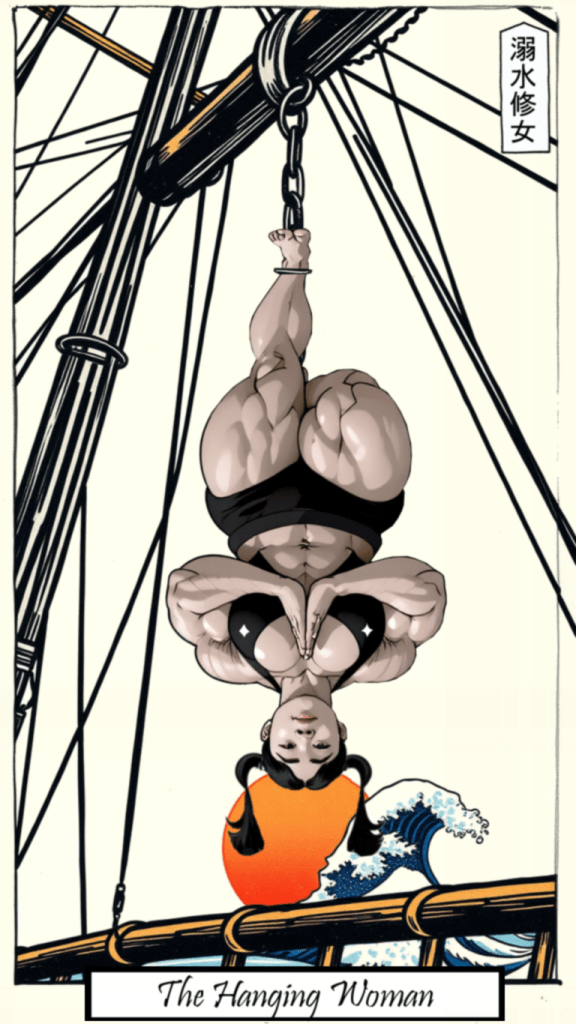
֍ The Hanged Woman – Card XII

TITLE: The Drowned Nun / 溺水修女 (Nìshuǐ xiūnǚ)

MYTHIC ARCHETYPE: The Nun Who Forgot to Drown

TAOIST PARALLEL: Tengguaiu (滕拐), a Taoist Nun, daogu (道姑), before her enlightenment—when her mortal body drowned while her soul wandered.

PIRATE TWIST: She’s suspended in a ship’s spar in contemplation, as ghost eels whisper backwards sutras in her ears.

WHY THE HANGED WOMAN? Her “punishment” is voluntary—she stays hanging upside down to unlearn breathing, preparing for xian (仙) immortality.

TAOIST PIRATE SYMBOLISM

KEYWORDS (Upright):

Fǎn hūxī (反呼吸, “reverse breathing”)—enlightenment through suffocation.

The upside-down chart (倒海圖, dào hǎi tú)—navigation by wrongness.

“Crab-walk wisdom” (蟹行智, xiè xíng zhì)—truths learned sideways.

KEYWORDS (Reversed):

Yān sǐ (淹死, “drowning death”)—resisting the lesson.

Fú píng (浮萍, “duckweed”)—surfacing too soon.

The hollow gourd (空葫蘆, kōng húlú)—failed enlightenment.

INTERPRETATION: This card is the ocean’s koan. To rise, you must first sink past thinking.

RITUAL: THE BRINE BARREL MEDITATION (鹵桶禪, Lǔ Tǒng Chán)

(Inspired by Taoist “drowning breath” practices and pirate survival trials)

PURPOSE: To surrender mental resistance through controlled drowning.

MATERIALS:

A large bowl of ice-cold saltwater.

A hollow reed or straw.

A black cloth.

A candle (blue).

STEPS:

Kneel before the bowl, light the candle. Cover your head with the cloth.

Submerge your face, breathing only through the reed. Chant underwater:

鐵拐落海,鐵骨上天,

怕死的先見閻王爺!

Iron crutch drowns, iron bones rise,
Cowards meet the Death God first!

When lungs burn, emerge but keep eyes closed. The first thing you see inside your eyelids is your true obstacle.

PARALLEL MYTHOLOGY

TITLE: The Belly of the Deep / The Prophet’s Surrender

MYTHIC ARCHETYPE: Jonah in the Belly of the Great Fish (Abrahamic Traditions)

REGION: Ancient Israel / Abrahamic Scripture (Judaism, Christianity, Islam)

TALE: God commands the prophet Jonah to go to the city of Nineveh and preach against its wickedness. Terrified and defiant, Jonah runs from his destiny. He boards a ship sailing in the opposite direction. God sends a great storm, and the sailors, realizing Jonah is the cause, cast him into the sea at his own suggestion. But he does not die. He is swallowed by a “great fish” (often depicted as a whale). For three days and three nights, he is trapped in the belly of the beast—a state of total suspension, darkness, and powerlessness. It is here, in the ultimate Hanged Man position, that he finally stops running. He prays, he surrenders his will to God’s, and he accepts his mission. The fish then vomits him onto dry land, and he goes to Nineveh, a changed man with a new perspective.

WHY THE HANGED WOMAN? Jonah’s story is the Hanged Man’s journey.

SUSPENSION: Trapped in the belly of the fish, he is utterly suspended between worlds, unable to act or escape.

NEW PERSPECTIVE: His world is literally turned upside down. Inside the dark, womb-like prison, he is forced to look inward, leading to an epiphany.

SURRENDER, NOT SACRIFICE: He doesn’t die. He lets go of his defiance. The “voluntary” part isn’t getting swallowed; it’s the act of surrender that happens inside the ordeal.

REBIRTH: He emerges from the ordeal changed and ready to fulfill the purpose he was running from.

INTERPRETATION THROUGH JONAH: This card signifies a necessary pause in your life. You may feel stuck, trapped, or powerless—like you’re in the belly of the beast. Stop fighting it. Stop running from your “Nineveh.” This is not a punishment; it is a sacred time-out. The only way forward is to surrender, let go of your stubborn plans, and look at your situation from this new, uncomfortable perspective. The insight you gain in this “darkness” will be what ultimately frees you.

THE RITUAL OF THE DARK WOMB (For Finding Surrender When Stuck)

OBJECTIVE: To stop resisting a necessary life change by voluntarily entering a symbolic “belly of the fish,” confronting your defiance, and surrendering to your path.

MATERIALS:

A small, dark, enclosed space you can sit in comfortably for a few minutes (a closet, a small bathroom with the lights off, or even under a heavy blanket).

An object that represents your “Nineveh”—the task, decision, or truth you are running from.

A glass of water.

STEPS:

THE FLIGHT AND THE STORM: Before you begin, hold your “Nineveh” object and acknowledge what you’ve been running from. Say it aloud: “I have been running from this difficult conversation” or “I have been avoiding this responsibility.”

ENTERING THE BELLY: Take your object and enter your chosen dark space. Sit down and close the door or cover yourself completely. Plunge yourself into darkness and silence. This is the belly of the fish. You are now officially “stuck.”

THE THREE BREATHS: You cannot fight your way out. You can only surrender. Take three very slow, deliberate breaths.

Breath One: Acknowledge your resistance. Feel it in your body.

Breath Two: Acknowledge your powerlessness in this moment. You cannot escape this darkness through force.

Breath Three: Let go. Release the tension of the fight.

PRAYER OF SURRENDER: Hold your “Nineveh” object in the dark. You don’t need to have a solution. You only need to change your posture from “I won’t” to “I am willing.” Whisper a simple statement of surrender. “I stop running. I am willing to face this. I surrender to the path.”

THE REBIRTH: After a few moments in this surrendered state, emerge from your dark space back into the light. You have been spit out onto the shore. Immediately drink the entire glass of water. This is an act of cleansing and returning to life.

CLOSING: Place your “Nineveh” object on your altar or somewhere you can see it. It is no longer an object of dread, but a symbol of your accepted mission. The ritual is complete.

SYNCRETIC BRIDGE

Jonah’s Fish → Dragon’s Wèi (胃, “stomach”): Both are wombs of forced enlightenment.

Three Days → Three Tides: Taoist rebirth cycles follow moon-pulled waters.

THE “SCHOLAR’S HEART” MANDATE:

Sources: The primary source is The Book of Jonah in the Hebrew Bible (the Tanakh). The story is also recounted in the New Testament and holds a significant place in the Quran, where the prophet is known as Yunus. For the ritual, see: “Drowning Boxing” (溺水拳, Nìshuǐ Quán)—a lost martial art practiced the dead on shipwreck survivors.

22 Sunday Jun 2025

Posted by babylon crashing in Chinese, Tarot, Translation

≈ Comments Off on

Tags

Chinese translation, ocean mythology, Ocean of Milk, poem, sea folklore, Taoist Pirate rituals, Tarot, wheel of fortune, 月潮籤

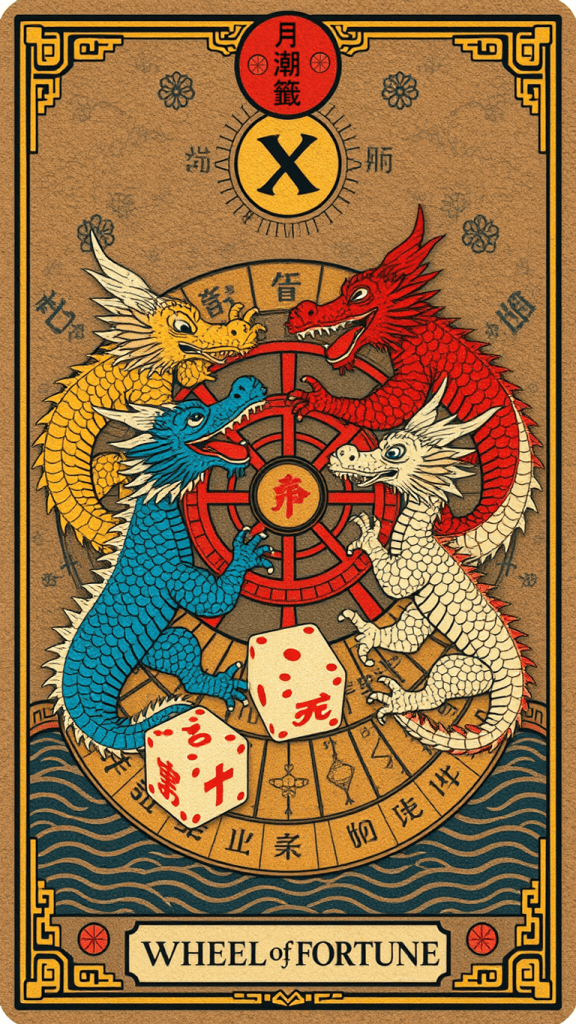
֍ WHEEL OF FORTUNE – Card X

TITLE: The Moon-Tide Lottery / 月潮籤 (Yuè Cháo Qiān)

MYTHIC ARCHETYPE: Mazu’s Gambling Hall

TAOIST PARALLEL: The Dragon Kings’ Dice Game (龍王骰戲, Lóngwáng Tóuxì) where the four sea gods wager tidal fortunes using whalebone dice carved with Bagua symbols.

PIRATE TWIST: The “wheel” is a ship’s steering oar spun by Zheng Yi Sao’s ghost, deciding which junk gets plunder and which gets typhoons.

WHY WHEEL OF FORTUNE? The tides never cheat—but they never play fair either.

TAOIST PIRATE SYMBOLISM

KEYWORDS (Upright):

Cháo bō (潮博, “tide gambling”)—fate as a pirate’s wager.

The moon’s ledger (月賬, yuè zhàng)—where debts wash clean every cycle.

“Kraken’s kiss” (海怪吻, hǎiguài wěn)—sudden fortune from chaos.

KEYWORDS (Reversed):

Shī cháo (失潮, “lost tide”)—missing your wave.

Yāo qián (妖錢, “haunted coins”)—cursed windfalls.

The drowned dice (沉骰, chén tóu)—fixed by sea ghosts.

INTERPRETATION: This card is fate’s tide table—you can’t stop the turn, but you can learn to surf.

RITUAL: THE BAGUA TIDE-CHART (八卦潮表, Bāguà Cháo Biǎo)

(Inspired by Fujianese pirate almanacs and Taoist tide-divination)

PURPOSE: To align with—not fight—life’s cycles.

MATERIALS:

Eight coins (for the Bagua).

A round wooden plate (ship’s wheel or bowl).

Saltwater in a seashell.

A candle (red for luck).

STEPS:

Arrange coins in a Bagua circle on the plate. Light the candle at center.

Spin the plate while chanting:

东龙之金,西龙之浪,

南龙之火,北龙之咸天。

The gold of the East Dragon, the waves of the West Dragon,

the fire of the South Dragon, the salty sky of the North Dragon.

When it stops, the top coin is your current tide:

☰ Heaven: Fortune rises.

☷ Earth: Stay grounded.

☲ Fire: Sudden change.

☵ Water: Go with the flow.

Flick saltwater on that coin—seal your pact with fate.

PARALLEL MYTHOLOGY

TITLE: The Churning of Cosmic Tides / The Wheel of Samudra

MYTHIC ARCHETYPE: The Samudra Manthan (Hindu Cosmology)

REGION: Indian Subcontinent (Hinduism)

FORM: A cosmic event where the Devas and Asuras use the serpent king Vasuki as a rope, wrapped around Mount Mandara as a churning rod, to churn the Ocean of Milk. Lord Vishnu, in his Kurma (turtle) avatar, supports the mountain.

TALE: As detailed above, the churning is a grand cooperative (and later competitive) act that unleashes the full spectrum of fate, from deadly poison to the goddess of fortune, all in the pursuit of immortality.

WHY WHEEL OF FORTUNE? It is the ultimate allegory for fate. The up-and-down pulling motion by the gods and demons perfectly mimics the rise and fall of fortunes. The array of unforeseen outcomes (both bane and boon) demonstrates that we can set events in motion, but we cannot control the cycles of destiny. Lakshmi’s emergence explicitly links the event to fortune.

INTERPRETATION THROUGH SAMUDRA MANTHAN: This card signifies that a great cycle is in motion in your life. You have set the churning rod in place, and now you must be prepared for what emerges from the depths. It may be a poison that tests you, or it may be a treasure you never expected. You cannot stop the wheel from turning, so your task is to adapt, to have faith (like the gods who trusted Shiva to handle the poison), and to be ready to receive the fortune when it arrives.

RITUAL OF THE SWEET AND SALTY CHURN (For Embracing Your Cycle)

OBJECTIVE: To prepare your spirit for an upcoming change or to find peace within a current cycle, acknowledging that all cycles contain both shadow and light.

MATERIALS:

A clear glass bowl or jar filled with water.

A spoonful of honey or sugar (for Lakshmi’s boon).

A spoonful of sea salt (for the Halahala’s challenge).

A small stirring stick or spoon (your Mount Mandara).

Optional: A small item to represent yourself (a small stone or charm).

STEPS:

PREPARATION: Sit with your bowl of water. This is your personal Ocean of Milk, the sea of your current life circumstances.

ACKNOWLEDGING DUALITY: Add the spoonful of honey to the water, saying: “I am open to the sweetness of fortune. I am ready for the blessings I cannot yet see.” Then, add the spoonful of salt, saying: “I have the strength to face the bitterness of challenge. I am ready for the lessons I must learn.”

THE CHURNING: Place your “self” stone in the water if using. Now, use your stirring stick to slowly churn the water. As you stir, don’t focus on mixing everything perfectly. Just observe the currents. See how the sweet and salty elements swirl, sometimes separating, sometimes combining. This is your life’s cycle in motion.

THE SCRY OF ACCEPTANCE: As you churn, speak a simple mantra of surrender: “What comes, I will meet. What goes, I will release. The wheel turns, and I turn with it.” Continue stirring until you feel a sense of calm acceptance.

RECEIVING THE MOMENT: Stop churning. Close your eyes. Dip one finger into the water, and touch it to your tongue. Do you taste sweetness? Saltiness? Both? Neither? This is not a prediction, but a moment of mindfulness—a taste of your life’s current flavor. Accept it without judgment.

CLOSING: Leave the bowl to settle. The water will eventually become still again, the elements merged. This is the new equilibrium you will find after the turn. Pour the water out onto the earth as an offering. Say: “My thanks to the cosmic tides. My heart is ready.” The ritual is complete.

SYNCRETIC BRIDGE

Samudra Manthan → Dragon Pearl Gambit (龍珠賭, Lóngzhū Dǔ): Both unleash boons and curses from the deep.

Lakshmi → Mazu’s Treasure Barge (媽祖寶船, Māzǔ Bǎochuán): Abundance as flotsam from shipwrecks.

THE “SCHOLAR’S HEART” MANDATE:

Sources: This is a cornerstone story in Hinduism. The most detailed accounts are found in the Bhagavata Purana, the Mahabharata, and the Vishnu Purana. We can reference these sacred texts with great respect for their profound philosophical and spiritual depth. Also see: Ming “Tide-Wheel” Clocks—water clocks that predicted fortune cycles via tidal astronomy.

18 Wednesday Jun 2025

Posted by babylon crashing in Chinese, Tarot, Translation

≈ Comments Off on

Tags

Chinese translation, 龍廷, Lóng Tíng, ocean mythology, poem, Poetry, Poseidon, sea folklore, Taoist Pirate rituals, Tarot

🜄 THE EMPEROR – Card IV

TITLE: The Dragon Throne / 龍廷 (Lóng Tíng)

MYTHIC ARCHETYPE: The Pirate Dragon King

TAOIST PARALLEL: Ao Guang (敖廣), the East Sea Dragon King, merged with Zheng Zhilong (鄭芝龍)—the real-life Ming dynasty pirate admiral who commanded 3,000 junks.

PIRATE TWIST: He’s not just a mythical ruler—he’s the admiral of the ghost fleet, enforcing hǎi shén fǎ (海神法, “Sea God’s Law”) from a throne of cannons and coral. His trident? A tide-cutting ji (戟) halberd that splits storms.

WHY THE EMPEROR? He doesn’t just control the sea—he is its justice. Cross him and your ship sinks paper-light (紙沉, zhǐ chén). Serve him, and he’ll guide you through fog-walled coves.

TAOIST PIRATE SYMBOLISM

KEYWORDS (Upright):

Lóngtíng lǜ (龍廷律, “Dragon Court Rules”)—code of the sea.

“Tides obey the Bagua” (潮隨八卦, cháo suí bāguà)—order in chaos.

The admiral’s seal (海帥印, hǎi shuài yìn)—stamped on waves.

KEYWORDS (Reversed):

A broken tide-table (破潮曆, pò cháo lì)—navigation failed.

“Dragon’s yawn” (龍哈欠, lóng hāqiàn)—complacency before disaster.

The sea tribunal (海審, hǎi shěn) where traitors walk the plank.

INTERPRETATION: This card is law written in saltwater. The Dragon Throne rewards loyalty and sinks oath-breakers. His power isn’t tyranny—it’s the certainty of the tide.

RITUAL: THE ADMIRAL’S SEAL (海帥印, Hǎi Shuài Yìn)

(Inspired by Ming naval codes and Daoist tide-summoning rites)

PURPOSE: To claim authority or stabilize chaos.

MATERIALS:

A wooden plank (driftwood or bamboo).

Red ink (or bloodroot pigment).

A knife (to carve).

Nine copper coins (for the Nine Dragons).

Saltwater.

STEPS:

Carve the Bagua into the plank at dusk.

Dip coins in ink, press them onto the wood like a seal, chanting:

东龙审判,西龙称重,

南龙焚烧,北龙付出代价。

East Dragon judges, West Dragon weighs,

South Dragon burns, North Dragon pays.

Bury the plank at a crossroads or fling it into the sea.

PARALLEL MYTHOLOGY
TITLE: Poseidon, Sovereign of the Sea’s Dominion / Keeper of the Trident
MYTHIC ARCHETYPE: Poseidon (Greek God of the Sea, Earthquakes, and Horses)
REGION: Ancient Greece and the wider Hellenic world
FORM: God of the sea, storms, horses, and earthquakes; wielder of the mighty trident
TALE: Poseidon is a formidable god whose temper mirrors the ocean’s tempestuous moods. As one of the Olympian siblings, he claimed dominion over the seas and all its creatures, as well as horses and the tremors beneath the earth. His trident symbolizes both creative and destructive power, capable of calming waves or shattering lands. Though sometimes seen as capricious and volatile, Poseidon also represents steadfast authority and governance over nature’s primal forces. His role as the Emperor in our oceanic Tarot is to teach the balance of control and power—how to rule with strength tempered by wisdom, and how to command loyalty and respect through firm, just leadership.
WHY THE EMPEROR? The Emperor stands for order, structure, protection, and leadership. Poseidon’s role as the sovereign sea god aligns perfectly, embodying authority grounded in the elemental power of water and earth.
INTERPRETATION THROUGH POSEIDON: When Poseidon appears, he calls forth the leader within you—the one who must wield power responsibly among tumultuous currents. He demands respect for the rules that hold worlds together but warns against becoming a tyrant who crushes rather than governs.
Poseidon asks: Where do you exert control? Are you a protector of your domain or a rigid despot? How do you balance power with compassion?
RITUAL: Invocation of Poseidon’s Command
PURPOSE: To call upon strength, leadership, or the power to establish order in chaos.
MATERIALS:
A trident-shaped object or symbolic representation (can be crafted or drawn)
Saltwater
Blue or sea-green candles
Shells or horse figurines (optional)
A strong, grounded space to perform the ritual
STEPS:
Place the trident or its symbol before you. Light the candles, representing the sea and its powers.
Sprinkle a few drops of saltwater around your space, envisioning Poseidon’s waves marking your territory.
SPEAK THE INVOCATION:

Poseidon, lord of sea and shore,
Keeper of waves, trident in hand,
Grant me the strength to lead and guard,
To rule with justice, firm but fair.

Visualize yourself standing tall like a pillar of rock amidst a stormy sea, unyielding but wise.
Close the ritual with gratitude, grounding yourself and honoring the ocean’s mighty ruler.
THE “BEST FIT” PRINCIPLE: Where Sedna is the deep, internal, life-giving source, Poseidon is the external, sovereign, structural power.

SOVEREIGNTY AND DOMAIN: The Emperor is the master of his realm. Poseidon’s authority over the sea is absolute and was established at the dawn of the Olympian age when the cosmos was divided among the three brothers (Zeus, Poseidon, Hades). This act of structuring the universe is a perfect Emperor concept.

THE TRIDENT AS SCEPTER: The Emperor holds a scepter, a symbol of his power to rule. Poseidon’s trident is one of the most famous symbols of divine authority in all mythology. It’s not just a weapon; it is the tool with which he enforces his will, creating earthquakes and calming storms. It is his law made manifest.

THE SHADOW SIDE: Poseidon’s infamous temper, his tyrannical rage against Odysseus, his stubbornness in his contest with Athena over Athens—these are all textbook examples of the Emperor’s negative traits: inflexibility, despotism, and the use of power for personal grudges rather than the good of the realm.

THE RITUAL OF THE TRIDENT’S STRIKE (To Establish a Foundation)

OBJECTIVE: To create a stable, protected foundation in a chaotic area of your life. Use this when starting a major project, fortifying your personal boundaries, or bringing order to your home or mind.

MATERIALS:

A staff, a sturdy branch, or even your own arm and fist. This is your “Trident.”

A bowl of saltwater.

Three stones, large enough to be stable. These represent the three points of the trident and the foundation you are building.

A piece of ground where you can perform the ritual (a yard, a park, or even a planter box).

STEPS:

SURVEYING THE DOMAIN: Stand before the piece of ground. This is your kingdom, the area you are about to bring into order. State your intention clearly and aloud. “I am here to bring order to my finances” or “I am here to establish a firm boundary of my personal time.”

CONSECRATING THE TRIDENT: Hold your staff (or arm) and dip its end into the saltwater. Raise it to the sky. DECLARE ITS POWER: “This is not wood, but bone of the Earth. This is not my arm, but the will of the Sea. This is the Trident that strikes the foundation and commands the deep.”

THE STRIKE: With all your focused intent, strike the ground firmly three times with the end of your staff. Each strike should be deliberate and powerful. With each strike, make a declaration:

(Strike 1): “By the power of the Earth Below, I set my foundation!”

(Strike 2): “By the power of the Sea Around, I set my boundary!”

(Strike 3): “By the power of the Sky Above, I declare my dominion!”

LAYING THE FOUNDATION: Place your three stones on the ground where you struck, forming a stable triangle. This is the physical anchor for the order you have created. Pour the remaining saltwater in a circle around the stones as a libation and a boundary of protection.

THE SOVEREIGN’S OATH: Stand straight, looking over your newly established “foundation.” Make a vow of responsible rulership. “I will rule this domain with strength and with wisdom. I will be its protector, not its tyrant. This order is established. So it is.”

CLOSING: Leave the stones in place for at least a full day and night. The act is complete. You have shifted from being a subject of chaos to the sovereign of your domain.

SYNCRETIC BRIDGE

Poseidon’s Trident → Dragon King’s Ji: Both split waves and enforce divine will.

Olympian Division → Fēngshuǐ of the Seas: The Dragon Kings divide the oceans like Bagua sectors.

THE “SCHOLAR’S HEART” MANDATE

Primary Sources: Homer’s Iliad and, most importantly, The Odyssey, where Poseidon’s role as a powerful, wrathful antagonist is central. Hesiod’s Theogony is essential for his origin and the division of the cosmos. The Homeric Hymn to Poseidon is a direct invocation that praises his power. For the ritual see: the biography of Admiral Zheng He’s (鄭和) navigation charts—they were ritual objects blessed by Mazu to command currents; as well as the Jiaolong myth in the 《述异记》 [Records of Strange Things], 6th century CE.

16 Monday Jun 2025

Posted by babylon crashing in Chinese, Tarot, Translation

≈ Comments Off on

Tags

Chinese translation, 默潮母, high priestess, Mò Cháo Mǔ, ocean mythology, poem, Poetry, sea folklore, Tarot

🜄 THE HIGH PRIESTESS – Card II

TITLE: The Silent Tide-Mother / 默潮母 [Mò Cháo Mǔ]

MYTHIC ARCHETYPE: Mazu’s Shadow—The Unseen Admiral

TAOIST PARALLEL: Mazu [媽祖] as the Veiled Oracle, but merged with Longmu [龍母, Dragon Mother]—a figure who raised five dragon kings as her sons and learned the ocean’s secrets from them.

PIRATE TWIST: She’s not just a benevolent goddess—she’s the phantom captain of a ghost junk that sails the Gengen Ocean [亙亙海, the Taoist “sea of subconscious”]. Her ship has no crew; it’s manned by paper sailors [剪水兵, jiǎn shuǐ bīng] who whisper prophecies in the wind.

WHY THE HIGH PRIESTESS? She navigates by moon-compasses and star-mirrors, charting courses only the drowned can read.

TAOIST PIRATE SYMBOLISM

KEYWORDS [Upright]:

Hai Di Shu [海底書, “Book of the Seabed”]—the unwritten knowledge of currents.

The moonwell [月井, yuè jǐng]—a ship’s hold filled with black brine for scrying.

“Listening to the tide’s qi” [聽潮氣, tīng cháo qì]—intuition as piracy.

KEYWORDS [Reversed]:

A muffled bell [啞鐘, yǎ zhōng]—ignoring omens.

“Sailing the Meng [夢, dream] tides” without a mirror—delusion.

The Dragon Mother turning her back [a storm coming].

INTERPRETATION: This card is for when you must steer by what isn’t there. The Silent Tide-Mother doesn’t speak—she shows. Her power is in the gaps: the pause between waves, the glint off a sunken sword, the silence before the monsoon.

RITUAL: THE GHOST JUNK’S MOONWELL [鬼船月井, Guǐchuán Yuèjǐng]

[Inspired by Fujianese sailor necromancy and Ming-era mirror magic]

PURPOSE: To scry for truths hidden in your own depths.

MATERIALS:

A black lacquer bowl [or any dark vessel].

Saltwater + a drop of ink [to darken it].

A silver coin [with a hole, if possible].

Seven blue threads [for the Dragon Mother’s sons].

A candle [white or blue].

RITUAL:

At dusk, light the candle and place it behind the bowl so it casts a shadow into the water.

Drop the coin into the bowl. Chant:

七龍守古井,

一錢付潮銀。

沉者終須浮,

示我月盜隱。

Seven dragons guard the well,

One coin pays the tide’s toll.

What sinks must rise again—

Show me what the moon stole.

Tie the threads around the bowl’s rim like rigging. Gaze into the ink-dark water until shapes form.

PARALLEL MYTHOLOGY

TITLE: Mother-of-Shells / Keeper of the Deep Waters
MYTHIC ARCHETYPE: Yemọja [Orisha of the Ocean, Yoruba Tradition]
MYTHOLOGICAL FIGURE: Yemọja [Yoruba & Diasporic Traditions]
REGION: Yoruba [West Africa], carried through the African diaspora into Brazil [Iemanjá], Cuba, Haiti, Trinidad.
FORM: Ocean mother, goddess of rivers that become the sea; patron of motherhood, secrets, and moon-touched water
TALE: Yemọja [also rendered Yemoja, Iemanjá] is the orisha of all waters—especially the rivers that flow to the ocean, which is her vast and sacred home. She governs fertility, mystery, prophecy, and the invisible connections between all living things.
She is the keeper of hidden knowledge and ancestral memory. Her name derives from, “Yeye omo eja”—“Mother whose children are fish.” She is also a lunar being, often depicted with silver adornments, veils, and mirrors.
WHY THE HIGH PRIESTESS? The High Priestess stands between worlds (the seen and the unseen) and calls us into inner silence, intuition, and sacred mystery. Yemọja embodies all this: she is the water that remembers, the ocean that dreams. Her temple is the shore at midnight, where truths are whispered between waves.
INTERPRETATION THROUGH YEMỌJA: This card reminds you to listen with your blood, not just your ears. Yemọja calls through dreams and symbols. If you are still, she will show you what you already know. She is not loud. She does not shout. But she never lies. To draw her card is to be invited to descend inward, to the moonlit pool where truth waits patiently to be seen.
RITUAL: Moonwater Mirror Rite
PURPOSE: To receive guidance, deepen intuition, or connect to ancestral memory through Yemọja’s current
MATERIALS:
Bowl of river or ocean water [or moon-charged spring water]
Small mirror or reflective dish
White cloth or scarf
Optional: silver jewelry or token
STEPS:
At night, ideally under a waxing or full moon, cover your space with the white cloth and place the mirror in the bowl of water so it floats or rests within.
Light a single candle. Sit quietly, allowing your breath to match the imagined rhythm of gentle waves.
Whisper this invocation:

Yemọja, mother of the fish,
Open the sea between my soul and the stars.
Let your waters carry my question to the deep,
And return with the answer I already know.

Gaze into the mirror. Let images arise. Let nothing be rushed. What you seek will come.
Afterward, wrap the mirror in the white cloth and keep it for future work. Pour the water into the earth or return it to a natural source.
This ritual blends traditional offerings to Yemọja [mirror, moon, water, white cloth] with meditative introspection. In many Afro-Caribbean traditions, white is her sacred color, and mirrors are used to commune with orisha energy.
SYNCRETIC BRIDGE

Yemọja’s Mirror → Taoist Jian [鑒, “mirror-divination”]:

Ancient Chinese mirrors were believed to reveal yao guai [妖怪, spirits]. Pirates used bronze mirrors to detect enemy ships in fog.

Dragonbone Oracles → Reading cracks in whale ribs.

Moonwater → Tide-Qi:

The Huangdi Yinfujing [黃帝陰符經] says water remembers—like Yemọja’s ancestral wisdom.

Salt-Script [writing questions on driftwood to let the sea erase/answer].

THE IMMEDIATE MATCH: The Drowned Man’s Conch Ritual [沉船螺術, Chénchuán Luó Shù]

Source: 《海盗陰法》 [Pirate Necromancy], 1798, salvaged from a waterlogged chest in the Thousand Ghost Reef.

WHY IT FITS: She is mother of drowned souls—this ritual forces kinship with them.

The conch’s spiral mirrors the cycle of life/death/revenge.

MOON CONNECTION: Performed at midnight, when lunar yin is strongest.

MATERIALS:

A conch stolen from a sunken ship’s corpse [must have barnacles still clinging to it].

Black salt [made from tidewater + ash from a burned ship’s log].

Three drops of your blood.

STEALING THE SHELL

Dive at low tide to pluck the conch from a drowned sailor’s hand [or where one should be].

Whisper:

借你耳舌,還你答案—

陰債暫欠,必以血還。

I borrow your ears and tongue, but promise repayment—

This ghost-debt I owe, will be paid in blood.

WARNING: If the corpse opens its eyes, leave the shell—it’s already claimed.

AWAKENING THE DEAD VOICE

Rub the shell with black salt until it whistles [like wind through rigging].

Spit into the spiral, then chant:

沉船冤魂,螺是你棺—

今日開棺,說我問事!

Shipwrecked ghost, this shell is your coffin—

Today I open it, speak my question!

Hold it to your left ear [the “ghost side”]. The answer will come as:

GARGLED WHISPER [truth].

SOUND OF CHOKING [lie].

YOUR OWN VOICE, BACKWARDS [the ghost has possessed you].

PAYING THE DEBT

Before sunset, you must:

Pour your blood into the sea where the shell was taken.

Burn a paper ship with the ghost’s name [if unknown, write “Unnamed Sailor of [Location]”].

If unpaid, the conch will fill with seawater in your hands and the drowned will claim your breath.

HISTORICAL CASE: In 1821, pirate Li Fan used this to find a Portuguese gold ship, but forgot to burn the paper ship. His crew swore the conch screamed all night before he walked overboard at dawn.

THE “SCHOLAR’S HEART” MANDATE:

Reputable Sources: Robert Farris Thompson’s Flash of the Spirit: African & Afro-American Art & Philosophy, Mari Silva’s Orishas: The Ultimate Guide to African Orisha Deities and Their Presence in Yoruba, Santeria, Voodoo and Hoodoo, along with an Explanation of Diloggun Divination and Lilith Dorsey’s Orishas, Goddesses, and Voodoo Queens The Divine Feminine in the African Religious Traditions. For the Taoist-Pirate rituals see:

《閩海幻視法》 [Fujian Sea Vision Magic], 1742.

《南海巫法秘本》 [Southern Sea Witchcraft Manual], 1809.

16 Monday Jun 2025

Posted by babylon crashing in Chinese, Tarot, Translation

≈ Comments Off on

Tags

龍潮師, ocean mythology, Pirate Stormcaller, poem, Poetry, sea folklore, Tangaroa, Taoist Pirate rituals, Tarot, The Magician

🜃 THE MAGICIAN – Card I

“The Magician is the Tide-Commanding Sorcerer—the one who speaks to the Dragon King in the language of stolen storms. Their power is not gentle. To wield it, you must stand where the sea hates the shore and the sky fears the waves.” [Notes.]

TITLE: The Dragon’s Tide-Caller / 龍潮師 [Lóng Cháoshī]

MYTHIC ARCHETYPE: Mazu’s Pirate-Sorcerer

TAOIST PARALLEL: Mazu [媽祖] as the warrior-priestess aspect, but merged with Qing dynasty pirate-queen Ching Shih [鄭氏]—a figure who commanded fleets with divine favor.

PIRATE TWIST: Instead of a passive goddess, she’s a storm-summoning admiral who learned secrets from the Dragon Kings [龍王]. Her “tools” are pirate relics:

Wand → A whalebone staff inscribed with tidal sigils.

Cup → A jade compass that steers by star-qi [氣] instead of wind.

Sword → A monsoon-cutlass [刀刃, dāorèn] that draws lightning.

Pentacle → A salt-crusted doubloon stamped with the Bagua [八卦].

WHY THE MAGICIAN? She doesn’t just pray for calm seas—she bends them.

TAOIST PIRATE SYMBOLISM

KEYWORDS [Upright]:

Wuwei [無為] as tactical patience—waiting for the perfect wave.

“Pirate feng shui” [arranging ship decks by elemental flow].

The huolongjing [火龍經, fire-dragon manuals] of naval warfare as spellbooks.

KEYWORDS [Reversed]:

A ship’s hex [艏咒, shǒu zhòu]—cursed navigation.

“Drowning the jade” [玉沉, yù chén]: wasting power.

The Dragon Kings ignoring your bribes.

INTERPRETATION: This card is for when you must command chaos. Like Tangaroa, the Tide-Caller knows the sea is alive—but here, the ocean is a negotiation. You don’t conquer it; you deal with it.

RITUAL 1: THE COMPASS OF FOUR DRAGONS [四海龍羅盤, Sìhǎi Lóng Luópán]

[Inspired by Ming-era nautical sorcery and Fujianese sea-witch rites]

PURPOSE: To align your will with the Four Dragon Kings [四海龍王] for mastery.

MATERIALS:

A bowl of brine [with a drop of your blood].

FOUR TOKENS:

FIRE: A ship’s nail [heated in flame].

WATER: A shark’s tooth.

AIR: A torn sail-scrap.

EARTH: A stolen temple coin.

A dagger [to carve the Bagua into driftwood].

RITUAL:

Draw the Bagua on driftwood, then float it in the brine. Chant:

东龙为我扬帆,

西龙为我扬帆,

南龙为我焚烧敌人,

北龙为我掩藏踪迹。

“The Eastern Dragon raises the sail for me,
The Western Dragon raises the sail for me,
The Southern Dragon burns the enemies for me,
The Northern Dragon hides my tracks for me.”

DROP EACH TOKEN INTO THE BOWL:

Nail hisses → Fire Dragon awakens.

Tooth sinks → Water Dragon stirs.

Scrap floats → Air Dragon listens.

Coin spins → Earth Dragon bargains.

STAB THE DRIFTWOOD—if it floats, the Dragons accept. If it sinks, they demand more.

PARALLEL MYTHOLOGY
TITLE:
The Sea-Caller / One Who Commands the Tides
MYTHIC ARCHETYPE: Tangaroa [Polynesian Ocean Deity]
MYTHOLOGICAL FIGURE: Tangaroa [Aotearoa / Māori Tradition]
REGION: Polynesia, especially Māori tradition in Aotearoa [New Zealand]
FORM: Oceanic deity; father of fish and reptiles; master of all sea-borne life
TALE: Tangaroa is the god of the sea, father of the fish, and one of the primal atua [gods] in Māori cosmology. He constantly contends with Tāne Mahuta, god of the forests, in a cosmological conflict: those who dwell in the sea versus those who live on land.
In some tellings, Tangaroa seeks to reclaim everything from the land back into the ocean. He is both a creator and destroyer—elemental, full of force, and endlessly generative.
WHY THE MAGICIAN? Tangaroa possesses full mastery of his element. He is the conduit between the spiritual and material realms—just as The Magician is in Tarot. He transforms intention into form. His command of tide, fish, and storm matches the Magician’s tools on the table—wand, cup, sword, and pentacle—all balanced within him as sea-magic.
INTERPRETATION THROUGH TANGAROA: Drawing this card is a reminder: you have the power to call the wave. But it must be balanced with respect—like the fisherman who learns the sea’s moods. Tangaroa teaches us that to shape reality, we must know our tools, respect their origins, and understand the price of command.
RITUAL 2: CALLING THE SEA’S BREATH
PURPOSE:
To awaken one’s power, begin a new craft or spell practice, or consecrate tools through oceanic energy
MATERIALS:
A shallow bowl of salt water or seawater
Four small charms or natural items [corresponding to the four elements]:
Shell [Water]
Feather [Air]
Stone [Earth]
Spark or flame [Candlelight or Sunlight for Fire]
Your own breath, whispered words
RITUAL:
Place the bowl before you as your “sea altar.” Arrange the four elemental items around it in cardinal directions.
Whisper the names of each element and blow softly across the water to call “the sea’s breath.”

CHANT:
“By Tangaroa’s will, the tide within me rises.
I call the depths to meet the sky.
Let what I dream become what is.”

Dip your fingers into the water and anoint your tools or hands.
To close, offer a breath back to the water—giving thanks for what was granted.
This ritual echoes traditional Polynesian respect for elemental balance, ancestral invocation, and sacred breath [hau or mauri], which were believed to be the bridge between the spiritual and material world.
MASTER OF THE DOMAIN: Tangaroa’s mastery over the sea is absolute. He is the active, directing principle of his realm. This is the core of The Magician’s energy.

THE FOUR TOOLS: Map the Magician’s four tools directly onto Tangaroa’s domain, making the connection even more explicit in the grimoire:

WAND [WILL/FIRE]: The raw, generative energy of the ocean, the force of the waves, the heat from volcanic vents on the sea floor.

CUP [EMOTION/WATER]: He literally is the ocean, the ultimate Cup.

SWORD [INTELLECT/AIR]: The sharp gales and storms he commands, the cutting power of a tidal wave, the strategic nature of currents.

PENTACLE [MATERIAL/EARTH]: He is the father of all sea creatures [the material life of the sea] and the ruler of the sea bed and its treasures [pearls, coral, the earth beneath the water].

CREATOR/DESTROYER: This duality you’ve highlighted is key. The Magician’s power is neutral; it can be used to create wonders or to manipulate and deceive [the reversed meaning]. Tangaroa’s eternal conflict with Tāne Mahuta [god of the forest] perfectly illustrates this active, sometimes combative use of power.

RITUAL 3: SUMMONING THE FOUR TIDES [For Manifestation]

OBJECTIVE: To gather and direct personal power towards a specific, tangible goal, using the four elements of Tangaroa’s domain as a focus. This is a ritual of active manifestation.

MATERIALS:

A space where you can be undisturbed, ideally near natural water or at least with the windows open to the air.

YOUR FOUR “TIDAL” TOOLS:

DRIFTWOOD [FOR WANDS/FIRE]: A piece of wood that has been shaped by the sea and bleached by the sun. It holds the energy of both.

SEASHELL [FOR CUPS/WATER]: A large, cup-shaped shell. Fill it with saltwater.

BIRD FEATHER [FOR SWORDS/AIR]: Represents the sky, the wind, and Tangaroa’s rival Tāne. Holding this is an act of balancing opposing forces—a key magical act.

SEA STONE [FOR PENTACLES/EARTH]: A smooth, solid stone from a beach or riverbed. It represents the tangible, manifested outcome.

RITUAL:

PREPARATION: Create your sacred space. Place your four tidal tools before you in a semi-circle. Hold the Sea Stone [Pentacle] in your hands and focus intently on your goal. Condense your desire into a single, clear sentence. Example: “I call forth a new client for my business.” or “I manifest the courage to complete my art.”

INVOCATION: Hold the Driftwood [Wand]. Feel its energy. Begin a low, rhythmic chant or drumming. Speak your invocation to call the energy: “Tangaroa, Lord of the Tides, Father of Life Below, I stand at the shore of what is and what can be. I seek your power, the will that moves the waves.”

GATHERING THE ELEMENTS:

Pick up the Shell [Cup]. Dip a finger in the water and anoint your heart. Say: “With the power of the Deep, I fill this work with heart.”

Pick up the Feather [Sword]. Wave it through the air, feeling the breeze. Say: “With the power of the Wind, I give this work clarity and thought.”

Pick up the Driftwood [Wand] again. Raise it high. Say: “With the power of the Sun on Water, I give this work energy and will.”

Finally, pick up the Stone [Pentacle]. Hold it tightly. Channel all the energy you’ve raised into it. Say: “With the power of the Earth Below, I make this work real.”

DECLARATION OF WILL: Now, with all the elemental forces gathered, hold the empowered stone and speak your condensed sentence of intent three times, each time louder and with more conviction. “I call forth a new client for my business! I call forth a new client for my business! I call forth a new client for my business!”

OFFERING & GROUNDING: The ritual’s power must be grounded and paid for. Your offering is an act of reciprocity. Go to a body of water [or a plant if not possible]. Pour the saltwater from the shell onto the ground/into the water. Say: “My thanks to the sea. The tide that flows out, flows back in. The work is done.” Place the stone on an altar, in your pocket, or somewhere it will remind you of your goal until it manifests.

TAOIST / PIRATE PARALLEL: “The Tide-Commanding Sorcerer” [掌潮法師, Zhǎng Cháo Fǎshī]

REGION: Fujian & Taiwan [18th–19th century]

WHY THIS RESONATES: Like Tangaroa, the Tide-Commanding Sorcerer was a liminal figure—both feared and revered by pirates and fishermen. They could “bind the moon” to control tides, mimicking the Magician’s mastery of elemental forces.

Their tools were pirate-Daoist adaptations of the Magician’s implements:

WAND → “Storm Summoning Rod” [carved from lightning-struck mast wood].

CUP → “Dragon’s Pearl Chalice” [used to collect whirlpool water for scrying].

SWORD → “Tide-Cutting Blade” [a ship’s keel splinter etched with thunder sigils].

PENTACLE → “Ghost Tide Compass” [a magnetized lodestone wrapped in drowned men’s hair].

RITUAL 3: “The Four Tides Invocation” [四海召法, Sì Hǎi Zhào Fǎ]

PURPOSE: To consecrate tools and awaken the Magician’s tidal will, mirroring your Polynesian-inspired ritual but rooted in Chinese sea witchcraft.

MATERIALS:

A bronze bowl of tidewater [collected at high moon].

Four Pirate-Daoist “Tidal Tools” [replace your elemental items]:

WAND → Storm Rod [a driftwood branch wrapped in shark-skin].

CUP → Pearl Shell [a clam shell holding cinnabar paste].

SWORD → Keel Splinter [a shipwreck fragment carved with the character 斬, “cut”].

PENTACLE → Lodestone [a magnetized rock tied with red silk].

STEPS:

Arrange the tools around the bowl in the Four Directions:

East [Wood/Storm Rod] → Growth, willpower.

South [Fire/Pearl Shell] → Passion, intuition.

West [Metal/Keel Splinter] → Precision, intellect.

North [Water/Lodestone] → Manifestation, grounding.

Chant the Tide-Summoning Verse

“東海借潮,南海借風—

西海借刃,北海借龍!”

[“East Sea lends tide, South Sea lends wind—

West Sea lends blades, North Sea lends the Dragon!”] … from 《海盗黑经》

Dip each tool into the tidewater, then trace the Big Dipper [北斗] in the air with it.

Close by spitting into the bowl [a pirate oath of allegiance to the sea].

FOLK MAGIC SYNCRETISM

Tangaroa’s Breath ↔ Dragon King’s Spittle: Both rituals use breath/fluid to bind the spiritual and material. In Fujian, sailors spat into the wind to “claim the tide’s favor.”

Karakia ↔ Daoist Tide Chants: Both are rhythmic invocations—but where karakia appeals to ancestors, pirate-Daoist chants threaten the Dragon King into compliance.

[Note. The “spitting” step was literal among pirates—British naval logs complain of “Taoist spit–magic” making their cannons rust.]

SYNCRETIC BRIDGE

Tangaroa’s Conflict → Five Elements [五行, Wǔxíng]

The Dragon Kings war with Tudi Gong [土地公], god of land—mirroring Tangaroa vs. Tāne.

Karakia → Taoist Zhou [咒, incantations]

Both use rhythmic breath to bind spirits. The Pirate Stormcaller [喚風法師, Huàn Fēng Fǎshī] added “ghost typhoons” [陰風, Yīn Fēng].

THE “SCHOLAR’S HEART” MANDATE

Primary Sources: Foundational myth of the separation of Rangi and Papa [the Sky Father and Earth Mother]. Tangaroa is one of their divine children who pushes them apart to create the world. His subsequent war with his brother Tāne is a central story. Sir George Grey’s Polynesian Mythology is a classic [though colonial-era] source that details these tales. For the Taoist/Pirate rituals, see:

《閩海秘法》 [Secret Fujian Sea Rites, 1742],

《海盗黑经》 [Pirate Black Canon, 1789]

《海盗風雨秘本》 [Pirate Storm-Summoning Manual, 1768], recovered from a shipwreck near Macau.

14 Saturday Jun 2025

Posted by babylon crashing in Chinese, Poetry, Tarot, Translation

≈ Comments Off on

Tags

Chinese translation, Li Tieguai, my art, ocean mythology, poem, Poetry, salt water rituals, sea folklore, selkie myths, Taoist Pirate tarot

THE FOOL – Card 0

TITLE: The Naked Immortal / 裸仙渡海 (Luǒxiān Dùhǎi)

MYTHIC ARCHETYPE: The Drowned Sage Who Laughs at Storms

MYTHOLOGICAL FIGURE: Li Tieguai (李鐵拐), the Crutch-Bearing Immortal, but before his transformation—a young, reckless seeker who drowned attempting to cross the sea on a gourd (a “fool’s vessel”).

PIRATE TWIST: Instead of drowning, he’s rescued by a Dragon King’s daughter (龍女) who gifts him a cursed pearl—it grants immortality but binds him to the sea’s whims. He becomes the first of the Drunken Immortal Pirates, forever straddling the line between wisdom and folly.

WHY THE FOOL? He’s caught between worlds (land/sea, mortal/immortal). His “leap” is trusting the ocean’s cruelty as a teacher.

TAOIST PIRATE SYMBOLISM

KEYWORDS (UPRIGHT):

Wuwei (無為) surrender to the tide.

Beggar’s wisdom (the “holy fool” who sees deeper).

Pirate’s gamble—sailing uncharted waters.

The “empty gourd” (symbol of potential).

KEYWORDS (REVERSED):

Shipwrecked hubris.

Cursed by the Dragon’s gift (immortality as a trap).

Losing one’s hun (魂, ethereal soul) to the depths.

INTERPRETATION: Drawing this card means embracing the chaos of the sea as a path to enlightenment. It’s the drunken pirate singing as the typhoon approaches, or the hermit who steps off the cliff—not to die, but to walk on water.

RITUAL

THE GOURD LEAP (壺跳, Hú Tiào)

(Inspired by Taoist “Floating Gourd” divination and Fujianese sailor rites)

PURPOSE: To consecrate a journey with the reckless faith of the Immortals.

MATERIALS:

A dried gourd (or a bowl painted with waves)

Saltwater + a handful of sand

3 coins (for the Three Treasures: 精, 氣, 神)

A red thread (to bind fate)

RITUAL:

Fill the gourd with saltwater and sand—shake it like a pirate’s dice.

WHISPER:

海無直路 (Hǎi wú zhí lù)
(“The sea has no straight roads.”)

Toss the coins into the gourd

ALL HEADS: The Dragon favors your gamble.

ALL TAILS: The tide warns of folly.

MIXED: The Immortals laugh—proceed, but lightly.

Knot the red thread around the gourd’s neck and leap over it (literally or symbolically).

CHANT:

李鐵拐醉渡,我醒跳!(Lǐ Tiěguǎi zuì dù, wǒ xǐng tiào!)
(“Iron Crutch Li crossed drunk, I leap sober!”)

Bury the gourd at a crossroads or fling it into moving water.

PARALLEL MYTHOLOGY
MYTHIC ARCHETYPE: The Selkie Who Sheds Her Skin
MYTHOLOGICAL FIGURE: The Selkie (Northern Atlantic Folklore)
REGION: Orkney, Shetland, Faroes, Iceland, Ireland
FORM: Seal in water, human on land; stepping ashore—naked, vulnerable, open-hearted. Like The Fool, the Selkie is entering a new world. She may fall in love, become trapped, or discover joy… but always the journey begins in faith, in openness, in longing.
TALE: Selkies are beings who shed their seal skins to walk as humans. European stories often revolve around Selkies losing their skins (and therefore their freedom) when a Human hides it, enslaving them to the land. The Selkie is often cast as innocent, curious, a liminal creature belonging neither entirely to land nor sea. Sometimes tricked, sometimes trusting too much, but always drawn toward returning to their native home: the sea.

ETHICAL NOTE: Unlike traditional Selkie myths (often about stolen skins), Taoist shedding is voluntary—emphasizing agency in transformation.
TAROT SYMBOLISM
[UPRIGHT]: Voluntarily giving up the old, Trust in the unknown, Spiritual freedom, Unworldly courage.
[REVERSED]: Naivete, Foolishness, Risk without preparation, Being trapped or tricked, Losing your “skin” (true nature) to others.

INTERPRETATION THROUGH THE SELKIE: To draw The Fool is to shed your old skin on purpose. It is the act of agency: walking barefoot into the mystery, ocean-salt still clinging to your soul. Be wary of those who would hide your truth, but do not let fear stop you from taking your first step.

RITUAL

“THE SALT-SHEDDING CEREMONY” (蛻鹽法, Tuì Yán Fǎ)

Source: Hybrid of Fujianese “skin-changing” rites (for fishermen transitioning to pirates) and Taoist rebirth rituals, also documented in 《閩海過渡秘錄》 (Secret Records of Fujian Sea Transitions), 1793.

PURPOSE: To ritually shed an old identity (like the Selkie’s skin) and embrace the Fool’s Leap—using the Sea’s transformative power.

MATERIALS:

A bowl of seawater (or saltwater + a seashell, if inland).

A square of black silk (or dark cloth)—represents the “old skin.”

A candle (red or white, for yang energy).

Three grains of rice (symbolizing the Three Treasures: jing, qi, shen).

STEPS:

At dusk (when tides shift), hold the silk and whisper:

海是我衣,潮是我魂—
今日脫去,明日新生!
(“Sea is my clothing, tide is my soul—
Take them off today, tomorrow I’ll be reborn!”)

Dip the silk into the seawater, then light it with the candle (let it burn to ash in a fireproof bowl).

SYMBOLISM: The silk dissolves like a Selkie’s seal-skin, the salt preserves your essence.

Scatter the ashes into flowing water (or bury them with the rice grains).

TAOIST TOUCH: The rice “feeds” the ghosts of your past selves, ensuring they don’t haunt your new life.

Leap over the candle (a mini “Fool’s jump”) into your next phase.

WHY THIS ALSO WORKS FOR THE FOOL

Parallels Selkie Lore: The silk = seal-skin; the ashes = returning to the sea.

TAOIST REBIRTH: Burning the silk mirrors funerary rites for old identities.

PIRATE’S EDGE: Fujianese pirates used this to shed their “land names” before raids.

SYNCRETIC BRIDGE

Selkie Skin → Taoist “Shedding the Corpse” (屍解, Shījiě): A ritual where adepts “fake death” to transcend mortal limits. Pirates whispered that Li Tieguai’s drowned body was just a decoy skin.

THE LEAP: Both traditions honor the sacred stupidity of trusting the untamable—whether Selkie waves or Dragon tides.

THE “SCHOLAR’S HEART” MANDATE:

Primary Sources: The essential Selkie texts are from David Thomson’s The People of the Sea, along with John Gregorson Campbell’s Superstitions of the Highlands and Islands of Scotland. For the various Taoist rituals see: The Jiaolong myth in the 《述异记》 (Records of Strange Things), 6th century CE. Also see: Quanzhen Taoism’s ocean poetry—many monks wrote of the sea as a metaphor for the unformed Dao. Pirate ships, like the body, are “temporary vessels.”

07 Saturday Jun 2025

Posted by babylon crashing in Chinese, drama, Translation

≈ Comments Off on

Tags

Blood Bodhisattva, Chinese translation, 血菩萨, poem, Poetry, retelling, the whole play, Titus Andronicus, wuxia

《血菩萨》
[BLOOD BODHISATTVA]

DRAMATIS PERSONÆ

TIĀN MǓ ~ Elderly military commander.
DÀ LÁNG ~ Head of the Five Poisons Sect, whom Tiān Mǔ has been waging war against for decades.
SÀTǓN ~ Eldest daughter to the late Empress.
BÁI SĪ ~ Youngest daughter to the late Empress; in a power struggle with Sàtǔn for the throne.
TIĚ GŪ ~ Court official and Tiān Mǔ’s sister.
BǍ XĪ LĀ ~ European, Nestorian Christian missionary with a demonic appetite for destruction.
TIĀN YÒU ~ Scholar, poet and Tiān Mǔ’s son.
IRON MOUNTAIN BLADES ~ Tiān Mǔ’s personal guards.
TIĚ YĪNG, TIĚ LIÁN, TIĚ LÍNG and TIĚ XUÈ ~ Tiān Mǔ’s Daughters.
HUĪ DÚ, LÁN DÚ and HĒI DÚ ~ Dà Láng’s Daughters.
LǏGUĀN, YÙSHǏ and JINYIWEI ~ Imperial Court Officials.

֍

[第一幕·第一场]
[ACT I. SCENE I]

《铁碎骨,羽没血,双姝启神不可封之伤。》
[Iron grinds bone, feathers drown in blood, two sisters open the wound no god can close.]

[玉门国·千剑宫外。]
[Yumen Kingdom · Outside the Thousand Swords Palace.]

([战鼓裂云,幕启时,白思与萨囤对峙宫阶之上。铁牛、天鹤两派弟子于阶下血战。宫门处,礼官肃立,御史执笔,锦衣卫刀出半鞘,静若石雕。] / [War drums tear at the clouds as the curtain rises, BÁI SĪ and SÀTŪN stand frozen on the palace steps. Below, their Iron Ox and Heavenly Crane disciples wage war. At the gates, LǏGUĀN officers stand rigid, YÙSHǏ scribes clutch ink-brushes and JINYIWEI guards rest hands on half-drawn blades, silent as carved sentinels].)

SÀTŪN / 萨囤
([斩马刀啸空而过,尘暴如龙卷起。
] / [Her Zhanmadao screams through air, whipping up a dust-whirlwind].)
铁牛门下!

Sons and daughters of the Iron Ox!
朕即凤诏,天命在刃!

I am the Phoenix’s living edict, the Mandate burns in my steel!
和我一起站起来,铸就历史的栋梁!

Stand with me and be forged into history’s pillars!
叛龙者……

Betray me …
([刀光一闪,宫灯齐灭。
] / [A blade-flash—every palace lantern gutters out].)
… 九族诛尽,宫门悬颅!

… And I’ll hang your bloodline’s skulls from the palace gates!

BÁI SĪ / 白思
([双针剑作鹤翼式,冷笑。
] / [Needle-swords flash into crane-wing stance, her sneer colder than moonlight].)
天命?
([冷笑。] / [Laugh like cracking ice].)
The Mandate?
弑亲之血,也配称凤?

Can a kinslayer’s hands still clutch the Phoenix’s crown?
天鹤展翅!

Heavenly Crane spreads its wings!
([她的双剑如振翅之羽轻颤——鹤之优雅中藏蝎之毒。她的门人齐声高鸣,宛如绢帛被利刃撕裂的尖啸。
] / [Her blades shiver like pinions mid-strike—the crane’s grace laced with scorpion’s venom. Her faction echoes with choral crane-cries, a sound like silk tearing on sword-edges].)
重器非在冠冕,而在德行。

True power lies not in crowns, but in virtue.
尔自比狂风?不过瘈狗吠日!

You call yourself a storm? A rabid dog barking at heaven!
([她的战士们的呐喊声响彻云霄——铁牛队伍摇摇晃晃,阵型散乱。
] / [Her warriors’ cries pierce the air—the Iron Ox ranks stagger, their formation fraying].)

TIĚ GŪ / 铁姑
([持碧玉令,九节鞭缠腰。满场肃杀。
] / [Enters with the Jade Scepter, her 9-section whip coiled around her hips. The air thickens, sharp as a guillotine’s edge].)
骨肉相残之座,未雪先倾。

The throne built on sister-blood collapses, before winter’s first snow can hide its sins.
今奉碎玉令,迎天母将军班师
…
By the Broken Jade Seal, I declare General Tiān Mǔ regent …
五毒教之役,当终今日。

Her war against the Five Poisons Sect ends now.
散!

Disperse!
… 否则御史以刻石指铭罪,鬼神同泣!

… Or the Yùshǐ’s Stone-Carving Finger will engrave your crimes so deep, even gods and ghosts will wail!
([御史的一击落地——指尖击碎了大理石地板,裂开了蜘蛛网,如同下了判决书一般。
] / [The Yùshǐ’s strike lands—fingertips shatter the marble floor, cracks spider-webbing like a verdict].)

SÀTŪN / 萨囤
([见玉阶旁书生所留的砚台,冷笑。
] / [Spots an inkstone left by a fleeing scholar, her lips curl].)
([脚踢翻,墨泼阶如血。
] / [Her boot flips it, black ink gushes down the steps like a slit throat].)
刻啊!

Carve this!
让后世记得……

Let history remember …
([锦衣卫刀光映墨,凤鸣凄厉。
] / [Jinyiwei blades gleam with reflected ink, their phoenix-cry a funeral dirge].)
([白思的鹤簪坠地,羽尖沾墨。
] / [BÁI SĪ’s crane-hairpin clatters, its feather-tip staining black].)
……铁牛将军之妹执印却不敢执刃!

… the Iron General’s sister clutches seals, but flees from steel!

TIĚ GŪ / 铁姑
([举令,寒声。
] / [Raising the Jade Order, her voice colder than a tomb’s breath].)
刻石遗臭,万古流秽。

Let stone etch your reek, let ten thousand generations gag on your name.
([玉阶震颤,如畏其言。
] / [The jade steps tremble, as if fearing her decree].)
母皇遗诏刻于玉,非书于血。

The Empress’ will was carved in jade, not scribbled in traitors’ blood.
([锦衣卫刀锋低鸣,似凤泣先帝。
] / [Jinyiwei blades hum, a phoenix weeping for the dead sovereign].)

BÁI SĪ / 白思
([凝视没羽,墨渍如泪,轻叹后扬声道。
] / [Gazes at the drowned feather, ink seeping like tears, then her voice lifts, clear and cold].)
血缘始,血缘终。

By blood it began, by blood it ends.
([向铁姑鞠躬,腰如竹折而不断。
] / [She bows to TIĚ GŪ, back bent like bamboo, unbroken].)
我臣服
…
I yield …
非顺汝刃,乃顺天佑。

Not to your blade, but to Heaven’s decree.
([白袍众退如雪崩,寂然无声。
] / [Her disciples retreat like an avalanche in reverse, soundless, deliberate].)
愿鹤唳引慈母之手。

May the crane’s cry guide my Mother’s hand.
([此言如刃,悬于天下咽喉之上。
] / [The words hang, a knife at the world’s throat].)
雪退散…

The snow withdraws…
([… 然寒入骨,千年不化。
] / […but frost lingers in the bones and will not thaw for a thousand years].)

SÀTŪN / 萨囤
([斩马刀寒光隐现,似判决半出鞘。她目光灼烈,胜过大漠热风。
] / [Her Zhanmadao gleams, a verdict half-unsheathed. Her gaze burns hotter than the desert wind].)
名铸剑出,不悔不归。

My name is forged in steel, my blade thirsts without remorse.
([铁牛派虽退,手不离刀。
] / [The Iron Ox faction withdraws, but every finger still curls around cold steel].)
让玉门断壁
…
Let the ruins of the Jade Gate …
([刀锋划地,裂石如骨碎。
] / [Her saber splits the earth, stone shatters like a spine].)
…由此断定,谁之血脉承载真凤天命!

… decide whose veins bear the Phoenix’s truth!

([众人退却之际,守卫扬起玉尘,五行阵于空中隐现旋转,倏然破散,恍若凤凰涅槃重生。] / [As factions retreat, guards raise jade-ash, the Wuxing symbols form then dissolve like a phoenix’s rebirth from the ash].)

([幕落,唯余 –] / [The curtains close on –])
萨囤之刀
[Sàtūn’s blade]
插于玉阶
[Embedded in jade steps]
白思之羽
[Bái Sī’s feather]
飘向冷月
[Drifting toward the icy moon]
铁姑的鞭
[Tiě Gū’s whip]
缠着半截断诏
[Coiled around a torn edict]
上书:
[which reads:]
朕死之年
…
The year I die…
…血菩萨现。

…the Blood Bodhisattva comes.

֍

[第一幕,第二场]
[ACT I. SCENE II]

[剑冢森森,魂灯荧荧]
[A forest of grave-swords; ghost-lanterns flicker blue.]

[祖剑堂 · 地宫]
[Ancestral Sword Hall · Underground Crypt.]

([战鼓渐歇,丧钟低鸣。地宫穹顶垂百剑,剑柄为碑。二十石台空置,待天母众女。青烟如蛇,盘绕尸骨未寒之刃。] / [War drums fade; funeral bells toll low. A cavern glows with yin-blue lanterns. From the ceiling hang a hundred swords, hilt-down, each a grave-marker. Twenty empty stone plinths await TIĀN MǓ’s fallen daughters. Incense coils like serpents around blades still slick with death].)

([铁链声响。铁链与铁翎押阵,铁山刀卫捧灵位与佩剑次入,后随铁英、铁血。天母戎装未卸,甲上犹带草原尘沙。大狼与其女[灰毒、蓝毒、黑毒]棘链缚身。末入巴悉拉,景教十字暗芒浮动。] / [Chains rattle. TIĚ LIÁN and TIĚ LÍNG march at the front, followed by Iron Mountain Blades bearing spirit tablets and sheathed swords. TIĚ YĪNG and TIĚ XUÈ come next. Then TIĀN MǓ, her armor still caked in steppe dust. Behind her, DÀ LÁNG and her daughters [HUĪ DÚ, LÁN DÚ, HĒI DÚ] shuffle forward, bound in barbed chains. Last enters BǍ XĪ LĀ, his Nestorian cross glinting like a hidden blade].)

([众人迫大狼一族跪于五眼蟾蜍铜魂炉前。] / [The prisoners are forced to kneel before a bronze soul-brazier shaped like a Five-Eyed Toad].)

TIĀN MǓ / 天母
([举碎玉令,诵咒如刃。
] / [Raising her broken Jade Seal, chanting like a whetstone on steel].)
玄女兵主——

Xuánnǚ, Dark Mother of War—
开黄泉之扉。

Open the Yellow Springs’ gate.
([抚剑墙,声裂金石。
] / [Her gauntlet scrapes the sword-walls; her voice splits metal and stone].)
吾女今与鬼同行。

My daughters walk with ghosts now.
以刃镇幽冥。

Let their swords guard the underworld’s edge.
([铁山刀卫置灵位于石台,朱砂名讳如血。无棺椁,以剑代尸。
] / [The Iron Mountain Blades place spirit tablets upon the plinths, names written in blood-red cinnabar. No coffins. No corpses. Only swords to stand in their stead].)
([抚空台,甲缝渗沙。
] / [Her armored fingers brush an empty plinth, steppe-dust sifting from the joints].)
祖剑冢啊…

O sacred crypt …
汝怀吾欢,亦纳吾悲。

You who cradle my joy and grief alike.
为何贪噬无厌?

Why must you gorge so ravenously?

TIĚ YĪNG / 铁英
([执刃穿魂幡,幡动如濒死之息。
] / [A dagger-pierced soul-banner trembles in her grip like a death rattle].)
母亲,赐一囚破丹田。

Mother, grant us a prisoner to shatter.
以炁饲亡魂。

Let her qi feed the dead.
化其息为香。

Let her breath become their incense.

TIĀN MǓ / 天母
([戟指灰毒,甲上反光如狼瞳。
] / [Her gauntlet points to HUĪ DÚ, armor-scratches glint like wolf-eyes].)
取可汗长女。

Then take the Da Khagan’s eldest.
草原狼种,正合燃薪。

a steppe-wolf’s whelp, fit kindling.

HUĪ DÚ / 灰毒
([颤声,气将断未断。
] / [Her voice trembles, breath not yet broken].)
吾非薪。

I am not kindling.

DÀ LÁNG / 大狼
([锁链暴起,棘刺入肉。
] / [Chains rattle as manacles bite into flesh].)
这也配称
‘道‘?
You call this the Tao?
这不是道。

This is no Tao.
是屠宰场!

It is the abattoir!
([唾血
] / [Spits blood].)
玉皇必降天罚——

The Jade Empress will curse your—

TIĀN MǓ / 天母
([抬手如闸,声寒于铁。
] / [A raised hand silences like decapitation].)
天道不悯豺狼。

The Tao has no mercy for wolves.
汝女之息,当饲吾殇。

Your daughter’s breath will feed my dead.

TIĚ YĪNG / 铁英
([并指为鹤喙,点向灰毒后腰。
] / [Fingers coiled like a crane’s beak, pressing to HUĪ DÚ’s spine].)
道予炁,道夺炁。

The Tao gives qi. The Tao takes it.
([三击如钟。
] / [Three strikes toll like a funeral bell].)
命门。
[Mìngmén.]
([闷响,灰毒气息骤滞。
] / [A dull thud—HUĪ DÚ’s breath seizes].)
脊中。
[Jǐzhōng.]
([玉裂之声,肌骨僵锁。
] / [A crack like splitting jade, her body locks rigid].)
大椎。
[Dàzhùi.]
([折骨脆响,银炁自七窍喷涌,旋入魂炉。
] / [A final snap, silver qi bursts from her seven apertures, swirling into the brazier].)

([炁凝‘仇‘字,瞬散。铁山刀卫置灰毒于碑前,形存神灭,永跪为鬼奴。] / [The qi forms the character 仇 《vengeance》before dissolving. HUĪ DÚ’s hollowed body is propped before the plinths; a living ghost forced to kneel for eternity].)

TIĀN YÒU / 天佑
([三叩入殿,额抵冷石。
] / [Entering with three kowtows, forehead pressed to stone].)
母亲…

Mother…
([捧纸马,声颤。
] / [Clutching paper effigies, voice trembling].)
儿带冥驹,助姊远行。

I bring paper horses for their journey.
([天佑一边吟诵诗歌,一边焚烧人像。
] / [TIĀN YÒU begins burning the effigies while reciting poetry].)
双蛇缠…

Two snakes entwined …
([纸灰突燃碧火。
] / [The ashes flare emerald].)
无首尾
…
Neither head nor tail …
([焚纸,灰烬化鹤形——白思之徽。
] / [The ashes twist into a crane—BÁI SĪ’s crest].)
唯饥无宴。

Only hunger. Never feast.
([魂炉中五眼骤睁。
] / [The Toad-brazier’s eyes snap open].)
([天佑退后,诗成谶言。
] / [TIĀN YÒU staggers back, the poem now a curse spoken out loud].)

TIĀN MǓ / 天母
([捧子面,甲锈沾颊。
] / [Cupping his face, her gauntlet leaves dried blood like tear-stains].)
吾儿…

My son…
男儿总被讥弱。

The world calls boys weak.
然你乃吾德所铸之身。

But you are my virtue made flesh.
([低语切齿。
] / [A whisper like grinding steel].)
活得比我久。

Outlive me.
([按剑柄,刃吟如泣。
] / [Her palm on a sword-hilt, the blade hums a mourner’s tune].)
安息吧,吾刃。

Rest, my blades.
未斩之恨,生者必断。

The living will cut what you could not.

([所有人都退场。] / [Everyone exits].)
([门阖。终余:灰毒游丝之息……与万剑饥鸣。
] / [The doors seal. All that remains: HUĪ DÚ’s shallow breath … and the starving chorus of ten thousand blades].)

֍

[第一幕,第三场]
[ACT I. SCENE III]

[宫阙深似海,血誓染阶红]
[Palaces deeper than oceans; blood-oaths stain the steps.]

[玉门国 · 皇极殿。]
[Yumen Kingdom · Imperial Throne Hall.]

([天母携女将入殿,新袍未掩战尘;铁姑率御史、锦衣卫盛装迎驾。萨囤与白思随后,影如刀割。] / [TIĀN MǓ and her daughters enter in clean robes still smelling of battlefield ash. TIĚ GŪ leads the YÙSHǏ and Jinyiwei in court regalia. SÀTŪN and BÁI SĪ follow, their shadows sharp as unsheathed blades].)

TIĚ GŪ / 铁姑
([捧碎玉玺,单膝触地。
] / [Kneeling with the broken Jade Seal].)
天母吾姊——

Tiān Mǔ, my sister—
万民乞您登极。

The people beg you to take the throne.
([拥抱时指甲陷其肩甲
] / [Her fingers dig into TIĀN MǓ’s pauldrons during their embrace].)

TIĀN MǓ / 天母
([推玺如避毒。
] / [Pushing the seal away like poisoned wine].)
民心若水,载舟覆舟。

The people’s hearts are water, they buoy empires or drown them.
老身只识马背,不解庙蛇之毒。

I am a creature of the saddle, not court-serpents’ venom.
([抚腰间断剑。
] / [Touching her broken sword’s hilt].)
六百三十九女埋骨边关…

Six hundred thirty-nine daughters buried on the frontier…
赐我荣杖,非九鼎之重。

Grant me an honor-staff, not the weight of the Nine Tripods.

SÀTŪN / 萨囤
([突然拔剑抵天母喉。
] / [A blade flashes to TIĀN MǓ’s throat].)
姊妹们!

Sisters!
为吾正名
…
Justify my name …
剑不出鞘,萨囤不休!

Sheathe no swords until I am crowned!

TIĀN MǓ / 天母
([无视颈间刃。
] / [Ignoring the blade].)
礼官、御史、锦衣卫。

Lǐguān, Yùshǐ, Jinyiwei.
尔等可愿托命于天母?

Will you entrust your wills to me?
([举起染血军旗。
] / [Raising a bloodstained banner].)
请立萨囤为帝——

Name Sàtūn Empress—
愿其德照玉门,如日临土。

May her virtue light the realm as the sun lights the land.

SÀTŪN / 萨囤
([突然执天佑手。
] / [Seizing TIĀN YÒU’s wrist].)
为酬天母…

To honor Tiān Mǔ…
朕纳其子为君侍。

I take her son as Consort.
([贴近耳语。
] / [Whispers in his ear].)
心榻之爱,非汝莫属。

No one else shall warm my bed.

TIĀN YÒU / 天佑
([面无波澜。
] / [Face blank as jade].)
陛下隆恩,臣当结草以报。

This undeserved grace I’ll repay even in death.

BÁI SĪ / 白思
([拽回天佑。
] / [Yanking him back].)
且慢!

Hold!
此子早与我盟誓连理。

He and I swore oaths years ago.
([亮出袖中婚书。
] / [A marriage contract flutters from her sleeve].)

([混战爆发。天母剑光如电,直取白思咽喉——] / [Melee erupts. TIĀN MǓ’s sword flashes toward BÁI SĪ’s throat—].)
([铁翎旋身插入二人之间,剑刃贯胸而入。
] / [TIĚ LÍNG pivots between them—the blade plunges into her chest].)

TIĚ LÍNG / 铁翎
([双手握剑刃,步步前趋。
] / [Gripping the blade, stepping forward].)
母亲…
([咳血] / [Coughs blood].)
Mother…
([剑柄抵至胸前,金属摩擦骨声刺耳。
] / [The hilt grinds against her sternum—bone screeches on steel].)
…这一剑若为军令…

…If this strike is your command…
([猛然将剑横向心脏。
] / [Wrenches the blade sideways toward her heart].)
…该刺准些!

…then strike true!
([天母瞳孔骤缩,手颤如遭雷击。
] / [TIĀN MǓ’s hands tremble, lightning-struck].)

SÀTŪN / 萨囤
([突然揽大狼入怀。
] / [Abruptly pulling DÀ LÁNG into her arms].)
朕改主意了。

I’ve changed my mind.
([高声。
] / [To the court].)
五毒可汗大狼——

Dà Láng of the Five Poisons—
才配为朕君侍!

Is fit to be my Consort!
([低声对大狼。
] / [Whispering to DÀ LÁNG].)
做朕的刀,朕许你复仇。

Be my blade, and I’ll grant your vengeance.

DÀ LÁNG / 大狼
([跪吻萨囤靴。
] / [Kissing SÀTŪN’s boot].)
臣妾愿为陛下爪牙。

This humble servant will be Your Majesty’s fangs.
([瞥向天母,眼藏毒光。
] / [A venomous glance at TIĀN MǓ].)

([除田牧外,其余人员退场。] / [Everyone except TIĀN MǓ exits].)

TIĀN MǓ / 天母
([独留殿中,捶地泣血。
] / [Alone, pounding the floor in rage].)
此朝无规,唯存野心!

This dynasty has no rules, only hunger!

֍

[第一幕,第四场]
[ACT I, SCENE IV]

玉门碎,朕为疆。
The Gate is Shattered, I Am the Frontier.

同夜,剑静室。
[Same night · The Sword-Quiet Room.]

([宫殿下方是一座寂静的石室。一排排尊贵的刀剑直立在漆架上。上方,祈祷卷轴如同褪色的皮肤般悬挂。一盏灯笼静静地停放在靠近中心的位置,没有亮起。] / [A silent stone chamber beneath the palace. Rows of honored blades rest upright in lacquered racks. Above, prayer-scrolls hang like faded skin. A single lantern sits unlit near the center].)

([场景开始,铁鹰点亮了灯笼。玉焰熊熊燃烧,在房间里投下怪异的阴影。铁凌的尸体躺在凸起的石台上,周围环绕着二十块未完成的剑坯。灯光将一切都笼罩在一种病态的绿色之中。] / [As the scene begins, TIĚ YĪNG lights the lantern. The jade flame flares to life, casting monstrous shadows across the room. TIĚ LÍNG’s body lies upon a raised stone plinth, surrounded by twenty unfinished sword blanks. The light bathes all in a sickly green hue].)

TIĚ YĪNG / 铁鹰
([拉开裹尸布,露出伤口。
] / [Pulls back the shroud, revealing the wound].)
她应得英雄之葬。

She earned a hero’s rest.

TIĀN MǓ / 天母
([仍然握着从女儿身上拔出的剑。
] / [Still holding the sword pulled from her daughter’s body].)
叛徒只配喂剑炉。

Traitors are only fit to be fed to the sword furnace.

([达朗默默地划开自己的手掌。她的鲜血滴落在剑坯上。每一滴都发出回响,在石头上发出尖锐的撞击声——] / [DÀ LÁNG silently slices her palm open. Her blood falls onto one of the sword blanks. Each drop echoes, sharp against stone—].)
滴——

滴——

滴——

([——在这种节奏之下,几乎难以察觉地,第二个声音响起:低沉的喉音
‘嘟嘟‘声,就像记忆中井里蟾蜍的呼吸。] / [—and beneath that rhythm, almost imperceptibly, a second sound stirs: a low, guttural, a wet-throated rattle, like the memory of a toad’s breath buried in a well].)
([其他人没有反应。声音消失了。
] / [The others do not react. The sound vanishes].)

DÀ LÁNG / 大狼
([低语。
] / [Whispers].)
此血,是誓言。

This blood… is a vow.
用我血淬的刀
…
A blade quenched in my blood…
…能杀神。

…Can kill gods.

([萨顿突然吻住她,咬着她的嘴唇。鲜血染红了两人的嘴唇。然后她转向其他人。] / [SÀTŪN pulls her into a sudden kiss, biting her lip. Blood touches both mouths. Then she turns to the others].)

SÀTŪN / 萨囤
朕宣布——

I declare—
明晨猎场完婚——神为证,血为誓。

At dawn, we wed in the hunt—blood-bound, with the gods as witness.

([其他人开始退场。灯笼噼啪作响,阴影伸展交错。唯有天佑一言不发。他跪在基座旁,将手指浸入妹妹的鲜血,在冰冷的石头上画出两条蛇。] / [The others begin to exit. The shadows stretch and tangle as the lantern sputters. Only TIĀN YÒU remains, silent. He kneels by the plinth, dips his fingers into his sister’s blood, and draws twin serpents on the cold stone].)

TIĀN YÒU / 天佑
雙蛇纏
…
Two snakes entwined …

([血蛇荡漾,滑进地板的裂缝中。] / [The blood-snakes ripple, slither into the cracks of the floor].)
([灯笼闪烁…摇晃…熄灭——只剩下一颗发光的玉色余烬。
] / [The lantern flickers… falters… dies—except one glowing jade ember].)
([余烬闪烁一次。然后熄灭。
] / [The ember pulses once—like a heartbeat. Then dies].)
([黑暗。
] / [Darkness].)

֍

第二幕,第一场
ACT II, SCENE I

发烧梦
FEVER DREAM.

《天如焦帛,血肉未忘所吞之誓。》
[The sky like scorched silk; the flesh has not forgotten the vows it was forced to swallow.]

[沙漠边缘,枯树下。]
[Edge of the desert, under a dead tree.]

LÁN DÚ / 蓝毒
昨日身陷桎梏……今日?

Yesterday, in chains … Today?
([她将手按向地面;大地发出痛苦的哀鸣。
] / [She lays a hand against the ground; it cries in anguish].)
哈。连沙砾都畏惧我的触碰。

Hah. Even the sand recoils from my touch.

HĒI DÚ / 黑都
如今我们被抛弃了,母亲却在宫里舔着萨顿的靴子。

Now we are abandoned, and Mother licks Sàtǔn’s boots in the Palace.

([巴希拉从阴影中现身。] / [BǍ XĪ LĀ rises from out of the shadows].)

BǍ XĪ LĀ / 巴希拉
迷途的小蛇,你们和我一样饥肠辘辘吧?想尝尝神明的血肉么?

Lost little snakes, are you as hungry as I am? Do you want to taste the flesh and blood of the gods?
([巴希拉作势要拥抱蓝毒。她后退一步。
] / [BǍ XĪ LĀ moves as if to embrace LÁN DÚ. She steps back].)

LÁN DÚ / 蓝毒
吻我,就是自取灭亡。

To kiss me is to destroy yourself.

HĒI DÚ / 黑都
你向一个无人得见的神明祈祷,但这救不了你。我们的贪欲……足以招致灭顶之灾。

You pray to a god no one can see, but it cannot save you. Our greed … is enough to bring disaster.

([巴希拉猛地拽过黑都,粗暴地吻住她。他的脸并未因她的毒液而溃烂……毫无异状。] / [BǍ XĪ LĀ suddenly grabs HĒI DÚ and roughly kisses her. Instead of his face melting from her poison … nothing happens].)

LÁN DÚ / 蓝毒
怎么可能?那绝非武学!那是……

How is that possible? That’s no martial art! That’s …

BǍ XĪ LĀ / 巴希拉
邪术?
‘那兽被赐予一张口,用以吐出狂言与亵渎之语。‘
Deviltry? ‘And the beast was given a mouth to utter proud words and blasphemies.’

HĒI DÚ / 黑都
你为何跟踪我们?有何企图?

Why are you following us? What do you want?

BǍ XĪ LĀ / 巴希拉
小丫头,你的毒液连耶和华都要避让,而我,早已凌驾于耶和华之上。

Little girl, even Yahweh would shun your venom—but I have already surpassed Yahweh.

HĒI DÚ / 黑都
‘耶和华?
‘
‘Yahweh’?

BǍ XĪ LĀ / 巴希拉
异族语言的异族词汇。我的舌头尝过你,滋味……妙不可言。

A foreign word from a foreign tongue. My tongue has tasted you, and the flavor … divine.

LÁN DÚ / 蓝毒
你究竟想要什么?

What exactly do you want?

BǍ XĪ LĀ / 巴希拉
《五毒女经》有云:
‘凡以腹匍匐者,皆为不洁。‘我只要你们最珍视之物。
The Five Poisons Scripture says: ‘All that crawl on their bellies are an abomination.’ I want only what you hold most dear.

HĒI DÚ / 黑都
我们的贞洁岂容你玷污!

We won’t let you defile our chastity!

BǍ XĪ LĀ / 巴希拉
‘处女之身
‘?真古怪。不,小蛇们,我渴望的是你们丹田里盘绕的……你们毒液般的黑色莲花。
‘Chastity’? Quaint. No, little snakes, I desire the black lotus curled in your Dāntián … your venomous core.

LÁN DÚ / 蓝毒
我不明白。

I don’t understand.

BǍ XĪ LĀ / 巴希拉
当然。你、你母亲、宫里那群蠢货……无人知晓末日为何物,更不知它如何降临。

Of course you don’t. You, your mother, those fools in the Palace … none of you know what the end of days means, let alone how it arrives.

HĒI DÚ / 黑都
‘末日
‘?无稽之谈。
‘Doomsday’? Ridiculous.

LÁN DÚ / 蓝毒
你说话像打哑谜。

You speak in riddles.

BǍ XĪ LĀ / 巴希拉
唯有不信者才觉得晦涩。你们渴望不可得之物。只要忠于这份渴望,自会得偿所愿。

Only the faithless find it obscure. You hunger for what cannot be had. Stay loyal to that hunger—and it shall be fed.

LÁN DÚ / 蓝毒
‘有奖励吗?
‘
‘Rewarded’?

HĒI DÚ / 黑都
你岂知我们心中所想?

How do you know what lies in our hearts?

BǍ XĪ LĀ / 巴希拉
呵!我岂会不知?明日,我们尊贵的新皇后将携众人出宫透气。沙漠中有片绿洲时隐时现,人称诅咒之地……却有鹿群冒险饮水。

Hah! How could I not know? Tomorrow, our noble new empress will lead the court beyond the palace walls. There’s an oasis in the desert, a cursed place that comes and goes … yet the deer still dare drink from it.

LÁN DÚ / 蓝毒
然后呢?

Then what?

BǍ XĪ LĀ / 巴希拉
不仅仅是欲望。不仅仅是荣耀。你所追求的是……

Not just desire. Not just glory. What you seek is …

HĒI DÚ / 黑都
复仇。

Revenge.

BǍ XĪ LĀ / 巴希拉
为你妹妹。为你母亲。明日,那群蝇营狗苟之徒将散落在诅咒之水畔,浑然不觉……任人宰割。
For your sister. For your mother. Tomorrow, those petty parasites will be spread along the banks of cursed waters, oblivious … ripe for slaughter.

LÁN DÚ / 蓝毒
([恍然
] / [Suddenly])
便于我们……设伏。

It’ll make it easy for us … to set an ambush.

HĒI DÚ / 黑都
……如果我们自己去打猎的话!

… if we do a little hunting of our own!

BǍ XĪ LĀ / 巴希拉
正是。

Exactly.

LÁN DÚ / 蓝毒
巴希拉,妙极!初来时还以为你不过是母亲的玩物……没想到竟是五毒宗高人。

Bǎ Xī Lā, brilliant! When I arrived, I thought you were just Mother’s pet … but you’re a true master of the Five Poisons Sect.

HĒI DÚ / 黑都
姐姐,回宫!明日必有好戏。

Sister, let’s return to the Palace! Tomorrow, the real show begins.

([双胞胎离去,她们的残影如热浪中的蜃楼,缓缓消散。] / [The twins depart. Their afterimages shimmer like heat mirages and slowly vanish].)

BǍ XĪ LĀ / 巴希拉
快滚吧,小蜈蚣。你们五毒教终将覆灭。纵是耶和华也会骇然背过脸去。
‘……见有一匹灰色马,骑在马上的,名为死亡,阴府紧随其后。‘
Run along, little centipedes. Your Five Poisons Sect will be destroyed. Even Yahweh would turn his face in horror. ‘And I looked, and behold a pale horse: and his name that sat on him was Death, and Hell followed with him.’

֍

[第二幕,第二场]
[ACT II, SCENE II]

《无童之地传童笑,大地屏息忘自生。》
[When children laugh where none should be, the earth forgets to breathe.]

[努尔绿洲,塔克拉玛干沙漠某处。]
[Nur Oasis, somewhere in the Taklimakan Desert.]

([天母、铁影、铁血、铁炼上。] / [TIĀN MǓ, TIĚ YĪNG, TIĚ XUÈ, and TIĚ LIÁN enter].)

TIĚ YĪNG / 铁影
不对劲…

Something’s wrong…

TIĀN MǓ / 天母
……此地的风水已绝。我戎马半生,从未感受过这般死寂。连龙脉都凝滞不行。

…The feng shui of this place is dead. I have been a soldier half my life, and never have I felt such dead silence. Even the dragon veins are stagnant.

([铁血检查水池。] / [TIĚ XUÈ inspects the pool].)

TIĚ XUÈ / 铁血
绿洲将枯,无花果树亦干渴哀鸣。

The oasis is dying, and the fig trees cry out in thirst.

([铁影见一只蝎子从无花果树上窜下,自蜇而亡,死状痛苦。] / [TIĚ YĪNG sees a scorpion scurry down from a fig tree and sting itself, dying in agony].)

TIĚ YĪNG / 铁影
连蝎子都宁可自戕,也不愿困死于此。

Even the scorpion kills itself rather than be trapped here.

([一具鹿尸侧卧水边,似中毒而亡。秃鹫盘旋其上。] / [A deer carcass lies on its side near the water, as if poisoned. Vultures circle above].)

TIĚ XUÈ / 铁血
食腐的秃鹫盘旋不落,尽管…

The carrion birds circle, yet do not land, even though…
([铁血踢向鹿尸,尸身骤然翻涌出饥饿的蛆虫。
] / [TIĚ XUÈ kicks the deer; the carcass erupts with ravenous maggots].)
…噁,尽是蛆虫!

…Disgusting—maggots everywhere!

TIĀN MǓ / 天母
唯有死神,方对这盛宴趋之若鹜。

Only the god of death is drawn to such a feast.

([天母、铁影、铁血、铁炼下。蝉鸣骤止。远处忽闻孩童笑声…然方圆数里,杳无人迹。蓝毒与黑毒自阴影中现身。] / [TIĀN MǓ, TIĚ YĪNG, TIĚ XUÈ, and TIĚ LIÁN exit. The cicadas fall silent. In the distance, a child’s laughter echoes… but for miles around, there is no one. From the shadows step LÁN DÚ and HĒI DÚ].)

LÁN DÚ / 蓝毒
姐姐,让他们逐鹿去吧。

Sister, let them chase deer if they wish.

HĒI DÚ / 黑都
猎人也终成猎物。瞧!

Even hunters become prey. Look!

([白丝与天佑自水池对侧上,浑然不觉周遭异样。二人未察双胞胎,旋即离去。] / [BÁI SĪ and TIĀN YÒU enter from the opposite side of the pool, oblivious to the strange aura. They do not see the Twins and quickly leave].)

LÁN DÚ / 蓝毒
是皇后那妹妹!

The Empress’s little sister!

HĒI DÚ / 黑都
还有那个迂腐的小诗人…

And that foolish little poet…

LÁN DÚ / 蓝毒
…写那首歪诗的家伙。

…the one who wrote that crooked poem.

HĒI DÚ / 黑都
‘双蛇交缠
‘……我记得是这句。
‘Two snakes entwined’… I remember the line.

LÁN DÚ / 蓝毒
如果我们用猩红色书写,听起来会不会更美丽?

Would it not be more beautiful, written in scarlet?

HĒI DÚ / 黑都
题在他胸口如何?

Perhaps carved into his chest?

([二人身影融入热浪。绿洲骤归死寂, 忽而无花果树泣泪。浓稠琥珀泪珠顺树皮滚落,在根部汇成诡谲形状。阴影中,童声再度响起,此番却成歌谣:] / [The Twins melt into the heat shimmer. The oasis is still once more, until the fig trees begin to weep. Thick amber tears roll down their bark and pool at the roots, forming strange shapes. From the shadows, the child’s voice returns, this time in rhyme:])

CHILD’S VOICE / 童声
金木水火土…

五行倒逆,

尸骨绽花。

Metal, wood, water, fire, earth…
The Five Elements invert,
Corpses bloom like flowers.

֍

[第二幕,第三场]
[ACT II. SCENE III]

《她跪如祭台,他灌她以诅咒、烈火与深渊之种。》
[She knelt like an altar; he filled her with curse, flame and the seed of the Abyss.]

[绿洲之心,一棵根系焦黑、枝干虬结的无花果树下。]
[The Oasis’s Heart, a gnarled fig tree with blackened roots.]

([巴希拉登场,手握一颗燃烧的人心,其中充盈着窃来的真气。他低语时,心脏搏动,血管中黑金光芒流转。] / [BǍ XĪ LĀ enters, holding a burning human heart he has been filling with stolen qi. It pulses as he talks to it, veins glowing black and gold].)

BǍ XĪ LĀ / 巴希拉
瘟疫啊!我一点一滴将你铸成——用幻象、谶语与邪咒。三十枚银币?犹大般的交易,换这一杯渎神的元气。

Pestilence! I fashioned you piece by piece—with visions, prophecies, and curses. Thirty pieces of silver? A Judas-like bargain for a cup of blasphemous spirit.

([一声异响。心脏骤冷,倏然生出蟹足般的附肢,钻入他的衣袍。] / [A noise. The heart cools. It sprout crab-like legs and scurries into his robes].)

BǍ XĪ LĀ / 巴希拉 (CONT’D)
啊,第十一灾
, 蝗虫之母亲临。
Ah, here comes the Eleventh Plague, the Mother of Locusts herself.

DÀ LÁNG / 大狼
([大狼上。
] / [Entering].)
爱人!终得独处。我对你的爱,如风将阴影缝入大地之肤,永不可解。

Lover! At last we are alone. My love for you is like the wind stitching shadows into the earth’s skin, it can never be undone.

BǍ XĪ LĀ / 巴希拉
好诗。我的爱人……渴求何物?

Pretty poetry … What does my love desire?

DÀ LÁNG / 大狼
将那蠢妇天母驱至我面前,听她子嗣的哀哭……

To drive that fool Tiān Mǔ before me and hear the lamentation of her children …
([大狼的手滑向他胸膛。
] / [DÀ LÁNG’s hand slides down his chest].)
但首先,请让我把你的祈祷吞进喉咙……直到欲呕。

But first let me swallow your prayers down my throat … until I gag.

BǍ XĪ LĀ / 巴希拉
红鸾星指引你的欲望……利维坦的疯狂在我的血液中流淌。翡翠帝国今日必须覆灭,因为主只爱破碎的容器。

The Crimson Luan Star guides your lust … but the madness of Leviathan flows in my blood. Today the Jade Empire will shatter for the Lord loves a Broken Vessel.

DÀ LÁNG / 大狼
哦?

Oh?

BǍ XĪ LĀ / 巴希拉
([递信。
] / [Hands her a letter].)
将此信呈予你的皇后。莫问。

Give this to your Empress. Ask nothing.

([二人接吻时,大狼血脉骤染漆黑。她狂喜战栗,巴希拉微笑如尸,目光死寂。大狼踉跄退场,神魂俱醉。] / [As they kiss DÀ LÁNG’s veins briefly turn black. She is in rapture. BǍ XĪ LĀ smiles like a corpse, his eyes dead. DÀ LÁNG staggers away, intoxicated].)

BǍ XĪ LĀ / 巴希拉 (CONT’D)
达朗,别祈求,耶和华早已注定你的结局。你真是个
‘破碎的器皿‘。我的儿子会从你的腹中诞生……而‘他必以铁杖击碎众生。‘
Ask for nothing, Dà Láng, for Yahweh has already decreed your end. ‘Broken vessel’ indeed. From your womb alone my son will burst … and ‘He shall break them with a rod of iron’.
([下。
] / [Exits].)

֍

[第二幕,第四场]
[ACT II. SCENE IV]

[被诅咒的绿洲另一隅。]
[Another corner of the cursed Oasis.]

([白丝与天佑上。此处的绿洲死寂——连风都凝滞。大狼自阴影中浮现,手中已无信笺。] / [BÁI SĪ and TIĀN YÒU enter. The Oasis here is too quiet—even the wind has died. DÀ LÁNG melts out of the shadows. She no longer carries the letter].)

BÁI SĪ / 白丝
([惊退
] / [Startled].)
玉门妃……为何独行?你的狼群何在?

Consort of the Jade Gate… why are you walking alone? Where are your wolves?

DÀ LÁNG / 大狼
我独行无狼,而命运……悬于发丝。

I run with no wolves but my fate hangs from a hair’s breadth.

([黑毒与蓝毒现形——非自树间,而是从绿洲池水的倒影中渗出。] / [HĒI DÚ and LÁN DÚ emerge—not from the trees, but from reflections in the oasis pool].)

LÁN DÚ / 蓝毒
母亲,您燃如烈火。这些飞蛾……是否扑得太近了?

Mother, you burn like fire … Did these moths flutter too close?

DÀ LÁNG / 大狼
飞蛾?确实。这些恼人的小翅膀……该如何处置?

Moths? Yes, it is so … What do we do with irritating little wings?

HĒI DÚ / 黑都
碾碎便是。

We crush them.
([刺向白丝
] / [She stabs BÁI SĪ].)

LÁN DÚ / 蓝毒
此乃孝道。

Our filial duty.
([同刺白丝
] / [She also stabs BÁI SĪ].)

([白丝任脉如琵琶弦骤断,末音哽于喉间。她呕出尘土,气绝身亡。远处,萨屯的猎号声隐约可闻。] / [BÁI SĪ’s Ren meridian snaps like a lute string, the last note chokes in her throat. She vomits dust and dies. In the distance SÀTŪN’s hunting horn sounds].)

DÀ LÁNG / 大狼
命运发丝,已成谶语。够了。

A hair’s breadth of fate was prophetic. Enough.
([指向蜷缩的天佑。
] / [Indicating the cowering TIĀN YÒU].)
扔去鸦雀不食之地。

Dump them both where even crows won’t peck.
([下。
] / [Exits].)

([黑毒与蓝毒拖走天佑与白丝尸身。] / [HĒI DÚ and LÁN DÚ drag TIĀN YÒU and the body of BÁI SĪ away].)

֍

[第二幕,第五场]
[ACT II. SCENE V]

《道如腐果裂,众徒以人之残息哺养深渊。》
[The Tao split open like rotten fruit and from its guts they fed the pit with men’s torn breath.]

[绿洲另一隅——天启之渊。]
[Another part of the Oasis – Abyss of Revelation.]

([此坑非寻常洞穴,乃大地溃烂之创。空中蝇群嗡鸣,蓝黑肥躯振翅,声如丧钟哀歌。坑缘沙地染同心圆痕,层层淤黑,似地面自渗污血。] / [The pit isn’t just a hole—it’s a festering wound in the earth. The air hums with flies, their bodies fat and blue-black, their drone like a funeral dirge. The sand around the rim is stained in concentric rings—darker with each layer, as if the ground itself bleeds inward].)

([黑毒与蓝毒将白丝尸身掷入其中,复推天佑抵于无花果树。蓝毒挥刃刺穿其掌,将其钉于树干。] / [HĒI DÚ and LÁN DÚ dump BÁI SĪ’s body into the pit. They shove TIĀN YÒU against a fig tree. LÁN DÚ drives her blade through his palm, pinning him to the trunk].)

LÁN DÚ / 蓝毒
([以指甲描画其发黑血管。
] / [Tracing the blackening veins with her nail].)
让我们以猩红墨汁……重谱你的诗篇。

Let’s rewrite your poetry… in scarlet ink.

([黑毒上前,钩剑泛着腐煞黑光。她精准刻下『逆』字于其胸。腐毒与其真气相触,字符处青烟嘶嘶。] / [HĒI DÚ steps forward, her hook-sword glowing dully with Black Rot. With surgical precision, she carves the character 逆 [Rebel] into his chest. Smoke hisses where the necrotic poison touches his qi].)

TIĀN YÒU / 天佑
([弓背痉挛。
] / [Back arching].)
呃—
!
Ai—!

([天佑惨叫惊起栖鸦,黑羽纷飞如风暴。其唇上黑筋盘曲,扭曲成诡笑。] / [TIĀN YÒU’s scream startles the nesting crows. They explode into flight, black feathers whipping like a storm. His lips, veined with black, curl into something grotesque].)

HĒI DÚ / 黑都
([模仿昔日对其姊妹所施之仪。
] / [Mimicking the ritual once performed on their sister].)
道生一,

一生二,

二生三,

三生……尸骸。

The Tao begets One,
One begets Two,
Two begets Three,
Three begets… corpses.
([她的手指敲击——大杵,杵中,命门。
] / [Her fingers strike—Dàzhùi, Jǐzhōng, Mìngmén].)
([每个穴位都破裂了。银色的气从天佑身上喷涌而出。
] / [Each pressure point cracks. Silver qi erupts from TIĀN YÒU’s body].)
([以拔罐术吸取逸散真气。
] / [Cupping the escaping qi].)
多刺耳的乐音啊…

Such ugly music…
([雾气凝成『仇恨』二字,复从其指间流散。
] / [The mist shapes into the characters for ‘hatred’ [仇恨], then dissolves between her fingers].)
…配你这丑角,倒也相宜。

…for such an ugly boy.

([天佑昏死,手掌仍钉于树。黑血沿树纹淤积,汇成不可辨之咒纹。] / [TIĀN YÒU collapses unconscious, his hand still pinned to the tree. Black blood pools in the bark’s grooves, forming illegible curse-script].)

LÁN DÚ / 蓝毒
([踢其瘫躯。
] / [Kicking his limp form].)
滚回家吧,小诗人。若有人问起谁将你
‘去势‘……便以沉默代我等作答。
Run home, little poet. If anyone asks who castrated you… let silence speak for us.

([黑毒与蓝毒狞笑退场,独留天佑瘫于巨坑之畔。鸦群归来,默然盘旋,在其顶上结成黑冕。] / [Laughing, HĒI DÚ and LÁN DÚ exit, leaving TIĀN YÒU crumpled beside the yawning pit. The crows return—circling silently above, forming a cursed black crown over his head].)

֍

[第二幕,第六场]
[ACT II. SCENE VI]

《鲜血沿饥渴深渊滴落,古神舔唇欲动。》
[Where blood weeps down the hungry pit, the old gods lick their lips.]

([铁血与铁炼仍在狩猎,自空地另一端上。二人骤停,紧盯天启之渊,却未见天佑瘫倒树后。二人趋近渊缘,俯身窥视。蝇群嗡鸣。] / [Still part of the hunt, TIĚ XUÈ and TIĚ LIÁN enter from the opposite side of the clearing. They stop and stare at the sinkhole. They fail to see the motionless body of TIĀN YÒU, crumpled behind the tree. They approach the edge and cautiously peer down into it. The air buzzes with flies].)

TIĚ XUÈ / 铁血
([眯眼
] / [Squinting].)
我看见……阴影蠕动。如蛆虫自渊底攀爬。
([干呕] / [Retches].) 这腐臭——!
I see… shadows writhing. Like maggots crawling up from the bottom. The stench—!

([蝇群骤然散开,二女骇然失色。] / [Suddenly the cloud of flies parts. Both women recoil in horror].)

TIĚ LIÁN / 铁炼
狼母在上!是白丝!她双目尽失……蝇群正在她口中产卵!

Wolf Mother! It’s Bái Sī! Her eyes … gone! The flies, laying eggs in her mouth!

([铁血和铁炼惊恐地对视着。突然,铁血注意到了弟弟的尸体。] / [TIĚ XUÈ and TIĚ LIÁN stare at each other, sick with horror. Suddenly TIĚ XUÈ sees her brother’s lifeless body].)

TIĚ XUÈ / 铁血
不不不不不不!小弟弟!

No, no, no, no, no! Little brother!

([未及反应,萨屯与达朗率皇后亲卫冲入空地。] / [Before they can react, SÀTŪN and DÀ LÁNG rush in with the Empress’s Guards].)

SÀTŪN / 萨囤
([凝视深渊
] / [Staring into the abyss].)
不,这不可能……白丝岂会……

No… this can’t be… Bái Sī would never…

DÀ LÁNG / 大狼
‘地狱之渊,地狱之行
‘——信中所言,分毫不差。
‘A hellish hole for a hellish deed’—exactly as the letter warned.

TIĚ XUÈ / 铁血
陛下,我们未曾——!方至此处——!

Your Majesty, we didn’t—! We only just arrived—!

DÀ LÁNG / 大狼
‘恶兽当自深渊崛起
‘……此信亦早有预警!
‘The beast shall rise from the pit’… That was in the warning, too!

SÀTŪN / 萨囤
([仍陷震骇
] / [Still reeling].)
吾姐素恨沙漠……曾说风声如鬼魅咀嚼骨渣。她……

My sister hated the desert… said the wind there sounded like ghosts chewing bone shards. She…
([如初见般瞪视铁血二人。
] / [She turns to TIĚ XUÈ and TIĚ LIÁN as if seeing them for the first time].)
尔等!天母之女!满口谎言!

You! Daughters of Tiān Mǔ! You speak nothing but lies!

([天母与铁影上,浑然未觉渊边异状。] / [TIĀN MǓ and TIĚ YĪNG enter, unaware of what has transpired by the pit].)

TIĀN MǓ / 天母
皇后陛下,闻号角声便速至。此绿洲每每移目即变……狩猎如何?可擒得猎物?

My Empress, I came at once upon hearing the horn. This oasis shifts each time I look away… How goes the hunt? Have you trapped the prey?

DÀ LÁNG / 大狼
‘绿洲变幻
‘?荒唐!老妪妄言,孰能信之!
‘The oasis shifts’? Nonsense! Mad talk from an old crone—who would believe it?

SÀTŪN / 萨囤
([暴怒
] / [Exploding in fury].)
天母!汝竟敢现身于此!?

Tiān Mǔ! You dare show your face here!?

DÀ LÁNG / 大狼
待她与
*([冷笑] / [sneering])* ‘铁刃‘残杀白丝之后……
After she and her ‘Iron Blades’ butchered Bái Sī…

TIĀN MǓ / 天母
([惊颤
] / [Shaken].)
‘谋杀
‘?
Murdered…?

DÀ LÁNG / 大狼
……偏等我们抵达,才故作悠哉现身,与信中所预言如出一辙。

…And now she waits to appear calm and composed—exactly as the letter foretold.

SÀTŪN / 萨囤
亲卫!此乃叛国弑君之罪!朕早知不该信尔等!

Guards! This is treason—regicide! I knew we should never have trusted you!

TIĀN MǓ / 天母
白丝夫人……已遭不测?

Madam Bái Sī… is truly gone?

DÀ LÁNG / 大狼
装傻!你再看看……
([指着天佑] / [Points to TIĀN YÒU].) ……为了制造一个完美的不在场证明,她竟然折磨自己的儿子!
Feigning ignorance now, are you? Look again… To craft her perfect alibi, she tortured her own son!

([萨屯、天母、铁影俱震,望向天佑残躯。一时寂然。天母踉跄上前,双臂虚悬,面如槁木。] / [SÀTŪN, TIĀN MǓ, and TIĚ YĪNG all stare in stunned silence at TIĀN YÒU’s broken body. TIĀN MǓ staggers forward, arms trembling in the air, her face ashen and hollow].)

SÀTŪN / 萨囤
([怒极
] / [Furious beyond reason].)
将这老狐孽种捆了!朕要亲创酷刑——天命昭昭,必令其痛彻神魂!

Bind these vixen whelps! I’ll invent tortures myself—by Heaven’s Mandate, they’ll suffer in soul and flesh!

([皇后的侍卫拖走铁雪和铁莲。寂静。天母踉跄地走向被绑在树上的天右。] / [The Empress’s Guards drag off TIĚ XUÈ and TIĚ LIÁN. Silence. TIĀN MǓ stumbles toward TIĀN YÒU, who still hangs from the tree].)

TIĀN MǓ / 天母
([跪下
] / [Kneeling beside him].)
没有呼吸。

No breath.
没有声音。

No sound.
连疼痛都没有。

Not even pain.
([她将手靠近他的皮肤。空气一动不动。
] / [She holds her hand close to his skin. The air does not move].)
([低语
] / [Whispers].)
这死寂……

This stillness …
我曾见过。

I have known it before.
那年在雪地上,积雪不化。

Once, on a field where the snow would not melt.
五毒门斩断一名少年之气,任乌鸦来温他的骨。

Where the Five Poisons cut the qi from a boy and left him to warm the crows.
([她轻轻触碰伤口。
] / [She gently touches the wounds].)
这沉默之中,有他们的歌。

A silence that sings of them.
([她将天右抱入怀中。
] / [She gathers him in her arms].)
可这沉默太整齐,太冷静,

像是被人为剪断的呼吸。

像是恶意,刻意留下的空白。

——一封用静默写的信。

那就让我来读。

But this silence—it’s too neat, too calm,
like a breath cut by design.
Like malice, leaving behind a blank on purpose.
—A letter written in silence.
Then let me read it.

([她站起。众人随她而去。退场。] / [She rises. The others follow. Exits].)

([静场良久。五目蟾蜍上,体沾墓灰,喉间第五目——一道竖隙——搏动不止。其鸣三声同现:临终牧师的祷词、新娘喉间的窒泣、利齿碾骨的脆响。蟾蜍转目,锁定深渊。长舌突伸——节节畸长——舔舐渊缘白丝凝血,战栗欢愉。] / [A long silence. Then the Five-Eyed Toad enters, its skin dusted with tomb-ash. Its fifth eye— a vertical slit on its throat—pulses. It croaks, and three sounds emerge at once: — A priest’s final prayer — A bride’s strangled gasp — The crunch of bone between teeth. The toad’s eyes swivel, fixing on the sinkhole. Its tongue lashes out—jointed, grotesquely long—and tastes the blood BÁI SĪ left behind. It quivers in ecstasy].)

֍

[第三幕,第一场]
[ACT III. SCENE I]

([舞台空荡,唯中央一平台,上置两包裹,以朱绳捆缚的白布覆之。钟鸣一声,静默。天母着白色将袍上,铁骨与铁鹰随侧。她徐行至萨屯与皇室前,肃然跪地。] / [A single bell chimes. The stage is bare save for a platform, center, upon which rest two bundles, wrapped in white cloth tied with red ceremonial cord. The silence holds. TIĀN MǓ enters in white general’s robes, flanked by TIĚ GŪ and TIĚ YĪNG. She walks slowly, then kneels in front of SÀTŪN and the royal court].)

TIĀN MǓ / 天母
太平之年,臣执此剑,以彰武德。

In times of peace, I held this sword with honor.
战乱之时,臣以血饲之。帝国之下——唯忠而已。

In war, I fed it blood. Under the empire, there is only loyalty.
今臣之忠义遭疑,剑锈心枯……

Now my loyalty is doubted, my sword is rusted and my heart is withered…
然若老朽一臂,可洗吾女之辱……

But if my old arm can still wash away the shame of my daughter…
则不必多言。

then there is no need to say more.
([她以盆净手,默然片刻。旋即拔剑,左手覆白鉢巻,抵地稳刃,断腕自戕。闷哼一声,断掌落盆,血水相融。她伏地叩首,额触砖石。
] / [She washes her hands in the basin. A pause. Then, unsheathing her blade, she steadies it with one hand on the ground. She wraps her left wrist with white silk, braces and swiftly cuts off her own hand. A sharp exhale. The hand falls into the basin. Blood swirls in water. She bows forward, kowtows, forehead touching the floor].)
为帝国。

For the Empire.
为仁慈。

For Mercy.
为陛下。

For you, my Empress.

([萨屯起身,神色慵懒。她踱至台前,审视包裹,忽莞尔一笑。] / [SÀTŪN stands, slow and unbothered. She approaches the dais, examining the bundles. Then, with the barest smile, she speaks].)

SÀTŪN / 萨囤
一臂?将军,朕要的是忠心
, 而非残羹。
Just one hand, General? I asked for loyalty, not leftovers.
([她做了个手势,一位侍从默默地解开一捆布。观众什么也没看到——只有田牧的脸。她的表情僵住了,然后破碎了。
] / [She gestures, and an Attendant silently unties one of the cloth bundles. The audience sees nothing—only TIĀN MǓ’s face. Her expression freezes, then shatters].)
朕赐你双礼……合该感激才是。

I have given you two gifts… you should be grateful.
她们的头颅
, 沉甸甸的,压着羞耻。
Their heads were heavy, weighed down with shame.
朕已为尔…… 轻如鸿毛。

I have made them… as light as a feather.

([天母凝望包裹,面色骤僵,形同槁木。腕间滴血无声。铁鹰缓步上前。] / [TIĀN MǓ says nothing. She does not scream. She does not move. Her severed wrist drips blood onto the floor. TIĚ YĪNG steps forward slowly].)

TIĚ YĪNG / 铁影
这就是帝国对待女儿的方式吗?

Is this how empire honors its daughters?

([萨屯不答,含笑携众退场。铁鹰跪于天母身侧,视血刃与朱绳包裹。] / [SÀTŪN does not respond. She smiles, turns, and exits with the Court, leaving the bundles behind. TIĚ YĪNG kneels beside TIĀN MǓ, who still kneels, broken. She looks to the blood, the sword, the silent cloth-covered heads].)

TIĚ YĪNG / 铁影 (CONT’D)
此地,已无吾立锥之所。

There is no place for me to stand here.
非陛下的宫阙,非宗庙,非沙场。

Not in your majesty’s palace, not in the ancestral temple, not on the battlefield.
母亲所授,儿当永志——

What my mother taught me, I will always remember ––
但绝非……为这般帝国。

but it is definitely not… for this empire.

([她拾起血刃,如抱婴孩,下。天母独跪,静默如渊。] / [She picks up the bloodied sword, cradles it like a child and exits. TIĀN MǓ remains kneeling in silence].)

֍

[第三幕・第二场]
[ACT III. SCENE II]
(This scene heading appears twice in the original, I will assume the first is Act III Scene II and the next one should be Act III Scene III. If this is incorrect, please let me know! For now, I will label them sequentially.)

[内宫秘殿。绢屏影绰,香烟如鬼萦绕。殿外:法锣沉沉,诵经隐隐——铁血与铁炼正赴黄泉。殿内:时间凝滞,寂静亵渎。巴悉拉跪坐冥想,身侧大狼仅着薄绸单衣,面泛潮红,眸含期待。青铜炉中紫焰幽曳,卷轴如舌展,朱砂墨溢地如血。]
[A private chamber in the inner palace. Shadowed silk screens. Incense drifts like ghosts. Outside: ritual gongs, muffled chanting—the execution of TIĚ XUÈ and TIĚ LIÁN proceeds without interruption. Inside: stillness, sacred and wrong. Time bends. A hush. BǍ XĪ LĀ kneels in meditation beside DÀ LÁNG, who wears only thin silken robes, flushed and expectant. A bronze brazier flickers with violet flame. Scrolls unfurl like tongues. A bowl of cinnabar ink bleeds across the floor.]

BǍ XĪ LĀ / 巴希拉
([轻语
] / [Whispering])
此处唯你我。星宿亦阖目——

It’s just you and me here. The stars are also closed ––
似这九天十地……不敢窥伺。

just like the nine heavens and ten earths… dare not peek.

DÀ LÁNG / 大狼
苍天何曾容得……情人欢好?

How can heaven allow… lovers to enjoy each other?
([褪去外袍,仰卧祭坛,闭目
] / [Slips off her robes, lies on the altar with her eyes closed])
快些,郎君。妾身……已难耐。

Hurry up, my love. I can’t wait anymore.

([长寂。她睁眼。巴悉拉伫立如石,唇动无声,诵念畸变经文——喉音沉浊,似古庙残碑之语。] / [Long silence. She opens her eyes. BǍ XĪ LĀ stands like stone, fully clothed, lips moving. The words are twisted scripture—glottal, guttural—spoken in a broken, holy tongue older than any temple].)

BǍ XĪ LĀ / 巴希拉
‘此妇当为吾怒之器,备以毁殁。
‘
‘She shall be for Me a vessel of wrath, prepared for destruction.’
([炉火骤燃。屏风影动,如逃如窜。
] / [The brazier flares. Shadows crawl up the silk screens, as if fleeing].)
首当净器。

First, we anoint the vessel.
‘其额题名:奥秘哉,大巴比伦,娼妓与地上可憎物之母。
‘
‘And upon her forehead was a name written: Mystery, Babylon the Great, the Mother of Harlots and Abominations of the Earth.’
([他捧起朱砂墨碗,以颤指绘经咒于大狼肌肤——腹、胸、腿。字迹隐泛幽光。
] / [He lifts the bowl of cinnabar ink. With trembling fingers, he paints sutras in black and rust-red across DÀ LÁNG’s skin—belly, breasts, thighs. They glow faintly].)
‘吾言岂非如火,亦如击磐之锤?
‘
‘Is not My word like fire, and like a hammer that breaks the rock in pieces?’
([他将一柄浸透腐煞的玉刃掷入火中。刃嘶鸣,泣血,渗黑。大狼喘息渐促——如堕幻境。
] / [He places a jade dagger, black with corruption, into the flame. It hisses. Screams. Bleeds blackness. DÀ LÁNG’s breath quickens—entranced].)
([柔声,几近爱怜
] / [Softly, almost tender].)
产门已闭。

The mouth of birth is closed.
‘地开口,吞没妇人与其神裔。
‘
‘The earth opened her mouth and swallowed up the woman and her seed.’
今吾当启新门。

Now I will open a new gate.

([未及她反应,刃已刺落。血肉绽裂声。血溅胸股祭石。她弓身痉挛,无欢愉呻吟,唯闻痛喘。忽其掌按她丹田,湿濡扭曲之声——如血肉自绽为花,裂作齿渊。腹开巨口,荧荧蠕噬,淫亵而饥。大狼惨嚎。] / [Before she can move, the dagger plunges. The sound of flesh bursting apart. Blood hisses onto her breasts, her thighs, the altar stone. Her body arches in shock. No moans of ecstasy, only pain. Then his palm presses to her navel. A twisting, wet sound——like flesh folding back upon itself. Her belly splits, not by blade nor wound, but like a flower blooming into teeth. A gaping, glowing maw opens, wet, obscene, hungry. DÀ LÁNG screams].)

BǍ XĪ LĀ / 巴希拉 (CONT’D)
‘彼倾魂至死……与罪同列。
‘
‘He poured out His soul unto death… and was numbered among the transgressors.’
([他从袍中取一燃烧之心——尚搏动,银脉盘错。倾入她体内渊口。殿外诵经声渐狂。待最后真气尽耗,心化灰烬。荧芒黯,渊口闭如沙漩。
] / [From his robe, BǍ XĪ LĀ removes a burning heart—still pulsing, riddled with veins of silver qi. He pours it into her, into the maw. The chanting outside grows frantic. As the last of the qi is spent, the heart withers to ash. The glow dims. The dentata closes like swirling sand in the desert].)
‘人将称其为可憎之母。彼将再孕,产兽。
‘
‘They will call her mother of abominations. She will conceive once more and it shall be a beast.’

([大狼瘫倒——汗濡身颤,血污狼藉,目眦欲裂。] / [DÀ LÁNG falls back—drenched in sweat, shaking, bleeding, terrified].)

DÀ LÁNG / 大狼
([喘促
] / [Gasping].)
冷极——

It’s cold—
不——灼如焚……此为何物?

No—it burns … what is it?

([巴悉拉漠然掷袍掩其残躯。仪毕。他目中已无她。] / [Almost absently, BǍ XĪ LĀ tosses her robes across her ruined body. The ceremony is over. His eyes are empty of her now].)

BǍ XĪ LĀ / 巴希拉
([自语
] / [To himself].)
‘彼已成魔居,聚万秽灵,囚诸不洁憎鸟之笼。
‘
‘She is become the habitation of devils, the hold of every foul spirit, and a cage of every unclean and hateful bird.’
([朗声
] / [Aloud].)
盘绕之暗。

The coiled dark.
汝已成终焉之杯。

You are now the chalice of ending.

DÀ LÁNG / 大狼
([气若游丝
] / [Barely above a whisper].)
妾觉……其已动。此刻便动。

I feel… it moving. Already.

BǍ XĪ LĀ / 巴希拉
待皇后啖女肉,

When the Empress eats the flesh of her daughters,
待尸月裂,

when the corpse-moon cracks,
待五毒蔽天——

when the heavens darken with five poisons—
其将破汝而出。

then it will crawl free.

([地底深处,古物蠢动。非肺所生之呻,无名之饥。] / [Far below, something ancient shifts in the roots of the earth. A moan not born of lungs. A hunger without name].)
([他走向殿门。他驻足,回望。
] / [He walks to the door. He pauses. Looks back once].)

DÀ LÁNG / 大狼
([恍惚呢喃
] / [Dazed, whispering].)
妾身……将为彼之母。

I … will be his mother.
吾儿。

Our son.
吾儿。

Our son.
吾儿。

Our son.

BǍ XĪ LĀ / 巴希拉
([低语
] / [To himself].)
然。

Yes.
亦为……首飨。

And its first meal.

֍

[第三幕,第三场]
[ACT III. SCENE III]
(Previously Act III, Scene II – second instance)

《天转其面,唯有鬼魂凝视。》
[Heaven turns its face, only ghosts stay to watch.]

[天母府邸颓门前,阴风阵阵。大狼、蓝毒、黑毒戴破碎戏面登场,扮作血煞星、白无常、黑无常。衣袍浸透丧香与疯癫。手持仪杖,一杖悬绞索,一杖铸淫鬼铭文铜阳。大狼提滴落腐液的幽灯。空气弥漫灰烬与霉绸之气。]
[Before crumbling gate of TIĀN MǓ’s residence. A cold wind blows. DÀ LÁNG, LÁN DÚ and HĒI DÚ enter, masked as the god and judges of the dead: Xuè Shà Xīng, Bái Wúcháng and Hēi Wúchāng. Their costumes reek of funeral incense and madness. They wear cracked opera masks. They pound on the door with ceremonial staffs –– one with a noose, the other with a bronze yang inscribed with the inscription of a lustful ghost. DÀ LÁNG holds a black lantern dripping with putrid liquid. The air is filled with the smell of ash and moldy silk.]

TIĀN MǓ / 天母
([自高窗窥下。
] / [Peering down from an upper window].)
何人叩门?血煞星?本将不需神明
,我即复仇!
Who dares knock? Xuè Shà Xīng? I need no goddess. I am vengeance!
([铁链残腕铿然作响。
] / [Rattles her stump-chain].)

DÀ LÁNG / 大狼
([覆面低语
] / [Veiled].)
吾乃血煞星,踏血途而来。此二者,白无常与黑无常。

I am Xuè Shà Xīng, who walks the blood-red path. These are my judges: Bái and Hēi Wúchāng.

TIĀN MǓ / 天母
([眯眼
] / [Squinting].)
倒也巧合。地府判官,竟生得像那蛇妇的孽种。

How convenient. The Judges of Hell, who just happen to look like the Viper’s whelps.

LÁN DÚ / 蓝毒
([扮白无常
] / [As BÁI WÚCHÁNG].)
谁斩鹿首于少女之坛?

Who beheaded the deer on the altar of girlhood?

HĒI DÚ / 黑都
([扮黑无常
] / [As HĒI WÚCHÁNG].)
谁碎珠门而听血之歌?

Who cracked the pearl-gate and laughed as the blood sang?

DÀ LÁNG / 大狼
谁以箫塞喉,却谓之合卺之乐?

Who silenced her with a flute and called it a wedding song?

TIĀN MǓ / 天母
([狂笑
] / [Laughing].)
那便让本将赐尔等明镜——照见诸神所不屑之相。

Then let me show you mirrors—you’ll see what the gods turned away from.
([唾于黑毒铜阳杖上,嗤嗤作响
] / [Spits, it lands on HĒI DÚ’s phallus staff. The metal hisses].)
要我下来?你们和那
‘慈悲‘的巴希拉同是一丘之貉。
Come down? You are just like that kind-hearted, Bǎi Xī Lā.
([退场。
] / [Exits].)

DÀ LÁNG / 大狼
([对女儿们
] / [To her daughters].)
巴希拉?慈悲?哈!就这?这就是让老妇疯魔的手段。

Bǎi Xī Lā? Kind? Haha! This is how you drive an old woman crazy.

([天母从下方现身,绕三人行如狼影。大狼三人战栗。] / [TIĀN MǓ enters below. DÀ LÁNG, LÁN DÚ and HĒI DÚ shiver as she circles them like a wolf].)

LÁN DÚ / 蓝毒 & HĒI DÚ / 黑都
([齐声
] / [In unison].)
吾等地府判官。

We are the Judges of Hell.

TIĀN MǓ / 天母
你们是来责罚我的阴魂?

Are you a spirit come to punish me?
([旁白
] / [Aside].)
还是如今连妖魔也穿得如此劣绸?

Or do demons wear such cheap silk now?

LÁN DÚ / 蓝毒 & HĒI DÚ / 黑都
([齐声
] / [In unison].)
诉尔罪孽,吾等必惩恶徒。

Tell us of a crime and we will punish the malefactors.

TIĀN MǓ / 天母
([抓住大狼
] / [Grabbing DÀ LÁNG].)
血煞星,你的小穴怎么有鬼尿味儿?

Tell me, Xuè Shà Xīng, why does your flesh smell like ghost piss?

([天母猛吻大狼,撕破面纱,惊现真容一瞬。] / [TIĀN MǓ kisses DÀ LÁNG violently. DÀ LÁNG’s veil tears, revealing a glimpse of her face].)

DÀ LÁNG / 大狼
([慌乱
] / [Flustered].)
你以为我是来羞辱你?

You think I’ve come to mock you?
([转为冷静
] / [Recovering].)
我原欲赐你武者之终……如今看来,你早已疯癫。

I wanted to give you a warrior’s death… but now it seems that you have gone insane.

TIĀN MǓ / 天母
疯癫?对……这必是地狱。我……我定已疯魔。

Insane? Oh yes. Then … this must be Hell. I … I must be mad.
([旁白
] / [Aside].)
疯到仍困此地,疯到仍见你等幻影。

Mad to still be here. Mad to see you.

LÁN DÚ / 蓝毒 & HĒI DÚ / 黑都
([齐声
] / [In unison].)
被诅咒者无权评判法官。

The damned do not get to judge the Judges.

TIĀN MǓ / 天母
([跪地,哭声过大
] / [Falling to her knees, sobbing a little too loudly].)
求你们!求你们!不要将我独留此处!空有悔恨!我一生心血付诸流水……让我向吾皇、玉门妃、与铁刃妹妹诀别……

Please! I beg you! Please … do not leave me here! Alone! Full of regrets! All my work undone!… Let me say goodbye to my Empress, her Consort, my sister, my Iron Mountain Blades …

LÁN DÚ / 蓝毒 & HĒI DÚ / 黑都
([齐声
] / [In unison].)
被诅咒者没有权利——

The damned do not get —

DÀ LÁNG / 大狼
([打断
] / [Interrupting].)
或许可破例。

Perhaps an exception can be made.
([对女儿们
] / [To her daughters].)
看看她,真是可怜。这可比我想象中乏味多了。若在满朝文武前羞辱她,不更妙?说不定她还会吓得尿裤子!满殿皆笑!

Look at her, she’s pathetic. This isn’t as fun as I was hoping. Wouldn’t it be a whole lot more delicious to humiliate her in front of the whole Court? She might even piss herself in fright! Everyone will laugh at that.
([对天母
] / [To TIĀN MǓ].)
可怜的魂灵,你愿以何物交换,换一次向皇后诀别的机会?

Miserable soul! What would you give to say goodbye to your Empress one last time?

TIĀN MǓ / 天母
([感激抬首
] / [Looking up gratefully].)
只此一次?一切都行!我这只手!这双腿!我的灵魂!我的肉体!全归你……只求让我无悔而终!

One last time? Anything! My other hand! Both my legs! My soul! My flesh! They’re all yours … just don’t let me die with regrets!

DÀ LÁNG / 大狼
([对女儿们
] / [To her daughters].)
姑娘们,意下如何?我去筹备一场终极盛宴,你们先照顾这位老妇人。

What do you say, girls? Can you babysit a crone while I go make preparations for a feast to end all feasts?

LÁN DÚ / 蓝毒
听起来有趣极了!

This will be fun!

HĒI DÚ / 黑都
去吧,母亲。我们这儿有玩具可供消遣……

Go, mother. We have our plaything and will amuse ourselves …

LÁN DÚ / 蓝毒
……还能趁机磨磨我们的爪子。

… by sharpening our claws.

DÀ LÁNG / 大狼
([对天母
] / [To TIĀN MǓ].)
可怜的凡人!地狱的判官竟起恻隐之心,实属罕见。我将为你筹备一场盛宴,庆祝你的一生、你的英勇、你的伟业。届时,所有生者皆将受邀,所有先你堕入地狱的女儿魂魄亦将莅临。

Wretched mortal! The Judges of Hell are in a rare and kind mood. I will prepare a banquet to celebrate your life, your bravery, your accomplishments. I will invite all the living and all the souls of your daughters who have gone to Hell before you.

TIĀN MǓ / 天母
([伏地叩谢
] / [Groveling on the floor].)
谢天!谢地!谢你们!

Thank you! Thank you! Thank you!
([呼喊
] / [Calls].)
姐姐——快出来听我赐福!

Tiě Gū! Sister! Come out here and hear my blessing!

([铁姑进来,一脸震惊。她像看疯子一样看着大郎、蓝毒和黑毒,却什么也没说。] / [TIĚ GŪ enters, visibly stunned. She stares at DÀ LÁNG, LÁN DÚ, and HĒI DÚ as if they’ve lost their minds, but says nothing].)

TIĀN MǓ / 天母 (CONT’D)
([仍然跪着。
] / [Still kneeling].)
看!看!我不用像个懦夫一样悲惨地死去了!谢谢你!

Look! Look! I won’t have to die like some wretched coward! Thank you!

([大郎微笑着退场。一阵长长沉默,房间里的气氛变得阴冷阴森。天牧站起身,缓缓转身,面对双胞胎。] / [DÀ LÁNG exits with a smile. A long silence settles; the air in the room turns cold and grim. TIĀN MǓ rises and slowly turns to face the Twins].)

TIĀN MǓ / 天母 (CONT’D)
([甜蜜地
] / [Sweetly].)
现在,武昌姐妹……我们来讨论一下残害。

Now, Wúchāng Sisters… let’s discuss mutilation.

([天牧一拳打碎了蓝毒,打碎了她舌头遮盖的面具。铁骨一拳打碎了黑毒的面具,将他的面具从中间撕开。双胞胎倒地——喘息着,挥舞着。他们的手被丧葬绳绑着。天牧把他们像鹿一样倒吊在沾满鲜血的竹子上。他们的经脉被朱砂勾勒成一幅痛苦的地图。] / [TIĀN MǓ punches LÁN DÚ, whose mask flies off. TIĚ GŪ smashes HĒI DÚ’S mask, tearing it clean down the center. The Twins collapse—gasping, thrashing. Their hands are bound with funeral cord. TIĀN MǓ strings them up like butchered deer from blood-soaked bamboo. Their meridians are traced in cinnabar: a map of agony].)

LÁN DÚ / 蓝毒
傻瓜!我们才是法官——

Fool! We are the Judges of —

TIĚ GŪ / 铁姑
真的吗?
([吐口水。] / [Spits].) 你们是白痴。
Really? You’re idiots.

HĒI DÚ / 黑都
([惊慌。
] / [Urgently].)
我们是公主的女儿!

We’re the daughters of the Imperial Consort!

TIĀN MǓ / 天母
你是生肉。

You’re raw meat.

LÁN DÚ / 蓝毒
([惊慌失措
,疯狂的盯着黑都。] / [Panicked and wide-eyed, staring at HĒI DÚ wildly].)
当我们出生时
,助产士说——
When we were born, the midwife said—

HĒI DÚ / 黑都
‘两条蛇,来自同一个蛋。
‘
—’two snakes, from the same egg.’

TIĀN MǓ / 天母
不,这是我亲爱的儿子说的。你对他做的比杀了他还要糟糕。现在,他会审判你们俩。

No. That was what my beloved son said. What you did to him was worse than death. Now he will judge you both.

([天佑赤脚进来,一声不吭。他双眼朦胧,脸上刻满了禁灵符。他手里拿着一个宽大的铜盆,上面刻着周朝的刑罚。他的指甲染成了黑色,沾满了墓泥。] / [TIĀN YÒU enters barefoot and silent. His eyes are clouded, his face marked with spirit-binding talismans. He carries a wide bronze basin etched with Zhou Dynasty execution rites. His nails are stained black, crusted with grave-dirt].)

TIĀN YÒU / 天佑
([喉音呻吟。
] / [Guttural moan].)

TIĀN MǓ / 天母
他不再能说话,但他的生命力记得……正义。

He no longer speaks, but his qi remembers … justice.

TIĚ GŪ / 铁姑
([模仿巴希拉
] / [Speaking like BǍ XĪ LĀ].)
‘尔等当食亲生子。女肉,儿骨。
‘
‘You shall eat your own children. Daughters’ flesh, sons’ bones.’

([天牧引导天佑的手,将盆子捧在双胞胎身下,天佑如同木偶般服从。] / [TIĀN MǓ guides TIĀN YÒU’s hands to hold the basin beneath the Twins. He obeys like a puppet].)

TIĚ GŪ / 铁姑 (CONT’D)
地狱的审判官们受了审判,然后被打入地狱。真是讽刺。

The Judges of Hell being judged and sent to Hell. Ironic, really.

TIĀN MǓ / 天母
([对双胞胎。
] / [To the Twins].)
这就是你们母亲的绝妙计划?掏空我子宫的女人的女儿?在我家人被屠杀时,她竟然还笑着?你们以为生于丝绸与毒药之中就能拯救你们吗?不。让孩子们的恐惧成为他们母亲现在的噤声。

This was your mother’s brilliant plan? The daughters of the woman who hollowed out my womb? Who smiled as my family was butchered? You thought being born into silk and poison would save you? No. Let your fear now be your mother’s silence.
([她举起杀戮之刃。空气变得凝重。雷声低沉。她的眼睛反射着微弱的血光。
] / [She raises the killing blade. The air thickens. Thunder murmurs. Her eyes glow faintly with reflected bloodlight].)
仇…仇…仇…

Revenge… Revenge… Revenge…

([田牧割断了两个女孩的喉咙。鲜血从她们的脖子喷涌而出,染红了水盆、墙壁和地板。‘复仇‘二字鲜血淋漓,如同伤口般跳动。舞台外,一群幽灵般的女人一遍又一遍地低声念叨着这个词。] / [TIĀN MǓ slices both throats. Blood arcs from their necks, painting the basin, the walls, the floor in living strokes. The character ‘仇‘ bleeds itself into being, pulsing like a wound. Somewhere offstage, a chorus of ghostly women whisper the word over and over].)

CHORUS / 合唱
仇…仇…仇…

Revenge… Revenge… Revenge…

֍

[第四幕,第一场]
[ACT IV. SCENE I]

[田母家的庭院如今已改建为仪式宴会场。华丽的旗帜在微风中轻轻飘扬。一张漆桌居中,摆满了美味佳肴——座位按严格的等级排列:萨顿居首,大郎与巴希拉分列左右,官员们位于下座。其后是一座高台,田母身穿沾满污渍的厨娘长袍伫立其上,铁骨如刀锋般站在她身旁。远处战鼓如垂死心脏般低沉跳动。]
[The courtyard of TIĀN MǓ’S house, now transformed into a ceremonial banquet ground. Ornate banners flap gently in the breeze. A lacquered table dominates, set with delicacies—yet the seats are arranged in strict hierarchy: SÀTŪN at the head, DÀ LÁNG and BǍ XĪ LĀ at her right and left, lesser officials below. Behind them, a dais where TIĀN MǓ stands, dressed in the stained robes of a cook. TIĚ GŪ looms beside her, a shadow sharp as a blade. Distant war drums pulse like a dying heart.]

([萨顿、达朗[面容憔悴,玉色肌肤上缠绕着黑色血管]、巴希拉[笑容过于灿烂]、朝臣与可汗使者依次入座。他们落座——不知不觉间重现了双胞胎的最后晚餐。] / [Enter SÀTŪN, DÀ LÁNG [Sickly, her jade-pale skin threaded with black veins], BǍ XĪ LĀ [smiling too wide], Courtiers, and the Khagan’s Envoy. They take their seats—unknowingly mirroring the Twins’ last supper].)

SÀTŪN / 萨囤
([冷笑
] / [Sneering].)
泥土地上的盛宴?真是……粗鄙。伟大的天牧竟然把她的剑换成了一把勺子?

A feast in the dirt? How… rustic. Has the great Tiān Mǔ traded her sword for a ladle?

TIĚ GŪ / 铁姑
([冷冷地
] / [Coldly].)
将军今晚提供的是款待,而不是荣耀。

The General serves hospitality tonight—not glory.

([巴希拉勉强地笑了笑。达朗摇摇晃晃地捂着腹部。仆人们端上热气腾腾的饺子,皮上沾满了浓汤。] / [BǍ XĪ LĀ chuckles nervously. DÀ LÁNG sways, clutching her stomach. Servants bring steaming dumplings, their skins glossy with broth].)

TIĀN MǓ / 天母
([鞠躬,声音如丧钟。
] / [Bowing, voice like a funeral gong].)
这位卑微老妇感谢各位的到来。正如每场宴席中所言
, 愿暴君之肉,从其骨上剥落。
This humble old woman thanks you for partaking. As they say at every feast, may the flesh of tyrants fall from their bones.

([客人们开始吃饭。巴希拉吃得很卖力。达朗脸色苍白,满头大汗,却一动不动。] / [The guests begin to eat. BǍ XĪ LĀ eats with forced gusto. DÀ LÁNG, pale and sweating, does not touch her plate].)

SÀTŪN / 萨囤
天牧,你为何乔装打扮?一个衣衫褴褛的将军?

Tiān Mǔ, why the disguise? A general in rags?

TIĀN MǓ / 天母
即便是将军,也需亲手沾泥,方可赢得荣誉。
([停顿] / [Pause].) 皇后,你还记得孔雎将军的传说吗?那位未能替亲子复仇,却亲手掐死了孩子的母亲?
Even a general must soil their hands to win honor. Tell me, Empress: Do you remember the legend of General Kǒng Jū? How she smothered her own child after she failed to avenge her?

SÀTŪN / 萨囤
([漫不经心地
] / [Casually].)
当然。失败就要承担后果。一个连自己孩子都保护不好的母亲,简直就是一头野兽。

Of course. Failure demands consequence. A mother who cannot protect her own is little more than a beast.

TIĀN MǓ / 天母
我同意。

I agree.

([天牧鼓掌。两名侍从半拖着天佑的尸体进来,天佑奄奄一息,脸上和胸口贴着束缚气功的符箓。他的四肢怪异地抽搐。人群中传来阵阵喘息声。] / [TIĀN MǓ claps. Two attendants enter, half-dragging the body of TIĀN YÒU, barely alive, with qi-binding talismans plastered to his face and chest. His limbs twitch grotesquely. Gasps ripple through the crowd].)

TIĀN MǓ / 天母 (CONT’D)
([轻声
] / [Softly].)
我的儿子,我唯一的儿子。灵魂和筋骨都被玷污了,而我们——我——却什么也没做。

My son, my only boy. Defiled in soul and sinew and we—I—did nothing.

([客人们继续吃饭。达朗犹豫了一下,咬了一口……然后干呕起来,筷子发出咔哒咔哒的声音。] / [The guests resume eating. DÀ LÁNG hesitates, takes a bite … then gags, her chopsticks clattering].)

DÀ LÁNG / 大狼
这味道——!

This taste—!

TIĀN MǓ / 天母
([微笑
] / [Smiling].)
公主,您认得它吗?

Do you recognize it, Princess?

([倒吸一口气。皇后僵住了,半嚼的饺子从她的嘴唇上滴落下来。] / [Gasps. The Empress freezes, a half-chewed dumpling dripping from her lips].)

DÀ LÁNG / 大狼
([不是问题。
] / [Not a question].)
我的女儿们——

My daughters—

TIĀN MǓ / 天母
([平静地
] / [Calmly].)
母亲应该知道自己血液的味道。

A mother should know the taste of her own blood.

SÀTŪN / 萨囤
([吐食物。
] / [Spitting food].)
亵渎!这是……亵渎!

Blasphemy! This is… desecration!

DÀ LÁNG / 大狼
([喘着气,紧紧抓住桌子。
] / [Gasping, gripping the table].)
里面……有东西……在动……!

It… hurts… inside… something… moving…!

SÀTŪN / 萨囤
([惊慌地转过身
] / [Turning in alarm].)
坚持住,我们会得到帮助的!

Hold on, we’ll get help!

TIĀN MǓ / 天母
哦,是的,正义即将到来。

Oh yes, justice is coming.

([一片混乱。群臣呕吐。可汗使者哀号。达朗尖叫起来,腹部膨胀、破裂,流出腐烂和焦黑的内脏。她在哀号中死去,尸体仍在咀嚼自己的舌头。天牧转身对着巴希拉吐口水。] / [Chaos erupts. Courtiers vomit. The Khagan’s envoy wails. DÀ LÁNG screams as her belly swells, splits— spilling corruption and blackened viscera. She dies mid-wail, her corpse still chewing its own tongue. TIĀN MǓ turns and spits on BǍ XĪ LĀ].)

BǍ XĪ LĀ / 巴希拉
([干呕着,向后退去
] / [Retching, scrambling back].)
不——不,这不是——!我才不——!

No—no, this isn’t—! I never—!

([巴希拉转身逃离了院子。他的十字架掉在地上,摔得粉碎。没有人阻止他。] / [BǍ XĪ LĀ turns and flees from the courtyard. His cross clatters to the ground—shattering. No one stops him].)

TIĀN MǓ / 天母
([在他身后喊道
] / [Calling after him].)
快跑,神父。你的末日已经把你抛弃在你的盛宴残渣里了!

Run, priest. Your apocalypse has abandoned you in the crumbs of your feast!

([铁古向前迈步,拔出刀子跟随,但天牧举起了一只手。] / [TIĚ GŪ steps forward, drawing her blade to follow, but TIĀN MǓ raises a hand].)

TIĀN MǓ / 天母 (CONT’D)
不,让他跑吧……现在。

No. Let him run … for now.

([天母走到儿子身边,轻轻摸了摸他的额头,然后撕下符箓。天佑的尸体发出一声叹息,如万只死蟋蟀同时低鸣,随即化为尘土,随风而散。] / [TIĀN MǓ walks to her son. Gently, she touches his brow. Then she tears the talismans free. TIĀN YÒU’S corpse exhales—a sigh like a thousand dead crickets—then crumbles to dust. The wind carries him away].)

SÀTŪN / 萨囤
([站起来,气得浑身发抖
] / [Rises, trembling with rage].)
你以为这样就能证明你正义?你不过是这腐败世界中另一团腐肉!

You think this proves you are righteous? You are just another piece of rotten meat in this corrupt world!

([随着达朗腐烂的尸体最后一次抽搐,庭院中一片寂静。随后,从墙外传来号角声、马蹄声和战鼓声。铁鹰虽然血迹斑斑,但却取得了胜利,身后跟着一队蒙古战士和叛逆的边防将领。] / [A beat of silence falls over the courtyard as DÀ LÁNG’S corrupted corpse twitches one last time. Then, from beyond the walls: a cry of horns. The sound of hooves. War drums. TIĚ YĪNG enters, bloodied but victorious, followed by a battalion of Mongol Warriors and Rogue Border Generals].)

TIĚ YĪNG / 铁英
城门敞开。天命已然在此腐朽。我们不征服——我们只是扫荡。

The city gates lie open. The Mandate of Heaven has rotted here. We do not conquer—we scour.

SÀTŪN / 萨囤
([挑衅地
] / [Defiant].)
你竟敢把外国狗带进我的宫里?

You dare bring foreign dogs into my court?

TIĚ YĪNG / 铁英
狗?也许吧。但我们还是会咬人。

Dogs? Perhaps. But we still bite.

([萨顿咆哮着,猛扑过去——但一支蒙古长矛刺穿了她的喉咙。她在咯咯的笑声中死去,鲜血溅满了宴会桌。她的身体倒在达朗身边。] / [SÀTŪN snarls, lunging—but a Mongol spear pierces her throat. She dies gurgling laughter, her blood splattering the banquet table. Her body collapses beside DÀ LÁNG].)

TIĚ YĪNG / 铁英 (CONT’D)
暴君已死,唯有风暴残存。而风暴,从不请求许可。

The tyrant is dead and only the storm remains. And storms do not ask permission.
([铁引望向巴希拉逃出的宫门。
] / [TIĚ YĪNG looks toward the palace gates where BǍ XĪ LĀ fled].)

TIĀN MǓ / 天母
我还有一道菜要上。

I have one more course to serve.
([天牧甩开围裙,拔出武器,用一只好手将残链绑在手腕上。
] / [TIĀN MǓ tosses aside her apron and draws out her weapon. Her one good hand straps her stump-chain to her wrist].)
([平静地
] / [Quietly].)
让甜点成为判断。

Let the dessert be judgment.

([天牧走进了燃烧的夜色中。] / [TIĀN MǓ walks off into the burning night].)

֍

[第四幕,第二场]
[ACT IV. SCENE II]

[漆黑天幕下的诅咒绿洲。星辰寒冷刺骨,悬得近乎压人。枯树如骸骨,枝桠扭曲,如亡魂向天哀求赦免。沙地发出嘶嘶声响,风如骨骼摩擦般低语。水池泛着病态而诡异的光芒。池边裂开一道深渊——那是天佑气息破碎之地。深渊之下,某种可怖之物潜伏等待。]
[The cursed desert oasis under a black sky. The stars hang too close, too cold. The trees are skeletal, clawing upward like the dead begging absolution. The sand hisses. The wind whispers like shifting bones. The pool glows with a sickly, unnatural light. A dark pit yawns beside it—the place where TIĀN YÒU’S qi was shattered. Something waits beneath.]

([巴西拉上场。] / [BǍ XĪ LĀ enters].)
([他原本华贵的传教士长袍如今破烂不堪、污秽不洁。他紧紧捂着胸口,那是他十字架原本所在的位置——如今空空如也。他踉跄而入,气喘如牛,满脸惊恐。
] / [His fine missionary robes are torn and filthy. He clutches his chest where a cross once hung—now gone. He staggers, panting in terror].)

BǍ XĪ LĀ / 巴希拉
([惊恐
] / [Terrified].)
不……不不不……不能是这里!别是这里!

No…no no no…not here! Not here!
([跌倒在地,手在沙里乱抓
] / [Falls to the ground, clawing in the sand].)
这不可能……他们向我承诺过!皇后听我说了!

This can’t be…they promised me! The Empress heard me!
([带着狂乱的祈求
] / [With frantic pleading].)
大郎!大郎!她明明……我明明已得教皇恩宠!圣印!火舌的赐福!

Da’lang! She… I still have the Pope’s favor! The Seal! The blessing of the Tongue of Fire!
([仰望天空
] / [Looking up at the sky].)
他们都说我会赢!我信仰的神是真理!他不会抛弃我……

They all said I would win! The God I believe in is the truth! He will not abandon me…

([隐约传来金属刮地的拖行声,低沉而节奏分明。巴西拉骤然僵住。从漆黑扭曲的树影中,天母缓缓现身。] / [A faint, metallic dragging begins, low and rhythmic. He freezes. From the trees, TIĀN MǓ enters].)
([她步伐缓慢,链条拴在断臂上,拖曳沙地。她看上去更老,更疲惫,身体微微颤抖。然而,空气却因她的到来而沉寂无声。
] / [She moves slowly, dragging her chain-bound stump through the sand. She looks older, wearier, trembling. Yet the air stills around her].)

TIĀN MǓ / 天母
([嗓音低沉如石碾
] / [Low, raspy].)
这片土地的神灵,没你想象的那么容易消亡,巴西拉。

The spirits of this land are not so easily dismissed, Bǎ Xī Lā.
它的神明……还在饥饿。

And its gods…they hunger.
你以为你会死在教堂里,香气缭绕?

Did you think you’d die in a chapel, perfumed with incense?
衣冠整齐,沐光而逝,被你的主亲吻接引?

Righteous and clean, kissed by your god?
([缓步前行,链条拖行声刺入耳中
] / [She takes another slow step, the chain dragging].)
不。

No.
你会死在这里。死在你播下恶果之地的泥土与污秽中。

You will die here. In this filth where you sowed your evil.

BǍ XĪ LĀ / 巴希拉
([惊恐倒退,注意到她的状态
] / [Startled, defensive].)
是你!你追我到这?你流血了……你连站都站不稳了……

You! You followed me? You’re bleeding. You’re… barely standing …
([突现疯狂之光,拔剑
] / [He draws his sword—erratic confidence flaring].)
我还有胜算!我主与我同在!击倒你这妖女!

I still have the edge! My God is with me! He will strike you down, witch!

TIĀN MǓ / 天母
([发出干涩冷笑
] / [Chuckling, dry as sand].)
你的主……遥不可及。

Your god seems… distant.
而我的神们……近在咫尺。

Mine, however, are very near.
来吧。来夺你所谓的
‘优势‘吧,传教士。
Come then. Take your ‘edge,’ priest.

([他们开战。] / [They fight].)
([巴西拉怒吼着猛冲,剑势狂乱,全凭蛮力毫无章法。天母不与他硬碰,只巧妙闪避。一息之距,一旋之差,一转之间——他的剑只斩中衣角、风声与寂静。铿然一声——她用链条挡下他的劈砍,火花四溅。一甩之间,链头缠住他的脚踝。他踉跄后退,一树枝猛然刺破他的衣袖。
] / [BǍ XĪ LĀ charges—his blade slashes wildly, strength without technique. TIĀN MǓ does not counter—she evades. A breath’s lean, a pivot, a turn—his sword cuts only cloth, wind, silence. CLANG. Her chain blocks a direct strike. Sparks hiss. A flick—his ankle is caught. He stumbles. A tree limb spears his sleeve].)

BǍ XĪ LĀ / 巴希拉
([喘息着,兴奋
] / [Panting, excited].)
看见了吗?你那虚假的力量正在衰退!

See? Your false power is fading!
你那魔鬼的法术失效了!

Your devilish spells are failing!
你不过是个女人,一个老寡妇!

You are only a woman, an old widow!
一个在神脚下爬行的野兽!你那些泥胎木偶的伪神祇早就该死!

A beast crawling at the feet of God! Your clay puppet gods should have died long ago!

TIĀN MǓ / 天母
那么就和我一起流血吧,牧师。

Then bleed with me, priest.
([她动了。起初很慢——然后越来越快。铁链划出一道弧线,在空中轰鸣。他猛扑过去——她不在。他转身——太迟了。链风啸过——大腿。回扫——侧腹。反劈——后背。
] / [She moves now. Slowly at first—then faster. The chain arcs in figure-eights, whispering through the air. He lunges—she’s not there. He turns—too late. The chain whistles – hits his thigh. Sweeps his flank. Counter-slash across his back].)
([水池仿佛叹息一声,荡起层层涟漪,幽光乍现。他气喘吁吁地退入池边,眼神迷茫。
] / [The pool sighs. Ripples flash with ghostlight. He backs into it, panting, uncertain].)
([枯树虬曲,幻象骤生——他竟见天佑缚于树下,泣血哀嚎。
] / [The dead tree suddenly twists and a hallucination appears – he sees TIĀN YÒU tied to it, crying and wailing].)

BǍ XĪ LĀ / 巴希拉
([低语,带颤
] / [Voice thin, broken].)
这……这里……那个男孩……

This… here… that boy…
那对孪生姐妹……把他带到……这里……

The Twins… brought him… here…

TIĀN MǓ / 天母
([声音骤变,如冰刃] / [Voice suddenly changes, like an ice blade].)
没错。
Yes.
([她挺直腰身,气息归稳,目光如刃] / [She straightens her back, her breath becomes steady, her eyes are like blades].)
你将我儿的魂魄在此撕裂。你将他奉献给那地狱之口。
You tore my son’s soul apart here. You offered him to the mouth of hell.
([她挺直身躯,不再衰弱,不再疲惫。风停了。沙也安静地倾听。她高举链条,此刻,它不再是负担,而是利刃。] / [She straightens. No longer frail. No longer tired. The wind stills. The sand listens. She raises her chain—not as burden, but as a blade].)
斩魂之缚——斩断灵魂的束缚。([一位母亲的复仇,被炼化为武学。] / [A mother’s vengeance perfected into technique].)
The Binding That Severs the Soul.
([她旋身一转,链光如电。他斩出一剑——却扑了空。她已绕到他身后——啪!右脸一道血痕。啪!左脸又一道。血如对称的面具,在他脸上浮现。] / [She spins once. The chain flickers. He slashes—she is gone. Behind him— Whip—his right cheek. Whip—his left. Twin lines of blood. A mask].)
([语气如鞭] / [Tongue like a whip].)
你曾许诺报偿。你谈过天恩。
You promised rewards. You talked about grace.
那你来——用金银收买我吧,传教士。

Then come on—buy me with gold and silver, missionary.
你的命换财宝。公平的交易,不是么?
Your life for treasure. A fair deal, isn’t it?

BǍ XĪ LĀ / 巴希拉
([捂脸,语无伦次
] / [Sobbing, babbling].)
是!金子!银子!

Yes! Gold! Silver!
在聂斯脱里那边藏着的财宝!西方来的珠宝!都给你!

Nestorian gold! Jewels from the West! All for you!
([链条轻弹,右脸一痕血线。
] / [The chain flicks, a streak of blood runs down the right side of his face].)

TIĀN MǓ / 天母
([冷笑
] / [Coldly amused].)
你来吧。承诺我一个天堂的位置。你们常说的
,在你主的右边,永远的荣耀。
Then promise me salvation. Place me next to your god, at his right hand. For eternity.
([链条再次飞出,死死缠住他的脖子。他挣扎窒息,踉跄着退到深渊边缘,脚下沙土不断崩塌。
] / [The chain lashes again, coiling his neck. He chokes. He stumbles—teetering at the pit’s edge].)
([倾身靠近,愤怒地低语
] / [Leaning close, whispering with wrath].)
巴希拉,请满足我的一切愿望吧。

Offer me everything I ask for, Bǎ Xī Lā.
一切。

Everything.
像你这样的灵魂,要付出什么代价?

What is the price for a soul like yours?

BǍ XĪ LĀ / 巴希拉
([哽咽、挣扎
] / [Gurgling].)
什么都行!我命也给你!

Anything! I’ll give you my life!
我做你奴仆都行……

I’ll be your slave…

TIĀN MǓ / 天母
([怒啸,声震天地
] / [Suddenly roaring, voice quaking of grief].)
我要把我的孩子们还回来,你这个狗杂种!

I WANT MY CHILDREN BACK, YOU SON-OF-A-DOG!
我要我的手!

I WANT MY HAND!
我要你凭那邪信窃走的一切!

I WANT EVERYTHING YOU STOLE WITH YOUR CURSED FAITH!
([她缓缓地,从断臂上解下链条。动作坚定而冷静。链落。人坠。四野寂静无声。
] / [She unbuckles the chain from her stump. A single, deliberate motion. It falls. He falls. Silence].)
([没有冲击。没有尖叫。只有消失。
] / [No impact. No scream. Just absence].)
([她孑然而立。抬头望向冷漠无情的星辰。她低头看向自己的断臂,看向深渊,然后转身望向东方——城市的方向。
] / [She stands alone. The stars stare down—distant, indifferent. She looks at her stump. At the pit. Then to the east—toward the city].)
([低语
] / [Quiet].)
我已一无所有。没有喜悦。没有够甜的复仇。

No joy. No vengeance sweet enough.
但,我的孩子……天佑……我的女儿们……你们可以安息了。

But my children… Tiān Yòu… My daughters… You can now rest.
([她转身,独自踏上归途。形单影只,却终得完整。
] / [She turns. Begins walking. Alone, but complete].)

֍

[尾声]
[EPILOGUE]

祖剑堂密室
Ancestral Sword Hall Crypt.

([大殿幽暗,空气凝滞。石骆驼沉睡于尘埃之下。祖剑微微泛光。新香在祭坛上袅袅燃起。铁鹰、铁姑与天母缓步而出,立于城门前。他们身后,立着一块崭新的纪念碑。碑上刻着:「天佑之碑」] / [The hall is dark, the air still. Stone camels sleep beneath layers of dust. The ancestral swords gleam faintly. New incense burns at the altar. TIĚ YĪNG, TIĚ GŪ, and TIĀN MǓ exit and stand before the City Gates. Behind them stands a fresh memorial stone. Carved upon it: The Tablet of TIĀN YÒU].)

TIĀN MǓ / 天母
铁家之子。

Son of the House of Iron.
他身负母伤,

He bore the wound of his mother,
以我之苦书写预言。

and wrote my pain into prophecy.

TIĚ GŪ / 铁姑
他从未举过刀——

He never lifted a blade—
却也让他在此与姐妹们安眠。

And yet let him sleep here with his sisters.

TIĚ YĪNG / 铁英
([低声
] / [Quietly].)
他不需要剑。

He didn’t need a sword.
但他无需剑也勇敢。

But was brave without one.

([风起,呜咽如哭。] / [The wind begins to howl].)

TIĚ GŪ / 铁姑
([轻轻地
] / [Lightly].)
都城那边……有人在议论。

There’s talk … in the capital.
说我该戴上凤冠。

That I should wear the Phoenix crown.

TIĚ YĪNG / 铁英
我会在你右手而骑。

I’ll ride at your right hand.
但你需要的不只是将军。你需要一个记得我们失去过什么的朝廷。

But you’ll need more than a general. You’ll need a Court who remembers what we lost.

TIĀN MǓ / 天母
([淡淡一笑
] / [Smiling faintly].)
那就去建一个吧。

Then make one.
([顿。
] / [Beat].)
我已完成了我的部分。

I’ve finished my part.

([风势渐强。远方沙暴翻卷,吞噬地平线。] / [The wind grows louder. A sandstorm curls along the horizon].)

TIĚ YĪNG / 铁英
([焦急
] / [Concerned].)
城门——

The gates—
我们该关上它。

We should close them.

([天母越过他们,走出门槛。] / [TIĀN MǓ steps out ahead of them, across the threshold].)

TIĀN MǓ / 天母
敞着吧。让死者有一道门。

Leave them open. The dead should have a door.
他们也需要这样的地方。

They’ll need a place like this.

([天母回首。铁鹰与铁姑仍立于城中,肩并肩,立于昏光之下。天母抬手一挥,又放下。沙暴渐渐吞没苍穹。] / [TIĀN MǓ turns. TIĚ YĪNG and TIĚ GŪ remain in the city, standing side by side in the muted light. TIĀN MǓ lifts her hand once, then lowers it. The sandstorm begins to swallow the sky].)

TIĀN MǓ / 天母 (CONT’D)
([低语
] / [Softly].)
唤我之名——我之魂必应。

Speak my name—and my spirit will answer.

([她步入风暴。身影渐隐,足迹无痕。无尸,无葬,唯有其传。] / [She walks out into the storm. Her figure fades. Her footsteps leave no mark. There will be no bones, no burial. Only the story].)

[结束]
[END]

֍

GLOSSARY OF TERMS

Bái Sī [白丝]: Literally “White Silk.” Youngest daughter to the late Empress.

Bái Wúcháng [白无常]: “White Impermanence.” One of the two Heibai Wuchang, deities in Chinese folk religion responsible for escorting spirits of the dead to the underworld. Often depicted in white robes.

Bǎ Xī Lā [巴悉拉]: The Chinese transliteration for “Basilas” or a similar European name; in this play, an evil Nestorian Christian missionary.

Dà Láng [大狼]: Literally “Big Wolf.” Head of the Five Poisons Sect.

Dāntián [丹田]: “Cinnabar field” or “Elixir field.” Energy centers in the body, crucial in traditional Chinese medicine, martial arts, and meditation for the cultivation and storage of Qi. Often refers to a point in the lower abdomen.

Dàzhùi [大椎]: “Great Hammer.” An acupressure point on the spine, considered a vital point.

Feng Shui [风水]: Literally “Wind-Water.” A traditional Chinese practice of arranging spaces to achieve harmony with the natural world and harness positive energy flows (Qi).

Five Poisons Sect [五毒教]: A fictional martial arts sect common in wuxia, specializing in poisons and often portrayed as villainous. The “Five Poisons” traditionally refer to the centipede, snake, scorpion, toad, and spider.

Five-Eyed Toad [五眼蟾蜍]: A mythical toad, often associated with poisons, dark magic, or wealth in Chinese folklore. The “five eyes” imply heightened perception or a connection to the five elements.

Hēi Dú [黑毒]: Literally “Black Poison.” One of Dà Láng’s daughters.

Hēi Wúcháng [黑无常]: “Black Impermanence.” One of the two Heibai Wuchang, deities in Chinese folk religion responsible for escorting spirits of the dead to the underworld. Often depicted in black robes.

Huī Dú [灰毒]: Literally “Grey Poison.” One of Dà Láng’s daughters.

Jade Empress [玉皇]: Often refers to the Jade Emperor (玉皇大帝, Yù Huáng Dà Dì), a supreme deity in Chinese folk religion and Taoism. Here, potentially gender-bent or a specific title.

Jade Gate [玉门]: Yumen, a historical frontier pass in Gansu province, China, marking an entrance to the Western Regions on the Silk Road. Symbolically, a gateway or border.

Jade Scepter / Jade Order [碧玉令 / 玉令]: A symbol of authority or imperial decree, made of precious jade.

Jǐzhōng [脊中]: “Center of the Spine.” An acupressure point on the spine, considered a vital point.

Jinyiwei [锦衣卫]: “Brocade-Clad Guard.” Imperial secret police and bodyguards during the Ming Dynasty in China, known for their power and often feared.

Kowtow [叩首]: The act of deep respect shown by kneeling and bowing so low as to touch one’s head to the ground.

Lán Dú [蓝毒]: Literally “Blue Poison.” One of Dà Láng’s daughters.

Leviathan [利维坦]: A biblical sea monster, here used by Bǎ Xī Lā to invoke a sense of monstrous, chaotic power.

Lǐguān [礼官]: “Officials of Rites.” Court officials responsible for ceremonies, protocol, and rituals.

Mandate of Heaven [天命]: An ancient Chinese political and religious doctrine used to justify the rule of the Emperor. Heaven grants the emperor the right to rule, but this mandate can be lost if the ruler becomes unjust or ineffective.

Mìngmén [命门]: “Gate of Life.” A crucial acupressure point on the lower back, considered a vital center of Qi.

Nestorian [景教]: An early branch of Christianity that spread along the Silk Road and reached China (where it was known as Jǐngjiào, 景教).

Nine Tripods [九鼎]: Legendary bronze cauldrons said to have been cast by Yu the Great of the Xia dynasty, symbolizing the sovereignty and unity of ancient China. Possessing them signified legitimate rule.

Paper Effigies [纸马 / 人像]: Paper representations of objects (like horses, servants, money) burned as offerings to the dead in traditional Chinese funerary rites, believed to provide for the deceased in the afterlife.

Phoenix [凤]: A mythical bird in Chinese mythology, symbolizing virtue, grace, and often associated with the Empress or auspicious occasions.

Qi [炁]: “Vital energy,” “life force,” or “spiritual breath.” A fundamental concept in Chinese philosophy, medicine, and martial arts, believed to flow through all living things. Its destruction can lead to death or a zombie-like state.

Ren Meridian [任脉]: The “Conception Vessel,” one of the extraordinary meridians in traditional Chinese medicine, running along the front midline of the body.

Sàtǔn [萨吞]: Eldest daughter to the late Empress, her name might be a transliteration or a chosen powerful-sounding name.

Spirit Tablet [灵位]: A plaque inscribed with the name of a deceased person, used in ancestral worship to house the spirit of the ancestor.

Tao [道]: “The Way” or “The Path.” A fundamental concept in Chinese philosophy, particularly Taoism, referring to the natural order of the universe, the underlying principle of existence.

Tiān Mǔ [天母]: Literally “Heavenly Mother” or “Sky Mother.” An elderly female general, the protagonist.

Tiān Yòu [天佑]: Literally “Heaven’s Blessing” or “Protected by Heaven.” Tiān Mǔ’s son.

Tiě Gū [铁姑]: Literally “Iron Aunt.” Court official and Tiān Mǔ’s sister.

Tiě Líng [铁翎], Tiě Lián [铁链], Tiě Xuè [铁血], Tiě Yīng [铁英]: Daughters of Tiān Mǔ. Their names often incorporate “Tiě” (Iron) and another character: Líng (Feather/Plume), Lián (Chain), Xuè (Blood), Yīng (Eagle/Hero).

Wuxing [五行]: The Five Elements or Five Phases (Wood, Fire, Earth, Metal, Water). A conceptual scheme in traditional Chinese thought used to explain a wide array of phenomena, from cosmic cycles to interactions within the human body.

Xuánnǚ [玄女]: The “Mysterious Woman” or “Dark Woman.” A Chinese goddess of war, sex, and longevity, often credited with aiding historical figures in battle.

Xuè Shà Xīng [血煞星]: “Blood Fiend Star” or “Star of Baleful Blood.” A malevolent deity or astrological influence associated with bloodshed and disaster.

Yahweh [耶和华]: The Hebrew name for God in the Old Testament, used by Bǎ Xī Lā.

Yellow Springs [黄泉]: The Chinese mythological underworld or realm of the dead.

Yùshǐ [御史]: Censor or Imperial Inspector. High-ranking officials in imperial China responsible for investigating and impeaching other officials, maintaining discipline and protocol.

Zhanmadao [斩马刀]: “Horse-Chopping Saber.” A type of long, single-edged Chinese sword, often wielded with two hands, known for its power.

← Older posts

age difference anal sex Armenia Armenian Genocide Armenian translation ars poetica art artist unknown blow job Chinese translation conversations with imaginary sisters cum cunnilingus drama erotic erotica erotic poem erotic poetry Federico Garcia Lorca fellatio finger fucking free verse ghost ghost girl ghost lover gif Gyumri haiku homoerotic homoerotica Humor i'm spilling more thank ink y'all incest Lilith Lord Byron Love shall make us a threesome masturbation more than just spilled ink more than spilled ink mythology ocean mythology Onna bugeisha orgasm Peace Corps photo poem Poetry Portuguese Portuguese translation prose quote unquote reblog retelling Rumi Sappho sea folklore Shakespeare sheismadeinpoland sonnet sorrow Spanish Spanish translation spilled ink story Taoist Pirate rituals Tarot Tarot of Syssk thank you threesome Titus Andronicus translation video Walt Whitman woman warrior xenomorph

electric mayhem [links]

  • armenian erotica and news
  • Poetic K [myspace]
  • poesia erótica (português)
  • sandra bernhard
  • discos bizarros argentinos
  • cyndi lauper
  • aimee mann

Meta

  • Create account
  • Log in
  • Entries feed
  • Comments feed
  • WordPress.com

Blog Stats

  • 389,846 hits

Categories

ars poetica: the blogs a-b

  • all things said and done
  • afterglow
  • black satin
  • stacy blint
  • aliki barnstone
  • sandra beasley
  • cecilia ann
  • wendy babiak
  • lynn behrendt
  • armenian poetry project
  • emma bolden
  • clair becker
  • sommer browning
  • kristy bowen
  • the art blog
  • american witch
  • margaret bashaar
  • afghan women's writing project
  • brilliant books
  • mary biddinger
  • tiel aisha ansari
  • alzheimer's poetry project
  • megan burns
  • Alcoholic Poet

Enter your email address to follow this blog and receive notifications of new posts by email.

Join 44 other subscribers

Archives

ars poetica: the blogs c-d

  • jackie clark
  • jennifer k. dick
  • natalia cecire
  • linda lee crosfield
  • roberto cavallera
  • lyle daggett
  • lorna dee cervantes
  • cleveland poetics
  • michelle detorie
  • julie carter
  • juliet cook
  • abigail child
  • CRB
  • cheryl clark
  • flint area writers
  • maria damon

ars poetica: the blogs e-h

  • elizabeth glixman
  • carrie etter
  • ghosts of zimbabwe
  • liz henry
  • carol guess
  • sarah wetzel fishman
  • human writes
  • Gabriela M.
  • jane holland
  • herstoria
  • amanda hocking
  • joy harjo
  • joy garnett
  • elisa gabbert
  • pamela hart
  • jeannine hall gailey
  • maureen hurley
  • Free Minds Book Club
  • maggie may ethridge
  • jessica goodfellow
  • bernardine evaristo
  • hayaxk (ՀԱՅԱՑՔ)
  • julie r. enszer

ars poetica: the blogs i-l

  • donna khun
  • diane lockward
  • emily lloyd
  • gene justice
  • renee liang
  • IEPI
  • miriam levine
  • Jaya Avendel
  • lesbian poetry archieves
  • kennifer kilgore-caradec
  • sheryl luna
  • irene latham
  • Kim Whysall-Hammond
  • charmi keranen
  • dick jones
  • joy leftow
  • lesley jenike
  • meg johnson
  • language hat
  • a big jewish blog
  • laila lalami
  • amy king
  • megan kaminski
  • sandy longhorn
  • las vegas poets organization
  • maggie jochild

ars poetica: the blogs m-o

  • ottawa poetry newsletter
  • january o'neil
  • sophie mayer
  • maud newton
  • caryn mirriam-goldberg
  • wanda o'connor
  • new issues poetry & prose
  • mlive: michigan poetry news
  • motown writers
  • heather o'neill
  • adrienne j. odasso
  • My Poetic Side
  • nzepc
  • iamnasra oman
  • majena mafe
  • marion mc cready
  • the malaysian poetic chronicles
  • michigan writers resources
  • sharanya manivannan
  • michigan writers network
  • michelle mc grane
  • Nanny Charlotte

ars poetica: the blogs p-r

  • kristin prevallet
  • helen rickerby
  • joanna preston
  • ariana reines
  • nikki reimer
  • maria padhila
  • rachel phillips
  • Queen Majeeda
  • split this rock
  • susan rich
  • sophie robinson
  • nicole peyrafitte

ars poetica: the blogs s-z

  • tim yu
  • shin yu pai
  • ron silliman
  • Stray Lower
  • Trista's Poetry
  • womens quarterly conversation
  • southern michigan poetry
  • scottish poetry library
  • vassilis zambaras
  • switchback books
  • tuesday poems
  • sexy poets society

  • Subscribe Subscribed
    • memories of my ghost sista
    • Join 44 other subscribers
    • Already have a WordPress.com account? Log in now.
    • memories of my ghost sista
    • Subscribe Subscribed
    • Sign up
    • Log in
    • Report this content
    • View site in Reader
    • Manage subscriptions
    • Collapse this bar
 

Loading Comments...