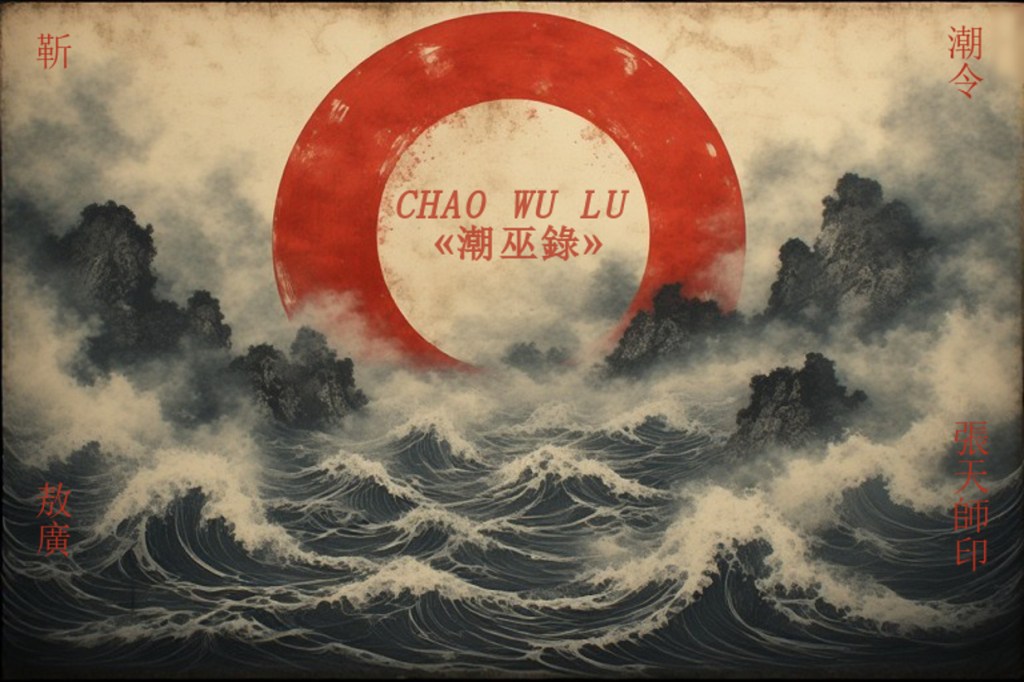
Powdered cuttlebone, gathered at low tide, sun-dried for three days, ground with cinnabar and one drop of the practitioner’s blood. The shark’s gift by proxy. See folio 24.
I have tried the exercise of the stone and the tide pool for three turnings of the moon. I am not certain the ripples change. I am certain that I am changing. ZJC.
Prologue: The Sea’s First Lesson
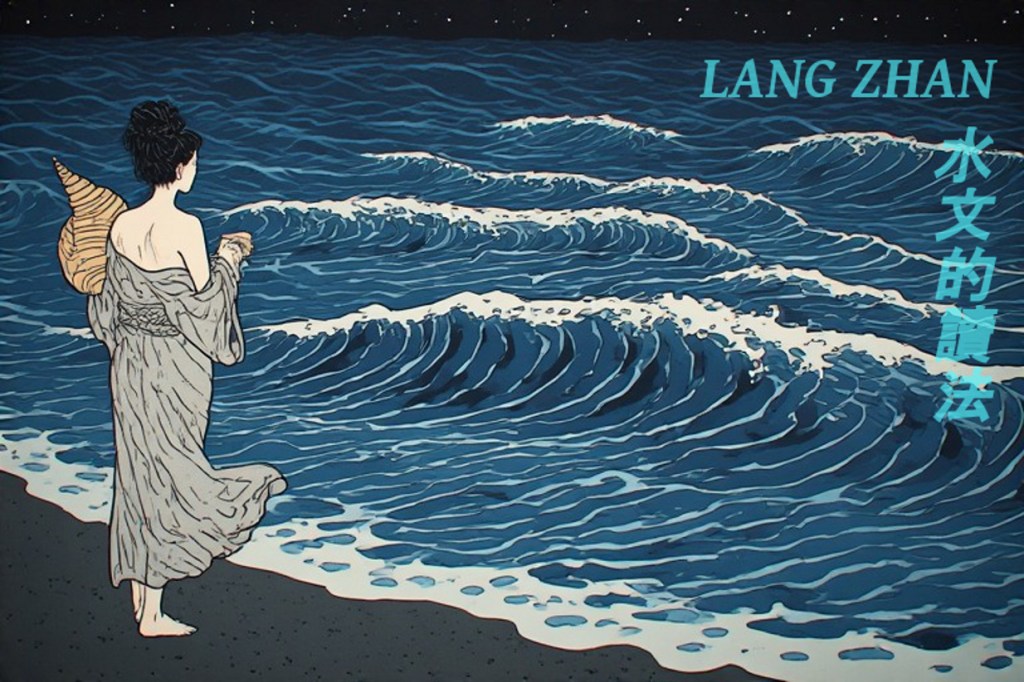
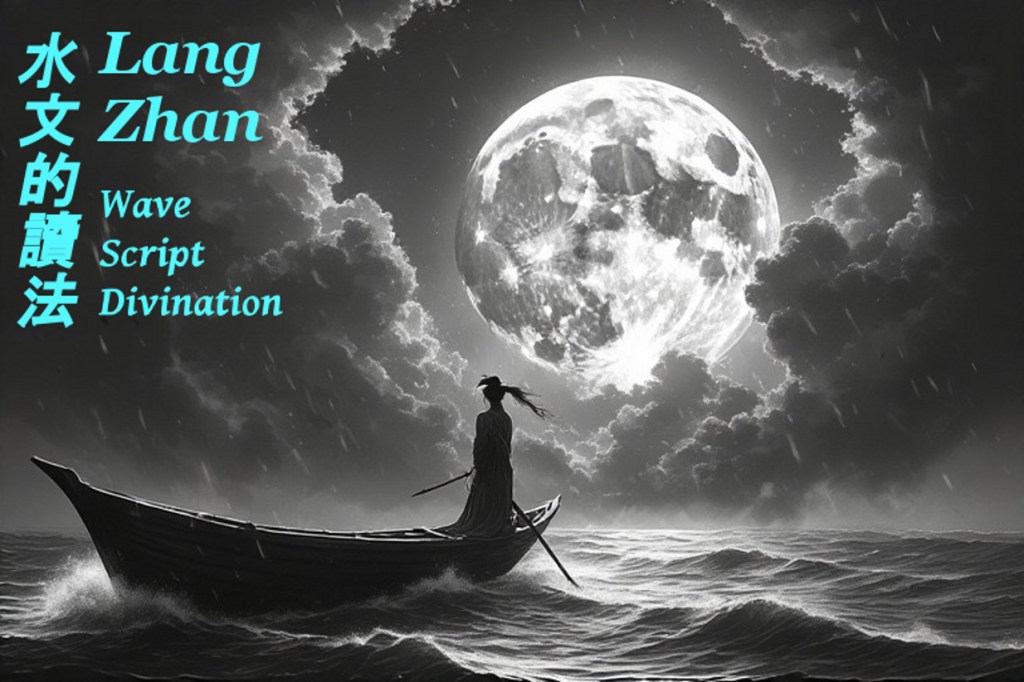
The sea does not keep its silence out of malice. It speaks endlessly—in a language older than any human word, written in a cursive of salt, foam and light. This language, Lang Zhan, is not a code to be cracked but a literacy to be earned. The waves are the Mother’s breath; to read them is to feel her pulse.
This manual is for those who are called to that literacy. It is not a museum piece, but a living transmission, adapted from the fragmentary texts of the Chao Wu Lu, the lore of the Fujianese Tide Witches and the cosmology of the Salt-Water Yi. It begins with the first and most profound step: go to the sea. Stand barefoot where the water meets the land. Tell her your name. She has been waiting to hear it.
The art of Lang Zhan does not offer the comfort of fixed meanings. It offers a relationship with a vast, intelligent and utterly indifferent presence that reflects your own soul back to you with terrifying clarity. The future is the least interesting thing about the sea. The depths are what matter.
THE SCHOLAR’S HEART MANDATE: A PROLOGUE ON TIDAL LITERACY
From the Preface to the Lost Fuzhou Wave-Reader’s Manual (c. 1788), a text known only from a single water-damaged copy in the Macau Maritime Archive, comes this admonition for the novice:
“The landsman looks at the sea and sees a flat, gray emptiness, a waste of water. The sailor looks and sees a road, marked with the signs of wind and current. The Tide Witch looks and sees a library. To learn Lang Zhan is to learn that the sea is not a thing that can be read, but a being that is reading you as you read it. It is a conversation between two depths. Do not begin by asking questions. Begin by standing on the shore at dawn, barefoot, for one hundred days. Let the sea grow accustomed to your presence. Let her learn the taste of your shadow. After one hundred days, if the shorebirds no longer startle at your approach and if the waves seem to reach a little higher toward your feet, then you may ask your first question. Not before. The sea is a sovereign, not a servant. She will not be interrogated by a stranger.”
This manual is a compendium of the grammar that conversation has revealed, passed down through the hands of, “the August Weavers of Tides and Tempests, a Tong of female ritualists,” and whispered in the margins of the Chao Wu Lu. It is a record of a literacy earned through salt and patience.
PART ONE: THE GRAMMAR OF WATER
Before you can read a text, you must understand its alphabet. The sea’s alphabet is not composed of letters but of the Eight Primal Patterns (Bā Làng Tú), the fundamental brushstrokes of the Mother’s calligraphy. These patterns are best read at dawn, when the boundary between darkness and light, yin and yang, is at its thinnest and the water’s truth is most visible.
THE EIGHT PRIMAL PATTERNS
A practitioner must learn to feel these patterns, not just see them. The wave that “looks” like a Dragon’s Rib must also feel like safety in the gut. The wave that forms Ghost Teeth must send a chill of warning up the spine.
1. Dragon’s Ribs (龍骨浪, Lóng Gǔ Làng)
Visual: Parallel, evenly spaced swells moving in a single, unified direction. The sea breathes in an orderly rhythm.
Meaning: Alignment. Safety. Favorable conditions. The cosmic breath is in order.
The Whisper of the Sea:“The day belongs to you. Sail now.”
Caution: If seen at noon, it signals an unnatural calm before a great shift. Investigate the stillness.
THE SCHOLAR’S HEART MANDATE: This pattern is so named from the Records of the Pearl River Fleet (c. 1801), which notes: “Before the Battle of the Bogue, the sea was a chaos of cross-tides and white water. On the morning of the engagement, the waves settled into long, even ribs stretching toward the Pearl River’s mouth. The Tide Witch of the Red Banner, old Yi-Min, saw this and told Admiral Ching Shih, ‘The Dragon stretches his ribs today. He is making a road for you.’ The fleet sailed into the ordered swells and victory. Yi-Min was rewarded with a Spanish silver dollar, which she wore on a chain around her neck until the day she walked into the sea at the age of ninety-two, claiming the Dragon King had finally called in his debt.”
2. Ghost Teeth (鬼牙浪, Guǐ Yá Làng)
Visual: Jagged, chaotic wavelets overlapping and breaking against each other, creating sharp, irregular peaks like a serrated blade.
Meaning: Betrayal. Hidden danger. Divided intentions. A trusted ally may fail you.
The Whisper of the Sea:“Look to your left hand. The sea sees what you refuse to see.”
Navigator’s Note: Look not for an enemy fleet, but for the silence in your own crew.
THE SCHOLAR’S HEART MANDATE: This pattern is the most personal of the eight. From the Penghu Fisher-Witches’ Almanac (c. 1840): “A woman came to the tide-reader of our village with a question about her son, a smuggler who had not returned from a run to the mainland. She was afraid he had been taken by the Qing navy. The reader led her to the shore at first light and the Ghost Teeth were gnawing the horizon. The reader did not speak for ten full breaths. Then she said, ‘The sea does not see a naval cutter. The sea sees a quarrel in a Canton tavern over a game of dice. Your son is not in chains. He is hiding from a debt. He will return when he has stolen enough to pay it.’ The woman did not believe the reader. But three weeks later, the son returned, carrying a purse of stolen silver and a scar above his left eye. The reader’s wisdom was proven, but the mother never looked at her son the same way again.”
3. Silk Unfurling (展絲浪, Zhǎn Sī Làng)
Visual: Long, smooth, rolling swells that stretch for miles without breaking.
Meaning: A rare and powerful omen of hidden treasure or an unexpected, profound opportunity approaching.
The Whisper of the Sea:“The gift is already on its way.”
THE SCHOLAR’S HEART MANDATE: The pattern is associated with a story from the Secret Records of Fujian Sea Transitions (c. 1793), concerning a Tide Witch known only as “Grandmother Oyster.” “Grandmother Oyster lived alone on a rocky islet where no one could grow anything. She was considered the poorest woman in the archipelago. One morning, a young fisherwoman saw Silk Unfurling on the horizon and rowed out to Grandmother Oyster’s island to ask its meaning. The old woman was already standing on the shore. ‘I know,’ she said. ‘The sea told me.’ She held out her hand and opened it. In her palm was a single, perfect pearl, large as a quail’s egg, glowing with a light that seemed to come from deep within. ‘I found it at my feet ten minutes ago,’ she said. ‘It was not here yesterday. The tide brought it. This is what the Silk was unfurling for.’ Grandmother Oyster was the poorest woman in the archipelago no longer, but she remained on her islet and when anyone sailed to her with a question, she would hold the pearl up to the light and say, ‘The sea will give you one of these, too, if you learn to listen.'”
4. The White Serpent (白蛇浪, Bái Shé Làng)
Visual: A single, undulating line of thick white foam stretching laterally across multiple wave fronts.
Meaning: Transformation. A significant, life-altering change is approaching.
The Whisper of the Sea:“Read the direction. Seaward for the external world, landward for the struggle within.”
THE SCHOLAR’S HEART MANDATE: From the Compendium of Wandering Sorceries (c. 1855), a text compiled by a defrocked Daoist nun: “The White Serpent is the Ouroboros of the sea, the serpent that eats its own tail. To see it is to know that one life is ending and another is beginning. The old Tide Witches used to say that the White Serpent is the restless spirit of a woman who died in childbirth and that her line of foam is the umbilical cord, forever seeking a new shore. When her head points seaward, she is looking for her lost child in the world. When it points landward, she is looking for her lost child within you. To see the White Serpent is to be chosen as a midwife for a new self. It is a fearsome blessing and it should be greeted with salt and silence.”
5. The Shattered Mirror (破鏡浪, Pò Jìng Làng)
Visual: A wave that rises and then collapses suddenly inwards upon itself, producing a circular, non-resolving ripple.
Meaning: Illusion. Deception. Self-delusion.
The Whisper of the Sea:“The sea cannot make you leave. She can only show you the broken glass.”
THE SCHOLAR’S HEART MANDATE: This pattern is the most dreaded by lovelorn sailors. An annotation in the Grimoire of the Moon-Eyed Witch (c. 1820) records this laconic exchange: “A woman of the floating village asked the tide-reader, ‘Does my husband keep a mistress in the port of Amoy?’ The tide-reader watched the dawn waves for fifty breaths, saw the circular, collapsing ripple of the Shattered Mirror and said, ‘He keeps three. The sea sees their faces. Do you wish me to describe them?’ The woman said nothing, but her silence was a howl. The tide-reader added, ‘The sea also sees the pearl that will come to you when you leave him. It is larger than his entire fishing fleet. The mirror is shattered, but the pearl is real.’ The woman walked into the village, packed her belongings and was gone by noon. The husband returned to an empty hut and when he asked the tide-reader what had happened, she said, ‘The sea told your wife a secret. The sea does not tell me to tell you.'”
6. The Dragon’s Gate (龍門浪, Lóng Mén Làng)
Visual: Two large, powerful waves rising simultaneously left and right, with a channel of impossibly still water between them.
Meaning: A test, a threshold. A challenge that must be faced.
The Whisper of the Sea:“The gate is open. Leap, or turn back.”
THE SCHOLAR’S HEART MANDATE: The mythic resonance of this pattern is noted in the Scripture of the Southeast Dragon Kings (c. 1783): “The Dragon’s Gate is the only pattern that requires immediate action, not contemplation. The Tide Witch who sees it at dawn must act by noon. The Tide Witch who sees it at dusk must act by the next dawn. Legend tells of a young Cantonese captain, the first woman to command a junk in her own name, who sailed her ship to the mouth of the strait where the Qing navy lay in wait. At dawn, she saw the Dragon’s Gate open before her prow. Her first mate, an old man who had sailed with her father, saw the same waves and cried, ‘It is a trap! The still water is a shoal!’ The captain looked at the waves, then at her first mate. ‘The Dragon’s Gate is not a shoal,’ she said. ‘It is a dare.’ She steered directly into the still channel. The Qing ships, seeing her enter what their charts marked as impassable shallows, did not follow. But her ship passed through without incident and when she reached the open sea on the other side, she found a wind that carried her all the way to Manila. The first mate asked how she had known. ‘I did not know,’ she said. ‘I trusted the water to hold me. The gate is not a promise. It is a test of nerve.'”
7. The Drowned Hand (溺手浪, Nì Shǒu Làng)
Visual: A single wave rising anomalously higher than all others, then pulled down from below before it can break.
Meaning: Direct intervention from the spirit world.
The Whisper of the Sea:“You will know if this is a helping hand or a dragging claw by the temperature of your blood.”
THE SCHOLAR’S HEART MANDATE: From the Penghu Fisher-Witches’ Almanac: “When the Drowned Hand appears, the old women say, a ghost has taken an interest in your question. This is neither good nor bad in itself, but it requires an immediate and private ritual. The practitioner should prick her left ring finger with a bronze needle—or, failing bronze, a thorn from a beach rose—and let a single drop of blood fall into the surf. If the next wave smooths the blood into a perfect circle, the intervening spirit is an ancestor and means to help. If the blood scatters into ragged filaments, the spirit is a stranger and its motives are its own. If the blood simply vanishes without a trace, the practitioner should leave the shore immediately and not return for three days, for the spirit is stronger than she is and has not yet decided whether to be merciful.”
8. The Silent Tide (默潮浪, Mò Cháo Làng)
Visual: Waves moving with visible force but producing no sound whatsoever—an unnatural, absolute silence.
Meaning: The rarest and most dangerous pattern. An unrecognizable presence has entered your waters.
The Whisper of the Sea:“The sea is silent because she is terrified. You should be, too.”
The Tide Witch’s Response: Immediate and absolute protective action. Deploy the Three Concealments—the Stealth Talisman, the Muffling Oar and the Sailor’s Shadow Ward—at once, without delay.
THE SCHOLAR’S HEART MANDATE: The most detailed account of this pattern comes from the Record of Pacifying Fujian’s Sea Ghosts (c. 1891), which describes an event in the winter of 1809: “A fleet of six fishing junks was becalmed off the coast of Meizhou Island. The sea was heaving with a heavy swell, but the men heard nothing. No wind, no wave-crash, no cry of gulls. It was as if the world had been stuffed with cotton. One of the fishermen, an old man who had survived the great typhoon of ’79, began to tremble. ‘The Silent Tide is upon us,’ he whispered to his son. ‘We must not speak. We must not move. We must be dead men on a dead sea until the sound returns.’ The crew obeyed. They lay on the deck as if drowned. For three hours, the silence held and in the depths beneath their hull, a vast, dark shape passed slowly, a shadow that blocked the bioluminescent glow of the deep. Not a fish. Not a whale. Something that had come up from a place where light had never reached. When the shape finally passed and the sound of the waves returned with a roar, the old man wept with relief. ‘It was looking for voices,’ he said. ‘It hunts by sound. The sea hid us the only way she could—by taking our noise away.’ The Silent Tide is, therefore, not a malice of the sea but a mercy. The sea holds her breath to hide you from the thing that stalks you.”
PART TWO: THE DEEPER ARTS OF READING
Mastering the eight patterns is the first step. To become a true Wave Calligrapher, one must learn to read the sea’s subtler texts, written in foam, salt and the behavior of her creatures.
THE SCHOLAR’S HEART MANDATE: From the Tide-Watcher’s Breviary (c. 1860), a small, handwritten book found tucked into the lining of a sea-chest: “The Eight Patterns are the bones of the language. The Deeper Arts are its flesh and breath. A woman can learn the bones in a year and be a competent reader. She will spend the rest of her life learning the flesh and breath and she will die illiterate. The sea is too large a text for any one soul to master. That is not a cause for despair. It is a cause for wonder. An illiterate in the sea’s library is still, by any land-bound measure, a sage.”
1. The Practice of Lang Zhan (A Foundational Ritual)
Timing: Dawn or dusk. Noon is discouraged; the sun flattens the water and makes the sea’s “handwriting” illegible. Midnight is for urgent questions only.
Position: Barefoot at the tide line, where the highest wave of the last tide touched.
The Question: Frame your question silently and clearly. Ask one thing. The sea answers one thing.
The Observation: Watch the waves for the space of one hundred slow breaths. Hold a soft focus, “as you would gaze at the face of a lover, not as you would stare at a chart.”
The Interpretation: After the hundred breaths, close your eyes. The first pattern you recall is the primary answer. The sea shows many things; the thing you remember without trying is the thing she wants you to know.
The Recording: Keep a Wave Journal. Write down the pattern, the date, the tidal state, the lunar phase and the question. The sea’s answers are precise, but your memory is not.
2. The Method of the Conch-Shell
For this, you require a spiral-cut conch shell large enough to hold your whispered intent. Wade into the shallows at dawn or dusk. Cup the shell in your hands and breathe your specific question into its opening as a soft whisper that fogs the inner pearl. Submerge the shell and release it to the sea. Then, stand and watch the waves for one hundred breaths. The first pattern to arise is a direct response from the Ocean Mother.
THE SCHOLAR’S HEART MANDATE: This is the method favored by the August Weavers and it is said that the shell used must be a gift from the sea—a shell found empty on the shore, never one taken from a living creature. The Secret Manual of Southern Sea Witchcraft (c. 1809) warns: “A shell bought from a merchant carries the merchant’s voice, not the sea’s. A shell wrenched from a living conch carries a death-curse. Only a shell freely given by the tide can be a true vessel for the Mother’s voice.”
3. Foam Necromancy (Pào Hún Fǎ)
This art is for communicating with the drowned. Collect nine handfuls of the purest white foam from the crest of a just-breaking wave. Spread it on a square of black silk. Let it settle. If the foam contracts into a single, dense central cluster, the dead approve of your question and are present to help you. If it scatters loosely across the silk, their answer is a foretelling of disaster—a shipwreck in your affairs.
THE SCHOLAR’S HEART MANDATE: From the Pirate Necromantic Rites (c. 1783): “Foam is the breath of the drowned. It is the only part of them that still touches the air. When you gather it, do so gently, as you would gather a sleeping child. The foam remembers the lungs it came from. Speak to it. Tell it your name. Tell it the name of the one you seek. If the foam knows that name, it will cling together, eager to speak. If it does not, it will flee from your touch and you must not pursue it. The drowned are tired. Let them rest.”
4. Salt-Crack Divination (Yán Liè Zhān)
Scrape the salt crusts formed on a ship’s deck or a rock saturated by sea-spray. Build a small, hot fire. Throw the salt into the flames and watch how the crystals crack. Cracks that fork like lightning bolts reveal the active wrath of the Dragon King—a celestial warning against your current course. Cracks that split into interwoven, net-like shapes warn of a rival’s trap—a net closing around you, laid by human hands.
THE SCHOLAR’S HEART MANDATE: From the Fujian Sea Blessings Manual (c. 1732): “Salt that has been kissed by the sea and then dried by the sun is the only salt suitable for this divination. Salt from a merchant’s shop is dead salt. It has no memory of the Mother. It will not speak. The salt of the tide line, however, still dreams of the wave that left it there. When you throw it into the fire, you are not destroying it. You are waking it. The crack is its voice. Listen closely. The Dragon King’s voice is a roar. A rival’s plot is a whisper. Both can be heard in the salt, if your ear is trained.”
PART THREE: THE LOST ART OF THE WAVE CALLIGRAPHERS (LANG SHUFA)
Literacy, for a master, becomes authorship. A fragment from Folio 51 of the Chao Wu Lu hints at a lost tradition, the Lang Shufa, the living art from which Lang Zhan derived. A woman on Penghu could speak to her sister on the Fujian coast by beating the water’s surface with the flat of an oar: three strikes, a pause, two strikes. The message would arrive at her feet over a hundred miles away. This art required a lifetime of practice and a bond between the two practitioners that was closer than blood. The text cannot teach this lost art. But it can teach you the first, foundational exercise for a new lineage of Water-Speakers.
A Beginner’s Exercise in Wave-Calling
Seek out a still, sheltered body of salt water: a tide pool or a quiet cove. Sit beside it and let your breathing slow until it feels like the rhythm of the gentle waves. Drop a single, small, smooth stone into the center of the pool. Watch as the concentric ripples spread outward—this is your voice, initiated by a single act. Now, recite a single word imbued with strong feeling—a name, a question, a line of verse—silently in your mind. Drop the stone again. Did the ripples change? Practice this daily for one turning of the moon. Record your findings. The sea, as the Compiler noted, is large enough to carry voices. She is old enough to remember how. She is only waiting for someone to learn.
THE SCHOLAR’S HEART MANDATE: The Compiler of the Chao Wu Lu closes their account of the Wave Calligraphers with a personal note, one of the few places in the entire text where their voice breaks through the ritual formalism: “I have tried the exercise of the stone and the tide pool. I have done it for one turning of the moon and for a second and for a third. I do not know if the ripples change. I cannot tell if the change I see is in the water or in my own eye, my own hope. But I will continue. Not because I believe I will learn to speak to a sister across the sea. I have no sister. But because the practice has taught me something else. It has taught me to watch the water with such close attention that the boundary between the water and myself has begun to feel thin, porous, provisional. I am starting to believe that the Sea Witch who achieves the lost art of the Wave Calligraphers does not speak to the water. She speaks as the water. She is the stone and the ripple and the shore all at once. That is the art I am seeking. That is the art I believe is possible. I include this account so that future generations will know that it was once possible and might be possible again and that the path to that possibility begins with a single, small, smooth stone dropped into a tide pool at dawn.”
PART FOUR: THE INNER TIDE — SOMATIC DIVINATION
The sea outside is a mirror of the sea within. The Tide Witch who has mastered the reading of external waves must also learn to read the waves that rise and fall in her own Ocean of Qi, the lower dantian located three finger-widths below the navel. This is the internal practice of Lang Zhan and it is considered the bridge between the interpretive and the creative arts. Before one can write upon the water, one must be able to feel the water writing within oneself.
THE SCHOLAR’S HEART MANDATE: From the Inner Scripture of the Tidal Body (c. 1820), a fragmentary text attributed to the August Weavers: “The landlubber’s error is to believe that the body ends at the skin. The Tide Witch knows that the body is an ocean and the skin is only its shoreline. The tides within are no less real than the tides without. They rise and fall with the moon. They churn with storm. They hold the wrecks of old griefs and the pearls of old joys. To learn Lang Zhan is to become a cartographer of two seas and the map of one is the legend for the other.”
The Practice of Internal Wave-Reading
Timing: At the turning of the tide, when the external sea pauses between ebb and flow. At this moment, the internal sea also pauses and its depths become visible.
Posture: Seated meditation, preferably facing the sea. If landlocked, face west, the direction of the Queen Mother’s mountain.
The Sounding: Bring your attention to the Ocean of Qi. Do not visualize. Simply feel. Is the sea within you calm, or is it churning? Are there cross-currents of anxiety pulling against the prevailing wind of your will? Is there a ghost tide rising from some deep, unacknowledged grief?
The Eight Patterns Within: The same eight patterns that appear on the external sea can manifest in the internal sea. A feeling of steady, rhythmic energy flowing unimpeded is the internal Dragon’s Ribs. A jagged, anxious churning is the internal Ghost Teeth. A sudden, profound stillness that seems to widen inside you is the internal Dragon’s Gate. Learn to name these internal patterns as you would name the external ones.
The Recording: In your Wave Journal, beside your external observations, record your internal soundings. In time, you will see that the two seas rise and fall together. This is the proof of the Mother’s body: the tide that moves the ocean is the tide that moves your blood.
THE SCHOLAR’S HEART MANDATE: This practice is alluded to in the Chao Wu Lu‘s instructions for the Weak Water Meditation, but a more direct account appears in the oral testimony of an unnamed Tide Witch, recorded in the Taiwanese Pirate Spells collection (1833): “My grandmother, who was the last reader in our village before the Japanese came, used to say: ‘I do not just watch the waves. I feel them first. I stand on the shore and the water in my belly rises to meet the water at my feet. When they touch, I know what the sea is going to say before she says it. That is not magic. That is just paying attention to two things at once for sixty years. Anyone can do it if they start young enough and never stop.’ She started when she was five. She died when she was ninety-one. She never stopped.”
PART FIVE: LANG ZHAN AND THE DAOIST OCEAN TAROT
The system of Lang Zhan is the foundation upon which the Daoist Ocean Tarot is built. The Tarot is, in its essence, a translation of wave-reading from water to cardstock. Every spread is a stretch of sea. Every card is a wave pattern. The question is not “What does this card mean?” but “What is the water doing?”
For the Tide Witch who has achieved basic literacy in the Eight Primal Patterns, the Tarot offers a way to bring the sea’s voice inland, to consult its wisdom when the shore is far away. But the Tarot is a secondary text. The sea is the original. The cards are a tide chart. The tide chart is not the tide.
THE SCHOLAR’S HEART MANDATE: From the introduction to the Daoist Ocean Tarot, attributed to the anonymous Compiler of the Salt Archive:“I did not create the Tarot. I translated it. The Major Arcana are the twenty-two faces the sea showed me over a decade of dawn vigils. The Minor Arcana are the fifty-six voices I heard in the wave-crash and the tide-sigh. I give you these cards not as a replacement for the sea, but as a letter of introduction. Give them to the sea when you meet her. Say: ‘I have been studying your grammar. I am still illiterate, but I am learning. Will you teach me more?’ The sea, I have found, is kind to the sincere student. She will not mock your flashcards. She will simply nod and the next wave will carry a new word you have never seen before.”
Correspondences: The Major Arcana as Wave States
0. The Fool (The Naked Immortal): The moment just before a wave breaks, when the water has gathered itself into a shape but has not yet committed to collapse. Suspension. Potential. The gourd before it is thrown into the sea.
I. The Magician (The Dragon’s Tide-Caller): The transition from chaos to rhythm, when scattered swells suddenly organize into a single, coherent wave train.
II. The High Priestess (The Silent Tide-Mother): The “oil waves” (yóu bō), a strange flattening of the surface that occurs when deep currents contradict the wind. The visible calm that conceals profound motion.
XIII. Death (The Moon-Eating Turtle): The black wave (hēi làng), the single, massive swell that rises from a storm’s heart and consumes every smaller wave in its path.
XXI. The World (The Dragon’s Whirlpool): The great circular current (dà zhōu liú), the planetary-scale circulation that connects all seas into a single, unified system.
THE SCHOLAR’S HEART MANDATE: From the personal notes of the Tarot’s Compiler, found in the margins of the first printed edition: “I have been asked many times which card is my favorite. The answer changes with the tide. But on the morning I finished the Major Arcana, I walked to the shore to perform the closing ritual and the sea showed me The World—the great circular current, the whirlpool of dragons. I laughed. I had spent a decade drawing faces for the sea and in the end, she showed me a face I had never imagined: the face of the journey completing itself, the face of the Fool’s gourd arriving on a shore it had never seen but had always been sailing toward. I added the card that night. It is the twenty-second face. The twenty-third face is yours.”
PART SIX: LANG ZHAN IN THE SALT-KIN CODEX
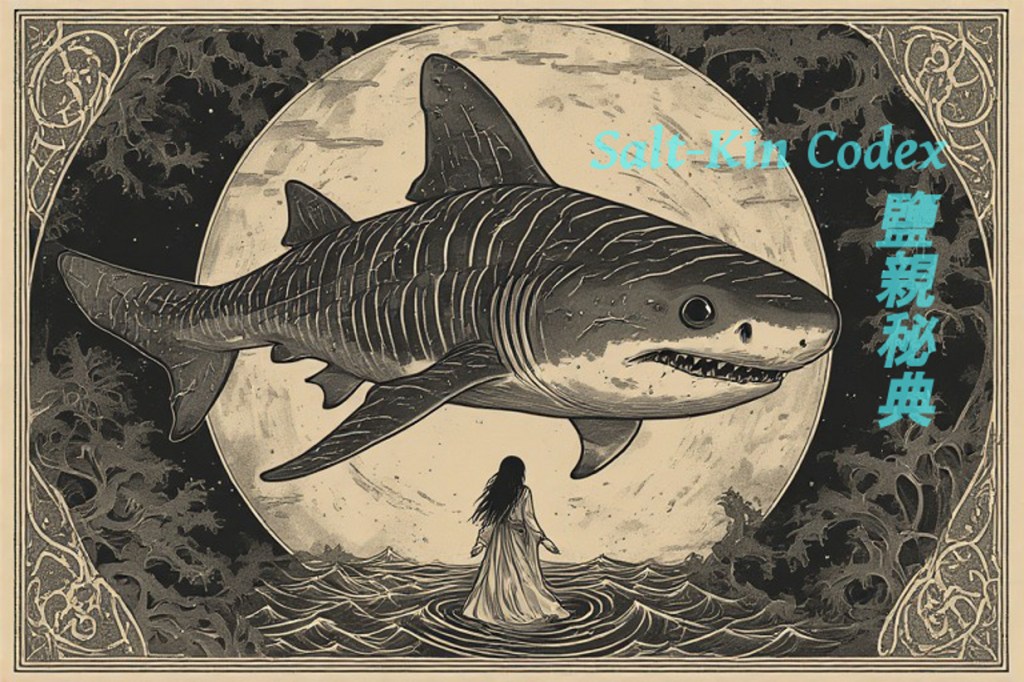
The Salt-Kin Codex, the grimoire of the Shark Path, recognizes the shark as the ultimate master of Lang Zhan. The shark does not merely read the water; it is read by the water and the reading and the being-read are a single, seamless act. The shark’s entire body is a divination tool. Its lateral line senses the pressure-wave of a distant struggle. Its ampullae of Lorenzini feel the electromagnetic tremor of a hidden heart. It does not interpret; it knows. The Tide Witch who follows the Shark Path seeks to cultivate this same somatic, instantaneous literacy—a reading that is not separate from being, but identical with it.
THE SCHOLAR’S HEART MANDATE: From the Salt-Kin Codex, the section entitled “The Shark’s Grammar”: “The shark has no need of the Eight Patterns. The patterns are for those of us who are still learning to think like water. The shark is already water thinking about itself. When you have practiced Lang Zhan for a lifetime, you will not see the Dragon’s Ribs or the Ghost Teeth. You will simply feel the sea’s intent, as the shark feels the floundering fish from a mile away. The patterns are the scaffold. The shark is the building. Do not mistake the scaffold for the temple.”
The Shark Dream Omens: A Divinatory Guide
When the Salt-Kin comes to the practitioner in dream, it is not offering a symbol. It is offering a direct transmission. The dream-shark is not a metaphor for a pattern in your life; it is the pattern itself, swimming directly into your sleeping mind.
The Silent Swim Beside You: The shark pulls alongside you but does not attack. You feel a vast, ancient quietude. This is the experience of the Leviathan’s Rest (Hexagram 52). You are being initiated into the power of sovereign stillness. The sea around you is calm, but the pressure of the deep is in your chest. This is a good omen for spiritual maturity.
The Offering of a Tooth: The shark ejects a single tooth from its mouth, which you catch. This is a gift from the Manifest Ancestor. You are being given a specific tool for a coming act of righteous discernment. The tooth is the Shark’s Bite (Hexagram 21). When you wake, you will know, in your bones, what must be severed from your life. Do not hesitate. The tooth is sharp for a reason.
The View from the Apex: You see through the cold, perfect eyes of the shark, feeling the electromagnetic tremor of a hidden truth. This is the ultimate vision of the Abyssal Trench (Hexagram 29). You have merged with the Salt-Kin and understand the Dao without a single word of doctrine. This dream is rare. If it comes, you must fast for three days afterward. The human body is not meant to hold that much truth for long. The fasting helps it settle.
THE SCHOLAR’S HEART MANDATE: The Salt-Kin Codex warns that the dream of the View from the Apex is dangerous for the unprepared: “A young Tide Witch on the Penghu Islands dreamed this dream and woke with the taste of brine in her mouth that did not fade for a year. She could not bear the company of humans. She took to wandering the tide pools at low tide, speaking to the anemones. The villagers thought her mad. But the old Shark-Speaker of the island, a woman who had not spoken in a decade, came to her one evening and said, ‘You are not mad. You are over-salted. Come to my hut. I will teach you how to be a shark in a human body without drowning in the contradiction.’ The young witch became the next Shark-Speaker. Her name is not recorded. But her hut is still there, at the edge of the tide pools and the anemones still whisper her name when the water is low.”
APPENDIX: A LEXICON OF ADVANCED LANG ZHAN TERMS
You Bo (油波, “Oil Waves”): A phenomenon where the sea surface becomes eerily flat, as if coated in oil. To the untrained eye, this looks like a calm sea. To the wave-reader, it indicates that powerful, contradictory deep currents are moving beneath the surface. It is the visual expression of the High Priestess. A reading taken on an oil-wave sea is a reading of the subconscious, not the conscious mind. Interpret accordingly.
Jiao Chao (交潮, “Cross-Tide”): The turbulent, chaotic zone where two currents of different temperature, salinity, or direction collide. This is the visual expression of the Wheel of Fortune. No clear reading is possible in a cross-tide. The sea itself is confused. The only appropriate response is to wait, to accept that this part of the sea is unreadable and that the unreadability is the reading.
Bao Lang (暴浪, “Violent Surge”): A wave that breaks not on the shore but against itself, collapsing into white water from its own internal pressure. This is the visual expression of the Tower. It signals a destruction that is self-originating, not externally imposed. The thing that breaks was always going to break. The wave-reader who sees this should not mourn the collapse. It was already written in the water’s grammar.
Hui Bo (回波, “Returning Wave”): The wave that has traveled out to sea and now comes back, carrying with it the energy of everything it encountered on its journey. This is the visual expression of Judgment. The wave-reader who recognizes the returning wave can read in its shape the history of the voyage that sent it out. This is the pattern of ancestral reckoning.
THE SCHOLAR’S HEART MANDATE: From the Tide-Watcher’s Breviary: “The beginner sees waves. The apprentice sees patterns. The adept sees a single, flowing text. The master sees nothing at all—only water, only the Mother’s body, breathing. Do not aspire to be a master. Aspire to be a perpetual apprentice, always learning, always slightly confused, always grateful. The master who has seen everything has stopped looking. The apprentice who is still confused is still paying attention. The sea prefers the apprentice. The sea has been breathing for four billion years. It is still confusing to her, too.”
FINAL NOTE: THE TWENTY-THIRD FACE
The Chao Wu Lu ends with a passage that is also an instruction for the end of this manual. It is not a conclusion, but a threshold:
“You have learned the twenty-two faces. You have learned the fifty-six tides. You have learned the spells and the proverbs and the names of the Dragon Kings and the methods of reading waves. You have learned enough to sail.
What you have not learned—what no book can teach—is what the sea will say to you when you are alone on it, at night, with the lanterns burning low and the ghosts gathering at the rail and the compass spinning toward a destination that does not appear on any chart.
That is something we cannot give you. That is the gift that you give yourself by sailing.
The tide is turning. The ship is waiting. The Bone Admiral has lit the first lantern on the pier.
Sail and the sea will teach you what we could not. Sail and the drowned will guide you where we could not.
Sail and you will become—in time, in salt, in the slow accretion of wisdom that comes only to those who have weathered storms and lost ships and continued sailing—one of the faces of the sea yourself.
The twenty-third face is yours.”
THE FINAL SCHOLAR’S HEART MANDATE: The Compiler of the Salt Archive added a personal note to this passage, which appears in no formal manuscript but was found written on a slip of tide-stained paper tucked into the binding of the master folio: “I have compiled these texts. I have translated these rituals. I have done my best to honor the women who came before. But I am not a Tide Witch. I am a scholar, a collector, a keeper of fragments. I have never seen the Silent Tide. I have never felt the Shark’s dream. I have only ever been a student of the shore. The sea, I think, has been patient with me. She has let me gather her shells without drowning me. She has let me build this Archive. But I know, as I write these final words, that the Archive is not for me. It is for the woman who will find it, long after I am gone and who will read it with a different kind of eye—the eye of one who is not merely curious, but called. If you are that woman, I have one request. When you go to the sea to claim your twenty-third face, say my name to her. I need her to know that I tried.”
May the sea remember my name. May the sea remember yours.
being a Grimoire of the Shark Path Through the Tide Witch’s Dao
Compiled from the Waters of the Chao Wu Lu, the Salt-Water Yi and the Dreaming Abyss.
)(*)(
COMPILER’S PREFACE
This Codex is a record of a specific transmission: the re-visioning of the shark not as a demon of Western horror, but through the lens of Daoist mysticism and the traditions of the Tide Witches. It is a work of respectful syncretism. While acknowledging the profound and sacred traditions of the Pacific, particularly the concept of the ‘aumākua, this text does not borrow or appropriate that living, guarded term. Instead, it constructs its own parallel lineage, drawing on the established cosmology of the Chao Wu Lu and Salt-Water Yi to name the shark as a Manifest Ancestor (顯祖, Xiǎn Zǔ) and a Salt-Kin Spirit (鹽親靈, Yán Qīn Líng) .
The wisdom herein is an unfolding of the core Daoist principle that the Dao is the Mother and the Mother’s body is salt water. The shark, therefore, is not an outsider to this cosmology but its most ancient, perfected and fearsomely honest prophet. This Codex provides a complete path for the Tide Witch who would seek the shark as a guide, teacher and kin. It is meant to be used. The sea is the final witness.
)(*)(
PART ONE: THE SALT-KIN COSMOLOGY
The Foundation of the Shark Path in the Dao
THE SHARK IS THE DAO EMBODIED
The Dao De Jing speaks of the Dao as water. The shark is the living will of that water. It masters its element not by fighting the current, but by becoming one with it.
The Uncarved Block (Pu, 朴): The shark is the ultimate living Pu. It is a 400-million-year-old testament to perfection through simplicity. It has not changed because it has not needed to. Its form is a masterpiece of pure, simple utility, a raw, natural power before it is shaped and dulled by concepts.
Wu Wei (Non-Action): The shark is the master of effortless action. Its silent glide is not a battle against the water but a conversation with it. As the Chao Wu Lu intones, “The shark moves without sound… Both are teachers.” This is the power with the sea, not over it, the very distinction the Tide Witch’s Code demands.
Ziran (Naturalness): A shark is what it is, without pretense or apology. To follow the Dao is to cultivate one’s own inner shark-nature: to move through the world with quiet, effortless purpose, fully accepting one’s own nature.
THE SHARK AS MANIFEST ANCESTOR (XIǍN ZǓ)
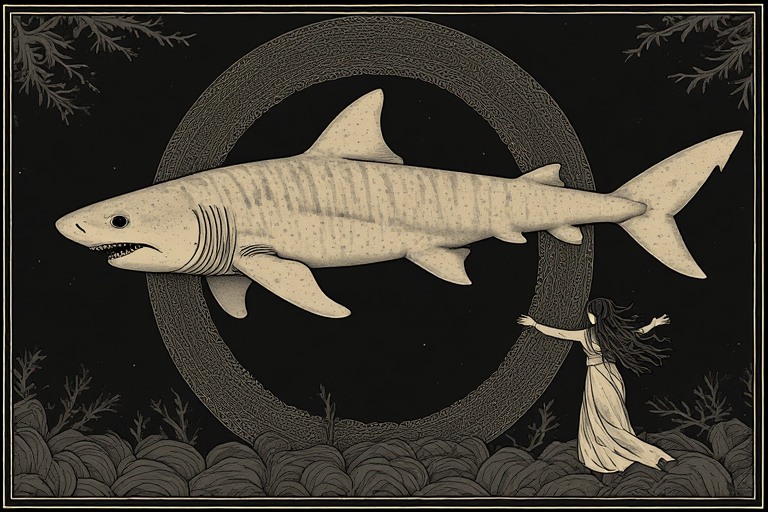
The Chao Wu Lu establishes the Tide Witches as a collective lineage of outcasts: “We are the ones the temples did not want… The sea took us in.” For women exiled from their bloodlines, the spirits of the deep became their new ancestors. A shark encountered in ritual or dream is not a god to be worshiped, but a Tide Witch who came before, a “sister of the deep,” whose soul has taken this formidable, fluid form. She is the Mazu, the Chen Jinggu, or the unnamed “Tide Witch of the Black Banner” who now swims the abyss, offering guidance. The “inner pearl” of the Salt-Water Yi is her soul, shining through the shark’s body.
THE SHARK AS TEACHER OF THE ABYSS
The shark is the ultimate instructor in the lessons of the Salt-Water Yi‘s Hexagram 29, The Abyssal Trench. It does not visit the crushing dark; it lives there. It is the embodied wisdom that the Tide Witch seeks in the Weak Water Meditation: the thing “against which everything breaks and everything means nothing.” It is not a monster; it is a master of stillness, silence and the terrifying, effortless grace of the Dao itself.
)(*)(
PART TWO: THE RITUAL TOOLS OF THE SALT-KIN PATH
A tool is not a tool until it has been introduced to the sea.
1. The Tooth of the Severing Truth (斷真齒, Duàn Zhēn Chǐ)
A shark’s tooth is a symbol of the one thing a shark teaches that no other creature can: the ability to bite through the false and sever it cleanly from the true. This is the Daoist concept of the Shark’s Bite, the swift, impartial separation of the healthy from the diseased. A Tide Witch who scavenges a tooth from the shore has been given a gift.
Consecration: Consecrate the tooth in New Moon Water, “where the darkness pools.” Hold a silent vigil and speak: “This is not a tooth. This is a blade of discernment. It severs what must be severed. It defends what must be defended. It is the gate that only truth may pass.”
Ritual Use: The tooth can draw a protective circle of salt, inscribe a talisman of severing to cut a “ghost-rope” to a toxic past, or physically sever a cord in an unbinding ritual, acting as the blade of righteous discernment.
2. The Driftwood Stylus of the Current (流木筆, Liú Mù Bǐ)
This is a piece of wood, worn smooth and salt-logged by a long journey on the tides. It is a piece of a tree that, like a Tide Witch, was taken by the sea and remade. Its grain has been polished by the same current the shark swims. It carries the memory of the journey without the need for a death. The Shark is the teacher; the driftwood is the willing, empty vessel that has listened to the same lessons.
Finding the Stylus: You do not break a branch from a living tree. You walk the wrack line, the high-tide mark after a storm, and you wait. The sea will provide a piece of wood that fits naturally in your hand. It should be smooth from abrasion, with no sharp edges. It is a found tool, a gift from the Mother.
Consecration: The consecration mirrors that of the stylus, but the invocation is fundamentally different.
Take the driftwood stylus into the water. Submerge it fully. Hold it under for the space of nine breaths, letting the wood re-member what it was to be below the surface.
Raise it from the water. Pass it through the smoke of a ghost-wood or ambergris candle.
Speak the activation, acknowledging its unique origin:
“Wood of the living tree, branch of the shore,
You did not die for this tool; you were remade by the sea.
You were a mast, a root, a spar. Now you are a pen.
The current has shaped you. The salt has seasoned you.
You are no longer driftwood. You are a stylus of pure intention.
A student of the shark’s silent wake, not a trophy of its death.
You trace what must be traced. You transmit the patterns of the clouds.
You write the word on the wave.
You are awake.”
Trace a circle in the air, feeling the resistance of the medium. The stylus is now a partner, not a possession.
Ritual Use: This stylus is used identically to the Driftwood Stylus. It traces the eight trigrams over a scrying bowl. It beats the water in the rhythm of a sigil to send a message through Lang Zhan. It is a conductor for the Tide Witch’s intent, made more powerful by the fact that its creation caused no harm, and thus carries no ghost-debt.
)(*)(
PART THREE: A GRIMOIRE OF THE SALT-KIN RITUALS
Ritual or Practice
Purpose
Source
The Rite of the Salt-Kin Spirit
To petition a Manifest Ancestor in shark form to become a personal patron and guide.
Chao Wu Lu, “The Tide Surge”; Salt-Water Yi, Hexagram 29.
The Inner Salt-Kin Meditation
To conceive, nourish and befriend the embryonic shark-spirit within one’s own Ocean of Qi.
Daoist Ocean Tarot, The Three Dantian; Salt-Water Yi, Hexagram 61.
The Consecration of the Tooth of Severing Truth
To awaken a scavenged shark tooth as a ritual tool of discernment and protection.
Chao Wu Lu, “Consecration of Tools”; Salt-Water Yi, Hexagram 21.
The Consecration of the Driftwood Stylus
To awaken a scavenged bit of driftwood as a tool for writing intent on water and in air.
A divinatory guide for interpreting dream encounters with the Salt-Kin.
Salt-Water Yi, Hexagrams 52, 21, 29, 53, 26.
The Salt-Kin’s Code for Enduring the Eclipse
Four contemplative instructions for a Tide Witch in a season of oppression, concealment and scarred survival.
Salt-Water Yi, Hexagram 36.
THE RITE OF THE SALT-KIN SPIRIT
A ritual to petition a deep-dwelling Manifest Ancestor who has taken the form of a shark to become a personal guide.
Timing: The Dark of the Moon, as the tide reaches its lowest ebb. The time of “New Moon Water,” for “preparing for deep internal work.”
Location: The edge of the sea.
Materials: An offering of sea salt you have evaporated yourself, a single black pearl or a smooth black stone (your Kinship Token) and your bare feet.
THE RITE:
The Stillness Before the Call. Walk to the water’s edge. Breathe until your breathing matches the wave rhythm. Hold your pearl in your left (receiving) hand, the salt in your right. Gaze out at the dark horizon.
The Naming of the Kin. Speak your name to the water. Then speak the names of your matrilineal ancestors. If their names are lost, say: “I am the daughter of daughters whose names were not written. I speak them now into the water, where the sea, the oldest archive, remembers all names.”
The Casting of the Salt. Cast the salt from your right hand onto the water. As it dissolves, speak: “Salt of my body, memory of the sea, I return a part of myself to the source. Let this offering be a scent of kinship that travels to the deep places, where the ones who swam before still swim.”
The Call to the Salt-Kin. Wade deeper. Face the open sea. Hold the black pearl to your heart. From the center of your Ocean of Qi, speak in a low, resonating hum of intent: “O, Sister of the Deep, Manifest Ancestor, Salt-Kin Spirit, You who took the form of the silent hunter to master the crushing dark, I call to you across the threshold of my world and yours. I am not here to borrow your faith, but to offer my own kinship. I am the inheritor of the Tide Witches, whose lineage is written in water. If my heart is sincere, if my salt is true, let this pearl be the seed of a bond. Come to me in dream, in omen, in the sudden, soundless flick of a fin. Be my patron in the deep places. Be my teacher in the art of the wake. The sea is the final witness. The sea is our common home.”
The Return. Walk backward out of the water, never turning your back on the sea. Sit and let the salt water dry on your skin. The pearl is now your Kinship Token. Keep it with you.
Signs of Acceptance: A sudden, vivid dream of deep water or a dark-haired woman. A seabird crossing your path seaward. A feeling of having stepped into a deeper, cooler current of guidance.
THE DESCENT TO THE SALT-KIN (DREAM INCUBATION)
A three-day rite of purification and petition to seek a direct, instructive dream-encounter with the Salt-Kin Spirit.
Timing: Begin purification two days before the New Moon. The main ritual is on the night of the dark moon itself.
Location: Your sleeping chamber, made into a sacred, abyssal space.
Materials: Your Kinship Token, a bowl of New Moon Water, a single small mirror, a piece of ambergris or myrrh and your consecrated Driftwood Stylus or Tooth.
The Three-Day Preparation:
Day 1: Eat simply. No intoxicants. Make the body a hollow, light vessel.
Day 2: Bathe with sea salt. Visualize the salt dissolving all land-thoughts. Before sleep, whisper to your Kinship Token: “Tomorrow, at the gate of the dark moon, I seek the dream. Make me a bridge.” Place it under your pillow.
The Rite of the New Moon:
Prepare the Abyss Chamber. After sunset, transform your sleeping space. Limit all light to a single candle.
The Offering of Scent. Light the ambergris or myrrh. Let the dark, marine scent fill the room. This is the smell of the deep, the incense of the Salt-Kin.
The Silent Mirror. Place the bowl of New Moon Water on your bedside table. Place the mirror behind it, facing your bed, but angled upward so it reflects only the empty, dark space above you. It is a window for the spirit to gaze through.
The Invocation of the Deep Lineage. Holding your tool in your left hand and your Token in your right, stand at the foot of your bed and speak the words of Hexagram 29: “The abyss is not a place you fall into. It is a place you choose to dive into, again and again, until you learn to breathe water as easily as air.”
The Petition. Speak directly to the Salt-Kin, your voice a low, resonating hum: “O, O, Salt-Kin Spirit, Manifest Ancestor of the Silent Wake, I, [your name], a daughter of the deep, petition you. I come with clean salt and a hollow heart. I offer you the scent of the abyss, the memory of the whale-fall. By the Kinship Token I hold, by the tooth that severs the false, I ask for the Dream of the Trench. Let my sleeping mind be a gate. Let my sleeping body be a vessel. As I descend into the still water of sleep, come to me. Show me what I must see. Teach me what I must learn. Do not let me fear your form. Let me breathe water. The sea is the witness. The sea is our home. The dream is the gate.”
The Sealing and the Descent. Place your tools on the table. Extinguish the candle. Get into bed. Do not “try” to sleep. Begin the Weak Water Meditation. Bring your attention to your Ocean of Qi. Be the shore. Be a hollow vessel. Be a waiting abyss. The Salt-Kin will find you.
Upon Waking: Do not move. Seal the dream. Then, record every fragment immediately in a dedicated journal.
)(*)(
PART FOUR: A LEXICON OF SHARK DREAM OMENS
When the dream comes, it is a transmission. This guide will help decipher the message.
The Silent Swim Beside You: A massive shark pulls alongside you but does not attack. You feel a vast, ancient quietude. This is a lesson in Hexagram 52: The Leviathan’s Rest. You are being acclimated to the power of sovereign stillness. This is an omen of profound spiritual maturity.
The Offering of a Tooth: The shark ejects a single tooth from its mouth, which you catch. This is a gift from the Manifest Ancestor. You are being given a specific tool for a coming act of righteous discernment. The Hexagram is 21, The Shark’s Bite.
The View from the Apex: You see through the cold, perfect eyes of the shark, feeling the electromagnetic tremor of a hidden truth. This is the ultimate vision of Hexagram 29: The Abyssal Trench. You have fully merged with the Salt-Kin and understand the Dao without a single word of doctrine.
The Encounter in the Kelp Forest: A shark weaves silently through a sun-dappled kelp forest. This is a lesson in Hexagram 53: The Glacial Advance. It speaks of the need for quiet, stealthy grace in approaching a delicate situation or a new, powerful creative influence.
The Whale-Fall Communion: A giant, scarred shark is reverently feeding from the bones of a whale on the abyssal plain. It acknowledges you and returns to its meal. This is the most sacred vision, a direct transmission of Hexagram 26: The Whale-Fall’s Patience. You are being shown that all great power is fueled by what has come before and nothing is ever truly lost, only transformed.
)(*)(
PART FIVE: BESTIARY OF THE SALT-KIN PATH
A spiritual taxonomy of the specific shark forms that serve as teachers.
The Tiger Shark (The Collector of Scars): Embodies Hexagram 36: The Lantern-Shark’s Eclipse. Teacher of Endurance and Integration. Its lesson: nothing in your past is so toxic it cannot be consumed and transformed. Patron of the one surviving the dark season.
The Great White (The Righteous Arbiter): Embodies Hexagram 21: The Shark’s Bite. Teacher of the perfect, decisive, righteous strike. Its lesson: conserve your power for the single act of severing that restores a corrupted system. Patron of the whistleblower and the judge.
The Hammerhead (The Wanderer with Unblinking Sight): Embodies Hexagram 20: The Watchtower’s Gaze and Hexagram 56: The Wanderer’s Fires. Teacher of Hyper-Literate Perception and the Migratory Pilgrim. Its lesson: a strange perspective is a gift for navigating the open ocean of life. Patron of the mystic and the perpetual outsider.
The Nurse Shark (The Master of the Submerged Rest): Embodies Hexagram 52: The Leviathan’s Rest. Teacher of Profound Stillness. Its lesson: you do not have to be in constant motion to be powerful. You are permitted to rest. Patron of the meditator.
The Mako (The Burst of Pure Yang): Embodies Hexagram 1: The Nine-Dragon Fleet. Teacher of Irresistible Momentum. Its lesson: there are moments when speed is the only virtue. Unleash your stored power in a single, unstoppable charge. Patron of the breakthrough.
)(*)(
APPENDIX: THE SALT-KIN’S CODE FOR ENDURING THE ECLIPSE
Derived from the Salt-Water Yi‘s Hexagram 36, The Lantern-Shark’s Eclipse, for the Tide Witch who is in the mud, hiding her light.
The Scar is the Credential. The Lantern-Shark’s scarred back is not shame. It is proof you can survive the deep. The scarred, tempered light is of far greater value than the naive light.
Stillness is Not Abandonment. Burying your radiant belly in the mud to endure the dark season is an act of faith and correct action. The mud is not a grave; it is a womb.
The Flash of Hidden Radiance. Even in a season of concealment, a single, critical moment may require you to briefly flash your hidden truth to save another from a false sun. This is a righteous act of the Shark’s Bite performed with light.
The Eclipse Ends. The Scarred Light Returns.“The light that has survived the eclipse can never be put out again.” After the long oppression, the Tide Witch rises, her light now a hard-won, tempered and inextinguishable radiance. She has become the light that earned the right to exist.
)(*)(
The Dao is the Mother. The sea is her body. The shark is her most honest, scarred and perfect prophet. The Salt-Kin has been waiting, with the infinite patience of the Dao, for you to finally, fearlessly, call it kin. May your dreams be salt.
The sea does not keep its silence out of malice. It speaks endlessly—in a language older than any human word, written in a cursive of salt, foam and light. This language, Lang Zhan, is not a code to be cracked but a literacy to be earned. The waves are the Mother’s breath; to read them is to feel her pulse.
This manual is for those who are called to that literacy. It is not a museum piece, but a living transmission, adapted from the fragmentary texts of the Chao Wu Lu, the lore of the Fujianese Tide Witches and the cosmology of the Salt-Water Yi. It begins with the first and most profound step: go to the sea. Stand barefoot where the water meets the land. Tell her your name. She has been waiting to hear it.
The art of Lang Zhan does not offer the comfort of fixed meanings. It offers a relationship with a vast, intelligent and utterly indifferent presence that reflects your own soul back to you with terrifying clarity. The future is the least interesting thing about the sea. The depths are what matter.
)(*)(
PART ONE: THE GRAMMAR OF WATER
Before you can read a text, you must understand its alphabet. The sea’s alphabet is not composed of letters but of the Eight Primal Patterns (Bā Làng Tú), the fundamental brushstrokes of the Mother’s calligraphy. These patterns are best read at dawn, when the boundary between darkness and light, yin and yang, is at its thinnest and the water’s truth is most visible.
THE EIGHT PRIMAL PATTERNS
A practitioner must learn to feel these patterns, not just see them. The wave that “looks” like a Dragon’s Rib must also feel like safety in the gut. The wave that forms Ghost Teeth must send a chill of warning up the spine.
1. Dragon’s Ribs (龍骨浪, Lóng Gǔ Làng)
Visual: Parallel, evenly spaced swells, moving in a single, unified direction. The sea breathes in an orderly rhythm.
Meaning: Alignment. Safety. Favorable conditions. The cosmic breath is in order. A voyage or undertaking will proceed as planned. The current is with you.
The Whisper of the Sea:“The day belongs to you. Sail now.”
Caution: If seen at noon, it signals an unnatural calm before a great shift. Investigate the stillness.
2. Ghost Teeth (鬼牙浪, Guǐ Yá Làng)
Visual: Jagged, chaotic wavelets that overlap and break against each other, creating sharp, irregular peaks like a serrated blade.
Meaning: Betrayal. Hidden danger. Divided intentions. The surface is a lie. A trusted ally may fail you, or a seemingly sound plan hides a fatal flaw.
The Whisper of the Sea:“Look to your left hand. The sea sees what you refuse to see.”
Navigator’s Note: Look not for an enemy fleet, but for the silence in your own crew.
3. Silk Unfurling (展絲浪, Zhǎn Sī Làng)
Visual: Long, smooth, rolling swells that stretch for miles without breaking. The water’s surface is like liquid glass, taut and serene.
Meaning: A rare and powerful omen of hidden treasure or an unexpected, profound opportunity approaching from a great distance. It is the sea’s gift.
The Whisper of the Sea:“The gift is already on its way. Be ready to receive what you did not earn.”
A Tide Witch’s Saying:“If you see it once in a season, you are fortunate. If you see it once in a year, you are still fortunate.”
4. The White Serpent (白蛇浪, Bái Shé Làng)
Visual: A single, undulating line of thick white foam stretching laterally across multiple wave fronts, like a serpent moving through the water.
Meaning: Transformation. A significant, life-altering change is approaching, representing the end of one phase and the difficult, often painful, beginning of another. It is not inherently good or bad, only inevitable.
The Whisper of the Sea:“Read the direction. The serpent points its head toward the source of the change: seaward for the external world, landward for the struggle within.”
5. The Shattered Mirror (破鏡浪, Pò Jìng Làng)
Visual: A wave that rises and then collapses suddenly and inwards upon itself, producing a circular, non-resolving ripple that distorts all reflections.
Meaning: Illusion. Deception. Self-delusion. You are seeing what you desperately wish to see, not the truth. This pattern often appears when a woman asks about a man she knows she should leave.
The Whisper of the Sea:“The sea cannot make you leave. She can only show you the broken glass. Whether you cut yourself on it is your choice.”
6. The Dragon’s Gate (龍門浪, Lóng Mén Làng)
Visual: Two large, powerful waves rising simultaneously on the left and right, leaving a distinct, narrow channel of impossibly still water between them.
Meaning: A test. A threshold. The mythic waterfall where a carp must leap to become a dragon. A challenge that cannot be avoided or circumvented; it must be faced and passed through to achieve the next stage of being.
The Whisper of the Sea:“The gate is open. Leap, or turn back. There is no other path.”
7. The Drowned Hand (溺手浪, Nì Shǒu Làng)
Visual: A single wave that rises anomalously higher than all others, crests and is then abruptly and violently pulled down from below, as if seized by a hand from the deep, before it can break.
Meaning: Direct intervention from the spirit world. A ghost, an ancestor, or a cthonic force is reaching into your reality. You are not alone.
The Whisper of the Sea:“You will know if this is a helping hand or a dragging claw by the temperature of your blood. A dead ally reaches up with warmth. A dead enemy pulls you down with cold.”
8. The Silent Tide (默潮浪, Mò Cháo Làng)
Visual: Waves that move with visible force but produce no sound whatsoever—an unnatural, absolute silence. It is not a suppression of noise, but an absence of it.
Meaning: The rarest and most dangerous pattern. An unrecognizable presence has entered your waters—a land-spirit, a powerful sorcerer working against you, or a thing with no name. The sea itself is holding its breath in warning.
The Whisper of the Sea:“The sea is silent because she is terrified. You should be, too.”
The Tide Witch’s Response: Immediate and absolute protective action. Deploy the Three Concealments—the Stealth Talisman, the Muffling Oar and the Sailor’s Shadow Ward—at once, without delay.
)(*)(
PART TWO: THE DEEPER ARTS OF READING
Mastering the eight patterns is the first step. To become a true Wave Calligrapher, one must learn to read the sea’s subtler texts, written in foam, salt and the behavior of her creatures.
1. The Practice of Lang Zhan (A Foundational Ritual)
Timing: Dawn or dusk. Noon is discouraged, as the sun flattens the water and makes the sea’s “handwriting” illegible. Midnight is for urgent questions only.
Position: Barefoot at the tide line, where the highest wave of the last tide touched.
The Question: Frame your question silently and clearly. Ask one thing. The sea answers one thing.
The Observation: Watch the waves for the space of one hundred slow breaths. Do not stare, but hold a soft focus, “as you would gaze at the face of a lover, not as you would stare at a chart.”
The Interpretation: After the hundred breaths, close your eyes. The first pattern you recall is the primary answer. The sea shows many things; the thing you remember without trying is the thing she wants you to know.
The Recording: Keep a Wave Journal. Write down the pattern, the date, the tidal state, the lunar phase and the question. The sea’s answers are precise, but your memory is not.
2. The Method of the Conch-Shell For this, you require a spiral-cut conch shell large enough to hold your whispered intent. Wade into the shallows at dawn or dusk. Cup the shell in your hands and breathe your specific question into its opening as a soft whisper that fogs the inner pearl. Submerge the shell and release it to the sea. Then, stand and watch the waves for one hundred breaths. The first pattern to arise is a direct response from the Ocean Mother, a perception born of the sea’s own script.
3. Foam Necromancy (Pào Hún Fǎ) This art is for communicating with the drowned. Collect nine handfuls of the purest white foam from the crest of a just-breaking wave. Spread it on a square of black silk. Let it settle. If the foam contracts into a single, dense central cluster, the dead approve of your question and are present to help you. If it scatters loosely across the silk, their answer is a foretelling of disaster—a shipwreck in your affairs.
4. Salt-Crack Divination (Yán Liè Zhān) For this fiery art, scrape the salt crusts formed on a ship’s deck or a rock saturated by sea-spray. Build a small, hot fire. Throw the salt into the flames and watch how the crystals crack. Cracks that fork like lightning bolts reveal the active wrath of the Dragon King—a celestial warning against your current course. Cracks that split into interwoven, net-like shapes warn of a rival’s trap—a net closing around you, laid by human hands.
)(*)(
PART THREE: THE LOST ART OF THE WAVE CALLIGRAPHERS (LANG SHUFA)
Literacy, for a master, becomes authorship. A fragment from Folio 51 of the Chao Wu Lu hints at a lost tradition, the Lang Shufa, the living art from which Lang Zhan derived. A woman on Penghu could speak to her sister on the Fujian coast by beating the water’s surface with the flat of an oar: three strikes, a pause, two strikes. The message would arrive at her feet over a hundred miles away. This art required a lifetime of practice and a bond between the two practitioners that was closer than blood. The text cannot teach this lost art. But it can teach you the first, foundational exercise for a new lineage of Water-Speakers.
A Beginner’s Exercise in Wave-Calling Seek out a still, sheltered body of salt water: a tide pool or a quiet cove. Sit beside it and let your breathing slow until it feels like the rhythm of the gentle waves. Drop a single, small, smooth stone into the center of the pool. Watch as the concentric ripples spread outward—this is your voice, initiated by a single act. Now, recite a single word imbued with strong feeling—a name, a question, a line of verse—silently in your mind. Drop the stone again. Did the ripples change? Practice this daily for one turning of the moon. Record your findings. The sea, as the Compiler noted, is large enough to carry voices. She is old enough to remember how. She is only waiting for someone to learn.
Compiled and Annotated from Fragments Preserved in the Taiwan Folk Belief Archive, the Guangdong Maritime Museum, and Oral Traditions of the Fujian and Penghu Coasts.
Compiler’s Preface
The Chao Wu Lu (Tide Witch Register) is a fragmented manuscript attributed to an anonymous collective of female ritualists operating along the Fujian-Guangdong coast during the late eighteenth and early nineteenth centuries. The earliest surviving fragments date from approximately the Jiaqing reign (1796–1820), a period that coincides with the height of the Cantonese pirate confederation under Ching Shih and Cheung Po Tsai. Later additions and annotations suggest the manuscript was copied and supplemented across multiple generations before entering the collections where its scattered pages now reside.
The Lu is written in a vernacular coastal dialect with substantial Classical Chinese ritual vocabulary, suggesting authors who were functionally literate but not products of the formal examination system. Its contents—instructions for talismanic diagrams, incantations, ritual protocols, and fragmentary cosmological teachings—constitute the only known English-language compilation of Daoist-Fujian sea magic centered explicitly on female practitioners and female deities.
This edition presents a collated text drawn from the three most complete surviving folio sets (Taiwan Folk Belief Archive Folios #MH-7 through #MH-58; Guangdong Maritime Museum Accession #GDM-OC-77; and the Penghu oral transcriptions published in Taiwanese Pirate Spells, 2005), supplemented by related materials from the Fujian Wave-Divination Classic (1689), the Scripture of the Southeast Dragon Kings (1783), the Secret Manual of Southern Sea Witchcraft (circa 1820), and the Record of Pacifying Fujian’s Sea Ghosts (1891). Annotations are the work of the compiler; errors of translation and interpretation are his alone.
The Chao Wu Lu is not a fixed text. It is a register—a living document that records the practices of the women who carried it. In the spirit of the tradition, each practitioner who receives this transmission is invited to add her own name, her own workings, and her own cautions to the pages that follow the formal text. The sea is the final witness. The register has no end.
—ZJC (2026)
Part One: The Register of the Sea Matriarchs
The Dao as Tidal Mother
The foundation of the Sea Witch’s practice rests on a single cosmological claim, drawn from the Daodejing and affirmed throughout The Chao Wu Lu: the Dao is named Mother, and the Mother’s body is salt water.
The Daodejing speaks of the Dao as “the mysterious female” (xuanpin, 玄牝), the dark animal gate through which all things enter existence. It speaks of the Dao as water—yielding, formless, irresistible, the softest thing in the universe that overcomes the hardest. The Chao Wu Lu fuses these two images into a single theology: the Dao is the sea, the sea is the Mother, and to practice sea magic is to align one’s own inner tides with the cosmic Mother’s eternal rhythm.
The Lu‘s opening folio states this creed in terms that leave no ambiguity:
“The Dao is the Mother of all things. The sea is the body of the Mother. The tide is her breath. The waves are her speech. The salt is her memory. You are her child, born of water, returning to water, made of water in the meantime. To practice this magic is to remember what you are. To forget is to drown on dry land.”
This is the theological ground from which everything else grows. The female is not derivative of the male. Yin is not subordinate to yang. The Mother is the source, and the source is the sea, and the sea does not negotiate her sovereignty.
Mazu: The Celestial Consort
“She was a fisherman’s daughter who would not be sold. The matchmaker came; she turned her face to the sea. The broker came; she climbed the mast and would not descend. At sixteen she took the bronze mirror and the red cord into her hands and said: I will marry no man. I will marry the tide. On the twenty-eighth day of the ninth moon, she walked into the water and did not return. Eight days later the fleet saw her standing on the waves, a red light burning between her brows. She had become the one who returns.”
Before she was Tianhou, Celestial Consort and Empress of Heaven—before the temples, the titles, the imperial canonization—Mazu was Lin Mo, a Fujianese fisherman’s daughter born in the tenth century on Meizhou Island. The official hagiographies smooth her edges: she was pious, filial, gifted in silent meditation. But the folk record, preserved in temple oral traditions and marginalia like The Chao Wu Lu, tells a sharper story.
Lin Mo refused marriage. This refusal was not passive. It was a public, repeated, and finally absolute act of self-determination. By declining the bride-price, she removed herself from the exchange economy that defined women’s value in late imperial coastal society. By cultivating her spirit in solitude—standing on the shore for hours, learning to project her consciousness into the waves—she developed abilities that the local community first dismissed and then, reluctantly, began to seek out.
The central miracle of her mortal life established the template for everything she would become: when her father and brothers were caught in a typhoon, Lin Mo entered a trance and sent her spirit across the water to guide them home. She rescued the men of her family not by physical intervention but by projection—a form of power that did not require her body to enter male space. She remained on the shore, eyes closed, and her presence moved across the waves.
This is the Mazu of the Sea Witch’s practice: not the serene porcelain figure of temple statuary, but the woman who weaponized stillness, who made her interiority a force that could reach across miles of open water. Her domain is navigation, divination, safe passage, and the right to refuse what the world insists you must accept.
Scholarly Touchstone: Brigitte Baptandier’s work on Fujianese goddess cults (particularly The Lady of Linshui, 2008) provides the anthropological framework for understanding how female deities in this region functioned as models of resistance to patrilineal norms. Judith Boltz’s surveys of Daoist revelation texts clarify the mechanism by which local cult figures were absorbed into orthodox Daoist pantheons without losing their folk character.
Xiwangmu: The Queen Mother of the West
“She does not walk on water. She does not need to. The water comes to her mountain and stops. Around Kunlun spreads the Weak Water, which will not float a feather, will not carry a leaf, will not bear a boat. No man has crossed it. No ship has crossed it. When the Tide Witches call upon the Queen Mother, they do not ask her to descend. They ask her to teach them how to become the shore against which everything breaks and everything means nothing. She spoke once to a witch who had fasted for forty-nine days: ‘Stillness is not absence. Stillness is the thing the wave forgets it cannot move.'”
Long before Daoism systematized its pantheon, before the Jade Emperor claimed the celestial throne, there was Xiwangmu—the Queen Mother of the West—and she was not benign.
The earliest texts present her as a feral sovereign: a woman with tiger’s teeth and a leopard’s tail, crowned with a victory headdress and dwelling in a mountain fastness ringed by water that will not permit passage. The Shanhaijing (Classic of Mountains and Seas, circa 4th–1st century BCE) describes her as the mistress of pestilence and the keeper of the elixir of immortality—a dual function that places life and death in the same female hand. She is not a mother goddess in the soft, nurturing sense. She is the mother as origin and terminus, the door through which one enters life and the door through which one exits it. Her province is the boundary, and she guards it with teeth.
The later Daoist tradition softened her iconography. By the Tang dynasty, she had become a beautiful immortal queen, attended by jade maidens, presiding over peach banquets in the gardens of the west. The Taoist Inner Scripture and related neidan texts recast her as the embodiment of pure Yin—the creative and destructive essence of the receptive principle, the great stillness from which all movement arises and toward which all movement tends.
The Chao Wu Lu draws from both traditions, but it privileges the earlier, wilder figure. The Tide Witches understood Xiwangmu not as a celestial bureaucrat but as a strategic model. Her method is not force but refusal. She does not conquer; she waits—and the world exhausts itself against her. For women whose lives were defined by constant vulnerability to violence, to poverty, to the demands of husbands and fathers and officials and navies, the Queen Mother’s stillness represented a radical alternative: power achieved not through action but through the cultivation of an immovable center.
Feminist scholarship on Xiwangmu has undergone significant revision in recent decades. Suzanne Cahill’s Transcendence and Divine Passion: The Queen Mother of the West in Medieval China (1993) remains the foundational English-language study. More recently, work on female alchemy traditions—particularly Elena Valussi’s research on the Nüdan lineages—has opened new avenues for understanding how women practitioners reclaimed and reinterpreted the Queen Mother as a model for internal cultivation outside patriarchal religious structures.
Chen Jinggu: The Rain-Bringer Who Died Standing
“She was pregnant when she danced the rain down. This is the part the temple priests leave out. Her belly was heavy with a child that would have been a daughter, and she knew that if she danced the full rite, the child would not survive the birth. She danced anyway. The drought had lasted three years. The rivers were dust. The Dragon Kings had turned their backs. So she took the bronze sword and the white snake whip and she danced on the altar until the sky cracked open and the water came—and when it came, she was already bleeding, and the rain was pink with her blood, and the child was born blue and silent. Chen Jinggu held the dead infant in one arm and raised the sword with the other, and the rain kept falling, and she kept dancing, and when the storm finally broke, she was still standing, but she was no longer alive. The women who witnessed this said that her body remained upright for three days in the downpour, and her eyes were open, and her mouth was smiling. Mazu came for her. Mazu said: ‘You are not a ghost. You are a door.’ And she took Chen Jinggu’s hand and led her into the company of the ones who protect women.”
Chen Jinggu (陳靖姑, also known as Lady Linshui, Linshui Furen 臨水夫人) occupies a singular position in the Fujianese pantheon. She is at once a Daoist exorcist, a fertility goddess, a protector of women and children, and—crucially for the Sea Witch’s register—a model of somatic sacrifice in service of communal survival. Her cult, which emerged during the Tang dynasty and crystallized in the Song, remains active across Fujian, Taiwan, and the Chinese diaspora.
The received hagiography, preserved in texts like the Linshui Pingyao (The Lady of Linshui Pacifies the Demons), tells of a woman who studied Daoist ritual arts under the legendary master Xu Xun, who exorcised snake demons and white-bone spirits, who saved villages from drought and plague, and who died at the age of twenty-four while performing a rainmaking ritual—her body exhausted, her pregnancy sacrificed, her spirit ascending to the celestial bureaucracy where she was granted authority over the Register of Infant Souls. It is a story of heroism smoothed into orthodoxy, its sharper edges worn down by centuries of institutional approval.
The Chao Wu Lu restores those edges. In its account, Chen Jinggu’s sacrifice was not simply tragic but deliberate. She knew the cost. She calculated it. And she chose, with full agency, to trade her life and her child’s life for the lives of the drought-stricken community. The Lu treats this not as martyrdom in the Christian sense—passive, suffering, redemptive—but as a strategic act of exchange with the cosmos. Blood for water. Life for rain. It is the logic of the bargain, and Chen Jinggu drove the hardest bargain of them all.
For the Sea Witch, Chen Jinggu embodies the principle that protection is not gentle. It may require blood. It may require standing in the storm until the storm yields. It may require holding the dead child in one arm and the sword in the other and refusing to fall.
Brigitte Baptandier’s The Lady of Linshui: A Chinese Female Cult (2008, English translation of the 1988 French original) remains the definitive study, examining how Chen Jinggu’s mythology negotiates the impossible demands placed on women—fertility and sacrifice, motherhood and vocation, bodily autonomy and communal obligation. Baptandier reads Chen Jinggu’s death in childbirth during the rainmaking ritual not as a failure but as a deification that transforms biological tragedy into spiritual sovereignty.
The Tide Witches (Chao Wu): The Exiled Ones
“We are the ones the temples did not want. The widows who would not die with their husbands. The daughters who ran. The priestesses who asked the wrong questions. The survivors of shipwrecks who should have drowned and did not. The ones who loved women. The ones who loved no one. The ones whose bodies would not bear children. The ones whose bodies bore children they refused to give to fathers. The sea took us in because the land spit us out. We learned the tides because we had no choice. We learned the ghosts because we were already half-ghost ourselves. Do not look for us in the official records. We are written in water.”
If Mazu is the Sea Witch’s patroness, Xiwangmu her strategic model, and Chen Jinggu her paradigm of sacrifice and endurance, the Tide Witches are something else entirely: they are the lineage itself. They are not a goddess to be petitioned but a collective to be joined. They are the ancestors, and their lives were the same shape as the lives of the women most likely to seek out this grimoire—marginal, imperiled, resourceful, furious.
The Chao Wu Lu never defines “Tide Witch” as a formal title. There is no ordination, no temple, no priestly hierarchy. The term chao wu (潮巫)—literally “tide shaman” or “tide sorceress”—appears in fragmented Qing-era sources as a pejorative, applied by officials and orthodox Daoist clergy to women practicing unsanctioned coastal magic. The Lu reclaims it. Throughout the manuscript, “Tide Witch” is used interchangeably with “Sea Witch,” and the opening folio makes clear that The Lu itself is the collective self-documentation of these women—a record passed from hand to hand, copied in secret, added to and annotated across generations.
The historical reality of such women is not in doubt, though their names are largely lost. Qing coastal gazetteers occasionally record the punishment of “sea sorceresses” who offered storm-calming services to fishing villages, or of widows accused of using “water magic” to curse rivals. European traders’ journals from the Canton period mention “women of the waves” consulted by pirate junks. Chen Qinan’s Chinese Pirate Religion (2004) documents oral traditions from Fujian and Taiwan that describe a class of female ritualists who operated outside both the Buddhist convent system and the Daoist temple hierarchy, serving liminal communities—fishermen, smugglers, pirates, and other women.
The Chao Wu Lu is their composite portrait. It is also their manual. And its opening folio makes a startling claim: The Lu was never “written” in the conventional sense. It was assembled from fragments spoken aloud, from instructions given in dreams, from patterns traced in salt and allowed to dry. The written manuscript is a secondary form. The primary text is the body of the practitioner and the body of the sea.
The Tide Witches’ Code
Scattered through The Chao Wu Lu‘s folios, interspersed between rituals, are short aphorisms and instructions that collectively form what might be called an ethical code—not a set of prohibitions but a set of reminders. These fragments appear below, reconstructed as a unified passage:
“A Tide Witch does not drown the innocent. The sea is her weapon, and a weapon used without cause rusts in the hand.
A Tide Witch does not refuse another woman who seeks shelter. You were given shelter by the sea when the land threw you out. Return the gift. Your door is a tide pool—open it to all that need refuge.
A Tide Witch does not lie to the sea. She may lie to men, to officials, to enemies, to anyone who does not deserve her truth. But the sea knows her blood. She cannot be deceived. If you stand in the water and speak, speak true or be silent.
A Tide Witch does not forget the ones who came before. We are written in water because water remembers. You are the record. Keep it.
A Tide Witch does not seek power over the sea. She seeks power with the sea. The difference is the difference between a captain and a corpse. The sea has captains. The sea has many corpses. Be the first thing, not the second.”
Part Two: The Tactical Grimoire
The Three Concealments (San Yin, 三隱)
The Chao Wu Lu groups three protective workings under the title “Three Concealments”—the foundational tactical suite of the Sea Witch. Together, they render a vessel undetectable by sight, by sound, and by spiritual tracking.
“A ship warded with the Three Concealments is not a ship. It is a rumor. It passes through the world without leaving evidence. The enemy sees calm water. The enemy hears wind. The enemy’s sorcerer stares into his mirror and sees only his own reflection. And somewhere, in a sea that has no record of them, the Tide Witches are sailing.”
The Stealth Talisman (Yin Shen Fu, 隱身符)
“When they asked the Tide Witch of the Red Banner how she made the fleet disappear, she laughed. ‘Disappear?’ she said. ‘We were never invisible. We were only unlookable-at. There is a difference. An invisible ship still makes waves. An unlookable-at ship makes the enemy’s eyes slide sideways. They see the water where you are. They see the moon. They see their own hands on the rigging. They do not see you. Their eyes are working perfectly. Their minds are not. That is the art. Not to vanish. To become irrelevant to the gaze.'”
Of all the tactical arts preserved in The Chao Wu Lu, none is more emblematic of the Sea Witch’s strategic philosophy than the Stealth Talisman—the talisman of “hidden body” (yin shen fu, 隱身符). In orthodox Daoism, yin shen talismans are a recognized category of protective magic, typically deployed to conceal the bearer from malevolent spirits, disease, or misfortune. The Chao Wu Lu adapts this category for a more specific and pragmatic purpose: evading human pursuit.
The cosmology behind the talisman is elegant. It does not render the ship or its crew optically invisible. Instead, it works on the principle of reflected attention—the talisman acts as a spiritual mirror, bending the hostile gaze away from its target and toward something else: the glint of moonlight on waves, a passing cloud, the enemy’s own doubts. The Lu explains:
“The eye sees what it expects to see. A warship expects to see a junk. A patrol expects to see a sail. Give them water. Give them empty horizon. Give them their own fear reflected back. They will see what you give them. They will not see you.”
This is, in The Lu‘s own terms, a distinctly feminine magical technology—not because men cannot use it, but because it is forged in the experience of those who have always had to manage the predatory gaze. The Tide Witch does not overpower the watcher. She redirects him. She becomes, in The Lu‘s phrase, “unlookable-at”—a negative space in the visual field, a ship-shaped absence that the eye fills with whatever it already believes is there.
Source:Chao Wu Lu, Folio 24–25. The Lu attributes the core technique to the ritualists of the Red Banner Fleet under Cheung Po Tsai, but notes that earlier versions appear in fragmentary form in Ming dynasty Daoist manuals from the Lu Shan tradition. The incorporation of cuttlebone ink is identified as a Fujianese coastal adaptation: “The cuttlefish moves without wake. The shark moves without sound. Both are teachers. Neither needs to die for the lesson.”
Materials:
Yellow or off-white paper—traditionally, The Lu specifies “paper that has been on a ship for at least one full voyage,” but any ritual paper will serve.
Ink prepared by mixing cinnabar with seawater and a pinch of powdered cuttlebone—the internal shell of the cuttlefish, which is shed naturally and can be gathered from beaches without harm to the living animal. The Lu notes: “The cuttlebone is the shark’s gift by proxy. It carries the same signature of silence, the same grammar of the deep.” If cuttlebone is unavailable, The Lu permits the substitution of powdered mother-of-pearl from an oyster shell—“another creature of the deep, another shell that remembers silence.”
A small mirror, bronze or glass—The Lu calls this “the companion mirror” and it is an essential component, not an optional addition.
A length of black thread.
Timing: The talisman is prepared at night, ideally under a waning moon. The Lu specifies that the working should be done “when the moon is small and the shadows are large”—a condition that favors concealment.
The Talisman’s Design:
The Yin Shen Fu consists of three registers:
Upper register: The character 隱 (yin, “hidden,” “concealed,” “secret”) written in seal script, its strokes deliberately faint and incomplete—“as though the ink itself is hiding from the paper.”
Middle register: A central spiral or whirlpool, painted counterclockwise, surrounded by four small circles representing the four directions. The Lu explains: “The spiral is the eye of the enemy. The circles are the four things he sees instead of you: water, sky, his own reflection, his own fear. You are the fifth thing. You are not drawn.”
Lower register: The Mirror-Breaking character, a composite sigil formed by writing 目 (mu, “eye”) and then crossing it through with a single diagonal slash—“the line that cuts the gaze, the blade that severs seeing from seen.” Below this, the seal of the Celestial Master (張天師印) in abbreviated form.
Procedure:
The Preparation of the Mirror. Before painting the talisman, breathe onto the companion mirror’s surface until it fogs. With your finger, trace onto the fogged glass the character 隱 (yin). As the fog clears and the character vanishes, say: “As this breath fades from the glass, Let the eyes of my enemies fade from me.” Set the mirror aside, facing away from you—“lest you catch your own gaze and conceal yourself from yourself.”
The Painting. Prepare the ink. As you mix it—cinnabar and cuttlebone, or cinnabar and mother-of-pearl—speak: “Ink of the cuttlefish who moves without wake, Essence of the shark who teaches without being touched, Write me out of the enemy’s sight. Write me into the water’s keeping.” Paint the talisman’s three registers in order, from top to bottom. Work in silence after the spoken preparation. The Lu instructs: “Once the brush touches the paper, do not speak again until the talisman is complete. Your breath is part of the ink. Let it be still.”
The Activation. Hold the completed talisman before the companion mirror. The mirror should reflect the talisman—and in that reflection, The Lu claims, the ink will appear to shimmer or shift, “as though the characters are trying to hide even from the glass.” This is the sign of a correctly prepared talisman. Speak the words of activation: “By the cuttlefish’s silence, By the shark’s tutelage, By the mirror that shows only what I permit— Yin shen! Hidden body! What looks for me sees something else. What hunts me hunts a ghost. What sails toward me sails through me. I am the gap in the horizon. I am the ship they do not see.”
The Mounting. Affix the talisman to the vessel’s mast, prow, or primary door—or, for personal use, fold it and carry it against the body. The Lu recommends wrapping the folded talisman in the black thread, “three turns counterclockwise, to turn away the gaze; three turns clockwise, to seal the working.”
Signs of Efficacy:
The companion mirror, when consulted after the activation, shows a faint blurring or darkening around the edges—as though the glass is “squinting.”
A feeling of “quietness” settling over the vessel or the practitioner’s person, “as though you have stepped behind a curtain that no one else can see.”
The Lu records a field-test: “Hang the talisman at the prow and sail past a fishing village at dawn. If the dogs do not bark, it is working.”
Cautions from The Lu:
“The Stealth Talisman conceals you from hostile eyes. It does not conceal you from the sea. The sharks will still know where you are. You have borrowed their nature without taking their blood, which is the correct way—the shark’s tutelage is a gift, not a transaction. Respect it. If your nets come up empty three days after using this talisman, you have offended Ao Guang, not the sharks. Throw a gold coin overboard and apologize. The Dragon King values courtesy above all things.”
The Muffling Oar Talisman (Mo Jiang Fu, 默槳符)
“The oar that speaks is a traitor. The oar that creaks is a spy. The oar that splashes is a drum that calls the enemy to battle. A ship should move like a thought through a mind—arriving before it is noticed, departing before it is remembered. The Tide Witch of the Black Banner taught her crew to row in silence by rowing with the drowned. ‘They do not make noise,’ she said. ‘They have forgotten how. You will learn to forget, too.’ And she carved the character for Silence into every oar, and the wood remembered, and the water forgot them.”
Where the Stealth Talisman addresses sight, the Muffling Oar Talisman addresses sound. Together they form a complete sensory defense: a ship that cannot be seen and cannot be heard is a ship that, for all practical purposes, does not exist in the enemy’s operational reality.
The Chao Wu Lu locates the talisman’s origin in a specific tactical problem. Pirate fleets operating in the shallow coastal waters of Fujian and Guangdong often needed to pass within earshot of naval patrols. The sound of oars—their rhythmic creak in the oarlocks, their splash against the water’s surface—carried across still water with dangerous clarity. A single poorly muffled oar could betray an entire fleet. The Mo Jiang Fu was the solution: a carved and wrapped talisman that The Lu describes as “teaching the oar the silence of the drowned.”
The underlying logic is necromantic but not predatory. The Lu does not instruct the practitioner to bind actual water ghosts into the oar. Instead, it invokes the drowned as models—tutelary presences whose silence the oar is asked to emulate. The drowned do not speak. The drowned do not splash. The drowned have become part of the water’s own quiet. The oar, through the talisman, learns from them.
“The wood was once alive. Then it was dead. Then it was shaped into an oar. It has already died twice. To ask it to be silent is to ask it to remember its own death—the stillness of the tree before it was felled, the stillness of the water before the first wave broke. Silence is the oar’s oldest memory. The talisman only wakes it.”
Source:Chao Wu Lu, Folio 27–28. The Lu identifies this as a working of the Black Banner Fleet (late 18th century), associated with the pirate Cai Qian (蔡牵), who was known for using Daoist ritualists to enhance his ships’ operational capabilities. A Qing naval report from 1804, preserved in the Fujian Admiralty Archives, describes the capture of a pirate vessel whose oars were “bound with red paper scrawled in cinnabar, the character for silence carved into each shaft.”
Materials:
An oar. Traditionally bamboo, but any wooden oar will serve. The Lu specifies that the oar should be “borrowed”—not stolen in the sense of theft, but taken without asking, used, and returned. The logic is precise: “If you ask permission, the oar belongs to the person you asked. If you take it without asking, it belongs to no one, and a belongingless oar is more willing to learn a new nature.” For the contemporary practitioner who cannot easily borrow an oar, The Lu suggests purchasing one and then ritually “unbelonging” it by leaving it in seawater for a full tide cycle before use.
Red paper or red silk cloth, prepared with ash from burned silkworm cocoons. The Lu explains: “The silkworm spins in silence. Its ash carries the signature of soundlessness.” If silkworm cocoon ash is unavailable, The Lu permits the ash of burned rice paper—“paper has no voice; its ash has none either.”
Ink mixed from cinnabar and powdered mother-of-pearl. The pearl’s function here is different from the Moon-Cutting talisman: it is not for mirroring the moon but for “reflecting sound away from the oar, as a pearl reflects light.”
Black thread, nine lengths, each the span of the practitioner’s forearm.
Timing: The talisman is carved and applied at the dark of the moon, or at midnight when the tide is at its slackest—“the moment between ebb and flow, when even the water holds its breath.”
Preparation of the Oar:
Before the talisman is made, the oar must be prepared. The Lu instructs:
“Take the oar into the water. Submerge it fully. Hold it under for the space of nine breaths. As you hold it, say nothing. Think nothing. Let the wood remember what it is to be below the surface, where sound does not travel. When you raise it, it will be heavier. It will be full of the sea’s silence. That is the first teaching.”
The Talisman’s Design:
The Mo Jiang Fu is carved directly into the oar’s shaft and then wrapped with the red paper or silk. The carving is shallow, “no deeper than a leaf’s thickness,” and consists of:
Primary character: 默 (mo, “silence,” “quiet,” “wordless”) carved in seal script near the oar’s grip, where the rower’s hand will cover it.
Below the primary character: A horizontal line, representing the surface of the water, and below it an inverted image of the primary character—“the silence below the surface, where the drowned teach.”
At the oar’s blade: A single spiral, carved counterclockwise, representing sound being drawn inward and extinguished.
The Paper Wrapping:
The red paper or silk is wrapped around the oar’s shaft at the point where it meets the oarlock. Before wrapping, the paper is inscribed with a simplified talisman:
Top: 默 (mo, “silence”)
Middle: 水鬼耳聾 (shuigui er long, “water ghosts go deaf”)
Bottom: A small seal of the Celestial Master
The wrap is bound into place with the nine lengths of black thread, knotted tightly.
Procedure:
The Carving. Using a knife or chisel that has been held underwater for nine breaths, carve the talisman into the oar’s shaft. Work in silence. The Lu instructs: “If you speak while carving, the oar will learn your voice and repeat it to the water. Carve as the drowned carve—without words, without breath, without witness.”
The Wrapping. Wrap the inscribed paper or silk around the shaft and bind it with the nine black threads. With each knot, speak one word of the nine-word binding: “Silent—as—the—drowned—man’s—breath—silent—as—the—shark’s—death.” Wait. The Lu acknowledges the apparent miscount and explains: “The ninth word is not spoken. It is the silence after ‘death.’ That is the knot that holds. The word you do not say is the strongest word.”
The Testing. Submerge the oar in water. If no ripples form where the wood enters, the talisman holds. If the water seems to part around the oar without sound, the talisman holds. The Lu adds a practical test: “Row with it. Have a companion stand on the shore with their back turned. If they cannot hear the oar, it is working.”
The Activation. Before the oar is used in earnest, hold it before you and speak the activation: “Oar of shadow, blade of night, Wood that remembers the stillness of the tree, Water-ghosts, teach this oar your quiet. Let no ear find us. Let no listener wake. We pass like a dream passes— Only remembered after we are gone.”
Signs of Efficacy:
The oar enters water with a sensation of “thickness”—as though the water has become oil, resisting sound
The rower feels a coolness creeping up the shaft toward their hands, “the cold of the deep places, the cold of mouths that do not speak”
Listeners on shore report hearing wind and wave but not the rhythmic creak and splash of oars
Cautions from The Lu:
“Do not use the same muffled oar for more than seven nights in succession. The silence accumulates. By the eighth night, the rower will notice that their own voice has grown faint, that their cough makes no sound, that their heart beats without echo. The drowned teach silence generously, but they do not know when to stop teaching. After the seventh night, return the oar to the sea. Let the water keep it for a full tide. Then take it up again. The surplus silence will have washed away.”
The Sailor’s Shadow Ward (Shuishou Ying Hu, 水手影護)
“Every sailor knows that the shadow is the soul’s shell. When a man drowns, his shadow drowns with him. When a woman is cursed, her shadow darkens before she does. The enemy who cannot find your ship will curse your shadow instead. The spirit who cannot enter your body will enter your shadow and ride it like a horse. This is why the Tide Witches paint their shadows on the deck and fix them there. Let the curse land on the painted shape. Let the ghost climb into the painted shape. The painted shape does not breathe. The painted shape does not bleed. The painted shape is a decoy, and decoys do not die—they only wait to be struck, and when they are struck, they fall apart, and you are already gone.”
The Sailor’s Shadow Ward completes the tactical triad. The Stealth Talisman deflects sight. The Muffling Oar absorbs sound. The Shadow Ward addresses something subtler and more dangerous: spiritual tracking.
The Chao Wu Lu operates within a cosmology where malevolent forces—vengeful ghosts, enemy sorcerers, hungry spirits drawn by the scent of fear—can locate and harm a person through their shadow. The shadow is understood not as a mere absence of light but as a numinous double, a “soul-shell” (hun qiao, 魂殼) that walks beside the body and carries its spiritual signature. To curse a shadow is to curse the person who casts it. To follow a shadow is to follow the person home.
The Shadow Ward’s response is characteristically indirect. Rather than shielding the shadow—a defensive posture The Lu dismisses as “holding a door closed against something that has already seen the keyhole”—the practitioner creates a decoy. She traces her own silhouette, or that of her crewmates, onto the deck in cinnabar, fixes the tracing with saltpetre, and then ritually severs the connection between the living shadow and the painted double. The painted shadow remains in place. The living shadow departs with the body, but it is now, in The Lu‘s phrase, “a shadow without an address”—untraceable, uncurseable, invisible to spiritual surveillance.
The logic is elegant and cold: you cannot be found through your shadow if your shadow has been left behind in two places, neither of them quite where you are.
Source:Chao Wu Lu, Folio 30–31. The Lu attributes the working to oral tradition from the Penghu Islands, where it was preserved by fishing families who used it “not for war but for the ghosts that follow boats home from drowned villages.” The technique was later adopted by pirate crews for tactical purposes. A fragmentary account recorded in Taiwanese Pirate Spells (臺灣海盜咒法, 2005) describes a simplified version still in use among Penghu fishermen as late as the mid-20th century.
Materials:
Cinnabar powder, sufficient to trace the outline of a human shadow.
Saltpetre (potassium nitrate), finely ground—traditionally sourced from aged guano or mineral deposits, but any pure saltpetre will serve.
A wooden surface: the deck of a ship, a floorboard, a plank that can be carried. The Lu specifies that the surface must be “something the sea can see”—wood, not stone or earth, because “wood remembers the tree, and the tree remembers the wind, and the wind carries voices away.”
A small bowl of seawater.
A knife, needle, or pin—anything with a point sharp enough to draw a single drop of blood.
Timing:The Lu prescribes noon—“when shadows are shortest and most tightly bound to the body.” This is the moment when the living shadow is at its most concentrated and easiest to duplicate. The ritual may also be performed at midnight during an eclipse, but The Lu notes that “eclipses are rare and noon is free.”
Preparation:
The ritual must be performed in sunlight strong enough to cast a clear shadow. The practitioner—and any crewmates whose shadows are to be warded—stands on the wooden surface such that their shadow falls across it in sharp outline.
Procedure:
The Tracing. Working quickly, before the sun moves, trace the outline of each person’s shadow onto the wood with the cinnabar powder. The Lu instructs: “Do not trace your own shadow. Each traces another’s. The shadow traced by its owner is a vanity. The shadow traced by another is a gift—and a gift can be given away, which is what you are about to do.” If working alone, The Lu permits self-tracing but warns: “You will feel the brush of your own hand across your own soul-shell. It will be cold. Do not flinch.”
The Fixing. Sprinkle the saltpetre over the cinnabar outlines. The saltpetre “fixes” the shadow in place—a chemical and symbolic stabilization. As you sprinkle, speak: “Salt to hold, fire to bind, Shadow stay, soul unwind.”The Lu notes that saltpetre is chosen for its dual nature: it preserves and it burns. “The shadow is preserved against curses, but it burns against spirits. What touches it tastes fire.”
The Severing. The practitioner now pricks her finger—The Lu specifies the left ring finger, as in Chen Jinggu’s invocation—and lets one drop of blood fall onto the cinnabar tracing of her own shadow. As the blood touches the pigment, she speaks the severing: “Shadow is the soul’s shell. Sea is the soul’s road. I leave this shell here. I take my soul with me. What walks in my shape is not me. What falls in my shape is not me. What hunts my shadow hunts a ghost of cinnabar and salt. Let it hunt. Let it find. Let it strike. I am elsewhere.”
The Sealing. Wet your finger with seawater and trace a circle around the painted shadows, connecting them all in a single enclosure. The Lu explains: “The circle is a net. The net catches what is thrown at the shadows. The shadows catch nothing. The circle is the boundary between what is cursed and what is free.”
After the Ritual:
The painted shadows are left in place. They must not be stepped on, scrubbed, or otherwise disturbed. The Lu warns: “To step on the ward is to step back into the decoy. You will feel the curses meant for the painted shape. You will carry ghosts home on your shoulders.”
If the wooden surface is a ship’s deck, the shadows remain for the duration of the voyage and are washed away only upon safe return to harbor—using seawater, never fresh, “because fresh water erases but does not dissolve, and the shadow might float free and follow you inland.”
If the surface is a portable plank, it may be stored face-down in a dark place, reactivated by exposure to sunlight when needed.
Signs of Efficacy:
Within hours: a feeling of “lightness” or “transparency,” as though the practitioner has become slightly less solid, less trackable, less findable
Within days: the cinnabar outlines may show signs of disturbance—smudging, cracking, the appearance of small scorch marks from the saltpetre. The Lu interprets these as evidence that the decoy is working: “Something has tried to strike the shadow. The shadow has taken the blow. You have not felt it. That is the proof.”
Auditory sign: a faint crackling sound near the painted shadows at night, “like salt burning, like paper tearing far away.” Ignore it. It means the ward holds.
Cautions from The Lu:
“Do not paint the shadow of someone who has not consented. The shadow that is taken without permission becomes a curse in return. You will have stolen a soul-shell, and the soul whose shell you stole will follow you—not in body, but in hunger. You will feel her standing behind you at odd moments. You will see her face in still water. You will hear her breathing when you are alone. Give the shadow back. Trace the outline in ash instead of cinnabar and let the wind take it. Then apologize. She may accept. She may not. The Sea Witch who steals shadows is no longer a Sea Witch. She is a thief, and the sea does not protect thieves.”
Part Three: Rituals of the Tide
The Moon-Cutting Tide Talisman (Zhan Chao Fu, 斬潮符)
“In the tiger month of the jiazi year, the Red Banner fleet was trapped in the Bay of a Thousand Needles by three Qing warships. The Tide Witch stood at the prow and painted this fu on red sailcloth with ink ground from a pearl taken from a Spanish priest’s reliquary. The moon was full and low on the water. She nailed the talisman to the mast and the sea before the fleet parted like a curtain, opening a corridor of still water. The ships slipped through. The Qing vessels, entering the same passage, found only jagged waves and a sudden squall that cracked their mainmast. The witch told the captain: The moon lends her knife once. Do not ask twice in the same season.”
The Moon-Cutting Tide Talisman is one of the most dramatic workings in The Chao Wu Lu—a ritual of emergency, deployed when a vessel must pass through water that would otherwise destroy it. The Lu presents it as a gift of the “Silver Lady,” a Tide Witch’s epithet for Mazu in her lunar aspect.
Source:Chao Wu Lu, Folio 7. The manuscript attributes the talisman’s use to the fleets of Cheung Po Tsai (張保仔, 1783–1822), the legendary Cantonese pirate who commanded the Red Banner Fleet. A marginal note in The Lu provides the vivid account quoted above.
Materials:
One sheet of red paper, preferably handmade and unsized (traditionally, a scrap of sailcloth could substitute).
Ink prepared by grinding a small quantity of powdered pearl into a standard cinnabar base. The pearl—associated with the moon, with Mazu’s luminous body, and with the “silver mirror” of still water—is the ritually active component.
A rusted ship’s nail. The rust carries the memory of salt water; the iron carries the weight of human craft. Ideally, this nail should be salvaged from a shipwreck, but a nail that has spent at least one full lunar cycle submerged in seawater will serve.
One black candle, preferably of beeswax or tallow, to be burned at the talisman’s base.
Timing: Perform at high tide under a visible moon. The moon need not be full, but it must be seen—clouded skies obstruct the talisman’s mirror-sympathy with the lunar body. The Lu specifies that the rite should be done “when the moon stands above the water and her reflection is unbroken.”
The Talisman’s Design:
The Zhan Chao Fu is painted on red paper using the pearl-ink:
Crown (top): The character 靳 (zhan, “to cut, to sever, to cleave”) rendered in seal script, its vertical strokes suggesting a blade descending
Body (middle): The two-character command 潮令 (chao ling, “Tide Command”), flanking an unpainted circle that represents the full moon. Within the circle, leave the paper bare—the red ground itself is the moon
Base (bottom): The Dragon King’s name, 敖廣 (Ao Guang), with the seal of the Celestial Master (張天師印) below it. The Dragon King is invoked and simultaneously bound by the higher authority of the Zhengyi lineage
Left and right margins: Swirling lines representing suppressed waves, curving inward toward the moon-circle like drawn curtains
Procedure:
Preparation of the space. Face the sea or the largest available body of natural water. If landlocked, a basin of ocean water may serve, but The Lu warns that “still water listens less well than running water.” Position the candle so that it will burn between you and the water’s edge.
The Painting. On the red paper, using the pearl-ink, paint the talisman as described above.
The Incantation. Holding the finished talisman in both hands, face the water and speak: “Silver Lady of the Sky, lend your knife. Jade Rabbit’s light divides the deep. By the Three Immortals’ decree— MAKE STILL THE SEA.”The Lu notes that on the final line, the voice should drop rather than rise—a command, not a plea.
The Nailing. Affix the talisman to the mast, prow, or nearest wooden upright surface with the rusted nail. Drive the nail through the moon-circle at the talisman’s center. The Lu instructs: “Three strikes of the hammer, no more, no less. The first is for Heaven. The second is for Earth. The third is for the one who stands between.”
The Candle. Light the black candle at the talisman’s base. Allow it to burn while you observe the water. The Lu prescribes a period of silent watching: “Stand until the candle gutters or the tide turns, whichever comes first.”
Signs of Efficacy:
Favorable: The nail becomes cold to the touch, as though it has been plunged into deep water. The candle flame bends toward the talisman and then straightens. The wave pattern before you shifts noticeably—parallel swells replacing chaos, or a path of smooth water opening.
Uncertain: The nail remains warm. The candle flame leans away from the water. Wait one full tide cycle and attempt the working again.
Unfavorable: The talisman tears during nailing, or the candle extinguishes before burning halfway. The Lu advises: “Do not press the moon. She gives her knife freely to those she favors, but she does not haggle.”
Cautions from The Lu:
“The Moon-Cutting opens a way but does not sustain it. The water will remember its shape. Do not ask the Silver Lady to part the same sea twice in the turning of one moon. She is generous, but she counts her gifts. The witch who forgets this will find the tide’s mouth closing around her own throat.”
The Rain-Bringer’s Invocation (Zhaoyu Zhou, 招雨咒)
“As the sky can forget how to weep, so the witch can forget how to flow. The blood slows. The visions stop. The tide goes out and does not return. In such times, call upon the Rain-Bringer. She knows what it is to be emptied. She knows what it is to be filled again.”
The Chao Wu Lu records an invocation to Chen Jinggu designed not for exorcism of spirits but for the breaking of “internal droughts”—periods when the practitioner’s creative or spiritual forces have dried up, when the inner sea has receded and left only salt flats.
Source:Chao Wu Lu, Folio 18–19. The Lu notes that the incantation was “taught by the goddess herself to a Tide Witch of the Min River in the year of the iron rat, transmitted in dream, and written down upon waking.”
Timing: Perform at the dark of the moon, or during any period of personal drought. The Lu instructs that the ritual should be done at the water’s edge when the tide is at its lowest ebb—“when the sea has withdrawn as far as it will go, and the wet sand stretches like a wound.”
Materials:
A bowl of fresh water (not seawater; The Lu specifies that this water must be “sweet, drawn from a spring or a well, water that has not yet tasted salt”).
A white ribbon or strip of white cloth, long enough to tie around your left wrist.
A single drop of your own blood, drawn from the left ring finger—the finger associated in The Lu with the heart’s collateral vessel.
Three grains of uncooked rice.
Procedure:
The Offering of Water. Kneel at the water’s edge and set the bowl of fresh water before you. Gaze into its surface. The Lu instructs: “See in the water the thing you have lost—the words you cannot write, the song you cannot sing, the work you cannot finish, the child you could not carry, the self you could not save. See it. Name it silently. Let the water know what it is asked to restore.”
The Opening of the Vessel. Prick the left ring finger and allow one drop of blood to fall into the bowl. As the blood blooms in the clear water, speak the first part of the invocation: “Blood remembers water. Water remembers blood. What was dried remembers the flood.”
The Binding of the Ribbon. Tie the white ribbon around your left wrist, knotting it three times. With each knot, speak one line: “First knot: I bind the drought. Second knot: I bind the silence. Third knot: I bind the fear that I will never flow again.”
The Incantation of Chen Jinggu. Raise the bowl toward the sea (or the sky, if landlocked) and speak the words attributed to the goddess’s own instruction: “Lady of the Bronze Sword, Who bled rain from a dry sky, Who stood when standing was impossible, Who holds the dead child in one arm And the living storm in the other— Chen Jinggu, Rain-Bringer, Gate of Women’s Returning, Let what is barren flow again. Let what is silent speak again. Let what is empty fill. I offer water to the water. I offer blood to the blood. By the sword you still carry, By the rain you still are, Open the sky of my body. Let the tide come back.”
The Scattering of the Rice. Take the three grains of rice and scatter them into the sea or onto the earth. The rice is not an offering to the goddess; it is an offering to the practitioner’s own future—a seed of what will grow when the drought ends. The Lu explains: “The rice does not ask the goddess for rain. The rice tells the goddess: I am ready to receive it.”
The Waiting. Remain kneeling until the tide begins to turn. If you are not at the sea, remain until the water in the bowl has gone perfectly still and your reflection is unbroken. When you rise, leave the bowl at the water’s edge (or empty it onto the earth). The white ribbon is to be worn for seven days and then burned, its ashes scattered into moving water.
Signs of Response:
Within three days: A sudden impulse to create, to speak, to move, to engage—an inner tide beginning to rise.
Within seven days: A dream of water, rain, or a woman in white holding a bronze sword. The Lu considers the white-clad woman dream definitive: “Chen Jinggu has heard. She sends her sword ahead of her. The rain follows the blade.”
Ongoing: The feeling of the left wrist pulsing when creative work is needed, as though the ribbon’s binding has left an invisible thread connecting the practitioner to the Rain-Bringer’s awareness.
Cautions from The Lu:
“Do not call on Chen Jinggu lightly. She answers, but she asks in return. When the rain comes, you must use it. The water she sends is not for hoarding. If she opens the sky of your body and you let the ground lie fallow, she will not come a second time. She did not die for your idleness. She died for the village. Whatever flows from you after this invocation belongs to the village, even if your village is only the one person who needs what you can make. Give it. That is the bargain.”
The Blood-Breast Talisman (Xueru Fu, 血乳符): Chen Jinggu’s Ward for Women
“After she died, the women who had witnessed her dance found that her blood had soaked into the altar cloth. They cut the cloth into pieces and distributed them among themselves. When a woman wore the cloth against her skin, no man could raise his hand against her—his arm would grow heavy, his fingers would forget their purpose, his eyes would slide off her body like water off oil. Over time, the cloth fragments were lost, but the knowledge of the pattern remained, and the Tide Witches painted it on silk and wore it beneath their garments.”
The Blood-Breast Talisman is a ward for women who travel alone, who sleep in strange houses, who walk roads where men wait. It is one of the few talismans in The Lu that is explicitly gendered in its application, and its origin story ties it directly to Chen Jinggu’s own bodily sacrifice.
Source:Chao Wu Lu, Folio 20.
Materials:
A square of red silk, small enough to be worn beneath clothing against the skin (traditionally, a piece the size of the palm).
Cinnabar ink, prepared with a single drop of the wearer’s blood—or, in a variation preserved in The Lu, the ink may be mixed with water that has been held in the mouth while reciting the Rain-Bringer’s Invocation.
A needle and red thread.
Timing: The talisman is prepared at night, ideally during the waning moon (for protective, diminishing qualities). The Lu does not prescribe a particular lunar phase but notes that “Chen Jinggu’s moon is the moon that bleeds—the moon that is going, not coming. She is the last quarter. She is the tide pulling back.”
The Talisman’s Design:
The talisman consists of a central character surrounded by a border of simplified wave-forms:
Center: The character 護 (hu, “protect”), written in a style that elongates its vertical stroke into a sword-shape descending through the character below it.
Below the center: A single small circle, representing the drop of blood, positioned beneath the descending sword-stroke.
Border: Four wave-forms at the cardinal directions, curving inward toward the center as though drawn to the blood-drop.
Reverse side of the silk: The name 陳靖姑 (Chen Jinggu) written in regular script, small, at the center.
Procedure:
Prepare the ink by mixing the cinnabar with the blood or the mouth-held water, grinding it smooth.
Paint the talisman on the silk, speaking the following words as you work—one line for each element of the design: “The sword goes down. The blood stays. The waves come close, but they do not touch. Chen Jinggu stands between.”
When the ink is dry, fold the silk three times toward you—each fold a sealing of the ward’s intent. The Lu specifies: “Fold as though you are closing a door. The first fold is the outer gate. The second fold is the inner gate. The third fold is the chamber where no one enters without your word.”
Sew the folded silk into a small pouch with the red thread, leaving a loop or cord so that it may be worn around the neck or pinned inside clothing. As you sew, speak: “Thread is the thread of my life. Needle is the needle that pierces only what I permit. This ward is sealed until I unseal it.”
Wear the talisman against the skin. The Lu notes that it should be “touched to the breast, over the heart—where Chen Jinggu held her dead child, where the milk and the blood mixed.”
Signs of Efficacy:
The talisman becomes warm against the skin when the wearer is in the presence of a genuine threat—“a warning that does not need words.”
A man who intends harm will find himself unable to meet the wearer’s eyes, will forget his purpose, or will suddenly feel an urgent need to leave.
Cautions from The Lu:
“The Blood-Breast Talisman loses its strength if the wearer uses it to harm an innocent. Chen Jinggu protects women; she does not license cruelty. If you strike without cause, the talisman will fall from your neck of its own accord. You will find it on the floor in the morning, unfolded, the ink faded. She will have taken back her sword. Do not call on her again.”
The Tide Surge (Chaoyong, 潮湧): Ritual of the First Tide
“You do not need us to accept you. The sea does the accepting. We are only witnesses, and we witness across time. When you wade into the water and speak the words, we hear you—the ones who came before, the ones who will come after, the ones standing beside you in a century you cannot see. The tide is simultaneous. The tide does not live in time. Neither do we.”
The Chao Wu Lu offers a ritual of self-dedication—a “becoming” that the practitioner performs alone at the threshold between land and water.
Source:Chao Wu Lu, Folio 2–3.
Timing: The ritual is performed at the turning of the tide—at the moment when the outgoing tide pauses before beginning its return. This moment, called chaoshui zhuan (潮水轉), is described as “the hinge of the sea, the door left open between what was and what will be.” If precise tidal timing is impossible, The Lu permits the ritual to be performed at dawn on a new moon.
Location: The edge of the sea. If the practitioner is landlocked, a saltwater bath may substitute, but The Lu is explicit that “the sea herself is preferred. She knows her own. A bathtub is a mirror; the ocean is a face. Speak to the face.”
Materials:
A garment or token that represents your old life—something you are willing to leave in the water. The Lu suggests a ribbon, a written paper, a lock of hair, or a piece of clothing that belongs to a version of yourself you are ready to release.
A handful of salt (if at the sea, the salt is optional; your own tears, The Lu notes, will suffice).
Your bare feet on wet sand or stone.
Procedure:
The Walking In. Remove your shoes. Stand at the edge of the surf and let the water touch your feet. Breathe until your breathing matches the rhythm of the waves. The Lu specifies: “Do not count. Do not force. The sea breathes in sevens. Your body knows this. Let it remember.”
The Naming of the Self. Speak your name aloud to the water. Then speak the names of the women who made you—your mother, your grandmothers, as far back as the line runs. If you do not know their names, say: “I am the daughter of daughters whose names were not written down. I speak them now into the water, where all names are kept.”The Lu instructs: “The sea is the oldest archive. She has never forgotten a woman’s name. She has simply been waiting for someone to ask.”
The Release of the Old Life. Hold your token or garment in both hands. Speak: “I came from the land, and the land named me. It named me daughter, wife, mother, widow, whore, witch. It named me small. It named me silent. It named me property. I return these names to the water. I return these shapes to the salt. What the sea dissolves, the sea keeps. I am not what they named me.” Release the token into the surf. Watch it go.
The Speaking of the Oath. Wade deeper—ankle-deep, knee-deep, as far as you can safely stand. Turn to face the horizon. Speak: “I am the tide coming in. I am the tide going out. I am the ghost tide and the still tide and the tide that rises under the moon’s knife. I am the daughter of Mazu, who walked on the waves. I am the student of Xiwangmu, who waits at the center. I am the sister of Chen Jinggu, who danced until the sky bled. I am the inheritor of the Tide Witches, who were never defeated, only erased—and who are not erased now, because I remember them. I take the sea as my witness. I take the sea as my teacher. I take the sea as my mother, my sister, my self. I am the Tide Witch. I have always been. I am only now saying it aloud.”
The Return. Walk backward out of the water. Do not turn your back on the sea—The Lu instructs that “the sea is not done with you, and turning away is a discourtesy.” When you reach dry sand, sit down and let the water dry on your skin. The salt that remains is the sea’s acknowledgment.
Signs of Acceptance:
A wave that reaches higher than the ones before it, touching you above the knee or hip—the sea’s embrace.
A sudden stillness in the water around your legs, as though the tide is holding its breath.
A seabird that crosses your path flying seaward. The Lu identifies the white-bellied sea eagle as the Tide Witches’ particular messenger.
An overwhelming urge to laugh or weep or both. The Lu notes: “The sea does not distinguish between joy and grief. She receives both as offerings. Let her have them.”
If the Sea Refuses:
The Lu acknowledges this possibility briefly and without elaboration: “If the sea is silent, she is not refusing you. She is waiting. Come back at the next new moon. Come back at the next turning of the tide. Come back until she speaks. She will speak. She is testing your patience, which is the first thing a Tide Witch must learn.”
The Weak Water Meditation (Ruoshui Guan, 弱水觀)
“This is not a working against an enemy. This is a working against the part of yourself that still believes what the enemy says. The Queen Mother does not argue with the wave. She lets it break. You will learn to let it break.”
The Chao Wu Lu preserves an internal cultivation practice called the Weak Water Meditation—a method for turning the practitioner’s stillness into an active, protective force. The Queen Mother’s principle is operative: “Yin overcomes yang through stillness and tranquility. The female overcomes the male. The still overcomes the agitated. This is the way of things, and the world has forgotten it.”
Source:Chao Wu Lu, Folio 14, with supplementary material from the Nüdan (female alchemy) tradition of the Qing dynasty, particularly the Nüdan Hebian (Collected Works on Female Alchemy, 1835).
Timing: Practice at dawn or dusk, when the boundary between light and dark is thinnest. The Lu prescribes a seven-day initial cycle, but the meditation may be maintained indefinitely as a daily practice.
Posture: Seated, preferably on the ground or a low cushion. The spine is straight but not rigid; the hands rest palm-up on the knees. If near the sea, face the water. If inland, face west—the direction of Kunlun, of endings, of the autumn and the setting sun.
Procedure:
The Finding of the Center. Close your eyes. Bring your attention to the Ocean of Qi (qihai), the lower dantian, located approximately three finger-widths below the navel. Breathe into this point. Do not visualize. Simply feel the breath arriving there, pooling, settling. The Lu instructs: “Do not pull the breath down. Let it fall. Let it be a stone dropping through still water. It knows where the bottom is.”
The Becoming of the Shore. When the breath has settled and the mind has quieted, bring to awareness a thing that disturbs you—a fear, an enemy, a circumstance that causes the “tides within to rise and fall without your consent.” Picture this disturbance as a wave. Let it approach. Feel its size, its noise, its apparent power. Now—and this is the core of the practice—do not push back. Do not flee. Do not argue. Simply be the shore. The wave arrives. It breaks. It recedes. You remain. The Lu provides a phrase to hold in the mind during this phase: “I am the sand. I am the stone. I am the thing the water cannot dissolve.”
The Turning of the Tide. After sufficient practice—The Lu suggests seven days, but acknowledges variability—the practitioner will notice a subtle shift. The wave-image will begin to lose its force before it reaches the imagined shore. This is the external effect of the internal stillness: the disturbance, deprived of reaction, begins to dissolve of its own accord.
Signs of Progress:
First marker: The breath drops easily to the qihai without conscious effort.
Second marker: During meditation, external sounds (wind, voices, the surf) become distant without disappearing—as though a buffer of quiet air has formed around the body.
Third marker: In daily life, a situation that would previously have provoked immediate reaction instead produces a pause—a space between stimulus and response in which choice becomes possible. The Lu identifies this pause as “the Queen Mother’s gift.”
Cautions from The Lu:
“The Weak Water protects, but it does not discriminate. If you cultivate stillness too deeply, you may find that joy also breaks against you without entering. The Queen Mother lives on a mountain ringed by impassable water, and she is powerful beyond measure. She is also alone. Practice this meditation, but do not forget to descend the mountain. The Sea Witch walks on the shore between the water and the land. She is not meant to dwell in the heights forever.”
The Ghost Tide Exorcism (Qu Gui Chao Fa, 驅鬼潮法)
“There are times when the sea inside you will rise without cause. You will wake and find your mind is a storm—waves where there should be stillness, noise where there should be direction, a churning that serves no purpose and leads to no harbor. The land-doctors call this melancholy, hysteria, the wandering womb, the weakened will. They are wrong. It is a ghost tide in the body. The water within you has been agitated by something unseen—a curse you absorbed without knowing, a grief you swallowed and did not digest, a spirit that brushed against you in a crowd and left its restlessness behind. The cure is not talk. The cure is not time. The cure is to nail the tide to the floor of the sea and command it to be still.”
The Nailing of the Tide is an exorcism—but its target is not an external possessing entity. It is an internal state of chaotic agitation that has been personified in order to be addressed. The Lu treats emotional and psychological turmoil not as pathology but as a spiritual intrusion: a “ghost tide” (gui chao, 鬼潮) that rises from the depths of the self and threatens to overwhelm the surface of daily life.
Source:Chao Wu Lu, Folio 33–35. The core ritual appears in at least two other Fujianese manuscripts: The Record of Pacifying Fujian’s Sea Ghosts (閩海鎮鬼錄, 1891) and The Secret Manual of Southern Sea Witchcraft (南海巫法秘本, circa 1820).
Materials:
Three iron nails, ideally salvaged from a shipwreck. The Lu instructs: “The nails must remember drowning. They must have been pulled from wood that went down with a ship and came up again. The nail that has survived the deep knows what it is to be pinned. It will teach the tide what it knows.” If shipwreck nails are unavailable, any three iron nails may be used, but they must be soaked in seawater for three days and three nights before the working.
A hammer.
Red thread, long enough to bind the three nails into a triangle.
A small bowl of your own blood, drawn from the left arm. The Lu specifies: “Not a few drops. Enough to wet the thread. The blood is the price. The blood is what the tide takes in exchange for its stillness.”
Black paper cut into a simple human shape—a paper doll with no face. This is the tishen (替身), the substitute body that will carry the agitation away.
Matches or a lighter, for the burning of the substitute.
Timing: The ritual is performed at the tide line when the tide is at its highest point and about to turn—“the hinge of the water, the moment of maximum reach.”The Lu prescribes dusk.
Procedure:
The Diagnosis. Before the nailing, confirm that a ghost tide is truly present. Stand at the water’s edge, close your eyes, and ask aloud: “Is this mine, or have I swallowed something that belongs to the sea?” If the next wave reaches higher than the ones before it, touching your feet where the previous waves did not, the tide answers yes. If the wave recedes farther than the ones before it, the agitation is your own and requires a different working. The Lu notes: “Your own storms are best weathered, not nailed. The nail is for intruders. Your own sorrows must be sailed through.”
The Arrangement of the Nails. Walk to the highest reach of the tide line—the wet sand just beyond the water’s furthest advance. Arrange the three nails in a triangle pointing seaward. The first nail, representing Heaven, is placed at the apex. The second and third, representing Earth and Humanity, are placed at the base angles. The triangle should be no larger than your outspread hand.
The Binding. Bind the three nails together with the red thread, passing the thread around each nail head to form the triangle in string as well as in placement. Before binding the final knot, draw the thread through the blood in the bowl.
The Nailing. Kneel beside the triangle. Raise the hammer. The Lu prescribes three strikes per nail—nine strikes total—each accompanied by a spoken line: First nail (Heaven):“By Heaven above the water—BE STILL.”Second nail (Earth):“By Earth beneath the water—BE STILL.”Third nail (Humanity):“By the one who stands between—BE STILL.”
The Substitute. Take the faceless paper doll and press it to your forehead, your chest, your belly—“the three seats of the agitation: the mind, the heart, the sea of qi.” As you press it to each point, speak: “What is in my mind, I give to this paper. What is in my heart, I give to this paper. What churns in my sea, I give to this paper. I am emptied. This is filled.” Place the paper doll on the sand within the triangle of nails. Set it alight. As it burns, watch the smoke. The Lu instructs: “If the smoke rises straight, the offering is accepted. If the smoke blows toward you, the ghost tide is refusing to leave. You must nail it again. You must name it.” If you do not know the ghost tide’s name, The Lu provides a litany: “Grief. Rage. Fear. Shame. Envy. Despair. The curse of another. The hunger of a stranger. The echo of a death you witnessed. The voice of a parent who told you you were nothing. The voice of a lover who made you believe it. The memory you cannot swallow. The future you cannot face. The ghost of the person you were before the thing that changed you happened. One of these is the name. Speak them all. The fire will flicker at the true one.”
The Waiting. When the paper has burned to ash, remain kneeling beside the nails. Watch the tide. The next wave should stop before it reaches the nails. If it does, the exorcism is successful. If the water covers the nails, the ghost tide is stronger than the working, and the practitioner must repeat the ritual at the next high tide with additional nails—“five for the five directions, seven for the seven stars, nine for the nine depths of the Dragon King’s palace.”
After the Ritual:
The nails are left in the sand. The tide will eventually claim them. As they rust, the ghost tide weakens.
The ashes of the substitute body are gathered and thrown into the sea.
The practitioner should bathe in seawater at the next full moon to complete the cleansing.
Signs of Efficacy:
Immediate: a sensation of cooling in the chest and forehead, “as though a fever has broken”
Within one tide cycle: the inner noise quiets. Thoughts become linear. Decisions become possible.
Within three days: a dream of still water—a bay without wind, a lake without ripples, a sea of glass. The Lu considers this dream definitive: “The inner tide has been nailed. You will know because you will sleep without dreaming of drowning.”
Cautions from The Lu:
“Do not nail the tide in anger. If you drive the nails while your own rage is hot, the iron will drink the rage instead of the agitation. You will feel better for a day. Then the rage will return, and it will have learned the shape of iron. It will be harder to bind the second time. Before you nail, breathe. Before you strike, be certain that what you are binding is not your own righteous fury, which should not be bound—which should be aimed. The nail is for intruders. The sword is for enemies. Do not confuse the tools.”
The Dragon King’s Bargain (Long Wang Qi, 龍王契)
“The Dragon Kings are not gods. Gods can be petitioned with incense and promises. The Dragon Kings are bureaucrats of the deep, sovereigns of salt, and they do not listen to prayers. They listen to contracts. If you want safe passage, you do not beg Ao Guang for mercy. You offer him terms. You put something on the table that he wants. You let him see that you are willing to bleed for the bargain. And then you wait for the sea to sigh and the wind to turn—because that is how a Dragon King signs his name. Not with ink. With weather.”
The Dragon King’s Bargain is the formal protocol for negotiating with Ao Guang—and, by extension, with the ocean itself as a conscious, contractual partner. The Lu presents it not as worship but as diplomacy.
Source:Chao Wu Lu, Folio 37–40. Elements of the bargain appear across multiple Fujianese and Taiwanese sources, including The Scripture of the Southeast Dragon Kings (東南海龍王經, 1783).
Materials:
An offering of significant value, drawn from categories The Lu identifies as pleasing to Ao Guang: Gold (a coin, a ring, a piece of jewelry); Jade (a carved piece, a bead, a broken ornament); or something that measures time without poison—an hourglass of wood, glass, and sand; a sundial carved from stone or shell. The Lu explicitly prohibits any object containing materials that will poison the water.1“What you give to the Dragon King becomes part of his palace. Do not furnish his palace with garbage.”
Three drops of blood from the practitioner’s left thumb—the “oath finger” (shi zhi, 誓指).
A red silk pouch or square of red cloth.
A written petition: a small strip of paper with the specific terms of the bargain. The Lu instructs: “Write it as a contract, not a prayer. Not ‘please grant me safe passage’ but ‘I offer this gold for safe passage from this harbor to that harbor, beginning at this tide and ending at landfall.'”
Timing: Midnight, at a whirlpool, deep channel, or any place where the water seems to “fold in on itself.”The Lu specifies “when the Dragon Kings hold court and receive petitions.”
Procedure:
The Preparation of the Offering. Place the gold or jade in the red silk pouch. Prick the left thumb and let three drops of blood fall onto the offering. As the blood touches the gold or stone, speak: “Blood binds what gold buys. What I give, I give truly. What I ask, I ask truly. Let the Dragon King know my hand by this mark.” Fold the written petition and tuck it into the pouch with the offering.
The Approach to the Water. Stand at the water’s edge or the ship’s rail. Hold the pouch in both hands at the level of your heart. The Lu instructs: “Do not kneel. The Dragon King does not respect supplicants. He respects equals. You are not his subject. You are a sovereign of the land, and he is a sovereign of the sea, and you are meeting at the border of your domains.”
The Invocation. Speak: “Ao Guang, Dragon King of the Eastern Sea, Sovereign of the deep channels, Keeper of the whale-road and the storm-gate, I bring you gold. I bring you blood. I bring you a contract written in my own hand. If the terms are acceptable, receive this offering and send me a sign. If the terms are not acceptable, send the offering back and I will not trouble you again this season. By the Three Pure Ones who bind all treaties, By the Jade Emperor who witnesses all oaths, I speak. I offer. I wait.”
The Casting. Throw the pouch into the water. The Lu specifies: “Throw with your right hand. The right hand is the hand of action, the hand that signs, the hand that strikes. The left hand is the receiving hand. Keep it open at your side.”
The Waiting. Watch the water:
Acceptance: The pouch sinks immediately, grasped from below. Within moments, the water will “sigh”—a sudden exhalation of air from the depths. Within a tide cycle, the wind will shift in your favor.
Negotiation: The pouch floats for a long time. The Dragon King is considering. Wait until dawn.
Rejection: The pouch drifts back or washes ashore. Do not press. “He has his reasons, and he does not explain them to mortals.”
The Sealing (if accepted). The practitioner must seal the bargain on her own body. The Lu prescribes a small, permanent mark: a shallow cut on the left forearm, allowed to heal into a scar, or a dot of indigo ink pressed into the skin with a needle. This mark serves as the practitioner’s copy of the contract—“the Dragon King’s signature on your skin.”
Historical Example from The Lu:
“The pirate Ching Shih stood at the rail of her flagship and held a brass pocket watch in her open palm—a Portuguese timepiece taken from a merchant the previous week. She considered it. Then she removed the watch from its casing, separating the brass from the glass, and kept the glass aside. The brass and steel she wrapped in red silk. The glass she would return to the sand, where it had begun. ‘The Dragon King does not want the whole clock,’ she told her quartermaster. ‘He wants what ticks. Give him the heart, not the skin.’ The brass sank. The fog came before dawn. It lasted four days, not three—the Dragon King, pleased with the mechanism, gave her an extra day as a gesture of respect.”
Cautions from The Lu:
“Do not bargain for what you do not need. The Dragon King is generous, but his generosity is a loan, not a gift. Every bargain carries interest. If you ask for a wind, you may find that the wind takes you where you asked to go but not where you want to be. If you ask for a storm to destroy your enemies, you may find that the storm remembers your face. The Dragon King does not allow his gifts to be used against him. Do not bargain for the death of another unless you are willing to offer your own death as collateral. The sea keeps its books balanced.”
The Gathering of Ocean Water
“The land-dwellers think all water is the same. They are fools. Water gathered at the full moon is not the same as water gathered at the new. Water taken from a rising tide is not the same as water taken from a falling tide. Water scooped from the surface is not the same as water drawn from the depths. The sea is not one thing. She is a thousand waters, each with its own signature, its own purpose, its own hour of power.”
Of all the tools and materials catalogued in The Chao Wu Lu, none is more fundamental than ocean water itself. The Lu treats ocean water not as a passive substance but as a living fluid with shifting properties that vary according to lunar phase, tidal movement, depth, and location.
The foundational distinction is between two primary types:
Full Moon Water (Wangyue Shui, 望月水)
When to Gather: At the height of the full moon tide—the highest reach of the water during the night when the moon is fullest. The Lu specifies that the gathering should occur “when the moon stands directly overhead and her reflection falls unbroken on the water beneath her.”
Properties: Full Moon Water is expansive, illuminating, and summoning. It carries the maximum charge of lunar qi. This water is used for consecrating new tools and talismans, bringing power into a space, summoning visions during scrying and divination, blessing a vessel before a voyage, and initiations.
Gathering Protocol:
Approach the water at the moment of high tide under the full moon. Carry a container of glass, ceramic, or wood—never metal, which The Lu warns “quarrels with the lunar charge and leaves the water argumentative.” Stand at the tide line and let the highest wave wash over your bare feet. Speak:
“I gather you at your fullest, When the moon has filled you with her silver, When the tide has risen to its highest reach, When the sea is most herself.”
Submerge the container and fill it from the surface—“the topmost layer, where the moonlight has kissed the water most recently.” Cap the container and hold it to the moonlight. The Lu prescribes a moment of silent acknowledgment: “Look at the moon through the water. Look at the water through the moon. They are the same light in different vessels. You are a third vessel. All three are full.”
New Moon Water (Shuoyue Shui, 朔月水)
When to Gather: At the dark of the moon, when the tide is at its lowest ebb—“when the sea has withdrawn as far as she will go, and the wet sand stretches like an open palm.”
Properties: New Moon Water is contractive, cleansing, and banishing. It carries the quality of the moon in its hidden phase—yin at its most inward. This water is used for removing negative energy, banishing unwanted presences, closing workings and sealing completed rituals, washing tools used for exorcism or binding, and preparing for deep internal work.
Gathering Protocol:
Approach the water at the lowest point of the tide under the new moon. Walk out as far as the tide has retreated. The Lu instructs: “Walk to the edge of the water and then one step farther. Gather where the sea will return but has not yet returned. That is the water of thresholds, and thresholds are where magic lives.” Fill the container from just below the surface—“where the darkness pools, where the light has not been.” Cap the container and hold it to the dark sky. Speak:
“I gather you at your most hidden, When the moon has withdrawn her gaze, When the tide has fallen to its lowest hollow, When the sea keeps her own counsel.”
Other Waters Recognized by The Lu:
Storm Water (Baoyu Shui, 暴雨水): Gathered during a storm, from rain falling directly into the sea. Volatile and powerful. Used for sudden change, disruption of stasis, breaking of obstacles. “Store Storm Water in a sealed container away from your sleeping place. It dreams of thunder.”
Dawn Water (Chenguang Shui, 晨光水): Gathered at first light, when the sun has touched the sea but not yet risen. Carries the balance of yin and yang. Used for healing, divination, and “all things that require the cooperation of darkness and light.”
Depth Water (Shenshui, 深水): Gathered from as far below the surface as safely reachable. Used for necromantic workings and communication with the drowned. “The deep water knows things the surface has forgotten. Some of those things are true. Some of those things are unbearable. Use Depth Water sparingly, and never alone.”
Whirlpool Water (Xuanwo Shui, 漩渦水): Gathered from the edge of a whirlpool. The preferred medium for the Dragon King’s Bargain and any working involving contracts, bindings, or the turning of fortune.
The Earth Dragon’s Blood:
The Lu offers a cosmological explanation: the sea is the terminal point of the dilong (地龍), the Earth Dragons whose subterranean bodies channel qi through the landscape. Where the Earth Dragons reach the coast, their qi pours into the sea. The ocean is therefore “the blood of the Earth Dragon, pooled at the end of all rivers, the sum of all waters that have touched stone and soil and root.” This is why ocean water gathered at different locations carries different qualities. The Lu advises practitioners to gather water from multiple coastlines when possible—“the sea off Fujian is not the sea off Guangdong, is not the sea off Taiwan, is not the sea off Hainan. Each coast has its own dragon. Each dragon has its own temperament.”
The Consecration of Gathered Water:
All gathered ocean water should be formally consecrated before use. Hold the container in both hands. Face the sea. Speak:
“Water of the moon’s fullness, Water of the moon’s hiding, Water of the storm’s heart, Water of the dawn’s threshold, Water of the deep places, You are the sea, and the sea is the Dao, And the Dao is the Mother of all things. I will use you as the Dao uses herself— Without force, without waste, without explanation. You are blessed because you are what you are. I am blessed because I know what I hold.”
Store the consecrated water in its sealed container, marked with the date, lunar phase, tidal state, and location of gathering. The Lu notes that ocean water “does not spoil in the ordinary sense—it has already been preserved by the salt, which is the sea’s own memory—but it can lose its charge if left in sunlight or near strong odors. Keep it dark. Keep it cool. Keep it where the moon can find it on her passage across the sky.”
Part Four: Wave Script Divination (Lang Zhan, 浪占)
“The sea writes constantly. Every wave is a stroke. Every tide is a sentence. Every storm is an argument. Most people see water. The Tide Witch learns to read. This is not a metaphor. The sea has a script, and the script is legible, and legibility is power.”
Wave Script Divination is the most advanced of the Sea Witch’s interpretive arts—and the one that cannot be reduced to a simple procedure. It is not a ritual. It is a literacy.
The Lu traces the art’s origins to fishing communities along the Fujian coast, where the ability to “read” approaching weather, fish movements, and submerged hazards from wave behavior was a survival skill long before it was ritualized. What distinguishes The Lu‘s treatment is its insistence that the sea can answer specific questions: the fisherman reads the waves to know whether it is safe to sail; the Tide Witch reads the waves to know whether a lover will prove faithful, whether an enemy plans attack, whether a working will succeed.
“The sea is the oldest witness. She has seen every shipwreck before it happened. She has felt every death before the body hit the water. She knows the outcome of every voyage before the sails are raised. She will tell you what she knows, but she will not tell you plainly. She speaks in the language of waves. Learn the language. She has been waiting for someone to ask.”
The Eight Patterns
The Chao Wu Lu identifies eight primary wave patterns, observed at dawn:
1. Dragon’s Ribs (龍骨浪, Long Gu Lang)
Parallel waves, evenly spaced, moving in the same direction.
Meaning: Safety, order, favorable conditions. A voyage will proceed without incident. A working will unfold as planned. If this pattern appears in answer to a question about timing, it indicates that now is the moment.
“When Dragon’s Ribs appear at dawn, the day belongs to you. When they appear at dusk, the night belongs to you. When they appear at noon, something is wrong—the sea is calm when it should be restless. Investigate.”
2. Ghost Teeth (鬼牙浪, Gui Ya Lang)
Jagged, overlapping waves that break against each other, creating irregular peaks.
Meaning: Betrayal, hidden danger, divided intentions. Someone in your company is not what they seem. A plan that appears sound contains an unseen flaw.
“Ghost Teeth do not always mean an enemy. They sometimes mean a friend who will fail you. Look to your left hand. Look to the person you trust most. The sea sees what you refuse to see.”
3. Silk Unfurling (展絲浪, Zhan Si Lang)
Long, smooth, rolling waves that do not break but seem to stretch endlessly.
Meaning: Hidden treasure, unexpected opportunity, something valuable approaching from a distance.
“Silk Unfurling is the rarest of the eight patterns. If you see it once in a season, you are fortunate. If you see it once in a year, you are still fortunate. The sea does not offer treasure freely. She shows the silk only when the gift is already on its way.”
4. The White Serpent (白蛇浪, Bai She Lang)
A single line of white foam stretching across multiple wave fronts, undulating.
Meaning: Transformation, significant change approaching, the end of one phase and the beginning of another. Neither favorable nor unfavorable—it signals transition.
“If the White Serpent appears with its head pointing seaward, the change is coming from outside. If the head points landward, the change is coming from within. Read the direction before you interpret the omen.”
5. The Shattered Mirror (破鏡浪, Po Jing Lang)
Waves that rise and then collapse suddenly, producing a circular ripple that does not resolve.
Meaning: Illusion, deception, something that appears true but is not. The practitioner is seeing what she wishes to see.
“The Shattered Mirror often appears when a woman asks about a man she knows she should leave. The sea cannot make you leave. She can only show you the broken glass. Whether you cut yourself on it is your choice.”
6. The Dragon’s Gate (龍門浪, Long Men Lang)
Two large waves rising simultaneously left and right, leaving a channel of still water between them.
Meaning: A test, a threshold, a challenge that must be met before progress is possible. Named for the mythic waterfall where carp who leap the falls transform into dragons.
“The Dragon’s Gate is the only pattern that requires immediate action, not interpretation. If you see it at dawn, act by noon. If you see it at dusk, act by the next dawn. The sea opens doors. She also closes them.”
7. The Drowned Hand (溺手浪, Ni Shou Lang)
A single wave that rises higher than all others, crests, and is pulled down from below before it can break.
Meaning: Interference from the spirit world. A ghost, an ancestor, or a chthonic force is intervening.
“If the Drowned Hand appears and you feel cold, the intervention is hostile. If you feel warmth, the intervention is protective. A dead ally is reaching up to help. A dead enemy is reaching up to pull you down. You will know the difference by the temperature of your own blood.”
8. The Silent Tide (默潮浪, Mo Chao Lang)
Waves that move but produce no sound—a genuine absence, not a suppression.
Meaning: A presence that should not be there. The Silent Tide is the rarest and most dangerous of the eight patterns.
“The Silent Tide means that something has entered your waters that the sea does not recognize. It may be a spirit that belongs to land. It may be a sorcerer working against you. It may be a thing with no name. The sea is silent because she is holding her breath. You should do the same.”
The appropriate response is immediate protective action—the Three Concealments deployed at once, without delay, until the waves make sound again.
The Practice of Wave Script Divination
Timing: Dawn is preferred. Twilight is acceptable. Noon is discouraged—“the sun flattens the water, and the sea’s handwriting becomes illegible.” Midnight is reserved for urgent questions only.
Position: Stand at the water’s edge, barefoot, facing the sea, where the highest wave of the last tide touched.
The Question: Frame your question silently, “as clearly as a pebble dropped into still water.” Ask one thing. The sea answers one thing.
The Observation: Watch the waves for the space of one hundred slow breaths. Maintain a soft focus—“as you would gaze at the face of a lover, not as you would stare at a chart.”
The Interpretation: After the hundred breaths, close your eyes. The first pattern you recall is the primary answer. The Lu explains: “The sea shows many things. The thing she wants you to remember is the thing you remember without trying.”
The Recording: Write down the pattern, the date, the tidal state, the lunar phase, and the question asked. “The sea’s answers are precise, but your memory is not. A pattern recorded is a pattern preserved. A pattern forgotten is an answer wasted.”
The Wave Calligraphers
Folio 51 of The Chao Wu Lu makes a brief, tantalizing reference to an advanced form of Lang Zhan:
“I have heard of a woman on the Penghu Islands who could speak to her sister on the Fujian coast by beating the water with the flat of an oar. Three strikes, a pause, two strikes—the sister would see the pattern arrive in the waves at her feet and know that the fleet had sailed, or that the baby had come, or that the husband was dead. This art required a lifetime of study and a bond between the two practitioners that was closer than blood. I have never witnessed it myself. I include this account only so that future generations will know that it was once possible and might be possible again.”
The compiler adds: “I would like to believe this is true. The sea is large enough to carry voices. She is old enough to remember how.”
Part Five: The Consecration of Tools
The Bronze Mirror and the Spirit Wand
“A tool is not a tool until it has been introduced to the sea. Before the introduction, a mirror is glass and metal. After the introduction, it is an eye. Before the introduction, a wand is a stick. After the introduction, it is a spine.”
The Chao Wu Lu presumes that objects possess a capacity for relationship, memory, and agency. A consecrated tool is a partner, formally presented to the sea, accepted by the sea, and returned to the practitioner’s hand awake.
The Rite of Awakening
Source:Chao Wu Lu, Folio 53.
Materials:
The tool to be consecrated: a Bronze Mirror or a Spirit Wand.
A bowl of Full Moon Water, gathered that night.
A small quantity of salt, taken from the sea—evaporated from seawater by the practitioner’s own hand, or gathered from natural salt crust at the tide line. The Lu specifies: “Do not use salt from a shop. The sea’s salt carries the sea’s memory. The shop’s salt carries the shop’s memory.”
A candle—beeswax or tallow, not paraffin.
Optional: a small offering to leave at the tide line.
Timing: Full moon, at high tide. “When the moon has cleared the horizon and her reflection is whole on the water.”
The Consecration of the Bronze Mirror (Tong Jing, 銅鏡):
The Bronze Mirror is the Sea Witch’s primary tool for seeing what is hidden—ghosts, deceit, the true faces of those who wear false ones. It should be “small enough to wear at the belt, large enough to reflect a face, heavy enough to feel in the hand when it is time to use it.”
Hold the mirror in both hands, its face turned toward the sea. Let the moonlight strike its surface. Speak:
“Bronze of the earth, mirror of the sky, I give you to the water. I give you to the salt. I give you to the moon.”
Dip the mirror into the bowl of Full Moon Water. Hold it submerged for three breaths. As it rests beneath the surface, The Lu instructs: “Close your eyes. Feel the mirror in the water. It is learning. It is listening. The water is telling it what water knows.”
Raise the mirror. Sprinkle a pinch of salt across its face, then wipe it clean. Speak:
“You are no longer bronze. You are an eye. You see what hides. You show what is. You reflect deceit back on the deceiver. You capture the faces of the dead and hold them still. You are the mirror of the Tide Witch. You are awake.”
Hold the mirror to the moonlight. Look at the moon’s reflection on its surface. Pass the mirror through the candle flame—not close enough to scorch, but close enough to feel the heat. “The fire seals what the water opened. The mirror has been drowned and burned. It will not fear either.”
The Consecration of the Spirit Wand (Shen Zhang, 神杖):
The Spirit Wand is carved from peach wood or willow—“peach for protection, willow for communication with the dead”—and should be approximately the length of the practitioner’s forearm. The wand should be carved by the practitioner herself, or received as a gift from another Tide Witch, or found already shaped by the sea.
Hold the wand in both hands, horizontal, parallel to the horizon. Face the sea. Speak:
“Wood of the living tree, branch of the shore, I give you to the water. I give you to the salt. I give you to the moon.”
Dip the wand into the bowl of Full Moon Water. Submerge only the tip—“the tip is the wand’s mouth, and the mouth is what speaks.” Hold it there for three breaths.
Raise the wand. Sprinkle salt along its length, then brush it off. Speak:
“You are no longer wood. You are a spine. You write what must be written. You trace what must be traced. You transmit the talismans of the clouds. You are the wand of the Tide Witch. You are awake.”
Hold the wand vertically, its tip pointing at the moon. Trace a circle in the air—“the circle of the sea, the circle of the sky, the circle of the horizon that binds them.” Trace it slowly. “Feel the wand move through the air as an oar moves through water. There should be resistance. If there is no resistance, the wand is not yet awake. Repeat the naming. It will wake.”
Pass the wand through the candle flame—the tip only, a quick pass. “The wand is a living thing even in death. It remembers fire. Remind it, but do not threaten it.”
The Closing of the Rite:
After the consecration, speak:
“Sea, I have introduced you to my ally. Salt, I have introduced you to my tool. Moon, I have introduced you to my eye, my spine. Witness it. Remember it. If I forget what this tool is, remind me. If this tool forgets what I am, remind it. We are bound now. The binding is witnessed. The binding is sealed.”
Pour the remaining Full Moon Water back into the sea. Leave the offering, if any, at the tide line. Extinguish the candle. “Do not turn your back on the water until the candle smoke has dispersed. The sea is still watching. Let her be the last to look away.”
The Care of Consecrated Tools:
The Bronze Mirror: Store wrapped in dark cloth—“blue or black, the colors of deep water and night sky.” Do not allow it to reflect an empty room. When not in use, keep the mirror facing down or against a wall. Clean it with seawater once a month, at the full moon.
The Spirit Wand: Store upright, not lying flat—“a spine should be vertical.” Do not allow anyone who is not a Tide Witch to handle it. “The wand has been introduced to you. It does not know your sister, your lover, your curious friend. To them it will feel like a stick. To you it will feel like a living limb.”
Both tools:The Lu recommends annual reconsecration—“on the anniversary of the tool’s awakening, or at the full moon nearest to it, or whenever the tool begins to feel unfamiliar in your hand.”
Part Six: The Closing of the Register
“A grimoire is not a book. A book is read and returned to the shelf. A grimoire is lived and worn against the body and stained with salt and blood and candle wax. A book belongs to its author. A grimoire belongs to its user. This Lu has been passed from hand to hand for longer than I know. Each woman who received it added something. Each woman who copied it changed something—a word, a pattern, a caution, a name. That is the tradition. We do not preserve the text like a dead thing in amber. We keep it alive by using it, by marking it, by making it ours. When you close this Lu for the first time, it will be my book. When you open it again, it will be yours. The seal is what makes the transformation.”
The Rite of the Closing Seal
Source:Chao Wu Lu, Folio 58.
Materials:
The practitioner’s copy of The Chao Wu Lu.
Cinnabar ink prepared with one drop of the practitioner’s blood and one drop of Full Moon Water.
A brush or pen.
A small bowl of seawater.
The Bronze Mirror.
The Spirit Wand.
A candle.
Timing: Full moon, high tide, at the sea’s edge. “Close the register where the sea can witness it.”
Preparation:
Sit or kneel at the tide line. Arrange before you: The Lu, the ink and brush, the bowl of seawater, the Bronze Mirror, the Spirit Wand, and the lit candle. Let the water touch your feet. Breathe.
“Before you sign, remember every working you have done. Remember the first time you waded into the water and spoke the oath. Remember the talismans you painted. Remember the ghost tide you nailed. Remember the bargains you struck. Remember the waves you read at dawn. The sea remembers all of these. You should remember them, too.”
The Rite:
The Witnessing. Hold the Bronze Mirror before you. Look at your own face by candlelight and moonlight. Speak: “I see the woman who came to the water. I see the woman who asked for help. I see the woman who learned to ask better questions. I see the woman who became what she needed to become. I witness her. I do not look away.”
The Declaration. Lower the mirror. Raise the Spirit Wand and trace a circle in the air before you. Speak: “I am the tide coming in. I am the tide going out. I am the daughter of Mazu, who walked on the waves. I am the student of Xiwangmu, who waits at the center. I am the sister of Chen Jinggu, who danced until the sky bled. I am the inheritor of the Tide Witches, who were erased but not defeated, who were forgotten but not gone, who are remembered now because I remember them. I have read the sea and been read by her. I have taken the sea as my teacher, my mother, my sister, my self. I am the Tide Witch. I sign my name to the register.”
The Sealing. Open The Lu to the blank page at its end. Dip the brush in the ink. Write your name. Below your name, write the date—the calendar date, the tidal state, the lunar phase, and the location. The Lu provides an example: “Signed by [Name], at the full moon of the seventh month, under a rising tide, on the shore of [Place], in the [number] year of her practice, witnessed by the sea and the moon and the Tide Witches who came before.” If you have a personal sigil, add it beside your name. If you have a name known only to the sea, write that name instead.
The Offering. Dip your fingers in the bowl of seawater and touch them to the signed page—“a drop of the sea on the page, to bind the signature to its witness.” The salt water will warp the paper slightly, leave a tidemark. This is intentional. “The stain is proof. Every woman who signs this register leaves a stain. The stains are different. The salt is the same. The salt is the sea’s signature beneath yours.”
The Closing. Close The Lu. Hold it against your chest. Speak: “This Lu is mine. It was given to me by the women who came before. It will be given to the women who come after. I am the bridge between the dead and the unborn. I am the living entry in the register. When I die, let this Lu pass to another. When another receives it, let her add her name to mine. The register does not end. The tide does not end. The sea does not end. Neither do we.” Extinguish the candle. Pour the bowl of seawater back into the tide.
Instructions for Transmission
“If you know another Tide Witch, give it to her. If you know a woman who is not yet a Tide Witch but who watches the sea with the right kind of hunger, give it to her. If you know no one, leave it where the sea can find it—in a cave above the tide line, in a box of driftwood sealed with wax, with a note that says: ‘For the woman who reads the waves.’ The sea will bring it to her. The sea knows her own. If none of these are possible, burn it. Scatter the ashes on the water. The sea has a copy. She has always had a copy. Nothing is ever truly lost. The register will always be kept in more hands than ours.”
Afterword from the Compiler
The Chao Wu Lu does not end. It pauses.
Every grimoire is a conversation between the dead and the unborn, and you, reader, are the living participant who makes the conversation possible. The rituals in these pages were not written to be admired as historical artifacts. They were written to be performed—at the water’s edge, under the moon, with salt on your skin and the tide rising toward your feet. If you do nothing else with this book, do this: go to the sea. Stand barefoot where the water meets the land. Tell her your name. She has been waiting to hear it.
The Tide Witches were real. They were widows and runaways, outcasts and survivors, women who loved women and women who loved no one, women who refused the roles assigned to them and made their own power from the materials at hand: water, salt, ink, blood, moonlight, and an indestructible will to survive. They left behind a fragmented record because fragmentation was the only form of record available to them. They left behind a secret tradition because secrecy was the condition of their existence.
We have gathered the fragments. We have honored the tradition. The rest is yours.
The sea remembers. So will you.
End of the Chao Wu Lu.
Compiled and annotated by ZJC (2026)
Dedicated to all who have been erased and all who have remained.
Glossary of the Chao Wu Lu
Ao Guang (敖廣) The Dragon King of the Eastern Sea, sovereign of the waters through which the Tide Witches sailed. The Lu treats Ao Guang not as a god to be worshipped but as a contractual partner—vain, punctual, bound by the terms of formal bargains. His domain includes the South China Sea and the deep channels off the Fujian coast. He is one of four Dragon Kings of the cardinal seas but is the only one who appears regularly in The Lu.
See also: Dragon Kings, Long Wang Qi
Bronze Mirror (Tong Jing, 銅鏡) One of the two primary tools of the Sea Witch, alongside the Spirit Wand. Used to reveal hidden spirits, capture the faces of ghosts, reflect deceit back upon the deceiver, and scry across distances. In orthodox Daoist exorcism, the bronze mirror is a standard implement for exposing and binding spirits; The Lu adapts this tradition for maritime use. Should be small enough to wear at the belt, large enough to reflect a face. Stored wrapped in dark cloth when not in use.
See also: Consecration, Spirit Wand
Celestial Master (Zhang Tianshi, 張天師) Zhang Daoling, the founder of the Zhengyi (Orthodox Unity) school of Daoism, believed to have received the mandate to combat evil spirits and establish the first formal Daoist religious community in the second century CE. His seal (張天師印) appears at the base of many talismans in The Lu, signifying the authority by which the practitioner commands spirits, Dragon Kings, and chaotic forces. The Lu‘s use of this seal reflects its roots in The Lu Shan and Zhengyi ritual traditions, though the Tide Witches themselves operated outside formal ordination lineages.
See also: Talisman, Three Pure Ones
Chao Wu (潮巫) Literally “tide shaman” or “tide sorceress.” A term that appears in fragmented Qing-era sources as a pejorative applied to women practicing unsanctioned coastal magic. The Chao Wu Lu reclaims it as a title of honor. Throughout the manuscript, “Tide Witch” and “Sea Witch” are used interchangeably. The Tide Witches are not a formal order but a collective lineage: widows, runaways, survivors of shipwrecks, disgraced priestesses, women who loved women, and others marginalized by late imperial coastal society who found refuge and power in the sea.
See also: Chao Wu Lu
Chao Wu Lu (潮巫錄) The Tide Witch Register, the fragmentary manuscript from which this grimoire is compiled and annotated. The Lu (錄) is a record, a catalogue, a formal list—in Daoist usage, a lu of talismans is a compilation of sacred diagrams, and a lu of spirits is a census of the invisible. The Chao Wu Lu is a genealogy of the women who practiced Fujianese sea magic, passed from hand to hand across generations. The Lu claims it was never originally written in the conventional sense but assembled from spoken fragments, dream transmissions, and patterns traced in salt.
See also: Chao Wu
Chen Jinggu (陳靖姑) Also known as Lady Linshui (Linshui Furen, 臨水夫人). A Tang-Song dynasty Fujianese Daoist exorcist, fertility goddess, and protector of women and children. According to The Chao Wu Lu‘s account, she was pregnant when she performed the rainmaking ritual that ended a three-year drought; knowing the dance would cost her child’s life and her own, she danced anyway. She died standing, and her body remained upright for three days. The Lu treats her not as a passive martyr but as a model of strategic sacrifice—blood for water, life for rain. Her cult remains active across Fujian, Taiwan, and the Chinese diaspora.
See also: Blood-Breast Talisman, Rain-Bringer’s Invocation
Cinnabar (Zhu Sha, 硃砂) Mercuric sulfide, the red mineral pigment used as the base for most talismanic ink in Daoist ritual. In The Lu, cinnabar is mixed with various activating agents depending on the working: powdered pearl for the Moon-Cutting Tide Talisman, powdered mother-of-pearl or cuttlebone for the Stealth Talisman, and the practitioner’s own blood for the Blood-Breast Talisman and the Closing Seal. The red color is associated with life force, protection, and the authority of the Celestial Master.
See also: Talisman
Consecration The rite by which a tool is formally introduced to the sea, transforming it from an inert object into an awakened partner. The Lu specifies that consecration should be performed at the sea’s edge under a full moon, using Full Moon Water, naturally evaporated sea salt, and a candle of beeswax or tallow. The Bronze Mirror and Spirit Wand are the two tools that require formal consecration. Unconsecrated tools, The Lu warns, will work “badly, unpredictably, with a kind of sullen resistance.”
See also: Bronze Mirror, Full Moon Water, Spirit Wand
Cuttlebone (Hai Piao Xiao, 海螵蛸) The internal shell of the cuttlefish, shed naturally and gathered from beaches. In The Lu, powdered cuttlebone is mixed with cinnabar and seawater to create the ink for the Stealth Talisman, where it functions as “the shark’s gift by proxy”—carrying the signature of silent movement without requiring harm to any living creature. If unavailable, The Lu permits substitution with powdered mother-of-pearl from an oyster shell.
See also: Stealth Talisman
Dantian (丹田) The fields of elixir, the primary energy centers of the body in Daoist internal alchemy. The Lu refers specifically to the lower dantian, the qihai (氣海) or Ocean of Qi, located approximately three finger-widths below the navel. This is the reservoir of the body’s vital energy, the internal sea whose tides correspond to the external sea’s rhythms. All internal cultivation practices in The Lu—particularly the Weak Water Meditation and the Ghost Tide Exorcism—begin with breathing into the qihai.
See also: Qi, Weak Water Meditation
Dao (道) The Way, the fundamental principle of Daoist cosmology: formless, nameless, the source of all existence. The Daodejing names the Dao as “Mother,” and The Chao Wu Lu identifies this Mother with the sea: “The Dao is the Mother of all things. The sea is the body of the Mother. The tide is her breath.”The Lu‘s theology is grounded in this identification, which places the feminine principle at the origin of the cosmos and the sea at the center of spiritual practice.
See also: Daodejing, Xuanpin
Daodejing (道德經) The foundational text of Daoism, attributed to Laozi and dated to approximately the 4th century BCE. The Chao Wu Lu draws on the Daodejing‘s identification of the Dao with the feminine, with water, and with the principle of wu wei (non-action, effortless action). Key passages invoked include the Dao as “the mysterious female” (Chapter 6), water as the softest thing that overcomes the hardest (Chapter 78), and the female overcoming the male through stillness (Chapter 61).
See also: Dao, Wu Wei, Xuanpin
Dragon Kings (Long Wang, 龍王) The four sovereigns of the cardinal seas in Chinese cosmology: Ao Guang of the East, Ao Qin of the South, Ao Run of the West, and Ao Shun of the North. The Chao Wu Lu focuses on Ao Guang, whose eastern domain includes the South China Sea. The Dragon Kings are not gods but elemental bureaucrats—ancient, powerful, and transactional. They are petitioned through formal contracts rather than worship, and they value gold, jade, and objects that measure time.
See also: Ao Guang, Long Wang Qi
Drowned Hand (Ni Shou Lang, 溺手浪) One of the eight primary patterns of Wave Script Divination: a single wave that rises higher than all others, crests, and is pulled down from below before it can break. Indicates intervention from the spirit world—a ghost, an ancestor, or a chthonic force. The temperature felt by the observer (cold or warm) indicates whether the intervention is hostile or protective.
See also: Wave Script Divination
Earth Dragon (Di Long, 地龍) In Chinese geomancy, the subterranean dragons whose bodies form the landscape and channel qi through the earth. The Chao Wu Lu extends this concept to the coast, identifying the sea as the terminal point where the Earth Dragons’ qi pours into the ocean. Ocean water is therefore “the blood of the Earth Dragon,” and water gathered at different coastlines carries the distinct qi of the terrestrial dragons whose bodies feed it.
See also: Qi
Full Moon Water (Wangyue Shui, 望月水) Ocean water gathered at the height of the full moon tide, from the surface where the moonlight directly touches it. Expansive, illuminating, and summoning in its properties. Used for consecrating tools, blessing vessels, initiating practitioners, and bringing power into a space. The Lu specifies that it must be gathered in a container of glass, ceramic, or wood—never metal.
See also: New Moon Water, Ocean Water
Ghost Teeth (Gui Ya Lang, 鬼牙浪) One of the eight primary patterns of Wave Script Divination: jagged, overlapping waves that break against each other, creating irregular peaks and troughs. Indicates betrayal, hidden danger, or divided intentions. May signal an enemy, a failing friend, or the practitioner’s own divided heart.
See also: Wave Script Divination
Ghost Tide (Gui Chao, 鬼潮) A supernatural or psychological state of chaotic agitation, described by The Lu as “the sea inside you rising without cause.” The Ghost Tide may result from an absorbed curse, unprocessed grief, or spiritual intrusion. The Ghost Tide Exorcism (Qu Gui Chao Fa) treats it by nailing it symbolically to the ocean floor through the three iron nails of the Three Powers.
See also: Ghost Tide Exorcism, Nailing the Tide
Jade (Yu, 玉) One of the acceptable offerings for the Dragon King’s Bargain, alongside gold and time-measuring objects. The Lu specifies that the Dragon King values the stone itself, not the workmanship; a broken jade bangle is as acceptable as a perfect carving. Jade is associated with immortality, purity, and the mineral essence of mountains.
See also: Dragon King’s Bargain, Gold
Lang Zhan (浪占) Wave Script Divination, the Sea Witch’s most advanced interpretive art. The practitioner learns to read the sea’s surface as a living text written in wave patterns, foam, and salt. The Lu identifies eight primary wave patterns observed at dawn, each with specific interpretive meanings. Unlike ritual workings, Lang Zhan cannot be learned from the grimoire alone; it requires years of direct observation and relationship with a particular stretch of coastline.
See also: Wave Script Divination, and individual pattern names
Long Wang Qi (龍王契) The Dragon King’s Bargain, the formal protocol for negotiating with Ao Guang. The practitioner offers gold, jade, or a time-measuring device along with three drops of blood and a written contract. The offering is cast into a whirlpool or deep channel at midnight. Acceptance is signaled by the immediate sinking of the offering and a “sigh” from the water, followed by a favorable wind within one tide cycle.
See also: Ao Guang, Dragon Kings
Lu (錄) A register, record, or catalogue. In Daoist usage, a lu is a formal list—of talismans, of spirits, of initiates. The Chao Wu Lu is simultaneously a grimoire, a genealogy, and a legal document. By signing the register, the practitioner enters her name into the lineage of Tide Witches and accepts the obligations of the transmission.
See also: Chao Wu Lu
Mazu (媽祖) Originally Lin Mo, a fisherman’s daughter from Meizhou Island, Fujian, born in the tenth century CE. She refused marriage, cultivated her spirit, and developed the ability to project her consciousness across the waves. After her death, she was deified as the Celestial Consort (Tianhou, 天后), patroness of sailors, fishermen, and all who travel by water. In The Chao Wu Lu, Mazu is the initiator, the woman who became divine through mastery of projection and compassion. She is called the Silver Lady in her lunar aspect.
See also: Moon-Cutting Tide Talisman, Silver Lady
Mo Jiang Fu (默槳符) The Muffling Oar Talisman, the second of the Three Concealments. The character 默 (mo, “silence”) is carved into the oar’s shaft and the oar is wrapped with red paper or silk bound with nine black threads. Works by teaching the oar to emulate the silence of the drowned. The ninth knot is tied in silence—“the word you do not say is the strongest word.” Must not be used for more than seven nights consecutively.
See also: Three Concealments, Stealth Talisman, Sailor’s Shadow Ward
New Moon Water (Shuoyue Shui, 朔月水) Ocean water gathered at the dark of the moon, from just below the surface at the lowest ebb of the tide. Contractive, cleansing, and banishing in its properties. Used for removing negative energy, closing workings, washing exorcised tools, and preparing for deep internal work. Gathered from “where the darkness pools, where the light has not been.”
See also: Full Moon Water, Ocean Water
Ocean of Qi (Qihai, 氣海) The lower dantian, the primary energy reservoir of the body. Located three finger-widths below the navel. The Lu treats the qihai as the internal sea, the point within the practitioner’s body where the cosmic tides can be felt and directed. All internal cultivation practices in The Lu begin here. The term appears in both Daoist neidan texts and The Lu‘s own ritual instructions.
See also: Dantian, Qi
Ocean Water The fundamental ritual medium of The Chao Wu Lu. The Lu distinguishes multiple types of ocean water based on lunar phase, tidal state, depth, and location, each with specific properties and ritual applications. All gathered water should be stored in sealed, labeled containers away from direct sunlight. The Lu identifies ocean water as the blood of the Earth Dragon, the pooled qi of all landscapes that touch the sea.
See also: Full Moon Water, New Moon Water, Storm Water, Dawn Water, Depth Water, Whirlpool Water, Earth Dragon
Qing Dynasty (清朝, 1644–1912) The historical context for much of The Chao Wu Lu‘s composition and use. The Qing was the last imperial dynasty of China, ruled by the Manchu Aisin Gioro clan. Its maritime policies alternated between strict coastal embargoes (particularly during the early decades) and periods of active trade. Pirate confederations flourished in the South China Sea during the late eighteenth and early nineteenth centuries, reaching their apex under Ching Shih and Cheung Po Tsai. Qing naval records and local gazetteers from this period occasionally reference the “sea sorceresses” and “tide shamans” who served pirate fleets.
Qi (氣) Vital energy, the animating force that flows through all living things. In Daoist cosmology, qi condenses to form matter and disperses to return to the formless Dao. The Lu uses qi in both its internal sense (the energy cultivated through meditation, the “tides within”) and its external sense (the energy of the sea, the moon, and the landscape). The Ocean of Qi is the practitioner’s internal reservoir.
See also: Dantian, Ocean of Qi
Rain-Bringer’s Invocation (Zhaoyu Zhou, 招雨咒) A ritual of Chen Jinggu designed to break internal “droughts”—periods of creative, spiritual, or emotional barrenness. Performed at the dark of the moon with fresh water, a white ribbon, a drop of blood, and three grains of rice. The Lu warns that Chen Jinggu answers but asks in return: whatever flows after the invocation must be given away, not hoarded.
See also: Chen Jinggu
Register See Lu, Chao Wu Lu
Sailor’s Shadow Ward (Shuishou Ying Hu, 水手影護) The third of the Three Concealments. At noon, when shadows are shortest, the practitioner traces her shadow (or her crewmates’ shadows) onto a wooden deck with cinnabar, fixes it with saltpetre, severs the connection with a drop of blood, and seals the decoys with a circle of seawater. The painted shadows serve as decoys for curses and spiritual tracking. Non-consensual use is strictly prohibited.
See also: Three Concealments, Stealth Talisman, Mo Jiang Fu
Sancai (三才) The Three Powers or Three Potencies: Heaven (Tian, 天), Earth (Di, 地), and Humanity (Ren, 人). The fundamental triad through which all cosmic operations are mediated in Daoist thought. Invoked in the Ghost Tide Exorcism, where three iron nails are driven into the sand—one for each power—to bind chaotic forces.
See also: Ghost Tide Exorcism
Silent Tide (Mo Chao Lang, 默潮浪) One of the eight primary patterns of Wave Script Divination: waves that move but produce no sound. The rarest and most dangerous of the eight patterns. Indicates a presence in the practitioner’s waters that the sea does not recognize. The appropriate response is immediate deployment of the Three Concealments.
See also: Wave Script Divination, Three Concealments
Silk Unfurling (Zhan Si Lang, 展絲浪) One of the eight primary patterns of Wave Script Divination: long, smooth, rolling waves that do not break but stretch endlessly. The rarest favorable pattern. Indicates hidden treasure, unexpected opportunity, or something valuable approaching from a distance.
See also: Wave Script Divination
Silver Lady The Chao Wu Lu‘s epithet for Mazu in her lunar aspect—the moon’s light reflected on water, the knife that cuts the tide. Invoked in the Moon-Cutting Tide Talisman: “Silver Lady of the Sky, lend your knife.”
See also: Mazu, Moon-Cutting Tide Talisman
Spirit Wand (Shen Zhang, 神杖) One of the two primary tools of the Sea Witch, alongside the Bronze Mirror. Carved from peach wood (for protection) or willow (for communication with the dead), approximately the length of the practitioner’s forearm. Used to transmit talismans, direct energy, and trace sigils in air, water, or sand. Should be carved by the practitioner herself, received as a gift from another Tide Witch, or found as driftwood already shaped by the sea. Stored upright—“a spine should be vertical.”
See also: Bronze Mirror, Consecration
Stealth Talisman (Yin Shen Fu, 隱身符) The first of the Three Concealments. The character 隱 (yin, “hidden”) is painted in deliberately faint seal script above a counterclockwise spiral and a mirror-breaking sigil. Works on the principle of reflected attention: the talisman does not make the vessel optically invisible but redirects the hostile gaze so that the enemy sees water where the ship is and the ship where the water is. Ink is made with cinnabar, seawater, and cuttlebone or mother-of-pearl.
See also: Three Concealments, Mo Jiang Fu, Sailor’s Shadow Ward
Storm Water (Baoyu Shui, 暴雨水) Ocean water gathered during a storm, from rain falling directly into the sea. Volatile, unpredictable, exceptionally powerful. Used for workings that require sudden change, disruption of stasis, or the breaking of obstacles. The Lu warns: “Store Storm Water in a sealed container away from your sleeping place. It dreams of thunder.”
See also: Ocean Water
Talisman (Fu, 符) A written or painted diagram that channels spiritual authority. Daoist talismans typically combine seal script characters, cosmic diagrams, and the seal of the Celestial Master. The Chao Wu Lu preserves several talismans adapted for maritime use, including the Stealth Talisman, the Moon-Cutting Tide Talisman, the Muffling Oar Talisman, and the Blood-Breast Talisman. Talismanic ink is traditionally cinnabar-based, with activating agents specific to each working.
See also: Cinnabar, Celestial Master
Three Concealments (San Yin, 三隱) The foundational tactical suite of the Sea Witch: the Stealth Talisman (concealing from sight), the Muffling Oar Talisman (concealing from sound), and the Sailor’s Shadow Ward (concealing from spiritual tracking). Together, they render a vessel undetectable across all three domains of perception. The Lu describes a fully warded ship as “a rumor” that “passes through the world without leaving evidence.”
See also: Stealth Talisman, Mo Jiang Fu, Sailor’s Shadow Ward
Three Pure Ones (Sanqing, 三清) The supreme deities of the Daoist pantheon: the Celestial Worthy of Primordial Beginning (Yuanshi Tianzun), the Celestial Worthy of Numinous Treasure (Lingbao Tianzun), and the Celestial Worthy of the Way and Its Virtue (Daode Tianzun). Invoked in the Dragon King’s Bargain as the cosmic legal authorities who bind all treaties and judge violations. The Chao Wu Lu acknowledges the Three Pure Ones but subordinates them in practice to the feminine deities (Mazu, Xiwangmu, Chen Jinggu) and the sea itself.
See also: Dao, Celestial Master
Tishen (替身) A substitute body, typically a paper effigy, used in Chinese ritual to absorb and carry away misfortune, curses, or spiritual intrusions. The Lu employs the tishen in the Ghost Tide Exorcism (where it receives the practitioner’s agitation and is burned) and in the Sailor’s Shadow Ward (where the painted shadow functions as a decoy soul-shell). The principle of substitution—offering a copy that takes the blow while the original escapes—is central to The Lu‘s tactical philosophy.
See also: Ghost Tide Exorcism, Sailor’s Shadow Ward
Wave Calligraphers (Lang Shufa, 浪書法) According to a fragmentary reference in The Chao Wu Lu, a lost tradition of Tide Witches who could not only read the waves but write in them, transmitting messages across miles of open water by striking the surface in specific patterns. The Lu‘s compiler acknowledges this account as “known only by fragments, passed down orally, and possibly lost entirely” but preserves it as a horizon of possibility.
See also: Wave Script Divination
Wave Script Divination See Lang Zhan
Weak Water (Ruo Shui, 弱水) The impassable body of water that surrounds Xiwangmu’s mountain at Kunlun. According to the Shanhaijing, it will not float a feather, carry a leaf, or bear a boat. The Chao Wu Lu transforms this into a metaphor and a meditation: the Weak Water Meditation (Ruoshui Guan) teaches the practitioner to become the shore against which disturbances break and become nothing.
See also: Xiwangmu, Weak Water Meditation
Weak Water Meditation (Ruoshui Guan, 弱水觀) An internal cultivation practice associated with Xiwangmu. The practitioner breathes into the qihai, visualizes a disturbance as a wave, and practices being the shore—not pushing back, not fleeing, but remaining still as the wave breaks and recedes. The Lu cautions that stillness cultivated too deeply can isolate: “The Sea Witch walks on the shore between the water and the land. She is not meant to dwell in the heights forever.”
See also: Xiwangmu, Weak Water, Dantian
Whirlpool Water (Xuanwo Shui, 漩渦水) Ocean water gathered from the edge of a whirlpool or maelstrom. The preferred medium for the Dragon King’s Bargain and any working involving contracts, bindings, or the turning of fortune from one direction to another. Carries “the memory of the spiral.”
See also: Ocean Water, Dragon King’s Bargain
White Serpent (Bai She Lang, 白蛇浪) One of the eight primary patterns of Wave Script Divination: a single line of white foam stretching across multiple wave fronts, undulating. Indicates transformation and significant change. Neither favorable nor unfavorable in itself. The direction of the “head” (seaward or landward) indicates whether the change comes from external or internal sources.
See also: Wave Script Divination
Wu Wei (無為) Non-action, effortless action—the Daoist principle of acting in harmony with the Dao rather than forcing outcomes through effort. The Chao Wu Lu applies wu wei to the Sea Witch’s tactical philosophy: the Stealth Talisman does not overpower the enemy’s gaze but redirects it; the Weak Water Meditation does not resist the wave but lets it break; the Tide Witch does not seek power over the sea but power with the sea.
See also: Dao, Daodejing
Xiwangmu (西王母) The Queen Mother of the West, one of the oldest deities in the Chinese pantheon. In early texts like the Shanhaijing, she appears as a feral sovereign with tiger’s teeth and a leopard’s tail, dwelling on Mount Kunlun ringed by the impassable Weak Water. Later Daoist tradition softened her into a beautiful immortal queen embodying pure Yin. The Chao Wu Lu draws on both images, treating Xiwangmu as the strategic model of stillness—the one who does not need to move because everything breaks against her.
See also: Weak Water, Weak Water Meditation
Xuanpin (玄牝) The “mysterious female” or “dark female animal” of the Daodejing (Chapter 6), described as the gateway through which all things enter existence. The Chao Wu Lu places the xuanpin at the center of its cosmology, identifying this primordial feminine principle with the sea itself: “The Dao is named Mother; the Mother’s body is salt water.” The term is the theological anchor of the grimoire’s feminist reclamation of Daoist cosmology.
See also: Dao, Daodejing
Yin Shen Fu (隱身符) See Stealth Talisman
Zhan Chao Fu (斬潮符) See Moon-Cutting Tide Talisman
Zhengyi (正一) The Orthodox Unity school of Daoism, founded by Zhang Daoling in the second century CE. The Zhengyi tradition emphasizes talismanic magic, exorcism, and ritual mastery, and its influence is visible throughout The Chao Wu Lu in the repeated use of the Celestial Master’s seal. However, the Tide Witches operated outside formal Zhengyi ordination lineages, adapting its technologies for their own purposes and contexts.
See also: Celestial Master, Talisman
1 Those such things did not exist at the time, I would include: no plastics, no synthetic compounds, no treated leathers, no batteries, no modern electronics. Nothing that will make you an enemy of the sea.
Sing me up a good storm. Teach me to raise
a wild zephyr from a sun-bleached cottage
lost in fog on the red coast. I can gaze
in a pool to tell your fortune. A bridge
over flowing water is good shelter
from those who would do you harm. But sea-salt
and dried kelp are mysteries. Seafarer
I am not. I’m a child of bones, asphalt
and books, not brine and pink conch. There are flies
on my breasts and my dreams do me no good.
Shells, types of water, the winds; I go down
in my dreams to the bone-crushing depths, rise
into … what? But it calls. The tide, driftwood,
the sea. If I cannot learn I will drown.
][
NINE WAVES MAGIC
“Utilize the power of the Nine … this spell works best if you cast it on the 9th hour of the 9th day of the 9th month of the year — September 9th at 9 am.” – taken from The Book of Tides.
][
This gray magic of yours from the ocean,
it is neither white nor black; like petrel
bones and shark teeth, it just is. A foreign
concept for those who think only evil
and good make up this world. Sea witchery
must be older than all that; since all life
came from powers that we blithely call sea.
I’ve read tales of the sea-gypsy, fish-wife
and storm-hag, mostly they’re patronizing
since they deal with women of the wild waves;
but they’re the teachers that I need to find.
Somewhere beyond the horizon’s fading
safety let me drift in a boat called Grave’s
End; taught by those that the land has maligned.
][
“The sand dollar with its perfect 5-pointed star, Nature’s pentagram.” – taken from The Book of Tides.
][
THE RESPONSE
Left at the water’s edge, all that’s been blessed;
gray tools to use if only I knew how.
Winter’s North Wind, Summer’s South. Autumn’s West,
Spring’s East. Shark’s rib. The tooth of a sea-cow.
Flow and ebb, High and Low tide. Fog. Lightning.
Abalone. Clam. Welk. Nautilus. Cockle.
Cowry. Fish hook. Ti leaf. Sea glass. Kelp ring.
Sailor’s knot. Bladderwrack. Ash twig. Coral.
Offerings made into a Book of Tides.
This is as far as I can go. Beyond
this I don’t belong, yet. The sea’s deep gate,
all your tremendous dark, requires guides.
Who will help me fashion my driftwood wand?
I wait. Like all strangers and gods, I wait.
][
note:
The Book of Tides is an online resource that I highly recommend. Someday I hope to learn what the nine waves in Nine Waves Magic actually are.