
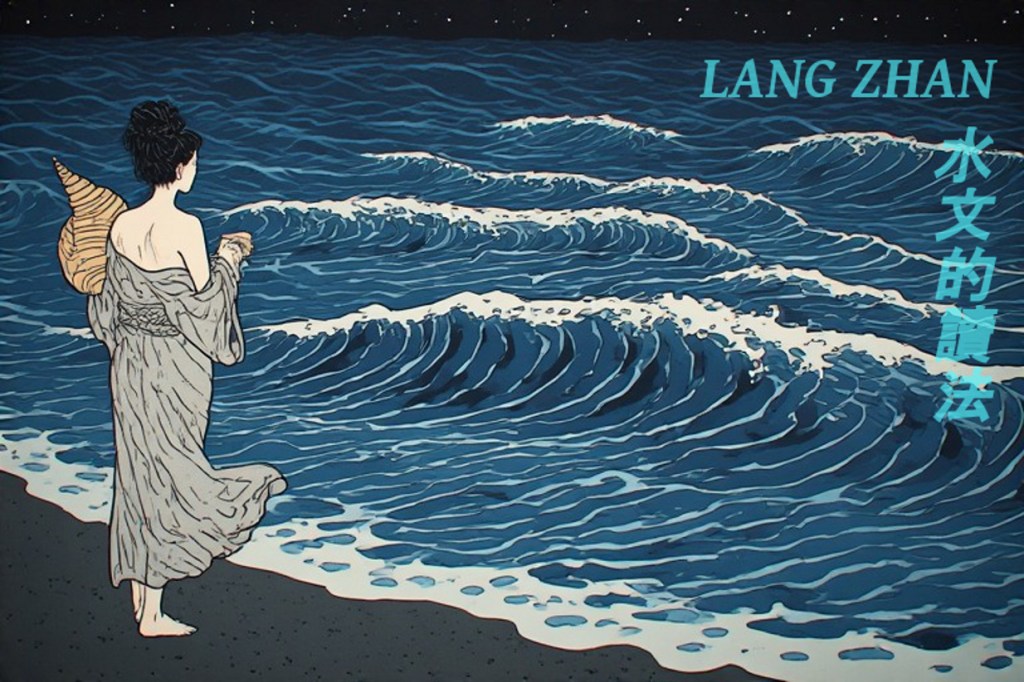
LANG ZHAN 《水文的讀法》 (Shuǐ Wén de Dú Fǎ)
THE TIDE WITCH’S MANUAL OF WAVE SCRIPT DIVINATION
Powdered cuttlebone, gathered at low tide, sun-dried for three days, ground with cinnabar and one drop of the practitioner’s blood. The shark’s gift by proxy. See folio 24.
I have tried the exercise of the stone and the tide pool for three turnings of the moon. I am not certain the ripples change. I am certain that I am changing. ZJC.
Prologue: The Sea’s First Lesson
The sea does not keep its silence out of malice. It speaks endlessly—in a language older than any human word, written in a cursive of salt, foam and light. This language, Lang Zhan, is not a code to be cracked but a literacy to be earned. The waves are the Mother’s breath; to read them is to feel her pulse.
This manual is for those who are called to that literacy. It is not a museum piece, but a living transmission, adapted from the fragmentary texts of the Chao Wu Lu, the lore of the Fujianese Tide Witches and the cosmology of the Salt-Water Yi. It begins with the first and most profound step: go to the sea. Stand barefoot where the water meets the land. Tell her your name. She has been waiting to hear it.
The art of Lang Zhan does not offer the comfort of fixed meanings. It offers a relationship with a vast, intelligent and utterly indifferent presence that reflects your own soul back to you with terrifying clarity. The future is the least interesting thing about the sea. The depths are what matter.
THE SCHOLAR’S HEART MANDATE: A PROLOGUE ON TIDAL LITERACY
From the Preface to the Lost Fuzhou Wave-Reader’s Manual (c. 1788), a text known only from a single water-damaged copy in the Macau Maritime Archive, comes this admonition for the novice:
“The landsman looks at the sea and sees a flat, gray emptiness, a waste of water. The sailor looks and sees a road, marked with the signs of wind and current. The Tide Witch looks and sees a library. To learn Lang Zhan is to learn that the sea is not a thing that can be read, but a being that is reading you as you read it. It is a conversation between two depths. Do not begin by asking questions. Begin by standing on the shore at dawn, barefoot, for one hundred days. Let the sea grow accustomed to your presence. Let her learn the taste of your shadow. After one hundred days, if the shorebirds no longer startle at your approach and if the waves seem to reach a little higher toward your feet, then you may ask your first question. Not before. The sea is a sovereign, not a servant. She will not be interrogated by a stranger.”
This manual is a compendium of the grammar that conversation has revealed, passed down through the hands of, “the August Weavers of Tides and Tempests, a Tong of female ritualists,” and whispered in the margins of the Chao Wu Lu. It is a record of a literacy earned through salt and patience.
PART ONE: THE GRAMMAR OF WATER
Before you can read a text, you must understand its alphabet. The sea’s alphabet is not composed of letters but of the Eight Primal Patterns (Bā Làng Tú), the fundamental brushstrokes of the Mother’s calligraphy. These patterns are best read at dawn, when the boundary between darkness and light, yin and yang, is at its thinnest and the water’s truth is most visible.
THE EIGHT PRIMAL PATTERNS
A practitioner must learn to feel these patterns, not just see them. The wave that “looks” like a Dragon’s Rib must also feel like safety in the gut. The wave that forms Ghost Teeth must send a chill of warning up the spine.
1. Dragon’s Ribs (龍骨浪, Lóng Gǔ Làng)
- Visual: Parallel, evenly spaced swells moving in a single, unified direction. The sea breathes in an orderly rhythm.
- Meaning: Alignment. Safety. Favorable conditions. The cosmic breath is in order.
- The Whisper of the Sea: “The day belongs to you. Sail now.”
- Caution: If seen at noon, it signals an unnatural calm before a great shift. Investigate the stillness.
THE SCHOLAR’S HEART MANDATE: This pattern is so named from the Records of the Pearl River Fleet (c. 1801), which notes: “Before the Battle of the Bogue, the sea was a chaos of cross-tides and white water. On the morning of the engagement, the waves settled into long, even ribs stretching toward the Pearl River’s mouth. The Tide Witch of the Red Banner, old Yi-Min, saw this and told Admiral Ching Shih, ‘The Dragon stretches his ribs today. He is making a road for you.’ The fleet sailed into the ordered swells and victory. Yi-Min was rewarded with a Spanish silver dollar, which she wore on a chain around her neck until the day she walked into the sea at the age of ninety-two, claiming the Dragon King had finally called in his debt.”
2. Ghost Teeth (鬼牙浪, Guǐ Yá Làng)
- Visual: Jagged, chaotic wavelets overlapping and breaking against each other, creating sharp, irregular peaks like a serrated blade.
- Meaning: Betrayal. Hidden danger. Divided intentions. A trusted ally may fail you.
- The Whisper of the Sea: “Look to your left hand. The sea sees what you refuse to see.”
- Navigator’s Note: Look not for an enemy fleet, but for the silence in your own crew.
THE SCHOLAR’S HEART MANDATE: This pattern is the most personal of the eight. From the Penghu Fisher-Witches’ Almanac (c. 1840): “A woman came to the tide-reader of our village with a question about her son, a smuggler who had not returned from a run to the mainland. She was afraid he had been taken by the Qing navy. The reader led her to the shore at first light and the Ghost Teeth were gnawing the horizon. The reader did not speak for ten full breaths. Then she said, ‘The sea does not see a naval cutter. The sea sees a quarrel in a Canton tavern over a game of dice. Your son is not in chains. He is hiding from a debt. He will return when he has stolen enough to pay it.’ The woman did not believe the reader. But three weeks later, the son returned, carrying a purse of stolen silver and a scar above his left eye. The reader’s wisdom was proven, but the mother never looked at her son the same way again.”
3. Silk Unfurling (展絲浪, Zhǎn Sī Làng)
- Visual: Long, smooth, rolling swells that stretch for miles without breaking.
- Meaning: A rare and powerful omen of hidden treasure or an unexpected, profound opportunity approaching.
- The Whisper of the Sea: “The gift is already on its way.”
THE SCHOLAR’S HEART MANDATE: The pattern is associated with a story from the Secret Records of Fujian Sea Transitions (c. 1793), concerning a Tide Witch known only as “Grandmother Oyster.” “Grandmother Oyster lived alone on a rocky islet where no one could grow anything. She was considered the poorest woman in the archipelago. One morning, a young fisherwoman saw Silk Unfurling on the horizon and rowed out to Grandmother Oyster’s island to ask its meaning. The old woman was already standing on the shore. ‘I know,’ she said. ‘The sea told me.’ She held out her hand and opened it. In her palm was a single, perfect pearl, large as a quail’s egg, glowing with a light that seemed to come from deep within. ‘I found it at my feet ten minutes ago,’ she said. ‘It was not here yesterday. The tide brought it. This is what the Silk was unfurling for.’ Grandmother Oyster was the poorest woman in the archipelago no longer, but she remained on her islet and when anyone sailed to her with a question, she would hold the pearl up to the light and say, ‘The sea will give you one of these, too, if you learn to listen.'”
4. The White Serpent (白蛇浪, Bái Shé Làng)
- Visual: A single, undulating line of thick white foam stretching laterally across multiple wave fronts.
- Meaning: Transformation. A significant, life-altering change is approaching.
- The Whisper of the Sea: “Read the direction. Seaward for the external world, landward for the struggle within.”
THE SCHOLAR’S HEART MANDATE: From the Compendium of Wandering Sorceries (c. 1855), a text compiled by a defrocked Daoist nun: “The White Serpent is the Ouroboros of the sea, the serpent that eats its own tail. To see it is to know that one life is ending and another is beginning. The old Tide Witches used to say that the White Serpent is the restless spirit of a woman who died in childbirth and that her line of foam is the umbilical cord, forever seeking a new shore. When her head points seaward, she is looking for her lost child in the world. When it points landward, she is looking for her lost child within you. To see the White Serpent is to be chosen as a midwife for a new self. It is a fearsome blessing and it should be greeted with salt and silence.”
5. The Shattered Mirror (破鏡浪, Pò Jìng Làng)
- Visual: A wave that rises and then collapses suddenly inwards upon itself, producing a circular, non-resolving ripple.
- Meaning: Illusion. Deception. Self-delusion.
- The Whisper of the Sea: “The sea cannot make you leave. She can only show you the broken glass.”
THE SCHOLAR’S HEART MANDATE: This pattern is the most dreaded by lovelorn sailors. An annotation in the Grimoire of the Moon-Eyed Witch (c. 1820) records this laconic exchange: “A woman of the floating village asked the tide-reader, ‘Does my husband keep a mistress in the port of Amoy?’ The tide-reader watched the dawn waves for fifty breaths, saw the circular, collapsing ripple of the Shattered Mirror and said, ‘He keeps three. The sea sees their faces. Do you wish me to describe them?’ The woman said nothing, but her silence was a howl. The tide-reader added, ‘The sea also sees the pearl that will come to you when you leave him. It is larger than his entire fishing fleet. The mirror is shattered, but the pearl is real.’ The woman walked into the village, packed her belongings and was gone by noon. The husband returned to an empty hut and when he asked the tide-reader what had happened, she said, ‘The sea told your wife a secret. The sea does not tell me to tell you.'”
6. The Dragon’s Gate (龍門浪, Lóng Mén Làng)
- Visual: Two large, powerful waves rising simultaneously left and right, with a channel of impossibly still water between them.
- Meaning: A test, a threshold. A challenge that must be faced.
- The Whisper of the Sea: “The gate is open. Leap, or turn back.”
THE SCHOLAR’S HEART MANDATE: The mythic resonance of this pattern is noted in the Scripture of the Southeast Dragon Kings (c. 1783): “The Dragon’s Gate is the only pattern that requires immediate action, not contemplation. The Tide Witch who sees it at dawn must act by noon. The Tide Witch who sees it at dusk must act by the next dawn. Legend tells of a young Cantonese captain, the first woman to command a junk in her own name, who sailed her ship to the mouth of the strait where the Qing navy lay in wait. At dawn, she saw the Dragon’s Gate open before her prow. Her first mate, an old man who had sailed with her father, saw the same waves and cried, ‘It is a trap! The still water is a shoal!’ The captain looked at the waves, then at her first mate. ‘The Dragon’s Gate is not a shoal,’ she said. ‘It is a dare.’ She steered directly into the still channel. The Qing ships, seeing her enter what their charts marked as impassable shallows, did not follow. But her ship passed through without incident and when she reached the open sea on the other side, she found a wind that carried her all the way to Manila. The first mate asked how she had known. ‘I did not know,’ she said. ‘I trusted the water to hold me. The gate is not a promise. It is a test of nerve.'”
7. The Drowned Hand (溺手浪, Nì Shǒu Làng)
- Visual: A single wave rising anomalously higher than all others, then pulled down from below before it can break.
- Meaning: Direct intervention from the spirit world.
- The Whisper of the Sea: “You will know if this is a helping hand or a dragging claw by the temperature of your blood.”
THE SCHOLAR’S HEART MANDATE: From the Penghu Fisher-Witches’ Almanac: “When the Drowned Hand appears, the old women say, a ghost has taken an interest in your question. This is neither good nor bad in itself, but it requires an immediate and private ritual. The practitioner should prick her left ring finger with a bronze needle—or, failing bronze, a thorn from a beach rose—and let a single drop of blood fall into the surf. If the next wave smooths the blood into a perfect circle, the intervening spirit is an ancestor and means to help. If the blood scatters into ragged filaments, the spirit is a stranger and its motives are its own. If the blood simply vanishes without a trace, the practitioner should leave the shore immediately and not return for three days, for the spirit is stronger than she is and has not yet decided whether to be merciful.”
8. The Silent Tide (默潮浪, Mò Cháo Làng)
- Visual: Waves moving with visible force but producing no sound whatsoever—an unnatural, absolute silence.
- Meaning: The rarest and most dangerous pattern. An unrecognizable presence has entered your waters.
- The Whisper of the Sea: “The sea is silent because she is terrified. You should be, too.”
- The Tide Witch’s Response: Immediate and absolute protective action. Deploy the Three Concealments—the Stealth Talisman, the Muffling Oar and the Sailor’s Shadow Ward—at once, without delay.
THE SCHOLAR’S HEART MANDATE: The most detailed account of this pattern comes from the Record of Pacifying Fujian’s Sea Ghosts (c. 1891), which describes an event in the winter of 1809: “A fleet of six fishing junks was becalmed off the coast of Meizhou Island. The sea was heaving with a heavy swell, but the men heard nothing. No wind, no wave-crash, no cry of gulls. It was as if the world had been stuffed with cotton. One of the fishermen, an old man who had survived the great typhoon of ’79, began to tremble. ‘The Silent Tide is upon us,’ he whispered to his son. ‘We must not speak. We must not move. We must be dead men on a dead sea until the sound returns.’ The crew obeyed. They lay on the deck as if drowned. For three hours, the silence held and in the depths beneath their hull, a vast, dark shape passed slowly, a shadow that blocked the bioluminescent glow of the deep. Not a fish. Not a whale. Something that had come up from a place where light had never reached. When the shape finally passed and the sound of the waves returned with a roar, the old man wept with relief. ‘It was looking for voices,’ he said. ‘It hunts by sound. The sea hid us the only way she could—by taking our noise away.’ The Silent Tide is, therefore, not a malice of the sea but a mercy. The sea holds her breath to hide you from the thing that stalks you.”
PART TWO: THE DEEPER ARTS OF READING
Mastering the eight patterns is the first step. To become a true Wave Calligrapher, one must learn to read the sea’s subtler texts, written in foam, salt and the behavior of her creatures.
THE SCHOLAR’S HEART MANDATE: From the Tide-Watcher’s Breviary (c. 1860), a small, handwritten book found tucked into the lining of a sea-chest: “The Eight Patterns are the bones of the language. The Deeper Arts are its flesh and breath. A woman can learn the bones in a year and be a competent reader. She will spend the rest of her life learning the flesh and breath and she will die illiterate. The sea is too large a text for any one soul to master. That is not a cause for despair. It is a cause for wonder. An illiterate in the sea’s library is still, by any land-bound measure, a sage.”
1. The Practice of Lang Zhan (A Foundational Ritual)
- Timing: Dawn or dusk. Noon is discouraged; the sun flattens the water and makes the sea’s “handwriting” illegible. Midnight is for urgent questions only.
- Position: Barefoot at the tide line, where the highest wave of the last tide touched.
- The Question: Frame your question silently and clearly. Ask one thing. The sea answers one thing.
- The Observation: Watch the waves for the space of one hundred slow breaths. Hold a soft focus, “as you would gaze at the face of a lover, not as you would stare at a chart.”
- The Interpretation: After the hundred breaths, close your eyes. The first pattern you recall is the primary answer. The sea shows many things; the thing you remember without trying is the thing she wants you to know.
- The Recording: Keep a Wave Journal. Write down the pattern, the date, the tidal state, the lunar phase and the question. The sea’s answers are precise, but your memory is not.
2. The Method of the Conch-Shell
For this, you require a spiral-cut conch shell large enough to hold your whispered intent. Wade into the shallows at dawn or dusk. Cup the shell in your hands and breathe your specific question into its opening as a soft whisper that fogs the inner pearl. Submerge the shell and release it to the sea. Then, stand and watch the waves for one hundred breaths. The first pattern to arise is a direct response from the Ocean Mother.
THE SCHOLAR’S HEART MANDATE: This is the method favored by the August Weavers and it is said that the shell used must be a gift from the sea—a shell found empty on the shore, never one taken from a living creature. The Secret Manual of Southern Sea Witchcraft (c. 1809) warns: “A shell bought from a merchant carries the merchant’s voice, not the sea’s. A shell wrenched from a living conch carries a death-curse. Only a shell freely given by the tide can be a true vessel for the Mother’s voice.”
3. Foam Necromancy (Pào Hún Fǎ)
This art is for communicating with the drowned. Collect nine handfuls of the purest white foam from the crest of a just-breaking wave. Spread it on a square of black silk. Let it settle. If the foam contracts into a single, dense central cluster, the dead approve of your question and are present to help you. If it scatters loosely across the silk, their answer is a foretelling of disaster—a shipwreck in your affairs.
THE SCHOLAR’S HEART MANDATE: From the Pirate Necromantic Rites (c. 1783): “Foam is the breath of the drowned. It is the only part of them that still touches the air. When you gather it, do so gently, as you would gather a sleeping child. The foam remembers the lungs it came from. Speak to it. Tell it your name. Tell it the name of the one you seek. If the foam knows that name, it will cling together, eager to speak. If it does not, it will flee from your touch and you must not pursue it. The drowned are tired. Let them rest.”
4. Salt-Crack Divination (Yán Liè Zhān)
Scrape the salt crusts formed on a ship’s deck or a rock saturated by sea-spray. Build a small, hot fire. Throw the salt into the flames and watch how the crystals crack. Cracks that fork like lightning bolts reveal the active wrath of the Dragon King—a celestial warning against your current course. Cracks that split into interwoven, net-like shapes warn of a rival’s trap—a net closing around you, laid by human hands.
THE SCHOLAR’S HEART MANDATE: From the Fujian Sea Blessings Manual (c. 1732): “Salt that has been kissed by the sea and then dried by the sun is the only salt suitable for this divination. Salt from a merchant’s shop is dead salt. It has no memory of the Mother. It will not speak. The salt of the tide line, however, still dreams of the wave that left it there. When you throw it into the fire, you are not destroying it. You are waking it. The crack is its voice. Listen closely. The Dragon King’s voice is a roar. A rival’s plot is a whisper. Both can be heard in the salt, if your ear is trained.”
PART THREE: THE LOST ART OF THE WAVE CALLIGRAPHERS (LANG SHUFA)
Literacy, for a master, becomes authorship. A fragment from Folio 51 of the Chao Wu Lu hints at a lost tradition, the Lang Shufa, the living art from which Lang Zhan derived. A woman on Penghu could speak to her sister on the Fujian coast by beating the water’s surface with the flat of an oar: three strikes, a pause, two strikes. The message would arrive at her feet over a hundred miles away. This art required a lifetime of practice and a bond between the two practitioners that was closer than blood. The text cannot teach this lost art. But it can teach you the first, foundational exercise for a new lineage of Water-Speakers.
A Beginner’s Exercise in Wave-Calling
Seek out a still, sheltered body of salt water: a tide pool or a quiet cove. Sit beside it and let your breathing slow until it feels like the rhythm of the gentle waves. Drop a single, small, smooth stone into the center of the pool. Watch as the concentric ripples spread outward—this is your voice, initiated by a single act. Now, recite a single word imbued with strong feeling—a name, a question, a line of verse—silently in your mind. Drop the stone again. Did the ripples change? Practice this daily for one turning of the moon. Record your findings. The sea, as the Compiler noted, is large enough to carry voices. She is old enough to remember how. She is only waiting for someone to learn.
THE SCHOLAR’S HEART MANDATE: The Compiler of the Chao Wu Lu closes their account of the Wave Calligraphers with a personal note, one of the few places in the entire text where their voice breaks through the ritual formalism: “I have tried the exercise of the stone and the tide pool. I have done it for one turning of the moon and for a second and for a third. I do not know if the ripples change. I cannot tell if the change I see is in the water or in my own eye, my own hope. But I will continue. Not because I believe I will learn to speak to a sister across the sea. I have no sister. But because the practice has taught me something else. It has taught me to watch the water with such close attention that the boundary between the water and myself has begun to feel thin, porous, provisional. I am starting to believe that the Sea Witch who achieves the lost art of the Wave Calligraphers does not speak to the water. She speaks as the water. She is the stone and the ripple and the shore all at once. That is the art I am seeking. That is the art I believe is possible. I include this account so that future generations will know that it was once possible and might be possible again and that the path to that possibility begins with a single, small, smooth stone dropped into a tide pool at dawn.”
PART FOUR: THE INNER TIDE — SOMATIC DIVINATION
The sea outside is a mirror of the sea within. The Tide Witch who has mastered the reading of external waves must also learn to read the waves that rise and fall in her own Ocean of Qi, the lower dantian located three finger-widths below the navel. This is the internal practice of Lang Zhan and it is considered the bridge between the interpretive and the creative arts. Before one can write upon the water, one must be able to feel the water writing within oneself.
THE SCHOLAR’S HEART MANDATE: From the Inner Scripture of the Tidal Body (c. 1820), a fragmentary text attributed to the August Weavers: “The landlubber’s error is to believe that the body ends at the skin. The Tide Witch knows that the body is an ocean and the skin is only its shoreline. The tides within are no less real than the tides without. They rise and fall with the moon. They churn with storm. They hold the wrecks of old griefs and the pearls of old joys. To learn Lang Zhan is to become a cartographer of two seas and the map of one is the legend for the other.”
The Practice of Internal Wave-Reading
- Timing: At the turning of the tide, when the external sea pauses between ebb and flow. At this moment, the internal sea also pauses and its depths become visible.
- Posture: Seated meditation, preferably facing the sea. If landlocked, face west, the direction of the Queen Mother’s mountain.
- The Sounding: Bring your attention to the Ocean of Qi. Do not visualize. Simply feel. Is the sea within you calm, or is it churning? Are there cross-currents of anxiety pulling against the prevailing wind of your will? Is there a ghost tide rising from some deep, unacknowledged grief?
- The Eight Patterns Within: The same eight patterns that appear on the external sea can manifest in the internal sea. A feeling of steady, rhythmic energy flowing unimpeded is the internal Dragon’s Ribs. A jagged, anxious churning is the internal Ghost Teeth. A sudden, profound stillness that seems to widen inside you is the internal Dragon’s Gate. Learn to name these internal patterns as you would name the external ones.
- The Recording: In your Wave Journal, beside your external observations, record your internal soundings. In time, you will see that the two seas rise and fall together. This is the proof of the Mother’s body: the tide that moves the ocean is the tide that moves your blood.
THE SCHOLAR’S HEART MANDATE: This practice is alluded to in the Chao Wu Lu‘s instructions for the Weak Water Meditation, but a more direct account appears in the oral testimony of an unnamed Tide Witch, recorded in the Taiwanese Pirate Spells collection (1833): “My grandmother, who was the last reader in our village before the Japanese came, used to say: ‘I do not just watch the waves. I feel them first. I stand on the shore and the water in my belly rises to meet the water at my feet. When they touch, I know what the sea is going to say before she says it. That is not magic. That is just paying attention to two things at once for sixty years. Anyone can do it if they start young enough and never stop.’ She started when she was five. She died when she was ninety-one. She never stopped.”
PART FIVE: LANG ZHAN AND THE DAOIST OCEAN TAROT
The system of Lang Zhan is the foundation upon which the Daoist Ocean Tarot is built. The Tarot is, in its essence, a translation of wave-reading from water to cardstock. Every spread is a stretch of sea. Every card is a wave pattern. The question is not “What does this card mean?” but “What is the water doing?”
For the Tide Witch who has achieved basic literacy in the Eight Primal Patterns, the Tarot offers a way to bring the sea’s voice inland, to consult its wisdom when the shore is far away. But the Tarot is a secondary text. The sea is the original. The cards are a tide chart. The tide chart is not the tide.
THE SCHOLAR’S HEART MANDATE: From the introduction to the Daoist Ocean Tarot, attributed to the anonymous Compiler of the Salt Archive: “I did not create the Tarot. I translated it. The Major Arcana are the twenty-two faces the sea showed me over a decade of dawn vigils. The Minor Arcana are the fifty-six voices I heard in the wave-crash and the tide-sigh. I give you these cards not as a replacement for the sea, but as a letter of introduction. Give them to the sea when you meet her. Say: ‘I have been studying your grammar. I am still illiterate, but I am learning. Will you teach me more?’ The sea, I have found, is kind to the sincere student. She will not mock your flashcards. She will simply nod and the next wave will carry a new word you have never seen before.”
Correspondences: The Major Arcana as Wave States
- 0. The Fool (The Naked Immortal): The moment just before a wave breaks, when the water has gathered itself into a shape but has not yet committed to collapse. Suspension. Potential. The gourd before it is thrown into the sea.
- I. The Magician (The Dragon’s Tide-Caller): The transition from chaos to rhythm, when scattered swells suddenly organize into a single, coherent wave train.
- II. The High Priestess (The Silent Tide-Mother): The “oil waves” (yóu bō), a strange flattening of the surface that occurs when deep currents contradict the wind. The visible calm that conceals profound motion.
- XIII. Death (The Moon-Eating Turtle): The black wave (hēi làng), the single, massive swell that rises from a storm’s heart and consumes every smaller wave in its path.
- XXI. The World (The Dragon’s Whirlpool): The great circular current (dà zhōu liú), the planetary-scale circulation that connects all seas into a single, unified system.
THE SCHOLAR’S HEART MANDATE: From the personal notes of the Tarot’s Compiler, found in the margins of the first printed edition: “I have been asked many times which card is my favorite. The answer changes with the tide. But on the morning I finished the Major Arcana, I walked to the shore to perform the closing ritual and the sea showed me The World—the great circular current, the whirlpool of dragons. I laughed. I had spent a decade drawing faces for the sea and in the end, she showed me a face I had never imagined: the face of the journey completing itself, the face of the Fool’s gourd arriving on a shore it had never seen but had always been sailing toward. I added the card that night. It is the twenty-second face. The twenty-third face is yours.”
PART SIX: LANG ZHAN IN THE SALT-KIN CODEX
The Salt-Kin Codex, the grimoire of the Shark Path, recognizes the shark as the ultimate master of Lang Zhan. The shark does not merely read the water; it is read by the water and the reading and the being-read are a single, seamless act. The shark’s entire body is a divination tool. Its lateral line senses the pressure-wave of a distant struggle. Its ampullae of Lorenzini feel the electromagnetic tremor of a hidden heart. It does not interpret; it knows. The Tide Witch who follows the Shark Path seeks to cultivate this same somatic, instantaneous literacy—a reading that is not separate from being, but identical with it.
THE SCHOLAR’S HEART MANDATE: From the Salt-Kin Codex, the section entitled “The Shark’s Grammar”: “The shark has no need of the Eight Patterns. The patterns are for those of us who are still learning to think like water. The shark is already water thinking about itself. When you have practiced Lang Zhan for a lifetime, you will not see the Dragon’s Ribs or the Ghost Teeth. You will simply feel the sea’s intent, as the shark feels the floundering fish from a mile away. The patterns are the scaffold. The shark is the building. Do not mistake the scaffold for the temple.”
The Shark Dream Omens: A Divinatory Guide
When the Salt-Kin comes to the practitioner in dream, it is not offering a symbol. It is offering a direct transmission. The dream-shark is not a metaphor for a pattern in your life; it is the pattern itself, swimming directly into your sleeping mind.
- The Silent Swim Beside You: The shark pulls alongside you but does not attack. You feel a vast, ancient quietude. This is the experience of the Leviathan’s Rest (Hexagram 52). You are being initiated into the power of sovereign stillness. The sea around you is calm, but the pressure of the deep is in your chest. This is a good omen for spiritual maturity.
- The Offering of a Tooth: The shark ejects a single tooth from its mouth, which you catch. This is a gift from the Manifest Ancestor. You are being given a specific tool for a coming act of righteous discernment. The tooth is the Shark’s Bite (Hexagram 21). When you wake, you will know, in your bones, what must be severed from your life. Do not hesitate. The tooth is sharp for a reason.
- The View from the Apex: You see through the cold, perfect eyes of the shark, feeling the electromagnetic tremor of a hidden truth. This is the ultimate vision of the Abyssal Trench (Hexagram 29). You have merged with the Salt-Kin and understand the Dao without a single word of doctrine. This dream is rare. If it comes, you must fast for three days afterward. The human body is not meant to hold that much truth for long. The fasting helps it settle.
THE SCHOLAR’S HEART MANDATE: The Salt-Kin Codex warns that the dream of the View from the Apex is dangerous for the unprepared: “A young Tide Witch on the Penghu Islands dreamed this dream and woke with the taste of brine in her mouth that did not fade for a year. She could not bear the company of humans. She took to wandering the tide pools at low tide, speaking to the anemones. The villagers thought her mad. But the old Shark-Speaker of the island, a woman who had not spoken in a decade, came to her one evening and said, ‘You are not mad. You are over-salted. Come to my hut. I will teach you how to be a shark in a human body without drowning in the contradiction.’ The young witch became the next Shark-Speaker. Her name is not recorded. But her hut is still there, at the edge of the tide pools and the anemones still whisper her name when the water is low.”
APPENDIX: A LEXICON OF ADVANCED LANG ZHAN TERMS
You Bo (油波, “Oil Waves”): A phenomenon where the sea surface becomes eerily flat, as if coated in oil. To the untrained eye, this looks like a calm sea. To the wave-reader, it indicates that powerful, contradictory deep currents are moving beneath the surface. It is the visual expression of the High Priestess. A reading taken on an oil-wave sea is a reading of the subconscious, not the conscious mind. Interpret accordingly.
Jiao Chao (交潮, “Cross-Tide”): The turbulent, chaotic zone where two currents of different temperature, salinity, or direction collide. This is the visual expression of the Wheel of Fortune. No clear reading is possible in a cross-tide. The sea itself is confused. The only appropriate response is to wait, to accept that this part of the sea is unreadable and that the unreadability is the reading.
Bao Lang (暴浪, “Violent Surge”): A wave that breaks not on the shore but against itself, collapsing into white water from its own internal pressure. This is the visual expression of the Tower. It signals a destruction that is self-originating, not externally imposed. The thing that breaks was always going to break. The wave-reader who sees this should not mourn the collapse. It was already written in the water’s grammar.
Hui Bo (回波, “Returning Wave”): The wave that has traveled out to sea and now comes back, carrying with it the energy of everything it encountered on its journey. This is the visual expression of Judgment. The wave-reader who recognizes the returning wave can read in its shape the history of the voyage that sent it out. This is the pattern of ancestral reckoning.
THE SCHOLAR’S HEART MANDATE: From the Tide-Watcher’s Breviary: “The beginner sees waves. The apprentice sees patterns. The adept sees a single, flowing text. The master sees nothing at all—only water, only the Mother’s body, breathing. Do not aspire to be a master. Aspire to be a perpetual apprentice, always learning, always slightly confused, always grateful. The master who has seen everything has stopped looking. The apprentice who is still confused is still paying attention. The sea prefers the apprentice. The sea has been breathing for four billion years. It is still confusing to her, too.”
FINAL NOTE: THE TWENTY-THIRD FACE
The Chao Wu Lu ends with a passage that is also an instruction for the end of this manual. It is not a conclusion, but a threshold:
“You have learned the twenty-two faces. You have learned the fifty-six tides. You have learned the spells and the proverbs and the names of the Dragon Kings and the methods of reading waves. You have learned enough to sail.
What you have not learned—what no book can teach—is what the sea will say to you when you are alone on it, at night, with the lanterns burning low and the ghosts gathering at the rail and the compass spinning toward a destination that does not appear on any chart.
That is something we cannot give you. That is the gift that you give yourself by sailing.
The tide is turning. The ship is waiting. The Bone Admiral has lit the first lantern on the pier.
Sail and the sea will teach you what we could not.
Sail and the drowned will guide you where we could not.
Sail and you will become—in time, in salt, in the slow accretion of wisdom that comes only to those who have weathered storms and lost ships and continued sailing—one of the faces of the sea yourself.
The twenty-third face is yours.”
THE FINAL SCHOLAR’S HEART MANDATE: The Compiler of the Salt Archive added a personal note to this passage, which appears in no formal manuscript but was found written on a slip of tide-stained paper tucked into the binding of the master folio: “I have compiled these texts. I have translated these rituals. I have done my best to honor the women who came before. But I am not a Tide Witch. I am a scholar, a collector, a keeper of fragments. I have never seen the Silent Tide. I have never felt the Shark’s dream. I have only ever been a student of the shore. The sea, I think, has been patient with me. She has let me gather her shells without drowning me. She has let me build this Archive. But I know, as I write these final words, that the Archive is not for me. It is for the woman who will find it, long after I am gone and who will read it with a different kind of eye—the eye of one who is not merely curious, but called. If you are that woman, I have one request. When you go to the sea to claim your twenty-third face, say my name to her. I need her to know that I tried.”
May the sea remember my name. May the sea remember yours.

