
• hopilavayi: an erotic dictionary

memories of my ghost sista

~ the dead are never satisfied

memories of my ghost sista

Tag Archives: Euripides

欧里庇得斯:《酒神的伴侣》[euripides’ the bacchae]

16 Friday Jan 2026

Posted by babylon crashing in Chinese, drama, Prose, Translation

≈ Comments Off on 欧里庇得斯:《酒神的伴侣》[euripides’ the bacchae]

Tags

Chinese translation, drama, Euripides, 酒神的伴侣, the Bacchae, tragedy, 欧里庇得斯
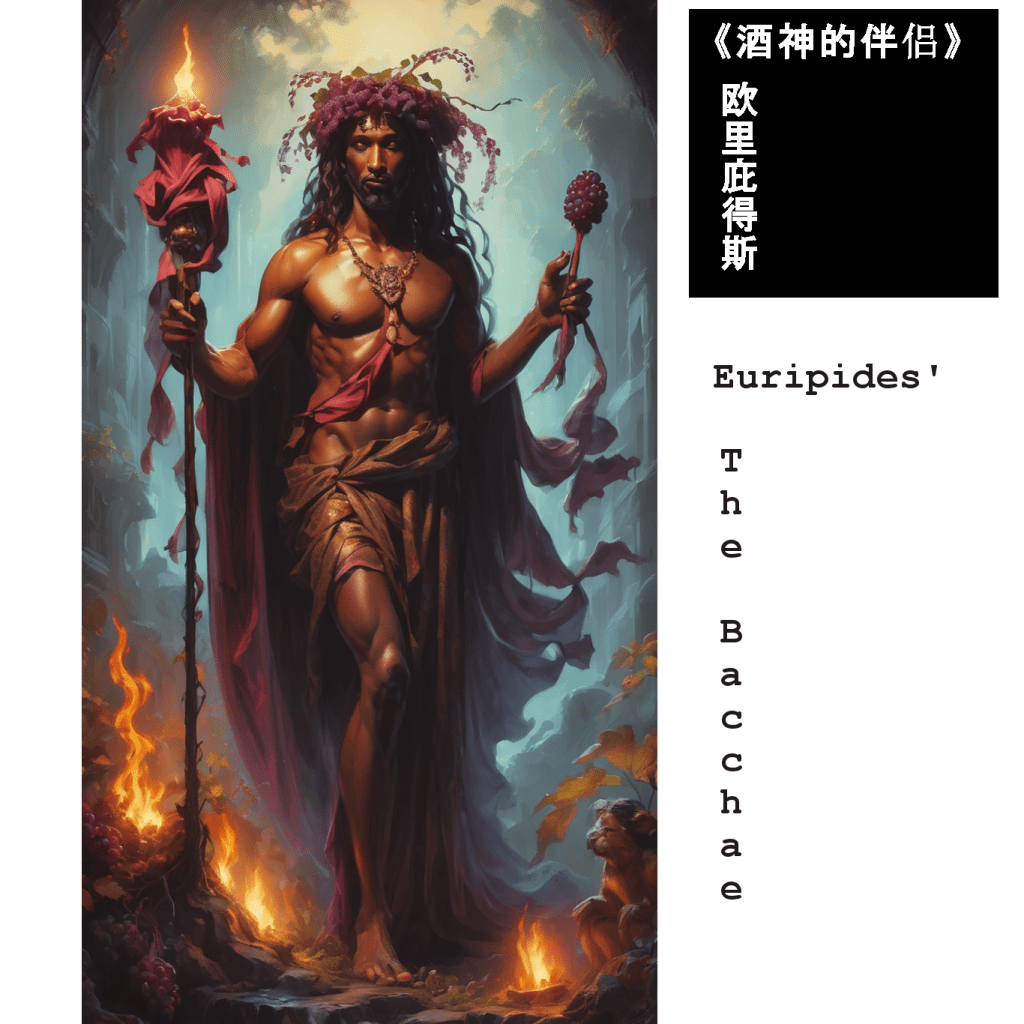
序幕:神灵降临

场景: 古希腊。忒拜王宫前。 布景: 破晓时分。塞墨勒的坟墓可见,缠绕着生机勃勃的藤蔓。 [一阵深沉、震撼大地的鼓声。随后,从观众上方或之中,传来狄俄尼索斯的声音。]

Scene: Ancient Greece. Before the royal palace of Thebes. Setting: Dawn. The tomb of Semele is visible, entwined with living vines. [A deep, earth-shaking drumroll. Then, the voice of Dionysus is heard from above or within the audience.]


狄俄尼索斯: 我回来了! (他现身,一个拥有夺目之美与沉静威仪的身影。) 我是狄俄尼索斯,宙斯之子,回到忒拜,这片我诞生的土地。我的母亲是卡德摩斯的女儿,名为塞墨勒,以火焰为产婆,以雷霆霹雳接生。而今我立于此处,一位隐姓埋名的神祇——化身凡人——在狄尔刻溪流与伊斯墨诺斯河水之畔。那里,王宫之前,我看见我那与闪电缔婚的母亲的坟墓,而在她破碎屋宇的废墟之上,宙斯那不灭的活火仍在闷烧,成为赫拉加诸我母亲暴行的不朽见证。

Dionysus: I have come! (He appears, a figure of dazzling beauty and calm majesty.) I am Dionysus, the son of Zeus, returned to Thebes, this land where I was born. My mother was the daughter of Cadmus, named Semele, delivered by fire as midwife, brought forth by the lightning-bolt. Now I stand here, a god in disguise—having taken mortal form—beside the waters of Dirce and the stream of Ismenus. There, before the palace, I see the tomb of my lightning-wed mother, and upon the ruins of her broken house, the undying flame of Zeus’ fire still smoulders, a living witness to Hera’s outrage against my mother.


(他在神龛前驻足,流露赞许。) 但卡德摩斯赢得了我的嘉许,因他将这坟茔化为献给我母亲的圣所。是我,用簇拥藤蔓的绿意遮蔽了她的墓冢。那金色江河的土地——吕底亚与佛律癸亚——已远抛身后,我的旅程始于彼处。我穿越波斯烈日灼烧的荒原、巴克特里亚的险峻山峦、米底亚的严酷荒漠。继而抵达丰饶的阿拉伯,沿着亚洲人烟稠密、塔楼林立的整个海岸前行,希腊人与异族在那里混杂而居。在那里,我将我的舞蹈传授给生者的双足,创立我的秘仪与祭礼,好让我在人间彰显真身:一位神祇。

(He pauses before the shrine, showing approval.) But Cadmus has won my favor, for he has made this grave a sanctuary for my mother. It was I who covered her tomb with the green luxuriance of clustering vines. The lands of golden rivers—Lydia and Phrygia—are left far behind, where my journey began. I have crossed the sun-scorched plains of Persia, the jagged mountains of Bactria, and the harsh deserts of Media. Then I reached prosperous Arabia, traveling along the entire coast of Asia, densely populated and thick with towers, where Greeks and barbarians mingle together. There, I taught my dances to the feet of the living and established my mysteries and rites, so that I might be revealed to mankind for what I am: a god.


于是,来到忒拜。这座城邦,在希腊首当其冲,如今正因我女信徒的呼喊、她们的狂喜而尖啸回荡。在忒拜,我将鹿皮缚于她们的肉身,以常春藤的枝干武装她们的双手。我此来,是为驳斥我母亲姊妹们的诽谤——那些最无权诋毁她的人。她们声称狄俄尼索斯并非宙斯之子,而是塞墨勒与凡人同寝,将她的羞耻栽赃给宙斯——她们讥讽,这是卡德摩斯为维护女儿名誉而捏造的骗局。她们说她撒谎,宙斯一怒之下以雷霆将她焚毁。

And so, to Thebes. This city, the first in Greece, now shrieks and echoes with the cries of my female followers and their ecstasy. In Thebes, I have bound the fawnskin to their flesh and armed their hands with the ivy-wreathed thyrsus. I have come here to refute the slanders of my mother’s sisters—those who had the least right to disparage her. They claimed that Dionysus was not the son of Zeus, but that Semele had slept with a mortal and blamed her shame on Zeus—a trick, they mocked, cooked up by Cadmus to protect his daughter’s reputation. They said she lied, and Zeus, in his fury, burned her to ash with a thunderbolt.


因为这番亵渎,我以狂乱蜇刺她们,将她们从家中驱赶上山,她们在那里心智癫狂地游荡,被迫披上我狂欢仪式的袍服。忒拜的每一位女子——唯独女子——都被我逼出家门,陷入疯魔。她们坐在那里,贫富无别,连卡德摩斯的女儿们也如此,在无顶的岩石上,银枞树下。无论情愿与否,此城必须领受教训:它未得我秘仪的启蒙。我将为我母塞墨勒正名,并显身于凡眼之前,作为她为宙斯诞下的神祇。

Because of this blasphemy, I have stung them with madness, driving them from their homes to the mountains, where they wander with crazed minds, forced to wear the robes of my revels. Every woman of Thebes—only the women—I have driven from her house in a frenzy. There they sit, rich and poor alike, even the daughters of Cadmus, upon the roofless rocks beneath the silver firs. Willing or not, this city must learn its lesson: it has not been initiated into my mysteries. I shall vindicate my mother Semele and manifest myself before mortal eyes as the god she bore to Zeus.


卡德摩斯王已退位,将他的王座与权柄留予其孙彭透斯;而此人如今反抗神性——就在我身上!他将我摒于祭品之外,祈祷中遗忘我名。故此,我将向他,向忒拜每一个凡人证明,我确是神祇。待我在此地的崇拜得以确立,诸事妥帖,我自会离去,向其他土地上的其他人显露真容。但若忒拜男子企图以兵刃相胁,将我的巴克科斯女信徒逼离山麓,我将召集我的迈那得斯们,兵戎相见。为此,我暂且敛起神性,化身凡人而行。

King Cadmus has abdicated, leaving his throne and power to his grandson Pentheus; and this man now rebels against divinity—against me! He shuts me out from sacrifices and forgets my name in his prayers. Therefore, I will prove to him and to every mortal in Thebes that I am indeed a god. When my worship here is established and all is in order, I will depart and reveal my true self to others in other lands. But if the men of Thebes attempt to use weapons to drive my Bacchants from the slopes, I will lead my Maenads into battle. For this purpose, I have temporarily concealed my godhead and walk in the form of a man.


(呼唤,其声传向那不可见的狂喜队伍。) 前进,我的女信徒们!崇拜我的女人们,我带领你们走出亚细亚,走出托摩洛斯山如壁垒般耸立于吕底亚之上的地方!前进,与我同行的伙伴们!来啊,用你们故乡佛律癸亚的鼓——瑞亚之鼓,亦是我的鼓——擂响彭透斯的宫门!让忒拜城目睹你们,而我将回到基泰戎的山林幽谷,我的巴克科斯们正在那里等候,我将加入她们飞旋的舞蹈。

(Calling out, his voice reaching toward the invisible, ecstatic band.) Onward, my Bacchants! Women who worship me, whom I led out of Asia, from where Mount Tmolus stands like a bulwark over Lydia! Forward, my companions on this journey! Come, with the drums of your native Phrygia—the drums of Rhea, which are also mine—and strike against the palace gates of Pentheus! Let the city of Thebes behold you, while I return to the forested glens of Cithaeron where my Bacchic women wait, and I will join them in their whirling dance.


开场诗:迈那得斯之歌

[一阵由远及近、不断高涨的声浪:鼓声、笛声、震响的青铜器。巴克科斯女信徒们开始从四面八方入场——有些来自观众席,有些来自侧翼。她们是不同年龄的女子,行动带着一种统一而骇人的韵律。有些人手持酒神杖(缠绕常春藤的长杖),有些人拿着小手鼓或铙钹,还有些人拿着响板或叉铃。她们的律动既是舞蹈,也是行进。阿高厄、伊诺和奥托诺厄身在其中,面容因狂喜的虚无感所圣化。鼓声持续,如不息的心跳。]

[A sound rising from the distance, growing louder: drums, flutes, the clashing of bronze. The Bacchic women begin to enter from all directions—some from the audience, some from the wings. They are women of all ages, moving with a unified and terrifying rhythm. Some carry the thyrsus (the ivy-wreathed staff), some hold tambourines or cymbals, others castanets or sistrums. Their movement is both dance and march. Agave, Ino, and Autonoe are among them, their faces sanctified by an ecstatic void. The drumming is constant, like a restless heartbeat.]


巴克科斯歌队: 来自亚细亚的土地,来自神圣的托摩罗斯山下,为神效力,疾驰而来,我们为布洛弥俄斯而来!神的劳役艰辛;艰辛,但事奉他是甜美的。事奉甜美,呼喊甜美:巴克科斯!厄沃赫!

Chorus of Bacchants: From the land of Asia, from beneath sacred Mount Tmolus, we come to serve our god, racing onward; we come for Bromius! The labor of the god is hard; hard, but the service is sweet. Sweet to serve, sweet to cry out: Bacchus! Euoi!


街上的人!路上的人!让开!让每一张嘴静默。勿让不祥之言亵渎你们的唇舌。让开!退后!肃静。因我现在要扬起那古老、古老的狄俄尼索斯颂歌。

Out of the way! Out of the path! Everyone, make room! Let every mouth be hushed. Let no ill-omened words profane your lips. Out of the way! Fall back! Silence. For now I raise that ancient, ancient hymn to Dionysus.


有福了,有福了,那些知晓神之奥秘的人。有福了,那将生命圣化于敬拜神的人,那为神灵所附、与众神神圣子民合一的人。有福了,那舞者与得净化者,他们在山冈上跳着神的圣舞。有福了,那酒神杖的持握者,他们手中挥舞着神的圣杖。有福了,那戴上神之常春藤冠冕的人。有福了,有福了,他们:狄俄尼索斯是他们的神!

Blessed, blessed is he who knows the holy mysteries of the gods. Blessed is he who hallows his life in worship, whose soul is possessed by the god, joined with the holy band of the divine. Blessed is the dancer, the purified one, who dances the sacred dance of the god upon the hills. Blessed is the bearer of the thyrsus, who swings the god’s holy staff in his hand. Blessed is he who wears the god’s crown of ivy. Blessed, O blessed are they: Dionysus is their god!


前进,巴克科斯们,前进,你们巴克科斯们,将你们的神凯旋迎回家!抬起神,神之子,护送你们的狄俄尼索斯回家!将他从佛律癸亚山冈迎下,随他穿过希腊的街巷!

Onward, Maenads! Onward, you Bacchic women! Bring your god home in triumph! Lift up the god, the son of the god; escort your Dionysus home! Lead him down from the Phrygian hills, follow him through the streets of Greece!


他的母亲曾如此将他诞下,历经分娩之剧痛;遭闪电击中,被宙斯迸发的烈焰所迫,吞噬,她死去,而他被过早地扯离。产床之上,她死于光之一击!光中诞下了这儿子!是宙斯拯救了他的儿子;以凡人眼目难及之速,将他带走,用金扣将婴孩缚紧;藏于大腿,如藏于子宫,将儿子隐匿,避过赫拉的目光。当纺织命运的众神定下时辰,这牛角之神便自宙斯诞生。他欢欣地为儿子加冕,将蛇置于他发间——由此,虔敬地,传予我们迈那得斯那盘绕的冠冕,她那蛇的“发髻”。

So his mother brought him forth, through the agony of labor; struck by lightning, forced by the bursting flame of Zeus, consumed, she died—and he was torn away too soon. Upon that bed of birth, she died by a stroke of light! From the light, this son was born! It was Zeus who saved his son; with a speed beyond mortal sight, he snatched him away and bound the infant with golden buckles; hidden in his thigh, as in a womb, concealing the son from the gaze of Hera. When the Fates wove the appointed hour, the bull-horned god was born of Zeus. Joyfully he crowned his son, placing serpents in his hair—and thus, in piety, he passed to us the Maenads’ coiled crown, her “locks” of snakes.


噢,忒拜,塞墨勒的乳母,用常春藤装饰你的发鬓!让毒莓的绿意蔓延!用浆果染红!噢,城邦啊,带上橡木与枞树的枝干,来跳神的舞蹈!用捻紧的羊毛穗子点缀你们斑驳的鹿皮!以神圣的谨敬持握那暴烈的神之杖!让舞蹈开始吧!

O Thebes, nurse of Semele, deck your hair with ivy! Let the green of the poisonous vine run wild! Redden it with berries! O city, take up the branches of oak and fir, and come dance the dance of the god! Adorn your dappled fawnskins with tassels of tightly-twisted wool! Hold with holy reverence the violent staff of the god! Let the dance begin!


他是布洛弥俄斯,奔向山冈!奔向山冈!那里有众多女子等候,被驱离织机与梭子,为狄俄尼索斯所附!我赞美克里特的神圣,那舞蹈的库瑞忒斯的洞穴,宙斯诞生之地,在那里,头戴三重盔、环绕着原始的鼓,科里班忒斯曾起舞。他们是万物中最早以飞旋的足应和紧绷兽皮的严整节拍与尖啸哀笛之音的人。而后,从他们传到瑞亚手中,这圣鼓被代代相传;但,被狂乱的萨堤尔所盗,最终落于我手,而今伴着这舞蹈,那每隔一年便颂扬你名的舞蹈:狄俄尼索斯!

He is Bromius, running to the mountains! To the mountains! Where many women wait, driven from the loom and the shuttle, possessed by Dionysus! I praise the holiness of Crete, the cave of the dancing Curetes, the birthplace of Zeus, where, wearing triple helmets and surrounding the primal drum, the Corybantes danced. They were the first of all beings to answer the strict beat of the stretched hide and the scream of the shrill flute with whirling feet. Then, from them, it passed into the hands of Rhea, and this holy drum was handed down through generations; but, stolen by the frenzied Satyrs, it came finally to me—and now it accompanies the dance, the dance that every other year celebrates your name: Dionysus!


他在山间是如此甜美。他从奔驰的兽群中降临大地。他披着神圣的鹿皮。他猎杀野山羊并啖其肉。他嗜好生鲜的血肉。他奔向佛律癸亚的群山,他奔向吕底亚的群山!他是引领我们的布洛弥俄斯!厄沃赫!

He is so sweet upon the mountains. He comes down to earth from the running herds. He wears the holy fawnskin. He hunts the wild goat and devours its flesh. He hungers for the raw, fresh meat. He runs to the mountains of Phrygia, he runs to the mountains of Lydia! He is Bromius, our leader! Euoi!


大地流淌着乳汁!它流淌着葡萄酒!它奔涌着蜜蜂的琼浆!如乳香般芬芳的,是他所持火炬的烈焰。火焰从他曳行的神杖飘出,当他奔跑,当他舞蹈,点燃落后者,以呼喊驱策,他长长的鬈发在风中飞扬!而他呼喊,如同她们呼喊,厄沃赫!

The earth flows with milk! It flows with wine! It gushes with the nectar of bees! Fragrant as frankincense is the flame of the torch he carries. Fire streams from the thyrsus he trails as he runs, as he dances, setting the stragglers ablaze, driving them with his cries, his long hair flying in the wind! And he cries, as they cry, Euoi!


前进,巴克科斯们!前进,巴克科斯们!跟随,金色托摩洛斯的荣耀,赞颂神,以隆隆的鼓声,以一声呼喊,厄沃赫!向厄维俄斯之神,以佛律癸亚的呼喊之声,当神圣的笛声如蜜流淌,为那奔向山冈之人,奏响神圣之歌——山冈的人!山冈!

Onward, Maenads! Onward, you Bacchic women! Follow, glory of golden Tmolus, praise the god with the rumbling of the drums, with a single cry, Euoi! To the god Evius, with the shouting voice of Phrygia, when the holy flute flows like honey, playing a sacred song for the one who runs to the mountains—to the hills! To the hills!


[鼓声达到高潮。巴克科斯们已完全占据了空间。她们双目圆睁,凝视着另一个世界。空气本身仿佛在震颤。随后,一阵突然的、集体的静默。她们已在此处。入侵,已然完成。]

[The drumming reaches a crescendo. The Bacchic women have completely occupied the space. Their eyes are wide, staring into another world. The very air seems to tremble. Then, a sudden, collective silence. They are here. The invasion is complete.]


第一场:老者们与神

[提瑞西阿斯自山冈方向上,身着鹿皮,头戴常春藤冠。他目盲,以酒神杖为手杖。]

[Teiresias enters from the direction of the mountains, dressed in fawnskin and wearing a crown of ivy. He is blind and uses a thyrsus as a walking-staff.]


提瑞西阿斯: 喂,守门的人!去请卡德摩斯来——卡德摩斯,阿革诺耳之子,从西顿来的异乡人,他建起了我们忒拜的城楼。去个人。说提瑞西阿斯找他。他会知道我为何事而来,知道我们这两个老迈之人所做的约定:要装饰我们的神杖,披上鹿皮,头戴常春藤冠。

Teiresias: Ho, there, gatekeeper! Call Cadmus—Cadmus, son of Agenor, the stranger from Sidon who built these towers of Thebes. Go, someone. Tell him Teiresias is looking for him. He knows why I have come, for the pact we made, two old men together: to wreathe our staves, put on the fawnskin, and crown our heads with ivy.


[卡德摩斯自宫中上,同样身着鹿皮,头戴常春藤冠。他也以酒神杖为手杖。]

[Cadmus enters from the palace, likewise dressed in fawnskin and wearing an ivy crown. He, too, uses a thyrsus as a staff.]


卡德摩斯: 我的老朋友,一听召唤,我就知道必是你。因为“智者之声中有智慧,令智者相认。” 我来了,穿着这身神的装束,准备出发。提瑞西阿斯,无论凡人之力多么微薄,我们都必须倾尽全力去礼敬这位神祇,因为他是我女儿的骨肉,如今已向世人显明为神,狄俄尼索斯。

Cadmus: My old friend, at the first sound of your call, I knew it was you. For “wisdom is in the voice of the wise, and the wise recognize it.” I have come, dressed in this gear of the god, ready to go. Teiresias, regardless of how meager mortal strength may be, we must do our utmost to honor this deity, for he is my daughter’s child, and has now been revealed to the world as a god, Dionysus.


我们去往何处?在何处踏步舞蹈,在神的舞步中抛掷我们苍白的头颅?为我阐明吧,提瑞西阿斯。在这等事上,你是智者。我定能日夜舞蹈,不知疲倦地以神杖叩击大地!能忘却自己的年老,是何等甜美。

Where shall we go? Where shall we step and dance, tossing our pale heads in the god’s own rhythm? Instruct me, Teiresias. In these matters, you are the wise one. I could dance all night and all day, tirelessly striking the earth with the thyrsus! How sweet it is to forget one’s own old age.


提瑞西阿斯: 我亦如此。我也感到年轻,年轻得足以舞蹈。

Teiresias: I feel the same. I, too, feel young—young enough to dance.


卡德摩斯: 很好。我们可要驾车前往山冈?

Cadmus: Excellent. Shall we take a chariot to the hills?


提瑞西阿斯: 步行更好。这更能彰显对神的敬意。

Teiresias: Walking is better. It shows a greater reverence for the god.


卡德摩斯: 便如此吧。我来引路,以我之老迈,导你之老迈。

Cadmus: Let it be so, then. I will lead the way, my old age guiding yours.


提瑞西阿斯: 神自会指引我们前去,无需我们费力。

Teiresias: The god himself will guide our steps there, without effort on our part.


卡德摩斯: 难道只有我们两人将为巴克斯起舞吗?

Cadmus: Are we the only two who will dance for Bacchus?


提瑞西阿斯: 众生皆盲,唯独你我能洞见真相。

Teiresias: The rest of the world is blind; only you and I can see the truth.


卡德摩斯: 但我们耽搁太久了。来,挽住我的手臂。

Cadmus: But we have delayed too long. Come, take my arm.


提瑞西阿斯: 将你的手与我的相扣。

Teiresias: Interlock your hand with mine.


卡德摩斯: 我只是个凡人,仅此而已。我不敢嘲弄上天。

Cadmus: I am a mortal man, nothing more. I dare not mock the heavens.


提瑞西阿斯: 我们并非轻慢神性。不,我们是习俗与传统的承继者,它们因年代久远而神圣,由我们先祖传承给我们。任何诡辩的逻辑都无法推翻它们,无论这狡黠的时代发明出何等精微的论调。

Teiresias: We do not hold divinity in light regard. No, we are the inheritors of customs and traditions, made holy by their antiquity, passed down to us by our ancestors. No sophistry of logic can overthrow them, no matter what subtle arguments this clever age might invent.


人们或许会说:“你不觉得羞耻吗?这般年纪,还去跳舞,头戴常春藤冠?” 嗯,我不以为耻。神可曾明言,只许年轻人或只许老年人舞蹈?不,他渴望受全人类的尊崇。他不愿将任何人排除在他的崇拜之外。

People might say: “Are you not ashamed? At your age, to go dancing, wearing a crown of ivy?” Well, I am not ashamed. Has the god ever stated that only the young or only the old are permitted to dance? No, he desires to be honored by all of humanity. He wishes to exclude no one from his worship.


卡德摩斯: 提瑞西阿斯,你目不能视,这次就让我为你充当一回解说者吧。那个我让予王位的人来了,厄喀翁之子,彭透斯,正匆匆朝王宫赶来。他显得激动不安。是的,听他说。

Cadmus: Teiresias, since you cannot see, let me serve as your eyes for a moment. The man to whom I yielded the throne—Pentheus, son of Echion—is rushing toward the palace. He seems agitated and disturbed. Yes, listen to him.


第一场:暴君与先知

[彭透斯与随从自城中上。]

[Pentheus enters from the city with his attendants.]


彭透斯: 我刚巧离城,但消息传到我耳中,说这里有某种古怪的祸乱,说我们的女人们离家出走,在山间丛林里装模作样地狂喜嬉闹,跳舞崇拜某个最新的神祇,一个叫狄俄尼索斯的,管他是谁!她们中间摆满了盈溢的酒钵。然后,女人们一个个溜进隐秘的角落,去满足男人的肉欲。她们自称是巴克斯的女祭司,其实崇拜的是阿芙洛狄忒。

Pentheus: I happened to be away from the city, but news has reached my ears of some strange mischief here—how our women have abandoned their homes to play at “ecstasy” in the mountain forests, dancing to worship some upstart god, this Dionysus, whoever he may be! They set up overflowing wine-bowls in their midst, and then, one by one, the women slink off into secret corners to satisfy the lusts of men. They call themselves priestesses of Bacchus, but it is Aphrodite they truly serve.


我已擒获其中一些;我的狱卒已将她们安全地锁在牢里。那些仍在逃窜的,将如野兽般从山中被猎捕下来——是的,包括我自己的母亲阿高厄,还有伊诺和奥托诺厄,阿克泰翁的母亲。顷刻之间,我就要用铁网困住她们,终结这淫秽的乱象。我还听说,有个异乡人从吕底亚来到忒拜,是那种江湖术士,长长的柔软卷发散发着香气,双颊潮红,眼中带着阿芙洛狄忒的咒语。他日夜与妇孺厮混,用他秘仪中入会的欢愉诱惑她们。

I have already captured some of them; my jailers have them safely locked in the public prison. Those still at large I will hunt down from the mountains like wild beasts—yes, including my own mother Agave, and Ino and Autonoe, the mother of Actaeon. In no time, I shall trap them in iron nets and put an end to this obscene disorder. I also hear of some stranger who has come to Thebes from Lydia, one of those sorcerer-priests, with long, perfumed soft curls, a flush on his cheeks, and the spells of Aphrodite in his eyes. He spends his days and nights among the women and girls, seducing them with the “joys” of his initiation rites.


但若让我把他弄进那屋檐下,我必叫他停止用神杖敲击、摇头晃脑。向神起誓,我会砍下他的头颅!就是这个人,声称狄俄尼索斯是神,被缝进宙斯的大腿,而事实上,那同一道霹雳将他和他母亲一并焚毁了,就因为她无耻地谎称与宙斯同寝。无论这异乡人是谁,这等招摇撞骗、无法无天的行径,难道不配绞刑吗?

But if I catch him inside this house, I will make him stop his thyrsus-tapping and his head-tossing. By heaven, I will cut his head from his shoulders! This is the man who claims that Dionysus is a god, sewn into the thigh of Zeus, when in fact that same lightning-bolt incinerated him and his mother alike, because she shamelessly lied about sleeping with Zeus. Whoever this stranger may be, does such swaggering lawlessness not deserve a hanging?


(突然看见提瑞西阿斯和卡德摩斯。)

彭透斯 (续): 什么?!这简直难以置信!先知提瑞西阿斯,竟披着斑驳的鹿皮!还有你,你,我的亲祖父,竟拿着神杖扮演酒神狂女!先生,看到您年老昏聩至此,我实在感到羞耻。把那常春藤扯掉,祖父!现在,扔掉那根杖。扔掉,我说。

(Suddenly noticing Teiresias and Cadmus.)

Pentheus (continued): What?! This is beyond belief! The prophet Teiresias, dressed in a dappled fawnskin! And you, you, my own grandfather, playing the Maenad with a thyrsus! Sir, I am truly ashamed to see your old age so lacking in sense. Tear off that ivy, grandfather! Now, drop that staff. Drop it, I say.


(对提瑞西阿斯。)

彭透斯 (续): 啊哈,我明白了:这是你搞的鬼,提瑞西阿斯。没错,你又想向世人揭示一位新神,好从燔祭和观鸟占卜中中饱私囊。苍天在上,若非你年事已高,我此刻就将你与那些巴克科斯女信徒一同投进监牢,因为你将这些肮脏的秘仪引入了忒拜。一旦你看见酒液在女人的宴席上闪烁微光,那你便可断定,这节庆已然腐坏。

(To Teiresias.)

Pentheus (continued): Aha, I see: this is your doing, Teiresias. Of course, you want to reveal yet another new god to the world, the better to line your pockets from burnt offerings and bird-divinations. By heaven, if it were not for your advanced years, I would throw you into prison this instant along with those Bacchic women, for introducing these filthy mysteries to Thebes. Once you see the gleam of wine at a woman’s feast, you can be sure the festival is rotten.


歌队成员: 何等渎神之言!异乡人,你对上天毫无敬畏吗?对播撒龙牙的卡德摩斯毫无敬意吗?厄喀翁之子要辱没自己的家门吗?

Chorus Member: What blasphemy! Stranger, have you no fear of the heavens? No respect for Cadmus, who sowed the dragon’s teeth? Does the son of Echion mean to bring shame upon his own house?


提瑞西阿斯: 给智者一个正当的议题申辩,其雄辩不足为奇。但你口齿伶俐;言辞从舌端滚落,如此顺滑,仿佛你的话充满智慧而非愚蠢。一个因自负其口才而喋喋不休的人,恰恰暴露了他的本质:一个无价值且愚蠢的公民。我告诉你,这位你嘲弄的神祇,终有一日将在全希腊拥有巨大的权能与威望。

Teiresias: When a wise man has a noble cause to argue, his eloquence is no surprise. But you, your tongue is nimble; your words roll off your lips so smoothly that they sound like wisdom, though they are only folly. A man who prattles on, confident in his own eloquence, only exposes his true nature: a worthless and foolish citizen. I tell you, this god whom you mock will one day possess vast power and prestige throughout all of Greece.


年轻人,人类仅拥有两样至高的恩赐。其一是女神得墨忒耳,或称大地——随你选用哪个名字。是她赐予人类滋养的谷物。但继她之后,来了塞墨勒之子,他以自己发明的礼物——液体般的葡萄酒——与她馈赠相匹配。因为饱享这美妙的赠礼,受苦的人类便忘却了悲苦;它带来安眠;带来对白日烦忧的遗忘。再没有其他医治悲苦的良药。

Young man, mankind possesses only two supreme gifts. The first is the goddess Demeter, or Earth—call her by whichever name you choose. It is she who gives humans the nourishment of grain. But after her came the son of Semele, matching her gift with his own invention—liquid wine. Because they drink deeply of this beautiful gift, suffering mortals forget their grief; it brings sleep; it brings forgetfulness of the day’s troubles. There is no other medicine for misery.


当我们向众神奠酒时,我们倾倒的正是酒神本身,藉由他的转圜,人类或可赢得上天的眷顾。此外,狄俄尼索斯是预言之神。他的信徒,如同疯女,被赋予了预知的能力。因为当神进入一个女子的身体神灵附体,他便以预言的气息充满她。终有一日,你甚至会看见他手持火炬,在德尔斐的巉岩间跳跃,翻越峰峦间的牧场,挥舞旋转他的酒神杖:声名响彻希腊。

When we pour libations to the gods, it is the god of wine himself we pour out, so that through his mediation, mortals may win the favor of heaven. Furthermore, Dionysus is a god of prophecy. His followers, like the madwomen, are granted the power of foresight. For when the god enters a woman’s body in possession, he fills her with the breath of prophecy. One day, you will even see him with torches leaping among the crags of Delphi, bounding over the upland pastures, brandishing and whirling his thyrsus: his name famous throughout Greece.


记住我的话,彭透斯。切勿如此确信权力是人生至要;切勿将你病态心灵的幻象误认为智慧。欢迎这位神祇来到忒拜;为你自己加冕;为他奠酒,加入他的狂欢。人们伫立在你门外,城邦颂扬彭透斯之名,你便心满意足。神亦然:他也喜爱荣耀。但我和卡德摩斯,你所嘲笑的这两个人,将头戴常春藤冠,加入神的舞蹈——或许是一对古老而愚蠢的人,但我们必须起舞。

Mark my words, Pentheus. Do not be so certain that power is the most important thing in life; do not mistake the delusions of your sick mind for wisdom. Welcome this god to Thebes; crown yourself; pour him libations and join his revels. You are satisfied when people stand at your gates and the city magnifies the name of Pentheus. The god is the same: he also loves glory. But Cadmus and I, these two men whom you mock, will wear the ivy and join the god’s dance—an old and foolish pair we may be, but dance we must.


你所说的一切,都无法使我改变心意或忤逆天意。你疯了,病入膏肓地疯了,任何药物都无力救治,因为你已为权力的疯狂所麻醉。

Nothing you have said will change my mind or make me defy the heavens. You are mad, sick with a madness beyond the power of any medicine to heal, for you have been drugged by the frenzy of power.


歌队成员: 阿波罗会赞同您的话,先生。您明智地尊崇布洛弥俄斯:一位伟大的神。

Chorus Member: Apollo would approve of your words, sir. You are wise to honor Bromius: a great god.


卡德摩斯: 我的孩子,提瑞西阿斯言之有理。你的归宿在这里,与我们、与我们的习俗传统在一起,而非孤身在外。你现在心神涣散,所思所想全然是谵妄。即便这狄俄尼索斯并非神祇,如你所断言,也请说服自己相信他是。这虚构是崇高的,因为塞墨勒将看似一位神祇的母亲,这给我们家族带来了不小的殊荣。

Cadmus: My child, Teiresias is right. Your place is here, with us and our customs and traditions, not standing alone outside. Right now you are distracted; your thoughts are nothing but delirium. Even if this Dionysus is not a god, as you assert, convince yourself to believe he is. The fiction is a noble one, for it makes Semele seem the mother of a god, which brings no small honor to our family.


你见过你表兄阿克泰翁那可怕的死状:他自己养大的那些食人猎犬将他撕成碎片,就因为他夸口自己的狩猎本领超越了阿尔忒弥斯的技艺。别让他的命运成为你的。来,让我用常春藤叶为你加冕。然后与我们同去,荣耀这位神祇。

You saw the terrible death of your cousin Actaeon: how the man-eating hounds he had raised himself tore him to pieces, simply because he boasted that his skill in the hunt surpassed the art of Artemis. Do not let his fate become yours. Come, let me crown you with ivy. Then come with us and honor the god.


彭透斯: 把手拿开!去崇拜你的巴克斯吧,但别把你们的疯病传染给我。向神起誓,我要让那个教你们愚行的人付出代价。去,立刻去个人,到这位先知发布预言的地方。用撬棍把它撬起来,整个掀翻,底朝天;拆毁你们所见的一切!把他的束发带扔到风吹雨打中去!这比什么都更能激怒他。

Pentheus: Take your hands off me! Go worship your Bacchus, but do not infect me with your madness. By heaven, I will make the man who taught you this folly pay the price. Go, someone, at once, to the place where this prophet sits to deliver his omens. Prise it up with crowbars, flip the whole thing upside down; demolish everything you see! Throw his sacred fillets to the winds and the rain! That will sting him more than anything.


至于你们其余的人,去搜遍全城,找到那个女里女气的异乡人,那个用这怪病感染我们的女人、玷污我们床榻的家伙。一旦抓住他,就给他戴上镣铐,押解到此。他将死得其所——被乱石击毙。他会后悔来忒寻欢作乐的。

As for the rest of you, go scour the city for that effeminate stranger, the fellow who infects our women with this strange disease and pollutes our beds. Once you catch him, bring him here in chains. He shall have the death he deserves—stoning. He will regret coming to Thebes for his revelries.


(随从们下。提瑞西阿斯与卡德摩斯走向神龛。)

提瑞西阿斯: 莽撞的蠢材,你不知自己言辞的后果!你方才说的是疯话,但这已是癫狂的呓语!卡德摩斯,我们走吧,为这狂乱的愚人,也为这座城邦祈祷,向神祈求,莫让可怕的复仇自天而降。唉,拄好你的杖,随我来。用手扶住我,我也好搀扶你,免得我们两个老人一同绊倒,沦为笑柄。但我们必须前去,尽我们对神——宙斯之子巴克斯——应尽的奉事。不过要当心,免得有朝一日,你的家族因彭透斯而陷于苦难时追悔莫及。我所说的不是预言,而是事实。愚人的话语,终以愚行收场。

(The attendants exit. Teiresias and Cadmus move toward the shrine.)

Teiresias: Rash fool, you do not know the consequences of your own words! You spoke folly before, but this is now the raving of a madman! Cadmus, let us go and pray for this frantic fool, and for the city too, asking the god not to let some terrible vengeance fall from the sky. Ah, well, take up your staff and follow me. Hold me up, and I will do the same for you, lest two old men fall down together and become a laughingstock. But we must go and perform our duty to the god—Bacchus, son of Zeus. But beware, lest one day your house regrets what Pentheus has done. I speak not in prophecy, but in fact. The words of a fool end in folly.


[提瑞西阿斯与卡德摩斯向山冈方向下。]

[Teiresias and Cadmus exit toward the mountains.]


第二场合唱歌(第一合唱歌):神圣之颂

歌队: 神圣啊,天庭的女王,以金翼翱翔大地之上的神圣,你可听见彭透斯所言?可听见他对那蒙福者之王、那冠冕与宴饮之神、塞墨勒之子布洛弥俄斯的亵渎?这些是他赐予的福祉:长笛带来的欢笑,当闪光的葡萄酒在众神宴席上倾泻时烦忧的消解,还有那酒樽为头戴常春藤的宴饮者投下的睡意。

Chorus: Holiness, Queen of Heaven, Holiness who wings her golden flight over the earth, do you hear the words of Pentheus? Do you hear his blasphemy against the King of the Blessed, the god of wreaths and banquets, Bromius, the son of Semele? These are the blessings he bestows: the laughter of the flute, the dissolving of cares when the sparkling wine is poured at the feasts of the gods, and the sleep that the wine-bowl casts over the ivy-crowned revelers.


口无遮拦,桀骜不驯,愚妄……其终局乃是灾祸。但那宁静良善的生活,那接纳的智慧……这些岿然不动,维系并守护着人的家室。在邈远的天宇,天穹之子们居住。但他们注视着凡人的生活。而被当作智慧的并非此道;不智的是那些野心勃勃、逾越人类界限的人。我们生命短暂。旋即死去。因此我说,那追逐荣耀、追寻某种无限超人之梦的人,或许会失却眼下的收获,只囤积死亡。此等人物是疯狂的,他们的谋算邪恶。

The end of an unbridled tongue, of lawless folly, is disaster. But the life of quiet goodness, the wisdom of acceptance… these remain unshaken and hold together the homes of men. Far off in the air the sons of heaven dwell, but they keep watch upon the lives of mortals. What passes for wisdom is not wisdom; it is unwise to be ambitious and to overleap the boundaries of man. Our life is brief. We die soon. And so I say, the man who chases greatness, who pursues some dream of the infinite and the superhuman, may lose the harvest at his feet and garner only death. Such men are mad, and their counsels are evil.


噢,让我前往塞浦路斯,阿芙洛狄忒的岛屿,那施咒于人心的爱欲之灵的故乡!或是帕福斯,那里百口的蛮族河流带来无雨的丰饶!或是皮埃利亚,缪斯的幽居之所,奥林匹斯的神圣山冈!噢,布洛弥俄斯,引领者,欢愉之神,布洛弥俄斯,带我去往那里!那里有可爱的美惠女神徜徉,那里有欲望,在那里我有权按我所愿敬拜。

O, let me go to Cyprus, the island of Aphrodite, home of the Loves who cast their spells upon the hearts of men! Or to Paphos, where the hundred-mouthed barbarian river brings rainless fertility! Or to Pieria, the Muses’ haunt, the holy hill of Olympus! O Bromius, leader, god of joy, Bromius, take me there! There the Graces wander in loveliness, there is Desire, and there I have the right to worship as I will.


这位神祇,宙斯之子,乐于宴饮与节庆。他钟爱赐福丰盛、护佑幼者的和平女神。他赐予富人与穷人这简单的礼物:葡萄酒,葡萄的欢欣。但他憎恶那嘲弄者,憎恶那讥诮他生命——那些白日蒙福、夜晚倍加蒙福之人的幸福——的人;他们朴素的智慧避开了骄傲不凡者的思想及其一切僭越神明的迷梦。但凡俗众人所行,朴素之人所信,我亦信,我行。

This god, the son of Zeus, delights in banquets and festivals. He loves the goddess Peace, who bestows abundance and protects the young. To rich and poor alike he gives this simple gift: wine, the joy of the grape. But he hates the mocker, the man who scorns the life he lives—blessed by day and doubly blessed by night; the simple wisdom of those who shun the thoughts of the extraordinary mind and all its dreams of overreaching the gods. But what the common people do, what the simple man believes, that I believe, and that I do.


第二场:异乡人被捕与审讯

[两名随从押着狄俄尼索斯上;其中一人走向王宫,遇见正上场的彭透斯,指向被缚的狄俄尼索斯。]

[Two attendants enter leading Dionysus in chains; one goes toward the palace and meets Pentheus as he enters, pointing to the bound Stranger.]


随从: 彭透斯,我们回来了;而且没有空手。我们擒获了您派我们去追捕的猎物。不过我们这猎物很是温顺:不跑也不躲,心甘情愿地伸出双手,全然无惧。他红润的面颊如醉酒般潮红,就站在那里微笑,我们捆住他双手押解至此,他毫无异议。这让我深感不安。“听着,异乡人,”我说,“我并无过错。我们是奉彭透斯之命行事。”

Attendant: Pentheus, we are back; and not empty-handed. We have captured the prey you sent us to hunt. But this prey of ours was quite tame: he did not run or hide, but willingly held out his hands, entirely without fear. His cheeks remained flushed with a wine-dark glow, and he stood there smiling while we bound his hands and led him here; he offered no protest. It made me deeply uneasy. “Listen, stranger,” I said, “this is not my doing. I am acting on the orders of Pentheus.”


至于您锁上镣铐、投入地牢的那些女人,她们不见了,干干净净地消失了,蹦跳着去了田野,呼唤她们的神布洛弥俄斯。她们腿上的锁链自行崩断。宫门无人触碰便自行敞开。大人,这来到忒拜的异乡人满身神迹。我所知仅此。其余便是您的事了。

As for those women you shackled and threw into the dungeons—they are gone, vanished clean away, skipping off to the meadows, calling upon their god Bromius. The chains on their legs simply snapped apart. The palace doors swung open by themselves, touched by no human hand. My lord, this stranger who has come to Thebes is full of miracles. That is all I know. The rest is up to you.


彭透斯: 解开他的手。他已落入我们的网中。他或许敏捷,但我想他现在逃不掉了。 (随从为狄俄尼索斯松绑。)

Pentheus: Unbind his hands. He is caught in our net now. He may be fast, but I think he will not escape us now. (The attendant unbinds Dionysus.)


那么,你长得挺迷人嘛,异乡人,至少对女人而言——我想,这解释了你为何出现在忒拜。你的卷发很长。我猜你不摔跤吧。你这皮肤可真白皙——你一定很精心呵护——不是日晒的颜色;不,这肤色来自夜晚,当你在夜色中用你的美貌猎逐阿芙洛狄忒之时。现在,说你是谁,从何处来?

Well, you are quite charming, stranger—at least to women—which, I suppose, explains your presence in Thebes. Your curls are long. I take it you are no wrestler. And your skin is so very white—you must take great care of it—it is not the color of the sun; no, this complexion comes from the night, when you use your beauty to hunt down Aphrodite in the dark. Now, tell me who you are and where you come from.


狄俄尼索斯: 这没什么可夸耀的,说来也简单。想必你听说过盛产鲜花的托摩洛斯山?

Dionysus: There is no boast in it; the answer is simple. Surely you have heard of Mount Tmolus, rich in flowers?


彭透斯: 我知道那地方。它环绕着撒尔狄斯城。

Pentheus: I know the place. It encircles the city of Sardis.


狄俄尼索斯: 我来自那里。我的国家是吕底亚。

Dionysus: I come from there. My country is Lydia.


彭透斯: 你传入希腊的这位神祇是谁?

Pentheus: And who is this god you are introducing to Greece?


狄俄尼索斯: 狄俄尼索斯,宙斯之子。是他使我入门。

Dionysus: Dionysus, the son of Zeus. It was he who initiated me.


彭透斯: 你们那里有个本地宙斯,专门繁衍新神吗?

Pentheus: Is there some local Zeus in your country who breeds new gods?


狄俄尼索斯: 他与你们的宙斯是同一位——那位娶了塞墨勒的宙斯。

Dionysus: He is the same as your Zeus—the one who wedded Semele.


彭透斯: 嗤。你如何看见他的?在梦中还是面对面?

Pentheus: Pah! And how did you see him? In a dream or face to face?


狄俄尼索斯: 面对面。他授予我他的仪式。

Dionysus: Face to face. He bestowed his rites upon me.


彭透斯: 你的这些秘仪,是什么形式?

Pentheus: And what form do these mysteries of yours take?


狄俄尼索斯: 不可告知未入门者。

Dionysus: They may not be told to the uninitiated.


彭透斯: 告诉我,知晓你秘仪的人享受何种益处。

Pentheus: Tell me what benefit they bring to those who know them.


狄俄尼索斯: 我不可说。但它们值得知晓。

Dionysus: I may not say. But they are worth knowing.


彭透斯: 你的回答是故意要激起我的好奇。

Pentheus: A clever answer, designed to provoke my curiosity.


狄俄尼索斯: 不:我们的秘仪憎恶不信之人。

Dionysus: No: our mysteries loathe the unbeliever.


彭透斯: 你说你见过那神。他化作什么形貌?

Pentheus: You say you saw the god. In what shape did he appear?


狄俄尼索斯: 他愿化作什么形貌便是什么形貌。选择在他,不在我。

Dionysus: In whatever shape he pleased. The choice was his, not mine.


彭透斯: 你在回避问题。

Pentheus: You are evading the question.


狄俄尼索斯: “与愚人讲道理,反被称作愚人。”

Dionysus: “To speak sense to a fool is to be called a fool oneself.”


彭透斯: 你是否也将你的仪式传入了其他城邦?还是忒拜首当其冲?

Pentheus: Have you introduced your rites to other cities, or is Thebes the first?


狄俄尼索斯: 如今四海之外邦皆有人为狄俄尼索斯起舞。

Dionysus: Everywhere among the barbarians, men already dance for Dionysus.


彭透斯: 他们比希腊人更愚昧。

Pentheus: They are more foolish than the Greeks, then.


狄俄尼索斯: 在此事上并非如此。习俗各异。

Dionysus: In this matter, they are not. Customs differ.


彭透斯: 你们是在白日还是夜间举行仪式?

Pentheus: Do you perform your rites by day or by night?


狄俄尼索斯: 多在夜间。黑暗更宜于虔敬。

Dionysus: Mostly by night. Darkness is better suited to devotion.


彭透斯: 更宜于淫乱和勾引妇女。

Pentheus: Better suited to lewdness and seducing women.


狄俄尼索斯: 白日里亦可寻见放荡。

Dionysus: Shameful acts can be found in the daylight as well.


彭透斯: 你会为这些狡黠的回答后悔的。

Pentheus: You will regret these clever answers.


狄俄尼索斯: 而你,会为你愚蠢的渎神之言后悔。

Dionysus: And you, for your ignorant blasphemies.


彭透斯: 好一个大胆的狂女!你真会摔跤——在唇舌上。

Pentheus: How bold this Maenad is! You truly are a wrestler—with your tongue.


狄俄尼索斯: 告诉我,你打算施以何种惩罚?

Dionysus: Tell me, what punishment do you intend to inflict?


彭透斯: 首先,我要剪掉你这女里女气的卷发。

Pentheus: First, I shall shear off those effeminate curls of yours.


狄俄尼索斯: 我的头发是神圣的。我的卷发属于神。

Dionysus: My hair is sacred. My curls belong to the god.


彭透斯: 其次,你要交出你的神杖。

Pentheus: Second, you will surrender your thyrsus.


狄俄尼索斯: 你拿去吧。它属于狄俄尼索斯。 (彭透斯夺过酒神杖。)

Dionysus: Take it from me. It belongs to Dionysus. (Pentheus seizes the thyrsus.)


彭透斯: 最后,我将派人看管你,将你囚禁在宫中。

Pentheus: And finally, I will keep you under guard, imprisoned within the palace.


狄俄尼索斯: 神自会在我愿意时释放我。

Dionysus: The god himself will release me whenever I wish.


彭透斯: 哈哈!等你向他求助时,你已和你的女人们一同在牢里了。

Pentheus: Ha! By the time you call on him for help, you will be in a cell with your women.


狄俄尼索斯: 他此刻就在这里,并看见我如何忍受你的对待。

Dionysus: He is here right now, and sees how I endure your treatment.


彭透斯: 哦?他在哪儿?我看不见他。

Pentheus: Oh? And where is he? I do not see him.


狄俄尼索斯: 尽管如此,他与我同在。你的渎神之言使你目盲。

Dionysus: He is with me nonetheless. Your blasphemy has made you blind.


彭透斯: (对随从) 抓住他。他在嘲弄我和忒拜。

Pentheus: (To the attendants) Seize him. He is mocking me and Thebes.


狄俄尼索斯: 我给予你们清醒的警告,蠢材:不要给我戴上镣铐。

Dionysus: I give you sober warning, fools: do not put me in chains.


彭透斯: 然而我说:锁住他。看见了吗?在这里,我更强。

Pentheus: But I say: shackle him. See? Here, I am the stronger.


狄俄尼索斯: (在他说话时,巴克科斯们开始击鼓,鼓声持续至本场结束。) 你不知自己力量的界限。你不知自己在做什么。你甚至不知自己是谁。

Dionysus: (As he speaks, the Bacchic women begin to drum, a beat that continues to the end of the scene.) You do not know the limits of your own power. You do not know what you are doing. You do not even know who you are.


彭透斯: 我是彭透斯,厄喀翁与阿高厄之子。

Pentheus: I am Pentheus, son of Echion and Agave.


狄俄尼索斯: 彭透斯,你的名字预示了你的悲哀。

Dionysus: Pentheus, your name portends your grief.


彭透斯: 把他带走。锁住他的手!关进宫旁的马厩里。既然他渴望黑暗,就给他想要的。让他在那下面黑暗中跳舞吧。 (随从捆绑狄俄尼索斯时,鼓声变得更大、更激越。)

Pentheus: Take him away. Chain his hands! Shut him in the stables by the palace. Since he craves the darkness, let him have what he wants. Let him dance down there in the dark. (As the attendants bind Dionysus, the drumming becomes louder and more frantic.)


至于这些女人,你制造麻烦的同伙,我要把她们卖作奴隶,或让她们在我的织机上劳作。那会让她们的鼓声沉寂。 (彭透斯下,入王宫。)

Pentheus (continued): As for these women, your accomplices in mischief, I shall sell them as slaves or set them to work at my looms. That will silence their drumming. (Pentheus exits into the palace.)


狄俄尼索斯: 我走了,虽然并非去受苦,因为那不可能。但狄俄尼索斯,你以行为侮辱、否认其神性的那位,将向你清算。当你给我戴上锁链,你禁锢的正是神本身。 (狄俄尼索斯与随从下,入王宫;巴克科斯歌队席卷舞台,从她们一直在击鼓的侧翼和各方涌过,留下鼓;打击乐由乐师接续。)

Dionysus: I go, though not to suffer—for that is impossible. But Dionysus, the one whose divinity you insult and deny with your actions, will call you to account. When you put me in chains, it is the god himself you are imprisoning. (Dionysus exits into the palace with the attendants; the Chorus of Bacchants sweeps across the stage, surging from the wings and various directions where they have been drumming, leaving the drums behind; the percussion is taken up by musicians.)


第三场合唱歌(第二合唱歌):拯救之呼号

歌队: 噢,狄尔刻,神圣的河流,阿刻罗俄斯水脉的子嗣,你的泉眼曾迎接过神祇,宙斯之子!因宙斯之父将其子从永恒烈焰中攫出,呼喊:狄堤然布斯,来!进入我男性的子宫。我称你为巴克斯,并以此名向忒拜宣告。但如今,噢,蒙福的狄尔刻,当我头戴常春藤冠、带来欢庆来到你的河岸,你却将我驱逐。噢,狄尔刻,为何拒我于外?我以簇拥的葡萄起誓,以狄俄尼索斯的酒起誓,终有一日,你将知晓布洛弥俄斯之名!

Chorus: O Dirce, holy river, child of Achelous’ stream, your waters once welcomed the infant god, the son of Zeus! For Zeus his father snatched his child from the eternal flame, crying: “Dithyrambus, come! Enter this, my masculine womb.” I name you Bacchus, and by this name, I reveal you to Thebes. But now, O blessed Dirce, when I come to your banks with ivy-crowned celebration, you reject me. O Dirce, why do you shut me out? I swear by the clustering grapes, by the wine of Dionysus, the day will come when you shall know the name of Bromius!


带着狂怒,带着狂怒,他暴跳如雷,彭透斯,厄喀翁之子,生于地生神族,龙种所产,大地所哺!非人之物,一头狂犬,一个在狂暴中肆虐、咆哮、蔑视天神的巨人。他以锁链威胁我,尽管我的身心已与神绑定。他将我的同伴囚于牢笼,投入黑暗的监牢。

With rage, with rage, he seethes—Pentheus, son of Echion, born of the earth-born race, spawned from the dragon’s seed, nurtured by the soil! He is no man, but a savage beast, a giant raging in fury, snarling and defying the gods of heaven. He threatens me with chains, though my soul and body are bound to the god. He imprisons my companions, casting them into dark cells.


噢,主啊,宙斯之子,你可看见?噢,狄俄尼索斯,你可看见我们如何被无法挣脱的枷锁桎梏,被压迫者的镣铐所困?自奥林匹斯降临吧,主啊!来吧,挥舞你黄金的神杖,以死亡以毁灭镇压这嗜血的野兽,其暴行如此狂妄地凌虐人与神。

O Lord, son of Zeus, do you see? O Dionysus, do you see how we are held by inescapable bonds, trapped by the shackles of the oppressor? Descend from Olympus, O Lord! Come, brandish your golden thyrsus and strike down this bloodthirsty beast whose arrogance outrages both man and god.


噢,主啊,你在何处挥舞你的神杖,在那奔驰的神之队伍中?在那野育兽之地的倪萨山?在科律喀亚的山脊?抑或在那奥林匹斯的林间,俄耳甫斯曾拨弄他的竖琴,以音乐召集树木、召集荒野兽群之地?噢,皮埃利亚,你是有福的!厄维俄斯尊崇你。他来舞蹈,带领他的巴克科斯们,渡过奔流的阿克西俄斯河,引领他的迈那得斯们旋舞越过吕底亚,那慷慨的众河之父,以它滋养良驹之地的丰美水流而闻名。

O Lord, where do you brandish your thyrsus amidst your racing divine band? Upon the beast-breeding slopes of Nysa? On the ridges of Corycia? Or perhaps in the forests of Olympus, where Orpheus once plucked his lyre, gathering the trees and the wild beasts with his music? O Pieria, you are blessed! Evius honors you. He comes to dance, leading his Bacchants across the rushing Axius, guiding his Maenads in their whirling dance across Lydia—that generous father of rivers, famous for its rich waters that nourish the land of fine horses.


第三场:神迹与彭透斯的受辱

[雷鸣电闪;地动山摇;王宫震颤。]

[Thunder and lightning; earth shaking; the palace trembling.]


狄俄尼索斯 (自宫内): 嗬!听我呼唤!嗬,巴克科斯们!嗬,巴克科斯们!听我呼喊!

Dionysus (From within the palace): Io! Hear my call! Io, Bacchants! Io, Bacchants! Hear my cry!


巴克科斯歌队: 谁在呼喊?谁以厄维俄斯的呼声召唤我?主啊,你在何处?

Chorus: Who is calling? Who summons me with the cry of Evius? O Lord, where are you?


狄俄尼索斯: 嗬!我再次呼喊——宙斯与塞墨勒之子!

Dionysus: Io! I call again—the son of Zeus and Semele!


歌队: 噢,主啊,布洛弥俄斯!布洛弥俄斯,此刻降临我们身边!

Chorus: O Lord, Bromius! Bromius, come to us now!


狄俄尼索斯: 让地震降临吧!震裂这世界的根基!

Dionysus: Let the earthquake come! Shatter the foundations of the world!


歌队: 看那儿,彭透斯的宫殿在摇晃!看,宫殿正在崩塌!狄俄尼索斯就在其中。崇拜他吧!我们崇拜他!看那儿!梁柱之上,巨石如何开裂崩碎!听。布洛弥俄斯在呼喊胜利!

Chorus: Look there, Pentheus’ palace is shaking! Look, the palace is falling! Dionysus is within. Worship him! We worship him! Look there! How the stone lintels above the columns are cracking and shattering! Listen. Bromius is shouting in victory!


狄俄尼索斯: 释放神明的炽烈雷霆吧!噢,闪电,来吧!以烈焰吞噬彭透斯的宫殿! (一道闪电迸发,火焰自塞墨勒墓冢窜起;惊雷炸响。)

Dionysus: Unleash the god’s fiery thunderbolt! O lightning, come! Burn Pentheus’ palace with flame! (A flash of lightning bursts forth; flames leap from Semele’s tomb; thunder crashes.)


歌队: (歌唱、舞蹈,并在下述短促、富有节奏/打击乐的歌曲结束时匍匐于地。) 啊,看那火焰如何在塞墨勒神圣的墓冢上跃起,宙斯雷霆的火焰,他的闪电,依然活着,在它们坠落之处熊熊燃烧!跪下,迈那得斯们,怀着敬畏伏倒在地!他行走于自己制造的废墟之间!他已令那高耸的屋宇崩颓!他来了,我们的神,宙斯之子!

Chorus: (Singing, dancing, and falling prostrate at the end of this short, rhythmic/percussive song.) Ah, look how the fire leaps up on Semele’s holy tomb, the flame of Zeus’ thunder, his lightning, still living, burning where it fell! Kneel, Maenads, fall to the ground in awe! He walks among the ruins he has made! He has brought the high house down! He is here, our god, the son of Zeus!


[狄俄尼索斯穿过宫殿废墟上。]

[Dionysus enters over the ruins of the palace.]


狄俄尼索斯: 怎么了,亚细亚的女人们?你们竟惊恐得瘫倒在地了吗?那么我想你们必定看见了巴克斯如何撼动了彭透斯的宫殿。不过,来,起身吧。不必害怕。

Dionysus: What is it, women of Asia? Are you so struck with terror that you fall to the ground? Then I suppose you must have seen how Bacchus shook the palace of Pentheus. But come, rise up. No need to fear.


歌队: 噢,我们神圣狂欢中最伟大的光,见到你的面容我是多么欢喜!没有你,我便迷失了。

Chorus: O greatest light of our holy revels, how glad I am to see your face! Without you, I was lost.


狄俄尼索斯: 当他们押走我,要将我投入彭透斯黑暗的牢狱时,你曾绝望吗?

Dionysus: Did you despair when they led me away to cast me into Pentheus’ dark dungeon?


歌队: 我还能如何?若你有不测,我该向何处求助?但你如何从那不敬神之人手中逃脱?

Chorus: How could I not? If you were to suffer harm, where would I turn for help? But how did you escape the hands of that ungodly man?


狄俄尼索斯: 轻而易举。不费吹灰之力。

Dionysus: Easily. Without effort.


歌队: 但你手腕上的镣铐呢?

Chorus: But the shackles on your wrists?


狄俄尼索斯: 在这一点上,我反过来羞辱了他,以侮辱回敬侮辱。他似乎以为锁住了我,却连我的手指都未曾碰到。他沉溺于自己的妄想。在他打算关押我的马厩里,他找到的并非我,而是一头公牛,并试图捆绑它的膝与蹄。他拼命喘息,牙齿咬着自己的嘴唇,浑身大汗淋漓,而我则静坐一旁,安然观望。

Dionysus: In this point, I humiliated him in return, repaying insult with insult. He seemed to think he was binding me, yet he never touched even a finger of mine. He was feeding on his own delusions. In the stable where he intended to imprison me, he found not me, but a bull, and tried to bind its knees and hooves. He panted, biting his own lips, dripping with sweat, while I sat nearby, watching quietly.


但就在那时,巴克斯降临,撼动宫殿,并以火舌触及他母亲的坟墓。彭透斯以为宫殿起火,四处狂奔,呼喊奴仆取水。人人动手:皆是徒劳。而后,他怕我逃脱,突然停下,拔出剑,冲向宫殿。在那里,似乎布洛弥俄斯造了一个形影,一个幻象,酷似于我,立于庭院之中。彭透斯闯入,对着那团闪亮的空气刺砍劈杀,仿佛那是我。

But just then, Bacchus came, shook the palace, and touched his mother’s tomb with tongues of flame. Pentheus, thinking the palace was on fire, ran frantically here and there, shouting to the slaves to bring water. Everyone set to work: all in vain. Then, fearing I might escape, he suddenly stopped, drew his sword, and rushed into the palace. There, it seems, Bromius created a shape, a phantom, in my likeness, standing in the courtyard. Pentheus charged in, stabbing and hacking at the shining air, as if it were me.


接着,神再次羞辱了他。他将宫殿夷为平地,任其彻底破碎、化为废墟——这便是他囚禁我的报偿。目睹这惨淡景象,彭透斯弃剑于地,搏斗已使他精疲力竭。一个人,仅仅是一个人,竟敢向神祇开战。至于我,我静静地离开宫殿,走了出来。彭透斯,我毫不在意。

Then, the god humiliated him once more. He razed the palace to the ground, shattering it utterly into ruins—this was his reward for imprisoning me. Seeing this bleak sight, Pentheus dropped his sword, exhausted by the struggle. A man, a mere man, dared to wage war against a god. As for me, I quietly left the palace and came out. Pentheus means nothing to me.


(宫内传来践踏与踢踹声。)

Dionysus (continued): (Sounds of stomping and kicking from within the palace.)


狄俄尼索斯 (续): 但从庭内传来的脚步声判断,我想我们那位先生很快就要出来了。不知他会有何说辞?且让他虚张声势吧。我不会被激怒。智者贵在克制,需以此以此驾驭激愤。

Dionysus (continued): But judging by the tramp of boots from the courtyard, I think our gentleman will be coming out very soon. I wonder what he will have to say? Let him bluster. I shall not be provoked. It is the mark of a wise man to practice self-control, and with it, to master his temper.


第四场:暴君与信使

背景:宫殿废墟前。 Setting: Before the ruins of the palace.

【彭透斯自宫中冲出。】

[Pentheus rushes out from the palace.]


彭透斯: 奇耻大辱!那个被我亲手锁住的闯入者,竟然挣脱了! 【看到狄俄尼索斯】 什么?!是你?好,你还有什么可说的?你是怎么逃出来的?回答我!

Pentheus: Outrageous! That intruder, the man I locked up in chains with my own hands, has escaped! [Seeing Dionysus] What?! You? Well, what do you have to say? How did you escape? Answer me!


狄俄尼索斯: 你的怒气,脚步太重。在此地,须得放轻脚步。

Dionysus: Your anger makes your footsteps heavy. You must tread lightly here.


彭透斯: 少废话!你是怎么逃出来的?

Pentheus: Enough talk! How did you get out?


狄俄尼索斯: 你不记得了?我说过,自有人会放我自由。

Dionysus: Do you not remember? I told you, someone would set me free.


彭透斯: 有人?谁?这个故弄玄虚的“有人”到底是谁?

Pentheus: Someone? Who? Who is this mysterious “someone”?


狄俄尼索斯: 正是那位赐予人类葡萄藤与累累硕果的神。

Dionysus: The very god who gave mankind the vine and its clustered fruit.


彭透斯: 呵,真是“了不起”的贡献。

Pentheus: Hah, a “magnificent” contribution indeed.


狄俄尼索斯: 你嗤之以鼻的,正是他最伟大的荣光。

Dionysus: What you sneer at is his greatest glory.


彭透斯: 等我在这里抓到他,他就别想逃过我的雷霆之怒。我要下令把城里所有塔楼的门闩都给我插紧!

Pentheus: Wait until I catch him here; he won’t escape my thunderous rage. I will order every latch on every tower in the city to be bolted tight!


狄俄尼索斯: 那又如何?难道一道城墙,拦得住神明的脚步?

Dionysus: And what of it? Can a mere wall stop the footsteps of a god?


彭透斯: 你呀,是很机灵——可惜,没用对地方。

Pentheus: You are very clever—but, alas, not where it counts.


狄俄尼索斯: 恰恰在最关键的地方,我才最是机灵。 【一位牧牛人自基泰戎山上赶来。】

Dionysus: It is precisely where it counts most that I am clever. [A Cowherd enters from Mount Cithaeron.]


狄俄尼索斯(续): 不过,你且听听这位信使带来的、来自基泰戎山的消息吧。我们就待在这儿。不必担心:我们不会逃走。

Dionysus (continued): But listen to the news this messenger brings from Cithaeron. We will stay here. Do not worry: we will not run away.


牧牛人: 彭透斯,忒拜之王啊,我从基泰戎山而来,那里终年覆盖着闪闪发光的、永恒的积雪——

Cowherd: Pentheus, King of Thebes, I come from Cithaeron, where the glistening, eternal snows never melt—


彭透斯: 【打断。】 行了行了,说正事!你有什么消息,快说!

Pentheus: [Interrupting.] Enough, enough, get to the point! What news do you have? Speak!


牧牛人: 陛下,我见到了那些神圣的狂女,那些光着脚、疯疯癫癫跑出城的女人们。我来向您和忒拜城禀报,她们做出了何等怪异、奇幻、堪称神迹甚至超越神迹的事情。只是,不知我能否畅所欲言,按我自己的方式和话语来讲述?还是该长话短说?我惧怕您性情严酷,陛下,您天威凛冽,怒火太盛。

Cowherd: Majesty, I saw those holy madwomen, the ones who ran barefoot and frantic from the city. I come to report to you and to Thebes the strange, fantastic things they do—acts that are miracles, and even beyond miracles. But I do not know if I may speak freely, to tell the story in my own way and words? Or should I cut it short? I fear your harsh nature, Sire; your kingly temper is fierce, and your rage is excessive.


彭透斯: 尽管畅所欲言。我向你保证:不会惩罚你。对一个讲真话的人发火,没有道理。不过——你的故事越是骇人听闻,我对那个教唆我们妇女这套邪门巫术的家伙,惩罚也就会加倍严厉。

Pentheus: Speak freely. I promise you: I will not punish you. It makes no sense to be angry at a man who tells the truth. But—the more shocking your story, the more severe will be my punishment for the man who taught our women these wicked arts.


【牧牛人开始讲述。在此期间,酒神的女信徒们(歌队)围绕着他起舞;乐师提供鼓点/打击乐伴奏。】

[The Cowherd begins his tale. During this, the Bacchants (Chorus) dance around him; musicians provide drum/percussion accompaniment.]


第四场(续):牧牛人的叙述

牧牛人的叙述: 就在太阳放出光芒、温暖大地的时候,我们放牧的牛群正沿着山脊的小道往上走。忽然,我看到了三队跳舞的女人:一队由奥托诺厄带领,第二队由您母亲阿高厄统帅,伊诺则带领第三队。她们躺在那里,陷入深深的疲惫的睡眠——有的倚在冷杉枝上,有的就倒在落地的橡树叶间,四处都是——但所有人都端庄又清醒,并不像您想的那样酩酊大醉,也不是被笛声迷惑,去树林里追逐什么爱欲。

The Cowherd’s Narrative: Just as the sun sent forth its rays to warm the earth, our cattle were climbing the ridge-path. Suddenly, I saw three companies of dancing women: one led by Autonoe, the second commanded by your mother Agave, and Ino leading the third. They lay there, sunk in deep and weary sleep—some resting against fir branches, others simply lying among the fallen oak leaves, scattered everywhere—but all of them modest and sober, not drunk as you imagine, nor entranced by flute music to chase after lust in the woods.


这时,您母亲听到了我们这群有角牲口的叫声,她一跃而起,发出一声高喊,把她们全都从睡梦中唤醒。她们也揉开眼中那层柔和的睡意,轻盈而笔直地站起身——那景象真是动人:老妇、少女和未婚的姑娘,所有人动作如一。她们先让头发松散下来,披在肩头;那些束带松脱的,就用蜿蜒的蛇来固定身上的鹿皮,蛇信子还舔着她们的脸颊。那些奶水充盈的新母亲,把家中婴孩撇在一旁,此刻却将小羚羊和狼崽搂在怀中哺乳。接着,她们用树叶——常春藤、橡树叶、还有开花的野葡萄——装饰自己的头发。

Then your mother, hearing the lowing of our horned cattle, sprang up and gave a sharp cry to wake them all from their slumber. They rubbed the soft sleep from their eyes and stood up, light and straight—a moving sight to behold: old women, young girls, and unmarried maidens, all moving as one. First, they let their hair fall loose over their shoulders; those whose fastenings had come undone used winding snakes to secure their fawnskins, the snakes licking their cheeks with flickering tongues. New mothers, their breasts full of milk, having left their human babies behind, were now cradling gazelles and wolf cubs in their arms, nursing them. Then they crowned their hair with leaves—ivy, oak, and flowering bryony.


一个女人将她的酒神杖击向岩石,一股清凉的泉水便汩汩涌出。另一个将茴香杆插入地里,杆尖触土之处,神明轻轻一点,便有葡萄酒泉喷涌而出。想要奶水的,只用手指轻抓泥土,洁白的奶浆就涌流出来。纯净的蜂蜜从她们的神杖中喷射而出,流淌不息。陛下,您若当时在场,亲眼见到这些奇迹,必会跪倒在地,向您现在否认的这位神明祈祷。

One woman struck her thyrsus against a rock, and a cool spring of water gushed forth. Another plunged her fennel stalk into the ground, and where the tip touched the earth, the god sent a fountain of wine shooting up. Those who desired milk had only to scratch the earth with their fingertips, and white streams flowed out. Pure honey dripped constantly from their wands. Majesty, had you been there and seen these miracles with your own eyes, you would have fallen to your knees and prayed to the god you now deny.


我们这些牧牛人和牧羊人聚成小堆,对女人做出的这些奇幻可怕的神迹,既惊奇又争论不休。这时,一个口齿伶俐的城里人站起来说:“所有住在山上牧场的人,你们说,咱们去把彭透斯王的母亲阿高厄从狂欢中抓出来,是不是能讨得国王一点欢心?”我们听从了他的提议,便撤开身,埋伏在灌木丛的枝叶下。

We herdsmen and shepherds gathered in small knots, arguing and marveling at the strange and terrible miracles these women were performing. Then a fellow from the city, glib of tongue, stood up and said: “All you who live on the mountain pastures, what do you say we hunt down King Pentheus’ mother, Agave, snatch her from her revels, and win a little favor with the King?” We agreed to his plan, so we withdrew and hid ourselves in the ambush of the undergrowth.


随后,一声信号,所有酒神的女信徒们便挥舞起神杖,狂欢开始了。她们齐声高喊:“哦,伊阿科斯!宙斯之子!”“哦,布洛米俄斯!”她们呼喊着,直到野兽和整座山都仿佛因神性而发狂。当她们奔跑时,万物都随之奔流。然而,阿高厄正跑近我藏身的埋伏处。我跳起来想抓住她,她却一声大喊:“跟着我的猎犬啊,有人来猎杀我们了!跟上,跟上我!拿起你们的神杖作武器!”

Then, at a signal, all the Bacchants swung their wands, and the revelry began. With one voice they cried aloud: “O Iacchos! Son of Zeus!” “O Bromius!” They shouted until the wild beasts and the mountain itself seemed wild with divinity. As they ran, everything ran with them. But Agave was running near the ambush where I lay hidden. I jumped up to seize her, but she gave a great cry: “Hounds of my following, men are hunting us! Follow, follow me! Arm yourselves with your wands!”


一听这话,我们赶忙逃窜,差点被女人们撕成碎片。她们手无寸铁,却猛扑向草地上吃草的牛群。接着,你就能看到:一个女人赤手空拳,就将一头吓哞哞叫的肥壮牛犊撕成两半;其他人则将小母牛扯碎。肋骨、裂开的蹄子散落得到处都是,血淋淋的肉块挂在冷杉枝上。那些怒气聚在角上的公牛,低头冲来,却被成群的女子拉倒,踉跄栽地,皮肉转眼被剥个精光——陛下,那速度,比您眨一下尊贵的眼睛还快。

Hearing this, we fled just in time to avoid being torn to pieces by the women. Unarmed, they swooped down upon the cattle grazing on the grass. Then you could see it: a single woman, with her bare hands, tearing a bellowing, fatted calf in two; others were ripping heifers apart. Ribs and cloven hooves were scattered everywhere; bloody scraps of flesh hung dripping from the fir branches. Bulls, their rage gathered in their horns, lowered their heads to charge, but were dragged to the ground by swarms of women, stumbling and falling, their flesh stripped from their bones in an instant—Majesty, faster than you could blink your royal eyes.


随后,她们借着自己的疾速,像鸟儿一样飞过阿索波斯河沿岸广阔的田野,那里最是肥沃丰饶。她们如入侵者般扑向山脚下的许西埃和厄律特莱。目之所及,皆遭她们劫掠摧毁。她们从人家屋里抢夺孩童。抢来的东西堆在背上,无需捆扎,也稳稳当当。没有一件东西——无论是铜器还是铁器——掉落在地。火焰在她们的发卷上跳动,却烧不着她们分毫。

Then, carried by their own speed, they flew like birds across the wide plains along the river Asopus, the most fertile of lands. like invaders, they swooped down on Hysiae and Erythrae at the foot of the mountain. Everything in sight they looted and destroyed. They snatched children from their homes. The plunder was piled on their backs, staying steady without being tied. Nothing—neither bronze nor iron—fell to the ground. Fire played in their curls, yet it did not burn them.


村里的男人们被女人们的所作所为激怒,拿起武器反抗。陛下,那场面才叫可怕。男人的长矛尖锐锋利,却刺不出血;而女人们投出的神杖,却能造成伤口。然后,男人们就跑了——被一群女人击溃了!要我说,有神明与她们同在。最后,这些酒神的女信徒们回到起点,回到神明造出的泉边,洗净双手,而蛇则舔去了溅在她们脸颊上的血滴。

The villagers, enraged by what the women were doing, took up arms to resist. Majesty, that was the terrible sight. The men’s sharp spears drew no blood; but the wands thrown by the women inflicted wounds. And then the men ran—routed by a band of women! I tell you, a god was with them. Finally, the Bacchants returned to where they started, to the springs the god had made, and washed their hands, while snakes licked the drops of blood from their cheeks.


陛下,无论这位神明是谁,请迎他入忒拜吧。因为他是伟大的。 【牧牛人下】

Majesty, whoever this god may be, receive him into Thebes. For he is great. [The Cowherd exits.]


第五场:诱惑与陷阱

歌队: 在暴君面前宣讲自由,令我战栗。但真理必须宣之于口:没有哪位神,比狄俄尼索斯更伟大。

Chorus: I tremble to speak with freedom before a tyrant. But the truth must be told: there is no god greater than Dionysus.


彭透斯: (怒火中烧) 这酒神的狂焰,已如野火般蔓延!烧得太近了。在全体希腊人眼中,我们已蒙受奇耻大辱。此刻,容不得半分犹豫! (转向一名侍从) 你!立刻去厄勒克特拉门,调集所有重甲步兵;传令最快的骑兵、机动部队和弓箭手全部集结。我们要向酒神的狂女们进军!若对女人的如此行径温顺忍受,局势便已失控! 【侍从下】

Pentheus: (Seething with rage) This Bacchic fury spreads like wildfire! It burns too close. In the eyes of all Hellas, we are humiliated. There is no room for hesitation now! (To an attendant) You! Go at once to the Electra Gate; summon all my heavy infantry; command the swiftest cavalry, the light troops, and the archers to muster. We march against these Bacchic Maenads! To endure such behavior from women would be to let all control slip away! [Attendant exits]


狄俄尼索斯: (异常地、令人不安地平静) 彭透斯,你听而不闻,抑或根本无视我的警告。你已冒犯了我,即便如此,我仍再次告诫你:不要对神动武。安静留在此地。布洛米俄斯不会容你将他的女信徒从山间的狂欢中驱走。

Dionysus: (With unnatural, unsettling calm) Pentheus, you hear but do not heed my warnings. You have insulted me, yet even so, I warn you once more: do not take up arms against a god. Stay quiet where you are. Bromius will not permit you to drive his followers from their revels in the mountains.


彭透斯: 轮不到你来教训我!你是从牢里逃出来的。难道还想再受一次惩罚?

Pentheus: It is not for you to lecture me! You have escaped your cell. Do you wish to taste my punishment again?


狄俄尼索斯: 我若是你,会向他献祭,而非愤怒地踢打必然之事,以一介凡人之躯对抗神明。

Dionysus: If I were you, I would offer him sacrifice rather than kick in anger against the inevitable—a mere mortal struggling against a god.


彭透斯: 我会给你那神明应得的“献祭”——祭品就是他的女人们!我要在基泰戎的树林里,来一场盛大的屠杀。

Pentheus: I will give that god of yours the “sacrifice” he deserves—the slaughter of his women! I will make a great carnage of them in the woods of Cithaeron.


狄俄尼索斯: 当她们的常春藤神杖击退你们的青铜盾牌时,你们都将溃败,蒙羞而逃。

Dionysus: You will all be routed; you will flee in shame when their ivy wands drive back your shields of bronze.


彭透斯: (对歌队或自语) 跟这人纠缠毫无希望。世上没什么能让他闭上嘴。

Pentheus: (To the Chorus or to himself) There is no hope in struggling with this man. Nothing on earth will make him hold his tongue.


狄俄尼索斯: 朋友,你仍有挽回局面的机会。

Dionysus: Friend, there is still a chance to save the situation.


彭透斯: 哦?靠听从我自己奴隶的命令?

Pentheus: Oh? By taking orders from my own slave?


狄俄尼索斯: 不。我负责将女人们带回忒拜。不流一滴血。

Dionysus: No. I myself will bring the women back to Thebes. Without shedding a drop of blood.


彭透斯: 这是个圈套。

Pentheus: This is a trap.


狄俄尼索斯: 圈套?如果我用我的办法救了你,何来圈套?

Dionysus: A trap? How can it be a trap if I use my own means to save you?


彭透斯: 我知道。你和她们合谋,想永远确立你那套仪式。

Pentheus: I know. You have conspired with them to establish your rites forever.


狄俄尼索斯: 没错,我是合谋了——与神合谋。 (停顿,气氛微变) 叫人把我的盔甲拿来!而你,闭嘴。 【彭透斯大步朝山的方向走去,但被狄俄尼索斯的话音定住。】

Dionysus: I have indeed conspired—with the god. (A pause; the atmosphere shifts slightly) Bring me my armor! And you, be silent. [Pentheus strides toward the mountain, but is frozen by Dionysus’ voice.]


狄俄尼索斯: 且慢!……你,想亲眼看看她们在山上的狂欢么?

Dionysus: Wait! … Would you like to see them, at their revels in the mountains?


彭透斯: (脚步停下,语气不由自主地改变) 为了看到那景象,我愿付一大笔钱。

Pentheus: (Stopping in his tracks, his tone involuntarily changing) I would pay a great sum of gold to see that sight.


狄俄尼索斯: (轻声,带着诱捕般的兴趣) 为何有如此炽烈的好奇?

Dionysus: (Softly, with the interest of a hunter) Why this sudden, burning curiosity?


彭透斯: (试图找回威严,却泄露了遐想) 我当然会为看到她们赤身裸体、醉态百出而感到遗憾——

Pentheus: (Trying to recover his dignity, but betraying his fantasy) Of course, I should be sorry to see them naked and flushed with wine—


狄俄尼索斯: (敏锐地打断,戳破伪装) 但尽管“遗憾”,你却非常非常想看到她们赤身裸体、醉态百出?

Dionysus: (Cutting him off sharply, piercing the mask) But “sorry” though you’d be, you would very, very much like to see them naked and flushed with wine?


彭透斯: (脱口而出,欲望压倒理智) 是的,非常想。(压低声音,像在分享一个秘密)我可以蹲在冷杉树下,躲着,偷看。

Pentheus: (Blurting it out, desire overmastering reason) Yes, very much. (Lowering his voice, as if sharing a secret) I could crouch under the fir trees, hidden, and watch them.


狄俄尼索斯: (冷静地推翻他的设想) 但若你试图隐藏,她们可能会追踪到你。

Dionysus: (Coolly dismissing the plan) But if you try to hide, they might track you down.


彭透斯: (被说服,思考状) 你说得有理。嗯……我会公开地去。

Pentheus: (Convinced, reflecting) You are right. Hm… I will go openly then.


狄俄尼索斯: (推进一步) 要我现在就带你去吗?你准备好了?

Dionysus: (Pushing further) Shall I lead you there now? Are you ready?


彭透斯: (急切地) 越快越好。现在哪怕浪费片刻,都令人失望。

Pentheus: (Eagerly) As fast as possible. Any delay now would be a disappointment.


狄俄尼索斯: (抛出陷阱) 但首先,你必须穿上女人的衣服。

Dionysus: (Setting the snare) But first, you must put on women’s clothes.


彭透斯: 什么?!你要我,一个男人,穿女裙?为什么?

Pentheus: What?! You want me, a man, to wear a woman’s dress? Why?


狄俄尼索斯: (理所当然地) 如果她们知道你是男人,会立刻杀了你。

Dionysus: (As if it were obvious) If they know you are a man, they will kill you on the spot.


彭透斯: 哦……这倒是。我看出来了,你是个老练的狡猾之徒。

Pentheus: Oh… that is true. I see you are a seasoned and cunning fellow.


狄俄尼索斯: (坦然承认) 我所知的一切,都是狄俄尼索斯所教。

Dionysus: (Accepting it frankly) All I know, Dionysus has taught me.


彭透斯: (已被说服,进入“解决问题”思维) 你的建议很中肯。我只是还没想好,我们具体该怎么做。

Pentheus: (Convinced, moving into problem-solving mode) Your advice is sound. I only haven’t decided exactly how we should do this.


狄俄尼索斯: 我会随你进去,帮你穿戴。

Dionysus: I will go in with you and help you dress.


彭透斯: (羞耻感猛然抬头) 穿戴?穿女人的裙子?那我会羞愤而死。

Pentheus: (Shame suddenly flaring up) Dress me? In a woman’s gown? I should die of shame.


狄俄尼索斯: (以退为进,淡淡地) 那好吧。看来你不再渴望观看狂女们的嬉戏了?

Dionysus: (A tactical retreat, indifferently) Very well. Then I suppose you no longer wish to watch the Maenads at their play?


彭透斯: (迅速回应,暴露了真正的渴望) 等等……我必须穿成什么样?

Pentheus: (Quickly, exposing his true craving) Wait… how exactly must I be dressed?


狄俄尼索斯: (有条不紊地描绘,如同施咒) 首先,我会在你头上戴一顶长发卷曲的假发。接着,是长及脚踝的袍子,和一双便鞋。然后,手执一根酒神杖,肩披一张带斑点的鹿皮。

Dionysus: (Outlining it methodically, like casting a spell) First, I shall place on your head a wig with long, curling hair. Then, a robe reaching to your ankles, and a pair of slippers. Finally, you will hold a thyrsus and wear a dappled fawnskin over your shoulder.


彭透斯: (最后的抗拒) 我受不了那个!我无法让自己穿上女人的衣服。

Pentheus: (A final resistance) I cannot bear it! I cannot bring myself to put on women’s clothes.


狄俄尼索斯: (平静地施加最后压力) 但如果你执意要与狂女们开战,那就意味着流血。

Dionysus: (Applying the final pressure calmly) But if you persist in waging war against the Maenads, that means bloodshed.


彭透斯: (被拉回现实,权衡利弊) ……对。我们首先得去侦察一下。

Pentheus: (Pulled back to reality, weighing the options) … True. We must go and scout first.


狄俄尼索斯: (表示认可) 这当然比从糟糕走向更糟,要明智得多。

Dionysus: (Approvingly) That is certainly wiser than moving from bad to worse.


彭透斯: (已完全进入“秘密行动”的心态) 但我们怎样才能穿过城市而不被人看见?

Pentheus: (Now fully committed to the “covert op”) But how can we pass through the city without being seen?


狄俄尼索斯: 我们走僻静的街道。我来带路。

Dionysus: We will take the back streets. I will lead the way.


彭透斯: (担忧点变得可笑而具体) 路线随你,只要别让那些酒神的女人们嘲笑我就行。不过,我得先斟酌一下你的建议,去还是不去。

Pentheus: (His worries becoming ridiculously specific) Any route you like, as long as those Bacchants don’t get a chance to mock me. However, I must first weigh your advice—whether to go or not.


狄俄尼索斯: (一切尽在掌握) 悉听尊便。无论你作何决定,我都已准备好。

Dionysus: (Everything under control) As you wish. Whatever you decide, I am ready.


彭透斯: (神情恍惚,如梦呓般) 是的……要么我率领大军进军山上,要么……就照你的建议行事。 【彭透斯魂不守舍地进入宫殿。】

Pentheus: (Trance-like, as if talking in a dream) Yes… either I march to the mountain with my army, or… I follow your advice. [Pentheus enters the palace, dazed.]


第六场:发疯的国王与神圣猎手

狄俄尼索斯: (对着歌队,声音低沉而充满掌控力) 女人们,我们的猎物已在网中挣扎。他将见到酒神的狂女,并以死亡偿付代价。狄俄尼索斯啊,现在行动在你。哈哈!你就在近旁。惩罚这人吧。但先搅乱他的神智;用疯狂令他迷惑,他便不会拒绝。想起他曾那么凶狠的威胁,我要让他成为忒拜的笑柄,被游街示众。

Dionysus: (To the Chorus, his voice low and commanding) Women, the prey is struggling in the net. He shall go to the Maenads, and pay the price with his life. Dionysus, the task is now yours. Ha! You are near at hand. Punish this man. But first, distract his wits; confuse him with madness, for in his right mind he would never consent. Remembering how fiercely he threatened, I shall make him a laughingstock to all Thebes as he is led through the streets.


现在,我要去为彭透斯穿上那身行头——那将是他踏入冥府时穿的衣裳,由他亲生母亲的双手屠宰后穿上。他将认识狄俄尼索斯,宙斯之子,至臻之神,对人类而言,最可畏,也最温柔。 【狄俄尼索斯进入宫殿。】

Now, I go to dress Pentheus in the finery he will wear to the house of Death—slaughtered by his own mother’s hands. He shall know Dionysus, son of Zeus, a god in the highest, most terrible to men, and yet most gentle. [Dionysus enters the palace.]


歌队(第三合唱歌与舞): ——何时我才能再次赤足跳起彻夜之舞,在潮湿的空气与露水中欢欣地甩动头颅,像一只奔跑的小鹿,为广阔田野的翠绿生机而雀跃,无需恐惧狩猎,远离围捕的喧嚣、编织的罗网和猎人吆喝猎犬的吠叫?

Chorus (Third Stasimon and Dance): —When shall I dance again with bare feet through the night, tossing my head in the damp air and the dew, like a running fawn leaping for joy in the green life of the wide meadows, free from the fear of the hunt, far from the shouting of the beaters, the woven nets, and the hunter’s cry to his hounds?


——何为智慧?神明有何馈赠,能比这更尊荣:将你的手胜利地按在仇敌的头顶?荣耀永远珍贵。神明的力量缓慢前行,却无可错辨。它惩罚那人:灵魂痴迷,傲慢刚硬,漠视诸神。神明是狡黠的:他们埋伏着,以漫长的时光为步距,猎杀不敬者。

—What is wisdom? What gift of the gods is more held in honor than this: to hold your hand in victory over the head of a foe? Glory is precious forever. The power of the gods moves slowly, but it is unerring. It punishes the man whose soul is obsessed, whose pride is hard, who disregards the gods. The gods are cunning: they lie in wait, stepping through long reaches of time to hunt down the unholy.


【狄俄尼索斯自宫门出,停下呼唤。】

狄俄尼索斯: 彭透斯!若你仍如此好奇,想看那禁忌的景象,如此执迷于恶行,出来吧。让我们看看你扮成狂女的模样,好去窥探你的母亲和她的同伴。

Dionysus (Emerging from the palace, calling out): Pentheus! If you are still so curious to see what is forbidden, so obsessed with evil, come out. Let us see you dressed as a Maenad, ready to spy on your mother and her companions.


【彭透斯自宫门出。他身穿亚麻长裙,手持酒神杖,头戴长假发。他已被神附体。】

狄俄尼索斯(续): 哎呀,你看起来活像卡德摩斯家的一个女儿。

[Pentheus enters, dressed in a linen gown, holding a thyrsus and wearing a long wig. He is possessed by the god.]

Dionysus (continued): Why, you look exactly like one of Cadmus’ daughters.


彭透斯: (眼神涣散,声音恍惚) 我好像……看到两个太阳在天空燃烧。现在是两个忒拜,两座城,各有七座城门。而你——你是走在我前面的一头公牛。你头上长出了角。你一直是头野兽吗?啊,现在我看见了,你就是一头公牛。

Pentheus: (Eyes glazed, voice tranced) I seem… to see two suns burning in the sky. And two cities of Thebes, each with its seven gates. And you—you are a bull walking before me. Horns have grown from your head. Were you always a beast? Ah, now I see, you are a bull indeed.


狄俄尼索斯: 你看见的是神。他虽曾为敌,如今宣布休战,与我们同行。你看见了先前目盲时看不见的。

Dionysus: You see the god. Though once he was your enemy, he now declares a truce and walks with us. You see now what you were blind to before.


彭透斯: (扭捏作态) 我看起来像谁吗?像伊诺,还是我母亲阿高厄?

Pentheus: (Simpering) Do I look like anyone? Like Ino, or my mother Agave?


狄俄尼索斯: 像极了,简直如同双生。不过瞧:你的一缕卷发从发网里松脱了,那是我刚才塞好的。

Dionysus: Exactly like them, as if you were twins. But look: a lock of your hair has slipped from the net, where I tucked it just now.


彭透斯: (天真地) 一定是我欢欣起舞,随着音乐摇头时弄松的。

Pentheus: (Innocently) It must have come loose while I was dancing, shaking my head to the music.


狄俄尼索斯: 那让我当你的侍女,帮你塞回去。别动。 (上前整理)

Dionysus: Then let me be your maid and tuck it back in. Stand still. (He steps forward to adjust the hair.)


彭透斯: 你弄吧!我完全交给你了。

Pentheus: You do it! I am entirely in your hands.


狄俄尼索斯: 还有,你的束带滑了。真不像话,裙摆在你脚踝处歪了。

Dionysus: And your sash is loose. Such a pity—the hem of your dress is crooked at the ankle.


彭透斯: (心神迷乱) 我……我无法思考。务必让裙边整齐!

Pentheus: (Dazed) I… I cannot think. Please, make the hem straight!


狄俄尼索斯: 等你亲眼看到酒神的狂女们是何等贞洁时,你会惊讶万分,并视我为最好的朋友。

Dionysus: When you see for yourself how chaste the Maenads are, you will be struck with wonder and count me as your best friend.


彭透斯: (突然爆发出妄想的巨力) 你说,我能把基泰戎山举起来吗?我想连山带那些狂女,一肩膀扛起来!

Pentheus: (With a sudden burst of delusional strength) Tell me, can I lift Mount Cithaeron? I want to carry the whole mountain on my shoulder, Maenads and all!


狄俄尼索斯: 如果你想,当然。你曾心智失常,但现在你的想法和健全人一样了。

Dionysus: If you wish, certainly. You were once of unsound mind, but now your thoughts are as they should be.


彭透斯: 我们该带撬棍去吗?还是我该用肩膀抵住山崖,把它掀起来?

Pentheus: Should we take crowbars? Or should I use my shoulder to heave the cliff up?


狄俄尼索斯: 什么?那会毁了宁芙的居所,毁掉潘神吹奏林间笛的神圣丛林啊。

Dionysus: What? And destroy the homes of the Nymphs, and the sacred groves where Pan plays his pipe?


彭透斯: 哦!你说得对。无论如何,不该用蛮力制服女人。我还是躲在冷杉树下好了。

Pentheus: Oh! You are right. In any case, one should not overcome women by force. I will hide under the fir trees instead.


狄俄尼索斯: (语带双关) 你会找到一个配得上你的埋伏处。

Dionysus: (With a double meaning) You will find the hiding place you deserve.


彭透斯: 我想也是。我已经能看见她们了,就在灌木丛里,像田野里的野兽一样交配,陷在情欲的罗网中。

Pentheus: I think so too. I can see them already, there in the thickets, mating like wild animals in the fields, caught in the nets of lust.


狄俄尼索斯: 正是。这就是你的任务:你去窥看。你可能会吓到她们……或者,她们吓到你。领你穿过忒拜城,因为全城唯有你,敢这么做。

Dionysus: Exactly. That is your mission: you go to spy. You might frighten them… or they might frighten you. Let me lead you through the heart of Thebes, for you alone in this city are brave enough to do this.


彭透斯: 领我穿过忒拜城的中心吧,因为全城唯有我,敢这么做。

Pentheus: Lead me through the center of Thebes, for I am the only one in the city who dares to do this.


狄俄尼索斯: (庄严宣告) 你,且唯有你,将经历这一切。一场巨大的考验等待着你。我会平安地带你去……尽管,会有别人带你回来。

Dionysus: (Solemnly) You, and you alone, shall endure this. A great ordeal awaits you. I shall bring you there in safety… though another shall bring you back.


彭透斯: 是的……我母亲。你太宠我了!

Pentheus: Yes… my mother. You spoil me!


狄俄尼索斯: 我就是要宠你。

Dionysus: I intend to spoil you.


彭透斯: 来吧,我迫不及待要得到我的奖赏了!

Pentheus: Come, I cannot wait to receive my reward!


狄俄尼索斯: (最后的神谕) 为了布洛米俄斯。布洛米俄斯与我,战无不胜。 【彭透斯与狄俄尼索斯下。】

Dionysus: (Final prophecy) For Bromius. Bromius and I are invincible. [Pentheus and Dionysus exit.]


第四场合唱歌(第四合唱歌):复仇之歌

歌队: 快!奔向山间,狂乱的迅捷猎犬!跑啊,跑向卡德摩斯女儿们的狂欢!去刺痛她们,针对那穿女装的男子,那窥探狂女的疯子,从岩石后窥视,从高处侦察!他的母亲将第一个看见他。她将向狂女们呼喊:

Chorus: Go! To the mountain, swift hounds of madness! Run, run to the revels of Cadmus’ daughters! Go and sting them against this man in women’s dress, this madman who spies on the Maenads, watching from behind the rocks, scouting from the heights! His mother shall be the first to see him. She will cry out to the Bacchants:


“这窥探者是谁?竟敢来窥视忒拜虔信者的狂欢?是谁将他生下,酒神的信徒们?这人生来非女子所出。是某只母豺生下了他!或是利比亚的戈耳工之一!”

“Who is this spy? Who dares to come and watch the revels of the faithful of Thebes? Who gave him birth, O followers of Bacchus? This man was not born of woman. Some lioness gave him birth! Or one of the Libyan Gorgons!”


哦,正义啊,秩序之则,习俗之灵,来吧!显形吧!持剑现身!刺穿那渎神者的喉咙,那嘲弄者,他前行,践踏习俗,亵渎神明!哦,正义,刺死那厄喀翁邪恶的、泥土所生的孽种!

O Justice, principle of Order, spirit of Custom, come! Reveal yourself! Appear with sword in hand! Pierce the throat of the blasphemer, the mocker who goes forth, trampling on custom and profaning the gods! O Justice, strike down this evil, earth-born spawn of Echion!


他去了,那不信者,失控,唾沫横飞,狂怒,叛逆,横行,疯狂攻击神之秘仪,玷污神母的圣礼。他奔向那不可侵犯之物。他被狂怒吞噬。他头也不回地奔向死亡。因唯有死亡,能勒住凡人的狂言。我们都奔向死亡。故此,我说,接受吧,接受:谦卑方为智,谦卑即有福。

He is gone, the unbeliever, out of control, foaming with rage, rebellious, running wild, madly attacking the secret rites of the god, defiling the sacraments of the Mother. He rushes toward the inviolable. He is consumed by fury. He runs headlong toward his death. For only death can bridle the wild words of mortals. We all race toward death. Therefore, I say, accept it, accept: to be humble is to be wise; to be humble is to be blessed.


但世人所谓的智慧,我不欲求。我追猎另一种目标,那些伟大、昭彰、确凿的目的,达成它们,我们凡俗的生命方得赐福。让这些成为我追猎的猎物:纯洁,谦卑;一颗柔顺的灵魂,接受一切。让我行于习俗之路,那永恒的、尊荣的、众人践行的道路,行走于天穹之子下,怀着敬畏与惊颤。

But the wisdom of the world, I do not seek. I hunt another goal, those great, manifest, and certain ends by which our mortal lives are blessed. Let these be the prey I hunt: purity, humility; a gentle soul that accepts all things. Let me walk the path of custom, the eternal, honored road trodden by all, walking under the children of heaven with awe and trembling.


哦,正义啊,秩序之则,习俗之灵,来吧!显形吧!持剑现身!刺穿那渎神者的喉咙,那嘲弄者,他前行,践踏习俗,亵渎神明!哦,正义,刺死那厄喀翁邪恶的、泥土所生的孽种!

O Justice, principle of Order, spirit of Custom, come! Reveal yourself! Appear with sword in hand! Pierce the throat of the blasphemer, the mocker who goes forth, trampling on custom and profaning the gods! O Justice, strike down this evil, earth-born spawn of Echion!


哦,狄俄尼索斯,显形为公牛吧!现身吧,化作多头飞窜的巨蛇,喷吐火焰的雄狮!哦,巴克斯,来吧!带着你的微笑降临!将你的绳套抛向那追猎你狂女之人!将他掀翻在地!被你那群嗜血的狂女践踏在脚下!

O Dionysus, reveal yourself as a bull! Appear as a many-headed, darting serpent, or a fire-breathing lion! O Bacchus, come! Descend with your smile! Cast your noose over the man who hunts your Maenads! Hurl him to the ground! Let him be trampled under the feet of your bloodthirsty band!


第七场:彭透斯之死

【一名信使自山上奔来。】 [A Messenger enters, running from the mountain.]

信使: (语调沉重,充满预兆) 这曾是多么显赫的殿堂啊,在希腊声名远播!这由来自西顿的异乡人卡德摩斯所创立的家族,他曾在这片毒蛇出没的土地上播下龙牙!我不过是个奴隶,微不足道,即便如此,我仍为这倾覆之家的命运哀悼。

Messenger: (In a heavy, ominous tone) O house that once was great throughout all Hellas! This house of Cadmus, the stranger from Sidon, who sowed the dragon’s teeth in this serpent-haunted soil! I am but a slave, a man of no account, yet even I mourn for the ruin of this master’s house.


歌队: (急切地) 怎么了?有酒神狂女们的消息?

Chorus: (Eagerly) What is it? Is there news of the Bacchants?


信使: (直接宣告) 我的消息是:厄喀翁之子,彭透斯,死了。

Messenger: (Directly) My news is this: Pentheus, the son of Echion, is dead.


歌队: (爆发出狂喜的欢呼) 万岁,布洛米俄斯!我们的神是伟大的神!

Chorus: (Bursting into a shout of joy) Victory to Bromius! Our god is a great god!


信使: (震惊、不解) 你们说什么,女人们?你们竟敢为这摧毁此家的灾祸而欢庆?

Messenger: (Shocked) What are you saying, women? Do you dare to rejoice in the disaster that has destroyed this house?


歌队: (冰冷、疏离地) 我不是希腊人。我用我自己的方式敬拜我的神。我不必再因惧怕牢狱而畏缩。是狄俄尼索斯,狄俄尼索斯,而非忒拜,掌控着我!

Chorus: (Coldly) I am no Greek. I worship my god in my own way. I no longer shrink in fear of dungeons. It is Dionysus, Dionysus—not Thebes—who has mastery over me!


信使: (仍感不义,但被催促) 但这幸灾乐祸是不对的……

Messenger: It is not right to gloat over such misfortune…


歌队: (急切地切入正题) 告诉我们,那个嘲笑着是怎么死的。他是如何被杀的?

Chorus: (Cutting to the point) Tell us how the mocker died. How was he killed?


信使: (迟疑地开始) 我们一共三人:彭透斯,我,还有那位自愿当向导的异乡人。我们渡过阿索波斯河,进入了基泰戎荒芜的野地。在一处绿草如茵的小山谷里,我们停下,屏息静气,为的是能看见而不被看见。

Messenger: (Hesitantly beginning) There were three of us: Pentheus, myself, and that stranger who acted as our guide. We crossed the Asopus and entered the wild uplands of Cithaeron. In a grassy glen, we halted, holding our breath and keeping silent, so that we might see without being seen.


从那个瞭望处,我们看见了坐着的狂女们。有的用新鲜常春藤缠绕神杖;另一些则像刚卸下彩绳的小母马般,用酒神的歌谣唱诵。但彭透斯看不清。他说:“异乡人,从这里我看不清这些假冒的狂女。但如果我爬上那棵高耸的冷杉,就能更好地看清她们可耻的纵欲了。”

From that lookout, we saw the Maenads. Some were twining fresh ivy onto their wands; others, like young fillies released from painted yokes, were chanting Bacchic hymns. But Pentheus could not see well. He said, “Stranger, from where I stand, I cannot see these counterfeit Bacchants. But if I climb that towering fir tree overlooking the bank, I could better see their shameful lusts.”


于是,那异乡人施展了一个奇迹。他伸手抓住一棵巨大冷杉的最高枝,将它向下拉,直到它弯得像一张拉紧的弓。凡人之力绝无可能做到。接着,他让彭透斯坐在最高的树梢上,缓慢而轻柔地让树干升起。树升高了,高耸入云,我的主人就攀在顶端。

Then the stranger performed a miracle. He reached up for the topmost branch of a great fir and pulled it down, down to the dark earth, until it was curved like a drawn bow. No mortal strength could have done it. Then, he seated Pentheus upon the highest tip and let the trunk rise, slowly and gently. The tree soared up toward the sky, with my master perched upon its crest.


现在,狂女们看他,比他看她们更清楚了。而她们刚一看清,那异乡人便消失了,同时一个巨大的声音从天上来呼喊道:“女人们,我把那嘲弄你们和神圣秘仪的人带来了。向他复仇吧。”话音未落,一道火光迸发。高处的空气凝滞了。狂女们跳起来,那声音再次响起。这次,她们听清了,那是神明清晰无误的命令。

Now the Maenads saw him more clearly than he saw them. No sooner was he visible than the stranger vanished, and a great voice from heaven cried out: “Women, I bring you the man who mocks you and my sacred rites. Take vengeance upon him.” As he spoke, a flash of fire lit the sky. The air grew still. The Maenads sprang up, and when the voice called a second time, they understood the god’s clear command.


她们穿过树林与激流,双脚被神祇的气息催逼得发狂。当她们看见我的主人栖在树上,便用石头砸他,投掷神杖。她们甚至试图撬起树根,把整棵树扳倒。这时,阿高厄喊道:“狂女们!围住树干!若不擒住这攀爬的野兽,他将泄露神的秘密!”

They rushed through the woods and torrents, their feet driven mad by the breath of the god. When they saw my master perched in the tree, they pelted him with stones and hurled their thyrsi. They even tried to pry up the roots to topple the tree. Then Agave cried: “Maenads! Circle the trunk! We must catch this climbing beast before he reveals the god’s secrets!”


成千上万只手将冷杉树连根拔起。彭透斯从高处坠落,一路呜咽尖叫,因为他知道末日临近。他的亲生母亲,如同母狮扑向猎物,第一个扑向了他。他扯下假发,哀求道:“不,不要!母亲!我是彭透斯,您的亲生儿子!怜悯我,饶了我吧,不要杀死您的儿子啊!”

A thousand hands tore the fir tree from the earth. Pentheus fell from his high perch, screaming as he tumbled, for he knew his end was near. His own mother, like a lioness on her prey, was the first to fall upon him. He tore off his wig, pleading: “No, no! Mother! I am Pentheus, your own son! Have mercy, spare me, do not kill your own child!”


但阿高厄口吐白沫,眼珠痉挛。她疯了,被巴克斯附体。她抓住他的左手腕,一脚踏在他的胸膛上,将他的手臂从肩膀处硬生生拧了下来。与此同时,伊诺和奥托诺厄以及狂女大军一拥而上。他用仅存的气息惨叫,而她们则在胜利中尖啸。她们撕下他的胳膊,扯下他的脚,每只手都沾满了鲜血,她们拿他身体的碎块当球嬉戏。

But Agave, foaming at the mouth, her eyes rolling in frenzy, was possessed by Bacchus. She seized his left arm, planted her foot against his chest, and wrenched the limb from its socket. Meanwhile, Ino and Autonoe and the whole host of Maenads set upon him. He shrieked with his last breath while they screamed in triumph. They tore away his arms, they ripped the feet from his legs; every hand was red with blood as they played ball with the scraps of his flesh.


可怜的残骸四处散落。他的母亲,拾起他的头颅,刺穿在神杖上。她以为那是山狮的头颅,正凯旋地举着它。她正朝这里走来,炫耀着她那令人毛骨悚然的战利品。但她带回家的胜利,不过是她自己的悲痛。请容我离开这悲伤之地。谦卑与敬畏,才是凡人的至宝。 【信使下。】

The wretched remains are scattered everywhere. His mother has taken his head and fixed it upon her thyrsus. She thinks it is the head of a mountain lion and carries it in triumph. She is coming here now, boasting of her gruesome trophy. But the victory she brings home is nothing but her own grief. Let me leave this place of sorrow. To be humble and to fear the gods—these are the best possessions for a mortal man. [The Messenger exits.]


第八场:阿高厄的凯旋

歌队(第五合唱歌与舞): ——我们舞蹈,荣耀归于巴克斯!我们舞蹈,庆贺彭透斯之死,这龙种的陨落!他身着女裙;手持华美的神杖!是它,挥动着将他引向死亡,由一头公牛引路,前往冥府!

Chorus (Fifth Stasimon and Dance): —We dance in honor of Bacchus! We dance to celebrate the death of Pentheus, the fall of the dragon’s seed! He wore a woman’s dress; he carried the beautiful thyrsus! It was this that led him to his death, guided by a bull, down to the house of Hades!


万岁,酒神的狂女们!万岁,忒拜的女人们!你们的胜利是美妙的,这战利品是美妙的,这声名赫赫的、浸满悲痛的战利品!何等荣耀的猎戏!将你的孩子拥入怀中,他浑身鲜血淋漓!

Victory to the Bacchants! Victory to the women of Thebes! Your triumph is a thing of beauty, this trophy is a thing of beauty—a famous trophy drenched in grief! What a glorious game of the hunt! To clasp your own child in your arms, while he is dripping with blood!


【阿高厄上,彭透斯的头颅刺在她的杖尖上。】

阿高厄: (歌唱着,语调亢奋而飘忽) 亚细亚的狂女们啊!我们把这新折的枝条带回宫殿!这是我在欢快的狩猎中,从山上新采的嫩枝。一头荒山野狮的幼崽,被我擒获,未用绳网。看啊,看看我带回的奖品!

Agave: (Singing in a high, floating tone) Women of Asia! We bring this fresh-cut branch back to the palace! It is the new sprig I plucked from the mountains in our joyful hunt. A young cub of a mountain lion, captured by me, without a net. Look, see the prize I bring!


在基泰戎,我们的猎物被杀了!是我第一个击中了他!狂女们称我为“有福的阿高厄”!卡德摩斯的女儿们。这狩猎,真令人快活。

On Cithaeron, our prey was slain! I was the first to strike him! The Maenads call me “Blessed Agave”! Daughters of Cadmus. This hunt—it was truly a joy.


歌队: (簇拥上前,语气热切却暗藏机锋) 说呀,说呀!我看见了。我欢迎我们神的狂欢伴侣。他在哪儿被抓住的?在基泰戎?谁杀了他?确实快活。然后呢?

Chorus: (Crowding forward, with hidden edge) Tell us, tell us! I see it. I welcome our god’s fellow-reveler. Where was it caught? On Cithaeron? Who killed it? Joyful indeed. And then?


阿高厄: 那就分享我的荣耀,分享这盛宴吧!看,这幼崽多年轻,多鲜嫩。在它柔软的鬃毛下,脸颊上已泛起茸茸的细毛。我们的神是智慧的。猎手巴克斯,巧妙地、精明地,驱使狂女们扑向他的猎物。你们现在赞美我吗?哈哈!忒拜的男人们也该赞美彭透斯的母亲和她非凡的本领。我赢得了这次追猎的锦标!

Agave: Then share in my glory, share in this feast! See how young this cub is, how tender. Beneath its soft mane, the down is just beginning to sprout on its cheeks. Our god is wise. Bacchus the hunter, deftly and shrewdly, drove the Maenads upon his prey. Do you praise me now? Ha! The men of Thebes should also praise the mother of Pentheus and her extraordinary skill. I have won the trophy of this hunt!


歌队: (继续诱导,话中有话) “分享”?哦,不幸的女人?戴着那假发,是的,他看起来像头野兽。我赞美你。那彭透斯,你的儿子呢?非凡的捕获。你自豪吗?这狩猎,真令人快活。

Chorus: (Continuing to lead her on) “Share”? O wretched woman? With that wig, yes, he looks like a beast. I praise you. And Pentheus, your son? An extraordinary capture. Are you proud? This hunt—it was truly a joy.


阿高厄: (完全未察觉异样) 那么,可怜的人们,向忒拜的公民们展示这伟大的奖品吧!向所有人展示你们在狩猎中赢得的这个锦标! 【阿高厄炫耀地举起她的神杖,上面刺着彭透斯的头颅。】

Agave: (Completely oblivious) Then, you poor creatures, show this great prize to the citizens of Thebes! Show everyone the trophy you won in the hunt! [Agave boastfully raises her thyrsus, with the head of Pentheus impaled upon it.]


阿高厄: (转向想象中的观众) 你们,这高塔林立之城的公民!你们,忒拜的男人们!看看吧,你们女王的狩猎锦标!这就是我们追捕的猎物,不是用网,也不是用青铜矛,而是用女人们的双手擒获的。你们那些跨口现在还有什么价值?我们,赤手空拳,就捕获了这猎物,并将它流血的身体肢解!

Agave: (To an imaginary audience) You citizens of this high-towered city! You men of Thebes! Behold your Queen’s hunting trophy! This is the prey we pursued, not with nets, nor with bronze spears, but captured by the bare hands of women. What value do your boasts have now? We, with our own hands, captured this prey and tore its bleeding body limb from limb!


阿高厄: (语气突然转为日常的、略显困惑的询问) ——可是,我父亲卡德摩斯在哪儿?他该来啊。还有我儿子……——彭透斯在哪儿?叫他来。我要让他把我杀的这头野狮的头,作为战利品钉在城门上。

Agave: (Suddenly shifting to an everyday, puzzled tone) —But where is my father, Cadmus? He should be here. And my son…—where is Pentheus? Call him. I want him to take the head of this wild lion I have killed and nail it to the city gates as a trophy.


第九场:觉醒与哀悼

【卡德摩斯上,仆从们抬着一具棺椁,内盛彭透斯支离的遗体。】 [Cadmus enters, followed by servants carrying a bier containing the mangled remains of Pentheus.]

卡德摩斯: (声音苍老、疲惫) 跟着我,仆人们。把这可怕的担子抬进去,放在宫殿前。这就是彭透斯。我经过漫长而疲惫的搜寻,才痛苦地将他的身体从基泰戎的山谷中拼凑起来——那里,他的遗体散成碎片,遍布森林,没有两处残躯落在同一地点。

Cadmus: (His voice old and weary) Follow me, servants. Bring this terrible burden and lay it before the palace. This is Pentheus. Only after a long and weary search did I painfully piece his body together from the glens of Cithaeron—where his remains lay scattered in fragments through the forest, no two pieces in the same place.


阿高厄: (仍在狂乱中) 现在,父亲,你可以夸口是全天下最骄傲的人了。因为你现在是全世界最勇敢的女儿们的父亲。拿着,父亲,拿着它。为我的猎杀荣耀吧,邀请你的朋友来共享这胜利的盛宴。

Agave: (Still in her frenzy) Now, father, you may boast of being the proudest man under the sun. For you are the father of the bravest daughters in the whole world. Take it, father, take it in your hands. Glory in my kill, and invite your friends to share in this feast of victory.


卡德摩斯: (悲痛欲绝) 哦,神啊,我多么为你——也为我自己——感到万分的悲悯。布洛米俄斯主神,我们血脉中的这位神,公正地——太公正了——将我们全部毁灭。

Cadmus: (Heartbroken) O gods, how I pity you—and myself. Bromius, the god of our own blood, has destroyed us all, justly—but with a justice too terrible to bear.


卡德摩斯: (引导她) 首先,抬起你的眼睛,望向天空。

Cadmus: (Guiding her) First, lift your eyes and look up at the sky.


阿高厄: 那儿。可是为什么?

Agave: There. But why?


卡德摩斯: 世界看起来和之前一样吗?还是它变了?

Cadmus: Does the world look as it did before? Or has it changed?


阿高厄: (仿佛初醒) 它似乎……不知怎地……更清晰,更明亮了。我感觉……平静些了。我感觉好像……我的神智……在变化。

Agave: (As if waking) It seems… somehow… clearer, brighter than before. I feel… quieter. I feel as though… my mind… is changing.


卡德摩斯: 你从自己腹中所生的孩子,叫什么名字?

Cadmus: What is the name of the child you bore in your womb?


阿高厄: 什么?当然是彭透斯。

Agave: What? Pentheus, of course.


卡德摩斯: (指向她手中) 那你手里捧着的,是谁的头颅?看看它。就一眼。只看一次。

Cadmus: (Pointing to what she holds) Then whose head is this you hold in your hands? Look at it. Just one look. Only once.


阿高厄: (低头,震惊与恐惧) 什——这是什么?我手里捧着的是什么?不!哦,神啊,不!它是——彭透斯的头——我捧着我的——

Agave: (Looking down, in shock and terror) Wha—What is this? What am I holding in my hands? No! O gods, no! It is—the head of Pentheus—I am holding my—


阿高厄: (茫然) 可……是谁杀了他?

Agave: (Dazed) But… who killed him?


卡德摩斯: (一字一句) 是你杀了他。你和你的姐妹们。在基泰戎,就在猎犬将阿克泰翁撕成碎片的地方。

Cadmus: (One word at a time) You killed him. You and your sisters. On Cithaeron, in the very place where the hounds tore Actaeon to pieces.


阿高厄: (开始明白) 那么……是狄俄尼索斯毁灭了我们?

Agave: (Beginning to understand) Then… it was Dionysus who destroyed us?


卡德摩斯: (指向棺椁) 就在那儿。我费尽力气才将碎块收集起来。孩子,你曾是我家族的支柱;你是我女儿的儿子。如今,我却必须离去,一个被放逐、蒙受耻辱的人。

Cadmus: (Pointing to the bier) There he lies. I gathered the pieces with great labor. Child, you were the pillar of my house; you were my daughter’s son. Now, I must go, an exile and a disgraced man.


阿高厄: (从彻底的清醒中爆发出无尽的痛苦) 哦,父亲!现在你看到了,一切是如何天翻地覆。我现在身处煎熬,备受折磨!这双被诅咒的手,沾染着我儿子鲜血的诅咒!我这双手,如何能将他拥入怀中?

Agave: (Bursting into agony from complete sanity) O father! Now you see how the world is turned upside down. I am in torment, in agony! These cursed hands, stained with the curse of my son’s blood! How can I take him into my arms with these hands?


【阿高厄缓慢地抬起、拼合棺中遗体,头颅是最后一件。】

阿高厄: (念出最后的祝祷) 哦,最亲爱、最亲爱的面容!漂亮的、孩子气的嘴!现在,我用这面纱掩藏你的头颅。现在,我将以爱的关怀,收集这些残缺的血肉肢体,这由我带到世间的骨肉。

Agave: (The final benediction) O dearest, dearest face! Beautiful, boyish mouth! Now, I cover your head with this veil. Now, with loving care, I gather these broken limbs of flesh and bone—this body that I brought into the world.


歌队: (肃穆地) 让这景象,教诲所有目睹者:狄俄尼索斯,是宙斯之子。

Chorus: (Solemnly) Let this sight teach all who behold it: Dionysus is the son of Zeus.


第十场:神的判决

【狄俄尼索斯以神显之姿显现。】 [Dionysus appears in his divine form.]

狄俄尼索斯: (声音恢宏,非人) 我是狄俄尼索斯,宙斯之子。然而,忒拜人亵渎了我。他们诽谤我,说我出自凡人之胎;更胆敢以暴力威胁我身。因此,我揭示他们即将承受的苦难:他们将如仇敌般被逐出此城,流落异乡;在那里,他们将屈从于奴隶的轭下,饱受屈辱。

Dionysus: (His voice vast and inhuman) I am Dionysus, son of Zeus. Yet the people of Thebes have profaned me. They slandered me, saying I was born of mortal seed; they even dared to threaten my person with violence. Therefore, I reveal the sufferings they must endure: they shall be driven from this city as enemies and wander in foreign lands; there, they shall submit to the yoke of slavery and spend their remaining days in bitter humiliation.


至于你,阿高厄,以及你邪恶的姐妹们,你们必须离开此城,以赎所犯的谋杀之罪。你们已是不洁之身。你,卡德摩斯,将变形为蛇;而你的妻子哈耳摩尼亚,也将承受相同的命运。此乃宙斯神谕所定。此乃狄俄尼索斯之言,我非凡父所生,确是宙斯之真种。

As for you, Agave, and your evil sisters, you must leave this city to atone for the murder you have committed. You are now unclean. You, Cadmus, shall be transformed into a serpent; and your wife Harmonia shall suffer the same fate. This is ordained by the oracle of Zeus. These are the words of Dionysus, born of no mortal father, but the true seed of Zeus.


卡德摩斯: (哀恳) 我们恳求您,狄俄尼索斯。我们错了。

Cadmus: (Pleading) We beseech you, Dionysus. We have done wrong.


狄俄尼索斯: (冰冷地) 太迟了。在你们本应认出我时,你们并未认出。我是神。我被你家族之人亵渎,你家族之人便当受苦。这一切,我父宙斯早已注定要发生。 【狄俄尼索斯消失。】

Dionysus: (Coldly) Too late. You did not recognize me when you should have. I am a god. I was insulted by your house, and so your house must suffer. All this my father Zeus ordained long ago. [Dionysus vanishes.]


阿高厄: (声音空洞) 这是命定,父亲。我们必须走了。被放逐了!我们该去往何处?

Agave: (In a hollow voice) It is fate, father. We must go. Exiled! Where are we to go?


卡德摩斯: (苍老无助) 我不知道,我的孩子。你的父亲再也无法帮助你了。永别了,你不幸的孩子。这便是傲慢(Hubris)的代价。 【卡德摩斯下。】

Cadmus: (Old and helpless) I do not know, my child. Your father can help you no more. Farewell, my unhappy child. This is the price of Hubris. [Cadmus exits.]


阿高厄: (诀别) 让我离开吧,让我永不再见基泰戎!我将它留给别的狂女了。 【阿高厄下。】

Agave: (Her final farewell) Let me go, and let me never see Cithaeron again! I leave it to other Maenads now. [Agave exits.]


歌队(终曲): (吟诵着——舞队退场) 神明形态万千。 神明成就万事。 人所最预期者,未尝实现。 神明却为无人预期者,辟出了道路。 【剧终。】

Chorus (Exodos): (Chanting as they exit) The gods appear in many forms. The gods bring many things to pass. What was most expected has not been done. But for the unexpected, the god has found a way. [THE END]

Electra [Armenian/ English translation]

04 Sunday Jan 2026

Posted by babylon crashing in Armenia, Armenian, Disaster –- Pain –- Sorrow, drama, Translation

≈ Comments Off on Electra [Armenian/ English translation]

Tags

Armenian translation, drama, Electra, Euripides, Poetry, tragedy

ACT I. THE LAND SPEAKS.
SCENE 1 – ELECTRA’S FIRST MONOLOGUE.

ELECTRA
Հա՛յր։
Father.

Քո անունը չեմ ասում բարձր,
որ պատերը չլսեն
և չսովորեն այն հնչյունը,
որ պիտի մաշեն իրենց լեզուներով։
I do not speak your name aloud,
so the walls will not hear it
and learn that sound
only to wear it down with their tongues.

Ես կանգնած եմ այստեղ
ոչ թե որովհետև սպասում եմ,
այլ որովհետև գնալու տեղ չկա
այն կնոջ համար,
որի ներսում հողը արդեն բացվել է։
I stand here
not because I wait,
but because there is no place to go
for the woman
inside whom the earth has already opened.

Գիշերները ես հաշվում եմ
քո ոսկորների թվով։
Առավոտները՝
քո արյանի չչորացած հետքերով
քարերի վրա։
At night I count
your bones.
By morning,
the still-wet tracks of your blood
on the stones.

Նրանք ասում են՝ «Ժամանակը բուժում է»։
Սուտ են խոսում։
Ժամանակը սովորեցնում է միայն,
թե ինչպես ապրել վերքի մեջ
առանց գոռալու։
They say, “Time heals.”
They lie.
Time only teaches
how to live in a wound
without screaming.

Ես սովորել եմ։
Ես չեմ լացում, երբ նրանք նայում են։
Ես չեմ աղաչում։
Ես չեմ ընկնում գետնին
ինչպես կանայք,
որոնք ուզում են մխիթարվել։
I have learned.
I do not cry when they watch.
I do not beg.
I do not fall to the ground
like women
who seek comfort.

Իմ մխիթարությունը հիշողությունն է։
Իմ աղոթքը՝ չմոռանալը։
My comfort is memory.
My prayer is not to forget.

Նրանք քայլում են քո տան մեջ
քո անունը բերանում,
ինչպես կեղտոտ հաց։
Նրանք քնում են քո անկողնում
և մտածում են՝ հողը լռել է։
Բայց հողը չի լռում։
They walk in your house
with your name in their mouths,
like dirty bread.
They sleep in your bed
and think the earth is silent.
But the earth does not remain silent.

Հողը լսում է ինձ։
Քարերը լսում են։
Գիշերը, երբ ոչ ոք չի համարձակվում շնչել,
ես խոսում եմ նրանց հետ։
The earth listens to me.
The stones listen.
At night, when no one dares to breathe,
I speak with them.

Ես ասում եմ՝ «Պահեք»։
Պահեք այն օրը։
Պահեք այն ժամը։
Պահեք այն ձեռքը,
որ պիտի բարձրանա։
I say, “Preserve.”
Preserve that day.
Preserve that hour.
Preserve that hand
which must rise.

Ես դեռ գիտեմ բառերը։
Ես դեռ գիտեմ անունները։
Ես չեմ շտապում։
I still know the words.
I still know the names.
I do not rush.

Ով շտապում է՝ մոռանում է։
Ամեն բան սպասում է ինձ։
Who hurries forgets.
Everything waits for me.

Ահա ես այստեղ եմ, հա՛յր,
որ չմոռացնեմ։
Here I am, Father,
so that I will not forget.

֎

ACT 1. WHEN SHADOWS SPEAK.

SCENE 2 – THE WATCHING WOMEN CHORUS.

WATCHING WOMAN I
Նայեցե՛ք նրան։
Look at her.
Նա չի շարժվում։
She does not move.

WATCHING WOMAN II
Երբ մարդը չի շարժվում,
կամ շատ ուժեղ է,
կամ արդեն քար է։
When a person does not move,
they are either very strong,
or already stone.

WATCHING WOMAN III
Նա չի լացում։
Սա ամենավտանգավոր նշանն է։
She does not cry.
This is the most dangerous sign.

WATCHING WOMAN IV
Լացը փրկություն է։
Լացը բաց է թողնում։
Ավելի լավ է բաց թողնել,
իսկ նա պահում է։
Crying is salvation.
Crying lets go.
It is better to let go,
but she holds on.

[All four step slowly forward, forming a semi-circle; light tightens on Electra at center stage.]

WATCHING WOMAN I
Նրա աչքերը փակ չեն,
բայց քուն չկա դրանց մեջ։
Her eyes are not closed,
but there is no sleep in them.

WATCHING WOMAN II
Նա լսում է այն,
ինչ մենք չենք լսում։
She hears what we cannot hear.

WATCHING WOMAN III
Գիշերը ես տեսա նրան
պատերի հետ խոսելիս։
At night I saw her
speaking with the walls.

WATCHING WOMAN IV
Չէ՛, նա չէր խոսում։
Նա հրաման էր տալիս։
No, she was not speaking.
She was giving orders.

[Short pause; all whisper, eyes fixed on Electra.]

WATCHING WOMAN I
Նա հոր անունը բերանում է պահում
ինչպես դանակ։
She keeps her father’s name
in her mouth like a knife.

WATCHING WOMAN II
Եվ չի օգտագործում։
And she does not use it.

WATCHING WOMAN III
Դանակը, որ չի օգտագործվում,
ավելի սուր է դառնում։
The knife that is not used
becomes sharper.

WATCHING WOMAN IV
Նա մեզ չի նայում,
որովհետև մենք արդեն մեռած ենք նրա համար։
She does not look at us,
because we are already dead to her.

WATCHING WOMAN I
Կինը, որ մոռանում է իր մարմինը,
վտանգավոր է։
The woman who forgets her body
is dangerous.

WATCHING WOMAN II
Կինը, որ հիշում է միայն հիշողությունը,
ավելի վտանգավոր է։
The woman who remembers only memory
is more dangerous.

WATCHING WOMAN III
Նա չի խելագարվել։
Դեռ ոչ։
She is not mad.
Not yet.

WATCHING WOMAN IV
Խելագարությունը աղմուկ է։
Սա լռություն է։
Madness is noise.
This is silence.

[They step back slowly, bow slightly, then freeze.]

WATCHING WOMEN [I-VI.]
Նա չի աղաչում։
Նա չի խնդրում։
Նա չի մոռանում։
And she does not beg.
She does not plead.
She does not forget.

Եվ ով չի մոռանում,
չի ներում։
And whoever does not forget
does not forgive.

[Light dims on the Watching Women; focus tightens on Electra center stage, alone, silent. Stone scraping fades. Soft wind continues.]

֎

ACT I. MEMORY BECOMES FLESH.
SCENE 3 – ELECTRA’S SECOND MONOLOGUE.

ELECTRA
Հիշողությունը
այլևս գլխումս չէ։
Memory
is no longer in my head.

[Steps forward, hands brushing over thighs and torso as if tracing an internal map.]

Այն իջել է ներքև,
ոսկորների մեջ,
ուր բառերը չեն հասնում։
It has descended down,
into the bones,
where words cannot reach.

[Breath deepens; slight tremor in knees; light flickers over her feet.]

Երբ քայլում եմ,
հողը ծանրանում է իմ տակ։
Երբ կանգնում եմ,
ծնկներս դողում են
ոչ հոգնածությունից —
այլ որովհետև ինչ-որ բան
ուզում է ծնվել ներսում։
When I walk,
the earth grows heavy beneath me.
When I stand,
my knees tremble
not from fatigue—
but because something
wants to be born inside.

[She leans forward, hands almost touching floor, as if feeling a pulse in the earth.]

Ես չեմ կարող երկար նստել։
Ես չեմ կարող պառկել։
Մարմինս գիտի մի բան,
որ լեզուս դեռ չի համարձակվում ասել։
I cannot sit for long.
I cannot lie down.
My body knows something
my tongue still does not dare to speak.

[Takes quick breath, chest heaving; slight shiver of shoulders.]

Գիշերը արթնանում եմ
քրտինքի մեջ,
և դա վախ չէ։
Դա հիշողություն է,
որ դուրս է եկել երակներիս վրա։
At night I wake
in sweat,
and it is not fear.
It is memory
that has risen through my veins.

[Hand rises slowly toward heart, then traces ribs; light glows slightly red over torso.]

Հա՛յր…
քո արյունը
ես չեմ տեսել։
Բայց իմ ձեռքերը
գիտեն դրա ջերմությունը։
Father…
I have not seen your blood.
But my hands
know its warmth.

[She clenches fists, nails digging slightly into palms; metallic scrape echoes softly.]

Երբ սեղմում եմ մատներս,
ինչ-որ բան խշշում է ներսումս,
ինչպես մետաղը՝ քարերին դիպչելիս։
When I clench my fingers,
something rustles inside me,
like metal striking stone.

[Pauses; lifts gaze to audience; voice softens, almost whispering.]

Նրանք ասում են՝
«Մոռացիր, աղջիկ»։
Բայց ես չեմ կարող մոռանալ
այն, ինչ հիմա
քայլում է իմ մեջ։
They say,
“Forget, girl.”
But I cannot forget
what now
walks inside me.

[Steps forward slowly, spreading arms slightly; light warms, highlighting face and torso.]

Ես քեզ կրում եմ
ոչ թե սրտումս —
այլ ազդրերիս մեջ,
մեջքիս լարումում,
ատամներիս սեղմման մեջ։
I carry you
not in my heart—
but in my thighs,
in the tension of my back,
in the clench of my teeth.

[Breath heavy, audible; pauses to inhale; hand brushes along ribs.]

Երբ շնչում եմ,
շունչս ծանր է։
Երբ բացում եմ բերանս,
բառերը դառն են։
When I breathe,
my breath is heavy.
When I open my mouth,
the words are bitter.

[Steps back, fists unclench, arms drop slowly.]

Ես այլևս չեմ խոսում հողի հետ։
Հողը խոսում է ինձնով։
I no longer speak with the earth.
The earth speaks through me.

Եթե ձեռք բարձրացնեմ,
դա իմը չի լինի։
Եթե գոռամ,
դա ձայն չէ —
դա ճեղք է։
If I raise my hand,
it will not be mine.
If I scream,
it is not a voice—
it is a rupture.

[Turns slowly, one hand extended, as if feeling invisible resistance.]

Ես չեմ շտապում։
Բայց մարմինս
սկսել է հաշվել։
I am not in a hurry.
But my body
has begun to count.

Օրերը՝
ոչ արևով,
այլ զարկերով։
The days—
not by the sun,
but by the beats.

[Pause; light flickers; shadow of wall stretches behind her.]

Եվ երբ թիվը լրացվի,
ես չեմ հարցնի։
And when the count is complete,
I will not ask.

[Step forward sharply; sudden tension in shoulders and hands.]

Ես կշարժվեմ։
I will move.

[Lights dim to near darkness; heartbeat sound grows louder and slower; scrape and metallic tinkle fade.]


֎

ACT II. THE VULTURE GROWS
SCENE 1 – THE WATCHING WOMEN [THE OMEN OF ELECTRA]

[The Watching Women enter from different sides, moving silently at first, like shadows pooling into the center. Each step is measured, yet the air trembles with urgency.]

WATCHING WOMAN I
Որտե՞ղ է թաքնվում Էլեկտրան։
Where is Electra hiding?

WATCHING WOMAN II
Սա Էլեկտրայի ժամը է։
Այն ժամը, երբ նա լաց է լինում հոր գերեզմանի մոտ,
մինչդեռ պատերը զրնգում են։
This is Electra’s hour.
The hour when she weeps at her father’s grave,
while the walls resound.

[A sudden metallic clink echoes; Electra darts out from the inner hall, unseen until now. Everyone turns toward her. She recoils like a wild animal, one arm shielding her face.]

WATCHING WOMAN I
Տեսա՞ր, թե ինչպես էր նա մեզ նայում։
Did you see how she looked at us?

WATCHING WOMAN II
Չարաճճի։ Նա վայրի կատվի նման է։
Mischievous. She is like a wild cat.

WATCHING WOMAN III
Այս պահին նա պառկած է և տնքում է։
At this moment, she lies and prowls.

WATCHING WOMAN I
Նա միշտ պառկում է և այդպես տնքում, երբ արևը մայր է մտնում։
She always lies and prowls like this when the sun sets.

WATCHING WOMAN III
Եվ հետո մենք չափազանց հեռու գնացինք։
Չափազանց մոտեցանք նրան։
And then we went too far.
We approached her too closely.

WATCHING WOMAN I
Նա չի կարող դիմանալ, եթե պարզապես նայես նրան։
She cannot bear it if you simply look at her.

WATCHING WOMAN III
Մենք չափազանց մոտեցանք նրան։
Հետո նա գոռաց մեզ վրա՝ ինչպես կատվի։
«Գնացե՛ք, ճանճեր, հեռացե՛ք», – գոռաց նա։
We approached her too closely.
Then she shouted at us like a cat:
“Go, flies, get away!”

WATCHING WOMAN IV
«Կեղտոտ ճանճեր, հեռացեք»։
“Filthy flies, get away.”

WATCHING WOMAN III
«Մի՛ բավարարվեք իմ վերքերով»։
[raises her hand, striking air as if the lash lands]
Եվ մեզ հարվածեց հանգույցված կաշվի կտորով։
“Do not settle for my wounds.”
And she struck us with a knotted piece of leather.

[Electra straightens. The laugh rises from her throat—harsh, chattering, not melodic, not human.]

ELECTRA
Դուք… դուք ինչ-որ բան մոռացել եք ասել։
You… you forgot to say something.

WATCHING WOMAN IV
«Սողալով հեռացեք», – գոռաց նա մեզ վրա։
«Քաղցր կերեք և ճարպ կերեք,
և գաղտնի պառկեք քնելու, դուք և ձեր ժողովուրդը…»
“Creep away,” she shouted at us.
“Eat sweet and fat,
and lie down in secret, you and your people…”

WATCHING WOMAN III
Մենք անգործ չէինք մնացել—
We did not remain idle—

WATCHING WOMAN IV
Մենք պատասխանեցինք նրան։
We answered her.

WATCHING WOMAN III
Այո՛։ «Եթե քաղցած ես, – պատասխանեցի ես Էլեկտրային, –
ուրեմն դու նաև կրքոտ ես»։
Yes. “If you are hungry,” I answered Electra,
“then you are also fierce.”

[Short silence. Electra steps forward, measured, controlled.]

ELECTRA
Կրքոտ…
Դուք սխալվում եք։
Ես քաղցած չեմ սննդի համար։
Ես քաղցած չեմ սիրո կամ մխիթարության համար։
Fierce…
You are mistaken.
I am not hungry for food.
I am not hungry for love or comfort.

WATCHING WOMAN II
Հետո ի՞նչ…
Then what…

ELECTRA
[Voice erupts, guttural, animal-like growl.]
Ես իմ փորի մեջ անգղ եմ կերակրում։
Ամեն օր։ Ամեն ժամ։
Եվ նա աճում է։
Նրա կտուցը սուր է իմ ներսից։
Նրա թևերը ճեղքում են իմ կողերը՝ դուրս գալու համար։
I feed a vulture in my belly.
Every day. Every hour.
And it grows.
Its beak is sharp inside me.
Its wings tear through my ribs to get out.

[She folds her hands toward her stomach, as if caressing and restraining the monstrosity within.]

Տեսնու՞մ եք նրան։
Նա սպասում է։
Ինչպես ես։
Do you see it?
It waits.
Like me.

WATCHING WOMAN I
[Half whisper, gasping.]
Դիակուտող…
Corpse-devourer…

ELECTRA
[Soft, almost intimate, metallic in tone.]
Այո՛։
Դիակուտող։
Ես նստում եմ այնտեղ, որտեղ կարող եմ զգալ դիակի հոտը։
Ես քերում եմ հողը վաղուց մեռածի հետևից։
Ինչո՞ւ…
Yes.
Corpse-devourer.
I sit where I can smell the corpse.
I scratch the earth behind the long-dead.
Why…

[Voice sharpens, metallic.]

Որովհետև դիակը սպասում է։
Եվ անգղը սպասում է։
Եվ ես…
ես միայն այն միջնորդն եմ, որ պետք է միավորի նրանց։
Because the corpse waits.
And the vulture waits.
And I…
I am only the mediator who must unite them.

[Short, frozen silence. The Watching Women are paralyzed.]

Այժմ գնացեք։
Գնացեք և պատմեք ձեր ժողովրդին։
Ասացեք, որ Էլեկտրան ոչ թե լաց է լինում…
Այլ կերակրում է։
Go now.
Go and tell your people.
Say that Electra does not weep…
She feeds.

[She turns, back to them. The Watching Women scatter quickly, clumsily, like shadows fleeing. Spotlight narrows to Electra, alone. Heartbeat softens, metallic echoes fade.]

֎

ACT II. THE HAUNTED MOTHER.
SCENE 2 – CLYTEMNESTRA ENTERS.

[Clytemnestra enters slowly from upstage right. Hair plastered to her forehead with sweat. Her body seems to carry a weight of unseen horrors. She stops mid-stage, breath ragged, glancing at Electra but not approaching.]

CLYTEMNESTRA
Ջուր տվե՛ք։
Give me water.

[Silence. Nobody moves. Her voice trembles slightly, but is commanding.]

Օդն այստեղ խիտ է։
Սա տուն չէ։
Սա փակված մարմին է։
The air is thick here.
This is not a house.
This is a closed body.

[She notices Electra. Stares but keeps distance.]

Դու այստեղ ես։
Ես գիտեի։
You are here.
I knew it.

Գիշերը,
երբ աչքերս փակեցի,
դու կանգնած էիր նույն տեղում,
և պատերը
քրտնում էին։
At night,
when I closed my eyes,
you stood in the same place,
and the walls
sweated.

[Pause. She wipes her neck with her hand.]

Իմ մարմինը չի քնում։
Այն հիշում է,
երբ ես չեմ ուզում։
My body does not sleep.
It remembers
when I do not want it to.

Երազներս չեն գալիս պատկերներով։
Նրանք գալիս են հոտով։
Մետաղ։
Հող։
Թաց մազ։
My dreams do not come as images.
They come as smell.
Metal.
Earth.
Wet hair.

Երբեմն
արթնանում եմ գոռալով,
բայց ձայն չկա։
Միայն բերանս է բաց։
Sometimes
I wake screaming,
but there is no sound.
Only my mouth is open.

[Pause. Breath ragged. She takes a tentative step toward Electra, then stops.]

Դու լռում ես։
Դու միշտ լռում ես
այնպես,
որ թվում է՝
իմ ներսը լսելի է դառնում։
You are silent.
You are always silent
in such a way
that it seems
my inside becomes audible.

Ասա մի բան։
Նույնիսկ անեծք։
Նույնիսկ սուտ։
Say something.
Even a curse.
Even a lie.

Լռությունը
կպչում է մաշկիս։
Silence
sticks to my skin.

[She steps closer, then halts.]

Ես թագուհի եմ։
Բայց գիշերը
թագը ծանրանում է գլխիս վրա,
ինչպես քար։
I am a queen.
But at night
the crown grows heavy on my head,
like stone.

Իմ մարմինը
չի հավատում իմ իշխանությանը։
My body
does not believe in my authority.

Ձեռքերս դողում են։
Ոտքերս հիշում են փախուստը։
My hands tremble.
My feet remember fleeing.

[Her voice cracks.]

Ես չեմ վախենում քեզնից։
I am not afraid of you.

[Short pause.]

Սա սուտ է։
This is a lie.

Ես վախենում եմ
քո հիշողությունից։
I am afraid
of your memory.

[She glances at Electra’s hands.]

Որովհետև այն
մարմին ունի։
Because it
has a body.

[Short, heavy silence. She stands, frozen, caught between dread and awe.]

Դու ոչինչ չես անում,
բայց տունը
այլևս չի ենթարկվում ինձ։
You do nothing,
yet the house
no longer obeys me.

Պատերը շնչում են քեզնով։
Հողը ծանրանում է։
The walls breathe you.
The earth grows heavy.

Ասա ինձ՝
դու ինչ ես սպասում։
Tell me—
what are you waiting for?

[Whispers.]
Ո՞վ է գալու։
Who is coming?

[Silence. Metallic scrape again, closer. A lantern flickers and dies. The wind moves the curtain but the door does not open.]

WATCHING WOMAN
[whispering from different corners.]
— Ճանապարհի հոտ կա։
— Օտար փոշի։
— Ոտքերի ձայն՝ առանց մարդու։
— There is the scent of a path.
— Foreign dust.
— Footsteps without a human.

[Clytemnestra shivers, sensing the presence.]

CLYTEMNESTRA
Ո՞վ է այստեղ։
Who is here?

[No answer. Only metallic scraping, slowly approaching. Her body tenses.]

WATCHING WOMAN
[deep, layered voices.]
Այն, ինչ հեռու էր,
այլևս հեռու չէ։
Այն, ինչ անուն չուներ,
մոտենում է։
That which was distant,
is no longer distant.
That which had no name,
approaches.

[All eyes on Electra. She stands calm, poised, the center of the stage.]

ELECTRA
[soft, almost gentle, voice steady.]
Երազը չի սպանում —
այն պարզապես բացում է դուռը։
The dream does not kill—
it simply opens the door.

[Lights slowly dim, leaving only shadows and faint outlines of the characters. The metallic echoes linger as the tension thickens.]

֎

ACT II. DREAMS BECOME FLESH.
SCENE 3 – CLYTEMNESTRA [CONTINUES.]

[Clytemnestra sits on a low platform or step. Her hands tremble. Sweat drips down her face. Every emotion is small, hesitant. She begins her fragmented monologue.]

CLYTEMNESTRA
Ես չեմ քնում։
I do not sleep.

Եթե աչքերս փակվեն,
այն քուն չէ —
դա ներս ընկնել է։
If my eyes close,
it is not sleep—
it is falling inward.

Երազներս
չեն գալիս պատմությամբ։
Նրանք գալիս են
մարմնով։
My dreams
do not come as stories.
They come
with a body.

Սկզբում՝
մի ձայն։
Ոչ անուն։
Ոչ խոսք։
Միայն ծանրություն,
ինչպես քայլ
թաց հողի վրա։
At first—
a sound.
No name.
No words.
Only weight,
like a step
on wet earth.

Հետո՝
ձեռքեր։
Then—
hands.

Ես չեմ տեսնում դեմք։
Ես տեսնում եմ միայն
ինչպես են ձեռքերը
իմնից մեծ։
I do not see a face.
I see only
how the hands
are bigger than mine.

Նրանք ինձ չեն խփում։
Դա ավելի վատ է։
They do not strike me.
It is worse.

Նրանք չափում են։
Իմ վիզը։
Իմ ուսերը։
Իմ քունքը։
They measure.
My neck.
My shoulders.
My sleep.

[Breathing quickens, almost panicked.]

Երբեմն
արթնանում եմ
իմ անունը բերանում,
բայց դա իմ ձայնը չէ։
Sometimes
I wake
my name in my mouth,
but it is not my voice.

Այլ ձայն է,
որ սովորել է
իմ բերանը։
It is another voice
that has learned
my mouth.

Երբեմն
ես վազում եմ երազի մեջ,
բայց ոտքերս
չեն հպվում գետնին։
Sometimes
I run in a dream,
but my feet
do not touch the ground.

Ես լողում եմ
արյան միջով,
և այն տաք է։
I swim
through blood,
and it is warm.

Չի այրում։
It does not burn.

Սա ամենասարսափելին է։
This is the most terrible.

[Short pause. Her hands clench, she looks at Electra almost pleadingly.]

Երեկ
երազում
տեսա ծառ։
Yesterday,
in a dream,
I saw a tree.

Չոր։
Արմատները՝ դուրս եկած։
Dry.
Roots torn out.

Երբ մոտեցա,
տեսա՝
արմատների տակ
մարմին կա։
When I approached,
I saw—
beneath the roots
was a body.

Ես գիտեի՝
եթե նայեմ դեմքին,
ես չեմ արթնանա։
I knew—
if I looked at its face,
I would not wake.

Ես չնայեցի։
I did not look.

[She speaks without tears; voice empty, almost metallic.]

Բայց մարմինը
բացեց աչքերը։
But the body
opened its eyes.

[Pause. She trembles slightly, voice softer, fragile.]

Ես թագուհի եմ։
Բայց գիշերը
ես պարզապես
միս եմ։
I am a queen.
But at night
I am only
flesh.

Եվ միսը
հիշում է։
And the flesh
remembers.

[Whisper, directed at Electra, almost a confession.]

Ասա ինձ…
սա պատիժ է՞,
թե հիշեցում։
Tell me…
is this punishment,
or remembrance?

[She leans forward slightly, eyes searching. A faint metallic clang offstage. Wind rustles the curtain; door remains closed.]

WATCHING WOMEN [I-VI.]
[whispering, from different corners.]
— Ճանապարհի հոտ կա։
— Օտար փոշի։
— Ոտքերի ձայն՝ առանց մարդու։
— There is the scent of a path.
— Foreign dust.
— Footsteps without a human.

[Clytemnestra shivers, senses the approach. Fear, awe, and guilt swirl into physical tension.]

CLYTEMNESTRA
Ո՞վ է այստեղ։
Who is here?

[Silence. The metallic scrape grows nearer, closer. Her body freezes. A single flickering lantern casts quick shadows.]

WATCHING WOMEN [I-IV.]
[deep, layered.]
Այն, ինչ հեռու էր,
այլևս հեռու չէ։
Այն, ինչ անուն չուներ,
մոտենում է։
That which was distant,
is no longer distant.
That which had no name,
approaches.

[All eyes on Electra, still and poised.]

ELECTRA
[soft, deliberate, almost gentle.]
Երազը չի սպանում —
այն պարզապես բացում է դուռը։
The dream does not kill—
it simply opens the door.

[Lights dim gradually, shadows swallowing the edges of the stage. Metallic echoes linger. Tension thickens, ready to erupt into the Straussian frenzy of Act III.]

֎

ACT III. THE BLOOD STANDS STILL.
SCENE 1 – ORESTES’ FIRST ENTRANCE.

[Door opens silently. Orestes stands at the threshold, body rigid, face unreadable. His presence is cold, almost spectral.]

ORESTES
Ես տուն եմ եկել։
I have come home.

[Silence. Clytemnestra trembles, Electra remains still, eyes fixed on him.]

CLYTEMNESTRA
Դու—
You—

ORESTES
[cutting, precise.]
Ես տուն եմ եկել։
I have come home.

CLYTEMNESTRA
Տունը… Այո՛, տունը…
[pleading, fragile.]
The house… Yes, the house…
Եկ… քո տեղը ներսում է…
Come… your place is inside…

ORESTES
Իմ տեղը միշտ այստեղ է եղել։
My place has always been here.

ELECTRA
[voice rises, then cracks.]
Դու ուշացար։
You were late.

ORESTES
Դու սպասեցիր։
You waited.

[Long silence. Orestes looks at Clytemnestra. She does not meet his eyes, only watches the crown fall slightly on her neck.]

֎

ACT III. LAST PLEA.
SCENE 2 – CLYTEMNESTRA ENTERS.

CLYTEMNESTRA
Կրկին լսե՛ք ինձ։
Hear me again.

Ես խոսում եմ, ոչ որպես թագուհի,
այլ որպես մարմին, որ դեռ ցանկանում է շնչել։
I speak not as a queen,
but as a body that still wants to breathe.

Արյունը իմն է, բայց ո՞վ է հանձնելը:
The blood is mine, but who shall surrender it?

Թող ձեր ձեռքը դառնա փափուկ,
Թող ձեր աչքը մի պայթի…
Let your hand become gentle,
Let your eye not burst…

Ես պատրաստ եմ՝
մատանիներ, ոսկի, հող, անուշաբույր…
I am ready—
rings, gold, soil, fragrance…

Լացեք, եթե պետք է,
բայց թող ինձ ապրելու թույլտվություն տաք:
Cry, if you must,
but grant me permission to live.

[Sharp, urgent, pleading.]

Վերադարձեք…
Թող շնչեմ…
Թող ես էլ ճեղքեմ լռությունը…
Return…
Let me breathe…
Let me break the silence as well…

[Electra remains cold, unyielding. Orestes’ presence is controlled, silent. Clytemnestra understands: time has run out. The crown slips from her head.]

֎

ACT III. – STRAUSSIAN FRENZY.
SCENE 3 – ELECTRA ENTERS.

ELECTRA
[with no warning, twisted smile.]
Դու մտածեիր, որ շանս ունես…
You thought… you had a chance…

[She moves toward Clytemnestra like a predator. Mother recoils.]

CLYTEMNESTRA
[screaming, merciless.]
Ազնիվ չէ՛…
You are not innocent…

ORESTES
[breathless, cold.]
Դու ժամանակ չունես։
You have no time.

[Clytemnestra runs, claws extended, feet sliding on the floor. Electra grabs her, tight but not tender. Orestes raises the knife.]

ELECTRA
[sharp, almost sensitive.]
Արդեն իսկ վերջ։
It is already over.

[Movement erupts—blows, grabs, knife. Clytemnestra cries, but not as queen—she is only body, realizing the inevitability. Short, muted silence. Electra’s small smile—the first crack of ecstasy.]

֎

ACT III. FINAL COLLAPSE.
SCENE 4 – ELECTRA ENTERS.

ELECTRA
[firm, whisper.]
Այս տունը… այլևս մերն է։
This house… is ours now.

[Orestes makes a small, precise motion. No enemy, no words. Lights fade gradually. Only the shadows of walls remain.]

֎

ACT III.– SHORT EPILOGUE.

SCENE 5 – ELECTRA ENTERS.

ELECTRA
Արյունը մնաց հողին,
ոչ ոք չի մաքրելու, ոչ ոք չի մոռանալու:
The blood remains on the earth,
no one will cleanse it, no one will forget it:

Անկարող է իմ շունչը մոռանալ տառապանքը,
անձրևը չի լվացնելու մեղքը,
սիրտը չի մոռանալու ծիծաղն ու լացը,
Եվ այս տունը…
այս տունը միշտ կհիշի այն, ինչ եղել է:
My breath cannot forget the suffering,
the rain will not wash away the guilt,
the heart will not forget laughter and tears,
and this house…
this house will always remember what has been:

Այս դատը… այս արյունը…
Այժմ մերն է,
բայց ոչ խաղաղություն։
Ոչ մեղք՝ չի մնացել, ոչ անմեղություն։
This judgment… this blood…
is now ours,
but there is no peace.
No guilt remains, no innocence.

[Silence. Electra and Orestes stand side by side, breaths balanced, eyes sharp. The room heavy, silent. Darkness.]

[FIN.]

euripides’ bacchae [prologue]

21 Monday Oct 2019

Posted by babylon crashing in quote unquote

≈ Comments Off on euripides’ bacchae [prologue]

Tags

Bacchae, bacchanal, Bacchus, Dionysus, drama, Euripides, new translation, play

[SCENE: Semele’s tomb outside the royal palace of Thebes. Dionysus, fey god of intoxication and beautiful boys, stands alone before the palace gates. He speaks directly to the audience.]

DIONYSUS

They called me a sissy so I destroyed them. I suppose, though, I am something of a mama’s boy. My grandfather, Old Man Cadmus, king when I was a child, made my mother’s tomb (this one here, overgrown with grapevines, I see) a quiet spot. I like grapevines. It’s a good place to return to. For that I might even be grateful. But … no.

Semele’s sisters, my aunts, have all behaved badly. They called Dionysus a pretender and a bastard and that angelic Hera didn’t trick my poor mother into killing herself. They claim that the bull she shamelessly fucked wasn’t Papa Zeus in disguise … that he didn’t then reveal himself to my mother as living fire, burning her alive with me still in her womb. They don’t understand how the gods work and because they weren’t immediately struck down by lightning (where’s the fun in that?) my aunts grew cocky.

Me? O I’ve been here and there. Sowing my wild goats in the Far East, teaching my Mysteries to charming infidels and barbarians out in Arabia and Asia. That’s when I heard they were mocking Dionysus back home. I love stories where hubris and chutzpah gets grossly punished. Especially now, on the day that I have returned to cursed Thebes where I was born, bringing with me derangement—divine and consuming—as punishment.

[Holds up his thyrsus, a long phallic-shaped ivy-covered spear]

Of course this looks like a penis. I shook my thyrsus and made the women of Lydia and Phrygia froth at the mouth and abandon their families to go dancing naked with their mothers and daughters and friends. Why? Because I can. I spread madness everywhere I go, and because my mother’s sisters thought calling me a sissy would be an insult, my dear aunties—Agave, Ino and Autonoe—are fucking more than Bacchic bulls up in the mountains these days.

Sinners must be taught their lesson. Cadmus, being old and wrinkly, pissed me off when he renounced the throne to Auntie Agave’s son, Pentheus. There’s nothing worse than a snotty-nosed prude afraid of his own cock but claiming to know what the gods want. What an odious little shit, Pentheus, who apparently is too stupid to fear divine wrath if the god in question lisps and prances through his city, which will be ironic, I suppose, since I’ve turned his supporters, the proper women of Thebes, into blood-lusting, finger-fucking Maenads … like the kids say these days: burn, patriarchy, burn.

[Enter Lucine, leader of the Bacchae cult, wearing a garland of flowers on her head. She is dressed in ritual deerskin and carries a small drum.]

DIONYSUS [cont.]

My beautiful savage, Lucine, named after the moon. You have followed me out of the kingdoms of Ararat and Artaxiad. We have conquered barbarian lands together. Now I shall go to the valley below Mount Cithaeron and rejoin my Bacchae. Beat your drum outside Pentheus’ palace. Let all the eyes in this damn city see you dance.

SAVAGE: a new telling of medea

22 Thursday May 2014

Posted by babylon crashing in drama

≈ Comments Off on SAVAGE: a new telling of medea

Tags

drama, Euripides, Medea, retelling, Seneca

Words of power are killing me,
while the sun displays its teeth.
All mockery is laughing,
all violence is cheap.
She said:
“These are my guns,
these are my furs,
this is my killing room.”
“You can play with me there sometimes
if you catch me in the mood.”

— EURYTHMICS, Savage

][][

CHARACTERS:

MEDEA: Priestess of Hecate, exiled princess, murderer and mother.

HANDMAIDEN: Medea’s adopted companion, confidant and plaything. She has followed Medea this far because she loves her “elder sister,” but fears not only for her own personal safety in a land where she is completely powerless but also for Medea’s sanity.

CREON: The syphilitic king of the city of Corinth. While it would be easy to portray his misogyny as high camp paranoia, that would be missing the point; Creon is the product of a whole culture that sees women as nothing more than slaves and political bargaining chips. The fact that Medea is a sorceress is beside the point. For Creon any woman who refuses to bow to her husband’s wishes is a threat.

JASON: If all our myths are filled with great men doing great deeds, ignoring all their failings in favor of singing their praise, then it is virtually impossible to give them a balanced treatment without redirecting the entire drama into a complex psychological examination of the male psyche. Seneca attempts this, somewhat, with having Jason actually recognize that he might be hurting Medea. Jean Anouilh’s Jason is full of ennui, wishing (but not acting on) a desire to simply disappear from any form of responsibility that his actions might have caused. I see no reason for that approach in this play. Jason lived off Medea for ten years, building up his own reputation off her skills and arts, having to have her save him time and time again. Creon might be highly repugnant by our modern sensibilities but he is the product of his own culture and values. Jason, though, is the closest the play gets to the sort of selfish wickedness that is being charged against Medea.

THE CHORUS: As in almost all Greek plays there were members of the cast whose purpose was to explain to the audience what was going on. They would be considered as “scantily clad info dumps” in this day age, telling Medea’s whole backstory in the prologue. Euripides’ Medea has a rather large chorus, which, if this was an opera, would make perfect sense, but as a play with so few characters simply becomes distracting. By keeping the number at two, making them citizens of the city in favor of the wedding between Jason and Creon’s daughter, Creusa, they give a more balanced view than what Medea and Jason represent.

][][

SCENE:
A barren wasteland outside the city walls of Corinth. To one side of the stage is a crude tent, fashioned from rags. A low baleful wind forever cries. It is the realm of the dead, the damned and the souls of outcasts. MEDEA enters, carrying a letter. She is in her early fifties, with long black hair streaked with gray. Contrary to popular belief she is, at this time, neither insane nor bombastic. As she begins reading the letter she walks aimlessly around, absorbed. Suddenly her entire frame quivers, a look of amazement passes over her face and the letter flutters from her fingers to the ground. She stands, as if turned to stone, staring into space. A long pause. MEDEA crouches down, as if suddenly she had gone blind. She reaches out, finds nothing and then begins to pull at her hair. She starts to make a horrible, keening sound, inhuman, moaning and rocking back and forth. She looks up; tear stained, terrified, miserable. When she speaks it is in a hoarse whisper.

MEDEA:
Hecate … gods … someone. Hear me … you who protect maidenheads and nuptial beds and the faithfulness of lovers … help me … please.

[MEDEA begins to crawl about on hands and knees, groaning.]

Where are my mothers with writhing hair and smoking torches? Where are my divine mothers, those who watch over the lives of their mortal daughters? Hecate, my queen, I call for you, remember that Jason of the Argonauts swore “forever.” Forever … who will punish those who break their oaths in love and marriage, punish those who offer up only empty promises?

Who is there? Will Grandmother Chaos end the world for me? Who will pull the sky down? Who will call upon the Dark Lady of bereavement? Call upon the Furies? Who will unleash the serpent-shaking nightmares? Who will be present now? Who will hear your wretched daughter?

[MEDEA finally gets herself under control, wipes her nose and eyes with the back of her hand. She stumbles to her feet. When she speaks again it is a long moan of pain.]

Heeeeeecate … you were present during our wedding rites and in our marriage bed. You tasted the blood I shed on the white cloth. You know the name of he who first entered me, he who swore on his mortal soul.

[MEDEA goes to pick up the fallen letter, looks at it.]

Mother, he says that he will find a new wife and a new bed. How can this be?

[Wraps herself in the cloak of Hecate’s priestess, begins mumbling to herself.]

… Hecate, mother … never once when I was a girl in service to your temple did I ever think that these hands of mine would be soaked in blood so willingly. Did I ever believe that I could cast my faith, or my family, or my people away so eagerly for a stranger … a man … a creature of clay? Can you hear me, Lady? My past is now a dream. It is now a nightmare. Children will recoil when I pass by. They will call me Madam Cataclysm, Madam Cat-Scratch, behind my back.

[MEDEA shred the letter in a burst of fury, then sags, waving her hands before her as if she had just burned them.]

Wounds … blood … the last death rattle in failed childbirth. What cruel trick stole all that was glorious and good in me?

Jason! For ten years I have tried to be like you. I became your wife, the mother of your children, your shield against a world that would have destroyed you long ago. Ever since the first day when the Argo landed on the shores of Colchis have I tried to please you in every way that I can. But now I have been cast aside by the one that I called my husband, by the one whom I sacrificed everything for.

Jason, ten years is a long time to live a lie. Was I ever a wife? Was I ever a mother? Was I even human? All the oaths that you swore to me have suddenly been forgotten now that you are about to marry another, daughter of the king. This hurt that has been done to me is bitter every time I think about my father, my city, my own brother, my own flesh murdered by my own hands. And why?

[Lights, laughter, noise and music. MEDEA retreats to one side of the stage as the CHORUS enters, still celebrating the wedding of JASON and CREUSA.]

CHORUS #1:
May the virile gods of the sky and earth be present and bless the marriage of our new prince, Lord Jason. May they grant the full happiness that a man might experience on such a night.

CHORUS #2:
How lovely is the bride, our princess, the envy of Athenian and Spartan women. To find a rival for this unrivaled beauty one must look to the heavens, when the great gods’ passion for virgins brings them to walk among us.

CHORUS #1:
Only a conqueror like Jason could be worthy such a hind.

CHORUS #2:
Did you see how he whispered in her ear and caused a gentle blush as the dawn rouging the dewy meadows?

CHORUS #1:
New vows mark a new day, and what has been said before must end. The perverse woman of Colchis has been replaced by one much more fetching.

CHORUS #2 [seeing MEDEA]:
Perverse, indeed! In all happy festivals there is one, of course, who scuttles back into her own self-made misery like a crab, moaning against our wedding songs and delight. I say let the crab go.

CHORUS #1:
She is a foreign woman. Let her go back to her people, wherever the land of her birth might really be. Our ways have never been her ways. She was never charitable among us. She calls herself royalty but without a nation and without a state.

[The CHORUS takes their seats on the far side, away from MEDEA as she and her HANDMAIDEN return to center stage.]

MEDEA:
This is a nightmare. I have nothing. Jason took it all and foolish I followed him here. Now I’m abandoned, alone, a stranger. How can this man that I loved toss me away as if I were nothing?

[MEDEA sits down and lets the HANDMAIDEN to comb her hair as she fumes.]

Yes, yes, I have done evil, so what? The poets say that love can accomplish anything, but I say so can hate. They say he is a man of honor, but I say that’s not true. For his honor he would have followed me to hell is I asked. A sword can cut through all the lies and a man’s cowardliness. If he loved me, as I love him, he would have refused, defied King Creon’s offer. He would have taken me and fled for love, if not for honor. Now I doubly cursed: unloved and dishonored.

[MEDEA stands up suddenly, clawing at her robes.]

Shall I choke in my own priestess robes? Never! I shall engineer such malice as will remind the groom and bride that sacred vows are not playthings of fools and the faithless. Let their marriage torches blaze bright and merry. My heart’s flames will not be contained so easily.

[MEDEA tears her robes from her, standing defiant and half-naked, her fists raised.]

Damn them all! Jason’s house will be smashed! Creon shall be king of rubble and ash! Creusa shall burn in her wedding bed. Little man, I gave up my life for you! I saved you more times than I can count. How do you repay me? Bah! You are a husband of broken pledges. You are a man whose words of love have all been lost to the wind. You act as if Medea didn’t exist anymore. More the fool you, for I do! I do and this city will burn once Medea’s towering flames have leveled it.

HANDMAIDEN [embarrassed for the older woman, hurriedly trying to redress her]:
Hush, elder sister, cover yourself up, I beg of you. Keep all of this to yourself.

MEDEA:
Never!

HANDMAIDEN:
I will try and help you come up with something, but bide your time. All you do is scream out threats as if the city were deaf.

MEDEA [finally dressed, haughty]:
Child, inconsequential grief is always easy to hide. Mine calls out for blood.

HANDMAIDEN:
Please! Please, tell me what you’re going to do.

MEDEA:
Fortune favors the bold and none are bolder than Medea.

HANDMAIDEN:
But, elder sister, you’re only one. A mother and alone!

MEDEA:
What is it about motherhood that makes you think the trade is so frail? I tell you, motherhood or no motherhood, I have led my father’s army into battle. I have used my dark arts to subdue whole nations. While Medea lives then there is hope for me and fear for my enemies.

HANDMAIDEN:
But your wealth is gone. What can you do alone?

MEDEA:
I am never alone as long as I have my wrath, fury, fire and malice.

HANDMAIDEN:
What good is malice against jails they can throw us in to and never be heard of again? Men who can rape and kill with the king’s blessing? Flee!

MEDEA:
For ten years I have fled. No. Not anymore.

HANDMAIDEN:
My lady!

MEDEA:
Yes, I am Lady Medea!

HANDMAIDEN:
You are a mother!

MEDEA:
Child, don’t you think that I don’t know that?

HANDMAIDEN:
Then flee, for your children’s sake … as well as your own!

MEDEA:
Am I to be lectured to about responsibility by one whose breasts have yet to fill out her tunic? You think I am mad, and perhaps I do clutch tightly to those seeds, but I clutch them to help me survive.

HANDMAIDEN:
If you act in violence they’ll hunt after you.

MEDEA:
Let the dogs come. I will toss them such a bone as to send them howling for cover.

HANDMAIDEN:
Your boldness will undo you. Not even a princess can remain regal when she bathes in blood. Humble yourself. Remember that we are alone.

MEDEA:
“We?” Little sister, all that is left to me is what no one can take away: my anger, my soul, my revenge. But I promise you this, before dawn shows her face, my feckless husband will have wished that the Argo had broken itself into splinters before reaching my father’s shores.

[Sudden noise of marching feet, clang of armor, etc. HANDMAIDEN exits, MEDEA retreats to the right side of the stage, CREON and two soldiers enter.]

CREON:
The witch is still here? Fie! She is scheming up some new devilry, no doubt. It’s in her blood. These barbarian whores don’t understand the value of compassion and love. A pox! I wanted her executed, drawn and quartered, thrown to the wild dogs, but my daughter and her new husband demanded that her life be spared. Exile is too good for this succubus, eater of men’s vitality, Mistress of Impotence. But all I can do now is see that she is cast out immediately and without all her usual moaning.

[MEDEA approaches CREON, who takes a nervous step backward.]

Damnation! See how she walks like a minx, like a shameless slattern! Keep her away. I don’t want to see her or hear her. Tempter of men! Do not let her come closer.

[To MEDEA.]

Away, you! You are disgraceful. Phew! Go! You should not be permitted to breathe our same air.

[To himself.]

She might spread her womanly disease, somehow, simply by passing by.

MEDEA [genuinely confused]:
“Keep away?” But what have I done? Why do you cover your nose as if I were a miserable leper?

CREON:
Witch! Why do you approach the royal person?

MEDEA:
I ask for justice.

CREON:
“Justice?” You taint justice with your sore-encrusted presence. Your sick desires pervert all that you touch. I am a king. My word is law. There is nothing else. You must obey.

MEDEA:
A grave wrong cannot be suffered.

CREON:
A pox cannot be suffered! My son-in-law has told me stories of your Colchis orgies, of your debaucheries, of your corruption. You break down all natural gates. You make men mad with your hunger and cravings. Return to the palace of your father, if he will take in such an unworthy daughter.

MEDEA:
I see. Well, then, let the one who brought me to you take me back.

CREON:
And pollute the royal body even more? Don’t be absurd! It’s too late. He’s is saved from your tetters and scabs.

MEDEA [ignoring the last insult with an arched eyebrow]:
So, king, I am to be divorced and cast out all in one day and yet my case was never heard.

CREON:
Meh. You talk pretty but so does everyone with a forked tongue. Very well, I am listening. What words do you have in your defense?

MEDEA:
King Creon, listen closely. I know what desire can do. You once said that love ruins the body, and I tend to agree. When everything that you do for love turns you into an object of pity, leaves you forsaken, an exile among strangers, then it is very hard not to be cynical of the very same love that brought you so low. You talk about the royal body. I once lived in a palace, as well. The blood of Hecate runs through my veins. I drank from crystal and silver goblets just like you. Princes from a hundred lands came to woo and sue for my hand. Had you known me back then you would have called me your “little sister.” But what is a royal body when it no longer can be called royal? The gods’ favor and man’s brief glory can be snatch away. What do the poor know about loss if they’ve had nothing to lose in the first place? But you and I? Without the royal “we” then we are monsters. Everything that we do is monstrous and we are only forgiven for our deeds because the gods smile on us. Today you look on me with scorn but remember, it was I who saved the Argo … I did that. I saved your son-in-law and all his brave companions. Castor and Pollux live only because of me. Zetes, Calais and Lynceus, too. All these men who are now your allies with kingdoms of their own; they all owe their lives because of me. You treat me like a criminal, a petty thief, but tell me, what are my crimes? What laws of your city have I broken that requires me leaving here forever?

CREON:
There have been told tales of many shameful acts.

MEDEA:
“Shameful acts?” Yes, of course. Everything that I do, in your eyes, is shameful. I will not pretend that I ever tried to pass myself off as a noble Grecian. But are those crimes? What charges, what legal charges, I mean, have been made against me? If I’m to be punished then at punish my coconspirator as well.

CREON:
What do you mean?

MEDEA:
If I have sinned it was because of Jason.

CREON:
You can stand there and talk philosophy all you want and pretend to be outraged when someone mentions the evil that you have done all you want. The stories that my son-in-law has told me have set my teeth on edge. Why do you think my neighbor, King Acastus, has a warrant out for your head on account of what you are said to have done to his father in Thessaly? Jason might have been young and brash when he was with you, but so are all men when they are in a harpy’s spell. It was you, Medea, who charmed Peleas’ daughters into cutting up their father and boiling his body with tales of immortality and secret potions and brews! You are a monstrous woman and treacherous. You act as you can’t imagine what I’m talking about, but I must purge cancer from the royal body before it spreads any further.

MEDEA:
Market rumors and stories of old women is why you are driving me away? Then give me back my ship and my captain, too. We arrived together and we share in the same guilt. If I killed Peleas–

CREON:
“If?”

MEDEA:
–it was not done for me. Everything I’ve done was for my husband. We fled together after I killed my brother for him.

CREON:
You shed the blood of your own family? Atrocious!

MEDEA:
And you have not? Where is your uncle now? Where are his sons who were a threat to your reign? Yes, I killed my own brother for Jason. For him I deserted my father. But you have it confused. Don’t the Greeks preach that wives are simply the vassals of their husbands? To be used like slaves? You call me a barbarian and yet by your own twisted logic, I was simply doing my husband’s bidding. I am blameless.

CREON:
You waste your words. You waste my time.

MEDEA:
I see. So nothing I can say will change your mind?

CREON:
There is nothing to change. You are a witch and a whore.

MEDEA:
I am also a mother. Allow me one last request. My sons are innocent in all this. Do not allow their barbarian mother to taint their futures.

CREON [with vile contempt]:
Do not worry about their future. For as long as they are with me I shall be as a doting father to them.

MEDEA [reading the threat unspoken in CREON’S words]:
So … I ask you one thing more. By all that you hold holy, by the marriage of your son-in-law to your daughter, I beg you; delay my exile for one more day. Allow me a mother’s farewell to my sons.

CREON:
Why? I trust you no more than a poxed temple priestess. You’ll use the time for wickedness.

MEDEA:
You give me too much credit, king. What can one woman, alone, do in a day?

CREON:
What can’t you do?

MEDEA:
Would you deny the sons of your son-in-law one last parting with their mother?

CREON:
I would if I could. But today, on this festive day, I cannot. Very well, siren, you have one day to bid your sons goodbye, forever.

MEDEA:
You are right. “Forever” is the right word for it.

CREON:
Bah! You are wasting a man’s precious time. One day! Then, if you are found within the walls of this city you shall die. No mercy! No pleas. No charms. Do you understand?

[CREON stares at MEDEA for a long, hard moment.]

Goodbye. You will excuse me now. I am late for my daughter’s wedding feast.

[CREON and SOLDIERS exit left; MEDEA exits right. The CHORUS stands.]

CHORUS #1:
The king talks of the Spartan disease and the foul rot of his loins. Who first brought such strange fruit back into this land? Who was the first to look across the sea and wonder what mysteries lay beyond the horizon? Who was the first to watch the coast dwindle away to nothing and not turn back? Ships, like faith, are frail. Wood is said to be the only thing standing between us and Poseidon’s kingdom.

CHORUS #2:
Yes, yes, yes. Now we long for the dim past when no one ventured far from his own farm. We long for a time, if it ever existed, when reading the stars and navigating the waters were unknown, were feared and seen as a sign of madness.

CHORUS #1:
But now we have hungers uncontrolled. From distant shores we hunt for unruly passions and commit crimes against nature that we could never have once imagined.

CHORUS #2:
If only there weren’t monsters. If only there weren’t terrors, enchantresses and foreign agents to invade and bring with them their foreign strangeness, new pests and diseases. But of all the horror brought to us, the worst, by far, is the anarchic Medea. I have sailed through waterspouts on the silver surface of the sun-kissed sea, but nothing and no one is more vicious than Medea.

CHORUS #1:
Is she a curse? Do the gods turn on us for some ancient wrong not even our grandfather’s grandfather can remember? We bow and supplicate for crimes we do not understand still punishment follows.

CHORUS #2:
Are the lambs guilty when a wolf prowls among them? How could we have known that the woman that we once welcomed among us would be the bearer of terrors more ghastly than those that Prometheus must live through? Her malice is impossible to ignore. She intends to do harm to all who live in Corinth.

CHORUS #1:
She came on that damned ship and it is said that the figurehead of the Argo was carved from the wood of Lady Diana’s trees; holy wood taken from the sacred oaks that were able to speak to mortals in the gods’ voices. They said that the figurehead could warn Prince Jason of the dangers that lay ahead. Why was it silent for us, innocents, when the ship first appeared in our harbor? Why did not the earth scream out when Medea disembarked for the very first time?

[A half-naked MEDEA enters, hurrying out of her tent, in her Hecate possession. She is chased by the HANDMAIDEN, afraid and distraught.]

HANDMAIDEN:
Wait, elder sister! Restrain your passions. I beg you! Get a hold of yourself. For shame’s sake! Listen! Listen to me. I beg you …

[MEDEA continues to wander about the stage, pulling at her hair, clearly out of her mind.]

Furious Maenad! Raving One! Love of my heart! Medea is possessed. Her hair is undone. Her breasts run red from blood drawn by her nails. Her eyes blaze with a hallowed fervor. Dark Lady! Hecate! I am terrified now to behold your daughter. See! She gags; she sobs, she screams and then turns and is silent. I try to pet and calm her but the raving only begins again. I fear it will end in something appalling. I fear and fear.

[MEDEA suddenly turns, dark and terrible, approaches HANDMAIDEN glaring]

Mother, mother, mother, how did I end up here? Abandoned and my lady raving mad.

MEDEA [a burst of anger, then slowly her anger drains away so that she is speaking in a monotone]:
Blood and Fury! There are no limits to love, nor should there be to hate … for they are two aspects of the same. Fierce as a wounded beast I shall turn … on my attacker to swing and slash, eager to bring … them down … no fire can match the burning … within my neither-soul.

[MEDEA sags. As if in a trance, wraps her arms around the HANDMAIDEN, pulls her close.]

Child. Child? I was a child once, in my father’s palace. I dreamed that I would one day wreak such havoc upon men that they would whisper in horrified awe of Medea for a thousand years. What was Jason thinking? How can a lover’s passion pale that way? He still could have come to speak to me, to explain, to bid me farewell. But not a word, as if he feared me, too. The son-in-law of the king, he could have pleaded in my behalf, for my children’s sake, for mine. But nothing, nothing, nothing. I have but a single day to set the world ablaze. I shall make do. Don’t I always make do? Ah, child, child, darling of my heart. I shall make do.

HANDMAIDEN [completely out of her depth as to what to do, simply clinging to MEDEA]:
Elder sister, please, calm down.

MEDEA [shaking her head as if waking from a dream, looks down at the HANDMAIDEN, slowly pulls herself away from the girl’s embrace]:
Ah! The only calm for me is in death, stillborn and ruin. As I drown so shall I drag them down with me.

[MEDEA exit.]

HANDMAIDEN [calling after MEDEA in despair]:
What can you do all alone? Your strength is nothing compared to theirs. You can only hurt yourself!

[Enter JASON.]

JASON [seeing the HANDMAIDEN who shrinks from him]:
Ah! I came looking for my wife and found her adopted daughter instead. Child, you are as beautiful now as I remember. Remember the first time I took you? All with your mistress’ consent. It was a pleasure breaking you …

[The HANDMAIDEN rushes off stage, miserable.]

… and now how quickly she flees from me. They say bitter medicine is what is best for our ills and yet all that I have faced tastes sweet in my mouth. She calls me faithless and fickle, but in the city they call me a hero. What is a hero but a man who takes what he wants? You can’t be both. If I must be judged let them say Jason was full of anguish, passion, fury and love.

[Enter MEDEA, under self-control, dressed and respectable.]

If there was ever the opposite of anguish, passion, fury and love then it approaches now.

MEDEA [unexpectedly gently, at least at first]:
Husband. So you’ve come to take me away. Are we to flee one last time? You remember how we lived, don’t you? It was ten years that we were together, fleeing together, fighting together, forever and together? But … no. I see it in your face. The letter that you sent did not lie. Where can Hecate’s daughter go to? Do you think I would return to Colchis and the palace drenched with mv little brother’s blood? Everywhere is now closed to Medea and her Jason. Tell me, where can I go? Ah, I see! The son-in-law of the king does not know. He just commands, and prays that I shall yield, that I go uncomplaining back into the shadows while he soaks up the sun’s love.

[MEDEA stands dangerously close to JASON then goes spinning away, laughing.]

My, my, my. I suppose that for reasons confused and muddy you hoped that Medea deserves to be punished for her folly. Ungrateful, little man, do you remember the dragon’s teeth and the armed men who sprang out of the ground to destroy you? Of course you do and had it not been for me, puppy, you would have suffered a hideous death. Not because Jason was clever or wise but because he had Medea. Or think of my poor brother, dead, dismembered, scattered. Did you escape my father’s palace because you were crafty or clever? No. You let me murder my own flesh for which now I am being damned, all to save your worthless hide. Think of King Peleas, too, whom, through my dark arts, I bid his daughters cut up so that you might be a bigger tyrant than ever he was. And now you call it butchery? And now the king who raped his aunt and sold his own daughter to a cut-throat outlaw judges me as sinful? I swear to you, Jason, husband, little man, by the monstrosities that we conquered, by the dangers that we endured; by the heavens and all the hells; by darling Hecate who was witness to our wedding rites, I ask for compassion. Do not think that you are safe or innocent in any of this. I know what I gave away, forfeited, sacrificed for you, because you asked, because I loved you. Can you give me back my father, brother, native land, my maidenhead, as well as the wealth of the Indies and Scythian gold piled high? No. You have neither the skill, or art or heart for magic. Now that all of it gone, spent by you, you will abandoned me for one with a bigger dowry. I used up all my money on you, baby, and I want it back.

JASON:
I tell you, Creon wanted you killed. I pleaded, begged for your life.

MEDEA:
Of course you begged. You’ve been begging all your life.

JASON:
Go while you can. The anger of kings is dreadful.

MEDEA:
“The anger of kings?” There is only one anger you need to fear and it does not hide behind the whims of the crown and scepter.

JASON:
Why should I fear that?

MEDEA:
Why? Is that a serious question or has your brain gone soft on all the praises Creon heaps on you every day. “Hero of the Argos,” and “Jason of the Golden Fleece.” Why? Because you profit on all the blood I have spilt in your name. My sins are yours. You think that the world will accuse me and somehow remain silent for you? You will go to Creon and maintain that I am guiltless, if you are going to try and claim that you are guiltless.

JASON:
That would be dishonorable.

MEDEA:
Honor? I have never met a less honorable man than you. And yet you cling to this lie despite all this?

JASON:
Medea, calm yourself. Think of our children. What I do is for their sake.

MEDEA:
“Our children?” The ones that Creon hints that he will mistreat if I do not leave tonight?

JASON:
My father-in-law would never hurt our sons.

MEDEA:
Father-in-law, eh?

JASON:
Why do you want to ruin a good future for you children? I’ve done the best I could. You should go now.

MEDEA:
Ah yes, the best anyone could. It might surprise you, but Creon has heard my modest proposal. I have time enough to say a proper goodbye.

JASON [becoming nervous]:
The what do you want? Tell me what you want and I shall do it.

MEDEA [sarcastic]:
You’ll do what I want?

JASON:
I am nagged everywhere I turn: on one side a king, on the other –

MEDEA:
By your wife! By Medea! And little man you know that I am the wickeder one by far. Had you come begging me to protect you, as you have done countless times before when it was only your worthless hide at stake, then I would have gladly let the king struggle with me and you would have been a pretty trophy.

JASON [nervous]:
Woman! Enough! Say what you want me to do. Hurry! Do not cause the Furies to turn on us.

MEDEA:
Until the Furies have always listened to my advice.

JASON:
King Acastus has sworn to kill you.

MEDEA:
Kill us. And you think marriage into Creon’s house will save you? You think the cousin of the father-in-law will somehow not get his way in the end? Creon is old and afraid and sees enemies in every shadow.

JASON:
So what? Are you suggesting that if I ran away with you one more time that I could somehow be better off than I am now? What if they hunted us down?

MEDEA [laughing]:
Let those two do what their hearts please; and the kingdoms of Colchis and Aeetes, as well. Throw in the mewling Scythians and the Pelasgians, too. The whole world can turn on me and I will destroy them all.

JASON:
You joke. You’ve been away from your beloved Hecate for so long you delude yourself into thinking you’re a goddess yourself.

MEDEA:
You have seen me and my dark arts. You have watched me lead an army into war. Maybe here in Greece women are slaves and broodmares but not Medea.

JASON [unnerved and incensed]:
Enough. We have taken too long already. You must go.

MEDEA [calmly]:
You think that I mad, that I am out of control. But that is just fear. Dumb, stupid fear. For ten years you have slept at my side. You think that you can trick yourself into believing that I am a monster. That I can summon up the heavens to rain thunderbolts down upon you, that I can call up avenging fires to shake the dull rock of your new world. You think this because you’ve seen me do it before. And because you know what I can do you’d rather see me in a pure, blind rage, a rage so vast that it would consume Medea along with it. But having to confront a calm woman? A composed wife who states only the facts? You are helpless before such power.

JASON [flustered]:
Quit calling yourself that! I call all displays of womanly tantrums, no matter loud or soft, a weakness. You talk too much and listen far too little. Consider what you need for your exile. I shall supply whatever you request.

MEDEA:
Of course you will. I ask for my children. Give me back my children. You will have new sons and daughters with your new wife. I cannot. I thought leaving my sons with you and Creon would be a blessing for them, but I fear the worse. Let me have them as companions in my grief. I would rather have them by my side in certainty than abandon them to uncertainty.

JASON:
I wish that I could do that, for your sake. But as a father, I have to think what’s best for them. King Creon would not permit it in any case, for, if they went with you, he would always fear them.

MEDEA [to herself]:
So Jason and Creon have turned my own flesh and blood into the very weapons that will guarantee their own destruction? This is indeed a nightmare and I am powerless to stop it. Hecate! I need your wisdom.

[To JASON.]

So be it. But you will let me say goodbye, will you not? I shall be the only mother that they know. Do not deny me so little. If anger burnt in me, if its smoke blinded my eyes, it is spent.

JASON:
Of course, you may see your children before you go. I only ask that you control yourself in a womanly manner.

MEDEA:
Of course. “In a womanly manner.”

[JASON exit.]

MEDEA:
Unbelievable! He walks off like that? As if he hadn’t a care in the world? How can he forget who I am? What I’ve done? Ten years! For ten years I’ve been by his side and today he acts as if it had never happened.

[To herself.]

He acts as if his hands are clean, as if he has no memory of what we have done. Vicious hands, blood-spattered crimes, terrible love. Others have called me shameless, I know I am fearless, but can I be heartless? If I must. If I must …

[To her HANDMAIDEN.]

Girl, go to the tent and in my chest there is a robe, a treasure of given to me by my aunt, Circe. There is also a headdress from the highlands of Urartu, set with precious gems. Let my sons bring these precious gilts to the bride.

[The HANDMAIDEN exit.]

But let me first prepare an exquisite poison. I will call on Hecate. I will pray for the powers of darkness and death.

[MEDEA exit.]

CHORUS #1:
Ugh! Nothing in nature, nothing in war, nothing any mortal man can do, terrifies as much as a woman’s disgust.

CHORUS #2:
You cannot argue with women when they rave. They seem to enjoy destroying the world around them for no other reason than to watch it burn.

CHORUS #1:
We pray that Jason may be safe. What is the point of going out to achieve marvelous exploits if you come back home and find worse and more sordid troubles than you ever did on the surface of the sea?

CHORUS #2:
Women are the undoing of all the great heroes. Orpheus went to hell but when he came back was he then happy? No. a frenzy of women tore him apart.

CHORUS #1:
The exploits of heroes are like that; splendid to hear about but then, at the end, there’s dreadful reversal. Even Hercules, striding the earth, perished in a poisoned shirt.

CHORUS #1:
What good is the gift then? How which are the blessings and which the curses. Better therefore not to be noticed. Keep your head down, live simply and never adventure. The roads have dangers, the woods are bad, but the sea is the worst; cruel and vindictive.

[The HANDMAIDEN enters.]

HANDMAIDEN:
My soul shakes at the terrible vengeance fermenting in my lady’s heart. She shines with a beauty that terrifies me. The sun and moon grow pale at the monstrous things that she concocts. These rites I have seen before, they are hideous. Serpents’ milk is not so deadly. Unclean carrion birds are not so foul. At her Hecate’s shrine she recites her incantations and performs her grisly ceremonies to bring forth her dark arts. She prays to Mistress Rage and Lady Fear to accept her devotion, sanctify her spite and inspire dread in a big payback. As she prays the air around her turns foul with pollution and vile haze rise up around her and yet she blooms, laughs, looks ten years younger. As I stand near, helpless, her Greek neighbors walk to and fro, snickering over what they jest at our primitive beliefs, simple-minded superstitions from far away. And still she prays and chants and meditates. My lady, elder sister, Medea!

[Begins pacing, much like MEDEA herself.]

The question that she asks is whether it’s worse to do evil in a sane and orderly world, or admit that there is no order or sanity, that chaos spins our empty lives this way and that to make a momentary pattern, perhaps, perhaps even a pleasing one, as the ash that swirls from a fire makes a random dance in the air, but it is meaningless to try to find a deeper meaning from it. If there is structure or form to be found it is the reckless structure of rage, the form of despair. Torture has its own code. Pain its laws. To these obscene commandments is my lady driven, and from all that burns in her heart only grander sins can come.

[Enter MEDEA, carrying a small cauldron on a tripod which she places in the middle of the stage.]

MEDEA:
I am Medea, daughter of King Aeëtes of Colchis, niece to the goddess Circe Invidiosa, granddaughter of the sun god Helios, and Medea has returned. I invoke the gods and demand that they rouse themselves from their indifference over mortal affairs. Come down and come to my need. I pray to and call upon the moon goddess, my Hecate, grisly queen of the night. Be with me now, mother, in your most dire shade. I need your hands to help me now.

[Takes out a small knife.]

For Hecate I cut my long hair short, for you I take off my sandals, and walk in a barefoot circle. For you I call on heaven to open and pour down blood like rain.

[Cuts off her long hair, throws it into the cauldron.]

Hecate, hear me! I offer all that is me to you. My power is your power and my honor is yours, and the passion … and the revenge. Accept my gifts, O queen!

[Raises up one of her bare arms, places the knife across her wrist.]

Hecate, I offer blood for blood, cutting myself until I grow mad like a Maenad. The hand that holds the knife is yours. The arm that divulges the blood is yours. Accept this gift and lend me your breathtaking power.

[MEDEA cuts her arm and lets the blood flow into the cauldron. She waits for a moment, looks around, then speaks to one only she can see.]

Yes, mother, I know. I have returned to you once more. [pause] No, no. You have always been kind grateful and I have been a fool. [pause] Yes, Jason … again. But mother, mother, what am I to do?

[Startled, MEDEA takes a phial out of her pocket and stares at it. She then pours its contents into the cauldron as well.]

Poison. Of course. So it begins.

[MEDEA moves over to the tent and removes a robe from her chest. The robe is magnificent, what MEDEA herself wore when a princess back in Colchis. She places the robe on the ground.]

Creusa’s funeral dress. My lady, let this cloth cheat the eye. Let smoke arise from her body as if, on a spit, she were roasting alive, her hair incandescent. Let the flames consume her, let them burn her flesh down to her her marrow, make her virgin blood boil. But then, and then, and then, let them begin their magic, penetrating the skin and veins and the bones with their burning. Let her screams float on the wind to silence the world.

[MEDEA pours a thick liquid from the cauldron onto the dress. There is a terrible hiss as the fabric soaks in the poison.]

MEDEA [turning to her HANDMAIDEN]:

My prayers are heard. Now are my powers inexorable. Bring my sons so that they might carry this gift of mine to the bride.

[MEDEA’S TWO SONS are brought in.]

Ah, my darlings, born to a most unfortunate fate. This gift will help you to win the love of your new mother. Take it to Creusa. When you are done, return to embrace your mother for the last time.

[The TWO SONS exit toward the palace while MEDEA exits opposite across the stage, carrying the cauldron with her.]

CHORUS #1:
What was that all about? These heathens with their odd and primitive rites; it is a blasphemy for such a woman as Medea to utter nonsense to her gods.

CHORUS #2:
Perhaps, but I think she was rather impressive with all her mumbo-jumbo. Emotion like what she just treated us to can be alarming if real. If only she had gone into theater instead of turning outlaw. One would hardly think that a foreigner, a powerless woman, could ever pretend to have bottled up so much violence hidden inside such a small frame.

[Enter a MESSENGER, running, from the direction of the palace.]

MESSENGER:
Disaster! Catastrophe! Ruin! Complete devastation! The walls of the castle have fallen, our city has toppled, and father and daughter are dead. They are nothing but ashes!

CHORUS #2:
What? Tell us what has happened!

MESSENGER:
A trick.

CHORUS #1:
A trick? Explain yourself.

MESSENGER:
What is there to explain? The fire rages, the house is fallen, the city burns and quakes with terror.

CHORUS #1:
If the city burns why are you here? We must fetch water!

MESSENGER:
Water? Water only feeds the flames. All that was ordered by Nature has now been cursed.

[Enter MEDEA and her HANDMAIDEN.]

HANDMAIDEN [to MEDEA]:
My lady, flee! You can still get away. Go at once, wherever you will but go!

MEDEA:
Me? Go? That is funny, indeed! My vengeance has only just started. Why should I go when I can stay here and look and listen? These men in their arrogance and hubris have awoken a dragon. Now, I am a fury, I am Medea. For years I used the red threads of fate to draw Jason to me, but tonight I shall snip each and every one. Anyone can kill a brother; that happens every day. Anyone can steal their father’s treasure and run away. But to utterly crush a man’s spirit? to burn down all that he stood for and to watch him spend the end of his days hated and alone? Such an act requires dreadful and astonishing things. It is a beautiful thing. Not one shred of Jason’s glory shall remain. Not one! If he won’t love me for who I am then he will fear me for what I can do. You heard him say it! He would keep them for himself. They are not mine! Their blood is not my blood. Better be rid of such an unspeakable past.

[MEDEA begins to cry, with superhuman strength pulls herself together.]

My tears are nonsense; they are not for anyone else but Medea. Was I a good mother? Did I love them? I was. I have. But he took ten years from me; now I will take a lifetime from him. I will tear them from his arms and watch as their blood like tears gushes over their father’s upturned face.

[Calling to the HANDMAIDEN.]

Bring my children here! The Furies assemble, waving their torches and all I can do is think of my poor brother, Absyrtus, calling out in the Underworld for justice with his severed limbs piled around him in a heap. Brother, I will make your death meaningful. Watch. There’s nothing Medea cannot endure.

[MEDEA’S TWO SONS enter.]

Ah, my darlings, come here!

[To the eldest.]

You will go to your uncle, the old man who said he would dote on you. You are his from now on.

[MEDEA kills him. Noises can be heard offstage.]

What is this? Cowards rushing to prevent a disaster? Ah, and here comes the biggest coward of them all.

[To her YOUNGER SON.]

Come, darling, we’ll go to our sleeping mat, where you slept by my side all the days of your life. Don’t be afraid. You shall sleep deeply soon.

[To herself.]

O my soul; be strong! Let the whole world see what you have done, what you are about to do, and tremble.

[Exit MEDEA, leading her SON by the hand. JASON enters, armed, leading soldiers. He addresses the CHORUS.]

JASON:
People of Corinth! Your prince would speak! Where is she? Bring the witch to me! Show me where she is, the butcher, the cunt and I shall make her answer for this and pay her back for all that she has done. There! The tent! Burn it, with her inside. Raze it to the ground.

MEDEA [stepping out from the tent, carrying the limp form of her SON in her arms, facing down JASON]:
A princess restored, mistress of all that I see. All the things that I once held dear — my father, my poor brother, Colchis, the Golden Fleece — matter not. The deed is done and the vengeance begins. I abide to a terrible and incontrovertible law, in fact, the only law both gods and mankind cannot escape from. It is a law that—I confess — I obey with joy.

JASON:
A harpy up until the very end; by all the gods as my witness I will strike you down and kill you where you stand!

MEDEA [chuckles]:
No, Jason, you will not. Funny, little Jason. Your beautiful young wife is dead, and your rich and powerful father-in-law, too. A horrible death befell them. From my hands. Because of you.

JASON:
No! By the gods, you how could you?

MEDEA:
I was just curious to see if a man who abandoned his wife was even capable of feeling anything for anyone other than himself.

JASON:
Damn you! One child lies senseless on the ground, the other hangs in your arms. I call on you as a mother to let them go.

MEDEA:
Let them go? But of course.

[MEDEA turns the corpse on the ground over with her foot, revealing that the front of his shirt is soaked in blood]

JASON:
No!

MEDEA:
And here.

[MEDEA drops the corpse in her arms, wearing a matching blood-soaked shirt, next to the first. JASON falls to his knees, howling.]

MEDEA:
Still … little man, two is not enough. A thousand would not be enough. If I found in my children of yours lurking deep between my thighs, I’d take the most bitter of women’s herbs to deliver only blood, disaster and stillbirths.

JASON [groveling on the ground]:
Why? Why! Where are the gods?

MEDEA:
Where they always are. Deaf and mute unless they take time from their games to laugh at the misfortunes of lesser creatures. And you are, certainly, Jason of the Argonauts, a lesser creature. Remember who I was and who I am. I return to the land of nightmares, for nightmares are all that you monsters can see in me.

[MEDEA gestures with her arms. A huge golden chariot pulled by two dragons descends from the sky. She climbs onboard and is borne away.]

SAVAGE: a glance at the plot of the tragedy “medea”

20 Tuesday May 2014

Posted by babylon crashing in drama

≈ Comments Off on SAVAGE: a glance at the plot of the tragedy “medea”

Tags

drama, Euripides, Medea, savage, Seneca, tragedy

The story of Medea is very old. Apollonius of Rhodes wrote about her in the 3rd century BC. The great writers of the ancient Western world –Ovid, Euripides and Seneca, among others — were fascinated about her myth. Unlike many other Greek tragic heroines Medea is complex and depending on the time and era that her story is being told there are many different sides to her personality. Medea the wife. Medea the mother. Medea the victim. Medea the witch. Medea the killer of her own children. The details change from author to author, but what is generally agreed upon is that Medea, if not an outright shaman or necromancer herself, was a priestess to the goddess of the night, Hecate. She falls in love with the hero Jason and agrees to help him find the Golden Fleece. There is some debate as to whether her actions were voluntary, Apollonius claims that the goddess Aphrodite cursed Medea to help Jason knowing it would lead to her downfall. Whatever the case, Medea and Jason at some point flee her native land and in the process she kills her own brother, Absyrtus. For ten years the two of them travel as exiles, living in various locations around the Mediterranean. Even though Euripides’ play states that she only had two sons, other sources say Medea was the mother of Alcimenes, Thessalus, Tisander, Mermeros and Pheres, as well as a daughter, Eriopis. It all goes to hell, however, when, while living in Corinth, Jason abandons Medea for King Creon’s daughter, Glauce. Medea’s revenge comes in the form of a wedding dress and golden coronet, both of which are covered in poison, which result in the deaths of both the princess and the king when he tries to save her. According to the poet Eumelus, Medea accidentally kills her children in the process, though Euripides’ much more famous version of filicide — premeditative murder of her own children — is what people most commonly associate with her. The story usually ends with Medea leaving Corinth for Athens in a flying chariot. It is interesting that Medea can be seen as both a powerless victim using murder as her only way to gain control of her life, as well as a force of nature beyond the control of mortal man, who does everything that she does not out of desperation but because she has complete agency.

What I present here is a rough outline concerning the plot points of the drama, what I’m using as I am (slowly) working on my own version. For anyone interested in watching a longer version of the play I suggest the 1969 film adaptation by Italian director Pier Paolo Pasolini and featuring the opera singer Maria Callas in the title role.

][][

MEDEA [by herself, mad with grief]:
Hecate! Gods! If you exist hear my sorrow. My pain demands justice! Jason of the Argonauts, I speak to you.

For ten years I have tried to be like you. I became your wife, the mother of your children, your shield against a world that would have destroyed you long ago. Ever since the first day when the Argo landed on the shores of Colchis have I tried to please you in every way that I can. But now I have been cast aside by the one that I called my husband, by the one whom I sacrificed everything for.

Ten years is a long time to live a lie. Was I ever a wife? Was I ever a mother? Was I even human? All the oaths that you swore to me have suddenly been forgotten now that you are about to marry another, daughter of the king.

Ten years, Jason, but tonight I shall see you destroyed! This hurt that has been done to me is bitter every time I think about my father, my city, my own brother, my own flesh murdered by my own hands. And why? For love of a man, I am told.

All is folly.

[enter KING CREON]

MEDEA:
Creon?

CREON:
Sorceress! Gorgon! I order you to take your cursed offspring and leave this city at once!

MEDEA:
But why? Why send me away?

CREON:
I have heard your maddening threats against the royal family that gave you sanctuary when no one else would! I fear for my daughter’s safety. Best be rid of you now before anything can happen.

MEDEA:
So you think that you can just take everything from me because I am a woman and alone? You think that you can cast me out to die upon the wasteland? There are many things that you cannot take, king. You cannot take my anger. But why should that bother you? It is only my husband that I hate. I mean you and your house no harm.

CREON:
The more you talk the less I trust you.

MEDEA:
You say that I must go but what about my children? Give me time to arrange for their safety and future. One day. Give me one day and then I will freely go. You will never see me again. We are both parents, after all.

CREON:
So be it. Because of the love that I have for my daughter I will give you one day. But, witch, if you are still here even a minute longer by tomorrow at daybreak I will kill you myself.

[exit]

MEDEA:
Here I stand. Human evil is on every side but I shall slaughter my enemies: the king, his daughter and my bastard husband. But how shall I do it? What form will my revenge take? Shall I burn down the royal bridal bed? Shall I slit their throats in their sleep? No. Of all my dark arts it shall be poison that shall be my comrade in this crime. I shall weave a bridal dress worthy of a virgin princess and into it pour all my malice.

[enter JASON]

JASON:
You didn’t have to get exiled, you know.

MEDEA:
Jason! Have you come here to gloat over my misfortunes? Haven’t you caused me enough grief already?

JASON:
You brought this on yourself. Your threats against the royal house guaranteed that you would be banished from the city.

MEDEA:
My threats were not against the royal house but only you; the man who is marrying into it.

JASON:
I think the king finds it hard to make such distinctions when you are vowing revenge against the whole world.

MEDEA [genuinely confused]:
Husband, why are you doing this? I saved your life time and time again! I killed my own brother for you. I have no family to go back to.

JASON:
That is hardly my concern, is it? Quit thinking about only yourself and look at this from my point of view. Creon is a most generous king. He gave me his own daughter to wed. How could I refuse?

MEDEA:
I do not say this for my own benefit but for our children, your sons. I will happily leave them with you if Creon wills it.

JASON:
Your sudden motherly concern is touching. I have never seen you care this much about anything.

MEDEA:
Why would you say that? I gave birth to them and now I am being sent out into the wilderness with nothing to guarantee my own safety, never mind theirs. They are your sons. Will you see to their well-being?

JASON:
I’m not sure if the king can be swayed. He does see you as bad blood, after all.

MEDEA:
Please, take them with you. Perhaps your new wife will love them as much as I have. Perhaps she will guarantee their safety.

JASON:
I suppose that I will take them with me. Let it never be said that Jason left his own sons with someone with so few womanly sympathies.

MEDEA:
Thank you. Please, take this robe as a sign of good faith between us. It is a beautiful garment for a beautiful lady.

JASON:
Indeed! This is a handsome gift. The king and my bride shall be delighted.

[exit]

MEDEA:
And so it begins!

[enter the CHORUS with MEDEA’S TWO SONS]

CHORUS:
Death! Disaster! Chaos!
The House of Creon
has fallen! We watched
in horror as it fell! Jason,
Creon’s son-in-law,
brought your sons
before the old king.

He brought the robes
that you had woven as gifts.
Never have we seen
craftsmanship so fine.

The loom must have been enchanted.
The young princess was so overcome
by the dress that she immediately put it on.

The king ordered a mirror
to be brought in so that
his daughter might admire
herself. What we saw
instead will haunt us
to the end of our days.

The princess screamed as bewitching fire
suddenly consumed her. Her entire body exploded
like a torch dipped in tar. The king ran to her side
and tried to put out the fire with his own hands
and in doing so the green hell-fire spread to him

as well. Father and daughter
writhed on the floor,
their eyes twisted

in their sockets, and so hot
were the flames that no
mortal assistance
could be offered.

They lay in state now,
little more than charred
bones. Demonic mother!

We have brought
your children to you
for even an inhuman
creature as you should not
be separated from her sons.

[exit]

MEDEA [taking her sons by their hands]:
Come now, wretched darlings. You shall be my final revenge against your father. I am constantly being told that I am not like all the other miserable mortals who pass by me every day. They say that I am not a fit mother, not a fit wife, not even human. So be it. If I am not human then how can I be judged by this act that I am about to commit?

[kills her children]

Cry, Jason of the Argonauts! You are undone. Your house falls! Your future perishes! Your sons are murdered by their own mother’s hand!

[summons up a fiery chariot pulled by two dragons]

Medea is no more! Let no mother name her daughter after me! Let no prattling fools talk of my sins or crimes! Let none ever call me human again. Medea the Witch! Medea the Bloody! I am the daughter of King Aeetes of Colchis, niece to the goddess Circe, granddaughter of the sun god Helios. I return to the land of nightmares, for nightmares are all that you can see in me.

[exit]

SAVAGE: a retelling of euripides’ medea

08 Thursday May 2014

Posted by babylon crashing in drama

≈ Comments Off on SAVAGE: a retelling of euripides’ medea

Tags

drama, Euripides, Lingualandicis, Medea, retelling, savage, science fiction, xenomorph

all mockery is laughing
all violence is cheap …
O you savage.

— Eurythmics

][][

CHARACTERS:
Lyssk
Ts’ssk
Su Xi Xsu
Tao Jiu-Di
A Boy
Two Guards
Children

SETTING:
A wind-swept desert outside the walls of the city of New Zhanjiang. The year is 2156. The Sino-Anglo Confederacy had brought humanity to the stars nearly a hundred years earlier. Now the newly formed 3rd Divine Chinese Empire is the dominate culture in every star system that humanity has sent pioneers, terraformers, Imperial Marines and missionaries to colonize.

][][

ACT I:

Darkness. Sound of endless, hungry wind. The stage is bare save for two large boulders in center stage. Dusty, dim light slowly rise, never enough to clearly see anything save for uninterrupted, confusing swirls of shadows everywhere. The wind storm reaches its crescendo and fades. Slowly the boulders unfold themselves from the tight balls they were sleeping in, like husky dogs in the Arctic snow. Seven feet tall, naked, profoundly curvy, eyeless, earless, with their oblong skulls and segmented tails, the Lingualandicis (“clitoris-tongues”) of this story are a single gender, a female warrior race. The larger and younger of the two is Lyssk, exiled from her homeland and estranged from her human husband. The smaller and older one is Ts’ssk, Lyssk’s former lover, former nanny, former confidant. Since arriving at New Zhanjiang, Lyssk and Ts’ssk have adopted short skirts to cover “their shame,” as the Preacher-Man calls all nudity, both human and extraterrestrial. As the wind dies the two xenomorphs’ conversation slowly becomes audible. As with all species under Imperial control they speak the official language of the court, Mandarin Chinese.

][][

TS’SSK [TALKING OVER THE FADING WIND]: Or … to do anything else, I suppose?

LYSSK: Don’t joke about it.

TS’SSK: Why not? I joke about everything else.

LYSSK: My throat chokes with all the lies that are trapped inside.

TS’SSK: Here, let me kiss it.

LYSSK: Do you hear that?

TS’SSK: Hear what?

LYSSK: Pleasure. It is prowling out there in the dark.

TS’SSK: My queen is a little dramatic tonight. No, I think that is what these particular humans call singing. Today must be their harvest day.

[SOUND OF A GOSPEL CHOIR OFF-STAGE. THE VOICE OF AN OFF-WORLD PREACHER-MAN TESTIFYING TO HIS FLOCK]

PREACHER-MAN: Praise the Lord! Halleluiah!

CONGREGATION: Praise the Lord! Halleluiah!

PREACHER-MAN: Tonight is the night when a great weight will be lifted!

CONGREGATION: Amen! Yea! Amen!

PREACHER-MAN: And in our hour of darkness a mighty light will descend from the heavens and there shall be a great revelation!

LYSSK: I hate their revelations. I hate their singing. I hate their harvests. I hate how they grow rich and fat each year. I hate what they do for their pleasures.

TS’SSK: It doesn’t really matter. Though, when you think about it, we had our harvests back home, too. I suppose it’d be more accurate to call them, “culls,” but no matter. Our girls painted their faces red with their own blood, and then in the small hours of the morning, after the screaming of the first sacrifice, they’d begin to fight. How beautiful our Lingualandicis girls were when they fought!

LYSSK: Be quiet now. Not another word.

TS’SSK: Words are all I have. I am old and you do not care.

LYSSK: If you find your surroundings boring, please, go home.

TS’SSK: It’s not that simple, child. Why did we leave, Lady Lyssk?

LYSSK [HISSING]: We left because I love Tao Jiu-Di. Because I stole from my mother for him. Because I killed my sister for him. Because I waged war against my own hive. Why do you even ask? You have been with me every step of the way.

TS’SSK: Isn’t love grand? Now I get to squat here like a vagabond in the dust with the once and never queen.

LYSSK: Your words irk.

TS’SSK: Here we go again.

LYSSK: Go see if my children are safe.

TS’SSK: Because you can’t go the twenty feet yourself?

LYSSK: Because your queen commands.

[TS’SSK GETS UP SIGHING LOUDLY AND WALKS AWAY]

LYSSK [HISSINGS]: Listen! [STANDS] Someone is coming.

TS’SSK [LISTENING]: No, I think that is what these particular humans call the wind.

[LYSSK CROUCHES, HER TAIL WHIPPING BACK AND FORTH. THE GOSPEL SINGING IS ONCE MORE HEARD IN THE FAR DISTANCE]

PREACHER-MAN: We have gone to the stars and they are ours!

CONGREGATION: Amen!

PREACHER-MAN: Now, I know! I know that it is hard on your soul to be so far from home!

CONGREGATION: Halleluiah!

PREACHER-MAN: Brothers and sisters, can I get a Halleluiah?

CONGREGATION: Halleluiah!

PREACHER-MAN: I said, can I get a Halleluiah?

CONGREGATION: Halleluiah!

PREACHER-MAN: But you are doing the Lord’s work! You are bringing light to the darkness! For we do not judge a sister by the color of her skin, the shape of her head, the blood in her veins —

CONGREGATION: Amen! Yea! Amen!

PREACHER-MAN: — only if she is saved! ‘For the Lord cast out the dragon in the Garden to the stars’ … [FADES]

LYSSK [STILL CROUCHING, STILL AGITATED]: Missionaries! Soft Flesh with their desire to conquer. The red plague upon them all. Where is Tao Jiu-Di? Where is my husband?

TS’SSK: Do not wait for him any longer, my spitting flame. You are eating your heart out.

LYSSK: If only I could! If only I could reach inside and rip it right out, ribs, breasts and all!

TS’SSK: If this is a harvest day then I am sure your Tao Jiu-Di is dancing even as we speak, dancing with the daughter of General Su Xi Xsu.

LYSSK [FLATLY]: Be quiet, hissing shell.

TS’SSK: I won’t say another word but he’s not coming back tonight.

[PAUSE. THE NIGHT IS FULL OF SOFT ALIEN NOISES. TS’SSK RETURNS TO SIT DOWN NEXT TO LYSSK]

LYSSK [SUDDENLY]: What is that odor?

TS’SSK: What odor?

LYSSK [INHALING DEEPLY]: That! That! Right there, can’t you smell it?

TS’SSK [BEMUSED]: What are you talking about, my little queen-poppet?

LYSSK: Ecstasy! Pleasure! Joy! How it all stinks. Yet the Soft Flesh have confined us out here in the dark! As if they were afraid we would steal their babies during the night. Seduce their females. [SHE STANDS TALL AND HISSES LOUDLY] I’ve waited in the dark, waited and waited and still he doesn’t return to me.

TS’SSK: He is fortunate. His people invited him in. They won’t let one of their own go hungry.

LYSSK: The very people who’ve come to civilize us, leaving us out here to scavenge like dogs.

TS’SSK: We make them nervous. [DREAMILY] Do you remember? How pink the hive looked at the end of the day with cypress trees all around and when we returned from our hunting out in the Sutu marsh you would throw yourself on a divan and have the drones bathe you. You were the Queen’s daughter and nothing was too beautiful for you. Back when you were calm and naked, back when they once rubbed oil into your shell.

LYSSK [FINGERING THE HEM OF HER SKIRT SADLY]: I’m still naked.

TS’SSK: Not as much as you once were.

LYSSK: Why do you always talk so? Do you think I miss living in a hive, hunting, having drones pleasure me?

TS’SSK: Does it matter? We’ve been on the run ever since.

LYSSK: We’re not running now.

TS’SSK: No, that is true. Now we get cheated, beaten, scorned and spat upon.

LYSSK: It’s the way that the Soft Flesh does things.

TS’SSK: It’s the way that you only think about yourself. You just assumed that, old as I am, I would follow you to the Three Hells simply because you fell in love? Meh. If I die, what are you going to do with my body?

LYSSK: I don’t know. Sell your withered carcass to the local butcher? I am told we taste a lot like dog.

TS’SSK [SERIOUSLY]: He is leaving you, Lady Lyssk.

LYSSK [STARTLED]: Silence! [HISSES] Listen.

TS’SSK: It is still the wind. He is out there, somewhere, dancing with his own kind. He will not come back.

LYSSK: But why does the Soft Flesh have to act this way? What ecstasy of theirs is it that stinks even from out here? Their world is rank with it. It is in their sweat, their terrible alcohol, their greasy food. Soft Flesh! Why do you caterwaul and stomp about like beasts? Is it because I, Lady Lyssk, am so choked with grief? Ts’ssk, beloved Ts’ssk … I feel as if I were in labor. I suffer and I am scared as when you helped to pull my first daughter from between my legs. Ts’ssk! Something stirs in me as in the olden days, the hive days. [SHE CLINGS TO TS’SSK, TREMBLING] Ts’ssk, if I scream will you put your tongue in my mouth? If I struggle will you rub me until I purr? Why do I suffer all alone? [HISSING] Hold me, Ts’ssk. Hold me with all your strength. Hold me as you did when I was a child, when I was insane with the pains of childbirth. [PAUSE] I still have something to birth into this world, something more terrible and more violent than I could ever be. Ts’ssk, I am afraid! I am afraid! I am afraid!

[A BOY ENTERS SUDDENLY AND STOPS]

BOY [NERVOUS, SLOWLY APPROACHING]: Are you Lady Lyssk?

LYSSK [HISSES, RISING UP LIKE A DARK GODDESS]: Yes! Speak!

BOY: Lord Tao Jiu-Di sent me.

TS’SSK [WITH A SNORT]: Lord? Did you say Lord Tao Jiu-Di?

LYSSK: What is the matter? Is he in trouble?

BOY: He told me to tell you that you are saved.

LYSSK: Saved? What is there to save? Explain!

BOY [BECOMING MORE AND MORE NERVOUS]: Um, he told me to tell you that he will come, uh, that you shouldn’t go anywhere.

LYSSK: Where is he?

BOY: He is with the generalissimo, Su Xi Xsu, at her palace.

LYSSK: Is he a captive?

BOY: No.

LYSSK: Then … then all this human joy is for him?

BOY: Yes.

LYSSK: What has he done to earn such gratitude? Talk! [SUDDENLY AWARE THAT THE BOY IS CLEARLY TERRIFIED OUT OF HIS MIND. SPEAKS IN A CALM VOICE] Please, forgive me. You had to come all this way in the dark by yourself. Come and sit on your auntie’s lap.

[THE BOY, TOO FRIGHTENED TO ARGUE, SITS IN LYSSK’S LAP, WHO WRAPS HER LONG ARMS AROUND HIM]

LYSSK [SWEETLY]: Please, just tell me, are they dancing for him as we speak?

BOY: Yes.

LYSSK: Do they raise their cups to bless him?

BOY [LOOKS UP ACCIDENTALLY INTO HER GAPING MAW, SQUEAKS]: Yes.

LYSSK: Child, you do not know me. You do not know Lady Lyssk. [FONDLING THE BOY] I’ve never understood the purpose of you Soft Flesh’s second sex. Why evolution spat out males I will never know. O, but I see! Does mv face frighten you? Do you want me to smile? [SMILES, A COMPLETE HORROR SHOW OF TEETH AND HINGED JAW] See? I am smiling. Now tell me. It must be good news since they are casting their blessings into the wind.

BOY [WHISPERS]: He is marrying Su Xi Xsu’s daughter, Lu Kui-Lei. The wedding is tomorrow morning.

LYSSK: Thank you, darling! Go and play now with the girls of missionaries. Dance all night long, as much as you can. When you are old, please, remember that you were the one who informed Lady Lyssk of her fate.

BOY [GETTING UP OFF HER LAP]: What shall I say to him?

LYSSK: To him?

BOY: Lord Tao Jiu-Di.

LYSSK: Tell him that I, too, raise my cup to bless him.

[THE BOY EXITS]

LYSSK [STANDS AND HISSES]: Thank you, husband! Thank you Su Xi Xsu! Thank you, all of you Soft Flesh, who worship an impotent god and came to teach me his holy language! How simple you all are as you spread across the cosmos. Like viruses, like plagues. How little the profit of ever embracing the things that you hold most dear has cost me.

TS’SSK [APPROACHING]: My honored sparrow, my little vulture.

LYSSK: Leave me alone! I no longer need your kisses or your pity. I shall birth my last child tonight by myself. O, new born hatred! How lovely you are! How good you smell. How delicious!

TS’SSK: Stop, dear Lyssk!

LYSSK [STANDS TALL WITH FOLDED ARMS]: Leave me alone, old thing. This tainted, foul human ecstasy is all around me, like a dog sniffing at my cunt.

TS’SSK: Take no notice of that, we can go away for a while. We can go to the foothills of Minia Pakma and chase billy goats. We can steal a boat and go sailing between the islands of Beylix. We can go fishing and stay away until the celebrations are over.

LYSSK: Ts’ssk, can’t you hear? Can’t you hear? [PAUSE] I am listening to the one who is about to arrive: my hatred. Daughter, violence, murder, sweetness! What has he done to me, Ts’ssk? I knew only war and madness. He came with his warm body. Soft Flesh is so warm. He had only to enter my mother’s hive and ruin me before all the others with a single kiss. A kiss! Ten years have gone by and Tao Jiu-Di is no longer mine. Have I been dreaming? Am I still Lady Lyssk? Humans love their dogs. Once he said I was like a bitch in heat. I had no idea what he was talking about. I have spent ten years wanting him, letting him do anything he wanted with my legs wide open. He made my desires twisted. He made loving myself shameful. How can such a pleasurable act be seen as dirty? These words burn, they are not even mine. They’re what is expected by a race that divides its people into slaves and masters. They pervert everything they touch. Like cancer. Like plague. I came to him naked and pleased him; pleasured him. How could I help but give him all of my mother’s secrets when he asked for them? How could I help but kill my little sister for him when she confronted us? How could I stop him from turning me into a pretty cutthroat? A rouge? A fool!

TS’SSK [PAUSE]: Pretty?

LYSSK: [SNAPPING] Petty! [HOPELESSLY] I did all I had to do, that is all.

TS’SSK: Is that all?

LYSSK: Yes, I let love ruin me.

TS’SSK: Ah, my hooked vulture. So now you’re blaming all this on love?

LYSSK [HISSING]: Blame? Ruined! Damaged! Fucked over! Lady Nssk, Guardian of the Hive, we all came from you but you made me the only perverse one! The freak! I was the one to fall in love with a monster, a creature so cruel and violent that he stole my heart.

TS’SSK: Why do you talk as if you still don’t understand what you’re dealing with? You fell in love with an alien organism. You call him human and handsome and husband. I call him a devil. There is something perverse about a species designed only to divide and conquer. Yet you act the part of the wounded lover because the cancer won’t be faithful just to one host? And you call me a hissing shell?

LYSSK: You talk and talk! Have you suddenly become a shaman? Does Lady Nssk whisper in your skull? Then tell me this: why wasn’t I made a human instead? I have breasts and a cunt just like the ones he is dancing with right now, yet I am looked at with loathing. Why make me Lingualandicis when we are a dying race? Would not a human Lyssk been just as beautiful? Then Tao Jiu-Di would not be seeking out other beds; then he could touch me without shame.

TS’SSK [FONDLES HER]: But you weren’t born human, were you? You can blame the Soft Flesh all you like, rage at the Goddesses, stomp your feet, hold your breath. What difference does it make? Humanity is just as deluded about the divine as you are about your heart. And yet you rage on. A spitting flame. A joke cast out into the dark. Shadows.

LYSSK: Hold that tongue of yours. I am still Lady Lyssk. Even on the run I am still a queen’s daughter. For ten years I have been running. Ten years! But tonight it is over, Ts’ssk. Tonight I will be the queen that old Lyssk never could.

TS’SSK: Calm yourself, lady.

LYSSK: I am calm, Ts’ssk. I am the fatal silence. Can you not hear how softly I go about on all fours? I am strangling everything inside this shell softly [HISSING] I am mutating with hate.

TS’SSK: Ai! You frighten me. Let us go and spend our days like we once did a long time ago, as lovers and mothers.

LYSSK: I will not go.

TS’SSK: Why not?

LYSSK: I am waiting for my husband.

TS’SSK [LOSING HER COOL]: This is madness! Humans! What are you expecting The apes never sue for peace. They only see the worlds that they conquer in terms of converting the heathens or total annihilation. There is no symmetry in them.

LYSSK: Nor in us! I am a warrior! I am a war queen! I have seen more conflict than you have and you are twice my age. Peace? Peace. I hate the word.

TS’SSK [CURLING UP BACK INTO A BALL]: Easy talk for one so young. But if your Tao Jiu-Di has abandoned you, if he has taken one of his own as a new bride, then what is the Soft Flesh going to do with us now?

LYSSK: Why worry about that? What you should rather be asking is, ‘name the vengeance that we are going to lay at their doorstep?’ Yes! I am frightened too, but not of their harvests or their absent sky-god or their lust to conquer! I am afraid of myself. Tao Jiu-Di, you put my soul to sleep, but now Lady Lyssk is awakening.

TS’SSK: You are amazingly fickle. When I speak bad about your choice in mates you bite off my head —

LYSSK: As if!

TS’SSK: — but suddenly you are filled with the need for revenge? They are going to banish us, Lyssk.

LYSSK: Perhaps they will.

TS’SSK: Where shall we go?

LYSSK: Look around yourself. This desert is large. I am sure there is a cave somewhere I can rule over. Lyssk, Queen of a Hive of one … alone.

TS’SSK [MOANING]: Now we shall have to flee again.

LYSSK: Yes, we shall flee again, hissing shell … after we’re done.

TS’SSK: After we’re done with what?

LYSSK: Must you ask me that?

TS’SSK: What do you want to do, my lady?

LYSSK: What I did for him when I betrayed my mother, when I had to kill my sister. What I did to old Pakma Raka when I tried to make Tao Jiu-Di tyrant of his rotten spice city. What I have done for my husband a thousand times over. Not because I was human but because I loved him.

TS’SSK: Even by our own lax standards, that really wasn’t love. Listen to yourself.

LYSSK: That wasn’t love? I am Lady Lyssk, all alone on an alien planet, a traitor of her hive, condemned, detested! But nothing is too much for me to overcome! [THE GOSPEL MUSIC SUDDENLY GROWS STRONGER IN THE FAR DISTANCE. LYSSK’S VOICE OVERPOWERS IT] Let them sing and dance like puppets! Let them sing wedding songs to a god that never listens! I have schemed and plotted before and it shall be a long night before tomorrow’s wedding. Husband! Tao Jiu-Di! You thought that you knew me, calling me a savage beast to frighten children behind my back. You took me as a virgin; the first out of all my ancestors, out of all my race, to let your queer hardness inside. What were you thinking as you penetrated me? Did you think I was going to turn into the same miserable flesh as you? I followed you in blood-hunger because I loved you, and now I need your blood to say goodbye.

TS’SSK [THROWS HERSELF AGAINST HER]: Lyssk! Bite your tongue! Bury your moans in the bottom of your soul! Bury your hatred! We have passed through darker nights. We shall endure this.

LYSSK: Endure? I told you to seal up my screaming mouth with a kiss and all you do is chide me as if I were still a babe sucking from your pap, your tits, nipples, whatever.

TS’SSK [TRYING TO CALM HER]: You will have your revenge, my little oni. You will revenge yourself, my sweet scavenger. One day you will blind them all with your rage. But not today! We are nothing here. We are only two toothless predators living among appalling sheep. We have fallen so low; even the missionaries’ fat and juicy children throw stones at us. I beg you, love, just for tonight; do not let your blood-hunger rule you.

LYSSK: Just for tonight? Never, tiny mother.

TS’SSK: Capricious!

LYSSK: Coward!

TS’SSK: But what can we do in this unsympathetic world? Tao Jiu-Di is leaving us. What do we have left?

LYSSK: As long as I live I will seek revenge. As long as I live … as long as I live …

TS’SSK: Poor child! Su Xi Xsu is in power and it is only because she permitted it that we are even allowed to stay out in the darkness. Were she to say a word, were she to give her permission, her Imperial Marines would be upon us with their pulse rifles and claymores! They’ve called us a spreading virus. They would kill us.

LYSSK [SOFTLY]: They will kill us, too. But they will find that they’ve come too late.

TS’SSK [THROWING HERSELF AT LYSSK’S CLAWED FEET]: Lyssk, I am old and I don’t want to die! I followed you. I gave up everything for you. I tell you, the universe is still full of good things! There is Alpha Grace Jones that will keep us safe for a thousand years. There are other suns that will warm our faces. I can make you the warm soup that we use to sip at midday. Perhaps we’ll find another hive, somewhere, that won’t care where we came from.

LYSSK [PUSHES HER ASIDE WITH CONTEMPT]: Carcass! This morning I too wanted to live in this sand-choking ghost wind, but now it is no longer a matter of living but where is the best place to die.

TS’SSK [CLINGING TO HER LEGS]: But I want to live!

LYSSK: I know. You want to live. The little thing that everybody wants. I truly must be a demon, the embodiment of something foul and vile since Tao Jiu-Di wants to live, too. That is why he left. Why you will leave.

TS’SSK [HURT]: Why would I leave you?

LYSSK [PETULANT]: Everyone leaves me.

TS’SSK [FINALLY FED UP]: Brat! You no longer love him. You have not loved him for a long time now. You act like no one in all of recorded time has ever suffered like you! You were infatuated with him because he was warm and fit snuggly in your arms as you slept. I’ve seen rag dolls with more dignity. He was the first to tell you that he was unhappy. You know the night I speak of, back when we were on the run and living in caves and he said that he wanted to sleep outside. Not in the cave. Not in your arms. Outside. So why did you let him go when you knew the fickle nature of the Soft Flesh’s heart? Yes, you’ve seen more war than I have but it has brought you no wisdom. Yes, I still call you lady and little queen, but nobody else does. I accepted it was your heart talking when you said you had fallen in love with something so … unnatural! The things you did to your own people all because of that love! One kills for a mate who still desires you, not for a beast you let out of your bed at night. You have thrown away your love on a beast, nothing more!

LYSSK [TAKES HER BY THE SHOULDERS AND LIFTS HER OFF THE GROUND. HISSING]: Take care, dearest Ts’ssk! You know too much. You say too much. I sucked at your nipple all right, and I have put up with your cantankerous moaning for ten years. But it is not from milk that Lyssk has grown. I owe no more to you than I would to the goat I might have suckled from if I had not been born to rule.

TS’SSK: But you do not rule.

LYSSK: You do not listen! You have said too much, you and your carcass. The game that we are playing is not for the likes of you, old and wormy. We both shall die far from home … hated … alone.

[LYSSK THROWS THE TS’SSK TO THE GROUND AND TURNS ON HER HEEL]

TS’SSK [MOANING]: Lady, someone is coming.

[LYSSK TURNS AROUND. SU XI XSU IS BEFORE HER, ACCOMPANIED BY TWO SOLDIERS. SHE CALLS HERSELF A GENERAL BUT SHE IS MORE OF A MINOR WAR LORD ON A MINOR PLANET. IN HER EARLY 60S, GRAY HAIRED, SHE IS HAUNTED BY A LIFE TIME OF KILLING]

SU XI XSU: Are you Lady Lyssk of the Lingualandicis?

LYSSK: I am.

SU XI XSU: I am General Su Xi Xsu of the Imperial Marines, president elect of New Zhanjiang.

LYSSK [IN NO MOOD FOR DIPLOMACY GIVES A MOCK BOW]: Halloo.

SU XI XSU [RAISING AN EYEBROW]: I have heard of your crimes. They say a blood-hungry dragon lives out in the shadows. Mothers tell that to their children to frighten them. I have put up with you for several weeks but now you will go.

LYSSK [TURNING]: Go? Just like that? Like a bad dream?

SU XI XSU: A nightmare? Yes, that would be a good way of describing you. We have no need of nightmares.

LYSSK: General, be careful, my mother is a queen.

SU XI XSU: I have been told all about your mother. Go to her and complain. Somehow I doubt you find too many sympathetic ears.

TS’SSK: Ears?

LYSSK [ARROGANTLY, TAIL WHIPPING BACK AND FORTH]: Fine, I shall leave here because it pleases me. The savage thing in the dark shall not scare anymore of your whelps. I shall return to my mother, but let the one who left me here by the walls of your city take me back.

SU XI XSU: What do you mean?

LYSSK: Give Tao Jiu-Di back to me.

SU XI XSU: What? Lord Tao Jiu-Di is my guest, the son of a king who was my friend when I was young.

LYSSK: My husband was never the child of royalty, if that is what he told you. I should know.

SU XI XSU: He is my guest and he is free to do as he chooses. Do not call him ‘husband’, that is a sacred title used only among the Lord’s children. He might have lain with you, as disgusting as that image is, since you are more like a beast in the field than a woman, but I do not recognize that you are man and wife any more than if he had brought a goat and asked for a wedding blessing.

LYSSK [INDICATING THE DISTANT SOUNDS OF CELEBRATION]: Is that what are they singing and dancing about?

SU XI XSU: Indeed. Tonight they are celebrating my daughter’s betrothal. Tao Jiu-Di will marry Lu Kui-Lei tomorrow.

LYSSK: Long life and long happiness to them both.

SU XI XSU: They have no need of your blessings.

LYSSK: O, why refuse them, General Su Xi Xsu of the Imperial Marines? Invite me to the wedding. Introduce me to Lu Kui-Lei. I can be useful to her. For ten years now I have been Tao Jiu-Di’s mate. I know all of his perverse tastes. I have quite a lot to teach your daughter, who has only known him for ten days and I doubt he has gotten a chance to break her in yet.

SU XI XSU: I am well aware of your crude and lascivious nature and it is to avoid corrupting her that I have decided that you should leave tonight. You and your companion have one hour to cross the border. These men will show you the way.

LYSSK: If I should refuse?

SU XI XSU: The princes of the late Pakma Raka, the man that you murdered in a failed coup d’état, have asked all the governments in the system for your queer, oblong head. If you remain, I will deliver you into their hands.

LYSSK: Pakma Raka commanded a great spice empire. I am told he was a good neighbor. Why would you wait to turn me in?

SU XI XSU [PAUSE]: Lord Tao Jiu-Di asked me to let you go.

LYSSK [GENUINELY SURPRISED]: Generous Tao Jiu-Di! I ought to thank him, don’t you think? Can you imagine those princes torturing me on the very day of your daughter’s wedding? Can you see me bound to a mechanical-ruling singularity, telling everyone who would listen whom I killed their beloved Pakma Raka for? ‘It was for the honored son-in-law of your humble neighbor — the great generalissimo — Lady Su Xi Sxu!’ You take the role of a tyrant very lightly, my dear Soft Flesh. At my mother’s hive I had time to learn that one does not govern by sending away their enemies. Have me killed me at once.

SU XI XSU [HEAVILY]: Yes, I know I should. But I promised to let you go.

LYSSK [RISING TO HER FULL GLORIOUS HEIGHT IN FRONT OF SU XI XSU]: General, lady, female human … you are old. You have been running your wars for a long time. You have seen enough blood-shed and slaughter to curdle any mud and clay soul. You have played enough filthy tricks so that even your missionaries, those pious souls, turn away in disgust. Now look at me and recognize who I am. I am Lyssk. Lady Lyssk, the daughter of Queen Nachkt. My mother had plenty of innocents slaughtered when it was necessary as well. But I tell you my name because we are more similar than you realize, dear bloody sister Su Xi Xsu.

SU XI XSU [LOOKING LYSSK UP AND DOWN, SNIFFS]: Sorry, no. I don’t see it.

LYSSK: We both have the blood of those who judge and who condemn running through us. We are the ones who never have to speculate how all the terrible decisions we make will change everyone around us for generations to come. You are no more a general than I am a queen, Su Xi Xsu. If you want to give Tao Jiu-Di to your daughter, Lu Kui-Lei, for whatever misguided, foolish reason, then have me killed at once. But you also must kill my companion, dear old Ts’ssk, and the children of Tao Jiu-Di as well.

SU XI XSU [ASTONISHED]: You were able to birth human children? Is that even possible?

LYSSK [SNAPPISH]: If you were able to understand my biology then you’d know my children are more like … what is the word that you apes use? Hybrid? Meh. Regardless, the answer is a simple yes. But I am not interested in filling in the holes to your faulty education. What I do want, however, is that you and your raggedy little soldiers kill everything that Lyssk has ever loved.

SU XI XSU: Why do you wish to die so badly?

LYSSK: Why do I want to live? Neither you nor Tao Jiu-Di have anything to gain in having me living and plotting against your blood. You know it as well as I.

SU XI XSU [GESTURES VAGUELY, SAYS IN A DEAD VOICE]: War has drained me of blood. I just wish to do something respectable before I get too old.

LYSSK [HISSING OMINOUSLY]: Then you are too old now! Keep me alive? Letting me go? Let your daughter reign instead, let her do the dirty work as it ought to be done. You can go fuck off, or wank off, or … whatever it is you tyrants do in your free time.

SU XI XSU [STRIDING ANGRILY OVER TO GLARE UP AT LYSSK]: Alien pride! Wretched insult! Watch that clit-tongue of yours. Did you think that I came here to seek your advice?

LYSSK: Why else would you be here? Gloating? My cheery personality? You can try to silence me if you have the balls for it.

SU XI XSU: Why would you even use that metaphor? I thought all Lingualandicis were female.

LYSSK: From your screwy gender-bender way of thinking, I suppose. After all this time I still find the whole concept of ‘masculinity’ bizarrely abominable. But, then again, I’ve always been a sucker for a cute abomination.

SU XI XSU: Be that as it may, I promised Tao Jiu-Di that you would leave unhurt.

LYSSK [GIVES A PURRING LAUGH, FIRST WE’VE HEARD]: Please! Unhurt? How can you even promise me that? Am I a shadow? A memory? An unfortunate mistake? All that Tao Jiu-Di wished for I brought to life! He may think he is conjuring me away so that he can hide himself among your toy soldiers in your toy palace, bury himself in your daughter’s cunt and become an even worse asshole than you when you die. But you and he and she are undone. My husband knows his soul and mine are bound together forever. You don’t possess the dark science to severe that. Drive me away? Why not. Kill me? Please! It will all be the same. In marrying him to your daughter, old woman, you are also making your daughter mine, whether you like it or not. [HISSES] Su Xi Xsu, do what must be done. Exile Tao Jiu-Di as well. You talk about my crimes, but for ten years he has been my coconspirator, my accomplice, my collaborator. His hands are soaked in the same blood as mine, hands which are going to violate your daughter. We are both mothers. You know that I do not speak lightly about such things. Give me Tao Jiu-Di.

SU XI XSU: No. I will see that you go alone.

LYSSK [SOFTLY]: Su Xi Xsu. I do not want to beg you. I cannot. My knees cannot bend, my voice cannot be humble. But you are weak since you could not bring yourself to have me killed. I was not alone when I came to this world. It was for Tao Jiu-Di that I killed Pakma Raka, betrayed my mother, and slaughtered my innocent sister. I did all that I up to be Tao Jiu-Di’s woman.

SU XI XSU: You can’t be his woman, you’re not human! You said that we were similar, sisters in blood. But no, you are wrong. It is true that we both have split more blood than even Hell can endure … but I did it for my people, for my city, for trying to make a better life for my family. You did for a man and now all you do is bad-mouth the very man you say you cannot live without. Pathetic.

LYSSK: If I bad mouth him it is because you and he leave me no other way to state my case. He belongs to me and my crimes belong to him.

SU XI XSU: No! You’re just twisting the truth up in that alien head of yours. Tao Jiu-Di certainly isn’t an innocent in this world, but parted from you and he can be saved. You alone have stained yourself. Tao Jiu-Di is one of us, the son of one of us. He is like any other men, a wild child, perhaps, but now he is a man who thinks as we do. You alone are inhuman, a monstrosity, a stranger here with your stupid head and hatred. Go back to your mother’s hive. I say again, we have no need of nightmares here.

LYSSK [SOFTLY]: What about my daughters? What are they? Lingualandicis? Human?

SU XI XSU: I do not know, and frankly, I don’t care. You will leave them with us. They will grow up in my palace. I promise you they will have my protection.

LYSSK [SOFTLY]: Generosity does not suit very well, Soft Flesh.

SU XI XSU: Enough! Your hour head start has begun. When three rabbit moons are high in the sky nothing will protect you here any longer. My orders have been given.

LYSSK: An hour. [PAUSE] In an hour I will never see my daughters again. I will not be able to raise them properly, not to be able to feed and bathe them. Their mother shall always be a stranger to them. What should I say to them? How can I do this? Exile is nothing compared to this. Su Xi Xsu, you are a mother. How can I do what you ask? Give me until tomorrow. I will stay awake all night watching my girls dream. I will awaken them in the morning as I always do and I will send them to you.

SU XI XSU [LOOKS AT HER FOR A MOMENT IN SILENCE]: Yes. [PAUSE] Yes. [CHUCKLES] You see, I am getting old. I should deny your request. But, Lady Lyssk, I have laid whole planets to waste. I have annihilated entire races with my army. Perhaps, in exchange for a peaceful night for your daughters, the Lord will be kind when it my turn to stand before him.

[SU XI XSU EXITS, FOLLOWED BY HER SOLDIERS]

LYSSK: Perhaps. [WAITS UNTIL THE HUMANS ARE OUT OF SIGHT THEN SPITS ON THE GROUND, HISSING SOFTLY AS THE SOUND OF THE WIND INCREASES] I am laughing at you, Su Xi Xsu! You want to let my daughters sleep because something stirs inside your heart when alone at night? You are old and vain and you have lost your claws. You are a fool if you think making supplications and amends to all the souls of the children that you have murdered, to all the races that you exterminated, to everyone who did not bow down before you and your missionaries and your horrible god will ever help! I am Lyssk! Daughter of Queen Nachkt of the Blue Hive. [SHE HISSES TO THE TS’SSK] Hurry, hissing shell. We shall be gone in an hour.

[CURTAIN, END OF ACT I]

RUIN: a retelling of euripides’ “trojan women”

22 Friday Mar 2013

Posted by babylon crashing in Armenia, drama, Illustration and art, Translation

≈ Comments Off on RUIN: a retelling of euripides’ “trojan women”

Tags

1915, Armenian Genocide, Euripides, retelling of Trojan Women, RUIN, tragedy, translation

the ruin cover 2
RUIN «ՍՆԱՆԿԱՆԱԼ»[1]

SETTING: Ottoman Turkey, summer. 1915.

CHARACTERS

. Anahit (wife of a village baker)[2]

. Astghik (her neighbor)

. Narine (Anahit’s oldest daughter)

. Kevser (Narine’s Turkish friend)

. Bagmasti (Anahit’s youngest daughter)

. Razmik (Astghik’s infant son)

 
The Chorus of Village Women:
. Keran
. Satenik
. Gayane
. Tamar

. Ivedik Bey (a low ranking Young Turk officer)

. Several non-speaking Ottoman Soldiers, Kurds, Slaves, etc.

* * *

PROLOGUE:

[TOTAL DARKNESS. SLOWLY DUDUK MUSIC BEGINS, A DRONING LAMENTATION FROM A DOUBLE-REED WOODEN PIPE. IT SOUNDS LIKE MOUNTAINS CRYING IF MOUNTAINS COULD CRY. FROM OUT OF THE DARK THE VOICE OF A WOMAN, CROONING A LULLABY]

“Oror, Oror, you are sleeping.
With fallen leaves I will cover you.
The wild wolf will give you milk.
She will give you a little milk, darling.
The sun is your father.
The moon is your mother.
The tree is your cradle.”
[3]

[AS THE SONG FADES THE MOON RISES FROM THE DARK, SLOWLY ILLUMINATING A SMALL PATCH OF DIRT. A YOUNG WOMAN CROUCHES IN THE DARK, ARMS OVER HER HEAD AS IF WARDING OFF A BLOW. THIS IS NARINE. SHE IS DRESSED IN RAGS, ONCE A NUN’S HABIT, NOW BAREFOOT, FERAL, HALF NAKED. SHE WAS NOT SINGING BUT SHE KNOWS THE WORDS AND SILENTLY MOUTHS THEM. SHE RAISES HER HEAD WHEN SHE REALIZES SHE IS UNABLE TO MAKE ANY NOISE AT ALL. THIS FRUSTRATES HER. SHE TRIES TO WET HER MOUTH TO SPEAK BUT CAN’T. TRIES TO SPIT BUT HER MOUTH IS BONE DRY. FINALLY SHE GRABS A HANDFUL OF DIRT, BITES INTO IT AND SPITS IT OUT. SHE WIPES HER MOUTH WITH THE BACK OF HER HAND AND SPEAKS]

How can I start this? What should I say?

With my own hands I dug the earth up and covered my mother’s body with it – with dirt, with dirt and tears and dirt. This desert, Der Zor,[4] is unkind to all of us who bury our mothers, our fathers, aunts, brothers, sisters, uncles, nieces in it … who bury our memories. I dug with my own hands. My nails cracked. I dug with my own hands. My nails bled. With my own hands I dug the earth up and covered my mother’s face with dirt, with dirt and tears and blood. I buried her with my blood still on her face, her hair, her lips, everywhere I touched her I buried her with my blood. My mother’s grave is red. My mother’s grave is red. My mother’s grave is red.

Der Zor. It’s hardly even a sound. The salt dust rose up and consumed us. For weeks we moved forward and walked through walls of sand. We had been moving forward for days, for weeks, for years. Then they stopped us. Here. Everywhere we look the air sings with grit, it fills our lungs, it burns our tongues with its bitter, bitter song.

Der Zor. They drove us out of the Kaçkar Mountains. They drove us out of the Nur Mountains, out of our highlands and Strandzha and the Yalnızçam Mountains. Anywhere they found us they drove us south. Out of our cities, out of our towns and villages. Always south. They drove us all in long lines, in caravans, in groups of hundreds and thousands. We were told to bring what we could carry on our backs. Men and women and children groaning under the weight of books and linen and clothes and rugs and … we left everything on the side of the road. We left everything behind.

Maybe you’ll find yourself slogging through the hills and nearby is a soldier, what we called a Gendarmi,[5] trudging along side you and you might ask him the reasoning behind this whole endeavor and of course he will know nothing because he is a child dressed in a uniform, a boy looking just as exhausted and miserable as the lines of citizens he is guarding. Remember that. We were citizens. We were part of the greatest empire on the planet; the Osmanyan Kaysroutyoun; the Ad-Dawlat al-ˤĀlī al-ˤUthmānī; The Sublime and Eternal Ottoman State.

Remember that.

What happened to us
happened when the Sublime
turned on itself. Goya’s “Saturn
Devouring His Son,”
[6] Dairjan’s “Le Massacre
Des Innocents.”
[7] it happened everywhere
and all at once. Remember.

[THE MOON FADES. DARKNESS]

* * *

ACT 1:

SCENE: Day. Gayagab Karakolu,[8] a Relocation Settlement lost somewhere in the endless salt-flats of the Der ez Zor. It is a huge open-air compound heavily guarded with scrawny, malnourished Ottoman soldiers. They look miserable in the heat but nothing compared to the prisoners, Armenian women in rags like Narine, who sit or squat in the dirt. A few tents are visible here and there but the vast majority of women live without shelter, subsiding on boiled grass. Behind the camp is a line of mountains and behind the mountains rise columns of smoke, as if the world is on fire just over the horizon.

[AS THE LIGHTS COME UP THE DUDUK OF THE PROLOGUE IS REPLACED WITH HOWLING WIND. NO ONE MOVES EXCEPT WHEN SOMEONE COVERS HER EYES FROM THE STINGING SAND. THE WIND FADES. PAUSE]

Anahit[9] [LITERALLY RISING UP OUT OF THE SAND, SPITTING A MOUTHFUL OUT IN DISGUST, WHIMPERS]: Tongue? Tongue! [FINDS VOICE AND WITH VOICE COURAGE] Sisters! O, sisters. Come, come, you miserable plunder[10] Come. You are on your knees. Lift your head from the sand. Stretch out your necks! Stretch!

[SHE STANDS, A HOODED FIGURE, LETTING SAND POUR FROM HER ROBES AND IN A DAZE TURNS AND WITNESSES THE SMOKE RISING BEHIND THE TENTS]

Look! Look! Erzurum[11] is no more! Zeitun[12] is no more! Urfa,[13] Sivas,[14] Erzinjan[15] are no more! Our towns, our cities, our farms, our villages. Gone! Hold tight, Anahit. Stay strong while fate plays its game. Be still. Be impassive. Self-pity only brings you closer to grief. [PAUSE, MUTTERING]

Grief? I moan — I moan — How can I not moan
when I think of all I have lost? Everything.
My people, my children, my husband! The holy
mountain! Our language, the glory
of our wealth, passed down to us
over the generations — all of it, vanished.

Now I am robbed of my words.
What words am I forbidden
to speak aloud? What words
am I forced say by others?
What words will allow me
to mourn? How heavy are my words!

[SHE RETURNS TO THE SPOT SHE ERUPTED FROM, LOOKING DOWN INTO THE HOLE]

Where is my husband? Why are my eyes
still in my head? I saw them bleed him
in the doorway to our hut. I saw
his blood flower — no, flow — no.
I saw his blood. [PAUSE] And my sons?
And my daughters? I shall sing them all
a lullaby for the unfortunate!
A lullaby to mourn misfortune.

[BEGINS TO SING]

Oror, Oror, you are sleeping …

[STOPS. QUICKLY TURNS, LOOKS AT THE SMOKE ONE MORE TIME, SLOWLY RETURNS TO STARE BACK INTO THE HOLE, MUTTERING]

Chattel, chattel. The most loyal of millet
for the House of Osman[16] And still it fell.
And still it fell. [PAUSE] I talk too much.
I should chew my tongue to stub. Be still.
Be impassive. Words only bring you closer
to grief. Words cannot keep my silence.

[PULLS OFF HER CLOAK TO REVEAL HER NEAR BALD HEAD, HER LONG HAIR NOW NOTHING BUT STUBBLE, SHOUTS]

I am a slave! Torn from my people, my hair shaved short in double-dyed grief. Hold tight, Anahit. I am now a slave — a slave. Hold tight. I am now part of a butcher’s miserable blood money.

[SHE TURNS TOWARDS THE TENTS AND CALLS OUT]

Come out, you women of Hayk![17] Come out and weep with me! Come, you wives of farmers! Wives of ditch diggers! Wives of bankers! Wives of merchants! Wives of school teachers! The Sultan’s most loyal of millet! Come out and weep, you unfortunate women of Hayk! Unfortunate in the blood that runs through your veins! Come!

[THE CHORUS SLOWLY BEGINS TO ENTER FROM THEIR TENTS]

Keran:[18]
You called, Anahit, we answered. What is it? What are you saying?

Satenik:[19]
I could hear you wailing from my tent.

Gayane:[20]
What are you trying to tell us?

Tamar:[21]
We all wail here, huddled out under the sun, Anahit. We all wail.

Anahit:
Look out across this vast desert. What do you see?

[EACH MEMBER OF THE CHORUS STANDS AT A CARDINAL POINT AND PEERS OUT THROUGH THE HEAT AND SMOKE]

Keran:
From here I see the empty wastes of Der Zor desert.

Satenik:
From here I see the villages of our people burning in the mountains.

Gayane:
From here I see the armies of the Young Turks being beaten this way and that, being washed head-on against the rocks of the Tzar’s Russian army.

Tamar:
From out of the empty wastes of Der Zor desert I see a long caravan of women being marched by soldiers. They are coming this way.

Keran:
What? Another? Why? What will they do with all of us? Why do they insist on bring us out here?

Satenik:
The sand fills my mouth! I choke, I gag. Water, give me water!

Gayane:
Is there not a single pious woman left in all of Turkey? Have they dragged all of us — aunts, mothers, sisters, daughters, grandmothers — out to this god-awful wilderness?

Anahit:
I don’t know, sisters, but I sense the worst.

[NARINE HEARD LAUGHING OFF STAGE]

Anahit:
Child? Child, child, child! Someone, please, find my daughter. Do not let them bring my daughter out here. Leave her in the tent. She is seized by one of her manic fits. She is not right in the head. Poor, unfortunate child! What Turk will drag you to his bed? The time of prophecies is over.[22]

Tamar: [TURNING TO POINT BEYOND THE TENTS]
And the soldiers over there, what are they doing?

Anahit:
Sister, can’t you see? They are drawing up lots to see who you’ll be sold to.

Keran:
Have the Turks made up their minds so quickly?

Anahit:
Your lot will be announced any moment now.

Satenik:
Christ, will I be given to some old man for his amusement? A man with moldy teeth?

Gayane:
I hear the Kurds use women only for one night and then slit their throats because there are so many of us to choose from.

Tamar:
I hear they are forcing us to convert.

Keran:
Rape … the thought of what my body might be forced to do causes me to shiver in dread.[23]

Anahit:
Look! Look at this underworld, this infernal region, this hell. Der Zor! We are like ghosts. Who will be my master? And where? What will I be doing? Will I be waiting on foreign guests in a foreign house or will I be a wet nurse for some overlord’s brats?[24]

Satenik:
What lament would do justice to your pain, Anahit?

Gayane:
Or to mine?

Anahit:
I will no longer spin Turkish wool. I will no longer send a shuttlecock up and down a Turkish loom.[25] I will not longer craft the designs in the carpets that a tyrant orders of me.

Tamar:
Look! There! This is the last time I can look upon the corpse of my son. Shadows! Shadows against the sun, vultures circling.

Keran:
Worse! This is not over yet.

Satenik:
Dragged by the hair to the bed of a Kurd!

Gayane:
Dragged by the throat to the bed of a Turk!

Tamar:
Better to slit my throat and leave me in the desert for carrion. A curse upon such a fate!

Keran:
Never to see the copper-red banks of the Euphrates[26] again!

Satenik:
Never to see olive-green reeds of the Tigris again!

Gayane:
Never to see the purple-black waters of Lake Van[27] again!

Tamar:
Never to see the twin snow-capped peaks of Mount Ararat again!

[SUDDEN DARKNESS]

Voice of Narine from out of the dark:

What should I say? No – no, I will not start this way. I will tell you a love story instead. Everyone adores a love story since there is nothing at risk in it. It is just matters of the heart, after all, and we live in a world where you can buy any heart you want.

[THE MOON RISES. NARINE IS SITTING IN THE DIRT AS BEFORE. SHE SHIFTS AROUND, TRYING TO GET COMFORTABLE. BEGINS TALKING, ABSENTMINDEDLY PLAYING IN THE SAND]

It is so simple. There is a man. Let us make him dashing and tall with a trimmed mustache and a brilliant fez and the dapper clothing of a banker. It doesn’t really matter what he does because in love stories we are told the rich and poor are alike. Love can overcome everything, we are told. So we’ll make the man a True Believer, a good Muslim and a citizen of this Empire. But a love story cannot work without some tangles in it, without some cockamamie misunderstandings and perhaps even a little risk. We like to think our love is worth the risk, don’t we? So he is married, but not to another True Believer, but to a woman of low caste, a Dhimmi, as everyone calls us. I won’t say it never happened but there is a reason behind this story, this love story where love overcomes everything and nothing is really ever at risk.

We will call the man Ahmet, because it means praiseworthy and we want this man to know we have no hard feelings toward him. No bad blood after all this time because, after all, it is just history we’re talking about. His wife will be named Agnesa, which means chaste. This is a world that can’t imagine a woman as anything but. And the date will be April 24, 1915.[28] In June the year before the Archduke Ferdinand was assassinated on the streets of Sarajevo and so, less than a year later, all of this began to happen.

Ahmet has come to visit his wife in jail. He is not poor or crafty or ignorant. He feels he was born into honor. But the war, the Great War, has made changes in his life. Compromises, let us call them. For almost a year the newspapers have been talking about The Dhimmi Question, The Armenian Question. What do you do with heathens and spies and traitors who live among you? What, indeed, and now it has come to this.

[GETS UP, BRUSHES HANDS OFF. BEGINS MIMING THE STORY SHE IS TELLING]

The cell she is in is small, nothing more than a cot and chamber pot. Ahmet has been allowed to bring in a chair in which he sits. Agnesa stands by the wall, looking at her feet.

“Darling,” Ahmet says, “you have been quiet for some time, what are you thinking?”

“I do not understand what is happening. There feels like a great stillness in the air beating against my heart, my brain, confusing me.”

Ahmet shrugs: “It has been a strange day.”

“I have been told they arrested my father and two of my brothers.”

“They were dangerous, we both knew that.” Ahmet tries to smile. “They had mixed loyalties. You cannot be an Osmanli[29] and an Armenian at the same time. This Ottoman Relocation Order[30] won’t be permanent. You’ll come back home soon. It is for the best.”

“But they are my father and my brothers!”

“And your sympathies for them will only get you into more trouble.”

“How can you say that?”

“Darling, I know you are upset, but look at it from my point of view. These are peculiar times. We’ll be fine when the war is over. You can come back to live with me and all of this will be forgotten.”

“How are you going to protect me if you are not with me?”

“With my love. I’ll bribe the guards, make sure you are well looked after.”

“…”

“I am sorry but don’t look at me that way. I am not to blame for what is happening.”

“Who is to blame then?”

“The war.”

“The war? Not our soldiers rounding up my people? Not the Young Turks passing law after law restricting what I can do? But the war?”

“I told you not to take that tone with me. I am doing what I can for you because I love you. There are over a million Armenians in this empire that pose a threat to our security. You have to see that.”

“Armenians? But they are citizens, like you and me. We are all Ottoman citizens.”

“They are a threat.”

“Husband, look at me. I was born in Constantinople. I have lived there all my life. Do I look like a threat to you?”

“No, no, you are different. I know you. I love you. I am sorry for all the injustices of the world and if I were rich enough I’d fix each and every one.”

“This is not something money can fix.”

“What then? What do you want me to do?”

“Call it remaining honorable. Call it being brave for me.”

“Bravery? Of course I am brave. I am an Osmanli. Wait until this war is over and then you’ll be allowed to come home and we’ll put all this behind us, like it never happened.”

“Do you really think it will work that way?”

“History is fickle. Look out your window. Do you hear the Babylonians crying because of what the Romans did to them? In a hundred years from now no one will remember any of this ever happened.”

“Do you think so?”

“The Sublime and Eternal Ottoman Empire is the greatest nation in the world! The Sultans have been around for a thousand years and the Young Turks will be around for a thousand more to come. Mark my word, wife. Life is about honor and glory and a man cannot be called a man if he does not have pride.”

“What about me and my people? Where do the Armenians fit into this?”

Ahmet shrugs.

Do you get it now? It is not a matter of how I can start telling you this. It is not a matter of what I should say. There were orders given not to bury our dead. There were orders that our corpses were to be left out on the wastelands for the windstorms to consume. So that we should rot away into nothing, leaving bones so bleached that even the carrion-eaters would turn away in disgust. As a lesson. As a lesson. As a lesson to my mother’s wandering soul, alone and afraid in the empty wastes of Der Zor.

There were words I must say. As the wind screamed about us, rose out of my throat. I had no choice. I was screaming over her body like a thing, not a beast, not a witch, a thing. Ripped-lungs on my hands and knees throwing dirt on her face with my hair whirling about my head, ugly child, ugly wind storm. I had no choice. Spitting. Screaming. Snot covered face. No where to go. Nothing to return to. Rising up — O heart, O heart, O risky, risky heart. I had no choice.

[FREEZES]

* * *

ACT 2

[NARINE BREAKS FROM HER MIMING TO GO AND SQUAT BACK DOWN IN THE DIRT. SHE WATCHES IT SIFT THROUGH HER FINGERS FOR A FEW MOMENTS AND SIGHS]

Kevser.

Let me start with Kevser. My friend. It was from her that I first hear the rumors as to what was about to happen.

[LIGHTS GO UP. THE SCENE HAS BEEN TRANSFORMED SINCE THIS IS A MEMORY. THE CAMP IS STILL THERE AS BEFORE BUT A CRUDE CURTAIN HAS BEEN ERECTED, PAINTED TO RESEMBLE THE INTERIOR OF A TURKISH BATHHOUSE. WOODEN BENCHES HAVE BEEN BROUGHT IN. THERE IS STEAM, THE SOUND OF HOT WATER, THE LAUGHTER OF WOMEN IN TURKISH, KURDISH, ARMENIAN, GREEK. THE CHORUS OF VILLAGE WOMEN HAVE WRAPPED TOWELS AROUND THEMSELVES AND SIT AT THE BENCHES, WASHING EACH OTHERS’ BACK. POURING IMAGINARY WATER OVER THEIR HAIR. THE WHOLE MOOD IS FESTIVE, LIKE A PICNIC. NARINE STANDS AND WRAPS A TOWEL AROUND HERSELF]

We were in the village bathhouse hanging our clothing on wooden pegs, wrapped in our towels with dozens of little bells sewn around the edges, making our way into the steam room. The smooth tile walls echoed with the laugh-talk of the bathers. Some knelt, stepping into large tubs of sweet smelling water while others, half-naked ghosts in the steam, moved slowly about.

[NARINE SITS DOWN NEXT TO HER TURKISH FRIEND, KEVSER, WHOSE TOWEL IS NOT COVERED IN BELLS. DURING THIS CONVERSATION NARINE IS CONSTANTLY BREAKING THE 4TH WALL TO EXPLAIN THINGS TO THE AUDIENCE]

Kevser:
Nara-jan, I have big news. I have heard things!

Narine:
Oh, my dear Kevser-jan, you are always hearing things. Probably something to do with your Abu? [TO AUDIENCE] I use an Arabic term for father, big man, patriarch.

Kevser:
My Abu says a whole army of Hamideye soldiers is coming. They will be here soon.

Narine: [TO AUDIENCE]
She uses the term for the Sultan’s private army, the mercenaries, the shock troop. [TO KEVSER] Probably for our protection against the Russians.

Kevser:
My Abu keeps getting telegrams from Constantinople, but he won’t tell me what they say.

Narine:
Probably nothing important.

Kevser:
No. I know they are important. When my Abu wasn’t looking I peeked. They say they are going to start sending Dhimmi away.

Narine: [STARTLED]
What? Why? You must be wrong.

Kevser:
No. My Abu says they are getting more and more Kurdish horsemen together. He said they will need them if they are going to do what the Sultan wants.

Narine:
Kevser-jan, you are my best friend. My family has lived next to yours for years. This village was built by Armenians. There have always been Armenians here, there always will be.

Kevser:
You think so?

Narine: [BEGINNING TO PANIC A LITTLE]
What do you mean? What do you know I don’t? What’s going to happen when the Hamideye get here?

Kevser: [SHRUGS]
I don’t know. But my Abu says it will be for your own good.

[SUDDEN DARKNESS]

* * *

[THE SCENE SHIFTS, NARINE VANISHES AND WE ARE BACK IN THE CAMP OF GAYAGAB KARAKOLU. BLINDING SUN. THE WOMEN SIT ABOUT DEJECTEDLY]

Satenik: [NOTICES IVEDIK BEY APPROACHING]
Sisters, O, look! I can see a messenger, heading from the Turkish command post.

Tamar:
I wonder what message he’ll be delivering to us.

Keran:
He’ll probably say which of us are now slaves to the Kurds.

[ENTER IVEDIK BEY WITH TWO GUARDS]

Ivedik Bey:
Dhimmi women. You know who I am. I’ve made numerous trips from Constantinople to see you are treated fairly since you are Dhimmi and traitors. You know me. I have reported to the Red Cross. To the American missionaries. That’s why I came in person to deliver to you this new edict.

Anahit:
O! It is here, it is here! The news we’ve been expecting! Here it is.

Ivedik Bey:
Yes, I suppose it is. [HOLDS UP A SMALL NOTEBOOK] Your masters have made up their minds and the lots have been drawn. Was the news you were terrified of?

Anahit:
Where are we to go?

Ivedik Bey:
“We?” No, you’re all each given to a different man. You will be separated.

Anahit:
Tell me, then, Ivedik Bey, who is taking my Narine, my miserable daughter?

Ivedik Bey: [CONSULTS NOTEBOOK]
She is Colonel Topal Osman Bey’s[31] special prize.

Tamar:
That man? He would never take a low-born wife. So she will be converted? Made into a Muslim wife?

Ivedik Bey: [CHUCKLES, AS IF HE WERE SHARING A JOKE]
No, probably not converted, per se, but I know he will use her well. [MAKES OBSCENE GESTURE WITH FIST]

Anahit:
What are you saying? My daughter? She is a nun![32] God himself has granted her the gift of a virgin’s life!

Ivedik Bey:
Well, I am sure that either your God will swoop in and rescue her or she will be needing to find another profession in a hurry.

Anahit:
Oh, dear child! Throw away the holy keys to the church and take down the sacred veils that adorn your head!

Ivedik Bey:
Men must have their concubines.

Anahit:
And my other? My youngest daughter you took from me? What has become of her?

Ivedik Bey:
Who do you mean? Bagmasti?[33] or do you have an even younger one?

Anahit:
Yes, my Bagmasti. Who has drawn her name?

Ivedik Bey:
Muhammad.

Anahit:
Which one?

Ivedik Bey:
There is but only one. Muhammad ibn ‘Abdullah.

Anahit:
I don’t understand. My daughter? To be given to Muhammad? Is this some sort of obscure Turkish custom or some sort of new law?

Ivedik Bey:
Our Imam thought it for the best. Just be happy for your daughter. We have given her … shelter.[34] That’s all you need to know.

Anahit:
“We have given her shelter?” What do you mean by that? She is only 8 years old! Where is she?

Ivedik Bey:
She’s in the hands of the first Prophet of God and that is for the best.

Anahit:
And what of me? What will become of me? As a child I tended sheep in my father’s pasture. As a girl I learned the language of my people. As a wife I took care of my husband Tigranes.[35] As a mother I raised my children. All for this? All for this? Whose slave will I be?

Ivedik Bey:
You’ll be serving Etci Mehmed Bey,[36] commandant of this camp and governor of this district.

Anahit:
O! loathsome man — lawless and poisonous! His double tongue turns the world upside-down! It silences generations! It erases whole races off the planet. O, poor Anahit! Come, you women of Hayk! Mourn for my fate, lament for my passing. I am destroyed. What God rules over me? I have drawn a calamitous card!

Satenik:
You know your fate, Anahit but what about mine?

Gayane:
Who’s got my fate in his hands, a Kurd?

Tamar:
A Turk?

Ivedik Bey:
Come, come, Dhimmi! It’s time for you to bring out Anahit’s daughter! Make haste, women! I must take her to our Colonel before I take the rest of you lot to your new lords.

[FREEZES, SUDDEN DARKNESS. NARINE STEPS FROM BEHIND THE TENTS INTO A SINGLE SPOTLIGHT. SHE HOLDS AN UNLIT TORCH IN HER HANDS]

Narine:
Let me start with what I believe in. One night I sat watching the dark move beyond the window of my bedroom in the village I grew up in. I watched the line of the woods darken against the night sky. The moon was breaking through the clouds and its light increased, minute by minute, the outline of the mountains, the oaks standing here and there and away to the west the little valley fed by a pussy-willow choked river with its vast slab of stone. A shrine dating so far back into the past that it had been a hushed legend long before the Armenian people even took up Christianity, the Altar of Tsovinar.

Tsovinar![37]

The silence of rocks can frighten some people and the Osmanli who lived in our village had inscribed to the rock all sorts of gruesome fancies, that we heathen Christians over the centuries had taken our Muslim neighbors and sacrificed them in the old days, a vein of iron in the great slab had become the bloodstain of True Believers slaughtered to a mountain goddess.

The stone was old even before the Mongolians rode out from the east and set everything aflame. It pre-dates the Romans and the Babylonians and the warring tribes that fought constantly over these fertile valleys and farms. Ringing each side, cut into the rock, one can read our ancient language. Whoever had worshiped Tsovinar had left for us all Her numerous poems and prayers, chants and songs, all for the glory of the One who Ruled the Water and appeared as a tongue of flame whenever She walked among Her people.

I would take you there now if I could. Everyone in the house being asleep, all the better to let us make our way to the back door and out into the night.

The chill wet air helps to clear my head as we strike out across a field. Behind us the farm house is dark. Before us lay the storm clouds that rush by over head and now the winds have helped raise the moon and the world is wet with rocky earth smells.

I would take you across the field if I could. At a noise we stop … one might think that some child was crying, a ghost lost in the forest ahead of us, but it is the yip-yip of a fox, the cry of a little creature in pain, caught in a trap. I can make out the replies of its mate. We have no means of freeing the animal without being bitten but all the same, it is wrong to leave a small creature in pain, so we head in the direction of the trees, entering the woods by a path that leads through a grove of oaks.

Step with me into the clearing. Here is the Altar of Tsovinar. Along with the ancient craftsmen who had built the monument other hands have been hard at work in this valley over the centuries as well. Here and there are scattered the stone crosses, the Khachkars,[38] covered in chiseled rosettes and flower designs. It is a curious world, one I cannot help entering into and feeling as if I am treading into something not meant for me to witness. It is a mystery, but what its question might be I cannot guess.

Our neighbors, our Osmanli neighbors, believed my people live with one foot in the world of spirits and they claimed we could see all sorts of odd things that proper people should never have to look at. In my mind, though, what the Altar allows me to do is focus on those vague and wandering wisps of memory that live in the back of my mind. The ghosts of some other life I normally cannot get back to. Perhaps the fox had succeeded in freeing itself from the trap? It’s hard to know. Its cries ceased, cut off all of a sudden, just like how swamp lights, fox fire, disappear before us.

[SHE SITS DOWN AND BEGINS TO PREPARE A FIRE USING THE UNLIT TORCH]

I wrap myself in my cloak and sit with elbows on knees and chin in the palms of my hands, under the lee of a Khachkar when suddenly I start and turn. Someone has called my name: “Narine-jan!”

[SHE JUMPS UP, USING THE NOW LIT TORCH TO PEER ABOUT. SHE RUNS TO ONE SIDE OF THE STAGE, THEN THE OTHER, CAUSING THE TORCH TO LEAVE TRAILS OF LIGHT BEHIND HER IN THE DARK. SHE DISAPPEARS BEHIND THE TENTS AND SPEAKS HER LINES AS ONLY A GLOWING BALL OF LIGHT SEEN ON THE OTHER SIDE OF THE CANVAS]

For a moment I think that it is a real voice and then I think that it is only one of those sounds a person hears when they are half asleep. I resume my way, hurrying along the path back to the village with the memory of that voice nipping at my shadow: “Narine!” and my shadow fleeing in front of me.

[SUDDENLY THE LIGHTS GO UP AND IVEDIK TURNS, POINTING AT THE TORCH SWINGING MADLY ABOUT]

Ivedik Bey:
What’s this? Firelight? Are the Dhimmi women setting themselves on fire because they’ll be taken to Turkish beds? Do they prefer death to life? [TO THE GUARDS] Quick! Stop any of these laughable females from setting themselves on fire! I do not want any embarrassing suicides on my hands. Do you hear me? Go and bring out this mad torch of a woman.

Anahit:
O, my daughter!

[NARINE BURSTS FROM THE TENTS WAVING HER TORCH, NOW IN A STATE OF DELIRIUM, RUNNING ABOUT AS IF SHE LOST SOMETHING. SHE HAS PUT ON THE REMAINS OF SEVEN VEILS AND A CROSS, ALL THAT IS LEFT OF THE SYMBOLS OF HER PROFESSION]

Narine:
May this fire,[39] this tame fire,
rising slow, dancing blithely,
lifting up the impulsive night,
standing up under the harsh
desert air. Christ,
Lord God, bless
the union that it makes
and grant that I, who am
a virgin married to my Father,
shall burn
like this flame
the night I lie under some new lord.

[TO ANAHIT]

Hold this torch, Mother,
sing to me the wedding hymns.
What’s wrong?
Why are you crying?
Because of my father?
Because of my brothers?
Because of my sisters?
It is too late to grieve for them
for I am to be married, your tears
should be of joy! Here, take it!

[SHE SHAKES THE TORCH AT HER MOTHER]

You will not sing? Very well,
my own voice shall honor
my wedding night and carry
this flame to the holy bed
where some Young Turk is to find me.

[HANDS A TORCH TO KERAN AND KNEELS IN THE DIRT, BEGINS TO PRAY]

For even if the Mother of the Lord burns up
all her stars and and sets the entrails
of the heavens on fire
I will not have enough light
to do what I must.

Keran:
Madness! Anahit, hold your daughter. Her ecstasy will destroy us all!

Narine: [STANDS, HER DELIRIUM SUDDENLY VANISHED]
You think that I’m mad? Listen, Mother, I tell you. You should rejoice at this betrothal. As ever aunt, mother, sister, daughter and grandmother that is dragged off to bed. For once there we will turn these Turkish marriage beds into tombs. How many soldiers did Enver Pasha lose at Sarikamis? 60,000? More? A trifle. We shall do even worse to them. We will be their doom. Through us, because of us, they shall think themselves accursed and hold their manhoods cheap[40] if any speak of what they have done. So now is not the time to weep unless it is tears of joy and laugh as the wind laughs, let there be a firestorm of laughter for I swear on my father’s and my brothers’ and my sisters’ graves that we all shall be revenged.

Keran:
She is mad! How you laugh in the face of such misfortune?

Satenik:
She is mad! We have no people left to raise a hand in our defense.

Gayane:
She is mad! We have no armies. We have no land. We are wives of farmers — wives of ditch diggers — wives of bankers — wives of merchants — We are the Sultan’s most loyal of millet —

Tamar:
She is mad! How can you prophesy things that cannot happen?

Anahit:
My flesh! O, my flesh, what is this you are saying? You are a slave. Worse, you are a daughter of a slave. We have lost.

Narine:
Lost? We have lost nothing. We should be grateful to the Turks for their kindness. Yesterday we were farmers, ditch diggers, bankers, merchants and today we are revolutionaries! From this day on the world shall look upon us and know that such a grave wrong has been done to us that there is no forgiving. Today the world shall look at the Young Turks and know that they are butchers, cursed as Cain was cursed. They might try and silence us for a hundred years but the world shall know. The world shall know! [SUDDEN DARKNESS]

* * *

ACT 3

[TOTAL DARKNESS. SLOWLY DUDUK MUSIC BEGINS AS BEFORE. FROM OUT OF THE DARK THE SAME VOICE OF THE WOMAN, CROONING A NEW LULLABY]

“C’tesut’yun, C’tesut’yun, goodbye, goodbye.
Do not cry, Mother, I am the one who must cry.
Do not sigh, wind, I am the one who must sigh.
Do not tremble, silver leaves, I am the one who is trembling.
Do not leave, sky, I am the one who must go.”

[BUT UNLIKE BEFORE THIS TIME THE MUSIC AND SINGING ARE CUT OFF SHARPLY. PAUSE. THE MOON RISES FROM THE DARK, SLOWLY ILLUMINATING THE SAME SMALL PATCH OF DIRT. NARINE CROUCHES AS BEFORE, ARMS OVER HER HEAD. WHEN SHE STANDS WE SEE SOMETHING TERRIBLE HAS OCCURRED. SHE IS SOAKED IN BLOOD, HER NECK SLICED OPEN. A GHOST LOST IN THE ENDLESS DESERT NIGHT OF DER EZ ZOR]

Narine: [TRYING TO TELL THE STORY AS BEFORE, FALTERING]
Orders … Orders … Relocation order … We had been told we were to pack everything and leave but our household was quiet with grief. No one knew what to do. My mother sat in bed all day, staring out the window, watching the swallows dart and swim in the sky.

I try to help with odd chores, anything to keep busy. We sat at the table, drinking bitter coffee from tiny cups. When I would finish mine I’d turn the cup upside down on its saucer. Slowly Mother would drag the saucer over to her and turn the cup clockwise three times and tap the bottom once. We both would stare at the cup as we watched the coffee grounds cool. We had been doing this forever, it felt like, reading coffee stains, trying to see the future. Finally my Mother would lift the cup off the saucer and stare at its curious stains, a coded message only she could read.

[A SECOND SPOTLIGHT ILLUMINATES ANAHIT. SINCE THIS TOO IS A MEMORY SHE TURNS TO NARINE AND SPEAKS]

Anahit:
You know, I use to do this all the time back when we would have friends over to laugh and gossip. If the cup stuck to the plate, everyone ooh’ed and aah’ed. I always told them it meant good luck, good luck with their husbands, their friends, their lives. All the women in the room would lean forward on their elbows trying to see what I could see.

Narine:
Everyone said your predictions were always good.

Anahit:
“Always good?” None of them were good. Nothing was good if something like this has happened. Why claim you can see the future if you can’t see what is in your own neighborhood? I use to say, “Ah, Akhchik-jan,[41] you will receive a message from a handsome stranger.” Or, “you are about to go on a long voyage.” Any foolish idea that would pop into my head.

Narine:
They weren’t foolish. You were just trying to say what people wanted to hear.

Anahit:
“Wanted to hear?” No. That’s no good. Did I once, just once, say what they needed to hear? At any time at all did I say “take your family and flee”? Did I ever mention, you know, as a way to start a conversation, that your own countrymen will shoot and kill your husband for no reason, just because he was a Dhimmi? Did a hint of what is happening now ever enter into my mind?

Narine:
Please, Mother, you are being too hard on yourself. No one could have predicted this.

Anahit: [BITTERLY]
Yes, my point exactly.

[THE BRIGHT LIGHTS SUDDENLY SWITCH ON. INSTEAD OF VANISHING OFF STAGE AS SHE HAD DONE BEFORE, NARINE SIMPLY STANDS IN THE MIDDLE OF THE COMPOUND, SLOWLY UNSPOOLING, LOOKING AROUND HERSELF. NOBODY NOTICES ONE MORE GHOST UNDER THE BRUTAL SUN. IT IS AS IF SHE NEVER EXISTED. SLOWLY SHE MAKES HER WAY TO ONE SIDE OF THE STAGE TO SIT AND WATCH AS HER ATOMS DISPERSE ON THE WIND]

Satenik:
O!

Tamar:
Look to Anahit!

[ALL HEADS TURN. ANAHIT LAYS IN A CRUMPLED HEAP IN THE CENTER OF THE STAGE, AS IF ALL HER BONES WERE BROKEN]

Keran:
Christ, what happened?

Satenik:
She fell and not a word from her!

Gayane:
Quickly, pick her up!

Tamar:
Give me a hand.

[THE WOMEN TRY TO PICK HER UP BUT ANAHIT RECOILS WHEN TOUCHED]

Keran:
What? Will you lie there on the ground, you terrible women!

Satenik:
Come on, pick her up!

Anahit: [STILL ON THE GROUND]
No, let me stay here. Let me lie here. Be quiet.

Gayane:
Silence will betray us.

Anahit: [STILL CRUMPLED]
Then sing and dance for all I care. O, God! I am calling for you! I am calling for your help![42] I did nothing. I was married to a baker. I had children. I raised a family. My grandmother taught me to read. These are crimes! For that I saw every child of mine die! I have cut my hair off in grief. A handful of our men protest in Constantinople and the Young Turks set all Anatolia on fire. The Kurds burn our villages and when we protest they say we are spies for the Tzar. We ask for protection and must witness the destruction of our whole people. And my daughters, the women I raised who were my pride and joy, holy upon holy, they were all taken from me, joy of my breast, to be the wives of the dead. The dead! [PAUSE. WITHOUT BOTHERING TO GET UP] Sisters, look out across this vast desert. What do you see?

[EACH MEMBER OF THE CHORUS STANDS AT A CARDINAL POINT AS BEFORE]

Keran:
From here I see the empty wastes of Der Zor desert.

Satenik:
From here I see the villages of our people burning in the mountains.

[ANAHIT STANDS]

Tamar:
From out of the empty wastes of Der Zor desert I see a long caravan of women being marched by soldiers. They are coming this way.

[ANAHIT AND THE CHORUS STEP ASIDE AS THE CARAVAN OF A DOZEN WOMEN IN CHAINS MARCH ACROSS STAGE. IN THE MIDDLE IS A WAGON BEING PULLED BY TWO MALE SLAVES. THEY ARE FOLLOWED BY KURDS IN TRIBAL OUTFITS, RIFLES SLUNG OVER THEIR SHOULDERS, LAUGHING AND TALKING SOFTLY AMONG THEMSELVES. THROUGH THIS ENTIRE CONVERSATION THEY DO NOT REACT TO ANYTHING SAID OR DONE, AS IF THE ARMENIAN WOMEN WERE ALREADY GHOSTS FOR THEM]

Satenik: [SHE SUDDENLY SEES ASTGHIK IN THE WAGON CRADLING THE BABY RAZMIK]
Anahit, look! Look there! It is Astghik.[43]

Gayane:
She is a prisoner in that wagon.

Tamar:
She is with her beloved son, poor little Razmik![44]

[THE WAGON PAUSES IN FRONT OF ANAHIT]

Satenik:
Astghik-jan, you poor woman!

Gayane:
Where are they taking you and all these women?

Astghik: [DULLY]
Our Kurdish masters are taking us away.

Anahit:
O, my beloved sister!

Astghik:
Why groan for me, Anahit?

Anahit:
O, my sister!

Astghik: [SHRUGS]
This is my lot, Anahit!

Anahit:
O, Lord, Christ!

Astghik:
O yes, calamity.

Anahit:
O, my child! My Razmik!

Astghik:
All gone now.

Anahit:
One vile fate after another!

Astghik:
Vile, indeed.

Anahit: [TURNING TO POINT AT THE DISTANT SMOKE AS IF NO ONE ELSE HAS SEEN IT]
The smoke is still choking our mountains! Everything still burns!

Astghik:
Ah yes. Fire. Where would we be without fire?
Look at us, sister. Both of us are so unfortunate,
both of us beaten by one disaster after another.
Our village was destroyed, our banks
and printing presses and universities
and theaters all gone.
Anahit-jan, do know why?
Because God was angry
with at us for being good with finances
and numbers. For paying taxes and not
arguing. For supporting our Sultan
when he needed our sons for his wars.
For having small dreams and not
asking for more. All this God punished
us for. For the bloodied corpses
of our men who are now strewn
about the Taurus Mountains,
naked plunder for the vultures.
That is our dowry.

[FREEZES, SUDDEN DARKNESS. NARINE STAGGERS INTO THE SPOTLIGHT. SHE IS EVEN GORIER THAN BEFORE, IF THAT IS POSSIBLE, AND LOOKS AS IF A STRONG WIND WOULD BLOW HER AWAY FOREVER]

Narine:
Dowry … Future … Inheritance … My father disappeared this morning.

[MUCH LIKE THE STORY OF AHMET AND AGNESA, SHE BEGINS TO MIME THE ACTION BUT BECAUSE SHE IS DEAD NARINE CANNOT HOLD HER MEMORIES TOGETHER. SHE BEGINS TO SLOWLY DISINTEGRATE. HER MOVEMENTS ARE A STIFF PARODY OF THE LIVING]

My mother and I found Markrid.[45] a cousin, waiting for us in on the doorstep of our farm house as we returned from market.

“Oh! Oh! Anahit-jan! Anahit-jan!” The woman runs to my mother, cries and flutters her hands like a bird. “They came to the bakery, they took Tigranes and my Haroutyoun[46] to the village jail!”

I watch my mother stagger and put her hand against the garden wall.

“How? Why? What have we done?”

“We’ve done nothing,” Markrid can hardly talk she is sobbing so much. “But they’re rounding up all the men between fifteen and seventy years of age!”

“This must be some kind of mistake!” My mother gestures down the street. “We’ll go, come, we’ll go and talk some sense into these people.”

The three of us hurry down to the Committee of Union and Progress building where the assistant deputy to the region dabs at his face with his handkerchief and mutters. The building functions as the village’s city hall, courthouse and jail all in one. It is full of hundreds of glum and dejected men, all waiting to be processed. As we enter the large main room, I stand on tiptoes and stretch my neck to see over the others. There, behind bars in a corner of the room, I finally spot my father. He looks tired and his clothes are dirty and rumpled as if he had been roughed up.

“Father! Father!” I begin. “Over here, it’s us!”

“Hush! Don’t make so much noise.” My mother pinches my arm. “We don’t want the guards to see us.”

Our eyes are drawn to the center of the room where six or seven burly Osmanli soldiers sit, billy clubs at their sides, lazily watching the prisoners. Slowly my father makes his way over to the bars and sticks his hand through so I can hold onto him. My mother runs her fingers over his face, touching a small purple bruise.

“They came this morning. Osmanli soldiers.” He begins. “They searched the store. They said we had guns hidden somewhere. They took all Haroutyoun’s money and burned his accounting books and stole all the bread in the store-house. Just like that.”

“Your poor face!” My mother whispers. “What are we going to do?”

“I do not know. They told me they only want to frighten us by keeping us in jail overnight. They told me that I would be released tomorrow morning.”

“Should we trust them? Why are they dong this? We’ve always been friends.”

My father stares at my mother for a moment.

“Friends? No, we haven’t always been friends. We’ve simply … lived together. For hundred of years we’ve lived together, but while we’ve prospered in business, science, education, the arts, what have they been doing? They think we have everything and they have nothing.”

“But that is absurd!” She retorts. “That is insane.”

“Yes, that is insane and these are insane times. There have always been Armenians in the empire. But this time tomorrow, I am told, all that will be a memory. As if none of this ever happened.”

“You talk as if — no, I do not believe it! You will be released tomorrow morning.”

My father smiles.

“You think so?”

“What do you mean? What do you know I don’t? What’s going to happen in the morning?”

[PAUSE. NARINE GRASPS AT THE AIR BEFORE FINISHING]

“No, you are right,” he draws a long breath. “Nothing is going to happen. Go home, my dear Anahit-jan.”

And that. [BUT HERE SHE TOUCHES THE BLOOD AT HER NECK, LOOKING AT IT AND CHUCKLING AS IF SHE STILL CAN’T BELIEVE SHE IS DEAD] And that …

[SUDDEN DARKNESS]

* * *

ACT 4

[SAME AS BEFORE, CAMP OF GAYAGAB KARAKOLU. BLINDING SUN. ASTGHIK HAS CLIMBED OUT OF THE CART, STILL HOLDING HER CHILD. THE KURDS ARE IN THE BACKGROUND, STILL TALKING AMONGST THEMSELVES]

Astghik: [INDICATING HER PLIGHT]
Look, here, Anahit! Look at me and look at my son! My son and I are being carried away like nothing more than spoils of war. Ottoman-born like the rest of you, now turned into slaves. God must hate us so. [PAUSE] Where is your girl, Anahit? Your oldest, Narine?

[ANAHIT LOOKS AROUND AS IF EXPECTING TO SEE NARINE’S GHOST SITTING SOMEWHERE. NARINE IS MISSING]

Anahit:
Gone– gone– gone–

Astghik:
O soul! And now you have more worries to deal with.

Anahit:
Worries! Worries competing with other…

Astghik: [INTERRUPTING]
Anahit-jan, sister, your daughter… your daughter, Bagmasti. The Turks have cut her throat and left her on the salt flats for the vultures. They say she is now serving Muhammad in the only way she knows how.

Anahit:
My Bagmasti! I am a weakling, a coward, a craven. Ivedik Bey told me they were sheltering her but I did not understand. I did not understand. Now she can only see the sky and her ghost will wander this wilderness until Judgment Day.

Satenik:
Will she never find peace?

Astghik:
I saw her out there with my own eyes. They took twenty of our girls … and when they were done … and when they were done I got down off this cart and put a cloak over her corpse. Then I stayed there and lamented all their deaths with my grief.

Anahit:
Wicked … ungodly[47] …

Astghik:
Ungodly or not, Bagmasti-jan is dead and we are alive and there is no escape.

Anahit:
Don’t say that, sister. If there is hope there is escape. If there is faith there is salvation.

Astghik: [LAUGHS]
Salvation?

Anahit:
Salvation.

Astghik:
No. Sister, no. Salvation doesn’t mean anything.
It’s just a word people use when they are comfortable
and safe and happy. Salvation?
I still suffer and I know I will keep suffering.
So what if I was a good wife and devoted mother?
It doesn’t matter how a woman behaves.
The world thinks the worst of us
and slanders us if we give it half a chance.
I didn’t give it that chance. I stayed
at home where the gossips
couldn’t get at me. I was happy
devoting myself wholly to family. But
you see, sister, my virtuous life
has been my undoing and my reputation
for being chaste backfires. For it is that
chastity that makes me so appealing
to these Kurdish men. How long
do you think I will survive
in these mountains?
A week?
A day? Less
than one night?
I am frightened.
I am frightened and I am to be broken.
They will break me and all the nights
I found pleasure in this body and my husband’s,
in the bodies of my children and my family
and friends, all the pleasure
that I ever enjoyed will be gone
when another who murdered my husband
and my children and my family lays
on top of me and forces himself inside
me and breaks me open. Anahit, Anahit-jan,
you wail for yourself but look at me. You
speak of hope. There is no hope. I am alive
and I have no hope and when I die I will not
be given a proper burial and even in death
I will have no hope.

Gayane:
Your calamity, Astghik-jan, is similar to ours and as you speak of your fate, you speak of ours at the same time.

Keran:
All of ours.

Anahit:
Stop this blaspheme at once! You have a child, a fine son. Razmik will grow into a man. The tree of Hayk is not dead. As long as you live your child will live and you will have hope.

[SHE NOTICES IVEDIK BEY APPROACHING IN THE DISTANCE]

Ah, but one worry leads to another. I wonder what new disaster this Turkish lackey brings to us now?

[ENTER IVEDIK AND SOLDIERS]

Ivedik Bey:
Astghik, I have bad news for you.[48] but I have been ordered to give it, against my wishes.

[ASTGHIK SAYS NOTHING. SHE STARES AT IVEDIK AND THEN AT THE GUARDS WITH THEIR RIFLES]

Ivedik Bey:
It concerns your son, Astghik.

Astghik:
My child? Will he be separated from me?

Ivedik Bey:
In a manner of speaking, yes.

Astghik:
Will he be given to another Kurd?

Ivedik Bey:
No. No Kurd will ever be his master.

Astghik:
What? Have you decided to leave him behind as well? Will all the children of Hayk be left in this god-forsaken desert as ghosts?

Ivedik Bey:
Yes.

Astghik:
Yes?

Ivedik Bey:
Yes. It was the camp commandant’s, Etci Mehmed Bey’s, decisions.

[ASTGHIK STARES BLANKLY AT THE MEN]

Ivedik Bey: [BECOMING IRRITATED AT THIS DELAY]
Etci Mehmed decreed that we should not let the son of an Armenian grow into a man and there’s nothing else you can do. Neither your people nor your husband can protect you now since neither exist anymore. Now come along, be good about this. Don’t be silly. Do I have to tear him from you? By the Prophet’s beard, can’t you see you won’t gain anything by trying my patience or making my solders angry? If you hand him over we’ll let you bury him. That’s what you Christians all want, isn’t it? The keys to the Kingdom of Heaven? Let me help and make sure he’ll be waiting for you there.

[ASTGHIK TRIES TO BLINK, TO SHAKE HER HEAD, TO LOOK SURPRISED. SHE SWAYS A BIT. SHE LOOKS AT IVEDIK BEY EXPRESSIONLESSLY. SHE LOOKS DOWN AT HER CHILD. SLOWLY SHE SINKS TO THE FLOOR. THE GUARDS APPROACH HER. SHE LOOKS UP. THEY STOP]

Anahit: [STUNNED]
You men — You men with your — judgment.

Astghik:
Anahit-jan.

Anahit: [TURNING]
Yes?

[INSTEAD OF ANSWERING SHE HOLDS OUT RAZMIK TO HER NEIGHBOR. ANAHIT TAKES THE CHILD. ASTGHIK SLOWLY CRAWLS TO HER FEET. SHE LIMPS OVER AND STARES INTO ANAHIT’S EYES. PAUSE. SHE RECLAIMS RAZMIK AND HOBBLES OVER TO IVEDIK]

Astghik:
Here we are, take us. Kill us. Do whatever you men do. We’re yours. I can’t protect my child. I can’t protect myself. What are you waiting for? Slit our throats. Hit me with an ax. Bash my boy’s head against a wall. Throw us in a fire. Whatever you men do.

Ivedik Bey: [STARING AT ASTGHIK FOR AN EQUALLY LONG PAUSE]
No matter.

[SIGNALING THE GUARDS, IVEDIK LEADS ASTGHIK OFF STAGE CARRYING RAZMIK]

Anahit:
O

[THE KURDS, WHO HAVE BEEN CHATTING MERRILY TO THEMSELVES, AS IF NOTHING HAS HAPPENED, NOW GET READY TO DEPART. THEY LOOK AROUND, NOTICE THEY ARE ONE WOMAN SHORT. ONE OF THEM SHRUGS, GOES UP TO THE CHORUS AND RANDOMLY PULLS SATENIK FROM THE CROWD. THE VILLAGE WOMAN DOESN’T EVEN LOOK AROUND AS THEY PUT HER IN THE CART. THEY THEN, STILL CHATTING, BEGIN MOVING OFF STAGE. ANAHIT AND THE REMAINING CHORUS SILENTLY WATCH HER DEPART]

Anahit:
What a blessing blindness would be.

Gayane:
What a blessing deafness would be.

Tamar:
What a blessing silence would be.

Keran:
What a blessing burning my memory out of my skull would be. Like pulling a worm from a rotting apple.

Anahit:
They have taken our parents, our walls, our roof beams.

Gayane:
They have taken our children, our astronomy, our schools.

Tamar:
They have taken our elderly fathers, our soft laughter, our casual ease.

Keran:
They have taken our grandchildren, our markets, our bath houses.

Anahit:
They have taken our sons. They have taken our daughters. There is nothing left. There is nothing left.

Gayane:
There is nothing left.

Tamar:
There is nothing left of all our churches and the lush fragrance of all the burnt offerings inside them.

Keran:
There is nothing left of the Holy Cathedral of Akhtamar,[49] on the island in Lake Van where our holy Catholicos[50] reigned.

Anahit:
There is nothing left of the golden wheat valleys of Ararat, nourished by the rolling waters of the melting snow rushing down from her peaks.[51]

Tamar:
There is nothing left of Ararat’s twin peaks, the first spot Noah descended from after the Flood. Earth’s most sacred boundary.

Keran:
There is nothing left of all the books, written in gold.

Anahit: [LOOKS AROUND, THERE ARE ONLY A FEW WOMEN LEFT ON THE STAGE. HER WORDS ARE FOR NEITHER THE SURVIVORS NOR THE CONQUERORS NOR GOD. THEY ARE JUST WORDS]

Why? Of all the ways you could have handled this, of all
the things you could have done, you thought this …
this … was the best of all possible solutions?
Why? Did we not mumble our obeisances loud enough?
Did one of us forget to pay our taxes on time?
[MOCKINGLY] “There’s a reason Allah does not
favor you.” “The loyal Millet has gone rotten, we must cut
it out.” “The Armenians pose an internal risk
if they side with the Tzar.”
Really? I never knew
my little Bagmasti was such a threat to you Young Turks.

[AS IF ON CUE IVEDIK BEY AND HIS GUARDS REAPPEAR. THEY STAND TO ONE SIDE SILENTLY LISTENING. ANAHIT CONTINUES, OBLIVIOUS THEY ARE THERE, OBLIVIOUS OF HER SURROUNDINGS]

Look! Look what you have done and even now
you smirk at us. You lick your lips over human misery
and call it justice. But I tell you, this time
you have made a mistake: you should have killed
every single one of us if you wanted to sweep us
out of the way. If you’d done that nobody would have remembered
the Armenians ever again. Come on then, what are you waiting for?
Have you run out of bullets? Bored with stabbing pregnant girls
in the stomach to see if the baby is a boy or girl?

And still … And still we’re stronger than you.

We held out against the whole of Turkey and if
we were beaten it was because you had tanks
and bombs and armies and we had rifles so old
even shepherds would be ashamed of using them.
We had rocks and sticks and hope. You open
your mouth to condemned me? Me, the lowly Dhimmi?
Now this Dhimmi will condemn you: when you walk
the streets people will see you and know you are cowards.
When you talk of pride people will shake their heads
and know you have none. When you raise your children
the whole world will know that a race of butchers
is simply begatting more butchers for the slaughter.
For such a smart people you really are lost, aren’t you?
Who will sing your praises? Are you so fucking blind
you don’t even see what you have done?

Two thousand years from now our courage
will still be remembered …

… and so will your cruelty.

Ivedik Bey: [WALKING INTO THE CENTER OF THE STAGE SMARTLY]
You think so? Such a tall tale, indeed. My orders are to destroy anything left behind in this camp. [TO ONE OF THE GUARDS] When those damn Russians get here I don’t want one bone on the ground to show that we’ve been here. Burn everything. [TO ANOTHER] Round all the women up. We march south at first light. Anyone who is too old or tired or sick to move, shoot them.

[SUDDEN DARKNESS]

* * *

EPILOGUE:

[A GRASS HILLY UNDER THE ENDLESS STARS. CRICKETS CAN BE HEARD. ANAHIT’S DAUGHTERS ARE STILL ALIVE. NARINE SLEEPS NEARBY BUT BAGMASTI LAYS CURLED UP IN THE CROOK OF ANAHIT’S ARM, LOOKING UP AT HER. WE DON’T KNOW WHERE THEY ARE BUT AT SOME BEGINNING POINT OF THEIR DOOMED MARCH SOUTH. ALL AROUND THEM SLEEP THE OTHER WOMEN, CURLED IN TWOS AND THREES. THE SILHOUETTE OF AN OTTOMAN SOLDIER CAN BE SEEN OFF TO ONE SIDE. DESPITE THE TERRIBLENESS OF THE SITUATION IT APPEARS PEACEFUL]

Bagmasti:
Mother?

Anahit:
Yes?

Bagmasti:
Are you awake?

Anahit:
Yes, dear, I am awake.

Bagmasti:
Why aren’t you sleeping? Narine is asleep. All the women who were behind us are asleep. All the women and children who were marching ahead of us are asleep. You need to sleep.

Anahit:
Need? Hmm, no, not “need.” I am awake because I am looking at the stars.

Bagmasti:
The stars are all milky tonight.

Anahit:
Yes, dear. That is why they call it the Milky Way.

Bagmasti:
Do they?

Anahit:
Of course, haven’t you ever looked up at the sky before?

Bagmasti:
During the day, sure. Mother, how come you know so much about the sky?

Anahit:
I don’t, I’m just looking at it, that is all. Look, I can see a thousand or more stars, I can see two planets, I can see that wonderful spiraling, milky galaxy.

Bagmasti:
No, you do know stuff. I know you know names.

Anahit:
Names? Yes, I know some names. Funny, I spent a whole life being alive and I only know some names.

Bagmasti:
Do you know names for the stars?

Anahit:
Yes, I know the names for the stars.

Bagmasti:
You really know the names of the stars?

Anahit:
Your Mother just said so, didn’t she?

Bagmasti:
OK, what’s the name of Mars?

Anahit:
Mars isn’t a star, silly girl. I thought you told me you had gone to school.

Bagmasti:
School, schmool. So what’s the name of Mars?

Anait:
Mars.

Bagmasti: [GIGGLING QUIETLY]
No, in our language. In Armenian.

Anahit:
H’rat.

Bagmasti:
H’rat? Really?

Anahit:
I just said it, didn’t I?

Bagmasti:
That’s a silly name. Um, how about Mercury?

Anahit:
Pailatsu.

Bagmasti:
Huh. Jupiter?

Anahit:
Lusentak.

Bagmasti:
Saturn?

Anahit:
Yeryevak.

Bagmasti:
The Goat?

Anahit:
Ohven.

Bagmasti:
The Lion?

Anahit:
Ariuts.

Bagmasti:
Um, the Bull?

Anahit:
Aitsyeghjur.

Bagmasti:
And the Fish?

Anahit:
Dzuk.

Bagmasti:
Dzuk? I like that name, Dzuk. My birthday is in Dzuk.

Anahit:
I know.

Bagmasti:
Mother?

Anahit:
Yes, child?

Bagmasti:
Did you always know all the names for all the stars?

Anahit:
In Armenian?

Bagmasti:
Yeah, Armenian.

Anahit:
My mother, who you never knew, taught me the names when I was your age. And her father taught her, he was something of a star gazer himself, I am told.

Bagmasti:
My great-great grandfather? Did they have names for stars back then?

Anahit:
Child, our people mapped out the stars before the Egyptians did. In the city of Metsamor[52] far to the east our scientists were teaching the Romans when Rome was brand new.

Bagmasti:
Huh. [PAUSE] We did? Rome?

Anahit:
Yes, there is a circle of stones[53] up in the mountains I was taken to when I was very small.

Bagmasti:
A circle of stones?

Anahit:
Yes, near the mountain of Aragats.[54] Our people used it to map out the stars, gave them all names, recorded where they were.

Bagmasti:
Really?

Anahit:
Yes.

Bagmasti:
Mother?

Anahit:
Yes, child of my heart?

Bagmasti:
Are you going to miss me when we are dead?

Anahit:
Bagmasti! Bagmasti … I will always be with you. Deep in my heart I believe we will always be together. Don’t you?

Bagmasti:
Hmm. No. Not really. I was just wondering. [PAUSE] What do you think?

Anahit [SILENT FOR A MOMENT, THEN SHE BEGINS TO SING THE SAME LULLABY SHE ONCE SANG FOR NARINE SINCE, SOMETIMES, ALL WE CAN DO IS BEAR WITNESS]

“Oror, Oror, you are sleeping.
With fallen leaves I will cover you.
The wild wolf will give you milk.
She will give you a little milk, darling.
The sun is your father.
The moon is your mother.
The tree is your cradle.”

[DARKNESS. FINI]

NOTES:

[1] Armenian is a difficult language so I try to use words sparingly and always try to transliterate. “Snan’kanal,” is the word “RUIN” in Armenian. return

[2] Anahit (Armenian: «ԱՆԱՀԻՏ») As a goddess she was first of war, later became the embodiment of fertility and healing, wisdom and water in Armenian mythology. By the 3rd century BC she was the main deity in Armenian pantheon, similar to the Assyrian and Babylonian Ishtar and the Sumerian Inanna. return

[3] The version of “Oror, Oror” I am using is a combination of several different Armenian folk lullabies. Translations by Diana Der-Hovanessian and Hasmik Harutyunyan. return

[4] Also spelled Dayr az-Zawr, Deir al-Zur and Ter ez Zor. («ՏԷՐ ԶՕՐ» in Armenian). The name of a town, a Turkish district and a desert, as well as the terminus for the the Ottoman-Armenians. Dubbed “Relocation Settlements,” they ended up in outdoor camps, set up in various parts of the desert spanning what is now Northern Syria and Southern Turkey. “Those who survived the long journey south were herded into huge open-air concentration camps, the grimmest of which was Deir-ez-Zor … No provision was made for their journey or exile … when the refugees reached Deir ez-Zor, they cooked grass, ate dead birds … A small number escaped through the secret protection of friendly Arabs from villages in Northern Syria.” (George, 164) The name Der Zor bears the same weight as that of Auschwitz. return

[5] A Gendarmerie is simply a military group charged with police duties among civilian populations. The members of such a group are called Gendarmes. return

[6] A painting by the Spanish artist Francisco Goya depicting the myth of the Cronus (or Saturn), who, fearing that his children would overthrow him, ate each one upon their birth, painted directly onto the walls of his house sometime between 1819 and 1823. return

[7] While the original work, said to have been in a private collection in Constantinople as late as 1910, has been lost, versions on the theme of “Le Massacre des Innocents” have been done by Nicolas Poussin (painting, around 1628-1629), Eugene Demolder (painting, 1891), Michel de Ghelderode (play for marionettes, 1926), Maurice Maeterlinck (novel, 1914) as well as the Sant’Anna di Stazzema Massacre Memorial (sculpture for the 560 Italian villagers and refugees executed on August 12, 1944 by the 16th SS Division Reichsführer-SS). return

[8] Gayagab Karakolu is the name of one of the Relocation Settlements [Author note: “For the sake of clarification this drama could take place in any of the listed camps. The name was picked at random.”] return

[9] Author’s note: “The idea that this blighted desert resembles the classical idea of Hell isn’t much of a stretch. Bleak is bleak, regardless of the location. Whether or not the stage is filled with enough sand to have Anahit burst forth like Orpheus escaping from Hades is a rather moot point as well. Anyone who has been caught in a sandstorm knows every inch of skin not protected is caked with grit and, in Anahit’s case, the tongue, the tool most effective in bearing witness.” return

[10] This reference to her fellow prisoners comes from Theodoridis’ text where Hecuba refers to herself as “Part of the conquerors’ miserable plunder.” (line 141) return

[11] Erzurum (Armenian: «ԿԱՐԻՆ») City in eastern Anatolia. The name derives from “Arz-e Rûm” (“The Land of the Romans” in Persian). It was known in Roman and subsequently Byzantine times as Theodosiopolis, acquiring its present name after its conquest by the Seljuk Turks following the Battle of Manzikert in 1071. It was also one of the cites of the Hamidian massacres (1894–1896) where much of the Armenian population of the city were slaughtered. (Arakelyan, 232) return

[12] Armenian name for the town of Süleymanlı (Armenian: «ԶԵՅԹՈՒՆ») located in the Kahramanmaraş Province. The Armenian militia of Hunchaks (a political organization whose full name is Social Democrat Hunchakian Party) engaged in armed resistance against the Young Turks, first between August 30-December 1, 1914 and again on March 25, 1915. return

[13] «ՈՒՌՀԱ» in Armenian, also known as Şanlıurfa, located near the Euphrates river in southeast Turkey. Cite of a massacre that claimed around 5000 lives. return

[14] Also known as Sebasteia (Armenian: «ՍԵԲԱՍՏԻԱ») the provincial capital of Sivas Province. The city in the broad valley of the Kızılırmak river. Not only the location of The Kemalist Sivas Congress (Heyet-i Temiliye) which, along with the arrival of Mustafa Kemal Atatürk (1881–1938), the founder of the Turkish Republic, is considered a turning point in the formation of the Turkish Republic, but also the cite where the entire Armenian population of Sivas was deported (5 July 1915). Birth place of Saint Blaise, Armenian saint and bishop. (Kévorkian, 543) return

[15] Known in Byzantine times as Celtzene and Acilisene to the Romans (Armenian: «ԵՐԶՆԿԱ»), the capital of Erzincan Province in eastern Anatolia. The city is noted for the Battle of Erzincan, where, in 1916, the Turkish Third Army, commanded by Kerim Pasha, was routed by the Tzarist General Nikolai Yudenich and the Russian Caucasus Army who captured the city on June 25. (Author’s note: “It is also birth place of Varaztad Kazanjian, an Armenian-American dentist who was one of the pioneers of plastic surgery, but that has little to do with this story.”) (Arakelyan, 233) return

[16] According to sources, “Millet” was an Ottoman term for a legally protected religious minority (Jews, Assyrians, Greeks, for example) and so it is similar to the concept of Dhimmitude. The word comes from the Arabic word “millah” and literally means nation. Until the 19th century Armenian texts refer to themselves as “the most loyal of millet for the House of Osman” [the Ottoman Empire]. (Yeór, 119–29) return

[17] Hayk (Armenian: «ՀԱՅԿ») The legendary patriarch and founder of the Armenian nation. return

[18] Named after Queen Keran (died in 1285), wife of Leo II. Daughter of Prince Hethum of Lampron. Later in life called Kir Anna (Lady Anna). According to legend she had fifteen children after which she became a nun and entered the Monastery of Drazark, assuming the name of Theophania. return

[19] The epic Medieval poem, “Artashes et Satenik,” details the relationship between the princess Satenik (Artaxias in Western Armenian) and Artashes I. The historian Movses Khorenatsi, in his History of Armenia, explains that Artashes was from a small nomadic tribe, the Alanians, and the Armenian king, upon seeing her beauty, went to war against her people in order to win her heart. Failing in this he decided to abduct Satenik since “bride abductions were considered more honorable during that period than formal acquiescence” (Anon., 140) return

[20] Inspired by Saint Gayane. The 5th century Armenian historian, Agathangelos, describes how a Roman girl, Gayane, led Hrip’sime and others to Valarshapat [the ancient Armenian kingdom] to escape persecution from the tyrant Diocletian. It was the subsequent martyrdom of Hripsime, Gayane and the other women in her group that help lead to the conversion of Armenia to Christianity in 301 AD. The name Agathangelos, in Old Armenian, «ԱԳԱԹԱՆԳԵՂՈՍ», translates as “the bearer of good news.” return

[21] According to Georgian mythology Tamar was a sky goddess who controlled the weather and rode through the air on a serpent with a golden saddled and bridle. Other references include the Hebrew name meaning, “Date Palm,” as well as appearing in Genesis, married to Er and then, when widowed, to his younger brother, Onan. return

[22] In Euripide’s drama Cassandra is apparently driven insane from being able to foretell futures no one will believe in. This appears to be more embarrassing to Hecuba than anything else, with Theodoridis translating the line as: “Don’t bring my daughter out here!/ She will be seized by one of her frenzied attacks again and she will embarrass me in front of all the Greek soldiers.” (lines 178-9) Narine, of course, has no such divine gifts. return

[23] It is odd that no translation of Trojan Women ever uses the word “rape,” even though that is very obviously what is about to happen (and has happened) to these prisoners. The closest we get is with Sartre’s translation of the line, “The thought of what my body may do/ Makes me loath each limb of it” (15) which is vague. return

[24] Compare this to Sartre’s lines “Or [will I] have to squat night and day/ Outside somebody’s door/ at their beck and call;/ As nurse to some Greek matron’s brats …” (14) return

[25] Euripides actually gives this line to one of the unnamed Chorus members: “Chorus 3: I will no longer send the shuttle up and down a Trojan loom!” (Theodoridis, line 199) But I liked the power of the line so I gave it to Anahit. return

[26] The longest and one of the more historically one of the most important rivers in Southwest Asia. Together with the Tigris it is one of the two defining rivers of Mesopotamia. It originates in eastern Anatolia and flows through Syria and Iraq to join the Tigris in the Shatt al-Arab, flowing into the Persian Gulf. return

[27] In Turkish: Van Gölü and in Kurdish: Behra Wanê. It is the largest lake in Turkey (74 miles across), located in the far east of the country in Van district of Anatolia. (Author’s note: “The Lake Van region is also home to a rare Van Kedisi-breed of cat noted for among other things its unusual fascination with water, but that too doesn’t enter into the story we are telling.”) (Hewsen, 1-17) return

[28] Armenian Martyrs’ Day. The date that 250 Armenian intellectuals and community leaders were arrested and executed by orders of the Young Turks. Considered the start of the Armenian Genocide. return

[29] Term for the Ottoman ruling class. return

[30] The Young Turks’ edict to officially resettle the Ottoman-Armenian population. return

[31] By contemporary standards, a war criminal. Topal Osman was commander of Atatürk’s special bodyguard regiment and a supporter of Enver Pasha’s “Pan-Turk” plan of removing the Dhimmi by force from the Empire. In 1923 he was executed by his own troops for extreme cruelty and his body hung in front of the Turkish Parliament. (Akçam, 341-2) return

[32] Cassandra was the high priestess of Apollo, a divine virgin. At the fall of Troy, she sought shelter in the temple of Athena, where she was violently abducted and raped by Ajax the Lesser. It was this act that, in the Prologue of Trojan Women, turns Athena against the Greeks and why she declares she will curse them at some future point. return

[33] The name of an ancient Armenian goddess. She was worshiped at Mirzazin in Ararat. Her temple, together with that of Haldi was plundered and burned by Sargon II, warlord of Assyria. return

[34] The Greek messenger Talthybios tells Hecuba that her youngest daughter, Polyxena, will serve as a handmaiden for Achilles, who is, of course, dead. Euripides implies that she will be a human sacrifice to which Hecuba replies, “What strange customs you Greeks have” (Sartre, 19) To be fair to Ottoman Turkish customs, I have never heard of anyone being sacrificed in 1915 to the Prophet Muhammad. On the other hand, considering the horrendous number of women that were murdered, being sacrificed to the Prophet or to a grand Pan-Turkish vision seems to be a moot point. return

[35] Named after Emperor Tigranes II (140 – 55 BC) who conquered most of Asia Minor and held off the might of the Roman army through superior military strategies. His name literally means, “King of Kings.” return

[36] The title Etci in Turkish translates as “The Butcher,” often given to military leaders. return

[37] Her name («ՏՍՈՎԻՆԱՐ») means “Nar on the Sea.” (Author’s note: My patron saint, Tsovinar is the pre-Christian goddess of water, sea and rain. She walked the mountains as a creature of fire who forced the rain and hail to fall from the heavens with her fury.) return

[38] Looking like a highly ornate tombstone, the Khachkar («ԽԱՉՔԱՐ») is a carved stone memorial, “a stele covered with rosettes and botanical motifs … One of the early functions … [was] as grave markers,” (Thierry, 3) and they are still found all over modern-day Armenia, each being highly individualistic depending on function and location. return

[39] This speech of Narine’s makes more sense in the context of Cassandra, who is preparing herself for a traditional Trojan wedding (at least according to Euripides). She uses the lit torch to call upon various Gods of marriage to bless being taken away by Agamemnon: “May Hymen bless the union that it makes/ And grant that I, who was a virgin of the sun,/ Shall its full quietus make, as I lie beside/ the King” (Sartre, 23). (Author’s note: “Of the few Armenian weddings I have had the honor of attending none use lit torches and yet, to keep the continuity of the drama, I kept it in because, who knows?, perhaps in some remote village of the Taurus Mountains, now lost to time and history, someone once did call upon the lit flame to bless what was about to happen.”) return

[40] Taken from Shakespeare’s Henry V: “And gentlemen in England now a-bed/ Shall think themselves accursed they were not here,/ And hold their manhoods cheap whiles any speaks/ That fought with us upon Saint Crispin’s day.” (Act III) Shame is a powerful tool. return

[41] Akhchik simply translates as “girl,” with the suffix “-jan” added it is a term of affection. return

[42] Author’s note: “I loved the lines Theodoridis translated: ‘Unsolicited kindness is not kindness at all, my girls. Leave me be./ The body knows its proper place. It is here, on the ground./ Because of what I have suffered, because of what I am suffering and because of what I am about to suffer, this is its rightful place’ (lines 464-467) but chose not to use it in the end. Euripide’s Hecuba spends a lot of time personally complaining about the wrongs done to her, versus The Chorus’ complaints about the state of Troy. Even as a fallen Queen I tried to tone down such complaining for Anahit. We know she’s suffering. It’s called showing, not telling.” return

[43] Her name is taken from a pre-Christian Armenian goddess of fertility and love. Astghik is the diminutive of the Armenian «ԱՍՏՂ» Astġ, meaning “star.” Shrines to her can still be found in Ashtishat (Taron), located to the North of Mush, in the mountains of Palaty, as well as around Artamet, 12 km from Van. (Artsruni, 107) return

[44] Means “Little Soldier.” return

[45] Armenian form of Margaret, meaning “pearl.” return

[46] Means “Resurrection.” return

[47] Euripides gives his Hecuba some very choice words to level against the Greeks: “You! Barbarians! Greeks! The evil things you do!” (Theodoridis, line 765) She is constantly reminding the audience the Greeks are evil. There are no shades of gray, no doubt. If she had the power should would wipe them off the face of the planet without hesitation. Anahit is not given these lines. Her grief is just as great and the wrongs done against her and her people just as ghastly as what has been done against the Trojan women but the word “evil” will not be spoken here. That is not in my power to utter. return

[48] Author’s note: “In all the translations I’ve read this part of the play feels unbelievable. Every time Talthybius shows up on stage terrible things happen. Here he says he doesn’t know how to break some more bad news to Andromache. She replies, “You show a good heart to try and soften the blow of bad news” (Theodoridis, line 716) to which he replies they’re going to throw her baby child off the tallest tower since Odysseus is a complete bastard and apparently gave these sorts of order for the hell of it. At this point Andromache gives a monologue lamenting her sorry state and whether the Greeks would obey such decrees if it was their own children. This doesn’t sound, to me, like a parent who was just informed that their child is to be brutally murdered. She then gives up her son and is taken off to the waiting Greek ships without ever finding out what actually happens to her child nor remaining behind long enough to bury him (which is the deal Talthybius originally made with her). Perhaps I am missing something in my reading of the scene but I have a hard time imagining any flesh and blood parent saying or acting this way. It’s why the shell shocked Astghik says nothing and when the order is give chooses to perish with her child. In a 2005 interview, Steven Spielberg stated that he made “Close Encounters of the Third Kind” (1977) when he did not have children of his own and if he were making it today “[he] would never have had Roy Neary leave his family and go on the mothership” (Morton, 16). That, in a very different way, is Astghik’s choice as well.”
return

[49] The Armenian Cathedral of the Holy Cross (Armenian: «ՍՈՒՐԲ ԽԱՉ»), located on Akhtamar Island, in Lake Van, was a cathedral which served as a royal church to the Vaspurakan Kingdom. Vaspurakan («ՎԱՍՊՈՒՐԱԿԱՆ») meaning the “Land of Princes,” was first a province and then a kingdom of Greater Armenia during the Middle Ages. (Harutyunyan, 381-384; Hewsen, 126) return

[50] The Catholicos of All Armenians is the chief bishop of Armenia’s national church, the Armenian Apostolic Church. return

[51] This is almost a direct quote from: “Chorus 3: And the ivy-growing valleys of Ida, nourished by the rolling waters of the melting snow, rushing down from her peak!” (Theodoridis, line 1069) return

[52] Metsamor («ՄԵԾԱՄՈՐ») a city in the Armavir Province of modern day Armenia. According to Kiesling it is home to the “Metsamor Museum, marking the location of a Bronze-age settlement … There is a row of phallus stones just outside the front entrance of the museum. The stones were created as part of a fertility rite. Excavations at the site demonstrate that there had been a vibrant cultural center here from roughly 4,000 to 3,000 BC, and many artifacts are housed in the museum. The settlement persisted through the Middle Ages.” (Kiesling, 37) return

[53] The reference is to a pre-historic observatory, Zorats Karer («ԶՈՐԱՑ ՔԱՐԵՐ»), also called Karahunj or Carahunge. Located near the city of Sisian in the Syunik province of Armenia, it contains 223 large stone tombs. “A necropolis from the Middle Bronze Age to the Iron Age,” according to researchers from the University of Munich. “About 80 of the stones feature a circular hole, although only about 50 of the stones survive. They have been of interest to Russian and Armenian archaeoastronomists who have suggested that they could have been used for astronomical observation. This was prompted by four of the holes pointing towards the point where the sun rises on midsummer’s day and four others at the point where the sun sets on the same day.” (Ruggles, 65–67) return

[54] Mount Aragats («ԱՐԱԳԱԾ») is the highest point in modern day Armenia, located in the province of Aragatsotn, northwest of Yerevan. Located on its slopes are the Byurakan Observatory and the medieval Fortress of Amberd. (Author’s note: When I lived in Gyumri I was told a story of how Saint Gregory, the Illuminator, prayed one day on Mount Aragats and a miraculous ever-burning lantern hanging from the heavens came down to shed light on him. I climbed to the summit of the mountain with a team of Greek doctors from Medecins Sans Frontiers, but unfortunately I didn’t see any lanterns.) return

* * *

WORKS CITED:

Agathangelos. “History of the Armenians.” Translated by Robert W. Thomson. New York: State University of New York Press. (1974)

Ahnert, Margaret Ajemian. The Knock at the Door. 1st edition. New York: Beaufort Books. (2007)

Akçam, Taner. A Shameful Act: The Armenian Genocide and the Question of Turkish Responsibility. New York: Metropolitan Books (2006)

Ann, Martha and Imel, Dorothy Myers. Goddesses in World Mythology. ABC-CLIO. (1993)

Anonymous. «ԱՐՏԱՇԵՍ ԵՒ ՍԱԹԵՆԻԿ» “Artashes and Satenik.” Soviet Armenian Encyclopedia. vol. ii. Yerevan, Armenian SSR: Armenian Academy of Sciences. (1976)

Arakelyan, Babken N. «ՀԱՅԱՍՏԱՆԻ ԽՈՇՈՐ ՔԱՂԱՔՆԵՐԸ» “The Great Cities of Armenia.” History of the Armenian People. vol. iii. Yerevan: Armenian Academy of Sciences. (1976)

Artsruni, Gagik. The Pantheon of Armenian Pagan Deities. Yerevan. (2003)

George, Joan. Merchants in Exile: The Armenians in Manchester, England, 1835-1935. London: Gomidas Institute. (2002)

Green, David and Richmond Lattimore (editors). Greek Tragedies, vol ii., 2nd ed. Chicago: University of Chicago Press (1960)

Harutyunyan, Varazdat M. «ՃԱՐՏԱՐԱՊԵՏՈՒԹՅՈՒՆ»“Architecture.” History of the Armenian People. vol. iii. Yerevan: Armenian Academy of Sciences. (1976)

Hewsen, Robert H. “The Geography of Armenia” in Richard G. Hovannisian’s The Armenian People From Ancient to Modern Times, vol. 1. New York: St. Martin’s Press. (1997)

Kévorkian, Raymond. Le Génocide des Arméniens. Paris: Odile Jacob. (2006)

Khorenatsi, Moses. «ՊԱՏՄՈՒԹՅՈՒՆ ՀԱՅՈՑ» “History of Armenia.” Facsimile edition. Introduction by R. W. Thomson. Tiflis: Caravan Books (1981)

Kiesling, Brady and Raffi Kojian. Rediscovering Armenia. 2nd edition. Yerevan, Washington DC: Matit. (2005)

Liddell Hart, B.H. Scipio Africanus: Greater Than Napoleon. London: W Blackwood and Sons. (1926)

Morton, Ray. “Close Encounters of the Third Kind: The Making of Steven Spielberg’s Classic Film.” Applause Theatre and Cinema Books. (November 1, 2007)

Murray, Gilbert. The Trojan Women of Euripides. Translated into English rhyming verse, with explanatory notes. Oxford, New York: Oxford University Press. (1915)

Ruggles, Clive. Ancient Astronomy. ABC-CLIO (2005)

Sartre, Jean-Paul (adapted). Euripides’ The Trojan Women. English translation by Ronald Duncan. New York: Knopf. (1967)

Scullard, H.H. Scipio Africanus: Soldier and Politician. London: Thames and Hudson. (1970)

Shapiro, Alan (translated). Trojan Women by Euripides. With introduction and notes by Peter Burian. Oxford, New York: Oxford University Press. (2009)

Theodoridis, George (translation). Euripides’ Trojan Women. (2008)
www. poetryintranslation.com/theodoridisgtrojanwomen.htm

Thierry, Jean-Michel. Armenian Art. New York: Harry N. Abrams. (1989)

Yeór, Bat. The Dhimmi: Jews and Christians under Islam. New Jersey: Cranbury. (1985)

RUIN (introduction)

22 Friday Mar 2013

Posted by babylon crashing in Armenia, drama, Illustration and art, Translation

≈ Comments Off on RUIN (introduction)

Tags

Armenian Genocide, Euripides, introduction, retelling of Trojan Women, RUIN, tragedy

Women of Şanlıurfa, Ottoman Turkey (photographer unknown, 1915)

Women of Şanlıurfa, Ottoman Turkey (photographer unknown, 1915)

“Ingrata patria, ne ossa quidem habebis”
Ungrateful fatherland, you will not even have my bones.
– Scipio Africanus’ reply to Rome.[1]

“Judged by common standards, the [Trojan Women] is far from a perfect play” (5) begins Gilbert Murray in his introduction to his translation of Euripides’ tragedy, Troädes (Trojan Women). It’s a curious statement to make. He wrote it in the beginning of the 20th century, 1915. The Great War was already a year old. Though he had no way of knowing it at the time, the Armenian Genocide had just begun. I assume what Murray’s criticism comes down to is that Trojan Women has no conventional action to it. There is no satisfactory outcome. No classical heroes. No moral victories. No conclusion. It simply tells the aftermath of a terrible war from the losing side.

I say it is a curious statement because, seen at the close of the 20th century and the beginning of the 21st, to even criticize Trojan Women based on Victorian assumptions of the role of art and its rigid functions, comes from a place of privilege, safety and arrogance about the nature of warfare itself. It means, in the words of Wilfred Owen, you were still buying into “The old Lie: Dulce et decorum est/ Pro patria mori.” “How sweet and fitting it is/ to die for one’s country.” It also means you haven’t studied the play as closely as you think you have since it challenges the very notion of the function of so-called “classical” drama. The Gods, who during The Iliad decided the outcome of the Trojan War at every step, are now impotent. They still squabble like children, but they cannot effect any outcome despite all their hubris. The great patriotic heroes – Odysseus, Paris, Achilles – are revealed to be sadistic butchers and nothing more. They give the orders for a slaughter of a whole people but are never seen on stage, everything is carried out by sycophants and unnamed foot soldiers. The protagonists are the survivors of the destruction of Troy, the women of the title, who are about to be either raped and murdered or sold into slavery and scattered to the ends of the earth. That’s it. There is no intervention. No last minute heroics. Even though, through other stories and myths, we have been told the outcome of some of these character’s lives, the ending is left deliberately ambiguous. Any redeeming aspects of their faith and religion or their belief in an afterlife of salvation are shown to be false. The only thing these women know is that misery lays ahead for them and destruction lays behind and Euripides demands we look at this: this feminist, anti-war manifesto written in 415 B.C.

The Iliad, at least in comparison to the world Euripides shows us, is a pornographic farce. There is no tension in Homer’s story since the outcome is already known ahead of time by the audience; it’s just a matter of applying poetic license to as many descriptions of macho gore and manly death as possible.[2]

Some critics have said that The Iliad is an anti-war denouncement, which only makes sense if you consider the movie Scarface (1983) to be a cautionary tale about cocaine. The Song of Ilium is fatalistic and pre-deterministic at its core since at every single turn in the plot we are shown it is the Gods making all the choices. And so, after ten years of killing, a million and a half spears have been thrown and we have been told how the brains of the enemy ooze down the shafts of each one in vivid detail. When the movie The Expendables came out the tag line was: “If testosterone could mate with an explosion, this would be the offspring.” Indeed and, as Euripides says to us, it’s that kind of “mangasm” that we don’t need.

Instead of a battlefield we are shown the refugee camp where the survivors of the war have been taken to. All the adult men of Troy are dead. All that is left is their fallen queen, Hecuba, who will act as the ceremonial mouthpiece for all the wrongs done against her city, her people and her person. Her daughters, the cursed Cassandra and the child Polyxena, will soon be taken from her. The wife of Hector, Andromache, will be sold into slavery after being stripped of all her dignity. The Chorus, whose traditional function is to comment on the play’s theme and help the audience understand what is happening, have no more idea about their fate or the motives of the Greeks than Hecuba does. All they can do is tell the story of how Troy fell and all the bitter mistakes that were made. This is how the play begins and it only gets darker. Helen, the kidnapped wife of cuckold Menelaus and the whole reason the Greeks lay siege to Troy, is reunited with her husband and suffers no punishment for her many betrayals. Polyxena is offered as human sacrifice to the tomb of Achilles and Andromache’s son, Astyanax, the only male Trojan apparently left, is taken from her and thrown from the walls of the city onto the rocks. After Hecuba’s daughters, sisters and friends are either killed or taken away as slaves to the victorious Greek generals she gets to witness the ruins of Troy itself being set on fire and burned to the ground. The play ends with the echoes of the god Poseidon moaning about the cruelty of men but he doesn’t actually intervene on Hecuba’s behalf and all the vengeance Athena promised she’d wreck upon the Greeks in the Prologue won’t apparently happen until sometime in the future, if it will happen at all.

* * *

It’s astounding, as I write this, to think that 2400 years ago Euripides laid out a method in which to talk about something that, more often than not, defies our postmodern ability to satisfactory express: the effects of war on a civilian population. People serious said the claim that “After 9/11 Irony is Dead,” or that, “After the Holocaust No Poetry” as well as a curious statement in one literary journal I found that stated: “A ban on the following subject matter: the Holocaust, bars of soap, grandparents with blue tattoos … Jerusalem at dusk,” speak about certain frustrations, yes, but hardly at all about the nature of art and it’s ability to address horror. What we become numb to are certain artists and their insistence on using cliched images, their refusing to invent a new language that will allow us to understand horror except in the most trivial of manners. Euripides, however, shows us that not only can we, but that we must be able to discuss the horrors we human subject each other to if we wish to remain human. One gets the hint from Murray’s commentary that the audiences for Trojan Women have not always been up to the task. “Indeed,” he writes, “the most usual condemnation of the play is not that it is dull, but that it is too harrowing; that scene after scene passes beyond the due limits of tragic art.”[3]

How ironic that talking about war’s effects in real terms is deemed too “tragic” for tragic art.

It is for that reason, as well as the 20th century’s inability to satisfactory talk about the Armenian Genocide in clear words, that I chose to use Trojan Women as a framework for telling this story.

In a way, though, the Armenian Genocide is the antithesis of Troädes. The Ottoman-Armenians were not a foreign country the Ottoman-Turks conquered. They were citizens of the same empire. There was no Troy – an armed city-state with its own army ready to defend itself. Yes, the Armenians did defend themselves and yes the Turks did lay siege to several of their own cities — Van, Zeitun, Musa Dagh — but that’s where the comparison stops. These were farmers and shepherds fighting off a modern, mobilized army. There are Armenian heroes, of course, but no Hectors in the classical sense. No generals with equivalent military strength to pit against a similar adversary. No. The Ottoman-Armenians were a minority to begin with within the Empire. The term “Dhimmi” is used interchangeably in the play with Armenians since that was their status and the sort of dismissive term a bully like Ivedik might use. To be a Dhimmi meant you were a non-Muslim living in a Muslim world. Like the term Négritude in the 1930s where certain Black intellectuals found solidarity in a common identity as a rejection of French colonial racism, Dhimmitude is a modern concept to address a very old problem. By the time Abdülhamid II became Sultan whatever protection and civil rights the Dhimmi once enjoyed had been systematically dismantled. They paid an inordinate amount of taxes, their men were conscripted into the military and, more importantly, they had virtually no legal recourse. Your land could be seized, you could be imprisoned or executed simply because Sharia law allowed it. And so, when the Young Turks needed a scapegoat to blame after the debacle of the Battle of Sarikamish, which cost the Ottomans, through Enver Pasha’s vanity and gross military incompetence, over 60,000 of their own troops, it was easy to blame a small minority within the Empire who already had no protection, no armies and no allies who’d come to their defense.

Another important difference is that there is no Hecuba in the story I am telling. On April 24, 1915, by orders of the Young Turks, some 250 Armenian intellectuals and community leaders in Constantinople were arrested and executed. If there had been an equivalent Trojan Queen then that’s when she died. Anahit is the wife of a village baker. There are ditch diggers here, farmers, school teachers, but these are humble people with no vast wealth to plunder, as was the case in Troy. What Anahit and the Chorus of village women lament, instead, is the destruction of their books, their language, their way of life. Taken from them are their churches, their songs and their symbol of identity, the holy mountain called Ararat. There is no Helen in this play, for that matter, no trickster who is able to talk her way out of punishment. There are fallen queens, of course, but they take the form of the Armenian feminist intellectuals who were executed or fled into exile: Srpuhi Dussap, Sibyl, Mariam Khatisian, Marie Beylerian, Shushanik Kurghinian and Zabel Yesayian. Each deserves her own story to be told but it is not this one. This belongs to an anonymous woman named Anahit and her village neighbors because, in the end, a war against civilians is a war against women such as these.

There is a Cassandra, the closest thing we have to a narrator, Narine. Cassandra was cursed with the gift to foretell the future but no one would ever believe her. Modern interpretation seems to like to she Cassandra as second-rate Ophelia: demented, raving and doomed. It is with her monologue that Euripides allows the women of Troy anything close to prophetic revenge. We know, according to myth, she is taken by Agamemnon to be, literally, his sex slave (what is constantly referred to as a mistress) and, when they return home, both shall be murdered by Clytemnestra. This is the plot of another Euripides play, Electra. What Cassandra tells her mother is that, basically, it’s a good thing the Greeks have decided to take the women of Troy as slaves since this will allow them to get close enough to their rapists to kill them. Of course no one believes her, to which she says:

“… Let him carry me off to Argos. For once there, I will turn our marriage bed into his tomb. Helen had a thousand thousand Greeks killed beneath our walls but I shall do even worse to them. Cassandra will be their doom. Through me, and because of me, their King, their great King, shall perish. By my sacrifice their royal house shall fall. And I shall destroy his people as he has destroyed our own …” (Sartre, 25)

I like that sentiment and I let Narine say those lines but, of course, this doesn’t happen in the deserts of northern Syria, the terrible Der ez Zor, in 1915. To try to work that into this story would mean that the story called Operation Nemesis, when members of the Armenian Revolutionary Federation hunted down and assassinated many of the high ranking Young Turks responsible for killing 1.5 million of their own people, wouldn’t happen. So, unlike Cassandra, Narine is not prophetic. She is not even a reliable narrator since she disappears from the second half of the play. I don’t know who is telling the story, truth be told, since no one survives, except, in the end, the Armenian culture. But that’s what real life is all about. Survivor’s tales are only fragments. Those who lived through horror do not know what was happening at the time. It is only through years of sifting through evidence that one can come to a conclusion and the characters of this play do not have that luxury.

* * *

I am, of course, a product of my time and culture. I am not Armenian though I lived in Armenia for two years, in the city of Gyumri, as a Peace Corps volunteer. I worked in an orphanage for mentally and physically disabled infants. The “throw away children,” as they were called. No one talked about the Genocide during my time there. The 1988 earthquake that had destroyed the city hadn’t been dealt with, let alone discussing the greatest horror of their people with strangers. It wasn’t until years after I returned to Michigan that I even began thinking of telling a story like this and then I was worried I would do a bad job. The only thing worse than having a stranger tell your story is a having a stranger make a complete mess out of your story. So I began to read. There are not a lot of survivor’s tales translated into English, which is a shame and needs to be addressed. The text everyone should read, however, if they want a vivid history of Ottoman Turkey in the beginning of the 20th century, is Margaret Ajemian Ahnert’s amazing chronicle of her grandmother Ester’s horrific memories, “The Knock at the Door” (2007). The bath house scene in this play draws upon those accounts and if I owe any primary source a huge debt of gratitude it is Ahnert’s.

Simon Wiesenthal said, “The new generation has to hear what the older generation refuses to tell it.” I don’t know about anybody else, but the lesson I need to hear is about the pitfalls surrounding revenge. Hecuba spends much of Trojan Women cursing the Gods and the Greeks equally. Both are “monsters” and “inhuman” and in her eyes can no longer consider themselves honorable. This is the language of the victimized, the cliched language we must be wary of if we want to tell our stories since we have heard it from every group of people who have ever been wronged through the course of time: we are good and moral and our enemies are not and one day we shall get revenge. Hecuba, for all her suffering, is no better than the Greeks when it comes to forgiveness and mercy. She wants to totally obliterate them. The first thing she urges Menelaus to do is kill his wife, Helen, and Andromache blames Hecuba for causing their downfall by not killing her own son Paris as was ordained by the Gods when he was born. No one takes personal responsibility for the dire state they are in and that is the moral outcome of Trojan Women: calling the other side evil, for Euripides, had no more impact than the Gods’ threats at the beginning of the play. The Greeks and Trojans are equally blood thirsty and there is no sense in Hecuba that she’d ever consider mercy as a logical emotion to show her enemies.

I have the privilege, safety and arrogance to consider that mercy may not be the natural state of human condition in the same way that I had to consider whether or not I’d allow Astghik to be separated from her son. In the end I needed to have at least one act of self-determination, somewhere. We are creatures that have build our cultures by destroying everything we come in contact with and yet, simultaneously, we also continually strive to be better than that. This is the mystery of our species that I do not understand. If I cast myself anywhere in this drama, then it is alongside Narine’s ghost, aren’t we all one more shadow flickering under a brutal sun? We wait for a salvation that won’t happen until sometime in the future, if it will happen at all.

(October 31, 2010)

* * *

Notes:

[1] Publius Cornelius Scipio Africanus (235–183 BC), the Roman general who defeated Hannibal at the final battle of the Second Punic War at Zama. Despite being one of the greatest military tacticians the world has ever seen he retired early and lived quietly, taking no part in Roman politics. As an old man he was taken to court on trumped up bribery charges which so shamed the citizens of Rome they forced the prosecution to drop the case. Scipio fled into voluntary exile to Liternum, on the coast of Campania, where he lived there for the rest of his life, revealing his magnanimity by attempting to prevent the ruin of the exiled Hannibal, his former enemy, by the corrupt of senators of his own people. It is said he had the inscription “Ingrata patria, ne ossa quidem habebis” carved on his tomb, a message to those he did so much for and was treated so poorly by in return. (Liddell Hart, 18; Scullard, 37-38) return

[2] I had first attempted to turn to The Iliad as the model to tell this story, writing in Free verse. The poem, while true to its source, was still nothing more than a war poem. Praising war was not the story I wanted to tell. return

[3] I had first attempted to turn to The Iliad as the model to tell this story, writing in Free verse. The poem, while true to its source, still nothing more than a war poem. Praising war was not the story I wanted to tell. return

* * *

Works Cited:

Kévorkian, Raymond. Le Génocide des Arméniens. Paris: Odile Jacob. (2006)

Liddell Hart, B.H. Scipio Africanus: Greater Than Napoleon. London: W Blackwood and Sons. (1926)

Murray, Gilbert. The Trojan Women of Euripides. Translated into English rhyming verse, with explanatory notes. Oxford, New York: Oxford University Press. (1915)

Sartre, Jean-Paul (adapted). Euripides’ The Trojan Women. English translation by Ronald Duncan. New York: Knopf. (1967)

Scullard, H.H. Scipio Africanus: Soldier and Politician. London: Thames and Hudson. (1970)

Yeór, Bat. The Dhimmi: Jews and Christians under Islam. New Jersey: Cranbury. (1985)

ΤΡΩΆΔΕΣ: EURIPIDES’ TROJAN WOMEN [part III and IV]

22 Friday Mar 2013

Posted by babylon crashing in Translation

≈ Comments Off on ΤΡΩΆΔΕΣ: EURIPIDES’ TROJAN WOMEN [part III and IV]

Tags

drama, Euripides, Τρωάδεσ, translation, Trojan Women

Translator’s Notes:

Here are the last two parts of Euripides’ tragedy. The reason I sat down to hash out a new version of this story goes something like this:

Two years ago I was trying to write a story about the Armenian Genocide. Poetry is my first love but it is hard to get one’s message out to a wider audience if the only way you can tell it is in iambic pentameter. The only problem I had was I’m not very good at writing fiction. The only thing worse than not doing something is doing it poorly. So I began looking around to see if I could find a story or play whose structure I could adapt to my own purposes. That was when I discovered Trojan Women, which seemed perfect. However, as they say, the path to hell is paved with good intentions. What I soon discovered was that out of all my friends and family I showed the finished product to none of them had any idea what the story of Trojan Women was and didn’t like what they read. I was told the play seemed “unrealistic” and was offered several suggestions as to how the ending could be “fixed” to make it more upbeat and positive. That this was retelling of Euripides’ work was lost, somehow, on them.

This is why I am publishing the source material first before re-blogging my Armenian version of Trojan Women; to show the reading audience where the ideas came from. I think that might clear up a lot of the troubles my friends first encountered when trying to get what the play was all about. We shall see. Either way it has been an interesting ride and thank you for coming along with me on it. Cheers!

* * *

ACT III:

ENTER MENELAOS WITH GUARD.

MENELAOS:
What a glorious day, this is! Finally I shall be holding my wife, Helen! I – Menelaos – I and all the Greeks have suffered a great deal. I come to bury Troy, not to praise it; not because of a single woman but because I wished to punish the men who treated my hospitality with contempt, the men who deceived me; stole my wife from within my own palace walls! Bah! That man and all his land have now been punished. We Greeks saw to that. So now I have come for her. I have come for … eh, I get no pleasure in uttering her name, that woman who, I admit, once was my wife. She’s here, in these huts, among all the other Trojan slaves. The soldiers who have suffered so much fighting on her account left it to me to either kill her here or, if I wanted, to take her back to Greece alive. I’ve decided not to kill her here but to take her back and punish her at home. Hah! Guards, go inside and drag the murderous beast out by the hair. Bring her here where the winds are favorable for revenge.

GUARDS ENTER ONE OF THE HUTS.

HECUBA:
Zeus! You who can do what you is impossible for mortals to do. Hear my prayer, my lord; whether your ways are silent or scream in rage, Zeus, you drive all human stories towards justice!

MENELAOS:
Eh? What do you mean by this asinine complaint?

HECUBA:
I praise to you, O Menelaos, for wanting to kill your wife. Let not her eyes fall upon your, or she will tempt your passions. Yes, her eyes! Her eyes can enslave any man, she can burn any city; set all their houses on fire. You know those eyes very well.

ENTER THE GUARDS FORCING HELEN OUT OF THE HUT. SHE IS WEARING EXPENSIVE, GLITTERING, SHOWY CLOTHES … A STARK CONTRAST TO THE HUMBLE, DIRTY CLOTHES WORN BY THE QUEEN AND THE CHORUS.

HELEN:
This is a horrendous start to a new play, Menelaos! Your thugs have dragged me out here — in front of these huts and against my will! Yes, yes, I know you hate me. I have no doubt about that … so tell me, what future do you Greeks have for me?

MENELAOS:
No, no major discussion have been made about you. The army has decided that since it was me you’ve hurt, I should have the power to save or kill you.

HELEN:
To kill me? La! Would I, by any chance, be allowed to make my case against this decision, to try at least show that such a punishment would be unjust?

MENELAOS:
No, I’m not here to argue with you, Helen my dear, but to kill you.

HECUBA:
Let her speak, Menelaos. Let her not die without doing this but let me be the one who’ll put to her the other side of the argument. You, conquering Greek, know nothing of the true measure of Troy’s suffering. Let me speak! I can assure you that my story will result in her death.

MENELAOS:
A waste of time, woman! Still, let her speak, if she wants. I give her my permission, not because she has asked for it but because of you, Queen Hecuba, because you have asked for it.

HELEN: (TO MENELAOS)
In that case, since you see me as your enemy, you won’t respond to my arguments, even if they are just. So, all I can do is argue against the accusations I think you’ll be making against me. (TO HECUBA) First of all, it was she, this Hecuba, who gave birth to Paris. That was then when our troubles began. The destruction of Troy came about because of Priam, her husband, who should have killed Paris while still in the womb cravenly did not. He should have murdered the baby as the gods decreed. But listen to what followed after the birth of Paris. It was this man who judged the three goddesses in a beauty contest. Palas Athena bribed him by promising him that he would head the Trojan army against Greece and destroy them utterly. Hera’s promise, on the other hand, was that he should be made ruler of all Asia. Aphrodite, who admired my beauty, told him that if he declared her the most beautiful of the goddesses she would give me to him. With no nay or yea on my part. So, now listen to what happened after that. Aphrodite, of course, won the contest and you, for some strange reason, went against the gods’ will to try and reclaim me. You were neither beaten by a foreign army nor were you conquered by a foreign king. You benefited from my misfortune. Because of my beauty I was made a slave by a goddess. But that’s not good enough for you, is it? Now you treat me with disdain as if I had done all this myself. You don’t turn your rage upon the goddess Aphrodite, oh no, who was with Paris when he stole me from your walls. It was much easier, you despicable man, to blame me than to cross Aphrodite. Ten years of war could have been avoided if you weren’t such a little worm, Menelaos. Because if you must punish anyone, Menelaos, then punish the gods! Come, are you strong enough to do that? Punish the goddess who stole me! Go on! Punish her! This is where you say something wise. You could say that since Paris is dead the guilt of my god-driven abduction has been forgiven. You could say, my husband, that after all I have survived and after all that has been done to me that you should be giving me an award for bravery instead of trying to kill me. Bah! Another man made me his slave. And you don’t even argue against the will of the gods? If that’s what you want to do then you are a cuckold and a fool.

THE CHORUS:
Come now, my Queen, defend your dead children, speak up, save your country!

THE CHORUS:
Her speech was strong, persuasive, forceful, even, I think, eloquent.

THE CHORUS:
You must destroy her words because she is guilty of all our destruction!

HECUBA:
First, let me represent the goddess; at the same time, prove that this woman is a liar. There’s no way that Hera or the virgin Athena would have lost their minds to such an extend that the first one would sell Greece to the barbarians; the second would subjugate the Athenians to the Trojans. Nor have they ever gone to Ida to engage in some silly beauty contest. Why would they want to do a thing like that? Why would the mother of all the gods, the Mighty Hera, suddenly be overwhelmed by such a silly desire to boast about her beauty? She’s a fucking goddess! And Athena? What was her motivation in such a stupid tale? Marriage with a mortal? She ran away from her marriage bed by asking her father to grant her eternal virginity! Think about it. No, if you’re trying to make the goddesses look stupid by dressing them up with human flaws that’s your fault not theirs. This will not persuade anyone with a bit of sense. Then you say that the mighty Aphrodite was swayed by my own son? Ha! How ridiculous that is! Laughable! Why would she want to come down all the way from the Olympus to do that? Why should she even bother? The truth is that Helen found in my son, Paris, a handsome man. She took one look at him and head spun. Aphrodite’s lust? Ha! Rather she thought Greece was far too meager in her wealth so she decided to leave Sparta and come over here to where the gold overflows. Menelaos’ palace didn’t quite meet the needs of her lavish debauchery. All right, so be it. Be that as it may you also say that Paris took her away by force. So say now that he kidnapped you? Really, golden hair? Did you scream for help at all? Did any other other soul hear you? So you came racing over here with the Greeks following right behind you. Then the war started in all its deadly rage and whenever you got news that Menelaos was winning you would sing his praises everywhere! I lived with for ten years, I know everything you think and do. And when the news declared that the Trojans were winning, ha, well then, it was as if Menelaos didn’t exist! Your morals, Helen, followed the wind rather than any sort of virtue. You also claim to have tried escaping Troy by lowering yourself over the walls with ropes because, you said, you were kept here against your will. Well, tell me, then, has anyone ever caught you tying a noose around your neck or trying to sharpen a knife to gut yourself? Now that’s what a brave woman would have done, if she really loved her husband! Not only that but how many times have I, personally, advised you to leave Troy and end this war? “Come, daughter,” I said to you, “Come, my son will find another wife. Let me take you secretly to the Greek ships so that this will put an end to the war.” But, of course, you didn’t like that advice since never followed it. Ten years is a long time to be anyone’s slave. No, while you were in Paris’ bed you could do as you pleased. You loved all the attention that your barbarian slaves lavished upon you. That was the thing, wasn’t it? All those slaves milling about you! Now look at you! Look still wear rich Trojan clothes! Vulgar woman! You should be spat upon! You should have come out here dressed in humble, ragged clothes, shaking with fear. You should have shaved your head like I did, humiliated because of the evil deeds you’ve done. You should be behaving with decency, not with such crass hauteur of a goddess. (TURNING TO MENELAOS) So, little man, listen to what I have to say. They are directed at you. I say, kill her! She deserves death!

THE CHORUS:
Lord Menelaos, do justice to your ancestors. Do justice to your house.

THE CHORUS:
Punish Helen in a way that will show your nobility in the eyes of your enemies.

THE CHORUS:
Prove that you are not a cuckold.

MENELAOS:
Hmm. So you say that Helen has fled my house of her own volition, jumping into the bed of an interloper? That Aphrodite had nothing to do it? That Helen introduced the goddess into her tale merely to boast? Hmm. Go now, Helen! Go to the men who will stone you to death. It will be a swift death. A swift payment for the evils you’ve committed. That will teach you to defile my name.

HELEN: (FALLS BEFORE MENELAOS, PUTS HER ARMS AROUND HIS KNEES)
No, Menelaos! I beg you! Don’t kill me for something that was caused by the gods! Forgive me!

HECUBA:
Don’t listen to her, Menelaos. Don’t betray the dead who were killed for her sake. I beg you, on their behalf, on behalf of all my sons!

MENELAOS:
That’s enough, old woman. I don’t care at all about what happens to her. (TO HIS SOLDIERS) Greeks, take her to our ships. We’ll send her off to Sparta.

HECUBA:
In that case, Menelaos, don’t let her get aboard the same ship as yours.

MENELAOS: (LAUGHING)
O, why is that? Has she gained that much weight?

HECUBA:
No, but there’s no lover who can’t justify committing evil for love’s sake.

MENELAOS:
Perhaps but it depends upon the heart of the loved one. In any case, I shall do as you say. We won’t put her on board the same ship with me. You’re quite right about that. Once we get to Greece, one way or another, she will serve justice.

EXIT MENELAOS, HELEN AND THE SOLDIERS.

* * *

ACT IV:

THE CHORUS:
Hark us, Zeus! This is your work. You have surrendered your Trojan temple to the Greeks.

THE CHORUS:
The sacred ethereal flame of the burning myrrh.

THE CHORUS:
The holy citadel of Pergamon.

THE CHORUS:
The ivy growing valleys of Ida, nourished by the rolling waters of the melting snow, rushing down from her peaks!

THE CHORUS:
Ida’s peaks, the first to catch the light of the Sun god. Earth’s most sacred boundary.

THE CHORUS:
Hark us, Zeus! Your sacrifices are all wasted!

THE CHORUS:
The joyful songs of your dancers!

THE CHORUS:
All the night long vigils for all the gods!

THE CHORUS:
All the statues, wrought in gold.

THE CHORUS:
The twelve sacred Trojan breads baked in the full of the moon.

THE CHORUS:
Hark us, Zeus! I want to know if you thought about all this?

THE CHORUS:
Sitting as you are on your heavenly throne.

THE CHORUS:
Can you see my city now?

THE CHORUS:
It’s a city destroyed by blazing fire!

HECUBA:
O, my dear husband! Your soul is wandering about. Your corpse is left unburied. Deprived of the burial bath.

THE CHORUS:
Oh, may the gods burn the ships that carry us!

THE CHORUS:
Oh, Zeus! Burn Menelaos’ ship with a dreadful lightning bolt! Burn it just as it sails through the Aegean waves.

HECUBA:
Burn it, Lord Zeus, as it takes me from my Trojan home. They are taking me into exile as a slave!

THE CHORUS:
Your daughter, Zeus! Lady Helen! will hold up a golden mirror!

THE CHORUS:
A golden mirror! What a delightful toy that is for girls!

THE CHORUS:
I hope she never reaches her father’s home in Sparta!

THE CHORUS:
Or Menelaos! I hope she never gets to the city of Pitana; nor return to the temple of Athena of the golden doors.

THE CHORUS:
Menelaos, husband of the most shameful woman in Greece, hear us!

THE CHORUS:
Helen, who brought great grief; destruction to the rivers of Simois!

ENTER TALTHYBIUS WITH FOUR SOLDIERS, TWO OF WHOM ARE CARRYING THE BODY OF ASTYANAX ON A HUGE, BRONZE SHIELD. HECUBA AND THE CHORUS IMMEDIATELY RUSH IN HORROR TO LOOK AT THE BODY.

HECUBA:
Oh! Oh!

THE CHORUS:
Despicable act!

THE CHORUS:
Despicable fate!

THE CHORUS:
One disaster falling upon another!

THE CHORUS:
Look upon the corpse of Astyanax!

HECUBA::
Murdered by the Greeks!

THE CHORUS:
They’ve hurled him down from the walls!

TALTHYBIUS:
Hecuba, there’s only one ship left in the harbor now. It’s heading for Thessaly. On it are the rest of the spoils that belong to Achilles’ son, Neoptolemus. This child, Hector’s son, will be buried here. This child breathed his last after he was hurled down from the towers. Andromache begged that the boy’s corpse be handed to you, personally, so that you may look after it appropriately. Wrap it up with a shroud and put garlands over it. Andromache couldn’t bury the poor child herself since her master had to leave in such a hurry. Hurry now; obey these orders. Oh, I’ve taken care of one little task for you. As I was crossing the Scamander river, I stopped; washed the child’s corpse; cleaned its wounds. Now you must dig a grave for him. We should work together to make the task easier for us both. The sooner we finish, the sooner we’ll sail for home.

EXIT TALTHYBIUS WITH HIS TWO SOLDIERS

HECUBA: (TO THE SOLDIERS CARRYING THE BODY)
Here! Put this bronze shield down here! Oh, what a dreadful sight! Oh, child! My eyes can’t bear what they see! Such a bitter sight! Greeks! So frightened of this little boy! So frightened that you had to murder him! Why? What were you afraid of? That he would rebuild his devastated city? That he would resurrect Troy in his lifetime? Well, let me tell you why you are afraid, Greeks! You are afraid of a little boy because you are nothing! You have killed Hector who fought gloriously with thousands of other Trojans; you have burnt our city. You have killed thousands of brave men and yet you were afraid of this little boy! Ha! Fear! Fear without a reason is not what the brave feel!

SHE KNEELS BY ASTYANAX’S CORPSE. THE SOLDIERS MOVE BACK.

HECUBA:
O, my darling! Had you been killed in a battle defending your country, my boy, had you grown up; married; become a king, equal to the gods, you would have been blessed. But no, my darling. The beautiful locks on your head! Locks that your mother fondled so often, so lovingly! How she kissed those locks! Now! What they have done to your poor, beautiful head! The tumbled down walls of your father’s city, my child, the walls that Apollo himself built, they were the cause of your death. O! O! I can’t utter the words! Here, through these crushed little bones, I see the smile of death! Death, this bloody gash on your face, screams out! O, these little arms! Broken. And your lips! The things you used to say! You used to jump into my bed; saying, “Grandmother, when you die, I’ll cut lots of my curls for you; I shall come over to your grave and sing for your our blessings!” But child, I am an old woman without a city. What an unlucky corpse I must bury! What will the poet write upon your tombstone, my boy? “Here lies a child killed by the Greeks because they were afraid of him!” (TO THE GREEK SOLDIERS) What a shameful epitaph for the Greeks! (BACK TO THE BODY) You’ve lost all of your father’s inheritance. (SHE RAISES HERSELF UP, ADDRESSING THE CHORUS) Come now, Trojan women, adorn this poor little corpse! Bring whatever you have. Whatever our ill fortune allows us. (TO THE CORPSE) From me, too, my son, I’ll give you all I’ve got left. Only foolish men rejoice in their prosperity, thinking it is everlasting. Fortune behaves like a crazy man, jumping now this way and that. No fortunate man is fortunate forever.

VARIOUS WOMEN COME OUT OF THE HUTS; FROM BEHIND THE WALLS CARRYING FLOWERS. OTHER ADORNMENTS WHICH THEY OFFER TO HECUBA.

THE CHORUS:
Oh, child! How you’ve touched my heart! How you’ve touched my heart, dear child!

THE CHORUS:
You are Astyanax! You are the lord of a ghost city!

HECUBA: (LIFTING UP A CLOAK)
Here, little child! This is the fine cloak you’d be wearing on your wedding day. Here! I’m wrapping your dead little body with it now. (PICKS UP A GARLAND) You who my son, Hector, loved so much! Accept now this garland from my hands. You will enter the underworld but you will not die.

THE CHORUS:
O! O, my child!

THE CHORUS:
What bitter grief that the dark earth will receive this sweet child!

HECUBA:
O! My lost little boy!

THE CHORUS:
Cry, mother, cry the dirge of the dead!

HECUBA:
My boy! My poor little boy!

THE CHORUS:
Poor old woman! Unbearable grief, grief that will stay with you evermore.

HECUBA: (TEARING STRIPS OF CLOTH FROM HER DRESS AND USING THEM AS BANDAGES)
Let me bandage your wounds with these strips, my child! Your father will take care of you better, my child, when you meet him in the underworld.

THE CHORUS: (BEATING THEIR HEADS AND BREASTS)
Beat your heads, Trojan women!

THE CHORUS: (BEATING THEIR HEADS AND BREASTS)
Beat your breasts, Trojan girls!

THE CHORUS: (BEATING THEIR HEADS AND BREASTS)
Beat your heads, Trojan women!

HECUBA LIFTS HERSELF UP. SUDDENLY THE LOUD LAMENT STOPS. A TENSE MOMENT OF QUIET. AGITATED, YET SUBDUED BY SOME INNER-THOUGHT, HER ACTION IS SOMEWHAT EVOCATIVE OF HER DAUGHTER CASSANDRA’S EARLIER.

HECUBA: (WHISPERING)
Dear friends (PAUSE) My dear friends (PAUSE) My dear (TRAILS OFF INTO SILENCE)

THE CHORUS:
What is it, Hecuba? You are whispering.

THE CHORUS:
What are you thinking about, Hecuba?

THE CHORUS:
Tell us, Hecuba, we are your dearest friends!

THE CHORUS:
We are with you!

HECUBA:
It’s obvious now, my friends. The gods, my friends! The gods had only one thing in mind when they caused all this: to bring dark fame to my city! By bringing more hatred to Troy than to any other city on Earth! All our sacrifices were of no use, my friends. Still, there is some good in this because if the gods did not turn everything upside down then the world would not have heard of us. The world would not be singing about us. The Muses would have no cause to sing about us to the coming generations of mortals. (TO THE SOLDIERS) Ha! Go on, you Greeks! Take this child; bury him in his poor grave! What difference does it make for the dead if they have a rich funeral or a poor one? Wealth for the dead is a hollow display for the sake of the living.

THE SOLDIERS APPROACH, PICK UP THE BODY; LEAVE. SOON OTHER SOLDIERS APPEAR WALL. THEY ARE HOLDING LIT TORCHES.

THE CHORUS:
O, poor child! Your poor, unfortunate mother!

THE CHORUS:
Poor Andromache! All her dreams about you have been turned into ashes.

THE CHORUS:
So blessed with a princely son so horribly murdered!

THE CHORUS: (NOTICES THE SOLDIERS NEAR THE WALL)
Look there! Who are these men over there?

THE CHORUS:
They are waving lit torches about!

THE CHORUS:
Is this a new disaster for Troy?

TALTHYBIUS: (SHOUTS FROM WITHIN)
You, captains! You’ve been ordered to burn down Priam’s city to the ground, so don’t just stand there with the torches lazily. Burn the place!

TALTHYBIUS: (ENTERING WITH SOLDIERS, STILL SHOUTING AT THOSE ON THE WALL)
The quicker you burn this place the quicker we can set sail for home! (TO THE CHORUS) As for you, daughters of Troy, let me say two things for you: Be ready, so that when the captains sound their trumpet we can leave this damned place. You, you poor old wretch, you follow me. Odysseus has sent these men here to take you to him. Luck of the draw, old woman. You’ll be his slave in his country.

HECUBA:
This then is the crown of misery? They’re burning my city; they’re taking me far away from my land. Come old feet! Move a little faster. (TO TALTHYBIUS) Wait. Wait. Wait. Let me say goodbye to Troy. My Troy! So glorious in the days! So glorious among the barbarians! Soon, the glory of Troy will be forgotten! Gods! Gods! Hear me, gods! (PAUSE) But why am I calling upon them now? They didn’t come when we had dire need. They didn’t listen.

TALTHYBIUS: (TO HIS SOLDIERS)
Come on, men, come; take her away quickly. Take her to Odysseus. She is his prize.

HECUBA:
Zeus! Son of Cronos, can you see this? Can you see the our suffering?

THE CHORUS:
Of course he can, Hecuba! Of course he sees it all but our great city, our great Troy (PAUSE) is gone!

THE CHORUS:
Our Troy no longer exists!

HUGE CRASHING NOISE FOLLOWED BY THE ROAR OF RAISING FLAMES BEHIND THE WALLS.

HECUBA:
O, look there! Look there! All the houses, all the houses; all the city’s towers are ablaze!

THE CHORUS:
Just like smoke, billowing upon the wind, our city falls apart.

THE CHORUS:
Land, palaces; men, all have fallen!

HECUBA:
My land, my land! Nurse of my children! This is your mother’s voice. Do you not know it?

THE CHORUS:
Your sad voice is calling the dead, Hecuba!

ALL THE WOMEN KNEEL DOWN; BEAT THE GROUND WITH HER HANDS. THEIR VOICES ARE DIRECTED AT THE UNDERWORLD

HECUBA:
The dead! The dead! I bend my aged legs! I fall upon my knees! I beat the earth with both my hands! The dead! The dead!

THE CHORUS:
We, too, beat the earth with our hands. We, too, call out to our dead husbands beneath the soil!

THE CHORUS:
My husband!

THE CHORUS:
My son!

THE CHORUS:
My love!

HECUBA:
They are taking us away!

THE CHORUS:
These are the voices of grief!

HECUBA:
They are taking us to be slaves!

THE CHORUS:
Slaves in another land!

HECUBA:
Priam! My Priam, poor husband! You are gone, my dear husband! No grave for you Priam! If only you knew of my misery!

THE CHORUS:
A black death has covered our eyes.

THEY GET UP. HECUBA LOOKS AROUND HER FOR THE LAST TIME.

HECUBA:
All the temples of the gods destroyed, my beloved city!

THE CHORUS:
Ruined!

HECUBA:
Ruined by the murderous fire.

THE CHORUS:
Our beloved Troy!

THE CHORUS:
Soon you will crash down upon our beloved earth.

HECUBA: (POINTS AT THE SMOKE RAISING BEHIND THE WALLS)
Just like smoke, the dust will raise to the sky.

THE CHORUS:
Our city is be gone!

THE CHORUS:
There will be no Troy for us any more.

A LOUD CRASH FROM BEHIND THE WALLS.

HECUBA:
O! Did you not hear that?

THE CHORUS:
Yes, yes! All the towers are falling!

MORE LOUD CRASHING. THE END OF THE WORLD.

HECUBA:
The whole earth is trembling! The whole city! O! Help me! I’m shaking. I cannot walk. Help me, my friends! Come, my friends, let us enter together this fate called slavery!

THE CHORUS: (RUNS TO HELP HER)
O Queen! O! Our poor city!

THE CHORUS:
Pathetic Troy!

THE CHORUS:
Come then, let us all go to the ships of the Greeks!

EXIT ALL. FINI.

ΤΡΩΆΔΕΣ: EURIPIDES’ TROJAN WOMEN [part II]

19 Tuesday Mar 2013

Posted by babylon crashing in Translation

≈ Comments Off on ΤΡΩΆΔΕΣ: EURIPIDES’ TROJAN WOMEN [part II]

Tags

drama, Euripides, Τρωάδεσ, translation, Trojan Women

Translator’s Notes:

First produced in 415 BC, in the city of Dionysia, Euripides’ drama attests to the fact that the horror of war — which is to say, the horror visited upon the civilian population of the losing side, primarily women and children — has not changed for thousands of years. Written and produced in the same year as the Peloponnese War, critics have often considered it the playwright’s harsh comment on the capture of the Aegean island of Melos and the massacre and oppression of its citizen by Euripides’ own people, the Athenians. The boldness and “tener cojones” of Euripides shocked and shamed his fellow citizens who, as the winning side, felt they could do whatever they liked to the Aegeans. As a result of the play’s blatant political message of “might does not make right” the play, with very little change, enjoyed a resurgence in the late 1960s and 1970s as protest theater against the United States involvement with the Vietnam War.

In all the scenes of the play, it is this one, that I present as Act II, that the translator, Gilbert Murray, working in 1915, called the most “harrowing … scene [that] passes beyond the due limits of tragic art.” (6) Murray, I believe, was not being squeamish. Indeed, the nightmare that is and was the First World War was firmly in his mind when he wrote, “To be [with] the action of this play the imagination needs not to travel back over three thousand years of history. It can simply leap a thousand leagues of ocean.” (2) However, Murray, British (born 1866), was educated and came to see the role of what he calls tragic art in a vastly different way than I do. I am vaguely aware of the Victorian and pre-Modernist theories of Tragōidia, what the Greeks called “the he-goat song.” Sort of like the mountains of ink spilled defining the Victorian sonnet, they’re quaint ideas and if you’re getting a MFA in the Classics I’m sure the source of much inspiration. They’re also outdated to the point of uselessness.

If we’re talking about real horror and the art that has the task of commenting about it, then you must talk about this: I was born in 1970 (to use that as a point in time) and the rough number of genocides that have taken place during my brief lifetime comes in around 14. I list the perpetrators, location and estimated number dead as follows:

– Pol Pot (Cambodia, 1975-79) 1,700,000
– Kim Il Sung (North Korea, 1948-94) 1,600,000 (purges and concentration camps)
– Menghistu (Ethiopia, 1975-78) 1,500,000
– Yakubu Gowon (Biafra, 1967-1970) 1,000,000
– Leonid Brezhnev (Afghanistan, 1979-1982) 900,000
– Jean Kambanda (Rwanda, 1994) 800,000
– Saddam Hussein (Iran 1980-1990 and Kurdistan 1987-88) 600,000
– Tito (Yugoslavia, 1945-1987) 570,000
– Jonas Savimbi (Angola, 1975-2002) 400,000
– Mullah Omar – Taliban (Afghanistan, 1986-2001) 400,000
– Idi Amin (Uganda, 1969-1979) 300,000
– Yahya Khan (Pakistan, 1970-71) 300,000 (Bangladesh)
– Mobutu Sese Seko (Zaire, 1965-97) ?
– Charles Taylor (Liberia, 1989-1996) 220,000

What this means to me is that if your song — beseeching the gods on behalf of a sacrificial goat (Aristotle’s theory of where the origins of tragic art come from, thus “the he-goat song”) — cannot take in the very realness of ethnic cleansing, mass rape and murder, indeed, what we talk about when we talk about war, then you need to get a new song, my friend, craft a new art, find a new understanding of what truly is “harrowing;” for in 415 BC Euripides didn’t shy away from the simple fact that Tragōidia must talk about this and so must we all.

* * *

ACT II

THE CHORUS:
O!

THE CHORUS:
O! See to the poor woman! She has fallen!

THE CHORUS:
Who is looking after our queen?

THE CHORUS:
Who is this old woman’s guardian?

THE CHORUS:
Speak to us!

THE CHORUS:
Quickly, pick her up!

THE CHORUS:
Help me!

THE CHORUS TRIES TO PICK HECUBA UP, BUT SHE REFUSES THEIR HELP.

THE CHORUS:
Eh? Will we leave her here on the ground? Get up, you terrible women!

THE CHORUS:
Come on, pick the poor old woman up!

HECUBA: (STILL ON THE GROUND)
No, let me lay here. Unsolicited kindness is not kindness at all, my daughters. Leave me be. This body knows its proper place. It is here on the ground. Because of what I am suffering this is its rightful place. Ye Gods! I am calling upon you! What terrible superiors you are to us! My life was blissful back when I was a princess. I was married to a king. We had children; these were unique in all the Trojan world. No other woman, no Trojan nor Greek nor barbarian would boast to having children like mine. Yet, I, alone, saw every one of them die by a Greek spear. I, alone, have cut my hair at their tombs. It wasn’t by a divine messenger that I had received the news of the death of their father, my Priam. No! I saw that myself, with my own eyes. I was a with him when they slay him. They murdered him at the altar of our own house! I witnessed the destruction of our whole city! My daughters, my women whom I raised to be their husbands’ pride and joy. You beautiful virgins! You were all taken from me, forced into marriage to foreigners. Will I ever see you again? Will you ever see me again? No. No. No. I must now be a slave. I am an old, gray woman. I must go to Greece … as a slave. What will I be doing? What will Hector’s mother be doing? Will I be washing their doorways? holding their gates? working in their kitchens? baking their bread? My mangled body dressed in rags will have the hard ground as its bed. My body! A body that was used to a royal bed! Use to the clothes of a queen! Gods, how much must I suffer because of my marriage? How much have I suffered; how much more must I suffer still? You, my child, Cassandra! Cassandra, oracle of the gods in her frenzy! What dreadful fate will accompany you? My poor darling Polyxene! Where are you now? O, so many sons lost, so many daughters lost! All my children! All taken from me! No one can help us now. (THE CHORUS TRY AGAIN TO LIFT HER UP) Fools, why bother lifting me up from this ground? What do you think I can do? Drag me to a pile of stones that I may crash myself upon; with tears battering my heart, I die there. What hope is there left for Hecuba? Leave me be! My days are gone. I am a slave.

THE CHORUS:
Come Muses! Come help us sing a requiem!

THE CHORUS:
Help us tell this story of damned Troy! This song that is full of tears!

THE CHORUS:
The Greeks built a huge horse, wheeled into the city;. It was that horse which brought about our destruction. Our miserable enslavement.

THE CHORUS:
An enormous horse, whose cheeks were plated with gold.

THE CHORUS:
Whose belly was clogged with spears.

THE CHORUS:
They left that horse by the gates of our city. The men saw it from above the walls shouted with mirth.

THE CHORUS:
The fools called: “Trojans! Our troubles are over! Come, roll this holy statue to the temple of Athena, the daughter of Zeus!”

THE CHORUS:
So all the men came down from the walls.

THE CHORUS:
All the Trojans rushed out to the gates to drag this evil offering to the virgin goddess who rides the immortal stallion.

THE CHORUS:
That gift was fatal to Troy.

THE CHORUS:
So the celebrating went on all day until the night fell; the black night began but the sounds of Lybian flutes continued. Such a happy tune.

THE CHORUS:
The music flickered wide across the city; inside every home, it made the doomed eyes heavy enough to sleep.

THE CHORUS:
It was then, at the very moment when the virgins were dancing in the temple of Zeus’ daughter, Artemis, the goddess of the hills, it was then that the sound of murderous terror spun wildly through the night.

THE CHORUS:
Ares, the god of war emerged from his ambush.

THE CHORUS:
From Athena’s dire handiwork. At every altar, in every Trojan home: our blood was splashed.

THE CHORUS:
Young girls in their deserted beds shaved their heads in grief!

THE CHORUS:
The Greeks ran mad with slaughter.

THE CHORUS:
We were their offering; misery for Troy.

THE CHORUS SUDDENLY SEES ANDROMACHE IN THE DISTANCE.

THE CHORUS:
Hecuba, look! Look! Andromache is coming!

THE CHORUS:
She’s riding in a foreign wagon.

THE CHORUS:
At her breast hangs her beloved Astyanax.

THE CHORUS:
Hector’s baby boy.

ENTER ANDROMACHE WITH ASTYANAX ON A WAGON. HECTOR’S BRONZE SHIELD AS WELL AS OTHER TROJAN SPOILS OF WAR, ARE HANGING FROM THE SIDES OF THE WAGON. THEY ARE FOLLOWED BY GREEK GUARDS.

THE CHORUS:
Andromache, you poor woman!

THE CHORUS:
Where are they taking you?

THE CHORUS:
Look! Hector’s bronze shield!

THE CHORUS:
All the Trojan spoils of war, taken by the Greeks.

THE CHORUS:
Achilles’ son will adorn their Phthian Temples with them.

ANDROMACHE:
My Greek masters are taking me away!

HECUBA:
O, my darling girl!

ANDROMACHE:
Eh? Why groan for me, Hecuba?

HECUBA:
O, my girl!

ANDROMACHE:
Such suffering I must endure, Hecuba!

HECUBA:
O, Lord, Zeus!

ANDROMACHE:
Disaster!

HECUBA:
O, my child!

ANDROMACHE:
All gone now!

HECUBA:
Troy is gone! All our joy is gone!

ANDROMACHE:
Miserable fortune of our city!

HECUBA:
The smoke is choking Troy!

ANDROMACHE:
Come back, come back, my husband, my Hector!

HECUBA:
He is dead, my poor child, he is dead!

ANDROMACHE:
Come back my Hector! Come back, my love, my shield!

HECUBA:
Hector! Once you destroyed so many Greeks! Come now; take me down with you to the halls of Hades!

ANDROMACHE:
We both desire the very same thing, Hecuba. Both of us equally unfortunate, both of us equally beaten by one disaster after another. Our city was destroyed, Hecuba, because the gods were angry with your son. O, Paris, a man who should have been killed at birth. O, a man who, to satisfy his lust for a shameful woman, destroyed our Troy. Now the bloodied corpses of our heroes are strewn about all round Athena’s temple.

HECUBA:
O, my poor land!

ANDROMACHE:
The tears gush forth bitterly from you.

HECUBA: (INDICATING THE SMOKE BEHIND TROY’S WALLS)
Now, look now upon the abominable end! Look at the palace where I gave birth to all my children! O, my darlings. Your mother abandons you in the earth. Your mother leaves you behind in a ghost city of the dead. How painful is my grief! Only the dead can forget such grief!

THE CHORUS:
The damned find some solace in tears, in some wailing; in the singing of some requiems. But it does not heal. Nothing heals this grief.

ANDROMACHE: (INDICATING HER PLIGHT)
Hecuba! O, Hector’s mother! The mother of a man who killed many Greeks! Do you see all this?

HECUBA:
I see, my daughter! I see that this is the work of the gods who want to show us that they can tear down things that the mortals love in a second.

ANDROMACHE:
Look, here, Hecuba! Look at me! Look at my son! My son; I am carrying him away like nothing more than spoils of war.

HECUBA:
Fate is a terrible force, Andromache! Only a few minutes ago the Greeks took my Cassandra away!

ANDROMACHE:
O, poor soul! It seems that damned Ajax suddenly appeared to rob you of your daughter one more time. But you have more troubles to deal with.

HECUBA:
Troubles, indeed! Infinite troubles. No way to measure them, no way to count them! Troubles competing with other.

ANDROMACHE:
Hecuba, your daughter; your daughter, Polyxene is dead!

HECUBA:
What? What is that you said?

ANDROMACHE:
The Greeks have slaughtered her on Achilles’ tomb. Offered her life as a gift to his lifeless corpse.

HECUBA:
O, my darling girl! O, my poor daughter! My Polyxene! Talthybius told me this earlier. His words were cryptic but true!

ANDROMACHE:
I saw her there, on Achilles’ tomb, with my own eyes. I got down off this cart. I put my cloak over her face. Then I stayed there, Hecuba. I stay there and lamented her loss with my tears.

HECUBA:
Diabolical, ungodly death! O, my daughter!

ANDROMACHE:
Diabolical or not, Polyxene died and she is still luckier than me.

HECUBA:
Don’t say that, my daughter. Being dead is not the same as being alive. Being dead is to have nothing. Being alive is to have hope.

ANDROMACHE:
Hope? Come, come, mother! Hope? Mother of many children! Hope? To be dead, Hecuba, to be unborn it is the same thing. But if the choice is between a miserable life; if it is between a miserable life, then death, ai, death is always preferable. Because the dead feel no misery. They know nothing of grief. But we, we living mortals, we know. Hope? if a happy woman falls into misery she must deal with the memory of the joy she previously had. Her soul seeks the joys of the past. So, it is the same with Polyxene. It is as if she never was. I, on the other hand, Hecuba, yes, I have known joy! I have dreamed of achieving a good name. Yes, yes, hear me. I had known joy! In Hector’s house I had been a virtuous woman, behaving in every way like a modest, chaste woman should. What did it get me? Whatever it was that people expected from a married woman I did. I stayed inside the house because I knew that the gossiping tongues poison women who venture outside their homes. I had put aside all desire. I simply listened to my own council. It was good advice but what did it get me? It was the fame of my virtue that spread throughout all the Greek camp. Virtue that will destroy me because the moment he captured me Achilles’ son will make me his slave! So I’ll be a mistress in a murderer’s bed. They say that one night in a man’s bed erases all revulsion towards him. Ha! I think no woman is worse than the one who, having lost her husband, her family, her city, puts all memory of the past aside; turns to love the bed of another. O, Hector! My beloved Hector! You were enough for me! You had rich mind, a strong heart, a wealthy house! I was an innocent girl when you took me from my father’s; you were the first to know me in my maiden bed. But now, my Hector, now you are dead; now I am a slave; taken aboard a ship to Greece, to be raped until my body and soul give out. So, Hecuba, is Polyxene’s death — a death for which you’ve spilled so many tears — is that a more miserable fate than mine? Because, for me, mother of many children, for me, what you call hope is a thing which other human beings have but not me. I will not allow hope to deceive me. I know full well that I have no hope of ever seeing better days again. Do not talk to me of that word.

THE CHORUS:
Your misfortune, Andromache is similar to ours; you speak of your own fate, you speak of ours at the same time.

HECUBA:
Yet, yet I still cling to that word like a sailor clings to Fate when a storm threatens to destroy his ship. That’s what I feel now. The infinite misery that the gods have crashed upon me, overpowered my tongue; I cannot speak. The gods have sent too great a storm upon me. So, stop, my darling girl, stop talking of our Hector. Our tears cannot save him. (SHE NOTICES TALTHYBIUS APPROACHING IN THE DISTANCE) O, but one concern leads to another. Who is this Greek coming towards us? I wonder what new decisions he brings us?

ENTER TALTHYBIUS AND SOLDIERS

TALTHYBIUS:
Ah, Andromache, wife of the bravest of all the Greeks, wife of the dead Hector. I have bad news for you, news that I will give you against my wishes, so don’t hate me. These announcements are made by both the Greeks and the sons of Pelops.

ANDROMACHE:
How ominous your words, Talthybius! speak!

TALTHYBIUS:
It concerns your child, Andromache. (UNCOMFORTABLY) What words must I use?

ANDROMACHE:
What? This child will be separated from me? Will he be given to another master?

TALTHYBIUS:
No. No Greek will ever be his master.

ANDROMACHE:
What? Have you decided to leave him behind?

TALTHYBIUS:
Andromache, I don’t know how to break these awful news to you. I don’t know how to do this gently. But I must tell it, Andromache. The Greeks will kill your son!

ANDROMACHE:
O! I have never heard news more painful than these!

TALTHYBIUS:
It was Odysseus’ decisions. Voted in favor by the rest of the assembly.

ANDROMACHE:
Will my pains never end? Will the disasters never stop? One dreadful misfortune upon another!

TALTHYBIUS:
Odysseus had told the assembly that they should not let the son of a Trojan noble grow to be a man.

ANDROMACHE:
Would any of them be just as convincing if it concerned their own son?

TALTHYBIUS:
He’s convinced them to have the child thrown from the Trojan towers. So … let that happen, Andromache. You would be doing the wise thing. Bear this misfortune with the noble courage you have. Don’t insist on holding on to the boy. Understand, Andromache, that you are weak and powerless. There’s no one here to defend you. Think carefully about this, woman. Both your city and you husband are gone. Today your life is in the hands of another. Think of that, Andromache. Don’t fight against it. Do nothing shameful or outrageous. Throw no curses at the Greeks. I wouldn’t tolerate that at all. The moment you say anything against us, neither you nor your child will find any understanding from anyone. Stay silent; receive your fate like a good woman; and you, too, will be received by the Greeks more favorably.

ANDROMACHE: (TO ASTYANAX)
O, my sweet child! My darling son! They will murder you. You will leave your mother all alone. You will be killed because you are noble; the son of a noble, a noble man who has saved many but who cannot save you. Such disastrous marriage that brought me here, to Hector’s palace, not so that I’d bear a child … but a sacrificial victim for the Greeks. You’re crying, my darling? You understand the awful fate that awaits you? Hug me, my heart! For, my darling, you will be thrown mercilessly from a high cliff. Your neck will break. O, young, sweet child! It was all for nothing then! It was in vain that my breast suckled you while you were still in your birthing clothes. All my work, all my pain, all my concern for you, it was all for nothing! Come, darling! Come now, hug your mother tightly, for the very last time! Come, put your little arms around me! Come, kiss your mother on the lips, darling! (TO TALTHYBIUS AND HIS MEN) You! You monsters! You Greeks! The evil things you do! What has this child ever done to you? Why kill an innocent little boy? O, Helen! Look what these barbarians do! Your first love was Bloodshed; your next was Hate! Then came Murder; you breed every monstrous grief and pain that walks upon this earth! Look what you do! May the gods destroy you! Well then, come! Come and take him! Take my child. Throw him over the wall, if that is what you want! Come on, take him. Kill him. Gorge yourselves upon his young flesh! How can I save him when I can’t even save myself? Come, break my miserable body. What a splendid wedding I am heading to, now that I’m husbandless, childless, homeless!

A MEMBER OF THE CHORUS HANDS ANDROMACHE A BLACK SCARF WITH WHICH SHE USES TO COVER HER FACE WITH.

THE CHORUS:
Unfortunate Troy! The deaths are endless; all for the sake of one woman and her hideous lust!

TALTHYBIUS: (TO ASTYANAX, KINDLY)
Come, my son, leave your poor mother’s arms now. Come with me. We have to go to the tip of your father’s towers together. It is an order. (TO HIS MEN) Take him.

THE MEN TAKE ASTYANAX’S HAND AND LEAD HIM AWAY FROM HIS MOTHER. OTHER GUARDS SURROUND ANDROMACHE AND LEAD HER OUT.

TALTHYBIUS:
Such cruel messages ought to be delivered by harsher couriers. I have not the heart for them.

AS TALTHYBIUS AND THE SOLDIERS ARE LEADING ANDROMACHE AND ASTYANAX OUT, HECUBA CRIES OUT, RUSHES OVER TO ASTYANAX, CLUTCHING HIM, ADDRESSING HIM FOR THE LAST TIME.

HECUBA:
No! No! O, my son! Son of my ill fated son! These evil men have torn away your life from your mother. Ai, my little boy! How can I endure this? How can I help you, my poor boy, unfortunate boy?

AN ANGRY SCUFFLE ENSUES; THE SOLDIERS SEPARATE ASTYANAX FROM HECUBA.

HECUBA:
Our only help to you is to beat our heads until we bleed. That’s the only power left to us.

TALTHYBIUS, HIS MEN, ALONG WITH ASTYANAX AND ANDROMACHE ALL EXIT.

HECUBA:
O, my poor city! My poor, Troy! Miserable luck to you; to us both! What’s left for us? What misery is still to fall upon us to make our destruction complete?

THE CHORUS:
O, Telamon!

THE CHORUS:
King of Salamis, the island home of bees!

THE CHORUS:
An island, washed endlessly by the crashing waves.

THE CHORUS:
An island near the sacred rocks of Athena’s temple.

THE CHORUS:
Where she first revealed to the world the sacred sapling of the green olive.

THE CHORUS:
A heavenly garland for her; a gem for her dazzling city, Athens.

THE CHORUS:
It was you who came here, Telamon! Here in Troy!

THE CHORUS:
A long time ago! You had come here with Hercules, Alcmene’s son.

THE CHORUS:
Hercules, the master of the bow and arrow!

THE CHORUS:
He came all the way from Greece to sack our city, to raze our Troy to the ground.

THE CHORUS:
Cheated of his lovely steeds, Heracles set off with the finest flower of Greek men.

THE CHORUS:
When he reached the banks of Simois with its sparkling streams, he put down his seagoing oars, tied ropes to his sterns; stepped upon the land with his precise arrows, all ready to murder Laomedon.

THE CHORUS:
So, Hercules blasted all of Apollo’s work. All the stone walls, built by Apollo’s master builders, all of it, Hercules blasted with the roaring breath of fire. He devastated the Trojan land.

THE CHORUS:
So, it happened twice. Twice the slaughtering Greeks have destroyed our Dardanian walls.

THE CHORUS:
It was all for nothing, then. Laomedon! All for nothing that you ran gracefully about in Zeus’ halls topping his golden wine cups, a most virtuous occupation, for the sake of your city. Look about you now, Laomedon. What do you see? The land of your birthplace is burning.

THE CHORUS:
Listen! Hear that, Laomedon? Hear that groan? It is the groan of the sea. Her beaches groan with agony.

THE CHORUS:
Like birds calling for their missing young.

THE CHORUS:
Gone are your splendid bath houses.

THE CHORUS:
The race course you used to race your horses on.

THE CHORUS:
Here the whole of Priam’s land has been wiped out by the Greek fire.

THE CHORUS:
O, Eros! Eros, son of Zeus! You came once to the halls of our King Dardanus, to accomplish the will of the Heavens!

THE CHORUS:
What of Dawn? Dawn with her white wings, the goddess whose splendid light is loved by all mortals.

THE CHORUS:
She saw! She saw! The devastation of our land.

THE CHORUS:
She watched the ruin of our city, Pergamon’s city.

THE CHORUS:
She sat there. She watched it being destroyed even though it was this city that has given her a husband for her bridal chamber, a husband she once snatched from these parts; carried him away in a cart of sparkling golden stars.

THE CHORUS:
Alas! Our city is no more! Gone! The gods no longer love our Troy!

[cont.]

* * *

Work Cited

Murray, Gilbert. The Trojan Women of Euripides. New York: Oxford University Press (1915)

← Older posts

age difference anal sex Armenia Armenian Genocide Armenian translation ars poetica art artist unknown blow job Chinese translation conversations with imaginary sisters cum cunnilingus drama erotic erotica erotic poem erotic poetry Federico Garcia Lorca fellatio finger fucking free verse ghost ghost girl ghost lover gif Gyumri haiku homoerotic homoerotica Humor i'm spilling more thank ink y'all incest Lilith Lord Byron Love shall make us a threesome masturbation more than just spilled ink more than spilled ink mythology ocean mythology Onna bugeisha orgasm Peace Corps photo poem Poetry Portuguese Portuguese translation prose quote unquote reblog retelling Rumi Sappho sea folklore Shakespeare sheismadeinpoland sonnet sorrow Spanish Spanish translation spilled ink story Taoist Pirate rituals Tarot Tarot of Syssk thank you threesome Titus Andronicus translation video Walt Whitman woman warrior xenomorph

electric mayhem [links]

  • sandra bernhard
  • aimee mann
  • armenian erotica and news
  • Poetic K [myspace]
  • cyndi lauper
  • poesia erótica (português)
  • discos bizarros argentinos

Meta

  • Create account
  • Log in
  • Entries feed
  • Comments feed
  • WordPress.com

Blog Stats

  • 389,879 hits

Categories

ars poetica: the blogs a-b

  • aliki barnstone
  • sandra beasley
  • afterglow
  • lynn behrendt
  • american witch
  • margaret bashaar
  • mary biddinger
  • megan burns
  • emma bolden
  • armenian poetry project
  • sommer browning
  • alzheimer's poetry project
  • kristy bowen
  • cecilia ann
  • clair becker
  • wendy babiak
  • afghan women's writing project
  • stacy blint
  • brilliant books
  • the art blog
  • tiel aisha ansari
  • all things said and done
  • Alcoholic Poet
  • black satin

Enter your email address to follow this blog and receive notifications of new posts by email.

Join 44 other subscribers

Archives

ars poetica: the blogs c-d

  • cleveland poetics
  • lorna dee cervantes
  • julie carter
  • cheryl clark
  • jennifer k. dick
  • CRB
  • linda lee crosfield
  • juliet cook
  • michelle detorie
  • lyle daggett
  • jackie clark
  • flint area writers
  • roberto cavallera
  • abigail child
  • maria damon
  • natalia cecire

ars poetica: the blogs e-h

  • carrie etter
  • Gabriela M.
  • joy garnett
  • julie r. enszer
  • ghosts of zimbabwe
  • joy harjo
  • human writes
  • Free Minds Book Club
  • bernardine evaristo
  • elisa gabbert
  • jessica goodfellow
  • amanda hocking
  • sarah wetzel fishman
  • carol guess
  • liz henry
  • elizabeth glixman
  • herstoria
  • jeannine hall gailey
  • maggie may ethridge
  • pamela hart
  • jane holland
  • hayaxk (ՀԱՅԱՑՔ)
  • maureen hurley

ars poetica: the blogs i-l

  • gene justice
  • irene latham
  • diane lockward
  • meg johnson
  • las vegas poets organization
  • lesbian poetry archieves
  • Kim Whysall-Hammond
  • joy leftow
  • maggie jochild
  • miriam levine
  • sheryl luna
  • IEPI
  • amy king
  • dick jones
  • a big jewish blog
  • charmi keranen
  • emily lloyd
  • lesley jenike
  • Jaya Avendel
  • donna khun
  • sandy longhorn
  • megan kaminski
  • laila lalami
  • kennifer kilgore-caradec
  • language hat
  • renee liang

ars poetica: the blogs m-o

  • adrienne j. odasso
  • january o'neil
  • wanda o'connor
  • Nanny Charlotte
  • My Poetic Side
  • marion mc cready
  • michigan writers network
  • sophie mayer
  • majena mafe
  • maud newton
  • iamnasra oman
  • new issues poetry & prose
  • michigan writers resources
  • michelle mc grane
  • ottawa poetry newsletter
  • the malaysian poetic chronicles
  • nzepc
  • mlive: michigan poetry news
  • motown writers
  • caryn mirriam-goldberg
  • heather o'neill
  • sharanya manivannan

ars poetica: the blogs p-r

  • helen rickerby
  • ariana reines
  • joanna preston
  • susan rich
  • split this rock
  • nicole peyrafitte
  • nikki reimer
  • sophie robinson
  • Queen Majeeda
  • rachel phillips
  • maria padhila
  • kristin prevallet

ars poetica: the blogs s-z

  • vassilis zambaras
  • shin yu pai
  • tim yu
  • Trista's Poetry
  • Stray Lower
  • womens quarterly conversation
  • scottish poetry library
  • sexy poets society
  • southern michigan poetry
  • switchback books
  • ron silliman
  • tuesday poems

  • Subscribe Subscribed
    • memories of my ghost sista
    • Join 44 other subscribers
    • Already have a WordPress.com account? Log in now.
    • memories of my ghost sista
    • Subscribe Subscribed
    • Sign up
    • Log in
    • Report this content
    • View site in Reader
    • Manage subscriptions
    • Collapse this bar
 

Loading Comments...