Tags
1875-1907, Chinese translation, drama, Qiu Jin, Revolutionaries -- China -- Biography, The Autumn Wind
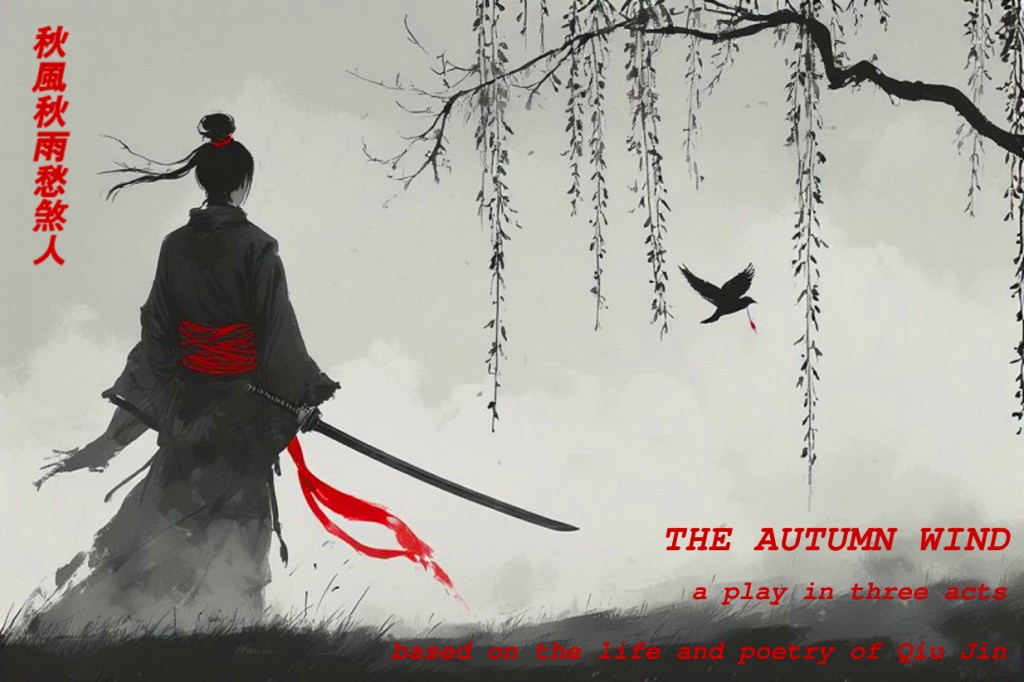
A Play in Three Acts.
By ZJC (2026)
Characters:
- QIU JIN (30s) — Revolutionary, poet, swordswoman. She leaves her husband and children to change China. She will not succeed. She will be remembered.
- WU ZHIYING (late 40s) — Poet, calligrapher, wife of a Qing official. She helps Qiu Jin escape to Japan. She loves her across distance and death.
- XU ZIHUA (40s) — Widowed principal of Xunxi Girls’ School. She hires Qiu Jin. She becomes Qiu Jin’s partner, her sister, her gravedigger.
- XU XILIN (30s) — Qiu Jin’s cousin. Revolutionary. He recruits her into the Restoration Society. His failure causes her death.
- THE STATE (Actor 5) — Messenger, Official, Executioner, Gulin. The face of the government that wants to erase her.
Setting: Beijing, Tokyo, Zhejiang, Shaoxing. 1903-1908. A single room that transforms — a writing desk, a tea table, a scroll on the wall, a willow branch when needed, a sword that appears and disappears.
Running Time: Approximately 90 minutes.
ACT ONE: THE OATH
SCENE 1: THE CAPITAL
Beijing, 1903. Wu Zhiying’s house.
A room. Elegant but restrained. A writing desk. A scroll on the wall: four characters: 宁静致远 (“Tranquility leads to distance”). A tea table. A window.
WU ZHIYING sits at the tea table. She pours tea with precise, careful movements.
QIU JIN stands by the window, looking out.
WU ZHIYING: You have been standing there for ten minutes.
QIU JIN: I like the light.
WU ZHIYING: The light is the same as it was ten minutes ago.
QIU JIN: No. It has moved.
(Wu Zhiying sets the teapot down. She looks at Qiu Jin’s back.)
WU ZHIYING: You are not what I expected.
(Qiu Jin turns.)
QIU JIN: What did you expect?
WU ZHIYING: Someone quieter.
(Qiu Jin almost smiles.)
QIU JIN: My husband says the same thing.
WU ZHIYING: Your husband is here? In Beijing?
QIU JIN: He is here. He is always here. That is the problem.
(She crosses to the tea table. She sits across from Wu Zhiying. She does not drink.)
QIU JIN: You wrote to me. After you read my poems.
WU ZHIYING: I did.
QIU JIN: Why?
(Wu Zhiying considers the question.)
WU ZHIYING: Because I have never read anything like them. A woman writing about the Manchus. About revolution. About the lives women are forced to live.
(Pause.)
I did not know women could write like that.
QIU JIN: Neither did I. Until I did.
(Wu Zhiying looks at her.)
WU ZHIYING: You are very strange.
QIU JIN: I know.
WU ZHIYING: I like it.
(Qiu Jin finally picks up the teacup. She drinks.)
QIU JIN: This is good tea.
WU ZHIYING: It is the only good thing in this house.
(Qiu Jin sets the cup down.)
QIU JIN: You are unhappy.
(Wu Zhiying does not answer.)
QIU JIN: I can see it. In the way you pour tea. In the way you sit. You are very still. Too still. Like you are too large and are afraid someone will notice you.
WU ZHIYING: Someone might.
QIU JIN: Your husband?
WU ZHIYING: My husband does not notice anything… except for his work, his colleagues, his position. I am furniture.
(She says this flatly. Not with self-pity, simply a fact.)
QIU JIN: Then why do you stay?
WU ZHIYING: Where would I go?
(Qiu Jin leans forward.)
QIU JIN: Japan. There are women there — Chinese women — studying, writing, organizing. They are not furniture.
WU ZHIYING: I cannot go to Japan.
QIU JIN: Why not?
WU ZHIYING: Because I am a woman.
QIU JIN: That is not a reason.
WU ZHIYING: It is the only reason that matters.
(They look at each other.)
QIU JIN: I am going. As soon as I can arrange it. My husband does not know yet. He will not approve.
WU ZHIYING: Then how will you go?
QIU JIN: I will find a way.
(Wu Zhiying is silent for a long moment.)
WU ZHIYING: I have money. Not much. But some. My mother left it to me. My husband does not know.
QIU JIN: I cannot take your money.
WU ZHIYING: You are not taking it. I am giving it.
(Pause.)
Consider it payment for the poems.
(Qiu Jin stares at her.)
QIU JIN: You do not know me. We met an hour ago.
WU ZHIYING: I know your poems. That is enough.
(Qiu Jin looks down at her hands.)
QIU JIN: I will pay you back.
WU ZHIYING: No. You will not.
(She pours more tea.)
You will go to Japan. You will study. You will write more poems. You will become the woman you are meant to be. And I will stay here. In this house. Pouring tea.
QIU JIN: That is not fair.
WU ZHIYING: No. It is not.
(She hands Qiu Jin the cup.)
But it is the only way.
(Qiu Jin takes the cup. She does not drink. She holds it in both hands.)
QIU JIN: I will write to you. From Japan.
WU ZHIYING: I would like that.
QIU JIN: I will tell you everything. The women I meet. The things I learn. The revolution.
WU ZHIYING: Be careful.
QIU JIN: I am always careful.
(Wu Zhiying looks at her — at her restless hands, her bright eyes, her refusal to sit still.)
WU ZHIYING: No. You are not.
(Qiu Jin almost smiles again.)
QIU JIN: No. I am not.
(She sets the cup down. She stands.)
I should go. My husband will be wondering where I am.
WU ZHIYING: Let him wonder.
(Qiu Jin looks at her.)
WU ZHIYING: Stay a little longer.
(Qiu Jin sits down again.)
(They sit in silence. The tea grows cold.)
(Wu Zhiying reaches across the table. She takes Qiu Jin’s hand.)
(Qiu Jin does not pull away.)
WU ZHIYING (quietly): I have never done that before.
QIU JIN: Done what?
WU ZHIYING: Reached for someone.
(Qiu Jin looks at their joined hands.)
QIU JIN: Neither have I.
(They sit in silence. The light changes — the sun moving across the room.)
(Wu Zhiying speaks without looking up.)
WU ZHIYING: When you go to Japan — when you become what you are meant to be — will you remember me?
QIU JIN: I will remember this room. This tea. This light.
(She squeezes Wu Zhiying’s hand.)
I will remember your hand in mine.
(Wu Zhiying closes her eyes.)
(Lights fade.)
SCENE 2: THE ESCAPE
Beijing, 1904. The same room.
The tea table is bare. A small bag sits on the floor — Qiu Jin’s luggage. A cloak hangs over the back of a chair.
WU ZHIYING stands by the window, looking out. QIU JIN paces.
WU ZHIYING: You should sit.
QIU JIN: I cannot sit.
WU ZHIYING: You are making me nervous.
QIU JIN: You should be nervous.
(Wu Zhiying turns from the window.)
WU ZHIYING: I have done everything you asked. The money is in the bag. The tickets are in your coat. The ship leaves at dawn.
QIU JIN: I know.
WU ZHIYING: Then why are you still here?
(Qiu Jin stops pacing. She looks at Wu Zhiying.)
QIU JIN: Because I am afraid.
(Wu Zhiying crosses to her.)
WU ZHIYING: You? Afraid?
QIU JIN: I have never been outside Beijing. I have never been on a ship. I have never been alone.
WU ZHIYING: You will not be alone. There will be other women on the ship. Students. Revolutionaries.
QIU JIN: I do not know them.
WU ZHIYING: You did not know me. Six months ago.
(Qiu Jin looks at her.)
QIU JIN: That was different.
WU ZHIYING: How?
QIU JIN: Because I knew you before I met you. In your poems.
(Wu Zhiying is silent.)
QIU JIN: I read everything you ever wrote. Before I ever wrote to you. Before I ever asked to meet you. I knew your voice before I heard it.
(Pause.)
I do not know anyone in Japan.
(Wu Zhiying takes Qiu Jin’s hands.)
WU ZHIYING: Then write to me. Tell me their voices. I will learn them with you.
(Qiu Jin grips her hands.)
QIU JIN: What if I fail?
WU ZHIYING: Fail at what?
QIU JIN: At becoming what I am meant to be.
(Wu Zhiying looks at her — at her dark clothes, her pinned-up hair, her trembling hands.)
WU ZHIYING: Then why go? Why do… any of this?
(She releases Qiu Jin’s hands. She moves to the table. She picks up a small package — wrapped in silk, tied with a red cord.)
I have something for you.
QIU JIN: You have already given me too much.
WU ZHIYING: This is not money. This is not tickets.
(She holds it out.)
This is for when you are afraid.
(Qiu Jin takes the package. She unties the cord. She unwraps the silk.)
(Inside: a small jade pendant. A lotus flower. Worn smooth — old, loved.)
QIU JIN: What is this?
WU ZHIYING: My mother’s. She gave it to me when I married. She said it would protect me.
(Pause.)
It did not. Nothing could have protected me from that life.
(Qiu Jin looks at the pendant.)
WU ZHIYING: But it protected me from forgetting who I was. Before I became furniture.
(Qiu Jin holds the pendant against her chest.)
QIU JIN: I cannot take this.
WU ZHIYING: But you will.
(She steps back.)
When you are in Japan. When you are alone. When you are afraid. Hold this. Remember that someone in Beijing is thinking of you. Someone in Beijing is waiting for your letters. Someone in Beijing loves you.
(Qiu Jin’s eyes fill with tears.)
QIU JIN: You have never said that before.
WU ZHIYING: I have never had the courage.
(They stand in silence.)
(Outside, a bell rings — distant, insistent.)
WU ZHIYING: That is the curfew. You need to go.
QIU JIN: I know.
(Neither of them moves.)
WU ZHIYING: Qiu Jin.
QIU JIN: Yes?
WU ZHIYING: Do not look back.
(Qiu Jin puts the pendant around her neck. She picks up her bag and pulls her cloak over her shoulders.)
(She moves to the door. She stops.)
QIU JIN: I will write to you. From the ship. From Japan. From everywhere I go.
WU ZHIYING: I will be here.
QIU JIN: Promise me.
WU ZHIYING: I promise.
(Qiu Jin opens the door.)
(She looks back — one last time.)
QIU JIN: I love you, too.
(She leaves.)
(Wu Zhiying stands alone.)
(She crosses to the window. She watches Qiu Jin go.)
(The light changes. Dawn approaching.)
(Wu Zhiying speaks — to herself, to the empty room.)
WU ZHIYING: “Now that things have gotten so dangerous —”
(She stops.)
You wrote that. To me. In your last letter. Before you decided to leave.
(She touches the window frame.)
“Now that things have gotten so dangerous — Please change your girl’s garments for a Wu sword.”
(Pause.)
I have not changed my garments… but I have changed my heart.
(She turns from the window.)
(She looks at the tea table — bare now, empty.)
WU ZHIYING: I will wait for your letters. I will read them a hundred times. I will write back. I will tell you everything. And I will pretend — every day — that you are coming back.
(She sits down at the table.)
(She picks up a brush. She begins to write — not a poem, not a letter. Just a single character, over and over.)
(The character for “wait.”)
(守.)
(She writes it again. And again. And again.)
(Lights fade.)
SCENE 3: THE DISTANCE
Two spaces on stage simultaneously.
Stage left: A small room in Tokyo, Japan. 1904-1905. A writing desk. A window.
Stage right: Wu Zhiying’s house in Beijing. The same room.
Both poets sit at their respective desks. They write. They speak their letters aloud. The audience hears both sides of the conversation, but the women cannot hear each other.
The lights come up on both sides of the stage simultaneously.
QIU JIN writes. She speaks as she writes.
QIU JIN: I have been in Japan for three months. The city is loud. The language is strange. I do not understand half of what people say to me.
(She writes.)
But there are other Chinese women here. Students. Revolutionaries. They talk about the future as if it is something we can build with our own hands.
(She looks up.)
I have never met anyone like them.
(On the other side of the stage, WU ZHIYING reads Qiu Jin’s letter. She writes back.)
WU ZHIYING: You write about the future as if it is already here. I read your letters three, four, five times a day. I memorize them.
(She writes.)
I showed one to my husband. He asked who had written it. I told him a friend. He said, “Your friend writes like a man.”
(She sets the brush down.)
I did not tell him that was a compliment.
(QIU JIN writes again.)
QIU JIN: I have started wearing men’s clothing. It is easier to move. Easier to be seen. Easier to be taken seriously.
(She writes.)
The women here call me “Brother Qiu.” I like it.
(She pauses.)
I cut my hair. It is short now. When I look in the mirror, I do not recognize myself. But I recognize who I want to become.
(WU ZHIYING reads. She touches the page — as if she could touch Qiu Jin through the paper.)
WU ZHIYING: I dream about you. In the dreams, you are always leaving. Walking away from me. I call your name, but you do not turn around.
(She writes.)
Last night, the dream was different. You turned around. You smiled. You said, “I am not leaving. I am going ahead.”
(She sets the brush down.)
I woke up crying.
(QIU JIN writes again. Faster now.)
QIU JIN: I have joined a revolutionary society. The Restoration Society. My cousin Xu Xilin introduced them to me. They talk about assassinations. About uprisings. About blood.
(She writes.)
I thought I would be afraid. I am not.
(She pauses.)
I thought of you. When they asked me to take the oath. I thought of your hand in mine. In your house. That first day.
(She writes.)
I thought: if I die, she will remember me.
(WU ZHIYING reads. Her hand trembles.)
WU ZHIYING: Do not die.
(She writes.)
I am not asking. I am telling you. Do not die.
(She sets the brush down.)
I cannot write the poem I want to write. The words will not come. They are stuck in my chest. Behind my ribs. Where I keep your letters.
(QIU JIN writes one final time.)
QIU JIN: I am coming back to China. Soon. Not to Beijing — to Zhejiang. To start a school. To train women to fight.
(She writes.)
I do not know when I will see you again. I do not know if I will see you again.
(She pauses. She touches the jade pendant at her neck — the one Wu Zhiying gave her.)
But I carry you with me. Everywhere.
(She sets the brush down.)
(On the other side of the stage, WU ZHIYING reads the letter. She holds it against her chest.)
(Both women sit in silence.)
(The lights fade on both sides simultaneously.)
SCENE 4: THE REVOLUTIONARY
Tokyo, Japan. 1905. A small room. A table. A few chairs. On the wall, a map of China. A single sword.
QIU JIN sits at the table. Before her: a letter from Wu Zhiying. She has read it many times. She touches the characters.
XU XILIN enters. He is agitated.
XU XILIN: Are you still reading that, cousin?
(Qiu Jin looks up.)
QIU JIN: Are you still interrupting?
(He sits across from her.)
XU XILIN: I have news. The Restoration Society is meeting tonight. Cai Yuanpei will be there. Tao Chengzhang will be there.
QIU JIN: I know who they are.
XU XILIN: Then you know they are the ones who will overthrow the Manchus. Not the poets. Not the letter-writers.
(He glances at the letter.)
The ones with swords.
(Qiu Jin folds the letter. She sets it aside.)
QIU JIN: You think poetry cannot be a weapon?
XU XILIN: I think poetry has never stopped a bullet.
(She looks at him.)
QIU JIN: What are you asking me to do?
XU XILIN: Join us. Tonight. Take the oath. Become a revolutionary.
QIU JIN: I am already a revolutionary.
XU XILIN: You are a woman who wears men’s clothes and writes angry poems. That is not the same.
(She stands. He does not flinch.)
QIU JIN: You came to me in Beijing. Before I left. You told me the Manchus had to go. You told me women deserved better. You told me I could be part of something larger than myself.
XU XILIN: I meant it.
QIU JIN: Then why are you treating me like a child?
(He is silent.)
QIU JIN: I know what the Restoration Society does. Assassination. Armed uprising. Blood.
XU XILIN: Yes.
QIU JIN: You think I am not capable of that?
XU XILIN: I think you are capable of more.
(She stares at him.)
XU XILIN: You are a woman. That is a weapon. No one expects a woman to carry a bomb. No one searches a woman for a dagger. You can go where I cannot.
(Pause.)
You can kill where I cannot.
(Qiu Jin sits down slowly.)
QIU JIN: You want me to be an assassin?
XU XILIN: I want you to be a revolutionary. Assassination is just one tool.
(She looks at the letter from Wu Zhiying.)
XU XILIN: Who is that from?
QIU JIN: A friend.
XU XILIN: A friend, or a lover?
(She does not answer.)
XU XILIN: I do not care what she is to you. But do not let her make you soft.
QIU JIN: She does not make me soft. She makes me brave.
(Xu Xilin stands.)
XU XILIN: Then be brave tonight. Come to the meeting. Take the oath. Stop writing letters and start planning.
(He moves to the door. He stops.)
The meeting is at eight. I will wait for you until eight-fifteen.
(He leaves.)
(Qiu Jin sits alone. She picks up the letter. She reads it again — silently, her lips moving.)
(She sets it down. She picks up a brush. She writes back to Wu Zhiying. She speaks as she writes.)
QIU JIN (writing): My cousin has asked me to join the Restoration Society. He wants me to carry a dagger. He wants me to learn to kill.
(She writes.)
I do not know if I can. I do not know if I should. But I know I cannot stay here forever, writing poems, waiting for the world to change.
(She writes.)
I asked you once to change your girl’s garments for a Wu sword. I have changed my garments. Now I must decide what to do with my hands.
(She sets the brush down.)
(She stands. She looks at the map on the wall — China, divided, occupied.)
(She speaks to the map — to China, to the revolution, to herself.)
QIU JIN: I will go to the meeting.
(Pause.)
I will take the oath.
(Pause.)
I will become what they need me to become.
(She finishes the letter to Wu Zhiying with the following words.)
“When the saber is drawn from its scabbard, the heavens shake.
The sun, moon, and stars hide their radiance.
With one chop to the ground, the sea water stands upright.
With three inches of blade, a sinister wind howls.”
(Pause. She finishes the letter with.)
And I will not stop writing.
(She leaves.)
(Blackout.)
SCENE 5: THE ORCHID VERSE
Tokyo, Japan. 1905.
A small room. A table. A candle. On the table: a sheet of white paper, a brush, ink.
The room is bare — no map, no sword, no scrolls. Just the table and the candle and the two women who have come here to change their lives.
WU ZHIYING stands at the table. She has not yet sat down. She is looking at the blank paper.
QIU JIN watches her from the doorway.
QIU JIN: You came.
(Wu Zhiying turns.)
WU ZHIYING: You asked me to.
QIU JIN: I have asked you many times. You have not come before.
(Wu Zhiying looks around the room.)
WU ZHIYING: This is not what I expected.
QIU JIN: What did you expect?
WU ZHIYING: Something grander. An altar. Flowers. Incense.
QIU JIN (almost smiling): We are not swearing to the gods. We are swearing to each other.
(Wu Zhiying looks at her. Really looks.)
WU ZHIYING: You have changed.
QIU JIN: Yes.
WU ZHIYING: Your hair. Your clothes. Your face.
QIU JIN: My face is the same.
WU ZHIYING: No. Your face is harder.
(Qiu Jin crosses to the table. She stands opposite Wu Zhiying.)
QIU JIN: I have been learning to kill.
(Wu Zhiying does not flinch.)
WU ZHIYING: I know.
QIU JIN: My cousin — Xu Xilin — he wants me to carry a dagger. I’ve joined the Restoration Society but he wants me to be ready to die.
WU ZHIYING: And what do you want?
(Qiu Jin is silent for a moment.)
QIU JIN: I want to stop being afraid.
(Wu Zhiying nods slowly.)
WU ZHIYING: That is why I came.
(She sits down at the table. Qiu Jin sits across from her.)
WU ZHIYING: I have been thinking about what you wrote. In your letters.
(She pauses. Then she recites — from memory — Qiu Jin’s own words.)
“The scent of orchids — heart to heart,/ Like metal and stone — silently in harmony.”
(Pause.)
I have been thinking about my own life. My husband. My house. My poems. No one reads them. No one cares. I am a wife who writes. That is all.
QIU JIN: That is not all.
WU ZHIYING: It is all they see.
(She touches the blank paper.)
You wrote to me once: “My soulmate is separated by mountains and rivers.”
QIU JIN (quietly): I remember.
WU ZHIYING: I wrote a poem. For you. For today.
QIU JIN: Let me hear it.
Wu Zhiying takes a breath. She recites.
WU ZHIYING:
“We met in the capital, strangers.
We meet again in Japan, sisters.
The ink on this paper will fade.
The seals will crack. But the vow —
The vow will outlast us both.”
(She looks up.)
That is why I came.
(Silence.)
(Qiu Jin reaches across the table. She takes Wu Zhiying’s hand.)
QIU JIN: Then let us swear it. Here. Now. No altar. No incense. Just us.
WU ZHIYING: What do we swear?
QIU JIN: That we are sisters. Beyond blood. Beyond marriage. Beyond death.
(Wu Zhiying looks at their joined hands.)
WU ZHIYING: And if one of us dies?
QIU JIN: Then the other carries her name.
(Wu Zhiying nods.)
WU ZHIYING: Then write it.
(Wu Zhiying reaches into her sleeve. She pulls out a small silk pouch. She unties it. Inside: a brush — not an ordinary one. The handle is carved with orchids. It is beautiful, personal, clearly special.)
(She holds it out to Qiu Jin.)
WU ZHIYING: My brush. The one I use for my best poems. I have never let anyone else hold it.
(Qiu Jin takes it. She looks at it. She looks at Wu Zhiying.)
QIU JIN: This is more than a vow.
WU ZHIYING: Yes.
(Qiu Jin picks up the brush. She dips it in ink. She begins to write on the white paper. She speaks as she writes.)
QIU JIN (writing): We, Qiu Jin and Wu Zhiying, swear before heaven and earth —
(She writes.)
To be sisters. To share each other’s joys and sorrows. To protect each other’s names.
(She writes.)
If one of us dies, the other will live as if she were still here.
(She sets the brush down. She reads what she has written.)
(Then she hands the brush to Wu Zhiying.)
(Pause.)
(Wu Zhiying takes the brush. She reads the contract. She adds her own lines. She speaks as she writes.)
WU ZHIYING (writing): I, Wu Zhiying, swear to keep Qiu Jin alive.
(She writes.)
I will not let her disappear.
(She sets the brush down.)
(They look at each other across the table.)
(Wu Zhiying folds the contract carefully. She tucks it into her sleeve.)
(They sit in silence.)
(Wu Zhiying stands.)
WU ZHIYING: I should go. The ship leaves at dawn.
QIU JIN: I know.
WU ZHIYING: Will you write to me?
QIU JIN: Every day.
WU ZHIYING: And when you return to China?
QIU JIN: I will find you.
(Wu Zhiying moves to the door. She stops.)
WU ZHIYING: Qiu Jin.
QIU JIN: Yes?
WU ZHIYING: Do not die.
(Qiu Jin does not answer.)
(Wu Zhiying leaves.)
(Qiu Jin stands alone. She holds the carved brush against her chest. She looks at the empty doorway.)
(She speaks — to Wu Zhiying, who cannot hear her, and to herself.)
QIU JIN: I will try.
(She bows her head.)
(Lights fade.)
ACT TWO: THE SCHOOL
SCENE 6: THE HIRE
Xunxi Girls’ School, Zhejiang Province. 1906.
A small office. A wooden desk, neat. A stack of student essays. A pot of cold tea. A window looking out onto a courtyard.
On the wall behind the desk: a scroll of calligraphy. Four characters: 宁静致远 — “Tranquility leads to distance.”
XU ZIHUA sits behind the desk. She holds a letter — Qiu Jin’s application. She has read it three times.
QIU JIN stands. She has not been offered a seat. She does not seem to notice.
XU ZIHUA: Your letter says you studied in Tokyo.
QIU JIN: I did.
XU ZIHUA: And before that?
QIU JIN: I was married.
(Xu Zihua looks up. A pause.)
XU ZIHUA: Many of our teachers are married.
QIU JIN: I left.
(Another pause.)
XU ZIHUA: I see.
(She sets the letter down. She folds her hands.)
You understand what we teach here. Girls. Young women. Most of them will marry. Most of them will raise children. We teach them to read, to write, to calculate. To be useful.
QIU JIN: You teach them to be small.
XU ZIHUA: I teach them to survive.
QIU JIN: Same thing.
(Xu Zihua does not rise to it. She waits.)
XU ZIHUA: Why do you want to teach here?
QIU JIN: Because you are the only school that would read my letter.
XU ZIHUA: That is not an answer.
QIU JIN: But it is the truth.
(Xu Zihua stands. She moves to the window. She looks out at the courtyard.)
XU ZIHUA: I have been principal here for six years. When I started, we had forty students. Now we have sixty. The local gentry want me to stop. They say I am creating women who will not obey their husbands.
(She turns.)
They are right.
QIU JIN: Then why do you keep going?
XU ZIHUA: Because my husband is dead.
(Qiu Jin waits.)
XU ZIHUA: He was a good man. He did not beat me. He did not take concubines. By every measure, I should mourn him still.
(She returns to the desk. She does not sit.)
But when he died, I could breathe.
(Qiu Jin’s face changes. Something softens.)
XU ZIHUA: I do not teach these girls to be small. I teach them to wait. There is a difference.
QIU JIN: For how long?
XU ZIHUA: What?
QIU JIN: For how long should they wait?
(Xu Zihua does not answer.)
QIU JIN (quoting from memory):
“I often wondered if you were a goddess beyond the clouds.
How fortunate to meet you, to clasp your hand in joy.
Your ambition surpasses even men’s.
Such talent in a woman is rare indeed.
Together we shall save our motherland…
How many women have long been submissive, hidden away?
We rely on you to restore our rights to freedom.”
Xu Zihua is startled into silence.
XU ZIHUA: You’ve read my poetry?
(She laughs, as if this is too absurd to even believe.)
Of course you have. Of course you have.
(She shakes her head.)
Look around you. This is a girl’s school, not a den of cut-throats and radicals. I am a school teacher, not a revolutionary.
QIU JIN: I think you already are. You just won’t admit it.
(A long silence.)
(Xu Zihua sits down heavily.)
XU ZIHUA: The magistrate came to see me last week. He said he has heard rumors about you. About the women’s newspaper you started in Shanghai.
QIU JIN: The newspaper is not a rumor.
XU ZIHUA: He said if I hire you, he will close my school.
QIU JIN: Will he?
XU ZIHUA: I do not know.
QIU JIN: Then we find out together.
(Xu Zihua laughs once more — a short, surprised sound.)
XU ZIHUA: You are not afraid of anything, are you?
QIU JIN: I am afraid of dying old. In a bed. Having done nothing.
(Xu Zihua looks at her. Really looks.)
XU ZIHUA: What would you teach my students?
QIU JIN: The truth.
XU ZIHUA: Which is?
QIU JIN: That the world can be different.
(Xu Zihua nods slowly.)
XU ZIHUA: And if I ask you to leave that part out?
QIU JIN: Then I am not your teacher.
XU ZIHUA: I cannot hire you.
QIU JIN: I know.
XU ZIHUA: You will get us both killed.
QIU JIN: Probably.
(Xu Zihua stands again. She goes to the window. She speaks without turning.)
XU ZIHUA: My daughter is eight years old. She is learning to read. She asked me last week why there are no women in the history books. I told her there are. She asked why no one talks about them. I did not have an answer.
(She turns.)
Be here tomorrow. Seven in the morning. The students arrive at seven.
QIU JIN: You just said—
(This time it is Qiu Jin who falls into silence. A small, brief smile.)
(Xu Zihua returns to the desk. She picks up the application letter. She folds it carefully.)
XU ZIHUA: I will tell the magistrate you are teaching physical education. Sword drills. Traditional forms. Nothing political.
QIU JIN: The sword is political.
XU ZIHUA (without looking up): Then teach them to hold it quietly.
(Qiu Jin watches her for a long moment.)
QIU JIN: What is your daughter’s name?
XU ZIHUA: Xiao Hua.
QIU JIN: Little Flower.
(Xu Zihua nods.)
QIU JIN: Then she is about to write history books that do not exist yet.
(Xu Zihua looks up. Her eyes are wet. She does not wipe them.)
XU ZIHUA: Seven o’clock.
(Qiu Jin turns to leave. At the door, she stops.)
QIU JIN: One more thing.
XU ZIHUA: Yes?
QIU JIN: The sword drills. They are not traditional.
(She leaves.)
(Xu Zihua sits alone. She picks up the cold tea. She does not drink it. She holds it.)
(After a long moment, she speaks to the empty room.)
XU ZIHUA (quietly): Little Flower. You asked why no one talks about them.
(She sets the cup down.)
You are about to meet one.
(Blackout.)
SCENE 7: THE MAGAZINE
Setting: Xunxi Girls’ School, Zhejiang Province. 1906. Xu Zihua’s office.
The same room as Scene 6. The desk. The scroll on the wall: “Tranquility leads to distance.”
But now there is something new: a printing press. Small. Portable. Ink-stained. Sheets of paper are scattered everywhere — some printed, some smudged, some discarded. Qiu Jin has been working. It is a messy job. Ink is on her hands, her sleeves, her face.
XU ZIHUA enters. She finds Qiu Jin hunched over the press, pulling a lever, checking a sheet, cursing softly under her breath. Ink is everywhere.
Xu Zihua watches for a moment. Then she approaches. She touches the metal of the press.
XU ZIHUA: This is what you spent your money on?
(Qiu Jin does not look up. She is adjusting the type.)
QIU JIN: This is what will change the world.
(Xu Zihua looks at her.)
XU ZIHUA: It’s a printing press.
(Qiu Jin looks up. She holds up a sheet of paper — the first proof of the newspaper.)
QIU JIN: It’s a sword.
(Xu Zihua is silent.)
XU ZIHUA: How many copies?
QIU JIN: One thousand.
XU ZIHUA: We have sixty students.
QIU JIN: The students are not the only ones who need to read it.
(She picks up the proof sheet.)
The magistrate has soldiers. He has guns. He has the law on his side.
(She holds up the paper.)
We have this.
XU ZIHUA: A gazette? A tabloid? A periodical?
QIU JIN: A truth that will reach those who have never been told they matter. In villages where no revolutionary has ever gone. It will reach anyone who thinks they are alone.
(She sets the paper down.)
The magistrate can kill me. He cannot kill everyone who reads this.
(Xu Zihua is silent.)
XU ZIHUA: You wrote the first issue already. What does it say?
(Qiu Jin picks up the proof sheet. She reads — not the whole thing, just fragments. The most dangerous lines.)
QIU JIN (reading): “The greatest injustice in this world is the injustice suffered by our two hundred million sisters.”
(She turns the page.)
“When heaven created people, it never intended such injustice. If the world is without women, how can men be born?”
(She looks up.)
“If we don’t take heart now and shape up, it will be too late when China is destroyed.”
(She sets the proof down.)
And I mean every word.
(Xu Zihua picks up the proof. She reads it silently. Her face changes.)
XU ZIHUA: They will burn every copy they find.
QIU JIN: Then we print more.
XU ZIHUA: They will arrest the people who distribute it.
QIU JIN: Then we find new people.
XU ZIHUA: They will kill you.
(Qiu Jin looks at her. Steady.)
QIU JIN: Then you will print it without me.
(Xu Zihua stares at her.)
QIU JIN: That is the test. Not whether you will fight when I am standing beside you—
(She stops. A long silence.)
(Xu Zihua sets the proof down. She touches the printing press again — differently this time. Not curious. Committed.)
XU ZIHUA: Show me how it works.
(Qiu Jin places a sheet of paper on the press. She inks the type. She pulls the lever.)
(The press closes. Opens.)
(A printed page.)
(Xu Zihua picks it up. She holds it in both hands. She reads the title.)
XU ZIHUA: “China Women’s News.”
(She looks at Qiu Jin.)
With this we will shake the world. With this everyone will hear.
QIU JIN: Yes.
(Xu Zihua looks at the printed page in her hands. Then she crosses to the wall. She pins it there — in huge letters, for everyone to see.)
《中国女报》
(She steps back. She looks at it. Then she looks at Qiu Jin.)
(Qiu Jin looks at the stack of printed pages — the newspaper that they both hope will outlast them all.)
(Xu Zihua picks up the next blank sheet of paper. She moves to the machine. She begins the process.)
XU ZIHUA: One thousand copies.
(She smiles.)
You asked me to help. So, I am helping.
(Xu Zihua touches the paper — not the ink, not the type. The edge. The place where the next issue will begin.)
(They turn back to the press. They work together — placing paper, inking type, pulling the lever.)
(The rhythm of it. The sound of it.)
(Lights fade.)
SCENE 8: THE SWORD
Setting: Xunxi Girls’ School. 1907.
The room is now a sparring hall. Mats on the floor. A weapons rack against the wall — wooden swords, staffs, a real blade.
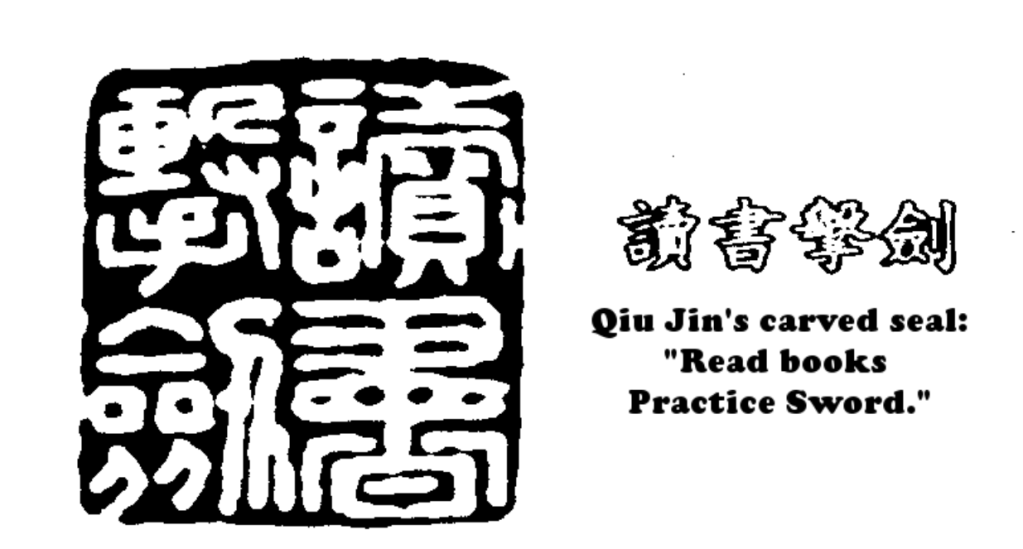
On the wall: a scroll with Qiu Jin’s personal motto: “Read Books./ Practice Sword.”
Qiu Jin is dressed in protective gear, holding a wooden sword. She is in the middle of training one of her students (Actor 5), who is also dressed for dueling.
Qiu Jin has been training her students for months and months and still the young girls are not ready.
XU XILIN enters. He is agitated — always agitated now.
XU XILIN: I finally found you! What are you doing?
(Humoring him but not stopping what she is doing.)
QIU JIN: Preparing.
(He crosses to her.)
XU XILIN: These girls. The ones you are training. Are they ready?
(As if to illustrate the two women duel. The student isn’t very good.)
QIU JIN: They are learning.
XU XILIN: Learning is not the same as ready.
(Lowering her sword. Still not looking at him.)
QIU JIN (almost sarcastic): Must I point out that patience is a virtuous trait?
(He looks at her blankly.)
XU XILIN: The sword. You have been practicing.
(For the first time Qiu Jin turns to look at her cousin. There is something wrong with him, something manic, something unhinged.)
(She has no words for this: of course she has been “practicing.”)
XU XILIN: Show me.
(He moves to the weapons rack. He takes a wooden sword. The student moves to one side. He takes her place.)
(They face each other.)
(Xu’s rage and impatience bubble right under the surface. When he recites his little speech it is clear that he’s been saying the same thing over and over for ages. It could be a slogan from a propaganda poster. It isn’t poetry.)
XU XILIN: For two hundred years the Manchus have forgotten that we are Han!
(He raises his blade.)
We will remind them!
(He attacks.)
(They spar. The fight is not long — thirty seconds, forty. But it is real. No music. Just the sound of wood on wood, breath, feet on the mats.)
(Xu Xilin is good. But Qiu Jin is far better. She disarms him. His wooden sword clatters to the floor.)
(He picks up his sword as if that round didn’t count.)
XU XILIN: Again.
(They circle each other.)
XU XILIN: You are thinking about her. The woman in Beijing. The one who writes you letters.
(Xu attacks — faster this time, harder.)
(She blocks and counters. She disarms him again.)
(For all his revolutionary zeal he has lost his way, his humanity.)
XU XILIN: You are thinking about *her* when you should be thinking about the *blade!*
QIU JIN (calmly): I am always thinking about her.
(He picks up his sword. He does not wait for her to attack. He moves first.)
(This time, she does not hesitate.)
(She drives him back across the room. He parries, blocks, retreats. She presses forward.)
(She strikes his blade from his hand.)
(His wooden sword falls, for the last time, to the ground.)
(She points her blade at his chest.)
(Silence.)
(The Student stares.)
XU XILIN (breathing hard): Fine. So you’ve “practiced.”
(He still only sees her as a girl.)
I have something for you.
(She lowers her sword.)
(He brings out a dagger — small, sharp, ridiculous against the sword Qiu Jin normally wears.)
(He holds it out.)
XU XILIN: It is meant to be hidden. In your sleeve. In your boot. In your hair.
(Qiu Jin looks at the dagger. Then at him.)
QIU JIN: I already have a sword.
XU XILIN (sneers): Yes, yes, that “sword”… what good are swords for assassinations?
XU XILIN: Take it.
(She does not take it.)
(Instead she walks to where his fallen wooden sword lays, retrieves it and places both hers and his back into the weapon rack. Respect for the weapon. For the ritual. A highly trained realist doing what the chaotic zealot can’t.)
XU XILIN (again): Take it.
(She takes it. She holds it in her palm. It is light.)
XU XILIN: You will need it. Soon.
(She looks at him.)
QIU JIN: What do you mean?
XU XILIN: I am going to Anqing. Next week.
QIU JIN: Why?
XU XILIN: To meet with En Ming. The governor.
(For once Qiu Jin looks taken aback. This isn’t news, this is just crazy.)
QIU JIN: What? You are going to kill him?
(He does not answer.)
QIU JIN (calmly): Xu Xilin. Cousin. You are going to kill him?
XU XILIN: Yes.
(She stares at him.)
QIU JIN: That is suicide.
XU XILIN: It is revolution.
QIU JIN: It is madness. You will die. Nothing will change.
XU XILIN: You do not know that. The People! The People will rise!
QIU JIN: I know that when you fail — and you *will* fail — they will go after your comrades, your friends… and your family. They will come here. They will arrest every student in this building. They will torture them. They will kill them.
XU XILIN: Then you should have trained them to fight harder.
(This is the one moment in the play when Qiu Jin loses her self-control. She slams the dagger down into the floor between them. The sound rings through the room.)
QIU JIN: You are a fool!
(He does not flinch.)
QIU JIN: You are a blind, arrogant fool. You think one dead governor will bring down the Qing? You think all of China will rise up at your call, like a trained dog?
XU XILIN: Someone has to start.
QIU JIN: Starting is not the same as succeeding! You are starting nothing. They’ll cut out your entrails and eat you alive. And you are taking the rest of us with you.
(She turns away from him. She cannot look at him.)
XU XILIN: You did not used to be this way. You used to believe in the revolution.
QIU JIN: “Believe”? No, cousin. Back in Japan I “believed”.
(She turns back.)
Now I am beyond belief. This is faith. What you suggest isn’t even revolution. It is vanity.
XU XILIN: You are a coward.
(Qiu Jin wrenches the dagger from the floor. She is furious.)
QIU JIN: Once! Once I swore that if I ever returned to the motherland, if I ever surrendered to the Manchu barbarians, if I ever deceived the Han people, then “stab me with this dagger”!
(He is silent.)
(She holds the dagger out in one hand.)
QIU JIN: If I am such a coward! — If all of this (gestures to the student, the school, China, everything) — means nothing to you — then go on, use this! Show me what a real revolutionary would do!
(Silence.)
(She drops the dagger on the floor, forgotten — not shouting now. Quiet. Deadly.)
QIU JIN: But I will not follow you into death for no reason. I will not sacrifice my students for some man’s pathetic satisfaction.
(She walks to the door. She stops.)
Even if the soldiers come — even if they ask what I knew — I will *never* tell them the truth: that you are a madman and are willing to throw away everything that we’ve worked for, everything that we’ve built, for pride.
(She leaves, her student following quickly behind.)
(Xu Xilin stands alone.)
(He looks at the dagger, laying on the floor.)
(It is impossible to read what he is thinking.)
(He picks it up. He holds it in his hand.)
(He says nothing.)
(Lights fade.)
SCENE 9: THE NEWS
Setting: Xunxi Girls’ School. July 1907. Afternoon.
Xu Zihua’s office. The same room. The scroll on the wall: “Tranquility leads to distance.” The printing press is in the corner. The newspaper is still pinned to the wall — 《中国女报》.
Xu Zihua and Qiu Jin sit at the desk. They are grading papers. A pot of tea sits between them. It is ordinary. It is mundane. It is the last ordinary moment of their lives.
Xu Zihua marks a paper. She sets it aside. She picks up another.
XU ZIHUA: This one is good. She wrote about the Tang dynasty poets.
QIU JIN (without looking up): Which ones?
XU ZIHUA: Li Bai. Du Fu. The usual.
QIU JIN: Did she mention that Li Bai died drunk in a boat, trying to embrace the moon’s reflection in the water?
(Xu Zihua looks at her.)
XU ZIHUA: No. She left that part out.
QIU JIN: Pity. That is the best part.
(She sets her paper down. She pours tea.)
QIU JIN: How many more?
XU ZIHUA: A dozen. Maybe more.
QIU JIN: We will be here all night.
XU ZIHUA: Is that a problem?
(Qiu Jin almost smiles.)
QIU JIN: No.
(She hands Xu Zihua a cup of tea.)
QIU JIN: No, it is not.
(They drink their tea. The afternoon light is golden. Peaceful.)
(Then — running footsteps. The door bursts open.)
(THE MESSENGER stands there, gasping for breath. His face is white. His clothes are torn. He has run all the way from Anqing.)
(Xu Zihua stands. The cup falls from her hand. It shatters on the floor.)
XU ZIHUA: What happened?
(The Messenger cannot speak. He is shaking.)
QIU JIN (calmly): Tell me.
MESSENGER: Anqing. The governor. Xu Xilin —
(He stops. He cannot finish.)
QIU JIN: Tell me.
MESSENGER: He killed En Ming. At the police academy. In front of everyone.
(Xu Zihua gasps. Qiu Jin does not move.)
MESSENGER: But the soldiers — they surrounded the building. He fought for hours. They captured him.
QIU JIN: Is he dead?
MESSENGER: Not yet.
(Pause.)
But he will be.
(Silence.)
(Xu Zihua looks at Qiu Jin. Qiu Jin’s face is unreadable.)
MESSENGER: Madam, you need to leave. They know about the school. They know about the plan. They will come here next.
QIU JIN: When?
MESSENGER: Hours. Maybe less. I rode ahead. They — they are coming.
(Outside, in the distance, shouting, violence. The sound of boots. There is nothing human about this noise: if totalitarianism had a heartbeat it would pound like this.)
(Xu Zihua runs to the window. She looks out. Her face drains of color.)
XU ZIHUA: They are already here.
(She turns to Qiu Jin.)
There is a back way. Through the kitchen. You can climb the wall—
QIU JIN: No.
XU ZIHUA: Qiu Jin—
QIU JIN: If I run—
(She pauses, gathers herself. Self-control is a terrible weight to carry.)
QIU JIN: (trying again): If I run they will take it out on everyone: you, the students, anyone who has ever trained in this room.
(She stands. She is calm.)
I have been waiting for this moment since the day my cousin left for Anqing.
XU ZIHUA: You knew he would fail?
QIU JIN: I knew he would try. That was enough.
(She moves to the desk. She picks up a brush. She dips it in ink.)
XU ZIHUA: What are you doing?
QIU JIN: Writing a letter. To a friend.
XU ZIHUA: There is no time for letters.
QIU JIN: There is always time for letters.
(She writes. She speaks as she writes.)
QIU JIN (writing): To Wu Zhiying, Beijing —
(She writes.)
The uprising has failed. Xu Xilin is captured. They are here.
(She stops. Stares at nothing.)
QIU JIN: (speaking as if Wu Zhiying were there): I do not regret anything. Not Japan. Not the school. Not the newspaper. Not the sword.
(She looks down at the paper. Writes.)
I only regret that I will not see you again.
(She sets the brush down.)
XU ZIHUA (picking up the paper, horrified): You are not finished.
(The noise outside intensifies. If there are students, or teachers, or civilians crying or lamenting or pleading it is lost in the chaos.)
QIU JIN (slowly): No. I am not.
(Xu Zihua rushes to Qiu Jin, as if she is ready to break a thousand years of tradition in this one action and clings to her, desperate, out of her mind with horror.)
XU ZIHUA: No! No, no, no, no! You can’t! There is still time. The back way—
(Qiu Jin gently removes Xu Zihua from her.)
QIU JIN: And lose you?
I will not let that happen.
(She moves to the door.)
(Qiu Jin stops. She does not turn.)
QIU JIN: When they ask… tell them that I was not afraid.
(Pause.)
(She turns. She looks at Xu Zihua. Her face is calm. Resolved.)
QIU JIN: Bury me at West Lake. Where the heroes are.
(She leaves.)
(Xu Zihua collapses in shock. She holds the unfinished letter.)
(Chaos outside. Boots on the stairs. Worlds ending.)
(As the lights and noise fade we are left in a bloodcurdling silence of inevitability.)
(Blackness.)
SCENE 10: THE AUTUMN WIND
The room is now a prison cell. Dim. Claustrophobic. One small window.
QIU JIN sits, shackled, at a bare wooden table.
She has been here for days. The interrogation is over. Her hands are shattered. Her lip is split. One eye is swollen. Her clothes are torn.
But her back is straight. She has not broken.
The light outside her cell is bleak, gray, rainy: autumn.
She traces a single word for the wind on the bare table in front of her: 风
These are the two elements that will form her greatest poem.
She stops.
She closes her eyes.
The noise of boots: softer but still just as tyrannical.
The sound of keys, of bolts being drawn of locks opening.
The door opens.
THE OFFICIAL enters. He is the face of the state, come to offer her a way out. He is doing his job.
OFFICIAL: Qiu Jin.
(She opens her eyes. She does not turn.)
OFFICIAL: You have been given every chance. Confess. Name your comrades. The governor is merciful.
QIU JIN: The governor is a Manchu. There is no mercy in him.
OFFICIAL: He will spare your life.
(Qiu Jin turns. She looks at him. They both know that’s a lie.)
QIU JIN: And, tell me, what would I do with my life if I “confessed and named my comrades”?
(The Official is surprised. He pauses, considering.)
OFFICIAL: Why, you would live, of course.
(Qiu Jin says nothing. The Official tries reasoning one last time. It has yet to work.)
OFFICIAL: Look, I understand. You are brave, for a woman. You want things better for all of us. So does the governor.
(The Official spreads a blank sheet of paper before her. He brings out ink and a brush. Qiu Jin stares at all this.)
QIU JIN (almost a whisper to herself, almost): “Not a man in the flesh, unable to walk among them;/ But my heart is stronger, more fierce than any man’s.”
OFFICIAL (confused): What? (Pressing on.) Go ahead. Take the brush. Confess.
(Qiu Jin raises one shackled hand, the chains rattling. She writes. She puts the brush down.)
(He looks at the paper. He reads the characters.)
(He looks at her.)
This is not a confession.
QIU JIN: It is the only one I have.
(He stares at her.)
OFFICIAL: Then you will die at dawn.
QIU JIN: I know.
(He leaves.)
(Qiu Jin is alone.)
(She stands. She speaks — to the room, to the women she loves, to everyone who cannot hear her.)
QIU JIN: They will kill me at dawn. At Xuantingkou. In the square where they behead criminals.
(Pause.)
There will be a crowd. Some will cheer. Some will weep.
(She touches her chest, where the pendant lies.)
I will not close my eyes. I want to see them.
I want to see the ones who will remember.
(Blackout.)
(When the lights rise, the stage is transformed.)
(The prison cell is gone. The square at Xuantingkou. Bare. A single wooden post. Ropes.)
(The gray light of dawn.)
(THE EXECUTIONER stands to one side. His ASSISTANT stands beside him.)
(Qiu Jin is led in. The Guards bind her to the post. Her hands are tied behind her. Her body is upright. Her face is toward the audience. She does not blink.)
(The Assistant moves behind her. He gathers her long hair in one hand, pulling it forward, lowering her head toward the ground.)
(Qiu Jin does not close her eyes.)
(She speaks, her confession, her last lines.)
QIU JIN: “Autumn wind, autumn rain, fills my heart with sorrow.”
(Pause.)
(The Executioner raises his sword.)
(The Assistant holds her hair taut.)
(The sword hangs in the air.)
(Silence.)
(Qiu Jin’s eyes find the audience.)
(She does not look away.)
(Blackout.)
(Complete darkness.)
(No sound.)
(Long pause.)
(Then, very faintly, the sound of wind.)
ACT THREE: THE ELEGY
SCENE 11: THE MADNESS OF WU ZHIYING
Setting: Wu Zhiying’s house, Beijing. July 1907.
The same room as Act One. On the wall, a scroll of calligraphy: 安排嬌骨用鞭摑 — in Qiu Jin’s handwriting. It would be droll if anyone was in the mood for such frivolous gestures.
But the room is a wreck. Dark. Curtains drawn. Table overturned. A broken tea set. A black mess where a pot of ink had been thrown against a wall in rage.
A single candle burns low — it has been burning for days.
Books, poems, papers are scattered on the floor. A life of letters has been dropped and not picked up.
WU ZHIYING sits on the floor. Hair undone. She does not move, staring at nothing. She has been here for days.
The candle flickers.
She mumbles — these are not words to be heard by anyone.
WU ZHIYING: “One life…”
(She stops.)
(She tries again.)
“One life…”
(She cannot finish.)
(She looks at the writing brush on the floor. She does not pick it up.)
(Blackout.)
(When the lights come on again time has passed. A couple of days — a thousand years, it is impossible to know.)
(Wu Zhiying has moved beyond grief into a new state — not mania, but she is a woman driven by a feverish goal that has consumed her.)
(But she is ill, gravely ill. A cup of untouched medicine sits on the floor. Cold. Forgotten. She stops once in a while to cough into a handkerchief. Perhaps not consumption, perhaps not blood in the lungs, but a dire illness.)
(Regardless, she sits at her table, now right side up, writing furiously.)
(Whatever sentiment that drove her to say, “I will stay here in this house pouring tea,” in Act 1 has been forgotten.)
(The floor around her contains a thousand crumpled attempts at articulating her grief. At her elbow, a small mountain of papers have been stacked; she has been composing Qiu Jin’s biography, writing eulogies, writing and writing and writing.)
(She stops. Puts down her brush with ink-stained fingers.)
(Silently reads her lines.)
(Rage at not writing the right words. In a fit she crumples the poem, tosses it aside. There is a horrible moment when she isn’t in control. It passes. She takes a fresh sheet of paper and starts again.)
(She closes her eyes. Gathers her thoughts. A long pause.)
(She begins to write. Stops. Adds a thought and puts down the brush.)
(She stands. This should be an agonizing movement; she has been sitting for days, her body forgotten. She walks a little, trying to get the blood moving. She stands over her poem, looking down on it, casting judgment.)
(She picks up the paper and finally reads it out loud.)
WU ZHIYING: “One life, not preserved, / For millennia, a heroic name lives.”
(At some earlier time she would have paused to enjoy such a powerful, creative success. Not today. She places the paper on top of the pile of finished work.)
(She sits. Picks up her brush and begins to write once more.)
(Blackness.)
(When the lights come up this time Wu Zhiying has transformed. She is still ill, still weak, but her hair is washed and her clothes clean. Her manuscripts organized into piles in front of her.)
(She speaks as she writes.)
WU ZHIYING (writing and coughing): To Xu Zihua, Principal of Xunxi Girls’ School —
(She writes.)
You have suggested a burial site by West Lake. Xiling. The place Qiu Jin herself wanted.
(She writes.)
Already the government is speaking out against — (She finds she is about to write, “Brother Qiu,” pauses and includes it.) Already there are rumors her body will be dug up, desecrated, as a warning to others. (She pauses, thinks.) The first priority is to secretly transport her coffin to the lake without the officials knowing. I have found a man in Shaoxing who can help.
(She stops as coughing nearly overwhelms her. Through pure self-will she controls herself, picks up the brush and continues.)
Write to me. We must act quickly.
(She sets the brush down. She reads what she has written. Then she adds one more line.)
WU ZHIYING (writing): She spoke of you often. In her last months, you were the one at her side. I do not know you. But I know she loved you. That is enough for me.
(She folds the letter. She seals it.)
(She holds it in both hands.)
(She speaks — to the letter, to Xu Zihua, to Qiu Jin.)
WU ZHIYING: I do not know if you will answer. I do not know if you are even alive.
(Pause.)
But you are the only other person in the world who loved her the way I did.
(She sets the letter down.)
That makes you my sister.
(She stands. She moves to the window. She opens the curtains. Light floods the room.)
(She blinks as if she had forgotten sunlight was even possible.)
(She calls out.)
WU ZHIYING: Messenger!
(The MESSENGER enters — the same young man from Scene 10. He is frightened. He is always frightened.)
MESSENGER: Madam?
WU ZHIYING: This must go to Zhejiang. Xunxi Girls’ School. Do not let anyone else touch it.
MESSENGER: Madam, the roads are dangerous—
WU ZHIYING: Then avoid the danger.
(He takes the letter. He leaves.)
(Wu Zhiying stands alone.)
(She looks at the scroll on the wall — Qiu Jin’s calligraphy.)
(She speaks — not to Qiu Jin now. To herself.)
WU ZHIYING: “One life, not preserved. / For millennia, a heroic name lives.”
(Whatever she was suffering in the beginning of the scene, she has turned her trauma into a weapon.)
(She bows her head.)
(Lights fade.)
SCENE 14: THE FUNERAL
Setting: West Lake, Hangzhou. Spring 1908.
The stage is bare. A single willow branch hangs from above — the suggestion of a tree, of water, of a place where heroes are buried.
A grave marker. Simple. Unadorned. A mound of earth.
WU ZHIYING and XU ZIHUA kneel at the grave. They have been here for some time.
The sound of a crowd — distant, murmuring. Not loud. Just present. Waiting.
Wu Zhiying reads her eulogy first. Not loudly. Not whispered. Simply.
WU ZHIYING:
“Are you sated by my great offering of wine?
Looking back at Jiangting, one farewell, many tears.
Today at Xiling I risk a great wailing.
I cannot sing your song, ‘The Precious Sword’.”
(She pauses.)
(Xu Zihua speaks.)
XU ZIHUA:
Those few of us who still keep our promises
will hang up our swords at her grave like the loyal Yanling.
From now on, the waves of Xiling,
when they reach this bridge, will not rest.
(Wu Zhiying speaks again.)
WU ZHIYING:
Painful is the memory of our parting,
tears of the lone traveler fell like silken thread.
Alone, I gaze upon the sun that sets behind the lone grave mount,
Holding my sorrow, which no one can know.
XU ZIHUA:
XU ZIHUA:
The one who lies here met a bloody end,
though now may rest by a good lake and a green hill, at home.
Oh let my grave be at the right side of yours —
under the bright moon, we will wander together
among the pines and catalpas.
(Silence.)
(The crowd murmurs. Louder now. Restless.)
(Wu Zhiying speaks again — a different poem, one she wrote on the road to Shanyin.)
WU ZHIYING:
Vast and murky are heaven and earth,
a myriad of feelings assault me.
I gather your bones, my tears soak the kerchief.
Autumn wind, autumn rain,
along the Shanyin road,
Sigh upon sigh,
it is not easy to be a survivor.
(She pauses.)
(Xu Zihua speaks her final poem.)
XU ZIHUA:
A legend of blood has been written.
Fortunately, there are green hills to hold the white bones.
Nanhu has built a bower for “Mourning Autumn”;
Will you visit us there, when the wind comes, and the rain?
(They wait.)
(The wind.)
(Silence.)
(Then — footsteps.)
(GULIN steps forward from the crowd. He is a Manchu official. He is not there to mourn. He is there to control the narrative.)
(He speaks — not shouting. Calm. Measured. Dangerous.)
GULIN: This is not a hero’s grave.
(Wu and Xu turn to look at him.)
(The crowd stirs. Murmurs grow.)
GULIN: The Qing did not steal this land. We took it from bandits. You honor a criminal.
(Wu and Xu do not answer.)
(The crowd erupts.)
(Boos. Shouts. Protest. The sound is not organized. It is not clean. It is messy, loud, and undeniable.)
(Gulin looks around. He is surrounded. Not by soldiers. By voices, common voices.)
(He tries to continue but cannot compete.)
(He leaves. Angry. Humiliated.)
(The crowd continues. Their voices swell.)
(Wu and Xu look at each other.)
(A nod.)
(Darkness.)
(The sound of the crowd continues — not fading, not diminishing, but growing, spreading, as if all of China were protesting.)
(The lights are gone. The stage is black. But the sound remains.)
(Long pause.)
(Gradually — very gradually — the crowd begins to fade. Not because they have stopped. Because they have moved beyond this place, this moment, this grave.)
(Silence.)
(Then, very faintly, the sound of wind.)
SCENE 15: AFTERMATH
Setting: West Lake, Hangzhou. The present day. The statue of Qiu Jin.
The stage is bare. A single light rises on the statue — a suggestion, a shape, a presence.
A VISITOR stands before it. She holds a red silk scarf in one hand. A small print — a woodblock image of Qiu Jin’s face — is tucked into her pocket, visible but not explained.
She speaks — not to the audience. To the statue. To Qiu Jin.
VISITOR: I have been standing here for an hour.
(Pause.)
People walk by. They mistake me for someone else. A tourist. A student. A ghost.
(She looks at the statue.)
I do not correct them.
(She steps closer. She touches the base of the statue.)
There was a printmaker once. In 1979. She carved your face into wood and pressed it onto paper. She said, “No one can tell how great Qiu Jin is.”
(She pauses.)
There was a filmmaker. She made a film where women with swords danced to your poems. She called you a “messy revolutionary.” A drama queen.
(She almost smiles.)
I think she was right.
(She is silent for a moment.)
(Then she speaks — a line of poetry. Qiu Jin’s line. The one that started everything.)
VISITOR: “Don’t tell me women are not the stuff of heroes…”
(She pauses.)
(She wraps the red scarf around the base of the statue. She places the print beside it.)
(She steps back.)
(She bows her head.)
VISITOR: I am not the first person to stand here. I will not be the last.
(The light fades slowly — very slowly — until there is nothing but darkness.)
(Silence.)
(Then, very faintly, the sound of wind.)
(Then — a new sound. Footsteps. Someone else approaching the statue.)
(The play does not end. It continues. Offstage. Into the future.)
(Blackout.)
EPILOGUE: THE JINGWEI BIRD
The stage is dark.
A single light rises on QIU JIN. She stands alone. She holds no sword. She holds no brush. She simply stands, facing the audience.
She speaks — not as the character Qiu Jin, but as the writer Qiu Jin, reaching out across a century to speak directly to us.
QIU JIN: I live in an era of transition.
(Pause.)
I’ve taken advantage of the glimmer of civilization that appears here — small, fragile, like light through a crack in a closed door — to expand the… (Pause, selecting the word.) boundaries of my universe.
(She steps forward.)
I am not very erudite. I have read fewer books than the men who dismiss me. I have studied fewer classics than the scholars who mock me. But I know this: it is always very painful for me to think that women in my country live in a world of darkness.
As if drunk.
As if immersed in a dream.
Without any knowledge.
(She touches her chest.)
There is a bird in the old stories. The Jingwei bird. She was a girl once — a girl who drowned in the Eastern Sea. She did not accept her death. She did not accept the sea’s power over her. She transformed. She became a bird. And every day, she carries twigs and stones from the Western Mountains to fill the sea.
Every day.
She will never fill it. She knows this. The sea is vast. The sea is ancient. The sea does not care about her small stones.
But she carries them anyway.
She looks out at the audience.
That is what I am doing. Carrying stones. Writing poems. Starting newspapers. Opening schools. Training women to fight. Small things. Impossible things.
They will kill me for it. I know this too.
(She almost smiles.)
But the Jingwei bird does not stop. Neither will I.
(The light begins to fade.)
(She speaks her final words into the dark.)
秋風秋雨愁煞人.
Qiūfēng qiūyǔ, lìng xīnzhōng chōngyíngzhe nányǐ chéngshòu de āichóu.
Autumn wind, autumn rain, fills my heart with sorrow.
(Blackout.)
AUTHOR’S NOTE
This play is based on the historical lives of Qiu Jin (1875-1907), Wu Zhiying (1857-1918), and Xu Zihua (1873-1935). While the dialogue and specific scenes are dramatized, the major events — the meeting in Beijing, the escape to Japan, the Golden Orchid oath, the founding of Chinese Women’s News, the Xunxi School, the failed uprising, the execution, the secret burial at West Lake — are documented in historical sources.
The poetry in Act One, Scene 5 (Wu Zhiying’s oath poem) is my own dramatic reconstruction. The poems in Act Three, Scene 14 are authentic translations of Wu Zhiying’s “Mourning Qiu Jin at Xiling” and Xu Zihua’s response poems, as documented in Hu Ying’s Burying Autumn and other scholarly sources.
The author wishes to acknowledge the scholarly work of Hu Ying (Burying Autumn), Li-li Ch’en (Women Writers of Traditional China), Yilin Wang (The Lantern and the Night Moths), and the archival research that has preserved these women’s stories.
ZJC (20206)
As supplementary sources go, this was my very first attempt at translating Qiu Jin’s poetry years and years ago; the poem that started it all. The original title reads, “A Reply Verse in Matching Rhyme (for Ishii-kun, a Japanese friend).” At the time I simply wrote, “A first attempt, by a young translator, who found Qiu Jin in an old anthology and fell in love.”
Don’t tell me women
are not the stuff of heroes,
I alone rode over the East Sea’s
winds for ten thousand leagues.
My poetic thoughts ever expanding,
like a sail between ocean and heaven.
I dream of your three islands,
all gems, all dazzling with moonlight.
I grieve to think of the bronze camels,
guardians of China, lost in thorns.
Ashamed, I have done nothing;
not one victory to my name.
I simply make my war horse sweat.
Grieving over my native land
hurts my heart. So tell me;
how can I spend these days here?
A guest enjoying your spring winds?