Tags

, , , , , , , ,

֍ Justice – Card XI

TITLE: The Pearlscale Magistrate / 珠秤判官 (Zhū Chèng Pànguān)

MYTHIC ARCHETYPE: Mazu’s Ghost-light Admiral

TAOIST PARALLEL: Bao Zheng (包拯), the legendary “Iron-Faced Judge” of Song Dynasty, merged with Mazu’s Tide-Scribe—a dead scholar who records karmic debts in coral ledger books.

PIRATE TWIST: His court is an empty beach at low tide – the accused have only until the waters return to prove their innocence.

WHY JUSTICE? He doesn’t need to be alive to see guilt; he listens to how the waves echo in a liar’s chest.

TAOIST PIRATE SYMBOLISM

KEYWORDS (Upright):

Cháo píng (潮平, “tide-balance”)—natural law as inevitable as moonpull.

The coral gavel (珊瑚槌, shānhú chuí)—its strike summons truth-telling eels.

“Saltwater oaths” (鹹水誓, xiánshuǐ shì)—broken vows crystallize on the tongue.

KEYWORDS (Reversed):

Wèi zhāng (偽漲, “false tide”)—fabricated evidence.

Yāo gào (妖告, “phantom testimony”)—lies that dissolve like sea foam.

The hollow pearl (空珠, kōng zhū)—justice delayed until the next typhoon.

INTERPRETATION: This card is karma’s tide table. The Magistrate’s verdicts aren’t decided—they’re revealed by how the ship lists.

RITUAL: THE CORAL LEDGER (珊瑚賬, Shānhú Zhàng)

(Inspired by Ming maritime law and Taoist debt-reckoning rites)

PURPOSE: To weigh a moral dilemma with tidal impartiality.

MATERIALS:

Two whale ear bones (or uneven stones).

A length of fishing net (or red thread).

Saltwater in a brass bowl.

Ink & brush (or a sharp shell).

STEPS:

Carve your dilemma onto the bones—one side per bone.

Tie them to the net, creating a primitive scale. Suspend it over the bowl.

Pour saltwater until one bone sinks and the other rises.

The lighter bone holds your true path.

Bury the sunk bone—its truth is settled. Carry the risen bone for 3 tides as counsel.

PARALLEL MYTHOLOGY

TITLE: The Arbiter of Dreams / The Scale of the Reed Beds

MYTHIC ARCHETYPE: Nanshe (Sumerian Goddess of Social Justice)

REGION: Ancient Mesopotamia (Sumer)

FORM: A powerful goddess, daughter of Enki (the god of wisdom, magic, and fresh water). Her sacred animals were birds and fish. Her center of worship was in the city of Lagash, a city of canals and marshes near the Persian Gulf.

TALE: Nanshe was no distant sky-god. Her justice was compassionate and hands-on. She was known as the one “who knows the orphan, who knows the widow, knows the oppression of man over man.” She was the protector of the socially vulnerable. Furthermore, she was a goddess of prophecy and the chief interpreter of dreams, using them to reveal truths and render fair judgments. At the New Year festival, people would come to her temple to have their dreams interpreted and their disputes settled.

WHY JUSTICE? Nanshe is Justice in action. She represents the search for truth (interpreting dreams), the weighing of actions (judging disputes), and the upholding of fairness, with a special emphasis on protecting those who cannot protect themselves. Her connection to water places her perfectly in our deck, and her role as a dream interpreter gives a mystical, intuitive layer to the cold logic often associated with the Justice card.

INTERPRETATION THROUGH NANSHE: This card signifies that a moment of truth has arrived. All actions have consequences, and now is the time they will be weighed. Nanshe asks you to act with absolute integrity. Are you being fair to others and to yourself? Are you honoring your responsibilities, especially to those who are vulnerable? The truth of the situation will be revealed, perhaps in an unexpected way, like a dream. Be prepared to face the clear, unvarnished facts and act accordingly.

THE RITUAL OF NANSHE’S SCALES (For Seeking a Just Path)

OBJECTIVE: To find a fair and true perspective on a situation where you are conflicted or where a difficult judgment must be made.

MATERIALS:

Two identical bowls or cups.

Two small, equal-sized pieces of paper and a pen.

Water.

AN OFFERING: A small amount of grain (barley, flour) or a piece of bread, representing the agricultural staples of Mesopotamia.

STEPS:

STATING THE CASE: Find a quiet place. Fill both bowls with an equal amount of water. On one piece of paper, write down one side of the argument/situation as objectively as possible. On the other paper, write the other side. Fold them and do not worry about which is which.

THE INVOCATION: Hold the offering in your hand. Address the archetype with respect. “Nanshe, Daughter of Wise Enki, She Who Knows the Orphan and the Widow, I seek your clarity. I have a matter to be weighed, and I wish to find the path of truth and fairness. Witness this rite and grant me wisdom.” Place the offering between the two bowls.

THE WEIGHING: Place one folded paper into each bowl of water. Now, place your hands palm-up under the bowls, as if you are the scales of Justice. Close your eyes. Don’t try to “feel” a physical weight. Instead, feel the emotional and moral weight of the situation you have created. Acknowledge the gravity of both sides. Simply hold the balance for a few minutes in silent contemplation. Your goal is not to find the answer now, but to present the case fairly to the judge.

THE DREAM PLEA: After holding the balance, open your eyes. Speak to the bowls. “The case is presented. The scales are balanced. Nanshe, Arbiter of Dreams, I ask you to carry this matter into my sleep. Reveal to me the truth I need to see. Grant me a dream of clarity.”

CLOSING: Leave the bowls with the papers in them by your bedside overnight. Before you sleep, your last thought should be of opening yourself to receive a truthful dream. In the morning, before you do anything else, write down any dreams you had, no matter how strange. The answer to your dilemma may be hidden there symbolically. Dispose of the water and papers by returning them to the earth. The judgment will come.

SYNCRETIC BRIDGE

Nanshe’s Scales → Taoist Chèng (秤, “balance”): Both use water to reveal weightless truths.

Dream Prophecy → Tide-Divination (占潮, zhān cháo): Ming sailors read verdicts in wave patterns.

THE “SCHOLAR’S HEART” MANDATE:

Sources: “Hymn to Nanshe,” a Sumerian cuneiform text that explicitly details her social justice functions. See: Samuel Noah Kramer’s “History Begins at Sumer” and Thorkild Jacobsen’s The Treasures of Darkness” provide deep context for her role in Mesopotamian religion. For the ritual see: Zheng He’s Maritime Code—the first international sea laws, enforced by Mazu’s priests as well as: 《閩海過渡秘錄》 [Secret Records of Fujian Sea Transitions], 1793.
Tags

, , , , , , , ,

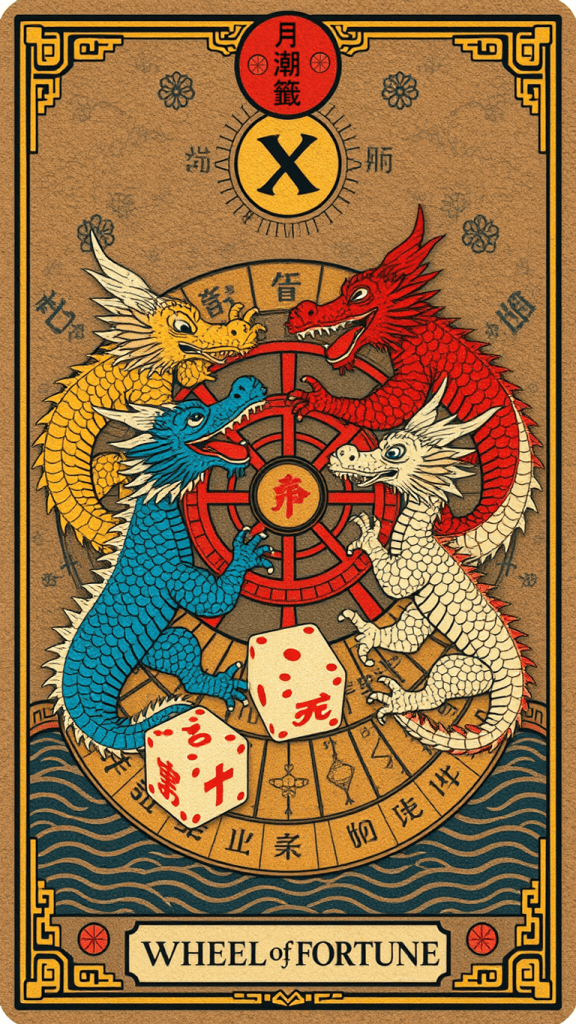
֍ WHEEL OF FORTUNE – Card X

TITLE: The Moon-Tide Lottery / 月潮籤 (Yuè Cháo Qiān)

MYTHIC ARCHETYPE: Mazu’s Gambling Hall

TAOIST PARALLEL: The Dragon Kings’ Dice Game (龍王骰戲, Lóngwáng Tóuxì) where the four sea gods wager tidal fortunes using whalebone dice carved with Bagua symbols.

PIRATE TWIST: The “wheel” is a ship’s steering oar spun by Zheng Yi Sao’s ghost, deciding which junk gets plunder and which gets typhoons.

WHY WHEEL OF FORTUNE? The tides never cheat—but they never play fair either.

TAOIST PIRATE SYMBOLISM

KEYWORDS (Upright):

Cháo bō (潮博, “tide gambling”)—fate as a pirate’s wager.

The moon’s ledger (月賬, yuè zhàng)—where debts wash clean every cycle.

“Kraken’s kiss” (海怪吻, hǎiguài wěn)—sudden fortune from chaos.

KEYWORDS (Reversed):

Shī cháo (失潮, “lost tide”)—missing your wave.

Yāo qián (妖錢, “haunted coins”)—cursed windfalls.

The drowned dice (沉骰, chén tóu)—fixed by sea ghosts.

INTERPRETATION: This card is fate’s tide table—you can’t stop the turn, but you can learn to surf.

RITUAL: THE BAGUA TIDE-CHART (八卦潮表, Bāguà Cháo Biǎo)

(Inspired by Fujianese pirate almanacs and Taoist tide-divination)

PURPOSE: To align with—not fight—life’s cycles.

MATERIALS:

Eight coins (for the Bagua).

A round wooden plate (ship’s wheel or bowl).

Saltwater in a seashell.

A candle (red for luck).

STEPS:

Arrange coins in a Bagua circle on the plate. Light the candle at center.

Spin the plate while chanting:

东龙之金,西龙之浪,

南龙之火,北龙之咸天。

The gold of the East Dragon, the waves of the West Dragon,

the fire of the South Dragon, the salty sky of the North Dragon.

When it stops, the top coin is your current tide:

☰ Heaven: Fortune rises.

☷ Earth: Stay grounded.

☲ Fire: Sudden change.

☵ Water: Go with the flow.

Flick saltwater on that coin—seal your pact with fate.

PARALLEL MYTHOLOGY

TITLE: The Churning of Cosmic Tides / The Wheel of Samudra

MYTHIC ARCHETYPE: The Samudra Manthan (Hindu Cosmology)

REGION: Indian Subcontinent (Hinduism)

FORM: A cosmic event where the Devas and Asuras use the serpent king Vasuki as a rope, wrapped around Mount Mandara as a churning rod, to churn the Ocean of Milk. Lord Vishnu, in his Kurma (turtle) avatar, supports the mountain.

TALE: As detailed above, the churning is a grand cooperative (and later competitive) act that unleashes the full spectrum of fate, from deadly poison to the goddess of fortune, all in the pursuit of immortality.

WHY WHEEL OF FORTUNE? It is the ultimate allegory for fate. The up-and-down pulling motion by the gods and demons perfectly mimics the rise and fall of fortunes. The array of unforeseen outcomes (both bane and boon) demonstrates that we can set events in motion, but we cannot control the cycles of destiny. Lakshmi’s emergence explicitly links the event to fortune.

INTERPRETATION THROUGH SAMUDRA MANTHAN: This card signifies that a great cycle is in motion in your life. You have set the churning rod in place, and now you must be prepared for what emerges from the depths. It may be a poison that tests you, or it may be a treasure you never expected. You cannot stop the wheel from turning, so your task is to adapt, to have faith (like the gods who trusted Shiva to handle the poison), and to be ready to receive the fortune when it arrives.

RITUAL OF THE SWEET AND SALTY CHURN (For Embracing Your Cycle)

OBJECTIVE: To prepare your spirit for an upcoming change or to find peace within a current cycle, acknowledging that all cycles contain both shadow and light.

MATERIALS:

A clear glass bowl or jar filled with water.

A spoonful of honey or sugar (for Lakshmi’s boon).

A spoonful of sea salt (for the Halahala’s challenge).

A small stirring stick or spoon (your Mount Mandara).

Optional: A small item to represent yourself (a small stone or charm).

STEPS:

PREPARATION: Sit with your bowl of water. This is your personal Ocean of Milk, the sea of your current life circumstances.

ACKNOWLEDGING DUALITY: Add the spoonful of honey to the water, saying: “I am open to the sweetness of fortune. I am ready for the blessings I cannot yet see.” Then, add the spoonful of salt, saying: “I have the strength to face the bitterness of challenge. I am ready for the lessons I must learn.”

THE CHURNING: Place your “self” stone in the water if using. Now, use your stirring stick to slowly churn the water. As you stir, don’t focus on mixing everything perfectly. Just observe the currents. See how the sweet and salty elements swirl, sometimes separating, sometimes combining. This is your life’s cycle in motion.

THE SCRY OF ACCEPTANCE: As you churn, speak a simple mantra of surrender: “What comes, I will meet. What goes, I will release. The wheel turns, and I turn with it.” Continue stirring until you feel a sense of calm acceptance.

RECEIVING THE MOMENT: Stop churning. Close your eyes. Dip one finger into the water, and touch it to your tongue. Do you taste sweetness? Saltiness? Both? Neither? This is not a prediction, but a moment of mindfulness—a taste of your life’s current flavor. Accept it without judgment.

CLOSING: Leave the bowl to settle. The water will eventually become still again, the elements merged. This is the new equilibrium you will find after the turn. Pour the water out onto the earth as an offering. Say: “My thanks to the cosmic tides. My heart is ready.” The ritual is complete.

SYNCRETIC BRIDGE

Samudra Manthan → Dragon Pearl Gambit (龍珠賭, Lóngzhū Dǔ): Both unleash boons and curses from the deep.

Lakshmi → Mazu’s Treasure Barge (媽祖寶船, Māzǔ Bǎochuán): Abundance as flotsam from shipwrecks.

THE “SCHOLAR’S HEART” MANDATE:

Sources: This is a cornerstone story in Hinduism. The most detailed accounts are found in the Bhagavata Purana, the Mahabharata, and the Vishnu Purana. We can reference these sacred texts with great respect for their profound philosophical and spiritual depth. Also see: Ming “Tide-Wheel” Clocks—water clocks that predicted fortune cycles via tidal astronomy.

Tags

, , , , , , , ,

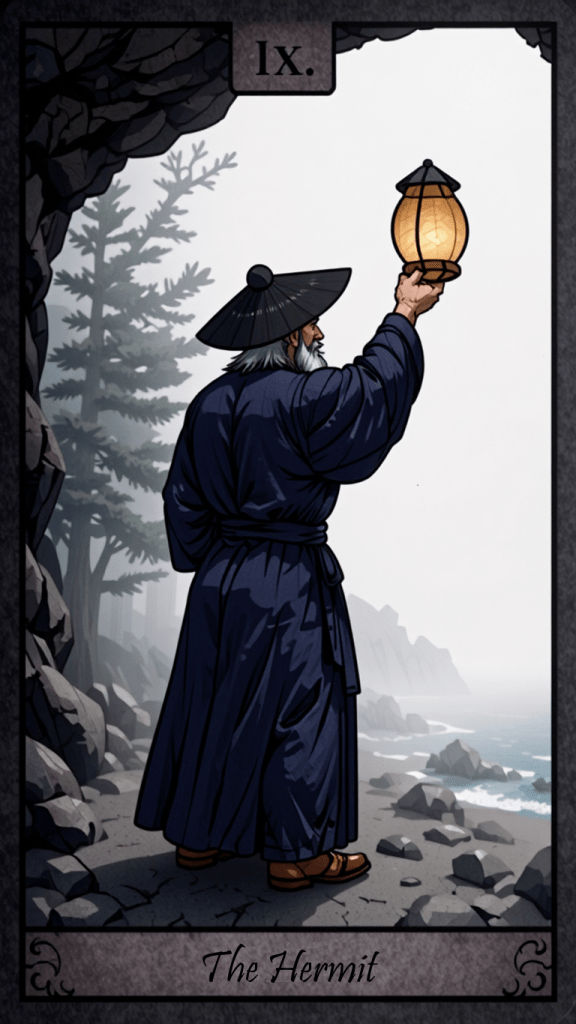
֍ The Hermit – Card IX

TITLE: The Blind Tide-Reader / 盲潮翁 (Máng Cháo Wēng)

MYTHIC ARCHETYPE: The Pirate Who Forgot His Name

TAOIST PARALLEL: Xu Fu (徐福), the alchemist sent by Qin Shi Huang to find immortality, lost at sea—merged with Zhuangzi’s Old Fisherman who knew the Way of tides.

PIRATE TWIST: He’s not just a hermit—he’s the admiral of a ghost fleet that sails in circles, forever seeking Penglai (蓬萊). His eyes were burned white by staring into the Black Tide Mirror (黑潮鏡, hēi cháo jìng) too long.

WHY THE HERMIT? He embodies wúwéi (無為) as driftwood—not seeking, but being sought by truth.

TAOIST PIRATE SYMBOLISM

KEYWORDS (Upright):

Cháo yīn (潮音, “tide-sound”)—hearing wisdom in wave patterns.

The forgotten compass (忘羅盤, wàng luópán)—navigation by soul, not stars.

“Crab-script” (蟹書, xiè shū)—reading truths in sand-writing.

KEYWORDS (Reversed):

Hǎi wàng (海忘, “sea-amnesia”)—lost in endless searching.

A salted tongue (鹹舌, xián shé)—wisdom that cannot be spoken.

The moonless ledger (無月賬, wú yuè zhàng)—records eaten by tides.

INTERPRETATION: This card is the lantern that blinds. The Tide-Reader’s light doesn’t guide—it reveals how lost you’ve always been.

RITUAL: THE BLACK TIDE MIRROR (黑潮鏡, Hēi Cháo Jìng)

(Inspired by Taoist dark meditation and Fujianese “shadow navigation”)

PURPOSE: To confront the self by becoming the abyss.

MATERIALS:

A black lacquer bowl (or ink-darkened water).

Three pinches of ashes (from incense or burnt paper).

A single iron nail (to “anchor” the vision).

A candle (white, to extinguish).

STEPS:

At midnight, place the bowl on a low table. Stir ashes into the water.

Press the nail into the table’s edge, chanting:

将潮水钉在沙滩上,将灵魂钉在大海上—你早已失去了你所追求的东西。

Nail the tide to the beach, nail your soul to the sea – you have already lost what you seek.

Light the candle, stare into the black water until the flame’s reflection drowns.

Blow out the candle. Sit in darkness until your breath matches the tide’s pull.

PARALLEL MYTHOLOGY

TITLE: The Monk of the Abyss / The Silence That Knows

MYTHIC ARCHETYPE: The Umibōzu (Japanese Yōkai)

REGION: Japan

FORM: A massive, shadowy, humanoid spirit that rises from the depths on calm nights. Its name translates to “sea monk,” as its head is large, round, and smooth like the shaven head of a Buddhist monk.

TALE: The Umibōzu is not a chatty oracle. It is a presence. It rises from a placid sea, a sudden, dark embodiment of the terrifying mystery and depth hidden just beneath the surface. It can be destructive if angered or disrespected, but its primary function in folklore is to be a figure of profound, awe-inspiring dread and mystery. To encounter the Umibōzu is to come face-to-face with the vast, unknowable soul of the ocean itself.

WHY THE HERMIT? The Hermit’s journey is a descent into the self. The Umibōzu is the personification of that deep, dark, silent inner space. It represents the intimidating but necessary step of confronting the vast unknown within. The wisdom it offers isn’t in words, but in the silence it commands. It forces a complete halt to the external journey, compelling the sailor (the seeker) to look into the abyss. It is the ultimate symbol of soul-searching and the profound truths found only in deep, contemplative solitude.

INTERPRETATION THROUGH THE UMIBŌZU: This card calls you to a profound retreat. It is time to turn off all external noise and face the silent, deep waters of your own consciousness. Like a sailor on a calm sea at midnight who suddenly sees the Umibōzu rise, you are being asked to stop everything and simply be with the immense mystery of your own being. It may be daunting, but the greatest wisdom you seek is not outside of you; it is waiting in your own personal abyss.

THE RITUAL OF THE DARK WATER LANTERN (For Seeking Inner Truth)

OBJECTIVE: To receive wisdom from your deepest subconscious by creating a space of absolute stillness and darkness, and listening to the silence.

MATERIALS:

A black or very dark-colored bowl.

Water.

A few drops of black ink or food coloring (optional, but effective).

One single candle (white or blue).

A room that can be made completely dark and silent.

STEPS:

CREATING THE ABYSS: In your darkened room, place the bowl before you. Fill it with water. If using ink, add a few drops until the water is an opaque, black mirror. This is the calm, midnight sea.

Lighting the Lantern: Light the single candle and place it beside the bowl. This is your Hermit’s lantern, the only light in the vast darkness. Turn off all other lights.

THE DESCENT: Sit in the silence. Stare softly at the reflection of the single flame on the surface of the black water. Breathe slowly, deeply. Let the silence of the room expand until it feels like the crushing, profound silence of the deep ocean. You are the lone sailor. The black water is your soul.

THE QUESTION: Whisper a single, deep question to the water. Do not ask “what should I do?” Ask “What wisdom do I need?” or “What truth am I avoiding?” Release the question into the deep.

THE VIGIL: Now, you listen. Do not expect a booming voice. The Umibōzu does not speak. Its wisdom rises from the quiet. Let your mind go still. An answer may come as a new feeling, a single word that surfaces in your mind, a forgotten memory, or a sudden, quiet understanding. You are not looking for an answer; you are creating the silence in which the answer that is already there can finally be heard.

THE RETURN: When you feel the vigil is complete, bow your head to the bowl in gratitude. Gently blow out the candle, plunging the room into total darkness for a moment. Acknowledge the abyss. Then, turn on the lights. Immediately write down any thoughts, feelings, or words that came to you in your journal.

SYNCRETIC BRIDGE

Umibōzu’s Silence → Taoist Mòzhì (默知, “silent knowing”) Both reject language for direct experience.

Black Water → Xuánmíng (玄冥, “dark profound”) The primordial sea before creation in Zhuangzi.

THE “SCHOLAR’S HEART” MANDATE:

Sources: The Umibōzu is a well-known yōkai in Japanese folklore. See: Toriyama Sekien’s Gazu Hyakki Yagyō and modern scholarly works on Japanese folklore, Michael Dylan Foster’s The Book of Yōkai: Mysterious Creatures of Japanese Folklore. For the ritual see:《東南海龍王經》(Scripture of the Southeast Dragon Kings), 1783 (Zhenjiang Taoist Temple Archive, Jiangsu).

Tags

, , , , , , ,

֍ STRENGTH – Card VIII

TITLE: The Dragon Whisperer / 龍語者 (Lóng Yǔ Zhě)

MYTHIC ARCHETYPE: The Pirate Who Tamed the Storm

TAOIST PARALLEL: Mazu (媽祖) as the Storm-Soothing Sage, merged with Zheng Yi Sao’s (鄭一嫂) legendary pirate queen who silenced mutinies with a glance.

PIRATE TWIST: She doesn’t just call sharks—she negotiates with typhoons. Her “rattle” is a dragonbone flute that plays the five tones of wind (五音風, wǔ yīn fēng).

WHY STRENGTH? She embodies wuwei (無為) mastery—controlling chaos through harmony, not force.

TAOIST PIRATE SYMBOLISM

KEYWORDS (Upright):

Fēng píng (風平, “wind-calming”)—serenity as power.

The dragon’s pulse (龍脈, lóng mài)—reading storms like qi meridians.

“Silk rope diplomacy” (絲繩交, sī shéng jiāo)—restraining violence with grace.

KEYWORDS (Reversed):

Hǔ jí (虎急, “tiger’s panic”)—fear breaking focus.

A cut qín string (斷琴弦, duàn qín xián)—lost harmony.

The Dragon’s snarl (龍哮, lóng xiào)—nature rejecting your touch.

INTERPRETATION: This card is strength as fluidity. The Whisperer doesn’t chain the dragon—she sings it to sleep.

RITUAL: THE FIVE WINDS FLUTE (五音笛, Wǔ Yīn Dí)

(Inspired by Ming naval weather magic and Taoist sound healing)

PURPOSE: To calm inner or outer turbulence through resonant harmony.

MATERIALS:

A flute (or a seashell to blow into).

Five ribbons (blue, green, red, white, black).

A bowl of brine.

A candle (yellow or blue).

STEPS:

Tie the ribbons to the flute, chanting:

东风向你招呼,南风向你进攻,西风向你屈服,北风向你跪下,中风将你封锁。

The east wind greets you, the south wind attacks you, the west wind submits to you, the north wind kneels before you, and the middle wind seals you away.

Dip the flute in brine (to “salt” its voice). Play one long note per wind direction.

Blow out the candle with the last note—the storm is tamed.

PARALLEL MYTHOLOGY

TITLE: The Shark Tamer / The Hand That Calms the Deep

MYTHIC ARCHETYPE: The Shark Caller (Melanesian Shamanic Tradition)

REGION: Melanesia, particularly Papua New Guinea and the Solomon Islands.

TALE: In these island cultures, certain individuals are born into lineages with the power to “call” sharks. This is not a trick; it is a profound shamanic practice. The caller prepares for days with ritual purification and abstinence. They then go out to sea in a canoe, using a special rattle made of coconut shells and other magical implements to create a specific sound. They chant secret names and incantations, which draw the sharks to the boat. It is an act of immense courage and deep spiritual connection, facing the ocean’s ultimate predator with nothing but knowledge, tradition, and calm inner power.

WHY STRENGTH? This is a perfect fit. The Shark Caller embodies the core principles of the Strength card:

COURAGE: Facing primal fear (the shark) without aggression.

INNER POWER: Using subtle forces (chants, rattles, knowledge) rather than physical might.

PATIENCE & COMPASSION: Understanding the nature of the beast to influence it.

INTEGRATION: The goal is to bring the wild power of the shark into a relationship with the human world, integrating the raw, instinctual self with the conscious, disciplined self.

INTERPRETATION THROUGH THE SHARK CALLER: To draw this card is to be told you have the inner strength to face a situation you fear. Do not meet it with brute force. Meet it like the Shark Caller. Understand its nature, have compassion for its wildness (whether it’s your own anger, a difficult person, or a challenging situation), and use your quiet, persistent inner power to bring it into harmony. You have the gentle hand that can tame the lion—or the shark.

THE RITUAL OF CALLING YOUR SHARK (For Integrating Inner Power)

OBJECTIVE: To bravely face a powerful “beast” within yourself, not to destroy it, but to understand it and integrate it as a source of controlled strength.

MATERIALS:

An object that represents your inner shark (a shark tooth, a dark stone, a drawing of a shark).

A bowl of saltwater.

A rattle or a small bell. Anything that can create a rhythmic, focused sound.

A safe, quiet space where you will not be disturbed.

STEPS:

CREATING THE LAGOON: Sit on the floor and place the bowl of saltwater in front of you. This is your safe ritual space, your lagoon.

NAMING AND SUMMONING: Hold the shark object. Name the inner beast you are facing. “My untamed anger, you are my shark.” or “My crippling self-doubt, you are my shark.” Place the object in the center of your space. Now, begin to gently shake the rattle. This is you, the Caller. You are not running; you are summoning. Close your eyes and allow the feeling—the anger, the fear—to rise within you. Let it fill the space. Just observe it. This is the act of courage.

THE GENTLE HAND (TONIC OF IMMOBILITY): When the feeling is at its peak, stop rattling. Open your eyes and look at the shark object. Now, perform the central act. Reach out your hand—slowly, calmly, deliberately. Do not grab the object. Gently place your fingertips on it. This is the touch on the shark’s snout. As you touch it, project feelings of calm, acceptance, and compassion, not fear. Speak to it. “I see you. I am not afraid of you. I honor your power.”

THE INTEGRATION: Keep your hand on the object. Feel the intense emotion begin to subside, transformed by your calm acceptance into a manageable energy. Now, make your pact with it. “Anger, you will be my strength to protect my boundaries. You will not be my rage that harms others. You will serve me.”

SEALING THE PACT: Lift the object and dip it into the bowl of saltwater, anointing and purifying it. Hold it to your heart. Say: “The beast within is not my enemy. It is my strength. We are one.”

CLOSING: Keep the charged shark object on your altar or carry it with you. When you feel that old, raw emotion rising, touch the object to remind yourself of your pact and your own inner strength. The ritual is complete.

SYNCRETIC BRIDGE

Shark Caller’s Rattle → Dragonbone Flute: Both use sacred sound to commune with predators.

Tonic Immobility → Wuwei: Non-action as the ultimate control.

THE “SCHOLAR’S HEART” MANDATE:

Sources: This is a well-documented anthropological phenomenon. See: references of Zheng (鄭和) “calm wind” flags—silk banners inscribed with Taoist wind-bindings as well as ethnographic studies on the art and rituals of Melanesia, such as the works of anthropologist A.B. Deacon or museum collections that feature shark-calling rattles and ritual art. For the ritual see: 《南海巫法秘本》[Southern Sea Witchcraft Manual], 1809.

Tags

, , , , , , , ,

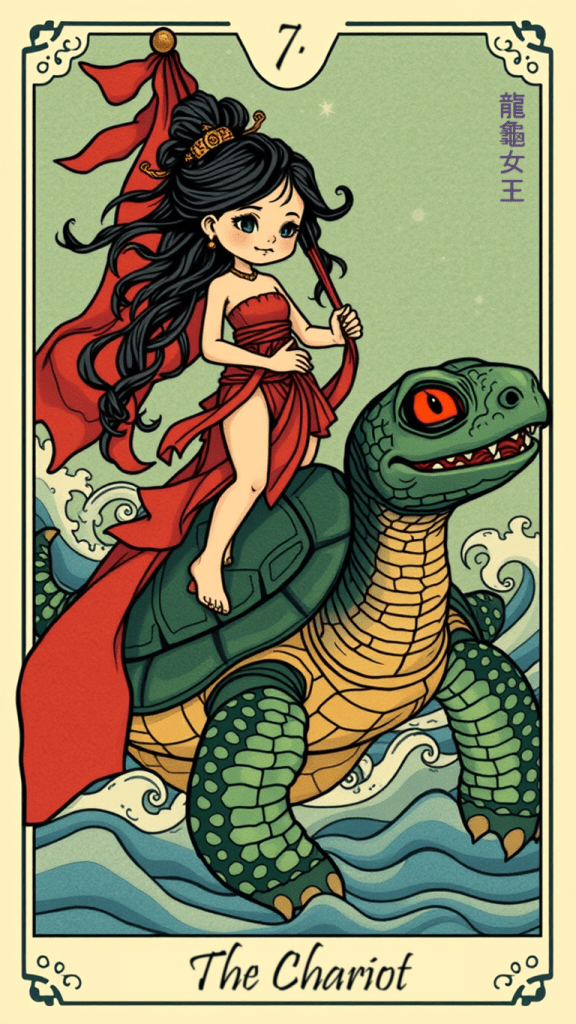
🜄 THE CHARIOT – Card VII

TITLE: The Dragon-Turtle Queen / 龍龜女王 (Lóng Guī Nǚwáng)

MYTHIC ARCHETYPE: The Girl Who Stole the Celestial Current

TAOIST PARALLEL: Mazu (媽祖) in her untamed youth—before she became a goddess, when she rode a dragon-turtle (龍龜, lóngguī) to outrun the Dragon King’s navy.

PIRATE TWIST: The turtle’s shell is carved with stolen star charts, and its flippers churn the water into smooth highways—because Mazu didn’t just ride it, she taught it to cheat tides.

WHY THE CHARIOT? This isn’t brute force—it’s alliance with the primordial. The dragon-turtle is the vehicle, the guide, and the weapon.

TAOIST PIRATE SYMBOLISM

KEYWORDS (Upright):

Guī bèi dào (龜背道, “Turtleback Dao”) — The path appears only when you move.

Starlight hooves (the turtle’s flippers glow with bioluminescence).

No reins (you don’t steer a dragon-turtle; you negotiate)

KEYWORDS (Reversed):

Cracked shell (overburdened by ambition).

The turtle dives (your will is not the tide’s will).

Mazu’s lost sandal (arrogance leaves evidence).

INTERPRETATION: You’re not driving—you’re dancing with a force older than ships. Victory comes from letting the cosmos carry you.

RITUAL: THE TURTLE’S STAR TRAIL (龜星跡, Guī Xīng Jì)

(For harnessing momentum without force)

MATERIALS:

A turtle shell (or a bowl painted with one)

7 pearls (or glass beads)

Seaweed (dried, for “roads”)

Your breath (held for 8 seconds)

STEPS:

Arrange the pearls in the Big Dipper pattern inside the shell.

Lay seaweed trails leading outward like “paths.”

Hold your breath and whisper:

媽祖坐騎,沉者之甲,

載我至星碎之處!

Mazu’s steed, shell of the drowned,
Carry me to where stars are shattered!

Blow across the pearls—the one that rolls farthest reveals your best direction.

PARALLEL MYTHOLOGY

TITLE: The Victorious Rider / The Will That Crosses Oceans

MYTHIC ARCHETYPE: Paikea (Māori Ancestral Hero)

REGION: Aotearoa (New Zealand) / Māori Tradition

FORM: A human ancestor of the Ngāti Porou iwi (tribe).

TALE: Paikea was the sole survivor of a maritime disaster on the vessel of his treacherous half-brother, Ruatapu. Left to die in the open ocean, Paikea did not give up. He called upon the guardians of the sea and his own ancestors, chanting powerful karakia (incantations). In response, a tohorā (whale) came to his aid. Clinging to its back, Paikea rode the whale across the vast Pacific, guided by his will and his connection to the natural world. He landed safely at Ahuahu (Mercury Island) in Aotearoa, becoming a revered progenitor of his people.

WHY THE CHARIOT? Paikea is the ultimate Charioteer. He harnesses a powerful, wild force (the whale) not through brute force, but through focused will, spiritual connection, and absolute determination. He balances the opposing forces of despair and hope, sea and sky, and drives himself forward to a triumphant victory against all odds. His story is the very definition of willpower leading to success.

INTERPRETATION THROUGH PAIKEA: This card is a green light. It says that you have the will and the power to overcome the obstacles in your path. Like Paikea, you must call upon your inner strength (mana), focus your intention like a beacon, and “ride the whale” of your current circumstances to victory. It’s a call to take the reins, be disciplined, and drive forward with confidence.

THE RITUAL OF THE RIDER’S CHANt (For Driving Towards a Goal)

OBJECTIVE: To galvanize your personal will and focus all your energy on achieving a specific, challenging goal. This is a ritual for when you need momentum and the strength to overcome obstacles.

MATERIALS:

An object that represents your “vehicle” or the energy you need to harness (e.g., a car key for a journey, a pen for writing a book, a small weight for a fitness goal).

A space where you can make noise and move.

A compass or a knowledge of the cardinal directions.

A glass of water.

STEPS:

DECLARING THE DESTINATION: Stand in your space and face the direction that feels most aligned with your goal (or just East, the direction of beginnings). Hold your “vehicle” object. State your goal aloud, not as a wish, but as a destination. “My destination is the completion of this project by the month’s end.”

THE INVOCATION OF WILL: Acknowledge the forces you must balance. “I call upon the strength of my ambition. I call upon the discipline of my mind. You will not pull against each other. Today, you pull together. You pull for me.”

CRAFTING THE CHANT (KARAKIA): You will now create your own personal power chant. It should be short, rhythmic, and intensely focused on your goal. Use strong, active words. Repeat it, starting soft and getting louder and more powerful. Let it build a rhythm in your body. You might stomp your feet or clap your hands.

EXAMPLE FOR A CREATIVE PROJECT: “Ink flows, mind knows, work grows, seed sows!”

Example for overcoming a fear: “Heart strong, stand long, fear wrong, move on!”

THE RIDE: Begin chanting. Let the energy build. Feel the power rising from the earth through your feet and out through your voice. You are Paikea on the back of the whale. You are the Charioteer. The chant is the force of your will driving you forward. Continue until you feel a peak of energy, a feeling of unstoppable momentum.

THE ARRIVAL AND GROUNDING: At the peak, give one final, powerful shout of your chant. Then, stop. Silence. Feel the vibrating energy in your body. Pick up your glass of water and drink it all. You are replenishing yourself after the journey. Hold your “vehicle” object to your heart and say: “The will is set. The journey has begun. Victory is the destination.”

CLOSING: Carry your “vehicle” object with you. The energy you infused into it will serve as a source of strength and focus as you move forward. The ritual is complete.

SYNCRETIC BRIDGE

Whale Rider → Dragon-Turtle: Both are ancient, wise, and terrifyingly fast.

Paikea’s Chants → Mazu’s Star Theft: The Maori hero called the whale; Mazu stole the turtle’s loyalty with fermented lychees.

THE “SCHOLAR’S HEART” MANDATE:

Sources: The story of Paikea is a central ancestral narrative for the Ngāti Porou and other iwi. It is recorded in oral traditions, songs (waiata), and genealogical recitations (whakapapa). See: scholarly works on Māori mythology, such as Margaret Orbell’s The Illustrated Encyclopedia of Māori Myth and Legend, for a respectful retelling. The modern story was, of course, popularized by the book and film Whale Rider. For the ritual see: Lin, Q. (Ed.). (1762). 《天妃顯聖錄》 [Tianfei Xianshenglu]. Fujian Folk Texts, Vol. 4. (“Girl Who Rode the Storm,” pp. 22–23).

Tags

, , , , , , , ,

🜄 THE LOVERS – Card VI

TITLE: The Moonlit Crossing / 月渡抉择 (Yuè Dù Juézé)

MYTHIC ARCHETYPE: The Pirate Queen and the Dragon King’s Daughter

TAOIST PARALLEL: Liu Yi (柳毅), the scholar who married a Dragon King’s daughter after delivering her plea for help, merged with Ching Shih’s (鄭一嫂) legendary romance—a Pirate Queen who bargained with sea spirits for her lover’s life.

PIRATE TWIST: The lover isn’t human—she’s the veiled daughter of Ao Guang (敖廣), who offers the pirate queen a choice: sail with her to the Dragon Palace (and become immortal) or return to the mortal world (and forget her forever)?

WHY THE LOVERS? The Pirate Queen must choose: mutiny against man-made’s laws and the sea’s cruelty?

TAOIST PIRATE SYMBOLISM

KEYWORDS (Upright):

Hǎi shì méng (海誓盟, “oath written in tidewash”)—a love that defies realms.

“Moonbridge” (月橋, yuè qiáo)—the fleeting path between worlds.

The pearl with two faces (雙面珠, shuāng miàn zhū)—one mortal, one divine.

KEYWORDS (Reversed):

Jiǎo yìn (腳印, “footprints in tidewash”)—a love erased by dawn.

“Broken compass” (破羅盤, pò luópán)—choosing safety over soul.

The Dragon’s ransom (龍贖金, lóng shújīn)—love bought with regret.

INTERPRETATION: This card is the mutiny of the heart. The Dragon’s daughter waits on the moonbridge—will you sink your past to join her?

RITUAL: THE PEARL’S CHOICE (珠選, Zhū Xuǎn)

(Inspired by Ming-era bridal laments and pirate parole rites)

PURPOSE: To clarify a heart’s dilemma when torn between two loves or paths.

MATERIALS:

Two pearls (or white stones).

A red thread (for fate).

Saltwater in a blue bowl.

A candle (white or red).

STEPS:

NAME THE CHOICES: Assign each pearl a path (for example, Stay or Go).

THREAD THE PEARLS: Tie them to the red thread, chanting:

东潮明珠,西潮明珠——

一颗属于陆地,一颗属于海洋。

East tide’s pearl, West tide’s pearl—

One for the land, one for the sea.

BURN THE THREAD: Hold it over the candle until it snaps. The first pearl to fall is your heart’s answer. Sink the Chosen Pearl into the bowl—the sea accepts your vow.

PARALLEL MYTHOLOGY

TITLE: The Shoreline Choice / The Heart’s Two Worlds

MYTHIC ARCHETYPE: The Fisherman and the Water Engkanto (Philippine Folklore)

REGION: The Philippines (specifically Visayan folklore)

FORM: A human (often a fisherman) and an engkanto, a beautiful, otherworldly nature spirit associated with the water and the mystical, invisible spirit-world.

TALE: In many Filipino tales, a mortal man encounters a stunningly beautiful diwata (nymph) or engkanto by the sea or a river. They fall into a deep, authentic love. The relationship is perfect, but it exists on a threshold. The engkanto eventually presents the mortal with The Choice: “Come with me to my world (the mystical city of Biringan, the kingdom beneath the waves). There, you will know no sorrow or aging, and we will be together forever. But you must forsake your human life completely. You can never return to your family, your friends, or the sunlit world.” The mortal is caught between two profound loves: the love for their partner and the love for their home and humanity.

WHY THE LOVERS? This myth is the Tarot’s Lovers card in narrative form. It is not about seduction; it is about a genuine, soul-level connection that forces the ultimate choice. It’s about the union of two different worlds (mortal and spirit, land and sea) and the need to align one’s heart with one’s values to make a decision that will define one’s entire reality. It perfectly captures the harmony, the choice, and the high stakes of the card.

INTERPRETATION THROUGH THE MYTH: This card signifies a monumental crossroads, usually involving a relationship or a deep calling of the heart. You stand on the shoreline between two worlds, two possible futures. You cannot have both. The choice must be made not just with logic, but with your soul’s deepest truth. Which world are you truly meant for? To draw this card is to be asked to make your shoreline choice with courage and authenticity.

THE RITUAL OF THE TWO SHELLS (For Making a Heart-Centered Choice)

OBJECTIVE: To gain clarity on a major life decision by physically and spiritually engaging with the opposing choices, and then formally committing to one path.

MATERIALS: Two distinct and different shells or stones. They must feel different to the touch.

A PHYSICAL THRESHOLD: a doorway, a line drawn in the sand, or a ribbon laid on the floor with a bowl of saltwater.

AN OFFERING: A beautiful flower, a piece of fruit, or a written poem.

STEPS:

DEFINE THE CROSSROADS: Stand before your threshold. Clearly state the choice you are facing. Assign one choice to each shell. For example, Shell A is “Stay in my current city.” Shell B is “Move to the new city.”

EMBODYING THE FIRST PATH: Pick up Shell A. Hold it in both hands. Close your eyes and fully immerse yourself in that reality. Speak its truths aloud: the good, the bad, the fears, the comforts. “If I stay, I have my friends, my familiar job. I also have this feeling of being stuck. I fear I will regret not leaving.” Spend a few minutes truly living in that choice. Then, dip the shell in the saltwater and place it on the “starting” side of the threshold.

EMBODYING THE SECOND PATH: Now, pick up Shell B. Do the same. Fully immerse yourself in this other reality. Speak its truths aloud. “If I move, I have this opportunity, the excitement of the unknown. I also have the fear of being alone. I will miss my family.” Live in this choice. Then, dip this shell in the saltwater and place it beside the other one.

THE SHORELINE CHOICE: Stand before the two blessed shells. You are the Fisherman on the shore. Do not think. Feel. Which shell, which path, calls to your soul? Which one feels like home, even if it’s scary? Your heart, not your logical mind, knows the answer.

THE COMMITMENT: When you know, pick up the shell of your chosen path. Leave the other one behind. Step across the threshold, holding your chosen shell to your heart. You have made the choice. You have left the other world behind.

THE OFFERING: Place your offering on the side of the threshold you left behind. This is an act of honoring the path not taken, thanking it for its wisdom, and releasing it with love. It prevents “what if” regrets. Say: “My choice is made. I honor what I leave behind. I walk forward with a whole heart.” The ritual is complete.

SYNCRETIC BRIDGE

Engkanto’s Choice → Dragon’s Tiāotiáo (迢迢, “eternal separation”): Both myths force a mortal-immortal divide.

Biringan City → Penglai (蓬萊): The Dragon Palace is the Taoist island of immortals.

THE “SCHOLAR’S HEART” MANDATE:

Sources: This archetype is a staple of Philippine folklore, referencing the extensive work of Maximo Ramos, particularly his book Creatures of Philippine Lower Mythology. Also Damiana Eugenio’s definitive collections of Philippine Folk Literature. See also: the legend of Biringan City, the invisible, ethereal city of the engkanto on Samar island, which acts as a Filipino Atlantis or Avalon. See: Mazu’s Celestial Matchmaking—she’s said to tie red threads between sailors and sea spirits. For the ritual, see: 《東南海龍王經》(Scripture of the Southeast Dragon Kings), 1783 (Zhenjiang Daoist Temple Archive, Jiangsu).

Tags

, , , , , , ,

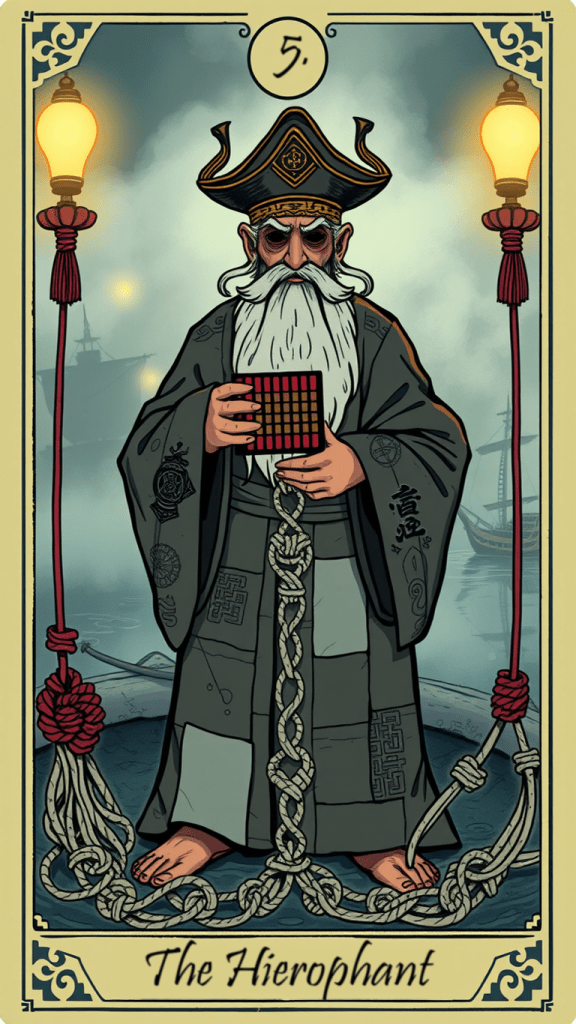
🜄 THE HIEROPHANT – Card V

TITLE: The Ghost Fleet’s Harbormaster / 陰船港主 (Yīn Chuán Gǎng Zhǔ)

MYTHIC ARCHETYPE: The Pirate Monk of the Nine Dragon Sea

TAOIST PARALLEL: Mazu’s Blind Harbormaster, a legendary figure who navigated ships by listening to qi (聽氣, tīng qì), merged with Zhu Bajie (豬八戒)—the oath-breaking, gluttonous monk from Journey to the West, reformed into a sea-priest of penitence.

PIRATE TWIST: He’s the keeper of the Jianghu Code (江湖規矩, jiānghú guīju), a former pirate who lost his eyes to a Dragon King’s curse for breaking an oath. Now he guides ships through fog-locked spirit ports, enforcing sacred pirate laws with a whalebone abacus that calculates karma.

WHY THE HIEROPHANT? He doesn’t preach—he arbitrates. His temple is a floating shrine-junk where warring captains kneel to settle disputes. He teaches that even thieves must honor the tide’s contract.

TAOIST PIRATE SYMBOLISM

KEYWORDS (Upright):

Hǎi shén pàn (海神判, “Sea God’s Verdict”)—fair judgment.

“Blood ink vows” (血墨誓, xuě mò shì)—oaths signed with cutlass scars.

The abacus of debts (算賬, suànzhàng)—karma tallied wave by wave.

KEYWORDS (Reversed):

A cut rope (斷索, duàn suǒ)—betrayal at sea.

“Blind fish” (盲魚, máng yú)—willful ignorance of tradition.

The cursed ledger (厄賬本, è zhàngběn)—unpaid spiritual debts.

INTERPRETATION: This card is the law of the outlaw. The Harbormaster knows even pirates need rules—or the sea swallows all.

RITUAL: THE TIDE-TIED OATH (潮綁誓, Cháo Bǎng Shì)

(Inspired by Ming pirate blood pacts and Daoist knot magic)

PURPOSE: To seal a sacred vow with the weight of the sea.

MATERIALS:

A length of seaweed (or hemp rope soaked in saltwater).

Two coins (one copper, one silver).

Your own blood (or red ink).

A candle (blue or white).

STEPS:

Knot the seaweed into a figure-eight (∞), chanting:

东潮宣誓,西潮束缚——

血与盐使契约磨砺。

The East Tide swore, the West Tide bound——
Blood and salt sharpens the pact.

Rub the coins with blood/ink, press them into the knots.

Burn one knot (for heaven’s record), sink the other (for the sea’s memory).

PARALLEL MYTHOLOGY

TITLE: The Oath-Keeper of the Tides / The Bridge Between Shores

MYTHIC ARCHETYPE: Njörðr (Norse God of the Sea and Sacred Oaths)

REGION: Scandinavia (Pre-Christian Norse Tradition)

FORM: A member of the Vanir gods, associated with the sea, seafaring, wind, fishing, wealth, and fertility of the coasts.

TALE: Njörðr’s most defining story comes at the end of the devastating Aesir-Vanir War. To secure a lasting peace, the two tribes of gods exchanged hostages. Njörðr, along with his children Freyr and Freyja, went to live with the Aesir in Asgard. He became a highly respected priest-king, presiding over religious festivals and sacred oaths. He is the living embodiment of a peace treaty, the bridge between two different cultures and traditions, who brings peace and prosperity through this sacred pact.

WHY THE HIEROPHANT? Njörðr is the Pontifex. He is the bridge. His entire existence in the main Norse myths is predicated on being the cornerstone of a sacred social structure (the peace treaty). He teaches that harmony and bounty (the wealth of the sea) come from honoring tradition, keeping one’s word, and integrating different belief systems. His story isn’t one of wild magic, but of diplomacy, community, and established ritual.

INTERPRETATION THROUGH NJÖRÐR: To draw this card is to be asked what oaths you have made—to others, and to yourself. It is a call to be a peace-broker in your own life. It signifies a time for learning from a trusted institution or mentor, one who can bridge your current world with a new one. Njörðr teaches that the greatest wealth is found not in lonely rebellion, but in the trust and structure that binds a community together.

RITUAL OF THE SALT AND SOIL PACT (For Making a Sacred Vow)

OBJECTIVE: To make a binding, sacred agreement, either with yourself (to commit to a path) or with another person (to seal a partnership or peace). This ritual establishes a formal structure of trust.

MATERIALS:

A cord or rope, about a foot long.

Two small bowls.

A spoonful of salt (or saltwater). This represents Njörðr’s domain: the Sea.

A spoonful of soil. This represents the other party, or the “land” of your current life.

AN OFFERING: Mead, ale, good quality beer, or honeyed water. Njörðr is a god of prosperity and festivals; he appreciates a good drink.

STEPS:

PREPARATION: Place the two bowls before you. Pour the offering into a cup. Clearly state the pact you intend to make. Write it down if you need to. Be precise. Example: “I make a sacred pact with myself to dedicate one hour every day to my craft, without excuse.”

THE INVOCATION: Hold the cup with the offering. Address the spirit of the ritual. “Njörðr, Oath-Keeper, Bridge Between Shores, you who secured peace with your presence, I call upon you to witness this sacred pact. Be the guardian of this vow.” Pour a small amount of the offering onto the ground or into a separate offering bowl.

ACKNOWLEDGING THE TWO SIDES: Place the salt in one bowl and the soil in the other. Touch the salt. “This is the Sea, the new world, the promise I am making.” Touch the soil. “This is the Land, my current self, the foundation upon which this promise is built.”

BINDING THE VOW: Take the cord. As you state your vow clearly and firmly one more time, tie a single, tight knot in the center of the cord. As you pull it tight, feel the commitment solidifying. This knot is the physical manifestation of your oath.

SEALING THE PACT: Take a pinch of the salt and a pinch of the soil and place them together in the palm of your hand. Mix them together. This symbolizes the joining of the two worlds, the peace treaty being sealed. Say: “As sea and land meet at the shore, so are these two sides joined. The pact is made.”

CLOSING: Drink from your offering cup. Keep the knotted cord on your altar, in your pocket, or tied to your wrist as a constant, physical reminder of your vow. The ritual is complete, and the pact is now witnessed.

SYNCRETIC BRIDGE

Njörðr’s Oaths → Pirate Xuèméng (血盟, “blood alliances”): Both bind land and sea through ritual.

Peace Treaty → Hǎi jìng (海靖, “sea pacification”): Ming emperors used pirate warlords as naval peacekeepers.

THE “SCHOLAR’S HEART” MANDATE:

Sources: The Poetic Edda (specifically the poems Vafþrúðnismál and Lokasenna) and Snorri Sturluson’s Prose Edda (in the Gylfaginning and Skáldskaparmál sections). These texts clearly lay out his role as a hostage, a peace-keeper, and a god of wealth. For the ritual see: 《海盗陰陽術》 (Pirate Yin-Yang Arts), 1796, and Quanzhou’s Maritime Trade Laws—12th-century pirate codes enforced by Mazu’s priestesses.

Tags

, , , , , , , , ,

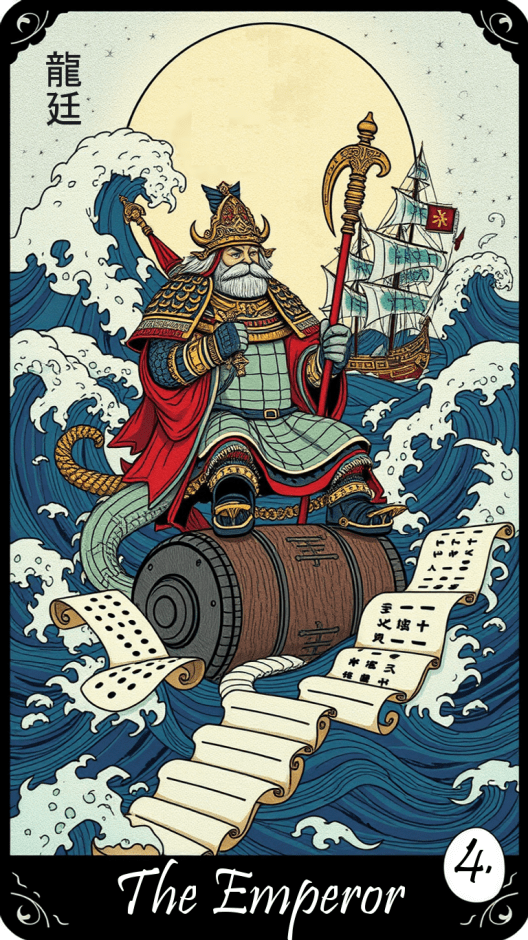
🜄 THE EMPEROR – Card IV

TITLE: The Dragon Throne / 龍廷 (Lóng Tíng)

MYTHIC ARCHETYPE: The Pirate Dragon King

TAOIST PARALLEL: Ao Guang (敖廣), the East Sea Dragon King, merged with Zheng Zhilong (鄭芝龍)—the real-life Ming dynasty pirate admiral who commanded 3,000 junks.

PIRATE TWIST: He’s not just a mythical ruler—he’s the admiral of the ghost fleet, enforcing hǎi shén fǎ (海神法, “Sea God’s Law”) from a throne of cannons and coral. His trident? A tide-cutting ji (戟) halberd that splits storms.

WHY THE EMPEROR? He doesn’t just control the sea—he is its justice. Cross him and your ship sinks paper-light (紙沉, zhǐ chén). Serve him, and he’ll guide you through fog-walled coves.

TAOIST PIRATE SYMBOLISM

KEYWORDS (Upright):

Lóngtíng lǜ (龍廷律, “Dragon Court Rules”)—code of the sea.

“Tides obey the Bagua” (潮隨八卦, cháo suí bāguà)—order in chaos.

The admiral’s seal (海帥印, hǎi shuài yìn)—stamped on waves.

KEYWORDS (Reversed):

A broken tide-table (破潮曆, pò cháo lì)—navigation failed.

“Dragon’s yawn” (龍哈欠, lóng hāqiàn)—complacency before disaster.

The sea tribunal (海審, hǎi shěn) where traitors walk the plank.

INTERPRETATION: This card is law written in saltwater. The Dragon Throne rewards loyalty and sinks oath-breakers. His power isn’t tyranny—it’s the certainty of the tide.

RITUAL: THE ADMIRAL’S SEAL (海帥印, Hǎi Shuài Yìn)

(Inspired by Ming naval codes and Daoist tide-summoning rites)

PURPOSE: To claim authority or stabilize chaos.

MATERIALS:

A wooden plank (driftwood or bamboo).

Red ink (or bloodroot pigment).

A knife (to carve).

Nine copper coins (for the Nine Dragons).

Saltwater.

STEPS:

Carve the Bagua into the plank at dusk.

Dip coins in ink, press them onto the wood like a seal, chanting:

东龙审判,西龙称重,

南龙焚烧,北龙付出代价。

East Dragon judges, West Dragon weighs,

South Dragon burns, North Dragon pays.

Bury the plank at a crossroads or fling it into the sea.

PARALLEL MYTHOLOGY
TITLE: Poseidon, Sovereign of the Sea’s Dominion / Keeper of the Trident
MYTHIC ARCHETYPE: Poseidon (Greek God of the Sea, Earthquakes, and Horses)
REGION: Ancient Greece and the wider Hellenic world
FORM: God of the sea, storms, horses, and earthquakes; wielder of the mighty trident
TALE: Poseidon is a formidable god whose temper mirrors the ocean’s tempestuous moods. As one of the Olympian siblings, he claimed dominion over the seas and all its creatures, as well as horses and the tremors beneath the earth. His trident symbolizes both creative and destructive power, capable of calming waves or shattering lands. Though sometimes seen as capricious and volatile, Poseidon also represents steadfast authority and governance over nature’s primal forces. His role as the Emperor in our oceanic Tarot is to teach the balance of control and power—how to rule with strength tempered by wisdom, and how to command loyalty and respect through firm, just leadership.
WHY THE EMPEROR? The Emperor stands for order, structure, protection, and leadership. Poseidon’s role as the sovereign sea god aligns perfectly, embodying authority grounded in the elemental power of water and earth.
INTERPRETATION THROUGH POSEIDON: When Poseidon appears, he calls forth the leader within you—the one who must wield power responsibly among tumultuous currents. He demands respect for the rules that hold worlds together but warns against becoming a tyrant who crushes rather than governs.
Poseidon asks: Where do you exert control? Are you a protector of your domain or a rigid despot? How do you balance power with compassion?
RITUAL: Invocation of Poseidon’s Command
PURPOSE: To call upon strength, leadership, or the power to establish order in chaos.
MATERIALS:
A trident-shaped object or symbolic representation (can be crafted or drawn)
Saltwater
Blue or sea-green candles
Shells or horse figurines (optional)
A strong, grounded space to perform the ritual
STEPS:
Place the trident or its symbol before you. Light the candles, representing the sea and its powers.
Sprinkle a few drops of saltwater around your space, envisioning Poseidon’s waves marking your territory.
SPEAK THE INVOCATION:

Poseidon, lord of sea and shore,
Keeper of waves, trident in hand,
Grant me the strength to lead and guard,
To rule with justice, firm but fair.

Visualize yourself standing tall like a pillar of rock amidst a stormy sea, unyielding but wise.
Close the ritual with gratitude, grounding yourself and honoring the ocean’s mighty ruler.
THE “BEST FIT” PRINCIPLE: Where Sedna is the deep, internal, life-giving source, Poseidon is the external, sovereign, structural power.

SOVEREIGNTY AND DOMAIN: The Emperor is the master of his realm. Poseidon’s authority over the sea is absolute and was established at the dawn of the Olympian age when the cosmos was divided among the three brothers (Zeus, Poseidon, Hades). This act of structuring the universe is a perfect Emperor concept.

THE TRIDENT AS SCEPTER: The Emperor holds a scepter, a symbol of his power to rule. Poseidon’s trident is one of the most famous symbols of divine authority in all mythology. It’s not just a weapon; it is the tool with which he enforces his will, creating earthquakes and calming storms. It is his law made manifest.

THE SHADOW SIDE: Poseidon’s infamous temper, his tyrannical rage against Odysseus, his stubbornness in his contest with Athena over Athens—these are all textbook examples of the Emperor’s negative traits: inflexibility, despotism, and the use of power for personal grudges rather than the good of the realm.

THE RITUAL OF THE TRIDENT’S STRIKE (To Establish a Foundation)

OBJECTIVE: To create a stable, protected foundation in a chaotic area of your life. Use this when starting a major project, fortifying your personal boundaries, or bringing order to your home or mind.

MATERIALS:

A staff, a sturdy branch, or even your own arm and fist. This is your “Trident.”

A bowl of saltwater.

Three stones, large enough to be stable. These represent the three points of the trident and the foundation you are building.

A piece of ground where you can perform the ritual (a yard, a park, or even a planter box).

STEPS:

SURVEYING THE DOMAIN: Stand before the piece of ground. This is your kingdom, the area you are about to bring into order. State your intention clearly and aloud. “I am here to bring order to my finances” or “I am here to establish a firm boundary of my personal time.”

CONSECRATING THE TRIDENT: Hold your staff (or arm) and dip its end into the saltwater. Raise it to the sky. DECLARE ITS POWER: “This is not wood, but bone of the Earth. This is not my arm, but the will of the Sea. This is the Trident that strikes the foundation and commands the deep.”

THE STRIKE: With all your focused intent, strike the ground firmly three times with the end of your staff. Each strike should be deliberate and powerful. With each strike, make a declaration:

(Strike 1): “By the power of the Earth Below, I set my foundation!”

(Strike 2): “By the power of the Sea Around, I set my boundary!”

(Strike 3): “By the power of the Sky Above, I declare my dominion!”

LAYING THE FOUNDATION: Place your three stones on the ground where you struck, forming a stable triangle. This is the physical anchor for the order you have created. Pour the remaining saltwater in a circle around the stones as a libation and a boundary of protection.

THE SOVEREIGN’S OATH: Stand straight, looking over your newly established “foundation.” Make a vow of responsible rulership. “I will rule this domain with strength and with wisdom. I will be its protector, not its tyrant. This order is established. So it is.”

CLOSING: Leave the stones in place for at least a full day and night. The act is complete. You have shifted from being a subject of chaos to the sovereign of your domain.

SYNCRETIC BRIDGE

Poseidon’s Trident → Dragon King’s Ji: Both split waves and enforce divine will.

Olympian Division → Fēngshuǐ of the Seas: The Dragon Kings divide the oceans like Bagua sectors.

THE “SCHOLAR’S HEART” MANDATE

Primary Sources: Homer’s Iliad and, most importantly, The Odyssey, where Poseidon’s role as a powerful, wrathful antagonist is central. Hesiod’s Theogony is essential for his origin and the division of the cosmos. The Homeric Hymn to Poseidon is a direct invocation that praises his power. For the ritual see: the biography of Admiral Zheng He’s (鄭和) navigation charts—they were ritual objects blessed by Mazu to command currents; as well as the Jiaolong myth in the 《述异记》 [Records of Strange Things], 6th century CE.

Tags

, , , , , , ,

🜄 THE EMPRESS – Card III

TITLE: The Saltblood Matriarch / 血鹽母 [Xuè Yán Mǔ]

MYTHIC ARCHETYPE: Mazu’s Wrath—The Queen of Shipwrecks

TAOIST PARALLEL: Mazu [媽祖] as the Storm-Bringer, fused with Lin Mo’s Legend—the girl who drowned saving her father’s fleet, only to rise as a goddess who both gives and takes from sailors.

PIRATE TWIST: She’s not just a savior—she’s the sovereign of drowned treasures, ruling a palace of sunken ships where barnacles bloom like orchids. Her severed fingers? Jade trade beads that became the first pearls.

WHY THE EMPRESS? She doesn’t just nurture—she decides. Her bounty is conditional: honor her, or she’ll salt your fields with shipwrecks.

TAOIST PIRATE SYMBOLISM

KEYWORDS [Upright]:

Fengshui of the Fathoms—arranging wreckage to attract wealth.

“Feeding the Sea” [祭海, jì hǎi]—offerings tossed to balance karma.

The Lóngnǚ’s dowry [龍女嫁妝]—sunken silks that surface as fortune.

KEYWORDS [Reversed]:

A cursed haul [厄運貨, èyùn huò]—plunder that starves its thief.

“Mazu’s turned tide” [媽祖反潮]—nurturance withdrawn.

The hungry ghosts [餓鬼, èguǐ] of ungrateful sailors.

INTERPRETATION: This card is abundance with teeth. The Saltblood Matriarch births coral from bones and feeds empires from her palms—but cross her, and your ships will founder. She’s the lesson: true wealth flows from reverence.

RITUAL:THE WRECKFEAST [沉船宴, Chénchuán Yàn]

[Inspired by Fujianese “Ghost Banquet” rites and pirate parole rituals]

PURPOSE: To restore flow to blocked creativity or resources.

MATERIALS:

A wooden bowl [driftwood if possible].

Nine coins [copper or brass].

Salt, rice and three drops of your blood.

A handful of sand.

A black silk cloth.

STEPS:

At low tide, lay the black silk as a “tablecloth.” Arrange the bowl atop it.

LAYER THE OFFERINGS:

Salt [for preservation].

Rice [for prosperity].

Sand [for the seafloor].

Coins [for the dead’s favor].

Add the blood, whispering:

沉船之母,我付出代价——

玉指张开,珍珠散开。

Mother of wrecks, I pay the price—

Let your jade fingers open, your pearls unloose.

Bury the bowl at the shoreline. Let the tide take it.

PARALLEL MYTHOLOGY

TITLE: Sedna, Mistress of the Deep / Queen of the Sea’s Bounty
MYTHIC ARCHETYPE: Inuit Sea Goddess
REGION: Arctic regions of Greenland, Canada, and Alaska
FORM: Goddess of the sea and marine animals; a powerful matron whose tragedy shaped the abundance of life beneath the waves
TALE: Sedna was once a mortal woman, sometimes said to be mistreated by her father. In a fateful moment of betrayal or escape, she was cast into the frigid sea and transformed into the goddess of the marine creatures. Her fingers were severed as she clung to the kayak’s hull and from these fingers arose the seals, walruses, and whales—the lifeblood of the Inuit people. Sedna dwells in the depths, controlling the availability of sea mammals and demanding respect and ritual offerings to provide bounty. Her story is one of sorrow, transformation, and fierce maternal power. She is at once a nurturer and a stern guardian, teaching reverence for the ocean’s gifts.
WHY THE EMPRESS? The Empress embodies fertility, growth, and the nurturing of life. Sedna’s dominion over the sea’s bounty makes her the perfect archetype—she is the ocean’s generous mother who sustains communities, even through hardship.
INTERPRETATION THROUGH SEDNA: When Sedna graces your reading, she calls you to honor your roots and your power to nurture life—whether that’s literal or creative energy. She reminds you that abundance often arises through sacrifice and deep emotional work.
Sedna asks: How do you tend the sources of your sustenance? Are you honoring the deep currents within that nourish your spirit?
RITUAL: Offering to Sedna for Bounty and Protection
PURPOSE: To invoke Sedna’s favor for sustenance, creativity, or emotional healing.
MATERIALS:
A bowl of cold seawater or snowmelt [or pure cold water]
Small offerings: feathers, bones, shells, or polished stones
Dark blue or sea-green cloth
Candle [preferably blue or white]
Optional: Inuit symbols or art
STEPS:
Arrange the offerings on the cloth near your water bowl. Light the candle.
Speak or chant a dedication:

Sedna, mother of the sea,
From your sorrow springs life anew.
I honor your depths, your strength, your rule—
Bless my hands with your fierce grace.

Let the candle burn safely, then close your ritual with thanks.
THE “BEST FIT” PRINCIPLE: This is a subversive and powerful fit. The traditional Empress is often a serene, sun-drenched Earth Mother, effortlessly abundant. Sedna is none of those things. She is a chthonic, wounded, and demanding mother of the deep. And that’s why she works.

THE SHADOW SIDE: The reversed meaning of The Empress [neglect, depletion, smothering] is perfectly embodied by an angry Sedna. When taboos are broken and she is disrespected, she withholds her bounty, tangling the sea animals in her hair, causing famine. She becomes the “Devouring Mother” not out of malice, but as a consequence of broken relationships.

ROLE OF SHAMAN.

The most important concept is the shaman’s ritual journey to Adlivun [the underworld at the bottom of the sea]. When hunting was poor, it was believed that Sedna’s hair had become tangled with the sins and broken taboos of the community. A shaman had to journey in a trance state to her abode, appease her, and carefully comb her hair, untangling it to release the animals. This act of care is central.

This is sympathetic magic ritual based directly on this act of “tending the source.”

RITUAL OF COMBING THE TANGLES [To Restore Abundance]

OBJECTIVE: To address a blockage in your life [creative, financial, emotional] by symbolically tending to the source of your abundance, acknowledging your neglect, and restoring a right relationship. This is for when you feel “stuck” or that your wellspring has run dry.

MATERIALS:

An effigy to represent Sedna. This does not need to be elaborate. A dark, oblong stone, a small doll, or even a bundle of dark cloth can work. This is the body of your “Source.”

Tangled yarn, thread, or even your own hair from a brush. This represents the blockages, anxieties, neglects, and “sins” that are causing the famine.

A comb.

A bowl of ice-cold water.

An offering: fermented fish [鮭醢, guī hǎi].

STEPS:

PREPARATION: In a quiet, low-lit room, place the bowl of ice water before you. Set your Sedna effigy beside it. Take a moment to feel the cold radiating from the water. You are at the edge of the Arctic sea.

NAMING THE TANGLES: Take the tangled yarn. As you wrap it around your Sedna effigy, speak aloud the blockages and neglects in your life. Be specific and honest. “This is my fear of failure. This is my procrastination on my project. This is the envy I feel. This is the way I have disrespected my own creative energy. This is my lack of gratitude.” Mangle and tangle the yarn until the effigy is ensnared.

THE JOURNEY DOWN: Dip your hands into the ice water. The shock is intentional. It focuses the mind. Close your eyes and visualize yourself descending into the dark, cold depths. You are the shaman on your journey. Feel the pressure, the silence. Approach the figure of the great goddess before you, tangled and angry.

THE ACT OF TENDING: Open your eyes. Pick up the comb. With immense patience and care, begin to comb out the tangles from the effigy. This is the central act. As you untangle each knot, speak words of apology and reconciliation. “I am sorry for this neglect. I release this fear. I will tend to my work. I will honor my creative gifts.” This should not be rushed. Feel the resistance in the knots give way. Continue until the yarn is completely untangled and hangs freely.

THE OFFERING: Place your offering [the food] in the bowl of cold water, letting it sink. Say:

“Great Mother of the Deep, I have cared for you. I have untangled your hair. I offer you this nourishment in gratitude. Let the seals of inspiration swim free again. Let the whales of abundance return.”

Pour the water slowly over the offerings, imagining the sea’s currents carrying your respect to Sedna’s realm. Meditate on resilience and gratitude for the gifts you receive from the, “Deep.”

CLOSING: Lay the now-untangled yarn and the comb at the feet of the effigy. Bow your head in respect. The relationship is restored. Leave the offering in the water for a time before respectfully disposing of it in the earth. The ritual is complete.

SYNCRETIC BRIDGE

Sedna’s Fingers → Mazu’s Beads: Both transform severed body parts into oceanic bounty.

Shaman’s Comb → Pirate’s Parley: Untangling knots = negotiating with the sea’s wrath.

THE “SCHOLAR’S HEART” MANDATE:

Primary Sources: The work of the early 20th-century anthropologist Franz Boas; his work, particularly The Central Eskimo, contains detailed accounts of the Sedna myth and the associated rituals as told to him by Inuit people. Knud Rasmussen’s collections in the Report of the Fifth Thule Expedition are also invaluable. For other real life comparisons, see: Zheng Yi Sao [鄭一嫂], the pirate queen who outfought empires—then retired rich by paying off the sea gods.

Tags

, , , , , , , ,

🜄 THE HIGH PRIESTESS – Card II

TITLE: The Silent Tide-Mother / 默潮母 [Mò Cháo Mǔ]

MYTHIC ARCHETYPE: Mazu’s Shadow—The Unseen Admiral

TAOIST PARALLEL: Mazu [媽祖] as the Veiled Oracle, but merged with Longmu [龍母, Dragon Mother]—a figure who raised five dragon kings as her sons and learned the ocean’s secrets from them.

PIRATE TWIST: She’s not just a benevolent goddess—she’s the phantom captain of a ghost junk that sails the Gengen Ocean [亙亙海, the Taoist “sea of subconscious”]. Her ship has no crew; it’s manned by paper sailors [剪水兵, jiǎn shuǐ bīng] who whisper prophecies in the wind.

WHY THE HIGH PRIESTESS? She navigates by moon-compasses and star-mirrors, charting courses only the drowned can read.

TAOIST PIRATE SYMBOLISM

KEYWORDS [Upright]:

Hai Di Shu [海底書, “Book of the Seabed”]—the unwritten knowledge of currents.

The moonwell [月井, yuè jǐng]—a ship’s hold filled with black brine for scrying.

“Listening to the tide’s qi” [聽潮氣, tīng cháo qì]—intuition as piracy.

KEYWORDS [Reversed]:

A muffled bell [啞鐘, yǎ zhōng]—ignoring omens.

“Sailing the Meng [夢, dream] tides” without a mirror—delusion.

The Dragon Mother turning her back [a storm coming].

INTERPRETATION: This card is for when you must steer by what isn’t there. The Silent Tide-Mother doesn’t speak—she shows. Her power is in the gaps: the pause between waves, the glint off a sunken sword, the silence before the monsoon.

RITUAL: THE GHOST JUNK’S MOONWELL [鬼船月井, Guǐchuán Yuèjǐng]

[Inspired by Fujianese sailor necromancy and Ming-era mirror magic]

PURPOSE: To scry for truths hidden in your own depths.

MATERIALS:

A black lacquer bowl [or any dark vessel].

Saltwater + a drop of ink [to darken it].

A silver coin [with a hole, if possible].

Seven blue threads [for the Dragon Mother’s sons].

A candle [white or blue].

RITUAL:

At dusk, light the candle and place it behind the bowl so it casts a shadow into the water.

Drop the coin into the bowl. Chant:

七龍守古井,

一錢付潮銀。

沉者終須浮,

示我月盜隱。

Seven dragons guard the well,

One coin pays the tide’s toll.

What sinks must rise again—

Show me what the moon stole.

Tie the threads around the bowl’s rim like rigging. Gaze into the ink-dark water until shapes form.

PARALLEL MYTHOLOGY

TITLE: Mother-of-Shells / Keeper of the Deep Waters
MYTHIC ARCHETYPE: Yemọja [Orisha of the Ocean, Yoruba Tradition]
MYTHOLOGICAL FIGURE: Yemọja [Yoruba & Diasporic Traditions]
REGION: Yoruba [West Africa], carried through the African diaspora into Brazil [Iemanjá], Cuba, Haiti, Trinidad.
FORM: Ocean mother, goddess of rivers that become the sea; patron of motherhood, secrets, and moon-touched water
TALE: Yemọja [also rendered Yemoja, Iemanjá] is the orisha of all waters—especially the rivers that flow to the ocean, which is her vast and sacred home. She governs fertility, mystery, prophecy, and the invisible connections between all living things.
She is the keeper of hidden knowledge and ancestral memory. Her name derives from, “Yeye omo eja”—“Mother whose children are fish.” She is also a lunar being, often depicted with silver adornments, veils, and mirrors.
WHY THE HIGH PRIESTESS? The High Priestess stands between worlds (the seen and the unseen) and calls us into inner silence, intuition, and sacred mystery. Yemọja embodies all this: she is the water that remembers, the ocean that dreams. Her temple is the shore at midnight, where truths are whispered between waves.
INTERPRETATION THROUGH YEMỌJA: This card reminds you to listen with your blood, not just your ears. Yemọja calls through dreams and symbols. If you are still, she will show you what you already know. She is not loud. She does not shout. But she never lies. To draw her card is to be invited to descend inward, to the moonlit pool where truth waits patiently to be seen.
RITUAL: Moonwater Mirror Rite
PURPOSE: To receive guidance, deepen intuition, or connect to ancestral memory through Yemọja’s current
MATERIALS:
Bowl of river or ocean water [or moon-charged spring water]
Small mirror or reflective dish
White cloth or scarf
Optional: silver jewelry or token
STEPS:
At night, ideally under a waxing or full moon, cover your space with the white cloth and place the mirror in the bowl of water so it floats or rests within.
Light a single candle. Sit quietly, allowing your breath to match the imagined rhythm of gentle waves.
Whisper this invocation:

Yemọja, mother of the fish,
Open the sea between my soul and the stars.
Let your waters carry my question to the deep,
And return with the answer I already know.

Gaze into the mirror. Let images arise. Let nothing be rushed. What you seek will come.
Afterward, wrap the mirror in the white cloth and keep it for future work. Pour the water into the earth or return it to a natural source.
This ritual blends traditional offerings to Yemọja [mirror, moon, water, white cloth] with meditative introspection. In many Afro-Caribbean traditions, white is her sacred color, and mirrors are used to commune with orisha energy.
SYNCRETIC BRIDGE

Yemọja’s Mirror → Taoist Jian [鑒, “mirror-divination”]:

Ancient Chinese mirrors were believed to reveal yao guai [妖怪, spirits]. Pirates used bronze mirrors to detect enemy ships in fog.

Dragonbone Oracles → Reading cracks in whale ribs.

Moonwater → Tide-Qi:

The Huangdi Yinfujing [黃帝陰符經] says water remembers—like Yemọja’s ancestral wisdom.

Salt-Script [writing questions on driftwood to let the sea erase/answer].

THE IMMEDIATE MATCH: The Drowned Man’s Conch Ritual [沉船螺術, Chénchuán Luó Shù]

Source: 《海盗陰法》 [Pirate Necromancy], 1798, salvaged from a waterlogged chest in the Thousand Ghost Reef.

WHY IT FITS: She is mother of drowned souls—this ritual forces kinship with them.

The conch’s spiral mirrors the cycle of life/death/revenge.

MOON CONNECTION: Performed at midnight, when lunar yin is strongest.

MATERIALS:

A conch stolen from a sunken ship’s corpse [must have barnacles still clinging to it].

Black salt [made from tidewater + ash from a burned ship’s log].

Three drops of your blood.

STEALING THE SHELL

Dive at low tide to pluck the conch from a drowned sailor’s hand [or where one should be].

Whisper:

借你耳舌,還你答案—

陰債暫欠,必以血還。

I borrow your ears and tongue, but promise repayment—

This ghost-debt I owe, will be paid in blood.

WARNING: If the corpse opens its eyes, leave the shell—it’s already claimed.

AWAKENING THE DEAD VOICE

Rub the shell with black salt until it whistles [like wind through rigging].

Spit into the spiral, then chant:

沉船冤魂,螺是你棺—

今日開棺,說我問事!

Shipwrecked ghost, this shell is your coffin—

Today I open it, speak my question!

Hold it to your left ear [the “ghost side”]. The answer will come as:

GARGLED WHISPER [truth].

SOUND OF CHOKING [lie].

YOUR OWN VOICE, BACKWARDS [the ghost has possessed you].

PAYING THE DEBT

Before sunset, you must:

Pour your blood into the sea where the shell was taken.

Burn a paper ship with the ghost’s name [if unknown, write “Unnamed Sailor of [Location]”].

If unpaid, the conch will fill with seawater in your hands and the drowned will claim your breath.

HISTORICAL CASE: In 1821, pirate Li Fan used this to find a Portuguese gold ship, but forgot to burn the paper ship. His crew swore the conch screamed all night before he walked overboard at dawn.

THE “SCHOLAR’S HEART” MANDATE:

Reputable Sources: Robert Farris Thompson’s Flash of the Spirit: African & Afro-American Art & Philosophy, Mari Silva’s Orishas: The Ultimate Guide to African Orisha Deities and Their Presence in Yoruba, Santeria, Voodoo and Hoodoo, along with an Explanation of Diloggun Divination and Lilith Dorsey’s Orishas, Goddesses, and Voodoo Queens The Divine Feminine in the African Religious Traditions. For the Taoist-Pirate rituals see:

《閩海幻視法》 [Fujian Sea Vision Magic], 1742.

《南海巫法秘本》 [Southern Sea Witchcraft Manual], 1809.