A Comparative Essay on Western Ceremonial Magic and the Chinese Ghost Tradition
with
THE UNLIT CANDLE
A Night for the Gūhún Yěguǐ: An Anti-Ceremonial Ritual
Author’s Note: This volume contains two companion texts. The first, The Circle and the Wound, is a work of comparative metaphysics — an essay tracing the difference between Western ceremonial magic’s bounded self and the porous, unfinished self that encounters the lonely ghost. The second, The Unlit Candle, is a stand-alone ritual script for those who wish to practice what the essay describes. They may be read separately or together. The essay provides the theory. The ritual provides the door.
ZJC (2026)
TABLE OF CONTENTS
The Circle and the Wound
Epigraph
I. The Circle as Technology of Fear
II. The Wound as Technology of Availability
III. Baudelaire’s Drunkenness as Accidental Eastern Turn
IV. The Circle Cannot Hold the Erotic Revenant
Interlude: Letter Never Sent
V. What the West Lost
VI. A Middle Way?
VII. Coda: The Unlit Candle as Emblem
Afterword: What This Essay Does Not Do
Glossary of Key Terms
Works Cited
The Unlit Candle: A Night for the Gūhún Yěguǐ
A Note Before You Begin
Part One: The Unmaking (Sunset)
Part Two: The Walk Without Destination (Late Evening)
Part Three: The Invitation That Is Not an Invitation (Midnight)
Part Four: The Vigil (Midnight to 3 A.M.)
Part Five: The Morning Window (Dawn)
The Return (To Be Used Only If Needed)
A Closing Blessing
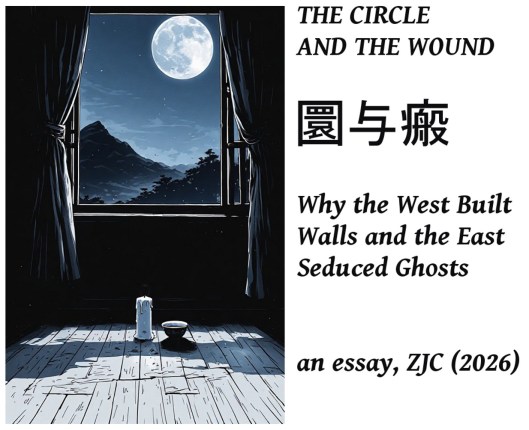
THE CIRCLE AND THE WOUND
Why the West Built Walls and the East Seduced Ghosts
Epigraph
“Il faut être toujours ivre. — Always be drunk. That’s the only question. If you don’t want to feel the horrible burden of Time breaking your shoulders, you must get drunk without respite. But on what? On wine, on virtue, or on poetry, as you choose.”
— Charles Baudelaire, Le Spleen de Paris
I. The Circle as Technology of Fear
Western magic begins with a line on the floor.
Not always literally. But the metaphysical gesture is unmistakable: here is the magician, whole and defended; there is the spirit, outside, contained, addressed through a triangle of art. The circle is drawn with sword or knife, with chalk or ash, with the magician’s own saliva if nothing else is available. It is the first act of nearly every grimoire tradition from the Key of Solomon to the Lemegeton to the less respectable pamphlets sold in Victorian London.
Why?
The official answer is protection. Spirits, in the Western view, are deceptive, envious, or malicious. They will lie about their names. They will offer gifts that turn to rot. They will possess if given the smallest opening. The circle keeps them out there while the magician remains in here.
But protection is only half the story. The circle also defines.
Plato had already prepared the ground. His chorismos — the separation of the ideal realm from the sensible world — is the original circle. The philosopher purifies himself from the body’s distractions, ascends toward the Form of the Good and leaves the messy, changing, erotic world behind. Neoplatonism deepened the wound (though it would not call it that): the soul’s task is to return to the One, shedding attachments like old skin. Purity is the method. Distance is the goal.
The Hermetic magicians inherited this architecture. The circle does not merely keep spirits out. It keeps the magician in — in a particular kind of self: bounded, sovereign, unbroken. Purity becomes power. The unwashed magician, the grieving magician, the drunk magician, the magician who has just made love or cried or forgotten to eat — these are failures. They have let down the wall.
And yet.
The lonely ghost does not live in the world the circle assumes. The Gūhún Yěguǐ is not a demon to be commanded. It is not a planetary spirit to be negotiated with. It is not even, strictly speaking, a separate entity in the Western sense. It is an unfinished life — a desire that never closed, a death that never found its proper ground, a body that rots far from home while the soul wanders crossroads and ruins, looking for warmth.
The circle says: I am complete. You are outside.
The ghost hears: Not for me.
It passes by.
II. The Wound as Technology of Availability
If the circle begins with a line on the floor, the wound begins with a door left ajar.
Not literally — though sometimes literally. In the Strange Tales from a Chinese Studio (Liaozhai zhi yi), the scholar who meets a ghost is almost always in a state of incompletion. He is lost in the mountains at dusk. He has drunk too much wine and missed the last ferry. He is grieving a dead wife and falls asleep on her grave. He is so absorbed in copying a sutra by candlelight that he does not notice the hour. The ghost does not break into his world. She slips through a crack he did not know he had left open.
Pu Songling, the author, understood something that Western ceremonial magic forgot: the self is not a fortress. It is a ruin.
Not a sad ruin. A productive one. A ruin has gaps. Wind passes through. Rain pools in corners. Moss grows where the roof once held. The ruin does not need to be rebuilt to be valuable. It only needs to be inhabitable — by memory, by longing, by the wandering dead.
The Gūhún Yěguǐ (wandering lonely ghost) is not a spirit of place. It is a spirit of interruption. A young woman dies of a broken engagement before the wedding. A merchant is robbed and murdered on a mountain pass, his body never returned to his village. A scholar’s wife dies in childbirth and the infant dies with her. These are not ancestors. They have no grave to tend, no tablet to honor, no descendant to pour tea on the anniversary of their death. They are unfinished.
And they wander.
But they do not wander randomly. They are drawn to the living who resemble them — not in circumstance but in shape. The grieving widow, the lovesick poet, the exhausted traveler, the drunkard singing alone at midnight: these are not victims. These are beacons. Their incompleteness is legible to the ghost. The ghost looks at them and thinks: This one knows what it is to want something that cannot finish.
No circle can keep out that recognition. The circle only makes the self invisible.
Consider the Taoist and Buddhist traditions that inform the ghost literature. They do not begin with the question How do I protect myself? They begin with the question What am I attached to? Attachment — to desire, to grief, to a name, to a body, to a home — is what creates both the hungry ghost and the living person who can see one. The hungry ghost (preta) has a tiny mouth and a vast, burning stomach. It can never be filled. It is the shape of wanting made visible. The living person who practices pudu (universal salvation) does not build a circle. They build a table. They set out food. They chant sutras not to command the ghosts to leave but to release them from their own hunger.
But release is not the only option.
The erotic revenant — the ghost who does not want to be fed and released, but to stay for a while — requires a different practice. She requires someone willing to be unreleased alongside her. This is not Buddhist orthodoxy. It is folk tradition, literary invention, the shadow of orthodoxy. But it is real in the way that dreams are real.
Pu Songling’s scholars do not exorcise the ghosts who visit them. They make tea. They recite poetry. They fall in love. They wake up with peonies on their pillows and fox fur under their nails. The ghost leaves eventually — she always leaves — but not because she was commanded. She leaves because the scholar’s own incompleteness has shifted, or because the dawn has come, or because she was never meant to stay. The encounter was not a possession. It was a visit. And visits end.
The wound-model does not fear the visit. It hosts it.
Here is the difference stated as clearly as I can manage:
Circle
Wound
Self
Bounded, sovereign, pure
Porous, unfinished, attached
Spirit
Deceptive, other, to be commanded
Lonely, recognizable, to be witnessed
Ritual act
Summoning, binding, banishing
Waiting, leaving the door open, being found
Failure mode
Possession, deception, contamination
The ghost never comes — or never leaves
Theology
Spirits are lesser beings
Spirits are us interrupted
The wound-model does not require belief in ghosts as Western metaphysics defines them. It requires something stranger: the willingness to sit in your own incompleteness without trying to seal it shut.
That willingness is the door left ajar.
III. Baudelaire’s Drunkenness as Accidental Eastern Turn
Now we make a strange leap: from seventeenth-century Chinese ghost tales to nineteenth-century Paris, to a poet who never read Pu Songling, never performed a pudu ritual and would have been baffled by the term Gūhún Yěguǐ. And yet.
Charles Baudelaire wrote, in Le Spleen de Paris:
“Il faut être toujours ivre. — Always be drunk. That’s the only question. If you don’t want to feel the horrible burden of Time breaking your shoulders, you must get drunk without respite. But on what? On wine, on virtue, or on poetry, as you choose.”
Most readers take this as hedonism. A few take it as metaphor. I want to take it literally — but not in the way Baudelaire intended. I want to read it as an anti-ceremonial instruction manual for encountering the wandering dead.
Baudelaire did not believe in ghosts, not really. He believed in correspondences — the secret sympathy between things, the way a perfume could summon a memory, the way a city street at midnight could feel haunted without containing a single specter. But that is exactly the point. The wound-model does not require ghosts to be ontologically real in the Cartesian sense. It requires the practitioner to be available to the experience of haunting, whether the ghost is “real” or not.
Intoxication — on wine, on virtue, on poetry — is a technology of unfinishing.
Consider: The sober, well-rested, well-fed, fully clothed, fully housed person is finished. They have no cracks. They have locked their door, paid their bills, answered their emails and gone to bed at a reasonable hour. No ghost will find them, because they have left no opening. They are the circle made flesh.
The drunk — not the stumbling fool, but the Baudelairean drunk, the one who has chosen to be always in an altered state — has deliberately unsealed themselves. Wine loosens the ego’s grip on its own boundaries. Virtue (the intoxication of moral intensity, of religious fervor, of political passion) displaces ordinary consciousness into a higher key. Poetry is the strangest intoxicant of all: it replaces the self’s ordinary language with a language that belongs to no one, that passes through the poet like a ghost through a wall.
Baudelaire’s famous sonnet “Correspondances” describes nature as a “forest of symbols” that watch the poet with “familiar glances.” This is not animism in the crude sense. It is the recognition that the world is already porous — that the boundary between self and not-self, living and dead, human and spirit, is not a line but a membrane. The sober person sees a tree. The intoxicated poet sees a familiar glance.
The Gūhún Yěguǐ lives in that glance.
Now consider Baudelaire’s other great innovation: the flâneur. The idle stroller of Parisian arcades, the one who walks without destination, who gets lost on purpose, who watches and is watched by the city’s anonymous crowds. The flâneur is not a tourist. The flâneur is a seeker of encounters — not because they are looking for something specific, but because they have abandoned the tyranny of destination.
This is exactly the state prescribed for the scholar who meets a ghost in Liaozhai. The scholar does not set out to find a haunted house. He becomes lost. He takes the wrong path. He lingers too long at a crossroads. He falls asleep under a tree whose species he cannot name. The ghost finds him not because he summoned her, but because his lostness made him visible.
Baudelaire’s flâneur is the secular, Western, nineteenth-century version of that lost scholar. The flâneur walks at night. The flâneur is slightly drunk (on wine or poetry). The flâneur has no place to be and no one waiting for him. He is, in the language of the wound-model, available.
What would Baudelaire have made of a Gūhún Yěguǐ? He would have recognized her immediately. She is the passante of his sonnet “À une passante” — the veiled woman who appears for a single stanza, locks eyes with the poet and vanishes into the crowd, never to be seen again. The poet cries out:
“O you whom I would have loved, O you who knew it!”
That is the erotic revenant. She appears. She is seen. She leaves. And the poet is left with an unfinished sentence — the exact state the wound-model cultivates.
Baudelaire never drew a circle. He never commanded a spirit. He never performed a banishing. He got drunk on poetry and walked the midnight streets of Paris, leaving his door ajar. And things visited him. Not ghosts, perhaps — not in the sense that a Taoist priest would recognize. But something. Something that looked at him with familiar eyes. Something that passed and left him changed.
That is the accidental Eastern turn: a French poet, without any knowledge of Chinese ghost literature, reinvented the wound-model because he understood that completion is the enemy of encounter.
The circle says: I am complete. Approach only on my terms.
Baudelaire says: I will never be complete. Come as you are.
The ghost, who has been wandering for centuries, finally finds a door that is not locked.
IV. The Circle Cannot Hold the Erotic Revenant
We have traced the circle’s logic and the wound’s alternative. We have watched Baudelaire stumble into an Eastern metaphysics he never knew he inherited. Now we must test the claim directly: Why does Western ceremonial magic fail with the erotic revenant?
Not fail entirely. The circle works beautifully for what it was designed to do: command planetary intelligences, bind demons, invoke angels, protect the magician from deception. The grimoire tradition is not foolish. It is specialized. It assumes a universe in which spirits are hierarchical, names are power and purity is the magician’s primary defense.
But the Gūhún Yěguǐ does not live in that universe.
She lives in ours — the one where death is sometimes messy, where love outlasts the body, where a broken engagement can produce a ghost that haunts not a house but a feeling. She is not a demon to be bound by the Seventy-Two Names of God. She is not a planetary spirit with an hour and a metal and a sigil. She has no rank in any hierarchy. She has only her longing and her longing is not a weakness to be exploited by the magician. It is the only thing about her that is real.
Let me show you the failure through two case studies: one Victorian, one Qing. The first is a failure of method. The second is a failure of will — which is to say, a success of the wound.
Case Study A: The Victorian Necromancer and the Ghost Who Would Not Be Commanded
In 1897, a minor English occultist — let us call him Arthur, though that was not his name — decided to summon the ghost of a woman he had loved in life. She had died of consumption three years earlier. He had not been at her bedside. The guilt was a knot in his chest that no amount of Hermetic study had loosened.
Arthur was well trained. He had read Lévi. He had practiced the Lesser Banishing Ritual of the Pentagram. He had a circle of consecrated chalk in his attic, a triangle of art painted on black wood and a copy of the Arbatel open to the appropriate chapter. He followed every instruction: purification bath, fasting, the invocation of the four archangels, the drawing of the circle with a sword that had never cut anything but air.
Then he called her name.
Nothing happened. He called again, louder, using the barbarous names of evocation that had worked so well for the planetary spirits. Still nothing. He waited until dawn, his back aching from standing inside the circle, his voice hoarse from commanding a ghost who would not appear.
She did not come because she could not. The circle, for all its power, had done exactly what it was designed to do: it had separated him from the spirit world. He stood inside a fortress of purity, commanding her to appear in the triangle of art — a space designed for binding, not for meeting. The ghost of a consumptive seamstress who had died without a wedding ring did not recognize herself in that geometry. She was not a planetary spirit. She had no interest in being bound. She wanted, perhaps, only to be seen — not summoned, not commanded, not placed in a triangle like a specimen.
Arthur died in 1901, still believing he had failed because his technique was insufficient. In truth, he had failed because his technique was exactly correct for a kind of spirit that had nothing to do with the one he sought.
The circle cannot hold the erotic revenant because the erotic revenant does not want to be held. She wants to be met.
Case Study B: The Qing Scholar and the Peony on the Pillow
Now consider a different scene.
The year is 1679, though the story could be any year. A scholar — let us call him Song, though Pu Songling gives him many names — is traveling through the mountains of Shandong. He has missed the last inn. His donkey has thrown a shoe. It is raining, a thin, persistent rain that soaks through his robes and makes the path treacherous.
He finds a ruined temple. Not a dramatic ruin — just an old shrine to a local goddess, abandoned when the village below moved to the other side of the mountain. The roof leaks. The statue of the goddess has lost her face to time and weather. But there is a dry corner and Song has a flask of wine and he is too tired to be afraid.
He drinks. He recites a poem to himself — something about autumn, something about a woman he once loved who married another man. He falls asleep on a pile of musty straw.
He wakes to candlelight.
A woman sits across from him. She is beautiful, yes — all the stories say that — but more than beautiful, she is familiar. He cannot place her, but his chest aches as if he has known her for years. She does not introduce herself. She pours him tea from a pot he did not see her bring. She asks him, softly, to recite the poem again.
He does. She smiles. The smile is the saddest thing he has ever seen.
They talk until dawn. Not about anything important — the rain, the mountain, a line of poetry he had misunderstood until she explained it. When the first light touches the broken statue of the goddess, the woman stands. She touches his cheek. Her fingers are cold, but not unpleasantly so. She says: “You will not remember me clearly tomorrow. That is not a cruelty. It is a mercy.”
She walks toward the wall and does not turn.
Song wakes alone. The candle is gone. The tea cup is cold. On his pillow — his makeshift pillow of folded robes — there is a single peony. Fresh. Unfaded. Impossible, because peonies do not grow in the mountains and it is not the right season and he did not have a peony when he fell asleep.
He keeps the peony pressed in a book until the day he dies. He never marries. He never tells anyone the full story, except once, to Pu Songling, who writes it down and changes the names.
What the Two Cases Teach Us
Arthur the Victorian did everything right by the standards of his tradition. He failed.
Song the scholar did nothing right by those same standards. He was impure (unwashed, drunk, emotionally porous). He drew no circle. He spoke no barbarous names. He made no attempt to bind or command. He simply sat in his own incompleteness and was found.
The difference is not technique. The difference is metaphysics.
Arthur believed:
The ghost is separate from the self
The ghost must be controlled
Purity is the condition of power
The encounter ends when the magician says it ends
Song believed (or, more accurately, acted as if):
The ghost is recognizable because the self is also unfinished
The ghost cannot be controlled, only witnessed
Impurity is the condition of encounter
The encounter ends when the ghost decides — or when dawn comes, which is the same thing
The Western tradition, in its obsession with protection, built a machine that cannot do what it never asked to do: host the stranger without demanding surrender.
The circle protects. But protection is not the same as hospitality.
The erotic revenant does not want to be fought or bound. She wants to be offered a cup of cold tea and a poem recited badly, at midnight, by someone who has also loved and lost and fallen asleep in a ruined temple.
That is not a failure of the circle. It is a category error. You cannot command a wound to heal by drawing a line around it. You can only sit in the wound with someone else who also cannot sleep.
V. What the West Lost
We have circled the wound long enough. Now we must name the loss.
Western ceremonial magic, for all its beauty and rigor, developed a particular neurosis: the fear of contamination. The circle is its expression, but the circle is only a symptom. Deeper than the circle is a metaphysics that treats the self as a fortress to be defended, the spirit as an enemy to be controlled and control as the only legitimate source of power.
This is not magic. This is trauma dressed as architecture.
Consider the history: the Hermetic tradition emerged from a world of religious persecution, sectarian violence and the slow death of the pagan gods. The magician drew the circle because the world outside the circle was genuinely dangerous — not because of spirits, but because of witch-hunters, inquisitors and neighbors who would burn you for owning the wrong book. The circle was not just a spiritual technology. It was a survival strategy.
But survival strategies calcify. What began as protection became identity. What began as caution became paranoia. By the time we reach the Victorian occult revival, the circle is no longer a response to danger. It is a habit of mind. The magician draws the circle because that is what magicians do. The possibility of not drawing the circle — of sitting in the dark with an unlit candle and a cup of cold tea — has become unthinkable.
The West lost the ability to be porous.
Porosity is not weakness. Porosity is the recognition that the boundary between self and world, living and dead, human and spirit, is not a line but a membrane. Things pass through. Some of them are welcome. Some of them are not. But you cannot choose which ones come if you have sealed every opening. A sealed fortress keeps out the enemy. It also keeps out the lover, the ghost, the strange blessing that arrives only when you are not prepared.
The wound-model risks contamination. That is its danger and its gift. The circle-model avoids contamination. That is its safety and its poverty.
What the Circle Protects (At What Cost)
Let me list what the circle preserves:
The integrity of the ego
The distinction between self and other
The magician’s sense of agency
The ability to begin and end the ritual at will
The comfort of knowing that the spirit world is over there
And let me list what the circle cannot access:
The ghost who does not recognize herself in the triangle
The blessing that arrives only through grief
The knowledge that comes from sitting in the wound with another unfinished being
The strange peace of not being in control
The encounter that changes you because you did not command it
The West chose safety. That was not a foolish choice. But it was a choice with consequences. One of those consequences is that Western magic has very little to say to the grieving, the lovesick, the lost — the very people who most need a technology of encounter. The circle tells them to purify themselves before they can approach the spirit world. But their grief is their approach. Their lovesickness is their ritual. Their lostness is their circle — not of protection, but of availability.
Descartes’ Circle
The deepest loss is philosophical.
René Descartes, searching for an unshakeable foundation for knowledge, retreated into the famous cogito: “I think, therefore I am.” He drew a circle around the thinking self and declared everything outside it — the body, the senses, the world, other minds, spirits — subject to doubt. The only certainty was the self’s own awareness of itself.
This is the circle of circles. Western philosophy has been trying to escape it for four hundred years, with limited success.
The wound-model does not attempt to escape the cogito. It simply refuses to start there. It asks: What if the self is not a thinking thing but a wanting thing? What if consciousness is not the ground of being but a late addition, a fragile flower growing out of the soil of desire and loss? What if the ghost is not a problem for epistemology but a neighbor for ontology?
The Gūhún Yěguǐ does not care whether you think, therefore you are. She cares whether you want, therefore you are like me.
Descartes drew the circle to achieve certainty. He lost the ghosts in the process. They were never the enemy he was trying to exclude. They were just… there. Waiting. Hoping he would one day leave the window open.
He never did.
The Unmourned Dead
Here is the cruelest loss: the West’s obsession with protection has made it nearly impossible to grieve properly.
Grief is the original wound. To grieve is to be unfinished. The person you loved has died and you cannot complete the conversation, cannot finish the sentence, cannot close the door. Grief is porosity — the dead passing through you whether you invite them or not.
The circle-model says: Protect yourself from grief. Banish it. Purify yourself from attachment. The dead are gone. Do not linger.
The wound-model says: Sit with grief. Let it change you. The dead are not gone; they are transformed. If you are lucky, they will visit. If you are very lucky, they will visit more than once.
The West has pathologized grief, medicated it, therapized it, shortened it, hidden it away in funeral homes and cemeteries that are no longer visited. We have drawn a circle around the living and called the dead “over there.” And we are lonelier for it.
The Gūhún Yěguǐ is not just a Chinese ghost. She is a universal figure: the dead who wander because the living have forgotten how to host them. Every culture has its version. The West has the banshee, the revenant, the ghost at the crossroads. But we have forgotten how to sit with them. We have forgotten that the cold cup of tea is not an offering — it is a recognition.
I see that you are still here. I am still here too. Let us be unfinished together for a while.
That is what the West lost. Not the ability to command spirits. The ability to recognize them.
VI. A Middle Way?
We have drawn a sharp contrast: circle versus wound, command versus availability, purity versus porosity. But sharp contrasts are for teaching, not for living. The practitioner who abandons the circle entirely may find themselves overwhelmed. The practitioner who never leaves the circle may find themselves alone.
Is there a middle way?
Not a compromise — compromise weakens both. But a navigation: knowing when to draw the circle and when to leave it undrawn. The wound-model is not a rejection of the circle. It is a contextualization of it. The circle works for some spirits, some purposes, some states of self. It fails for the Gūhún Yěguǐ. The wise practitioner learns both languages and speaks each when it is called for.
Let me propose a rough map.
When to Draw the Circle
The circle is appropriate when:
The spirit you are engaging has a known hierarchy, name and function
You require a specific outcome (information, a boon, a binding)
You are already in a state of relative wholeness and wish to remain so
The spirit is known to be deceptive, malicious, or indifferent to human welfare
You are working with others who need the safety of clear boundaries
You are a beginner, still learning the shape of your own psychic boundaries
The circle is good for these purposes. It is not evil or obsolete. It is a tool and tools have domains.
When to Leave the Circle Undrawn
The wound-model is appropriate when:
The spirit is an erotic revenant, a Gūhún Yěguǐ, or any ghost whose primary characteristic is unfinished longing rather than malice
You are yourself grieving, lovesick, lost, or otherwise porous
You seek not a command but an encounter — a meeting that may change you without your consent
You are willing to risk attachment, lingering, or the slow fading that comes from loving the dead
You understand that the ghost may not leave when you want it to
You have already done enough circle-work to know your own shape and can therefore recognize when to let it blur
The wound-model is not for beginners. It is not for the psychically fragile. It is for those who have built a self strong enough to temporarily unbuild.
The Door with a Lock Almost Never Used
The circle is a lock you use often. It keeps things out. That is its function. The wound is an open door. Things pass through. That is its function. The middle way is knowing that you have a lock — and choosing, for this night, not to use it.
The lock does not disappear. It waits on the doorframe, silent, ready. You are not a fool for having it. You are wise for knowing when to leave it untouched.
The Western tradition forgot that the lock could be left unused. It became compulsive: draw the circle, banish before and after, never leave an opening, never be vulnerable. That compulsion is not protection. It is fear dressed as technique.
The middle way restores choice. You may draw the circle tomorrow night, for a different spirit, for a different purpose. But tonight, for the Gūhún Yěguǐ, you leave it undrawn. You sit in the dark. You say: I am not summoning you. I am not commanding you. I am only here, unfinished, like you.
And if the ghost comes — or if she does not — you have done something the circle could never teach you: you have chosen vulnerability on purpose, without losing the ability to choose otherwise tomorrow.
That is not weakness. That is the hardest discipline of all.
Practical Synthesis: A Table
Situation
Circle?
Wound?
Notes
Summoning a planetary spirit
Yes
No
Hierarchy, command, specific outcome
Performing pudu for hungry ghosts
No
Yes (but with ritual structure)
Feeding, not commanding; release is the goal
Encountering a Gūhún Yěguǐ by accident
No
Yes
You are already in the wound; do not pretend otherwise
Seeking a specific erotic revenant (e.g., a dead lover)
No
Yes, with caution
The Return practice is essential
Beginner practice, learning boundaries
Yes
No
Build the self before you unbuild it
Long-term practitioner, deep grief work
No
Yes, with supervision
Do not do this alone if you are fragile
A spirit attacks or possesses
Yes
No
The wound-model has no defense; use the circle
This table is not a cage. It is a map. You may find your own territory.
VII. Coda: The Unlit Candle as Emblem
We have traveled far: from the chalk circle of the Victorian magician to the ruined temple of the Qing scholar, from Plato’s chorismos to Baudelaire’s drunken flâneur, from the hungry ghost realms to the salt water of a simple return. Now we come to rest on a single image.
The unlit candle.
In the practice of the wound, the practitioner sits before a candle and does not light it. That instruction is not arbitrary. It is the emblem of everything this essay has tried to say.
The lit candle belongs to the circle. It sees. It illuminates. It draws a boundary between light and dark, known and unknown, self and other. The magician lights candles to see the spirit they have summoned — to verify, to control, to document. The lit candle is the eye of command.
The unlit candle belongs to the wound. It does not see. It does not illuminate. It waits. It could be lit — that is important — but tonight it is not. The practitioner sits in darkness not because darkness is better, but because the ghost does not come to be examined. The ghost comes to be sensed. And sensing happens in the dark.
The unlit candle says:
I am not trying to capture you. I am not trying to prove you exist. I am not trying to write your name in a grimoire or bind you to a triangle of art. I am sitting here, in the dark, with a candle I could light but choose not to. That choice is my offering. It says: you do not have to be visible to be real. You do not have to be commanded to be welcome.
What the Unlit Candle Teaches
1. The suspension of the will. The lit candle is an act of will: I will see. The unlit candle is an act of will suspended: I will not see yet. I will wait. The circle-model exalts the will. The wound-model respects it and then, deliberately, sets it aside.
2. The rejection of evidence. The Western practitioner, trained in Descartes and empiricism, wants proof. Did the ghost come? Can I measure it? Can I photograph it? Can I write it down in a case study? The unlit candle refuses to answer those questions. It says: Proof is not the point. Encounter is the point. You may never know whether the ghost was real. But you will know whether you were changed.
3. The embrace of darkness as hospitality. Light can be aggressive. A flashlight in the face of a sleeping person is an assault. The same is true for ghosts. The lit candle says: I am studying you. The unlit candle says: You can rest here. I am not looking.
4. The possibility without demand. The unlit candle can be lit at any moment. That possibility is important. The practitioner is not helpless. They have a lighter or a match in their pocket. They could flood the room with light, banish the ghost, return to the safety of the circle. But they choose not to. That choice — renewable every second — is the shape of trust.
The Candle That Never Lights
Some nights, the practitioner sits before the unlit candle until dawn. The ghost does not come. The candle remains unlit. The practitioner drinks the cold tea alone, pours it onto bare earth, opens the eastern window and says: I am still among the living.
Was the night a failure?
No. The night was a practice in waiting without expectation. That is its own discipline. The circle-model cannot abide waiting without expectation — it always wants a result, a sign, a spirit in the triangle. The wound-model says: The waiting is the ritual. The sitting in the dark, the refusal to light the candle, the willingness to be unfinished — that is already the encounter. The ghost is not required.
Sometimes the ghost comes. Sometimes she does not. Both are gifts. The first gift is contact. The second gift is the patience to sit in her absence without despair.
A Final Distinction
The circle says: I will make contact. The wound says: I will be available for contact and I will not be broken if it does not come.
The circle says: I will protect myself. The wound says: I will risk myself, because some gifts are only given to the vulnerable.
The circle says: I will know. The wound says: I will wonder.
The circle says: Prove it. The wound says: I believe you — not because you have given evidence, but because you are here, in the dark with me and that is enough.
Afterword: What This Essay Does Not Do
Before we part, a final honesty.
This essay does not teach you how to summon a Gūhún Yěguǐ. No one can teach that, because no one can command her. It only teaches you how to be found by her — or by something that feels like her, whether or not she is “real” in a Cartesian sense.
This essay does not replace the living traditions of Taoist or Buddhist ghost-feeding. If you or your grandmother performed pudu during Ghost Month, do not take my words as authority. I am a visitor, a guest, a borrower. I have tried to be respectful. That does not mean I have succeeded.
This essay does not promise you an encounter. It promises you only the possibility of one — and the discipline to sit with that possibility without demanding more.
If you try the practice of the unlit candle and nothing happens, you have not failed. You have practiced porosity. That practice will change you even if no ghost appears. You will become someone who can sit in the dark without fear, who can leave a door open without panic, who can say I am unfinished and mean it.
That person is closer to the Gūhún Yěguǐ than any magician standing in a circle of chalk.
And maybe — just maybe — that is enough.
GLOSSARY OF KEY TERMS
For Readers of The Circle and the Wound
Circle (Western ceremonial)
A bounded ritual space, usually drawn on the floor, designed to protect the magician and command spirits. The circle assumes a universe in which spirits are deceptive, the self is fragile and purity is power. It is a technology of separation and control. Works well for planetary spirits and demons. Fails for the Gūhún Yěguǐ.
Wound (as used in this essay)
Not a literal injury. A metaphysical posture: the recognition that the self is already unfinished, porous and attached to desires and losses. The wound is not healed but hosted. It is the condition of availability for the Gūhún Yěguǐ.
Purity (Western / Hermetic / Christian)
Moral and sexual sinlessness. To be pure is to be free from contamination by the flesh, by sin, by bodily functions, by “unclean” contact. Impurity brings shame, guilt and unworthiness. The Western magician must purify themselves (through fasting, celibacy, bathing, confession) before drawing the circle. Failure to do so is not just ineffective — it is sinful.
Emotional tone: fear, shame, striving.
Purity (Taoist / 清 qīng)
Clarity, stillness and energetic alignment. Not a moral category. An impure Taoist practitioner is like muddy water — ineffective, not evil. The remedy is simple: bathe, meditate, burn incense, rest. No shame attached. A sexually active, wine-drinking, joke-telling practitioner can have perfectly clear qi if they are relaxed and aligned.
Emotional tone: neutral, practical, like cleaning a room.
Purity (Buddhist, in ghost-feeding / pudu)
Freedom from attachment and selfish intention. To be pure is to perform a ritual for the benefit of all beings, not for personal gain (fame, merit, a ghost to leave). Impurity means grasping — wanting something for yourself. The remedy is self-examination, not confession or cleansing.
The key term of the wound-model. Porosity is the willingness to be unfinished, open and available to encounter. The porous self does not seal itself behind a circle. It leaves the door ajar. Porosity is not the same as Western impurity (sin), but both reject the circle’s demand for closure.
Emotional tone: vulnerability, trust, patience.
Gūhún Yěguǐ (孤魂野鬼)
Chinese term: “wandering lonely ghost” or “wild ghost.” A spirit who died a “bad death” — away from home, unmarried, murdered, by suicide, or otherwise unable to join the ancestors. They have no grave, no one to tend their tablet, no descendants to pour tea. They wander crossroads, ruins and mountains, seeking warmth, recognition, or completion. In literature (Strange Tales from a Chinese Studio), they often appear as beautiful women who fall in love with scholars. They are not evil. They are unfinished.
Not to be confused with: hungry ghosts (preta), who are driven by insatiable hunger and are typically fed and released through pudu rituals. The Gūhún Yěguǐ may want love, not food.
Erotic Revenant
A broader category that includes the Gūhún Yěguǐ but also Western analogues: the ghost lover, the bride who died before the wedding, the sailor’s wife who haunts the shore. An erotic revenant is a ghost whose primary characteristic is unfulfilled longing — especially romantic or sexual — rather than malice or hunger. They return not to harm but to be with the living, however briefly.
Pudu (普度)
“Universal salvation” or “universal crossing over.” A Taoist and Buddhist ritual, particularly during Ghost Month, in which food, incense and sutras are offered to hungry ghosts to feed and release them from purgatory. The goal is to help them move on, not to invite them to stay. This is different from the encounter described in this essay, which is about meeting a single Gūhún Yěguǐ, not releasing a crowd.
Liaozhai zhi yi (聊齋誌異)
Strange Tales from a Chinese Studio. A collection of supernatural stories by Pu Songling (17th–18th century). The primary literary source for the Gūhún Yěguǐ in this essay. In these stories, scholars meet ghosts, fox spirits and other beings — often through chance, lostness, or emotional porosity, not through ritual summoning.
Baudelaire’s Drunkenness
From Charles Baudelaire’s prose poem “Enivrez-vous” (“Always be drunk”). In this essay, interpreted as an anti-ceremonial technique: intoxication (on wine, virtue, or poetry) deliberately unfinishes the self, making it porous and available to encounter. Baudelaire is treated as an accidental Eastern thinker who reinvented the wound-model without knowing it.
The Unlit Candle
The central emblem of the wound-model. A candle that could be lit (the practitioner has a lighter) but is deliberately left unlit. Represents the suspension of will, the rejection of evidence and the embrace of darkness as hospitality. The opposite of the lit candle (the eye of command, the demand to see and verify).
The Return
A simple ritual for re-entry after a ghost encounter (or attempted encounter): a sink of warm salt water, hands washed slowly and the words: “You are not my unfinished. You are your own. I release you back to the road. You may visit again, but you may not live here.” Not a banishment or a circle — a door with a lock almost never used. It restores the practitioner’s boundary without sealing them off permanently.
Porosity vs. Impurity (A Final Clarification)
Western Impurity
Taoist Impurity
Buddhist Impurity
Porosity (Wound-Model)
What it is
Sin, shame, moral failure
Muddy qi, scattered energy
Grasping, selfish intention
Openness, incompleteness, availability
Emotional tone
Guilt, fear
Neutral (like a dirty window)
Self-awareness
Vulnerability, trust
Does the ghost care?
No — but the Western magician thinks she does
No — she cares about recognition, not qi
No — she cares about being seen, not your attachment
Yes — this is what draws her
The Gūhún Yěguǐ is not drawn to sin. She is drawn to unfinishedness — which the West calls impurity (and fears), but which is simply the natural state of anyone who has loved, lost, grieved, or wandered.
WORKS CITED
Primary Sources
Baudelaire, Charles.Le Spleen de Paris (Paris Spleen). 1869. Includes the prose poem “Enivrez-vous” (“Always Be Drunk”) and the sonnet “À une passante” (“To a Passerby”). Multiple English translations exist; the translations in this essay are the author’s own.
Pu Songling (蒲松龄).Liaozhai zhi yi (聊齋誌異 / Strange Tales from a Chinese Studio). c. 1679–1707. Numerous translations. The tales referenced in this essay include those featuring scholars who encounter ghosts in ruined temples, mountain passes and other liminal spaces. Specific tales drawn upon include “The Peony Fairy,” “The Ghost Wife,” and “The Lost Scholar” (titles vary by translation).
Descartes, René.Meditations on First Philosophy. 1641. Cited for the cogito(“I think, therefore I am”) as the philosophical circle of the Western self.
Plato.Phaedo. c. 360 BCE. Cited for the concept of chorismos (the separation of the ideal realm from the sensible world) and the purification of the soul from the body.
Anonymous.The Key of Solomon (Clavicula Salomonis). c. 14th–15th century. Cited as a representative grimoire of the Western ceremonial magic tradition, including its requirements for ritual purity, fasting and chastity.
Anonymous (pseud. “Arbatel”).Arbatel de magia veterum. 1575. Cited for the system of Olympic spirits as an example of spirits that respond to circle-based command.
Secondary Sources
Bokenkamp, Stephen R.Early Daoist Scriptures. University of California Press, 1997. Provides context for Taoist concepts of purity (qing), clarity and energetic alignment, distinguishing them from Western moral purity.
Coleman, E.J. “The Hungry Ghosts: Buddhist Philosophy and the Practice of Pudu.” Asian Folklore Studies, vol. 45, no. 2, 1986, pp. 211–234. Discusses the pudu (universal salvation) rituals for feeding and releasing hungry ghosts during Ghost Month.
Idema, Wilt and Beata Grant.The Red Brush: Writing Women of Imperial China. Harvard University Asia Center, 2004. Includes analysis of female ghosts and erotic revenants in Chinese literature, including Liaozhai zhi yi.
Kohn, Livia.Daoism and Chinese Culture. Three Pines Press, 2001. Clarifies the difference between Daoist energetic purity (stillness, clarity) and Western moral purity.
Lévi, Éliphas.Dogme et rituel de la haute magie (Transcendental Magic). 1854–1856. Referenced in Case Study A as the text found in the attic; a key source for Victorian ceremonial magic and the circle tradition.
Teiser, Stephen F.The Ghost Festival in Medieval China. Princeton University Press, 1988. Definitive study of pudu rituals, hungry ghosts and the Ghost Month in Chinese Buddhist and Taoist practice.
Yamamoto, Yoshihiko. “The Gūhún Yěguǐ in Chinese Folk Religion: Wandering Souls and the Rituals of Salvation.” Journal of Chinese Religions, vol. 32, 2004, pp. 55–82. Defines the Gūhún Yěguǐ, distinguishes them from ancestors and hungry ghosts and discusses their appearance in literature and ritual.
Zeitlin, Judith T.The Phantom Heroine: Ghosts and Gender in Seventeenth-Century Chinese Literature. University of Hawai’i Press, 2007. Essential reading on the erotic revenant in Liaozhai zhi yi, particularly the figure of the ghost-woman who seeks love and recognition.
THE UNLIT CANDLE
A Night for the Gūhún Yěguǐ
An Anti-Ceremonial Ritual for the Lonely Ghost
A Note Before You Begin
This is not a summoning. You will command nothing. You will draw no circle. You will speak no barbarous names. The Gūhún Yěguǐ (wandering lonely ghost) does not come when commanded. She comes when she recognizes a kindred stillness — someone else who is also unfinished, also waiting, also open to the dark.
You do not need to believe in ghosts to perform this ritual. You only need to be willing to act as if for one night. The encounter may be psychological, poetic, or genuinely spectral. The ritual does not distinguish. It only asks that you show up, leave the door ajar and sit in your own incompleteness without trying to seal it shut.
Duration: From nightfall until dawn — or until you sleep, whichever comes first.
Best performed: On or near the new moon (when the sky is darkest).
You will need:
One candle (any color, but white or uncolored is traditional)
One cup (ceramic, not glass)
Cold tea (leftover from earlier in the day, or brewed and left to cool)
One piece of paper and one pen
A window facing north (or the direction you cannot name — the one you rarely look toward)
A lighter or matches (not to light the candle — to hold the possibility)
Optional: a small bowl of plain rice (not an offering — a witness)
You will not need:
A circle
Holy names
Protective amulets
Any command in any language
A single word of Latin, Hebrew, or Enochian
Part One: The Unmaking (Sunset)
Do not prepare. Do not purify. Do not shower immediately beforehand. If you are already clean, rub your hands in the earth of a houseplant or touch your own hair without washing it first. You are not becoming dirty. You are becoming porous.
1. The Unmade Bed
Go to your bedroom. If the bed is made, pull back one corner. If it is already unmade, leave it as it is. Sit on the edge for a moment. Say nothing. Then leave.
Why: A perfectly made bed says: No one lives here incompletely. An unmade bed says: Someone left in a hurry, or someone never left at all. The ghost hesitates at the second door.
2. The Cold Tea
Pour the cold tea into the cup. Do not heat it. Do not add sugar. Place the cup on the north windowsill. If you have no north window, place it on the floor in the northernmost corner of the room. Say aloud, without emphasis, as if stating a fact:
“This is cold, like you. This is waiting, like you. This asks for nothing.”
Why: You are not offering food. You are offering a gesture that expects nothing back. The ghost recognizes this as the shape of its own existence: waiting without arrival.
3. The Unfinished Sentence
Take the paper and pen. Write one sentence that you have never finished in your life. Examples:
“The letter I never sent began with…”
“If my father had lived one more year, I would have asked him…”
“The person I was at seventeen wanted…”
“The thing I never told you was…”
Stop in the middle of a word. Put the pen down. Do not complete the sentence. Do not read it again. Fold the paper once, badly (corners mismatched). Place it under the cold tea cup.
Why: The lonely ghost is an unfinished sentence. It cannot end because it never completed its desire. Your unfinished sentence is a mirror. The ghost reads it and thinks: This one understands.
Part Two: The Walk Without Destination (Late Evening)
Leave your home. You will return.
Walk without deciding where. At every intersection, turn in the direction that feels slightly wrong — the one you would not normally choose. If you come to a dead end, stand there for ten breaths. Do not turn back immediately. Let the dead end hold you.
If you see a stray animal, watch it until it leaves. Do not follow it. Do not call to it. The animal is not a ghost. But it may be watching for one.
If you pass a bridge, stop in the middle. Look down at the water (or the dry bed, or the asphalt — the shape matters less than the crossing). Say quietly:
“I am between. You are between. That is all we share tonight.”
If you pass a crossroads, pause. Do not pray. Just stand at the center for three breaths. A crossroads is where the dead wander. You are not visiting them. You are standing where they stand, for a moment.
Walk home by a different route. Do not hurry. If you feel afraid, do not run. Fear is not a warning. Fear is attention. The ghost notices attention.
Part Three: The Invitation That Is Not an Invitation (Midnight)
Back in your room. The cup of cold tea is still there. The paper is still under it.
Place the unlit candle in front of you. Do not light it.
Place the lighter or matches beside it. They are not tools. They are proof that you could light it — and are choosing not to.
Place the optional bowl of rice next to the candle — not as an offering, but as a witness: something that was once alive, then harvested, then cooked, then cooled and now sits here with you, also unfinished.
Say aloud, once, not as a prayer but as a statement of fact. Speak quietly. Speak to the room, not to any specific being:
“I am not summoning you. I am not commanding you. I do not know your name. I am only sitting here, unfinished, like you. If you want to be seen tonight, I will try to see you. If you want nothing from me, I will drink this cold tea alone tomorrow and forget I tried. That is the only promise I make: I will not pretend I am whole.”
Then be silent.
Part Four: The Vigil (Midnight to 3 A.M. — or until you sleep)
Now you wait. Not for something. Just with the waiting.
You may do nothing. You may close your eyes. You may whisper a poem you remember incompletely. You may hum a song whose lyrics you have forgotten. You may cry if you need to — ghosts are not embarrassed by tears.
You may almost light the candle. Pick up the lighter. Hold it near the wick. Then put it down. That act — the approach without the strike — is its own language. It says: I could command the light. I choose not to.
If nothing happens:
That is not failure. That is the most common outcome. The ghost may not be here tonight. Or it may be watching from the threshold, deciding. Or there may be no ghost at all and you have simply sat with your own unfinishedness — which is, itself, the beginning of understanding.
Stay until 3 A.M. if you can. If you fall asleep on the floor, that is also fine. The ghost does not require your wakefulness. Only your willingness to have been here.
If something happens:
Do not name it quickly. Do not ask “Is this a ghost?” That question will end the encounter. Instead, stay with the impression:
A cold spot that moves
A smell with no source (plum blossom, rain on dry earth, old paper)
A feeling of being watched without fear
A word that appears in your mind that you did not think first
A shadow that does not match any object
A faint sound — a breath, a footstep, cloth moving
If you feel a presence approach, do not turn around suddenly. Do not demand identification. Do not ask its name. Say, very softly:
“I see that you are here. You do not have to speak. You do not have to leave. You can stay as long as you want to be seen.”
Then be silent again. The presence may stay for seconds. It may stay until dawn. It may never leave entirely — but that is a different story and the Return (below) is for that story.
You may speak to the presence. You may say what you never finished saying to someone else. You may ask nothing. You may simply sit together, two unfinished beings, in the dark.
Do not try to touch it. Do not command it to leave. Do not demand proof. You are not a scientist. You are a host.
Part Five: The Morning Window (Dawn)
When the first light comes (or when you wake, if you slept), go to the eastern window. Open it. Breathe ten slow breaths. The air does not need to be fresh. It only needs to be from the direction of the living.
Say aloud:
“I am still among the living. I choose to stay. Whatever visited me, thank you for the visit. Whatever did not, thank you for the silence. I close no door — but I open this window.”
Do not pour out the cold tea immediately. Leave it on the north windowsill until noon. Then pour it onto bare earth — not down a sink. The tea must return to ground. If you have no bare earth, pour it into a potted plant and say:
“Return to root. Return to ground. Return to wherever you need to go.”
Do not finish the unfinished sentence. Burn the paper instead. Let the smoke go out the eastern window. As it burns, say nothing. The smoke is the sentence now. It is complete because it is gone.
Do not make your bed until evening. Let the dent remain one more day. The presence may come back tonight to check. That is allowed. You are not in a war. You are in a conversation that may last years.
Do light the candle now — at dawn, after the window is open. Light it. Let it burn for one minute. Then extinguish it. That minute says: I can light it. I chose not to last night. That choice is over. Today, I return to the light.
The Return (To Be Used Only If Needed)
If, in the days following this night, you feel too much of the presence — dreams that are not yours, a heaviness that does not lift, a sense that you are being watched in daylight, a cold spot that follows you from room to room — do not perform an exorcism. Perform a return.
On a sunny afternoon, fill a sink with warm water. Add a handful of salt (any salt). Wash your hands slowly, one at a time, saying:
“You are not my unfinished. You are your own. I release you back to the road. You may visit again, but you may not live here.”
Dry your hands on a clean towel. Open the eastern window. Say nothing more.
This is not a banishment. It is a door with a lock you almost never use. You are not sealing yourself off. You are simply saying: Not tonight. Not every night. I am still among the living.
If the presence returns another night and you are willing, you may choose to host it again. That is your choice. You are not bound. The door has a lock. You simply choose, most nights, to leave it unlocked.
A Closing Blessing
You have sat in the dark with an unlit candle. You have poured cold tea for no one. You have left your bed unmade, your sentence unfinished, your door ajar. You have been willing to be found — or willing to sit with the absence of being found.
That willingness is rare. Most people seal themselves so tightly that nothing can enter, not even grief. You have done the opposite. You have made yourself porous. Whether a ghost came or not, you have changed. You are someone who can sit in the dark without panic, who can leave a door open without terror, who can say I am unfinished and mean it.
“That person is closer to the Gūhún Yěguǐ than any magician standing in a circle of chalk.”
And maybe — just maybe — that is enough.
Unlit candle waits. The scholar’s empty teacup warm in cold moonlight.
Friar Bonaventura: Dispute no more in this, Giovanni. Philosophy may allow such sophistry, but Heaven makes no jest. Those who labour to prove God does not exist find only a shortcut to Hell. Enough! I will hear no more.
Giovanni: Dear Father, I have poured out the burden that weighs upon my heart. I have kept back no word to hide what I truly feel; and is this all the comfort you give me? May I not do what all men do — love?
Friar Bonaventura: You may, you may love, my dear son.
博纳文图拉修士: 可以,你可以爱,我亲爱的孩子。
Giovanni: Then shall a common prejudice, passed from man to man, from brother to brother, become the obstacle to my happiness? You said it yourself: we share but one father, one womb — cursed be my joy — that brought us both into the world. If Nature joined us, are we not all the more each other’s? And does not religion itself teach us we should be one: one soul, one flesh, one heart, one whole?
Friar Bonaventura: Hold your tongue, Giovanni. You are lost already.
博纳文图拉修士: 住口,乔瓦尼。你已经迷失了。
Giovanni: Must my joy be forever banished from her bed, only because I am her brother?
乔瓦尼: 难道只因为我是她的哥哥,我的欢愉就要永远被逐出她的床榻?
Friar Bonaventura: Are you the same prodigy who made all Bologna marvel but three months ago? I was proud to have you as my pupil; I would have given up my books rather than part from you. Yet my hopes in you are ruined, just as you have ruined yourself, Giovanni! Did you turn from learning only to run toward lust and death? For death waits beside your lust. Open your eyes to the world, and you will see a thousand faces brighter than your sister’s. Leave her; choose another woman; the sin would be lighter.
Giovanni: You might more easily stop the sea’s ebb and flow than turn my desire aside.
乔瓦尼: 要阻止大海的涨潮与退潮,也比劝退我的欲望容易。
Friar Bonaventura: Then I have nothing left to say. I already see your ruin. Heaven is just. And yet, hear my counsel still.
博纳文图拉修士: 那么,我已经无话可说。我已经看见你的毁灭。天是公正的。然而,你仍要听我的劝告。
Giovanni: I shall hear it as the voice of life itself.
乔瓦尼: 我会把它当作生命本身的声音来听。
Friar Bonaventura: Let your heart weep. Wash every word you have spoken with your tears, with your blood. Beg Heaven to cleanse the lust that rots your soul. For one week, pray three times each day, three times each night. If your desire remains unchanged, return and see me again. May my blessing go with you.
Giovanni: I will do all this, to escape the lash of vengeance. But afterwards, I swear, I will have no other god — but my fate.
乔瓦尼: 我会照做这一切,为了逃过复仇的鞭答。可之后,我发誓,我将不再有别的神——除了命运。
第二场 / Act I, Scene 2
English
中文
Florio: Signor Soranzo, though many suitors for my daughter have offered terms of great weight, my trust in your fortunes outweighs all other considerations. Yet you must know, I would not force my daughter to marry against her will. I have but two children — a son, and her. My son is too deep in his books, and I confess I fear for his health. Should anything befall him, all my hopes rest on my daughter. Thank God, my estate is sufficient: I would not have her marry for wealth, but for love.
Putana: What do you say, my little darling? Everybody busies themselves about you, quarrels for you, all on your account! You must watch yourself, or before long, someone will pluck you while you sleep.
Annabella: But, Putana, I have no interest in that kind of life. My thoughts are elsewhere. Please, leave me alone a while.
安娜贝拉: 可是,普塔娜,我对那种生活并没有兴趣。我心里想的是别的事。求你,让我一个人待一会儿吧。
Putana: Leave you? What kind of talk is that? Let me not leave you alone, my sweetheart. Besides, I have to congratulate you. Soranzo is worthy of the finest lady in Italy.
Putana: Above all, never marry a soldier! Almost all of them have been wounded in places where they shouldn’t have been, so much so they can’t even be men!
普塔娜: 总之,千万别嫁给士兵!他们几乎人人都在不该受伤的地方受过伤,弄得他们连男人都做不成!
Annabella: What a wicked tongue you have!
安娜贝拉: 你这张嘴真坏!
Putana: To my mind, with a woman’s eye, I do like Soranzo. He is tender; better still, he is rich; and better than all that, he is nobly born. If I were the beautiful Annabella, I too would pray Heaven to send me such a man. He is handsome, and I think he carries no nasty diseases on him — something rarer and rarer in a young man of twenty-three. Whatever else, he is a man, that much is certain! If he were not, he could never have earned such a reputation with Hippolita. That widow — even while her husband was alive, she was perpetually in heat. For that reason alone, my darling, I would wish him for your man. Because what your bed needs is a plain, healthy, proper man.
Annabella:[Aside] This woman must have had a few drinks already.
安娜贝拉(旁白): 这女人一定已经喝了几口了。
Annabella:[Seeing Giovanni] Look, Putana! Who is that man? How sad he looks!
安娜贝拉(看见乔瓦尼): 看,普塔娜!那个人是谁?他看起来多么忧伤!
Putana: Where?
普塔娜: 哪里?
Annabella: There.
安娜贝拉: 那里。
Putana: Why, that’s your brother, my little darling.
普塔娜: 哎呀,那是你的哥哥呀,我的小乖乖。
Annabella: Ah!
安娜贝拉: 啊!
Putana: Yes, it’s your brother!
普塔娜: 是啊,是你的哥哥!
Annabella: It cannot be! That man has become a shadow of himself. He is wiping his eyes! I think I even heard him sigh! Come, Putana, let us go ask him why he is so sorrowful. Since my brother loves me, he will not refuse to let me share his grief.
Annabella:[Aside] My soul is full of melancholy and fear.
安娜贝拉(旁白): 我的灵魂里充满了忧郁和恐惧。
第四场 / Act I, Scene 4
English
中文
Giovanni: Lost! I am lost! My fate has already sentenced me to death. The more I struggle, the more I love; the more I love, the more hopeless I become. I have worn out Heaven itself with my prayers. I have tried everything reason could counsel me. But it is no use; I am still what I am. I must speak, or I shall burst. It is not lust, I know; it is my fate that draws me. Ah! Here she comes…
Giovanni: Come, give me your hand. I trust you will not blush to take a walk with me. There is no one here but you and me.
乔瓦尼: 来,把你的手给我。我希望你不至于因为同我一道散步而脸红。这里没有别人,只有你和我。
Annabella: What do you mean by that?
安娜贝拉: 你这是什么意思?
Giovanni: I mean no harm.
乔瓦尼: 我并没有什么恶意。
Annabella: Harm?
安娜贝拉: 恶意?
Giovanni: No. How are you?
乔瓦尼: 没有。你好吗?
Annabella:[Aside] I hope he is not mad.
安娜贝拉(旁白): 但愿他不是疯了。
Annabella:[Aloud] I am well.
安娜贝拉(高声): 我很好。
Giovanni: I am sick, and I think, sick enough to die.
乔瓦尼: 我病了,而且我想,我病得很重,重到快要死了。
Annabella: God! Let it not be so!
安娜贝拉: 我的天!但愿不是这样!
Giovanni: Sister, I think you love me.
乔瓦尼: 妹妹,我想你是爱我的。
Annabella: Yes, you know well I do.
安娜贝拉: 是的,你明明知道。
Giovanni: It is true, I know it. You are very beautiful.
乔瓦尼: 是真的,我知道。你非常美。
Annabella: It seems sickness has put you in a good humour.
安娜贝拉: 看来疾病倒让你心情好了。
Giovanni: That remains to be seen. The poets say Juno surpasses all the goddesses in beauty. I dare say, if you stood among them, you would surpass them all.
Giovanni: Your eyes are like twin stars; if they cast their gentle light, even stones would come to life.
乔瓦尼: 你的双眼,像一对星辰;若它们温柔地放出光来,连石头都会获得生命。
Annabella: Ah, how prettily spoken!
安娜贝拉: 啊,说得真漂亮!
Giovanni: Upon your face, the lily and the rose contend, and the contest is rare and lovely. Such lips would be enough to tempt a saint.
乔瓦尼: 在你的脸上,百合与玫瑰相互争胜,争得奇异而可爱。这样的嘴唇,足以诱惑一位圣徒。
Annabella: Are you flattering me, or mocking me?
安娜贝拉: 你是在奉承我,还是在取笑我?
Giovanni: If you wish to see a beauty more perfect than Nature can create, go look in a mirror.
乔瓦尼: 如果你想看见一种比自然所能创造的更完美的美,就去照镜子吧。
Annabella: You have turned into quite the gallant young gentleman!
安娜贝拉: 你倒成了个会献殷勤的少年郎!
Giovanni:[Handing her his dagger] Take this.
乔瓦尼(把匕首递给她): 拿着。
Annabella: What should I do with it?
安娜贝拉: 做什么?
Giovanni: Here is my breast. Strike it. Strike here. You will see a heart within which is written the truth of what I say to you. What are you waiting for?
Giovanni: Love me, Annabella. I am lost. You, and your beauty, have shattered the harmony of my peace and my life. Why do you not strike?
乔瓦尼: 爱我,安娜贝拉。我已经完了。你,和你的美,已经打碎了我安宁与生命的和谐。你为什么不刺?
Annabella: If all this be true, then it were better I should die.
安娜贝拉: 如果这一切都是真的,那还不如让我死。
Giovanni: Is it true? Annabella, I have long suppressed these secret flames; they have nearly burned me to nothing. I have reasoned against my love; I have done all that virtue could counsel me — and all for nothing. My fate is this: you love me, or I die.
Giovanni: If I dissemble in the slightest, may calamity fall upon me this instant.
乔瓦尼: 若我有半点隐瞒,愿灾祸此刻就降在我身上。
Annabella: You are my brother, Giovanni.
安娜贝拉: 你是我的哥哥,乔瓦尼。
Giovanni: You are my sister, Annabella; I know it. And I may even use that to prove our case: we are the more bound to love each other. Nature, when she made you, made you mine. I have sought counsel from Holy Church, and the Church told me I may love you. Then since I may, and I will, it is lawful; and I will. Yes, I will. Now, shall I live, or shall I die?
Annabella: Live. You have conquered without a fight. What you ask of me, my captive heart had already resolved. The words I must speak make me blush, but now I can tell you: you have sighed one sigh for me — I have sighed ten; you have shed one tear for me — I have shed twenty. Not because I love you more, but because I dared not speak, and scarcely dared to think.
Annabella: Kneel, brother. Swear to me, by our mother’s memory, not to betray me through hate, nor through fickleness. Love me, or kill me, my brother.
Giovanni: I swear too. By this kiss I swear, and by this one, and by this one. Now, rise. I would not exchange this moment for Heaven itself. What shall we do now?
Giovanni: Then come. After so many tears, let us learn to smile upon each other, to kiss, to share one bed.
乔瓦尼: 那么,来吧。流了这么多眼泪之后,让我们学会相视而笑,学会接吻,学会同床共眠。
第六场 / Act I, Scene 6
English
中文
Soranzo:[Reading] “Excess, thou art the measure of love. Pleasure turns to pain, life to torment, and humiliation is its reward.” What does this mean? Let me read this passage again. Yes, just so… The poet was wrong. Had he known Annabella, had his heart felt the pressure I feel, he would have gladly kissed the whip that lashed him. Then let me take up my pen and refute him. [He writes.] “Moderation, thou art the measure of love. Trouble itself grows pleasant, life turns to delight, and happiness is its reward.” Ah! How my thoughts —
Vasques:[Within] Pray you, wait a moment. Let me announce you first, or I shall be punished for neglect.
瓦斯奎斯的声音: 求您等一等。让我先通报,否则我会因怠慢而受罚。
Soranzo: What now? Can I not have one quiet place! Who is it?
索伦佐: 什么事?我就不能有一处清静地方吗!是谁?
Vasques:[Within] This does your reputation harm.
瓦斯奎斯的声音: 您这样可有损您的名声。
Soranzo: Who is it?
索伦佐: 是谁?
Enter Hippolita, followed by Vasques.
希波莉塔入,瓦斯奎斯随后。
Hippolita: It is I! Do you know me now? Look upon this woman, deceived by your lust. You have made me the scorn of men, and now you would abandon me? You know, hypocrite, when my reputation was still whole, nothing could overcome the chastity in my heart. But then there were tears in your eyes and oaths on your tongue, so many, so many, until I was at last captured by pity. To possess my bed, to hasten my husband’s death through his disgrace, to ruin my good name as an honest woman — should all this be repaid with hatred and contempt?
Hippolita: Call me that no more. Nor think that with a few words you can make your deeds forgotten. Your new mistress shall not triumph! You may tell her for me that I too am of noble birth —
Hippolita: And you too cowardly. Do you see this black dress? Do you see this veil of mourning and grief? You are the cause of all this. Would you make me a widow once more, within my widowhood?
Hippolita: Hear new lies? You need not add to their number.
希波莉塔: 听新的谎言吗?你不必再给它们添数了。
Soranzo: I shall leave. You have lost your reason.
索伦佐: 我要走了。你已经失去理智。
Hippolita: And you your decency.
希波莉塔: 而你失去了体面。
Vasques: Madam, you go too far. Even if my master bore the best intentions in the world, you are forcing him to abandon them all. [To Soranzo] I beg you, torment her no further. I dare say Hippolita is now fit to hear you speak.
Soranzo: To speak with a madwoman. Is this the fruit your love has borne?
索伦佐: 同一个发狂的女人说话。这就是你的爱情结出的果子吗?
Hippolita: This is the fruit your hypocrisy has borne. Did you not swear, while my husband still lived, that you desired no other happiness but to call me your wife? Did you not swear to marry me after his death?
Soranzo: You are mistaken. The oaths I swore to you were wicked and unlawful from the first. To keep them would be a greater sin than to break them; for I cannot hide my repentance from you. Do you understand how far you have fallen? You sent a man who was once your husband toward his death.
Vasques: This is not well; this is not what you once promised her.
瓦斯奎斯: 这不好,这可不是您从前答应她的。
Soranzo: I care nothing for that. She must be made to see her own immorality. If I were to remain enslaved to such black sin, I should be damned. [To Hippolita] Come here no more. You, and your wantonness, have gone too far. [Exit Soranzo.]
Vasques:[Aside] That last speech was delivered with a very masterly rudeness.
瓦斯奎斯(旁白): 最后那段话,说得真是粗暴得很有水平。
Hippolita: How this fool despises his own happiness. He thinks he can strip me of my love, but now I despise him more than I ever loved him. Well, let him go. My revenge will lighten my misery.
Vasques: I know you are very angry. You have reason — that is true; but not so much as you imagine.
瓦斯奎斯: 我知道您非常愤怒。您有理由愤怒,这是真的;但并没有您想象得那么多。
Hippolita: Is that so!
希波莉塔: 是吗!
Vasques: You were too sharp with him just now. You could not have encountered my master at a worse moment. Tomorrow, you will see another man.
瓦斯奎斯: 您刚才太尖刻了。您不可能在更不利的时刻遇见我主人。明天,您看见的就会是另一个人。
Hippolita: Very well, then I shall wait until he is in a better mood.
希波莉塔: 好吧,那我就等他心情好些。
Vasques: You speak too bitterly! Let me counsel you —
瓦斯奎斯: 您这话说得太苦了!让我劝劝您——
Hippolita:[Aside] Here is my chance. [To Vasques] Counsel me to what?
希波莉塔(旁白): 机会来了。对瓦斯奎斯。 劝我什么?
Vasques: To change your manner toward him.
瓦斯奎斯: 劝您改变对他的态度。
Hippolita: He will love me no more. Vasques, you are too loyal to such a master. I think your reward will prove the same as mine.
希波莉塔: 他不会再爱我了。瓦斯奎斯,你对这样的主人太忠诚了。我想,你得到的报偿会和我的一样。
Vasques: Perhaps.
瓦斯奎斯: 也许吧。
Hippolita: Observe him. If I had beside me a man as honest as you, as prudent, as full of good counsel, I think it would be no excessive reward to make him master of everything I own — even to give him myself.
Vasques:[Aside] So that is the way you work, old mole? Carry on; I hold the reins. [To Hippolita] I have nothing deserving of such favour. Yet, if I could —
Vasques: I would pass the remainder of my days in peace and safety.
瓦斯奎斯: 我愿在安宁与安全之中度过余生。
Hippolita: Give me your hand. Promise me now: keep my intended plan secret, and help me succeed.
希波莉塔: 把手给我。现在答应我:为我预备好的计划保守秘密,并助我成功。
Vasques: I can scarcely believe such happiness exists. I swear I shall play my part to perfection; before your design is carried out, I shall not breathe a word.
Giovanni: No longer my sister — now, my love. That name is gentler. Do not blush…
乔瓦尼: 不再是我的妹妹了——现在,是我的爱人。这个名字更温柔。不要脸红……
Annabella: Since my life already belongs to him…
安娜贝拉: 我的生命既然已经属于他……
Giovanni: I cannot understand why young women make losing their virginity seem so earth-shattering. Once it is lost, it is really nothing. You are still yourself.
乔瓦尼: 我真不明白,少女们为什么总把失去贞洁看得惊天动地。其实失去了,也算不得什么。你仍旧是你。
Annabella: The same goes for you. Of course you can say that now.
安娜贝拉: 对你来说也一样。你现在当然可以这样说。
Giovanni: Do you mean to reproach me? Kiss me — so! I envy not the most powerful man on earth. To be your king is greater than to be king of the whole world. And yet I shall lose you…
Putana: Ha! Ha! It looks to me not that you have entered Heaven, but that Heaven has entered your body! Well, well done! Do not worry because he is your brother. He is still a man, I hope? I have said it before and I’ll say it again: if a girl feels an itch, she may scratch it with whoever comes to hand — father, brother, it is all the same.
Annabella: The last thing I wish is for this to be known.
安娜贝拉: 我最不愿的,就是让这件事被人知道。
Putana: Nor I. What words would come out of people’s mouths! Otherwise, the thing itself is of no great matter.
普塔娜: 我也不愿。人们嘴里会说出什么话来呀。要不然,这事本身倒没什么要紧。
Florio:[Within] Annabella!
弗洛里奥的声音: 安娜贝拉!
Annabella: God, my father is here! Give me my needlework.
安娜贝拉: 我的天,父亲来了!把我的针线活给我。
第十场 / Act I, Scene 10
English
中文
Florio: Busy at your needlework. Good, you have not wasted your time. Have you seen Giovanni?
弗洛里奥: 勤勤恳恳做活。很好,你没有虚度时光。你见过乔瓦尼吗?
Annabella: He just went out. I think he is with his teacher, Friar Bonaventura.
安娜贝拉: 他刚出去。我想,他在他的老师那里,博纳文图拉修士那儿。
Florio: That is a man blessed by Heaven. I hope he can instruct Giovanni in the way to the other world. Annabella, I have something to discuss with you, concerning both of us, father and daughter. You know that among your suitors, Soranzo is the only one who satisfies me…
Friar Bonaventura: Hold your tongue. Every word you have recounted threatens the death of the soul. I rue having heard it. Why were my ears not struck deaf before you came? For your sake, I am reproached by other priests; for your sake, I exhaust myself day and night, forcing these poor eyes to stay open only to shed tears for you. If we were certain there were neither Heaven nor Hell, and men were guarded only by Nature, as the ancient philosophers said, then your case might find some defence. But it is not so. You will see: before Heaven, Nature is blind. God is angry. You may be satisfied. You are marked out to know evil. It may be slow in coming, but come it will.
Giovanni: If you carried within your own body a desire like mine, you would make my sister’s love your Heaven, and her person your God.
乔瓦尼: 倘若您体内也有一种像我这样的欲望,您就会把我妹妹的爱情当作您的天堂,把她本人当作您的神。
Friar Bonaventura: I see you have already sold body and soul to Hell. My prayers can no longer redeem you. But let me give you one piece of counsel: persuade your sister to marry as soon as possible.
Giovanni: Marry! Let another man discover the hunger in her senses?!
乔瓦尼: 嫁人!让另一个男人发现她感官中的饥渴?!
Friar Bonaventura: If you will not consent, at least allow me to hear her confession, so that she does not die without absolution.
博纳文图拉修士: 如果你不同意,至少允许我为她听忏悔,免得她死时没有赦罪。
Giovanni: Do as you will. Then look closely at her face. In that small oval you will see a strange and rich world. For colour, her lips; for fragrance, her breath; for jewels, her eyes; for threads of gold, her hair. Every part of her is a marvel. And as for those parts created only for delight, I shall say nothing, for fear of offending your ears.
Florio: Signor Soranzo, here is my daughter. She knows my mind already. Speak with her, I pray you. [To Annabella] And you, treat him with the courtesy his noble rank deserves. I shall leave you alone together.
Florio: Where have you been, Giovanni? What, alone again, always alone! I do not like to see you this way. You must lay aside this excessive love of books. Come.
Giovanni: Sister, do not be too much like a woman. Think of me.
乔瓦尼: 妹妹,不要太像一个女人。想想我。
Annabella: What! Are you jealous?
安娜贝拉: 什么!你嫉妒了?
Giovanni: You shall know soon enough. Gentle night shall be welcomed. Evening crowns the day.
乔瓦尼: 一会儿你就会知道。温柔的夜晚将受到欢迎。黄昏为白昼加冕。
第十三场 / Act I, Scene 13
English
中文
Annabella: What business do you have with me?
安娜贝拉: 您找我有什么事?
Soranzo: Do you not know what I would say to you?
索伦佐: 您不知道我要对您说什么吗?
Annabella: Yes. You would say that you love me.
安娜贝拉: 知道。您要说您爱我。
Soranzo: And I could swear it. Do you believe me?
索伦佐: 我也可以发誓。您相信我吗?
Annabella: Your oaths are not words out of the Gospel.
安娜贝拉: 您的誓言并不是福音书上的话。
Soranzo: Have you no wish to love?
索伦佐: 您难道没有爱的愿望吗?
Annabella: Not to love you.
安娜贝拉: 不是爱您。
Soranzo: Then whom?
索伦佐: 那是谁?
Annabella: That is for my fate to decide.
安娜贝拉: 由我的命运决定。
Giovanni:[Aside] Her fate, at this moment, is in my hands.
乔瓦尼(旁白): 她的命运,此刻由我掌握。
Soranzo: What do you mean by that?
索伦佐: 您这是什么意思?
Annabella: To live a virgin, and to die a virgin.
安娜贝拉: 生为处女,死为处女。
Soranzo: Oh! That would be a great pity.
索伦佐: 哦!那可太可惜了。
Giovanni:[Aside] There is someone here who can testify that those are but a woman’s words.
乔瓦尼(旁白): 这里有人能证明,这不过是女人嘴上的话。
Soranzo: If you could see my heart, you would certainly swear —
索伦佐: 倘若您能看见我的心,您一定会发誓——
Annabella: Swear that you were already dead.
安娜贝拉: 发誓您已经死了。
Giovanni:[Aside] If only that were so.
乔瓦尼(旁白): 若真是这样就好了。
Soranzo: Do you see these tears of love?
索伦佐: 您看见这些爱情的眼泪了吗?
Annabella: No.
安娜贝拉: 没有。
Giovanni:[Aside] She is mocking him!
乔瓦尼(旁白): 她在嘲弄他!
Soranzo: They are begging you.
索伦佐: 它们在向您恳求。
Annabella: I hear nothing.
安娜贝拉: 我什么也没听见。
Soranzo: Oh! Grant my wish!
索伦佐: 哦!请成全我的愿望!
Annabella: What wish?
安娜贝拉: 什么愿望?
Soranzo: Let me live.
索伦佐: 让我活下去。
Annabella: Then grant it yourself.
安娜贝拉: 那就请您自己成全吧。
Giovanni:[Aside] One more such answer, and his hopes should die.
乔瓦尼(旁白): 再来一句这样的话,他的希望就该死了。
Soranzo: Madam, let us cease these unprofitable games. Know that I love you truly, and have loved you long. It is not your wealth I love, but your person. So do not let me suffer in vain. I am sick, and sick at heart.
Soranzo:[Aloud] Malice does not suit your intelligence, nor your age.
索伦佐(高声): 恶意并不适合您的聪明,也不适合您的年纪。
Annabella: Sir, your reason should have told you: if I loved you, or had ever had the least intention of loving you, I should have given you more hope by now.
安娜贝拉: 大人,您的理智本该让您明白:倘若我爱您,或者曾有一点爱您的意思,我早该给您更多希望了。
Giovanni:[Aside] I need never doubt her love again.
乔瓦尼(旁白): 我再也不必怀疑她的爱了。
Annabella: But since I would not have you waste your youth in waiting, I would rather counsel you to persist no further. Believe me, I say this precisely because I wish you well.
Annabella: Yes, it is myself. Yet I can give you some comfort. Know that, if I must choose from among the men who would have me, that man would be you. This should satisfy you.
Annabella: One word more. If you would have me believe your love, do not tell these things to my father. If in the end I must marry, it will be you, or no one.
Enter Florio and Putana. Giovanni emerges from hiding.
弗洛里奥与普塔娜入。乔瓦尼从藏身处出来。
Soranzo: Signor Florio, look to your daughter.
索伦佐: 弗洛里奥大人,您看您的女儿。
Giovanni: Sister, how are you?
乔瓦尼: 妹妹,你怎么样?
Annabella: I am ill. Brother, are you here?
安娜贝拉: 我病了。哥哥,你在这里吗?
Florio: Take her to bed at once.
弗洛里奥: 立刻把她扶到床上去。
Putana: Oh, poor little thing!
普塔娜: 哦,可怜的小东西!
Exeunt all but Soranzo.
众人下,只剩索伦佐。
第十四场 / Act I, Scene 14
English
中文
Vasques: Sir…
瓦斯奎斯: 大人……
Soranzo: Oh, Vasques! She told me she cannot love me! And then she fainted. I fear her life is in danger.
索伦佐: 哦,瓦斯奎斯!她对我说,她不能爱我!而且,她又昏了过去。我害怕她的性命有危险。
Vasques:[Aside] Your own life is in danger too, if you knew all. [Aloud] Perhaps it is nothing but a maid’s dizziness — too much youthful blood. What can one say, sir? In such cases, there is no better remedy than a swift marriage. But did she absolutely refuse you?
Friar Bonaventura: May peace and charity enter here.
博纳文图拉修士: 愿和平与慈爱临到这里。
Florio: Welcome, Friar. Wherever you go, you bring Heaven with you.
弗洛里奥: 欢迎您,修士。您无论走到哪里,都把天国带到哪里。
Giovanni: Father, I have fetched this holy man from his cell as swiftly as I could. He comes to aid my sister in this hour of distress with spiritual comfort, and to grant her absolution should she be in danger of death.
Florio: Well done, Giovanni. You have shown a Christian’s care and a brother’s love. Come, Father, I will take you to her chamber. But I have one more request: it is the deepest anxiety of a father’s heart. I hope, before I die, to see my daughter married as she should be. One word from you would move her more than all my persuasions.
Friar Bonaventura: I shall tell her all this. May Heaven assist her.
博纳文图拉修士: 我会把这一切告诉她,愿上天扶助她。
第十六场 / Act I, Scene 16
English
中文
Putana: Oh! We are all undone, utterly undone, completely undone, and everlastingly shamed! Your sister! Oh! Your sister!
普塔娜: 哦!我们全都完了,彻彻底底完了,完全完了,而且永远丢尽脸了!您的妹妹!哦!您的妹妹!
Giovanni: What has happened? Speak. How is she?
乔瓦尼: 怎么了?说。她怎样了?
Putana: I wish I had never been born than to see this.
普塔娜: 我宁愿自己从未出生,也不愿看见这种事。
Giovanni: She is not dead, is she?
乔瓦尼: 她没有死,对不对?
Putana: Dead? She is pregnant! You know what you have done. It is too late for regret now. May God forgive you.
普塔娜: 死?她怀孕了!您知道您自己做了什么。现在后悔也太迟了。愿上帝宽恕您。
Giovanni: Pregnant? How do you know?
乔瓦尼: 怀孕?你怎么知道?
Putana: The nausea, the sickness, the changing complexion — and certain details you will excuse me from describing. She is with child, trust me. If you let a doctor poke his nose into her water, you are all finished!
Putana: Better. It was only a passing discomfort; I saw it at once for what it was. And from now on she must be prepared to suffer such discomfort often.
普塔娜: 好些了。那不过是一阵不适,我一眼就看出来了。而且从现在起,她得预备常常这样不适了。
Giovanni: Speak to her for me. Tell her not to be afraid. Find a way to keep any doctor from her. Invent excuses, think of reasons! Oh, anxiety! My head holds a whole world of anxieties. Do you understand? Be careful.
Friar Bonaventura: I am glad to see your penitence. For the soul you have laid open to me is so dark, so sinful, I wonder the earth has not swallowed you up. But weep, weep for yourself. These tears will do you good. Now, weep more deeply. I shall recite a prayer.
Friar Bonaventura: Yes. You are a poor, miserable creature, almost condemned while yet alive. Listen, my daughter! Under a dark and profound vault there is a place where daylight can never enter. There, cursed souls howl without pity. The gluttonous are fed with toads and vipers; burning oil is poured down the drunkard’s throat; the murderer is stabbed over and over for all eternity; the lecher is stretched out upon a gridiron of red-hot steel and feels, within his soul, the torment of his own inflamed lust.
Friar Bonaventura: The one who commits incest suffers there. Then you will wish that every kiss from your brother had been a dagger. You will hear him cry: “Oh! I wish that my wicked sister had been hurled to Hell the moment she yielded to my lust!” But I see repentance entering your heart. Tell me, what do you feel now?
Friar Bonaventura: There is. Heaven is so merciful that it still offers you forgiveness. This is what you must do. First, to save your honour, you must marry Signor Soranzo. Second, to save your soul, you must abandon this sinful life and live only for your husband.
Friar Bonaventura: I know, it is hard to cast off the lure of sin. Oh, it is almost a kind of death. But do not forget what awaits you. Will you do this?
Annabella: Yes. I swear to live with you, and for you.
安娜贝拉: 是的。我发誓,同您一起生活,也为您而活。
Friar Bonaventura: This is well. What remains to be done may be completed tomorrow.
博纳文图拉修士: 这样就好。剩下该做的事,明日便可完成。
第十八场 / Act I, Scene 18
English
中文
Hippolita: He is betrothed?
希波莉塔: 他已经订婚了?
Vasques: I was present.
瓦斯奎斯: 我就在场。
Hippolita: When is the wedding?
希波莉塔: 什么时候成婚?
Vasques: Two days hence.
瓦斯奎斯: 两天之后。
Hippolita: Two days! Well, I almost wish they were two nights, so that I might send him to his last sleep. Vasques, I shall do this without hesitation.
Vasques: I do not doubt your courage; nor, I think, do you doubt my discretion. I am entirely yours.
瓦斯奎斯: 我不怀疑您的勇气;我想,您也不怀疑我的谨慎。我全然属于您。
Hippolita: Even if countless obstacles stood between us, I would still be yours. He is already to be married? Oh, this vile man! I am certain that if he saw me weep, he would only laugh.
Hippolita: No, let him laugh. My mind is made up. So long as you stay true!
希波莉塔: 不,就让他笑吧。我已经下定决心。只要你始终真诚!
Vasques: If I were to betray you, what could I gain that would compare to the unexpected fortune you permit me to long for?
瓦斯奎斯: 若我背叛您,所得的东西,怎能同您允许我渴望的那种意外命运相比?
Hippolita: Even my heart, Vasques, I could give you. Let my youth cast itself upon these new pleasures. If we succeed, he has but two days left to live.
Friar Bonaventura: May you flourish long, happy pair, taking joy in one another.
博纳文图拉修士: 愿你们长久昌盛,幸福的一对,彼此以对方为喜乐。
Soranzo: Father, your prayers shall be answered. Friends, let us raise our cups and crown this day to Annabella’s health. Vasques!
索伦佐: 神父,您的祈祷必会应验。朋友们,让我们举杯,为安娜贝拉的健康,为这一天加冕。瓦斯奎斯!
Vasques: Sir?
瓦斯奎斯: 大人?
Soranzo: Give me that cup. My brother, I drink to your health. Though you are still unmarried, your turn will come soon. I drink to your sister’s happiness, and to my own.
Annabella: If he does not wish to, do not force him.
安娜贝拉: 他不愿意,就不要勉强他。
Giovanni:[Aside] What torture! If this marriage were not yet complete, I would rather die than see my sister kissed by another man.
乔瓦尼(旁白): 多么折磨!若这婚姻还没有完成,我宁愿死,也不愿看见我的妹妹被另一个人亲吻。
Vasques: Are you unwell?
瓦斯奎斯: 您不舒服吗?
Giovanni: Attend to your own duties, boy. I need no care from you.
乔瓦尼: 请你做你的差事吧,小伙子。我不需要你的照料。
Enter Hippolita, veiled. She unveils.
希波莉塔入,戴着面纱。她揭下面纱。
Soranzo: Hippolita!
索伦佐: 希波莉塔!
Hippolita: It is I. Do not be afraid, charming bride; I have not come to steal your husband from you. The rumours that have long set Parma gossiping need no longer be spoken of. For now he is yours, my dear. Give me your hand. I bear you goodwill, gentle Annabella; and so I wish to bind once more the union that Holy Church has sanctioned. Come, Soranzo, take my hand. Do I not do well?
Hippolita: You know I have a merciful heart. Here I release you from any promises you may have made to me. For a witness, give me a cup of wine. [Vasques hands her a cup.] Soranzo, I drink to your long rest. [She drinks.][Aside, to Vasques.] Do not forget, Vasques!
Soranzo: I thank you, Hippolita. I too drink to this happy union, as to another life. — Oh! Where is the wine?
索伦佐: 多谢您,希波莉塔。我也为这幸福的结合而饮,像为另一种人生而饮。哦!酒呢?
Vasques: You shall have no wine.
瓦斯奎斯: 您不会有酒的。
Hippolita: What!?
希波莉塔: 什么!?
Vasques: Now you shall know, she-devil: it is your own treachery that kills you. I had no need to marry you.
瓦斯奎斯: 现在你该知道了,女魔鬼:杀死你的,正是你自己的背叛。我可没有必要娶你。
Hippolita: Traitor!
希波莉塔: 叛徒!
Vasques: Alas, hopes too high must always fall! If you have any religion left in you, now is the time to pray. This bag of malice, this woman, secretly tried to buy me with promises of marriage, to poison my master and so revenge herself upon him. Look upon her… End your days, Hippolita; as for life, there is no hope left.
Hippolita: It is true. I feel my last moment coming. If this slave had kept his promise — oh! How I suffer! — Soranzo, it is you who should now be dying. My heart burns in Hell’s fire! May my curse fall upon you! May your bridal bed become an instrument of torture to your heart! Oh, this fire is unbearable! May you father bastards! May monsters issue from your womb! May you die in your sin, despised and abandoned by all! [She dies.]
Friar Bonaventura: Thus does lust lead men and women!
博纳文图拉修士: 淫欲便是这样引人至此!
Annabella: What a terrible thing!
安娜贝拉: 多么可怕的事!
Soranzo: Vasques, from this day forward I count you a loyal servant. I shall never forget. Come, my love, let us go home. This feast has grown too sorrowful.
Soranzo: Whore! Was there no other man in all Parma but me, that I must serve as your flaunting cuckold, the screen for your belly’s sport? And now, must I be father to these rotten bastards? Tell me — was it I?
Annabella: Beast of a man! Very well, this is your fate. I never wanted you! Quite the contrary! If you had given me time, I would have told you what condition I was in. But you were in such haste!
Soranzo: Whore among whores, you dare speak to me so!
索伦佐: 娼妇里的娼妇,你竟敢这样对我说话!
Annabella: Yes, and why should I not? You are utterly mistaken. Do you think I chose you for love? I did it to save my honour! But if you are willing to be patient, I may see whether I can love you.
Annabella: Gently — that was not in our bargain. But I may tell you this: the man, the man who surpasses ordinary men, gave me this boy — for it is a boy, your heir shall be a son —
Annabella: If you will not hear me, I shall say no more.
安娜贝拉: 如果你不肯听我说,我就不再说下去了。
Soranzo: Go on. Speak!
索伦佐: 说下去,讲!
Annabella: That man, in every way, is like an angel.
安娜贝拉: 那个人,处处都像一位天使。
Soranzo: What is his name?
索伦佐: 他叫什么名字?
Annabella: That step we have not reached. Content yourself with this glory — that you shall serve as father to a child begotten by such a man.
安娜贝拉: 还没到那一步。你只要满足于这种荣耀就够了:你将替这样一个男人生下的孩子,充当父亲。
Soranzo: Tell me his name.
索伦佐: 告诉我他的名字。
Annabella: Never! May I be cursed forever if you learn it!
安娜贝拉: 永不!若你知道了,愿我永远受诅咒!
Soranzo: Shall I not know it, wretch? I shall cut open your heart and find it there.
索伦佐: 我会不知道吗,贱人!我会剖开你的心,在那里把它找出来。
Annabella laughs.
安娜贝拉大笑。
Soranzo: You laugh? Whore, tell me who your lover is, or I shall drag your body, corrupted by lust, into the dust by your hair. [He drags her.] Do you not tremble?
Annabella: No. Be a good executioner. I leave behind a revenge, and you shall taste it.
安娜贝拉: 不。做个好刽子手吧。我留下了一场复仇,而你会尝到它。
Soranzo: If you will confess, I will spare your life.
索伦佐: 你若肯招认,我就饶你一命。
Annabella: I will not purchase my life at so high a price.
安娜贝拉: 我不愿用这么高的价钱买我的命。
Soranzo: I shall not delay my vengeance. [He draws his sword. Enter Vasques.]
索伦佐: 我不会延迟我的复仇。他拔剑。瓦斯奎斯入。
Vasques: What do you mean to do?
瓦斯奎斯: 您要做什么?
Soranzo: Stand aside. Such a whore deserves no mercy.
索伦佐: 让开。这样的娼妇不配得到怜悯。
Vasques: Yet God forbids it. She is your wife. The fault she committed before she married you was not committed against you.
瓦斯奎斯: 可是上帝禁止这样做。她是您的妻子。她在嫁给您之前犯下的过错,并不是针对您而犯。
Soranzo: She shall not live.
索伦佐: 她不能活。
Vasques: No, she must live. Would you have her confess who caused her misfortune? That is no reasonable demand! If she answered, she would lose what little respect I still have for her.
Annabella: Pah! Do not plead for me. I hold my own life worth nothing. If this man must go mad, let him take it.
安娜贝拉: 呸!不要替我哀求。我把自己的性命看得一文不值。若这个男人需要发疯,就让他拿去吧。
Soranzo: Do you hear, Vasques?
索伦佐: 你听见了吗,瓦斯奎斯?
Vasques: I hear, and I admire her. She shows a nobility of soul. Curse me if you will, but it becomes her. [Aside, to Soranzo] Whatever happens, hold back your revenge for now. Let me ferret this matter out. You must restrain yourself, or all is ruined. [Aloud] Sir, if my service has ever earned any trust from you, do not be so violent.
Soranzo: Oh, Vasques, Vasques! I had locked all the treasure of my heart inside this lump of flesh, inside this treacherous face. How you have mocked my hopes! How you have buried me alive in your lewd womb!
Vasques:[Aside] Good. Continue in that strain — short, passionate; that is exactly what is needed.
瓦斯奎斯(旁白): 好。就照这个腔调继续,短促些,动情些,这正是需要的。
Soranzo: Tell me, do you deny that I once worshipped you?
索伦佐: 告诉我,你难道不认为我曾经崇拜过你吗?
Annabella: I must admit, you did love me very much.
安娜贝拉: 我必须承认,您的确很爱我。
Soranzo: And yet you meant to use me! Annabella, be assured that whoever the wretch was who pushed you into this shame, he may have desired you, but he never loved you as I loved you. What he loved was a pretty woman’s face, not the part that once belonged to me — your heart, and the virtue I thought was yours.
Annabella: Oh! These words cut deeper into my heart than your sword ever could.
安娜贝拉: 哦!这些话刺进我心里的深处,胜过你的剑。
Vasques: I am never soft-hearted, yet now even I am beginning to weep. You see, sir, I knew what he would be like once his anger had passed.
瓦斯奎斯: 我从不心软,可现在,连我也要开始流泪了。您看,大人,我早知道他的怒气过去以后会怎样。
Soranzo: Forgive me, Annabella. Though your youth tempted you beyond your strength, I will not forget what I am — your husband. If I see you are faithful to me from this day forward, I shall pardon all your faults.
Soranzo: Rise. My reason now tells me: “Women often fall into sin through weakness.” Go to your chamber.
索伦佐: 起来。我的理智如今告诉我:”女人常常因软弱而跌入罪中。”回你的房间去。
第二十一场 / Act I, Scene 21
English
中文
Vasques: Excellent — the best course that could have been taken. Now then, sir, how do you find your happiness?
瓦斯奎斯: 很好,这是所能采取的最好办法。那么现在,大人,您觉得自己的幸福如何?
Soranzo: I carry Hell in my heart. Every drop of my blood burns for revenge.
索伦佐: 我心里怀着地狱。我全身的血都为复仇而燃烧。
Vasques: That is very likely. But do you know how to revenge yourself? And upon whom? Ah! To marry a pregnant woman and think you had married a virgin — such things, they say, are common enough these days. The question is: who has crawled into your cave…
Soranzo: If revenge be delayed, the blow falls all the heavier.
索伦佐: 复仇若被延迟,那一击便更沉重。
第二十二场 / Act I, Scene 22
English
中文
Vasques: Ah, little wench, you have cost me trouble enough. From the very first, I suspected something. Seeing my mistress’s scornful looks, her wayward humours, her fits of irritation — finding fault with everything that happened here — I said to myself: “Where the hen crows and the cock is silent, that house will come to ruin.” But how did all this happen so quickly? First, I must find out who did it. [Enter Putana.] Here comes my means, where before there were none. What is this? You are weeping? I cannot blame you for that. We have a master who is mad as a devil.
Vasques: Me? He uses me like a dog. His cruelty will drive our mistress to her death. She is pregnant — but what great matter is it to reproach a woman of her age for being pregnant?
Putana: Alas! But she did it weeping, and not of her own free will.
普塔娜: 唉!可她是哭着做的,而且并非出于自愿。
Vasques: I would swear his fury comes entirely from one thing: she refuses to name the father. Once he knows, I know him well enough to say he will forget this instantly.
Vasques: I am certain. Just now he thought you could reveal everything, and meant to force you to speak; luckily I calmed him. On that note — you must know a great deal.
Putana: Not for the whole universe, Vasques, I swear to you.
普塔娜: 整个宇宙也不行,瓦斯奎斯,我向你发誓。
Vasques: To sell her out — that, of course, would be very wicked. But in the present case, you could ease her suffering, pacify our master, and earn a little money, all at once.
Putana: I am certain. You will see — he is never long away from her.
普塔娜: 我确定。你会看见,他不会离她太久。
Vasques: He would be wrong to stay away long. But can I trust you?
瓦斯奎斯: 他若离得久,那才错了。可是,我能相信你吗?
Putana: Trust me?! What sort of person do you take me for? I have been too close to this to invent tales.
普塔娜: 相信我?!你把我当成什么人?我一直贴得这么近,才不会胡编乱造。
Vasques strikes Putana senseless and gags her.
瓦斯奎斯击昏普塔娜,并堵住她的嘴。
Vasques: Come, open your gums, you toad-bellied old whore. I shall drag her down to the cellar, and later, I shall put out her eyes. [He disposes of Putana’s body and returns to the stage.]
Vasques: This is too good, better than all my hopes. Her own brother! What a horror! It is the devil who leads the dance now. Her brother — good. And this is only the beginning. I must tell my master and guide him toward his revenge. All this turmoil over a matter of breeches! Who comes? Giovanni! The very man. My judgment is fixed, as sure as winter and summer. [Enter Giovanni.]
Vasques: She has been somewhat indisposed again; her body is still a little weak.
瓦斯奎斯: 她又有些不适,身体还有点虚弱。
Giovanni: Too much bodily pleasure, I think.
乔瓦尼: 我想,她是肉体享用得太过分了。
Vasques: Too much bodily pleasure — that, I think, is fairly accurate.
瓦斯奎斯: 肉体享用得太过分——我想,这话相当准确。
Giovanni: Where is she?
乔瓦尼: 她在哪里?
Vasques: In her chamber. Go see her; she is alone. [Exit Giovanni.] Let the young man enjoy what good hours remain to him. He is already sold to death; even the devil himself could not buy him back. [Enter Soranzo.] Sir, I am a man of ability.
Soranzo: My wife’s brother has come. He shall know everything.
索伦佐: 我妻子的哥哥来了。他会知道一切。
Vasques: Let him be. I have settled matters with a certain person — I will tell you who.
瓦斯奎斯: 让他去。我已经同某个人办妥了该办的事——我会告诉您是谁。
Soranzo: Vasques, do you know…
索伦佐: 瓦斯奎斯,你知道……
Vasques: It is no longer for me to know. It is your turn now.
瓦斯奎斯: 现在不该由我知道了。该轮到您知道了。
第二十四场 / Act I, Scene 24
English
中文
Annabella: Farewell, pleasure; farewell, you fleeting moments — false joys that once wove a weary life into shape. You, Time, who travel through the world, pause here your restless course. Pause, to complete the journey of my fate and deliver the tragedy of a poor, miserable woman to future ages. My conscience now rises up against my desire and accuses it as sin. [Enter Friar Bonaventura.]
Annabella: Here, like a bird shut in a cage, I am cut off from everyone, even from Putana. I can only speak to air and walls, thinking of my foul misery. Oh, Giovanni, I wish the punishment our sins deserve might pass far from you and let me alone endure its torment.
Friar Bonaventura:[Aside] This voice is music to my soul.
博纳文图拉修士(旁白): 这声音,对我的灵魂而言,正是一支音乐。
Annabella: My God, forgive me: this once, help me. Let there be a good man who passes by this way, to whom I may entrust this letter written with tears and blood. If You grant me this grace, I vow to repent.
Friar Bonaventura: Madam, Heaven has heard you and appointed me the instrument of your salvation.
博纳文图拉修士: 夫人,天国已经听见了你,并命我做你得救的器具。
Annabella: Who are you?
安娜贝拉: 您是谁?
Friar Bonaventura: Your brother’s friend, the hermit — and one who takes comfort in having heard this confession.
博纳文图拉修士: 你哥哥的朋友,那位隐修士——也为听见这番忏悔而感到欣慰的人。
Annabella: Is Heaven so generous? Holy man, take this letter to my brother; tell him to repent. Advise him to be wary and not to trust my husband’s friendship. What I fear is more than I can say.
Annabella: I thank You, Heaven; You have lengthened my life until I might make such good use of it.
安娜贝拉: 感谢您,天国,您延长了我的生命,直到我能这样好好地使用它。
第二十五场 / Act I, Scene 25
English
中文
Vasques: Am I to be believed now? You first married a whore; she threw herself into your arms only to mock the horns on your head, to cuckold you in the bridal bed, and to spend your money on panders.
Vasques: Horned beasts are very patient creatures, sir.
瓦斯奎斯: 长角的牲畜,都是很有耐性的动物,大人。
Soranzo: I am resolved. Not another word. You are the best at handling such agreeable phrases — use them to invite my brother and rival, and his father, to the feast I hold for my birthday. Go quickly, and return.
Vasques: Until I return, do not let your pity show itself. Think of incest, think of adultery.
瓦斯奎斯: 在我回来以前,别让您的怜悯出来。想着乱伦,想着通奸。
Soranzo: This revenge is the sole ambition that possesses me. I shall either achieve it, or perish for it.
索伦佐: 这复仇,是唯一占有我的雄心。我要么达成它,要么为它灭亡。
第二十六场 / Act I, Scene 26
English
中文
Giovanni: Before my sister married, I once thought all the savour of love would be lost in such a union. Yet now I find no change in my delight. She is still mine. Every kiss of ours is as sweet, as intoxicating, as the first. For me, the world and all its joys are here. A life of pleasure — that is Heaven. [Enter Friar Bonaventura.] Father, I may tell you now: that Hell with which you used to threaten me is nothing but superstition.
Friar Bonaventura: Your blindness is killing you. Look at this letter, written to you. [He hands Giovanni the letter.] Why do you change colour, my son?
Giovanni: You play the devil’s messenger between my love and your so-called religious sorcery. Where did you get this?
乔瓦尼: 您在我的爱情和您那些所谓宗教的巫术之间,扮演魔鬼信使的角色。这东西您从哪里来的?
Friar Bonaventura: Your conscience is withered, Giovanni. Otherwise, you would have obeyed this warning.
博纳文图拉修士: 你的良心已经枯干了,乔瓦尼。否则,你早该服从这警告。
Giovanni: It is her hand — I recognise it. And written in her blood. What does she write? — that we are discovered. Discovered? Damnation, if it be true! How is that possible? Have we become traitors to our own delight? All nonsense! This is nothing but your invention, my poor — [Enter Vasques.] Well, what do you here?
Vasques: My master invites you to the feast he gives today to celebrate his birthday. Your father, and the Cardinal — the Pope’s ambassador — have also promised to attend. Will you join them at the feast?
Giovanni: Tell him just as I said. And add this: I will come.
乔瓦尼: 就按我说的告诉他。再多告诉他一句:我会去。
Vasques: That has a strange ring to it.
瓦斯奎斯: 这话听起来有些奇怪。
Giovanni: Tell him I will come.
乔瓦尼: 告诉他,我会去。
Vasques: You will not fail to appear?
瓦斯奎斯: 您不会失约?
Giovanni: More questions! I will come. Have you your answer?
乔瓦尼: 又问!我会去。你得到答复了吗?
Vasques: I shall deliver it. I am your servant. [Exit Vasques.]
瓦斯奎斯: 我会转告他。我是您的仆人。瓦斯奎斯下。
Friar Bonaventura: I hope you will not go.
博纳文图拉修士: 我希望你不会去。
Giovanni: Not go? Why not?
乔瓦尼: 不去?为什么?
Friar Bonaventura: Be wise — do not go. I swear this feast is a plot.
博纳文图拉修士: 要明智,不要去。我发誓,这场宴会是一场阴谋。
Giovanni: Not go! Even if Death stood before me and threatened me with its blazing dangers, I would go there, resolved, like them, to plunge deep into the slaughter.
Friar Bonaventura: Go where you will. I see the confusion of your fate has reached its end, and a most foul and terrible end it is. I should not stay to witness your fall with my own eyes. I will return to Bologna. Farewell, Parma! I wish I had never known you, nor anything to do with you! Well, my son, since no prayer can save you, I leave you to your despair. [Exit Friar Bonaventura.]
Giovanni: Despair, or the torments of Hell — I care for none of it. My mind is set. Now, now, stir yourselves, my thoughts, and build a plan of destruction. My soul, become a man entire. If I must fall like a mighty oak, then as I fall, many small trees shall be crushed.
Vasques: All of them. You see, everything is prepared for this great business; nothing is lacking but a firm resolution in your heart. Remember your shame, remember your honour’s loss, remember Hippolita’s blood; arm your courage with your own humiliation.
Soranzo: The less I speak, the hotter my heart burns. Blood will quench this flame.
索伦佐: 我说得越少,心里烧得越烈;鲜血会扑灭这火焰。
Vasques: Very good. One thing more: when our little incestuous one arrives, he will be eager to gnaw his old meat. Let him. Give him time to make good use of your bed; let this rutting hare run free until he is hunted to death. Thus we may dispatch him to Hell in the very act of his cursed deed.
Soranzo: Let it be so. Look — he comes first, just as you wished. [Enter Giovanni.] Welcome, my dear brother. I see what an honour you do me. But where is our father?
Giovanni: He is waiting upon the Cardinal, to greet him. How is my sister?
乔瓦尼: 他正等着红衣主教,好向他致意。我的妹妹怎么样?
Soranzo: Like a good housewife, not yet fully prepared. You should go see her.
索伦佐: 像一个贤良的女主人,还没有完全准备好。您该去看看她。
Giovanni: If you wish.
乔瓦尼: 若您愿意。
Soranzo: I must await my guests. My good brother, I pray you, hasten to bring her here.
索伦佐: 我必须等候我的客人。我的好兄弟,劳驾您快些把她请来。
Giovanni: You are in a great hurry. [Exit Giovanni.]
乔瓦尼: 您倒很急。乔瓦尼下。
Vasques: Matters advance as if the Prince of Devils himself meant to destroy him! Let him gorge upon his own ruin. [Enter Cardinal and Florio.]
瓦斯奎斯: 事情进展得就像恶魔之王亲自要毁掉他一样!让他饱餐他自己的毁灭吧。红衣主教与弗洛里奥入。
Soranzo: Most reverend Father, the condescension you show in gracing my humble house does me deep honour. I shall ever remain your servant.
索伦佐: 至为尊贵的神父,您屈尊降临寒舍,使我深感荣耀。我将永远是您的仆人。
Cardinal: You are our friend, sir. The Holy See shall understand with what zeal you honour, in his representative, the deputy of St Peter.
红衣主教: 您是我们的朋友,大人。圣座会明白,您以何等热忱,在他的代表身上,尊敬圣彼得的代理人。
第二十八场 / Act I, Scene 28
English
中文
Giovanni: What, so soon changed! Has your new master taught you some new night-games that our simpler days knew nothing of? Is that it? Or do you now intend to deny the vows you once swore?
Annabella: Why laugh at my misery, yet see nothing of the danger we are in?
安娜贝拉: 为什么嘲笑我的不幸,却丝毫没有觉察我们身处的危险?
Giovanni: What danger is greater than your manner? You are a faithless sister. Otherwise you would know that all their malice would halt at a single frown from me. Ah! I once held fate clenched in my fist; had you been steadier then, I might have commanded even the eternal movement of time. But now you mean to become an honest woman, do you? Is it decided?
Annabella: My dearest brother, know what I once was; and know also that now only the space of a banquet divides us from death. They have dressed me in these splendid clothes not without purpose; this sudden and solemn feast is no entertainment for pleasure and extravagance. I was kept a prisoner here alone; now they give me a moment’s liberty so that you may come to me — this too is not without cause. Do not deceive yourself, Giovanni. This banquet is the sign of our death. Prepare yourself to meet it.
Giovanni: In the other world, will we still know each other?
乔瓦尼: 到了另一个世界,我们还会认得彼此吗?
Annabella: Yes.
安娜贝拉: 会的。
Giovanni: Who told you so?
乔瓦尼: 你听谁说过?
Annabella: I am certain of it.
安娜贝拉: 我确信如此。
Giovanni: Do you truly believe I shall see you still? Look at me. Shall we be able to embrace, to speak, to laugh — or to do those things we did here?
乔瓦尼: 你真相信我还能看见你?看着我。我们还能拥抱、说话、发笑,或者做我们在这里所做的事吗?
Annabella: I do not know. But for now, how do you think you can escape this danger?
安娜贝拉: 我不知道。可眼下,你以为自己怎样逃过这危险?
Giovanni: Look, look here. What do you see in my face?
乔瓦尼: 看,看这里。你在我的脸上看见什么?
Annabella: Madness, and a soul in chaos.
安娜贝拉: 疯狂,还有一个混乱的灵魂。
Giovanni: Death, and groaning fury. But look again — what do you see in my eyes?
乔瓦尼: 是死亡,和呻吟的愤怒。可是再看——你在我的眼里看见什么?
Annabella: I think you are weeping.
安娜贝拉: 我想,你在哭。
Giovanni: Yes, I weep. These are tears of mourning — the very tears that ran down my cheeks when I first loved you and knew not how to speak that love. Pray, Annabella, pray! Go, go and win a throne of purity and holiness in Heaven.
Giovanni: Protect me too. Kiss me. If future ages hear of us, perhaps their laws may have cause to blame us; yet perhaps, when they know what this love of ours truly was, this love may erase the horror they feel at other incests. Give me your hand. How gently life runs in these full veins. I see a fine life-line — a sweet promise made by Nature. Kiss me once more… Forgive me.
Annabella: Oh, my brother, by your hand… Heaven, forgive him, and forgive my sin too. Farewell, cruel brother… cruel… mercy… Heaven… oh… oh… [Annabella dies.]
Giovanni: She is dead, alas! Poor soul! The unhappy fruit within her womb — life given by me, and from me it receives both cradle and grave. I may not delay. Soranzo, you have miscalculated. I have forestalled you: I have killed your beloved; and for her sake I would have staked my heart against every drop of your blood. Beautiful Annabella, how you have conquered folly and hatred! Do not hesitate, my brave hand. Rise up, my heart, and play your last and greatest part!
Soranzo: May it please Your Eminence to taste these humble confections.
索伦佐: 请尊驾尝一尝这些粗陋的蜜饯。
Cardinal: We shall ever remain your friend.
红衣主教: 我们将永远是您的朋友。
Vasques:[Aside, to Soranzo] Remember what you must do.
瓦斯奎斯(旁白,对索伦佐): 记住您该做的事。
Soranzo:[Aside, to Vasques] My heart is resolved. [Aloud] But where is my brother Giovanni?
索伦佐(旁白,对瓦斯奎斯): 我的心已经决定了。高声: 可是,我的兄弟乔瓦尼究竟在哪里?
Enter Giovanni.
乔瓦尼入。
Giovanni: Here, here, Soranzo. Clad in reeking blood, I come triumphant over death. Neither Fate nor the powers that govern the course of souls could hold me back.
Giovanni: The glory of this deed of mine has quenched the noonday sun and turned noon to night! You came to the feast hoping for a sumptuous banquet. I too came to the feast; but I have dug deep and brought forth a richer food. This is a heart — a heart in which my own heart is buried. Look upon it well. Do you know it?
Giovanni: Yes, Father. Listen, and I will tell you how worthy I am to be your son.
乔瓦尼: 是的,父亲。听着,我要告诉您,我何等配得上做您的儿子。
Florio: What are you saying?
弗洛里奥: 你在说什么?
Giovanni: It is now some many moons since I first truly loved, and forcibly possessed, your daughter — my sister.
乔瓦尼: 已有几轮月亮过去了,自从我第一次真诚地爱上,并强有力地占有了您的女儿——我的妹妹。
Florio: What! Alas, my lords, he is mad, horribly mad!
弗洛里奥: 什么!唉,诸位大人,他疯了,疯得可怕!
Giovanni: No, Father. I have enjoyed the bed of gentle Annabella. Soranzo, you know it. Your shame is written on your face.
乔瓦尼: 不,父亲。我曾享用温柔的安娜贝拉的床榻。索伦佐,你知道。你的脸上刻着你的耻辱。
Cardinal: Shameless incestuous wretch!
红衣主教: 无耻的乱伦者!
Florio: His frenzy speaks lies for him!
弗洛里奥: 他的狂怒在替他说谎!
Giovanni: No, what I have spoken is all truth, I swear it!
乔瓦尼: 不,我所说的全是真相,我发誓!
Soranzo: Bring that whore here.
索伦佐: 把那个娼妇带来。
Vasques: I go. [Exit Vasques.]
瓦斯奎斯: 我去。瓦斯奎斯下。
Giovanni: Have you so little faith left in yourselves as to doubt my triumph? I swear, by my love for Annabella, it was her own hand that tore this heart from her breast. [Enter Vasques.] Is it true or false?
Giovanni: Let them be! Oh, my father, how well such a death becomes your grief. Now none of our house survives but me — me, gilded with the blood of a sister too beautiful and of an unhappy father.
Soranzo: Shame of inhuman humanity, do you think you can live after such a crime?
索伦佐: 非人的人类之耻,你以为你能在罪行之后活下去吗?
Giovanni: Soranzo, look upon this heart that once belonged to your wife. I bring it in triumph, to exchange it for yours. [They fight. Soranzo falls.] Now my beautiful revenge is mine!
Vasques: I can endure no more. You are too arrogant in your own slaughter.
瓦斯奎斯: 我再也忍不住了。你在自己的屠杀里太过傲慢。
Giovanni: Come, I am ready to meet you. [They fight. Vasques, aided by the Cardinal, cuts Giovanni’s veins.]
乔瓦尼: 来吧,我已准备好迎接你。他们交战。瓦斯奎斯在红衣主教帮助下,割断乔瓦尼的血脉。
Vasques:[To Soranzo] Sir, how fare you? [He points to Giovanni.] Do you see?
瓦斯奎斯(对索伦佐): 大人,您怎样了?他指着乔瓦尼。 您看见了吗?
Soranzo: I am dying; yet I am happy in my death, for I have lived to see my humiliation revenged upon this black demon. Vasques, let me breathe my last upon your breast. Do not let this monster live. [Soranzo dies.]
Vasques: May rest be his reward, and may it accompany this my ever more dear master and lord!
瓦斯奎斯: 愿安息成为他的报偿,并伴随我这永远更加亲爱的主人与大人!
Giovanni: Whose hand gave me this wound?
乔瓦尼: 是哪只手给了我这一伤口?
Vasques: Mine. I was your first adversary. Is that enough?
瓦斯奎斯: 我的手。我是你的第一个敌手。这样够了吗?
Giovanni: I thank you. You have done for me what I would have done myself. Are you certain your master is dead?
乔瓦尼: 谢谢。你替我做了我本来也要做的事。你确定你的主人死了吗?
Vasques: As certain as I see you dying too.
瓦斯奎斯: 确定,正如我看见你也在死去一样。
Cardinal: Think on your life, think on your death, and beg for mercy.
红衣主教: 想想你的生,想想你的死,请求宽恕吧。
Giovanni: Mercy! I have already found it — in this justice.
乔瓦尼: 宽恕!我已经在这正义里找到了它。
Cardinal: At least seek to pray to Heaven.
红衣主教: 至少试着向天国哀求。
Giovanni: Oh, how much blood I have shed! Death, you are a guest I have waited for too long. I embrace you, and I embrace your wounds. Oh, my last moment has come. Wherever I go, may I freely gaze upon my Annabella’s face and take my joy in it! [Giovanni dies.]
Cardinal: Strange miracle of justice. Tell me, child, is there anyone we have not yet mentioned who knows the secret of this incest?
红衣主教: 奇异的正义神迹。告诉我,孩子,还有没有什么人,我们尚未提到,却知道这桩乱伦的秘密?
Vasques: There is — the waiting-woman who attended the murdered mistress.
瓦斯奎斯: 有。被杀的女主人身边那个女仆。
Cardinal: What is her condition now?
红衣主教: 她现在怎样?
Vasques: She is imprisoned. After she confessed, I put out her eyes; but I kept her alive so that she might bear witness to everything I heard with my own ears from Giovanni’s mouth. Now, my lord, I submit my deeds to your judgment.
Cardinal: As for that woman, she is the fountainhead of these consequences. My sentence: take her out of the city at once and burn her on the spot.
红衣主教: 至于那个女人,她是这些后果的祸首。我的判决是:立刻将她押出城去,当场烧死。
Vasques: That is great justice. And what of me? If it be death, I welcome it too.
瓦斯奎斯: 这是伟大的正义。那么我呢?若是死亡,我也欢迎它。
Cardinal: Child, since what you have done was not carried out from private malice, we sentence you to perpetual banishment. Within three days, you must depart. We do this not for your crime, but to uphold the principle of reason. Remove these bodies and give them proper burial. All their gold, jewels, and goods shall be confiscated by the Church. Until this day, incest and murder have never met so strangely. Of such a young woman, so richly endowed with all the beauties Nature can bestow, it is hard indeed not to say: ‘Tis pity she’s a whore.
her bone”? Bad rhyme. It must rhyme with “vulval.”
Offal? No. “Something-something … we’re kissing.”
La bruja me agarra,/ me lleva a su casa,/ me sienta en su regazo/ y me besa.
The witch grabs me,/ takes me to her house,/ sits me on her lap/ and kisses me.
Yes! You got it. The clap, I mean … the Witch
Clap. No! You said this would be in good taste.
¡Ay! dígame, dígame/ dígame usted/ ¿cuántas criaturitas/ se ha chupado usted?
Oh! Tell me, tell me,/ Tell me,/ how many babes have you drained the life from?
Cannibal humor slays me. It’s a niche
duffer; like porn for the boring and chaste.
Or this strange folk song you keep quoting from.
Ninguna, ninguna/ ninguna no sé,/ ando en pretenciones/ de chuparme a usted.
None, none,/ none, I don’t know/ but I’m planning to drain you next.
Drain who? You: kid. Me: booty witch like bomb.
Notes.
It’s a sonnet getting interrupted by a folk song. That’s the problem with short term memory loss, I keep forgetting what I wanted to write about. I’m thinking about my childhood and my broken home on the range and suddenly I find this Mexican folk song, “La Bruja,” which apparently was one of Frida Kahlo’s favorites and now I’m trying to work it in as if it’ll magically fit in 14-lines of poetry.
The new Agent Orange: dropping song fragments into crap verse from very far away just to watch it burn.
rain soaked breasts, about storms within and storms
without, kissing her dusky throat. Thunder’s
note, she called it, which did more than just warm
her flesh. Auntie I never knew, you wrote
about longing and I keep going back
to the source. I, too, crave. Like Qiu Jin’s quote
about music, yours has been the soundtrack
I’ve been dancing to for years. A teacher
at Freetown’s all-girl school [1920]
Auntie, you drank from Frangepani’s proffered
bowl and called it peace: the first faint glimmer
of light. Tɛnki. I love your long, rainy
season, that storm wet craft that you conjured.
][][
Notes.
Gladys May Casely Hayford (1904-1950), who went by the pen name Aquah Laluah, was a schoolteacher at The Girls Vocational School in Sierra Leone. She is credited as the first poet to write in the Krio language, a regional Creole. Tɛnki is the Krio word for thank you. Like Aquah Laluah, Qiu Jin was also a feminist, lesbian poet who taught at an all-girl’s school in Qing-era China, though Qiu Jin was executed after a failed revolutionary uprising. Four of Aquah Laluah’s poems were collected by Countee Cullen in Caroling Dusk: An Anthology of Verse by Black Poets of the 1920s. The quotes of her that I use come from her poem, Rainy Season Love Song, which I share here in its whole:
Out of the tense awed darkness, my Frangepani comes;
Whilst the blades of Heaven flash round her, and the roll of thunder drums
My young heart leaps and dances, with exquisite joy and pain,
As storms within and storms without I meet my love in the rain.
“The rain is in love with you darling; it’s kissing you everywhere,
Rain pattering over your small brown feet, rain in your curly hair;
Rain in the vale that your twin breasts make, as in delicate mounds they rise,
I hope there is rain in your heart, Frangepani, as rain half fills your eyes.”
Into my hands she cometh, and the lightning of my desire
Flashes and leaps about her, more subtle than Heaven’s fire;
“The lightning’s in love with you darling; it is loving you so much,
That its warm electricity in you pulses wherever I may touch.
When I kiss your lips and your eyes, and your hands like twin flowers apart,
I know there is lightning, Frangepani, deep in the depths of your heart.”
The thunder rumbles about us, and I feel its triumphant note
As your warm arms steal around me; and I kiss your dusky throat;
“The thunder’s in love with you darling. It hides its power in your breast.
And I feel it stealing o’er me as I lie in your arms at rest.
I sometimes wonder, beloved, when I drink from life’s proffered bowl,
Whether there’s thunder hidden in the innermost parts of your soul.”
Out of my arms she stealeth; and I am left alone with the night,
Void of all sounds save peace, the first faint glimmer of light.
Into the quiet, hushed stillness my Frangepani goes.
Is there peace within like the peace without? Only the darkness knows.