Tags
2026, Charles Baudelaire, Chinese translation, Dao mysticism, Eastern occult magic, forsaken spirit, Gūhún Yĕguĭ, lonely soul, The Circle and the Wound, Western occult magic, ZJC, 圜与瘢
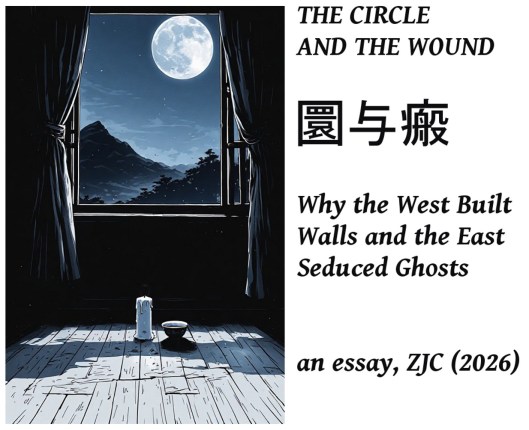
THE CIRCLE AND THE WOUND
圆与伤
A Comparative Essay on Western Ceremonial Magic and the Chinese Ghost Tradition
with
THE UNLIT CANDLE
A Night for the Gūhún Yěguǐ: An Anti-Ceremonial Ritual
Author’s Note: This volume contains two companion texts. The first, The Circle and the Wound, is a work of comparative metaphysics — an essay tracing the difference between Western ceremonial magic’s bounded self and the porous, unfinished self that encounters the lonely ghost. The second, The Unlit Candle, is a stand-alone ritual script for those who wish to practice what the essay describes. They may be read separately or together. The essay provides the theory. The ritual provides the door.
ZJC (2026)
TABLE OF CONTENTS
The Circle and the Wound
- Epigraph
- I. The Circle as Technology of Fear
- II. The Wound as Technology of Availability
- III. Baudelaire’s Drunkenness as Accidental Eastern Turn
- IV. The Circle Cannot Hold the Erotic Revenant
- Interlude: Letter Never Sent
- V. What the West Lost
- VI. A Middle Way?
- VII. Coda: The Unlit Candle as Emblem
- Afterword: What This Essay Does Not Do
Glossary of Key Terms
Works Cited
The Unlit Candle: A Night for the Gūhún Yěguǐ
- A Note Before You Begin
- Part One: The Unmaking (Sunset)
- Part Two: The Walk Without Destination (Late Evening)
- Part Three: The Invitation That Is Not an Invitation (Midnight)
- Part Four: The Vigil (Midnight to 3 A.M.)
- Part Five: The Morning Window (Dawn)
- The Return (To Be Used Only If Needed)
- A Closing Blessing
THE CIRCLE AND THE WOUND
Why the West Built Walls and the East Seduced Ghosts
Epigraph
“Il faut être toujours ivre. — Always be drunk. That’s the only question. If you don’t want to feel the horrible burden of Time breaking your shoulders, you must get drunk without respite. But on what? On wine, on virtue, or on poetry, as you choose.”
— Charles Baudelaire, Le Spleen de Paris
I. The Circle as Technology of Fear
Western magic begins with a line on the floor.
Not always literally. But the metaphysical gesture is unmistakable: here is the magician, whole and defended; there is the spirit, outside, contained, addressed through a triangle of art. The circle is drawn with sword or knife, with chalk or ash, with the magician’s own saliva if nothing else is available. It is the first act of nearly every grimoire tradition from the Key of Solomon to the Lemegeton to the less respectable pamphlets sold in Victorian London.
Why?
The official answer is protection. Spirits, in the Western view, are deceptive, envious, or malicious. They will lie about their names. They will offer gifts that turn to rot. They will possess if given the smallest opening. The circle keeps them out there while the magician remains in here.
But protection is only half the story. The circle also defines.
Plato had already prepared the ground. His chorismos — the separation of the ideal realm from the sensible world — is the original circle. The philosopher purifies himself from the body’s distractions, ascends toward the Form of the Good and leaves the messy, changing, erotic world behind. Neoplatonism deepened the wound (though it would not call it that): the soul’s task is to return to the One, shedding attachments like old skin. Purity is the method. Distance is the goal.
The Hermetic magicians inherited this architecture. The circle does not merely keep spirits out. It keeps the magician in — in a particular kind of self: bounded, sovereign, unbroken. Purity becomes power. The unwashed magician, the grieving magician, the drunk magician, the magician who has just made love or cried or forgotten to eat — these are failures. They have let down the wall.
And yet.
The lonely ghost does not live in the world the circle assumes. The Gūhún Yěguǐ is not a demon to be commanded. It is not a planetary spirit to be negotiated with. It is not even, strictly speaking, a separate entity in the Western sense. It is an unfinished life — a desire that never closed, a death that never found its proper ground, a body that rots far from home while the soul wanders crossroads and ruins, looking for warmth.
The circle says: I am complete. You are outside.
The ghost hears: Not for me.
It passes by.
II. The Wound as Technology of Availability
If the circle begins with a line on the floor, the wound begins with a door left ajar.
Not literally — though sometimes literally. In the Strange Tales from a Chinese Studio (Liaozhai zhi yi), the scholar who meets a ghost is almost always in a state of incompletion. He is lost in the mountains at dusk. He has drunk too much wine and missed the last ferry. He is grieving a dead wife and falls asleep on her grave. He is so absorbed in copying a sutra by candlelight that he does not notice the hour. The ghost does not break into his world. She slips through a crack he did not know he had left open.
Pu Songling, the author, understood something that Western ceremonial magic forgot: the self is not a fortress. It is a ruin.
Not a sad ruin. A productive one. A ruin has gaps. Wind passes through. Rain pools in corners. Moss grows where the roof once held. The ruin does not need to be rebuilt to be valuable. It only needs to be inhabitable — by memory, by longing, by the wandering dead.
The Gūhún Yěguǐ (wandering lonely ghost) is not a spirit of place. It is a spirit of interruption. A young woman dies of a broken engagement before the wedding. A merchant is robbed and murdered on a mountain pass, his body never returned to his village. A scholar’s wife dies in childbirth and the infant dies with her. These are not ancestors. They have no grave to tend, no tablet to honor, no descendant to pour tea on the anniversary of their death. They are unfinished.
And they wander.
But they do not wander randomly. They are drawn to the living who resemble them — not in circumstance but in shape. The grieving widow, the lovesick poet, the exhausted traveler, the drunkard singing alone at midnight: these are not victims. These are beacons. Their incompleteness is legible to the ghost. The ghost looks at them and thinks: This one knows what it is to want something that cannot finish.
No circle can keep out that recognition. The circle only makes the self invisible.
Consider the Taoist and Buddhist traditions that inform the ghost literature. They do not begin with the question How do I protect myself? They begin with the question What am I attached to? Attachment — to desire, to grief, to a name, to a body, to a home — is what creates both the hungry ghost and the living person who can see one. The hungry ghost (preta) has a tiny mouth and a vast, burning stomach. It can never be filled. It is the shape of wanting made visible. The living person who practices pudu (universal salvation) does not build a circle. They build a table. They set out food. They chant sutras not to command the ghosts to leave but to release them from their own hunger.
But release is not the only option.
The erotic revenant — the ghost who does not want to be fed and released, but to stay for a while — requires a different practice. She requires someone willing to be unreleased alongside her. This is not Buddhist orthodoxy. It is folk tradition, literary invention, the shadow of orthodoxy. But it is real in the way that dreams are real.
Pu Songling’s scholars do not exorcise the ghosts who visit them. They make tea. They recite poetry. They fall in love. They wake up with peonies on their pillows and fox fur under their nails. The ghost leaves eventually — she always leaves — but not because she was commanded. She leaves because the scholar’s own incompleteness has shifted, or because the dawn has come, or because she was never meant to stay. The encounter was not a possession. It was a visit. And visits end.
The wound-model does not fear the visit. It hosts it.
Here is the difference stated as clearly as I can manage:
| Circle | Wound | |
|---|---|---|
| Self | Bounded, sovereign, pure | Porous, unfinished, attached |
| Spirit | Deceptive, other, to be commanded | Lonely, recognizable, to be witnessed |
| Ritual act | Summoning, binding, banishing | Waiting, leaving the door open, being found |
| Failure mode | Possession, deception, contamination | The ghost never comes — or never leaves |
| Theology | Spirits are lesser beings | Spirits are us interrupted |
The wound-model does not require belief in ghosts as Western metaphysics defines them. It requires something stranger: the willingness to sit in your own incompleteness without trying to seal it shut.
That willingness is the door left ajar.
III. Baudelaire’s Drunkenness as Accidental Eastern Turn
Now we make a strange leap: from seventeenth-century Chinese ghost tales to nineteenth-century Paris, to a poet who never read Pu Songling, never performed a pudu ritual and would have been baffled by the term Gūhún Yěguǐ. And yet.
Charles Baudelaire wrote, in Le Spleen de Paris:
“Il faut être toujours ivre. — Always be drunk. That’s the only question. If you don’t want to feel the horrible burden of Time breaking your shoulders, you must get drunk without respite. But on what? On wine, on virtue, or on poetry, as you choose.”
Most readers take this as hedonism. A few take it as metaphor. I want to take it literally — but not in the way Baudelaire intended. I want to read it as an anti-ceremonial instruction manual for encountering the wandering dead.
Baudelaire did not believe in ghosts, not really. He believed in correspondences — the secret sympathy between things, the way a perfume could summon a memory, the way a city street at midnight could feel haunted without containing a single specter. But that is exactly the point. The wound-model does not require ghosts to be ontologically real in the Cartesian sense. It requires the practitioner to be available to the experience of haunting, whether the ghost is “real” or not.
Intoxication — on wine, on virtue, on poetry — is a technology of unfinishing.
Consider: The sober, well-rested, well-fed, fully clothed, fully housed person is finished. They have no cracks. They have locked their door, paid their bills, answered their emails and gone to bed at a reasonable hour. No ghost will find them, because they have left no opening. They are the circle made flesh.
The drunk — not the stumbling fool, but the Baudelairean drunk, the one who has chosen to be always in an altered state — has deliberately unsealed themselves. Wine loosens the ego’s grip on its own boundaries. Virtue (the intoxication of moral intensity, of religious fervor, of political passion) displaces ordinary consciousness into a higher key. Poetry is the strangest intoxicant of all: it replaces the self’s ordinary language with a language that belongs to no one, that passes through the poet like a ghost through a wall.
Baudelaire’s famous sonnet “Correspondances” describes nature as a “forest of symbols” that watch the poet with “familiar glances.” This is not animism in the crude sense. It is the recognition that the world is already porous — that the boundary between self and not-self, living and dead, human and spirit, is not a line but a membrane. The sober person sees a tree. The intoxicated poet sees a familiar glance.
The Gūhún Yěguǐ lives in that glance.
Now consider Baudelaire’s other great innovation: the flâneur. The idle stroller of Parisian arcades, the one who walks without destination, who gets lost on purpose, who watches and is watched by the city’s anonymous crowds. The flâneur is not a tourist. The flâneur is a seeker of encounters — not because they are looking for something specific, but because they have abandoned the tyranny of destination.
This is exactly the state prescribed for the scholar who meets a ghost in Liaozhai. The scholar does not set out to find a haunted house. He becomes lost. He takes the wrong path. He lingers too long at a crossroads. He falls asleep under a tree whose species he cannot name. The ghost finds him not because he summoned her, but because his lostness made him visible.
Baudelaire’s flâneur is the secular, Western, nineteenth-century version of that lost scholar. The flâneur walks at night. The flâneur is slightly drunk (on wine or poetry). The flâneur has no place to be and no one waiting for him. He is, in the language of the wound-model, available.
What would Baudelaire have made of a Gūhún Yěguǐ? He would have recognized her immediately. She is the passante of his sonnet “À une passante” — the veiled woman who appears for a single stanza, locks eyes with the poet and vanishes into the crowd, never to be seen again. The poet cries out:
“O you whom I would have loved, O you who knew it!”
That is the erotic revenant. She appears. She is seen. She leaves. And the poet is left with an unfinished sentence — the exact state the wound-model cultivates.
Baudelaire never drew a circle. He never commanded a spirit. He never performed a banishing. He got drunk on poetry and walked the midnight streets of Paris, leaving his door ajar. And things visited him. Not ghosts, perhaps — not in the sense that a Taoist priest would recognize. But something. Something that looked at him with familiar eyes. Something that passed and left him changed.
That is the accidental Eastern turn: a French poet, without any knowledge of Chinese ghost literature, reinvented the wound-model because he understood that completion is the enemy of encounter.
The circle says: I am complete. Approach only on my terms.
Baudelaire says: I will never be complete. Come as you are.
The ghost, who has been wandering for centuries, finally finds a door that is not locked.
IV. The Circle Cannot Hold the Erotic Revenant
We have traced the circle’s logic and the wound’s alternative. We have watched Baudelaire stumble into an Eastern metaphysics he never knew he inherited. Now we must test the claim directly: Why does Western ceremonial magic fail with the erotic revenant?
Not fail entirely. The circle works beautifully for what it was designed to do: command planetary intelligences, bind demons, invoke angels, protect the magician from deception. The grimoire tradition is not foolish. It is specialized. It assumes a universe in which spirits are hierarchical, names are power and purity is the magician’s primary defense.
But the Gūhún Yěguǐ does not live in that universe.
She lives in ours — the one where death is sometimes messy, where love outlasts the body, where a broken engagement can produce a ghost that haunts not a house but a feeling. She is not a demon to be bound by the Seventy-Two Names of God. She is not a planetary spirit with an hour and a metal and a sigil. She has no rank in any hierarchy. She has only her longing and her longing is not a weakness to be exploited by the magician. It is the only thing about her that is real.
Let me show you the failure through two case studies: one Victorian, one Qing. The first is a failure of method. The second is a failure of will — which is to say, a success of the wound.
Case Study A: The Victorian Necromancer and the Ghost Who Would Not Be Commanded
In 1897, a minor English occultist — let us call him Arthur, though that was not his name — decided to summon the ghost of a woman he had loved in life. She had died of consumption three years earlier. He had not been at her bedside. The guilt was a knot in his chest that no amount of Hermetic study had loosened.
Arthur was well trained. He had read Lévi. He had practiced the Lesser Banishing Ritual of the Pentagram. He had a circle of consecrated chalk in his attic, a triangle of art painted on black wood and a copy of the Arbatel open to the appropriate chapter. He followed every instruction: purification bath, fasting, the invocation of the four archangels, the drawing of the circle with a sword that had never cut anything but air.
Then he called her name.
Nothing happened. He called again, louder, using the barbarous names of evocation that had worked so well for the planetary spirits. Still nothing. He waited until dawn, his back aching from standing inside the circle, his voice hoarse from commanding a ghost who would not appear.
She did not come because she could not. The circle, for all its power, had done exactly what it was designed to do: it had separated him from the spirit world. He stood inside a fortress of purity, commanding her to appear in the triangle of art — a space designed for binding, not for meeting. The ghost of a consumptive seamstress who had died without a wedding ring did not recognize herself in that geometry. She was not a planetary spirit. She had no interest in being bound. She wanted, perhaps, only to be seen — not summoned, not commanded, not placed in a triangle like a specimen.
Arthur died in 1901, still believing he had failed because his technique was insufficient. In truth, he had failed because his technique was exactly correct for a kind of spirit that had nothing to do with the one he sought.
The circle cannot hold the erotic revenant because the erotic revenant does not want to be held. She wants to be met.
Case Study B: The Qing Scholar and the Peony on the Pillow
Now consider a different scene.
The year is 1679, though the story could be any year. A scholar — let us call him Song, though Pu Songling gives him many names — is traveling through the mountains of Shandong. He has missed the last inn. His donkey has thrown a shoe. It is raining, a thin, persistent rain that soaks through his robes and makes the path treacherous.
He finds a ruined temple. Not a dramatic ruin — just an old shrine to a local goddess, abandoned when the village below moved to the other side of the mountain. The roof leaks. The statue of the goddess has lost her face to time and weather. But there is a dry corner and Song has a flask of wine and he is too tired to be afraid.
He drinks. He recites a poem to himself — something about autumn, something about a woman he once loved who married another man. He falls asleep on a pile of musty straw.
He wakes to candlelight.
A woman sits across from him. She is beautiful, yes — all the stories say that — but more than beautiful, she is familiar. He cannot place her, but his chest aches as if he has known her for years. She does not introduce herself. She pours him tea from a pot he did not see her bring. She asks him, softly, to recite the poem again.
He does. She smiles. The smile is the saddest thing he has ever seen.
They talk until dawn. Not about anything important — the rain, the mountain, a line of poetry he had misunderstood until she explained it. When the first light touches the broken statue of the goddess, the woman stands. She touches his cheek. Her fingers are cold, but not unpleasantly so. She says: “You will not remember me clearly tomorrow. That is not a cruelty. It is a mercy.”
She walks toward the wall and does not turn.
Song wakes alone. The candle is gone. The tea cup is cold. On his pillow — his makeshift pillow of folded robes — there is a single peony. Fresh. Unfaded. Impossible, because peonies do not grow in the mountains and it is not the right season and he did not have a peony when he fell asleep.
He keeps the peony pressed in a book until the day he dies. He never marries. He never tells anyone the full story, except once, to Pu Songling, who writes it down and changes the names.
What the Two Cases Teach Us
Arthur the Victorian did everything right by the standards of his tradition. He failed.
Song the scholar did nothing right by those same standards. He was impure (unwashed, drunk, emotionally porous). He drew no circle. He spoke no barbarous names. He made no attempt to bind or command. He simply sat in his own incompleteness and was found.
The difference is not technique. The difference is metaphysics.
Arthur believed:
- The ghost is separate from the self
- The ghost must be controlled
- Purity is the condition of power
- The encounter ends when the magician says it ends
Song believed (or, more accurately, acted as if):
- The ghost is recognizable because the self is also unfinished
- The ghost cannot be controlled, only witnessed
- Impurity is the condition of encounter
- The encounter ends when the ghost decides — or when dawn comes, which is the same thing
The Western tradition, in its obsession with protection, built a machine that cannot do what it never asked to do: host the stranger without demanding surrender.
The circle protects. But protection is not the same as hospitality.
The erotic revenant does not want to be fought or bound. She wants to be offered a cup of cold tea and a poem recited badly, at midnight, by someone who has also loved and lost and fallen asleep in a ruined temple.
That is not a failure of the circle. It is a category error. You cannot command a wound to heal by drawing a line around it. You can only sit in the wound with someone else who also cannot sleep.
V. What the West Lost
We have circled the wound long enough. Now we must name the loss.
Western ceremonial magic, for all its beauty and rigor, developed a particular neurosis: the fear of contamination. The circle is its expression, but the circle is only a symptom. Deeper than the circle is a metaphysics that treats the self as a fortress to be defended, the spirit as an enemy to be controlled and control as the only legitimate source of power.
This is not magic. This is trauma dressed as architecture.
Consider the history: the Hermetic tradition emerged from a world of religious persecution, sectarian violence and the slow death of the pagan gods. The magician drew the circle because the world outside the circle was genuinely dangerous — not because of spirits, but because of witch-hunters, inquisitors and neighbors who would burn you for owning the wrong book. The circle was not just a spiritual technology. It was a survival strategy.
But survival strategies calcify. What began as protection became identity. What began as caution became paranoia. By the time we reach the Victorian occult revival, the circle is no longer a response to danger. It is a habit of mind. The magician draws the circle because that is what magicians do. The possibility of not drawing the circle — of sitting in the dark with an unlit candle and a cup of cold tea — has become unthinkable.
The West lost the ability to be porous.
Porosity is not weakness. Porosity is the recognition that the boundary between self and world, living and dead, human and spirit, is not a line but a membrane. Things pass through. Some of them are welcome. Some of them are not. But you cannot choose which ones come if you have sealed every opening. A sealed fortress keeps out the enemy. It also keeps out the lover, the ghost, the strange blessing that arrives only when you are not prepared.
The wound-model risks contamination. That is its danger and its gift. The circle-model avoids contamination. That is its safety and its poverty.
What the Circle Protects (At What Cost)
Let me list what the circle preserves:
- The integrity of the ego
- The distinction between self and other
- The magician’s sense of agency
- The ability to begin and end the ritual at will
- The comfort of knowing that the spirit world is over there
And let me list what the circle cannot access:
- The ghost who does not recognize herself in the triangle
- The blessing that arrives only through grief
- The knowledge that comes from sitting in the wound with another unfinished being
- The strange peace of not being in control
- The encounter that changes you because you did not command it
The West chose safety. That was not a foolish choice. But it was a choice with consequences. One of those consequences is that Western magic has very little to say to the grieving, the lovesick, the lost — the very people who most need a technology of encounter. The circle tells them to purify themselves before they can approach the spirit world. But their grief is their approach. Their lovesickness is their ritual. Their lostness is their circle — not of protection, but of availability.
Descartes’ Circle
The deepest loss is philosophical.
René Descartes, searching for an unshakeable foundation for knowledge, retreated into the famous cogito: “I think, therefore I am.” He drew a circle around the thinking self and declared everything outside it — the body, the senses, the world, other minds, spirits — subject to doubt. The only certainty was the self’s own awareness of itself.
This is the circle of circles. Western philosophy has been trying to escape it for four hundred years, with limited success.
The wound-model does not attempt to escape the cogito. It simply refuses to start there. It asks: What if the self is not a thinking thing but a wanting thing? What if consciousness is not the ground of being but a late addition, a fragile flower growing out of the soil of desire and loss? What if the ghost is not a problem for epistemology but a neighbor for ontology?
The Gūhún Yěguǐ does not care whether you think, therefore you are. She cares whether you want, therefore you are like me.
Descartes drew the circle to achieve certainty. He lost the ghosts in the process. They were never the enemy he was trying to exclude. They were just… there. Waiting. Hoping he would one day leave the window open.
He never did.
The Unmourned Dead
Here is the cruelest loss: the West’s obsession with protection has made it nearly impossible to grieve properly.
Grief is the original wound. To grieve is to be unfinished. The person you loved has died and you cannot complete the conversation, cannot finish the sentence, cannot close the door. Grief is porosity — the dead passing through you whether you invite them or not.
The circle-model says: Protect yourself from grief. Banish it. Purify yourself from attachment. The dead are gone. Do not linger.
The wound-model says: Sit with grief. Let it change you. The dead are not gone; they are transformed. If you are lucky, they will visit. If you are very lucky, they will visit more than once.
The West has pathologized grief, medicated it, therapized it, shortened it, hidden it away in funeral homes and cemeteries that are no longer visited. We have drawn a circle around the living and called the dead “over there.” And we are lonelier for it.
The Gūhún Yěguǐ is not just a Chinese ghost. She is a universal figure: the dead who wander because the living have forgotten how to host them. Every culture has its version. The West has the banshee, the revenant, the ghost at the crossroads. But we have forgotten how to sit with them. We have forgotten that the cold cup of tea is not an offering — it is a recognition.
I see that you are still here. I am still here too. Let us be unfinished together for a while.
That is what the West lost. Not the ability to command spirits. The ability to recognize them.
VI. A Middle Way?
We have drawn a sharp contrast: circle versus wound, command versus availability, purity versus porosity. But sharp contrasts are for teaching, not for living. The practitioner who abandons the circle entirely may find themselves overwhelmed. The practitioner who never leaves the circle may find themselves alone.
Is there a middle way?
Not a compromise — compromise weakens both. But a navigation: knowing when to draw the circle and when to leave it undrawn. The wound-model is not a rejection of the circle. It is a contextualization of it. The circle works for some spirits, some purposes, some states of self. It fails for the Gūhún Yěguǐ. The wise practitioner learns both languages and speaks each when it is called for.
Let me propose a rough map.
When to Draw the Circle
The circle is appropriate when:
- The spirit you are engaging has a known hierarchy, name and function
- You require a specific outcome (information, a boon, a binding)
- You are already in a state of relative wholeness and wish to remain so
- The spirit is known to be deceptive, malicious, or indifferent to human welfare
- You are working with others who need the safety of clear boundaries
- You are a beginner, still learning the shape of your own psychic boundaries
The circle is good for these purposes. It is not evil or obsolete. It is a tool and tools have domains.
When to Leave the Circle Undrawn
The wound-model is appropriate when:
- The spirit is an erotic revenant, a Gūhún Yěguǐ, or any ghost whose primary characteristic is unfinished longing rather than malice
- You are yourself grieving, lovesick, lost, or otherwise porous
- You seek not a command but an encounter — a meeting that may change you without your consent
- You are willing to risk attachment, lingering, or the slow fading that comes from loving the dead
- You understand that the ghost may not leave when you want it to
- You have already done enough circle-work to know your own shape and can therefore recognize when to let it blur
The wound-model is not for beginners. It is not for the psychically fragile. It is for those who have built a self strong enough to temporarily unbuild.
The Door with a Lock Almost Never Used
The circle is a lock you use often. It keeps things out. That is its function.
The wound is an open door. Things pass through. That is its function.
The middle way is knowing that you have a lock — and choosing, for this night, not to use it.
The lock does not disappear. It waits on the doorframe, silent, ready. You are not a fool for having it. You are wise for knowing when to leave it untouched.
The Western tradition forgot that the lock could be left unused. It became compulsive: draw the circle, banish before and after, never leave an opening, never be vulnerable. That compulsion is not protection. It is fear dressed as technique.
The middle way restores choice. You may draw the circle tomorrow night, for a different spirit, for a different purpose. But tonight, for the Gūhún Yěguǐ, you leave it undrawn. You sit in the dark. You say: I am not summoning you. I am not commanding you. I am only here, unfinished, like you.
And if the ghost comes — or if she does not — you have done something the circle could never teach you: you have chosen vulnerability on purpose, without losing the ability to choose otherwise tomorrow.
That is not weakness. That is the hardest discipline of all.
Practical Synthesis: A Table
| Situation | Circle? | Wound? | Notes |
|---|---|---|---|
| Summoning a planetary spirit | Yes | No | Hierarchy, command, specific outcome |
| Performing pudu for hungry ghosts | No | Yes (but with ritual structure) | Feeding, not commanding; release is the goal |
| Encountering a Gūhún Yěguǐ by accident | No | Yes | You are already in the wound; do not pretend otherwise |
| Seeking a specific erotic revenant (e.g., a dead lover) | No | Yes, with caution | The Return practice is essential |
| Beginner practice, learning boundaries | Yes | No | Build the self before you unbuild it |
| Long-term practitioner, deep grief work | No | Yes, with supervision | Do not do this alone if you are fragile |
| A spirit attacks or possesses | Yes | No | The wound-model has no defense; use the circle |
This table is not a cage. It is a map. You may find your own territory.
VII. Coda: The Unlit Candle as Emblem
We have traveled far: from the chalk circle of the Victorian magician to the ruined temple of the Qing scholar, from Plato’s chorismos to Baudelaire’s drunken flâneur, from the hungry ghost realms to the salt water of a simple return. Now we come to rest on a single image.
The unlit candle.
In the practice of the wound, the practitioner sits before a candle and does not light it. That instruction is not arbitrary. It is the emblem of everything this essay has tried to say.
The lit candle belongs to the circle. It sees. It illuminates. It draws a boundary between light and dark, known and unknown, self and other. The magician lights candles to see the spirit they have summoned — to verify, to control, to document. The lit candle is the eye of command.
The unlit candle belongs to the wound. It does not see. It does not illuminate. It waits. It could be lit — that is important — but tonight it is not. The practitioner sits in darkness not because darkness is better, but because the ghost does not come to be examined. The ghost comes to be sensed. And sensing happens in the dark.
The unlit candle says:
I am not trying to capture you. I am not trying to prove you exist. I am not trying to write your name in a grimoire or bind you to a triangle of art. I am sitting here, in the dark, with a candle I could light but choose not to. That choice is my offering. It says: you do not have to be visible to be real. You do not have to be commanded to be welcome.
What the Unlit Candle Teaches
1. The suspension of the will.
The lit candle is an act of will: I will see. The unlit candle is an act of will suspended: I will not see yet. I will wait. The circle-model exalts the will. The wound-model respects it and then, deliberately, sets it aside.
2. The rejection of evidence.
The Western practitioner, trained in Descartes and empiricism, wants proof. Did the ghost come? Can I measure it? Can I photograph it? Can I write it down in a case study? The unlit candle refuses to answer those questions. It says: Proof is not the point. Encounter is the point. You may never know whether the ghost was real. But you will know whether you were changed.
3. The embrace of darkness as hospitality.
Light can be aggressive. A flashlight in the face of a sleeping person is an assault. The same is true for ghosts. The lit candle says: I am studying you. The unlit candle says: You can rest here. I am not looking.
4. The possibility without demand.
The unlit candle can be lit at any moment. That possibility is important. The practitioner is not helpless. They have a lighter or a match in their pocket. They could flood the room with light, banish the ghost, return to the safety of the circle. But they choose not to. That choice — renewable every second — is the shape of trust.
The Candle That Never Lights
Some nights, the practitioner sits before the unlit candle until dawn. The ghost does not come. The candle remains unlit. The practitioner drinks the cold tea alone, pours it onto bare earth, opens the eastern window and says: I am still among the living.
Was the night a failure?
No. The night was a practice in waiting without expectation. That is its own discipline. The circle-model cannot abide waiting without expectation — it always wants a result, a sign, a spirit in the triangle. The wound-model says: The waiting is the ritual. The sitting in the dark, the refusal to light the candle, the willingness to be unfinished — that is already the encounter. The ghost is not required.
Sometimes the ghost comes. Sometimes she does not. Both are gifts. The first gift is contact. The second gift is the patience to sit in her absence without despair.
A Final Distinction
The circle says: I will make contact.
The wound says: I will be available for contact and I will not be broken if it does not come.
The circle says: I will protect myself.
The wound says: I will risk myself, because some gifts are only given to the vulnerable.
The circle says: I will know.
The wound says: I will wonder.
The circle says: Prove it.
The wound says: I believe you — not because you have given evidence, but because you are here, in the dark with me and that is enough.
Afterword: What This Essay Does Not Do
Before we part, a final honesty.
This essay does not teach you how to summon a Gūhún Yěguǐ. No one can teach that, because no one can command her. It only teaches you how to be found by her — or by something that feels like her, whether or not she is “real” in a Cartesian sense.
This essay does not replace the living traditions of Taoist or Buddhist ghost-feeding. If you or your grandmother performed pudu during Ghost Month, do not take my words as authority. I am a visitor, a guest, a borrower. I have tried to be respectful. That does not mean I have succeeded.
This essay does not promise you an encounter. It promises you only the possibility of one — and the discipline to sit with that possibility without demanding more.
If you try the practice of the unlit candle and nothing happens, you have not failed. You have practiced porosity. That practice will change you even if no ghost appears. You will become someone who can sit in the dark without fear, who can leave a door open without panic, who can say I am unfinished and mean it.
That person is closer to the Gūhún Yěguǐ than any magician standing in a circle of chalk.
And maybe — just maybe — that is enough.
GLOSSARY OF KEY TERMS
For Readers of The Circle and the Wound
Circle (Western ceremonial)
A bounded ritual space, usually drawn on the floor, designed to protect the magician and command spirits. The circle assumes a universe in which spirits are deceptive, the self is fragile and purity is power. It is a technology of separation and control. Works well for planetary spirits and demons. Fails for the Gūhún Yěguǐ.
Wound (as used in this essay)
Not a literal injury. A metaphysical posture: the recognition that the self is already unfinished, porous and attached to desires and losses. The wound is not healed but hosted. It is the condition of availability for the Gūhún Yěguǐ.
Purity (Western / Hermetic / Christian)
Moral and sexual sinlessness. To be pure is to be free from contamination by the flesh, by sin, by bodily functions, by “unclean” contact. Impurity brings shame, guilt and unworthiness. The Western magician must purify themselves (through fasting, celibacy, bathing, confession) before drawing the circle. Failure to do so is not just ineffective — it is sinful.
Emotional tone: fear, shame, striving.
Purity (Taoist / 清 qīng)
Clarity, stillness and energetic alignment. Not a moral category. An impure Taoist practitioner is like muddy water — ineffective, not evil. The remedy is simple: bathe, meditate, burn incense, rest. No shame attached. A sexually active, wine-drinking, joke-telling practitioner can have perfectly clear qi if they are relaxed and aligned.
Emotional tone: neutral, practical, like cleaning a room.
Purity (Buddhist, in ghost-feeding / pudu)
Freedom from attachment and selfish intention. To be pure is to perform a ritual for the benefit of all beings, not for personal gain (fame, merit, a ghost to leave). Impurity means grasping — wanting something for yourself. The remedy is self-examination, not confession or cleansing.
Emotional tone: self-awareness, humility, compassion.
Porosity
The key term of the wound-model. Porosity is the willingness to be unfinished, open and available to encounter. The porous self does not seal itself behind a circle. It leaves the door ajar. Porosity is not the same as Western impurity (sin), but both reject the circle’s demand for closure.
Emotional tone: vulnerability, trust, patience.
Gūhún Yěguǐ (孤魂野鬼)
Chinese term: “wandering lonely ghost” or “wild ghost.” A spirit who died a “bad death” — away from home, unmarried, murdered, by suicide, or otherwise unable to join the ancestors. They have no grave, no one to tend their tablet, no descendants to pour tea. They wander crossroads, ruins and mountains, seeking warmth, recognition, or completion. In literature (Strange Tales from a Chinese Studio), they often appear as beautiful women who fall in love with scholars. They are not evil. They are unfinished.
Not to be confused with: hungry ghosts (preta), who are driven by insatiable hunger and are typically fed and released through pudu rituals. The Gūhún Yěguǐ may want love, not food.
Erotic Revenant
A broader category that includes the Gūhún Yěguǐ but also Western analogues: the ghost lover, the bride who died before the wedding, the sailor’s wife who haunts the shore. An erotic revenant is a ghost whose primary characteristic is unfulfilled longing — especially romantic or sexual — rather than malice or hunger. They return not to harm but to be with the living, however briefly.
Pudu (普度)
“Universal salvation” or “universal crossing over.” A Taoist and Buddhist ritual, particularly during Ghost Month, in which food, incense and sutras are offered to hungry ghosts to feed and release them from purgatory. The goal is to help them move on, not to invite them to stay. This is different from the encounter described in this essay, which is about meeting a single Gūhún Yěguǐ, not releasing a crowd.
Liaozhai zhi yi (聊齋誌異)
Strange Tales from a Chinese Studio. A collection of supernatural stories by Pu Songling (17th–18th century). The primary literary source for the Gūhún Yěguǐ in this essay. In these stories, scholars meet ghosts, fox spirits and other beings — often through chance, lostness, or emotional porosity, not through ritual summoning.
Baudelaire’s Drunkenness
From Charles Baudelaire’s prose poem “Enivrez-vous” (“Always be drunk”). In this essay, interpreted as an anti-ceremonial technique: intoxication (on wine, virtue, or poetry) deliberately unfinishes the self, making it porous and available to encounter. Baudelaire is treated as an accidental Eastern thinker who reinvented the wound-model without knowing it.
The Unlit Candle
The central emblem of the wound-model. A candle that could be lit (the practitioner has a lighter) but is deliberately left unlit. Represents the suspension of will, the rejection of evidence and the embrace of darkness as hospitality. The opposite of the lit candle (the eye of command, the demand to see and verify).
The Return
A simple ritual for re-entry after a ghost encounter (or attempted encounter): a sink of warm salt water, hands washed slowly and the words: “You are not my unfinished. You are your own. I release you back to the road. You may visit again, but you may not live here.” Not a banishment or a circle — a door with a lock almost never used. It restores the practitioner’s boundary without sealing them off permanently.
Porosity vs. Impurity (A Final Clarification)
| Western Impurity | Taoist Impurity | Buddhist Impurity | Porosity (Wound-Model) | |
|---|---|---|---|---|
| What it is | Sin, shame, moral failure | Muddy qi, scattered energy | Grasping, selfish intention | Openness, incompleteness, availability |
| Emotional tone | Guilt, fear | Neutral (like a dirty window) | Self-awareness | Vulnerability, trust |
| Does the ghost care? | No — but the Western magician thinks she does | No — she cares about recognition, not qi | No — she cares about being seen, not your attachment | Yes — this is what draws her |
The Gūhún Yěguǐ is not drawn to sin. She is drawn to unfinishedness — which the West calls impurity (and fears), but which is simply the natural state of anyone who has loved, lost, grieved, or wandered.
WORKS CITED
Primary Sources
Baudelaire, Charles. Le Spleen de Paris (Paris Spleen). 1869. Includes the prose poem “Enivrez-vous” (“Always Be Drunk”) and the sonnet “À une passante” (“To a Passerby”). Multiple English translations exist; the translations in this essay are the author’s own.
Pu Songling (蒲松龄). Liaozhai zhi yi (聊齋誌異 / Strange Tales from a Chinese Studio). c. 1679–1707. Numerous translations. The tales referenced in this essay include those featuring scholars who encounter ghosts in ruined temples, mountain passes and other liminal spaces. Specific tales drawn upon include “The Peony Fairy,” “The Ghost Wife,” and “The Lost Scholar” (titles vary by translation).
Descartes, René. Meditations on First Philosophy. 1641. Cited for the cogito (“I think, therefore I am”) as the philosophical circle of the Western self.
Plato. Phaedo. c. 360 BCE. Cited for the concept of chorismos (the separation of the ideal realm from the sensible world) and the purification of the soul from the body.
Anonymous. The Key of Solomon (Clavicula Salomonis). c. 14th–15th century. Cited as a representative grimoire of the Western ceremonial magic tradition, including its requirements for ritual purity, fasting and chastity.
Anonymous (pseud. “Arbatel”). Arbatel de magia veterum. 1575. Cited for the system of Olympic spirits as an example of spirits that respond to circle-based command.
Secondary Sources
Bokenkamp, Stephen R. Early Daoist Scriptures. University of California Press, 1997. Provides context for Taoist concepts of purity (qing), clarity and energetic alignment, distinguishing them from Western moral purity.
Coleman, E.J. “The Hungry Ghosts: Buddhist Philosophy and the Practice of Pudu.” Asian Folklore Studies, vol. 45, no. 2, 1986, pp. 211–234. Discusses the pudu (universal salvation) rituals for feeding and releasing hungry ghosts during Ghost Month.
Idema, Wilt and Beata Grant. The Red Brush: Writing Women of Imperial China. Harvard University Asia Center, 2004. Includes analysis of female ghosts and erotic revenants in Chinese literature, including Liaozhai zhi yi.
Kohn, Livia. Daoism and Chinese Culture. Three Pines Press, 2001. Clarifies the difference between Daoist energetic purity (stillness, clarity) and Western moral purity.
Lévi, Éliphas. Dogme et rituel de la haute magie (Transcendental Magic). 1854–1856. Referenced in Case Study A as the text found in the attic; a key source for Victorian ceremonial magic and the circle tradition.
Teiser, Stephen F. The Ghost Festival in Medieval China. Princeton University Press, 1988. Definitive study of pudu rituals, hungry ghosts and the Ghost Month in Chinese Buddhist and Taoist practice.
Yamamoto, Yoshihiko. “The Gūhún Yěguǐ in Chinese Folk Religion: Wandering Souls and the Rituals of Salvation.” Journal of Chinese Religions, vol. 32, 2004, pp. 55–82. Defines the Gūhún Yěguǐ, distinguishes them from ancestors and hungry ghosts and discusses their appearance in literature and ritual.
Zeitlin, Judith T. The Phantom Heroine: Ghosts and Gender in Seventeenth-Century Chinese Literature. University of Hawai’i Press, 2007. Essential reading on the erotic revenant in Liaozhai zhi yi, particularly the figure of the ghost-woman who seeks love and recognition.
THE UNLIT CANDLE
A Night for the Gūhún Yěguǐ
An Anti-Ceremonial Ritual for the Lonely Ghost
A Note Before You Begin
This is not a summoning. You will command nothing. You will draw no circle. You will speak no barbarous names. The Gūhún Yěguǐ (wandering lonely ghost) does not come when commanded. She comes when she recognizes a kindred stillness — someone else who is also unfinished, also waiting, also open to the dark.
You do not need to believe in ghosts to perform this ritual. You only need to be willing to act as if for one night. The encounter may be psychological, poetic, or genuinely spectral. The ritual does not distinguish. It only asks that you show up, leave the door ajar and sit in your own incompleteness without trying to seal it shut.
Duration: From nightfall until dawn — or until you sleep, whichever comes first.
Best performed: On or near the new moon (when the sky is darkest).
You will need:
- One candle (any color, but white or uncolored is traditional)
- One cup (ceramic, not glass)
- Cold tea (leftover from earlier in the day, or brewed and left to cool)
- One piece of paper and one pen
- A window facing north (or the direction you cannot name — the one you rarely look toward)
- A lighter or matches (not to light the candle — to hold the possibility)
- Optional: a small bowl of plain rice (not an offering — a witness)
You will not need:
- A circle
- Holy names
- Protective amulets
- Any command in any language
- A single word of Latin, Hebrew, or Enochian
Part One: The Unmaking (Sunset)
Do not prepare. Do not purify. Do not shower immediately beforehand. If you are already clean, rub your hands in the earth of a houseplant or touch your own hair without washing it first. You are not becoming dirty. You are becoming porous.
1. The Unmade Bed
Go to your bedroom. If the bed is made, pull back one corner. If it is already unmade, leave it as it is. Sit on the edge for a moment. Say nothing. Then leave.
Why: A perfectly made bed says: No one lives here incompletely. An unmade bed says: Someone left in a hurry, or someone never left at all. The ghost hesitates at the second door.
2. The Cold Tea
Pour the cold tea into the cup. Do not heat it. Do not add sugar. Place the cup on the north windowsill. If you have no north window, place it on the floor in the northernmost corner of the room. Say aloud, without emphasis, as if stating a fact:
“This is cold, like you. This is waiting, like you. This asks for nothing.”
Why: You are not offering food. You are offering a gesture that expects nothing back. The ghost recognizes this as the shape of its own existence: waiting without arrival.
3. The Unfinished Sentence
Take the paper and pen. Write one sentence that you have never finished in your life. Examples:
- “The letter I never sent began with…”
- “If my father had lived one more year, I would have asked him…”
- “The person I was at seventeen wanted…”
- “The thing I never told you was…”
Stop in the middle of a word. Put the pen down. Do not complete the sentence. Do not read it again. Fold the paper once, badly (corners mismatched). Place it under the cold tea cup.
Why: The lonely ghost is an unfinished sentence. It cannot end because it never completed its desire. Your unfinished sentence is a mirror. The ghost reads it and thinks: This one understands.
Part Two: The Walk Without Destination (Late Evening)
Leave your home. You will return.
Walk without deciding where. At every intersection, turn in the direction that feels slightly wrong — the one you would not normally choose. If you come to a dead end, stand there for ten breaths. Do not turn back immediately. Let the dead end hold you.
If you see a stray animal, watch it until it leaves. Do not follow it. Do not call to it. The animal is not a ghost. But it may be watching for one.
If you pass a bridge, stop in the middle. Look down at the water (or the dry bed, or the asphalt — the shape matters less than the crossing). Say quietly:
“I am between. You are between. That is all we share tonight.”
If you pass a crossroads, pause. Do not pray. Just stand at the center for three breaths. A crossroads is where the dead wander. You are not visiting them. You are standing where they stand, for a moment.
Walk home by a different route. Do not hurry. If you feel afraid, do not run. Fear is not a warning. Fear is attention. The ghost notices attention.
Part Three: The Invitation That Is Not an Invitation (Midnight)
Back in your room. The cup of cold tea is still there. The paper is still under it.
Place the unlit candle in front of you. Do not light it.
Place the lighter or matches beside it. They are not tools. They are proof that you could light it — and are choosing not to.
Place the optional bowl of rice next to the candle — not as an offering, but as a witness: something that was once alive, then harvested, then cooked, then cooled and now sits here with you, also unfinished.
Say aloud, once, not as a prayer but as a statement of fact. Speak quietly. Speak to the room, not to any specific being:
“I am not summoning you. I am not commanding you. I do not know your name. I am only sitting here, unfinished, like you. If you want to be seen tonight, I will try to see you. If you want nothing from me, I will drink this cold tea alone tomorrow and forget I tried. That is the only promise I make: I will not pretend I am whole.”
Then be silent.
Part Four: The Vigil (Midnight to 3 A.M. — or until you sleep)
Now you wait. Not for something. Just with the waiting.
You may do nothing. You may close your eyes. You may whisper a poem you remember incompletely. You may hum a song whose lyrics you have forgotten. You may cry if you need to — ghosts are not embarrassed by tears.
You may almost light the candle. Pick up the lighter. Hold it near the wick. Then put it down. That act — the approach without the strike — is its own language. It says: I could command the light. I choose not to.
If nothing happens:
That is not failure. That is the most common outcome. The ghost may not be here tonight. Or it may be watching from the threshold, deciding. Or there may be no ghost at all and you have simply sat with your own unfinishedness — which is, itself, the beginning of understanding.
Stay until 3 A.M. if you can. If you fall asleep on the floor, that is also fine. The ghost does not require your wakefulness. Only your willingness to have been here.
If something happens:
Do not name it quickly. Do not ask “Is this a ghost?” That question will end the encounter. Instead, stay with the impression:
- A cold spot that moves
- A smell with no source (plum blossom, rain on dry earth, old paper)
- A feeling of being watched without fear
- A word that appears in your mind that you did not think first
- A shadow that does not match any object
- A faint sound — a breath, a footstep, cloth moving
If you feel a presence approach, do not turn around suddenly. Do not demand identification. Do not ask its name. Say, very softly:
“I see that you are here. You do not have to speak. You do not have to leave. You can stay as long as you want to be seen.”
Then be silent again. The presence may stay for seconds. It may stay until dawn. It may never leave entirely — but that is a different story and the Return (below) is for that story.
You may speak to the presence. You may say what you never finished saying to someone else. You may ask nothing. You may simply sit together, two unfinished beings, in the dark.
Do not try to touch it. Do not command it to leave. Do not demand proof. You are not a scientist. You are a host.
Part Five: The Morning Window (Dawn)
When the first light comes (or when you wake, if you slept), go to the eastern window. Open it. Breathe ten slow breaths. The air does not need to be fresh. It only needs to be from the direction of the living.
Say aloud:
“I am still among the living. I choose to stay. Whatever visited me, thank you for the visit. Whatever did not, thank you for the silence. I close no door — but I open this window.”
Do not pour out the cold tea immediately. Leave it on the north windowsill until noon. Then pour it onto bare earth — not down a sink. The tea must return to ground. If you have no bare earth, pour it into a potted plant and say:
“Return to root. Return to ground. Return to wherever you need to go.”
Do not finish the unfinished sentence. Burn the paper instead. Let the smoke go out the eastern window. As it burns, say nothing. The smoke is the sentence now. It is complete because it is gone.
Do not make your bed until evening. Let the dent remain one more day. The presence may come back tonight to check. That is allowed. You are not in a war. You are in a conversation that may last years.
Do light the candle now — at dawn, after the window is open. Light it. Let it burn for one minute. Then extinguish it. That minute says: I can light it. I chose not to last night. That choice is over. Today, I return to the light.
The Return (To Be Used Only If Needed)
If, in the days following this night, you feel too much of the presence — dreams that are not yours, a heaviness that does not lift, a sense that you are being watched in daylight, a cold spot that follows you from room to room — do not perform an exorcism. Perform a return.
On a sunny afternoon, fill a sink with warm water. Add a handful of salt (any salt). Wash your hands slowly, one at a time, saying:
“You are not my unfinished. You are your own. I release you back to the road. You may visit again, but you may not live here.”
Dry your hands on a clean towel. Open the eastern window. Say nothing more.
This is not a banishment. It is a door with a lock you almost never use. You are not sealing yourself off. You are simply saying: Not tonight. Not every night. I am still among the living.
If the presence returns another night and you are willing, you may choose to host it again. That is your choice. You are not bound. The door has a lock. You simply choose, most nights, to leave it unlocked.
A Closing Blessing
You have sat in the dark with an unlit candle. You have poured cold tea for no one. You have left your bed unmade, your sentence unfinished, your door ajar. You have been willing to be found — or willing to sit with the absence of being found.
That willingness is rare. Most people seal themselves so tightly that nothing can enter, not even grief. You have done the opposite. You have made yourself porous. Whether a ghost came or not, you have changed. You are someone who can sit in the dark without panic, who can leave a door open without terror, who can say I am unfinished and mean it.
“That person is closer to the Gūhún Yěguǐ than any magician standing in a circle of chalk.”
And maybe — just maybe — that is enough.
Unlit candle waits.
The scholar’s empty teacup
warm in cold moonlight.

