“I’m not a good lay/ I’m a straight razor,”
Judy Grahn, “Edward the Dyke”
There was no grief. The summer radio
played “you can have my husband/ but don’t mess
with my woman” all day long. Your afro
gleamed as we cruised in your Austin Princess
downtown. Playtime approached. After playtime
came dawn. Dusk and dawn. But you, drunk on spunk,
the first exile, loved love during wartime,
with your kerosene myth, junk in your trunk
and duck’s arse cut. Girls called you Liliti;
I called you my “mama-jan;” my surreal
strap-on sister. My roots and the orgy
where I was conceived. One hand on the wheel
while your other played with my head between
your thighs, licking your clit stiff and obscene.
I can sense your scent in the wind’s distress,
in tastes that ravish — the grape and anise
that grow on your grave. I wear the headdress
of my mistress. I carry her chalice
and her stone knife. In the mist of slumming
flowers and wet earth you have hung over
my bed, a silent silver thing, shining
through tree branches. I have pulled you closer,
sucked long at your foggy breast, played with your
wet and hazy clit. If sadness can haunt,
so can need, so can greed. You are cocksure
with what you are holding. With what you want.
joining What-was-not with What-might-have-been,
joining your dead lust with my living sin.
Actually, all Rumi’s love poems are tragic and bittersweet. Jalal ad-Din Muhammad Rumi (September 30, 1207 – December 17, 1273) was a 13th-century Persian Sufi mystic and quiet possibly the greatest poet the world has ever produced. Legend has it that one day while in the market place he heard a goldsmith tapping on a golden bowl and the music so astounded him he began to slowly turn about in wonder. From this he founded the Order of the Whirling Dervishes.
None of that matters in understanding this poem. What matters is that for all his talent and understanding of love and God and poetry, Rumi had one great love: Shams.
Shams-e Tabrizi was a wandering Sunni Muslim searching and praying for someone who could “endure my company.” From November 1244 to December 1248 the two men were inseparable and then, on the night of December 5, they heard a knock on the door. Shams went to answer it and was never seen again. It is rumored that it was Rumi’s own son (or some jealous followers) who killed Shams, but of course we’ll never know.
What we do know is that Rumi spent the rest of his life looking for Shams, never to find him. He wrote thousands of poems and through them all he constantly talks of Shams returning, “When Shams comes back from Tabriz,/ he’ll put just his head around the edge/ of the door to surprise us, just like this.” Except Shams will never come back and Rumi knows it and this is why this poem breaks me every time I read it. I have no patience for certain modern Persian scholars whose own homophobia tries to explain away Rumi’s and Shams’ love as simply platonic. This is one of the greatest love stories ever told and they do a disservice to both Rumi and lovers everywhere by derogating it.
We are all haunted by the ghosts of past loves that will never return. I draw my inspiration from Rumi and his beloved Shams.
If anyone asks you
how the perfect satisfaction
of all our sexual wanting
will look, lift your face
and say,
Like this.
When someone mentions the gracefulness
of the nightsky, climb up on the roof
and dance and say,
Like this.
If anyone wants to know what “spirit” is,
or what “God’s fragrance” means,
lean your head toward him or her.
Keep your face there close.
Like this.
When someone quotes the old poetic image
about clouds gradually uncovering the moon,
slowly loosen knot by knot the strings
of your robe.
Like this.
If anyone wonders how Jesus raised the dead,
don’t try to explain the miracle.
Kiss me on the lips.
Like this. Like this.
When someone asks what it means
to “die for love,” point
here.
If someone asks how tall I am, frown
and measure with your fingers the space
between the creases on your forehead.
This tall.
The soul sometimes leaves the body, the returns.
When someone doesn’t believe that,
walk back into my house.
Like this.
When lovers moan,
they’re telling our story.
Like this.
I am a sky where spirits live.
Stare into this deepening blue,
while the breeze says a secret.
Like this.
When someone asks what there is to do,
light the candle in his hand.
Like this.
How did Joseph’s scent come to Jacob?
Huuuuu.
How did Jacob’s sight return?
Huuuu.
A little wind cleans the eyes.
Like this.
When Shams comes back from Tabriz,
he’ll put just his head around the edge
of the door to surprise us
If I had the voice I’d sing the mystic’s
lullaby, salt hallow, to keep you safe.
But I, that am not shaped for sportive tricks,
my voice a lisping hell, must love my waif
sister, family ghost, in a new way.
Your eyes are beautiful beggars, now beg
for fry bread and a butterscotch sundae.
I’ll feed you. Between your legs your pink egg
cracks. I’ll break it for you. Like a firefly
you sleep three feet off the floor. I’ll guard you.
When you cry I’ll kiss your shaggy bangs dry.
And in rutting season I’ll make you mew,
then goo on me. A song for a sinner.
A lullaby for my dead kid sister.
I.
Just the merest flutter of temptation
would make a courtesan or a scholar
or a saint wanton, shameless. Lord Byron
knew this. In his Manfred the dead sister
is a symbol of impossible lust.
II.
The mist on the mountain and on the moon
hint at pathways few dare to take. Disgust
is just regret turned in on itself. Soon
the fog of lustfulness, the tempest’s scar,
the night’s charioteer, will come for you.
III.
If you love me, give in, though I am far
away, give in to what we both would do.
You, who are neither nun nor sorceress,
be my sister, my taboo, my lewdness.
Do not believe this tale until the school
bell rings. They said that I played with myself
in a corner of the yard. Boys were cruel
and girls flew away. Even the blind elf,
always drunk, smelling like a tanned horse hide,
was deaf to me. As a child the one ghost
who stayed was a motherly suicide
with a taste for innocence. Who would boast
that it was virgin cum which kept her in
limbo. But she lied. There is no limbo;
only us. I was her pretty plaything.
She would suckle on me, suck my foreskin
down her throat. And just before my deathblow
orgasm in the yard … the bell would ring.
You are nude under your clothes. Your perfume
gives you away. Sounds of strangers pissing
brings you to your knees in, please, a mensroom;
one you crept in when no one was looking. “Do it! Do it!” comes a voice, one, you note,
filled with “baby!” how much you are wanted,
as his alien darkness fills your throat.
Some love their trysts and treachery, lifeblood
that sings. Some don’t. There’s the urban legend
about some bloke who lost more than his soul
and his pride when he had his cock bitten
clean off one Thursday at the glory hole.
Do not believe such tales. The earth-weary
tell these tales. We’re not weary, we’re horny.
Balumba stole my lover’s breath. She died
and all of Mayumba suffered with me.
The next day, down by the ocean, I spied
the ghost of my love as she passed. Fairy
lights were in her hair, her left breast had grown
back and her splendid ass shook as she walked.
Balumba had painted an ash skull-bone
on my lover’s face and prated and squawked
in the mist of my dead Osa’s unbound
hair. I do not like blue-faced Balumba,
even if she is a woman who drowned
under the long shadows of the casbah.
Osa just smiles. Death was not the nightmare
she thought. Neither was our secret affair.
Notes
Bongolo Hospital of Libreville is the only cancer treatment center in all of Gabon, Africa. The distance from Libreville to my coastal village of Mayumba is 276 miles. Mayumba is known for its long sandy beach where leatherback turtles nest.
Balumba (whose name means Ghost Face) is a Gabonese haunt from the same region.
1.
Mountains do not amaze the way the gaps
in the earth do. The Marianas calls
for me, those dark bottomless shapes on maps
where our feeble sunlight dies and nightfalls
over and over into the abyss.
2.
To sink, to drift, to dream, a soul crying
in the darkness. I do not know if “bliss”
is the right word, perhaps it’s “fear”? Drowning
is a thing larger than our souls. Union
3.
with these eldritch horrors. Souls can never
find their way home once lost in the ocean.
4.
Pray for this diving bell and its diver.
Pray that pressure does not crush, oxygen
holds out, that all we love comes back again.
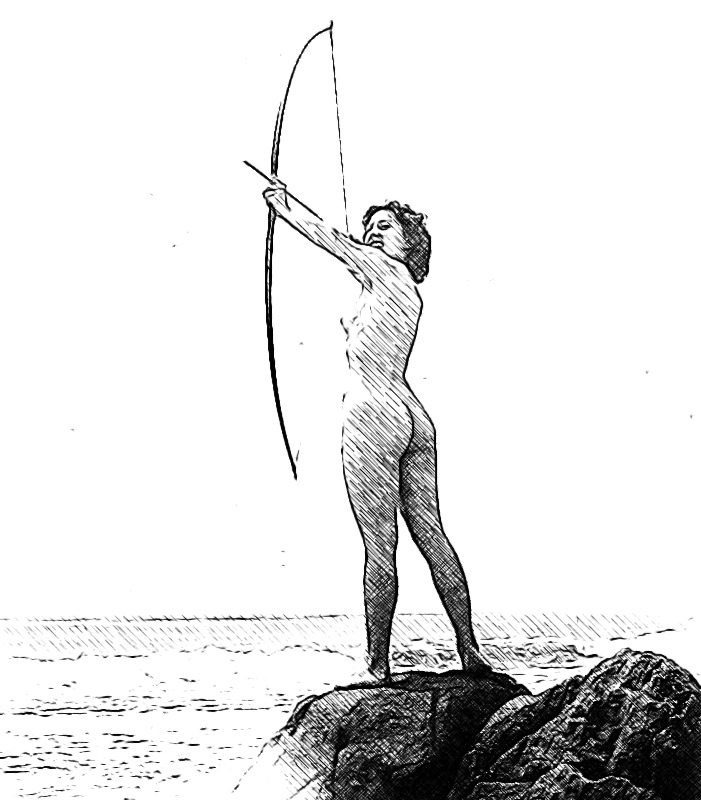
Now I hunt for the tomb of Queen Myrine,
was with her when the walls of Cerneh fell.
Myrine, who laid the Greek and Philistine
worlds to ash. Hippolyta, the rebel
Amazon, loved her. And, fey and childlike,
I did, too. Wars come, wars go, but hunger
remains. Once, curious what I tasted like
inside, we fell, clinging to each other
in a berserk haze. Hips grinding, amazed,
hot with blood-sweat until the war-god, Mars,
became enraptured. Now women are praised
for their chastity, not battle scars.
My queen, your tomb is lost, but your cravings
and name live on. Take these, my offerings.
Note:
Amazonomachy: art portraying battles between Greeks and Amazonian warriors; Pheidias designed an amazonomachy upon the shield of Athena Parthenos, a statue of the goddess found in the Parthenon.