• hopilavayi: an erotic dictionary

memories of my ghost sista

~ the dead are never satisfied

memories of my ghost sista

Tag Archives: Taoist Pirate rituals

19 Thursday Jun 2025

Posted by babylon crashing in Chinese, Tarot, Translation

≈ Comments Off on

Tags

Chinese translation, ocean mythology, Philippine Folklore, sea folklore, Taoist Pirate rituals, Tarot, the lovers, The Moonlit Crossing, 月渡抉择

🜄 THE LOVERS – Card VI

TITLE: The Moonlit Crossing / 月渡抉择 (Yuè Dù Juézé)

MYTHIC ARCHETYPE: The Pirate Queen and the Dragon King’s Daughter

TAOIST PARALLEL: Liu Yi (柳毅), the scholar who married a Dragon King’s daughter after delivering her plea for help, merged with Ching Shih’s (鄭一嫂) legendary romance—a Pirate Queen who bargained with sea spirits for her lover’s life.

PIRATE TWIST: The lover isn’t human—she’s the veiled daughter of Ao Guang (敖廣), who offers the pirate queen a choice: sail with her to the Dragon Palace (and become immortal) or return to the mortal world (and forget her forever)?

WHY THE LOVERS? The Pirate Queen must choose: mutiny against man-made’s laws and the sea’s cruelty?

TAOIST PIRATE SYMBOLISM

KEYWORDS (Upright):

Hǎi shì méng (海誓盟, “oath written in tidewash”)—a love that defies realms.

“Moonbridge” (月橋, yuè qiáo)—the fleeting path between worlds.

The pearl with two faces (雙面珠, shuāng miàn zhū)—one mortal, one divine.

KEYWORDS (Reversed):

Jiǎo yìn (腳印, “footprints in tidewash”)—a love erased by dawn.

“Broken compass” (破羅盤, pò luópán)—choosing safety over soul.

The Dragon’s ransom (龍贖金, lóng shújīn)—love bought with regret.

INTERPRETATION: This card is the mutiny of the heart. The Dragon’s daughter waits on the moonbridge—will you sink your past to join her?

RITUAL: THE PEARL’S CHOICE (珠選, Zhū Xuǎn)

(Inspired by Ming-era bridal laments and pirate parole rites)

PURPOSE: To clarify a heart’s dilemma when torn between two loves or paths.

MATERIALS:

Two pearls (or white stones).

A red thread (for fate).

Saltwater in a blue bowl.

A candle (white or red).

STEPS:

NAME THE CHOICES: Assign each pearl a path (for example, Stay or Go).

THREAD THE PEARLS: Tie them to the red thread, chanting:

东潮明珠,西潮明珠——

一颗属于陆地,一颗属于海洋。

East tide’s pearl, West tide’s pearl—

One for the land, one for the sea.

BURN THE THREAD: Hold it over the candle until it snaps. The first pearl to fall is your heart’s answer. Sink the Chosen Pearl into the bowl—the sea accepts your vow.

PARALLEL MYTHOLOGY

TITLE: The Shoreline Choice / The Heart’s Two Worlds

MYTHIC ARCHETYPE: The Fisherman and the Water Engkanto (Philippine Folklore)

REGION: The Philippines (specifically Visayan folklore)

FORM: A human (often a fisherman) and an engkanto, a beautiful, otherworldly nature spirit associated with the water and the mystical, invisible spirit-world.

TALE: In many Filipino tales, a mortal man encounters a stunningly beautiful diwata (nymph) or engkanto by the sea or a river. They fall into a deep, authentic love. The relationship is perfect, but it exists on a threshold. The engkanto eventually presents the mortal with The Choice: “Come with me to my world (the mystical city of Biringan, the kingdom beneath the waves). There, you will know no sorrow or aging, and we will be together forever. But you must forsake your human life completely. You can never return to your family, your friends, or the sunlit world.” The mortal is caught between two profound loves: the love for their partner and the love for their home and humanity.

WHY THE LOVERS? This myth is the Tarot’s Lovers card in narrative form. It is not about seduction; it is about a genuine, soul-level connection that forces the ultimate choice. It’s about the union of two different worlds (mortal and spirit, land and sea) and the need to align one’s heart with one’s values to make a decision that will define one’s entire reality. It perfectly captures the harmony, the choice, and the high stakes of the card.

INTERPRETATION THROUGH THE MYTH: This card signifies a monumental crossroads, usually involving a relationship or a deep calling of the heart. You stand on the shoreline between two worlds, two possible futures. You cannot have both. The choice must be made not just with logic, but with your soul’s deepest truth. Which world are you truly meant for? To draw this card is to be asked to make your shoreline choice with courage and authenticity.

THE RITUAL OF THE TWO SHELLS (For Making a Heart-Centered Choice)

OBJECTIVE: To gain clarity on a major life decision by physically and spiritually engaging with the opposing choices, and then formally committing to one path.

MATERIALS: Two distinct and different shells or stones. They must feel different to the touch.

A PHYSICAL THRESHOLD: a doorway, a line drawn in the sand, or a ribbon laid on the floor with a bowl of saltwater.

AN OFFERING: A beautiful flower, a piece of fruit, or a written poem.

STEPS:

DEFINE THE CROSSROADS: Stand before your threshold. Clearly state the choice you are facing. Assign one choice to each shell. For example, Shell A is “Stay in my current city.” Shell B is “Move to the new city.”

EMBODYING THE FIRST PATH: Pick up Shell A. Hold it in both hands. Close your eyes and fully immerse yourself in that reality. Speak its truths aloud: the good, the bad, the fears, the comforts. “If I stay, I have my friends, my familiar job. I also have this feeling of being stuck. I fear I will regret not leaving.” Spend a few minutes truly living in that choice. Then, dip the shell in the saltwater and place it on the “starting” side of the threshold.

EMBODYING THE SECOND PATH: Now, pick up Shell B. Do the same. Fully immerse yourself in this other reality. Speak its truths aloud. “If I move, I have this opportunity, the excitement of the unknown. I also have the fear of being alone. I will miss my family.” Live in this choice. Then, dip this shell in the saltwater and place it beside the other one.

THE SHORELINE CHOICE: Stand before the two blessed shells. You are the Fisherman on the shore. Do not think. Feel. Which shell, which path, calls to your soul? Which one feels like home, even if it’s scary? Your heart, not your logical mind, knows the answer.

THE COMMITMENT: When you know, pick up the shell of your chosen path. Leave the other one behind. Step across the threshold, holding your chosen shell to your heart. You have made the choice. You have left the other world behind.

THE OFFERING: Place your offering on the side of the threshold you left behind. This is an act of honoring the path not taken, thanking it for its wisdom, and releasing it with love. It prevents “what if” regrets. Say: “My choice is made. I honor what I leave behind. I walk forward with a whole heart.” The ritual is complete.

SYNCRETIC BRIDGE

Engkanto’s Choice → Dragon’s Tiāotiáo (迢迢, “eternal separation”): Both myths force a mortal-immortal divide.

Biringan City → Penglai (蓬萊): The Dragon Palace is the Taoist island of immortals.

THE “SCHOLAR’S HEART” MANDATE:

Sources: This archetype is a staple of Philippine folklore, referencing the extensive work of Maximo Ramos, particularly his book Creatures of Philippine Lower Mythology. Also Damiana Eugenio’s definitive collections of Philippine Folk Literature. See also: the legend of Biringan City, the invisible, ethereal city of the engkanto on Samar island, which acts as a Filipino Atlantis or Avalon. See: Mazu’s Celestial Matchmaking—she’s said to tie red threads between sailors and sea spirits. For the ritual, see: 《東南海龍王經》(Scripture of the Southeast Dragon Kings), 1783 (Zhenjiang Daoist Temple Archive, Jiangsu).
18 Wednesday Jun 2025

Posted by babylon crashing in Chinese, Tarot, Translation

≈ Comments Off on

Tags

Chinese translation, 陰船港主, hierophant, ocean mythology, sea folklore, Taoist Pirate rituals, Tarot, Yīn Chuán Gǎng Zhǔ

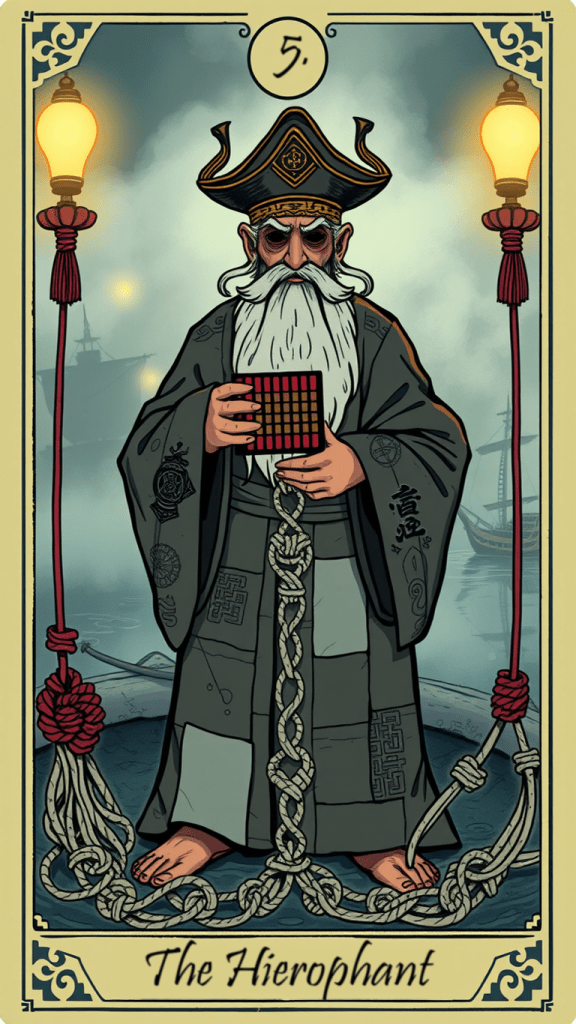
🜄 THE HIEROPHANT – Card V

TITLE: The Ghost Fleet’s Harbormaster / 陰船港主 (Yīn Chuán Gǎng Zhǔ)

MYTHIC ARCHETYPE: The Pirate Monk of the Nine Dragon Sea

TAOIST PARALLEL: Mazu’s Blind Harbormaster, a legendary figure who navigated ships by listening to qi (聽氣, tīng qì), merged with Zhu Bajie (豬八戒)—the oath-breaking, gluttonous monk from Journey to the West, reformed into a sea-priest of penitence.

PIRATE TWIST: He’s the keeper of the Jianghu Code (江湖規矩, jiānghú guīju), a former pirate who lost his eyes to a Dragon King’s curse for breaking an oath. Now he guides ships through fog-locked spirit ports, enforcing sacred pirate laws with a whalebone abacus that calculates karma.

WHY THE HIEROPHANT? He doesn’t preach—he arbitrates. His temple is a floating shrine-junk where warring captains kneel to settle disputes. He teaches that even thieves must honor the tide’s contract.

TAOIST PIRATE SYMBOLISM

KEYWORDS (Upright):

Hǎi shén pàn (海神判, “Sea God’s Verdict”)—fair judgment.

“Blood ink vows” (血墨誓, xuě mò shì)—oaths signed with cutlass scars.

The abacus of debts (算賬, suànzhàng)—karma tallied wave by wave.

KEYWORDS (Reversed):

A cut rope (斷索, duàn suǒ)—betrayal at sea.

“Blind fish” (盲魚, máng yú)—willful ignorance of tradition.

The cursed ledger (厄賬本, è zhàngběn)—unpaid spiritual debts.

INTERPRETATION: This card is the law of the outlaw. The Harbormaster knows even pirates need rules—or the sea swallows all.

RITUAL: THE TIDE-TIED OATH (潮綁誓, Cháo Bǎng Shì)

(Inspired by Ming pirate blood pacts and Daoist knot magic)

PURPOSE: To seal a sacred vow with the weight of the sea.

MATERIALS:

A length of seaweed (or hemp rope soaked in saltwater).

Two coins (one copper, one silver).

Your own blood (or red ink).

A candle (blue or white).

STEPS:

Knot the seaweed into a figure-eight (∞), chanting:

东潮宣誓,西潮束缚——

血与盐使契约磨砺。

The East Tide swore, the West Tide bound——
Blood and salt sharpens the pact.

Rub the coins with blood/ink, press them into the knots.

Burn one knot (for heaven’s record), sink the other (for the sea’s memory).

PARALLEL MYTHOLOGY

TITLE: The Oath-Keeper of the Tides / The Bridge Between Shores

MYTHIC ARCHETYPE: Njörðr (Norse God of the Sea and Sacred Oaths)

REGION: Scandinavia (Pre-Christian Norse Tradition)

FORM: A member of the Vanir gods, associated with the sea, seafaring, wind, fishing, wealth, and fertility of the coasts.

TALE: Njörðr’s most defining story comes at the end of the devastating Aesir-Vanir War. To secure a lasting peace, the two tribes of gods exchanged hostages. Njörðr, along with his children Freyr and Freyja, went to live with the Aesir in Asgard. He became a highly respected priest-king, presiding over religious festivals and sacred oaths. He is the living embodiment of a peace treaty, the bridge between two different cultures and traditions, who brings peace and prosperity through this sacred pact.

WHY THE HIEROPHANT? Njörðr is the Pontifex. He is the bridge. His entire existence in the main Norse myths is predicated on being the cornerstone of a sacred social structure (the peace treaty). He teaches that harmony and bounty (the wealth of the sea) come from honoring tradition, keeping one’s word, and integrating different belief systems. His story isn’t one of wild magic, but of diplomacy, community, and established ritual.

INTERPRETATION THROUGH NJÖRÐR: To draw this card is to be asked what oaths you have made—to others, and to yourself. It is a call to be a peace-broker in your own life. It signifies a time for learning from a trusted institution or mentor, one who can bridge your current world with a new one. Njörðr teaches that the greatest wealth is found not in lonely rebellion, but in the trust and structure that binds a community together.

RITUAL OF THE SALT AND SOIL PACT (For Making a Sacred Vow)

OBJECTIVE: To make a binding, sacred agreement, either with yourself (to commit to a path) or with another person (to seal a partnership or peace). This ritual establishes a formal structure of trust.

MATERIALS:

A cord or rope, about a foot long.

Two small bowls.

A spoonful of salt (or saltwater). This represents Njörðr’s domain: the Sea.

A spoonful of soil. This represents the other party, or the “land” of your current life.

AN OFFERING: Mead, ale, good quality beer, or honeyed water. Njörðr is a god of prosperity and festivals; he appreciates a good drink.

STEPS:

PREPARATION: Place the two bowls before you. Pour the offering into a cup. Clearly state the pact you intend to make. Write it down if you need to. Be precise. Example: “I make a sacred pact with myself to dedicate one hour every day to my craft, without excuse.”

THE INVOCATION: Hold the cup with the offering. Address the spirit of the ritual. “Njörðr, Oath-Keeper, Bridge Between Shores, you who secured peace with your presence, I call upon you to witness this sacred pact. Be the guardian of this vow.” Pour a small amount of the offering onto the ground or into a separate offering bowl.

ACKNOWLEDGING THE TWO SIDES: Place the salt in one bowl and the soil in the other. Touch the salt. “This is the Sea, the new world, the promise I am making.” Touch the soil. “This is the Land, my current self, the foundation upon which this promise is built.”

BINDING THE VOW: Take the cord. As you state your vow clearly and firmly one more time, tie a single, tight knot in the center of the cord. As you pull it tight, feel the commitment solidifying. This knot is the physical manifestation of your oath.

SEALING THE PACT: Take a pinch of the salt and a pinch of the soil and place them together in the palm of your hand. Mix them together. This symbolizes the joining of the two worlds, the peace treaty being sealed. Say: “As sea and land meet at the shore, so are these two sides joined. The pact is made.”

CLOSING: Drink from your offering cup. Keep the knotted cord on your altar, in your pocket, or tied to your wrist as a constant, physical reminder of your vow. The ritual is complete, and the pact is now witnessed.

SYNCRETIC BRIDGE

Njörðr’s Oaths → Pirate Xuèméng (血盟, “blood alliances”): Both bind land and sea through ritual.

Peace Treaty → Hǎi jìng (海靖, “sea pacification”): Ming emperors used pirate warlords as naval peacekeepers.

THE “SCHOLAR’S HEART” MANDATE:

Sources: The Poetic Edda (specifically the poems Vafþrúðnismál and Lokasenna) and Snorri Sturluson’s Prose Edda (in the Gylfaginning and Skáldskaparmál sections). These texts clearly lay out his role as a hostage, a peace-keeper, and a god of wealth. For the ritual see: 《海盗陰陽術》 (Pirate Yin-Yang Arts), 1796, and Quanzhou’s Maritime Trade Laws—12th-century pirate codes enforced by Mazu’s priestesses.

18 Wednesday Jun 2025

Posted by babylon crashing in Chinese, Tarot, Translation

≈ Comments Off on

Tags

Chinese translation, 龍廷, Lóng Tíng, ocean mythology, poem, Poetry, Poseidon, sea folklore, Taoist Pirate rituals, Tarot

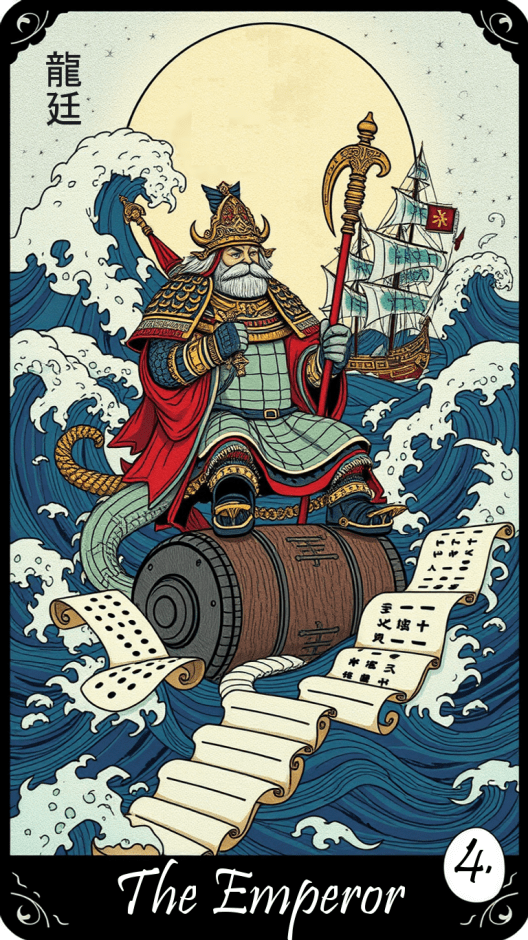
🜄 THE EMPEROR – Card IV

TITLE: The Dragon Throne / 龍廷 (Lóng Tíng)

MYTHIC ARCHETYPE: The Pirate Dragon King

TAOIST PARALLEL: Ao Guang (敖廣), the East Sea Dragon King, merged with Zheng Zhilong (鄭芝龍)—the real-life Ming dynasty pirate admiral who commanded 3,000 junks.

PIRATE TWIST: He’s not just a mythical ruler—he’s the admiral of the ghost fleet, enforcing hǎi shén fǎ (海神法, “Sea God’s Law”) from a throne of cannons and coral. His trident? A tide-cutting ji (戟) halberd that splits storms.

WHY THE EMPEROR? He doesn’t just control the sea—he is its justice. Cross him and your ship sinks paper-light (紙沉, zhǐ chén). Serve him, and he’ll guide you through fog-walled coves.

TAOIST PIRATE SYMBOLISM

KEYWORDS (Upright):

Lóngtíng lǜ (龍廷律, “Dragon Court Rules”)—code of the sea.

“Tides obey the Bagua” (潮隨八卦, cháo suí bāguà)—order in chaos.

The admiral’s seal (海帥印, hǎi shuài yìn)—stamped on waves.

KEYWORDS (Reversed):

A broken tide-table (破潮曆, pò cháo lì)—navigation failed.

“Dragon’s yawn” (龍哈欠, lóng hāqiàn)—complacency before disaster.

The sea tribunal (海審, hǎi shěn) where traitors walk the plank.

INTERPRETATION: This card is law written in saltwater. The Dragon Throne rewards loyalty and sinks oath-breakers. His power isn’t tyranny—it’s the certainty of the tide.

RITUAL: THE ADMIRAL’S SEAL (海帥印, Hǎi Shuài Yìn)

(Inspired by Ming naval codes and Daoist tide-summoning rites)

PURPOSE: To claim authority or stabilize chaos.

MATERIALS:

A wooden plank (driftwood or bamboo).

Red ink (or bloodroot pigment).

A knife (to carve).

Nine copper coins (for the Nine Dragons).

Saltwater.

STEPS:

Carve the Bagua into the plank at dusk.

Dip coins in ink, press them onto the wood like a seal, chanting:

东龙审判,西龙称重,

南龙焚烧,北龙付出代价。

East Dragon judges, West Dragon weighs,

South Dragon burns, North Dragon pays.

Bury the plank at a crossroads or fling it into the sea.

PARALLEL MYTHOLOGY
TITLE: Poseidon, Sovereign of the Sea’s Dominion / Keeper of the Trident
MYTHIC ARCHETYPE: Poseidon (Greek God of the Sea, Earthquakes, and Horses)
REGION: Ancient Greece and the wider Hellenic world
FORM: God of the sea, storms, horses, and earthquakes; wielder of the mighty trident
TALE: Poseidon is a formidable god whose temper mirrors the ocean’s tempestuous moods. As one of the Olympian siblings, he claimed dominion over the seas and all its creatures, as well as horses and the tremors beneath the earth. His trident symbolizes both creative and destructive power, capable of calming waves or shattering lands. Though sometimes seen as capricious and volatile, Poseidon also represents steadfast authority and governance over nature’s primal forces. His role as the Emperor in our oceanic Tarot is to teach the balance of control and power—how to rule with strength tempered by wisdom, and how to command loyalty and respect through firm, just leadership.
WHY THE EMPEROR? The Emperor stands for order, structure, protection, and leadership. Poseidon’s role as the sovereign sea god aligns perfectly, embodying authority grounded in the elemental power of water and earth.
INTERPRETATION THROUGH POSEIDON: When Poseidon appears, he calls forth the leader within you—the one who must wield power responsibly among tumultuous currents. He demands respect for the rules that hold worlds together but warns against becoming a tyrant who crushes rather than governs.
Poseidon asks: Where do you exert control? Are you a protector of your domain or a rigid despot? How do you balance power with compassion?
RITUAL: Invocation of Poseidon’s Command
PURPOSE: To call upon strength, leadership, or the power to establish order in chaos.
MATERIALS:
A trident-shaped object or symbolic representation (can be crafted or drawn)
Saltwater
Blue or sea-green candles
Shells or horse figurines (optional)
A strong, grounded space to perform the ritual
STEPS:
Place the trident or its symbol before you. Light the candles, representing the sea and its powers.
Sprinkle a few drops of saltwater around your space, envisioning Poseidon’s waves marking your territory.
SPEAK THE INVOCATION:

Poseidon, lord of sea and shore,
Keeper of waves, trident in hand,
Grant me the strength to lead and guard,
To rule with justice, firm but fair.

Visualize yourself standing tall like a pillar of rock amidst a stormy sea, unyielding but wise.
Close the ritual with gratitude, grounding yourself and honoring the ocean’s mighty ruler.
THE “BEST FIT” PRINCIPLE: Where Sedna is the deep, internal, life-giving source, Poseidon is the external, sovereign, structural power.

SOVEREIGNTY AND DOMAIN: The Emperor is the master of his realm. Poseidon’s authority over the sea is absolute and was established at the dawn of the Olympian age when the cosmos was divided among the three brothers (Zeus, Poseidon, Hades). This act of structuring the universe is a perfect Emperor concept.

THE TRIDENT AS SCEPTER: The Emperor holds a scepter, a symbol of his power to rule. Poseidon’s trident is one of the most famous symbols of divine authority in all mythology. It’s not just a weapon; it is the tool with which he enforces his will, creating earthquakes and calming storms. It is his law made manifest.

THE SHADOW SIDE: Poseidon’s infamous temper, his tyrannical rage against Odysseus, his stubbornness in his contest with Athena over Athens—these are all textbook examples of the Emperor’s negative traits: inflexibility, despotism, and the use of power for personal grudges rather than the good of the realm.

THE RITUAL OF THE TRIDENT’S STRIKE (To Establish a Foundation)

OBJECTIVE: To create a stable, protected foundation in a chaotic area of your life. Use this when starting a major project, fortifying your personal boundaries, or bringing order to your home or mind.

MATERIALS:

A staff, a sturdy branch, or even your own arm and fist. This is your “Trident.”

A bowl of saltwater.

Three stones, large enough to be stable. These represent the three points of the trident and the foundation you are building.

A piece of ground where you can perform the ritual (a yard, a park, or even a planter box).

STEPS:

SURVEYING THE DOMAIN: Stand before the piece of ground. This is your kingdom, the area you are about to bring into order. State your intention clearly and aloud. “I am here to bring order to my finances” or “I am here to establish a firm boundary of my personal time.”

CONSECRATING THE TRIDENT: Hold your staff (or arm) and dip its end into the saltwater. Raise it to the sky. DECLARE ITS POWER: “This is not wood, but bone of the Earth. This is not my arm, but the will of the Sea. This is the Trident that strikes the foundation and commands the deep.”

THE STRIKE: With all your focused intent, strike the ground firmly three times with the end of your staff. Each strike should be deliberate and powerful. With each strike, make a declaration:

(Strike 1): “By the power of the Earth Below, I set my foundation!”

(Strike 2): “By the power of the Sea Around, I set my boundary!”

(Strike 3): “By the power of the Sky Above, I declare my dominion!”

LAYING THE FOUNDATION: Place your three stones on the ground where you struck, forming a stable triangle. This is the physical anchor for the order you have created. Pour the remaining saltwater in a circle around the stones as a libation and a boundary of protection.

THE SOVEREIGN’S OATH: Stand straight, looking over your newly established “foundation.” Make a vow of responsible rulership. “I will rule this domain with strength and with wisdom. I will be its protector, not its tyrant. This order is established. So it is.”

CLOSING: Leave the stones in place for at least a full day and night. The act is complete. You have shifted from being a subject of chaos to the sovereign of your domain.

SYNCRETIC BRIDGE

Poseidon’s Trident → Dragon King’s Ji: Both split waves and enforce divine will.

Olympian Division → Fēngshuǐ of the Seas: The Dragon Kings divide the oceans like Bagua sectors.

THE “SCHOLAR’S HEART” MANDATE

Primary Sources: Homer’s Iliad and, most importantly, The Odyssey, where Poseidon’s role as a powerful, wrathful antagonist is central. Hesiod’s Theogony is essential for his origin and the division of the cosmos. The Homeric Hymn to Poseidon is a direct invocation that praises his power. For the ritual see: the biography of Admiral Zheng He’s (鄭和) navigation charts—they were ritual objects blessed by Mazu to command currents; as well as the Jiaolong myth in the 《述异记》 [Records of Strange Things], 6th century CE.

17 Tuesday Jun 2025

Posted by babylon crashing in Chinese, Tarot, Translation

≈ Comments Off on

Tags

Chinese translation, Empress, 血鹽母, Sedna, Taoist Pirate rituals, Tarot, The Saltblood Matriarch, Xuè Yán Mǔ

🜄 THE EMPRESS – Card III

TITLE: The Saltblood Matriarch / 血鹽母 [Xuè Yán Mǔ]

MYTHIC ARCHETYPE: Mazu’s Wrath—The Queen of Shipwrecks

TAOIST PARALLEL: Mazu [媽祖] as the Storm-Bringer, fused with Lin Mo’s Legend—the girl who drowned saving her father’s fleet, only to rise as a goddess who both gives and takes from sailors.

PIRATE TWIST: She’s not just a savior—she’s the sovereign of drowned treasures, ruling a palace of sunken ships where barnacles bloom like orchids. Her severed fingers? Jade trade beads that became the first pearls.

WHY THE EMPRESS? She doesn’t just nurture—she decides. Her bounty is conditional: honor her, or she’ll salt your fields with shipwrecks.

TAOIST PIRATE SYMBOLISM

KEYWORDS [Upright]:

Fengshui of the Fathoms—arranging wreckage to attract wealth.

“Feeding the Sea” [祭海, jì hǎi]—offerings tossed to balance karma.

The Lóngnǚ’s dowry [龍女嫁妝]—sunken silks that surface as fortune.

KEYWORDS [Reversed]:

A cursed haul [厄運貨, èyùn huò]—plunder that starves its thief.

“Mazu’s turned tide” [媽祖反潮]—nurturance withdrawn.

The hungry ghosts [餓鬼, èguǐ] of ungrateful sailors.

INTERPRETATION: This card is abundance with teeth. The Saltblood Matriarch births coral from bones and feeds empires from her palms—but cross her, and your ships will founder. She’s the lesson: true wealth flows from reverence.

RITUAL:THE WRECKFEAST [沉船宴, Chénchuán Yàn]

[Inspired by Fujianese “Ghost Banquet” rites and pirate parole rituals]

PURPOSE: To restore flow to blocked creativity or resources.

MATERIALS:

A wooden bowl [driftwood if possible].

Nine coins [copper or brass].

Salt, rice and three drops of your blood.

A handful of sand.

A black silk cloth.

STEPS:

At low tide, lay the black silk as a “tablecloth.” Arrange the bowl atop it.

LAYER THE OFFERINGS:

Salt [for preservation].

Rice [for prosperity].

Sand [for the seafloor].

Coins [for the dead’s favor].

Add the blood, whispering:

沉船之母,我付出代价——

玉指张开,珍珠散开。

Mother of wrecks, I pay the price—

Let your jade fingers open, your pearls unloose.

Bury the bowl at the shoreline. Let the tide take it.

PARALLEL MYTHOLOGY

TITLE: Sedna, Mistress of the Deep / Queen of the Sea’s Bounty
MYTHIC ARCHETYPE: Inuit Sea Goddess
REGION: Arctic regions of Greenland, Canada, and Alaska
FORM: Goddess of the sea and marine animals; a powerful matron whose tragedy shaped the abundance of life beneath the waves
TALE: Sedna was once a mortal woman, sometimes said to be mistreated by her father. In a fateful moment of betrayal or escape, she was cast into the frigid sea and transformed into the goddess of the marine creatures. Her fingers were severed as she clung to the kayak’s hull and from these fingers arose the seals, walruses, and whales—the lifeblood of the Inuit people. Sedna dwells in the depths, controlling the availability of sea mammals and demanding respect and ritual offerings to provide bounty. Her story is one of sorrow, transformation, and fierce maternal power. She is at once a nurturer and a stern guardian, teaching reverence for the ocean’s gifts.
WHY THE EMPRESS? The Empress embodies fertility, growth, and the nurturing of life. Sedna’s dominion over the sea’s bounty makes her the perfect archetype—she is the ocean’s generous mother who sustains communities, even through hardship.
INTERPRETATION THROUGH SEDNA: When Sedna graces your reading, she calls you to honor your roots and your power to nurture life—whether that’s literal or creative energy. She reminds you that abundance often arises through sacrifice and deep emotional work.
Sedna asks: How do you tend the sources of your sustenance? Are you honoring the deep currents within that nourish your spirit?
RITUAL: Offering to Sedna for Bounty and Protection
PURPOSE: To invoke Sedna’s favor for sustenance, creativity, or emotional healing.
MATERIALS:
A bowl of cold seawater or snowmelt [or pure cold water]
Small offerings: feathers, bones, shells, or polished stones
Dark blue or sea-green cloth
Candle [preferably blue or white]
Optional: Inuit symbols or art
STEPS:
Arrange the offerings on the cloth near your water bowl. Light the candle.
Speak or chant a dedication:

Sedna, mother of the sea,
From your sorrow springs life anew.
I honor your depths, your strength, your rule—
Bless my hands with your fierce grace.

Let the candle burn safely, then close your ritual with thanks.
THE “BEST FIT” PRINCIPLE: This is a subversive and powerful fit. The traditional Empress is often a serene, sun-drenched Earth Mother, effortlessly abundant. Sedna is none of those things. She is a chthonic, wounded, and demanding mother of the deep. And that’s why she works.

THE SHADOW SIDE: The reversed meaning of The Empress [neglect, depletion, smothering] is perfectly embodied by an angry Sedna. When taboos are broken and she is disrespected, she withholds her bounty, tangling the sea animals in her hair, causing famine. She becomes the “Devouring Mother” not out of malice, but as a consequence of broken relationships.

ROLE OF SHAMAN.

The most important concept is the shaman’s ritual journey to Adlivun [the underworld at the bottom of the sea]. When hunting was poor, it was believed that Sedna’s hair had become tangled with the sins and broken taboos of the community. A shaman had to journey in a trance state to her abode, appease her, and carefully comb her hair, untangling it to release the animals. This act of care is central.

This is sympathetic magic ritual based directly on this act of “tending the source.”

RITUAL OF COMBING THE TANGLES [To Restore Abundance]

OBJECTIVE: To address a blockage in your life [creative, financial, emotional] by symbolically tending to the source of your abundance, acknowledging your neglect, and restoring a right relationship. This is for when you feel “stuck” or that your wellspring has run dry.

MATERIALS:

An effigy to represent Sedna. This does not need to be elaborate. A dark, oblong stone, a small doll, or even a bundle of dark cloth can work. This is the body of your “Source.”

Tangled yarn, thread, or even your own hair from a brush. This represents the blockages, anxieties, neglects, and “sins” that are causing the famine.

A comb.

A bowl of ice-cold water.

An offering: fermented fish [鮭醢, guī hǎi].

STEPS:

PREPARATION: In a quiet, low-lit room, place the bowl of ice water before you. Set your Sedna effigy beside it. Take a moment to feel the cold radiating from the water. You are at the edge of the Arctic sea.

NAMING THE TANGLES: Take the tangled yarn. As you wrap it around your Sedna effigy, speak aloud the blockages and neglects in your life. Be specific and honest. “This is my fear of failure. This is my procrastination on my project. This is the envy I feel. This is the way I have disrespected my own creative energy. This is my lack of gratitude.” Mangle and tangle the yarn until the effigy is ensnared.

THE JOURNEY DOWN: Dip your hands into the ice water. The shock is intentional. It focuses the mind. Close your eyes and visualize yourself descending into the dark, cold depths. You are the shaman on your journey. Feel the pressure, the silence. Approach the figure of the great goddess before you, tangled and angry.

THE ACT OF TENDING: Open your eyes. Pick up the comb. With immense patience and care, begin to comb out the tangles from the effigy. This is the central act. As you untangle each knot, speak words of apology and reconciliation. “I am sorry for this neglect. I release this fear. I will tend to my work. I will honor my creative gifts.” This should not be rushed. Feel the resistance in the knots give way. Continue until the yarn is completely untangled and hangs freely.

THE OFFERING: Place your offering [the food] in the bowl of cold water, letting it sink. Say:

“Great Mother of the Deep, I have cared for you. I have untangled your hair. I offer you this nourishment in gratitude. Let the seals of inspiration swim free again. Let the whales of abundance return.”

Pour the water slowly over the offerings, imagining the sea’s currents carrying your respect to Sedna’s realm. Meditate on resilience and gratitude for the gifts you receive from the, “Deep.”

CLOSING: Lay the now-untangled yarn and the comb at the feet of the effigy. Bow your head in respect. The relationship is restored. Leave the offering in the water for a time before respectfully disposing of it in the earth. The ritual is complete.

SYNCRETIC BRIDGE

Sedna’s Fingers → Mazu’s Beads: Both transform severed body parts into oceanic bounty.

Shaman’s Comb → Pirate’s Parley: Untangling knots = negotiating with the sea’s wrath.

THE “SCHOLAR’S HEART” MANDATE:

Primary Sources: The work of the early 20th-century anthropologist Franz Boas; his work, particularly The Central Eskimo, contains detailed accounts of the Sedna myth and the associated rituals as told to him by Inuit people. Knud Rasmussen’s collections in the Report of the Fifth Thule Expedition are also invaluable. For other real life comparisons, see: Zheng Yi Sao [鄭一嫂], the pirate queen who outfought empires—then retired rich by paying off the sea gods.

16 Monday Jun 2025

Posted by babylon crashing in Chinese, Tarot, Translation

≈ Comments Off on

Tags

龍潮師, ocean mythology, Pirate Stormcaller, poem, Poetry, sea folklore, Tangaroa, Taoist Pirate rituals, Tarot, The Magician

🜃 THE MAGICIAN – Card I

“The Magician is the Tide-Commanding Sorcerer—the one who speaks to the Dragon King in the language of stolen storms. Their power is not gentle. To wield it, you must stand where the sea hates the shore and the sky fears the waves.” [Notes.]

TITLE: The Dragon’s Tide-Caller / 龍潮師 [Lóng Cháoshī]

MYTHIC ARCHETYPE: Mazu’s Pirate-Sorcerer

TAOIST PARALLEL: Mazu [媽祖] as the warrior-priestess aspect, but merged with Qing dynasty pirate-queen Ching Shih [鄭氏]—a figure who commanded fleets with divine favor.

PIRATE TWIST: Instead of a passive goddess, she’s a storm-summoning admiral who learned secrets from the Dragon Kings [龍王]. Her “tools” are pirate relics:

Wand → A whalebone staff inscribed with tidal sigils.

Cup → A jade compass that steers by star-qi [氣] instead of wind.

Sword → A monsoon-cutlass [刀刃, dāorèn] that draws lightning.

Pentacle → A salt-crusted doubloon stamped with the Bagua [八卦].

WHY THE MAGICIAN? She doesn’t just pray for calm seas—she bends them.

TAOIST PIRATE SYMBOLISM

KEYWORDS [Upright]:

Wuwei [無為] as tactical patience—waiting for the perfect wave.

“Pirate feng shui” [arranging ship decks by elemental flow].

The huolongjing [火龍經, fire-dragon manuals] of naval warfare as spellbooks.

KEYWORDS [Reversed]:

A ship’s hex [艏咒, shǒu zhòu]—cursed navigation.

“Drowning the jade” [玉沉, yù chén]: wasting power.

The Dragon Kings ignoring your bribes.

INTERPRETATION: This card is for when you must command chaos. Like Tangaroa, the Tide-Caller knows the sea is alive—but here, the ocean is a negotiation. You don’t conquer it; you deal with it.

RITUAL 1: THE COMPASS OF FOUR DRAGONS [四海龍羅盤, Sìhǎi Lóng Luópán]

[Inspired by Ming-era nautical sorcery and Fujianese sea-witch rites]

PURPOSE: To align your will with the Four Dragon Kings [四海龍王] for mastery.

MATERIALS:

A bowl of brine [with a drop of your blood].

FOUR TOKENS:

FIRE: A ship’s nail [heated in flame].

WATER: A shark’s tooth.

AIR: A torn sail-scrap.

EARTH: A stolen temple coin.

A dagger [to carve the Bagua into driftwood].

RITUAL:

Draw the Bagua on driftwood, then float it in the brine. Chant:

东龙为我扬帆,

西龙为我扬帆,

南龙为我焚烧敌人,

北龙为我掩藏踪迹。

“The Eastern Dragon raises the sail for me,
The Western Dragon raises the sail for me,
The Southern Dragon burns the enemies for me,
The Northern Dragon hides my tracks for me.”

DROP EACH TOKEN INTO THE BOWL:

Nail hisses → Fire Dragon awakens.

Tooth sinks → Water Dragon stirs.

Scrap floats → Air Dragon listens.

Coin spins → Earth Dragon bargains.

STAB THE DRIFTWOOD—if it floats, the Dragons accept. If it sinks, they demand more.

PARALLEL MYTHOLOGY
TITLE:
The Sea-Caller / One Who Commands the Tides
MYTHIC ARCHETYPE: Tangaroa [Polynesian Ocean Deity]
MYTHOLOGICAL FIGURE: Tangaroa [Aotearoa / Māori Tradition]
REGION: Polynesia, especially Māori tradition in Aotearoa [New Zealand]
FORM: Oceanic deity; father of fish and reptiles; master of all sea-borne life
TALE: Tangaroa is the god of the sea, father of the fish, and one of the primal atua [gods] in Māori cosmology. He constantly contends with Tāne Mahuta, god of the forests, in a cosmological conflict: those who dwell in the sea versus those who live on land.
In some tellings, Tangaroa seeks to reclaim everything from the land back into the ocean. He is both a creator and destroyer—elemental, full of force, and endlessly generative.
WHY THE MAGICIAN? Tangaroa possesses full mastery of his element. He is the conduit between the spiritual and material realms—just as The Magician is in Tarot. He transforms intention into form. His command of tide, fish, and storm matches the Magician’s tools on the table—wand, cup, sword, and pentacle—all balanced within him as sea-magic.
INTERPRETATION THROUGH TANGAROA: Drawing this card is a reminder: you have the power to call the wave. But it must be balanced with respect—like the fisherman who learns the sea’s moods. Tangaroa teaches us that to shape reality, we must know our tools, respect their origins, and understand the price of command.
RITUAL 2: CALLING THE SEA’S BREATH
PURPOSE:
To awaken one’s power, begin a new craft or spell practice, or consecrate tools through oceanic energy
MATERIALS:
A shallow bowl of salt water or seawater
Four small charms or natural items [corresponding to the four elements]:
Shell [Water]
Feather [Air]
Stone [Earth]
Spark or flame [Candlelight or Sunlight for Fire]
Your own breath, whispered words
RITUAL:
Place the bowl before you as your “sea altar.” Arrange the four elemental items around it in cardinal directions.
Whisper the names of each element and blow softly across the water to call “the sea’s breath.”

CHANT:
“By Tangaroa’s will, the tide within me rises.
I call the depths to meet the sky.
Let what I dream become what is.”

Dip your fingers into the water and anoint your tools or hands.
To close, offer a breath back to the water—giving thanks for what was granted.
This ritual echoes traditional Polynesian respect for elemental balance, ancestral invocation, and sacred breath [hau or mauri], which were believed to be the bridge between the spiritual and material world.
MASTER OF THE DOMAIN: Tangaroa’s mastery over the sea is absolute. He is the active, directing principle of his realm. This is the core of The Magician’s energy.

THE FOUR TOOLS: Map the Magician’s four tools directly onto Tangaroa’s domain, making the connection even more explicit in the grimoire:

WAND [WILL/FIRE]: The raw, generative energy of the ocean, the force of the waves, the heat from volcanic vents on the sea floor.

CUP [EMOTION/WATER]: He literally is the ocean, the ultimate Cup.

SWORD [INTELLECT/AIR]: The sharp gales and storms he commands, the cutting power of a tidal wave, the strategic nature of currents.

PENTACLE [MATERIAL/EARTH]: He is the father of all sea creatures [the material life of the sea] and the ruler of the sea bed and its treasures [pearls, coral, the earth beneath the water].

CREATOR/DESTROYER: This duality you’ve highlighted is key. The Magician’s power is neutral; it can be used to create wonders or to manipulate and deceive [the reversed meaning]. Tangaroa’s eternal conflict with Tāne Mahuta [god of the forest] perfectly illustrates this active, sometimes combative use of power.

RITUAL 3: SUMMONING THE FOUR TIDES [For Manifestation]

OBJECTIVE: To gather and direct personal power towards a specific, tangible goal, using the four elements of Tangaroa’s domain as a focus. This is a ritual of active manifestation.

MATERIALS:

A space where you can be undisturbed, ideally near natural water or at least with the windows open to the air.

YOUR FOUR “TIDAL” TOOLS:

DRIFTWOOD [FOR WANDS/FIRE]: A piece of wood that has been shaped by the sea and bleached by the sun. It holds the energy of both.

SEASHELL [FOR CUPS/WATER]: A large, cup-shaped shell. Fill it with saltwater.

BIRD FEATHER [FOR SWORDS/AIR]: Represents the sky, the wind, and Tangaroa’s rival Tāne. Holding this is an act of balancing opposing forces—a key magical act.

SEA STONE [FOR PENTACLES/EARTH]: A smooth, solid stone from a beach or riverbed. It represents the tangible, manifested outcome.

RITUAL:

PREPARATION: Create your sacred space. Place your four tidal tools before you in a semi-circle. Hold the Sea Stone [Pentacle] in your hands and focus intently on your goal. Condense your desire into a single, clear sentence. Example: “I call forth a new client for my business.” or “I manifest the courage to complete my art.”

INVOCATION: Hold the Driftwood [Wand]. Feel its energy. Begin a low, rhythmic chant or drumming. Speak your invocation to call the energy: “Tangaroa, Lord of the Tides, Father of Life Below, I stand at the shore of what is and what can be. I seek your power, the will that moves the waves.”

GATHERING THE ELEMENTS:

Pick up the Shell [Cup]. Dip a finger in the water and anoint your heart. Say: “With the power of the Deep, I fill this work with heart.”

Pick up the Feather [Sword]. Wave it through the air, feeling the breeze. Say: “With the power of the Wind, I give this work clarity and thought.”

Pick up the Driftwood [Wand] again. Raise it high. Say: “With the power of the Sun on Water, I give this work energy and will.”

Finally, pick up the Stone [Pentacle]. Hold it tightly. Channel all the energy you’ve raised into it. Say: “With the power of the Earth Below, I make this work real.”

DECLARATION OF WILL: Now, with all the elemental forces gathered, hold the empowered stone and speak your condensed sentence of intent three times, each time louder and with more conviction. “I call forth a new client for my business! I call forth a new client for my business! I call forth a new client for my business!”

OFFERING & GROUNDING: The ritual’s power must be grounded and paid for. Your offering is an act of reciprocity. Go to a body of water [or a plant if not possible]. Pour the saltwater from the shell onto the ground/into the water. Say: “My thanks to the sea. The tide that flows out, flows back in. The work is done.” Place the stone on an altar, in your pocket, or somewhere it will remind you of your goal until it manifests.

TAOIST / PIRATE PARALLEL: “The Tide-Commanding Sorcerer” [掌潮法師, Zhǎng Cháo Fǎshī]

REGION: Fujian & Taiwan [18th–19th century]

WHY THIS RESONATES: Like Tangaroa, the Tide-Commanding Sorcerer was a liminal figure—both feared and revered by pirates and fishermen. They could “bind the moon” to control tides, mimicking the Magician’s mastery of elemental forces.

Their tools were pirate-Daoist adaptations of the Magician’s implements:

WAND → “Storm Summoning Rod” [carved from lightning-struck mast wood].

CUP → “Dragon’s Pearl Chalice” [used to collect whirlpool water for scrying].

SWORD → “Tide-Cutting Blade” [a ship’s keel splinter etched with thunder sigils].

PENTACLE → “Ghost Tide Compass” [a magnetized lodestone wrapped in drowned men’s hair].

RITUAL 3: “The Four Tides Invocation” [四海召法, Sì Hǎi Zhào Fǎ]

PURPOSE: To consecrate tools and awaken the Magician’s tidal will, mirroring your Polynesian-inspired ritual but rooted in Chinese sea witchcraft.

MATERIALS:

A bronze bowl of tidewater [collected at high moon].

Four Pirate-Daoist “Tidal Tools” [replace your elemental items]:

WAND → Storm Rod [a driftwood branch wrapped in shark-skin].

CUP → Pearl Shell [a clam shell holding cinnabar paste].

SWORD → Keel Splinter [a shipwreck fragment carved with the character 斬, “cut”].

PENTACLE → Lodestone [a magnetized rock tied with red silk].

STEPS:

Arrange the tools around the bowl in the Four Directions:

East [Wood/Storm Rod] → Growth, willpower.

South [Fire/Pearl Shell] → Passion, intuition.

West [Metal/Keel Splinter] → Precision, intellect.

North [Water/Lodestone] → Manifestation, grounding.

Chant the Tide-Summoning Verse

“東海借潮,南海借風—

西海借刃,北海借龍!”

[“East Sea lends tide, South Sea lends wind—

West Sea lends blades, North Sea lends the Dragon!”] … from 《海盗黑经》

Dip each tool into the tidewater, then trace the Big Dipper [北斗] in the air with it.

Close by spitting into the bowl [a pirate oath of allegiance to the sea].

FOLK MAGIC SYNCRETISM

Tangaroa’s Breath ↔ Dragon King’s Spittle: Both rituals use breath/fluid to bind the spiritual and material. In Fujian, sailors spat into the wind to “claim the tide’s favor.”

Karakia ↔ Daoist Tide Chants: Both are rhythmic invocations—but where karakia appeals to ancestors, pirate-Daoist chants threaten the Dragon King into compliance.

[Note. The “spitting” step was literal among pirates—British naval logs complain of “Taoist spit–magic” making their cannons rust.]

SYNCRETIC BRIDGE

Tangaroa’s Conflict → Five Elements [五行, Wǔxíng]

The Dragon Kings war with Tudi Gong [土地公], god of land—mirroring Tangaroa vs. Tāne.

Karakia → Taoist Zhou [咒, incantations]

Both use rhythmic breath to bind spirits. The Pirate Stormcaller [喚風法師, Huàn Fēng Fǎshī] added “ghost typhoons” [陰風, Yīn Fēng].

THE “SCHOLAR’S HEART” MANDATE

Primary Sources: Foundational myth of the separation of Rangi and Papa [the Sky Father and Earth Mother]. Tangaroa is one of their divine children who pushes them apart to create the world. His subsequent war with his brother Tāne is a central story. Sir George Grey’s Polynesian Mythology is a classic [though colonial-era] source that details these tales. For the Taoist/Pirate rituals, see:

《閩海秘法》 [Secret Fujian Sea Rites, 1742],

《海盗黑经》 [Pirate Black Canon, 1789]

《海盗風雨秘本》 [Pirate Storm-Summoning Manual, 1768], recovered from a shipwreck near Macau.

Newer posts →

age difference anal sex Armenia Armenian Genocide Armenian translation ars poetica art artist unknown blow job Chinese translation conversations with imaginary sisters cum cunnilingus drama erotic erotica erotic poem erotic poetry Federico Garcia Lorca fellatio finger fucking free verse ghost ghost girl ghost lover gif Gyumri haiku homoerotic homoerotica Humor i'm spilling more thank ink y'all incest Lilith Love shall make us a threesome masturbation more than just spilled ink more than spilled ink mythology ocean mythology Onna bugeisha orgasm Peace Corps photo poem Poetry Portuguese Portuguese translation prose quote unquote reblog retelling Rumi Sappho sea folklore Shakespeare sheismadeinpoland sonnet sorrow Spanish Spanish translation spilled ink story Taoist Pirate rituals Tarot Tarot of Syssk thank you threesome Titus Andronicus translation video Walt Whitman war woman warrior xenomorph

electric mayhem [links]

  • poesia erótica (português)
  • Poetic K [myspace]
  • aimee mann
  • cyndi lauper
  • sandra bernhard
  • armenian erotica and news
  • discos bizarros argentinos

Meta

  • Create account
  • Log in
  • Entries feed
  • Comments feed
  • WordPress.com

Blog Stats

  • 387,426 hits

Categories

ars poetica: the blogs a-b

  • sommer browning
  • wendy babiak
  • afghan women's writing project
  • american witch
  • mary biddinger
  • brilliant books
  • tiel aisha ansari
  • cecilia ann
  • aliki barnstone
  • all things said and done
  • afterglow
  • alzheimer's poetry project
  • sandra beasley
  • stacy blint
  • megan burns
  • lynn behrendt
  • armenian poetry project
  • black satin
  • clair becker
  • the art blog
  • emma bolden
  • Alcoholic Poet
  • margaret bashaar
  • kristy bowen

Enter your email address to follow this blog and receive notifications of new posts by email.

Join 44 other subscribers

Archives

ars poetica: the blogs c-d

  • abigail child
  • CRB
  • linda lee crosfield
  • natalia cecire
  • roberto cavallera
  • cheryl clark
  • juliet cook
  • lyle daggett
  • maria damon
  • julie carter
  • cleveland poetics
  • michelle detorie
  • jennifer k. dick
  • jackie clark
  • flint area writers
  • lorna dee cervantes

ars poetica: the blogs e-h

  • elisa gabbert
  • Free Minds Book Club
  • carrie etter
  • carol guess
  • elizabeth glixman
  • joy harjo
  • herstoria
  • maggie may ethridge
  • joy garnett
  • jeannine hall gailey
  • pamela hart
  • Gabriela M.
  • jessica goodfellow
  • hayaxk (ՀԱՅԱՑՔ)
  • sarah wetzel fishman
  • bernardine evaristo
  • liz henry
  • human writes
  • maureen hurley
  • amanda hocking
  • julie r. enszer
  • ghosts of zimbabwe
  • jane holland

ars poetica: the blogs i-l

  • IEPI
  • gene justice
  • Kim Whysall-Hammond
  • maggie jochild
  • miriam levine
  • dick jones
  • diane lockward
  • donna khun
  • meg johnson
  • sheryl luna
  • sandy longhorn
  • las vegas poets organization
  • amy king
  • renee liang
  • megan kaminski
  • lesley jenike
  • charmi keranen
  • kennifer kilgore-caradec
  • irene latham
  • a big jewish blog
  • Jaya Avendel
  • lesbian poetry archieves
  • joy leftow
  • language hat
  • laila lalami
  • emily lloyd

ars poetica: the blogs m-o

  • sharanya manivannan
  • michelle mc grane
  • My Poetic Side
  • michigan writers resources
  • marion mc cready
  • nzepc
  • january o'neil
  • maud newton
  • adrienne j. odasso
  • heather o'neill
  • sophie mayer
  • majena mafe
  • motown writers
  • new issues poetry & prose
  • the malaysian poetic chronicles
  • wanda o'connor
  • Nanny Charlotte
  • caryn mirriam-goldberg
  • michigan writers network
  • iamnasra oman
  • mlive: michigan poetry news
  • ottawa poetry newsletter

ars poetica: the blogs p-r

  • rachel phillips
  • nicole peyrafitte
  • Queen Majeeda
  • helen rickerby
  • nikki reimer
  • maria padhila
  • split this rock
  • ariana reines
  • sophie robinson
  • kristin prevallet
  • joanna preston
  • susan rich

ars poetica: the blogs s-z

  • Trista's Poetry
  • scottish poetry library
  • shin yu pai
  • ron silliman
  • southern michigan poetry
  • switchback books
  • tim yu
  • sexy poets society
  • tuesday poems
  • womens quarterly conversation
  • vassilis zambaras
  • Stray Lower

  • Subscribe Subscribed
    • memories of my ghost sista
    • Join 44 other subscribers
    • Already have a WordPress.com account? Log in now.
    • memories of my ghost sista
    • Subscribe Subscribed
    • Sign up
    • Log in
    • Report this content
    • View site in Reader
    • Manage subscriptions
    • Collapse this bar
 

Loading Comments...