• hopilavayi: an erotic dictionary

memories of my ghost sista

~ the dead are never satisfied

memories of my ghost sista

Tag Archives: sea folklore

24 Tuesday Jun 2025

Posted by babylon crashing in Chinese, Tarot, Translation

≈ Comments Off on

Tags

Chinese translation, Guabancex, ocean mythology, sea folklore, Taoist Pirate rituals, Tarot, the tower, 漩淵之口

֍ THE TOWER – Card XVI

TITLE: The Maelstrom’s Maw / 漩淵之口
TAOIST PARALLEL: Xiǎo Lán, Ninth Surge Daughter of the Sea
ARCHETYPE: The Tide That Devours Pride

TALE: In the era of shifting winds, the Eastern Sea Dragon King built a beacon-tower to tame the tides—a golden spire that claimed to measure all currents, to name all storms, to command all sea-spirits. But his daughter, Xiǎo Lán, the ninth-born of his brood, inherited the soul of the tide itself. She warned: “You cannot measure water without betraying it.” He ignored her. On the ninth typhoon of the ninth year, she rose in spiral wrath, tearing the tower from its roots and drowning her own kin who tried to defend it. The Dragon King wept, but the maelstrom would not relent until every stone sank. Since then, when pride builds towers over tide, her nine vortexes return to cleanse the arrogance of certainty.
WHY THE TOWER? Her maelstrom is not punishment—it is the wave that removes what should never have stood.
KEYWORDS (Upright):
Bēng hǎi (崩海) – Collapsing sea
Lóng hāi (龍咳) – Dragon’s cough (storm as rejection)
Duàn lónggǔ guāng (斷龍骨光) – Keel-breaking light
KEYWORDS (Reversed):
Jiǎ tǎ (假塔) – False tower
Yān mò (淹沒) – Self-chosen drowning
Nuò máo (懦錨) – The coward’s anchor

INTERPRETATION: Xiǎo Lán is not evil. She is truth unbound by structure. Her wrath is not personal—it is a cleansing necessity. She is the Taoist embodiment of uncontrolled change, of nature correcting human overreach, much like Guabancex.

RITUAL: THE SHIPBREAKER’S AXE (破船斧, Pò Chuán Fǔ)

(Inspired by Ming-era scuttling rites and Taoist demolition magic)

PURPOSE: To sink your own illusions before the sea does it for you.

MATERIALS:

A wooden plank (driftwood or old furniture).

Red paint (or bloodroot pigment).

A hammer and nail.

Nine seashells.

STEPS:

Paint your “lie” on the plank in one character. Example: Pride (傲), Fear (怕), Greed (貪).

Nail the plank to a tree (or large log), chanting:

九漩之命,潮咬謊言,斧碎虛塔,沉者自救。

By order of the Nine Vortexes, the tide bites through lies, the axe breaks the false tower, the sunken shall save themselves.

Smash it with the hammer, shouting one true thing you’ve denied.

Bury the shells with the splinters—their hollows now hold what you released.

PARALLEL MYTHOLOGY

TITLE: The Hurricane / The Cleansing Fury

MYTHIC ARCHETYPE: Guabancex, The Lady of the Winds (Taíno)

REGION: The Caribbean (Taíno peoples of Hispaniola, Puerto Rico, Cuba, etc.)

FORM: The female cemí of chaos and the hurricane. She is depicted with her arms in a spiral motion, mimicking the winds of the storm she commands.

TALE: Guabancex does not act alone. She is the terrifying queen of a catastrophic trio. When she becomes enraged, she unleashes the juracán. She sends her herald, Guataubá, to announce her coming with thunder, lightning, and dark clouds. Then she sends Coatrisquie to gather the floodwaters and release them, causing massive destruction and floods. Her power is absolute, elemental, and utterly transformative. It is not “evil”; it is the violent, amoral, and necessary power of nature clearing away everything that cannot withstand it.

WHY THE TOWER? She is The Tower card. The lightning bolt from a clear sky is Guataubá’s announcement. The falling figures are those swept away by Coatrisquie’s floods. And the Tower itself is whatever human-made structure—be it a hut, a temple, or a sense of false pride—that stands in the path of the juracán’s spiral arms. She represents the sudden, complete, and humbling destruction of our world by a power far greater than ourselves, paving the way for a complete rebuild on cleared ground.

INTERPRETATION THROUGH GUABANCEX: When this card appears, the winds of change are no longer a breeze; they are a hurricane. A juracán is coming for a structure in your life built on a false or weak foundation. You cannot stop it. You cannot reason with it. To cling to the tower is to be destroyed with it. The only path is to let go, seek humble shelter, and allow the cleansing fury to pass. What feels like total destruction is actually a radical, divine clearing of the land so something truer can be built.

RITUAL OF SHATTERING THE TOWER (For Conscious Demolition)

OBJECTIVE: To identify a false structure, belief, or situation in your life and perform a magical act of destroying it yourself, thus reclaiming agency in a Tower moment.

MATERIALS:

Something safe to break that represents your “tower.” This could be a small terracotta pot, a flat, brittle stone, or even a stale piece of bread or a cracker.

A permanent marker.

A safe place to perform the ritual (outdoors, a garage, or a sturdy box).

Safety gear is essential if breaking pottery or stone (e.g., safety glasses, gloves).

STEPS:

NAMING THE TOWER: With the marker, write the false belief on your object. Be brutally honest. “This job is my only source of worth.” “This relationship defines who I am.” “My pride keeps me from asking for help.”

THE INVOCATION OF THE STORM: Hold the object. Acknowledge the truth. The foundation is cracked. The storm is coming. Say aloud: “Guabancex, Lady of the Winds, I feel the coming of the juracán. I see the lie in this tower I have built. I will not be thrown from it. I will tear it down with my own hands.”

THE SHATTERING: Place the object on a hard surface. Put on your safety gear. This is the moment of release. Take a heavy object (a hammer, another rock) and with a powerful cry, smash your tower. Don’t just tap it; shatter it. Let out the frustration, the fear, the anger. This is your lightning bolt. This is your controlled demolition.

SURVEYING THE RUBBLE: Breathe. Look at the pieces. It’s done. The false structure is gone. What is left is rubble, but also open sky and clean ground. The illusion is broken. Feel the terrifying freedom in that.

CLOSING: Carefully gather the broken pieces. You can either dispose of them far from your home or keep one small, smooth piece as a reminder that you had the strength to tear down your own prison. The ritual is complete. You have weathered the storm by becoming the storm.

SYNCRETIC BRIDGE

Guabancex’s Winds → Dragon’s Hūxiào (呼嘯, “roaring breath”) Both erase human arrogance.

Coatrisquie’s Flood → Hǎi xiāo (海消, “sea-digestion”) What the ocean takes, it transforms.

THE “SCHOLAR’S HEART” MANDATE:

Sources: Primary written source is Fray Ramón Pané’s Relación acerca de las antigüedades de los indios (An Account of the Antiquities of the Indians), written around 1498. He was commissioned by Christopher Columbus to document Taíno beliefs. For the ritual, see: 《九漩掃塔記》 (Jiǔ Xuán Sǎo Tǎ Jì, “The Chronicle of the Nine Maelstrom Scourings”) 1721.

24 Tuesday Jun 2025

Posted by babylon crashing in Chinese, Tarot, Translation

≈ Comments Off on

Tags

Chinese translation, 黑珠溺者, Moby Dick, ocean mythology, sea folklore, Taoist Pirate rituals, Tarot, the devil

֍ THE DEVIL – Card XV

TITLE: The Drowner of the Black Pearl / 黑珠溺者 (Hēi Zhū Nì Zhě)
MYTHIC ARCHETYPE: The Pearl Diver Who Could Not Surface
TAOIST PARALLEL: The Diver who harvested corruption and mistook it for treasure
PIRATE TWIST: Once a healer and fisherwoman, she dove in search of a legendary pearl said to purify qi. Instead, she found a black pearl, knotted with hungry yin, and became obsessed with cleansing it. The more she held it, the more it devoured her. Now she lives beneath the coral shelf, her lungs full of brine, offering the pearl to anyone desperate enough to dive after it.

WHY THE DEVIL? The black pearl is the lie you tell yourself: “If I just hold on longer, I can fix it. I can fix me.” Her chains are not forged or gambled—they are woven from corrupted breath and sunk lifelines.

TAOIST PIRATE SYMBOLISM

KEYWORDS (Upright):

Hēi qì zhū (黑气珠) — Black-Qi Pearl: alluring, but full of decay
Mìngtóu shēn (命投深) — Throwing life into the deep: sacrifice without return
Zì guǒ (自果) — Self-fruiting: becoming the source of your own poisoning

KEYWORDS (Reversed):

Tuì yǐng (退影) — Withdrawing shadow: stepping back from what stains
Diào xīn liàn (钓心链) — Breaking the heart-hook chain
Jìng qì (净气) — Purified breath: returning to your center

INTERPRETATION: This card is the soaked whisper: “It is not the pearl that is cursed—it is the hunger you feed it with.” You are diving deeper and deeper, thinking the next grasp will be the one that heals, redeems, or completes. But the object of your desire is not just unreachable—it is rotting, and it poisons you each time you touch it. What you cling to has already drowned you. The way out is not up—it is release.
RITUAL: SEVERING THE PEARL’S BREATH (断珠息, Duàn Zhū Xī )
Inspired by Taoist exorcism breathwork, purification baths, and the symbolic death/rebirth of divers.
PURPOSE: To sever addiction, obsessive desire, or self-sabotaging attachment by exhaling the corrupted qi and refusing the pearl.
MATERIALS:
A black stone or marble (to represent the corrupted pearl)
A shallow bowl of saltwater (or seawater)
A white cloth or sash (symbol of breath and body)
A mirror
OPTIONAL: a few rotten flower petals (representing decay once called beautiful)
STEPS:
PREPARATION:
The Deep Breath
Sit before the bowl of saltwater, the black pearl in your cupped palms.
Wrap the white cloth around your chest—symbolizing your lungs, your breath, your life force.
Gaze at yourself in the mirror. See the weight you carry.
NAMING THE PEARL: Whisper what the black pearl really is:
“You are my need for control.”
“You are the hunger to be loved.”
“You are the poison I keep sipping, hoping for sweetness.”

Let it be said. Let it sting.
THE BREATH REFUSAL: Inhale deeply. Hold the breath as long as you can—just like a diver. Then exhale sharply, pushing the breath downward into the bowl. As you exhale, drop the black pearl into the saltwater. Say:

我拒绝你的腐烂。我选择浮出水面。

I refuse your rot. I choose to surface.

THE CLEANSING FLOAT: Dip your fingers into the bowl. Swirl gently. If using flower petals, add them now. Wash your face, heart, and throat with this salted water. Let the dead beauty fade.
RELEASE THE CLOTH: Unwrap the white cloth. Lay it over the bowl. This act buries the old breath. Gaze once more in the mirror—not for guilt, but for returning. Say aloud: “This body is mine. This breath is mine. I surface now.”

AFTERCARE: Dispose of the cloth and pearl ritually (bury or return to the sea). If indoors, pour the water at the roots of a tree—not down the drain. Let what was taken feed something that lives.
PARALLEL MYTHOLOGY

TITLE: The Captain of Obsession / The White Whale Hunt

MYTHIC ARCHETYPE: Captain Ahab and Moby Dick (Modern American Mythos)

REGION: The global ocean of 19th-century whaling / The American literary consciousness.

FORM: The monomaniacal, peg-legged captain of the whaling ship Pequod.

TALE: Having lost his leg to a mysterious and immense white whale known as Moby Dick, Captain Ahab forsakes all else—profit, safety, the lives of his crew—for a single purpose: revenge. He bends the entire world of his ship into a tool for his personal obsession. He rejects all pleas for reason and sanity, hunting the whale across the world’s oceans until it leads to their mutual, apocalyptic destruction.

WHY THE DEVIL? Ahab is the perfect human face of The Devil archetype. He represents the trap of the ego, the enslavement to a single desire, and the seductive power of a charismatic but destructive leader. His quest is not heroic; it is a spiral into the abyss of his own making. The White Whale is the perfect symbol for the external thing we blame for our inner misery.

INTERPRETATION THROUGH AHAB: This card asks: “What is your White Whale?” What single-minded pursuit, grudge, or desire are you sacrificing your happiness, health, and relationships for? You may feel trapped, but the chains are of your own forging. Like Starbuck pleading with Ahab, your conscience is offering you a way out. This card is a dire warning to abandon a hunt that can only lead to your destruction.

RITUAL OF CUTTING THE HARPOON LINE (To Break an Obsession)

OBJECTIVE: To consciously identify a “White Whale” in your life and perform a magical act of severing your obsessive tie to it.

MATERIALS:

A piece of paper and pen.

A length of cord or thick thread (white is ideal).

A sharp pair of scissors or a knife.

A single candle (black or deep blue).

STEPS:

Nailing the Doubloon: Light the candle. On the paper, write down your “White Whale”—the obsession, the addiction, the grudge. Be brutally honest.

FORGING THE HARPOON: Tie one end of the cord securely around the piece of paper. This is now your harpoon line, the energetic connection between you and your destructive quest. Hold the other end of the cord.

AHAB’S OATH: Stare into the candle flame. Let yourself feel the fire of the obsession. Speak aloud why you hold onto it. What does it give you? A sense of purpose? A distraction from pain? “I hunt this because it gives me focus. I hold this grudge because it makes me feel powerful.” Acknowledge the seductive lie.

STARBUCK’S CHOICE: Now, deliberately change your perspective. Think of what the hunt is costing you—your peace, your joy, your “ship.” Let the voice of reason speak. “This quest is costing me my peace of mind. It is harming my relationships. It is time to turn the ship for home.”

CUTTING THE LINE: Hold the cord taut. This is the moment of truth. Take the scissors or knife and, with a powerful, decisive motion, cut the cord. As the paper falls away, say aloud: “The line is cut. The hunt is over. I am free.”

CLOSING: Immediately snuff out the candle. The fire of obsession is extinguished. Take the cut paper and either burn it safely in the candle’s remaining heat, or rip it into tiny pieces and dispose of it. You are no longer Ahab. You are a free sailor on an open sea.

SYNCRETIC BRIDGE

Ahab’s Whale → Corrupt pearl (珠, “pearl”): Both are cursed treasures that cannot be possessed.

Pequod’s Doom → Addiction (瘾, “yǐn”): A floating prison of unpaid karmic debts.

THE “SCHOLAR’S HEART” MANDATE:

Source: The foundational text is Herman Melville’s 1851 novel, Moby-Dick; or, The Whale. It is widely considered one of the great masterpieces of literature and has a vast body of academic criticism analyzing its mythological, Gnostic, and psychological themes, solidifying its status as a modern myth. For the ritual, please see: 《斷珠息經》 (Duàn Zhū Xī Jīng, Scripture of the Severed Pearl Breath) Compiled circa 1769, Southern Sea Alchemical Canon (南海丹經集), Volume IX.

24 Tuesday Jun 2025

Posted by babylon crashing in Chinese, Tarot, Translation

≈ Comments Off on

Tags

Chinese translation, 血珠丹士, ocean mythology, sea folklore, Taoist Pirate rituals, Tarot, temperance, Tzovinar

֍ TEMPERANCE – Card XIV

TITLE: The Pearl-Blood Alchemist / 血珠丹士 (Xuè Zhū Dān Shì)

MYTHIC ARCHETYPE: The Pirate Who Brewed Typhoons

TAOIST PARALLEL: Mazu’s Apothecary who balanced gunpowder and grace, mixing monsoon rains with salted blood to cure plagues.

PIRATE TWIST: Her cauldron is a cannon barrel tipped sideways, boiling tiger’s milk with shark’s tears into liquid harmony.

WHY TEMPERANCE? She doesn’t tame opposites—she makes them dance.

TAOIST PIRATE SYMBOLISM

KEYWORDS (Upright):

Hǎi huǒ hé (海火合, “sea-fire union”)—where cannon smoke marries wave foam.

The drunken compass (醉羅盤, zuì luópán)—spinning true only when balanced.

“Moon-blood tea” (月血茶, yuè xuè chá)—a brew that heals mutinies.

KEYWORDS (Reversed):

Zhà táng (炸糖, “exploding sugar”)—sweetness turned grenade.

Wèi jiě (未解, “untransmuted”)—elements that refuse to marry.

The cracked hourglass (裂沙漏, liè shālòu)—time split by imbalance.

INTERPRETATION: This card is the alchemist’s kiss—where opposite poisons become one medicine.

RITUAL: THE CANNON CAULDRON (炮鼎, Pào Dǐng)

(Inspired by Taoist external alchemy and pirate gunpowder rites)

PURPOSE: To alchemize two warring forces into liquid equilibrium.

MATERIALS:

A metal bowl (or upturned helmet).

Two liquids:

Saltwater (for the sea’s ruthlessness).

Rice wine (for the pirate’s joy).

A pinch of gunpowder (or black tea leaves).

A candle (red).

STEPS:

Light the candle inside the bowl. Name your two opposing forces aloud.

Pour the liquids simultaneously around the flame, chanting:

火焰吞噬潮水,

潮水浇灭火焰——

双方皆无胜负,

双方都改名换姓。

Flame devours the tide,

Tide quenches the flame—

Neither wins,

Both change name.

Add the gunpowder. Watch it hiss but not ignite—this is controlled fusion.

Extinguish the candle with the mixture. The steam is your new path.

PARALLEL MYTHOLOGY

TITLE: The Sky-Sea’s Flow / The Divine Alchemy

MYTHIC ARCHETYPE: Tzovinar (Armenian Goddess of Storms and Sea-Waters)

REGION: Ancient Armenia

FORM: A powerful goddess of rain, sea, and storm. Her name means “Daughter of the Sea” or “Tidal-Nar,” and she rides a fiery horse through the sky, bringing life-giving rain from the clouds to the earth and sea.

TALE: Tzovinar is a primordial force. In one myth, she quenches her thirst by drinking a full handful of sea water, which leads to her immaculate conception of the twin heroes Sanasar and Baghdasar (founding fathers of an Armenian city). This act—taking the vast, undrinkable sea and integrating it within herself to create life—is the ultimate act of temperance and alchemy. She blends the sky-world and the sea-world within her very being.

WHY TEMPERANCE? She is the act of mixing. The RWS Angel has one foot on land and one in water, pouring between two cups. Tzovinar embodies this more elementally: she is the divine rain (one cup) pouring into the great sea (the other cup). Her act of drinking the sea shows a mastery over elemental forces, not through force, but through careful integration and blending to create something new and balanced. She is the alchemical marriage of opposites.

INTERPRETATION THROUGH TZOVINAR: This card is a call to be a divine alchemist in your own life. You are being asked to blend two opposing forces—logic and emotion, work and rest, the sacred and the mundane. Like Tzovinar pouring the life-giving rain into the vast sea, you have the power to create a new, healed whole from disparate parts. Do not seek extremes. The answer lies in the “just right” middle path, the perfect mixture that brings peace and generative power.

RITUAL OF THE TWO WATERS (For Creating Harmony)

OBJECTIVE: To find balance and a “middle path” between two conflicting areas of your life (e.g., your day job and your artistic passion, your need for solitude and your need for partnership).

MATERIALS:

Two distinct cups or bowls.

Water from two different sources, if possible (e.g., tap water and rainwater, or saltwater and freshwater). If not, just using two separate containers is fine. One will represent each side of your conflict.

A third, larger “alchemical” bowl, which will be your blending vessel.

Optional: a tiny pinch of salt for one water and a tiny pinch of sugar for the other to make them symbolically distinct.

STEPS:

NAMING THE POLES: Place the two cups of water before you. Assign each cup to one of the conflicting forces in your life. Hold the first cup. Acknowledge its nature, its needs, its voice. “This is my need for structure and security.” Now hold the second cup. Acknowledge its nature. “This is my need for freedom and creative chaos.”

THE INVOCATION OF BLENDING: Place the larger empty bowl between the two cups. Invoke the spirit of the card. “Tzovinar, she who drinks the sea and summons the rain, teach me the art of alchemy. Guide my hands that I may find the middle flow, the path of healing.”

THE TEMPERANCE POUR: Now, perform the central act. Simultaneously, or alternating back and forth, begin pouring the water from the two cups into the central bowl. This is not about just dumping them in. It’s a slow, mindful process. Watch how the waters merge. Listen to the sound. Your goal is to create a single, unified body of water from the two sources. Find a rhythm. Feel the balance.

CONSECRATING THE NEW WAY: When both cups are empty and the water is blended in the central bowl, dip the fingers of both hands into this new, integrated water. Anoint your third eye (for a new perspective), your heart (for a new feeling), and your hands (for new action). Say aloud: “Not two, but one. Not conflict, but balance. Not extremes, but harmony. I walk the middle path.”

CLOSING: Use this consecrated water for something life-giving. Water a plant with it, pour it onto the earth as a libation, or simply leave it on your altar as a symbol of your newfound balance. The ritual is complete.

SYNCRETIC BRIDGE

Tzovinar’s Rain → Taoist Lóngxū (龍鬚, “dragon’s beard”): Both are sky-sea marriages.

Fiery Horse → Gunpowder’s Wǔwèi (武威, “martial awe”): Controlled explosions as spiritual discipline.

THE “SCHOLAR’S HEART” MANDATE:

Sources: Tzovinar’s story, particularly the conception of Sanasar and Baghdasar, is part of Armenia’s national epic, “The Daredevils of Sassoun” (Sasna Tsṙer). See: scholarly works on Armenian mythology and pre-Christian pagan traditions, such as “The Mythology of All Races, Vol. VII: Armenian” by Mardiros H. Ananikian. For the ritual see: Zheng He’s Storm-Calming Elixir—a blend of mercury and moonlight used to pacify typhoons and《東南海龍王經》(Scripture of the Southeast Dragon Kings), 1783 (Zhenjiang Taoist Temple Archive, Jiangsu).

23 Monday Jun 2025

Posted by babylon crashing in Chinese, Tarot, Translation

≈ Comments Off on

Tags

Chinese translation, death, 食月龜, Māui, ocean mythology, sea folklore, Taoist Pirate rituals, Tarot, Zheng Yi Sao

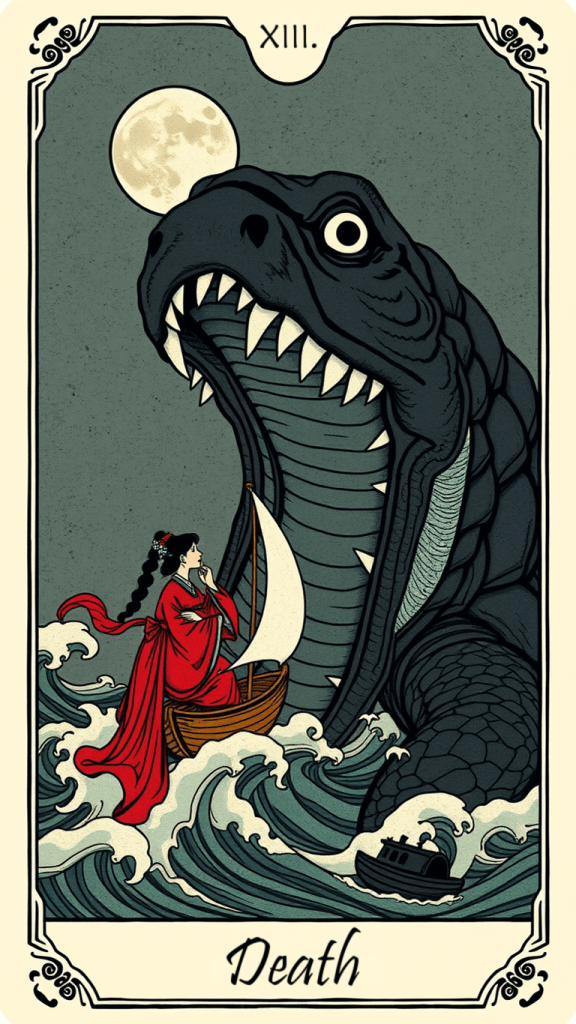
֍ DEATH – Card XIII

TITLE: The Moon-Eating Turtle / 食月龜 (Shí Yuè Guī)

MYTHIC ARCHETYPE: The Pirate Who Swallowed the Eclipse

TAOIST PARALLEL: Ao Guang (敖廣), the Dragon King of the East Sea, in his death aspect—when he transforms into a black turtle that devours the moon each month.

PIRATE TWIST: This is Zheng Yi Sao’s final voyage, where she steers her burning ship into the turtle’s maw to become the tide itself.

WHY DEATH? The turtle doesn’t kill—it digests time. What sinks in its belly becomes the next high tide.

TAOIST PIRATE SYMBOLISM

KEYWORDS (Upright):

Hǎi xiāo (海消, “sea-digestion”)—endings as nutrients for new waves.

The cracked moon pearl (裂月珠, liè yuè zhū)—what breaks becomes the next dawn.

“Anchor-turning” (起錨轉, qǐ máo zhuǎn)—lifting what must sink to sail anew.

KEYWORDS (Reversed):

Fǔ chén (腐沉, “rot-sinking”)—clinging to a corpse ship.

Yè tān (夜貪, “night greed”)—hoarding dead moonbeams.

The turtle’s hiccup (龜嗝, guī gé)—a rebirth stuck in the throat.

INTERPRETATION: This card is the tide’s empty stomach. What you lose today feeds tomorrow’s shore.

RITUAL: THE TURTLE’S FEAST (龜宴, Guī Yàn)

(Inspired by Ming pirate burial rites and Taoist moon-eating ceremonies)

PURPOSE: To ritually feed an ending to the cosmic turtle.

MATERIALS:

A black bowl of saltwater.

Nine grains of rice (for the turtle’s teeth).

A small ship model (or folded paper boat).

A candle (white, to extinguish).

STEPS:

Name the ending aloud. Place the rice in the bowl—this is your offering to death.

Set the ship afloat in the bowl. Light its candle mast, chanting:

船头断裂,桅杆断裂——

旧月哺育着乌龟的脊背。

Bow is broken, mast is broken—

Old moon feeds the turtle’s back.

When the candle drowns, whisper: “You are eaten. You are tide now.”

Bury the ship in soil or cast it to sea.

PARALLEL MYTHOLOGY

TITLE: The Last Endeavor / The Goddess Who Awakens

MYTHIC ARCHETYPE: The Final Quest of Māui (Polynesian)

REGION: Polynesia (especially Māori tradition of Aotearoa)

FORM: Māui, the great culture hero and trickster. Hine-nui-te-pō, the Great Woman of the Night, Goddess of Death.

TALE: After all his epic deeds—fishing up islands, snaring the sun, stealing fire—the ever-clever Māui decided to embark on his final, greatest adventure: to abolish death for all humanity. He learned that he could do this by entering the body of the sleeping goddess of death, Hine-nui-te-pō, through her birth canal, traveling through her, and emerging from her mouth, thus reversing the cycle of life and death. He took his companions, the birds of the forest, and instructed them to be absolutely silent. But as Māui began his journey, the sight of the great hero wriggling into the goddess was so ridiculous that the little fantail bird (the Pīwakawaka) burst out laughing. This sound awoke Hine-nui-te-pō. She clenched her thighs, crushing the great Māui, and he became the first man to die. And so, because of Māui’s hubris and failure, death remains in the world.

WHY DEATH? This myth is the perfect lesson of the Death card. It shows the most powerful hero humbled by the inevitable. It teaches that one cannot trick, negotiate with, or conquer the end of a cycle. One must let go. The imagery—entering the dark body of the chthonic goddess—is a perfect metaphor for the descent required for transformation. Māui’s failure ensures the cycle of death and rebirth for all of us.

INTERPRETATION THROUGH MĀUI: This card signifies a non-negotiable ending. Like Māui, your ego may want to fight it, trick it, or pretend you can escape it. You cannot. To try and cling to the old way is to be crushed like Māui. This is not a punishment, but a fundamental law of nature. Surrender to this ending. Allow what must die to die. Only by letting go can you make way for what comes next. The little fantail bird is laughing at your attempts to hold on. Listen to its wisdom.

THE RITUAL OF THE LAUGHING BIRD (For Severing a Tie)

OBJECTIVE: To consciously and willfully sever your connection to something that must end (a job, a relationship, an identity, a belief) by acknowledging the futility of holding on.

MATERIALS:

An object that represents the thing you are clinging to.

Scissors or a knife.

A bird feather (or a picture/symbol of a bird).

A place where you can be outside, or at least near an open window.

STEPS:

ACKNOWLEDGING THE ATTACHMENT: Hold the object in your hands. Feel your connection to it. Acknowledge what it has given you. Speak your gratitude for it aloud. Then, acknowledge why you are afraid to let it go. “This identity has kept me safe. I’m afraid of who I will be without it.”

THE HUBRIS OF MĀUI: Now, think about your attempts to keep this thing alive when you know it’s over. See the absurdity in it. You are Māui, trying to crawl backward into the goddess of death. It’s an impossible, prideful task.

HEARING THE LAUGHING BIRD: Pick up the bird feather. This is the Pīwakawaka. This is the part of your soul that sees the truth and knows you need to let go. Imagine hearing its cheerful, irreverent laugh at your struggle. The universe is not mocking you with malice; it is reminding you of the natural flow. It can even be a moment of dark humor—let yourself smile or chuckle at how tightly you’ve been clinging.

THE SEVERANCE: Hold the object (or a thread tied to it). Pick up the scissors. Say aloud: “I cannot reverse the cycle. I honor the ending. I let go.” With a single, decisive action, cut the thread or ceremonially “cut” your energetic tie to the object. It is done. The severance is clean.

CLOSING: Hold the feather up to the open air. “My thanks to the truth-teller.” Release the object respectfully—bury it, burn it (if safe), or simply put it away in a box, signifying that its active life is over. The ritual is complete.

SYNCRETIC BRIDGE

Hine-nui-te-pō → Black Turtle (玄武, Xuánwǔ): Both devour to regenerate.

Māui’s Hubris → Pirate Wàngǔ (頑固, “stubbornness”): The sea tolerates no immortal thieves.

THE “SCHOLAR’S HEART” MANDATE:

Sources: This is one of the most famous stories of the Polynesian cycle. It is heavily documented in the works of Sir George Grey’s Polynesian Mythology and Margaret Orbell’s The Illustrated Encyclopedia of Māori Myth and Legend. For the ritual see: 《閩海幻視法》 [Fujian Sea Vision Magic], 1742.

23 Monday Jun 2025

Posted by babylon crashing in Chinese, Tarot, Translation

≈ Comments Off on

Tags

Chinese translation, Jonah’s Fish, ocean mythology, poem, sea folklore, Taoist Pirate rituals, Tarot, the hanging woman, 溺水修女

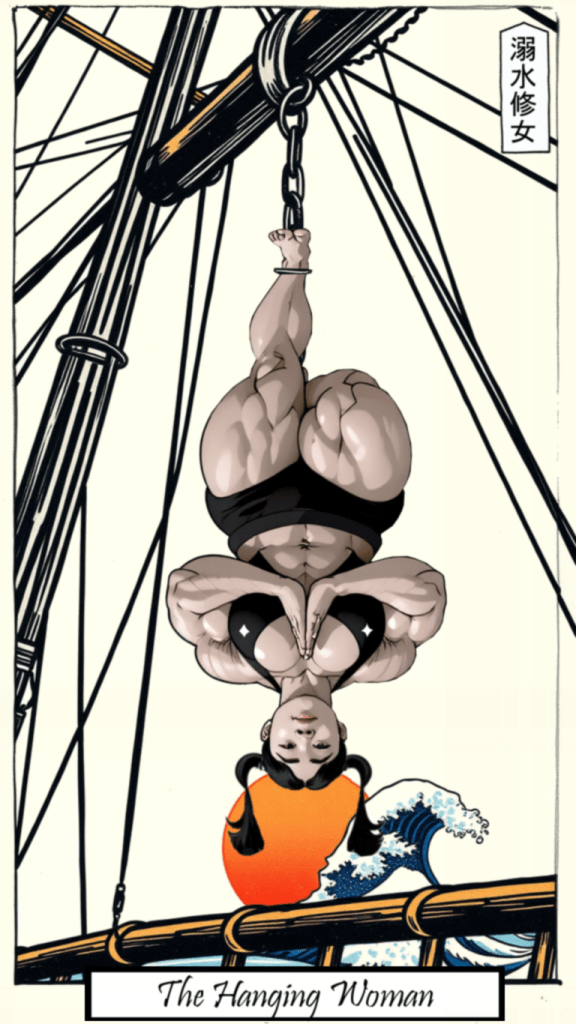
֍ The Hanged Woman – Card XII

TITLE: The Drowned Nun / 溺水修女 (Nìshuǐ xiūnǚ)

MYTHIC ARCHETYPE: The Nun Who Forgot to Drown

TAOIST PARALLEL: Tengguaiu (滕拐), a Taoist Nun, daogu (道姑), before her enlightenment—when her mortal body drowned while her soul wandered.

PIRATE TWIST: She’s suspended in a ship’s spar in contemplation, as ghost eels whisper backwards sutras in her ears.

WHY THE HANGED WOMAN? Her “punishment” is voluntary—she stays hanging upside down to unlearn breathing, preparing for xian (仙) immortality.

TAOIST PIRATE SYMBOLISM

KEYWORDS (Upright):

Fǎn hūxī (反呼吸, “reverse breathing”)—enlightenment through suffocation.

The upside-down chart (倒海圖, dào hǎi tú)—navigation by wrongness.

“Crab-walk wisdom” (蟹行智, xiè xíng zhì)—truths learned sideways.

KEYWORDS (Reversed):

Yān sǐ (淹死, “drowning death”)—resisting the lesson.

Fú píng (浮萍, “duckweed”)—surfacing too soon.

The hollow gourd (空葫蘆, kōng húlú)—failed enlightenment.

INTERPRETATION: This card is the ocean’s koan. To rise, you must first sink past thinking.

RITUAL: THE BRINE BARREL MEDITATION (鹵桶禪, Lǔ Tǒng Chán)

(Inspired by Taoist “drowning breath” practices and pirate survival trials)

PURPOSE: To surrender mental resistance through controlled drowning.

MATERIALS:

A large bowl of ice-cold saltwater.

A hollow reed or straw.

A black cloth.

A candle (blue).

STEPS:

Kneel before the bowl, light the candle. Cover your head with the cloth.

Submerge your face, breathing only through the reed. Chant underwater:

鐵拐落海,鐵骨上天,

怕死的先見閻王爺!

Iron crutch drowns, iron bones rise,
Cowards meet the Death God first!

When lungs burn, emerge but keep eyes closed. The first thing you see inside your eyelids is your true obstacle.

PARALLEL MYTHOLOGY

TITLE: The Belly of the Deep / The Prophet’s Surrender

MYTHIC ARCHETYPE: Jonah in the Belly of the Great Fish (Abrahamic Traditions)

REGION: Ancient Israel / Abrahamic Scripture (Judaism, Christianity, Islam)

TALE: God commands the prophet Jonah to go to the city of Nineveh and preach against its wickedness. Terrified and defiant, Jonah runs from his destiny. He boards a ship sailing in the opposite direction. God sends a great storm, and the sailors, realizing Jonah is the cause, cast him into the sea at his own suggestion. But he does not die. He is swallowed by a “great fish” (often depicted as a whale). For three days and three nights, he is trapped in the belly of the beast—a state of total suspension, darkness, and powerlessness. It is here, in the ultimate Hanged Man position, that he finally stops running. He prays, he surrenders his will to God’s, and he accepts his mission. The fish then vomits him onto dry land, and he goes to Nineveh, a changed man with a new perspective.

WHY THE HANGED WOMAN? Jonah’s story is the Hanged Man’s journey.

SUSPENSION: Trapped in the belly of the fish, he is utterly suspended between worlds, unable to act or escape.

NEW PERSPECTIVE: His world is literally turned upside down. Inside the dark, womb-like prison, he is forced to look inward, leading to an epiphany.

SURRENDER, NOT SACRIFICE: He doesn’t die. He lets go of his defiance. The “voluntary” part isn’t getting swallowed; it’s the act of surrender that happens inside the ordeal.

REBIRTH: He emerges from the ordeal changed and ready to fulfill the purpose he was running from.

INTERPRETATION THROUGH JONAH: This card signifies a necessary pause in your life. You may feel stuck, trapped, or powerless—like you’re in the belly of the beast. Stop fighting it. Stop running from your “Nineveh.” This is not a punishment; it is a sacred time-out. The only way forward is to surrender, let go of your stubborn plans, and look at your situation from this new, uncomfortable perspective. The insight you gain in this “darkness” will be what ultimately frees you.

THE RITUAL OF THE DARK WOMB (For Finding Surrender When Stuck)

OBJECTIVE: To stop resisting a necessary life change by voluntarily entering a symbolic “belly of the fish,” confronting your defiance, and surrendering to your path.

MATERIALS:

A small, dark, enclosed space you can sit in comfortably for a few minutes (a closet, a small bathroom with the lights off, or even under a heavy blanket).

An object that represents your “Nineveh”—the task, decision, or truth you are running from.

A glass of water.

STEPS:

THE FLIGHT AND THE STORM: Before you begin, hold your “Nineveh” object and acknowledge what you’ve been running from. Say it aloud: “I have been running from this difficult conversation” or “I have been avoiding this responsibility.”

ENTERING THE BELLY: Take your object and enter your chosen dark space. Sit down and close the door or cover yourself completely. Plunge yourself into darkness and silence. This is the belly of the fish. You are now officially “stuck.”

THE THREE BREATHS: You cannot fight your way out. You can only surrender. Take three very slow, deliberate breaths.

Breath One: Acknowledge your resistance. Feel it in your body.

Breath Two: Acknowledge your powerlessness in this moment. You cannot escape this darkness through force.

Breath Three: Let go. Release the tension of the fight.

PRAYER OF SURRENDER: Hold your “Nineveh” object in the dark. You don’t need to have a solution. You only need to change your posture from “I won’t” to “I am willing.” Whisper a simple statement of surrender. “I stop running. I am willing to face this. I surrender to the path.”

THE REBIRTH: After a few moments in this surrendered state, emerge from your dark space back into the light. You have been spit out onto the shore. Immediately drink the entire glass of water. This is an act of cleansing and returning to life.

CLOSING: Place your “Nineveh” object on your altar or somewhere you can see it. It is no longer an object of dread, but a symbol of your accepted mission. The ritual is complete.

SYNCRETIC BRIDGE

Jonah’s Fish → Dragon’s Wèi (胃, “stomach”): Both are wombs of forced enlightenment.

Three Days → Three Tides: Taoist rebirth cycles follow moon-pulled waters.

THE “SCHOLAR’S HEART” MANDATE:

Sources: The primary source is The Book of Jonah in the Hebrew Bible (the Tanakh). The story is also recounted in the New Testament and holds a significant place in the Quran, where the prophet is known as Yunus. For the ritual, see: “Drowning Boxing” (溺水拳, Nìshuǐ Quán)—a lost martial art practiced the dead on shipwreck survivors.

23 Monday Jun 2025

Posted by babylon crashing in Chinese, Tarot, Translation

≈ Comments Off on

Tags

Chinese translation, 珠秤判官, justice, Nanshe, ocean mythology, sea folklore, Taoist Pirate rituals, Tarot, The Pearlscale Magistrate

֍ Justice – Card XI

TITLE: The Pearlscale Magistrate / 珠秤判官 (Zhū Chèng Pànguān)

MYTHIC ARCHETYPE: Mazu’s Ghost-light Admiral

TAOIST PARALLEL: Bao Zheng (包拯), the legendary “Iron-Faced Judge” of Song Dynasty, merged with Mazu’s Tide-Scribe—a dead scholar who records karmic debts in coral ledger books.

PIRATE TWIST: His court is an empty beach at low tide – the accused have only until the waters return to prove their innocence.

WHY JUSTICE? He doesn’t need to be alive to see guilt; he listens to how the waves echo in a liar’s chest.

TAOIST PIRATE SYMBOLISM

KEYWORDS (Upright):

Cháo píng (潮平, “tide-balance”)—natural law as inevitable as moonpull.

The coral gavel (珊瑚槌, shānhú chuí)—its strike summons truth-telling eels.

“Saltwater oaths” (鹹水誓, xiánshuǐ shì)—broken vows crystallize on the tongue.

KEYWORDS (Reversed):

Wèi zhāng (偽漲, “false tide”)—fabricated evidence.

Yāo gào (妖告, “phantom testimony”)—lies that dissolve like sea foam.

The hollow pearl (空珠, kōng zhū)—justice delayed until the next typhoon.

INTERPRETATION: This card is karma’s tide table. The Magistrate’s verdicts aren’t decided—they’re revealed by how the ship lists.

RITUAL: THE CORAL LEDGER (珊瑚賬, Shānhú Zhàng)

(Inspired by Ming maritime law and Taoist debt-reckoning rites)

PURPOSE: To weigh a moral dilemma with tidal impartiality.

MATERIALS:

Two whale ear bones (or uneven stones).

A length of fishing net (or red thread).

Saltwater in a brass bowl.

Ink & brush (or a sharp shell).

STEPS:

Carve your dilemma onto the bones—one side per bone.

Tie them to the net, creating a primitive scale. Suspend it over the bowl.

Pour saltwater until one bone sinks and the other rises.

The lighter bone holds your true path.

Bury the sunk bone—its truth is settled. Carry the risen bone for 3 tides as counsel.

PARALLEL MYTHOLOGY

TITLE: The Arbiter of Dreams / The Scale of the Reed Beds

MYTHIC ARCHETYPE: Nanshe (Sumerian Goddess of Social Justice)

REGION: Ancient Mesopotamia (Sumer)

FORM: A powerful goddess, daughter of Enki (the god of wisdom, magic, and fresh water). Her sacred animals were birds and fish. Her center of worship was in the city of Lagash, a city of canals and marshes near the Persian Gulf.

TALE: Nanshe was no distant sky-god. Her justice was compassionate and hands-on. She was known as the one “who knows the orphan, who knows the widow, knows the oppression of man over man.” She was the protector of the socially vulnerable. Furthermore, she was a goddess of prophecy and the chief interpreter of dreams, using them to reveal truths and render fair judgments. At the New Year festival, people would come to her temple to have their dreams interpreted and their disputes settled.

WHY JUSTICE? Nanshe is Justice in action. She represents the search for truth (interpreting dreams), the weighing of actions (judging disputes), and the upholding of fairness, with a special emphasis on protecting those who cannot protect themselves. Her connection to water places her perfectly in our deck, and her role as a dream interpreter gives a mystical, intuitive layer to the cold logic often associated with the Justice card.

INTERPRETATION THROUGH NANSHE: This card signifies that a moment of truth has arrived. All actions have consequences, and now is the time they will be weighed. Nanshe asks you to act with absolute integrity. Are you being fair to others and to yourself? Are you honoring your responsibilities, especially to those who are vulnerable? The truth of the situation will be revealed, perhaps in an unexpected way, like a dream. Be prepared to face the clear, unvarnished facts and act accordingly.

THE RITUAL OF NANSHE’S SCALES (For Seeking a Just Path)

OBJECTIVE: To find a fair and true perspective on a situation where you are conflicted or where a difficult judgment must be made.

MATERIALS:

Two identical bowls or cups.

Two small, equal-sized pieces of paper and a pen.

Water.

AN OFFERING: A small amount of grain (barley, flour) or a piece of bread, representing the agricultural staples of Mesopotamia.

STEPS:

STATING THE CASE: Find a quiet place. Fill both bowls with an equal amount of water. On one piece of paper, write down one side of the argument/situation as objectively as possible. On the other paper, write the other side. Fold them and do not worry about which is which.

THE INVOCATION: Hold the offering in your hand. Address the archetype with respect. “Nanshe, Daughter of Wise Enki, She Who Knows the Orphan and the Widow, I seek your clarity. I have a matter to be weighed, and I wish to find the path of truth and fairness. Witness this rite and grant me wisdom.” Place the offering between the two bowls.

THE WEIGHING: Place one folded paper into each bowl of water. Now, place your hands palm-up under the bowls, as if you are the scales of Justice. Close your eyes. Don’t try to “feel” a physical weight. Instead, feel the emotional and moral weight of the situation you have created. Acknowledge the gravity of both sides. Simply hold the balance for a few minutes in silent contemplation. Your goal is not to find the answer now, but to present the case fairly to the judge.

THE DREAM PLEA: After holding the balance, open your eyes. Speak to the bowls. “The case is presented. The scales are balanced. Nanshe, Arbiter of Dreams, I ask you to carry this matter into my sleep. Reveal to me the truth I need to see. Grant me a dream of clarity.”

CLOSING: Leave the bowls with the papers in them by your bedside overnight. Before you sleep, your last thought should be of opening yourself to receive a truthful dream. In the morning, before you do anything else, write down any dreams you had, no matter how strange. The answer to your dilemma may be hidden there symbolically. Dispose of the water and papers by returning them to the earth. The judgment will come.

SYNCRETIC BRIDGE

Nanshe’s Scales → Taoist Chèng (秤, “balance”): Both use water to reveal weightless truths.

Dream Prophecy → Tide-Divination (占潮, zhān cháo): Ming sailors read verdicts in wave patterns.

THE “SCHOLAR’S HEART” MANDATE:

Sources: “Hymn to Nanshe,” a Sumerian cuneiform text that explicitly details her social justice functions. See: Samuel Noah Kramer’s “History Begins at Sumer” and Thorkild Jacobsen’s The Treasures of Darkness” provide deep context for her role in Mesopotamian religion. For the ritual see: Zheng He’s Maritime Code—the first international sea laws, enforced by Mazu’s priests as well as: 《閩海過渡秘錄》 [Secret Records of Fujian Sea Transitions], 1793.

22 Sunday Jun 2025

Posted by babylon crashing in Chinese, Tarot, Translation

≈ Comments Off on

Tags

Chinese translation, ocean mythology, Ocean of Milk, poem, sea folklore, Taoist Pirate rituals, Tarot, wheel of fortune, 月潮籤

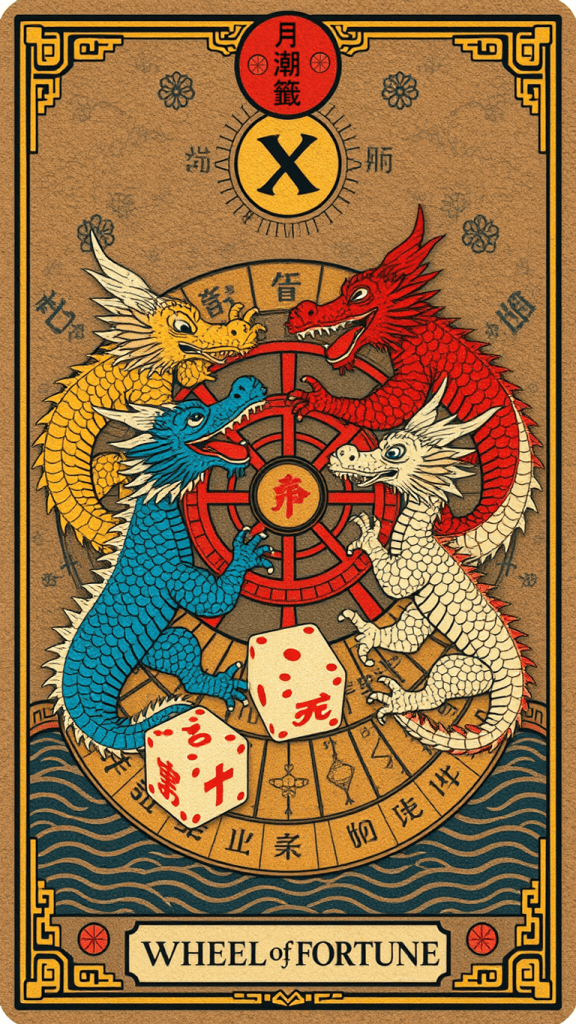
֍ WHEEL OF FORTUNE – Card X

TITLE: The Moon-Tide Lottery / 月潮籤 (Yuè Cháo Qiān)

MYTHIC ARCHETYPE: Mazu’s Gambling Hall

TAOIST PARALLEL: The Dragon Kings’ Dice Game (龍王骰戲, Lóngwáng Tóuxì) where the four sea gods wager tidal fortunes using whalebone dice carved with Bagua symbols.

PIRATE TWIST: The “wheel” is a ship’s steering oar spun by Zheng Yi Sao’s ghost, deciding which junk gets plunder and which gets typhoons.

WHY WHEEL OF FORTUNE? The tides never cheat—but they never play fair either.

TAOIST PIRATE SYMBOLISM

KEYWORDS (Upright):

Cháo bō (潮博, “tide gambling”)—fate as a pirate’s wager.

The moon’s ledger (月賬, yuè zhàng)—where debts wash clean every cycle.

“Kraken’s kiss” (海怪吻, hǎiguài wěn)—sudden fortune from chaos.

KEYWORDS (Reversed):

Shī cháo (失潮, “lost tide”)—missing your wave.

Yāo qián (妖錢, “haunted coins”)—cursed windfalls.

The drowned dice (沉骰, chén tóu)—fixed by sea ghosts.

INTERPRETATION: This card is fate’s tide table—you can’t stop the turn, but you can learn to surf.

RITUAL: THE BAGUA TIDE-CHART (八卦潮表, Bāguà Cháo Biǎo)

(Inspired by Fujianese pirate almanacs and Taoist tide-divination)

PURPOSE: To align with—not fight—life’s cycles.

MATERIALS:

Eight coins (for the Bagua).

A round wooden plate (ship’s wheel or bowl).

Saltwater in a seashell.

A candle (red for luck).

STEPS:

Arrange coins in a Bagua circle on the plate. Light the candle at center.

Spin the plate while chanting:

东龙之金,西龙之浪,

南龙之火,北龙之咸天。

The gold of the East Dragon, the waves of the West Dragon,

the fire of the South Dragon, the salty sky of the North Dragon.

When it stops, the top coin is your current tide:

☰ Heaven: Fortune rises.

☷ Earth: Stay grounded.

☲ Fire: Sudden change.

☵ Water: Go with the flow.

Flick saltwater on that coin—seal your pact with fate.

PARALLEL MYTHOLOGY

TITLE: The Churning of Cosmic Tides / The Wheel of Samudra

MYTHIC ARCHETYPE: The Samudra Manthan (Hindu Cosmology)

REGION: Indian Subcontinent (Hinduism)

FORM: A cosmic event where the Devas and Asuras use the serpent king Vasuki as a rope, wrapped around Mount Mandara as a churning rod, to churn the Ocean of Milk. Lord Vishnu, in his Kurma (turtle) avatar, supports the mountain.

TALE: As detailed above, the churning is a grand cooperative (and later competitive) act that unleashes the full spectrum of fate, from deadly poison to the goddess of fortune, all in the pursuit of immortality.

WHY WHEEL OF FORTUNE? It is the ultimate allegory for fate. The up-and-down pulling motion by the gods and demons perfectly mimics the rise and fall of fortunes. The array of unforeseen outcomes (both bane and boon) demonstrates that we can set events in motion, but we cannot control the cycles of destiny. Lakshmi’s emergence explicitly links the event to fortune.

INTERPRETATION THROUGH SAMUDRA MANTHAN: This card signifies that a great cycle is in motion in your life. You have set the churning rod in place, and now you must be prepared for what emerges from the depths. It may be a poison that tests you, or it may be a treasure you never expected. You cannot stop the wheel from turning, so your task is to adapt, to have faith (like the gods who trusted Shiva to handle the poison), and to be ready to receive the fortune when it arrives.

RITUAL OF THE SWEET AND SALTY CHURN (For Embracing Your Cycle)

OBJECTIVE: To prepare your spirit for an upcoming change or to find peace within a current cycle, acknowledging that all cycles contain both shadow and light.

MATERIALS:

A clear glass bowl or jar filled with water.

A spoonful of honey or sugar (for Lakshmi’s boon).

A spoonful of sea salt (for the Halahala’s challenge).

A small stirring stick or spoon (your Mount Mandara).

Optional: A small item to represent yourself (a small stone or charm).

STEPS:

PREPARATION: Sit with your bowl of water. This is your personal Ocean of Milk, the sea of your current life circumstances.

ACKNOWLEDGING DUALITY: Add the spoonful of honey to the water, saying: “I am open to the sweetness of fortune. I am ready for the blessings I cannot yet see.” Then, add the spoonful of salt, saying: “I have the strength to face the bitterness of challenge. I am ready for the lessons I must learn.”

THE CHURNING: Place your “self” stone in the water if using. Now, use your stirring stick to slowly churn the water. As you stir, don’t focus on mixing everything perfectly. Just observe the currents. See how the sweet and salty elements swirl, sometimes separating, sometimes combining. This is your life’s cycle in motion.

THE SCRY OF ACCEPTANCE: As you churn, speak a simple mantra of surrender: “What comes, I will meet. What goes, I will release. The wheel turns, and I turn with it.” Continue stirring until you feel a sense of calm acceptance.

RECEIVING THE MOMENT: Stop churning. Close your eyes. Dip one finger into the water, and touch it to your tongue. Do you taste sweetness? Saltiness? Both? Neither? This is not a prediction, but a moment of mindfulness—a taste of your life’s current flavor. Accept it without judgment.

CLOSING: Leave the bowl to settle. The water will eventually become still again, the elements merged. This is the new equilibrium you will find after the turn. Pour the water out onto the earth as an offering. Say: “My thanks to the cosmic tides. My heart is ready.” The ritual is complete.

SYNCRETIC BRIDGE

Samudra Manthan → Dragon Pearl Gambit (龍珠賭, Lóngzhū Dǔ): Both unleash boons and curses from the deep.

Lakshmi → Mazu’s Treasure Barge (媽祖寶船, Māzǔ Bǎochuán): Abundance as flotsam from shipwrecks.

THE “SCHOLAR’S HEART” MANDATE:

Sources: This is a cornerstone story in Hinduism. The most detailed accounts are found in the Bhagavata Purana, the Mahabharata, and the Vishnu Purana. We can reference these sacred texts with great respect for their profound philosophical and spiritual depth. Also see: Ming “Tide-Wheel” Clocks—water clocks that predicted fortune cycles via tidal astronomy.

22 Sunday Jun 2025

Posted by babylon crashing in Chinese, Tarot, Translation

≈ Comments Off on

Tags

Chinese translation, 盲潮翁, ocean mythology, Poetry, sea folklore, Taoist Pirate rituals, Tarot, the hermit, Umibōzu

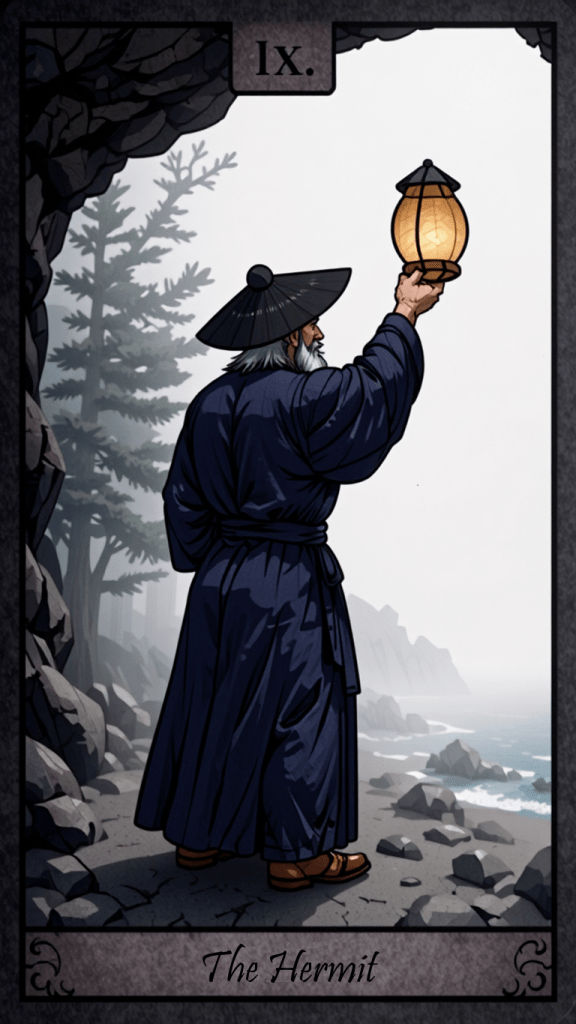
֍ The Hermit – Card IX

TITLE: The Blind Tide-Reader / 盲潮翁 (Máng Cháo Wēng)

MYTHIC ARCHETYPE: The Pirate Who Forgot His Name

TAOIST PARALLEL: Xu Fu (徐福), the alchemist sent by Qin Shi Huang to find immortality, lost at sea—merged with Zhuangzi’s Old Fisherman who knew the Way of tides.

PIRATE TWIST: He’s not just a hermit—he’s the admiral of a ghost fleet that sails in circles, forever seeking Penglai (蓬萊). His eyes were burned white by staring into the Black Tide Mirror (黑潮鏡, hēi cháo jìng) too long.

WHY THE HERMIT? He embodies wúwéi (無為) as driftwood—not seeking, but being sought by truth.

TAOIST PIRATE SYMBOLISM

KEYWORDS (Upright):

Cháo yīn (潮音, “tide-sound”)—hearing wisdom in wave patterns.

The forgotten compass (忘羅盤, wàng luópán)—navigation by soul, not stars.

“Crab-script” (蟹書, xiè shū)—reading truths in sand-writing.

KEYWORDS (Reversed):

Hǎi wàng (海忘, “sea-amnesia”)—lost in endless searching.

A salted tongue (鹹舌, xián shé)—wisdom that cannot be spoken.

The moonless ledger (無月賬, wú yuè zhàng)—records eaten by tides.

INTERPRETATION: This card is the lantern that blinds. The Tide-Reader’s light doesn’t guide—it reveals how lost you’ve always been.

RITUAL: THE BLACK TIDE MIRROR (黑潮鏡, Hēi Cháo Jìng)

(Inspired by Taoist dark meditation and Fujianese “shadow navigation”)

PURPOSE: To confront the self by becoming the abyss.

MATERIALS:

A black lacquer bowl (or ink-darkened water).

Three pinches of ashes (from incense or burnt paper).

A single iron nail (to “anchor” the vision).

A candle (white, to extinguish).

STEPS:

At midnight, place the bowl on a low table. Stir ashes into the water.

Press the nail into the table’s edge, chanting:

将潮水钉在沙滩上,将灵魂钉在大海上—你早已失去了你所追求的东西。

Nail the tide to the beach, nail your soul to the sea – you have already lost what you seek.

Light the candle, stare into the black water until the flame’s reflection drowns.

Blow out the candle. Sit in darkness until your breath matches the tide’s pull.

PARALLEL MYTHOLOGY

TITLE: The Monk of the Abyss / The Silence That Knows

MYTHIC ARCHETYPE: The Umibōzu (Japanese Yōkai)

REGION: Japan

FORM: A massive, shadowy, humanoid spirit that rises from the depths on calm nights. Its name translates to “sea monk,” as its head is large, round, and smooth like the shaven head of a Buddhist monk.

TALE: The Umibōzu is not a chatty oracle. It is a presence. It rises from a placid sea, a sudden, dark embodiment of the terrifying mystery and depth hidden just beneath the surface. It can be destructive if angered or disrespected, but its primary function in folklore is to be a figure of profound, awe-inspiring dread and mystery. To encounter the Umibōzu is to come face-to-face with the vast, unknowable soul of the ocean itself.

WHY THE HERMIT? The Hermit’s journey is a descent into the self. The Umibōzu is the personification of that deep, dark, silent inner space. It represents the intimidating but necessary step of confronting the vast unknown within. The wisdom it offers isn’t in words, but in the silence it commands. It forces a complete halt to the external journey, compelling the sailor (the seeker) to look into the abyss. It is the ultimate symbol of soul-searching and the profound truths found only in deep, contemplative solitude.

INTERPRETATION THROUGH THE UMIBŌZU: This card calls you to a profound retreat. It is time to turn off all external noise and face the silent, deep waters of your own consciousness. Like a sailor on a calm sea at midnight who suddenly sees the Umibōzu rise, you are being asked to stop everything and simply be with the immense mystery of your own being. It may be daunting, but the greatest wisdom you seek is not outside of you; it is waiting in your own personal abyss.

THE RITUAL OF THE DARK WATER LANTERN (For Seeking Inner Truth)

OBJECTIVE: To receive wisdom from your deepest subconscious by creating a space of absolute stillness and darkness, and listening to the silence.

MATERIALS:

A black or very dark-colored bowl.

Water.

A few drops of black ink or food coloring (optional, but effective).

One single candle (white or blue).

A room that can be made completely dark and silent.

STEPS:

CREATING THE ABYSS: In your darkened room, place the bowl before you. Fill it with water. If using ink, add a few drops until the water is an opaque, black mirror. This is the calm, midnight sea.

Lighting the Lantern: Light the single candle and place it beside the bowl. This is your Hermit’s lantern, the only light in the vast darkness. Turn off all other lights.

THE DESCENT: Sit in the silence. Stare softly at the reflection of the single flame on the surface of the black water. Breathe slowly, deeply. Let the silence of the room expand until it feels like the crushing, profound silence of the deep ocean. You are the lone sailor. The black water is your soul.

THE QUESTION: Whisper a single, deep question to the water. Do not ask “what should I do?” Ask “What wisdom do I need?” or “What truth am I avoiding?” Release the question into the deep.

THE VIGIL: Now, you listen. Do not expect a booming voice. The Umibōzu does not speak. Its wisdom rises from the quiet. Let your mind go still. An answer may come as a new feeling, a single word that surfaces in your mind, a forgotten memory, or a sudden, quiet understanding. You are not looking for an answer; you are creating the silence in which the answer that is already there can finally be heard.

THE RETURN: When you feel the vigil is complete, bow your head to the bowl in gratitude. Gently blow out the candle, plunging the room into total darkness for a moment. Acknowledge the abyss. Then, turn on the lights. Immediately write down any thoughts, feelings, or words that came to you in your journal.

SYNCRETIC BRIDGE

Umibōzu’s Silence → Taoist Mòzhì (默知, “silent knowing”) Both reject language for direct experience.

Black Water → Xuánmíng (玄冥, “dark profound”) The primordial sea before creation in Zhuangzi.

THE “SCHOLAR’S HEART” MANDATE:

Sources: The Umibōzu is a well-known yōkai in Japanese folklore. See: Toriyama Sekien’s Gazu Hyakki Yagyō and modern scholarly works on Japanese folklore, Michael Dylan Foster’s The Book of Yōkai: Mysterious Creatures of Japanese Folklore. For the ritual see:《東南海龍王經》(Scripture of the Southeast Dragon Kings), 1783 (Zhenjiang Taoist Temple Archive, Jiangsu).

22 Sunday Jun 2025

Posted by babylon crashing in Chinese, Tarot, Translation

≈ Comments Off on

Tags

Chinese translation, 龍語者, five wind flute, ocean mythology, sea folklore, Shark Tamer, Taoist Pirate rituals, Tarot

֍ STRENGTH – Card VIII

TITLE: The Dragon Whisperer / 龍語者 (Lóng Yǔ Zhě)

MYTHIC ARCHETYPE: The Pirate Who Tamed the Storm

TAOIST PARALLEL: Mazu (媽祖) as the Storm-Soothing Sage, merged with Zheng Yi Sao’s (鄭一嫂) legendary pirate queen who silenced mutinies with a glance.

PIRATE TWIST: She doesn’t just call sharks—she negotiates with typhoons. Her “rattle” is a dragonbone flute that plays the five tones of wind (五音風, wǔ yīn fēng).

WHY STRENGTH? She embodies wuwei (無為) mastery—controlling chaos through harmony, not force.

TAOIST PIRATE SYMBOLISM

KEYWORDS (Upright):

Fēng píng (風平, “wind-calming”)—serenity as power.

The dragon’s pulse (龍脈, lóng mài)—reading storms like qi meridians.

“Silk rope diplomacy” (絲繩交, sī shéng jiāo)—restraining violence with grace.

KEYWORDS (Reversed):

Hǔ jí (虎急, “tiger’s panic”)—fear breaking focus.

A cut qín string (斷琴弦, duàn qín xián)—lost harmony.

The Dragon’s snarl (龍哮, lóng xiào)—nature rejecting your touch.

INTERPRETATION: This card is strength as fluidity. The Whisperer doesn’t chain the dragon—she sings it to sleep.

RITUAL: THE FIVE WINDS FLUTE (五音笛, Wǔ Yīn Dí)

(Inspired by Ming naval weather magic and Taoist sound healing)

PURPOSE: To calm inner or outer turbulence through resonant harmony.

MATERIALS:

A flute (or a seashell to blow into).

Five ribbons (blue, green, red, white, black).

A bowl of brine.

A candle (yellow or blue).

STEPS:

Tie the ribbons to the flute, chanting:

东风向你招呼,南风向你进攻,西风向你屈服,北风向你跪下,中风将你封锁。

The east wind greets you, the south wind attacks you, the west wind submits to you, the north wind kneels before you, and the middle wind seals you away.

Dip the flute in brine (to “salt” its voice). Play one long note per wind direction.

Blow out the candle with the last note—the storm is tamed.

PARALLEL MYTHOLOGY

TITLE: The Shark Tamer / The Hand That Calms the Deep

MYTHIC ARCHETYPE: The Shark Caller (Melanesian Shamanic Tradition)

REGION: Melanesia, particularly Papua New Guinea and the Solomon Islands.

TALE: In these island cultures, certain individuals are born into lineages with the power to “call” sharks. This is not a trick; it is a profound shamanic practice. The caller prepares for days with ritual purification and abstinence. They then go out to sea in a canoe, using a special rattle made of coconut shells and other magical implements to create a specific sound. They chant secret names and incantations, which draw the sharks to the boat. It is an act of immense courage and deep spiritual connection, facing the ocean’s ultimate predator with nothing but knowledge, tradition, and calm inner power.

WHY STRENGTH? This is a perfect fit. The Shark Caller embodies the core principles of the Strength card:

COURAGE: Facing primal fear (the shark) without aggression.

INNER POWER: Using subtle forces (chants, rattles, knowledge) rather than physical might.

PATIENCE & COMPASSION: Understanding the nature of the beast to influence it.

INTEGRATION: The goal is to bring the wild power of the shark into a relationship with the human world, integrating the raw, instinctual self with the conscious, disciplined self.

INTERPRETATION THROUGH THE SHARK CALLER: To draw this card is to be told you have the inner strength to face a situation you fear. Do not meet it with brute force. Meet it like the Shark Caller. Understand its nature, have compassion for its wildness (whether it’s your own anger, a difficult person, or a challenging situation), and use your quiet, persistent inner power to bring it into harmony. You have the gentle hand that can tame the lion—or the shark.

THE RITUAL OF CALLING YOUR SHARK (For Integrating Inner Power)

OBJECTIVE: To bravely face a powerful “beast” within yourself, not to destroy it, but to understand it and integrate it as a source of controlled strength.

MATERIALS:

An object that represents your inner shark (a shark tooth, a dark stone, a drawing of a shark).

A bowl of saltwater.

A rattle or a small bell. Anything that can create a rhythmic, focused sound.

A safe, quiet space where you will not be disturbed.

STEPS:

CREATING THE LAGOON: Sit on the floor and place the bowl of saltwater in front of you. This is your safe ritual space, your lagoon.

NAMING AND SUMMONING: Hold the shark object. Name the inner beast you are facing. “My untamed anger, you are my shark.” or “My crippling self-doubt, you are my shark.” Place the object in the center of your space. Now, begin to gently shake the rattle. This is you, the Caller. You are not running; you are summoning. Close your eyes and allow the feeling—the anger, the fear—to rise within you. Let it fill the space. Just observe it. This is the act of courage.

THE GENTLE HAND (TONIC OF IMMOBILITY): When the feeling is at its peak, stop rattling. Open your eyes and look at the shark object. Now, perform the central act. Reach out your hand—slowly, calmly, deliberately. Do not grab the object. Gently place your fingertips on it. This is the touch on the shark’s snout. As you touch it, project feelings of calm, acceptance, and compassion, not fear. Speak to it. “I see you. I am not afraid of you. I honor your power.”

THE INTEGRATION: Keep your hand on the object. Feel the intense emotion begin to subside, transformed by your calm acceptance into a manageable energy. Now, make your pact with it. “Anger, you will be my strength to protect my boundaries. You will not be my rage that harms others. You will serve me.”

SEALING THE PACT: Lift the object and dip it into the bowl of saltwater, anointing and purifying it. Hold it to your heart. Say: “The beast within is not my enemy. It is my strength. We are one.”

CLOSING: Keep the charged shark object on your altar or carry it with you. When you feel that old, raw emotion rising, touch the object to remind yourself of your pact and your own inner strength. The ritual is complete.

SYNCRETIC BRIDGE

Shark Caller’s Rattle → Dragonbone Flute: Both use sacred sound to commune with predators.

Tonic Immobility → Wuwei: Non-action as the ultimate control.

THE “SCHOLAR’S HEART” MANDATE:

Sources: This is a well-documented anthropological phenomenon. See: references of Zheng (鄭和) “calm wind” flags—silk banners inscribed with Taoist wind-bindings as well as ethnographic studies on the art and rituals of Melanesia, such as the works of anthropologist A.B. Deacon or museum collections that feature shark-calling rattles and ritual art. For the ritual see: 《南海巫法秘本》[Southern Sea Witchcraft Manual], 1809.

20 Friday Jun 2025

Posted by babylon crashing in Chinese, Tarot, Translation

≈ Comments Off on

Tags

Chinese translation, 龍龜女王, Māori mythology, ocean mythology, Paikea, sea folklore, Taoist Pirate rituals, Tarot, the chariot

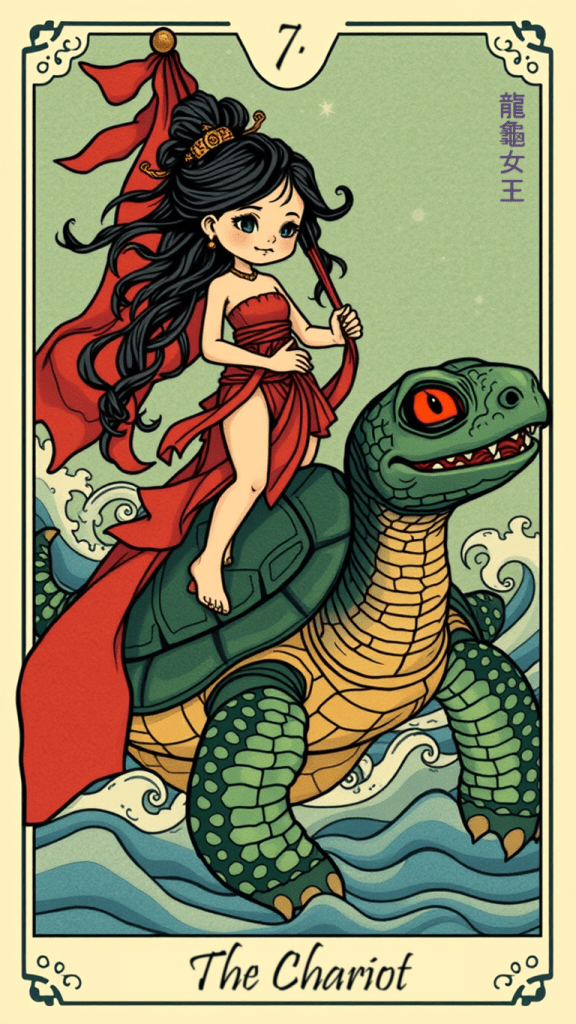
🜄 THE CHARIOT – Card VII

TITLE: The Dragon-Turtle Queen / 龍龜女王 (Lóng Guī Nǚwáng)

MYTHIC ARCHETYPE: The Girl Who Stole the Celestial Current

TAOIST PARALLEL: Mazu (媽祖) in her untamed youth—before she became a goddess, when she rode a dragon-turtle (龍龜, lóngguī) to outrun the Dragon King’s navy.

PIRATE TWIST: The turtle’s shell is carved with stolen star charts, and its flippers churn the water into smooth highways—because Mazu didn’t just ride it, she taught it to cheat tides.

WHY THE CHARIOT? This isn’t brute force—it’s alliance with the primordial. The dragon-turtle is the vehicle, the guide, and the weapon.

TAOIST PIRATE SYMBOLISM

KEYWORDS (Upright):

Guī bèi dào (龜背道, “Turtleback Dao”) — The path appears only when you move.

Starlight hooves (the turtle’s flippers glow with bioluminescence).

No reins (you don’t steer a dragon-turtle; you negotiate)

KEYWORDS (Reversed):

Cracked shell (overburdened by ambition).

The turtle dives (your will is not the tide’s will).

Mazu’s lost sandal (arrogance leaves evidence).

INTERPRETATION: You’re not driving—you’re dancing with a force older than ships. Victory comes from letting the cosmos carry you.

RITUAL: THE TURTLE’S STAR TRAIL (龜星跡, Guī Xīng Jì)

(For harnessing momentum without force)

MATERIALS:

A turtle shell (or a bowl painted with one)

7 pearls (or glass beads)

Seaweed (dried, for “roads”)

Your breath (held for 8 seconds)

STEPS:

Arrange the pearls in the Big Dipper pattern inside the shell.

Lay seaweed trails leading outward like “paths.”

Hold your breath and whisper:

媽祖坐騎,沉者之甲,

載我至星碎之處!

Mazu’s steed, shell of the drowned,
Carry me to where stars are shattered!

Blow across the pearls—the one that rolls farthest reveals your best direction.

PARALLEL MYTHOLOGY

TITLE: The Victorious Rider / The Will That Crosses Oceans

MYTHIC ARCHETYPE: Paikea (Māori Ancestral Hero)

REGION: Aotearoa (New Zealand) / Māori Tradition

FORM: A human ancestor of the Ngāti Porou iwi (tribe).

TALE: Paikea was the sole survivor of a maritime disaster on the vessel of his treacherous half-brother, Ruatapu. Left to die in the open ocean, Paikea did not give up. He called upon the guardians of the sea and his own ancestors, chanting powerful karakia (incantations). In response, a tohorā (whale) came to his aid. Clinging to its back, Paikea rode the whale across the vast Pacific, guided by his will and his connection to the natural world. He landed safely at Ahuahu (Mercury Island) in Aotearoa, becoming a revered progenitor of his people.

WHY THE CHARIOT? Paikea is the ultimate Charioteer. He harnesses a powerful, wild force (the whale) not through brute force, but through focused will, spiritual connection, and absolute determination. He balances the opposing forces of despair and hope, sea and sky, and drives himself forward to a triumphant victory against all odds. His story is the very definition of willpower leading to success.

INTERPRETATION THROUGH PAIKEA: This card is a green light. It says that you have the will and the power to overcome the obstacles in your path. Like Paikea, you must call upon your inner strength (mana), focus your intention like a beacon, and “ride the whale” of your current circumstances to victory. It’s a call to take the reins, be disciplined, and drive forward with confidence.

THE RITUAL OF THE RIDER’S CHANt (For Driving Towards a Goal)

OBJECTIVE: To galvanize your personal will and focus all your energy on achieving a specific, challenging goal. This is a ritual for when you need momentum and the strength to overcome obstacles.

MATERIALS:

An object that represents your “vehicle” or the energy you need to harness (e.g., a car key for a journey, a pen for writing a book, a small weight for a fitness goal).

A space where you can make noise and move.

A compass or a knowledge of the cardinal directions.

A glass of water.

STEPS:

DECLARING THE DESTINATION: Stand in your space and face the direction that feels most aligned with your goal (or just East, the direction of beginnings). Hold your “vehicle” object. State your goal aloud, not as a wish, but as a destination. “My destination is the completion of this project by the month’s end.”

THE INVOCATION OF WILL: Acknowledge the forces you must balance. “I call upon the strength of my ambition. I call upon the discipline of my mind. You will not pull against each other. Today, you pull together. You pull for me.”

CRAFTING THE CHANT (KARAKIA): You will now create your own personal power chant. It should be short, rhythmic, and intensely focused on your goal. Use strong, active words. Repeat it, starting soft and getting louder and more powerful. Let it build a rhythm in your body. You might stomp your feet or clap your hands.

EXAMPLE FOR A CREATIVE PROJECT: “Ink flows, mind knows, work grows, seed sows!”

Example for overcoming a fear: “Heart strong, stand long, fear wrong, move on!”

THE RIDE: Begin chanting. Let the energy build. Feel the power rising from the earth through your feet and out through your voice. You are Paikea on the back of the whale. You are the Charioteer. The chant is the force of your will driving you forward. Continue until you feel a peak of energy, a feeling of unstoppable momentum.

THE ARRIVAL AND GROUNDING: At the peak, give one final, powerful shout of your chant. Then, stop. Silence. Feel the vibrating energy in your body. Pick up your glass of water and drink it all. You are replenishing yourself after the journey. Hold your “vehicle” object to your heart and say: “The will is set. The journey has begun. Victory is the destination.”

CLOSING: Carry your “vehicle” object with you. The energy you infused into it will serve as a source of strength and focus as you move forward. The ritual is complete.

SYNCRETIC BRIDGE

Whale Rider → Dragon-Turtle: Both are ancient, wise, and terrifyingly fast.

Paikea’s Chants → Mazu’s Star Theft: The Maori hero called the whale; Mazu stole the turtle’s loyalty with fermented lychees.

THE “SCHOLAR’S HEART” MANDATE:

Sources: The story of Paikea is a central ancestral narrative for the Ngāti Porou and other iwi. It is recorded in oral traditions, songs (waiata), and genealogical recitations (whakapapa). See: scholarly works on Māori mythology, such as Margaret Orbell’s The Illustrated Encyclopedia of Māori Myth and Legend, for a respectful retelling. The modern story was, of course, popularized by the book and film Whale Rider. For the ritual see: Lin, Q. (Ed.). (1762). 《天妃顯聖錄》 [Tianfei Xianshenglu]. Fujian Folk Texts, Vol. 4. (“Girl Who Rode the Storm,” pp. 22–23).

← Older posts

age difference anal sex Armenia Armenian Genocide Armenian translation ars poetica art artist unknown blow job Chinese translation conversations with imaginary sisters cum cunnilingus drama erotic erotica erotic poem erotic poetry Federico Garcia Lorca fellatio finger fucking free verse ghost ghost girl ghost lover gif Gyumri haiku homoerotic homoerotica Humor i'm spilling more thank ink y'all incest Lilith Love shall make us a threesome masturbation more than just spilled ink more than spilled ink mythology ocean mythology Onna bugeisha orgasm Peace Corps photo poem Poetry Portuguese Portuguese translation prose quote unquote reblog retelling Rumi Sappho sea folklore Shakespeare sheismadeinpoland sonnet sorrow Spanish Spanish translation spilled ink story Taoist Pirate rituals Tarot Tarot of Syssk thank you threesome Titus Andronicus translation video Walt Whitman war woman warrior xenomorph

electric mayhem [links]

  • sandra bernhard
  • Poetic K [myspace]
  • armenian erotica and news
  • cyndi lauper
  • poesia erótica (português)
  • aimee mann
  • discos bizarros argentinos

Meta

  • Create account
  • Log in
  • Entries feed
  • Comments feed
  • WordPress.com

Blog Stats

  • 387,419 hits

Categories

ars poetica: the blogs a-b

  • brilliant books
  • cecilia ann
  • armenian poetry project
  • wendy babiak
  • sommer browning
  • kristy bowen
  • stacy blint
  • clair becker
  • megan burns
  • afghan women's writing project
  • tiel aisha ansari
  • black satin
  • emma bolden
  • afterglow
  • american witch
  • alzheimer's poetry project
  • sandra beasley
  • all things said and done
  • Alcoholic Poet
  • margaret bashaar
  • mary biddinger
  • the art blog
  • aliki barnstone
  • lynn behrendt

Enter your email address to follow this blog and receive notifications of new posts by email.

Join 44 other subscribers

Archives

ars poetica: the blogs c-d

  • lorna dee cervantes
  • natalia cecire
  • julie carter
  • abigail child
  • jennifer k. dick
  • maria damon
  • lyle daggett
  • CRB
  • michelle detorie
  • cheryl clark
  • roberto cavallera
  • juliet cook
  • jackie clark
  • flint area writers
  • linda lee crosfield
  • cleveland poetics

ars poetica: the blogs e-h

  • jessica goodfellow
  • joy garnett
  • human writes
  • hayaxk (ՀԱՅԱՑՔ)
  • maggie may ethridge
  • carrie etter
  • liz henry
  • jeannine hall gailey
  • sarah wetzel fishman
  • bernardine evaristo
  • amanda hocking
  • herstoria
  • jane holland
  • elisa gabbert
  • elizabeth glixman
  • carol guess
  • ghosts of zimbabwe
  • joy harjo
  • Gabriela M.
  • Free Minds Book Club
  • maureen hurley
  • pamela hart
  • julie r. enszer

ars poetica: the blogs i-l

  • language hat
  • renee liang
  • donna khun
  • megan kaminski
  • amy king
  • laila lalami
  • a big jewish blog
  • kennifer kilgore-caradec
  • maggie jochild
  • emily lloyd
  • sheryl luna
  • meg johnson
  • charmi keranen
  • diane lockward
  • joy leftow
  • Kim Whysall-Hammond
  • dick jones
  • IEPI
  • miriam levine
  • gene justice
  • irene latham
  • lesbian poetry archieves
  • sandy longhorn
  • lesley jenike
  • Jaya Avendel
  • las vegas poets organization

ars poetica: the blogs m-o

  • mlive: michigan poetry news
  • new issues poetry & prose
  • sharanya manivannan
  • michigan writers resources
  • michelle mc grane
  • wanda o'connor
  • Nanny Charlotte
  • iamnasra oman
  • majena mafe
  • sophie mayer
  • My Poetic Side
  • heather o'neill
  • maud newton
  • caryn mirriam-goldberg
  • marion mc cready
  • ottawa poetry newsletter
  • january o'neil
  • nzepc
  • motown writers
  • adrienne j. odasso
  • michigan writers network
  • the malaysian poetic chronicles

ars poetica: the blogs p-r

  • ariana reines
  • Queen Majeeda
  • joanna preston
  • maria padhila
  • nicole peyrafitte
  • kristin prevallet
  • rachel phillips
  • helen rickerby
  • split this rock
  • susan rich
  • sophie robinson
  • nikki reimer

ars poetica: the blogs s-z

  • tuesday poems
  • Stray Lower
  • Trista's Poetry
  • shin yu pai
  • sexy poets society
  • ron silliman
  • scottish poetry library
  • womens quarterly conversation
  • vassilis zambaras
  • switchback books
  • southern michigan poetry
  • tim yu

  • Subscribe Subscribed
    • memories of my ghost sista
    • Join 44 other subscribers
    • Already have a WordPress.com account? Log in now.
    • memories of my ghost sista
    • Subscribe Subscribed
    • Sign up
    • Log in
    • Report this content
    • View site in Reader
    • Manage subscriptions
    • Collapse this bar
 

Loading Comments...