Tags
Chinese translation, 龍龜女王, Māori mythology, ocean mythology, Paikea, sea folklore, Taoist Pirate rituals, Tarot, the chariot
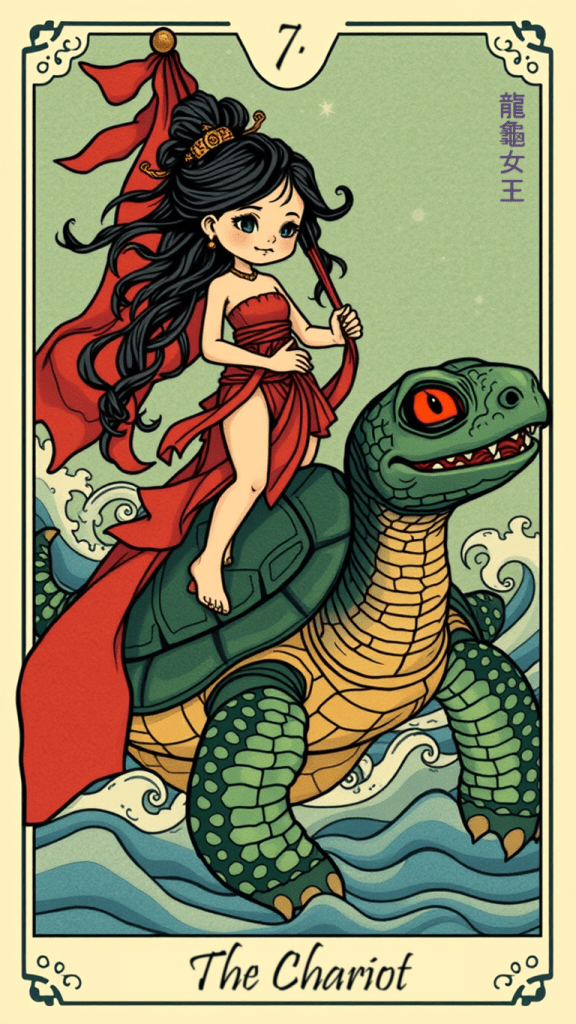
🜄 THE CHARIOT – Card VII
TITLE: The Dragon-Turtle Queen / 龍龜女王 (Lóng Guī Nǚwáng)
MYTHIC ARCHETYPE: The Girl Who Stole the Celestial Current
TAOIST PARALLEL: Mazu (媽祖) in her untamed youth—before she became a goddess, when she rode a dragon-turtle (龍龜, lóngguī) to outrun the Dragon King’s navy.
PIRATE TWIST: The turtle’s shell is carved with stolen star charts, and its flippers churn the water into smooth highways—because Mazu didn’t just ride it, she taught it to cheat tides.
WHY THE CHARIOT? This isn’t brute force—it’s alliance with the primordial. The dragon-turtle is the vehicle, the guide, and the weapon.
TAOIST PIRATE SYMBOLISM
KEYWORDS (Upright):
Guī bèi dào (龜背道, “Turtleback Dao”) — The path appears only when you move.
Starlight hooves (the turtle’s flippers glow with bioluminescence).
No reins (you don’t steer a dragon-turtle; you negotiate)
KEYWORDS (Reversed):
Cracked shell (overburdened by ambition).
The turtle dives (your will is not the tide’s will).
Mazu’s lost sandal (arrogance leaves evidence).
INTERPRETATION: You’re not driving—you’re dancing with a force older than ships. Victory comes from letting the cosmos carry you.
RITUAL: THE TURTLE’S STAR TRAIL (龜星跡, Guī Xīng Jì)
(For harnessing momentum without force)
MATERIALS:
A turtle shell (or a bowl painted with one)
7 pearls (or glass beads)
Seaweed (dried, for “roads”)
Your breath (held for 8 seconds)
STEPS:
Arrange the pearls in the Big Dipper pattern inside the shell.
Lay seaweed trails leading outward like “paths.”
Hold your breath and whisper:
媽祖坐騎,沉者之甲,
載我至星碎之處!
Mazu’s steed, shell of the drowned,
Carry me to where stars are shattered!
Blow across the pearls—the one that rolls farthest reveals your best direction.
PARALLEL MYTHOLOGY
TITLE: The Victorious Rider / The Will That Crosses Oceans
MYTHIC ARCHETYPE: Paikea (Māori Ancestral Hero)
REGION: Aotearoa (New Zealand) / Māori Tradition
FORM: A human ancestor of the Ngāti Porou iwi (tribe).
TALE: Paikea was the sole survivor of a maritime disaster on the vessel of his treacherous half-brother, Ruatapu. Left to die in the open ocean, Paikea did not give up. He called upon the guardians of the sea and his own ancestors, chanting powerful karakia (incantations). In response, a tohorā (whale) came to his aid. Clinging to its back, Paikea rode the whale across the vast Pacific, guided by his will and his connection to the natural world. He landed safely at Ahuahu (Mercury Island) in Aotearoa, becoming a revered progenitor of his people.
WHY THE CHARIOT? Paikea is the ultimate Charioteer. He harnesses a powerful, wild force (the whale) not through brute force, but through focused will, spiritual connection, and absolute determination. He balances the opposing forces of despair and hope, sea and sky, and drives himself forward to a triumphant victory against all odds. His story is the very definition of willpower leading to success.
INTERPRETATION THROUGH PAIKEA: This card is a green light. It says that you have the will and the power to overcome the obstacles in your path. Like Paikea, you must call upon your inner strength (mana), focus your intention like a beacon, and “ride the whale” of your current circumstances to victory. It’s a call to take the reins, be disciplined, and drive forward with confidence.
THE RITUAL OF THE RIDER’S CHANt (For Driving Towards a Goal)
OBJECTIVE: To galvanize your personal will and focus all your energy on achieving a specific, challenging goal. This is a ritual for when you need momentum and the strength to overcome obstacles.
MATERIALS:
An object that represents your “vehicle” or the energy you need to harness (e.g., a car key for a journey, a pen for writing a book, a small weight for a fitness goal).
A space where you can make noise and move.
A compass or a knowledge of the cardinal directions.
A glass of water.
STEPS:
DECLARING THE DESTINATION: Stand in your space and face the direction that feels most aligned with your goal (or just East, the direction of beginnings). Hold your “vehicle” object. State your goal aloud, not as a wish, but as a destination. “My destination is the completion of this project by the month’s end.”
THE INVOCATION OF WILL: Acknowledge the forces you must balance. “I call upon the strength of my ambition. I call upon the discipline of my mind. You will not pull against each other. Today, you pull together. You pull for me.”
CRAFTING THE CHANT (KARAKIA): You will now create your own personal power chant. It should be short, rhythmic, and intensely focused on your goal. Use strong, active words. Repeat it, starting soft and getting louder and more powerful. Let it build a rhythm in your body. You might stomp your feet or clap your hands.
EXAMPLE FOR A CREATIVE PROJECT: “Ink flows, mind knows, work grows, seed sows!”
Example for overcoming a fear: “Heart strong, stand long, fear wrong, move on!”
THE RIDE: Begin chanting. Let the energy build. Feel the power rising from the earth through your feet and out through your voice. You are Paikea on the back of the whale. You are the Charioteer. The chant is the force of your will driving you forward. Continue until you feel a peak of energy, a feeling of unstoppable momentum.
THE ARRIVAL AND GROUNDING: At the peak, give one final, powerful shout of your chant. Then, stop. Silence. Feel the vibrating energy in your body. Pick up your glass of water and drink it all. You are replenishing yourself after the journey. Hold your “vehicle” object to your heart and say: “The will is set. The journey has begun. Victory is the destination.”
CLOSING: Carry your “vehicle” object with you. The energy you infused into it will serve as a source of strength and focus as you move forward. The ritual is complete.
SYNCRETIC BRIDGE
Whale Rider → Dragon-Turtle: Both are ancient, wise, and terrifyingly fast.
Paikea’s Chants → Mazu’s Star Theft: The Maori hero called the whale; Mazu stole the turtle’s loyalty with fermented lychees.
THE “SCHOLAR’S HEART” MANDATE:
Sources: The story of Paikea is a central ancestral narrative for the Ngāti Porou and other iwi. It is recorded in oral traditions, songs (waiata), and genealogical recitations (whakapapa). See: scholarly works on Māori mythology, such as Margaret Orbell’s The Illustrated Encyclopedia of Māori Myth and Legend, for a respectful retelling. The modern story was, of course, popularized by the book and film Whale Rider. For the ritual see: Lin, Q. (Ed.). (1762). 《天妃顯聖錄》 [Tianfei Xianshenglu]. Fujian Folk Texts, Vol. 4. (“Girl Who Rode the Storm,” pp. 22–23).
 memories of my ghost sista