Tags
Chinese translation, death, 食月龜, Māui, ocean mythology, sea folklore, Taoist Pirate rituals, Tarot, Zheng Yi Sao
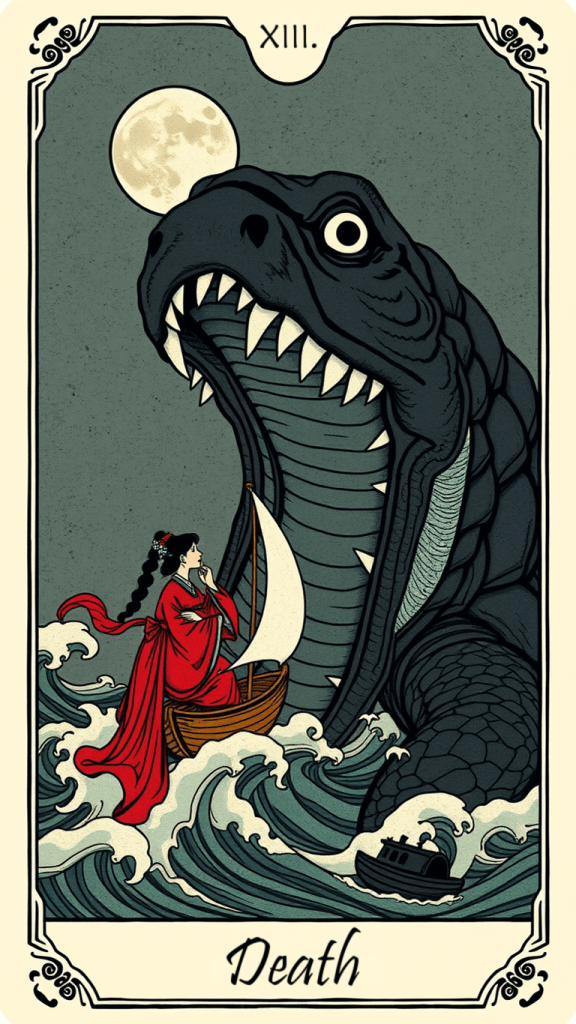
֍ DEATH – Card XIII
TITLE: The Moon-Eating Turtle / 食月龜 (Shí Yuè Guī)
MYTHIC ARCHETYPE: The Pirate Who Swallowed the Eclipse
TAOIST PARALLEL: Ao Guang (敖廣), the Dragon King of the East Sea, in his death aspect—when he transforms into a black turtle that devours the moon each month.
PIRATE TWIST: This is Zheng Yi Sao’s final voyage, where she steers her burning ship into the turtle’s maw to become the tide itself.
WHY DEATH? The turtle doesn’t kill—it digests time. What sinks in its belly becomes the next high tide.
TAOIST PIRATE SYMBOLISM
KEYWORDS (Upright):
Hǎi xiāo (海消, “sea-digestion”)—endings as nutrients for new waves.
The cracked moon pearl (裂月珠, liè yuè zhū)—what breaks becomes the next dawn.
“Anchor-turning” (起錨轉, qǐ máo zhuǎn)—lifting what must sink to sail anew.
KEYWORDS (Reversed):
Fǔ chén (腐沉, “rot-sinking”)—clinging to a corpse ship.
Yè tān (夜貪, “night greed”)—hoarding dead moonbeams.
The turtle’s hiccup (龜嗝, guī gé)—a rebirth stuck in the throat.
INTERPRETATION: This card is the tide’s empty stomach. What you lose today feeds tomorrow’s shore.
RITUAL: THE TURTLE’S FEAST (龜宴, Guī Yàn)
(Inspired by Ming pirate burial rites and Taoist moon-eating ceremonies)
PURPOSE: To ritually feed an ending to the cosmic turtle.
MATERIALS:
A black bowl of saltwater.
Nine grains of rice (for the turtle’s teeth).
A small ship model (or folded paper boat).
A candle (white, to extinguish).
STEPS:
Name the ending aloud. Place the rice in the bowl—this is your offering to death.
Set the ship afloat in the bowl. Light its candle mast, chanting:
船头断裂,桅杆断裂——
旧月哺育着乌龟的脊背。
Bow is broken, mast is broken—
Old moon feeds the turtle’s back.
When the candle drowns, whisper: “You are eaten. You are tide now.”
Bury the ship in soil or cast it to sea.
PARALLEL MYTHOLOGY
TITLE: The Last Endeavor / The Goddess Who Awakens
MYTHIC ARCHETYPE: The Final Quest of Māui (Polynesian)
REGION: Polynesia (especially Māori tradition of Aotearoa)
FORM: Māui, the great culture hero and trickster. Hine-nui-te-pō, the Great Woman of the Night, Goddess of Death.
TALE: After all his epic deeds—fishing up islands, snaring the sun, stealing fire—the ever-clever Māui decided to embark on his final, greatest adventure: to abolish death for all humanity. He learned that he could do this by entering the body of the sleeping goddess of death, Hine-nui-te-pō, through her birth canal, traveling through her, and emerging from her mouth, thus reversing the cycle of life and death. He took his companions, the birds of the forest, and instructed them to be absolutely silent. But as Māui began his journey, the sight of the great hero wriggling into the goddess was so ridiculous that the little fantail bird (the Pīwakawaka) burst out laughing. This sound awoke Hine-nui-te-pō. She clenched her thighs, crushing the great Māui, and he became the first man to die. And so, because of Māui’s hubris and failure, death remains in the world.
WHY DEATH? This myth is the perfect lesson of the Death card. It shows the most powerful hero humbled by the inevitable. It teaches that one cannot trick, negotiate with, or conquer the end of a cycle. One must let go. The imagery—entering the dark body of the chthonic goddess—is a perfect metaphor for the descent required for transformation. Māui’s failure ensures the cycle of death and rebirth for all of us.
INTERPRETATION THROUGH MĀUI: This card signifies a non-negotiable ending. Like Māui, your ego may want to fight it, trick it, or pretend you can escape it. You cannot. To try and cling to the old way is to be crushed like Māui. This is not a punishment, but a fundamental law of nature. Surrender to this ending. Allow what must die to die. Only by letting go can you make way for what comes next. The little fantail bird is laughing at your attempts to hold on. Listen to its wisdom.
THE RITUAL OF THE LAUGHING BIRD (For Severing a Tie)
OBJECTIVE: To consciously and willfully sever your connection to something that must end (a job, a relationship, an identity, a belief) by acknowledging the futility of holding on.
MATERIALS:
An object that represents the thing you are clinging to.
Scissors or a knife.
A bird feather (or a picture/symbol of a bird).
A place where you can be outside, or at least near an open window.
STEPS:
ACKNOWLEDGING THE ATTACHMENT: Hold the object in your hands. Feel your connection to it. Acknowledge what it has given you. Speak your gratitude for it aloud. Then, acknowledge why you are afraid to let it go. “This identity has kept me safe. I’m afraid of who I will be without it.”
THE HUBRIS OF MĀUI: Now, think about your attempts to keep this thing alive when you know it’s over. See the absurdity in it. You are Māui, trying to crawl backward into the goddess of death. It’s an impossible, prideful task.
HEARING THE LAUGHING BIRD: Pick up the bird feather. This is the Pīwakawaka. This is the part of your soul that sees the truth and knows you need to let go. Imagine hearing its cheerful, irreverent laugh at your struggle. The universe is not mocking you with malice; it is reminding you of the natural flow. It can even be a moment of dark humor—let yourself smile or chuckle at how tightly you’ve been clinging.
THE SEVERANCE: Hold the object (or a thread tied to it). Pick up the scissors. Say aloud: “I cannot reverse the cycle. I honor the ending. I let go.” With a single, decisive action, cut the thread or ceremonially “cut” your energetic tie to the object. It is done. The severance is clean.
CLOSING: Hold the feather up to the open air. “My thanks to the truth-teller.” Release the object respectfully—bury it, burn it (if safe), or simply put it away in a box, signifying that its active life is over. The ritual is complete.
SYNCRETIC BRIDGE
Hine-nui-te-pō → Black Turtle (玄武, Xuánwǔ): Both devour to regenerate.
Māui’s Hubris → Pirate Wàngǔ (頑固, “stubbornness”): The sea tolerates no immortal thieves.
THE “SCHOLAR’S HEART” MANDATE:
Sources: This is one of the most famous stories of the Polynesian cycle. It is heavily documented in the works of Sir George Grey’s Polynesian Mythology and Margaret Orbell’s The Illustrated Encyclopedia of Māori Myth and Legend. For the ritual see: 《閩海幻視法》 [Fujian Sea Vision Magic], 1742.
 memories of my ghost sista