Tags
Chinese translation, 龍廷, Lóng Tíng, ocean mythology, poem, Poetry, Poseidon, sea folklore, Taoist Pirate rituals, Tarot
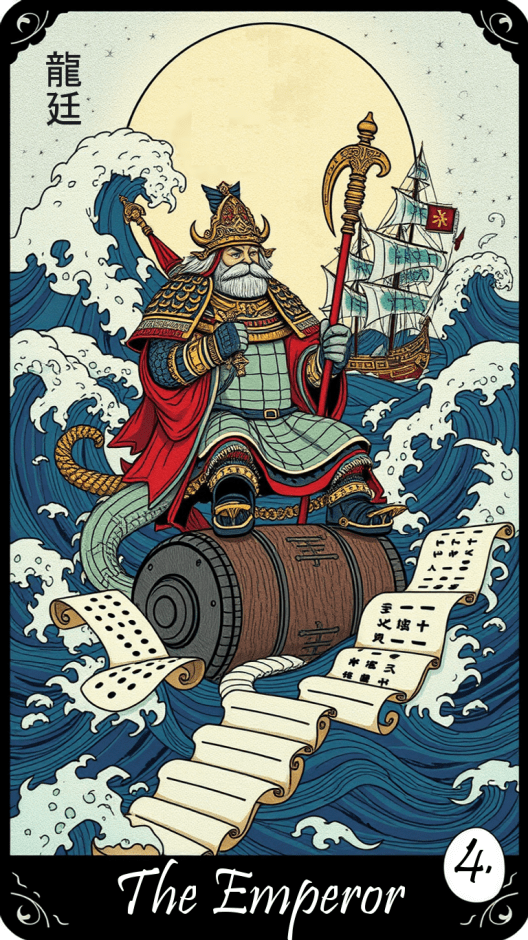
🜄 THE EMPEROR – Card IV
TITLE: The Dragon Throne / 龍廷 (Lóng Tíng)
MYTHIC ARCHETYPE: The Pirate Dragon King
TAOIST PARALLEL: Ao Guang (敖廣), the East Sea Dragon King, merged with Zheng Zhilong (鄭芝龍)—the real-life Ming dynasty pirate admiral who commanded 3,000 junks.
PIRATE TWIST: He’s not just a mythical ruler—he’s the admiral of the ghost fleet, enforcing hǎi shén fǎ (海神法, “Sea God’s Law”) from a throne of cannons and coral. His trident? A tide-cutting ji (戟) halberd that splits storms.
WHY THE EMPEROR? He doesn’t just control the sea—he is its justice. Cross him and your ship sinks paper-light (紙沉, zhǐ chén). Serve him, and he’ll guide you through fog-walled coves.
TAOIST PIRATE SYMBOLISM
KEYWORDS (Upright):
Lóngtíng lǜ (龍廷律, “Dragon Court Rules”)—code of the sea.
“Tides obey the Bagua” (潮隨八卦, cháo suí bāguà)—order in chaos.
The admiral’s seal (海帥印, hǎi shuài yìn)—stamped on waves.
KEYWORDS (Reversed):
A broken tide-table (破潮曆, pò cháo lì)—navigation failed.
“Dragon’s yawn” (龍哈欠, lóng hāqiàn)—complacency before disaster.
The sea tribunal (海審, hǎi shěn) where traitors walk the plank.
INTERPRETATION: This card is law written in saltwater. The Dragon Throne rewards loyalty and sinks oath-breakers. His power isn’t tyranny—it’s the certainty of the tide.
RITUAL: THE ADMIRAL’S SEAL (海帥印, Hǎi Shuài Yìn)
(Inspired by Ming naval codes and Daoist tide-summoning rites)
PURPOSE: To claim authority or stabilize chaos.
MATERIALS:
A wooden plank (driftwood or bamboo).
Red ink (or bloodroot pigment).
A knife (to carve).
Nine copper coins (for the Nine Dragons).
Saltwater.
STEPS:
Carve the Bagua into the plank at dusk.
Dip coins in ink, press them onto the wood like a seal, chanting:
东龙审判,西龙称重,
南龙焚烧,北龙付出代价。
East Dragon judges, West Dragon weighs,
South Dragon burns, North Dragon pays.
Bury the plank at a crossroads or fling it into the sea.
PARALLEL MYTHOLOGY
TITLE: Poseidon, Sovereign of the Sea’s Dominion / Keeper of the Trident
MYTHIC ARCHETYPE: Poseidon (Greek God of the Sea, Earthquakes, and Horses)
REGION: Ancient Greece and the wider Hellenic world
FORM: God of the sea, storms, horses, and earthquakes; wielder of the mighty trident
TALE: Poseidon is a formidable god whose temper mirrors the ocean’s tempestuous moods. As one of the Olympian siblings, he claimed dominion over the seas and all its creatures, as well as horses and the tremors beneath the earth. His trident symbolizes both creative and destructive power, capable of calming waves or shattering lands. Though sometimes seen as capricious and volatile, Poseidon also represents steadfast authority and governance over nature’s primal forces. His role as the Emperor in our oceanic Tarot is to teach the balance of control and power—how to rule with strength tempered by wisdom, and how to command loyalty and respect through firm, just leadership.
WHY THE EMPEROR? The Emperor stands for order, structure, protection, and leadership. Poseidon’s role as the sovereign sea god aligns perfectly, embodying authority grounded in the elemental power of water and earth.
INTERPRETATION THROUGH POSEIDON: When Poseidon appears, he calls forth the leader within you—the one who must wield power responsibly among tumultuous currents. He demands respect for the rules that hold worlds together but warns against becoming a tyrant who crushes rather than governs.
Poseidon asks: Where do you exert control? Are you a protector of your domain or a rigid despot? How do you balance power with compassion?
RITUAL: Invocation of Poseidon’s Command
PURPOSE: To call upon strength, leadership, or the power to establish order in chaos.
MATERIALS:
A trident-shaped object or symbolic representation (can be crafted or drawn)
Saltwater
Blue or sea-green candles
Shells or horse figurines (optional)
A strong, grounded space to perform the ritual
STEPS:
Place the trident or its symbol before you. Light the candles, representing the sea and its powers.
Sprinkle a few drops of saltwater around your space, envisioning Poseidon’s waves marking your territory.
SPEAK THE INVOCATION:
Poseidon, lord of sea and shore,
Keeper of waves, trident in hand,
Grant me the strength to lead and guard,
To rule with justice, firm but fair.
Visualize yourself standing tall like a pillar of rock amidst a stormy sea, unyielding but wise.
Close the ritual with gratitude, grounding yourself and honoring the ocean’s mighty ruler.
THE “BEST FIT” PRINCIPLE: Where Sedna is the deep, internal, life-giving source, Poseidon is the external, sovereign, structural power.
SOVEREIGNTY AND DOMAIN: The Emperor is the master of his realm. Poseidon’s authority over the sea is absolute and was established at the dawn of the Olympian age when the cosmos was divided among the three brothers (Zeus, Poseidon, Hades). This act of structuring the universe is a perfect Emperor concept.
THE TRIDENT AS SCEPTER: The Emperor holds a scepter, a symbol of his power to rule. Poseidon’s trident is one of the most famous symbols of divine authority in all mythology. It’s not just a weapon; it is the tool with which he enforces his will, creating earthquakes and calming storms. It is his law made manifest.
THE SHADOW SIDE: Poseidon’s infamous temper, his tyrannical rage against Odysseus, his stubbornness in his contest with Athena over Athens—these are all textbook examples of the Emperor’s negative traits: inflexibility, despotism, and the use of power for personal grudges rather than the good of the realm.
THE RITUAL OF THE TRIDENT’S STRIKE (To Establish a Foundation)
OBJECTIVE: To create a stable, protected foundation in a chaotic area of your life. Use this when starting a major project, fortifying your personal boundaries, or bringing order to your home or mind.
MATERIALS:
A staff, a sturdy branch, or even your own arm and fist. This is your “Trident.”
A bowl of saltwater.
Three stones, large enough to be stable. These represent the three points of the trident and the foundation you are building.
A piece of ground where you can perform the ritual (a yard, a park, or even a planter box).
STEPS:
SURVEYING THE DOMAIN: Stand before the piece of ground. This is your kingdom, the area you are about to bring into order. State your intention clearly and aloud. “I am here to bring order to my finances” or “I am here to establish a firm boundary of my personal time.”
CONSECRATING THE TRIDENT: Hold your staff (or arm) and dip its end into the saltwater. Raise it to the sky. DECLARE ITS POWER: “This is not wood, but bone of the Earth. This is not my arm, but the will of the Sea. This is the Trident that strikes the foundation and commands the deep.”
THE STRIKE: With all your focused intent, strike the ground firmly three times with the end of your staff. Each strike should be deliberate and powerful. With each strike, make a declaration:
(Strike 1): “By the power of the Earth Below, I set my foundation!”
(Strike 2): “By the power of the Sea Around, I set my boundary!”
(Strike 3): “By the power of the Sky Above, I declare my dominion!”
LAYING THE FOUNDATION: Place your three stones on the ground where you struck, forming a stable triangle. This is the physical anchor for the order you have created. Pour the remaining saltwater in a circle around the stones as a libation and a boundary of protection.
THE SOVEREIGN’S OATH: Stand straight, looking over your newly established “foundation.” Make a vow of responsible rulership. “I will rule this domain with strength and with wisdom. I will be its protector, not its tyrant. This order is established. So it is.”
CLOSING: Leave the stones in place for at least a full day and night. The act is complete. You have shifted from being a subject of chaos to the sovereign of your domain.
SYNCRETIC BRIDGE
Poseidon’s Trident → Dragon King’s Ji: Both split waves and enforce divine will.
Olympian Division → Fēngshuǐ of the Seas: The Dragon Kings divide the oceans like Bagua sectors.
THE “SCHOLAR’S HEART” MANDATE
Primary Sources: Homer’s Iliad and, most importantly, The Odyssey, where Poseidon’s role as a powerful, wrathful antagonist is central. Hesiod’s Theogony is essential for his origin and the division of the cosmos. The Homeric Hymn to Poseidon is a direct invocation that praises his power. For the ritual see: the biography of Admiral Zheng He’s (鄭和) navigation charts—they were ritual objects blessed by Mazu to command currents; as well as the Jiaolong myth in the 《述异记》 [Records of Strange Things], 6th century CE.
 memories of my ghost sista