In Leslie Feinberg’s novel, “Stone Butch Blues” (Firebrand Books, 1993) she talks about growing up in pre-Stonewall days, as a transgendered other, and the titillation and transgression of wearing men’s BVDs at a time when hetero-gender roles were brutally enforced, especially by the NYC police. Writing amorous stories about female samurai, the Onna bugeisha, one starts to think about all the ways these Japanese women were breaking their own social codes. And, this being an erotic story, one has to wonder, “just what did they wear under their armor while riding into battle?” This is where me not being a historian becomes problematic. I am very much a Westerner (the unwashed, hairy barbarian sort) and while I know that my own culture has lots of hang-ups about men and women mix-and-matching each other’s clothing, I don’t know if that translates into Japanese taboos all that well. We’re still laboring under that cockamamie Deuteronomy 22:5, “a woman must not wear men’s clothing, nor a man wear women’s clothing, for God detests anyone who does this,” (New International Version, 1984) which is why I love the cojones of drag queens so much, you go, sistas, fight the power! But what about feudal Japan, say, around 1860? Sometimes I like to think the Onna bugeisha went commando, but I like transgression, so perhaps we can try something a bit more risque. If you’ve seen any historical samurai movies you might have seen male villagers running around in what appears to be 19th century thongs, the fundoshi, which, while I have tried, I found them a bit chaffing. For this story, though, set during the Mito Rebellion (May 1864 through January 1865), I’m assuming that these goddesses of war not only wore male fundoshi into battle but also wore them to bed as well. It was, after all, a revolutionary time; the Tokugawa Shogunate, which ruled for 268 years, was about to fall (you won’t see that in this story, the rebels who supported the Emperor are crushed at Mito), but what this will do is usher in both the Meiji Restoration as well as the birth of Prime Minister Hideki Tojo (born December 30th, 1884) who, 57 years later, thought that bombing Pearl Harbor was a bloody good idea. Cheers!
* * *
It’s still the same old story, a fight for love and glory,
a case of do or die. The world will always welcome lovers
as time goes by.
— Dooley Wilson in “Casablanca” (1942)
June 17th, 1864
I.
“Do you like my breasts?”
She asked the younger woman this, quietly, not exactly cupping them as an offering, rather out of shyness. It was a move that made her lover’s heart melt. After all that the older woman had been through, to be this open, this vulnerable, it made the most proud of hearts humble.
“You are more beautiful than anyone I have ever known,” came the honest reply, to which she responded with a hungry kiss, the sort that did not stop at the lips but exploded into a series of tongue-lapping snogs, bites, nips, a multitude of succulent candy kisses all the way down the older woman’s throat, across her muscled chest, between the round, scarred, tattooed glories of her breasts, climaxing in a hard, stiff suckling upon her erect bloody-brown nipple.
The younger woman ran her face down the curved, muscled legs offered to her, to where her damp, cotton thong, a fundoshi, made a wicked pale Y in the dark. She drew away from the older woman just a little then, kneeling, breathing her hot breath all over the fabric; causing the other to shudder, open her legs just a little at first, then much wider. Her eyes shone as she watched her lover nuzzle the now sodden cotton that guarded her cunt, her dark earth yoni.
“You have such beautiful legs,” she said, running her warm hands up from her knees, along her thighs to trace her fingers along the lover’s pubic bone, starting to kiss her there, lightly, to the delighted groans of deep anticipation.
“Please,” and she mumbled the girl’s name, not out of forgetfulness but lust, “please, suck my nipples again.”
Her lover obliged, tonguing, nibbling. They kissed again, licking, sucking now, while her young fingers sought the inside her cunt, in eagerness the older woman stretched her thighs wider to allow her better access.
Boldly — because how else could one love such a spirit? — the younger woman returned her affection then to proffered cunt, nuzzling it gently with her nose, teased by her smell, that overpowering odor all equestrians bring to the bed, of horse-meat and muscles and blood; then, probing further, she entered her with her long, long tongue.
Her cleft was warm, salty from a life time of riding, she slid her hands around her muscled thighs to grasp her huge buttocks, hold firmly her cunt against her open mouth. The younger woman grasped her lover’s lips, slid her tongue across the rude clitoris, circling first one way, then with a godlike slurp, the other. She pulled back again to see that the purple lips, rouged with red, were parted, gaping, her lover’s eyes closed in something far better than blood lust, the globe of her right scarred, tattooed breast, heaving, tipped by a hard, erect nipple. The other, equally scarred and tattooed, was a barren hill, the nipple having been lost in battle many years ago.
The younger woman kneaded those massive cheeks again as she buried herself between her thighs, working her tongue deeper within, sucking her marrow, burrowing, circling her pulsating clit in between many, many wet-wet salt licks. The nub swelled in response and she, like with all candy, sucked a bit stronger. In our dreams all cunts taste like slick velvet in a night sky. Her lover was no exception; she tasted blood of a lifetime of war on her clitoris, girl-cum and desire. She pushed her mouth firmer against her pubic bone, as if she could suck, not only her entire hips into her mouth, but her soul.
There was a smell in the air, the sulfur of a slow burning gun, the hot wet slickness of purpose. The tramp of ten thousand feet through mud. The rage of an ocean storm against salt-incrusted rocks.
Now her lover was licking her in wide swathes and the two women fell into a hip-rubbing, cunt grinding, belly-gut rhythm. The warrior who was to lead her soldiers into battle held her girl-lips open so that her lover, a mere unwed woman of twenty-two years from the city of Edo, could nibble at her cum-bloated clit, as if everything in her body would simply melt like a red, hot wax, until her lover could suck it all down, gagging on the river of cum that flowed out of her. Her juices, a waterfall, ran into her mouth, over her face, drowning the world. The young woman lapped them up as she probed her ass deeply with three fingers. She found the spot, both deep in her anus and deep in her cunt, rubbed them together, sex magic, hero-worship at its most rude form, they were locked together in divine unison, both rocking, both gasping in rapture when the first shot of the rebellion were fired.
The worst of cunnilingus interruptus.
The older woman sprang to the window, her hair undone, her cum-splattered legs, staring out into the darkness.
Out from the great ancient forests clouds of gun smoke swept up; dense, sinister, the uproar of hundreds of rifles and cannons, a din that grew louder still. She could hear the voices, screams, the rough male sound of commands being given. She could see figures in the smoke, distorted, surreal, reappearing against a fiery background.
“Those cock suckers!” she cried. “They’re here!”
II.
Sayomi, whose name means the one who is night born, saw the sun rise in a shower of cherry and orange against a sky of sapphire. It even touched the gloomy shades of forest; shy little flowers of periwinkle, nestled in the grass, holding up their heads at the touch. From the window in the room in which she had nursed her grievously wounded sister, Ankoku, Sayomi looked out at the sunrise, saw only the leaves of summer moving gently in the warm breeze.
The young woman’s mind was not at rest, though. She had heard the rumbling of cart wheels, the tread of feet, the movement of a great celestial host with many queer and muffled sounds mixed underneath, all passing by in the dead of the night. Now that the morning was here, the old house seemed desolate, abandoned. Sayomi was lonely. She looked outside, saw nothing living among the bushes. Only signs that something vast and terrible had paused there long enough ago to feed an entire army. Here and there smouldered the dregs of camp fires, she could make out the spot where the tent of the Commander had stood; yet that too was now gone. Not a sound came to her ears save those that the forest made. The oppressive silence of a summer day felt like an omen.
Her older sister lay under her bedclothes, asleep; her armor piled in the corner of the room, her slashed coat covering her many crudely drawn bandages. Lady Anei was in the next room, having refused to return to Edo. She would remain near her lover, she said. Nevertheless, Sayomi felt absolutely alone, deserted by the rest of the world.
Then, coming out of the forest, Sayomi saw a single rider come near; the most fantastic figure that she had ever beheld; a woman in full battle dress, erect in the saddle, her head crowned with magnificent bushy iron-gray hair like a night demon’s, though her eyes gleamed silver as the moon behind a pair of spectacles. The rider came straight toward the window of the house, the feet of her horse making no sound at all as it tromped upon the sward.
“Bliss, bliss and heaven,” the younger woman thought. “Here is gorgeousness and gorgeousity made flesh.”
Sayomi tried not to cry, for Chiyo, her soul mate, whose name translated roughly as “She the Eternal,” had come to bid her desire goodbye, perhaps forever.
The woman on horseback put her hand through the open window. Commander Chiyo no Yukana, easily twenty years older than Sayomi herself, bent low over her horse’s neck, kissed the young woman’s offered hand with all the chivalry of a samurai of some far distant, ancient time; not like these Tokugawa dogs who now ruled the country.
Chiyo had never considered herself typically beautiful; she was a bow-legged woman in the saddle. Her body was covered with a secret map of scars and tattoos, hieroglyphics few knew how to read. While geisha and courtesans blacked-out their front teeth for fashion hers had been knocked out at an early age, back when the bokken — that wooden sword that had later brought her so much fame — was a mere clumsy and unwieldy stick in her fourteen-year old hands. Her eyes were hidden by spectacles for she was nearsighted with a squint. All these things Sayomi was aware of, distantly, but just being this close to her made her heart beat so much faster; Chiyo gave off an animal magnetism that Sayomi had never experienced before, as if to prove that this killing machine was anything but typical.
“I pray that you will come back,” Sayomi said softly, so as not to wake her sister, so as to not let the tears run down her face.
“If you are here,” her lover replied, “I will return to you. One way or another.”
Around her head Chiyo wore the silk scarf Sayomi had made for her, written with the words, “Sonno joi,” (“Revere the Emperor, Expel the Barbarians”) in red ink. Sweat from the previous day had already stained the fabric in places.
Chiyo kissed her hand once more.
“How is your sister?” she asked.
“She is still asleep.”
“I thought she was not going to survive the night. We will miss her today.”
“How can you be so sure it is going to happen today? I’ve looked at these peaceful skies, it seems impossible,” Sayomi said, though she had long ago prepared herself for the worst.
“Yoshinobu-dono has crossed the mountains. His army is in the forest.”
Both women knew what that meant. Sayomi fell silent.
Chiyo’s next words were those of caution.
“There is a cellar under this house,” she said. “If the battle turns against us and comes near, you will take Ankoku-san and the Lady and seek shelter in it, won’t you? Will you promise me that?”
“Hai, I promise.”
“Ah, good. Now … goodbye.”
“Goodbye,” Sayomi echoed miserably.
Chiyo kissed her hand once more, then, without another word, turned, riding through the forest and away. Sayomi watched her until she was hidden from view, then her streaming eyes wandered off toward the east, where the new sun was still casting glowing bands of pink and gold across the low clouds.
Her sister stirred on the mat, awoke, fretful.
“Why is the world so silent?” she asked.
“I do not know.”
There was a knock at the door, Lady Anei entered, smiling, dressed as if to welcome company.
“You two are up early, Sayomi-chan,” she said. “What do you see there at the window?”
“Nothing,” replied Sayomi. She did not tell anyone of Chiyo’s last words to her. That belonged to her alone.
“How quiet the camp is!” marveled Lady Anei after awhile. “Do all armies sleep this late?”
“No,” said Ankoku from her place on the floor.
“I don’t hear any voices or anything moving about,” exclaimed Lady Anei.
“Eh?” cried Ankoku. “Sayomi-chan, go to the window, will you?”
“No. I’ll go,” said Lady Anei, she strode to the window, where she uttered a cry of surprise.
“O! There is nothing there!” she proclaimed. “Where are the tents? the guns? the soldiers? Everything is gone! What does it mean?”
From far off in the forest, low down under the horizon’s rim, there came a sullen note breaking the silence.
The three women looked at each other.
“What was that?” Sayomi asked.
Then the note was repeated; a dull, sinister echo that seemed to roll out across the forest floor and hang over the house.
“The cannons!” Ankoku cried, “those Tokugawa bastards have found us!”
Sayomi ran to the window herself, yet she could see nothing, only the waving yellowish grass, the somber greenish forest, the bluish skies. The sound of the second cannon shot died away. Once more there was an unearthly silence where even the cicadas were still, yet only for a minute. The sinister sound swelled up once more under the horizon’s rim far off there to the north. It was followed by another note, then more; many, many more; until they merged into one vast, detestable roar.
Unconsciously Anei, the cynical courtesan, seized Sayomi’s hand in hers.
“The battle!” she cried. “It is the battle!”
“Hai,” said Ankoku. “I knew that it was coming.”
“O, our poor soldiers!” Sayomi said.
Ankoku sprang to her feet, her coat falling to the floor, revealing the bandages tied across her breasts, her arms, her head, then staggered.
“I must get to the window,” she gasped.
Sayomi came to her side.
“Your wounds,” she said. “Please lay back down.”
“I tell you I need to see what is happening!” her older sister exclaimed angrily. “If I cannot fight, I must see!”
They helped her to the window, where they propped her up in a chair facing the northern forest. The glow of blood lust came upon her face.
“Listen!” she cried. “Don’t you hear that? It’s the Tokugawa cannons, not less than twenty miles away. O, if only I were there!”
The three women looked continually toward the north, where a somber black line of smoke was beginning to form over the tree tops against the red-gold glow of the dawn. Louder and louder came the French-made cannons, a gift from Napoleon III. More guns were coming into action; the basso profundo, violent melody that seemed to roll up against the house like waves until every stone trembled with the blows.
Far over the forest a caul of smoke began to grow thicker, began to blot out the sky.
Ankoku bent her head. She was listening under the thunder of the great guns for the other sounds that she knew were along with them; the crackling of the rifles, the hiss of the bullets flying in clouds, the gallop of cavalry charging, the screaming. In the north the dull, heavy cloud of smoke was growing, spreading along the horizon, blotting out everything. The heavy roar, the charge, the defense, the disintegrating regiments, the scream of horses, cannons shattered by cannons, the long stream of wounded being carried to the rear, the dead, forgotten among the trees. Ankoku searched the forest for movement, a sign to tell her who would carry the day. She he saw nothing, save the waving grass, the melancholy woods, the empty sky.
Ankoku longed to be there in the field, riding at the head of her cavalry unit. She thought of Chiyo no Yukana, a commander greater than herself in almost every way. As she watched and waited her heart was filled with dread for the rebellion. She glanced at her sister and Lady Anei, two women whom she adored beyond all others. Their place should not be here, neither was her place here with them. She should be out there. Who was losing? She struck her thigh angrily with her fist and winced as fresh blood from a bullet wound seeped out.
“I hate this blindness,” she exclaimed, “being stuck indoors on a sunny day while the battle is raging and we cannot see anything!”
The two women standing on either side of her said nothing, simply gripped the other’s hand a little more tighter.
The thunderous noise grew. The battle rolled a step closer to them; low down under the pall of smoke, flashes of fire could be seen now. Then rolled the cannon fire nearer and when Sayomi put her free hand on the windowsill she felt beneath her finger tips the faint, steady throb in the wood as the vast, insistent volume of the onslaught beat down through it. The cloud of smoke now spread in a huge, somber curves across all the north, horns of the devil, the swift flashes of fire came faster and faster.
“It is coming our way,” murmured Ankoku, breathing in the air.
Sayomi felt a quiver run through the hand of Lady Anei, she looked at her face. The older woman was pale, yet she was still not afraid. She, too, would not leave the window. The promise of the cellar now a distant memory.
The face of the morning that had begun so bright was gone. A great pall of smoke in the north gave the early afternoon a sinister blur. The air was growing sultry and dusty. The wind ceased to blow. The grass hung motionless. All around them the forest was still and aghast while cannons after cannons rent the air with explosions.
“Do not let me die by stray shrapnel,” Ankoku murmured.
There was rapture in her voice. That which concerned her most was passing behind the veil of the forest, just out of sight, its roar filling their ears. She had no thought of anything else at that moment and desperately wanted to see who was winning.
An odor — the mingled reek of gunpowder, trampled dust, sweating bodies — reached them. Sayomi coughed, then wiped her face with her hands. She was surprised to find her cheeks both damp and cold. Somewhere out there in that chaos was her darling Chiyo, gathering her warriors for another charge, unless– no. She would not think of that possibility. Her lips felt harsh as she pressed them together.
The trembling of the house increased, the dishes from the breakfast which they had left on the table kept up an incessant rattle. The battle was still spreading; at first in a half circle, then the horns of the crescent moon were now extending as if they meant to meet about the house. But the watchers saw not a single soldier, not one horse, not a gun; only from off in the distance the swelling screen of smoke shot up, ejaculations by some devil god, cum upon cum, the flashes of light split through it all, nearer by the minute, spilling upon the grass, the leaves, hanging in the lifeless naked forest.
Ankoku groaned once more.
“Why? why am I here?” she cried, still bleeding. “When the battle to destroy the Tokugawa shogunate is being fought less than a ten miles away!”
The clouds of smoke were dark, veiled. A sudden tongue of flame shot up into the north, above the tree-line; yet unlike phallic cannon shots it did not flare and instantly die. Instead it hung in the sky; a spire of flame, blood-red against the sky, growing vast.
“The forest is burning,” murmured Ankoku. “What sort of engines of war do those bastards have to be able to set the very trees on fire?”
Now a multitude of varied, piercing gun-shots could be heard under the steady roaring of the cannons, all growing into an ever more nastier hiss, an impossibly wicked war cry.
“The rifles! Ten thousand of them at least!”
New tongues of fire leaped above the trees, hanging in the sky, sparks at first momentary, then dancing, then in showers of millions. Smoke drifted toward the house, assailing those at the window until their eyes prickled. The strange, nauseous odor — a mingled reek of blood, dust, powder, sweat and terror — grew heavier, ever more sickening as it approached.
“Listen!” cried Ankoku. “Don’t you hear that? It is the thunder of horses! The cavalry is charging!”
Nearer rolled the battle. Sayomi began to hear, under all the dissonance, those of human voices: screaming, crying, shouting out commands. Dark figures began to appear against the background of pale smoke and blood-red flame; distorted, shapeless, without any logic to their movement. For a moment there were no humans left who struggled between the flames, only demons made of smoke with voices that sounded like the wild screams of the dying horses.
The heat of the afternoon wore on, gathered in their room, penetrating into everything. The floor, the walls, their bodies, everything grew sticky and damp; yet the three did not notice, even as the sword cuts on both Ankoku’s arms reopened and stained the ends of her kimono. Already the world outside the window was strewn with the hideous dead. Unrecognizable, broken into a thousand pieces, bodies lost in the weeds that had once been warriors.
“The battle is dubious,” muttered Ankoku at last.
“What do you mean, sister?”
“See how it goes this way and that? If one side was winning, well then, there would be no give and take.”
Over in the north the scarlet steeples and pillars of fire united into one great sheet of flame that moved, with terrible speed, leaping from tree to tree, exploding into a wall of a million sparks. The lethal, loathsome stench increased all about them. A wind rose up, a fine dust of metal ashes and human bones sweeping into every possible crevice of the old house. It powdered the three women at the window, hung in the air as a thin mist, like a calculating, self-aware presence.
“They are all around us,” Lady Anei declared.
Sayomi looked up. The battle had now made a complete circle about the house, from every point came the flashes of cannonades, rifles, the incessant spurt of heat lightning. The black trunks of the maples disappeared; silver guns sending off heat waves in the dark; the charging of battle lines; the fallen horses scattered in the undergrowth; sparks flying up in vast volumes. Bits of charred bodies from the burning forest, caught up by hot ash cyclones, began to fall on the roof of the old house, kept up a steady, droning pitter-patter like rain that crackled in the heat.
Hours had passed, suddenly Ankoku uttered a low cry. She could detect now the color of the uniforms. There on the right were samurai wearing the red chrysanthemums of the Emperor and Ankoku’s hopes crumbled. The red chrysanthemums, reeling drunkenly about at every rifle crack, at every dying scream, were slowly being driven back. The blue-clad Tokugawa soldiers poured down upon them, forcing them to yield. Ankoku glanced at the others in the room. They, too, saw what she saw. She read it in the luridness of their faces, their cracked parted lips, the hopeless look in their eyes.
Hours passed. The battle shifted once more, hovering in the distance, fading against the black background as the day darkened. Twilight approached. The Tokugawa troops were thrust back, now the rebels gained the upper hand; for only a few feet, yet it was still a gain. nevertheless. Rebel commanders pushed forward. At the window the dense fine ash crept down the three watcher’s throats, all coughed repeatedly. They were powdered with it, it lay upon their faces, hair and shoulders, a veil from the great fires. Not one of the three moved to brush it away.
“A shell passed near us,” said Ankoku, then another screaming shell passed by, then others, all with malevolent rage. “And another. The battle is closing back upon us.”
With the coming of the twilight the light in the forest from so many shrapnel shells assumed a surreal, unearthly color, all tinged at the edges with a burning white, ripped through here and there with violet, bluish streaks. It seemed now to contract its coils then spring upon the watchers from all sides.
Suddenly riders shot out from the heart of the battle fog, standing for a moment in a huddled group, as if not knowing which way they should turn. They were outlined vividly against the glow, their uniforms were of the red chrysanthemum. Riderless horses galloped out of the smoke behind them, their empty saddles a testament to the great numbers the cavalry had just lost.
A groan burst from Ankoku and she pointed with her good hand, “they are going to retreat!”
Then Ankoku saw something that struck her with dread and she fell silent for a moment. She knew those soldiers. Even at the distance many of the figures were familiar.
“My soldiers!” she cried. “Those are my soldiers!”
The riders in the twilight were still in doubt, although they seemed to be drifting away from the battlefield. A fierce passion lay hold of Ankoku, she saw her own troops retreating when the fate of the rebellion hang before them. She thought neither of her wounds nor of the two women beside her. Springing to her feet Ankoku cried, “they need their leader!”
Ankoku ran to the door, her armor forgotten, her hair undone, blood from her own wounds streaking her clothes. Lady Anei and Sayomi saw her rush across the open ground toward the edge of the forest where the cavalry lingered, seizing one of the riderless horses. Painfully climbing into the saddle, turning her face toward the battle, they could hear her shout to her troops: “Follow me! Long live the Emperor! Banzai!”
The night was thick, hot, rank with mists, mists, odors that oppressed throat, nostrils. The wind seemed to have died, yet the fine dust of ashes still fell, the banks of loathsome smoke aimlessly floated about. The horse that Ankoku had seized was that of a slain banner carrier, the banner of the rebel House of Satsuma still tied by a string to the horn of the saddle. Ankoku lifted it above her head with her one good hand and then, at the head of her riders, rode into the heart of the battle.

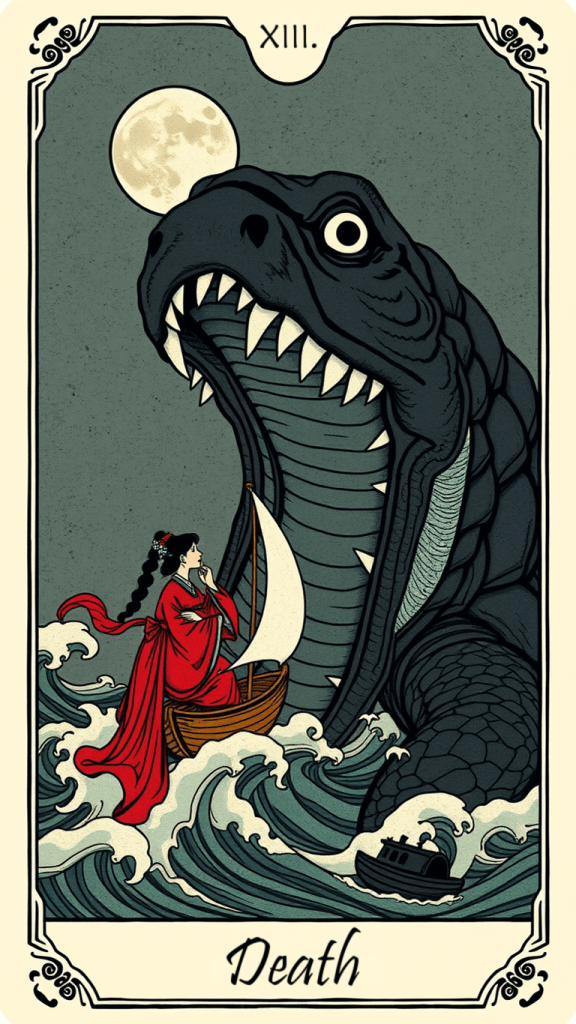

 memories of my ghost sista