Tags
Chinese translation, Jonah’s Fish, ocean mythology, poem, sea folklore, Taoist Pirate rituals, Tarot, the hanging woman, 溺水修女
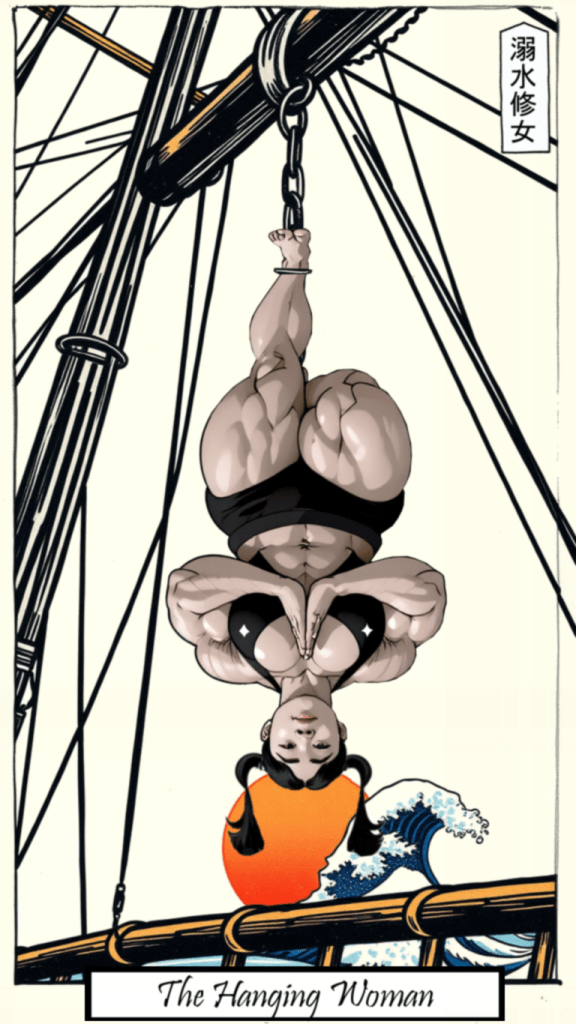
֍ The Hanged Woman – Card XII
TITLE: The Drowned Nun / 溺水修女 (Nìshuǐ xiūnǚ)
MYTHIC ARCHETYPE: The Nun Who Forgot to Drown
TAOIST PARALLEL: Tengguaiu (滕拐), a Taoist Nun, daogu (道姑), before her enlightenment—when her mortal body drowned while her soul wandered.
PIRATE TWIST: She’s suspended in a ship’s spar in contemplation, as ghost eels whisper backwards sutras in her ears.
WHY THE HANGED WOMAN? Her “punishment” is voluntary—she stays hanging upside down to unlearn breathing, preparing for xian (仙) immortality.
TAOIST PIRATE SYMBOLISM
KEYWORDS (Upright):
Fǎn hūxī (反呼吸, “reverse breathing”)—enlightenment through suffocation.
The upside-down chart (倒海圖, dào hǎi tú)—navigation by wrongness.
“Crab-walk wisdom” (蟹行智, xiè xíng zhì)—truths learned sideways.
KEYWORDS (Reversed):
Yān sǐ (淹死, “drowning death”)—resisting the lesson.
Fú píng (浮萍, “duckweed”)—surfacing too soon.
The hollow gourd (空葫蘆, kōng húlú)—failed enlightenment.
INTERPRETATION: This card is the ocean’s koan. To rise, you must first sink past thinking.
RITUAL: THE BRINE BARREL MEDITATION (鹵桶禪, Lǔ Tǒng Chán)
(Inspired by Taoist “drowning breath” practices and pirate survival trials)
PURPOSE: To surrender mental resistance through controlled drowning.
MATERIALS:
A large bowl of ice-cold saltwater.
A hollow reed or straw.
A black cloth.
A candle (blue).
STEPS:
Kneel before the bowl, light the candle. Cover your head with the cloth.
Submerge your face, breathing only through the reed. Chant underwater:
鐵拐落海,鐵骨上天,
怕死的先見閻王爺!
Iron crutch drowns, iron bones rise,
Cowards meet the Death God first!
When lungs burn, emerge but keep eyes closed. The first thing you see inside your eyelids is your true obstacle.
PARALLEL MYTHOLOGY
TITLE: The Belly of the Deep / The Prophet’s Surrender
MYTHIC ARCHETYPE: Jonah in the Belly of the Great Fish (Abrahamic Traditions)
REGION: Ancient Israel / Abrahamic Scripture (Judaism, Christianity, Islam)
TALE: God commands the prophet Jonah to go to the city of Nineveh and preach against its wickedness. Terrified and defiant, Jonah runs from his destiny. He boards a ship sailing in the opposite direction. God sends a great storm, and the sailors, realizing Jonah is the cause, cast him into the sea at his own suggestion. But he does not die. He is swallowed by a “great fish” (often depicted as a whale). For three days and three nights, he is trapped in the belly of the beast—a state of total suspension, darkness, and powerlessness. It is here, in the ultimate Hanged Man position, that he finally stops running. He prays, he surrenders his will to God’s, and he accepts his mission. The fish then vomits him onto dry land, and he goes to Nineveh, a changed man with a new perspective.
WHY THE HANGED WOMAN? Jonah’s story is the Hanged Man’s journey.
SUSPENSION: Trapped in the belly of the fish, he is utterly suspended between worlds, unable to act or escape.
NEW PERSPECTIVE: His world is literally turned upside down. Inside the dark, womb-like prison, he is forced to look inward, leading to an epiphany.
SURRENDER, NOT SACRIFICE: He doesn’t die. He lets go of his defiance. The “voluntary” part isn’t getting swallowed; it’s the act of surrender that happens inside the ordeal.
REBIRTH: He emerges from the ordeal changed and ready to fulfill the purpose he was running from.
INTERPRETATION THROUGH JONAH: This card signifies a necessary pause in your life. You may feel stuck, trapped, or powerless—like you’re in the belly of the beast. Stop fighting it. Stop running from your “Nineveh.” This is not a punishment; it is a sacred time-out. The only way forward is to surrender, let go of your stubborn plans, and look at your situation from this new, uncomfortable perspective. The insight you gain in this “darkness” will be what ultimately frees you.
THE RITUAL OF THE DARK WOMB (For Finding Surrender When Stuck)
OBJECTIVE: To stop resisting a necessary life change by voluntarily entering a symbolic “belly of the fish,” confronting your defiance, and surrendering to your path.
MATERIALS:
A small, dark, enclosed space you can sit in comfortably for a few minutes (a closet, a small bathroom with the lights off, or even under a heavy blanket).
An object that represents your “Nineveh”—the task, decision, or truth you are running from.
A glass of water.
STEPS:
THE FLIGHT AND THE STORM: Before you begin, hold your “Nineveh” object and acknowledge what you’ve been running from. Say it aloud: “I have been running from this difficult conversation” or “I have been avoiding this responsibility.”
ENTERING THE BELLY: Take your object and enter your chosen dark space. Sit down and close the door or cover yourself completely. Plunge yourself into darkness and silence. This is the belly of the fish. You are now officially “stuck.”
THE THREE BREATHS: You cannot fight your way out. You can only surrender. Take three very slow, deliberate breaths.
Breath One: Acknowledge your resistance. Feel it in your body.
Breath Two: Acknowledge your powerlessness in this moment. You cannot escape this darkness through force.
Breath Three: Let go. Release the tension of the fight.
PRAYER OF SURRENDER: Hold your “Nineveh” object in the dark. You don’t need to have a solution. You only need to change your posture from “I won’t” to “I am willing.” Whisper a simple statement of surrender. “I stop running. I am willing to face this. I surrender to the path.”
THE REBIRTH: After a few moments in this surrendered state, emerge from your dark space back into the light. You have been spit out onto the shore. Immediately drink the entire glass of water. This is an act of cleansing and returning to life.
CLOSING: Place your “Nineveh” object on your altar or somewhere you can see it. It is no longer an object of dread, but a symbol of your accepted mission. The ritual is complete.
SYNCRETIC BRIDGE
Jonah’s Fish → Dragon’s Wèi (胃, “stomach”): Both are wombs of forced enlightenment.
Three Days → Three Tides: Taoist rebirth cycles follow moon-pulled waters.
THE “SCHOLAR’S HEART” MANDATE:
Sources: The primary source is The Book of Jonah in the Hebrew Bible (the Tanakh). The story is also recounted in the New Testament and holds a significant place in the Quran, where the prophet is known as Yunus. For the ritual, see: “Drowning Boxing” (溺水拳, Nìshuǐ Quán)—a lost martial art practiced the dead on shipwreck survivors.
 memories of my ghost sista