
Tags
Chinese translation, 盲潮翁, ocean mythology, Poetry, sea folklore, Taoist Pirate rituals, Tarot, the hermit, Umibōzu
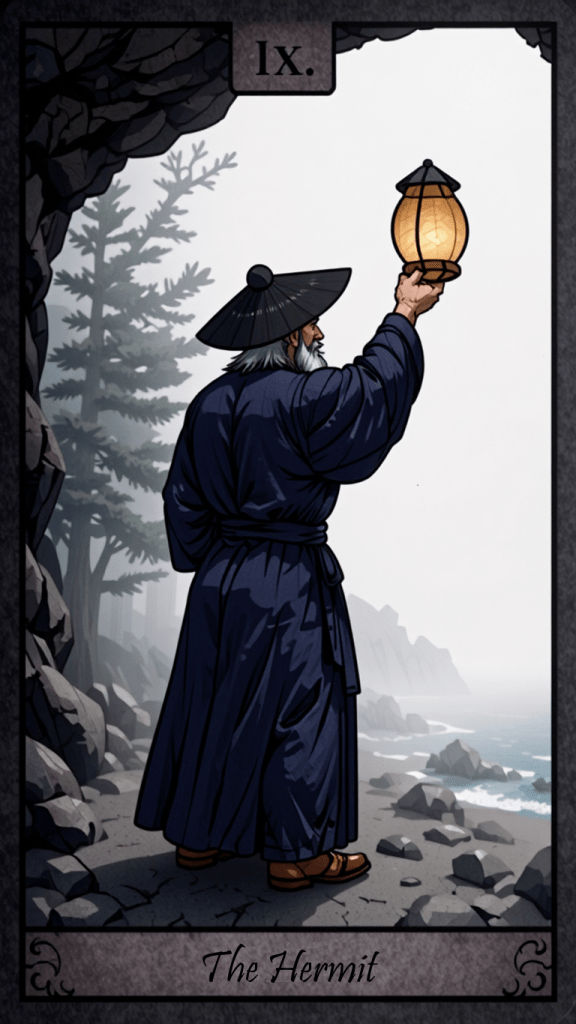
֍ The Hermit – Card IX
TITLE: The Blind Tide-Reader / 盲潮翁 (Máng Cháo Wēng)
MYTHIC ARCHETYPE: The Pirate Who Forgot His Name
TAOIST PARALLEL: Xu Fu (徐福), the alchemist sent by Qin Shi Huang to find immortality, lost at sea—merged with Zhuangzi’s Old Fisherman who knew the Way of tides.
PIRATE TWIST: He’s not just a hermit—he’s the admiral of a ghost fleet that sails in circles, forever seeking Penglai (蓬萊). His eyes were burned white by staring into the Black Tide Mirror (黑潮鏡, hēi cháo jìng) too long.
WHY THE HERMIT? He embodies wúwéi (無為) as driftwood—not seeking, but being sought by truth.
TAOIST PIRATE SYMBOLISM
KEYWORDS (Upright):
Cháo yīn (潮音, “tide-sound”)—hearing wisdom in wave patterns.
The forgotten compass (忘羅盤, wàng luópán)—navigation by soul, not stars.
“Crab-script” (蟹書, xiè shū)—reading truths in sand-writing.
KEYWORDS (Reversed):
Hǎi wàng (海忘, “sea-amnesia”)—lost in endless searching.
A salted tongue (鹹舌, xián shé)—wisdom that cannot be spoken.
The moonless ledger (無月賬, wú yuè zhàng)—records eaten by tides.
INTERPRETATION: This card is the lantern that blinds. The Tide-Reader’s light doesn’t guide—it reveals how lost you’ve always been.
RITUAL: THE BLACK TIDE MIRROR (黑潮鏡, Hēi Cháo Jìng)
(Inspired by Taoist dark meditation and Fujianese “shadow navigation”)
PURPOSE: To confront the self by becoming the abyss.
MATERIALS:
A black lacquer bowl (or ink-darkened water).
Three pinches of ashes (from incense or burnt paper).
A single iron nail (to “anchor” the vision).
A candle (white, to extinguish).
STEPS:
At midnight, place the bowl on a low table. Stir ashes into the water.
Press the nail into the table’s edge, chanting:
将潮水钉在沙滩上,将灵魂钉在大海上—你早已失去了你所追求的东西。
Nail the tide to the beach, nail your soul to the sea – you have already lost what you seek.
Light the candle, stare into the black water until the flame’s reflection drowns.
Blow out the candle. Sit in darkness until your breath matches the tide’s pull.
PARALLEL MYTHOLOGY
TITLE: The Monk of the Abyss / The Silence That Knows
MYTHIC ARCHETYPE: The Umibōzu (Japanese Yōkai)
REGION: Japan
FORM: A massive, shadowy, humanoid spirit that rises from the depths on calm nights. Its name translates to “sea monk,” as its head is large, round, and smooth like the shaven head of a Buddhist monk.
TALE: The Umibōzu is not a chatty oracle. It is a presence. It rises from a placid sea, a sudden, dark embodiment of the terrifying mystery and depth hidden just beneath the surface. It can be destructive if angered or disrespected, but its primary function in folklore is to be a figure of profound, awe-inspiring dread and mystery. To encounter the Umibōzu is to come face-to-face with the vast, unknowable soul of the ocean itself.
WHY THE HERMIT? The Hermit’s journey is a descent into the self. The Umibōzu is the personification of that deep, dark, silent inner space. It represents the intimidating but necessary step of confronting the vast unknown within. The wisdom it offers isn’t in words, but in the silence it commands. It forces a complete halt to the external journey, compelling the sailor (the seeker) to look into the abyss. It is the ultimate symbol of soul-searching and the profound truths found only in deep, contemplative solitude.
INTERPRETATION THROUGH THE UMIBŌZU: This card calls you to a profound retreat. It is time to turn off all external noise and face the silent, deep waters of your own consciousness. Like a sailor on a calm sea at midnight who suddenly sees the Umibōzu rise, you are being asked to stop everything and simply be with the immense mystery of your own being. It may be daunting, but the greatest wisdom you seek is not outside of you; it is waiting in your own personal abyss.
THE RITUAL OF THE DARK WATER LANTERN (For Seeking Inner Truth)
OBJECTIVE: To receive wisdom from your deepest subconscious by creating a space of absolute stillness and darkness, and listening to the silence.
MATERIALS:
A black or very dark-colored bowl.
Water.
A few drops of black ink or food coloring (optional, but effective).
One single candle (white or blue).
A room that can be made completely dark and silent.
STEPS:
CREATING THE ABYSS: In your darkened room, place the bowl before you. Fill it with water. If using ink, add a few drops until the water is an opaque, black mirror. This is the calm, midnight sea.
Lighting the Lantern: Light the single candle and place it beside the bowl. This is your Hermit’s lantern, the only light in the vast darkness. Turn off all other lights.
THE DESCENT: Sit in the silence. Stare softly at the reflection of the single flame on the surface of the black water. Breathe slowly, deeply. Let the silence of the room expand until it feels like the crushing, profound silence of the deep ocean. You are the lone sailor. The black water is your soul.
THE QUESTION: Whisper a single, deep question to the water. Do not ask “what should I do?” Ask “What wisdom do I need?” or “What truth am I avoiding?” Release the question into the deep.
THE VIGIL: Now, you listen. Do not expect a booming voice. The Umibōzu does not speak. Its wisdom rises from the quiet. Let your mind go still. An answer may come as a new feeling, a single word that surfaces in your mind, a forgotten memory, or a sudden, quiet understanding. You are not looking for an answer; you are creating the silence in which the answer that is already there can finally be heard.
THE RETURN: When you feel the vigil is complete, bow your head to the bowl in gratitude. Gently blow out the candle, plunging the room into total darkness for a moment. Acknowledge the abyss. Then, turn on the lights. Immediately write down any thoughts, feelings, or words that came to you in your journal.
SYNCRETIC BRIDGE
Umibōzu’s Silence → Taoist Mòzhì (默知, “silent knowing”) Both reject language for direct experience.
Black Water → Xuánmíng (玄冥, “dark profound”) The primordial sea before creation in Zhuangzi.
THE “SCHOLAR’S HEART” MANDATE:
Sources: The Umibōzu is a well-known yōkai in Japanese folklore. See: Toriyama Sekien’s Gazu Hyakki Yagyō and modern scholarly works on Japanese folklore, Michael Dylan Foster’s The Book of Yōkai: Mysterious Creatures of Japanese Folklore. For the ritual see:《東南海龍王經》(Scripture of the Southeast Dragon Kings), 1783 (Zhenjiang Taoist Temple Archive, Jiangsu).
 memories of my ghost sista