Tags
Chinese translation, 陰船港主, hierophant, ocean mythology, sea folklore, Taoist Pirate rituals, Tarot, Yīn Chuán Gǎng Zhǔ
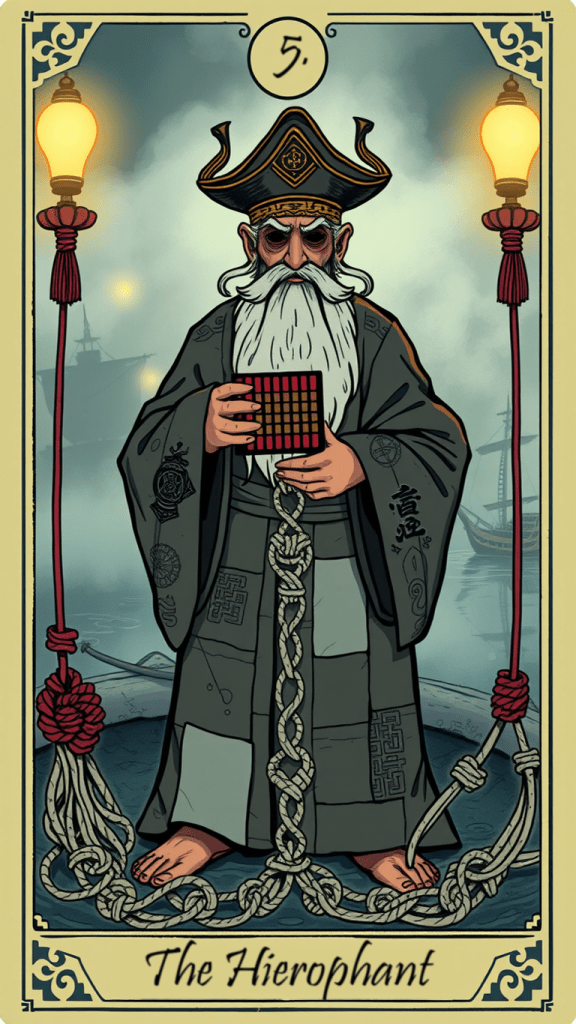
🜄 THE HIEROPHANT – Card V
TITLE: The Ghost Fleet’s Harbormaster / 陰船港主 (Yīn Chuán Gǎng Zhǔ)
MYTHIC ARCHETYPE: The Pirate Monk of the Nine Dragon Sea
TAOIST PARALLEL: Mazu’s Blind Harbormaster, a legendary figure who navigated ships by listening to qi (聽氣, tīng qì), merged with Zhu Bajie (豬八戒)—the oath-breaking, gluttonous monk from Journey to the West, reformed into a sea-priest of penitence.
PIRATE TWIST: He’s the keeper of the Jianghu Code (江湖規矩, jiānghú guīju), a former pirate who lost his eyes to a Dragon King’s curse for breaking an oath. Now he guides ships through fog-locked spirit ports, enforcing sacred pirate laws with a whalebone abacus that calculates karma.
WHY THE HIEROPHANT? He doesn’t preach—he arbitrates. His temple is a floating shrine-junk where warring captains kneel to settle disputes. He teaches that even thieves must honor the tide’s contract.
TAOIST PIRATE SYMBOLISM
KEYWORDS (Upright):
Hǎi shén pàn (海神判, “Sea God’s Verdict”)—fair judgment.
“Blood ink vows” (血墨誓, xuě mò shì)—oaths signed with cutlass scars.
The abacus of debts (算賬, suànzhàng)—karma tallied wave by wave.
KEYWORDS (Reversed):
A cut rope (斷索, duàn suǒ)—betrayal at sea.
“Blind fish” (盲魚, máng yú)—willful ignorance of tradition.
The cursed ledger (厄賬本, è zhàngběn)—unpaid spiritual debts.
INTERPRETATION: This card is the law of the outlaw. The Harbormaster knows even pirates need rules—or the sea swallows all.
RITUAL: THE TIDE-TIED OATH (潮綁誓, Cháo Bǎng Shì)
(Inspired by Ming pirate blood pacts and Daoist knot magic)
PURPOSE: To seal a sacred vow with the weight of the sea.
MATERIALS:
A length of seaweed (or hemp rope soaked in saltwater).
Two coins (one copper, one silver).
Your own blood (or red ink).
A candle (blue or white).
STEPS:
Knot the seaweed into a figure-eight (∞), chanting:
东潮宣誓,西潮束缚——
血与盐使契约磨砺。
The East Tide swore, the West Tide bound——
Blood and salt sharpens the pact.
Rub the coins with blood/ink, press them into the knots.
Burn one knot (for heaven’s record), sink the other (for the sea’s memory).
PARALLEL MYTHOLOGY
TITLE: The Oath-Keeper of the Tides / The Bridge Between Shores
MYTHIC ARCHETYPE: Njörðr (Norse God of the Sea and Sacred Oaths)
REGION: Scandinavia (Pre-Christian Norse Tradition)
FORM: A member of the Vanir gods, associated with the sea, seafaring, wind, fishing, wealth, and fertility of the coasts.
TALE: Njörðr’s most defining story comes at the end of the devastating Aesir-Vanir War. To secure a lasting peace, the two tribes of gods exchanged hostages. Njörðr, along with his children Freyr and Freyja, went to live with the Aesir in Asgard. He became a highly respected priest-king, presiding over religious festivals and sacred oaths. He is the living embodiment of a peace treaty, the bridge between two different cultures and traditions, who brings peace and prosperity through this sacred pact.
WHY THE HIEROPHANT? Njörðr is the Pontifex. He is the bridge. His entire existence in the main Norse myths is predicated on being the cornerstone of a sacred social structure (the peace treaty). He teaches that harmony and bounty (the wealth of the sea) come from honoring tradition, keeping one’s word, and integrating different belief systems. His story isn’t one of wild magic, but of diplomacy, community, and established ritual.
INTERPRETATION THROUGH NJÖRÐR: To draw this card is to be asked what oaths you have made—to others, and to yourself. It is a call to be a peace-broker in your own life. It signifies a time for learning from a trusted institution or mentor, one who can bridge your current world with a new one. Njörðr teaches that the greatest wealth is found not in lonely rebellion, but in the trust and structure that binds a community together.
RITUAL OF THE SALT AND SOIL PACT (For Making a Sacred Vow)
OBJECTIVE: To make a binding, sacred agreement, either with yourself (to commit to a path) or with another person (to seal a partnership or peace). This ritual establishes a formal structure of trust.
MATERIALS:
A cord or rope, about a foot long.
Two small bowls.
A spoonful of salt (or saltwater). This represents Njörðr’s domain: the Sea.
A spoonful of soil. This represents the other party, or the “land” of your current life.
AN OFFERING: Mead, ale, good quality beer, or honeyed water. Njörðr is a god of prosperity and festivals; he appreciates a good drink.
STEPS:
PREPARATION: Place the two bowls before you. Pour the offering into a cup. Clearly state the pact you intend to make. Write it down if you need to. Be precise. Example: “I make a sacred pact with myself to dedicate one hour every day to my craft, without excuse.”
THE INVOCATION: Hold the cup with the offering. Address the spirit of the ritual. “Njörðr, Oath-Keeper, Bridge Between Shores, you who secured peace with your presence, I call upon you to witness this sacred pact. Be the guardian of this vow.” Pour a small amount of the offering onto the ground or into a separate offering bowl.
ACKNOWLEDGING THE TWO SIDES: Place the salt in one bowl and the soil in the other. Touch the salt. “This is the Sea, the new world, the promise I am making.” Touch the soil. “This is the Land, my current self, the foundation upon which this promise is built.”
BINDING THE VOW: Take the cord. As you state your vow clearly and firmly one more time, tie a single, tight knot in the center of the cord. As you pull it tight, feel the commitment solidifying. This knot is the physical manifestation of your oath.
SEALING THE PACT: Take a pinch of the salt and a pinch of the soil and place them together in the palm of your hand. Mix them together. This symbolizes the joining of the two worlds, the peace treaty being sealed. Say: “As sea and land meet at the shore, so are these two sides joined. The pact is made.”
CLOSING: Drink from your offering cup. Keep the knotted cord on your altar, in your pocket, or tied to your wrist as a constant, physical reminder of your vow. The ritual is complete, and the pact is now witnessed.
SYNCRETIC BRIDGE
Njörðr’s Oaths → Pirate Xuèméng (血盟, “blood alliances”): Both bind land and sea through ritual.
Peace Treaty → Hǎi jìng (海靖, “sea pacification”): Ming emperors used pirate warlords as naval peacekeepers.
THE “SCHOLAR’S HEART” MANDATE:
Sources: The Poetic Edda (specifically the poems Vafþrúðnismál and Lokasenna) and Snorri Sturluson’s Prose Edda (in the Gylfaginning and Skáldskaparmál sections). These texts clearly lay out his role as a hostage, a peace-keeper, and a god of wealth. For the ritual see: 《海盗陰陽術》 (Pirate Yin-Yang Arts), 1796, and Quanzhou’s Maritime Trade Laws—12th-century pirate codes enforced by Mazu’s priestesses.
 memories of my ghost sista