Tags
adults are bastards, death of tinker bell, J. M. Barrie, loss of innocence, the boy who never grew up, the problem with nostalgia


Michael believed longer than the other boys, though they jeered at him; so he was with Wendy when Peter came for her at the end of the first year. She flew away with Peter in the frock she had woven from leaves and berries in the Neverland, and her one fear was that he might notice how short it had become; but he never noticed, he had so much to say about himself.
She had looked forward to thrilling talks with him about old times, but new adventures had crowded the old ones from his mind.
“Who is Captain Hook?” he asked with interest when she spoke of the arch enemy.
“Don’t you remember,” she asked, amazed, “how you killed him and saved all our lives?”
“I forget them after I kill them,” he replied carelessly.
When she expressed a doubtful hope that Tinker Bell would be glad to see her he said, “Who is Tinker Bell?”
“O Peter,” she said, shocked; but even when she explained he could not remember.
“There are such a lot of them,” he said. “I expect she is no more.”
I expect he was right, for fairies don’t live long, but they are so little that a short time seems a good while to them.
Wendy was pained too to find that the past year was but as yesterday to Peter; it had seemed such a long year of waiting to her. But he was exactly as fascinating as ever, and they had a lovely spring cleaning in the little house on the tree tops.
Next year he did not come for her. She waited in a new frock because the old one simply would not meet; but he never came.
“Perhaps he is ill,” Michael said.
“You know he is never ill.”
Michael came close to her and whispered, with a shiver, “Perhaps there is no such person, Wendy!” and then Wendy would have cried if Michael had not been crying.
— from CHAPTER 17: When Wendy Grew Up.
][][
We desperately want to believe that nostalgia wins out in the end; that we won’t be forgotten when we’re gone. That even when we grow up there are still child-like spirits out in the world who will remember us as we once were before everything changed – be it puberty, a fall from faith or even death. This is reflected, especially in the later half of the 20th century, in the stories we told children: there is no death, if bad things happen it won’t be to you, we are all our own special snowflake.
If anyone ever tells you that J. M. Barrie’s story about the boy who refused to grow up is anything other than nihilistic horror then they have either only watched the sanitized Disney version or got their hands on a much later, American edition of the book that edited out the last chapter for, as the publishers pointed out, it was far too “dark” and dealt with “adult themes” that “[American] children are entirely unable to contemplate.” I have no idea if that is true, but I do know that this obsession by adults to shield children from the world is deeply rooted in Victorian values, where children weren’t seen as their own person but rather an extension of adult fears and superstitions.
Adults often try to second-guess when childhood ends and adulthood begins. For most of human history it was when the body became sexually able to sire and conceive the next generation. Then the modern world removed the sexual aspect from the question (for reasons entirely non-biological) and invented Psychology so that the line between childhood and adulthood would become much more murkier.
I say adulthood begins when the whole concept of nostalgia is finally embraced — that act of looking back with longing, that inability to live purely in the present. I am not the first to point out that childhood has no word for a better past or a frightening future. It is the here and now that childhood can only exist in and it’s only when we develop the cognitive ability to realize our impermanence that we begin to long for things as they once were. Nostalgia is adulthood, which is why many children stories, especially the ones where the protagonist, at the end, must make the choice of staying in Neverland or growing up, were never written for children. They’re written for adults mourning their own childhood. No child will ever end a story by deciding whether to stay or go. Why would they? That experience has yet to happen. The closest thing adults have to this is the endless debate over death. Every religion and branch of science has their theories, but they are just that – ideas, hopes and fears. And yet, like the child’s inability to grasp what comes next until it has happened, adults too must wait, patiently, for something our developing minds can’t even grasp.
I am, like everyone else, a product of my environment. I grew up having my mother read classics of children literature: Where the Red Fern Grows, The Lion, The Witch and the Wardrobe, Old Yeller, Where the Wild Things Are, The Giving Tree and Peter Pan. The theme that runs through all of these works is that the adult author introduces the loss of innocence in such a way that any child who wishes to travel to Neverland must also be faced with the concept that they must make a life-altering change that will forever bar them from re-entering paradise. Why did Sesame Street kill off Mr. Snuffleupagus? Because adults complained that children shouldn’t have imaginary friends. How does Sarah escape the Goblin King, Jareth, in the movie Labyrinth? When she realizes he is simply a story with no power over her. Very simply put: adults are bitter about childhood and almost every book written for children (see: every title that has won a Caldecott or Newbery book award) reflects this.
The issue that I have is the same issue I have with the whole “knowledge = fall from grace” cliche that is found everywhere in Western culture – from the Adam and Eve story to the Norse god Oden giving up his eye to attain wisdom to Max giving up his role as King of the Wild Things to return home for dinner. This concept is so ingrained into our belief system that there is no alternative.
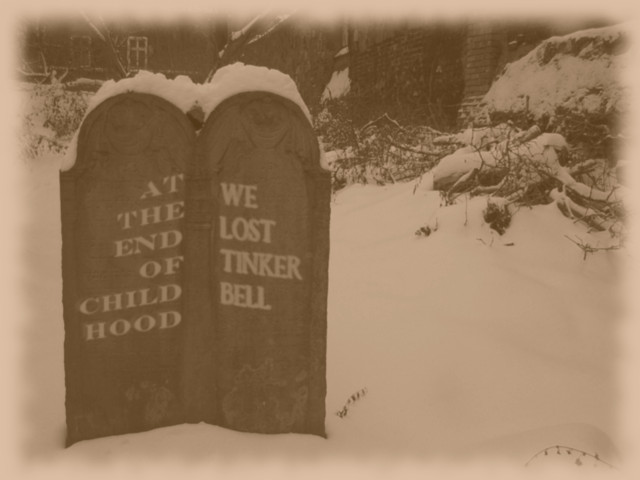
This is my definition of nihilism; that there is an Eden-like childhood in all of us and that we all, without exception, will be cast out from it. What a terribly bleak way to live and yet Christianity offers no alternative. It’s also why J. M. Barrie’s story is so frustrating. The last chapter was added on during one of his re-writes of the story. He had created the Garden without the Fall but later decided to burn it to the ground: we find that Tinkerbell had died and not only did Pan forget who she was but even his time spent with Captain Hook had never really happened. The Lost Boys were found and immediately (we are told in less than a year) turned their backs on Neverland. Wendy grows old and dies but Peter keeps returning, stealing first her daughter and then granddaughter, but always abandoning them once they reached a certain age. When Wendy Grew Up is bizarrely cynical for it attempts to say that there are monsters in this world, but they are the children who remain in a state of stagnant innocence.
For you and me, tonight, dear one, I will say a prayer on Tinkerbell’s grave.
 memories of my ghost sista