Tags
The myth of the self-made man is just that, a myth. Nothing is done in a vacuum and in order for us to learn we need others who will teach us. The High Priestess is our first opportunity to do just that on our journey. If the Shaman’s role was to gather the tools she needs to find the answers to her question, then the High Priestess will be the one who’ll show us how to use those tools.
In the Rider-Waite deck the figure in the card has an alternative name, the Popess, supposedly named after Pope Joan, a legendary woman in drag who fooled the Church for years and only was found out when she gave birth during Mass (somewhere, Leslie Feinberg, author of Stone Butch Blues, is rolling her eyes). Dressed in her blue, white and black colors, her cross and veils, the figure could also pass as a Mother Superior with little difficulty. She wears the moon crown of the great goddess Isis on her head and behind her swirl pomegranates and black and white lotuses, symbols of ancient female power. Finally, she sits between two pillars. One with a J inscribed on it while the other has a B, which curious because ancient Latin didn’t have the letter J in it for a very long time, it was only added much later to help in translating. Perhaps they are there to give Tarot scholars something to bicker about. A lot of bickering seems to go on between people who feel they are knowledgeable about the art. Arcane lore is a lot of things but it shouldn’t be a source of migraines after listening to certain people.
A lot of Tarot books and guides suggest meditation as the all-purpose fall back when confronted with questions you don’t immediately understand. If that were really the case there would be no point in using these cards at all, but I find Tarot allows me to look at my question in different ways, depending on the cards selected and how they are placed in the spread. The sort of linear thinking meditation produces rarely takes me anywhere outside of realizing time is a precious commodity and that serenity bugs the hell out of me. This is why the High Priestess isn’t seen sitting in a yoga position, blissfully smiling at eternity. In her hands she holds a scroll (in some cards it is a book) with the word “Tora” on it (perhaps a reference to the Tarot itself or the Jewish Torah) for one does not become a keeper of secrets lightly, it’s painful hard work. If pomegranates are a symbol for anything, they are to remind us of the Greek myth of Persephone, who went down into the land of the dead, Hell, and ate of its fruit. That sort of knowledge doesn’t come lightly, usually at a great cost to the wisdom seeker. The High Priestess doesn’t smile. She isn’t glad you are here. What she’s glad about, though, is that you are willing to be open enough to listen to what she has to say. You are willing to hear other’s wisdom. That is the key to this card: once you are willing to be open to answers they will come. It’s only when we close ourselves off — because of arrogance or pride or ignorance — that we find we are blind to what we are seeking. At that point no amount of esoteric knowledge will save you.
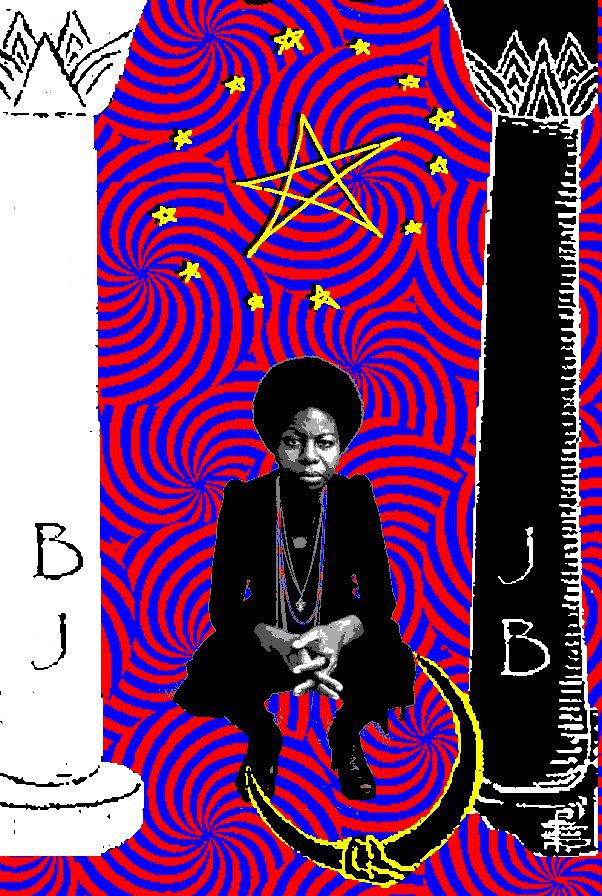
Last night I was having difficulty seeing this card in my head. I wanted a keeper of knowledge — historical knowledge, erotic knowledge, secret knowledge, self-knowledge — but she couldn’t obviously be dressed up like a nun (perhaps a leather nun) since any patriarchal religion that hates sex as much as the Catholic Church does won’t be the ones I’d turn to looking for my answers. It’d be like going to ask George Wallace, former pro-segregation Governor of Alabama during the Civil Rights movement, questions about morality. Sure, you’ll get answers, but nothing you can use. Then it all came together — who is known as the High Priestess? Obviously, Nina Simone.
“The High Priestess of Jazz,” as she was know, Simone was an African-American singer, songwriter, pianist, arranger and civil rights activist, whose first musical love was the works of Johann Sebastian Bach (fugues rock!). Here we have Nina at the height of her powers, during her Sinnerman-period. The terrible knowledge she possessed to be able to write a song like “Mississippi Goddam” (her response to the brutal murder of Medgar Evens and the church bombing in Birmingham, Alabama, where she sings, “Alabama’s got me so upset, Tennessee’s made me lose my rest, and everybody knows about Mississippi-goddam!” — if that’s not eating from the fruits of Hell, what is?) makes her exactly the person we all need to sit at the feet of. In front of her rests a black crescent moon bound by golden thread, while a crown of stars circles her head. As for the letters on the pillars, I’ve heard that in the Rider-Waite deck the B stands for Boaz, signifying ending, while the J stands for Jachin, meaning a beginning. Frankly, that’s just one interpretation, and really not all that interesting to me. We’ll let BJ stand for whatever you’d like it to be.
 memories of my ghost sista